


Abstract
While high-intensity interval training (HIIT) enhances physical conditioning, its specific impact on the TMG-derived mechanical properties of rowing-related muscles and sport-specific performance remains underexplored. This study investigated the effects of a 4-week rowing ergometer-based HIIT intervention on 2000-m rowing performance and muscle mechanical properties, evaluated via tensiomyography (TMG). Seventeen rowers were randomized into the HIIT group (n = 9) or the control group (CON, n = 8). Over four weeks, the HIIT group completed two weekly rowing ergometer HIIT sessions (ten 60-s all-out sprints, 30-s recovery), while the CON group continued regular training without additional HIIT. Pre- and post-intervention, participants underwent a 2000-m ergometer trial and TMG assessments across five rowing-related muscles. The HIIT group demonstrated a 3.1% reduction in 2000-m completion time, together with increases in mean power output (7.7%) and stroke rate (6.5%) (group × time interaction η2p = 0.53, 0.39, and 0.27, respectively; p < 0.05). TMG analysis showed shortened delay time (Td) and half-relaxation time (Tr) across all targeted muscles after false discovery rate correction. Contraction time (Tc) was shortened in the tibialis anterior and vastus medialis, while the erector spinae showed a nominal uncorrected change that should be interpreted cautiously. Maximal displacement (Dm) and sustain time (Ts) remained unchanged. These findings suggest that short-term rowing-specific HIIT is associated with improved 2000-m performance and TMG-derived peripheral temporal properties; however, unchanged Dm should be interpreted only as no detectable change in radial displacement under the present TMG conditions rather than definitive evidence of unchanged muscle stiffness. Because of the small sample size, unbalanced total training load between groups, and the absence of direct physiological or biomechanical measurements such as VO2max, lactate, electromyography, and stroke biomechanics, these findings should be interpreted as preliminary.
1. Introduction
Rowing is a high-intensity, rhythmically structured, and highly coordinated whole-body cyclic sport. The official race distance is 2000 m, during which athletes must sustain high power output over several minutes while repeatedly coordinating leg drive, trunk-mediated force transfer, and upper-limb pulling. From an energetic perspective, 2000-m rowing relies predominantly on aerobic metabolism, with a substantial anaerobic contribution during the start, power bursts, and final sprint [1,2]. Therefore, rowing performance depends not only on cardiorespiratory capacity but also on the ability to generate, transfer, and sustain force efficiently across repeated stroke cycles.
Biomechanically, rowing performance is determined by the integrated interaction among aerobic capacity, anaerobic power, rate of force development, neuromuscular coordination, and technical efficiency [3,4,5]. The lower limbs generate the majority of propulsive force, the trunk transfers force through the kinetic chain, and the upper limbs transmit force to the handle or oar blade. Any impairment in force transmission, contraction–relaxation timing, or stroke rhythm may reduce rowing efficiency and accelerate fatigue development. Previous studies have also shown that muscle morphology and mechanical characteristics of rowing-related muscles, particularly the knee extensors, are associated with rowing ergometer performance, sprint ability, and endurance capacity [6,7]. These findings indicate that rowing performance should be evaluated not only by gross performance outcomes but also by the mechanical behavior of key muscles involved in the rowing kinetic chain.
High-intensity interval training (HIIT) is widely used as a time-efficient strategy to improve endurance performance and high-intensity exercise capacity. By alternating repeated bouts of high-intensity work with short recovery periods, HIIT can stimulate both central and peripheral adaptations, including oxygen delivery, oxygen utilization, glycolytic capacity, buffering capacity, and neuromuscular function [8,9,10]. In rowing, short-term HIIT has been shown to produce meaningful improvements in sport-specific performance. Driller et al. [11] reported that 4 weeks of HIIT improved 2000-m rowing ergometer performance and relative VO2peak in well-trained rowers, while Turner et al. [12] showed that short-term high-intensity training improved 2000-m performance in national-level rowers. However, most previous studies have focused primarily on performance outcomes, cardiorespiratory fitness, metabolic responses, or internal training load. Whether short-term HIIT induces measurable changes in the muscle mechanical properties of multiple rowing-related muscles remains unclear.
Tensiomyography (TMG) is a non-invasive method for assessing skeletal muscle mechanical properties by measuring the radial displacement–time curve of the muscle belly in response to a single electrical stimulus. Commonly used TMG parameters include delay time (Td), contraction time (Tc), half-relaxation time (Tr), maximal displacement (Dm), and sustain time (Ts). These parameters provide information regarding muscle mechanical response, contraction speed, relaxation efficiency, and stiffness-related properties [13,14]. Methodological studies have reported good reliability for several TMG-derived parameters, particularly Td, Tc, and Dm, although parameter interpretation should consider muscle type, measurement standardization, and fatigue status [15,16,17]. Importantly, TMG does not directly measure voluntary neural drive, motor-unit recruitment, dynamic muscle activation, or rowing-specific muscle coordination. Therefore, TMG-derived parameters should be interpreted as complementary indicators of resting peripheral mechanical responses rather than direct evidence of specific central neuromuscular mechanisms. Because rowing requires repeated cyclic contractions and coordinated force transfer among the lower limbs, trunk, and upper limbs, a multi-muscle TMG approach may provide useful information beyond traditional performance testing.
Despite growing interest in TMG as a monitoring tool, few studies have examined whether short-term HIIT modifies TMG-derived peripheral muscle mechanical properties across multiple muscles involved in the rowing kinetic chain. This represents a relevant gap because previous rowing HIIT studies have mainly focused on performance, VO2peak, metabolic responses, or training load, whereas less is known about how electrically evoked mechanical temporal responses change in muscles that contribute to lower-limb drive, trunk force transfer, ankle control, and upper-limb pulling. Therefore, the present study aimed to investigate the effects of a 4-week rowing ergometer-based HIIT intervention on 2000-m rowing performance and TMG-derived muscle mechanical properties in rowers. TMG was used to assess five functionally relevant muscles: the deltoid, erector spinae, latissimus dorsi, tibialis anterior, and vastus medialis. These muscles were selected to represent major components of the rowing kinetic chain, including upper-limb force transmission, trunk stabilization, pulling mechanics, ankle positioning, and knee extension during the drive phase. We hypothesized that, compared with regular training, rowing-specific HIIT would improve 2000-m performance and induce favorable changes in TMG-derived temporal parameters, particularly shorter Td, Tc, and Tr, while displacement-related parameters such as Dm and Ts would remain relatively stable.
2. Materials and Methods
2.1. Participants
Seventeen rowers were recruited for this study and randomly assigned to either a high-intensity interval training group (HIIT, n = 9) or a control group (CON, n = 8). The age, height, and body mass of the HIIT group were 18.33 ± 2.54 years, 175.33 ± 5.42 cm, and 69.96 ± 9.55 kg, respectively. The corresponding values for the CON group were 20.25 ± 3.73 years, 173.88 ± 3.18 cm, and 75.99 ± 4.72 kg, respectively.
All participants were recruited from the available rowing team cohort and were engaged in regular rowing training. The finalized anonymized analytical dataset included age, height, body mass, skeletal muscle mass, body fat percentage, BMI, 2000-m rowing performance, and TMG variables. Detailed sex distribution, competitive level, rowing experience, and habitual training volume were not available in a complete format for quantitative analysis; this limitation has been acknowledged in the revised manuscript.
All participants were apparently healthy rowers, with no known cardiovascular or neuromuscular diseases. Participants were excluded if they had experienced any injury within the previous 6 months that could affect exercise performance or interfere with the training intervention and testing procedures. Before participation, all participants were informed of the study purpose, experimental procedures, potential risks, and benefits, and written informed consent was obtained. This study was approved by the Institutional Review Board of National Taiwan Sport University (approval number: NTSUIRB-114-042).
2.2. Study Design
This study adopted a randomized, parallel-group, pretest–posttest intervention design with a 4-week intervention period. Participants were randomly allocated to the HIIT or CON group. The HIIT group completed an additional rowing ergometer-based HIIT program twice per week for 4 weeks, whereas the CON group maintained their regular rowing training without additional HIIT sessions.
The primary outcomes, including 2000-m rowing ergometer performance and TMG-derived muscle mechanical properties, were assessed before and after the 4-week intervention. Pre-intervention testing was performed within 1 week before the start of the intervention, and post-intervention testing was conducted 48–72 h after the final training session to minimize the influence of acute fatigue. To reduce the effects of circadian variation, pre- and post-intervention assessments were scheduled at the same time of day for each participant, within approximately ±1 h.
Body composition was assessed at baseline only to characterize participants’ physical status and to examine whether pre-existing differences in body mass, skeletal muscle mass, body fat percentage, or body mass index might have influenced performance-related outcomes. Body composition was not used as a longitudinal outcome variable in the present study.
2.3. Experimental Procedures
Participants were instructed to avoid strenuous exercise for 24 h, caffeine and high-dose nutritional supplements for 12 h, and alcohol consumption for 24 h before each testing session. On arrival at the testing site, participants’ basic information and recent injury history were confirmed.
At baseline, participants underwent body composition assessment using bioelectrical impedance analysis. For the rowing performance test, participants first completed a standardized 10–20 min warm-up and then performed a 2000-m rowing ergometer test. At least 48 h after the rowing performance test, participants underwent TMG measurement. During TMG assessment, the muscles were measured in a fixed order, recommended as tibialis anterior, vastus medialis, erector spinae, latissimus dorsi, and deltoid. A rest interval of approximately 60–90 s was provided between muscles. To reduce inter-rater variability, all TMG measurements were performed by the same trained investigator.
If a TMG signal showed a double peak, excessive noise, or an unstable curve, the measurement was discarded and immediately repeated. If acceptable curves could not be obtained after repeated attempts, the value for that muscle was recorded as missing. If participants reported pain, dizziness, cramping, or any discomfort during testing, the procedure was immediately stopped, and additional rest or rescheduling was provided when necessary.
2.4. HIIT Intervention
The HIIT intervention was designed according to the sport-specific demands of rowing. The intervention was conducted over 4 weeks, from February 23 to 22 March 2026, and consisted of eight HIIT sessions in total. The HIIT group performed two HIIT sessions per week, with at least 48 h between sessions.
Each HIIT session was performed on a rowing ergometer (Model E, Concept2 Inc., Morrisville, VT, USA). Before each session, participants completed 10–15 min of warm-up, including dynamic stretching and rowing-specific preparation. The main HIIT protocol consisted of ten repeated bouts of 60-s all-out rowing sprints, with 30 s of passive or low-intensity recovery between bouts. After the HIIT session, participants completed a 5–10 min cool-down.
The structure of each HIIT session was as follows:
- -
- Warm-up: 10–15 min.
- -
- Main set: 60 s all-out rowing sprint/30 s recovery × 10 sets.
- -
- Cool-down: 5–10 min.
- -
- Frequency: 2 sessions/week.
- -
- Duration: 4 weeks.
- -
- Total HIIT sessions: 8.
Training adherence and session quality were monitored throughout the intervention. Completion of the prescribed ten intervals and any adverse symptoms were recorded for each HIIT session. Although session power output and RPE were used operationally to guide training quality, complete participant-level intervention monitoring records for mean power output, peak power output, and RPE were not available in a format suitable for formal statistical reporting. Therefore, these variables were not analyzed as formal outcomes and this limitation has been acknowledged.
Both groups continued their regular team training program during the 4-week period. The regular program included on-water rowing or rowing-specific technical training, strength training, and recovery activities. The additional HIIT stimulus was applied only to the HIIT group. Because detailed numerical training-load variables for the regular team training sessions were not available for all participants, the total training dose could not be strictly matched between groups. Therefore, the intervention contrast should be interpreted as the effect of adding rowing ergometer-based HIIT to regular training rather than the isolated effect of HIIT under matched total training load.
2.5. 2000-m Rowing Ergometer Test
Sport-specific rowing performance was assessed using a 2000-m rowing ergometer test on a Concept2 Model E rowing ergometer (Concept2, Morrisville, VT, USA). Before the test, participants completed a standardized 10–20 min warm-up. Participants were instructed to complete the 2000-m time trial as fast as possible. The drag factor or resistance setting was allowed to be selected according to each participant’s preferred setting and was kept consistent between pre- and post-intervention testing.
Performance variables were obtained directly from the ergometer monitor after completion of the test. The primary rowing performance outcomes included total completion time, mean power output, and stroke rate. Heart rate responses during the test were monitored using a Polar H10 heart rate monitor (Polar Electro Oy, Kempele, Finland).
2.6. Body Composition Assessment
Baseline body composition was assessed using a multi-frequency bioelectrical impedance analyzer (InBody 770, InBody Co., Ltd., Seoul, Republic of Korea). Before measurement, participants were asked to remove shoes, socks, and all metallic objects. Participants stood upright on the device with their feet placed on the metal foot electrodes and held the hand electrodes with both hands. During measurement, participants were instructed to remain still, look forward, and avoid talking.
The body composition assessment was conducted to characterize participants’ baseline physical status, including body mass, skeletal muscle mass, body fat percentage, and body mass index. Body composition was not assessed after the intervention and was not used as a longitudinal outcome variable in the present study.
2.7. Tensiomyography Assessment
Muscle mechanical properties were assessed using a tensiomyography system (TMG S2, TMG-BMC Ltd., Ljubljana, Slovenia; Taiwan distributor: Gogodone Co., Ltd., Taipei City, Taiwan). The TMG system records the radial displacement of the muscle belly in response to a brief electrical stimulus. The linear displacement sensor had a resolution of 0.01 mm, and data were sampled at 1000 Hz.
Participants were positioned in either supine, prone, or seated positions according to the target muscle. All measurements were conducted under relaxed isometric conditions. The displacement sensor was placed perpendicular to the thickest portion of the muscle belly. The measurement point was identified using visual inspection, palpation, and low-intensity test stimulation to locate the region with the greatest radial displacement response. Measurement sites were marked on the skin with a marker pen to ensure consistency between pre- and post-intervention testing.
A single rectangular electrical pulse with a pulse width of 1 ms was delivered through bipolar surface electrodes. The electrodes were placed longitudinally along the muscle fibers, with an inter-electrode distance of 50 mm, positioned proximally and distally to the displacement sensor. Stimulation intensity began at 30 mA and was progressively increased in 10-mA increments until a maximal, single-peaked displacement curve without secondary peaks was obtained. The stimulation intensity generally did not exceed 100 mA. A minimum rest interval of 10 s was provided between stimulation levels. A constant pre-tension displacement of 1.5 mm was applied to the sensor.
The following five muscles were assessed bilaterally: deltoid (DE), erector spinae (ES), latissimus dorsi (LD), tibialis anterior (TA), and vastus medialis (VM). Although both left and right sides were measured, bilateral differences were not compared statistically. Instead, the mean of the left and right sides was used to represent the value for each muscle because the primary aim was to evaluate the overall training-induced peripheral mechanical response rather than limb asymmetry. This approach also reduced the number of statistical comparisons in a small sample. Nevertheless, side-to-side asymmetry may have functional relevance in rowers and should be examined in future studies.
The TMG-derived parameters included:
- -
- Delay time (Td): the time from electrical stimulation to 10% of maximal displacement.
- -
- Contraction time (Tc): the time between 10% and 90% of maximal displacement during the contraction phase.
- -
- Half-relaxation time (Tr): the time from 90% to 50% of maximal displacement during relaxation.
- -
- Maximal displacement (Dm): the peak radial displacement of the muscle belly.
- -
- Sustain time (Ts): the duration between 50% of maximal displacement during contraction and 50% of maximal displacement during relaxation.
For each muscle, at least three acceptable curves were recorded. Acceptable curves were defined as single-peaked curves with good signal-to-noise ratio and smooth ascending and descending phases. Curves with double peaks, excessive noise, or unstable morphology were excluded and immediately remeasured. The final value for each muscle was calculated as the average of two to three acceptable curves. If fewer than two acceptable curves were obtained for a muscle, the value was treated as missing. Because the study was not originally designed as a formal reliability study, within-study reproducibility indices such as ICC or coefficient of variation were not calculated for all parameters. This methodological limitation is acknowledged in the Limitations section.
2.8. TMG Measurement Positions
The measurement positions and joint angles were standardized according to the target muscle. The procedures are summarized below (Table 1).
Table 1.
Standardized participant positioning and joint angles for tensiomyography (TMG) assessments.
2.9. Statistical Analysis
All statistical analyses were performed using IBM SPSS Statistics version 25.0 (IBM Corp., Armonk, NY, USA) and complementary calculations for confidence intervals, standardized effect sizes, and multiple-comparison correction. Descriptive data are presented as mean ± standard deviation (SD).
For TMG outcomes, the average of two to three acceptable curves was used as the analytical value for each muscle. If fewer than two acceptable curves were obtained for a specific muscle, that value was recorded as missing. If a participant had missing values for more than two muscles for a given parameter, that participant was excluded from the analysis of that parameter. Left and right values were averaged to represent the individual value for each muscle.
Before inferential testing, data were screened for extreme outliers and the assumptions underlying the mixed-design ANOVA were examined. Normality was assessed using the Shapiro–Wilk test and visual inspection of Q–Q plots, and homogeneity of variance was evaluated using Levene’s test. Because the within-subject factor included only two time points, sphericity correction was not required. A two-way mixed-design analysis of variance (ANOVA) was used to examine the effects of group and time on each dependent variable. Group, including HIIT and CON, was treated as the between-subject factor, whereas time, including pre- and post-intervention, was treated as the within-subject factor. The primary statistical focus was the group × time interaction. When a significant interaction was observed, simple main effect analyses were performed to identify within-group and between-group differences.
Inferential statistics included F values, p values, and partial eta squared values (η2p) as the effect size index for mixed-design ANOVA. Pre- to post-intervention changes were reported as mean change with 95% confidence intervals (95% CI). Standardized within-group pre–post changes were expressed as Cohen’s dz, and between-group differences in change scores were additionally summarized using Hedges’ g when appropriate. Percentage change was calculated using the following formula: %Δ = [(Post − Pre)/Pre] × 100.
Because multiple TMG variables were analyzed across five muscles, the Benjamini–Hochberg false discovery rate (FDR) procedure was applied within each TMG parameter family (Tc, Td, Dm, Tr, and Ts). Both uncorrected p values and FDR-adjusted q values were considered when interpreting the TMG findings. No formal a priori power analysis was performed before recruitment because the sample size was constrained by the number of eligible rowers available in the team cohort. A sensitivity analysis based on an independent comparison of change scores (n1 = 9, n2 = 8, α = 0.05, power = 0.80) indicated that, under the present sample size, only large effects could be detected with adequate statistical power (Cohen’s d ≈ 1.46). Therefore, findings from this study should be interpreted as preliminary. The level of statistical significance was set at α = 0.05.
3. Results
3.1. Participant Characteristics and Baseline Data
A total of 17 rowers completed the study and were included in the final analysis. Participants were assigned to either the HIIT group (n = 9) or the control group (CON, n = 8).
Baseline demographic and body composition characteristics are presented in Table 2. There were no statistically significant differences between the HIIT and CON groups in age, height, body mass, skeletal muscle mass, body fat percentage, or body mass index at baseline. However, the CON group showed numerically higher body fat percentage and body mass index than the HIIT group; therefore, these baseline differences should be considered when interpreting performance-related outcomes. No participant was excluded from the final TMG analyses, and acceptable repeated TMG curves were obtained for all participants and all target muscles.
Table 2.
Baseline characteristics and body composition of participants.
3.2. Effects of HIIT on 2000-m Rowing Ergometer Performance
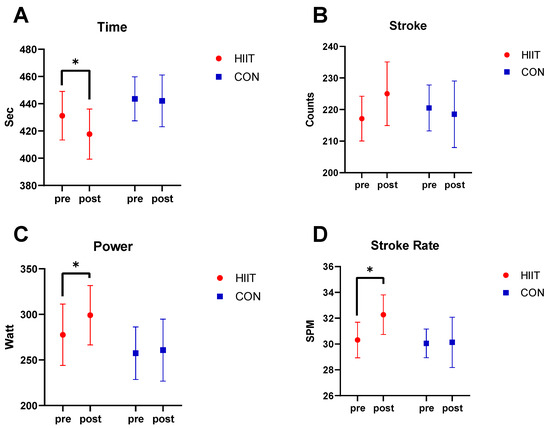
Changes in 2000-m rowing ergometer performance are presented in Table 3 and Figure 1. Significant group × time interactions were observed for completion time (F = 16.79, p = 0.001, η2p = 0.53), mean power output (F = 9.46, p = 0.008, η2p = 0.39), and stroke rate (F = 5.66, p = 0.031, η2p = 0.27). The interaction for total stroke count did not reach statistical significance (F = 3.56, p = 0.079, η2p = 0.19). Mean change values, 95% CIs, and Cohen’s dz are provided in Table 3 to support interpretation of the magnitude and practical relevance of the changes.
Table 3.
Changes in 2000-m rowing ergometer performance before and after the 4-week intervention.
Figure 1.
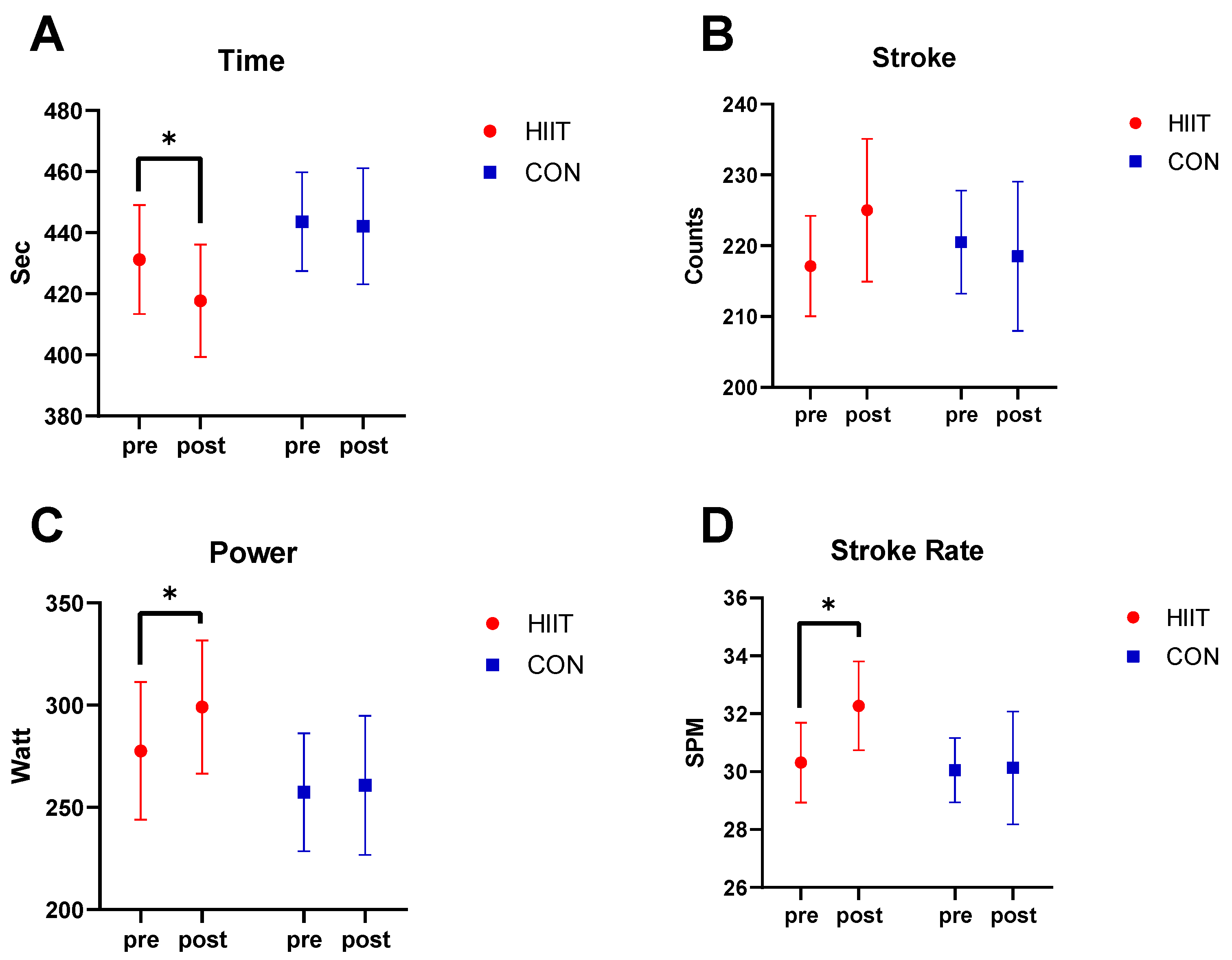
Changes in 2000-m rowing ergometer performance before and after the 4-week intervention. (A) Completion time, (B) total stroke count, (C) mean power output, and (D) stroke rate. Data are presented as mean ± SD. HIIT, high-intensity interval training group; CON, control group; SPM, strokes per minute. * p < 0.05 for group × time interaction.
The HIIT group reduced 2000-m completion time from 431.20 ± 17.86 s to 417.72 ± 18.39 s, corresponding to a 3.1% improvement and a mean change of −13.48 s (95% CI: −18.83 to −8.13; dz = −1.94). Mean power output increased by 21.46 W (95% CI: 9.92 to 33.00; dz = 1.43), and stroke rate increased by 1.96 spm (95% CI: 0.53 to 3.39; dz = 1.06). In contrast, the CON group showed only minimal changes in these variables. These findings indicate that the HIIT intervention improved 2000-m rowing performance primarily through increased power output and stroke rate rather than a statistically significant change in total stroke count.
3.3. Effects of HIIT on TMG-Derived Muscle Mechanical Properties
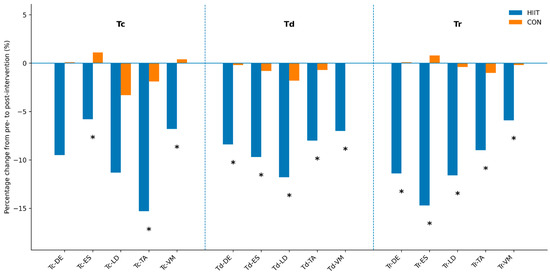
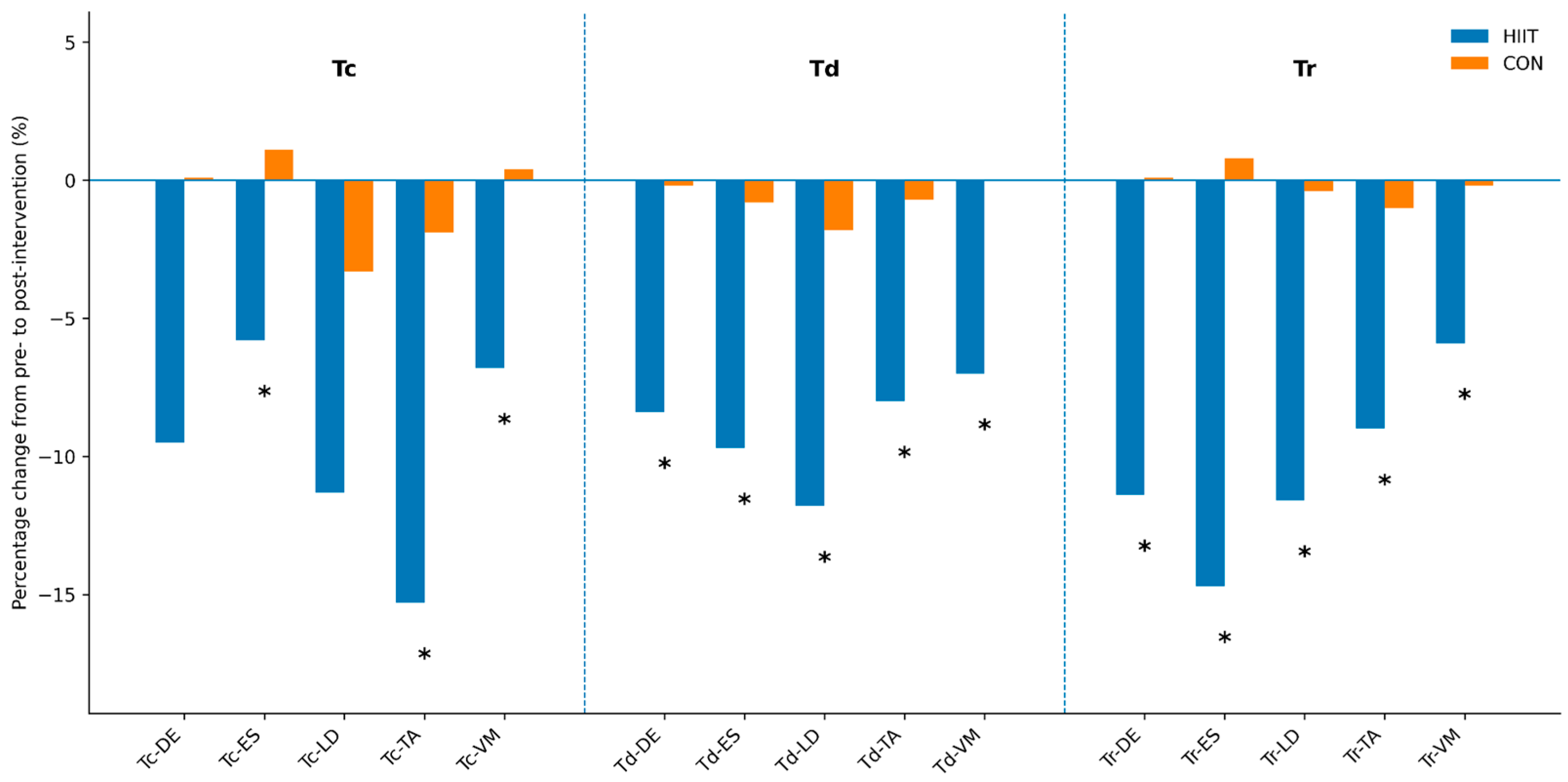
Changes in TMG-derived muscle mechanical properties are summarized in Table 4, and absolute changes in TMG-derived temporal parameters are shown in the revised Figure 2. For Tc, significant group × time interactions after FDR correction were observed in TA (F = 36.60, p < 0.001, q < 0.001, η2p = 0.71) and VM (F = 23.06, p < 0.001, q < 0.001, η2p = 0.61). Tc in ES showed a nominal uncorrected interaction (F = 5.72, p = 0.030), but this did not remain significant after FDR correction (q = 0.051) and was therefore interpreted cautiously. Tc in DE and LD showed numerical reductions in the HIIT group but did not reach statistical significance after correction.
Table 4.
Summary of TMG-derived muscle mechanical properties before and after the 4-week intervention.
Figure 2.
Absolute changes in TMG-derived temporal parameters after the 4-week intervention. Changes in contraction time (Tc), delay time (Td), and half-relaxation time (Tr) are shown across the deltoid (DE), erector spinae (ES), latissimus dorsi (LD), tibialis anterior (TA), and vastus medialis (VM). Data are presented as mean change ± SD. Negative values indicate shorter post-intervention time. HIIT, high-intensity interval training group; CON, control group. * q < 0.05 for group × time interaction after Benjamini–Hochberg FDR correction within each parameter family.
For Td, significant group × time interactions remained after FDR correction in all measured muscles: DE (F = 9.32, p = 0.008, q = 0.008, η2p = 0.38), ES (F = 10.91, p = 0.005, q = 0.007, η2p = 0.42), LD (F = 21.57, p < 0.001, q < 0.001, η2p = 0.59), TA (F = 10.31, p = 0.006, q = 0.007, η2p = 0.41), and VM (F = 46.60, p < 0.001, q < 0.001, η2p = 0.76). Similarly, significant group × time interactions remained after FDR correction for Tr across all measured muscles: DE (F = 19.79, p < 0.001, q < 0.001, η2p = 0.57), ES (F = 27.99, p < 0.001, q < 0.001, η2p = 0.65), LD (F = 29.79, p < 0.001, q < 0.001, η2p = 0.67), TA (F = 13.91, p = 0.002, q = 0.002, η2p = 0.48), and VM (F = 22.97, p < 0.001, q < 0.001, η2p = 0.60).
No significant group × time interactions were observed for Dm or Ts in any measured muscle after FDR correction. Overall, these results suggest that HIIT primarily affected TMG-derived temporal aspects of peripheral muscle mechanical responses, including electrically evoked delay, contraction-related timing, and relaxation-related timing, without significantly altering maximal radial displacement or sustain time.
4. Discussion
The present study investigated the effects of a 4-week rowing ergometer-based HIIT intervention on 2000-m rowing performance and TMG-derived peripheral muscle mechanical properties in rowers. The main findings were as follows. First, the HIIT group demonstrated significant improvements in 2000-m rowing performance, including a 3.1% reduction in completion time, a 7.7% increase in mean power output, and a 6.5% increase in stroke rate. Second, HIIT induced significant changes in TMG-derived temporal parameters, with Td and Tr shortened across all measured muscles after FDR correction and Tc shortened in TA and VM. The ES Tc response was nominally significant before correction but should be interpreted cautiously after FDR adjustment. Third, Dm and Ts did not significantly change in any measured muscle. Collectively, these findings suggest that short-term rowing-specific HIIT improved rowing performance and electrically evoked peripheral temporal responses; however, the physiological mechanisms responsible for the performance improvement remain inferential because central cardiorespiratory, metabolic, electromyographic, and biomechanical variables were not directly measured.
4.1. Adaptations in 2000-m Rowing Performance
The 4-week additional rowing ergometer-based HIIT intervention was associated with improved 2000-m rowing ergometer performance. The HIIT group reduced completion time by 3.1%, whereas the control group showed only a minimal change. This improvement was accompanied by significant increases in mean power output and stroke rate. However, because the HIIT group received additional training volume in the form of two extra HIIT sessions per week, the findings should not be interpreted as the isolated effect of HIIT independent of total training load. Rather, the performance improvements were observed after adding a rowing-specific HIIT stimulus to the regular team training program. These findings are consistent with previous studies showing that short-term HIIT can improve rowing ergometer performance in trained rowers. Driller et al. [11] reported that 4 weeks of HIIT improved 2000-m rowing performance by approximately 1.9% in well-trained rowers, together with improvements in VO2max and peak power output. Similarly, Akca and Aras [18] observed that different high-intensity interval training models improved 2000-m rowing performance in lightweight rowers. Turner et al. [12] also reported that high-intensity interval training and sprint-interval training improved 2000-m performance in national-level rowers.
The magnitude of improvement observed in the present study is practically meaningful. The HIIT group reduced 2000-m completion time by approximately 13.5 s, which may be relevant in rowing contexts where relatively small time differences can influence competitive ranking. The accompanying 21.5-W increase in mean power output and 1.96-spm increase in stroke rate suggest that athletes were able to sustain a faster race rhythm with greater power production. Importantly, total stroke count did not show a significant group × time interaction, despite a numerical increase in the HIIT group. This suggests that the improvement in completion time was not simply achieved by increasing the total number of strokes. Instead, the concurrent increases in mean power output and stroke rate indicate a potentially meaningful change in performance strategy or high-intensity work capacity. These findings remain preliminary because of the small sample size and should be confirmed in larger rowing cohorts.
The mechanisms underlying the observed performance improvement were not directly measured in this study. Previous evidence suggests that HIIT may improve rowing performance through central cardiovascular, metabolic, and neuromuscular pathways, including oxygen uptake kinetics, aerobic power, lactate threshold-related power output, buffering capacity, and high-intensity work capacity [19,20,21]. However, alternative explanations should also be considered, including regular team training, changes in pacing or stroke strategy, technical adaptation, test familiarization, and motivational factors. Therefore, the improved completion time, power output, and stroke rate should be interpreted as directly measured performance outcomes, whereas explanations involving VO2max, lactate kinetics, buffering capacity, voluntary neural drive, or rowing biomechanics remain hypothetical in the absence of direct measurements.
4.2. HIIT-Induced Changes in TMG-Derived Muscle Mechanical Properties
TMG provides a non-invasive method for evaluating peripheral muscle mechanical properties under standardized and relaxed conditions [13,14]. In the present study, HIIT significantly shortened Td across all measured muscles, including the deltoid, erector spinae, latissimus dorsi, tibialis anterior, and vastus medialis. Because Td reflects the delay between electrical stimulation and the initial mechanical response of the muscle, a shorter Td may indicate faster excitation–contraction responsiveness or improved mechanical readiness of the muscle after stimulation. This broad reduction in Td suggests that the HIIT intervention may have improved the early temporal response of multiple rowing-related muscles rather than producing an isolated adaptation in a single muscle group.
After FDR correction, Tc was significantly shortened in the tibialis anterior and vastus medialis, while the erector spinae showed a nominal uncorrected change that did not remain significant after correction. These muscles are closely related to lower-limb drive and lower-limb positioning during rowing. During the drive phase, the lower limbs initiate force production, while the trunk contributes to force transfer toward the handle [4,22,23]. Therefore, the significant shortening of Tc in the vastus medialis and tibialis anterior may reflect improved electrically evoked contraction-related temporal properties in muscles relevant to the rowing drive phase. However, these findings should not be interpreted as direct evidence of altered voluntary muscle activation or motor-unit recruitment during rowing.
The deltoid and latissimus dorsi also showed numerical reductions in Tc, but these changes did not reach statistical significance. This pattern may suggest that the 4-week rowing ergometer-based HIIT protocol preferentially stimulated muscles involved in leg drive and trunk stabilization rather than upper-limb pulling. This is biomechanically plausible because rowing ergometer sprint intervals require repeated powerful lower-limb extension and trunk control, whereas the upper limbs contribute more prominently during the later phase of the stroke. However, given the small sample size and the near-significant p values for these muscles, the possibility of meaningful upper-limb adaptation should not be excluded.
Tr was significantly shortened across all measured muscles after HIIT. Tr reflects the time required for muscle displacement to decrease during the relaxation phase. In cyclic sports such as rowing, rapid relaxation after each forceful contraction is important because muscles must repeatedly transition between force production and recovery within each stroke cycle. Previous studies have shown that TMG can be used to monitor fatigue-related changes and recovery status in athletes [24,25,26]. Therefore, the consistent reduction in Tr observed in the present study may suggest improved relaxation-related temporal properties, which could support more efficient recovery between repeated contractions during rowing.
The shortening of Td, Tc, and Tr provides a plausible peripheral mechanical correlate of the observed improvement in stroke rate and mean power output. Faster electrically evoked mechanical responses and shorter relaxation-related times may support more efficient cyclic muscle behavior under repeated rowing demands. However, it should be emphasized that TMG does not directly measure voluntary neural drive, dynamic muscle activation, rowing-specific muscle coordination, or metabolic recovery during exercise. Therefore, the observed TMG changes should be interpreted as improvements in resting, electrically evoked peripheral muscle mechanical responses rather than direct evidence of altered central neuromuscular control during rowing.
4.3. Interpretation of Dm and Ts Responses
In contrast to the significant changes in temporal parameters, Dm and Ts did not show significant group × time interactions in any measured muscle. Dm represents maximal radial displacement of the muscle belly and is commonly interpreted as a parameter related to muscle stiffness, tone, or mechanical compliance [27,28]. A lower Dm may indicate increased stiffness or reduced radial displacement, although this interpretation depends on muscle type, training status, and fatigue condition. Ts reflects the duration of the sustained twitch response and may provide additional information regarding the persistence of muscle tension.
The absence of significant changes in Dm and Ts suggests that the 4-week additional HIIT intervention primarily affected temporal aspects of electrically evoked muscle mechanical responses rather than producing detectable changes in displacement-related twitch characteristics. However, Dm should not be interpreted as a direct or definitive measure of muscle stiffness. Therefore, unchanged Dm only indicates that no significant change in maximal radial displacement was detected under the present TMG testing conditions; it does not rule out changes in muscle stiffness or other mechanical properties that may require elastography, passive stiffness testing, or biomechanical assessment to detect.
From an applied perspective, this pattern may represent a favorable response to the short-term training stimulus. Rowers must repeatedly generate high force while maintaining coordinated stroke rhythm. Previous studies have suggested that TMG-derived parameters can be useful for monitoring fatigue, recovery, and training status [14,29]. In the present study, shorter TMG-derived temporal parameters combined with unchanged Dm and Ts may indicate a change in electrically evoked peripheral mechanical timing without detectable alterations in radial displacement. These findings should be interpreted cautiously and not as definitive evidence of enhanced voluntary neuromuscular efficiency or unchanged muscle stiffness.
4.4. Practical Applications
The present findings have practical implications for rowing training and athlete monitoring, while acknowledging the preliminary nature of the study. First, adding a 4-week rowing ergometer-based HIIT intervention consisting of ten 60-s all-out bouts with 30-s recovery, performed twice per week, may be a useful short-term strategy to improve 2000-m rowing performance. This approach may be particularly relevant during the specific preparation or pre-competition phase, when coaches aim to enhance high-intensity power output and stroke rhythm within a limited training period. However, because the total training load was not strictly matched between groups, coaches should interpret the findings as the effect of adding a specific HIIT stimulus to regular training rather than as evidence that HIIT is superior to an equivalent volume of other training.
Second, the muscle-specific TMG findings suggest that rowing-based HIIT may preferentially enhance contraction-related temporal properties in muscles involved in lower-limb drive and trunk stabilization. Coaches may consider complementing rowing HIIT with additional upper-body or posterior-chain power training if the goal is to further enhance the pulling phase and whole-body kinetic-chain balance.
Third, TMG may serve as a useful non-invasive monitoring tool for evaluating peripheral muscle mechanical responses and recovery-related status in rowers. Changes in Td, Tc, and Tr may help identify whether athletes show favorable electrically evoked temporal responses after high-intensity training, whereas Dm and Ts may provide additional information regarding displacement-related or stiffness-related responses. Regular TMG monitoring may help coaches individualize training load and recovery strategies, but TMG should be interpreted together with performance, physiological, and biomechanical measures rather than as a standalone indicator of voluntary neuromuscular performance.
4.5. Limitations and Future Directions
This study has several limitations. First, the sample size was relatively small and was constrained by the number of eligible rowers available in the team cohort. No formal a priori power analysis was performed before recruitment; the sensitivity analysis indicated that the present sample was powered primarily to detect large effects. Therefore, findings should be interpreted as preliminary and generalized cautiously, particularly to elite, highly trained, or more heterogeneous rowing populations. In addition, effect sizes derived from small samples may be unstable or inflated, particularly for selected TMG variables with large interaction effects; these estimates require confirmation in larger studies. Second, the intervention period was limited to 4 weeks. Although significant performance and TMG-derived adaptations were observed, longer interventions are needed to determine whether these adaptations are sustained or further enhanced over time. Third, detailed numerical training-load variables for the regular team training program were not available for all participants, limiting our ability to quantify total training dose and to fully separate the effects of the additional HIIT stimulus from background training or increased total training volume.
Fourth, participant characterization was limited. The finalized anonymized analytical dataset did not include complete information on sex distribution, competitive level, rowing experience, or habitual training volume, which limits the evaluation of external validity. Body composition was also assessed only at baseline. Therefore, the present study cannot determine whether the 4-week HIIT intervention induced changes in skeletal muscle mass, fat mass, or body fat percentage. The InBody assessment was used primarily to characterize participants’ baseline physical status and to evaluate whether pre-existing body composition differences might have influenced performance outcomes. In addition, although baseline BMI and body fat percentage did not differ significantly between groups, the CON group showed numerically higher values, which should be considered when interpreting power-related outcomes. Fifth, the TMG measurements were standardized and repeated, but within-study reliability indices such as ICC and coefficient of variation were not calculated for all parameters. Furthermore, left and right sides were averaged; therefore, side-to-side asymmetry could not be examined. Finally, physiological and biomechanical measures such as VO2max, blood lactate, lactate threshold, stroke length, force–time curve characteristics, electromyography, and direct stiffness measurements were not assessed. Therefore, the mechanisms underlying the observed performance improvements and TMG-derived temporal changes should be interpreted as explanatory hypotheses rather than demonstrated mechanisms. Future studies combining TMG with electromyography, rowing biomechanics, physiological testing, direct muscle stiffness assessment, and detailed training-load monitoring may provide a more comprehensive understanding of HIIT-induced adaptations in rowers.
5. Conclusions
The present study showed that adding 4 weeks of rowing ergometer-based HIIT to regular training was associated with improved 2000-m rowing performance, as demonstrated by shorter completion time, higher mean power output, and increased stroke rate. The intervention was also associated with shorter TMG-derived temporal parameters, with significant reductions in Td and Tr across all measured muscles and significant reductions in Tc in the tibialis anterior and vastus medialis after FDR correction. In contrast, Dm and Ts remained unchanged, suggesting no detectable change in radial displacement or sustain time under the present TMG conditions. These findings support the potential use of short-term rowing-specific HIIT as a practical training stimulus and highlight the value of TMG as a complementary non-invasive tool for monitoring peripheral muscle mechanical responses in rowers. However, because of the small sample size, unbalanced total training load, limited participant characterization, and absence of direct physiological and biomechanical measurements, the findings should be interpreted as preliminary.
Author Contributions
Conceptualization, C.-Y.C., M.-C.L. and C.-C.H.; methodology, C.-Y.C., M.-C.L. and Y.-T.S.; software, C.-A.H. and Y.-T.S.; validation, M.-C.L., C.-A.H. and Y.-T.S.; formal analysis, C.-Y.C. and C.-A.H.; investigation, C.-Y.C. and C.-A.H.; resources, M.-C.L. and C.-C.H.; data curation, C.-A.H. and Y.-T.S.; writing—original draft preparation, C.-Y.C.; writing—review and editing, M.-C.L., Y.-T.S. and C.-C.H.; visualization, C.-Y.C. and C.-A.H.; supervision, Y.-T.S. and C.-C.H.; project administration, M.-C.L. and C.-C.H.; funding acquisition, C.-Y.C. and C.-C.H. All authors have read and agreed to the published version of the manuscript.
Funding
This research received no external funding.
Institutional Review Board Statement
The study was conducted in accordance with the Declaration of Helsinki, and approved by the Institutional Review Board of National Taiwan Sport University (protocol code NTSUIRB-114-042 and date of approval: 30 June 2025).
Informed Consent Statement
Informed consent was obtained from all subjects involved in the study.
Data Availability Statement
The original contributions presented in this study are included in the article. Further inquiries can be directed to the corresponding authors.
Acknowledgments
The authors would like to express their sincere gratitude to all members of our research team for their invaluable assistance in data collection and technical support throughout the experimental process.
Conflicts of Interest
The authors declare no conflicts of interest.
References
- Secher, N.H. The physiology of rowing. J. Sports Sci. 1993, 11, 241–246. [Google Scholar] [CrossRef] [Scilit] [PubMed]
- Mäestu, J.; Jürimäe, J.; Jürimäe, T. Monitoring of performance and training in rowing. Sports Med. 2005, 35, 597–617. [Google Scholar] [CrossRef] [Scilit] [PubMed]
- Hagerman, F.C. Applied physiology of rowing. Sports Med. 1984, 1, 303–326. [Google Scholar] [CrossRef] [Scilit] [PubMed]
- Baudouin, A.; Hawkins, D. Investigation of biomechanical factors affecting rowing performance. J. Biomech. 2004, 37, 969–976. [Google Scholar] [CrossRef] [PubMed]
- Soper, C.; Hume, P.A. Towards an ideal rowing technique for performance: The contributions from biomechanics. Sports Med. 2004, 34, 825–848. [Google Scholar] [CrossRef] [Scilit] [PubMed]
- van der Zwaard, S.; Weide, G.; Levels, K.; Eikelboom, M.R.I.; Noordhof, D.A.; Hofmijster, M.J.; van der Laarse, W.J.; de Koning, J.J.; de Ruiter, C.J.; Jaspers, R.T. Muscle morphology of the vastus lateralis is strongly related to ergometer performance, sprint capacity and endurance capacity in Olympic rowers. J. Sports Sci. 2018, 36, 2111–2120. [Google Scholar] [CrossRef] [Scilit] [PubMed]
- van der Zwaard, S.; Koppens, T.F.P.; Weide, G.; Levels, K.; Hofmijster, M.J.; de Koning, J.J.; Jaspers, R.T. Training-induced muscle adaptations during competitive preparation in elite female rowers. Front. Sports Act. Living 2021, 3, 781942. [Google Scholar] [CrossRef] [Scilit] [PubMed]
- Laursen, P.B.; Jenkins, D.G. The scientific basis for high-intensity interval training: Optimising training programmes and maximising performance in highly trained endurance athletes. Sports Med. 2002, 32, 53–73. [Google Scholar] [CrossRef] [Scilit] [PubMed]
- Buchheit, M.; Laursen, P.B. High-intensity interval training, solutions to the programming puzzle: Part I: Cardiopulmonary emphasis. Sports Med. 2013, 43, 313–338. [Google Scholar] [CrossRef] [Scilit] [PubMed]
- MacInnis, M.J.; Gibala, M.J. Physiological adaptations to interval training and the role of exercise intensity. J. Physiol. 2017, 595, 2915–2930. [Google Scholar] [CrossRef] [Scilit] [PubMed]
- Driller, M.W.; Fell, J.W.; Gregory, J.R.; Shing, C.M.; Williams, A.D. The effects of high-intensity interval training in well-trained rowers. Int. J. Sports Physiol. Perform. 2009, 4, 110–121. [Google Scholar] [CrossRef] [Scilit] [PubMed]
- Turner, K.J.; Pyne, D.B.; Périard, J.D.; Rice, A.J. High-intensity interval training and sprint-interval training in national-level rowers. Front. Physiol. 2021, 12, 803430. [Google Scholar] [CrossRef] [Scilit] [PubMed]
- Macgregor, L.J.; Hunter, A.M.; Orizio, C.; Fairweather, M.M.; Ditroilo, M. Assessment of skeletal muscle contractile properties by radial displacement: The case for tensiomyography. Sports Med. 2018, 48, 1607–1620. [Google Scholar] [CrossRef] [Scilit] [PubMed]
- García-García, O.; Cuba-Dorado, A.; Álvarez-Yates, T.; Carballo-López, J.; Iglesias-Caamaño, M. Clinical utility of tensiomyography for muscle function analysis in athletes. Open Access J. Sports Med. 2019, 10, 49–69. [Google Scholar] [CrossRef] [Scilit] [PubMed]
- Tous-Fajardo, J.; Moras, G.; Rodríguez-Jiménez, S.; Usach, R.; Doutres, D.M.; Maffiuletti, N.A. Inter-rater reliability of muscle contractile property measurements using non-invasive tensiomyography. J. Electromyogr. Kinesiol. 2010, 20, 761–766. [Google Scholar] [CrossRef] [Scilit] [PubMed]
- Martín-Rodríguez, S.; Loturco, I.; Hunter, A.M.; Rodríguez-Ruiz, D.; Munguia-Izquierdo, D. Reliability and measurement error of tensiomyography to assess mechanical muscle function: A systematic review. J. Strength Cond. Res. 2017, 31, 3524–3536. [Google Scholar] [CrossRef] [Scilit] [PubMed]
- Lohr, C.; Schmidt, T.; Medina-Porqueres, I.; Braumann, K.-M.; Reer, R.; Porthun, J. Diagnostic accuracy, validity, and reliability of tensiomyography to assess muscle function and exercise-induced fatigue in healthy participants: A systematic review with meta-analysis. J. Electromyogr. Kinesiol. 2019, 47, 65–87. [Google Scholar] [CrossRef] [Scilit] [PubMed]
- Akca, F.; Aras, D. Comparison of rowing performance improvements following various high-intensity interval trainings. J. Strength Cond. Res. 2015, 29, 2249–2254. [Google Scholar] [CrossRef] [Scilit] [PubMed]
- Berger, N.J.; Tolfrey, K.; Williams, A.G.; Jones, A.M. Influence of continuous and interval training on oxygen uptake on-kinetics. Med. Sci. Sports Exerc. 2006, 38, 504–512. [Google Scholar] [CrossRef] [Scilit] [PubMed]
- Helgerud, J.; Høydal, K.; Wang, E.; Karlsen, T.; Berg, P.; Bjerkaas, M.; Simonsen, T.; Helgesen, C.; Hjorth, N.; Bach, R.; et al. Aerobic high-intensity intervals improve VO2max more than moderate training. Med. Sci. Sports Exerc. 2007, 39, 665–671. [Google Scholar] [CrossRef] [Scilit] [PubMed]
- Ní Chéilleachair, N.J.; Harrison, A.J.; Warrington, G.D. HIIT enhances endurance performance and aerobic characteristics more than high-volume training in trained rowers. J. Sports Sci. 2017, 35, 1052–1058. [Google Scholar] [CrossRef] [Scilit] [PubMed]
- Pollock, C.L.; Jones, I.C.; Jenkyn, T.R.; Ivanova, T.D.; Garland, S.J. Changes in kinematics and trunk electromyography during a 2000 m race simulation in elite female rowers. Scand. J. Med. Sci. Sports. 2012, 22, 478–487. [Google Scholar] [CrossRef] [Scilit] [PubMed]
- Yamashita, M.; Ishida, T.; Osuka, S.; Watanabe, K.; Samukawa, M.; Kasahara, S.; Kondo, E.; Tohyama, H. Trunk muscle activities during ergometer rowing in rowers with and without low back pain. J. Sports Sci. Med. 2023, 22, 338–344. [Google Scholar] [CrossRef] [Scilit] [PubMed]
- García-Manso, J.M.; Rodríguez-Ruiz, D.; Rodríguez-Matoso, D.; de Saa, Y.; Sarmiento, S.; Quiroga, M. Assessment of muscle fatigue after an ultra-endurance triathlon using tensiomyography (TMG). J. Sports Sci. 2011, 29, 619–625. [Google Scholar] [CrossRef] [Scilit] [PubMed]
- Rey, E.; Lago-Peñas, C.; Lago-Ballesteros, J. Tensiomyography of selected lower-limb muscles in professional soccer players. J. Electromyogr. Kinesiol. 2012, 22, 866–872. [Google Scholar] [CrossRef] [Scilit] [PubMed]
- Kalc, M.; Puš, K.; Paravlic, A.; Urbanc, J.; Šimunič, B. Diagnostic accuracy of tensiomyography parameters for monitoring peripheral neuromuscular fatigue. J. Electromyogr. Kinesiol. 2023, 70, 102775. [Google Scholar] [CrossRef] [Scilit] [PubMed]
- De Paula Simola, R.Á.; Raeder, C.; Wiewelhove, T.; Kellmann, M.; Meyer, T.; Pfeiffer, M.; Ferrauti, A. Muscle mechanical properties of strength and endurance athletes and changes after one week of intensive training. J. Electromyogr. Kinesiol. 2016, 30, 73–80. [Google Scholar] [CrossRef] [Scilit] [PubMed]
- Wilson, M.T.; Ryan, A.M.F.; Vallance, S.R.; Dias-Dougan, A.; Dugdale, J.H.; Hunter, A.M.; Hamilton, D.L.; Macgregor, L.J. Tensiomyography-derived parameters reflect skeletal muscle architectural adaptations following 6 weeks of lower body resistance training. Front. Physiol. 2019, 10, 1493. [Google Scholar] [CrossRef] [Scilit] [PubMed]
- Čular, D.; Šimunič, B.; Rittweger, J. Tensiomyography: From muscle assessment to talent identification. Front. Physiol. 2023, 14, 1187641. [Google Scholar] [CrossRef] [Scilit] [PubMed]

Disclaimer/Publisher’s Note: The statements, opinions and data contained in all publications are solely those of the individual author(s) and contributor(s) and not of MDPI and/or the editor(s). MDPI and/or the editor(s) disclaim responsibility for any injury to people or property resulting from any ideas, methods, instructions or products referred to in the content. |
© 2026 by the authors. Licensee MDPI, Basel, Switzerland. This article is an open access article distributed under the terms and conditions of the Creative Commons Attribution (CC BY) license.