Article

Development and Implementation of a Machine Learning Model to Identify Emotions in Children with Severe Motor and Communication Impairments


by
Caryn Vowles
,
Kate Patterson
and
T. Claire Davies
*
Mechanical and Materials Engineering, Queen’s University, Kingston, ON K7L 3N6, Canada
*
Author to whom correspondence should be addressed.
Appl. Sci. 2025, 15(5), 2850; https://doi.org/10.3390/app15052850
Submission received: 13 January 2025 / Revised: 13 February 2025 / Accepted: 27 February 2025 / Published: 6 March 2025

Featured Application

Children with severe motor and communication impairments (SMCIs) face significant challenges in expressing emotions, often leading to unmet needs and social isolation. The identification of emotions from physiological signals using machine learning could provide enhanced support for the emotional well-being of children with complex communication needs and increase their quality of life.

Abstract

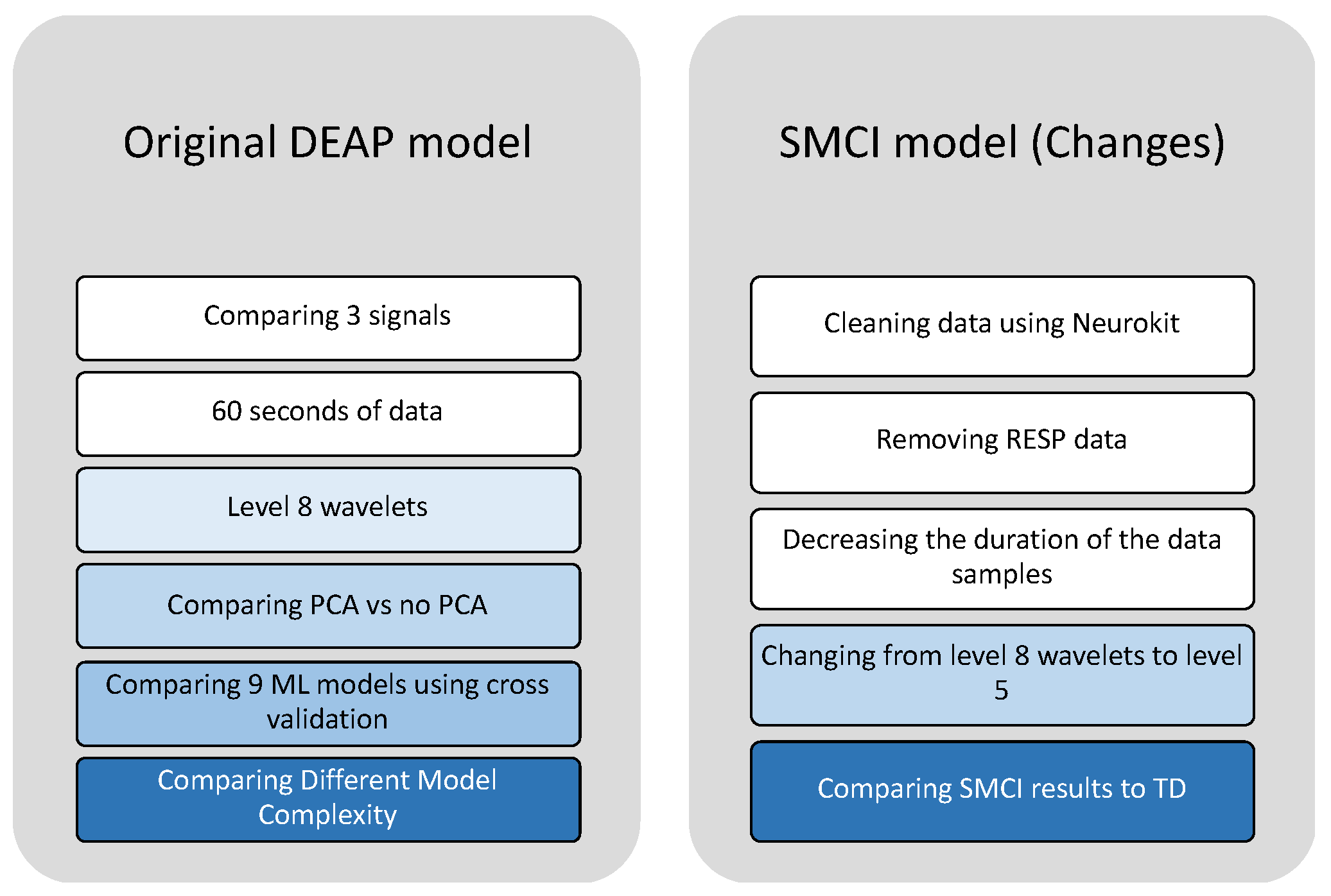
Children with severe motor and communication impairments (SMCIs) face significant challenges in expressing emotions, often leading to unmet needs and social isolation. This study investigated the potential of machine learning to identify emotions in children with SMCIs through the analysis of physiological signals. A model was created based on the data from the DEAP online dataset to identify the emotions of typically developing (TD) participants. The DEAP model was then adapted for use by participants with SMCIs using data collected within the Building and Designing Assistive Technology Lab (BDAT). Key adaptations to the DEAP model resulted in the exclusion of respiratory signals, a reduction in wavelet levels, and the analysis of shorter-duration data segments to enhance the model’s applicability. The adapted SMCI model demonstrated an accuracy comparable to the DEAP model, performing better than chance in TD populations and showing promise for adaptation to SMCI contexts. The models were not reliable for the effective identification of emotions; however, these findings highlight the feasibility of using machine learning to bridge communication gaps for children with SMCIs, enabling better emotional understanding. Future efforts should focus on expanding the data collection of physiological signals for diverse populations and developing personalized models to account for individual differences. This study underscores the importance of collecting data from populations with SMCIs for the development of inclusive technologies to promote empathetic care and enhance the quality of life of children with communication difficulties.
Keywords: disability; communication impairment; DEAP; machine learning; emotion; physiological signals; children disability; communication impairment; DEAP; machine learning; emotion; physiological signals; children