


Abstract
The magnetic field penetration depth poses challenges in communications, geophysical exploration, biomedical therapies, and superconducting device design. The objective of this systematic review was to identify, analyze, and understand the depth of magnetic field penetration in conductors, semiconductors, superconductors, insulators and natural materials, modelling applications in medicine, engineering, and basic sciences. An exhaustive search was carried out in databases such as Scopus, IEEE Xplore, ScienceDirect, and IOPSCIENCE using keywords such as depth and penetration and magnetic and field and materials. PRISMA was used as a method to define inclusion and exclusion criteria, ensuring quality, transparency, and methodological rigor, followed by a detailed statistical analysis. The results showed that the penetration depth varies according to the material, frequency, and application conditions. In human tissues, infrastructure, and agricultural applications, the penetration range is between 0.01 and 0.2 m, with the possibility of a range greater than one meter in specific applications. The higher the frequency, the lower the penetration depth is confirmed. In conclusion, the penetration of the magnetic field depends on material properties such as conductivity and magnetic permeability, frequency, and temperature. The developed models offer relevant information for future research and technological applications.
1. Introduction
Today, the magnetic field has been increasingly incorporated in a variety of fields, from food cooking, health, and environment to engineering and industry. This ubiquity has led to a growing interest in understanding the properties of the magnetic field and its interaction with different materials. Knowledge of the magnetic field’s ability to penetrate bulk, substances, and biologics with different densities, compositions, and structures is essential to optimize its multiple applications. In this article, the penetration depth of the magnetic field will be referred to as ppB.
The scientific literature reports numerous studies relating ppB to the physical and chemical properties of the material in question. For example, there is research on the application of the magnetic field (MF) as an effective and contamination-free treatment method to improve the characteristics in horticultural and agricultural development [1]. In addition, experiences in coil design and the use of unidirectional magnetic fields in manufacturing have been documented, showing that field strength and frequency, as well as material characteristics, alter the efficiency and performance of devices and production processes.
In the field of superconductors and electronic materials, results have shown how ppB varies with temperature, field frequency, and crystalline composition. Studies with conventional and high-temperature superconductors, as well as with single crystals and metallic composites, have revealed that magnetic field penetration determines phenomena such as vortex formation and quantum conduction behavior. This, in turn, enables the development of more efficient technologies in wireless transport, diagnostic biomedical therapies, geophysical exploration, and superconducting device design. For example, the emergence of the Meissner Ochsenfeld effect, showing that superconductivity represents a state of thermodynamic equilibrium, gave rise to the London and Ginzburg–Landau theory [2].
Neodymium magnets (50 and 100 mT) improved regeneration and shoot formation in lemon balm [3]. A MEX nozzle with solenoid was designed to generate a unidirectional magnetic field (10 mT), improving coercivity, remanence, and peak energy of in situ fabricated magnets [4]. With a 35 mT magnetic field, the antioxidants PO and GSH increased in fermentation with nivalenol (0.2 µg/mL), reducing VNI by 56.5% after 48 h and altering alcoholic properties [5]. In Nb3Sn, quadrupole resonator and muon spin rotation measurements evaluated lower critical and superheat fields, dependent on the London penetration depth (λ) at low energies [6]. Furthermore, V3Si is a multi-banded superconductor, showing hexagonal vortices whose size depends on the field, with a coherence length greater than the value calculated from Hc2 [7]. The magnetization of water with a magnetic field enhances colloidal particle aggregation and solid–liquid separation, affecting bacterial activity and biological properties [8]. The utilization of lithium–oxygen–sulfur batteries is improved by a magnetic field through wireless energy transfer, which is influenced by magnetic forces and spin effects [9]. The magnetic field was used to measure pressure in a magnetorheological fluid (MRF) stored in a tube, and it was observed that the pressure generated decreases with an increasing magnetic field frequency (up to 5 Hz) [10]. Regarding the minimum field variation in specific environments, their magnitudes are close to the geomagnetic field between 25 μT and 65 μT, i.e., magnetic fields are sometimes close to zero [11]. The magnetic field compensation with frequency and low magnitude, in the triaxial square Helmholtz coil (TSH) system, is compensated with a geomagnetic field of 39.5 µT and a uniform MF close to zero [12]. The principles of electromagnetic induction in muscle tissue are explained as an example of interaction with parts of the human body [13].
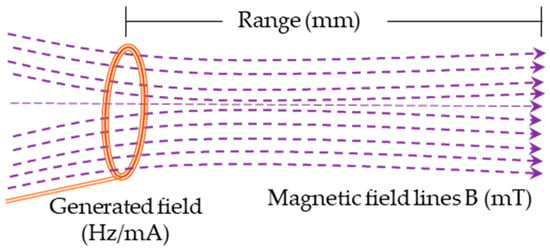
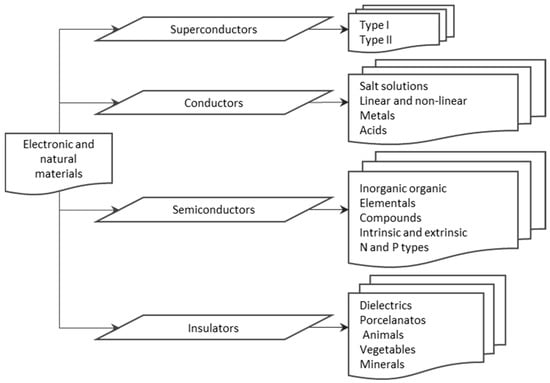
Using the Britannica definition of the magnetic field, the flux lines are known, but it is unknown how much they can penetrate at a certain mass density, magnetic field generation, its range and lines are presented in Figure 1.
Figure 1.
Magnetic field generation, its range, and lines, adapted from [14].
This magnetic field is based on several laws that explain the interactions between currents, fields, and forces: The Ampère–Maxwell Law establishes the connection between direct currents and the static magnetic field (B), while the Biot–Savart Law describes the relationship between an electric current and the resulting magnetic field. Gauss’s Third Law deals with magnetic flux through closed surfaces, while the Faraday–Lenz Law links the time variation of a magnetic field to an induced voltage drop. Finally, the Lorentz Force Law and Laplace’s Second Law detail how moving charges interact with the magnetic field (B), depending on the current involved.
From the 1970s to the present day, research on ppB in conductors, semiconductors, superconductors, and insulators has highlighted its importance for solving everyday problems, such as applications in healthcare and advanced technology.
For monocrystalline materials, the temperature and operating frequency are important [15]. Heike Kamerlingh Onnes discovered superconductors in 1911, materials that conduct electricity without resistance at low temperatures. Elements such as sulfur, boron, and carbon are superconductors under high pressure or in altered forms. The review analyzes the evolution of semiconductors, highlighting innovations, challenges, geopolitics, and economics, including emerging technologies such as graphene [16].
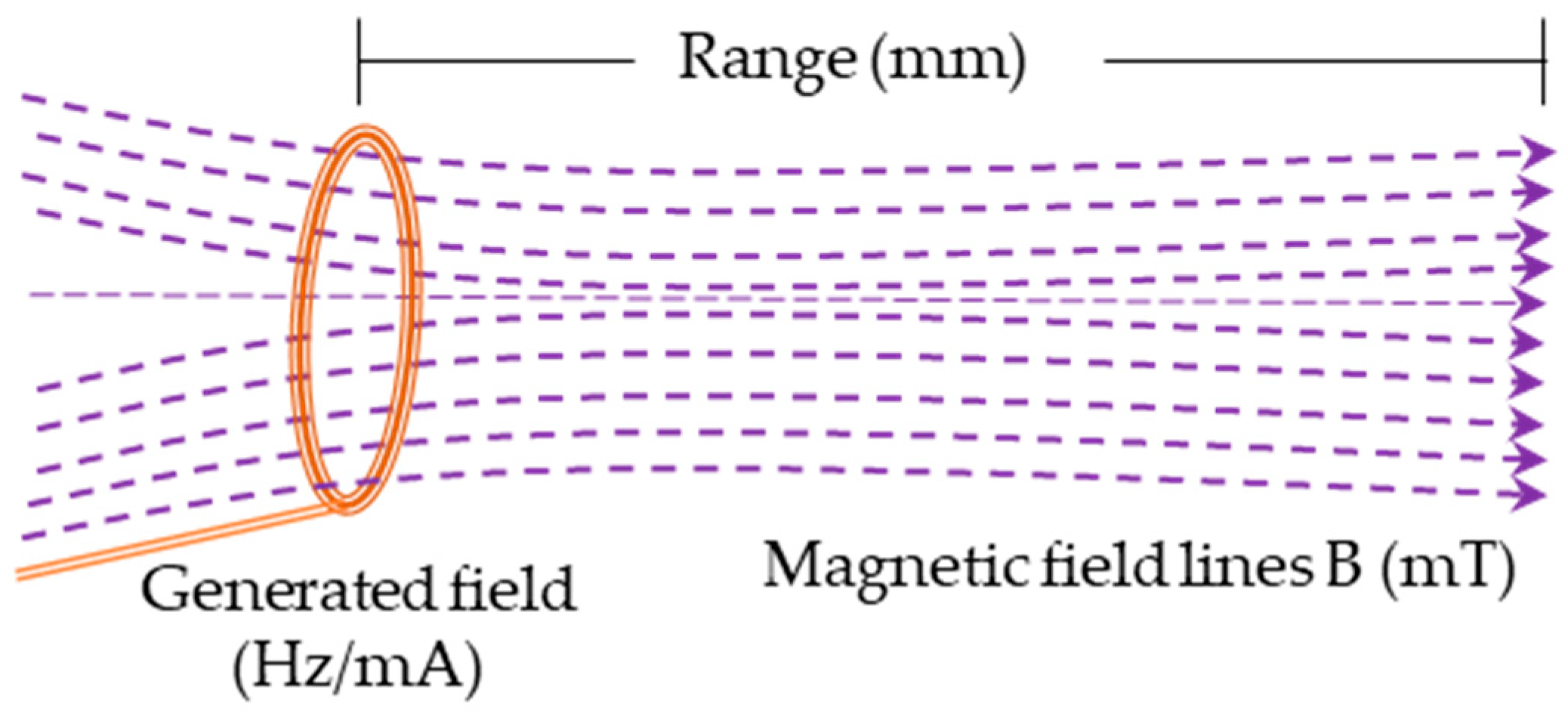
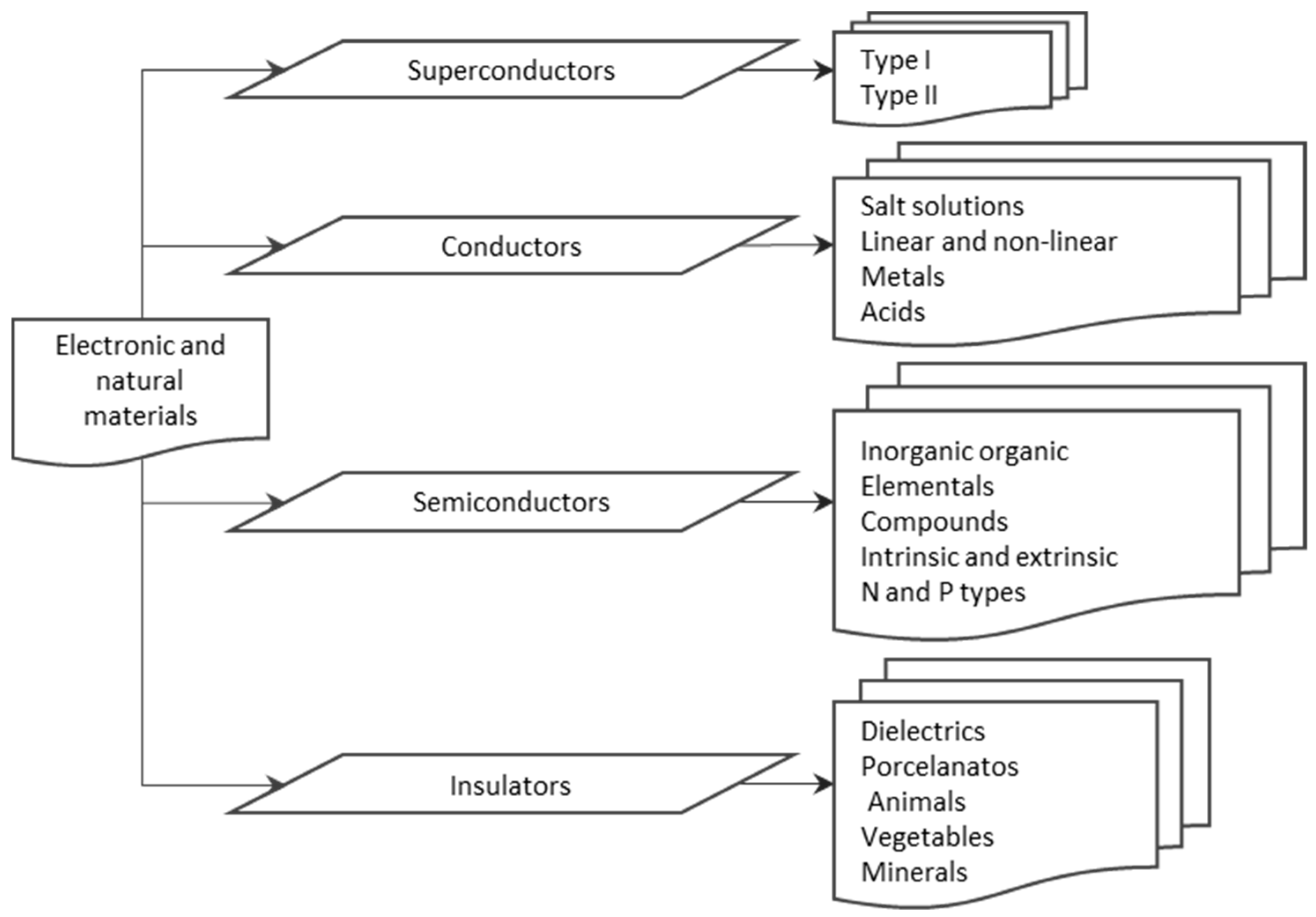
Electronic materials such as metal nitrides are transition materials and an important class of materials with applications as abrasives, semiconductors, superconductors, lithium-ion conductors, and thermoelectrics [17]. In addition, concrete is recycled as a filler in sand–lime products and waste. Insulating materials such as glass fiber, rock wool, and reconsidered sand are used as insulating materials [18]. Unlayered 2D materials stand out for their unique properties; e.g., platinum monosulfide is scarcely studied due to its difficult synthesis [19]. The dimensions of electronic and natural materials are illustrated in Figure 2.
Figure 2.
Dimensions of electronic and natural materials, adapted from [2,16,17,18].
These dimensions provide information to take into account in the selection and pursuit of scientific studies, and each of these materials has specific applications according to their electrical, magnetic, or mechanical properties, which makes them useful in different areas of engineering and the sciences.
In high Tc cuprate superconductors, the London penetration depth (λL) first decreases exponentially and then follows a power law due to the disappearance of the energy gap (Δg) [20]. However, ref. [21] determined a lower critical field Hc1 of 0.82 and 0.55 Tesla and a London penetration depth λ of 20 nm and 30 nm in H3S and LaH10, respectively. Then, as illustrated in [22], the coil used in transcranial magnetic stimulation (TMS) requires a balance between several parameters, such as the magnetic flux density (B), inductance (L), induced electric field (E), focality, penetration depth, and coil heating, among others.
The importance of this review is to understand the topic on the basis of scientific research from previous centuries to the present day. This phenomenon, called the magnetic field, is widely used in multiple applications. The generation of a magnetic field depends on the modeled matrix design, frequency, types of coils, and other factors. Due to this knowledge gap, there is interest in understanding and controlling the ppB and responding to the need to harness this phenomenon in practical solutions, from water treatment, high-efficiency battery design, wireless energy transport, and tumor detection in the human body to advanced biomedical ones. Therefore, the aim of this review article is to present and analyze the most relevant research on ppB in various materials and applications, contributing to expanding the frontiers of knowledge and promoting new lines of research. Specifically, it aims to answer the following questions: How does the penetration depth of the magnetic field vary in dense heterogeneous materials, substances, or biological materials? What emerging applications can the models benefit from under extreme conditions, such as high frequencies or varying temperatures?
2. Materials and Methods
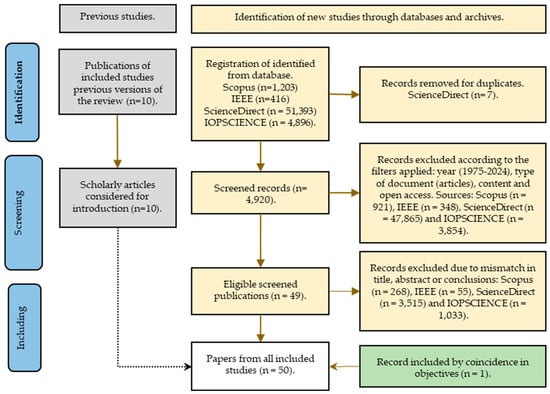
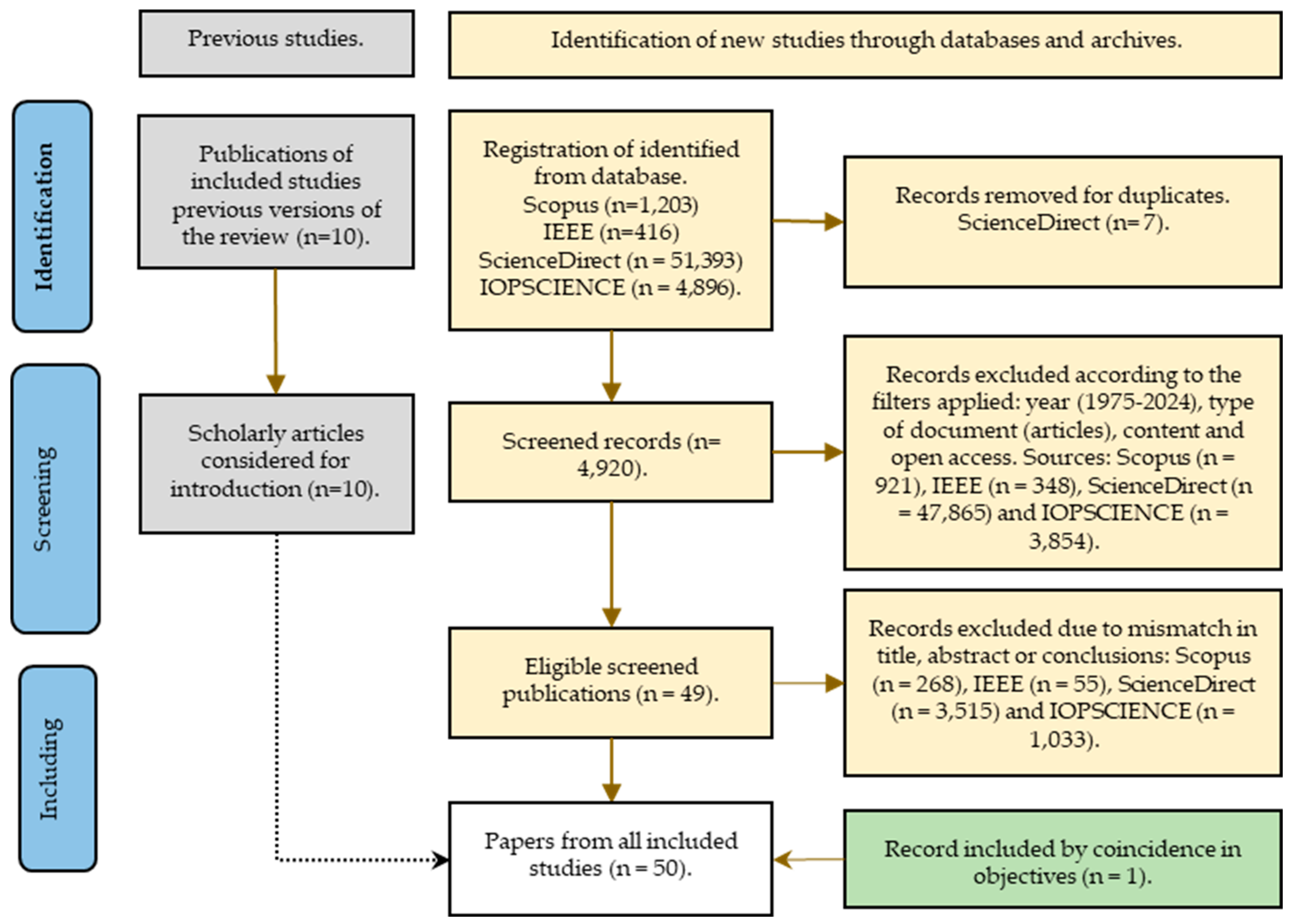
A systematic review methodology based on the international PRISMA statements was implemented, and its adoption in engineering helps to increase confidence in the results and minimize bias in this research [23]. This methodology was developed in two stages: the first was to find the studies to include, while the second was to create a matrix in order to extract the information from the studies for further analysis and present the findings in an organized manner. Figure 3 depicts the process of article selection in five stages: identification, replication, eligibility, selection, and bias. The identification stage consisted of searching for articles using the keywords “depth and penetration and magnetic and field and materials" in the Scopus, IEEE, ScienceDirect, and IOPSCIENCE databases for a total of 57,908 articles. The search was carried out between 1975 and 2024 until 25 July 2024.
Figure 3.
Information search flow in the database, adapted from [24].
The search was conducted in English; the strategy was to apply specific filters for each database and platform, such as type of publication (articles) and open access only articles, in order to ensure complete and available information.
During the selection process, studies with identical DOIs were eliminated after a one-to-one review to identify duplicates, as well as those with incomplete information in the title, abstract, conclusions, or methodology. This process was carried out using a predefined assessment protocol.
In addition, articles were excluded from any approach that did not meet the purpose of the review, lacked the relevant keywords, had context other than magnetic field penetration depth, or had central theme other than magnetic field.
Restricted access articles were also found that required a fee to download the PDF file, which were all linked to Mendeley; these were excluded from those shortlisted. Finally, 50 articles were selected as the total number of samples that met the criteria set for the study analysis. In assessing the risk of bias of the studies, articles were checked with at least three to more authors. However, side-effect media may serve as a risk in the simplification and translation of articles in other languages.
The method of analyzing the information from the included studies is shown in Table 1. This new Excel database contains title, authors, date of publication, country of experiment, type of material studied, depth of penetration, independent variable, method used, and main conclusion.
Table 1.
Studies selected for analysis.
For data analysis, data were extracted manually in Excel spreadsheets and used methods of quantitative analysis of descriptive statistics, such as averages, standard deviation, correlation, and factorial, visualized in the form of graphs, and qualitative analysis used mathematical models. With tools such as SPSS 26, Excel 2024, VOSviewer 1.6.19, Tableau 2023.4, and Math Type 7.5, the revision was originally Spanish and translated into British English.
3. Results
In each of the studies, the data were collected on the depth of penetration of the magnetic field (ppB). For certain objects, there are some mathematical models to calculate manually.
3.1. Mathematical Models
Mathematical models allow complex systems to be simplified in terms of equations and mathematical relationships, facilitating their analysis of the depth of penetration of the magnetic field (ppB). These models help to identify and quantify the relationships between different variables, such as permeability, resistivity, frequency, temperature, and other factors.
Because they describe the relationship between frequency, conductivity, permeability, and temperature, the models allow for predicting the behavior of materials under different conditions. In addition, they optimize the design of materials for specific applications, such as superconductors or electromagnetic shielding.
With these models, it is possible to predict the behavior of the magnetic field under different conditions, anticipating scenarios such as climate change, wireless communication, attenuation, and range of the magnetic field.
Equations (1)–(4) correspond literally to André-Marie Ampère (1775–1836) and Gauss [74], where B is the magnetic field in (Tesla), R is the radius of the solenoid in (meters), I is the intensity or current (in amperes), N is the number of turns of the wire, dl is the current differential, dA is the area differential, dt is the differential with respect to time, dØ is the electric flux differential, and µ0 is the vacuum permittivity, which is equivalent to μ0 = 4π × 10−7 T·m/A
This Equation (5) is a variant of the expression for the London penetration depth (λ), which depends on the temperature (T) through the superconducting carrier density ρs (T) [75], where m = is the effective mass of the superfluid charge carrier, C = is the speed of light, ρs = is the superfluid carrier density, and e = is the charge of the superfluid charge carrier.
The mathematical models in the research reviewed were used to calculate the magnetic field penetration, i.e., these equations allow us to study how the penetration depth varies under different conditions, which is useful in applications such as electromagnetic induction, the characterization of materials, and field attenuation. This was performed with the following used to calculate the ppB, called delta δ, for conducting and insulating materials:
Equations (6)–(8) are derived from the theory of London 1935 and BCS theory [76], where delta δ = depth of penetration (meters) in materials such as conductors and insulators, rho (ρ) = material resistivity (ohms meter), mu (μ) = material permeability (henries per meter), omega ω = angular frequency (radians per second, ω = 2 × π × f), f = frequency (henries), landa λ(T) = penetration depth (meters) in superconducting materials, T = temperature, Tc = critical temperature, m = specific mass of charge carriers (kg), ns = density of the superconductor (m−3), and e = electron charge (C).
3.2. Materials Studied
Each material has unique properties that drive innovation in different technological areas, from quantum to renewable energy and transport systems. Their study not only enables practical advances but also contributes to understanding the fundamental physical principles that govern diversified matter.
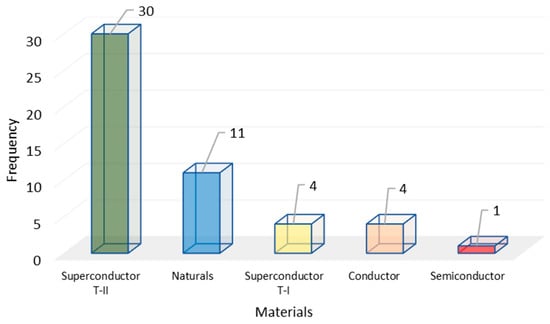
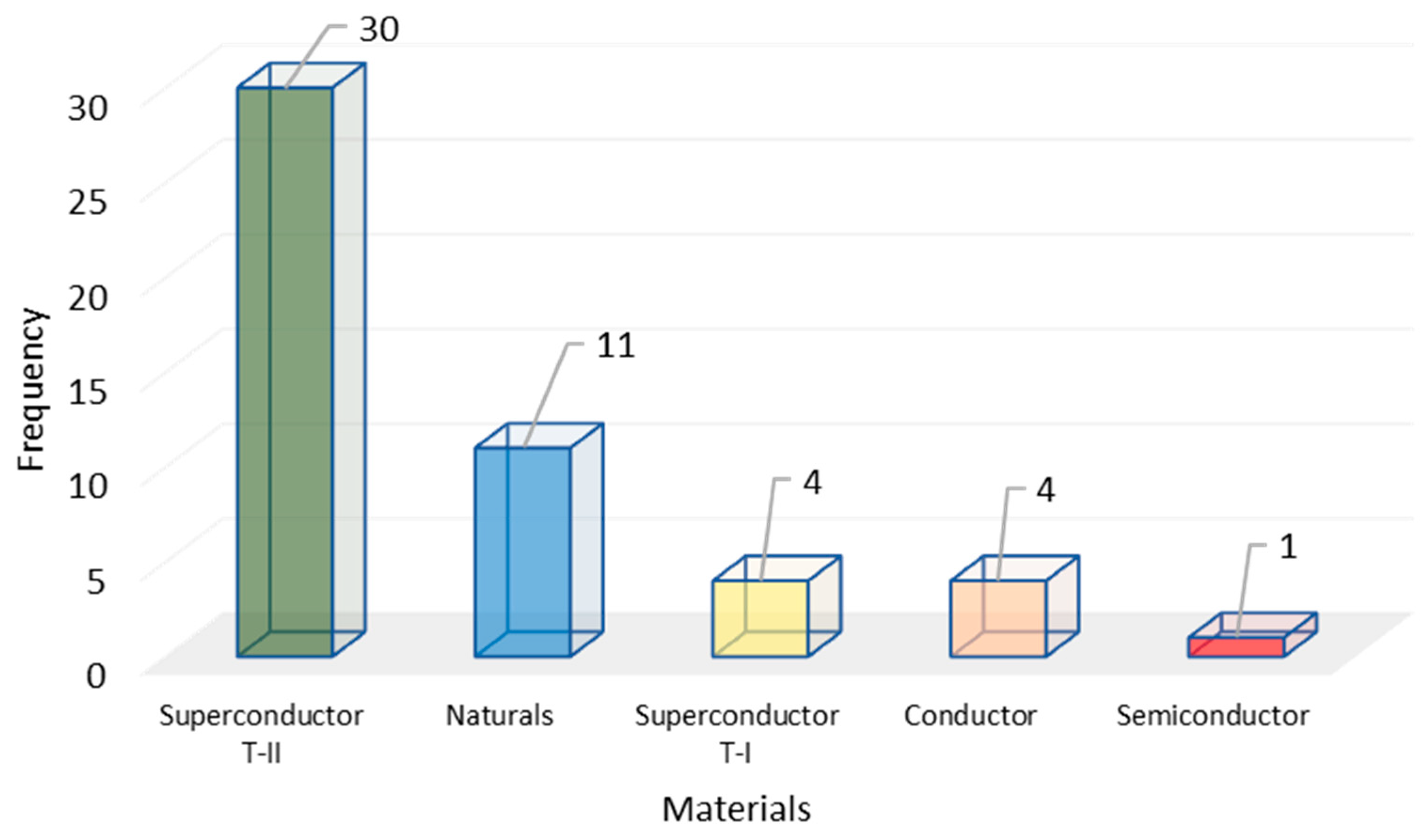
The bars in Figure 4 show the distribution of studies by material type: type II superconductors clearly dominate, with 30 studies, reflecting their scientific and technological relevance. Natural materials are in second place, with 11 studies, highlighting their importance in specific applications. Type I conductors and superconductors have only four studies, indicating a lower interest compared to type II. Semiconductors are under-represented, with only one study, which may reflect a narrower focus in this review.
Figure 4.
Relationship between frequency and materials in the reviewed studies.
There is a growing interest in advanced insulating materials to improve the sensitivity and functionality of devices in the presence of magnetic fields. That is, the number of studies and materials available varies by material type, with notably more research on superconductors and insulators than on conductive materials.
3.3. Reporting of Times and Countries of Experiments
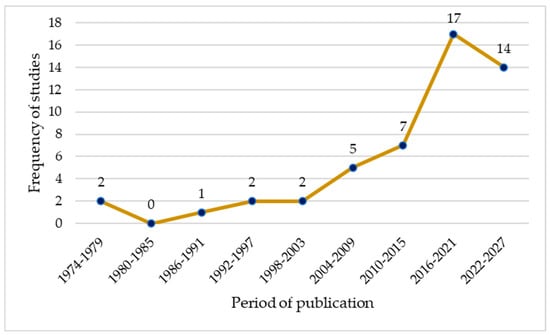
Figure 5 shows a trend of a significant increase in the number of studies over the years, with a remarkable growth in the interval 2004–2021, which has the highest value (17), while the first three intervals (1991–2003) have low values, i.e., in recent years, the trend is disruptive because there is research on magnetic field penetration in various types of materials.
Figure 5.
Temporal evolution of the studies on the subject under review.
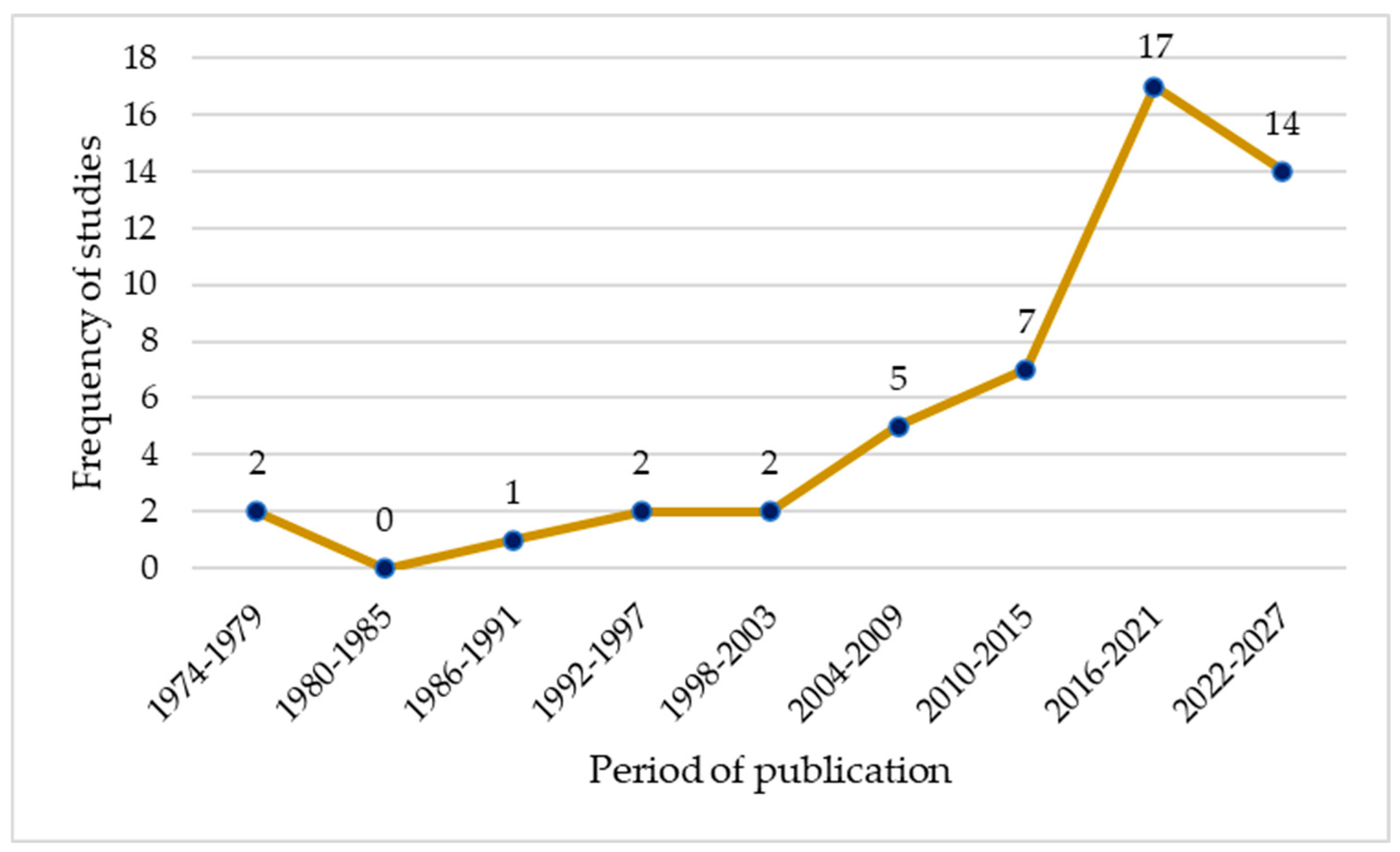
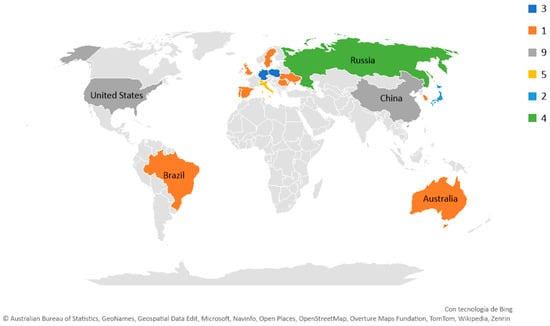
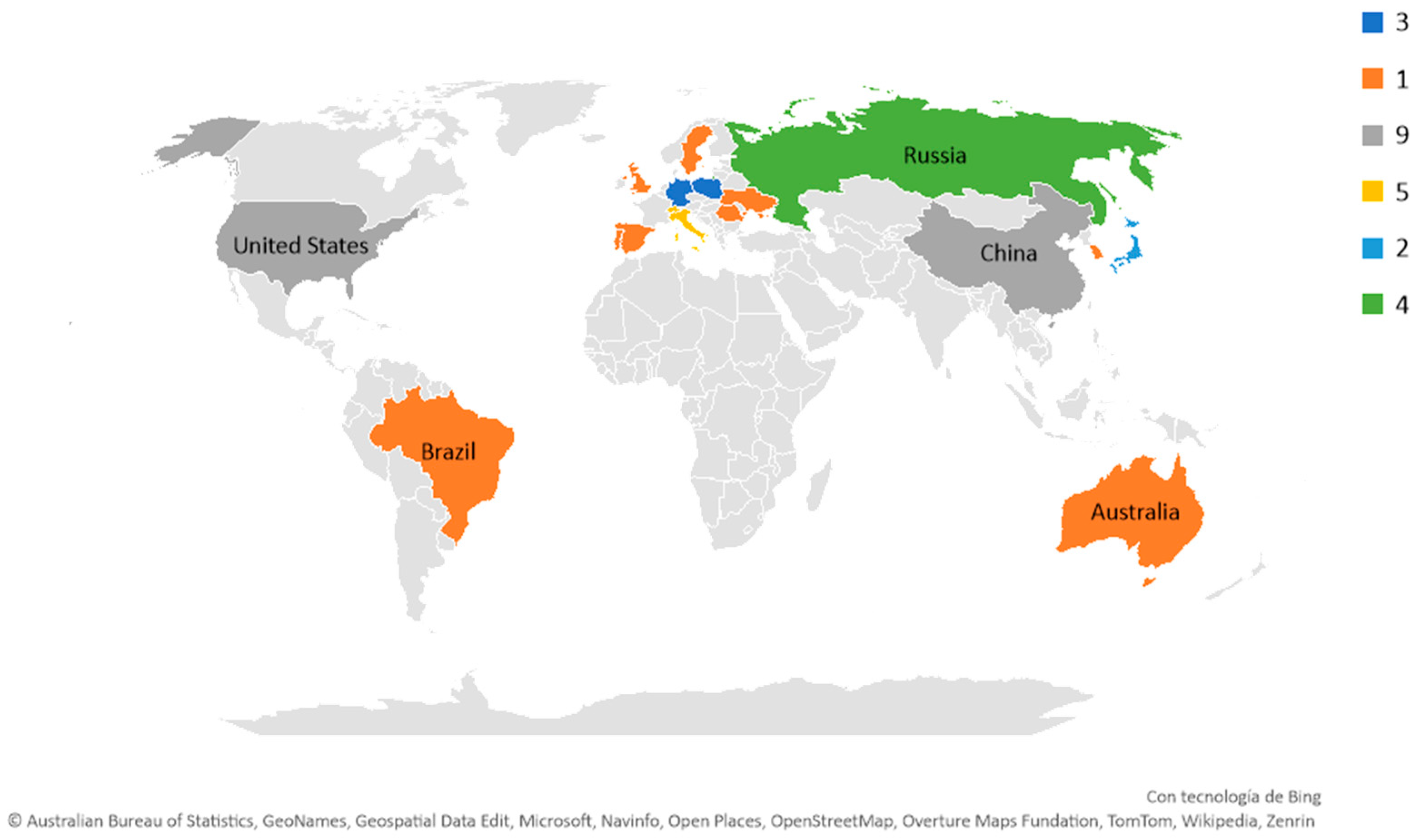
The review of experiments carried out in different countries around the world shows in Figure 6 that in Latin America there is less research on magnetic field penetration, while China and the United States are the countries where the most research is done.
Figure 6.
Number of studies found in the review, organized by country.
Germany and Poland have three studies each; Australia, Ukraine, Brazil, Sweden, Singapore, South Korea, Spain, Portugal, the United Kingdom, and Romania have one study each; the United States and China have nine studies each; Italy and Switzerland have five studies each; Russia has four studies; and Japan has two studies. The map shows the locations of experiments on magnetic field penetration in various types of materials in terms of continents. However, these experiments are carried out in physics laboratories, universities, and research centers all over the world, and the most relevant sites in this field tend to be located in regions with advanced scientific infrastructure, such as the United States and China.
3.4. Areas in Which the Studies Were Applied
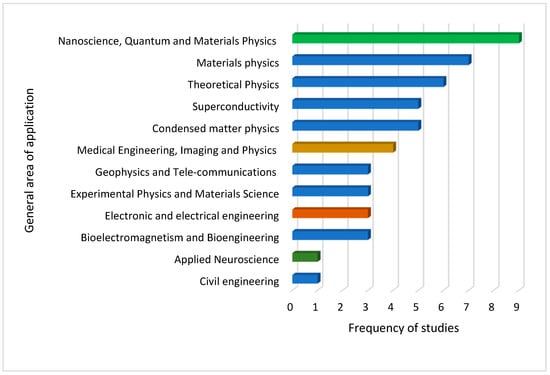
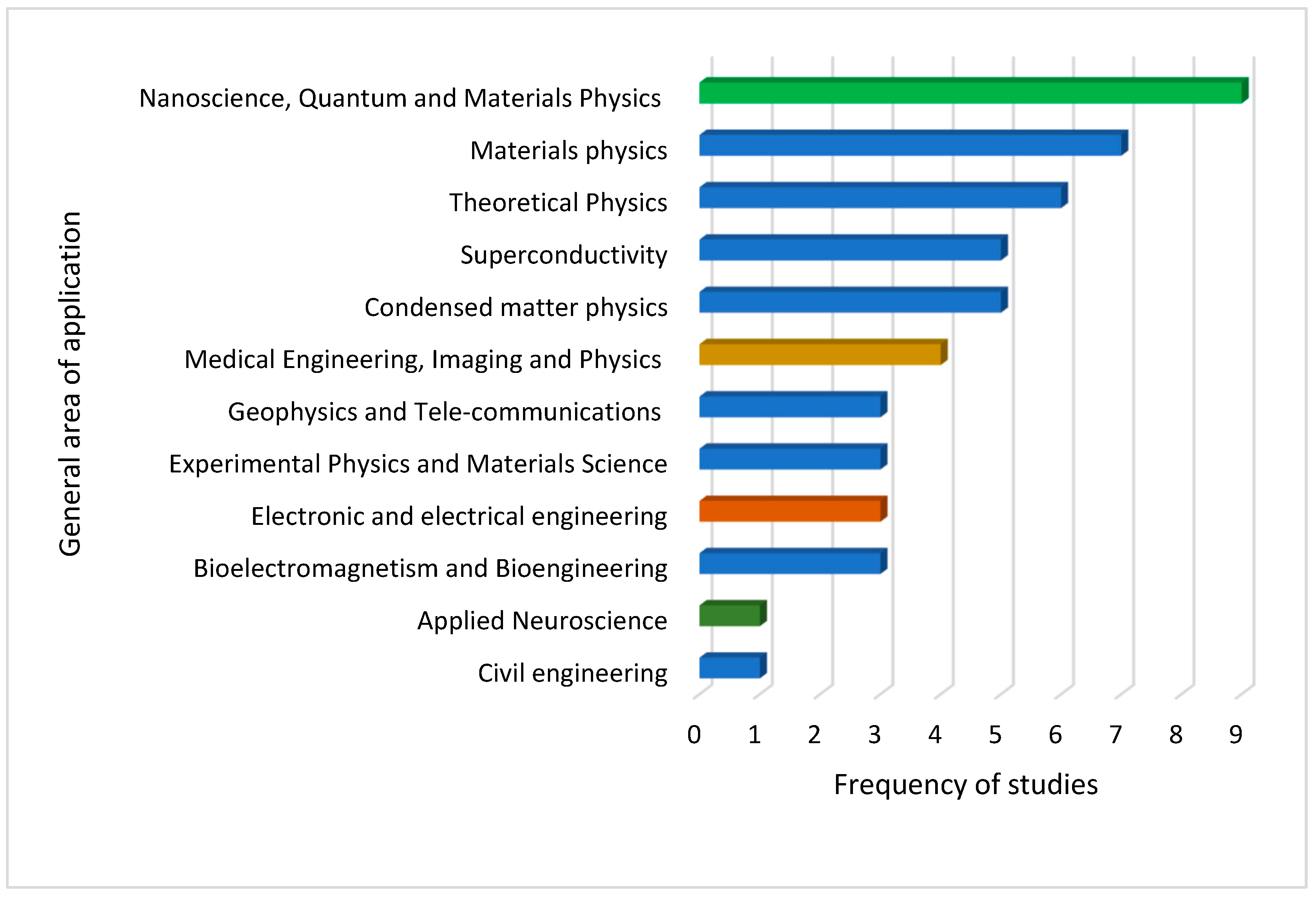
The application areas that were found in the review to have the most studies are nanoscience, quantum physics, and materials, with applications of superconductors with quantum technologies and advanced quantum electronic devices, such as nanotechnology. The second-most experiments were performed in the areas of materials physics, with the application of superconductors for telecommunications, energy storage, and multiple types of sensors. It should be noted that in the areas of medical engineering, imaging, and physics, the application of the magnetic field is for medical diagnostics, magnetic resonance, medical imaging, tissue studies, and pre-clinical studies. Likewise, the area of telecommunications and geophysics is applied for communication in underground mines and geological and deep water mapping. Also, Figure 7 shows that in the area of electronic and electrical engineering, studies reveal that it is applied in the protection of medical equipment against magnetic fields, dielectric fabrication and underground networks. However, the areas of bioengineering, neuroscience, and civil engineering are alien to these reviewed studies, with only a smaller number of experiments.
Figure 7.
Number of studies found in the review by application area.
Most studies focus on type II and natural superconducting materials due to their relevance to the electronics industry.
3.5. Penetration Depth
The penetration depth of the magnetic field in (nm) in type II superconducting materials is shown in Table 2, i.e., the penetration applied in the studies reviewed is very low.
Table 2.
Magnetic field penetration depth in superconductor II.
The mass of the charge carrier (m) in type II superconductors is usually close to the mass of the free electron, whose value is about 9.10938356 × 10⁻³¹ kg. The elementary electron charge (e), a fundamental physical constant whose value is about 1.602 × 10⁻¹⁹ C. (coulombs), is that carried by the charge carriers (Cooper pairs). The vacuum permeability (μ0) is a physical constant describing the ability of the vacuum to admit the passage of a magnetic field; its value is 4π × 10−7 N/A2 (Newtons per ampere squared). The superfluid carrier density (ρs) is the number of Cooper pairs per unit volume; its value is in the range of 1027 to 1028 m−3. However, these parameters are fundamental in the theory of superconductivity, as they determine key properties such as London’s penetration depth λ in (nm), which is calculated using Equation (7), where λ (lambda) defines the distance at which the magnetic field can penetrate the superconductor. These values can vary depending on the chemical composition, electronic structure, and state of the material. Niobium (Nb) can be either a type I or type II superconductor, depending on the purity and condition of the material. However, it is generally considered a type II superconductor when in its impure form or as an alloy. VT6 is a titanium alloy composed mainly of titanium (Ti), aluminum (Al), and vanadium (V). However, it is not considered a type II or type I superconductor at conventional temperatures.
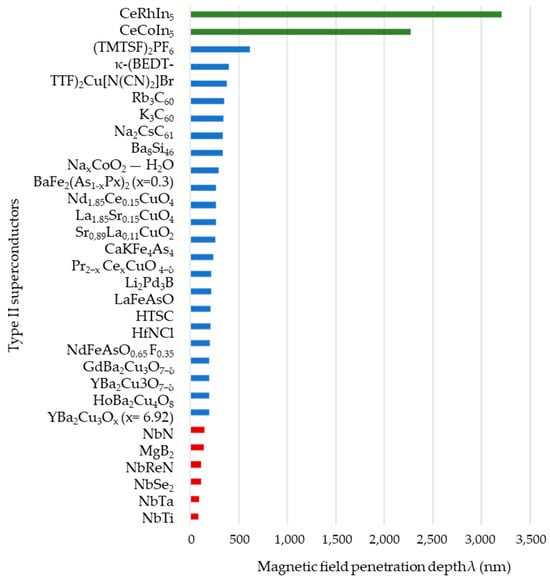
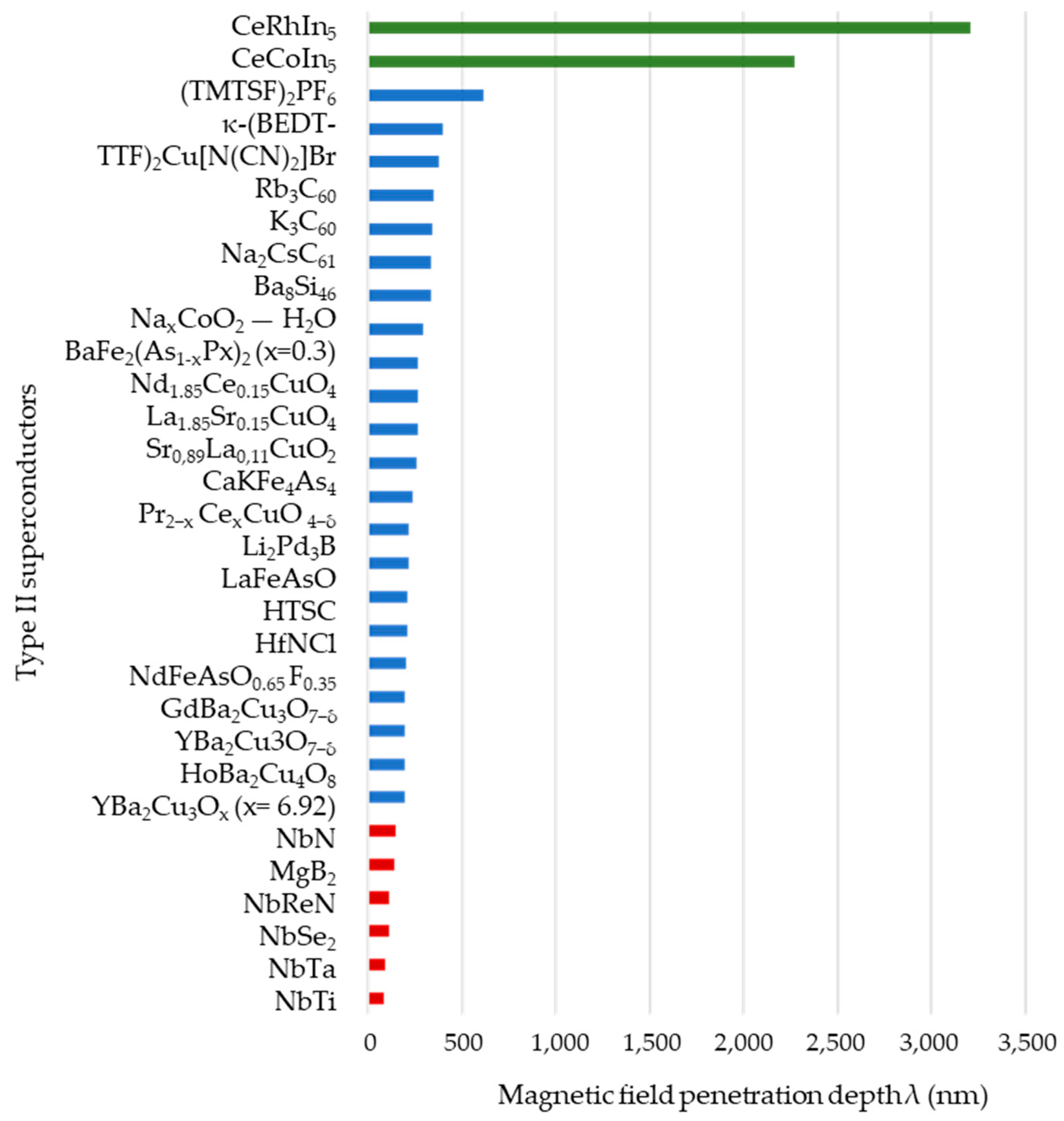
The variability of λ between 40 and 614 nm in type II superconductors reflects differences in the structure and electron density of the materials. Low λ values correspond to superconductors with strong magnetic exclusion and a high carrier density, while high λ values indicate deeper magnetic penetration, typical of materials with lower carrier density or complex structures, allowing the formation of more vortices within the material without breaking the conductivity state. In addition, Figure 8 details heavy superconductors such as CeCoIn5 and CeRhIn5 are materials in which the charge-carrying electrons have an effective mass much greater than the mass of the free electron, i.e., the magnetic field penetration depths are much greater than conventional superconductors such as NbTi and NbtTa.
Figure 8.
Depth of penetration of (λ) in type II superconductors.
The correlation coefficient of −0.324 between the variables λ (the penetration length in nanometers) and Tc (the critical temperature in K) indicates a weak negative relationship, i.e., as Tc increases, λ tends to decrease slightly, but this trend is not very pronounced. The p-value of 0.081, compared to a significance level of 5% (α = 0.05), indicates that the relationship shown is not statistically significant. Table 3 presents the information that there is insufficient evidence to conclude that there is a linear correlation between λ and Tc, i.e., the null hypothesis is not rejected.
Table 3.
Depth of penetration of the magnetic field and correlation in type II superconductors.
For insulating material data, the Kolmogorov–Smirnov normality test was performed, with a significance value (p-value) of 0.200 and 5 degrees of freedom (gl = 5), indicating that the significance value is greater than the common threshold of 0.05. Therefore, the data follow a normal distribution for the given sample size and significance level.
It is noted that the λ lambda values were calculated using the standard formula and the specific properties of each material. Materials with low electrical conductivity (such as rock and dry soil) show significantly higher penetration depths, whereas materials with high conductivity (such as brain and meat) have lower values, reflecting the rapid attenuation of the magnetic field.
There is an inverse correlation; as Tc increases, λ also tends to be higher. This suggests that superconductors with higher Tc have weaker coupling of electrons in the superconducting state, allowing the magnetic field to penetrate deeper. Also, type I superconductors are ideal for applications where perfectly diamagnetic behavior is required, but their usefulness is limited by the low Tc and their abrupt transition between the superconducting state and the normal state under a critical magnetic field.
The data in Table 4 show that the penetration depth (λ) of the magnetic field varies significantly as a function of the electrical conductivity (σ) and frequency of the electromagnetic wave. In particular, as the conductivity and frequency increase, the penetration depth decreases significantly, a fundamental aspect for applications in geophysics, biomedicine and communications.
Table 4.
Depth λ (mm) in natural materials.
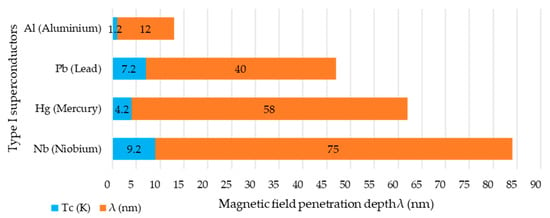
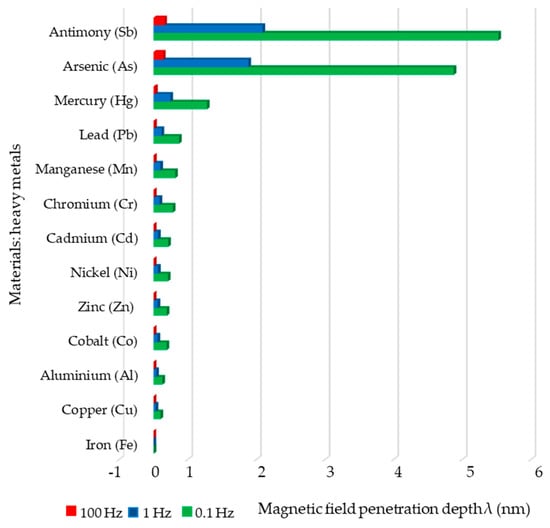
In Figure 9, Type I superconductors include pure elements such as niobium (Nb), mercury (Hg), lead (Pb) and aluminium (Al). These materials exhibit superconductivity with an abrupt transition and total expulsion of the magnetic field (Meissner effect). They have a single critical field (Hc) and are used in low temperature applications.
Figure 9.
Penetration depth of (λ) in type I superconducting materials.
Table 5 includes conductive materials such as copper (Cu), aluminium (Al), titanium (Ti) and VT6 (ECB), used in electrical conduction and structural applications. Copper and aluminium are notable for their high thermal and electrical conductivity, while titanium and VT6 offer high mechanical and corrosion resistance and are essential in the aerospace and superconductor industries. In addition, the depth of penetration of the magnetic field in these materials is a key factor in their electromagnetic behaviour.
Table 5.
Depth λ (mm) in common conductive materials.
Conductors such as copper and aluminum have a shallower penetration due to their high conductivity. But titanium and VT6 (ECB), being less conductive materials, allow a greater penetration of the magnetic field, as eddy currents are less effective in these materials, i.e., the depth of penetration is inversely related to the conductivity of the material: the higher the conductivity, the lower the penetration of the magnetic field. Likewise, the frequency of the magnetic field and the permeability of the material are also key factors affecting this behavior.
There is no material that is completely insulating from the magnetic field, as magnetic fields pass through almost all materials to some extent. However, some materials can deflect, reduce, or partially block the magnetic field through mechanisms such as absorption, reflection, or shielding.
4. Discussion
The application of Equations (6) and (7) has led to confusion regarding the units of measurement since, when substituting values, the simplification of units is not always correct. In some cases, the penetration depth λ ends up being expressed in meters per second, as if it were a velocity, instead of meters. Such inconsistencies can not only lead to experimental errors but also affect the theoretical interpretation of the results.
While the International System of Units (SI) provides a rigorous framework based on the decimal metric system, the evolution of quantum standards has redefined measurements in terms of fundamental constants, ensuring greater precision and reliability in advanced scientific applications. In this context, it is crucial to analyze how the equations used align with these modern definitions to avoid errors in the interpretation of physical quantities and their application in superconductivity and other research fields [77,78]; however, this approach maintains the original idea, but with more emphasis on the problem, its impact, and the relevance of unit systems in science and technology.
Agreeing with [79], external environmental elements can influence the electromagnetic waves emitted by a generator, causing attenuations when interacting with structures. This effect should be considered when assessing the penetration range of the magnetic field.
This is consistent with what is mentioned in [80], where the signal-to-noise ratio improves at higher frequencies, but magnetic impurities in cement widen the lines, reducing the resolution at higher magnetic fields.
We affirm the view expressed in [81] that devices exist that detect parallel magnetic vortices with nanometer resolution, accurate depth, and low field induction, operating in applied fields up to 200 mT.
We agree with the claim in [82] that at a zero temperature, the magnetic penetration depth (λ) varies linearly with the magnetic field, reflecting the non-linear Meissner, although the experimental evidence is uncertain due to external factors fluctuating in milliseconds, as also mentioned by the authors of [83].
As stated by the authors of [84], interlayer interactions in superconducting heterostructures are crucial, as they affect the current distribution at the interfaces. This modifies the response to external currents, magnetic fields, and electromagnetic stimuli, complicating the overall behavior of the system.
In veracity [2], the optimized performance of RF and AM atomic magnetometers at low frequencies allows for the EMI interference to be measured with high sensitivity, which is useful for detecting concealed weapons or underground imperfections, albeit with limitations in certain applications.
The penetration depth of ultraviolet radiation increased when the stratum corneum was thinner. This experiment improves the understanding of the wavelength and penetration of light into the skin, which could optimize light-based diagnostic and therapeutic approaches for dermal diseases [85]. However, it is also necessary to investigate the possible side effects of the magnetic field when used in species treatments and in prescriptions for muscle diseases or biological tissue [86].
Regarding electromagnetic field propagation and the skin effect [87,88], these principles will depend on a variable known as the wave propagation frequency. However, for alternating electromagnetic fields, higher frequencies will decrease the penetration depth due to the skin effect.
The research articles reviewed focus mainly on materials such as conductors, semiconductors, superconductors, insulators, and natural materials. However, this analysis is extended to include the behavior of magnetic fields in insulating materials and heavy metals, given their relevance. It is essential not to limit the study to the properties of the magnetic field but to consider all factors that can generate new knowledge and evaluate the possible collateral effects that these materials may have on living beings.
ω = 2πf is the angular frequency (in radians per second), f is the frequency of the electromagnetic wave (in Hz), μ is the magnetic permeability for all materials listed in the table (4π × 10−7 H/m), and σ is the electrical conductivity (in S/m). For this case, a frequency of 1 × 10⁹ Hz was considered, corresponding to high-frequency radio waves, such as those used in telecommunications or radar systems. Magnetic permeability is considered uniform for all materials in Table 6, which is a valid approximation for non-ferromagnetic materials. Electrical conductivities vary significantly, which impacts the penetration depth (λ).
Table 6.
Depth of penetration of the magnetic field into insulating materials.
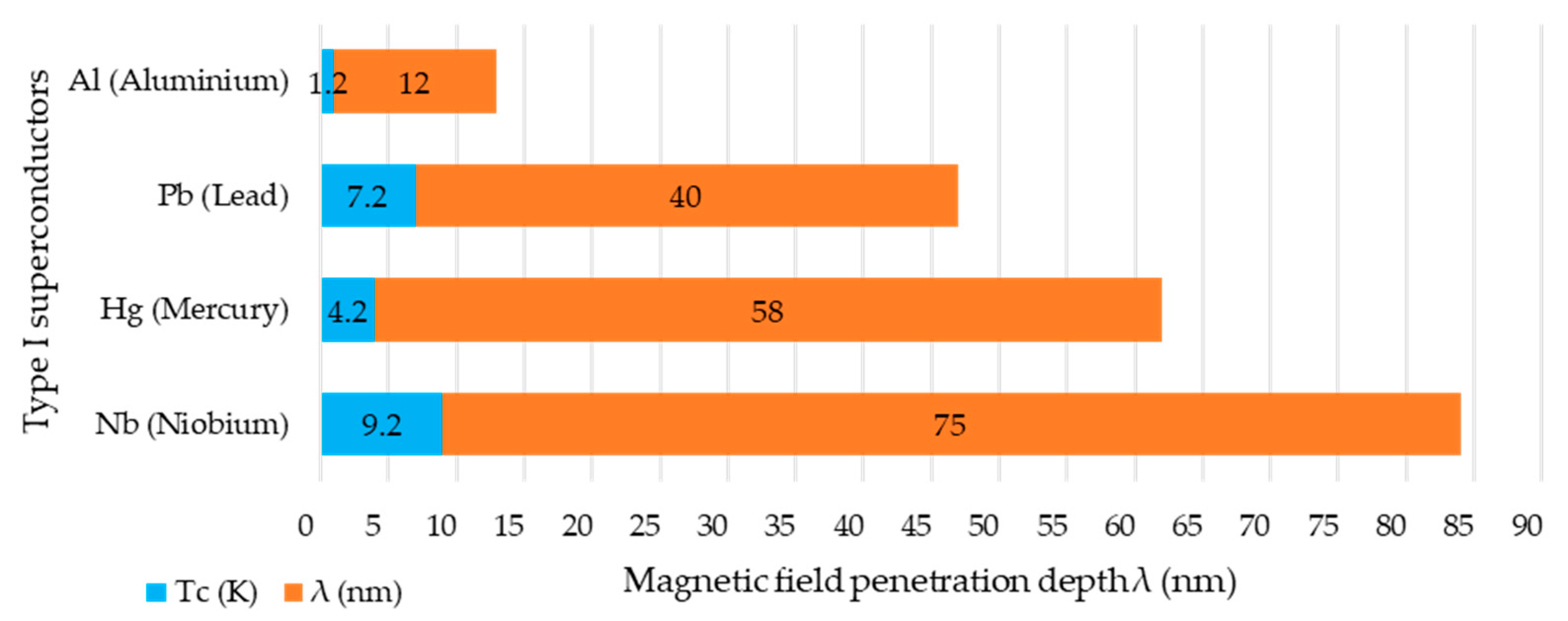
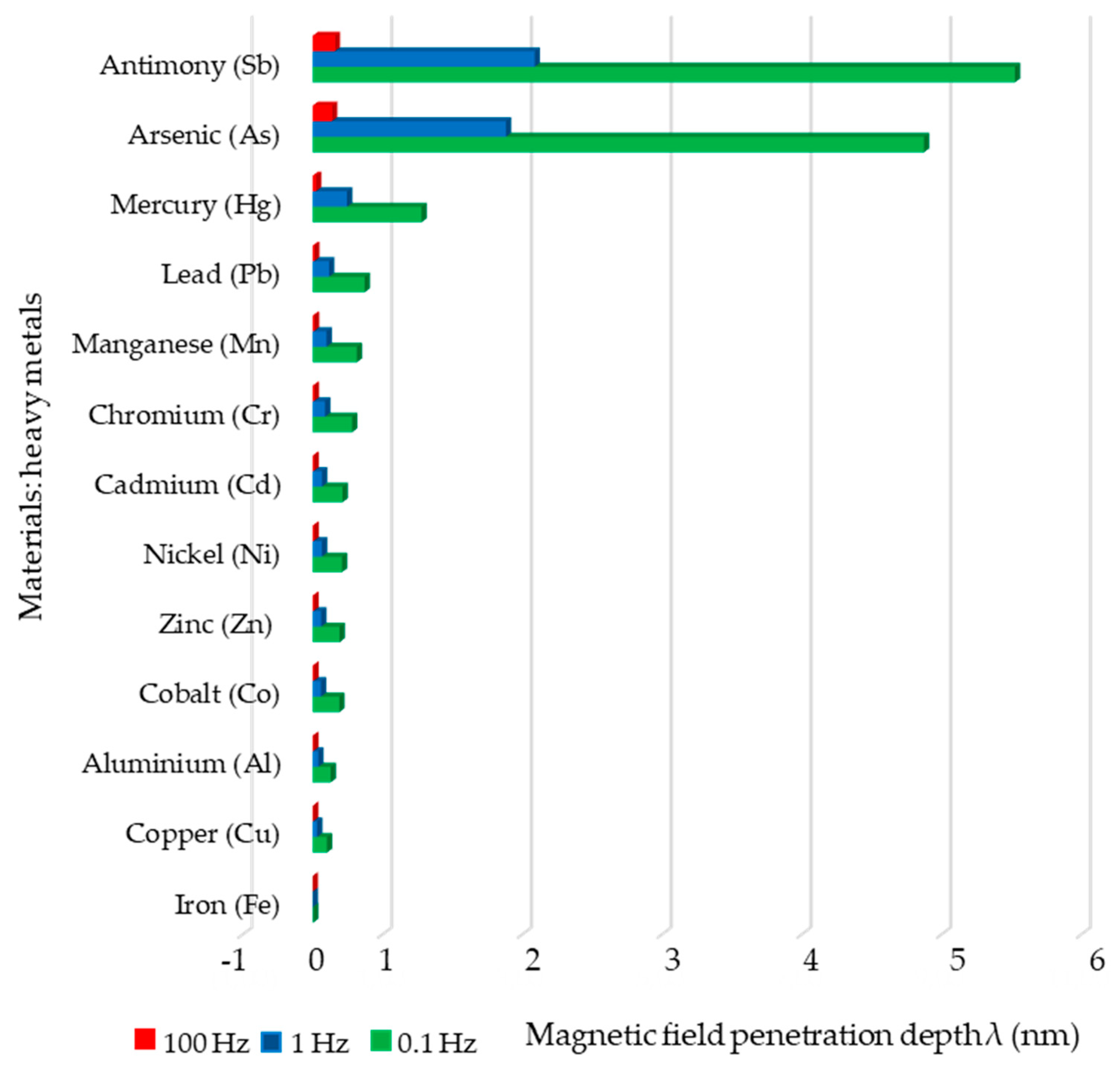
The Figure 10 shows that the penetration depth of a magnetic field in heavy metals can reach approximately 10 m, as calculated with Equation (6). This result confirms that, at lower frequencies, the penetration of the magnetic field is greater. The calculations were based on typical values of intrinsic material properties, such as conductivity and magnetic permeability, which determine the degree of field attenuation as a function of frequency.
Figure 10.
Penetration depth of (λ) in heavy metals.
This information is essential for various applications in engineering, physics, geophysics, and human health. However, it is important to consider that some heavy metals, in addition to their useful properties, are toxic and can cause significant damage to organs such as the brain, kidneys, and liver.
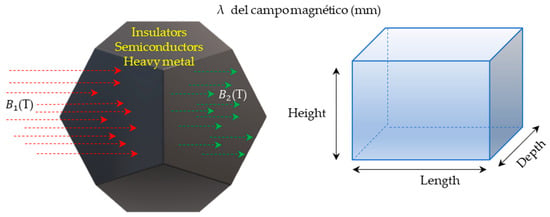
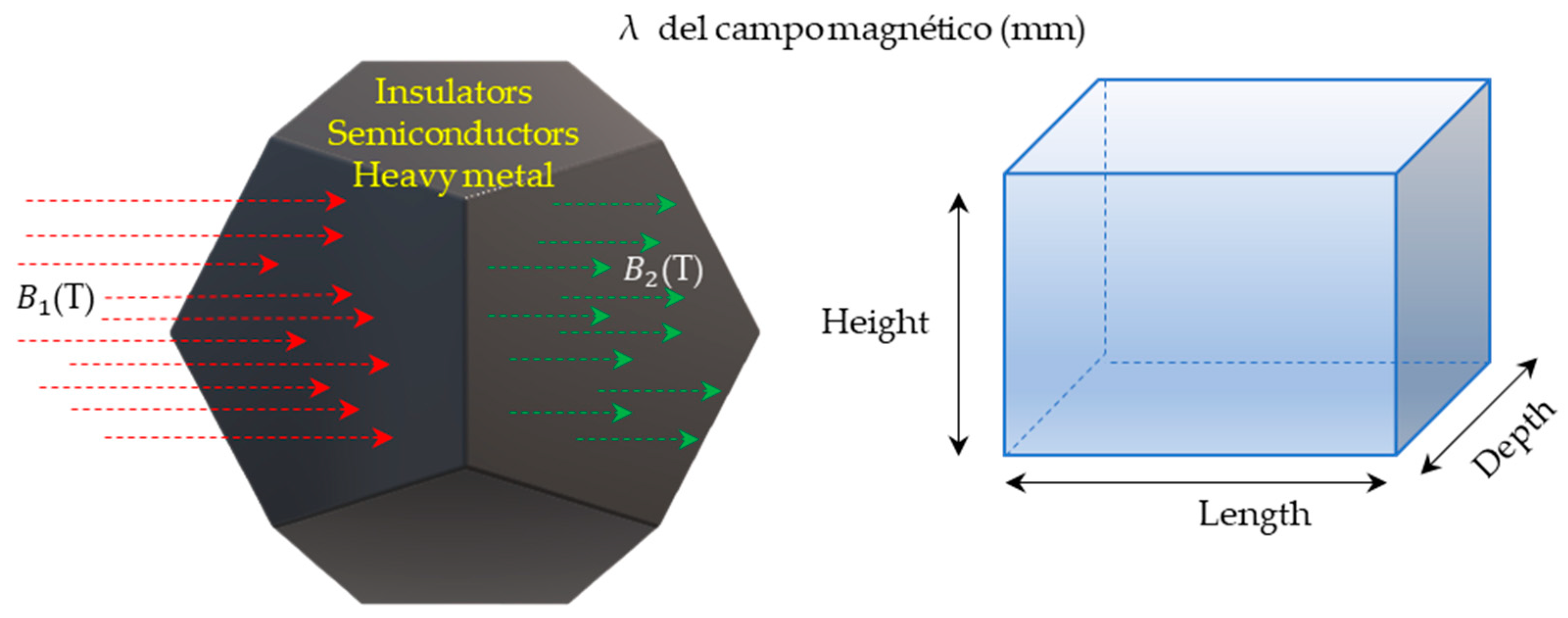
The depth of penetration of the magnetic field (ppB, in mm) represents the distance an initial magnetic field (B1, in Teslas) can penetrate a material before attenuating significantly. Figure 11 shows that the magnetic field passing through the material (B2, in Teslas) is significantly lower due to the loss of intensity caused by the intrinsic attenuation of the material.
Figure 11.
Symbolic schematic of magnetic field penetration (adapted from [89]).
This phenomenon is determined by the material properties, such as conductivity and magnetic permeability, and varies according to the type of material (insulators, semi-conductors, heavy metals, superconductors, conductors, and natural materials). Each type of material exhibits unique behavior toward magnetic field propagation, leading to significant differences in B2 values and penetration depth (λ).
The application of the magnetic field penetration depth could revolutionize areas such as the detection of metals and other materials under complex media, including water, rock, sand, clay, wet soil, biological tissues (such as animal skin), wood, and concrete. This approach could significantly improve scanning and diagnostic capabilities in hard-to-reach environments.
The design of new materials capable of blocking magnetic fields without interfering with data transmission represents a promising challenge. Such shielding could be key to ensuring signal integrity in advanced communication systems, particularly in environments with high electromagnetic interference.
The exploration of the magnetic field as a means to transport wireless energy and information could transform telecommunications technology and remote power systems, offering more efficient and sustainable solutions.
The interaction of the magnetic field with biological tissues opens up new possibilities in regenerative medicine, such as the controlled stimulation of skin, soft tissue, and bone regeneration. This could be an effective alternative in the treatment of chronic diseases and traumatic injuries.
Magnetic field-based technology could be used to detect cracks and structural defects in buildings in a non-invasive way. This would provide a valuable tool for the assessment and maintenance of critical infrastructure.
The use of the magnetic field in modulating biological behavior could help control insect populations harmful to human health. In addition, selective exposure to magnetic fields could be investigated as a method to deactivate or destroy viruses and other pathogens in the environment.
These ideas, presented through experience, mathematical models, and scientific readings, advance the possibility of futuristic scenarios combining applied physics, advanced engineering, and biotechnology, opening new frontiers for science and technology.
5. Conclusions
Magnetic permeability (μ = 4π × 10−7 H/m) is considered uniform in conducting, superconducting, natural, insulating, and heavy metal materials. However, variations in electrical conductivity (σ) significantly influence the penetration depth of the magnetic field (λ), which varies from 12 nm to 15,915,494 km, depending on the attenuating material.
When substituting values into the equations, errors can arise in the units of λ, such as expressing them in meters per second instead of meters. It is, therefore, essential to respect the International System of Units (SI) to ensure accuracy in calculations and facilitate subsequent experimental studies.
In conductive materials, the penetration depth of the magnetic field is low due to the rapid attenuation caused by eddy currents. This effect is particularly noticeable in metals such as copper, where, at a frequency of 60 Hz, λ reaches approximately 8 mm.
The analysis shows that, in natural materials, the penetration depth of the magnetic field varies between 29 and 91,888,149 m due to the absence of eddy currents. In dielectric materials, such as water and ceramics, the magnetic field is moderately attenuated, allowing greater penetration, although the ionized conductivity of water can generate minimal attenuation.
In heavy metals, the methodology applied according to Equation (6) indicates that the magnetic field penetration can reach up to 10 m, decreasing with increasing frequency. This phenomenon, determined via conductivity and magnetic permeability, has relevant applications in engineering, physics, and health; however, heavy metals can pose toxic risks to vital organs.
In insulating materials, the absence of free charges prevents the generation of eddy currents or significant attenuations, allowing the magnetic field to pass almost completely through them, regardless of frequency. The analysis indicates that λ in these materials varies between 5 and 168 m.
The correlation coefficient of −0.324 between the variables λ (penetration length in nanometers) and Tc (critical temperature in Kelvin) indicates a weak negative relationship, i.e., as Tc increases, λ tends to decrease slightly. The p-value of 0.081, compared to the 5% significance level (α = 0.05), suggests that the observed relationship is not statistically significant. This means that there is no linear correlation between λ and the critical temperature. This has applications in engineering, such as communications and geophysical exploration; in health, in biomedical therapies; and in physics, in the design of superconducting devices.
Author Contributions
Conceptualisation, P.P.A.G.; methodology, P.P.A.G.; software, W.M.Z.Z.; validation, W.M.Z.Z.; formal analysis, P.P.A.G.; research, P.P.A.G.; resources, E.V.P.; data preservation, E.V.P.; drafting (original draft, review, and editing), P.P.A.G.; visualization, G.E.O.C.; supervision, G.E.O.C.; project management, R.A.F.V. All authors have read and agreed to the published version of the manuscript.
Funding
This review research did not receive external funding, however, for payment of the APC it is possible that the Universidad Nacional Intercultural Fabiola Salazar Leguía de Bagua may fund extemporaneously.
Acknowledgments
We are grateful to the Universidad Nacional Intercultural Fabiola Salazar Leguía de Bagua for providing support for scientific research courses, as this manuscript is a product of it.
Conflicts of Interest
The authors declare that they have no conflict of interest.
References
- Xia, X.; Pagano, A.; Macovei, A.; Padula, G.; Balestrazzi, A.; Hołubowicz, R. Magnetic field treatment on horticultural and agricultural crops: Its benefits and challenges. Folia Hortic. 2024, 14, 67–80. [Google Scholar] [CrossRef] [Scilit]
- Maddox, B.; Renzoni, F. Two-photon electromagnetic induction imaging with an atomic magnetometer. Appl. Phys. Lett. 2023, 122, 144001. [Google Scholar] [CrossRef] [Scilit]
- Ülgen, C.; Yıldırım, A.B.; Türker, A.U. Enhancement of Plant Regeneration in Lemon Balm (Melissa officinalis L.) with Different Magnetic Field Applications. Int. J. Second. Metab. 2020, 7, 99–108. [Google Scholar] [CrossRef] [Scilit]
- Hwang, J.Y.; Park, S.J.; Son, Y.; Jung, H.Y. Influence of In Situ Magnetic Field on Magnetic Properties of a Bonded Permanent Magnet Manufactured through Material Extrusion Additive Manufacturing. Metals 2023, 13, 1653. [Google Scholar] [CrossRef] [Scilit]
- Boeira, C.Z.; Silvello, M.A.d.C.; Remedi, R.D.; Feltrin, A.C.P.; Santos, L.O.; Garda-Buffon, J. Mitigation of nivalenol using alcoholic fermentation and magnetic field application. Food Chem. 2021, 340, 127935. [Google Scholar] [CrossRef] [Scilit] [PubMed]
- Keckert, S.; Junginger, T.; Buck, T.; Hall, D.L.; Kolb, P.; Kugeler, O.; Laxdal, R.; Liepe, M.; Posen, S.; Prokscha, T.; et al. Critical fields of Nb3Sn prepared for superconducting cavities. Supercond. Sci. Technol. 2019, 32, 075004. [Google Scholar] [CrossRef] [Scilit]
- Ding, S.; Zhao, D.; Jiang, T.; Wang, H.; Feng, D.; Zhang, T. Surface structure and multigap superconductivity of V3Si (111) revealed by scanning tunneling microscopy. Quantum Front. 2023, 2, 3. [Google Scholar] [CrossRef] [Scilit]
- Zaidi, N.S.; Sohaili, J.; Muda, K.; Sillanpää, M. Magnetic field application and its potential in water and wastewater treatment systems. Sep. Purif. Rev. 2014, 43, 206–240. [Google Scholar] [CrossRef] [Scilit]
- Shen, K.; Xu, X.; Tang, Y. Recent progress of magnetic field application in lithium-based batteries. Nano Energy 2021, 92, 106703. [Google Scholar] [CrossRef] [Scilit]
- Widodo, P.J.; Budiana, E.P.; Ubaidillah, U.; Imaduddin, F.; Choi, S.B. Effect of Time and Frequency of Magnetic Field Application on MRF Pressure Performance. Micromachines 2022, 13, 222. [Google Scholar] [CrossRef] [Scilit] [PubMed]
- Restrepo-álvarez, A.F.; Franco-Mejía, E.; Cadavid-Ramírez, H.; Pinedo-Jaramillo, C.R. A simple geomagnetic field compensation system for uniform magnetic field applications. Rev. Fac. De Ing. 2017, 2017, 65–71. [Google Scholar] [CrossRef] [Scilit]
- Turner, D.A.; Malyshev, O.B.; Burt, G.; Junginger, T.; Valizadeh, R.; Gurran, L. A facility for the characterisation of planar multilayer structures with preliminary niobium results. Supercond. Sci. Technol. 2022, 35, 095004. [Google Scholar] [CrossRef] [Scilit]
- Richter, A.; Ferková, Ž.; Bittner, V. Physical Analysis of Low-dynamic Magnetic Field Impact on Human Tissue. Trans. Electr. Eng. 2020, 7, 14–17. [Google Scholar] [CrossRef] [Scilit]
- Lu, M.; Ueno, S. Comparison of the induced fields using different coil configurations during deep transcranial magnetic stimulation. PLoS ONE 2017, 12, e0178422. [Google Scholar] [CrossRef] [Scilit] [PubMed]
- Uemura, Y.J.; Le, L.P.; Luke, G.M. Muon spin relaxation studies in organic superconductors and organic magnets. Synth. Met. 1993, 56, 2845–2852. [Google Scholar] [CrossRef] [Scilit]
- Junior, C.N.F.; Redkva, P.E.; Sandrino, B. Semiconductors in the digital age: Developments, challenges and geopolitical implications. Multidiscip. Sci. J. Núcleo Do Conhecimento 2023, 2, 133–150. [Google Scholar] [CrossRef] [Scilit]
- Kloß, S.D.; Haffner, A.; Manuel, P.; Goto, M.; Shimakawa, Y.; Attfield, J.P. Preparation of iron(IV) nitridoferrate Ca4FeN4 through azide-mediated oxidation under high-pressure conditions. Nat. Commun. 2021, 12, 571. [Google Scholar] [CrossRef] [Scilit]
- Kalinowska-Wichrowska, K.; Ramírez, C.P.; Barriguete, A.V. The second life of construction waste. Proposal to reuse recycled fine aggregate and residues of insulating materials. An. Edif. 2019, 5, 1–8. [Google Scholar] [CrossRef] [Scilit]
- Pang, J.; Wang, Y.; Yang, X.; Zhang, L.; Li, Y.; Zhang, Y.; Yang, J.; Yang, F.; Wang, X.; Cuniberti, G.; et al. A wafer-scale two-dimensional platinum monosulfide ultrathin film: Via metal sulfurization for high performance photoelectronics. Mater. Adv. 2022, 3, 1497–1505. [Google Scholar] [CrossRef] [Scilit]
- Dzhumanov, S.; Turmanova, U.M.; Kurbanov, U.T. Two distinctive temperature dependences of the London penetration depth in high-Tc cuprate superconductors as support for the theory of Bose-liquid superconductivity. Phys. Lett. Sect. A 2022, 452, 128447. [Google Scholar] [CrossRef] [Scilit]
- Minkov, V.S.; Bud’ko, S.L.; Balakirev, F.F.; Prakapenka, V.B.; Chariton, S.; Husband, R.J.; Liermann, H.P.; Eremets, M.I. Magnetic field screening in hydrogen-rich high-temperature superconductors. Nat. Commun. 2022, 13, 3194. [Google Scholar] [CrossRef] [Scilit] [PubMed]
- Yang, Y.; Hoffman, S.; Lu, H.; Nguyen, H.; Makaroff, S.N.; Li, C.Q. High inductance magnetic-core coils have enhanced efficiency in inducing suprathreshold motor response in rats. Phys. Med. Biol. 2023, 68, 244001. [Google Scholar] [CrossRef] [Scilit]
- Cichewicz, A. SA43 Uptake of the Prisma 2020 Statement and Its Artificial Intelligence Component in Recently Published Systematic Reviews. Value Health 2023, 26, S405. [Google Scholar] [CrossRef] [Scilit]
- Aras, A.; Büyüközkan, G. Digital Transformation Journey Guidance: A Holistic Digital Maturity Model Based on a Systematic Literature Review. Systems 2023, 11, 213. [Google Scholar] [CrossRef] [Scilit]
- Sari, D.P.; Kaito, M.; Someya, Y.; Widyaiswari, U.; Watanabe, I.; Taniguchi, H.; Ishii, Y. Superconductivity nearby quantum critical region in hole-doped organic strange metal κ-(ET)4Hg3−δBr8, δ = 11%. J. Phys. Conf. Ser. 2023, 2462, 012061. [Google Scholar] [CrossRef] [Scilit]
- Curreli, N.; Lodi, M.B.; Melis, A.; Puddu, C.; Casu, S.; Fanti, A.; Djuric, N.; Retico, A.; Mazzarella, G. Analysis of a Flexible Dual-Channel Octagonal Coil System for UHF MRI. IEEE Access 2022, 10, 104589–104597. [Google Scholar] [CrossRef] [Scilit]
- Ovchinnikov, V.V.; Luk’yanenko, E.V.; Kurbatova, I.A.; Yakutina, S.V. Investigation of the effect of the treatment of the surface of VT6 alloy on the penetration depth of implantable ions. IOP Conf. Ser. Mater. Sci. Eng. 2020, 971, 032018. [Google Scholar] [CrossRef] [Scilit]
- Kanagasuntharam, S.; Ramakrishnan, S.; Muthukrishnan, S.; Sanjayan, J. Effect of Magnetorheological additives on the buildability of 3D concrete printing. J. Build. Eng. 2023, 74, 106814. [Google Scholar] [CrossRef] [Scilit]
- Zhigadlo, N.D.; Puzniak, R.; Moll, P.J.W.; Bernardini, F.; Shiroka, T. Emergence of superconductivity in single-crystalline LaFeAsO under simultaneous Sm and P substitution. J. Alloys Compd. 2023, 958, 170384. [Google Scholar] [CrossRef] [Scilit]
- Noyan, A.A.; Ovchenkov, Y.A.; Ryazanov, V.V.; Golovchanskiy, I.A.; Stolyarov, V.S.; Levin, E.E.; Napolskii, K.S. Size-Dependent Superconducting Properties of In Nanowire Arrays. Nanomaterials 2022, 12, 4095. [Google Scholar] [CrossRef] [Scilit] [PubMed]
- Ivan, I.; Ionescu, A.M.; Crisan, D.N.; Crisan, A. Vortex Glass—Vortex Liquid Transition in BaFe2(As1−xPx)2 and CaKFe4As4 Superconductors from Multi-Harmonic AC Magnetic Susceptibility Studies. Int. J. Mol. Sci. 2023, 24, 7896. [Google Scholar] [CrossRef] [Scilit] [PubMed]
- Gat, I.M.; Fudamoto, Y.; Kinkhabwala, A.; Larkin, M.; Luke, G.; Merrin, J.; Nachumi, B.; Uemura, Y.; Kojima, K.; Eiji, E.; et al. Muon spin relaxation measurements of magnetic-field penetration depth in Ba8Si46. Phys. B Condens. Matter 2000, 289–290, 385–388. [Google Scholar] [CrossRef] [Scilit]
- Uemura, Y.J.; Fudamoto, Y.; Gat, I.; Larkin, M.; Luke, G.; Merrin, J.; Kojima, K.; Itoh, K.; Yamanaka, S.; Heffner, R.; et al. μSR studies of intercalated HfNCl superconductor. Phys. B Condens. Matter 2000, 289–290, 389–392. [Google Scholar] [CrossRef] [Scilit]
- Landau, I.L.; Khasanov, R.; Togano, K.; Keller, H. Temperature dependences of the upper critical field and the Ginzburg-Landau parameter of Li2Pd3B from magnetization measurements. Phys. C Supercond. Its Appl. 2007, 451, 134–138. [Google Scholar] [CrossRef] [Scilit]
- Halbritter, J. Comments on deviations of the penetration depth of niobium from BCS calculations. J. Appl. Phys. 1975, 46, 1403–1404. [Google Scholar] [CrossRef] [Scilit]
- Belogolovskii, M.; Poláčková, M.; Zhitlukhina, E.; Grančič, B.; Satrapinskyy, L.; Gregor, M.; Plecenik, T. Competing length scales and 2D versus 3D dimensionality in relatively thick superconducting NbN films. Sci. Rep. 2023, 13, 19450. [Google Scholar] [CrossRef] [Scilit] [PubMed]
- Membrilla, J.A.V.; Pantoja, M.F.; Puerta, A.P.V.; Souza, V.H.; Sanchez, C.C. Design of Transcranial Magnetic Stimulation Coils With Optimized Stimulation Depth. IEEE Access 2024, 12, 1330–1340. [Google Scholar] [CrossRef] [Scilit]
- Landau, I.L.; Keller, H. On the interpretation of muon-spin-rotation experiments in the mixed state of type-II superconductors. Phys. C Supercond. Its Appl. 2007, 466, 131–141. [Google Scholar] [CrossRef] [Scilit]
- Cherednichenko, S.; Acharya, N.; Novoselov, E.; Drakinskiy, V. Low kinetic inductance superconducting MgB2nanowires with a 130 ps relaxation time for single-photon detection applications. Supercond. Sci. Technol. 2021, 34, 044001. [Google Scholar] [CrossRef] [Scilit]
- Kakhaki, Z.M.; Leo, A.; Spuri, A.; Ejrnaes, M.; Parlato, L.; Pepe, G.; Avitabile, F.; Di Bernardo, A.; Nigro, A.; Attanasio, C.; et al. Characterization of quasiparticle relaxation times in microstrips of NbReN for perspective applications for superconducting single-photon detectors. Mater. Sci. Eng. B 2024, 304, 117376. [Google Scholar] [CrossRef] [Scilit]
- Motovilova, E.; Sandeep, S.; Hashimoto, M.; Huang, S.Y. Water-Tunable Highly Sub-Wavelength Spiral Resonator for Magnetic Field Enhancement of MRI Coils at 1.5 T. IEEE Access 2019, 7, 90304–90315. [Google Scholar] [CrossRef] [Scilit]
- Khasanov, R.; Shengelaya, A.; Brütsch, R.; Keller, H. Suppression of the s-wave order parameter near the surface of the infinite-layer electron-doped cuprate superconductor Sr0.9La0.1CuO2. Condens Matter 2020, 5, 50. [Google Scholar] [CrossRef] [Scilit]
- Nam, T.; Kim, D.; Seo, M.; Im, G.; Hernandez, D.; Lee, T.; Kim, K.-N. Design of Rotated Surface Coil Array for Multiple-Subject Imaging at 400 MHz. IEEE Access 2022, 10, 66281–66289. [Google Scholar] [CrossRef] [Scilit]
- Smith, M.C.; Li, A.; Sievenpiper, D.F. A Multifunction Dense Array System with Reconfigurable Depth of Penetration. IEEE J. Electromagn. RF Microw Med. Biol. 2021, 5, 35–45. [Google Scholar] [CrossRef] [Scilit]
- Huang, Z. Temperature dependence of penetration depth in electron-doped cuprate superconductors. J. Phys. Conf. Ser. 2012, 400, 022030. [Google Scholar] [CrossRef] [Scilit]
- Luke, G.M.; Fudamoto, Y.; Kojima, K.; Larkin, M.; Merrin, J.; Nachumi, B.; Uemura, Y.; Sonier, J.; Ito, T.; Oka, K.; et al. Magnetic field penetration depth in single crystal La1.85Sr0.15CuO4 and Nd1.85Ce0.15CuO4. Phys. C Supercond 1997, 282–287, 1465–1466. [Google Scholar] [CrossRef] [Scilit]
- Gäbler, S.; Heuer, H.; Heinrich, G. Measuring and Imaging Permittivity of Insulators Using High-Frequency Eddy-Current Devices. IEEE Trans. Instrum. Meas. 2015, 64, 2227–2238. [Google Scholar] [CrossRef] [Scilit]
- Wu, X.; Xue, G.; Fang, G.; Li, X.; Ji, Y. The Development and Applications of the Semi-Airborne Electromagnetic System in China. IEEE Access 2019, 7, 104956–104966. [Google Scholar] [CrossRef] [Scilit]
- Heffner, R.H.; Goko, T.; Andreica, D.; Ohishi, K.; Higemoto, W.; Ito, T.U.; Amato, A.; Spehling, J.; Klauss, H.-H.; Bauer, E.D.; et al. μsR study of CeRhIn5 under applied pressure. J. Phys. Conf. Ser. 2010, 225, 012011. [Google Scholar] [CrossRef] [Scilit]
- Bonato, M.; Chiaramello, E.; Parazzini, M.; Gajsek, P.; Ravazzani, P. Extremely Low Frequency Electric and Magnetic Fields Exposure: Survey of Recent Findings. IEEE J. Electromagn. RF Microw. Med. Biol. 2023, 7, 216–228. [Google Scholar] [CrossRef] [Scilit]
- Imajo, S.; Kindo, K. The fflo state in the dimer mott organic superconductor κ-(BEDT-TTF)2Cu[N(CN)2]Br. Crystals 2021, 11, 1358. [Google Scholar] [CrossRef] [Scilit]
- Shevtsova, O.N. Magnetoresistance peculiarities and magnetization of materials with two kinds of superconducting inclusions. Mater. Sci. Pol. 2015, 33, 73–81. [Google Scholar] [CrossRef] [Scilit]
- Le, L.P.; Luke, G.; Sternlieb, B.; Wu, W.; Uemura, Y.; Brill, J.; Drulis, H. Magnetic penetration depth in layered compound NbSe2 measured by muon spin relaxation. Phys. C Supercond. Its Appl. 1991, 185–189, 2715–2716. [Google Scholar] [CrossRef] [Scilit]
- Feng, S.; Huang, Z.; Zhao, H. Doping dependence of Meissner effect in cuprate superconductors. Phys. C Supercond. Its Appl. 2010, 470, 1968–1976. [Google Scholar] [CrossRef] [Scilit]
- Gupta, R.; Maisuradze, A.; Zhigadlo, N.D.; Luetkens, H.; Amato, A.; Khasanov, R. Self-Consistent Two-Gap Approach in Studying Multi-Band Superconductivity of NdFeAsO0.65F0.35. Front. Phys. 2020, 8, 2. [Google Scholar] [CrossRef] [Scilit]
- Alexandrov, A.S.; Zhao, G.M. Isotope effects in high-Tccuprate superconductors as support for the bipolaron theory of superconductivity. New J. Phys. 2012, 14, 013046. [Google Scholar] [CrossRef] [Scilit]
- Krzyzosiak, M.; Gonczarek, R.; Gonczarek, A. Singular Fermi liquid as a model of unconventional superconductivity: Thermodynamic and magnetic properties. J. Phys. Conf. Ser. 2009, 152, 012058. [Google Scholar] [CrossRef] [Scilit]
- Dolgov, O.V.; Golubov, A.A.; Parker, D. Microwave response of superconducting pnictides: Extended s±scenario. New J. Phys. 2009, 11, 075012. [Google Scholar] [CrossRef] [Scilit]
- Yang, X.; Zhang, Z.; Ning, F.; Jiao, C.; Chen, L. Shielding effectiveness analysis of the conducting spherical shell with a circular aperture against low frequency magnetic fields. IEEE Access 2020, 8, 79844–79850. [Google Scholar] [CrossRef] [Scilit]
- Zalecki, R.; Woch, W.M.; Chrobak, M.; Kołodziejczyk, A. Penetration depth of magnetic field into YBa2Cu3Ox film on polycrystalline Ag substrate. Acta Phys. Pol. A 2015, 127, 272–274. [Google Scholar] [CrossRef] [Scilit]
- Belodedov, M.V.; Ichkitize, L.P. Modeling the dc current flow in granular superconductor wires. J. Sib. Fed. Univ. Math. Phys. 2017, 10, 239–243. [Google Scholar] [CrossRef] [Scilit]
- Adroja, D.; Bhattacharyya, A.; Smidman, M.; Hillier, A.; Feng, Y.; Pan, B.; Zhao, J.; Lees, M.R.; Strydom, A.; Biswas, P.K. Nodal superconducting gap structure in the quasi-one-dimensional Cs2Cr3As3 investigated using μsR measurements. J. Physical. Soc. Japan 2017, 86, 044710. [Google Scholar] [CrossRef] [Scilit]
- Gomes, N.; Almeida, M.E.; Machado, V.M. Series Impedance and Losses of Magnetic Field Mitigation Plates for Underground Power Cables. IEEE Trans. Electromagn. Compat. 2018, 60, 1761–1768. [Google Scholar] [CrossRef] [Scilit]
- Srpčič, J.; Perez, F.; Huang, K.Y.; Shi, Y.; Ainslie, M.D.; Dennis, A.R.; Filipenko, M.; Boll, M.; Cardwell, D.A.; Durrell, J.H. Penetration depth of shielding currents due to crossed magnetic fields in bulk (RE)-Ba-Cu-O superconductors. Supercond. Sci. Technol. 2019, 32, 035010. [Google Scholar] [CrossRef] [Scilit]
- Zhang, H.; Zhu, M.; Li, X.; Han, W.; Liu, Z. Very Low Frequency Propagation Characteristics Analysis in Coal Mines. IEEE Access 2020, 8, 95483–95490. [Google Scholar] [CrossRef] [Scilit]
- Krzyzosiak, M.; Huang, Z.; Feng, S.; Gonczarek, R. Electromagnetic response in kinetic energy driven cuprate superconductors: Linear response approach. Phys. C Supercond. Its Appl. 2010, 470, 407–414. [Google Scholar] [CrossRef] [Scilit]
- Shangguan, W.; Wang, X.; Huang, Z. The Magnetic Penetration Depth Calculated with the Mechanism of ‘Close-Shell Inversion. J. Mater. Sci. Chem. Eng. 2023, 11, 64–75. [Google Scholar] [CrossRef]
- Ghigo, G.; Torsello, D.; Gozzelino, L.; Fracasso, M.; Bartoli, M.; Pira, C.; Ford, D.; Marconato, G.; Fretto, M.; De Carlo, I.; et al. Vortex dynamics in NbTi films at high frequency and high DC magnetic fields. Sci. Rep. 2023, 13, 9315. [Google Scholar] [CrossRef] [Scilit] [PubMed]
- Dzebisashvili, D.M.; Klyuchantsev, A.B. London penetration depth as a test of order parameter symmetry in sodium cobaltate superconductors. Symmetry 2019, 11, 633. [Google Scholar] [CrossRef] [Scilit]
- Thanalakshme, R.P.; Kanj, A.; Kim, J.H.; Wilken-Resman, E.; Jing, J.; Grinberg, I.H.; Bernhard, J.T.; Tawfick, S.; Bahl, G. Magneto-Mechanical Transmitters for Ultralow Frequency Near-Field Data Transfer. IEEE Trans. Antennas Propag. 2022, 70, 3710–3722. [Google Scholar] [CrossRef] [Scilit]
- Barbruni, G.L.; Ros, P.M.; Demarchi, D.; Carrara, S.; Ghezzi, D. Miniaturised Wireless Power Transfer Systems for Neurostimulation: A Review. IEEE Trans. Biomed. Circuits Syst. 2020, 14, 1160–1178. [Google Scholar] [CrossRef] [Scilit] [PubMed]
- Sobota, P.; Topolnicki, R.; Ossowski, T.; Pikula, T.; Pikul, A.; Idczak, R. Superconductivity in the high-entropy alloy (NbTa)0.67(MoHfW)0.33. Phys. Rev. B 2022, 106, 184512. [Google Scholar] [CrossRef] [Scilit]
- Uemura, Y.J.; Keren, A.; Le, L.; Luke, G.; Wu, W.; Tsai, J.; Tanigaki, K.; Holczer, K.; Donovan, S.; Whetten, R. System dependence of the magnetic-field penetration depth in C60 superconductors. Phys. C Supercond. Its Appl. 1994, 235–240, 2501–2502. [Google Scholar] [CrossRef] [Scilit]
- Humphreys, W.J. Birkeland’s theory of magnetic storms and terrestrial magnetism. Terr. Magn. Atmos. Electr. 1909, 14, 81–83. [Google Scholar] [CrossRef] [Scilit]
- Mercer, W.J.; Pashkin, Y.A. Superconductivity: The path of least resistance to the future. Contemp. Phys. 2023, 64, 19–46. [Google Scholar] [CrossRef] [Scilit]
- Santos, E.S.D. A Teoria Microscópica BCS (Bardeen-Cooper-Schrieffer) e os Resultados da Eletrodinâmica de London; Anais dos Seminários de Iniciação Científica; Universidade Estadual De Feira De Santana: São Paulo, Brazil, 2021. [Google Scholar] [CrossRef] [Scilit]
- Göbel, E.O.; Siegner, U. Quantum Metrology: Foundation of Units and Measurements; Wiley: Hoboken, NJ, USA, 2015. [Google Scholar] [CrossRef] [Scilit]
- Magalhães, C. International System of Units (SI). Elem. Sci. Rev. 2021, 1, 1–6. [Google Scholar] [CrossRef] [Scilit]
- Lee, H.H.; Lim, J.-H.; Lee, J.W.; Kwon, J.H.; Hwang, J.-H.; Hyoung, C.H.; Park, H.H. Estimation of Electromagnetic Field Penetration into Concrete Buildings Using a Theoretical Approach Considering External Environmental Factors. J. Electromagn. Eng. Sci. 2023, 23, 212–223. [Google Scholar] [CrossRef] [Scilit]
- Pel, L.; Donkers, P.A.J.; Kopinga, K.; Noijen, J.J. 1H, 23Na and 35Cl Imaging in Cementitious Materials with NMR. Appl. Magn. Reson. 2016, 47, 265–276. [Google Scholar] [CrossRef] [Scilit] [PubMed]
- Junginger, T.; Laxdal, R.; MacFarlane, W.A.; Suter, A. SRF material research using muon spin rotation and beta-detected nuclear magnetic resonance. Front. Electron. Mater. 2024, 4, 1346235. [Google Scholar] [CrossRef] [Scilit]
- Wilcox, J.A.; Grant, M.J.; Malone, L.; Putzke, C.; Kaczorowski, D.; Wolf, T.; Hardy, F.; Meingast, C.; Analytis, J.G.; Chu, J.-H.; et al. Observation of the non-linear Meissner effect. Nat. Commun. 2022, 13, 1201. [Google Scholar] [CrossRef] [Scilit] [PubMed]
- Teknowijoyo, S.; Gulian, A. Superconductivity of amorphous and crystalline Re-Lu films. Supercond. Sci. Technol. 2024, 37, 035005. [Google Scholar] [CrossRef] [Scilit]
- Asaduzzaman, M.; Valente-Feliciano, A.-M.; Beverstock, D.R.; Suter, A.; Salman, Z.; Prokscha, T.; Junginger, T. Evidence for current suppression in superconductor-superconductor bilayers. Supercond. Sci. Technol. 2024, 37, 025002. [Google Scholar] [CrossRef] [Scilit]
- Finlayson, L.; Barnard, I.R.M.; McMillan, L.; Ibbotson, S.H.; Brown, C.T.A.; Eadie, E.; Wood, K. Depth Penetration of Light into Skin as a Function of Wavelength from 200 to 1000 nm. Photochem. Photobiol. 2022, 98, 974–981. [Google Scholar] [CrossRef] [Scilit] [PubMed]
- Kaub, L.; Schmitz, C. Comparison of the Penetration Depth of 905 nm and 1064 nm Laser Light in Surface Layers of Biological Tissue Ex Vivo. Biomedicines 2023, 11, 1355. [Google Scholar] [CrossRef] [Scilit]
- Matus, P.; Dantas, R.M.A.; Moessner, R.; Surówka, P. Skin effect as a probe of transport regimes in Weyl semimetals. Proc. Natl. Acad. Sci. USA 2022, 119, e2200367119. [Google Scholar] [CrossRef] [Scilit]
- Zhang, K.; Yang, Z.; Fang, C. Universal non-Hermitian skin effect in two and higher dimensions. Nat. Commun. 2022, 13, 2496. [Google Scholar] [CrossRef] [Scilit]
- Mikitik, G.P.; Sharlai, Y.V. Determination of the magnetic penetration depth with measurements of the vortex-penetration field for type-II superconductors. Phys. Rev. B 2024, 110, 064507. [Google Scholar] [CrossRef] [Scilit]

Disclaimer/Publisher’s Note: The statements, opinions and data contained in all publications are solely those of the individual author(s) and contributor(s) and not of MDPI and/or the editor(s). MDPI and/or the editor(s) disclaim responsibility for any injury to people or property resulting from any ideas, methods, instructions or products referred to in the content. |
© 2025 by the authors. Licensee MDPI, Basel, Switzerland. This article is an open access article distributed under the terms and conditions of the Creative Commons Attribution (CC BY) license (https://creativecommons.org/licenses/by/4.0/).