Article

An SSI-Based Solution to Support Lawful Interception

by
Francesco Buccafurri
1,
Aurelio Loris Canino
1,
Vincenzo De Angelis
2,
Annunziata Laurenda
1 and
Gianluca Lax
1,*
1
DIIES Department, University Mediterranea of Reggio Calabria, 89124 Reggio Calabria, Italy
2
DIMES Department, University of Calabria, 87036 Arcavacata di Rende, Italy
*
Author to whom correspondence should be addressed.
Appl. Sci. 2025, 15(4), 2206; https://doi.org/10.3390/app15042206
Submission received: 20 January 2025 / Revised: 9 February 2025 / Accepted: 17 February 2025 / Published: 19 February 2025

Abstract

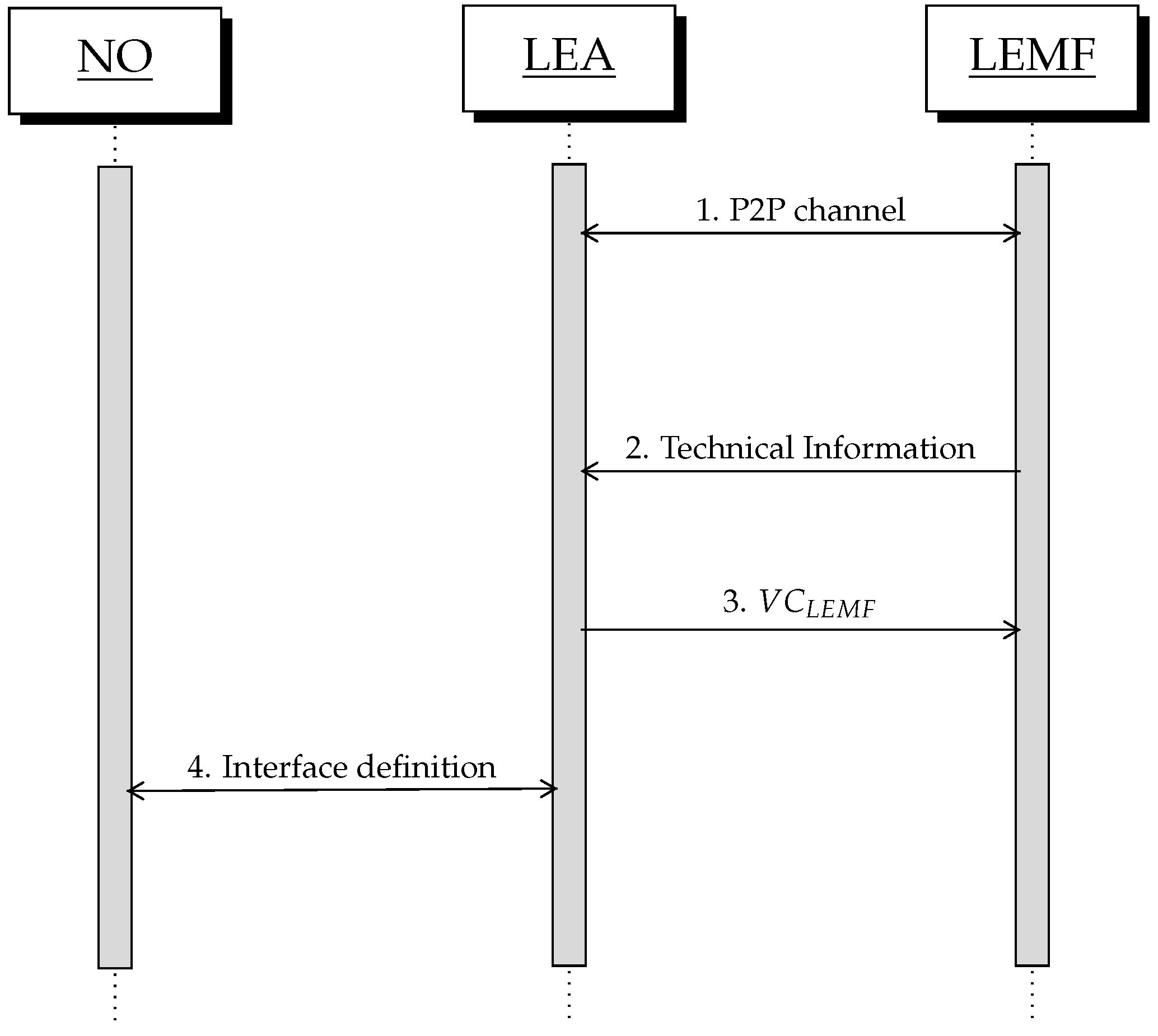
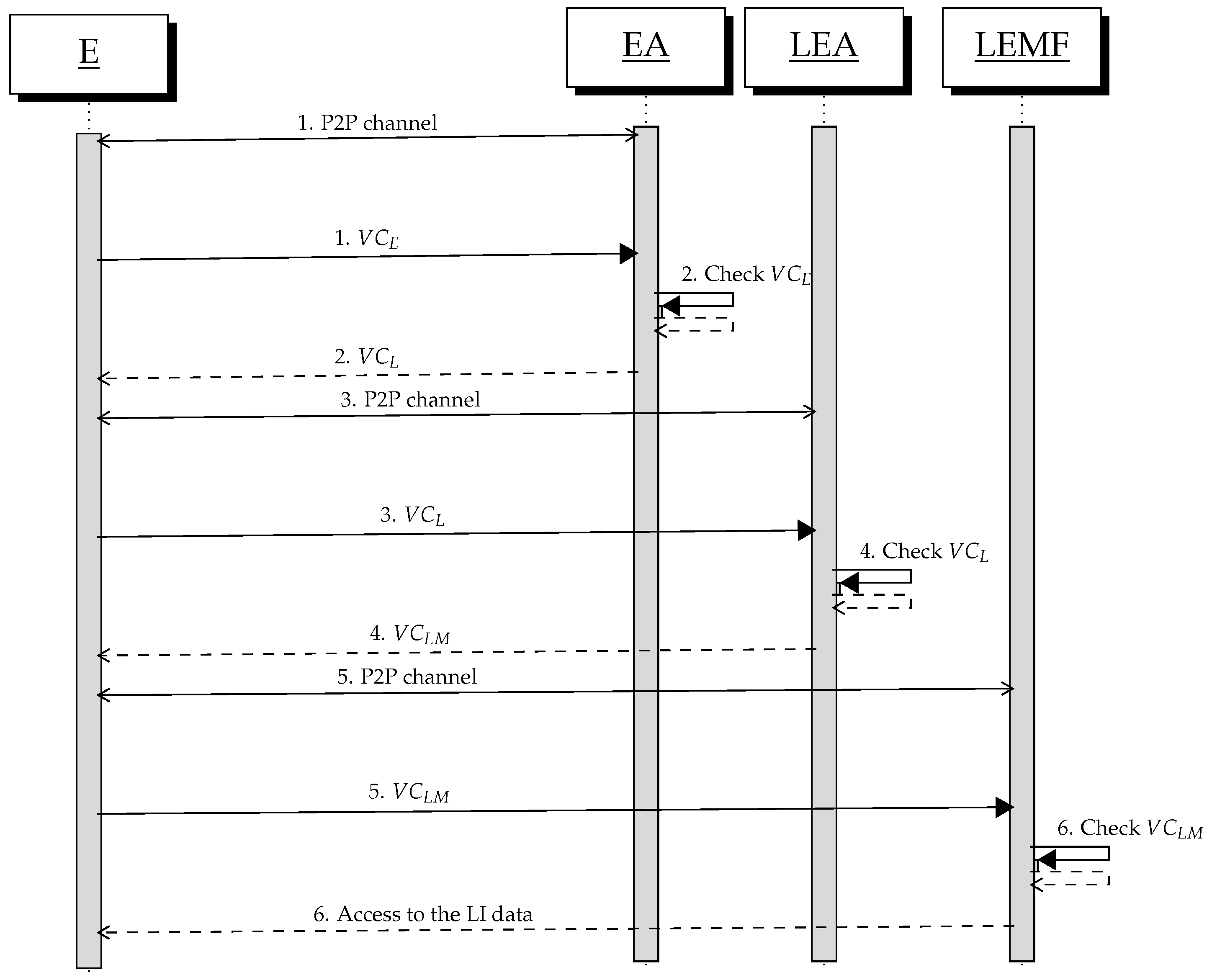
Lawful Interception refers to the acquisition of the contents of communications between private individuals or organizations by subjects authorized by law. It involves three actors: the network operator (NO), the Law Enforcement Agency (LEA), and the Law Enforcement Monitoring Facility (LEMF). In the literature, standards and scientific solutions are proposed for the interception procedure and the interaction between the NO and the LEMF. However, no standard has been proposed for the interaction between the LEMF and the LEA. The absence of standards for controlling LEA (or a delegated agency) access to intercepted contents stored by the LEMF is a significant gap that should be overcome. This prevents the implementation of secure, interoperable, and automated procedures, leading to inefficiencies and security risks. In this paper, we propose to cover the above gap by adopting the Self-Sovereign Identity (SSI) paradigm. The adopted research methodology follows a multi-phase approach that includes studying existing solutions, system design, and technical feasibility testing. The study first examines existing standards and identity management frameworks and their limitations. Next, an SSI-based architecture is proposed to manage the interactions between LEA (or a delegated agency) and LEMF. Finally, a proof of concept of the proposed solution written in Python and using the Hyperledger Indy blockchain has been implemented to assess whether our proposal is technically feasible. The proposed solution enhances automation, security, and interoperability in lawful interception. Indeed, it enables machine-readable authorizations, reducing errors and improving efficiency by eliminating manual operations. Additionally, verifiable credentials and decentralized identifiers strengthen security and standardize interactions across jurisdictions, ensuring privacy-preserving identity management. By standardizing interactions between LEA and LEMF, this research contributes to a more secure, privacy-preserving, and legally compliant lawful interception process.
Keywords: Self-Sovereign Identity; Sovrin; access control; ETSI; Hyperledge; Trinsic Self-Sovereign Identity; Sovrin; access control; ETSI; Hyperledge; Trinsic