


Abstract
Employee retention is a strategic priority for organizations operating in increasingly competitive labor markets, yet predicting long-term employee departure remains a critical challenge. This study examines the longitudinal validity of the Ordinal Turnover Intention Scale (OTIS), a single-item instrument designed to assess employees’ progression through the decision-making stages of turnover. A three-wave longitudinal study was conducted over 12 months. Hierarchical logistic regression analyses showed that the OTIS substantially improved turnover prediction beyond traditional turnover intention measures. A three-wave mediation analysis further showed that employees’ progression through the OTIS stages served as a key explanatory pathway linking initial turnover intentions to subsequent turnover. Finally, ROC curve analyses identified preliminary diagnostic thresholds that can support timely and targeted HR interventions. Beyond providing longitudinal validation of the OTIS, this study shows that conceptualizing turnover intention as a stage-based decision process rather than solely as a continuous intensity construct improves turnover prediction. This single-item instrument is easy to administer, suitable for repeated assessment, and readily integrated into HR analytics to support early identification of employees at risk of leaving and talent retention strategies.
1. Introduction
In the modern and highly competitive labor market, strategic Human Resource Management (HRM) increasingly relies on organizations’ ability to attract, develop, and retain talented employees (Cloutier et al., 2015). Workforce stability has therefore become a central organizational priority, as human capital represents one of the most valuable organizational resources (Ghislieri et al., 2018; Stankevičiūtė & Savanevičienė, 2018). Voluntary employee turnover threatens this objective by disrupting institutional knowledge, team cohesion, and long-term organizational performance while generating substantial organizational costs (Dess & Shaw, 2001; Hancock et al., 2013). Consequently, improving employee retention has become not only a strategic priority for organizations but also aligns with Sustainable Development Goal (SDG) 8 (Decent Work and Economic Growth), which promotes productive employment, decent work, and sustainable employment relationships. As a result, accurately predicting employee turnover has become a major objective for strategic HRM and workforce analytics.
While the rise in Human Resource (HR) analytics has highlighted the value of evidence-based management, the psychological metrics used to predict employee behavior have largely remained static, continuous, and “low-resolution” (Huselid, 2018). Within organizational psychology, turnover intention, defined as an employee’s cognitive and psychological inclination to leave their current job, is widely recognized as the most immediate and robust precursor of actual voluntary turnover behavior (Griffeth et al., 2000). Although substantial research has focused on identifying antecedents of turnover intention and refining explanatory models of employee turnover, comparatively less attention has been devoted to how turnover intention itself is conceptualized and measured. Specifically, relatively little attention has been paid to whether conventional measures adequately capture the progressive nature of employees’ withdrawal decision-making. This limitation in measurement may partly contribute to the persistent “intention–behavior gap”: the phenomenon where high reported intentions do not always translate into actual departure, while employees with seemingly lower intentions may suddenly resign (G. Cohen et al., 2016; Lee & Mowday, 1987; Sheeran, 2002).
Accordingly, this study aims to examine the longitudinal validity and practical utility of the Ordinal Turnover Intention Scale, an ordinal measure designed to identify and assess the progressive nature of employees’ withdrawal process.
2. Theoretical Framework
The conventional measurement approach conceptualizes turnover intention as a static, continuous construct, focusing exclusively on its intensity (i.e., how strongly an employee wishes to leave) (Bothma & Roodt, 2013; A. Cohen, 1999; Michaels & Spector, 1982). While this framework accurately assesses the strength of an employee’s desire to leave at a given moment, it is not primarily designed to capture the dynamic, sequential decision-making process an employee undergoes before physically resigning (Bertolini & Marcatto, 2025). Alternatively, multi-item scales designed to capture this complexity, such as the Expanded Multidimensional Turnover Intentions Scale (EMTIS; Ike et al., 2023), often suffer from criterion contamination. By blending the measurement of intention with its environmental and psychological antecedents (such as job satisfaction or career growth opportunities), they obscure interpretive clarity and limit practical diagnostic utility (Bertolini & Marcatto, 2025). These limitations highlight the need for an assessment tool capable of mapping an employee’s exact position within the withdrawal process without confounding the intention with its causes, thereby providing more interpretable information for HR practice.
In response to this need, Bertolini and Marcatto (2025) introduced the Ordinal Turnover Intention Scale (OTIS). Grounded in the foundational three-stage decision-making model of Mobley and colleagues (Mobley et al., 1978, 1979), which conceptualizes turnover as a progression from thinking of quitting, to the intention to search, and finally to the intention to quit or stay, the OTIS uses a straightforward single-item ordinal design. Rather than measuring intensity, the OTIS prompts employees to select one of six ordered statements (from Stage 0: “At the moment, I don’t think I should change my current job” to Stage 5: “I am about to voluntarily leave my current job”, see Table 1) that most accurately represents their current cognitive proximity to departure.
Table 1.
Ordered OTIS categories.
Importantly, while the OTIS is conceptually anchored in Mobley and colleagues’ stages, its structural design is inherently compatible with non-linear, event-driven models of turnover, such as Lee and Mitchell’s Unfolding Model (Lee & Mitchell, 1994). Rather than tracking the specific historical pathways or antecedents that lead an individual to a given state (such as whether a stage was reached via a slow deliberative process or an abrupt event), the OTIS focuses exclusively on measuring current, state-based cognitive proximity to departure. Because it avoids assuming a slow, invariant developmental path, the scale is fully capable of capturing sudden transitions or “stage-skipping” triggered by event-driven “shocks” (e.g., a sudden unsolicited job offer immediately projecting an employee from Stage 0 directly to Stage 4).
From a strategic HRM perspective, the OTIS’s concise ordinal format makes it particularly suitable for repeated organizational monitoring and integration into contemporary people analytics systems. By locating employees along a sequence of withdrawal stages rather than simply quantifying intention intensity, the scale may provide HR professionals with more interpretable information to support retention decisions.
In its preliminary validation on a cross-sectional sample of Italian employees, the OTIS demonstrated robust construct validity, reliability, and convergent validity with traditional measures (Bertolini & Marcatto, 2025). Furthermore, the scale has also shown promising utility as a practical outcome measure in specific organizational contexts, such as evaluating well-being and retention among public transport drivers (Carbone et al., 2026). However, cross-sectional designs provide limited evidence regarding the intention-behavior gap, as they cannot differentiate between employees who are merely considering a search and those who will actually take action. Therefore, to truly validate the scale’s diagnostic and predictive utility, longitudinal research is required. Tracking employees over time is essential to demonstrate how these ordinal stages predict subsequent turnover behavior and how they could eventually be integrated into evidence-based HRM practices to support proactive talent retention.
Research Objectives
Based on the theoretical considerations discussed above, the study pursues three research objectives:
- Compare the predictive validity of the OTIS against a traditional, intensity-based turnover intention measure using hierarchical regression analysis to determine which approach better explains self-reported voluntary turnover, thereby offering superior evidence-based insights for talent management and retention.
- Test a 12-month longitudinal mediation model to evaluate whether the impact of baseline intentions on long-term departure is channeled through the sequential cognitive stages of the OTIS.
- Establish optimal, evidence-based diagnostic thresholds for the OTIS at both 6-month and 12-month intervals, providing clear, action-oriented “alert levels” for targeted employee retention strategies.
3. Materials and Methods
3.1. Participants and Procedure
The study employed a three-wave longitudinal design (T0, T1, and T2) to evaluate the predictive and incremental validity of the OTIS. Participants were recruited and compensated via Prolific, an online survey platform. At each wave, the survey was administered through a Google Forms online questionnaire, which participants accessed via a link provided on the Prolific platform. The baseline sample (T0) consisted of 303 employees who met the following inclusion criteria: being at least 18 years old, currently employed, residing in Italy, and having Italian as their primary language. Data collection followed a six-month interval protocol. Baseline data were collected between 12 April and 15 April 2024. The first follow-up (T1) took place six months later, from 16 October to 24 October 2024, with 208 participants completing the second assessment (68.6% retention rate). The final assessment (T2) was conducted between 15 April and 23 April 2025, resulting in a final longitudinal sample of 147 participants (48.5% total retention rate from T0). This final sample size aligned with the initial power analysis and attrition estimates, which aimed for approximately 150 participants at the last stage (Bertolini & Marcatto, 2025). An attrition rate of approximately 50% over a 12-month period is not unusual in longitudinal research. Indeed, the scientific literature widely documents that drop-out rates ranging from 30% to 70% are common in multi-wave studies (Gustavson et al., 2012).
At each wave, participants provided informed consent directly on the first page of the questionnaire and were informed of their right to withdraw at any time. To ensure data consistency, follow-up invitations were restricted exclusively to those who had completed all previous phases. The study was approved by the Ethics Committee of the University of Trieste (Minutes No. 2, dated 26 February 2024) and followed the ethical standards of the Declaration of Helsinki. Confidentiality was maintained throughout the longitudinal tracking using anonymous Prolific IDs to link responses across the three waves.
3.2. Measures
The longitudinal assessment was designed to capture three distinct dimensions of the employee withdrawal process: (a) the intensity of the intention to leave, (b) the specific stage within the decision-making process, and (c) the self-reported turnover behavior. Self-reported turnover was assessed at the six-month (T1) and twelve-month (T2) follow-ups, while the remaining measures were administered at each of the three waves.
To assess the overall intensity of an employee’s desire to leave the organization, we used the traditional Turnover Intention (TI) measure, which was developed by A. Cohen (1999) following the foundational definitions by Mobley and colleagues (Mobley et al., 1978, 1979). Participants responded to the three items (e.g., “I often think about quitting this job”) using a 5-point Likert scale (from 1, “strongly disagree” to 5, “strongly agree”), where higher scores represent a more intense desire to quit. In the current study, the scale showed high internal consistency across all waves (Cronbach’s alpha: T0 = 0.89, T1 = 0.89, T2 = 0.90).
To map the specific stage reached by an employee within the sequential decision-making process of leaving an organization, we administered the Ordinal Turnover Intention Scale (OTIS) (Bertolini & Marcatto, 2025). In contrast to the TI scale, which measures intensity, the OTIS is a single-item diagnostic tool that captures cognitive proximity to departure through six ordered stages, ranging from a total absence of turnover thoughts to the final decision to leave.
Self-reported turnover behavior was assessed at T1 and T2. Participants were asked to indicate whether they had voluntarily left the organization where they were employed at the start of the study (T0) through a dichotomous question (Yes/No).
Missing values were extremely rare (<1%). For participants who missed a single item on the TI scale, composite scores were computed using the mean of the available items (requiring responses to at least two items), whereas the OTIS presented no missing values.
3.3. Data Analysis
First, preliminary analyses were conducted to characterize the sample across the three measurement waves. Descriptive statistics, including means, standard deviations, and frequencies, were calculated for all demographic and focal variables. To assess the impact of participant dropout, an attrition analysis was performed. Participants who completed the full study (N = 147) were compared to those who dropped out after T0 or T1 on key baseline variables (age, gender, TI and OTIS stage assessed at T0) using independent samples t-tests and chi-square tests. This analysis was conducted to assess whether attrition was systematically associated with the baseline characteristics considered and to inform the interpretation of the longitudinal findings.
Second, Spearman’s correlation coefficients were calculated to examine the longitudinal associations between TI and OTIS stages. This non-parametric approach was chosen to account for the ordinal nature of the OTIS stages.
Third, hierarchical logistic regressions were used to test the incremental validity of the OTIS over standard TI metrics. We conducted two separate analyses: the first predicted self-reported turnover at the six-month follow-up (T1) using predictors measured at baseline (T0); the second predicted self-reported turnover at the twelve-month follow-up (T2) using predictors measured concurrently at the six-month interval (T1), excluding participants who had already left the organization by that time. In both models, the standard TI was entered in Step 1, and the OTIS was added in Step 2 to assess the unique predictive contribution of the stage-based measure. The OTIS was entered as an ordered linear predictor (coded 0–5), implying an approximately constant change in the log-odds of turnover for each one-stage increase. This parsimonious specification was adopted to preserve model stability given the limited number of turnover events; modeling the six stages categorically would have required five parameters for the OTIS alone, substantially reducing the events-per-variable ratio and increasing the risk of model instability and overfitting. Model improvements were evaluated using the Likelihood Ratio Test (Delta χ2), Akaike Information Criterion (AIC), and Nagelkerke R2.
Fourth, a three-wave longitudinal mediation model was tested to examine whether the association between initial turnover intention and subsequent self-reported voluntary turnover was indirectly transmitted through the decision-making stage reached at the six-month follow-up. In this model, turnover intention at T0 was included as the independent variable, OTIS stage at T1 as the mediator, and self-reported voluntary turnover at T2 as the dichotomous outcome. Consistent with the specification adopted in the predictive analyses, OTIS stage was retained as a linear variable (coded 0–5), whereas self-reported voluntary turnover was modeled as an ordered binary outcome using a probit latent-response formulation. The model was estimated using diagonally weighted least squares (DWLS) with robust standard errors. The indirect effect was estimated as the product of the a and b paths, and its 95% confidence interval was obtained using the Monte Carlo method. Direct, indirect, and total effects were estimated separately.
Lastly, the diagnostic accuracy and optimal thresholds of the OTIS were assessed through Receiver Operating Characteristic (ROC) curve analyses. Two separate curves were calculated: one for predicting turnover at T1 using OTIS at T0 and one for predicting turnover at T2 using OTIS at T1. The Area Under the Curve (AUC) was used to evaluate overall performance, while the Youden Index (J) was employed to identify the optimal cut-off stages by maximizing the balance between sensitivity (identifying future leavers) and specificity (correctly identifying stayers). Analyses were conducted using Jamovi software (Version 2.7.12) and R software (Version 4.5.1); the longitudinal mediation model was estimated in R using the lavaan package (Version 0.7-2).
4. Results
Table 2 presents the descriptive statistics for the focal variables across the three measurement waves. At T0, the distribution across OTIS stages showed that a vast majority of the sample (74.3%) either reported a total absence of turnover intentions (Stage 0, 36.0%) or were in the initial, contemplative phase of the process (Stage 1, 38.3%). By T1, 16 participants (7.7%) reported having left their organization. At T2, an additional 16 participants (10.9%) reported having left the organization they belonged to. Intensity of turnover intentions (TIs) remained relatively stable between T0 (M = 2.36, SD = 1.21) and T1 (M = 2.42, SD = 1.20). A slight decrease was observed at T2 (M = 2.06, SD = 1.16) among the remaining employees. This trend is consistent with the longitudinal nature of the study, as participants with the highest initial intentions were more likely to report to have left the organization by the final wave, leaving a T2 sample composed of employees with higher organizational attachment.
Table 2.
Descriptive Statistics of the Sample Across Three Waves.
Since the study involved three waves of data collection, an attrition analysis was performed to determine if participants who completed the entire study differed systematically from those who dropped out. Comparisons were made between the final longitudinal sample (N = 147) and those who participated only in the first or second wave (N = 156). Results indicated no significant differences between the two groups regarding baseline TI (t(301) = 1.47, p = 0.143), distribution across OTIS stages (χ2(5) = 4.55, p = 0.474), or gender (χ2(1) = 0.506, p = 0.477). However, a significant difference was found for age (t(300) = 4.44, p < 0.001), with participants who remained in the study being slightly older (M = 36.8, SD = 10.6) than those who dropped out (M = 31.8, SD = 8.83). Despite this age-related trend, the results demonstrate that the final longitudinal sample remained largely representative of the baseline cohort, as no systematic differences were observed in the core turnover-related metrics under investigation in this study.
Spearman’s correlations between TI and OTIS across the three waves are reported in Table 3. As expected, the two scales showed high convergent validity at each time point, with synchronous correlations reaching their peak at T2 (rs = 0.88, p < 0.001). Regarding temporal stability, the OTIS displayed significant test–retest reliability across the six-month intervals (T0–T1: rs = 0.60, p < 0.001; T1–T2: rs = 0.51, p < 0.001). Moreover, TI measured at T0 was moderately to strongly associated with the subsequent OTIS stages reached at T1 (rs = 0.53, p < 0.001) and T2 (rs = 0.41, p < 0.001). These cross-lagged correlations suggest that the initial intensity of the desire to leave acts as a precursor to the progression through the stages of the turnover process, providing a preliminary empirical basis for the proposed mediation model.
Table 3.
Spearman’s Correlations Between TI and OTIS Across Three Waves.
Next, to evaluate whether the OTIS provides incremental validity over general turnover intentions, two hierarchical logistic regressions were performed. The first model (N = 208), reported in Table 4, tested the predictive value of baseline measures (T0) for self-reported turnover at the six-month follow-up (T1). In Step 1, the TI was entered as the sole predictor, and in Step 2 the OTIS was added to the model. In Step 1, the TI was a significant predictor (b = 0.80, p < 0.001) and explained 15% of the variance (Nagelkerke R2 = 0.15). The inclusion of the OTIS in Step 2 led to a significant improvement in model fit (Delta χ2(1) = 4.51, p = 0.03), increasing the explained variance to 20% (Nagelkerke R2 = 0.20). Notably, in this second step, the TI was no longer a significant predictor of turnover (b = 0.28, p = 0.40), while the OTIS remained a strong and significant predictor (b = 0.68, p = 0.04). The superiority of the second model was further supported by a decrease in the AIC, which dropped from 104 in Step 1 to 101 in Step 2. These results demonstrate that the OTIS provides unique information not captured by the TI and carries the primary predictive weight for self-reported turnover behavior.
Table 4.
Hierarchical Logistic Regression Predicting Turnover at T1.
A second hierarchical logistic regression, reported in Table 5, was performed to evaluate the incremental validity of the OTIS at T1 over the TI in predicting self-reported turnover at the 12-month follow-up (T2). To ensure the accuracy of the longitudinal prediction, the analysis was conducted excluding participants who had already left during the first six months, resulting in N = 135. In Step 1, the TI at T1 failed to reach statistical significance (b = 0.44, SE = 0.27, Z = 1.67, p = 0.10), explaining less than 5% of the variance (Nagelkerke R2 = 0.046). The inclusion of the OTIS at T1 in Step 2 led to a significant improvement in model fit (Delta χ2(1) = 8.59, p < 0.01), with the explained variance increasing to 19% (Nagelkerke R2 = 0.19) and the AIC decreasing from 77.5 to 70.9. While general intentions remained non-significant, the OTIS emerged as a robust predictor of self-reported turnover (b = 0.82, SE = 0.28, Z = 2.92, p < 0.01). These results confirm that after the first six months, initial general intentions lose their predictive relevance, whereas the current decision-making stage remains a critical indicator of future turnover.
Table 5.
Hierarchical Logistic Regression Predicting Turnover at T2.
To evaluate the statistical stability of these regression models given the observed number of self-reported turnover events, we assessed the Events-Per-Variable (EPV) ratio for the hierarchical logistic regressions. The T0–T1 analysis included 16 turnover events and two predictors, yielding an EPV of 8. In the T1–T2 analysis, after excluding participants who had already left by T1, 11 subsequent turnover events were observed; with two predictors, the resulting EPV was 5.5. While traditional rules of thumb suggest an EPV of at least 10 (Peduzzi et al., 1996), methodological evaluations have demonstrated that an EPV between 5 and 9 performs reliably without severe bias or loss of coverage, particularly when dealing with robust effect sizes (Vittinghoff & McCulloch, 2007).
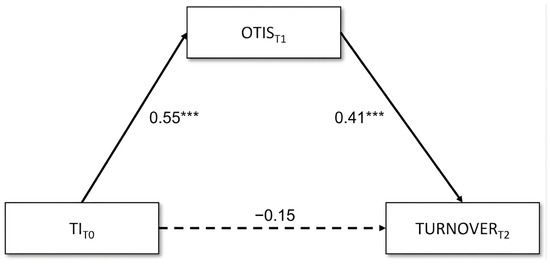
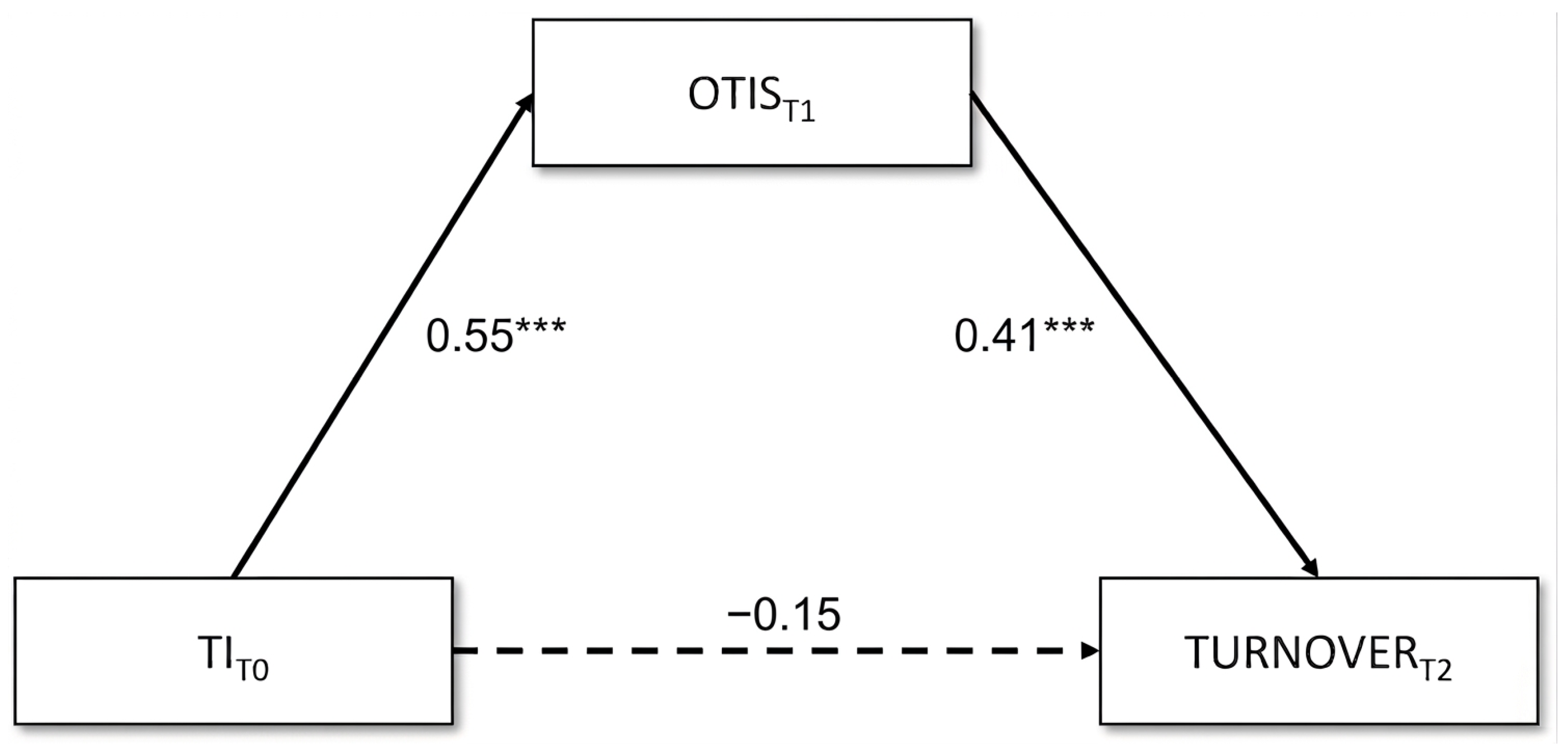
To investigate the dynamic process underlying long-term turnover, we tested a three-wave longitudinal mediation model (N = 135). Rather than assuming a direct, static link between baseline intentions and long-term behavior, this model examines whether the sequential progression through the decision-making stages, as captured by the OTIS at T1, represented a potential pathway linking initial intentions (TI at T0) to subsequent self-reported voluntary turnover (T2). In this model, TI at T0 was specified as the independent variable, OTIS at T1 as the potential mediator, and self-reported voluntary turnover at T2 as the dichotomous outcome (Figure 1).
Figure 1.
Longitudinal mediation model. Path values represent unstandardized coefficients (b). *** = p < 0.001.
The analysis showed that baseline turnover intentions significantly predicted progression into more advanced decision-making stages six months later (Path a; b = 0.55, 95% CI [0.40, 0.71], SE = 0.08, Z = 7.06, p < 0.001). OTIS stage at T1, in turn, significantly predicted self-reported voluntary turnover at the twelve-month follow-up (Path b; b = 0.41, 95% CI [0.24, 0.58], SE = 0.09, Z = 4.85, p < 0.001). The indirect effect of baseline TI on subsequent self-reported voluntary turnover through OTIS stage was statistically significant (b = 0.23, Monte Carlo 95% CI [0.13, 0.35], SE = 0.06, Z = 4.03, p < 0.001). In contrast, the direct effect of baseline TI on self-reported voluntary turnover was not statistically significant (Path c′; b = −0.15, 95% CI [−0.40, 0.10], SE = 0.13, Z = −1.18, p = 0.237), nor was the total effect (b = 0.08, 95% CI [−0.18, 0.32], SE = 0.13, Z = 0.59, p = 0.559). Taken together, these findings indicate a significant longitudinal indirect association whereby baseline turnover intentions were associated with subsequent self-reported voluntary turnover through employees’ progression along the OTIS decision-making stages.
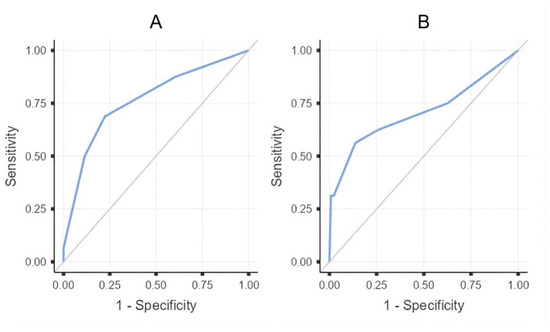
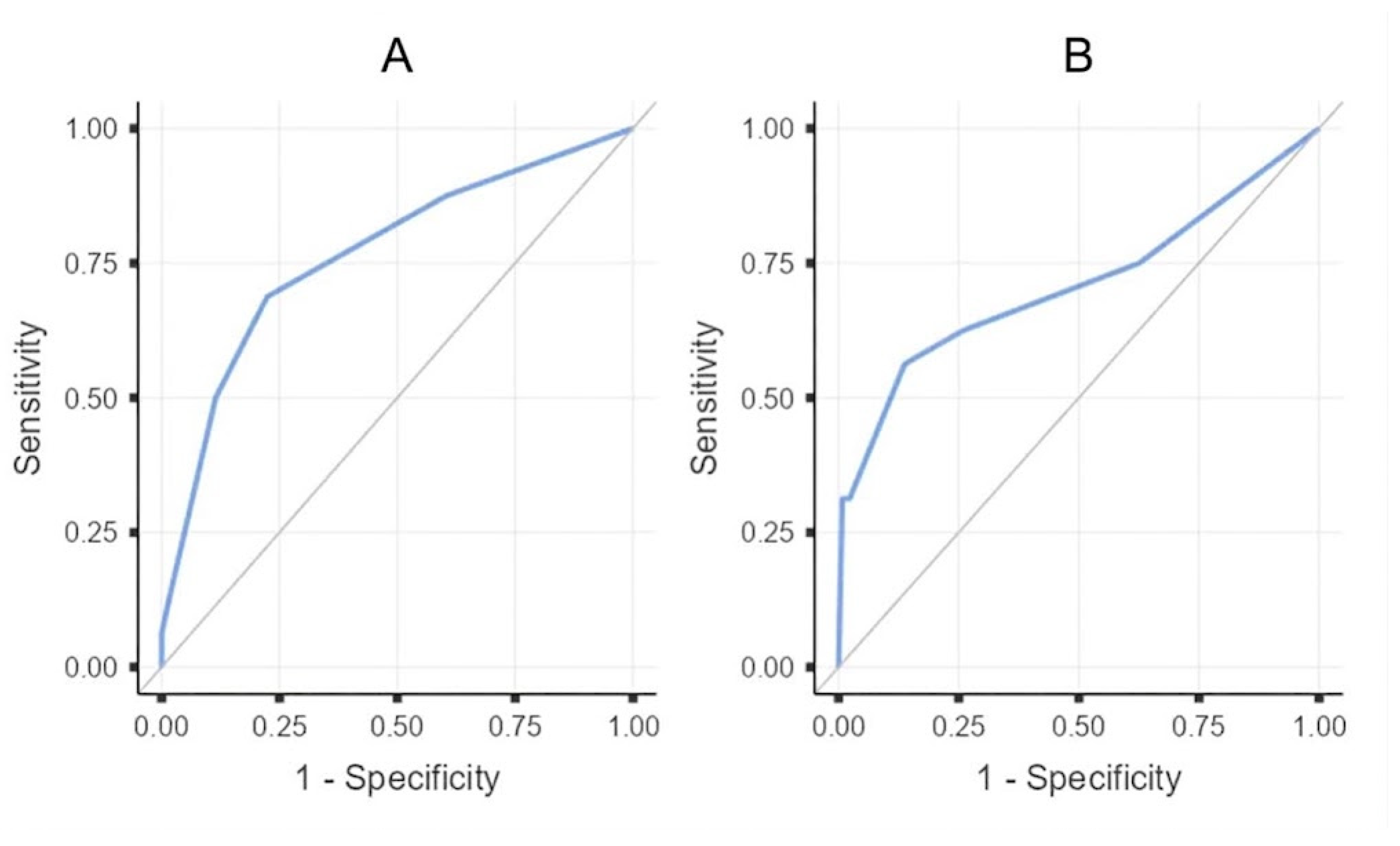
To evaluate the practical utility of the OTIS as an organizational screening tool, Receiver Operating Characteristic (ROC) curves were calculated for both six-month intervals. The OTIS demonstrated good overall predictive accuracy for the first period (T0 to T1; AUC = 0.77, 95%CI [0.63, 0.90], SE = 0.07, p < 0.001; Figure 2A) and maintained significant accuracy for the second period among the remaining employees (T1 to T2; AUC = 0.71, 95%CI [0.54, 0.88], SE = 0.09, p < 0.05; Figure 2B).
Figure 2.
ROC curves demonstrating the predictive accuracy of the OTIS over time. (A) displays the performance of baseline OTIS stages (T0) in predicting self-reported turnover behavior within the first six months (T1). (B) displays the performance of OTIS stages measured at six months (T1) in predicting self-reported turnover behavior within the subsequent six months (T2).
To identify the optimal cut-off stages for organizational intervention, the diagnostic performance of each OTIS stage was evaluated for both six-month intervals (Table 6). Analysis of the Youden Index (J) revealed a strategic shift in the optimal predictive threshold over time (Table 6). For the initial period (T0 to T1, N = 208), Stage 2 (seriously considering looking for a new job) emerged as the most balanced cut-off point (J = 0.46), providing a sensitivity of 68.8%, a specificity of 77.6%, a positive predictive value of 20.8%, and a negative predictive value of 96.8%. In contrast, for the subsequent interval (T1 to T2, N = 135), the optimal threshold shifted forward to Stage 3 (searching for alternatives; J = 0.44). At this stage, while sensitivity was 56.3%, specificity reached 87.2%, the positive predictive value was 37.5% and the negative predictive value was 94.0%. This indicates that for employees who remained after the first six months, only the progression to more active search phases served as a highly predictive signal of imminent departure.
Table 6.
Diagnostic Performance of OTIS Stages Across the Two Follow-up Periods.
5. Discussion
The main objective of this study was to move beyond the traditional, static measurement of turnover intention intensity by validating the OTIS as a novel assessment approach that identifies where an employee is situated within the withdrawal process. The results provide evidence that the turnover process is not merely a matter of “how much” an employee wants to leave, but rather “where” they stand in a sequential decision-making trajectory.
This research highlights several key contributions that advance our understanding of how cognitive intentions translate into concrete organizational departure. First, hierarchical logistic regression analyses demonstrated the incremental validity of the OTIS over traditional TI measures. While general turnover intentions initially predicted short-term self-reported resignation, this predictive power was no longer statistically significant once the decision-making stages of the OTIS were introduced into the model. Second, the longitudinal mediation analysis identified a significant indirect association linking initial turnover intentions to subsequent self-reported voluntary turnover through employees’ progression along the OTIS decision-making stages. Rather than showing a direct association with resignation months later, initial intentions (TI at T0) appeared to operate as relatively distal precursors associated with progression through the decision-making stages captured by the OTIS at T1, which in turn was associated with self-reported voluntary turnover at twelve months (T2). Finally, ROC curve analyses identified a dynamic shift in diagnostic risk thresholds over time. For the initial cohort, entering Stage 2 (Seriously considering looking for a new job) served as the optimal warning signal for near-term turnover, whereas for the “surviving” employees who remained after six months, the progression to Stage 3 (Searching for alternatives) represented the best indicator of imminent turnover.
The results of this study contribute to the literature on organizational psychology and employee retention primarily by challenging the traditional, static approach to measuring turnover intentions and proposing a more fine-grained, process-oriented perspective.
Research on employee withdrawal has largely relied on measuring the intensity of turnover intentions as the primary proxy for actual turnover. This reliance stems from both the practical difficulties of collecting longitudinal behavioral data and the assumption, largely popularized by the Theory of Planned Behavior (Ajzen, 1991), that intention is the most proximal predictor of behavior. However, a growing body of research has documented a significant “intention–behavior” gap, where general TI measures explained only a modest fraction of actual turnover variance (G. Cohen et al., 2016; Jung, 2010; Kirschenbaum & Weisberg, 1990; Lee & Mowday, 1987). Our findings offer a conceptual contribution to address this gap, positioning the OTIS not as a perfect deterministic predictor, but as a framework to map cognitive proximity to departure.
By showing a significant longitudinal indirect association through the decision-making stages of the OTIS, this study suggests that general TI measures may operate as relatively distal precursors of subsequent turnover behavior (Hom et al., 2012). For instance, an employee may experience strong intentions to leave for months without ever taking action (Wong & Cheng, 2020). The OTIS bridges this gap because it does not merely measure the strength of a passive desire, but maps the active progression of the steps required to turn that intention into action.
Furthermore, the superior predictive performance of the OTIS over traditional intention measures warrants careful interpretation. One might hypothesize that this advantage stems merely from capturing closer behavioral proximity (e.g., active job search). However, comparative benchmark scales like A. Cohen’s (1999) TI measure also explicitly assess active search behavior (e.g., item 2: “I am actively searching for an alternative to the organization”). Therefore, the incremental predictive validity demonstrated by the OTIS is unlikely to be explained solely by differences in content and may reflect, at least in part, its ordinal stage architecture. While continuous multi-item scales may dilute behaviorally relevant signals by averaging item scores, the OTIS instead identifies the employee’s specific decision-making stage. These findings suggest that representing employee withdrawal as a discrete, stage-based progression may provide a higher-resolution predictive signal than traditional continuous intensity scores.
Conceptually, our longitudinal mediation model (TI at T0 to OTIS at T1 to self-reported turnover at T2) provides support for classical sequential turnover models, such as Mobley and colleagues’ intermediate pathways model (Mobley et al., 1978). While this model hypothesized that individuals transition through discrete cognitive phases (e.g., thinking of quitting, evaluating alternatives, searching, and deciding to leave), turnover is rarely a perfectly linear, slow-paced journey for everyone. Contemporary theories, such as Lee and Mitchell’s Unfolding Model of Voluntary Turnover (Lee & Mitchell, 1994), highlight that employees’ decision-making processes are often disrupted by sudden, event-driven “shocks” (e.g., receiving an unsolicited job offer, experiencing a sudden interpersonal conflict, or facing unexpected personal life changes). These shocks do not necessarily cause employees to bypass the decision-making process entirely; rather, they often act as catalysts that cause individuals to skip intermediate stages (Holtom et al., 2005; Lee et al., 1999), suddenly shifting them from a state of inertia (Stage 0) straight into advanced stages, such as actively searching for new roles (Stage 3) or evaluating a concrete alternative (Stage 4). The strength of the OTIS lies in its compatibility with these non-linear dynamics (Maertz & Campion, 2004). Because the OTIS is designed as an instantaneous state-based measure, it does not require a slow or predictable progression to be diagnostic. It effectively captures the employees’ current position within the withdrawal process at the exact moment of measurement, regardless of the historical path, or sudden jump, that led them to that stage. This flexibility may help explain why the OTIS remains a robust predictor of withdrawal behavior over time, while also making it theoretically compatible with turnover trajectories involving sudden, shock-induced transitions.
Taken together, these findings suggest that representing turnover intention as a dynamic decision-making process may provide a more informative framework for understanding voluntary turnover.
5.1. HR Practice and People Analytics
The findings of this study offer several actionable insights for HR practitioners and organizational leaders, particularly in the context of strategic human resource management.
5.1.1. OTIS as a Practical Tool for Digital HR Analytics and Organizational Monitoring
In the contemporary corporate landscape, HR departments increasingly rely on evidence-based HR analytics to monitor workforce metrics and organizational health. However, these assessment efforts are often constrained by high-density, multi-item surveys that cause “survey fatigue” and generate low-resolution data (Porter et al., 2004). The OTIS offers a lean, highly versatile solution for standard organizational surveys. Because it is a single-item, ordinal measure, it can be seamlessly integrated into routine pulse-assessments or periodic feedback protocols (Wanous et al., 1997).
Beyond its ease of administration, the OTIS also offers several practical features that facilitate its implementation in organizational settings. Its ordinal structure facilitates straightforward interpretation while allowing repeated assessments over time. This enables organizations to monitor changes in employees’ position within the withdrawal process before they translate into actual turnover. In this sense, the OTIS may serve as a low-cost tool for routine workforce “health checks”, enabling organizations to track changes in organizational turnover risk through regular pulse assessments. The OTIS can be used to categorize departments, teams, or employee groups into risk-based clusters (e.g., “Green” for Stages 0–1, “Orange” for Stage 2, and “Red” for Stages 3–5).
Because employees identify a stage rather than simply reporting the strength of their intention to leave, this stage-based approach may also facilitate more open and less stigmatizing conversations about career intentions during coaching, performance reviews, or development discussions, potentially fostering a climate of psychological safety (Edmondson, 1999).
This structured monitoring is also consistent with SDG 8 (Decent Work and Economic Growth) as it enables predictive and supportive human capital management (Douglas, 2021).
Taken together, its simplicity, ease of interpretation, and suitability for repeated assessment make the OTIS particularly well suited for integration into contemporary people analytics systems, from individual coaching conversations to department-level monitoring, supporting more proactive and evidence-informed employee retention practices.
5.1.2. Strategic Intervention Windows: From Warning Signals to Critical Thresholds
Traditional turnover measures often leave managers with a “false positive” problem: many employees express a desire to leave (high TI), but only a small fraction actually resign. This can lead to a lack of clear direction for intervention. The OTIS helps address this limitation by providing a clear diagnostic roadmap. The ROC curve analysis suggests two potential strategic intervention windows: the early warning signal (Stage 2) and the critical threshold (Stage 3). During the initial six-month period, Stage 2 (Seriously considering looking for a new job) emerged as the optimal cut-off for identifying future leavers. For HR departments, this suggests that the first “seeds of doubt” may already provide a useful early warning signal. Interventions at this stage, such as stay interviews, job redesign, or mentorship programs (Finnegan, 2018; Leners et al., 2006), may be particularly relevant because the employee has not yet begun a formal search for alternatives. For employees who have been with the organization longer or have “survived” previous turnover waves, the alarm bell shifts to Stage 3 (Searching for alternatives). At this point, the employee is actively looking outside. From a practical perspective, reaching this stage may indicate that the window for simpler preventive interventions is narrowing, and that more substantial retention efforts (e.g., career path adjustments or compensation reviews) or succession planning may become increasingly relevant (Ali et al., 2019; Dahling & Librizzi, 2015).
Nonetheless, given the relatively small number of self-reported voluntary turnover events observed at each wave, these identified cut-off stages must be interpreted as preliminary. Because these thresholds were derived and evaluated within the same sample, they are subject to potential performance optimism. While they offer valuable heuristic guidelines for HR analytics, they require rigorous internal validation (e.g., bootstrapping) and external cross-validation in larger, more diverse organizational samples before they can be reliably adopted for high-stakes talent retention policies.
Because the OTIS captures employees’ current position within the withdrawal process, it may also help organizations rapidly reassess turnover risk following unexpected organizational or external events (e.g., organizational restructuring, leadership changes, or attractive external job opportunities) that may accelerate employees’ progression across stages (Lee & Mitchell, 1994).
The OTIS therefore identifies distinct intervention windows rather than a single point at which intervention becomes necessary, enabling organizations to tailor retention strategies according to employees’ stage within the withdrawal process.
5.2. Limitations and Future Directions
Despite its contributions, this study has several limitations that should be acknowledged. First, although the longitudinal design tracking employees across three waves is a major strength, it naturally suffered from sample attrition. To evaluate potential attrition bias, we compared baseline variables between completers and dropouts. While most variables showed no significant differences, a notable age divergence emerged, with participants who completed all waves being significantly older than those who dropped out. Although no significant attrition-related differences emerged in the core baseline turnover metrics considered (Goodman & Blum, 1996), this age discrepancy suggests that our final longitudinal sample is slightly skewed toward older employees, who may exhibit different retention dynamics compared to younger cohorts. Consequently, generalization to younger workforce segments should be made with caution. Future studies should replicate these findings with larger initial cohorts to increase statistical power, especially in more advanced stages where cell sizes can become smaller. Second, while our outcome variable captured a concrete behavioral event (self-reported voluntary turnover), it relied on participant self-reports rather than official organizational records, similarly to the predictors (TI and OTIS). While cognitive stages of decision-making are inherently subjective and best assessed by the individuals themselves, self-reports can be subject to social desirability bias, particularly in organizational climates where employees might fear that admitting that they are looking for job alternatives could have negative repercussions (Donaldson & Grant-Vallone, 2002). Future research could integrate the OTIS with objective proxy behaviors, such as internal HR metrics or aggregate departmental mobility data, to further validate the OTIS stages. Third, while we highlighted that the OTIS is theoretically compatible with non-linear or shock-induced trajectories (Lee & Mitchell, 1994), the present study did not explicitly measure the historical pathways or event-driven shocks that might have precipitated employees’ positioning within specific stages. Future longitudinal studies should specifically investigate how different pathways, such as gradual cognitive deliberation versus sudden, shock-induced stage transitions, influence employees’ progression through the OTIS continuum. Finally, while the OTIS demonstrated strong diagnostic utility, a natural next step for future research is to test its intervention effectiveness. Future research should employ experimental or quasi-experimental designs (Grant & Wall, 2009) to evaluate whether HR actions specifically targeted at employees at “Stage 2” successfully reduce the probability of transitioning to subsequent stages and ultimately lower actual turnover rates compared to a control group. In addition, the external validity of the present findings should be considered in light of the recruitment strategy and geographical context, as the sample consisted exclusively of Italian employees recruited through the Prolific online platform. Although this approach enabled the recruitment and longitudinal tracking of employees across different occupational contexts, the resulting sample may not fully represent the broader Italian workforce or employees in other national and cultural contexts. Accordingly, future studies should examine the generalizability and cross-cultural invariance of the OTIS across different occupational sectors, organizational settings, and cultural contexts. Given that cultural differences (e.g., individualism versus collectivism) and institutional characteristics across different economic sectors (e.g., healthcare versus technology or manufacturing) may profoundly shape how turnover intentions are formed and expressed, testing the OTIS in diverse international samples and industrial sectors represents a crucial next step to establish its diagnostic validity across varying labor market and cultural conditions.
6. Conclusions
In today’s competitive labor market, improving employee retention has become a central challenge for strategic HRM. Within this context, developing assessment tools capable of identifying employees’ progression through the withdrawal process may support more informed workforce analytics and retention decisions. Such applications are also consistent with SDG 8 (Decent Work and Economic Growth), which promotes decent work and sustainable employment relationships.
This longitudinal study provides supportive evidence for the Ordinal Turnover Intention Scale (OTIS) as an initial evidence-based assessment tool designed to monitor the decision-making stages of employee turnover. Over a one-year tracking period, our findings support a conceptualization of turnover as a dynamic process of increasing cognitive proximity to departure rather than solely as a binary or static state. By mapping this trajectory, the OTIS may enable the identification of preliminary critical thresholds where the intention to leave crystallizes into action, regardless of whether the path was linear or triggered by sudden organizational shocks (Lee & Mitchell, 1994). By identifying a significant longitudinal indirect association linking general turnover intentions to subsequent self-reported voluntary turnover through the OTIS decision-making stages, this research provides new evidence relevant to the well-known ‘intention–behavior gap’ in the organizational literature (G. Cohen et al., 2016; Jung, 2010; Kirschenbaum & Weisberg, 1990; Lee & Mowday, 1987). While traditional intensity-based measures often offer limited predictive power, the OTIS significantly improves turnover prediction, explaining a substantially higher portion of the variance, while maintaining an extremely low respondent burden. Furthermore, our ROC curve analyses provide preliminary heuristic evidence-based “alert levels” (Stage 2 as an early warning for short-term risk and Stage 3 as a critical threshold for long-term risk) that warrant further cross-validation in future organizational research.
By integrating behavioral science with evidence-based HR analytics, the OTIS emerges as a practical, non-intrusive, and predictive diagnostic tool for strategic HRM. Importantly, beyond providing longitudinal support for the OTIS, the present findings also suggest that the way turnover intentions are conceptualized and measured has important implications for turnover prediction.
More broadly, this study suggests that improving turnover prediction may depend not only on identifying additional antecedents of employee withdrawal, but also on improving how the withdrawal process itself is represented and measured. By capturing turnover intention as a stage-based decision process rather than solely as a continuous intensity construct, the OTIS shows how a more accurate representation of employees’ psychological trajectory can support more informed HR decisions and effective talent retention strategies.
Author Contributions
Conceptualization, F.M. and D.B.; methodology, F.M.; formal analysis, F.M. and D.C.; investigation, F.M. and D.B.; data curation, F.M.; writing—original draft preparation, F.M.; writing—review and editing, F.M., D.C. and D.B.; visualization, F.M.; supervision, F.M. All authors have read and agreed to the published version of the manuscript.
Funding
This research was funded by the Complementary Operational Programme (Programma Operativo Complementare—POC) of the Autonomous Region of Friuli Venezia Giulia (2014–2020).
Institutional Review Board Statement
The study was conducted in accordance with the Declaration of Helsinki, and approved by the Ethics Committee of the University of Trieste (Minutes No. 2, dated 26 February 2024).
Informed Consent Statement
Informed consent was obtained from all subjects involved in the study.
Data Availability Statement
The dataset supporting the findings of this study has been deposited in the Open Science Framework (OSF) and is available at: https://osf.io/t8jz4/overview?view_only=505cbfad7a0c4b59970deac4518f2d3f (accessed on 9 September 2026).
Conflicts of Interest
The authors declare no conflicts of interest.
Abbreviations
The following abbreviations are used in this manuscript:
| OTIS | Ordinal Turnover Intention Scale |
| TI | Turnover Intention |
| HR | Human Resources |
| HRM | Human Resource Management |
| SDG | Sustainable Development Goal |
| AIC | Akaike Information Criterion |
| ROC | Receiver Operating Characteristic |
| AUC | Area Under the Curve |
References
- Ajzen, I. (1991). The theory of planned behavior. Organizational Behavior and Human Decision Processes, 50(2), 179–211. [Google Scholar] [CrossRef] [Scilit]
- Ali, Z., Mahmood, B., & Mehreen, A. (2019). Linking succession planning to employee performance: The mediating roles of career development and performance appraisal. Australian Journal of Career Development, 28(2), 112–121. [Google Scholar] [CrossRef] [Scilit]
- Bertolini, D., & Marcatto, F. (2025). Introducing the Ordinal Turnover Intention Scale (OTIS): A cross-sectional validation in Italian employees and foundation for longitudinal research. Journal of Health and Social Sciences, 10(1), 42. [Google Scholar] [CrossRef]
- Bothma, C. F. C., & Roodt, G. (2013). The validation of the turnover intention scale: Original research. SA Journal of Human Resource Management, 11(1), 1–12. [Google Scholar] [CrossRef] [Scilit]
- Carbone, D., Colabucci, A., & Marcatto, F. (2026). When drivers step off the bus: Well-being and turnover intention in the public transport sector. International Journal of Environmental Research and Public Health, 23(4), 485. [Google Scholar] [CrossRef] [Scilit] [PubMed]
- Cloutier, O., Felusiak, L., Hill, C., & Pemberton-Jones, E. J. (2015). The importance of developing strategies for employee retention. Journal of Leadership, Accountability & Ethics, 12(2), 119–129. [Google Scholar]
- Cohen, A. (1999). The relation between commitment forms and work outcomes in Jewish and Arab culture. Journal of Vocational Behavior, 54(3), 371–391. [Google Scholar] [CrossRef] [Scilit][Green Version]
- Cohen, G., Blake, R. S., & Goodman, D. (2016). Does turnover intention matter? Evaluating the usefulness of turnover intention rate as a predictor of actual turnover rate. Review of Public Personnel Administration, 36(3), 240–263. [Google Scholar] [CrossRef] [Scilit]
- Dahling, J. J., & Librizzi, U. A. (2015). Integrating the theory of work adjustment and attachment theory to predict job turnover intentions. Journal of Career Development, 42(3), 215–228. [Google Scholar] [CrossRef] [Scilit]
- Dess, G. G., & Shaw, J. D. (2001). Voluntary turnover, social capital, and organizational performance. The Academy of Management Review, 26(3), 446. [Google Scholar] [CrossRef] [Scilit] [PubMed]
- Donaldson, S. I., & Grant-Vallone, E. J. (2002). Understanding self-report bias in organizational behavior research. Journal of Business and Psychology, 17(2), 245–260. [Google Scholar] [CrossRef] [Scilit]
- Douglas, S. (2021). Building organizational resilience through human capital management strategy. Development and Learning in Organizations: An International Journal, 35(5), 19–21. [Google Scholar] [CrossRef] [Scilit]
- Edmondson, A. (1999). Psychological safety and learning behavior in work teams. Administrative Science Quarterly, 44(2), 350–383. [Google Scholar] [CrossRef] [Scilit]
- Finnegan, R. P. (2018). The power of stay interviews for engagement and retention (2nd ed.). Society for Human Resource Management. [Google Scholar]
- Ghislieri, C., Molino, M., & Cortese, C. G. (2018). Work and organizational psychology looks at the fourth industrial revolution: How to support workers and organizations? Frontiers in Psychology, 9, 2365. [Google Scholar] [CrossRef] [Scilit] [PubMed]
- Goodman, J. S., & Blum, T. C. (1996). Assessing the non-random sampling effects of subject attrition in longitudinal research. Journal of Management, 22(4), 627–652. [Google Scholar] [CrossRef]
- Grant, A. M., & Wall, T. D. (2009). The neglected science and art of quasi-experimentation: Why-to, when-to, and how-to advice for organizational researchers. Organizational Research Methods, 12(4), 653–686. [Google Scholar] [CrossRef] [Scilit]
- Griffeth, R. W., Hom, P. W., & Gaertner, S. (2000). A meta-analysis of antecedents and correlates of employee turnover: Update, moderator tests, and research implications for the next millennium. Journal of Management, 26(3), 463–488. [Google Scholar] [CrossRef]
- Gustavson, K., Von Soest, T., Karevold, E., & Røysamb, E. (2012). Attrition and generalizability in longitudinal studies: Findings from a 15-year population-based study and a Monte Carlo simulation study. BMC Public Health, 12(1), 918. [Google Scholar] [CrossRef] [Scilit] [PubMed]
- Hancock, J. I., Allen, D. G., Bosco, F. A., McDaniel, K. R., & Pierce, C. A. (2013). Meta-analytic review of employee turnover as a predictor of firm performance. Journal of Management, 39(3), 573–603. [Google Scholar] [CrossRef] [Scilit]
- Holtom, B. C., Mitchell, T. R., Lee, T. W., & Inderrieden, E. J. (2005). Shocks as causes of turnover: What they are and how organizations can manage them. Human Resource Management, 44(3), 337–352. [Google Scholar] [CrossRef] [Scilit]
- Hom, P. W., Mitchell, T. R., Lee, T. W., & Griffeth, R. W. (2012). Reviewing employee turnover: Focusing on proximal withdrawal states and an expanded criterion. Psychological Bulletin, 138(5), 831–858. [Google Scholar] [CrossRef] [Scilit] [PubMed]
- Huselid, M. A. (2018). The science and practice of workforce analytics: Introduction to the HRM special issue. Human Resource Management, 57(3), 679–684. [Google Scholar] [CrossRef] [Scilit]
- Ike, O. O., Ugwu, L. E., Enwereuzor, I. K., Eze, I. C., Omeje, O., & Okonkwo, E. (2023). Expanded-multidimensional turnover intentions: Scale development and validation. BMC Psychology, 11(1), 271. [Google Scholar] [CrossRef] [Scilit] [PubMed]
- Jung, C. S. (2010). Predicting organizational actual turnover rates in the U.S. federal government. International Public Management Journal, 13(3), 297–317. [Google Scholar] [CrossRef] [Scilit]
- Kirschenbaum, A., & Weisberg, J. (1990). Predicting worker turnover: An assessment of intent on actual separations. Human Relations, 43(9), 829–847. [Google Scholar] [CrossRef] [Scilit]
- Lee, T. W., & Mitchell, T. R. (1994). An alternative approach: The unfolding model of voluntary employee turnover. The Academy of Management Review, 19(1), 51. [Google Scholar] [CrossRef] [Scilit] [PubMed]
- Lee, T. W., Mitchell, T. R., Holtom, B. C., McDaneil, L. S., & Hill, J. W. (1999). The unfolding model of voluntary turnover: A replication and extension. Academy of Management Journal, 42(4), 450–462. [Google Scholar] [CrossRef] [Scilit] [PubMed]
- Lee, T. W., & Mowday, R. T. (1987). Voluntarily leaving an organization: An empirical investigation of Steers and Mowday’s model of turnover. Academy of Management Journal, 30(4), 721–743. [Google Scholar] [CrossRef] [Scilit]
- Leners, D. W., Wilson, V. W., Connor, P., & Fenton, J. (2006). Mentorship: Increasing retention probabilities. Journal of Nursing Management, 14(8), 652–654. [Google Scholar] [CrossRef] [Scilit] [PubMed]
- Maertz, C. P., & Campion, M. A. (2004). Profiles in quitting: Integrating process and content turnover theory. Academy of Management Journal, 47(4), 566–582. [Google Scholar] [CrossRef] [Scilit]
- Michaels, C. E., & Spector, P. E. (1982). Causes of employee turnover: A test of the Mobley, Griffeth, Hand, and Meglino model. Journal of Applied Psychology, 67(1), 53–59. [Google Scholar] [CrossRef]
- Mobley, W. H., Griffeth, R. W., Hand, H. H., & Meglino, B. M. (1979). Review and conceptual analysis of the employee turnover process. Psychological Bulletin, 86(3), 493–522. [Google Scholar] [CrossRef]
- Mobley, W. H., Horner, S. O., & Hollingsworth, A. T. (1978). An evaluation of precursors of hospital employee turnover. Journal of Applied Psychology, 63(4), 408–414. [Google Scholar] [CrossRef]
- Peduzzi, P., Concato, J., Kemper, E., Holford, T. R., & Feinstein, A. R. (1996). A simulation study of the number of events per variable in logistic regression analysis. Journal of Clinical Epidemiology, 49(12), 1373–1379. [Google Scholar] [CrossRef] [Scilit] [PubMed]
- Porter, S. R., Whitcomb, M. E., & Weitzer, W. H. (2004). Multiple surveys of students and survey fatigue. New Directions for Institutional Research, 2004(121), 63–73. [Google Scholar] [CrossRef] [Scilit]
- Sheeran, P. (2002). Intention—Behavior relations: A conceptual and empirical review. European Review of Social Psychology, 12(1), 1–36. [Google Scholar] [CrossRef] [Scilit]
- Stankevičiūtė, Ž., & Savanevičienė, A. (2018). Designing sustainable HRM: The core characteristics of emerging field. Sustainability, 10(12), 4798. [Google Scholar] [CrossRef] [Scilit]
- Vittinghoff, E., & McCulloch, C. E. (2007). Relaxing the rule of ten events per variable in logistic and Cox regression. American Journal of Epidemiology, 165(6), 710–718. [Google Scholar] [CrossRef] [Scilit] [PubMed]
- Wanous, J. P., Reichers, A. E., & Hudy, M. J. (1997). Overall job satisfaction: How good are single-item measures? Journal of Applied Psychology, 82(2), 247–252. [Google Scholar] [CrossRef] [PubMed]
- Wong, K. F. E., & Cheng, C. (2020). The turnover intention–behaviour link: A culture-moderated meta-analysis. Journal of Management Studies, 57(6), 1174–1216. [Google Scholar] [CrossRef] [Scilit]

Disclaimer/Publisher’s Note: The statements, opinions and data contained in all publications are solely those of the individual author(s) and contributor(s) and not of MDPI and/or the editor(s). MDPI and/or the editor(s) disclaim responsibility for any injury to people or property resulting from any ideas, methods, instructions or products referred to in the content. |
© 2026 by the authors. Licensee MDPI, Basel, Switzerland. This article is an open access article distributed under the terms and conditions of the Creative Commons Attribution (CC BY) license.