


Abstract
Product management plays a key role in the development and management of digital products, but the current professional literature does not provide a unified and practically usable framework that systematically integrates product strategy, product manager responsibilities, and the product development process. The aim of the article is to analyze the role of the product manager, identify the main steps of the product management process, including the methods and analyses used, and propose an integrated framework based on empirical findings. The research was conducted using a qualitative approach through semi-structured interviews with product managers and practitioners. The results showed that the role of the product manager and its associated responsibilities vary significantly between organizations, while the product management process itself shows a high degree of similarity. Four main phases of the process were identified: product discovery, product ownership, product launch and commercialization, and product optimization. The differences were mainly reflected in the methods used, the analyses conducted, and the interpretation of selected product management concepts. The contribution of the article lies in proposing an integrated product management framework that connects relevant knowledge from literature with empirical findings and provides organizations with a systematic approach to managing the development of digital products.
1. Introduction
With the development of digital technologies, the success of a product has ceased to depend solely on marketing and branding and is increasingly influenced by the ability of organizations to effectively manage product development. Product management is therefore a management discipline responsible for a specific product, ensuring its planning, prioritization, and evaluation throughout its life cycle with the aim of delivering the right product at the right time for the right market (Ebert & Brinkkemper, 2014; Ebert, 2014).
The importance of product management is growing, especially in software companies, where product managers align customer needs with the organization’s business goals and coordinate development across multiple teams (Springer & Miler, 2018, 2022). In the environment of large agile organizations, they also ensure the definition of product goals, prioritization of requirements, and coordination of decision-making in conditions of frequently changing strategies and priorities (Mikalsen et al., 2018; Moe et al., 2024).
Successful product management requires a clearly defined product strategy, effective portfolio decision-making, and systematically established processes that connect business goals with product development (Münch et al., 2020; Eißler et al., 2020; Cooper et al., 2024). At the same time, research shows that the implementation of product management must be gradual and adapted to the conditions of the organization, as inappropriately designed processes are among the common causes of unsuccessful product management (Springer et al., 2023). These findings create space for a deeper investigation of product management and its processes.
Despite the growing importance of product management, there is no systematic and practically usable framework that integrates the strategic management of digital products with product management processes. Most existing studies focus either on the technological aspects of development or on individual management processes, while a comprehensive view linking these areas remains limited.
The aim of the article is to analyze the role of product management, identify the main steps of the product management process, including the methods and analyses used, and, based on empirical research, propose an integrated framework for the product management process.
To achieve the research aim, two research questions were formulated. The first focuses on identifying the position of the product manager in organizations and their main responsibilities. The second research question examines the individual phases of the product management process and the methods and analyses used within these phases. The answers to the research questions also provide the basis for the design of a strategic framework for the product management process.
RQ1: How is the position of product manager defined in companies and what responsibilities are associated with this role?
RQ2: What are the main steps of the product management process in companies and which methods and analyses are used within these steps?
The novelty of the article lies in connecting knowledge from the existing literature with empirical findings from practice and using this integration to propose a practically usable product management framework for organizations developing digital products.
2. Literature Review
2.1. Product Management
Product management is a management discipline and business process responsible for managing a product throughout its life cycle to maximize value for the organization (Ebert, 2007; Castaneda et al., 2025). Its essence is the clear assignment of responsibility for the product, which allows for effective planning, prioritization and evaluation of its success (Ebert & Brinkkemper, 2014; Moe et al., 2024). At the same time, it coordinates key areas such as product strategy, portfolio management, product marketing, and product development, with the product manager being responsible for ensuring their alignment throughout the product life cycle (Ebert, 2018; Paranhos & Santos, 2024).
According to Haines (2014) and Ebert (2026), product management is the business management of products, product lines or product portfolios in a comprehensive sense, with the aim of maximizing value throughout their entire life cycle. A. M. Kittlaus and Fricker (2017), on the other hand, define product management from a different perspective, describing it as a combination of goods and services that a supplier or development organization assembles to support its commercial interests and transfer certain rights to the customer.
The primary responsibility of the product manager is to create value through the design, launch and continuous improvement of the product, considering user, business and technological requirements (Ebert & Brinkkemper, 2014). This role requires the ability to address complex tasks depending on the nature of development projects (Steinhardt, 2017), as well as an understanding of product discovery and product delivery methodologies. The product manager therefore acts as an interdisciplinary coordinator who connects individual development teams during product planning, design, and development (Strader, 2010; Witkowski & Wodecki, 2025).
Practitioners and researchers have very different understandings of product management (Maglyas et al., 2011). The lack of standards and common definitions leads to misunderstandings among professionals. Gorchels (2000) and Shao et al. (2026) describe the work of a product manager as overseeing all aspects of a product or service line with the aim of creating and delivering superior customer satisfaction while ensuring long-term value for the company. To create a successful product, the product manager is involved in gathering, prioritizing, and selecting requirements (Dver, 2003; Paasivaara et al., 2018; Parikh, 2025).
Scrum defines a role responsible for business goals, namely the Product Owner. The spectrum of activities and responsibilities of a product manager is significantly broader than that of a product owner (H. B. Kittlaus, 2012; Witkowski & Wodecki, 2024).
There are several product management frameworks in the literature that have emerged in different contexts with different focuses. Some frameworks were designed to be more general, independent of the industry, while others are based on studies and observations primarily in the software product environment. Although the individual frameworks differ in structure, terminology and scope, they have significant overlaps in describing the key activities of product management. These are functions, activities or process areas, with the differences mainly consisting in the degree of focus on the strategic, tactical or implementation level of product management (Ebert, 2009; van de Weerd et al., 2006, 2010; A. M. Kittlaus & Fricker, 2017; Guchhait & Sarkar, 2024).
The literature on product management points to the fact that there is no single and universal framework that would be applicable to all types of organizations or products. Opinions differ in scope, structure, and terminology, but there is broad agreement on the core areas of product management, such as product strategy, portfolio management, product roadmap planning, requirements management, and product release planning.
A product manager is responsible for multiple processes and activities that interact with various functions across the organization. This clearly confirms that the work of a product manager is not an isolated process but reflects the complexity of the role and its involvement in multiple organizational areas, including development, marketing, and sales.
Digital product management plays a key role in organizing, coordinating, and managing business activities and processes within organizations. It requires a strategic approach that aims to effectively and efficiently align all involved actors, their competencies, and responsibilities with the organization’s long-term objectives. Product management as a management activity focuses on coordinating actors and processes in such a way as to support the achievement of the organization’s strategic and economic goals. The scope of decision-making authority also varies, with product managers more often involved in strategic decisions, while project managers primarily focus on operational and short-term decisions.
2.2. Product Strategy
Product strategy and vision involve defining the long-term direction and goals of a product, including how the product meets customer needs, differentiates itself from the competition, and creates value for the customer. They thus represent the essence of product strategy as an integral part of product management (Ebert, 2007; Wagenblatt, 2019; Moe et al., 2024). Product strategy and product planning are key business-oriented functions of product management (Maglyas et al., 2013; Springer et al., 2023).
Achieving competitive advantage is a fundamental element of product strategy, with many organizations around the world using data and artificial intelligence (AI) algorithms to improve their product offerings, optimize decision-making processes, and increase customer value (Witkowski & Wodecki, 2024).
Digital product management plays a key role in the environment of large agile organizations, as it involves analyzing market needs, defining the product vision, and working closely with development teams throughout the product lifecycle (Wagenblatt, 2019; Springer et al., 2023). In addition, it links technical and business perspectives, thereby promoting collaboration between stakeholders (Fricker, 2012; Ebert & Brinkkemper, 2014; Morán-Zabala & Cogollo-Flórez, 2024). Its principles fit naturally with agile approaches that emphasize customer orientation, iterative development, and maximizing client value (Springer et al., 2023).
Planning and coordination of product areas, including the strategic alignment of products, the definition and management of a product process map linked to strategic goals, and the alignment of technical decisions with the strategic direction of the product, are closely related to product management strategy and represent key prerequisites for its effective implementation (Ebert & Brinkkemper, 2014; Münch et al., 2020; Eißler et al., 2020; Paranhos & Santos, 2024).
As the person responsible for creating product strategy, planning, and monitoring results, the Product Manager (PM) plays a key role in managing the complexity of digital products. Nevertheless, this role is often underestimated and does not have a uniformly accepted definition in the literature (Fatema et al., 2020). However, there is general agreement that there must be a clearly defined product manager or product owner responsible for product strategy, planning, and performance evaluation (Crowne, 2002; Oruthotaarachchi & Wijayanayake, 2025).
Product managers are responsible for the organization’s design strategy, business case, product roadmap, high-level requirements, product deployment, and product retirement plan (Springer & Miler, 2022; Cooper & Sommer, 2023; Cooper et al., 2024). These responsibilities highlight the strategic role of the product manager within the organization and represent an integral part of product management.
According to Prem (2019) and Pattyn (2023), product managers often lack a sufficient methodical and procedural approach to working with data, which creates a gap between product strategy and its implementation.
The implementation of a product lifecycle management system increases the ability of organizations to respond to rapidly changing markets, thus directly supporting the achievement of strategic results in the field of market responsiveness (Tai, 2017; Pinna et al., 2018; Singh & Misra, 2019; Fani et al., 2021; Tanpure et al., 2022; McKendry et al., 2022).
The Product Management Lifecycle framework represents the life cycle of a product from its creation to its retirement. The product management life cycle is divided into seven phases, namely: conception, planning, development, verification, market launch, delivery and termination of the product. Decision points between the individual phases serve as milestones at which product managers are required to make key business decisions. According to the Product Management Body of Knowledge (ProdBoK), the product manager is responsible for the strategy, business case, product process map, high-level requirements, product deployment (release management) and product retirement plan. At the same time, product managers cooperate with other teams dedicated to analysis and design, development, operation, marketing and sales. It should be noted that ProdBoK does not take into account the extensive changes that the Internet has brought to the field of product marketing and product development and does not include any agile practices (Geracie & Eppinger, 2013; A. M. Kittlaus & Fricker, 2017; Pires et al., 2021; Merminod et al., 2022).
2.3. Product Management Process
The product management process consists of activities aimed at planning, implementing, monitoring and controlling product activities to achieve set goals within predefined constraints (Springer & Miler, 2018). The entire product life cycle is understood as extending from the initial concept to the end-of-life phase (Geracie & Eppinger, 2013; Liu et al., 2024). Digital product life cycle management represents a comprehensive approach to management that includes all phases of a product’s existence, from the initial concept and design, through development and market launch, to its termination (Ebert, 2006).
According to Oruthotaarachchi and Wijayanayake (2025), the product management process includes the phases of planning, design, development, market launch and subsequent maintenance of a software product throughout its entire life cycle.
Key process components of product management include product portfolio management, product roadmap creation and updating, and requirements management, which together form the basis of systematic software product development (Manteli et al., 2010). Release planning is the stage in which individual features are assigned to specific releases and represents a key step in software product management (Bekkers et al., 2012).
New product development (NDP) is a process divided into six basic phases, which include: product design and planning, concept creation and business analysis, product design and development, product testing and validation, product launch, and subsequent product improvement (Witkowski & Wodecki, 2024).
There are two main approaches to product development management in the literature. The first is based on scaled agile frameworks, such as the Scaled Agile Framework (SAFe) or Large-Scale Scrum (LeSS), which define standardized roles, processes, and artifacts to coordinate work across teams (Larman & Vodde, 2016; Leffingwell, 2018). The second approach emphasizes the need to adapt product management to the specific organizational context, as the effectiveness of processes depends on the nature of the organization, product, and teams (Conboy & Carroll, 2019; Dingsøyr et al., 2018; Berntzen et al., 2023). However, different implementation conditions often lead to problems such as long development cycles, short-term planning, and insufficient collaboration with customers. This suggests that there is no universal product management process applicable to all organizations.
Empirical research identifies several recurring challenges in product management, including determining the value of the product to the customer, unstable priorities, technical debt, insufficient coordination between departments, balancing innovation and maintenance of existing products, and limited use of experimentation in agile teams (Ebert, 2014; Springer et al., 2023; Springer & Miler, 2022). Maglyas et al. (2012) point to the need to systematically address these problems throughout the product life cycle, while Ebert (2018) emphasizes insufficient coordination, unclear division of responsibilities, a weak connection between strategy, the roadmap, and the business case, as well as insufficient development of product managers’ competencies.
Effective product management implementation brings several benefits, including reduced product delivery delays, increased productivity, better control of stakeholder needs, and enhanced accountability for agreed-upon business goals and responsibilities (Ebert & Brinkkemper, 2014; Cheng et al., 2025). Conversely, poor product management can lead to inadequate project planning, frequent changes to requirements and scope, as well as configuration issues and errors, illustrating its potential negative consequences. The basic tools of the product manager include roadmaps, requirements, milestone reviews, and business cases, which form an integral part of product management activities.
The frameworks reviewed provide important foundations for understanding product management, but they differ in scope and level of integration. The product management lifecycle framework describes the product life cycle through seven phases, including conception, planning, development, validation, launch, delivery, and closure, and defines the key responsibilities of the product manager in these phases. However, it does not fully reflect current digital and agile product development practices. Other approaches, such as ISPMA, address important areas of product management, but the literature reviewed in this study indicates differences in their scope, terminology, and emphasis. In contrast, the framework proposed in this study integrates four empirically identified process phases with product strategy, product manager decision-making, and the methods and analytical approaches used in practice. Its contribution is therefore not the identification of entirely new product management phases or activities, but the integration of related elements into a single, empirically informed framework for digital product development. Furthermore, the proposed framework explicitly reflects differences in how organizations interpret and implement selected product management concepts, while maintaining flexibility for different organizational contexts and digital products.
Based on the analysis of the current state, it was found that there is still no systematic and practically applicable framework for the strategic management of digital product development. Existing studies primarily focus either on the technological aspects of software development or on isolated management processes, while an integrated view linking product strategy, management responsibilities, process activities and analytical methods remains limited. In addition, existing frameworks vary considerably in scope, terminology, and implementation, which makes their practical application across different organizational contexts difficult. This study addresses this gap by proposing an integrated framework for the product management process based on empirical findings.
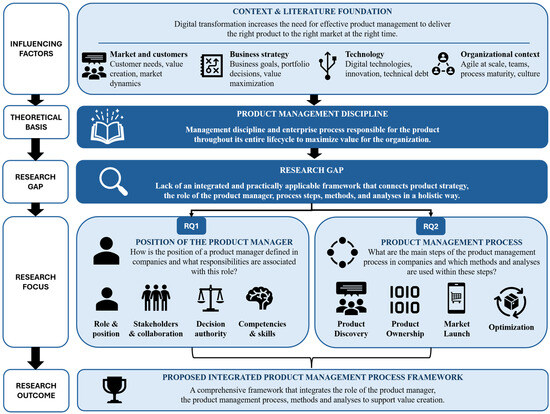
Figure 1 shows the conceptual framework of the study and the interconnection of its main elements. Product management is understood in the model as a management discipline that connects business strategy, customer needs, technological aspects and organizational context throughout the product life cycle. The identified research gap provides the basis for the formulation of the research questions and the subsequent empirical investigation.
Figure 1.
Conceptual research model.
Figure 1 summarizes the conceptual logic of the study, linking the identified research gap to the two research questions and the proposed research outcome. RQ1 addresses the position of the product manager, including the responsibilities associated with this role, while RQ2 focuses on the main steps of the product management process and the methods and analyses used at each stage. The findings from the empirical research provide the basis for the proposed integrated framework of the product management process.
3. Methodology
3.1. Data Collection
Data collection was conducted using a semi-structured interview technique (Ibarra-Sáiz et al., 2023; Malvaceda-Espinoza & Flores-Pereyra, 2025). Semi-structured interviews have been used as a primary research method in studies focusing on product management by Mikalsen et al. (2018), Pinna et al. (2018), and Springer and Miler (2022). Tyagi and Sawhney (2009) first conducted interviews and subsequently verified the results using a questionnaire. In contrast, Ebert (2018) used questionnaires in the first phase and then explored the findings in greater depth through structured interviews with experts. The simultaneous use of semi-structured interviews and questionnaires, followed by a comparison of their results, was applied by Manteli et al. (2010), Springer and Miler (2022), and Tai et al. (2024). A similar approach was adopted by Singh and Misra (2019), who, however, organized open discussions instead of interviews. Focus groups and workshops were also used as research methods by Grigoryan et al. (2025) and Fichtler et al. (2024).
The research sample consisted of 16 practitioners (n = 16) working at different levels of digital product development and management, mainly in the software development, banking, media, and manufacturing sectors. The respondents held positions such as Product Manager, Product Owner, and Business Analyst, while two respondents held the position of CEO. The first selection criterion was direct involvement in the complex process of bringing digital products to market, rather than involvement in only one part of the process, such as development. The second criterion was formal education in ICT or ICT management. This criterion was applied to ensure that the respondents understood the relationship between academic knowledge and professional practice, thereby supporting the development of a framework with both academic and practical relevance. This educational background also supported an understanding of product management from the perspective of the entire digital product development and market launch process, rather than from a single perspective, such as marketing. A predominantly marketing-oriented sample could have placed greater emphasis on the customer perspective while giving less attention to the development dimension of the process.
Data collection took place between January and March 2026 and was conducted in three formats: email communication (n = 6), communication via the Messenger chat application (n = 4), and face-to-face interviews (n = 6). Regardless of the data collection format, all 16 respondents were given the same seven core questions, which ensured a common data collection structure. The three formats differed only in the manner of communication and did not represent different interview protocols. In face-to-face interviews, core questions were discussed interactively, while in the email and Messenger formats, the same questions were provided to respondents in written form and respondents responded to them in writing. In all three formats, follow-up questions were used when clarification or additional details were needed. In face-to-face interviews, follow-up questions were asked directly during the conversation; in email and Messenger communications, they were sent as additional written questions in response to the participant’s response. Thus, follow-up questions were not standardized across participants but were used consistently as a means of clarification and elaboration based on the content of the respondent’s previous response.
The interview structure consisted of seven main questions:
- What does your organization understand by the term product management?
- What competencies and responsibilities does a product manager (or a person in a similar position) have in your organization?
- Who are the members of the product team and other stakeholders involved in the product management process in your organization?
- What steps do you follow as part of the product management process in your organization?
- Which methods do you use in the product management process in your organization?
- If you have an established product manager role, do you also have project or marketing managers? Are there clearly defined differences between their roles?
- Can you describe how and during which phases of product development and management your company uses AI solutions?
Since the study used a semi-structured interview design, additional questions were asked depending on the respondents’ answers and the context of the interview. These follow-up questions served to clarify and deepen the information obtained. They included, for example, questions about methods for validating the MVP and how the organization responded when a product idea was not positively received by potential customers during the validation phase.
3.2. Qualitative Analysis and Use of AI Tools
Qualitative content analysis was used to process and analyse the data (Flick, 2013; Graneheim et al., 2017). The analysis was conducted in three coding phases. During open coding, the interview transcripts were analysed sentence by sentence, and descriptive codes reflecting their content were assigned to individual statements, such as “pressure for speed” or “UX omission”. During axial coding, the relationships between the identified codes were explored and related codes were grouped into broader categories, including contextual factors, causes, and consequences. Selective coding was used to identify a central category that captured the main relationships between the identified categories and reflected the main focus of the study. In total, 100 key text segments were extracted, and 53 codes were assigned during the coding process.
To support the reliability of the qualitative analysis, coding was performed independently by two authors. The interviews were analysed by both coders to ensure a high level of accuracy and objectivity. The coding results were then compared by the authors to assess whether the identified codes, categories, and central theme adequately represented the content of the respective interview statements. Agreement between coders was additionally assessed using Cohen’s kappa coefficient. The observed agreement was 75.0% (p0 = 0.750), while the expected agreement was 3.8% (pe = 0.038), resulting in a Cohen’s kappa κ = 0.74, indicating a high level of agreement between coders.
Data collection continued until data saturation was reached. After approximately the twelfth interview, the main themes and arguments began to recur, and respondents provided largely similar responses. Four additional interviews were subsequently conducted to confirm that no new codes had emerged. As these interviews did not generate new codes, data collection was considered to have reached saturation and was terminated.
The coding process was also supported by an artificial intelligence tool (ChatGPT-4o) during the open coding phase. Both coders first independently analysed the interview data and assigned initial codes. The coded data was then entered into ChatGPT-4o to check for potentially omitted relevant textual statements and assess the consistency of the assigned codes with the content of the respective statements. The outputs generated by ChatGPT-4o were subsequently reviewed by the respective coder, who assessed their accuracy and relevance. The artificial intelligence tool therefore served only as a supplementary control mechanism and did not determine the final coding, categories, interpretation, or research findings. During the preparation of the manuscript, artificial intelligence was additionally used for spelling and language checks in English, as the authors are not native English speakers. AI tools were not used to generate research findings or replace the researchers’ analytical judgement.
4. Results
The research results provided answers to both research questions and allowed us to identify common and different elements of product management across the organizations studied. While the first research question focused on the role of the product manager and the responsibilities associated with it, the second examined the main phases of the product management process, including the methods and analytical approaches used. An overview of the main empirical findings is presented in Table 1.
Table 1.
Main empirical findings related to research questions.
As can be seen from Table 1, the position of product manager is not uniformly defined across organizations, and the scope of the role depends on the organizational setting and the nature of the product. In contrast, the product management process itself shows a high degree of similarity, as organizations use comparable phases in digital product development. The most significant differences were identified in the methods used, the analyses conducted, and the interpretation of some key product management concepts. The following sections therefore discuss these empirical findings in more detail.
The results show that the position of product manager varies considerably across organizations, particularly in terms of its scope and focus. In some organizations, this role overlaps with project management and includes operational activities such as planning, backlog management or coordination of team activities. “Some places also have a product manager who also serves as a project manager, i.e., they plan, run stand-ups, and manage the backlog.” In other cases, the product manager has a more strategic role, focusing mainly on defining the product vision, working with the customer and identifying the value of the product. “At our organization, product managers do more of the strategic work. We focus on working with customers, doing various kinds of research.”
The interviews also revealed that a key part of this role is the systematic collection and use of feedback, formulating hypotheses, and subsequently testing them through experimentation. “So, for me, one of the key parts is getting feedback, creating hypotheses, and then doing experiments and validating them.” Product managers actively use various tools for managing work and facilitating communication within the team, while clear allocation of responsibilities between individual team members is also emphasized. In addition, activities related to quality, risk, and schedule management were identified as important aspects of the role. Although the specific responsibilities vary between organizations, product managers consistently act as a link between customer needs and business and technological goals. “We focus on working with customers, we conduct various types of surveys, not only classic questionnaires for our users, but we also conduct various surveys directly in applications, e.g., via Hotjar.” Another respondent similarly emphasized direct contact with customers: “I also conduct interviews and go out and find out how clients directly work with our system.” Overall, the findings indicate that product management is a flexible and interdisciplinary role, the specific form of which depends on the organizational setting and the nature of the product.
Despite differences in how the product manager’s role is defined and the responsibilities it encompasses, the basic steps of the product management process were largely consistent across organizations. The interviews revealed that organizations use a similar logic for managing digital product development, which consists of four main phases. “The basic process structure consists of Product Discovery, Product Ownership, Launch and Commercialization, and Product Optimization.”
The first phase is product discovery, which includes identifying the problem, defining the goal, and designing a minimum viable product (MVP). This is followed by the product ownership phase, which focuses on the design and development of the product itself. The third phase is product launch and commercialization. The last phase is product optimization, which involves further improvements based on feedback and performance indicators.
Although organizations followed the same basic process logic, they differed in their choice of methods, analyses, and the specific implementation of individual phases.
Different approaches to the use of methods and analytical tools were identified across the individual phases of the product management process, with several differences observed between organizations. In the product discovery phase, organizations focused mainly on identifying customers and their needs, using analyses such as TAM/SAM/SOM, Inclusive Panda, Early/Ideal Customer Profile, or Innovation Adaptation Curve. Problem analysis was often carried out using design thinking methods, such as 5 Whys or 6 Questions, while goals were defined using different approaches (e.g., SMART, 5-4-3-2-1, Hard…). This phase also included formulating product hypotheses and developing a business model using tools such as Lean Canvas or Value Proposition Canvas. The interviews emphasized the importance of visualizing the business idea at this stage, before proceeding with MVP development. “In our experience, it is advisable to realize the intention at this stage before we start the MVP itself. Finding a need in the customer that I have verified, what is the unique value that we bring to the customer and how we will realize it, is the first business input over everything we implement.” These tools also emphasize the identification of the Unique Selling Point. Idea verification was carried out either without creating an MVP (e.g., interviews, questionnaires, focus groups) or through MVP-related experiments, such as landing pages, concierge tests, or A/B testing. “MVP—Make it as simple as possible. Always test only 1 hypothesis. Link it to real data (fake door test, collecting contact details, subscribing to the newsletter, pre-sales). The goal is to show that there is interest in the product.”
In the product ownership phase, the emphasis shifted to product development, starting with product strategy and subsequently addressing quality (e.g., QFD), time (product roadmap), and risk (risk register and risk matrix). This phase also included UI/UX design, along with the creation of an MMP and product testing using test scenarios or usability testing. “When developing, it is important to focus on quality, risk management, and schedule.” For product launch and commercialization, organizations mainly used approaches related to go-to-market strategy, customer onboarding, and customer journey mapping. “Launch and commercialization—Customer journey and onboarding the customer into the solution.” In the final phase, organizations focused on product optimization through tracking performance indicators (e.g., CSAT, NPS, CES), working with feedback, and managing the product life cycle. “As part of product optimization, we try to pay attention to user-focused metrics, NPS, CSAT and CES as such north star metrics.” Another respondent emphasized the importance of combining data with customer feedback: “Customer feedback is key and we actively work with it, and decisions must be based not only on data but also make sense from the perspective of client feedback.”
In addition to differences in methods, organizations varied in their interpretation and implementation of several fundamental product management concepts.
The findings also pointed to several ambiguities and differences in the understanding of key concepts, as well as in their allocation to individual process phases. In the case of the product life cycle, most organizations worked with this concept only in the optimization phase, where it was used to evaluate performance and determine the product’s future direction. In two cases, however, the life cycle was considered already in the product discovery phase, with respondents emphasizing the need to consider the individual stages of the life cycle from the outset to adapt activities throughout product development. At the same time, the findings indicated that knowledge of the product portfolio and an understanding of the life-cycle stage of individual products are important for the effective management of new product development. The same principle applies to the innovation adaptation curve, although in this case the focus is on customers.
Differences also emerged in the understanding of product strategy. In some organizations, the strategy was part of a broader business and marketing direction, while in others it was perceived more as an approach to product development itself, for example from the perspective of cost, quality, or service orientation. In such cases, it was naturally included in the product ownership phase.
Significant differences were also evident in the understanding of the terms MVP and MMP (Table 2). Some organizations used the term MVP to refer to a final product ready for launch, which corresponds more closely to the concept of MMP. However, an MVP does not have to represent a fully functional product but can take the form of a simple prototype or another tool used to verify the basic idea. In contrast, an MMP represents a minimal version of the product that already provides value to the customer and is suitable for commercial use. However, the term MMP is mainly used as a theoretical concept and is rarely used in practice. Instead, most organizations label such outputs as MVPs, although the meaning of the term varies considerably between companies. “In this case, MVP is understood more as MMP and we consider it as an experiment, i.e., a prototype, where we want to find out if we are going in the right direction.”
Table 2.
Main differences between MVP and MMP.
To improve the traceability of the proposed framework, Table 3 distinguishes between elements identified directly from the interviews, elements supported by the literature, and recommendations developed by the authors based on the synthesis of empirical and theoretical findings.
Table 3.
Traceability of the proposed framework to empirical findings and literature.
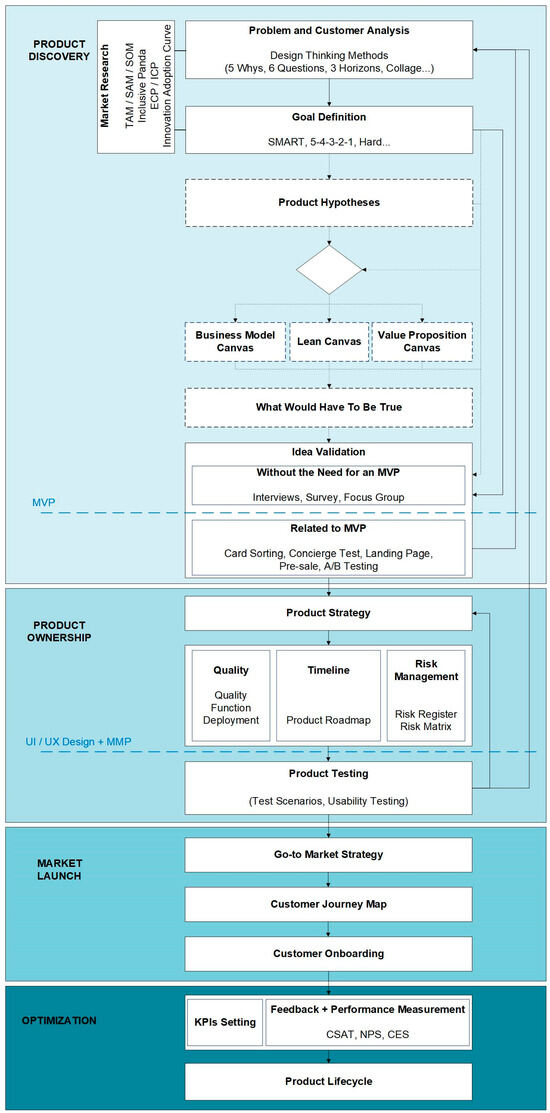
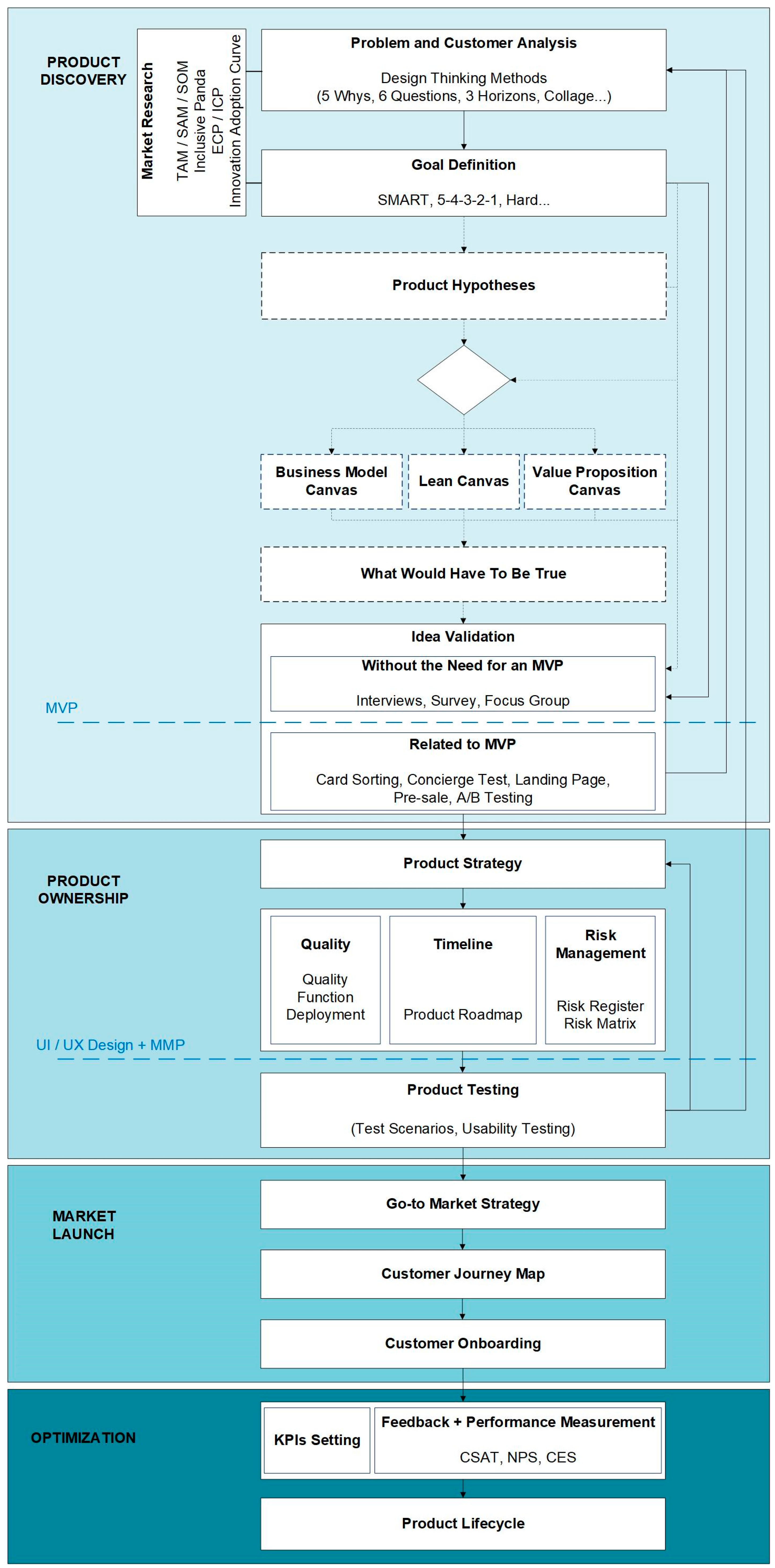
Based on the identified common elements of the product management process, the methods used, and the differences in the interpretation of key concepts, an integrated strategic product management framework for digital product development was proposed (Figure 2). The framework does not introduce entirely new product management phases; rather, it integrates the four empirically identified phases with relevant roles, methods, analytical approaches, and decision-making considerations.
Figure 2.
Strategic Product Management Framework—Digital Products.
Regarding the relationship between methods and analyses, the framework assumes that the product discovery phase should begin with thorough market research, with particular emphasis on identifying the target customer. This is reflected in the analysis of customer problems and needs and the definition of the product goal. Depending on the organization and the type of product, the process can continue in different ways. Organizations may either proceed directly to idea verification or first formulate product hypotheses, select an appropriate business model description framework, or apply the What Would Have To Be True method. When verifying an idea, the MVP represents an important milestone, as some methods can be applied without an MVP, whereas others require an MVP to be implemented. Both approaches to verification can be used in combination, or organizations may select only one, depending on the specific context. If the idea is not successfully verified, the process should return to the beginning, where the identified customer problems and needs are reassessed.
In the product ownership phase, the framework recommends first determining the strategy for developing the final product, including whether the product will focus, for example, on cost savings, exceptional added value for the customer, or exceptional quality. Subsequent decisions related to quality, schedule, and risk management should then be aligned with this strategy. At this stage, the final UI and UX are already designed, resulting in the MMP. The MMP should then be tested and, depending on the results, the product strategy may be reassessed, or the process may need to return to the initial identification of customer problems and needs. This represents the last point before the product is finalized and launched on the market.
In the product launch and commercialization phase, a go-to-market strategy should first be determined, followed by the development of a customer journey map and an appropriate customer onboarding process.
In the final phase of optimization, the product is already on the market, and its performance should be continuously monitored. This can be achieved by establishing KPIs. In some cases, KPIs may not be formally established, and feedback is collected and performance monitored without precisely defined goals. Finally, the product life cycle is managed throughout its subsequent stages, including the eventual withdrawal of the product from the market.
The results showed that although the position of the product manager varies significantly between organizations, the product management process itself is highly similar across organizations. The biggest differences were identified in the methods used, the understanding of selected concepts, and the way individual process steps are implemented. Based on these findings, an integrated product management framework was designed, connecting the main process phases with recommended methods and analytical tools.
5. Discussion
Research has shown that product management is an interdisciplinary management discipline whose implementation varies significantly across organizations. Although the literature describes the product manager as responsible for connecting business, technology, and customer requirements (Ebert & Brinkkemper, 2014; Springer & Miler, 2022), research findings indicate that the scope of the product manager’s responsibilities depends largely on the organizational context. In some organizations, product managers have a predominantly strategic role. They focus mainly on creating the product vision, defining product value, and working with customers. In other organizations, they also perform operational activities, such as backlog management, team coordination, and development planning. These findings support Berntzen et al. (2023) and Conboy and Carroll (2019), who argue that product management is strongly influenced by the organizational environment and cannot be effectively standardized through a single universal model.
Unlike the variously defined position of product manager in an organization, the product management process itself has proven to be significantly more consistent. Most of the organizations in which interviews were conducted implemented digital product development through four basic phases—product discovery, product ownership, market launch and optimization. The research results are in line with existing product management frameworks. These describe similar areas of the process, e.g., the Product Management Lifecycle Framework (Geracie & Eppinger, 2013), the ISPMA framework (A. M. Kittlaus & Fricker, 2017) or the framework proposed by Ebert (2018). The research also showed that individual organizations differ significantly in the choice of methods, analyses and ways of implementing individual process steps. This implies that a common process logic alone is not sufficient to ensure a unified approach to product management.
Another significant finding concerns differences in the understanding of several basic product management concepts. The greatest differences were identified in the interpretation of basic concepts such as MVP and MMP, product strategy, and the product life cycle. While professional literature clearly distinguishes between these concepts, organizations use them in different contexts and in different ways, adapting their meaning to their own processes. The findings suggest that the main challenge in product management does not lie in the lack of individual methods or tools. Rather, it lies in the absence of a unified framework that connects the individual process phases with their practical implementation and establishes common terminology across organizations. This also confirms the existence of the research gap defined in the introduction to the article.
The current professional literature includes several product management frameworks that focus either on strategic aspects of product management or on individual areas of the process. The research results showed that organizations in practice combine several approaches and use different methods, and their choice depends on the nature of the product, the organizational environment, and the level of product management development. This supports the need for an integrated framework that presents a systematic model linking the four main phases of product management with recommended methods and analyses.
The main contribution of the proposed strategic product management framework lies in its integration of elements that are addressed separately or with different emphases in existing approaches. The framework does not claim to introduce entirely new product management phases or activities. Rather, it extends existing approaches by integrating product strategy, the four empirically identified process phases, product manager decision-making, and the methods and analytical approaches used in practice within a single framework. This integration provides a more explicit link between the strategic and process dimensions of digital product management. At the same time, the framework reflects the empirical finding that organizations differ in their interpretation and implementation of selected product management concepts. It therefore retains sufficient flexibility to adapt to different organizational contexts and digital products.
From a practical perspective, the strategic framework is intended to provide organizations with a structured basis for examining and designing product management processes. It offers a systematic view of the individual phases of digital product development and identifies methods and analytical approaches that may be considered according to organizational needs and context. However, its practical applicability should be interpreted with caution, as the framework has not yet been quantitatively validated or experimentally evaluated across a broader range of organizations and product types.
The study has several limitations that should be considered when interpreting the findings. First, the research was conducted with a limited number of organizations focused on digital product development. Therefore, the findings may not be transferable to organizations operating in other industries or to different types of products. Second, the proposed strategic framework was developed from qualitative empirical data and represents an empirically grounded framework rather than a quantitatively validated model. Its proposed relationships between the different phases, methods, and analytical approaches therefore require further empirical verification.
Future research should address these limitations by testing the proposed strategic framework across a larger and more diverse sample of organizations. Quantitative research could examine the relationships between the framework’s individual components and assess whether their application is associated with more effective product management outcomes. Further research should also examine the applicability of the framework across different types of digital products, industries, and organizational environments. In addition, longitudinal or experimental studies could be used to assess how the application of the framework and its individual methods and analytical approaches influence product management across different phases of the digital product life cycle.
6. Conclusions
The aim of the article was to analyse the role of product management, identify the main steps of the product management process and the methods and analytical approaches used, and propose an integrated framework based on empirical research. The results showed that the role of the product manager and the scope of their responsibilities differ significantly across the analysed organizations. However, the product management process itself demonstrates a high degree of similarity. It can be divided into four basic phases: product discovery, product ownership, market launch, and optimization.
The research also revealed differences between organizations in the methods and analytical tools they use. Differences were also identified in the interpretation of several key product management concepts, including product strategy, the product life cycle, and the concepts of MVP and MMP. These findings indicate that, despite the existence of various recommended practices in professional literature, there is no universal framework for the product management process. Such a framework cannot be directly applied across all organizations.
The main contribution of the article is the proposal of an integrated product management framework. The framework connects the individual phases of the process with the methods and analytical approaches used in practice. It systematizes existing knowledge and integrates the strategic and process perspectives of digital product management. At the same time, it provides practical support for organizations in designing and optimizing their product management processes.
The research was conducted on a sample of organizations focused on digital product development. Therefore, the findings should be interpreted within this specific context. Future research should test the proposed framework across a larger number of organizations. It should also focus on quantitative validation and assess the applicability of the framework across different industries and product types.
The proposed framework provides an integrated approach to managing digital product development. It connects strategic decision-making, the product management process, and the methods and analytical approaches used in practice within a single model. Its primary contribution lies in this integration and in its grounding in empirical observations from practice. It does not seek to introduce entirely new product management phases. As the framework has not yet been quantitatively validated or experimentally evaluated in a broader organizational context, its applicability remains subject to further empirical testing and refinement.
Author Contributions
Conceptualization R.A.; Formal analysis N.S., R.A., D.F., L.K., M.K.; Funding acquisition M.K.; Methodology R.A., N.S.; Project administration R.A.; Resources N.S., R.A., D.F., L.K.; Supervision R.A.; Visualization N.S.; Writing original draft R.A., N.S., D.F., L.K., M.K.; Writing review and editing R.A., N.S. All authors have read and agreed to the published version of the manuscript.
Funding
Funded by the EU NextGenerationEU through the Recovery and Resilience Plan for Slovakia under the project No. 09I05-03-V02-00011.
Institutional Review Board Statement
In the case of ethical approval, we considered two guidelines that regulate ethics in the organization in which we operate (University of Žilina). Since one member of the ethics committee is an employee of our Faculty of Management and Informatics, we informally investigated whether it was necessary to request a meeting of the Ethics Committee of the University of Žilina. Since the research did not conduct testing on humans or animals and no points from the guidelines were met (https://www.uniza.sk/images/pdf/uradna-tabula/smernice-predpisy/2024/03062024_S-207-2021-Eticky-kodex-UNIZA-v-zneni-Dodatku-c-1.pdf, accessed on 7 June 2026 and https://www.uniza.sk/images/pdf/kvalita/2021/smernica-UNIZA-c-226.pdf, accessed on 7 June 2026), the ethics committee does not provide an official opinion for this type of research.
Informed Consent Statement
Our research involved professionals working at various levels of digital product management. As the research consisted of semi-structured interviews conducted both online and offline, consent was given in advance in writing via email or message stating: “I agree to participate in the research.” We did not ask respondents for any personal or sensitive information, nor did we ask them for anything that specifically identified the organization they worked for.
Data Availability Statement
The research consisted of qualitative semi-structured interviews. All findings are incorporated into the article.
Acknowledgments
During the preparation of this work, the author(s) used artificial intelligence tools for language proofreading and text stylization, as they are not native English speakers (free version of ChatGPT-5.6 Luna, free version of Grammarly-web-based version, accessed June 2026) and for methodological support in the coding process (described in more detail in Section 3.2), with all outputs obtained with the help of artificial intelligence being checked by researchers and the final coding and interpretation remaining entirely under human responsibility.
Conflicts of Interest
The authors declare no conflict of interest.
References
- Bekkers, W., Brinkkemper, S., van den Bemd, L., Mijnhardt, F., Wagner, C., & van de Weerd, I. (2012). Evaluating the software product management maturity matrix. In IEEE international requirements engineering conference (pp. 51–60). IEEE. [Google Scholar] [CrossRef] [Scilit]
- Berntzen, M., Stray, V., Moe, N. B., & Hoda, R. (2023). Responding to change over time: A longitudinal case study on changes in coordination mechanisms in large-scale agile. Empirical Software Engineering, 28, 114. [Google Scholar] [CrossRef] [Scilit]
- Castaneda, R. A. R., Ostrosi, E., & Stjepandic, J. (2025). Dynamic product risk management in product lifecycle management of medical products. Journal of Industrial Information Integration, 48, 100977. [Google Scholar] [CrossRef] [Scilit]
- Cheng, X., Huang, F. H., Yang, Q. M., & Qiu, L. Q. (2025). A digital twin data management and process traceability method for the complex product assembly process. Journal of the Brazilian Society of Mechanical Sciences and Engineering, 47, 151. [Google Scholar] [CrossRef] [Scilit]
- Conboy, K., & Carroll, N. (2019). Implementing large-scale agile frameworks: Challenges and recommendations. IEEE Software, 36(2), 44–50. [Google Scholar] [CrossRef] [Scilit]
- Cooper, R. G., Desai, M., Green, L., & Kleinschmidt, E. J. (2024). Strategies to improve portfolio management of new products: Results of the IRI Portfolio Study. Research-Technology Management, 67(1), 55–66. [Google Scholar] [CrossRef] [Scilit]
- Cooper, R. G., & Sommer, A. F. (2023). Dynamic portfolio management for new product development. Research-Technology Management, 66(3), 19–31. [Google Scholar] [CrossRef] [Scilit]
- Crowne, M. (2002). Why software product startups fail and what to do about it. Evolution of software product development in startup companies. In IEEE international engineering management conference. IEEE. [Google Scholar] [CrossRef] [Scilit]
- Dingsøyr, T., Moe, N. B., & Seim, E. A. (2018). Coordinating knowledge work in multiteam programs: Findings from a large-scale agile development program. Project Management Journal, 49(6), 64–77. [Google Scholar] [CrossRef] [Scilit]
- Dver, A. (2003). Software product management essentials. Meghan Kiffer. [Google Scholar]
- Ebert, C. (2006). Understanding the product life cycle: Four key requirements engineering techniques. IEEE Software, 23(3), 19–25. [Google Scholar] [CrossRef] [Scilit]
- Ebert, C. (2007). The impacts of software product management. Journal of Systems and Software, 80(6), 850–861. [Google Scholar] [CrossRef] [Scilit]
- Ebert, C. (2009). Software product management. Crosstalk, 22(1), 15–19. [Google Scholar]
- Ebert, C. (2014). Software product management. IEEE Software, 31(3), 21–24. [Google Scholar] [CrossRef] [Scilit]
- Ebert, C. (2018). Managing software products in a global context. In ICGSE ‘18: Proceedings of the 13th international conference on global software engineering (pp. 69–76). Association for Computing Machinery. [Google Scholar] [CrossRef] [Scilit]
- Ebert, C. (2026). Product management is product leadership. Computer, 59(4), 182–187. [Google Scholar] [CrossRef] [Scilit]
- Ebert, C., & Brinkkemper, S. (2014). Software product management—An industry evaluation. Journal of Systems and Software, 95, 10–18. [Google Scholar] [CrossRef] [Scilit]
- Eißler, P., Schneider, J., & Roling, B. (2020). Product roadmap alignment–Achieving the vision together: A grey literature review. In Agile processes in software engineering and extreme programming–workshops (pp. 50–57). Springer. [Google Scholar] [CrossRef] [Scilit]
- Fani, V., Falchi, C., Bindi, B., & Bandinelli, R. (2021). Implementation framework for PLM: A case study in the fashion industry. International Journal of Advanced Manufacturing Technology, 113(1–2), 435–448. [Google Scholar] [CrossRef] [Scilit]
- Fatema, K., Syeed, M., & Miah, M. S. U. (2020). Demography of startup software companies: An empirical investigation on the success and failure. International Journal of Computer Applications, 176(29). [Google Scholar] [CrossRef] [Scilit]
- Fichtler, T., Kirchberg, L., Grigoryan, K., Koldewey, C., & Dumitrescu, R. (2024). A method for identifying use cases in data-driven product management. Procedia CIRP, 122, 539–544. [Google Scholar] [CrossRef] [Scilit]
- Flick, U. (2013). The SAGE handbook of qualitative data analysis. SAGE Publications. [Google Scholar]
- Fricker, S. A. (2012). Software product management. In Software for people (pp. 53–81). Springer. [Google Scholar] [CrossRef] [Scilit]
- Geracie, G., & Eppinger, S. D. (2013). The guide to the product management and marketing body of knowledge. Product Management Educational Institute (PMEI). [Google Scholar]
- Gorchels, L. (2000). The product manager’s handbook: The complete product management resource (2nd ed.). McGraw-Hill. [Google Scholar]
- Graneheim, U. H., Lindgren, B. M., & Lundman, B. (2017). Methodological challenges in qualitative content analysis: A discussion paper. Nurse Education Today, 56, 29–34. [Google Scholar] [CrossRef] [Scilit] [PubMed]
- Grigoryan, K., Martin, L., Lamarz, J., Fichtler, T., Hohn, B., Asmar, L., Kühn, A., & Dumitrescu, R. (2025). Product management: Tasks, roles, and the importance of data. Procedia CIRP, 136, 838–843. [Google Scholar] [CrossRef] [Scilit]
- Guchhait, R., & Sarkar, B. (2024). A decision-making problem for product outsourcing with flexible production under a global supply chain management. International Journal of Production Economics, 272, 109230. [Google Scholar] [CrossRef] [Scilit]
- Haines, S. (2014). The product manager’s desk reference. McGraw-Hill. [Google Scholar]
- Ibarra-Sáiz, M. S., González-Elorza, A., & Rodríguez Gómez, G. (2023). Aportaciones metodológicas para el uso de la entrevista semiestructurada en la investigación educativa a partir de un estudio de caso múltiple. Revista de Investigación Educativa, 41(2), 501–522. [Google Scholar] [CrossRef] [Scilit]
- Kittlaus, A. M., & Fricker, S. A. (2017). Software product management: The ISPMA-compliant study guide and handbook. Springer. [Google Scholar] [CrossRef] [Scilit]
- Kittlaus, H. B. (2012). Software product management and agile software development: Conflicts and solutions. In Software for people: Fundamentals, trends and best practices (pp. 83–96). Springer. [Google Scholar] [CrossRef] [Scilit]
- Larman, C., & Vodde, B. (2016). Large-scale scrum: More with LeSS. Pearson Education. [Google Scholar]
- Leffingwell, D. (2018). SAFe 4.5 reference guide: Scaled agile framework for lean enterprises. Addison-Wesley Professional. [Google Scholar]
- Liu, L., Patwary, A. K., & Li, M. X. (2024). Measuring green performance in hotel industry through management environmental concern: Mediated by green product and process innovation. SAGE Open, 14(4), 1–15. [Google Scholar] [CrossRef] [Scilit]
- Maglyas, A., Nikula, U., & Smolander, K. (2011). What do we know about software product management?—A systematic mapping study. In Fifth international workshop on software product management (IWSPM) (pp. 26–35). IEEE. [Google Scholar] [CrossRef] [Scilit]
- Maglyas, A., Nikula, U., & Smolander, K. (2012). What do practitioners mean when they talk about product management? In 20th IEEE international requirements engineering conference, RE 2012—Proceedings (pp. 261–266). IEEE. [Google Scholar] [CrossRef] [Scilit]
- Maglyas, A., Nikula, U., & Smolander, K. (2013). What are the roles of software product managers? An empirical investigation. Journal of Systems and Software, 86(12), 3071–3090. [Google Scholar] [CrossRef] [Scilit]
- Malvaceda-Espinoza, E., & Flores-Pereyra, G. (2025). Methodological aspects in the construction of the protocol in semi-structured interviews. The Qualitative Report, 30(12), 4879–4890. [Google Scholar] [CrossRef] [Scilit]
- Manteli, C., van de Weerd, I., & Brinkkemper, S. (2010). Bridging the gap between software product management and software project management. In PROFES ‘10: Proceedings of the 11th international conference on product focused software (pp. 32–34). Association for Computing Machinery. [Google Scholar] [CrossRef] [Scilit]
- McKendry, D. A., Whitfield, R. I., & Duffy, A. H. (2022). Product lifecycle management implementation for high value engineering to order programs: An informational perspective. Journal of Industrial Information Integration, 26, 100264. [Google Scholar] [CrossRef] [Scilit]
- Merminod, V., Le Dain, M. A., & Frank, A. G. (2022). Managing glitches in collaborative product development with suppliers. Supply Chain Management: An International Journal, 27(3), 348–368. [Google Scholar] [CrossRef] [Scilit]
- Mikalsen, M., Moe, N. B., Stray, V., & Nyrud, H. (2018, December 13–16). Agile digital transformation: A case study of interdependencies. Thirty Ninth International Conference on Information Systems (ICIS 2018), San Francisco, CA, USA. Available online: https://aisel.aisnet.org/icis2018/management/Presentations/6 (accessed on 7 June 2026).
- Moe, N. B., Berntzen, M., Barbala, A., & Stray, V. (2024). Software product management in large-scale agile processes in software engineering and extreme programming. Lecture Notes in Business Information Processing, 512, 53–69. [Google Scholar] [CrossRef] [Scilit]
- Morán-Zabala, J. P., & Cogollo-Flórez, J. M. (2024). A Monte Carlo simulation methodology for uncertainty analysis in product recall management. In Simulation for a sustainable future, PT II, EUROSIM 2023 (pp. 59–70). Springer. [Google Scholar] [CrossRef] [Scilit]
- Münch, J., Trieflinger, S., Bogazköy, E., Eißler, P., Roling, B., & Schneider, J. (2020). Product roadmap formats for an uncertain future: A grey literature review. In 2020 46th Euromicro conference on software engineering and advanced applications (SEAA) (pp. 284–291). IEEE. [Google Scholar] [CrossRef] [Scilit]
- Oruthotaarachchi, C., & Wijayanayake, J. (2025). Aligning software product management with software engineering concepts: A systematic literature review. Journal of Information Systems Engineering and Business Intelligence, 11(2), 143–159. [Google Scholar] [CrossRef] [Scilit]
- Paasivaara, M., Behm, B., Lassenius, C., & Hallikainen, M. (2018). Large-scale agile transformation at Ericsson: A case study. Empirical Software Engineering, 23(5), 2550–2596. [Google Scholar] [CrossRef] [Scilit]
- Paranhos, I., & Santos, G. (2024). Critical factors for software product management: A systematic literature review. In 23rd Brazilian symposium on software quality (pp. 158–168). Association for Computing Machinery. [Google Scholar] [CrossRef] [Scilit]
- Parikh, N. (2025). The evolving role of product manager—A systematic review. Foundations of Management, 17(1), 37–56. [Google Scholar] [CrossRef] [Scilit]
- Pattyn, F. (2023). Preliminary structured literature review results using ChatGPT: Towards a pragmatic framework for product managers at software startups. In 2023 IEEE 31st international requirements engineering conference workshops (REW). IEEE. [Google Scholar] [CrossRef] [Scilit]
- Pinna, C., Galati, F., Rossi, M., Saidy, C., Harik, R., & Terzi, S. (2018). Effect of product lifecycle management on new product development performances: Evidence from the food industry. Computers in Industry, 100, 184–195. [Google Scholar] [CrossRef] [Scilit]
- Pires, M. C., Parreira, R., & Frazzon, E. M. (2021). Integrated operational supply chain planning in industry 4.0. International Journal of Integrated Supply Management, 14(1), 28–49. [Google Scholar] [CrossRef] [Scilit]
- Prem, E. (2019). Artificial intelligence for innovation in Austria. Technology Innovation Management Review, 9(12), 5–15. [Google Scholar] [CrossRef] [Scilit] [PubMed]
- Shao, H. Y., Zhang, S. M., Guo, W., Sun, J., Wang, L., & Chang, Z. X. (2026). A study on product attribute identification and decision-making based on design cognitive conflicts. Advanced Engineering Informatics, 69(A), 103832. [Google Scholar] [CrossRef] [Scilit]
- Singh, S., & Misra, S. C. (2019). Exploring the challenges for adopting the cloud PLM in manufacturing organizations. IEEE Transactions on Engineering Management, 68(3), 752–766. [Google Scholar] [CrossRef] [Scilit]
- Springer, O., & Miler, J. (2018). The role of a software product manager in various business environments. In 2018 Federated conference on computer science and information systems (FedCSIS) (pp. 985–994). IEEE. [Google Scholar]
- Springer, O., & Miler, J. (2022). A comprehensive overview of software product management challenges. Empirical Software Engineering, 27, 106. [Google Scholar] [CrossRef] [Scilit]
- Springer, O., Miler, J., & Wróbel, M. (2023). Strategies for dealing with software product management challenges. IEEE Access, 11, 55797–55813. [Google Scholar] [CrossRef] [Scilit]
- Steinhardt, G. (2017). Definition of product management: Defining the product management domain and the foundations of the Blackblot PMTK Methodology™. In The product manager’s toolkit (pp. 5–9). Springer International Publishing. [Google Scholar] [CrossRef] [Scilit]
- Strader, T. J. (2010). Digital product management, technology and practice: Interdisciplinary perspectives. IGI Global. [Google Scholar] [CrossRef] [Scilit]
- Tai, Y. M. (2017). Effects of product lifecycle management systems on new product development performance. Journal of Engineering and Technology Management, 46, 67–83. [Google Scholar] [CrossRef] [Scilit]
- Tai, Y. M., Tsao, Y. C., & Chen, T. H. (2024). Product lifecycle management system implementation and market responsiveness: The role of partner management capability. Journal of Industrial and Production Engineering, 41(3), 229–243. [Google Scholar] [CrossRef] [Scilit]
- Tanpure, G., Yadav, V., Jain, R., & Soni, G. (2022). Adoption of product lifecycle management in new product development: A case study of automotive organization. Benchmarking: An International Journal, 29(5), 1546–1561. [Google Scholar] [CrossRef] [Scilit]
- Tyagi, R. K., & Sawhney, M. S. (2009). High-performance product management: The impact of structure, process, competencies, and role definition. Journal of Product Innovation Management, 27, 83–96. [Google Scholar] [CrossRef] [Scilit]
- van de Weerd, I., Brinkkemper, S., Nieuwenhuis, R., Versendaal, J., & Bijlsma, L. (2006). On the creation of a reference framework for software product management: Validation and tool support. In International workshop on software product management (IWSPM) (pp. 3–12). IEEE. [Google Scholar] [CrossRef] [Scilit]
- van de Weerd, I., Brinkkemper, S., & Versendaal, J. (2010). Incremental method evolution in global software product management: A retrospective case study. Journal of Information and Software Technology, 52(7), 720–732. [Google Scholar] [CrossRef] [Scilit]
- Wagenblatt, T. (2019). Software product management: Finding the right balance for YourProduct Inc. Springer. [Google Scholar] [CrossRef] [Scilit]
- Witkowski, A., & Wodecki, A. (2024). An exploration of the applications, challenges, and success factors in AI-driven product development and management. Foundations of Management, 16(1), 139–156. [Google Scholar] [CrossRef] [Scilit]
- Witkowski, A., & Wodecki, A. (2025). Where does AI play a major role in the new product development and product management process? Management Review Quarterly. [Google Scholar] [CrossRef] [Scilit]

Disclaimer/Publisher’s Note: The statements, opinions and data contained in all publications are solely those of the individual author(s) and contributor(s) and not of MDPI and/or the editor(s). MDPI and/or the editor(s) disclaim responsibility for any injury to people or property resulting from any ideas, methods, instructions or products referred to in the content. |
© 2026 by the authors. Licensee MDPI, Basel, Switzerland. This article is an open access article distributed under the terms and conditions of the Creative Commons Attribution (CC BY) license.