


Abstract
This study aims to examine whether sustainability governance mechanisms are associated with reported corporate carbon emissions among firms listed on the Saudi Exchange (Tadawul) and to assess their potential implications for carbon accountability associated with Sustainable Development Goals (SDGs) 12, 13, and 16. Using an unbalanced panel of 188 firm-year observations from 51 firms during 2014–2021, the study estimates pooled ordinary least squares models with firm-clustered robust standard errors and industry and year fixed effects. Sustainability committee presence, stand-alone sustainability reporting, and external assurance are examined separately and through a 0–3 composite score. In the joint individual-mechanism model, external assurance is positively associated with reported emissions, whereas committee presence and reporting are nonsignificant. In a separate composite model, the sustainability governance score is positive and significant. The composite coefficient remains positive and significant in the asset- and revenue-scaled carbon-intensity and one-year-lagged specifications, although the assurance result is sensitive to the intensity denominator. The findings are consistent with an interpretation in which stronger governance is associated with greater visibility and completeness of reported carbon exposure; however, the observational data cannot distinguish this mechanism conclusively from differences in underlying emissions or endogenous governance adoption. Improved visibility may support responsible reporting (SDG 12), climate accountability (SDG 13), and transparent institutions (SDG 16).
1. Introduction
Climate change has made corporate greenhouse gas emissions a central issue in accounting, governance, and sustainability research. Investors, regulators, creditors, and other stakeholders increasingly require decision-useful information about transition risk, physical risk, and carbon-intensive activities. Carbon accountability, however, depends not only on whether a firm reports an emissions number but also on whether governance and control systems identify emission sources, define organizational and operational boundaries, consolidate data, and permit external scrutiny (Bui et al., 2021; Fan et al., 2021; Luo et al., 2023; Rankin et al., 2011).
Reported emissions are not identical to actual physical emissions or environmental efficiency. Total reported CO2-equivalent emissions reflect production scale and technology, but they also reflect boundary completeness, measurement capability, disclosure incentives, and managerial discretion. A low reported value may indicate genuinely low emissions or incomplete measurement; a high reported value may indicate substantial underlying exposure, more complete reporting, or both. Absolute reported emissions must therefore be interpreted alongside firm size, carbon intensity, reporting scopes, temporal trends, and assurance status (Tomar, 2023).
This study conceptualizes sustainability governance as an accountability architecture comprising oversight, disclosure, and verification. Sustainability committee presence represents formal internal oversight; issuance of a stand-alone sustainability report provides an organized disclosure channel; and external assurance subjects reported sustainability information to independent examination. These mechanisms may operate separately, but their joint presence can also indicate a more developed governance system (Al-Shaer & Zaman, 2016, 2018; Perego & Kolk, 2012; Simnett et al., 2009).
The theoretical argument is organized as a connected accountability process rather than as five unrelated explanations. Stakeholder and legitimacy pressures create demand for carbon accountability; resource dependence explains how specialized board structures provide expertise and coordination; agency theory explains the monitoring and information-asymmetry problems addressed by reporting and assurance; and signaling theory explains why costly verification can communicate reporting credibility. Together, these perspectives predict greater visibility of reported carbon exposure, while also recognizing that high-emission firms may voluntarily adopt stronger governance mechanisms (Freeman, 1984; Hillman & Dalziel, 2003; Jensen & Meckling, 1976; Spence, 1973; Suchman, 1995).
Three gaps motivate the study. First, prior research commonly examines ESG scores, environmental pillar scores, disclosure indices, or carbon performance; comparatively less is known about whether sustainability-governance architecture is associated with the amount of carbon exposure that becomes observable in corporate reporting. Second, governance mechanisms are often tested individually even though committee oversight, formal reporting, and assurance can perform complementary functions. Third, much of the evidence comes from developed or multi-country settings, leaving uncertainty about how these relationships operate where reporting and assurance practices are still developing. The study addresses these gaps by testing the three mechanisms separately and jointly, explicitly treating reported emissions as a transparency-sensitive outcome, and conducting intensity-based and lagged robustness analyses.
More specifically, prior empirical studies have largely examined environmental-performance scores, carbon-emission performance, carbon-disclosure quality, or the adoption and credibility of assurance rather than the amount and intensity of carbon exposure that becomes observable in corporate reporting. Studies in Saudi Arabia have linked sustainability committees, stand-alone reporting, assurance, and composite governance measures to environmental performance, while international studies have examined assurance adoption, disclosure quality, carbon-emission performance, and the real effects of mandatory disclosure. What remains unresolved is whether the presence and cumulative development of an oversight–disclosure–verification architecture are associated with the level and intensity of reported carbon exposure in a single emerging-market setting where governance adoption is heterogeneous. Table 1 summarizes the empirical distinction that motivates the present study.
Table 1.
Comparison of representative prior studies and the present research gap.
Saudi Arabia is a theoretically informative rather than merely an additional national setting. During 2014–2021, listed firms operated during a period of evolving and heterogeneous sustainability-reporting and assurance practices, while Vision 2030 and the Saudi Exchange’s ESG Disclosure Guidelines increased expectations for transparency and sustainable capital-market development (Saudi Exchange, 2021; Saudi Vision 2030, n.d.). The coexistence of ambitious national transformation, material carbon-intensive industries, and heterogeneous governance adoption creates meaningful variation in whether corporate carbon exposure becomes visible and credible. Recent Saudi evidence confirms that sustainability committees, reporting, and assurance are relevant to ESG outcomes, but it does not resolve how these mechanisms relate to the level and intensity of reported emissions (Alwadani et al., 2024; Soussi et al., 2025).
The study also relates to SDG 13 (Climate Action), SDG 12 (Responsible Consumption and Production), and SDG 16 (Peace, Justice and Strong Institutions). Measuring and scrutinizing reported CO2-equivalent emissions may support climate accountability associated with SDG 13; formal reporting and assurance may support responsible corporate disclosure associated with SDG 12; and committee oversight and independent verification are relevant to the transparency and accountability objectives associated with SDG 16 (United Nations, 2015).
Accordingly, this study aims to examine whether sustainability committee presence, stand-alone sustainability reporting, and external assurance are associated with reported corporate carbon emissions among firms listed on the Saudi Exchange (Tadawul; hereafter, Saudi-listed firms), and to determine whether their cumulative presence, represented by a composite governance score, is associated with greater visibility of reported carbon exposure. These practices may contribute to SDG 13 through more credible climate information, SDG 12 through responsible sustainability reporting, and SDG 16 through stronger accountability and transparent institutions (United Nations, 2015). However, the empirical models do not directly test achievement of these SDGs.
Because adoption of the governance mechanisms is voluntary and potentially endogenous, the empirical evidence is interpreted as associational rather than causal. Firms with substantial carbon exposure may be more likely to establish committees, publish reports, and obtain assurance. The analysis therefore supplements pooled models with firm fixed effects, carbon-intensity outcomes, and one-year-lagged governance variables, while retaining explicit caution about reverse causality and unobserved heterogeneity.
The study makes four contributions. First, it separates carbon-reporting visibility from environmental performance, reducing the risk of equating a larger reported total with governance-induced pollution. Second, it integrates oversight, disclosure, and verification within one conceptual and empirical framework while preserving component-level tests. Third, it adds carbon-intensity and temporal robustness evidence to the emerging literature on sustainability governance and assurance. Fourth, it extends carbon-accounting evidence to Saudi Arabia and derives policy implications for credible emissions measurement, disclosure, and assurance during the Kingdom’s sustainability transformation.
The remainder of the paper is structured as follows. Section 2 reviews related literature and develops hypotheses. Section 3 explains the research methodology, including the sample, variable measurements, and empirical models. Section 4 presents empirical results and discussion. Section 5 concludes the study by outlining the main findings, contributions, implications, limitations, and directions for future research.
2. Literature Review and Hypothesis Development
2.1. Sustainability Governance and Corporate Carbon Emissions
Corporate carbon emissions provide a direct quantitative indicator of greenhouse gas exposure, but the meaning of the observed measure depends on how it is constructed. An absolute total captures the amount of CO2-equivalent emissions reported by a firm; carbon intensity scales that amount by an economic denominator such as assets or revenue. Neither measure is equivalent to a broad ESG score. Absolute totals are informative about aggregate exposure, whereas intensity measures are more informative about emissions relative to organizational scale (Goud, 2022; Tomar, 2023).
Sustainability governance refers here to the internal and external arrangements through which firms oversee, disclose, and verify sustainability information. The empirical indicators are sustainability committee presence, issuance of a stand-alone sustainability report, and external assurance of sustainability reporting. The mechanisms are examined individually and as an equal-weighted composite score because they perform distinct but potentially complementary accountability functions (Mansour et al., 2025; Soussi et al., 2025).
2.2. Integrated Theoretical Framework and Theory Selection
The framework links the theories through a sequential accountability logic. Stakeholder theory identifies the information demands created by investors, regulators, creditors, customers, and affected communities. Legitimacy theory explains why environmentally visible firms respond to social and regulatory scrutiny, including by disclosing unfavorable impacts. Resource dependence theory explains how a specialized sustainability committee can supply expertise, coordination, and access to external knowledge. Agency theory then identifies the monitoring problem created by managerial control over technically complex carbon data, while signaling theory explains why costly reporting and independent verification can distinguish credible transparency from unsupported claims. The combined pathway is therefore external pressure and legitimacy need, organizational capacity, monitoring and disclosure, and credibility signaling. Each element converges on greater reporting visibility, although the same process can be initiated endogenously by firms with high carbon exposure.
Accordingly, the conceptual framework is reciprocal rather than strictly one-directional. Governance mechanisms may increase the completeness and credibility of reported carbon exposure, while substantial underlying carbon exposure may itself increase stakeholder scrutiny and the probability that firms adopt committees, reporting, and assurance. The directional hypotheses test the governance-to-reporting association, whereas endogenous adoption remains a competing mechanism in interpretation. Because the three mechanisms can co-occur, H1–H3 state expected directional associations rather than claims that each mechanism will exhibit an independently robust incremental effect in every specification; incremental contributions are assessed in the joint model.
The five perspectives were selected because they directly explain the study’s governance mechanisms and reporting outcome. Institutional theory is highly relevant to coercive, mimetic, and normative convergence, but the present single-country design does not test cross-regime diffusion or an exogenous disclosure mandate (DiMaggio & Powell, 1983). Stewardship theory emphasizes managers’ intrinsic alignment with organizational objectives, whereas the present study focuses on selective disclosure, verification, and information asymmetry (Davis et al., 1997). The natural resource-based view explains how environmental capabilities generate pollution prevention and competitive advantage, but the dependent variable here is the amount of emissions reported rather than strategic environmental capability or performance (Hart, 1995). These perspectives remain valuable for future research, but adding them as coequal foundations would weaken theoretical parsimony without introducing a distinct testable mechanism in the current design.
2.3. Sustainability Committee and Reported Corporate Carbon Emissions
A sustainability committee assigns formal responsibility for sustainability strategy, climate-related risk, stakeholder engagement, and nonfinancial reporting. By creating a dedicated forum at the board or board-affiliated level, the committee can coordinate operational data owners, elevate material environmental issues, and connect carbon measurement with governance oversight. This role is particularly relevant when carbon-accounting routines are still developing.
Stakeholder and legitimacy theories predict that firms facing greater environmental scrutiny will formalize oversight to respond to information demands and maintain social acceptance. Resource dependence theory adds that a specialized committee can provide expertise and relational resources needed to interpret climate risks, define reporting responsibilities, and oversee data collection. The committee can therefore increase the probability that material emissions are identified and included within the reporting boundary.
Empirical evidence supports this reporting channel. Driss et al. (2024) document higher-quality greenhouse gas disclosure when firms maintain sustainability committees, while Ben-Amar and McIlkenny (2015) and Prado-Lorenzo and García-Sánchez (2010) show that board governance is relevant to climate-related disclosure. Meqbel et al. (2026) further report that CSR committee characteristics are associated with carbon-emission performance. In Saudi Arabia, Alwadani et al. (2024) and Soussi et al. (2025) link sustainability committees to stronger environmental outcomes. Because the present dependent variable is the amount of total emissions reported, committee oversight is expected to increase reporting completeness rather than mechanically increase physical pollution.
H1.
Sustainability committee presence is positively associated with reported corporate carbon emissions among Saudi-listed firms.
2.4. Sustainability Reporting and Reported Corporate Carbon Emissions
A stand-alone sustainability report creates a recurring channel through which a firm communicates environmental policies, climate risks, energy use, emissions, targets, and mitigation activities. Producing the report also requires the organization to identify indicators, assign data ownership, consolidate information across units, and approve disclosures. These processes can increase the traceability and continuity of carbon information. Reporting alone, however, does not guarantee balanced or complete disclosure; firms may emphasize favorable information or use reporting symbolically (Boiral, 2013; Michelon et al., 2015).
Agency theory suggests that formal reporting can reduce information asymmetry by establishing a documented channel between managers and external users. Stakeholder theory emphasizes the report’s role in responding to heterogeneous information needs, while legitimacy theory recognizes that carbon-intensive firms may report more extensively when their activities attract scrutiny. These perspectives therefore predict more visible emissions information but do not imply that the publication of a report necessarily improves physical carbon efficiency.
Evidence similarly distinguishes disclosure from performance. Khatri and Kjærland (2023) associate sustainability reporting practices with environmental performance among Nordic firms, and Tomar (2023) shows that greenhouse gas disclosure can facilitate benchmarking and subsequent emissions responses. Yin et al. (2023) also document a relationship between ESG disclosure and carbon performance in heavily polluting industries. In Saudi Arabia, Soussi et al. (2025) find that sustainability reporting forms part of a broader governance system associated with environmental performance. These studies support the organizational relevance of reporting while leaving open whether higher reported totals reflect poorer efficiency or more complete visibility.
Because stand-alone reporting institutionalizes data collection and makes omissions more observable over time, firms that issue sustainability reports are expected to report a larger share of their carbon exposure, conditional on firm characteristics and industry and year effects. Therefore, the second hypothesis is formulated as follows:
H2.
Sustainability reporting is positively associated with reported corporate carbon emissions among Saudi-listed firms.
2.5. External Assurance and Reported Corporate Carbon Emissions
External assurance is the most explicit credibility mechanism examined in the study. Carbon information is technically complex, may span several organizational and operational boundaries, and is difficult for external users to verify. An assurance engagement can examine selected evidence, reporting processes, and conformity with stated criteria, thereby increasing incentives for documentation, consistency, and traceability. Assurance nevertheless varies in provider, standard, subject matter, scope, and level, so its presence should not be treated as a perfect certificate of reporting quality (Casey & Grenier, 2015; O’Dwyer & Owen, 2005).
Agency theory predicts that assurance can reduce information asymmetry surrounding managers’ carbon-accounting choices. Signaling theory suggests that a voluntary and costly engagement can communicate confidence in the reporting system, whereas legitimacy theory predicts stronger assurance demand among firms exposed to environmental scrutiny. Consistent with these arguments, Simnett et al. (2009) identify systematic determinants of sustainability-assurance adoption, Perego and Kolk (2012) describe its development as an accountability practice, and Fan et al. (2021) show that carbon information asymmetry is associated with independent carbon assurance. Bui et al. (2021) and Luo et al. (2023) further link carbon assurance to reporting integrity and disclosure quality.
External assurance is therefore expected to be positively associated with the amount of carbon emissions reported because assured firms are more likely to maintain documented and verifiable measurement systems. The predicted sign concerns reporting completeness and credibility; it does not assert that assurance causes physical emissions to rise. Therefore, the third hypothesis is formulated as follows:
H3.
External assurance of sustainability reporting is positively associated with reported corporate carbon emissions among Saudi-listed firms.
2.6. Composite Sustainability Governance Score and Reported Corporate Carbon Emissions
The three mechanisms can also function as an integrated sustainability-governance system. A committee provides oversight and coordination, a stand-alone report creates a structured disclosure process, and external assurance adds independent scrutiny. A firm that combines all three arrangements has a more developed accountability architecture than a firm with only one or none.
The composite approach follows directly from the integrated theoretical framework. Stakeholder and legitimacy pressures motivate accountability; the committee supplies governance capacity; reporting formalizes information production; and assurance addresses agency concerns and strengthens the credibility signal. The mechanisms are therefore complementary in function even though their empirical effects may differ.
This approach is consistent with emerging evidence. Soussi et al. (2025) combine committee presence, sustainability reporting, and assurance in a sustainability-governance measure, while Mansour et al. (2025) demonstrate the value of examining both individual board attributes and a composite board-effectiveness construct in carbon-disclosure research. The equal-weighted score used here remains a parsimonious index of institutional presence rather than a direct measure of governance quality.
Accordingly, a higher composite score is expected to be associated with more complete and visible reported carbon exposure. Therefore, the fourth hypothesis is formulated as follows:
H4.
The composite sustainability governance score is positively associated with reported corporate carbon emissions among Saudi-listed firms.
3. Methodology
3.1. Research Design
This study adopts a quantitative archival research design to examine the association between sustainability governance mechanisms and corporate carbon emissions among Saudi-listed firms. The archival approach is appropriate because the study relies on firm-year observations obtained from financial, governance, sustainability, and environmental databases. The design is also suitable for testing whether observable sustainability governance mechanisms are systematically associated with firms’ reported carbon-emissions outcomes.
Saudi Arabia provides an emerging-market setting undergoing substantial institutional development in sustainability reporting, environmental accountability, and capital-market governance. Vision 2030 and the Saudi Exchange’s ESG Disclosure Guidelines have increased attention to transparent sustainability practices while adoption remains heterogeneous across firms (Saudi Exchange, 2021; Saudi Vision 2030, n.d.). Consistent with prior Saudi sustainability-governance research, the study uses firm-year panel data covering 2014–2021 (Alwadani et al., 2024; Soussi et al., 2025).
This study tests two complementary empirical models. The first model examines sustainability governance mechanisms separately by including sustainability committee presence, sustainability reporting, and external sustainability assurance as individual explanatory variables. The second model replaces these individual mechanisms with a composite sustainability governance score. This two-model structure allows the study to determine whether carbon emissions are associated with specific governance practices or with the overall strength of sustainability governance.
3.2. Population, Sample, and Data Sources
The study population comprises companies listed on the Saudi Exchange (Tadawul) during 2014–2021, and the unit of analysis is the firm-year (one observation for each listed company in a given year). This period captures the early development of sustainability reporting and assurance and the increasing national emphasis on environmental responsibility under Vision 2030. The empirical setting therefore contains both pre- and post-2016 observations and substantial heterogeneity in governance adoption.
Each firm-year is classified by its Industry Classification Benchmark (ICB) industry code. Because emissions profiles vary across sectors owing to differences in technologies and economic activities (Goud, 2022; Tomar, 2023), the baseline, carbon-intensity, and lagged models include industry fixed effects in addition to year fixed effects. Sector is therefore treated as a core analytical control rather than replacing the firm-year unit at which governance mechanisms and reported emissions are measured; in the firm fixed-effects robustness models, time-invariant sector effects are absorbed by the firm effects (Wooldridge, 2010).
The data were obtained from Thomson One Banker and Refinitiv Eikon/Thomson Reuters ASSET4. Carbon-emissions data, sustainability governance information, corporate governance variables, and firm-level financial data were collected from these sources. Additional governance and sustainability information was cross-checked, where necessary, using annual reports, sustainability reports, and corporate governance disclosures.
The final dataset is structured as an unbalanced panel. This approach is appropriate because sustainability reporting, external assurance, and carbon emissions disclosure are not adopted uniformly across firms or years. Requiring a fully balanced panel would remove valid observations and may bias the sample toward firms with consistently available sustainability information. Therefore, the study retains all valid firm-year observations with available data for the dependent variable, hypothesized independent variables, and main control variables. Because inclusion in the analytical sample requires available reported-emissions data, the estimated associations are conditional on firm-years for which carbon-emissions information is captured by the data provider and should not be generalized automatically to non-reporting firm-years. The use of unbalanced panel data is common in empirical corporate governance and sustainability research when data availability varies across firms and time (Baltagi, 2008).
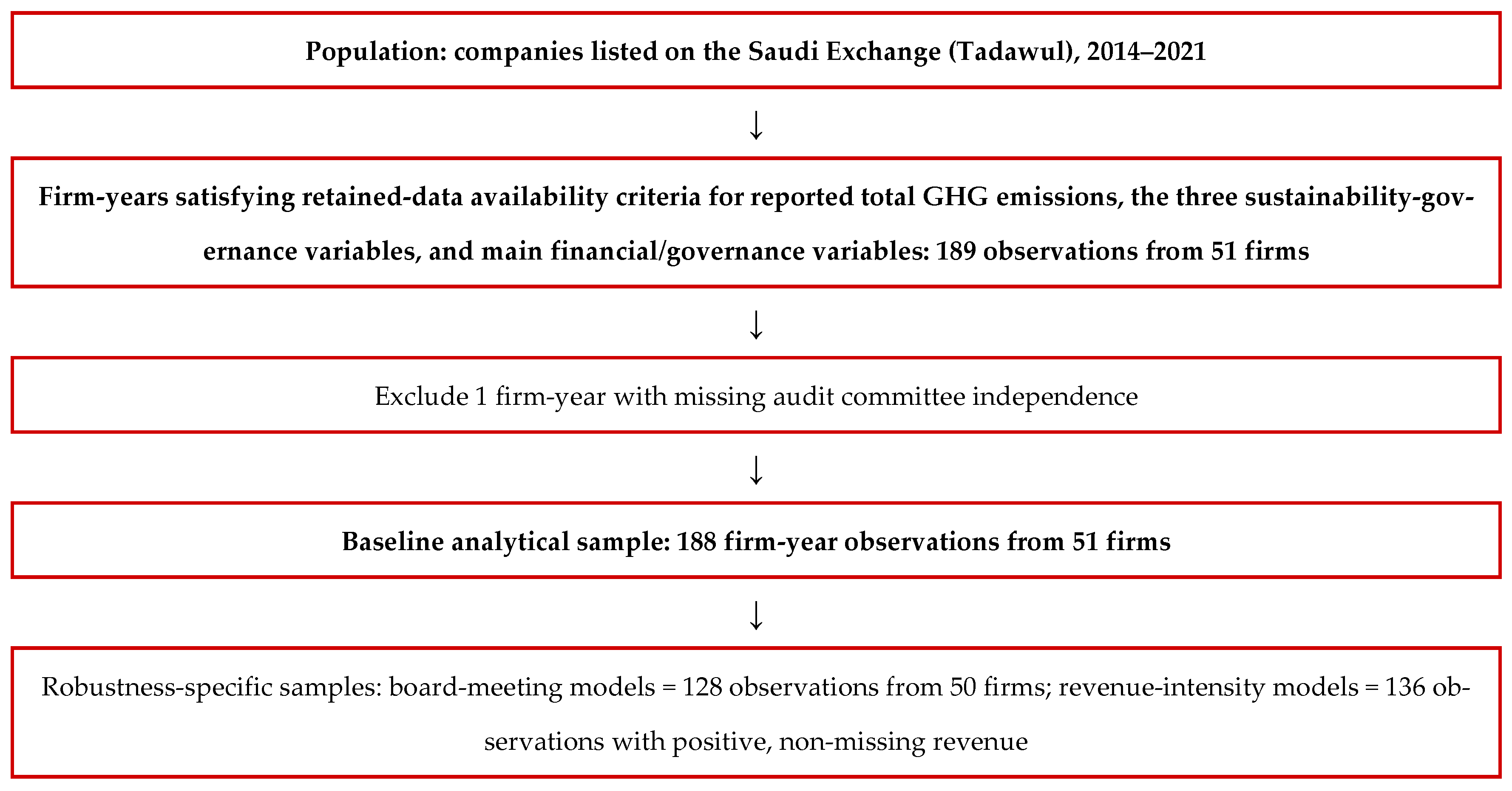
The full dataset contains 189 firm-year observations from 51 Saudi-listed firms. One observation lacks audit committee independence, leaving 188 observations in the baseline regressions. The board-meeting robustness models use 128 observations from 50 firms because that variable has additional missing values. Industry and year fixed effects control for sector-specific and time-specific influences on reported emissions.
Figure 1 summarizes the sample-selection process based on the archived extraction records. The available records support the reported selection sequence from the defined population to the retained analytical samples.
Figure 1.
Sample-selection flow.
3.3. Measurement of Variables
3.3.1. Dependent Variable: Corporate Carbon Emissions
The main dependent variable is reported corporate carbon emissions, obtained from Refinitiv Eikon/Thomson Reuters ASSET4. It represents the firm’s reported total greenhouse gas emissions expressed in CO2-equivalent units, which permits different greenhouse gases to be aggregated using a common metric.
The archived ASSET4 field used in this study is a provider-defined total GHG-emissions measure. The retained extract does not permit a consistent decomposition of that total into Scope 1, Scope 2, and Scope 3 components for every firm-year, nor does it establish that the scope composition and organizational boundaries are identical across firms and years. Accordingly, the analysis does not impose an assumed common Scope 1/2/3 composition. The dependent variable should be interpreted as the total emissions reported by the firm and captured by the data provider; variation in scope coverage, organizational boundaries, and estimation practice remains a measurement limitation addressed explicitly in Section 5.4.
Because the distribution of total CO2-equivalent emissions is highly skewed, the baseline dependent variable is the natural logarithm of the reported total. The transformation reduces the leverage of extreme values but does not remove scale dependence: larger firms can report larger absolute emissions because they operate more assets or generate more output. The baseline coefficient therefore concerns the amount of carbon exposure reported, not environmental efficiency.
To address this distinction, the robustness analysis uses two carbon-intensity outcomes: the natural logarithm of the ratio of total CO2-equivalent emissions to total assets [ln(CO2e/total assets)] and the natural logarithm of the ratio of total CO2-equivalent emissions to total revenue [ln(CO2e/total revenue)]. Firm size is omitted from these intensity specifications because scale is incorporated directly in the denominator; the remaining controls and the industry and year fixed effects are retained. The asset-intensity models use 188 observations, whereas the revenue-intensity models use 136 observations with positive, nonmissing revenue.
3.3.2. Hypothesized Independent Variables: Individual Sustainability Governance Mechanisms
The first model examines three individual sustainability governance mechanisms: sustainability committee presence, sustainability reporting, and external sustainability assurance.
Sustainability committee presence is a binary indicator equal to 1 when the firm has a board-level or board-affiliated sustainability committee and 0 otherwise. The variable captures formal assignment of oversight responsibility but not committee expertise, activity, authority, or meeting quality (Al-Shaer, 2020; Alwadani et al., 2024; Soussi et al., 2025).
Sustainability reporting is a binary indicator equal to 1 when the firm issues a stand-alone sustainability report and 0 otherwise. It captures establishment of a formal reporting channel but not report scope, materiality, balance, boundary coverage, or alignment with a particular international standard (Al-Shaer & Zaman, 2016, 2018; Michelon et al., 2015).
External assurance is a binary indicator equal to 1 when the sustainability report is externally assured and 0 otherwise. The indicator captures independent verification but not provider type, assurance standard, subject-matter scope, or level of assurance. These engagement characteristics can materially affect credibility and are not consistently observable for the full panel (Casey & Grenier, 2015; O’Dwyer & Owen, 2005; Simnett et al., 2009).
3.3.3. Composite Sustainability Governance Score
The second model uses an equal-weighted composite sustainability governance score calculated as the sum of committee presence, sustainability reporting, and external assurance. The score ranges from 0 to 3, with higher values indicating that more elements of the oversight–disclosure–verification architecture are present.
The score is calculated as follows:
where SUSCOM represents sustainability committee presence, SUSREP represents sustainability reporting, and ASSUR represents external assurance. A firm-year observation receives a score of 0 when none of the three mechanisms is present and a score of 3 when all three mechanisms are present.
SUSGOV_it = SUSCOM_it + SUSREP_it + ASSUR_it
The composite score is intended as a parsimonious measure of institutional development, not as a validated quality ranking. Equal weighting assumes that each mechanism contributes one observable element to the accountability architecture; it does not imply that a committee, report, and assurance engagement are identical in quality or effect. The component models are therefore retained to reveal whether the composite association is broadly shared or concentrated in one mechanism. Equal weighting is also appropriate in this setting because all three inputs are binary indicators of institutional presence, while data-driven weighting would introduce additional estimation complexity and potential instability.
3.3.4. Measurement Scope and Construct Limitations
The three binary indicators capture institutional presence rather than implementation quality. Sustainability reports differ in materiality, balance, scope, standard alignment, and boundary coverage; assurance engagements differ in provider expertise, independence, assurance standard, subject matter, scope, and level. Given the small number of assured firm-year observations, assurance-specific estimates should be interpreted cautiously because they may be more sensitive to sample composition than the composite-governance results. Accordingly, assurance is retained as a presence indicator, and provider-, standard-, scope-, or assurance-level subgroup analyses are not estimated. The assurance results are evaluated through their consistency across alternative specifications.
The composite score inherits these limitations and should be read as an index of how many accountability arrangements are present. It cannot determine whether a particular committee is active, a report is balanced, or an assurance engagement is extensive. Future research should code committee expertise and activity, report quality and scope coverage, assurance provider and standard, and reasonable versus limited assurance when larger treated samples become available.
3.3.5. Control Variables
The study controls for firm-level and board-level characteristics that may influence corporate carbon emissions. Firm size is measured as the natural logarithm of total assets. Larger firms are more visible, more complex, and more likely to have higher operational emissions; they may also face stronger pressure to report carbon information. Profitability is measured using return on assets. More profitable firms may have greater resources to invest in sustainability systems and environmental reporting. Leverage is measured as total debt divided by total assets. Highly leveraged firms may face stronger creditor monitoring, but they may also have fewer discretionary resources for sustainability initiatives.
Board size is measured as the total number of directors on board. Board independence is measured as the proportion of independent directors to total board members. Audit committee independence is measured as the proportion of independent members on the audit committee, while audit committee expertise is measured using the presence of members with accounting, financial, or relevant professional expertise. These governance controls are included because board and audit committee characteristics may influence environmental oversight, reporting discipline, and corporate accountability.
Industry fixed effects are included to control for differences in carbon intensity, production processes, regulatory exposure, and environmental visibility across sectors. Year fixed effects are included to control for time-specific changes in sustainability expectations, market conditions, regulatory developments, and national sustainability initiatives.
Board meetings are included only in a supplementary specification because missing observations substantially reduce the available sample. Accordingly, the variable is excluded from the primary baseline model to preserve the larger analytical sample.
3.4. Empirical Models
The study estimates two main regression models.
The separate and joint specifications answer different empirical questions. Separate models estimate the gross association of each governance mechanism with reported emissions, whereas the joint model estimates each mechanism’s incremental association conditional on the other two. Because committee presence, stand-alone reporting, and assurance frequently co-occur, simultaneous entry reduces the risk that a single-mechanism coefficient captures correlated adoption of the other mechanisms. The composite model then evaluates cumulative institutional presence rather than an incremental component effect.
The first model examines the individual associations of the three sustainability governance mechanisms with reported corporate carbon emissions:
where
CARBON_it = β0 + β1SUSCOM_it + β2SUSREP_it + β3ASSUR_it + β4SIZE_it + β5ROA_it + β6LEV_it + β7BODSIZE_it + β8BODIND_it + β9ACIND_it + β10ACEXP_it + IndustryFE + YearFE + ε_it
CARBON_it is the natural logarithm of total CO2-equivalent emissions for firm i in year t. SUSCOM_it, SUSREP_it, and ASSUR_it are the individual sustainability governance mechanisms. SIZE_it, ROA_it, and LEV_it are firm-level controls. BODSIZE_it, BODIND_it, ACIND_it, and ACEXP_it are governance controls. IndustryFE and YearFE represent industry and year fixed effects, and ε_it is the error term.
The second model replaces the individual sustainability governance mechanisms with the composite sustainability governance score:
CARBON_it = β0 + β1SUSGOV_it + β2SIZE_it + β3ROA_it + β4LEV_it + β5BODSIZE_it + β6BODIND_it + β7ACIND_it + β8ACEXP_it + IndustryFE + YearFE + ε_it
In this model, SUSGOV_it captures the overall sustainability governance score. A positive coefficient on SUSGOV would indicate that firms with more developed sustainability governance systems report higher carbon emissions. In the context of reported total CO2-equivalent emissions, such a result would be consistent with greater carbon-reporting completeness and visibility, rather than constituting direct evidence that sustainability governance increases physical emissions.
3.5. Estimation Strategy and Diagnostic Procedures
The baseline analysis uses pooled ordinary least squares regression to estimate the association between the governance mechanisms and the continuous log-transformed carbon-emissions outcome, with industry and year fixed effects and firm-clustered robust standard errors. Standard errors are clustered at the firm level to account for within-firm correlation across time. Firm-clustered robust standard errors are appropriate because observations from the same firm may not be statistically independent across years (Wooldridge, 2010).
Before estimating the regression models, several diagnostic procedures are conducted. First, missing-value diagnostics are performed to identify the number of available observations for each variable. Second, continuous control variables are winsorized at the 1st and 99th percentiles to reduce the influence of extreme observations. Third, descriptive statistics are reported to summarize the distribution of carbon emissions, sustainability governance mechanisms, and control variables. Fourth, Pearson correlation coefficients are examined to assess bivariate associations among the study variables. Fifth, variance inflation factors are calculated to evaluate potential multicollinearity among the explanatory variables. VIF values below conventional thresholds indicate that multicollinearity is unlikely to affect the regression estimates.
Four supplementary strategies assess robustness. First, board meetings are added to the baseline specifications, accepting the resulting reduction in sample size. Second, firm fixed-effects models control for time-invariant firm characteristics, although inference is constrained by limited within-firm changes in the governance indicators. Third, the dependent variable is replaced with asset- and revenue-scaled carbon intensity to evaluate whether the results reflect organizational scale. Fourth, the governance variables are lagged by one year within firms to reduce contemporaneous timing concerns. These tests improve specification credibility but do not eliminate self-selection, reverse causality, or time-varying omitted variables; causal claims are therefore avoided.
The available panel does not provide a valid external instrument or an exogenous policy shock suitable for instrumental-variable or quasi-experimental identification. Accordingly, firm fixed effects and lagged governance variables are employed as robustness checks, while the results are interpreted as associational rather than causal.
4. Empirical Results and Discussion
4.1. Sample Characteristics and Descriptive Evidence
The full dataset contains 189 firm-year observations from 51 Saudi-listed firms. The baseline regressions use 188 observations because audit committee independence is unavailable for one firm-year. This limited loss does not materially alter sample coverage. Reported corporate carbon emissions are measured as the natural logarithm of total CO2-equivalent emissions, and continuous control variables are winsorized at the 1st and 99th percentiles for regression estimation.
Table 2 reports the data-screening and descriptive statistics. The dependent variable, log carbon emissions, has a mean of 11.714 and a standard deviation of 3.063, indicating substantial cross-firm variation in reported carbon exposure. The raw CO2-equivalent emissions variable is highly dispersed, with a median of 61,966.600 and a maximum of 210,000,000.000. This dispersion supports the methodological decision to use a log-transformed emissions measure in the regression analysis. The descriptive evidence also indicates uneven adoption of sustainability governance mechanisms. Sustainability committees are observed in 32.28% of firm-year observations, sustainability reports are issued in 32.80%, and external assurance is observed in only 6.35%.
Table 2.
Data screening and descriptive statistics.
Table 3 shows the frequency distributions for the three individual sustainability governance mechanisms and the composite sustainability governance score. The distribution indicates considerable variation in the adoption of sustainability governance practices within the Saudi sample. More than half of the observations have no sustainability governance mechanism, while only 12 firm-year observations have all three mechanisms. This pattern is important for interpreting the results because the individual governance variables capture relatively selective adoption, whereas the composite score captures the cumulative development of sustainability governance.
Table 3.
Frequency distribution of sustainability governance mechanisms.
4.2. Correlation and Multicollinearity Diagnostics
Table 4 reports the Pearson correlation matrix and variance inflation factors. Carbon emissions are positively correlated with sustainability committee presence (r = 0.33, p < 0.01), sustainability reporting (r = 0.38, p < 0.01), external assurance (r = 0.43, p < 0.01), and the composite sustainability governance score (r = 0.45, p < 0.01). These bivariate results provide preliminary evidence that firms with more developed sustainability governance practices report higher carbon emissions. This is consistent with the interpretation that carbon-intensive or highly visible firms may be more likely to adopt governance structures, issue sustainability reports, and obtain external assurance.
Table 4.
Pearson correlation matrix and variance inflation factors.
The correlation matrix also shows that the three individual sustainability governance mechanisms are positively correlated with one another. For example, sustainability committee presence is correlated with sustainability reporting (r = 0.58, p < 0.01), and the composite sustainability governance score is highly correlated with both sustainability committee and sustainability reporting. This pattern supports the use of a second model based on a composite governance score. At the same time, the VIF values remain below conventional thresholds, indicating that multicollinearity is unlikely to distort the regression estimates.
4.3. Baseline Regression Results: Individual Sustainability Governance Mechanisms
Table 5 presents the baseline regression results. Model 1 includes only the control variables, industry fixed effects, and year fixed effects. Models 2–4 introduce each sustainability governance mechanism separately. Model 5 includes the three individual mechanisms simultaneously. Model 6 replaces the individual mechanisms with the composite sustainability governance score. All models use OLS regression with firm-clustered robust standard errors.
Table 5.
Baseline regression results for carbon emissions.
In the single-mechanism models, sustainability committee presence, sustainability reporting, and external assurance are each positively and significantly associated with reported carbon emissions. Committee presence is significant in Model 2 (b = 0.707, p = 0.006), sustainability reporting is significant in Model 3 (b = 0.699, p = 0.001), and external assurance is significant in Model 4 (b = 1.450, p < 0.001). These specifications support H1–H3 when the mechanisms are estimated separately.
When the three mechanisms are entered simultaneously in Model 5, external assurance remains positive and statistically significant (b = 1.023, p = 0.001), whereas committee presence and sustainability reporting are not significant. The attenuation is consistent with overlap among mechanisms that often coexist within the same governance architecture. H3 is therefore supported in the fully specified individual-mechanism model, while H1 and H2 receive support only in the separate models.
Firm size is positive and significant throughout the baseline specifications, confirming that absolute reported emissions are scale-sensitive. The other financial and governance controls are not statistically significant in the fully specified model, and board independence is negative but nonsignificant. This pattern reinforces the need for the carbon-intensity analyses reported below.
The high R2 values warrant cautious interpretation. Reported absolute emissions are strongly structured by organizational scale, sector, and time, and firm size is consistently a dominant predictor, while industry and year fixed effects absorb systematic sectoral and macro-temporal differences. In firm fixed-effects specifications, firm indicators additionally absorb persistent between-firm differences in emission levels. Accordingly, high explanatory power is not treated as evidence of causality or model superiority; inference relies on coefficient estimates, firm-clustered uncertainty, and sensitivity across alternative outcome and fixed-effects specifications.
4.4. Composite Sustainability Governance Model
Model 6 reports a positive and significant coefficient for the composite sustainability governance score (b = 0.478, p < 0.001), supporting H4. Conditional on the included controls and fixed effects, a one-point increase in the 0–3 score is associated with a 0.478 increase in log reported CO2-equivalent emissions. The result concerns reported exposure and should not be interpreted as a causal increase in physical pollution.
The composite result suggests that oversight, disclosure, and verification operate as complementary elements of carbon accountability. It is consistent with prior Saudi evidence on the organizational relevance of sustainability governance (Alwadani et al., 2024; Soussi et al., 2025), but the equal-weighted score should be understood as institutional presence rather than direct evidence that every mechanism is equally effective.
4.5. Additional Analyses and Robustness Tests
Table 6 first adds board meetings as a governance control. The available sample declines to 128 observations from 50 firms. External assurance remains positive and significant in the individual-mechanism model (b = 0.789, p = 0.037), and the composite score remains positive and significant (b = 0.389, p < 0.001). These results indicate that the main associations remain qualitatively consistent after controlling for board activity in the reduced sample.
Table 6.
Supplementary and robustness analyses.
Table 6 also reports firm fixed-effects models. Committee presence remains positive and significant in the individual model, whereas reporting and assurance are not significant; the composite coefficient is also not significant. Because the governance indicators change infrequently within firms, firm fixed effects identify the association from a limited set of adopters and absorb most between-firm variation. The attenuation suggests that the baseline associations are driven substantially by between-firm variation, reinforcing the need for cautious, noncausal interpretation.
Table 7 evaluates whether the baseline association is sensitive to organizational scale by using asset- and revenue-scaled carbon-intensity measures. In the asset-intensity models, assurance remains positive and significant (b = 0.880, p = 0.004), and the composite score is positive and significant (b = 0.333, p < 0.001). In the revenue-intensity models, the assurance coefficient is attenuated and nonsignificant (b = 0.356, p = 0.414), while the committee coefficient remains positive but does not provide sufficiently robust statistical evidence; the composite score remains positive and significant (b = 0.513, p < 0.001). The composite association is therefore robust to both denominators, whereas the mechanism-specific assurance result is sensitive to the intensity definition and the smaller revenue-available sample.
Table 7.
Carbon-intensity robustness analyses.
Table 8 reduces contemporaneous timing concerns by relating current reported emissions to governance measured one year earlier. Lagged assurance remains positive and significant (b = 1.422, p < 0.001); lagged committee presence is positive but not statistically significant at the 5% level (b = 0.604, p = 0.054), and lagged reporting is nonsignificant. The lagged composite score is positive and significant (b = 0.621, p < 0.001). These results strengthen temporal ordering but do not eliminate endogenous adoption or unobserved time-varying influences.
Table 8.
One-year-lagged sustainability governance analyses.
4.6. Discussion of Findings
Interpretation of the findings requires distinguishing four related but non-equivalent constructs: reported absolute emissions, emissions intensity, disclosure quality, and actual emissions performance.
The baseline results show that sustainability-governance mechanisms are associated with the visibility of reported carbon exposure, but their evidence differs by specification. Each mechanism is positive when estimated separately; when entered jointly, only external assurance remains significant. This pattern is consistent with functional overlap among committee oversight, reporting, and verification and identifies assurance as the mechanism with the strongest incremental association in the baseline model.
The assurance result is consistent with agency and signaling arguments. Independent examination can discipline data systems and communicate a willingness to accept external scrutiny. It also accords with evidence that carbon information asymmetry motivates assurance adoption and that assurance is associated with reporting integrity and disclosure quality (Bui et al., 2021; Fan et al., 2021; Luo et al., 2023). The result should nevertheless be interpreted as an association between assurance and reported exposure, not proof that assurance changes physical emissions.
A positive assurance-emissions association has two plausible, nonexclusive interpretations. Assurance may improve measurement completeness, causing previously unrecognized or excluded emissions to become reportable and verifiable. Alternatively, firms with substantial emissions may self-select into assurance to enhance credibility and respond to stakeholder or legitimacy pressure. This interpretation differs from studies linking governance, disclosure, or assurance to lower emissions or stronger environmental performance (Alwadani et al., 2024; Haque & Ntim, 2018; Issa, 2025; Khatri & Kjærland, 2023; Yin et al., 2023). The difference is conceptually coherent because those outcomes emphasize performance or reduction, whereas the baseline outcome here is the absolute amount reported.
The composite score remains positive in both asset- and revenue-intensity models, suggesting that its association is not explained solely by absolute firm scale. Mechanism-specific conclusions are more qualified: assurance remains significant for asset intensity but not for revenue intensity. This sensitivity indicates that the denominator, missing-revenue sample, and underlying economic activity matter when interpreting carbon outcomes. The composite evidence is therefore more stable than the incremental assurance evidence across alternative intensity measures.
The one-year-lagged models retain positive coefficients for lagged assurance and the lagged composite score, reducing concern that the baseline association reflects only contemporaneous measurement. However, lagging does not eliminate time-varying omitted variables, anticipatory adoption, or self-selection. Together with the attenuated firm fixed-effects estimates and the limited number of assured observations, the evidence supports an accountability-visibility interpretation but not a causal claim.
Overall, H3 and H4 are supported in the baseline models, whereas H1 and H2 are supported only when the mechanisms are estimated separately. The findings contribute to current debates by showing why reported emissions, carbon intensity, environmental performance, and disclosure credibility must be analyzed as related but distinct constructs.
5. Conclusions
5.1. Summary of Findings
This study examines whether sustainability committee presence, stand-alone sustainability reporting, external assurance, and their composite governance score are associated with reported corporate carbon emissions among Saudi-listed firms. The baseline analysis uses 188 firm-year observations from 51 firms during 2014–2021, pooled OLS with firm-clustered robust standard errors, and industry and year fixed effects. Reported emissions are measured as the natural logarithm of total CO2-equivalent emissions.
External assurance is positive and significant in the fully specified individual-mechanism model, while committee presence and reporting are significant only when estimated separately. The composite sustainability governance score is positive and significant. These findings are consistent with the possibility that the cumulative oversight–disclosure–verification architecture is associated with a larger amount of carbon exposure becoming visible in corporate reporting, while alternative explanations related to underlying emissions and endogenous governance adoption remain plausible.
The additional analyses qualify this conclusion. The composite coefficient remains positive for both asset- and revenue-scaled carbon intensity and when governance is lagged by one year. Assurance remains positive and significant in the asset-intensity and lagged models but loses significance in the revenue-intensity model. Firm fixed-effects estimates are weaker, indicating that much of the baseline association reflects differences across firms rather than within-firm changes over time.
The positive associations should not be interpreted as evidence that sustainability governance increases physical emissions. Stronger governance may improve measurement and boundary completeness, while high-emission firms may also adopt committees, reporting, and assurance in response to scrutiny. The results therefore support carbon-reporting visibility and endogenous adoption as plausible, simultaneous mechanisms.
5.2. Theoretical Implications
The study advances theory in three respects. First, it integrates stakeholder and legitimacy pressures, resource-dependence governance capacity, agency monitoring, and credibility signaling into one sequential accountability framework. Second, it separates reported carbon exposure from environmental efficiency, clarifying why a positive governance coefficient can coexist with accountability improvements. Third, it shows that the theoretical inference depends on measurement: absolute emissions, intensity, disclosure quality, and emissions performance are not interchangeable outcomes.
5.3. Practical and Policy Implications
The findings offer three practice-oriented considerations that may complement ongoing sustainability and disclosure initiatives in the Saudi context. First, disclosure guidance can encourage firms to report absolute emissions together with intensity, scope coverage, organizational boundaries, estimation methods, base-year restatements, targets, and year-on-year changes. Second, ongoing and future developments in climate disclosure may further benefit from considering evaluating firms using sector benchmarks, intensity, trajectory, and reporting completeness in addition to absolute totals. Third, continued development of corporate climate-governance practices could strengthen committee mandates and expertise, and encourage clearer assurance disclosures concerning provider, standard, subject matter, scope, and level. These priorities complement the Saudi Exchange’s ESG guidance and the environmental objectives of Vision 2030 and the Saudi Green Initiative (Saudi Exchange, 2021; Saudi Vision 2030, n.d.).
For boards and managers, the evidence supports investment in traceable carbon-data systems and assurance readiness rather than treating committees or reports as symbolic endpoints. Investors and analysts should interpret higher reported emissions in conjunction with intensity, reporting boundaries, assurance status, and trends to avoid rewarding opacity or penalizing greater transparency. These practices may contribute to SDG 13 through more credible climate information, SDG 12 through responsible sustainability reporting, and SDG 16 through stronger accountability and transparent institutions (United Nations, 2015).
5.4. Limitations and Future Research
Several limitations define the study’s boundaries. First, the sample is restricted to Saudi-listed firms during 2014–2021. The findings may not generalize to privately owned firms, small and medium-sized enterprises, unlisted organizations, or firms operating under different institutional regimes in other emerging economies. Future research should conduct comparative Gulf Cooperation Council and cross-country studies, extend the period to capture more recent reforms, and examine sector-specific patterns in carbon-intensive and lower-exposure industries. Because the analytical sample requires available reported-emissions data, sample inclusion may be nonrandom if firms with measurable or disclosed emissions differ systematically from non-reporting firms. The findings should therefore be interpreted as conditional on observed reported-emissions data rather than as estimates applicable to all Saudi-listed firm-years.
Second, the main dependent variable remains a reported emissions measure. Although the asset- and revenue-intensity tests reduce scale concerns, they cannot fully separate physical emissions from differences in reporting boundaries, estimation methods, scope coverage, and measurement completeness. Future longitudinal research should distinguish Scope 1, Scope 2, and Scope 3 emissions, model emissions trajectories and target achievement, and test whether initial governance adoption first increases visibility and later contributes to reductions.
Third, the governance indicators are binary, and external assurance is observed in 12 firm-year observations. This distribution does not permit reliable estimation by assurance provider, standard, scope, or level. Future studies could examine assurance-provider and engagement-level heterogeneity using larger assured samples. Finally, the observational design cannot establish causality. Firm fixed effects and one-year lags strengthen specification but do not remove reverse causality or selection. Comparative reforms, staggered adoption designs, credible instrumental variables, matching or balancing methods with adequate common support, and dynamic panel approaches should be considered when larger panels and defensible identification conditions are available.
Funding
This research was funded by Prince Sattam bin Abdulaziz University, grant number PSAU/2025/02/32936.
Institutional Review Board Statement
Not applicable.
Informed Consent Statement
Not applicable.
Data Availability Statement
The data underlying this study are available from the corresponding author upon reasonable request, subject to the licensing and access restrictions applicable to the databases from which the data were obtained.
Acknowledgments
The author extends their appreciation to Prince Sattam bin Abdulaziz University for funding this research work through the project number (PSAU/2025/02/32936).
Conflicts of Interest
The author declares no conflict of interest.
References
- Al-Shaer, H. (2020). Sustainability reporting quality and post-audit financial reporting quality: Empirical evidence from the UK. Business Strategy and the Environment, 29(6), 2355–2373. [Google Scholar] [CrossRef] [Scilit]
- Al-Shaer, H., & Zaman, M. (2016). Board gender diversity and sustainability reporting quality. Journal of Contemporary Accounting & Economics, 12(3), 210–222. [Google Scholar] [CrossRef] [Scilit]
- Al-Shaer, H., & Zaman, M. (2018). Credibility of sustainability reports: The contribution of audit committees. Business Strategy and the Environment, 27(7), 973–986. [Google Scholar] [CrossRef] [Scilit]
- Alwadani, N., Al-Shaer, H., & Albitar, K. (2024). The impact of internal governance mechanisms on environmental performance of Saudi firms. International Journal of Accounting & Information Management, 32(1), 40–57. [Google Scholar] [CrossRef] [Scilit]
- Baltagi, B. H. (2008). Econometric analysis of panel data (4th ed.). Wiley. [Google Scholar]
- Ben-Amar, W., & McIlkenny, P. (2015). Board effectiveness and the voluntary disclosure of climate change information. Business Strategy and the Environment, 24(8), 704–719. [Google Scholar] [CrossRef] [Scilit]
- Boiral, O. (2013). Sustainability reports as simulacra? A counter-account of A and A+ GRI reports. Accounting, Auditing & Accountability Journal, 26(7), 1036–1071. [Google Scholar] [CrossRef] [Scilit]
- Bui, B., Houqe, M. N., & Zaman, M. (2021). Climate change mitigation: Carbon assurance and reporting integrity. Business Strategy and the Environment, 30(8), 3839–3853. [Google Scholar] [CrossRef] [Scilit]
- Casey, R. J., & Grenier, J. H. (2015). Understanding and contributing to the enigma of corporate social responsibility (CSR) assurance in the United States. Auditing: A Journal of Practice & Theory, 34(1), 97–130. [Google Scholar] [CrossRef] [Scilit]
- Davis, J. H., Schoorman, F. D., & Donaldson, L. (1997). Toward a stewardship theory of management. Academy of Management Review, 22(1), 20–47. [Google Scholar] [CrossRef] [Scilit]
- DiMaggio, P. J., & Powell, W. W. (1983). The iron cage revisited: Institutional isomorphism and collective rationality in organizational fields. American Sociological Review, 48(2), 147–160. [Google Scholar] [CrossRef] [Scilit]
- Driss, H., Drobetz, W., El Ghoul, S., & Guedhami, O. (2024). The sustainability committee and environmental disclosure: International evidence. Journal of Economic Behavior & Organization, 221, 602–625. [Google Scholar] [CrossRef] [Scilit]
- Fan, H., Tang, Q., & Pan, L. (2021). An international study of carbon information asymmetry and independent carbon assurance. The British Accounting Review, 53(1), 100971. [Google Scholar] [CrossRef] [Scilit]
- Freeman, R. E. (1984). Strategic management: A stakeholder approach. Pitman. [Google Scholar]
- Goud, N. N. (2022). Corporate governance: Does it matter management of carbon emission performance? An empirical analyses of Indian companies. Journal of Cleaner Production, 379, 134485. [Google Scholar] [CrossRef] [Scilit]
- Haque, F., & Ntim, C. G. (2018). Environmental policy, sustainable development, governance mechanisms and environmental performance. Business Strategy and the Environment, 27(3), 415–435. [Google Scholar] [CrossRef] [Scilit]
- Hart, S. L. (1995). A natural-resource-based view of the firm. Academy of Management Review, 20(4), 986–1014. [Google Scholar] [CrossRef] [Scilit]
- Hillman, A. J., & Dalziel, T. (2003). Boards of directors and firm performance: Integrating agency and resource dependence perspectives. Academy of Management Review, 28(3), 383–396. [Google Scholar] [CrossRef] [Scilit]
- Issa, A. (2025). Driving emissions reduction: The power of external sustainability assurance and internal governance committees. International Journal of Disclosure and Governance, 22(1), 140–154. [Google Scholar] [CrossRef] [Scilit]
- Jensen, M. C., & Meckling, W. H. (1976). Theory of the firm: Managerial behavior, agency costs, and ownership structure. Journal of Financial Economics, 3(4), 305–360. [Google Scholar] [CrossRef] [Scilit]
- Khatri, I., & Kjærland, F. (2023). Sustainability reporting practices and environmental performance amongst Nordic listed firms. Journal of Cleaner Production, 418, 138172. [Google Scholar] [CrossRef] [Scilit]
- Luo, L., Tang, Q., Fan, H., & Ayers, J. (2023). Corporate carbon assurance and the quality of carbon disclosure. Accounting & Finance, 63(1), 657–690. [Google Scholar] [CrossRef] [Scilit]
- Mansour, M., Abu-Allan, A. J., Alshdaifat, S. M., E’leimat, D. A., & Saleh, M. W. A. (2025). Board effectiveness and carbon emission disclosure: Evidence from ASEAN countries. Discover Sustainability, 6, 604. [Google Scholar] [CrossRef] [Scilit]
- Meqbel, R., Alta’any, M., Abweny, M., & Al-Shaer, H. (2026). CSR governance committee and carbon emission performance: Does committee composition matter? International Journal of Finance & Economics, 31(1), 1395–1423. [Google Scholar] [CrossRef] [Scilit]
- Michelon, G., Pilonato, S., & Ricceri, F. (2015). CSR reporting practices and the quality of disclosure: An empirical analysis. Critical Perspectives on Accounting, 33, 59–78. [Google Scholar] [CrossRef] [Scilit]
- O’Dwyer, B., & Owen, D. L. (2005). Assurance statement practice in environmental, social and sustainability reporting: A critical evaluation. The British Accounting Review, 37(2), 205–229. [Google Scholar] [CrossRef] [Scilit]
- Perego, P., & Kolk, A. (2012). Multinationals’ accountability on sustainability: The evolution of third-party assurance of sustainability reports. Journal of Business Ethics, 110(2), 173–190. [Google Scholar] [CrossRef] [Scilit]
- Prado-Lorenzo, J. M., & García-Sánchez, I. M. (2010). The role of the board of directors in disseminating relevant information on greenhouse gases. Journal of Business Ethics, 97(3), 391–424. [Google Scholar] [CrossRef] [Scilit]
- Rankin, M., Windsor, C., & Wahyuni, D. (2011). An investigation of voluntary corporate greenhouse gas emissions reporting in a market governance system: Australian evidence. Accounting, Auditing & Accountability Journal, 24(8), 1037–1070. [Google Scholar] [CrossRef] [Scilit]
- Saudi Exchange. (2021). ESG disclosure guidelines. Available online: https://www.saudiexchange.sa/wps/portal/saudiexchange/listing/issuer-guides/esg-guidelines (accessed on 18 August 2026).
- Saudi Vision 2030. (n.d.). Saudi green initiative. Available online: https://www.vision2030.gov.sa/en/explore/projects/saudi-green-initiative (accessed on 18 August 2026).
- Simnett, R., Vanstraelen, A., & Chua, W. F. (2009). Assurance on sustainability reports: An international comparison. The Accounting Review, 84(3), 937–967. [Google Scholar] [CrossRef] [Scilit]
- Soussi, J. C., Aljaaidi, K. S., & Alwadani, N. F. (2025). Sustainable environmental governance and corporate environmental performance: Empirical evidence from Saudi companies. Journal of Risk and Financial Management, 18(11), 616. [Google Scholar] [CrossRef] [Scilit]
- Spence, M. (1973). Job market signaling. The Quarterly Journal of Economics, 87(3), 355–374. [Google Scholar] [CrossRef] [Scilit]
- Suchman, M. C. (1995). Managing legitimacy: Strategic and institutional approaches. Academy of Management Review, 20(3), 571–610. [Google Scholar] [CrossRef] [Scilit]
- Tomar, S. (2023). Greenhouse gas disclosure and emissions benchmarking. Journal of Accounting Research, 61(2), 451–492. [Google Scholar] [CrossRef] [Scilit]
- United Nations. (2015). Transforming our world: The 2030 agenda for sustainable development. Available online: https://sdgs.un.org/2030agenda (accessed on 18 August 2026).
- Wooldridge, J. M. (2010). Econometric analysis of cross section and panel data (2nd ed.). MIT Press. [Google Scholar]
- Yin, F., Xiao, Y., Cao, R., & Zhang, J. (2023). Impacts of ESG disclosure on corporate carbon performance: Empirical evidence from listed companies in heavy pollution industries. Sustainability, 15(21), 15296. [Google Scholar] [CrossRef] [Scilit]

Disclaimer/Publisher’s Note: The statements, opinions and data contained in all publications are solely those of the individual author(s) and contributor(s) and not of MDPI and/or the editor(s). MDPI and/or the editor(s) disclaim responsibility for any injury to people or property resulting from any ideas, methods, instructions or products referred to in the content. |
© 2026 by the author. Licensee MDPI, Basel, Switzerland. This article is an open access article distributed under the terms and conditions of the Creative Commons Attribution (CC BY) license.