


Abstract
Higher education institutions must sustain employees’ capacity and motivation amid organizational change. This study examined cross-sectional associations among perceived organizational support (POS), employee resilience, and sustainable employability in 202 university employees in Lima, Peru. Participants completed translated self-report measures. Following a measurement audit, POS was represented by a reduced unidimensional 10-item factor, resilience by nine items, and sustainable employability by a second-order factor reflected by productivity, workplace social climate, work control, and self-efficacy. Weighted least squares mean- and variance-adjusted latent-variable modeling showed acceptable fit, scaled chi-square (621) = 1330.81, CFI = 0.968, TLI = 0.965, RMSEA = 0.075, and SRMR = 0.080. POS was associated with resilience (beta = 0.469) and sustainable employability (beta = 0.374), while resilience was associated with sustainable employability (beta = 0.498). The indirect association through resilience was significant (B = 0.353, 95% Monte Carlo CI [0.209, 0.519]; beta = 0.234), and the direct association remained significant too, suggesting partial complementary mediation. Sensitivity analyses that excluded a productivity item with ceiling effects, used robust maximum likelihood, and added demographic controls led to the same conclusion. Since the data are cross-sectional and self-reported, the results are consistent but do not show a temporal or causal mediation process.
1. Introduction
Universities rely on academic, managerial, and professional staff who need to stay healthy, productive, and motivated and able to adapt throughout long careers. This challenge has become more noticeable as higher education institutions face digital transformation, changes in teaching expectations, greater accountability, and new ways of working. International evidence also points to persistent job insecurity, pressures to balance work and personal life, and unequal working conditions among university staff (Roser-Chinchilla et al., 2024). So, sustainable employability is not just about having a job; it is about the ongoing ability and opportunities to function productively and meaningfully throughout your working life (Fleuren et al., 2020; Houkes et al., 2020).
Perceived organizational support (POS) captures employees’ general belief that the organization values their contributions and cares about their well-being (Eisenberger et al., 1986, 2020). Organizational Support Theory proposes that supportive treatment is interpreted as a sign of organizational commitment to employees and can strengthen felt obligation, socioemotional need fulfillment, and expectations that effort will be recognized (Kurtessis et al., 2017). These processes make POS a plausible contextual resource for sustainable employability, because employees who perceive recognition, fair consideration, and assistance may have greater access to the psychological and organizational resources needed to remain capable and motivated.
Employee resilience is one of those vital resources that helps people adapt to stress, overcome difficulties, and keep performing well in the face of daily changes at work. Instead of treating resilience as a fixed personal trait, the employee resilience perspective emphasizes work behaviors through which employees collaborate, learn from mistakes, seek resources, respond to feedback, and use changes as an opportunity to grow (Bardoel et al., 2014; Näswall et al., 2019). Research has linked organizational support with employee resilience in university support staff, healthcare workers, and other demanding jobs (Jaingam & Na-Nan, 2023; Moschovopoulou & Papavassiliou-Alexiou, 2025; Pham et al., 2024; Tham et al., 2024). Longitudinal evidence has also related resilience to later indicators of sustainable employability (Semeijn et al., 2019).
However, three research gaps remain. First, recent higher education studies have tended to examine perceived support in relation to well-being, engagement, or sustainable employability in relation to individual factors, rather than simultaneously assessing perceived support, employee resilience, and sustainable employability among employed university staff (Álvarez-González et al., 2024; Deniz & Kocabaş, 2024). Second, evidence from Latin American higher education employees remains limited. The Peruvian university system includes both public and private institutions and has undergone sustained institutional and quality assurance reform, while universities differ in resources, governance, and employment modalities (SUNEDU, 2025). This context makes perceived support and employees’ adaptive resources particularly relevant, but it does not justify assuming that relationships found in other national systems automatically generalize to Peru. Third, earlier versions such as that of (Flores & Gómez, 2018) treated the items of perceived organizational support with positive and negative formulation as separate substantive constructs and used a modified sustainable employability structure (Mignon et al., 2022), so both decisions required a more rigorous measurement audit before structural interpretation.
The revised study therefore makes four contributions. First, it re-evaluates the original 36-item POS pool and explicitly examines whether the apparent positive–negative item separation reflects substantively distinct dimensions or a wording-related measurement effect. Second, it evaluates a six-factor latent measurement model and provides a direct assessment of the discriminant validity between employee resilience and self-efficacy, two conceptually related constructs whose empirical distinctiveness cannot be assumed. Third, it tests a theoretically motivated second-order representation of sustainable employability, reflected by productivity, workplace social climate, work control, and self-efficacy. Fourth, it estimates the proposed indirect association using ordinal latent-variable modeling and evaluates its robustness through Monte Carlo confidence intervals, an alternative specification excluding the ceiling-distributed P5 item, and robust maximum-likelihood estimation. Accordingly, the study examines whether perceived organizational support is positively associated with employee resilience and sustainable employability, whether employee resilience is positively associated with sustainable employability after accounting for perceived organizational support, and whether employee resilience carries a significant indirect association between perceived organizational support and sustainable employability. Consistent with the cross-sectional design, these relationships are interpreted as an observed covariance pattern compatible with the proposed theoretical mechanism rather than as evidence of temporal or causal effects.
Based on this reasoning, the following hypotheses were formulated: perceived organizational support is positively associated with employee resilience (H1); employee resilience is positively associated with sustainable employability (H2); perceived organizational support is positively associated with sustainable employability after accounting for employee resilience (H3); and employee resilience carries a positive indirect association between perceived organizational support and sustainable employability (H4).
2. Theoretical Framework and Hypotheses
2.1. Integrating Organizational Support, Conservation of Resources, and Sustainable Employability
Organizational Support Theory (OST), social exchange reasoning, and Resource Conservation Theory (RCT) offer complementary levels of explanation. OST identifies how employees form an overall judgment about whether the institution values their contributions and cares about their well-being (Eisenberger et al., 1986; Kurtessis et al., 2017). Social exchange reasoning explains why favorable treatment can be reciprocated through constructive attitudes and sustained commitment. Resource Conservation Theory adds another resource pathway: favorable organizational conditions, which can protect existing resources and facilitate the acquisition of the personal resources needed to manage demands (Jabeen et al., 2022).
Within this integrated framework, POS is considered a contextual resource, employee resilience an adaptive personal resource expressed in work behavior, and sustainable employability a multidimensional state reflecting employees’ continued capacity and opportunity to work productively. These theories are not interchangeable. OST explains the meaning employees assign to organizational treatment; RCT explains the accumulation and protection of resources; and the sustainable employability framework specifies the long-term outcome in terms of work capacity. In this sense, the proposed indirect association stems from their combination, where employees who perceive greater support may report more resilient work behaviors, and these behaviors may be associated with higher productivity, a better social climate, greater control, and higher self-efficacy.
2.2. Perceived Organizational Support and Sustainable Employability
Sustainable employability depends on both personal capabilities and enabling working conditions. Organizational recognition, access to support, consideration of employee goals, and concern for their well-being can foster learning, job control, social integration, and sustained motivation. Research on sustainable human resource management indicates that organizational practices and learning climates are related to job engagement and perceived employability (Lulewicz-Sas et al., 2022; Vuuren et al., 2023). In higher education, perceived organizational support has been associated with faculty well-being (Deniz & Kocabaş, 2024), while organizational support has been linked to broader social sustainability in higher education institutions (AlDhaen, 2026).
This argument does not claim that perceived organizational support (POS) guarantees sustainable employability. Employees may perceive support but may face external constraints, and sustainable employability also depends on health, skills, labor market conditions, and career opportunities. However, POS should be positively associated with the organizational and psychological conditions represented by the dimensions of sustainable employability.
H1.
Perceived organizational support is positively associated with sustainable employability.
2.3. Perceived Organizational Support and Employee Resilience
Supportive organizations can provide informational, emotional, and instrumental resources that enable employees to respond constructively to pressure and change. Employees who expect fair consideration and assistance may be more willing to seek help, use feedback, learn from mistakes, and collaborate during difficult situations. This interpretation is consistent with studies reporting positive associations between POS and resilience across university support staff, migrant workers, paramedics, and nurses (Jaingam & Na-Nan, 2023; Moschovopoulou & Papavassiliou-Alexiou, 2025; Pham et al., 2024; Tham et al., 2024).
The direction remains theoretically proposed rather than temporally established in this study. Resilient employees may also interpret organizational events more positively or elicit greater support. The hypothesis therefore concerns the cross-sectional association predicted by OST and RCT.
H2.
Perceived organizational support is positively associated with employee resilience.
2.4. Employee Resilience, Sustainable Employability, and the Indirect Association
Employee resilience includes behaviors that help workers maintain functioning, recover from setbacks, seek resources, and learn under changing conditions (Näswall et al., 2019). These behaviors are relevant to sustainable employability because they can support productivity, constructive social relationships, perceived control, and confidence in carrying out work. Semeijn et al. (2019) reported longitudinal cross-lagged associations between resilience and sustainable-employability indicators, while recent studies continue to position resilience as a resource for work functioning and well-being (Chen et al., 2025).
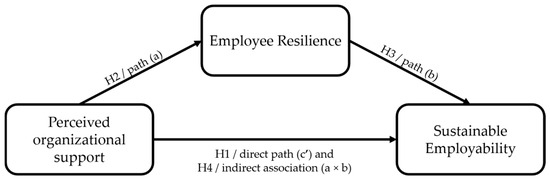
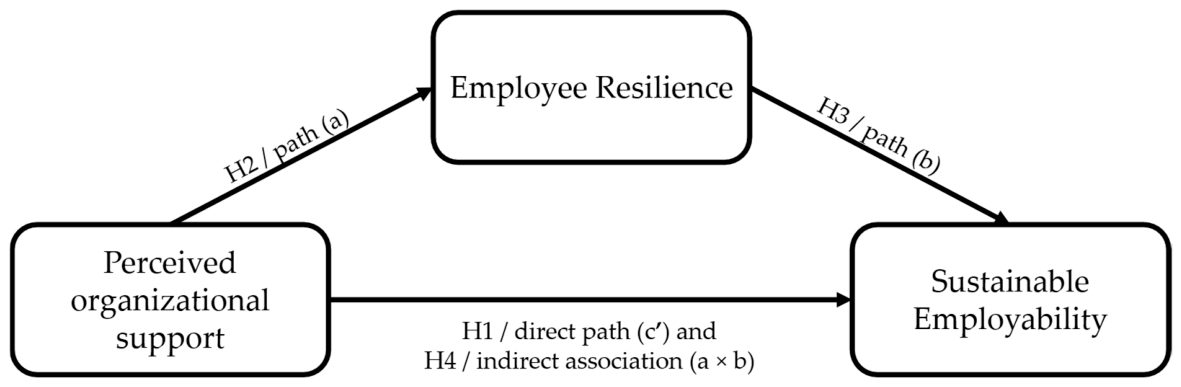
If POS is associated with greater resilience and resilience is associated with sustainable employability, part of the POS–sustainable-employability association may be statistically carried through resilience. This is an indirect-effect hypothesis, not a claim that the cross-sectional data establish temporal mediation. Alternative sequences, reciprocal effects, and omitted common causes remain possible (Maxwell & Cole, 2007; O’Laughlin et al., 2018). In this regard, the following hypothetical theories are proposed to be tested (Figure 1):
Figure 1.
Conceptual framework and hypotheses. Note. POS = perceived organizational support; ER = employee resilience. The arrows represent hypothesized cross-sectional latent associations, not established temporal or causal effects.
H3.
Employee resilience is positively associated with sustainable employability.
H4.
Perceived organizational support has a positive indirect association with sustainable employability through employee resilience.
3. Materials and Methods
3.1. Type and Design of Research
This quantitative study employed a non-experimental cross-sectional survey design. This design allows for the estimation of associations between latent variables and a statistical indirect effect, but it does not establish a temporal order or causal mediation. Consequently, causal terms were avoided in the interpretation, since longitudinal or experimental designs were required to evaluate the proposed process over time (Maxwell & Cole, 2007; O’Laughlin et al., 2018).
3.2. Participants
The target population comprised academic, managerial, and professional employees of higher education institutions in Lima, Peru. Operational staff, interns, employees on leave, and individuals who did not provide informed consent were excluded. The survey link was distributed through social-media and professional-contact channels and remained open from 28 October 2025 to 24 March 2026. Because the link was openly circulated, the numbers of employees invited or who opened the form were not recorded; a conventional response rate therefore cannot be calculated.
A total of 207 forms were submitted. Five respondents declined informed consent and were excluded before analysis, leaving 202 cases. No included case contained missing item responses, so no case was removed for missing data. The previously reported 97.58% has been relabeled as the inclusion proportion among submitted forms (202/207), not a response rate. Institution identifiers were not collected, so the exact number of universities represented and the degree of clustering within institutions cannot be reconstructed. This limitation, together with non-probability recruitment, means that the sample should not be considered statistically representative of all university employees in Lima or Peru.
The achieved sample exceeded the minimum planned for a simple indirect-effect model and produced converged, admissible latent-variable solutions. Nevertheless, sample-size adequacy for estimation does not imply population representativeness, and the complexity of the ordinal second-order model makes independent replication desirable (Sim et al., 2022).
3.3. Measures
3.3.1. Perceived Organizational Support
The POS was initially assessed using the 36-item Perceived Organizational Support Survey (Eisenberger et al., 1986), employing a seven-point agreement scale. The full set of items was retained during translation to allow for examination of the structure within the university context. A positive/negative two-factor model was initially evaluated; however, this is not theoretically sound given the unidimensionality of the credo construct, and the reverse-scored items were created to control for item response. Alternative confirmatory factor analysis (CFA) specifications showed that the split largely followed the wording of the items and did not provide an acceptable substantive measurement solution. The final model used 10 positively worded indicators (POS1, POS4, POS8, POS9, POS10, POS20, POS21, POS25, POS27, and POS35) and a theory-consistent correlated residual between POS1 and POS4, both related to the institution’s assessment of the employee’s contributions, goals, and values. Finally, the factor was interpreted unidimensionally as POS.
The Flores and Gómez (2018) study was not treated as a formal university-staff adaptation. That study used a 16-item Spanish version in 135 call-center teleoperators and found a sample-specific positive/negative item split. Its occupational setting, young sample, and use of an earlier Venezuelan Spanish translation differ substantially from the present higher education workforce. More recent Spanish-language validation with university professors also supports treating POS as a general construct (Vásquez et al., 2025). The revised manuscript therefore reports the Flores and Gomez study as contextual evidence rather than as the measurement basis for a substantive negative-support factor.
3.3.2. Employee Resilience
Employee resilience was measured with the nine-item Employee Resilience Scale (Näswall et al., 2019) on a seven-point agreement scale. The items assess collaborative coping, managing sustained workload, resolving crises, learning from mistakes, improving performance, responding to feedback, seeking resources and supervisory support, and using change as an opportunity for growth. All nine items were retained.
3.3.3. Sustainable Employability
Sustainable employability was assessed using items from Area 1 of the MAastricht Instrument for Sustainable Employability and its MAISE-Easy adaptation (Houkes et al., 2020; Mignon et al., 2022). MAISE-NL was developed to capture employees’ own perspectives on sustainable employability; MAISE-Easy simplified wording for low-skilled jobs. The latter’s accessible wording was useful for translation, but its original target population differs from the present highly educated sample. Transferability was therefore not assumed. Content relevance was reviewed by experts, the item structure was re-estimated, and the use of the instrument in this population is explicitly treated as an adaptation requiring external validation.
The final measurement model retained productivity (P1–P5), workplace social climate (WSC1–WSC4), job control (WC1–WC5), and self-efficacy (S2–S5). The four health items were not reassigned to other dimensions because they combined enjoyment, physical safety, pain, and stress, and showed inadequate internal consistency in the current data (alpha = 0.412). S1 was excluded due to its low factor loading and limited contribution to the self-efficacy factor. P5 was retained because it directly represented productivity, and its removal did not substantially improve the model fit; however, its strong ceiling distribution was examined in sensitivity analyses.
3.4. Translation, Content Review, and Pilot Testing
The English instruments were translated into Spanish and independently back-translated by two translators certified by the Peruvian College of Translators. The two versions were compared, and wording was adapted to the institutional context (for example, ‘organization’ was replaced by ‘university’). Six expert judges evaluated relevance, representativeness, and clarity; Aiken’s V ranged from 0.86 to 0.91 across the three instruments. A pilot test with 20 university employees assessed comprehension, clarity, response time, and preliminary functioning. The pilot participants were not included in the final sample.
3.5. Common Method Bias Safeguards and Data Quality
The use of a single-source self-report survey creates a risk of common method variance (Podsakoff et al., 2003, 2012). Procedurally, participation was anonymous and voluntary; informed consent preceded the items; no institution identifier was requested; standardized instructions were used; respondents were told there were no correct answers; and the questionnaire included differently worded items and separated construct blocks. These steps reduce evaluation apprehension and demand consistency but cannot eliminate method bias.
Statistically, an unrotated first-component screening across the 37 indicators used in the primary model accounted for 44.0% of the variance, below a majority threshold, and the hypothesized six-factor model showed good fit and discriminant validity. These results make a single general response factor less plausible, but Harman-type screening is not a definitive test. No marker variable, temporal separation, or multi-source measure was available; common method variance therefore remains a limitation.
Data quality checks covered consent, missingness, permissible response ranges, reverse coding, exact duplicate item columns, and response differentiation. The 202 included cases had no missing values or out-of-range responses, and reverse-coded variables were verified. Low-variation patterns and item-level ceiling effects were flagged for sensitivity analysis rather than automatically deleted.
3.6. Statistical Analysis
The initial descriptive and exploratory assessment was performed in JASP version 0.97.1, as its graphical interface facilitated transparent inspection of category frequencies, polychoric factor solutions, and warnings. The final structural and measurement models were reproducibly re-estimated in R 4.6.1 using lavaan 0.7–2 (Rosseel, 2012). Therefore, the results presented in the revised manuscript are SEM estimates of latent variables obtained with R, not regressions on factor scores.
Because the indicators were ordinal and several showed skewed category distributions, the primary estimator was weighted least squares mean- and variance-adjusted (WLSMV), with theta parameterization, latent variances fixed for scaling (std.lv = TRUE), robust standard errors, scaled fit statistics, and listwise handling. All 202 cases were retained because there were no missing values. Robust scaled chi-square, degrees of freedom, CFI, TLI, RMSEA with 90% confidence interval, and SRMR were reported (DiStefano & Morgan, 2014; Li, 2021; Muthén, 1984).
Exploratory factor analysis was used only as a diagnostic step because the same sample was subsequently used for CFA. It used a polychoric correlation matrix, minimum-residual extraction, oblimin rotation, and parallel analysis based on factor analysis. Loadings below 0.40, cross-loadings, item content, and theoretical alignment were examined. No health item was reassigned in the final model. Because no independent validation sample was available, all item-reduction decisions are considered sample-specific and require replication (Ferrando et al., 2022).
The measurement audit proceeded from construct-level alternatives to a correlated six-factor CFA. Reliability and convergent validity were evaluated using completely standardized loadings, composite reliability (CR), and average variance extracted (AVE). Discriminant validity was evaluated with latent correlations and the heterotrait–monotrait ratio (HTMT), using 0.85 as a conservative reference (Henseler et al., 2015). To assess overlap between resilience and self-efficacy, the six-factor model was compared with a model combining their indicators using the robust scaled chi-square difference test.
A second-order sustainable-employability model specified productivity, workplace social climate, work control, and self-efficacy as first-order dimensions. The structural model then regressed resilience on POS and sustainable employability on both resilience and POS. The indirect effect was defined as a x b. Primary inference used robust WLSMV estimates, and the nonlinear indirect and total effects were evaluated with 100,000 Monte Carlo draws from the positive-definite covariance submatrix of paths a, b, and c-prime (Tofighi & MacKinnon, 2016). An interval excluding zero was considered evidence of a statistical indirect association (Preacher & Hayes, 2008).
Robustness analyses re-estimated the model after excluding P5, used robust maximum likelihood (MLR) while treating indicators as approximately continuous, and fitted an observed-score model controlling for age, tenure, gender, educational level, and the binary university-type code. These analyses were used to assess conclusion stability, not to replace the primary ordinal latent model.
4. Results
4.1. Participant Characteristics and Recruitment Accounting
The final sample included 202 employees. Participants had a mean age of 51.86 years (SD = 12.49, range = 23–77) and a mean tenure of 10.57 years at their institution (SD = 10.12, range = 0.1–47.9). Most participants held postgraduate degrees. Departmental responses were grouped into academic units, governance/leadership areas, and administrative/support/other areas. Participation was obtained from 148 employees of public universities and 54 from private universities (Table 1).
Table 1.
Participant characteristics and recruitment accounting (N = 202).
4.2. Data-Quality and Exploratory Measurement Audit
All 202 included cases had complete, in-range item responses. The diagnostic EFA used the prespecified polychoric/minimum-residual/oblimin/parallel-analysis procedure. The employee-resilience items formed a strong single factor. For sustainable employability, the health items did not form a coherent reliable factor and were excluded without reassignment; S1 was also removed because of weak loading. The EFA and subsequent item reduction used the same sample and are therefore described as exploratory measurement refinement rather than independent confirmation. Complete item dispositions are reported in Supplementary Table S2.
4.3. Perceived Organizational Support Measurement Reanalysis
The original 36-item one-factor POS model fit poorly (CFI = 0.805, TLI = 0.793, RMSEA = 0.446, SRMR = 0.316). A two-factor model separating positive and negative wording improved incremental indices but retained unacceptable absolute misfit (RMSEA = 0.114, SRMR = 0.091) and mapped directly onto wording direction. A positive-only 18-item model showed a noninvertible information matrix and was not admissible despite high CFI/TLI. These findings did not support interpreting negative wording as a substantive negative-support construct. The final theory-guided 10-item unidimensional POS factor, with a correlated residual between POS1 and POS4, was therefore embedded in the full measurement model. Its loadings ranged from 0.790 to 0.964, AVE was 0.768, and CR was 0.971. The residual covariance was statistically significant and was limited to two closely related valuation items; no additional post hoc residual correlations were added.
4.4. Correlated Six-Factor Measurement Model
The correlated six-factor model showed good robust fit, scaled chi-square (613) = 1122.58, p < 0.001, CFI = 0.977, TLI = 0.975, RMSEA = 0.064, 90% CI [0.058, 0.070], and SRMR = 0.062. The model converged, passed the post-estimation admissibility check, and contained no negative variances. All retained loadings exceeded 0.70; the minimum was 0.718 for work control. AVE values ranged from 0.656 to 0.866 and CR values from 0.904 to 0.983 (Table 2).
Table 2.
Convergent validity and composite reliability of the six-factor model.
All traditional HTMT values were below 0.85, with a maximum of 0.812 (Table 3). The HTMT between resilience and self-efficacy was 0.611 (HTMT2 = 0.605). Their latent correlation was 0.621, 95% CI [0.519, 0.723]. A competing model that combined resilience and self-efficacy fit significantly worse, robust delta chi-square (5) = 96.41, p < 0.001, and showed CFI = 0.956, TLI = 0.953, RMSEA = 0.088, and SRMR = 0.095. The constructs were therefore retained as related but empirically distinguishable.
Table 3.
Heterotrait–monotrait ratios for the six-factor measurement model.
4.5. Second-Order Sustainable Employability Model
The theoretically restricted second-order model showed an acceptable, albeit weaker, fit; for example, scaled chi-square (621) = 1330.81, p < 0.001; CFI = 0.968; TLI = 0.965; RMSEA = 0.075; 90% CI [0.070, 0.081]; and SRMR = 0.080. Furthermore, the higher-order standardized loadings were 0.866 for productivity, 0.980 for workplace social climate, 0.783 for job control, and 0.844 for self-efficacy. The six-correlated-factor model showed a significantly better fit, yielding a robust chi-square (8) delta = 84.40, with p < 0.001. Therefore, the six-correlated-factor model remained the primary evidence of discriminant validity, while the second-order model was used as a parsimonious and theoretically grounded representation of the outcome in the structural analysis.
Workplace social climate showed a residual variance close to the limit (0.041; 95% CI [−0.038, 0.119]) and an R-squared value of 0.959. This was not a Heywood case with negative variance, but the result indicated a very high overlap with the second-order factor. Thus, excluding P5 did not eliminate this pattern; the loading of workplace social climate remained at 0.983 (Table 4). It should be noted that these characteristics are relevant, and therefore are reported transparently and considered in the limitations.
Table 4.
Comparison of principal measurement models.
4.6. Structural Model and Indirect Association
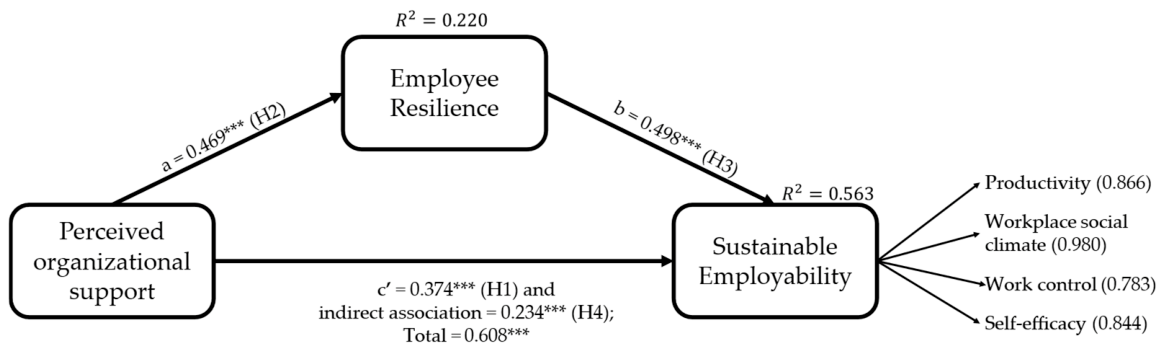
The latent structural model had the same acceptable overall fit as the second-order measurement model, yielding a scaled chi-square (621) = 1330.81, p < 0.001, CFI = 0.968, TLI = 0.965, RMSEA = 0.075, 90% CI [0.070, 0.081], and SRMR = 0.080. POS was positively associated with employee resilience (beta = 0.469), and resilience was positively associated with sustainable employability when controlling for POS (beta = 0.498). The remaining direct association between POS and sustainable employability was also positive (beta = 0.374; Table 5).
Table 5.
Structural paths and latent indirect effects.
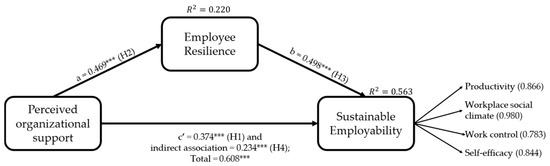
The Monte Carlo interval for the indirect association did not include zero, with B = 0.353, SE = 0.079, and 95% CI: [0.209, 0.519]; the completely standardized indirect coefficient was beta = 0.234. The total association was beta = 0.608 (Figure 2). Because the indirect and remaining direct associations were both positive and statistically significant, the pattern is described as complementary partial statistical mediation. Approximately 38.5% of the total standardized association was carried through resilience, reported as a descriptive proportion rather than a causal decomposition.
Figure 2.
Final cross-sectional latent path model. Note. POS = perceived organizational support. Standardized coefficients are shown. R-squared values appear above the endogenous latent variables. Higher-order loadings are shown beside the sustainable-employability dimensions. Residual variances and item-level measurement paths are omitted for legibility. *** p < 0.001. The arrows represent modeled cross-sectional associations, not causal effects.
4.7. Sensitivity Analyses
Excluding P5 produced nearly identical WLSMV structural results: POS -> resilience beta = 0.469, resilience -> sustainable employability beta = 0.484, direct POS -> sustainable employability beta = 0.393, indirect beta = 0.227, and total beta = 0.621; all p < 0.001. MLR estimation yielded the same direction and inferential conclusion, with indirect beta = 0.205 and p = 0.007, although CFI and TLI were weaker than under ordinal WLSMV (Table 6). An observed-score robustness model controlling for age, tenure, gender, educational level, and university-type code also retained a positive indirect association (B = 0.185, bootstrap 95% CI [0.077, 0.310]). These checks indicate that the substantive conclusion was not dependent on P5, the ordinal estimator, or the omission of the available demographic covariates.
Table 6.
Sensitivity of the structural conclusion across specifications.
5. Discussion
5.1. Principal Findings
The revised analysis supports a consistent cross-sectional pattern, where university employees who perceived greater organizational support also reported more resilient work behavior and stronger sustainable employability, and resilience statistically contributed to the association between perceived organizational support and sustainable employability. Furthermore, the direct association remained significant after including resilience, indicating that it was not the only pathway connecting the constructs. The model explained 22.0% of the resilience and 56.3% of the sustainable employability.
This conclusion is strengthened by the convergence between the ordinal WLSMV, a model excluding the P5 indicator with a ceiling distribution, multiple linear regression, Monte Carlo inference, and an observed score model with demographic controls. At the same time, the cross-sectional design precludes interpreting the indirect association as a temporal transmission. Therefore, resilience may shape perceptions of support, the relationships may be reciprocal, and unmeasured organizational conditions may influence all three constructs.
5.2. Theoretical Contributions
First, the study links OST and CRT theory to sustainable employability. POS appears as a contextual resource associated with a behavioral personal resource, resilience, and with a broader state of continued work capability. This complements research that links POS to well-being or retention by extending the outcome to a multidimensional sustainable-employability construct (Eisenberger et al., 2020; Kurtessis et al., 2017).
Second, the measurement audit clarifies that positively or negatively worded POS items should not be automatically interpreted as distinct substantive forms of organizational support. The positive–negative split of the construct aligned with the direction of the wording and did not withstand scrutiny from alternative models. Reverse-worded items can introduce methodological variance, comprehension problems, and artificial factors, especially when agreement response styles vary (Sonderen et al., 2013; Zhang et al., 2016). The reduced unidimensional factor is more consistent with OST, although it requires independent validation because it was selected from the same sample.
Third, the analysis demonstrates that resilience and self-efficacy are distinguishable in this dataset. Their HTMT was 0.611, and a fused factor fit significantly worse. Resilience reflects adaptive work behaviors across collaboration, feedback, resource seeking, and change, whereas self-efficacy in the sustainable-employability measure reflects confidence and persistence in performing planned actions. Their association is expected, but the constructs are not interchangeable.
Fourth, the second-order model provides qualified support for aggregating the four sustainable-employability dimensions. The higher-order loadings were strong, but the correlated six-factor model fit better and workplace social climate was close to a boundary solution. The higher-order representation is therefore useful for the structural question, while dimension-specific interpretations and future validation remain important.
5.3. Relevance to Higher Education and the Peruvian Context
University employment combines professional autonomy and meaningful work with governance demands, digital adaptation, performance evaluation, and resource constraints. The sample’s high education level and long average tenure distinguish it from the low-skilled population for which MAISE-Easy wording was originally simplified. The strong relationships among productivity, social climate, control, and self-efficacy suggest that continued employability in this workforce is experienced as both an individual and organizational condition.
The Peruvian context adds relevance without making the relationships uniquely Peruvian. Ongoing quality-assurance reforms and diversity across public and private institutions create variation in governance, resources, and employment practices (SUNEDU, 2025). The findings suggest that perceived recognition and care are associated with adaptive work resources in this setting. Cross-national and multilevel research is needed to establish whether institutional regulation, university type, contract conditions, or resource availability alter the pattern.
5.4. Practical Implications
The results identify organizational practices that warrant prospective evaluation rather than proving that a specific intervention will improve employability. Universities could make support more visible through fair recognition, accessible supervisory assistance, meaningful participation in decisions, feedback channels, professional-development opportunities, and transparent workload and career policies. Resilience-oriented initiatives should complement rather than replace organizational change; asking employees to adapt without addressing workload, control, resources, or social climate would individualize an institutional problem.
Because the indirect association was partial, initiatives focused only on resilience are unlikely to address the whole POS–sustainable-employability relationship. Future intervention studies should combine organizational-support practices with opportunities for collaborative problem solving, feedback use, resource seeking, and learning from change, and should evaluate outcomes longitudinally.
5.5. Limitations and Future Research
The cross-sectional design does not establish temporal ordering or causal mediation. Longitudinal cross-lagged, intensive repeated-measure, quasi-experimental, and intervention designs are needed to test directionality and within-person change.
All focal constructs were self-reported in one questionnaire. Procedural safeguards, the first-component screening, and the six-factor model reduce but do not eliminate common method concerns. Future studies should include temporal separation, marker variables, supervisor or coworker assessments, and objective indicators such as retention, absence, workload, promotion, or participation in development activities.
The open-link, non-probability recruitment did not provide an invitation denominator, and institution identifiers were not collected. The sample is not representative, and employee nesting could not be modeled. Future studies should use institution-level sampling, record public/private and institutional identifiers, and apply multilevel SEM.
The measurement refinement and CFA used the same sample. The reduced POS scale, exclusion of the health dimension and S1, and second-order structure may capitalize on sample-specific variation. Independent cross-validation, measurement invariance across university type and staff group, and preregistered replication are necessary.
The sample was older and highly educated, while MAISE-Easy was developed for low-skilled jobs. Although expert review and latent validation supported the retained items, the adaptation should not be treated as a definitive validation of MAISE-Easy for university personnel. A university-specific sustainable-employability measure may be preferable.
P5 showed a pronounced ceiling effect, and workplace social climate had a near-boundary residual variance in the second-order model. Sensitivity analyses did not change the structural conclusion, but future samples with more response variability should verify these estimates.
The study did not include contract type, academic rank, workload, caregiving responsibilities, or institution-level working conditions. These factors may confound or moderate the observed associations and should be incorporated in future research.
6. Conclusions
Among 202 university employees in Lima, POS, employee resilience, and sustainable employability were positively associated in a latent-variable model. Resilience carried a significant portion of the POS–sustainable-employability association, while the direct POS association remained significant. The pattern is therefore consistent with complementary partial statistical mediation, but it does not demonstrate a causal or temporal mechanism. The measurement reanalysis also showed that POS should be represented unidimensionally rather than as positive and negative wording factors, and that resilience is distinguishable from self-efficacy. The findings support further longitudinal and institutionally representative research on how organizational support and adaptive employee resources jointly relate to continued work capability in higher education.
Supplementary Materials
The following supporting information can be downloaded at https://www.mdpi.com/article/10.3390/admsci16080388/s1: Table S1: Audit of alternative perceived-organizational-support specifications; Table S2: Item disposition and rationale after the measurement audit; Table S3: Full traditional HTMT matrix; Table S4: Robust comparison tests for key alternative models; Table S5: Structural sensitivity analyses; Table S6: Content-validity summary.
Author Contributions
Conceptualization, L.A.G.-C., O.D.C.-F., B.M.-T. and J.U.-K.; methodology, L.A.G.-C.; software, L.A.G.-C.; validation, O.D.C.-F., B.M.-T. and J.U.-K.; formal analysis, L.A.G.-C.; investigation, L.A.G.-C., O.D.C.-F., B.M.-T. and J.U.-K.; resources, L.A.G.-C. and O.D.C.-F.; data curation, L.A.G.-C.; writing—original draft preparation, L.A.G.-C. and J.U.-K.; writing—review and editing, L.A.G.-C., O.D.C.-F., B.M.-T. and J.U.-K.; visualization, L.A.G.-C.; supervision, J.U.-K.; project administration, L.A.G.-C.; funding acquisition, L.A.G.-C. All authors have read and agreed to the published version of the manuscript.
Funding
This research was funded by Universidad Tecnológica del Perú, grant number P-2025-LIM-01.
Institutional Review Board Statement
The study was conducted in accordance with the Declaration of Helsinki and approved by the Ethics Committee of the Universidad Tecnológica del Perú (protocol code No. 373-2025-CEI-UTP and 2 September 2025).
Informed Consent Statement
Informed consent was obtained from all subjects involved in the study.
Data Availability Statement
The data generated in this study can be found at the following link: https://osf.io/2k5su/overview?view_only=e6d9fc9f7e354ebebeee8e1f495daebc (accessed on 7 July 2026).
Acknowledgments
The authors would like to express their gratitude to all members of the staff, the faculty, the administrative staff, the deans, and other university officials, particularly the dean of the School of Administrative Sciences at the Universidad Nacional Mayor de San Marcos (UNMSM), who initially participated in the pilot phase of the study. We also thank the administrative and academic staff of the Universidad Nacional de Ingeniería (UNI) and other staff members at private universities located in the Lima metropolitan area. During the preparation of this work, the authors used Scopus AI to explore background information and preliminarily search for associations between variables. Additionally, GPT-5.5 Thinking was used to improve the language and clarity of the text during manuscript preparation. After using these tools, all suggestions were reviewed, verified, and edited by the authors, who assume full responsibility for the content of the published article.
Conflicts of Interest
The authors declare no conflicts of interest.
Abbreviations
The following abbreviations are used in this manuscript:
| AVE | Average Variance Extracted |
| CFA | Confirmatory Factor Analysis |
| CMB | Common Method Bias |
| CRT | Conservation of Resources Theory |
| CR | Composite Reliability |
| EFA | Exploratory Factor Analysis |
| ER | Employee Resilience |
| HTMT | Heterotrait–Monotrait Ratio |
| JASP | Jeffrey’s Amazing Statistics Program |
| OST | Organizational Support Theory |
| POS | Perceived Organizational Support |
| SE | Sustainable Employability |
| WLSMV | Weighted Least Squares Mean- and Variance-Adjusted |
| WSC | Workplace Social Climate |
| WC | Work Control |
References
- AlDhaen, E. (2026). Organizational support and knowledge sharing as predictors of organizational social sustainability in higher education institutions. Discover Sustainability, 7(1), 702. [Google Scholar] [CrossRef] [Scilit]
- Álvarez-González, P., López-Miguens, M. J., & Caballero, G. (2024). The role of individual factors in perceived sustainable employability: An application in higher education. Education + Training, 66(7), 873–889. [Google Scholar] [CrossRef] [Scilit]
- Bardoel, E. A., Pettit, T. M., De Cieri, H., & McMillan, L. (2014). Employee resilience: An emerging challenge for HRM. Asia Pacific Journal of Human Resources, 52(3), 279–297. [Google Scholar] [CrossRef] [Scilit]
- Chen, J. W., Lu, L., & Kao, S. F. (2025). Fostering employee resilience and protecting productivity in the wellness-based positive work environment: The enhancing effects of workplace social support. International Journal of Stress Management, 32(3), 288–299. [Google Scholar] [CrossRef] [Scilit]
- Deniz, Ü., & Kocabaş, C. (2024). Understanding the relationship between perceived organizational support and psychological well-being: Perspectives of Turkish faculty members. Higher Learning Research Communications, 14(1), 51–67. [Google Scholar] [CrossRef] [Scilit]
- DiStefano, C., & Morgan, G. B. (2014). A comparison of diagonal weighted least squares robust estimation techniques for ordinal data. Structural Equation Modeling: A Multidisciplinary Journal, 21(3), 425–438. [Google Scholar] [CrossRef] [Scilit]
- Eisenberger, R., Huntington, R., Hutchison, S., & Sowa, D. (1986). Perceived organizational support. Journal of Applied Psychology, 71(3), 500–507. [Google Scholar] [CrossRef]
- Eisenberger, R., Shanock, L. R., & Wen, X. (2020). Perceived organizational support: Why caring about employees counts. Annual Review of Organizational Psychology and Organizational Behavior, 7, 101–124. [Google Scholar] [CrossRef] [Scilit]
- Ferrando, P., Lorenzo-Seva, U., Hernández-Dorado, A., & Muñiz, J. (2022). Decalogue for the factor analysis of test items. Psicothema, 1(34), 7–17. [Google Scholar] [CrossRef] [Scilit] [PubMed]
- Fleuren, B. P. I., de Grip, A., Jansen, N. W. H., Kant, I., & Zijlstra, F. R. H. (2020). Unshrouding the sphere from the clouds: Towards a comprehensive conceptual framework for sustainable employability. Sustainability, 12(16), 6366. [Google Scholar] [CrossRef] [Scilit]
- Flores, J., & Gómez, I. (2018). Apoyo organizacional percibido y compromiso organizacional en una empresa privada de Lima, Perú. Revista Ajayu: Órgano de Difusión Científica del Departamento de Psicología, 16(1), 1–30. [Google Scholar]
- Henseler, J., Ringle, C. M., & Sarstedt, M. (2015). A new criterion for assessing discriminant validity in variance-based structural equation modeling. Journal of the Academy of Marketing Science, 43(1), 115–135. [Google Scholar] [CrossRef] [Scilit]
- Houkes, I., Miglioretti, M., Picco, E., & Rijk, A. E. D. (2020). Tapping the employee perspective on the improvement of sustainable employability (SE): Validation of the MAastricht instrument for SE (MAISE-NL). International Journal of Environmental Research and Public Health, 17(7), 2211. [Google Scholar] [CrossRef] [Scilit] [PubMed]
- Jabeen, Q., Nadeem, M. S., Raziq, M. M., & Sajjad, A. (2022). Linking individuals’ resources with (perceived) sustainable employability: Perspectives from conservation of resources and social information processing theory. International Journal of Management Reviews, 24(2), 233–254. [Google Scholar] [CrossRef] [Scilit]
- Jaingam, W., & Na-Nan, K. (2023). The mediating effect of resilience on the relationship between perceived organizational support and innovative work behavior. International Journal of Advanced and Applied Sciences, 10(9), 45–56. [Google Scholar] [CrossRef] [Scilit]
- Kurtessis, J. N., Eisenberger, R., Ford, M. T., Buffardi, L. C., Stewart, K. A., & Adis, C. S. (2017). Perceived organizational support: A meta-analytic evaluation of organizational support theory. Journal of Management, 43(6), 1854–1884. [Google Scholar] [CrossRef] [Scilit]
- Li, C.-H. (2021). Statistical estimation of structural equation models with a mixture of continuous and categorical observed variables. Behavior Research Methods, 53(5), 2191–2213. [Google Scholar] [CrossRef] [Scilit] [PubMed]
- Lulewicz-Sas, A., Kinowska, H., & Fryczyńska, M. (2022). How sustainable human resource management affects work engagement and perceived employability. Economics & Sociology, 15(4), 63–79. [Google Scholar] [CrossRef] [Scilit]
- Maxwell, S. E., & Cole, D. A. (2007). Bias in cross-sectional analyses of longitudinal mediation. Psychological Methods, 12(1), 23–44. [Google Scholar] [CrossRef] [Scilit] [PubMed]
- Mignon, P., Hazelzet, E., Rijk, A. D., Bosma, H., & Houkes, I. (2022). Validation of the MAastricht instrument of sustainable employability (MAISE-NL) adapted for employees in low-skilled jobs (MAISE-easy). International Journal of Environmental Research and Public Health, 19(13), 7977. [Google Scholar] [CrossRef] [Scilit] [PubMed]
- Moschovopoulou, A., & Papavassiliou-Alexiou, I. (2025). The effect of perceived organizational support, empowering leadership and learning organization on Greek psychiatric nurses’ employee resilience: A cross-sectional study. International Journal of Workplace Health Management, 18(4), 371–390. [Google Scholar] [CrossRef] [Scilit]
- Muthén, B. (1984). A general structural equation model with dichotomous, ordered categorical, and continuous latent variable indicators. Psychometrika, 49(1), 115–132. [Google Scholar] [CrossRef] [Scilit]
- Näswall, K., Malinen, S., Kuntz, J., & Hodliffe, M. (2019). Employee resilience: Development and validation of a measure. Journal of Managerial Psychology, 34(5), 353–367. [Google Scholar] [CrossRef] [Scilit]
- O’Laughlin, K. D., Martin, M. J., & Ferrer, E. (2018). Cross-sectional analysis of longitudinal mediation processes. Multivariate Behavioral Research, 53(3), 375–402. [Google Scholar] [CrossRef] [Scilit] [PubMed]
- Pham, Q. N., Hong Phuong Pham, T., Vi Ngo, T. Y., & Nguyen, D. (2024, December 1). A novel optimization model for apparel closed-loop supply chain planning. 2024 International conference on logistics and industrial engineering (ICLIE), Ho Chi Minh City, Vietnam. [Google Scholar] [CrossRef] [Scilit]
- Podsakoff, P. M., MacKenzie, S. B., Lee, J.-Y., & Podsakoff, N. P. (2003). Common method biases in behavioral research: A critical review of the literature and recommended remedies. Journal of Applied Psychology, 88(5), 879–903. [Google Scholar] [CrossRef] [Scilit] [PubMed]
- Podsakoff, P. M., MacKenzie, S. B., & Podsakoff, N. P. (2012). Sources of method bias in social science research and recommendations on how to control it. Annual Review of Psychology, 63, 539–569. [Google Scholar] [CrossRef] [Scilit] [PubMed]
- Preacher, K. J., & Hayes, A. F. (2008). Asymptotic and resampling strategies for assessing and comparing indirect effects in multiple mediator models. Behavior Research Methods, 40(3), 879–891. [Google Scholar] [CrossRef] [Scilit] [PubMed]
- Roser-Chinchilla, J., Galán-Muros, V., & de Ita Valera, E. (2024). Higher education institutions as employers: Ensuring decent working conditions (SDG Brief Series, Goal 8). UNESCO IESALC. Available online: https://unesdoc.unesco.org/ark:/48223/pf0000391205 (accessed on 7 July 2026).
- Rosseel, Y. (2012). lavaan: An R Package for Structural Equation Modeling. Journal of Statistical Software, 48(2), 1–36. [Google Scholar] [CrossRef] [Scilit]
- Semeijn, J. H., Caniëls, M. C. J., & Kooistra, D. (2019). Cross-lagged effects of resilience and indicators of sustainable employability; a study among Dutch police officers. Policing: An International Journal, 42(6), 961–975. [Google Scholar] [CrossRef] [Scilit]
- Sim, M., Kim, S.-Y., & Suh, Y. (2022). Sample size requirements for simple and complex mediation models. Educational and Psychological Measurement, 82(1), 76–106. [Google Scholar] [CrossRef] [Scilit] [PubMed]
- Sonderen, E. v., Sanderman, R., & Coyne, J. C. (2013). Ineffectiveness of reverse wording of questionnaire items: Let’s learn from cows in the rain. PLoS ONE, 8(7), e68967. [Google Scholar] [CrossRef] [Scilit] [PubMed]
- SUNEDU. (2025). IV Informe bienal sobre la realidad universitaria en Perú (2021–2022). Superintendencia Nacional de Educación Superior Universitaria (SUNEDU). Available online: https://www.gob.pe/institucion/sunedu/informes-publicaciones/7363607-iv-informe-bienal-sobre-la-realidad-universitaria-de-peru (accessed on 7 July 2026).
- Tham, T. L., Alfes, K., Holland, P., Thynne, L., & Vieceli, J. (2024). Extreme work in extraordinary times: The impact of COVID-stress on the resilience and burnout of frontline paramedic workers—The importance of perceived organisational support. The International Journal of Human Resource Management, 35(10), 1739–1762. [Google Scholar] [CrossRef] [Scilit]
- Tofighi, D., & MacKinnon, D. P. (2016). Monte Carlo confidence intervals for complex functions of indirect effects. Structural Equation Modeling: A Multidisciplinary Journal, 23(2), 194–205. [Google Scholar] [CrossRef] [Scilit]
- Vásquez, L. A., Magaña, D. E., & Román, J. P. (2025). Validez y confiabilidad de la escala de apoyo organizacional percibido en español con profesores universitarios. Revista de La Educación Superior, 54(214), 125–144. [Google Scholar]
- Vuuren, T. V., Van Der Heijden, B. I. J. M., & Semeijn, J. H. (2023). With a little help from my friends: Adopting a P-E fit perspective in understanding the value of organizational learning climate for sustainable employability. Frontiers in Psychology, 14, 1128535. [Google Scholar] [CrossRef] [Scilit] [PubMed]
- Zhang, M., Kong, X. X., & Chenayah, S. C. (2016). The transformation of the clothing industry in China. Asia Pacific Business Review, 22(1), 86–109. [Google Scholar] [CrossRef] [Scilit]

Disclaimer/Publisher’s Note: The statements, opinions and data contained in all publications are solely those of the individual author(s) and contributor(s) and not of MDPI and/or the editor(s). MDPI and/or the editor(s) disclaim responsibility for any injury to people or property resulting from any ideas, methods, instructions or products referred to in the content. |
© 2026 by the authors. Licensee MDPI, Basel, Switzerland. This article is an open access article distributed under the terms and conditions of the Creative Commons Attribution (CC BY) license.