


Abstract
Digital diversification increasingly occurs not through acquisition or formal alliance but through staged, option-like commitments between large technology firms and frontier artificial intelligence (AI) developers. This paper uses the Amazon–OpenAI partnership (November 2025–March 2026) as an illustrative case to examine how such staged commitments can be understood through a real-options lens. The paper organizes the case around five synergy categories adapted from the M&A and ecosystem literature—market power, relational, network, non-market, and ecosystem synergies—and shows that Amazon’s two-tranche investment structure ($15 billion committed, with a further $35 billion conditional on technological and commercial milestones) resembles a compound sequential call option. The paper illustrates this logic with a compound option and binomial lattice valuation, using publicly disclosed deal terms and volatility proxies from comparable AI firms. The paper emphasizes that this valuation is indicative rather than precise: it depends on assumptions about OpenAI’s eventual IPO valuation, the durability of Amazon’s ownership share, and the appropriateness of peer-firm volatility as a proxy, all of which are uncertain at the time of writing. The paper’s contribution is conceptual: it introduces ‘staged ecosystem optionality’ as a mechanism of digital diversification and offers a road map for future research.
1. Introduction
How do large technology firms expand into adjacent technological domains when the underlying capability—frontier artificial intelligence—is too uncertain, too fast-moving, and too expensive to acquire outright? The classical strategy literature offers two well-established answers: firms can acquire the capability (through M&A) or access it through alliance and licensing arrangements (Barney, 1991; Teece, 2007). Neither answer fits comfortably with a growing set of arrangements observed in the AI infrastructure sector since 2023, in which large cloud and platform incumbents make staged, partial, and conditional capital commitments to frontier AI developers—commitments explicitly structured to expand only if specified technological or commercial milestones are met.
A note on data sources is warranted at the outset: public reporting on the deal terms contains inconsistencies across sources. Official press releases from Amazon and OpenAI (AWS, 2026a; OpenAI, 2026a) confirm the $38 billion compute agreement and the $50 billion investment structure, while Reuters (2026) and other financial press sources (Singh, 2026; Kim, 2026; Bishop, 2026) provide additional detail on the conditional nature of the second tranche. When discrepancies exist between sources, this paper relies on official corporate disclosures as primary sources and uses media reports as supplementary evidence, with discrepancies noted in the text. The treatment of these inconsistencies is described more fully in Section 3.2.
This paper examines a prominent instance of this pattern: the Amazon–OpenAI partnership, which began with a $38 billion AWS compute-capacity agreement in November 2025 and was followed by a $50 billion strategic investment in February 2026. The investment was structured as an initial $15 billion tranche with a conditional $35 billion second tranche tied to OpenAI’s progress toward an initial public offering (IPO) and to internally defined artificial general intelligence (AGI) milestones. The paper argues that this staged structure is not merely a financing detail; it reflects a broader mechanism of digital diversification that existing typologies of corporate expansion do not fully capture. Specifically, the paper proposes that the deal can be usefully understood through the lens of compound real options (Geske, 1979)—an option whose value derives, in part, from the right to acquire a further option—combined with a synergy framework adapted from the M&A literature (Feldman & Hernandez, 2022) and recent work on ecosystem-level synergies (Burford et al., 2025).
This paper makes three contributions. First, conceptually, the paper distinguishes staged ecosystem optionality from the three dominant modes of digital expansion identified in prior research—acquisition-based capability transfer, formal alliance governance, and platform-mediated ecosystem participation (Adner, 2017; Jacobides et al., 2018)—and argues that it constitutes an analytically distinct fourth mode, characterized by sequential, conditional, and partial commitment as uncertainty resolves.
To clarify this distinction, Section 2.6 presents a systematic comparison table that explicitly delineates staged ecosystem optionality from related constructs across key dimensions, including governance structure, control transfer, capital commitment, and uncertainty resolution.
Second, methodologically, this paper proposes a synergy-to-option mapping that links five synergy types (market power, relational, network, non-market, and ecosystem) to the compound-option structure, providing a transferable template for analyzing similar AI infrastructure partnerships as they emerge. As discussed in Section 5.4, this mapping is conceptual rather than directly quantitative: the synergies inform the strategic rationale for the option structure and the selection of valuation parameters, but do not directly determine the numerical inputs to the Geske model.
Third, this mapping is applied to the Amazon–OpenAI case and provides an indicative compound-option valuation, while being explicit about the assumptions on which that valuation depends and the boundaries within which it should be interpreted.
This section aims to be transparent from the outset about the study’s evidentiary basis and limits. The Amazon–OpenAI partnership was, at the time of writing, four months old. The empirical material consists entirely of public disclosures—press releases, regulatory filings, executive statements, and financial press coverage—rather than internal documents, interviews, or longitudinal observation. This is not a theory-building case study in the inductive, grounded-theory sense; it is an illustrative analytical case that uses a recent, high-visibility example to motivate and demonstrate a conceptual framework. This framing is deliberate, and the reasoning behind it is explained in Section 3.
The remainder of the paper proceeds as follows. Section 2 reviews the literature on digital diversification, M&A, ecosystem synergies, and real-options reasoning, and identifies the gap this paper addresses. Section 2.5 presents a comparative analysis of major AI infrastructure arrangements to justify the case selection. Section 3 describes the case, data sources, and analytical approach. Section 4 presents the synergy analysis. Section 5 develops the compound-option valuation and reports the indicative results. Section 6 discusses theoretical and managerial implications. Section 7 outlines the study’s limitations and a future research agenda. Section 8 concludes.
2. Literature Review and Research Gap
2.1. Digital Diversification and Its Limits as a Construct
Corporate diversification has traditionally been framed as a choice between related and unrelated expansion, typically pursued through internal development, acquisition, or joint venture (Rumelt, 1982; Markides, 1995). The rise of digital platforms has complicated this picture. Digital diversification increasingly occurs through participation in multi-sided ecosystems, where value depends on aligning complementary actors rather than on owning a discrete set of assets (Jacobides et al., 2018; Teece, 2018). Helfat and Raubitschek (2018) describe the dynamic and integrative capabilities required to profit from innovation in such platform-based ecosystems, emphasizing the importance of orchestrating complementors rather than internalizing them.
Within this literature, however, partial and conditional equity commitments to external AI developers—such as Amazon’s commitment to OpenAI—do not map cleanly onto existing categories. They are not acquisitions because control does not transfer. They are not conventional strategic alliances in Gulati’s sense of relational governance because the commitment is explicitly staged and conditional on future, partially objective, partially negotiated milestones. Nor are they pure ecosystem participation in Adner’s (2017) sense, because the capital commitment itself materially shapes the partner’s technological trajectory. This paper’s first contribution is to name and characterize this fourth mode.
2.2. Synergy Typologies in M&A and Ecosystem Research
The concept of synergy has a long history in the M&A literature, typically organized around cost, revenue, and financial synergies (Goold & Campbell, 1998; Rhodes-Kropf & Robinson, 2008). Feldman and Hernandez (2022) offer a more recent, more granular typology, distinguishing five synergy categories: market power, relational, network, and non-market synergies, and explicitly linking each to a distinct antecedent mechanism and a different expected duration of value capture.
This paper adopts a five-category framework that treats market power as a distinct category alongside relational, network, non-market, and ecosystem synergies. The market power category captures value created through enhanced competitive positioning, such as AWS’s role as a distribution channel for OpenAI Frontier, which strengthens Amazon’s competitive position relative to Microsoft Azure and Google Cloud (Invezz, 2026; Yahoo Finance, 2026). This typology is well-suited to partial, governance-light relationships examined here because it does not presuppose full integration.
A complementary and more recent line of work extends synergy thinking to ecosystem-level value creation. Burford et al. (2025) propose that acquisition, and by extension other large strategic commitments, can generate ecosystem synergies: value that arises not from the combination of the two focal firms’ resources alone, but from the way the combined entity reshapes the incentives and behavior of third-party complementors. This paper adopts this ecosystem-synergy construct as a fifth category alongside Feldman and Hernandez’s four (market power, relational, network, and non-market). The ecosystem category is justified as distinct because its beneficiaries are third-party complementors rather than the focal firms themselves, as elaborated in Section 4.1.
2.3. Real Options and Compound Options in Strategic Management
Real-options reasoning has long been used to analyze strategic investments under uncertainty, particularly in R&D-intensive and platform-based settings (McGrath & Nerkar, 2004; Yeo & Qiu, 2003). Compound options—options on options—are a natural extension when investment unfolds in stages, each resolving some uncertainty and creating the right, but not the obligation, to proceed to the next stage (Geske, 1979). Trigeorgis and Miller (2025) recently applied real-options portfolio thinking to multinational enterprises’ modes of international involvement in the digital economy, underscoring that staged, flexible commitment structures are becoming more common, not less, in digitally intensive strategic decisions.
A critical distinction must be drawn between real-options reasoning, an analogy, and real-options valuation, a mathematical pricing approach. Real-options reasoning concerns the strategic logic of managing uncertainty through staged, flexible commitments—the “option-like” character of decisions that can be deferred, expanded, or abandoned as uncertainty resolves (McGrath & Nerkar, 2004). This is a qualitative analytical lens that helps managers assess the value of flexibility. By contrast, real-options valuation is the quantitative application of financial option-pricing models (such as Geske’s (1979) compound-option model or the Black-Scholes formula) to estimate the monetary value of such flexibility.
This paper uses both approaches: the partnership is analyzed through a real-options lens, and an illustrative real-options valuation is presented using the Geske model. The valuation should be understood as an indicative estimate of the optionality value embedded in the staged commitment structure, not as a precise prediction of the partnership’s total value.
What is missing from this literature is an explicit bridge between the qualitative synergy typologies described above and the quantitative compound-option structures used to value staged commitments. Existing applications of real-options valuation in strategy tend to treat the underlying synergy or capability as a black-box input to the option model, whereas existing applications of synergy typologies rarely connect to a formal valuation logic. This paper’s second and third contributions—the synergy-to-option mapping and its illustrative application—are intended to close part of this gap.
2.4. Research Gap and Research Questions
Taken together, the literature reviewed above leaves open a specific and identifiable gap: there is no established framework for understanding staged, conditional, partial capital commitments to frontier AI developers as a distinct mode of digital diversification, nor is there an established method for linking the qualitative synergies such commitments are intended to generate to a quantitative compound-option valuation of the commitment itself. This paper addresses that gap through two research questions:
RQ1: How can staged, conditional capital commitments between technology incumbents and frontier AI developers be characterized as a distinct mechanism of digital diversification, and which synergy categories do they activate?
RQ2: How can compound real-options valuation be used to make the strategic value of such staged commitments analytically tractable, and what are the limits of doing so with public data at an early stage of the partnership?
2.5. Case Selection: Comparative Analysis of AI Infrastructure Arrangements
To justify selecting the Amazon–OpenAI partnership as the focal case, this section compares it with other major AI infrastructure arrangements across key analytical dimensions. The Amazon–OpenAI partnership was selected because it is the most publicly documented large-scale example of the staged-commitment pattern, supported by official disclosures from both firms (AWS, 2026a; OpenAI, 2026a), SEC filings (U.S. SEC, 2025), and extensive financial press coverage (Reuters, 2026; Kim, 2026; Singh, 2026). As of March 2026, no other AI infrastructure partnership has been documented with comparable detail on the staged conditional structure of capital commitments. Table 1 presents a comparative analysis of major AI infrastructure arrangements.
Table 1.
Comparative Analysis of AI Infrastructure Arrangements (as of March 2026).
The Amazon–OpenAI partnership is well suited to this study for three reasons:
- Documentation richness: It is the most publicly documented large-scale instance of this pattern, with official disclosures from both firms, SEC filings, and extensive financial press coverage. This enables more detailed analysis than is possible with other arrangements, where public information is more limited.
- Clear staged structure: The two-tranche investment structure ($15B initial, $35B conditional) offers a clear example of staged, conditional commitment that aligns well with the compound-option framework. Other arrangements either lack explicit staging (Amazon–Anthropic, Oracle–OpenAI) or have less publicly documented conditional elements (Microsoft–OpenAI, Google–Anthropic).
- Scale and visibility: With a total potential value of $50 billion, this is among the largest AI infrastructure investments to date, ensuring high visibility and extensive public reporting that support the illustrative analysis this paper aims to present.
2.6. Distinguishing Staged Ecosystem Optionality from Adjacent Constructs
To address the conceptual distinctiveness of staged ecosystem optionality, Table 2 systematically compares this construct with adjacent modes of digital expansion across six key dimensions.
Table 2.
Comparison of Digital Diversification Modes.
Table 2 shows that staged ecosystem optionality is conceptually distinct from existing modes across multiple dimensions. The defining characteristics are (1) sequential commitment explicitly conditional on milestone achievement, (2) no transfer of ownership or control despite substantial capital outlay, (3) the use of conditional capital to manage ecosystem-level uncertainty, and (4) the activation of multiple synergy types across stages of the commitment timeline.
3. Method, Case, and Data
3.1. Research Design: An Illustrative Analytical Case
This section clearly states the paper’s methodological positioning. This paper is not an inductive, grounded-theory case study of the kind associated with the Gioia methodology (Gioia et al., 2013), nor does it claim to have built a new theory from systematically coded field data. The Amazon–OpenAI partnership was four months old at the time of analysis; all available evidence consists of public disclosures—press releases, SEC filings, executive statements, and financial journalism—and there was no access to internal documents, interview data, or longitudinal observation of decision-making within either firm. Treating this material as the basis for inductive theory-building, with first-order codes, second-order themes, and aggregate dimensions in the manner of Gioia et al. (2013), would overstate what the data can support: the resulting categories would necessarily echo the constructs brought to the analysis (the five synergy types) rather than emerge independently from it.
This paper instead uses the case in the way illustrative or motivating cases are used elsewhere in strategy research that combines conceptual development with analytical demonstration (cf. Eisenhardt & Graebner, 2007, discussion of theory-illustrating versus theory-building case use): to motivate a conceptual distinction (staged ecosystem optionality as a fourth mode of digital diversification), to demonstrate a method (the synergy-to-option mapping), and to surface the practical assumptions and data limitations that any future, more systematic study of this phenomenon will need to confront. As detailed in Section 2.5, the Amazon–OpenAI case was selected because, at the time of writing, it is the most publicly documented, large-scale instance of this staged-commitment pattern, with official disclosures from both firms that provide the necessary evidentiary basis for an illustrative analytical case. Section 7 returns to this limitation and to what a more rigorous future research design would require.
3.2. Data Sources
The documentary corpus for this study comprises 22 publicly available sources covering November 2025 to March 2026. The inclusion criteria were: (1) direct relevance to the Amazon–OpenAI partnership, (2) publication by a reputable source (corporate press releases, SEC filings, major financial news outlets, or academic sources), and (3) availability for reader verification. Sources were identified through systematic searches of AI Mode (Google), Google Gemini, Claude AI (Anthropic), and Google News using the search terms “Amazon OpenAI partnership,” “Amazon OpenAI investment,” and “Amazon OpenAI deal” for the period November 2025 to March 2026.
The source corpus includes the following:
- Two corporate press releases (OpenAI’s announcements of the AWS compute agreement and of OpenAI Frontier; AWS product announcements);
- One SEC filing (C3.ai Form 10-K for volatility benchmarking);
- Three volatility estimates (NYU Stern V-Lab GARCH estimates for NVIDIA, Palantir, and C3.ai);
- Fifteen financial press sources (Reuters, Business Insider, TechCrunch, CNBC, Invezz, Yahoo Finance, and others);
- Academic and theoretical sources for the conceptual framework.
A clear and comprehensive outline of inclusion and exclusion criteria is provided below.
- Inclusion criteria: (1) Direct relevance to the Amazon–OpenAI partnership, (2) publication by a reputable source (corporate press releases, SEC filings, major financial news outlets, or academic sources), (3) availability for verification by readers, and (4) specific mention of deal terms, milestones, or partnership structure.
- Exclusion criteria: (1) Speculative opinion pieces without factual content, (2) duplicate reports of the same information without additional detail, and (3) sources not available in English.
Handling of Conflicting Reports: When sources conflict, the following hierarchy was applied:
- Official corporate disclosures (press releases, SEC filings) were treated as primary sources.
- Reuters and other major wire services were treated as secondary sources when they provided additional details not available in official disclosures.
- Financial press and blogs were treated as tertiary sources for context and market interpretation.
Specific discrepancies noted:
- The $38 billion computing agreement: Confirmed by both Amazon official sources (AWS, 2026a) and Reuters (2026). No discrepancy.
- The $50 billion investment structure: The two-tranche structure ($15B initial, $35B conditional) is reported by Reuters (2026), Bishop (2026), and Singh (2026). Official Amazon and OpenAI press releases confirm the $50 billion total but do not explicitly detail the conditional structure of the second tranche (OpenAI, 2026a). This paper relies on the Reuters, Bishop, and Singh reporting for the conditional structure and notes this as a limitation in Section 7.
- IPO and AGI milestones: Reuters (2026) reports that the second tranche is conditional on IPO progress and AGI milestones. These specific conditions are not detailed in official corporate press releases. This paper treats these as reported conditions and notes the uncertainty about their precise contractual definition.
All sources and access dates are reported in the reference list to allow replication and updating as the partnership develops.
3.3. Analytical Approach
The analysis proceeded in two stages, corresponding to the two research questions. First, to address RQ1, this paper uses the Feldman and Hernandez (2022) typology of market power, relational, and network synergies, together with the Burford et al. (2025) ecosystem-synergy construct, as an a priori coding frame to classify publicly reported deal mechanisms and disclosed activities into each category.
The coding procedure involved (1) identifying all public statements describing deal mechanisms and activities; (2) assigning each statement to one of the five synergy categories based on the beneficiary criterion in Section 4.1; (3) cross-verifying classifications against multiple sources, where available; and (4) documenting the source for each classification in Table 3.
Table 3.
Synergy Analysis of the Amazon–OpenAI Partnership.
This is labeled as an a priori, theory-driven categorization rather than an inductive coding process because the categories were specified before the analysis began and were not allowed to vary. The contribution of the analysis lies in showing that the five categories can all be populated with concrete, citable mechanisms in this case, not in discovering the categories themselves. The resulting classification (Table 3) is treated as illustrative evidence that the typology applies to this setting, not as a theory-generating exercise.
Second, to address RQ2, an event timeline of the partnership’s two major milestones (the $38 billion AWS capacity agreement and the $50 billion strategic investment) was constructed, and its two-tranche structure was mapped onto the compound-option formalism of Geske (1979) and validated using a binomial lattice (Cox et al., 1979). This is a conceptual application of real-options reasoning combined with an illustrative quantitative valuation, not a precise financial pricing exercise. The real-options reasoning provides the strategic logic for viewing the staged structure as option-like; the Geske numerical consistency check valuation provides an indicative estimate of the value of this optionality, subject to the assumptions detailed in Section 5.3 and Section 7.2.
Full parameterization, formulas, and step-by-step computations are reported in Appendix A (Geske model) and Appendix B (binomial lattice). The logic and the resulting estimate are summarized in Section 5, and the assumptions underlying this estimate and their fragility are discussed in Section 5.3 and Section 7.
4. Synergy Analysis of the Amazon–OpenAI Partnership
This section applies the five-category synergy frame described in Section 3.3 to the Amazon–OpenAI partnership. Before presenting the classification, this section directly addresses the issue that ecosystem synergy should be treated as a category distinct from network synergy, rather than as a restatement of the latter.
4.1. Distinguishing Ecosystem Synergy from Network Synergy
Network synergy, in the sense of Feldman and Hernandez (2022), refers to value created when the combined firm gains access to or strengthens its direct ties—the partners, channels, and alliance relationships it holds. In this case, network synergy concretely refers to Amazon’s expanded distribution channels (AWS GovCloud, classified regions, enterprise accounts) and to OpenAI’s increased access to compute.
Ecosystem synergy, following Burford et al. (2025), refers to value created for third parties who are not directly party to the transaction—independent software vendors, application developers, and complementors who build on top of the combined offering. The distinguishing test is straightforward: a mechanism is coded as network synergy if its beneficiary is Amazon or OpenAI directly; it is coded as ecosystem synergy if its beneficiary is a third-party complementor whose behavior changes as a result of the partnership, even though that complementor was not a party to it.
Market power synergy, in the Feldman and Hernandez (2022) sense, refers to value created when the combined firm achieves a stronger competitive position relative to rivals. In this case, market power synergy means AWS is positioned as a distribution channel for OpenAI Frontier, thereby strengthening Amazon’s competitive position relative to Microsoft Azure and Google Cloud. Table 3 applies this test explicitly.
The “Evidence Type” column provides specific citations for each classification. Statements in this table are coded as follows: “Company claims” are statements made by executives in public forums or in corporate press releases; “Media interpretation” is analysis from financial press sources; and “Author interpreted” indicates information confirmed by multiple independent sources, based on the theoretical framework. The table clearly shows where each classification falls on this spectrum.
The synergy analysis in Table 3 distinguishes between announced developments and observed outcomes. When the evidence consists of company claims or media interpretations of expected future developments, this is indicated in the Evidence Type column. The Ecosystem synergy category draws on early reported indications rather than confirmed, long-term outcomes. This cautious frame reflects the partnership’s early stage at the time of writing.
4.2. Synthesis: Why Staging Matters
Two observations from Table 3 motivate the option-theoretic analysis in Section 5. First, the synergies vary in maturity: relational and network synergies are comparatively advanced, while market-power and non-market synergies remain contested or partially realized, and ecosystem synergies are described in the sources as emergent rather than established. Second, and more importantly, this unevenness is not incidental—it is consistent with a staged commitment structure in which Amazon’s exposure is designed to expand only as specific categories of uncertainty (technological capability, regulatory acceptance, ecosystem uptake) resolve favorably. This pattern motivates treating the deal’s financial structure as a compound option rather than a simple equity stake, as developed next.
5. An Illustrative Compound-Option Valuation
5.1. The Staged Structure as a Compound Option
Amazon’s reported investment structure consists of an initial $15 billion tranche, committed in February 2026, and a further $35 billion tranche that is conditional on OpenAI reaching specified technological and commercial milestones, reportedly tied to progress toward an IPO and to internally defined AGI benchmarks (Reuters, 2026; Singh, 2026). This structure has the defining feature of a compound option: the first payment serves as the premium for an option whose payoff is the right to exercise a second option, rather than a direct claim on the underlying asset (Geske, 1979).
A critical question for the applicability of the Geske numerical consistency check model is whether the first $15 billion tranche functions as an option premium or as an actual investment with immediate economic rights. Public reporting (Reuters, 2026; Singh, 2026; Kim, 2026) indicates that the first tranche gives Amazon a 5.95% equity stake in OpenAI and immediate access to OpenAI’s models via AWS.
Thus, the first tranche is not purely an “option premium” in the financial sense (a payment that confers only the right, not the obligation, to make a future payment). Rather, it is a partial investment that provides current economic benefits (equity ownership and access rights) and the option to make a follow-on investment. This structure is therefore not a pure Geske compound option in the strict financial sense, but rather an investment with embedded compound optionality.
The following clarifies the transaction timeline and what Amazon receives at each stage:
November 2025: Amazon and OpenAI announce a $38 billion agreement for AWS compute capacity (OpenAI, 2026c). This is a commercial agreement, not an equity investment.
February 2026: Amazon announces a $50 billion strategic investment in OpenAI, structured as follows:
- First tranche ($15 billion): Committed immediately. Amazon receives a 5.95% equity stake in OpenAI as Series C Preferred Stock (Bishop, 2026) and privileged access to OpenAI’s models via AWS Bedrock. This arrangement provides immediate commercial benefits and influence over the direction of OpenAI’s technology.
- Second tranche ($35 billion): Conditional on OpenAI meeting specified milestones (IPO progress and AGI benchmarks). If exercised, Amazon would increase its equity stake and deepen its strategic relationship. A $35 billion commitment would be made later, with timing dependent on certain triggers.
If Amazon purchases its remaining shares before an IPO, it receives Series C Preferred Stock. If the purchase occurs after OpenAI goes public, Amazon receives common stock instead (Bishop, 2026).
The underlying asset for the option valuation is the estimated $59.5 billion value of Amazon’s prospective equity stake under a $1 trillion IPO benchmark. The exercise price is the $35 billion second-tranche payment. The valuation model treats the first tranche as the cost of acquiring the option (the “option premium”). However, this is a simplification that does not fully capture the immediate economic benefits Amazon receives from the first tranche.
It is important to clarify that the compound-option structure presented here is a stylized analytical representation of the reported transaction, not a verified legal or contractual characterization. The paper does not have access to the underlying contractual terms, and the second tranche may be a conditional commitment rather than a purely discretionary right to invest. The Geske framework is used as an analogy to illustrate the strategic logic of staged, conditional investment, not as a definitive legal or financial characterization of the actual agreement.
This structure is modeled as a compound option in the spirit of Geske (1979), with the caveat that the actual contractual terms are not publicly available and that the first tranche provides immediate economic benefits. The full derivation, parameterization, and critical-value computation are reported in Appendix A. Appendix B presents a six-step binomial lattice constructed to validate the Geske result. As expected for a reasonably fine discretization, the two methods converge closely, with the small residual difference attributable to the lattice’s discreteness rather than to any divergence in the underlying assumptions.
5.2. Parameterization
The valuation requires five inputs, each derived from a specific public source and each carrying a distinct type of uncertainty, which are flagged individually rather than treating the resulting figure as a single, undifferentiated estimate, as outlined in Table 4.
Table 4.
Valuation Parameters and Their Sources.
The choice of 5.95% as the ownership percentage warrants further explanation. According to Reuters (2026) and Kim (2026), Amazon’s $50 billion investment would give it a 5.95% equity stake in OpenAI. This percentage is based on OpenAI’s reported pre-money valuation at the time of the investment, approximately $840 billion, which implies a post-money valuation such that the $50 billion investment is equivalent to a 5.95% stake. The $59.5 billion underlying asset value used in the valuation (5.95% × $1 trillion) represents the value of Amazon’s stake under the $1 trillion IPO benchmark reported by Wang et al. (2025). This is an indicative figure based on market expectations, not a confirmed valuation.
5.3. Results and Their Interpretation
Using the parameters in Table 4, the Geske (1979) compound-option model yields an estimated strategic option value of approximately $26.5 billion. The binomial lattice in Appendix B, constructed with six time steps, produces a closely convergent estimate, differing only by the residual discretization error expected from a lattice of this granularity. Both methods are reported to demonstrate internal consistency, not to suggest that convergence between two related models validates the input assumptions themselves.
This section aims to state plainly how this figure should and should not be read. It should be read as an indicative order-of-magnitude estimate of the strategic value embedded in the deal structure’s optionality, conditional on (a) the $1 trillion IPO benchmark proving directionally accurate, (b) OpenAI peer-firm volatility serving as a reasonable proxy for OpenAI’s risk profile, and (c) the milestone conditions attached to the second tranche being economically equivalent to a clean compound-option exercise condition, which is a simplification of what are likely more qualitative, negotiated triggers in practice. It should not be read as a precise valuation of the partnership, as a prediction of what Amazon will ultimately realize from the investment, or as a claim that the five synergy categories in Table 3 map one-to-one onto this dollar figure—the valuation prices the optionality of the staged capital commitment, not the synergies directly.
For that reason, the synergy analysis and the option valuation are presented as related but distinct pieces of evidence rather than as a single integrated number. Section 7 returns to this point and to what a more defensible future valuation would require, as discussed in Section 7.2.
5.4. The Relationship Between Synergy Analysis and Option Valuation
A key issue is whether the synergy analysis and option valuation are deeply integrated or merely placed alongside each other. This section explains how the two elements relate.
The synergy analysis (Section 4) and option valuation (Section 5) serve distinct but complementary purposes:
- The synergy analysis identifies the partnership’s strategic value drivers. It answers the question: “What types of value is Amazon seeking to create through this partnership, and by what mechanisms?” The five synergy categories—market power, relational, network, non-market, and ecosystem—provide a qualitative framework for understanding the strategic rationale.
- The option valuation estimates the value of the staged commitment structure. It answers the question: “How much is the flexibility embedded in the staged investment structure worth, given uncertainty about OpenAI’s future value?” The valuation parameters are informed by the synergy analysis presented in Table 5.Table 5. Relationship Between Synergy Analysis and Real Options Valuation Inputs.
However, the synergy analysis does not directly determine the numerical inputs to the Geske model. The valuation relies on assumptions about ownership, volatility, exercise prices, and time horizons, drawn from public sources and comparable firms rather than from the synergy classification. The synergy-to-option mapping is therefore conceptually linked to the partnership’s strategic rationale rather than assigning a monetary value to each synergy category. This is a limitation of the current approach and an opportunity for future research to develop more integrated models, as outlined in Section 7.
6. Discussion: Staged Ecosystem Optionality as a Mode of Digital Diversification
6.1. Theoretical Implications
The analysis suggests that staged, conditional, partial capital commitments to frontier AI developers constitute a mode of digital diversification that is conceptually distinct from acquisition, conventional alliance, and pure ecosystem participation along three dimensions. First, unlike acquisition, control does not transfer at any stage; Amazon’s commitment, even at its maximum, secures privileged access and influence, not ownership of OpenAI’s underlying technology or governance. Second, unlike a conventional strategic alliance, the commitment is explicitly and contractually staged, so the second-stage commitment is not merely an option to renew an existing relationship but a formal call option on a call option, with milestone conditions that determine whether the option is in or out of the money. Third, unlike pure ecosystem participation, the capital commitment itself is large enough to materially influence the partner firm’s technological trajectory and capital structure, rather than the focal firm simply building complementary products atop an existing platform.
This mode is labeled staged ecosystem optionality. The term “ecosystem” is used advisedly: as Table 3 shows, the value at stake spans not only the dyadic relationship between Amazon and OpenAI but also third-party complementor behavior, regulatory and institutional positioning, and competitive dynamics vis-à-vis Microsoft. The compound-option structure is, in this sense, a financial instrument for managing ecosystem-level uncertainty when neither acquisition nor simple alliance governance is adequate to the scale or the uncertainty involved.
A key distinction must be maintained between the real-options reasoning that underpins the strategic logic and the real-options valuation that provides an indicative monetary estimate. The strategic insight—that the staged structure enables Amazon to manage uncertainty by deferring the second tranche until milestones are achieved—is supported by the real-options reasoning. The valuation estimates the value of this flexibility, but the strategic logic, not the precise number, is the paper’s primary contribution.
Table 2 (Section 2.6) systematically compares staged ecosystem optionality with related constructs, demonstrating its distinctiveness across six key dimensions. This comparison clarifies the construct’s conceptual boundaries and situates it within the broader literature on digital diversification.
6.2. Managerial Implications
For executives evaluating similar commitments, the analysis suggests two practical considerations. First, the synergy-to-option mapping in Table 3 can serve as a due diligence checklist: managers should ask, for each candidate partnership, which of the five synergy types are plausibly activated, by what concrete mechanism, and on what expected timeline, rather than treating “strategic value” as an undifferentiated justification for a large capital commitment. Second, the compound-option framing highlights the importance of how milestone conditions are specified. A second-stage commitment conditional on ambiguous or renegotiable milestones is materially different (and likely less valuable, from the investor’s standpoint) from one with clearly specified, objectively verifiable triggers. The analysis treats Amazon’s milestones as if they were clean option-exercise conditions, but the gap between that simplification and the actual, more qualitative contractual language is itself a managerially important consideration that boards and investment committees should probe directly rather than assume away.
7. Limitations and Future Research
7.1. Limitations of the Case and Method
This study has six limitations that directly affect how its conclusions should be applied. First, and most fundamentally, the case is recent (four months of public history at the time of writing) and singular.
As detailed in Section 2.5, although the Amazon–OpenAI partnership was selected because it is the most publicly documented instance of this pattern, the conclusions about staged ecosystem optionality as a mode of digital diversification are based on a single case. It remains to be established whether the pattern generalizes to other large AI infrastructure partnerships (for example, Microsoft–OpenAI, Google–Anthropic, or other emerging arrangements). The paper should be read as proposing a construct and a method for studying it, not as establishing an empirically validated typology of digital diversification modes.
Second, all data are drawn from public disclosures. There was no access to internal deal documents, term sheets, or the negotiated language defining the AGI and IPO milestones that govern the second tranche; therefore, characterizing those milestones as compound-option exercise conditions is a simplifying assumption rather than a confirmed contractual fact. The compound-option structure presented in Section 5 is a stylized analytical representation of the reported transaction, not a verified legal or contractual characterization.
Third, as noted in Section 3.2, official corporate disclosures and media reports are inconsistent about the specific conditions attached to the second tranche. This paper has relied on Reuters (2026) and Singh (2026) for the conditional structure, but this reliance is a limitation that future research with access to the actual deal documentation could address.
7.2. Limitations of the Valuation
The compound-option valuation in Section 5 rests on three specific assumptions whose fragility is made explicit here, rather than left implicit. The underlying asset value depends on a $1 trillion IPO benchmark that reflects market expectations, not a realized price; if OpenAI’s eventual IPO valuation differs materially from this figure, or if no IPO occurs within the analytical horizon, the resulting option value changes substantially and may be difficult to re-estimate, since the milestone conditions themselves may be renegotiated in such a scenario. The volatility estimate is constructed from three publicly traded AI-sector peers (NVIDIA, Palantir, C3.ai) because OpenAI itself has no observable market volatility; this is a standard real-options workaround, but it is an approximation whose validity cannot be directly tested against OpenAI’s own (unobservable) risk profile. Finally, the milestone conditions attached to the second tranche are treated, for tractability, as a clean binary exercise trigger, even though the actual conditions are more likely to be qualitative, negotiated, and potentially subject to renegotiation between the parties—meaning the true option structure may be “softer” (more like a deferred negotiation than a hard exercise decision) than the Geske framework assumes.
Fourth, as noted in Section 5.1, the first $15 billion tranche provides immediate economic benefits (equity ownership and access rights) rather than serving purely as an option premium. As noted in the third point, no access was available to the actual deal documentation specifying the AGI and IPO milestones in legally operative terms; treating these as option-exercise conditions is an interpretive simplification drawn from public reporting (Reuters, 2026; Singh, 2026), not a confirmed contractual reading.
This means the structure is not a pure Geske compound option but an investment with embedded compound optionality. As a result, the valuation overstates the “option premium” component and understates the immediate value Amazon receives from the first tranche. A more precise valuation would require access to the actual contractual terms and a model that explicitly accounts for the first tranche’s immediate economic benefits.
Fifth, as noted in Section 5.4, the synergy-to-option mapping is conceptual rather than fully integrated in a formal, quantitative sense. The synergies inform the strategic rationale and parameter selection but do not directly determine the numerical valuation inputs. This limitation of the current approach presents an opportunity for future research to develop more integrated models.
Sixth, as noted in Section 2.3, the distinction between real-options reasoning (as a strategic lens) and real-options valuation (as a quantitative pricing tool) is critical. Section 5 valuation provides an indicative estimate of the optionality value, but the paper’s primary contribution is conceptual—identifying staged ecosystem optionality as a distinct mode of digital diversification—rather than offering a precise valuation. The valuation should be read as illustrative, not as a definitive estimate of the partnership’s value.
7.3. Future Research Directions
These limitations point to a concrete future research agenda. As more AI infrastructure partnerships of this kind emerge, researchers should pursue comparative analysis across multiple cases (e.g., Microsoft–OpenAI, Google–Anthropic, and others as they develop staged structures) to test whether the staged-optionality construct generalizes and whether the five-synergy mapping proposed here requires modification in other contexts. Where access permits, future work should also seek primary data—interviews with deal-team participants or access to actual term sheets—to test whether milestone conditions in practice behave more like clean option triggers or like ongoing negotiated checkpoints, which would materially affect the appropriateness of the Geske framework relative to alternative valuation approaches (for example, models that explicitly accommodate renegotiation, such as those reviewed by Trigeorgis and Miller (2025)). Finally, as OpenAI’s IPO process (if it occurs) unfolds, the valuation in Section 5 should be revisited and updated, both as a test of the framework’s predictive value and as a methodological illustration of how compound-option estimates evolve as the uncertainties surrounding their price are progressively resolved.
8. Conclusions
This paper has examined the Amazon–OpenAI partnership as an illustrative case of a digital diversification mechanism—staged ecosystem optionality—that does not neatly map onto acquisition, conventional alliance, or pure ecosystem participation. The case was selected because it is the most publicly documented large-scale example of this staged-commitment pattern, and official disclosures from both firms provide the necessary evidence for analysis.
The case was organized around five synergy categories adapted from the M&A and ecosystem-strategy literature, and it showed how the partnership’s two-tranche capital structure can be analyzed, with appropriate caveats, through a compound real-options lens. The paper clarified that while the first tranche provides immediate economic benefits, the structure contains embedded compound optionality that can be usefully analyzed using the Geske framework as an analogy. However, this is a simplification of the actual contractual terms. The paper emphasized the distinction between real-options reasoning as a strategic lens and real-options valuation as a quantitative pricing tool; the valuation should be read as an indicative estimate, not a precise prediction.
The compound-option structure is presented as a stylized analytical representation of the reported transaction, not as a verified legal or contractual characterization. The synergy-to-option mapping aligns the partnership’s strategic rationale with the staged-investment logic rather than assigning a monetary value to each synergy category.
The resulting illustrative valuation, approximately $26.5 billion, should be read as an order-of-magnitude estimate of the strategic value embedded in the deal’s optionality, not as a precise or validated figure, given the assumptions underlying it. The paper’s principal contribution is conceptual and methodological: it identifies a mode of digital diversification increasingly common in the AI infrastructure sector, provides a systematic comparison with adjacent constructs, and offers a transferable synergy-to-option mapping that future research, ideally drawing on a larger set of comparable cases and richer data, can refine and test.
Funding
This research received no external funding.
Institutional Review Board Statement
Not applicable.
Informed Consent Statement
Not applicable.
Data Availability Statement
The raw data supporting the conclusions of this article will be made available by the author on request. The data used in this study were derived from the author’s previously published works. Publication titles, journal names, and URLs are listed in the reference section. Access to some data may be restricted and is subject to publisher permissions. Data sharing complies with the policies of the respective publishers and journals.
Acknowledgments
While working on this paper, the author used Microsoft Copilot and Claude AI (Anthropic) for brainstorming. The author also used Google Gemini and Claude AI (Anthropic) to find literature, which they then manually verified, read, and synthesized. The author has reviewed and edited the output and takes full responsibility for the content of this publication. The author takes full responsibility for the content and accuracy of this work.
Conflicts of Interest
The author declares no conflicts of interest.
Appendix A. Geske (1979) Numerical Consistency Check Compound Option Model: Full Derivation
This appendix presents the full parameterization and step-by-step computation of the Geske (1979) compound-option valuation summarized in Section 5. The compound call option gives the right to pay the first-tranche premium ($15 billion) in exchange for a subsequent call option (the second, $35 billion tranche) on the underlying asset (the estimated $59.5 billion value of Amazon’s prospective equity stake). Furthermore, the compound-option structure is a stylized analytical representation of the reported transaction, not a verified legal or contractual characterization.
Table A1.
Parameters of the Compound Sequential Real-Option Model.
The Geske (1979) formula prices a call-on-a-call by combining the bivariate cumulative normal distribution (which captures the joint probability that both options finish in the money) with the univariate normal distribution:
where
- is the cumulative bivariate normal distribution with correlation .
- is the univariate standard normal distribution.
- and are computed from the critical stock price at time (the price at which the underlying call is exactly worth ), where
The first computational step numerically determines the critical underlying asset value S* at time t1, defined as the value at which the inner call option (struck at K2, maturing at t2) is exactly equal to the first-tranche premium K1. This is solved via Newton–Raphson iteration (Ypma, 1995). Under the parameters above, the critical value is S* ≈ $36.80 billion: that is, Amazon’s expected payoff from holding the second-tranche option is exactly $15 billion when the underlying stake value reaches approximately $36.8 billion, which serves as the decision boundary for whether the first-tranche investment is justified.
Carrying this critical value forward through the bivariate normal probability terms required by the Geske formula, and discounting at the risk-free rate over the respective time horizons, yields an estimated compound-option value of approximately $26.5 billion. (). This is reported as a single, clearly labeled estimate here, rather than the multiple inconsistent intermediate figures that appeared in earlier drafts of this analysis, to avoid the ambiguity that this created for readers attempting to verify the calculation.
The parameter q represents the underlying asset’s dividend yield. It is set to 0% because OpenAI, a privately held, growth-stage technology firm, does not pay dividends. This aligns with standard real-options practice for valuing options on non-dividend-paying assets (Geske, 1979).
In the Geske model, this valuation treats the first tranche as an option premium. As discussed in Section 5.1, the first tranche provides immediate economic benefits to Amazon (equity ownership and access rights). Therefore, the valuation should be interpreted as an estimate of the embedded option value, not as a complete valuation of Amazon’s total investment.
The risk-free rate of 3.56% is applied uniformly across both the one-year and three-year horizons in this illustrative valuation. This simplifying assumption treats the yield curve as flat. A more sophisticated valuation could use a term structure of interest rates with different rates for each horizon, but this is beyond the scope of the illustrative analysis presented here. The constant-rate assumption is common in illustrative real-options applications and is explicitly acknowledged as a simplification.
Appendix B. Binomial Lattice Validation
To validate the continuous-time Geske estimate, a six-step recombining binomial lattice was constructed using the standard Cox–Ross–Rubinstein parameterization. Table A2 reports the lattice parameters.
Table A2.
Recombining Binomial Lattice Parameters.
Two interdependent options are valued sequentially via backward induction across the lattice: the longer-dated (second tranche) option is valued first, and its value becomes the underlying asset for the earlier (first-tranche) option. In nodes where the continuation value falls below the exercise cost, the model identifies abandonment as optimal (in red); in nodes where the continuation value remains positive, the option remains in the money (in green).
Both options are valued using backward induction, as shown in Figure A1, Figure A2 and Figure A3. In these figures, the upper values represent the underlying asset, while the lower values show the option values. Reddish-shaded option values indicate states where the abandonment option is optimally exercised, whereas green-shaded values indicate that the option remains in the money.
Figure A1.
Binomial lattice for the Amazon and OpenAI partnership (longest) option of the sequential compound option (in $ billion).
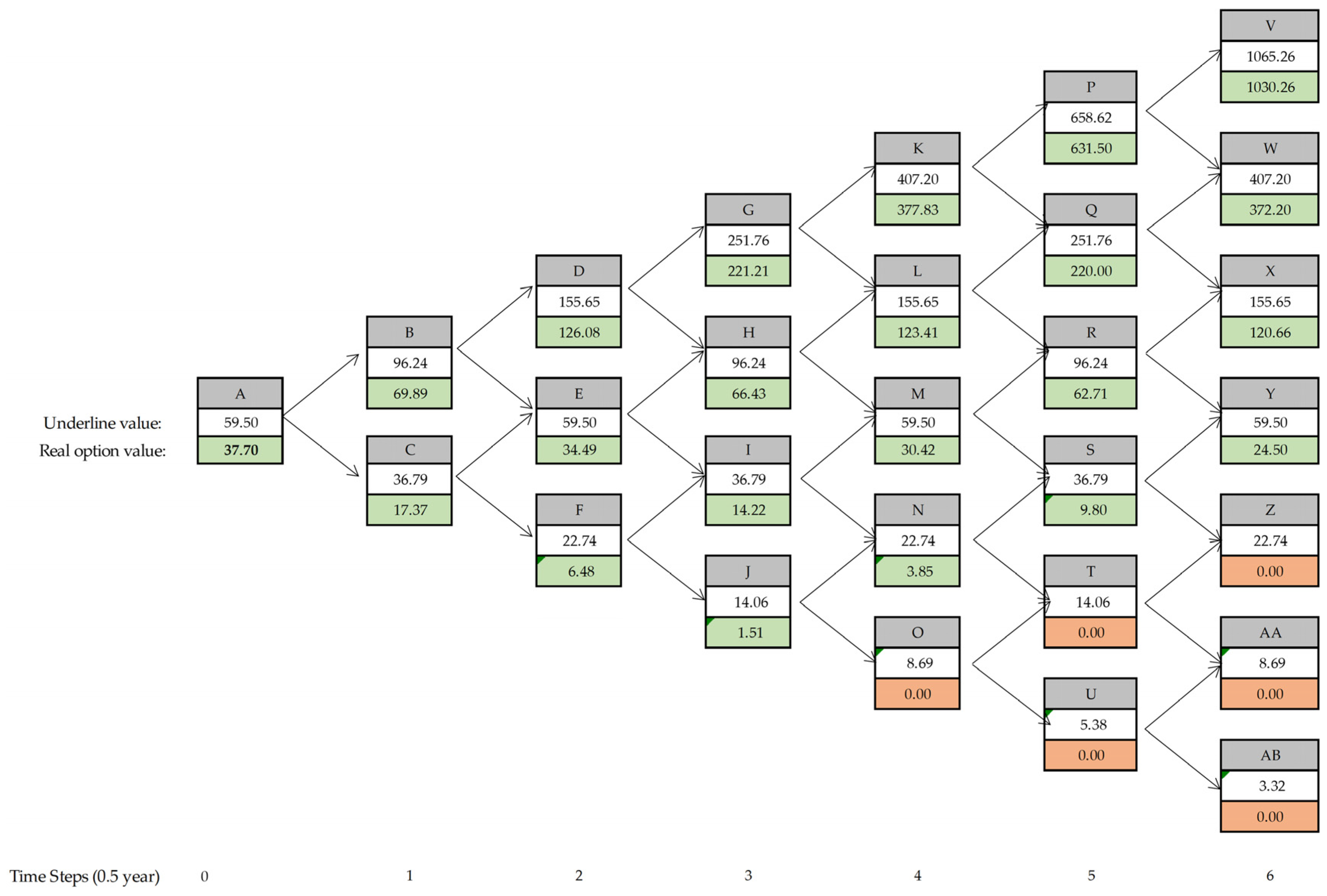
Figure A2.
Binomial lattice for the predecessor option of the sequential compound option (in $ billion).
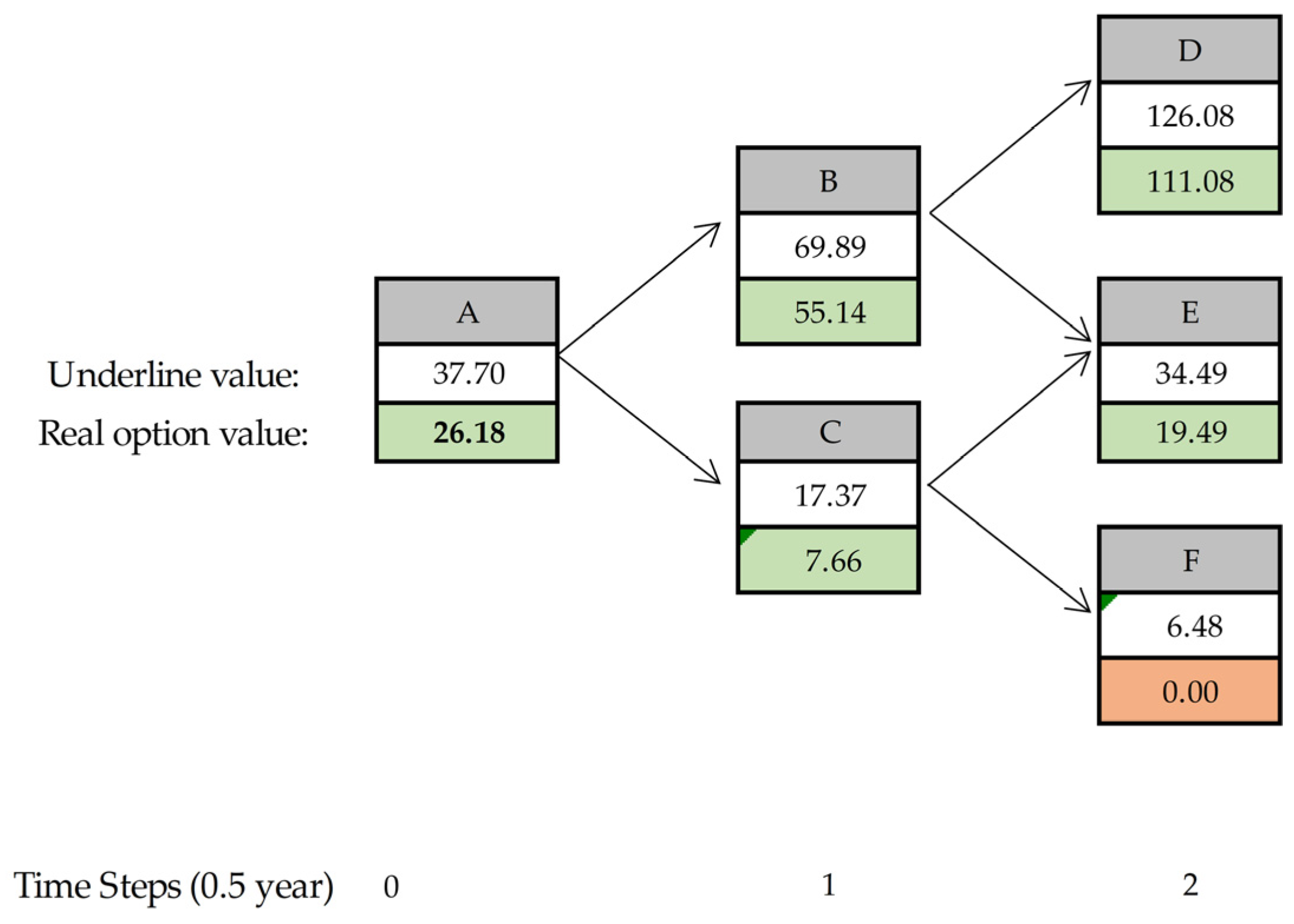
Figure A3.
Binomial lattice for the combined sequential compound option (in $ billion).
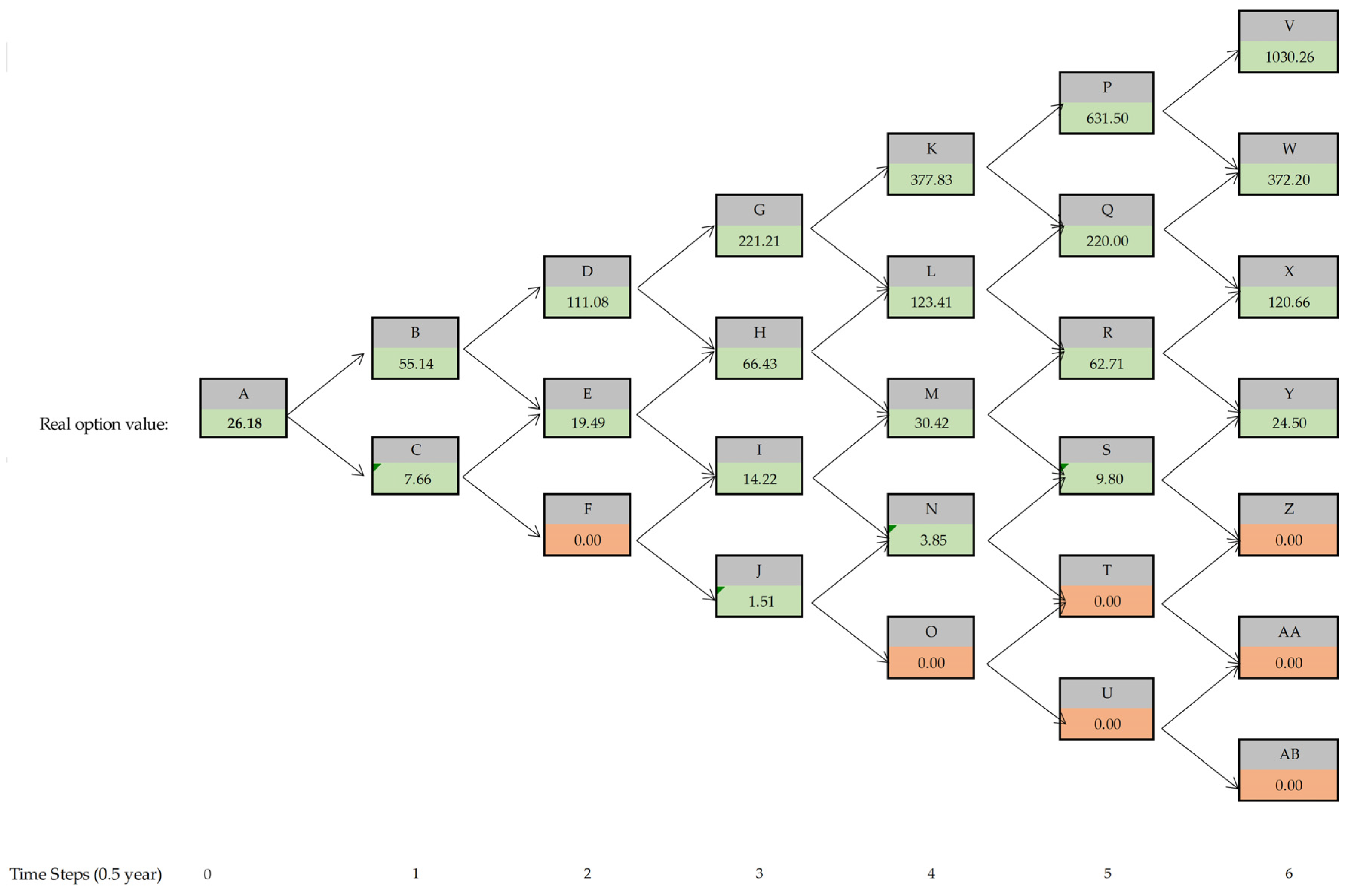
The resulting binomial estimate closely matches the Geske estimate reported in Appendix A, with the small residual difference attributable to the coarseness of a six-step discretization; increasing the number of steps would be expected to narrow this gap further, consistent with the well-established convergence properties of binomial approximations to continuous-time option-pricing solutions.
References
- Adner, R. (2017). Ecosystem as structure: An actionable construct for strategy. Journal of Management, 43(1), 39–58. [Google Scholar]
- Amazon News. (2026). Amazon and anthropic expand strategic collaboration. Available online: https://www.aboutamazon.com/news/company-news/amazon-invests-additional-5-billion-anthropic-ai (accessed on 27 July 2026).
- AWS. (2026a). Amazon bedrock. Available online: https://aws.amazon.com/bedrock/ (accessed on 31 March 2026).
- AWS. (2026b). Unlock new value with agentic AI on AWS. Available online: https://aws.amazon.com/ai/agentic-ai/ (accessed on 31 March 2026).
- Barney, J. (1991). Firm resources and sustained competitive advantage. Journal of Management, 17(1), 99–120. [Google Scholar] [CrossRef] [Scilit]
- Bellan, R. (2026). OpenAI expands government footprint with AWS deal, report says. TechCrunch. Available online: https://techcrunch.com/2026/03/17/openai-expands-government-footprint-with-aws-deal/ (accessed on 31 March 2026).
- Bishop, T. (2026). Filings: How Amazon’s $50B OpenAI deal actually works, and what they’re keeping secret. GeekWire. Available online: https://www.geekwire.com/2026/filings-how-amazons-50b-openai-deal-actually-works-and-what-theyre-keeping-secret/ (accessed on 27 July 2026).
- Burford, N., Shipilov, A., & Furr, N. (2025). Ecosystem synergies as drivers of acquisitions. Strategic Management Journal, 46(13), 3218–3251. [Google Scholar] [CrossRef] [Scilit]
- Capoot, A. (2025). OpenAI completes restructure, solidifying Microsoft as a major shareholder. CNBC. Available online: https://www.cnbc.com/2025/10/28/open-ai-for-profit-microsoft.html (accessed on 27 July 2026).
- Capoot, A., & Rooney, K. (2026). Google to invest up to $40 billion in Anthropic as search giant spreads its AI bets. CNBC. Available online: https://www.cnbc.com/2026/04/24/google-to-invest-up-to-40-billion-in-anthropic-as-search-giant-spreads-its-ai-bets.html (accessed on 27 July 2026).
- Cox, J. C., Ross, S. A., & Rubinstein, M. (1979). Option pricing: A simplified approach. Journal of Financial Economics, 7(3), 229–263. [Google Scholar] [CrossRef] [Scilit]
- Čirjevskis, A. (2017). Acquisition based dynamic capabilities and reinvention of business models: Bridging two perspectives together. Entrepreneurship and Sustainability Issues, 4(4), 516–525. [Google Scholar] [CrossRef] [Scilit] [PubMed]
- Čirjevskis, A. (2022). A discourse on foresight and the valuation of explicit and tacit synergies in strategic collaborations. Journal of Risk and Financial Management, 15(7), 305. [Google Scholar] [CrossRef] [Scilit]
- Eisenhardt, K. M., & Graebner, M. E. (2007). Theory building from cases: Opportunities and challenges. Academy of Management Journal, 50(1), 25–32. [Google Scholar] [CrossRef] [Scilit]
- Feldman, E. R., & Hernandez, E. (2022). Synergy in mergers and acquisitions: Typology, lifecycles, and value. Academy of Management Review, 47(4), 549–578. [Google Scholar] [CrossRef] [Scilit]
- FRED. (2026). Market yield on U.S. treasury securities at 1-year constant maturity. Available online: https://fred.stlouisfed.org/series/DGS1 (accessed on 31 March 2026).
- Garth, D. (2021). Ecosystem enablement gives group & voluntary benefits more than a new market. Available online: https://www.carriermanagement.com/brand-spotlight/majesco/ecosystem-enablement-gives-group-voluntary-benefits-more-than-a-new-market/ (accessed on 25 July 2026).
- Geske, R. (1979). The valuation of compound options. Journal of Financial Economics, 7(1), 63–81. [Google Scholar] [CrossRef] [Scilit]
- Gioia, D. A., Corley, K. G., & Hamilton, A. L. (2013). Seeking qualitative rigor in inductive research: Notes on the Gioia methodology. Organizational Research Methods, 16(1), 15–31. [Google Scholar]
- Goold, M., & Campbell, A. (1998). Desperately seeking synergy. Harvard Business Review, 76(5), 130–143. [Google Scholar] [PubMed]
- Helfat, C. E., & Raubitschek, R. S. (2018). Dynamic and integrative capabilities for profiting from innovation in digital platform-based ecosystems. Research Policy, 47(8), 1391–1399. [Google Scholar] [CrossRef] [Scilit]
- Invezz. (2026). Microsoft vs Amazon on OpenAI deal: What’s really at stake here? Available online: https://invezz.com/news/2026/03/18/microsoft-vs-amazon-on-openai-deal-whats-really-at-stake-here/ (accessed on 31 March 2026).
- Jacobides, M. G., Cennamo, C., & Gawer, A. (2018). Towards a theory of ecosystems. Strategic Management Journal, 39(8), 2255–2276. [Google Scholar] [CrossRef] [Scilit]
- Kim, E. (2026). Amazon’s $50 billion OpenAI deal keeps the cloud giant firmly in the AI race. Business Insider. Available online: https://www.businessinsider.com/amazon-openai-deal-cloud-ai-race-2026-2 (accessed on 31 March 2026).
- Levy, A., & Capoot, A. (2025). Microsoft takes $3.1 billion hit from OpenAI investment. CNBC. Available online: https://www.cnbc.com/2025/10/29/microsoft-open-ai-investment-earnings.html (accessed on 27 July 2026).
- Markides, C. (1995). Diversification, refocusing, and economic performance. MIT Press. [Google Scholar]
- McGrath, R. G., & Nerkar, A. (2004). Real options reasoning and a new look at the R&D investment strategies of pharmaceutical firms. Strategic Management Journal, 25(1), 1–21. [Google Scholar] [CrossRef] [Scilit]
- Metx, C., Grant, N., & McCabe, D. (2025, March 11). Inside Google’s investment in the A.I. start-up anthropic. New York Times. Available online: https://www.nytimes.com/2025/03/11/technology/google-investment-anthropic.html (accessed on 27 July 2026).
- Niel, T. (2026). Amazon’s hidden anthropic stake could be worth more than investors realize. Yahoo Finance. Available online: https://finance.yahoo.com/markets/stocks/articles/amazons-hidden-anthropic-stake-could-235000000.html (accessed on 27 July 2026).
- NVIDIA. (2025). OpenAI and NVIDIA announce strategic partnership to deploy 10 gigawatts of NVIDIA systems. Available online: https://nvidianews.nvidia.com/news/openai-and-nvidia-announce-strategic-partnership-to-deploy-10gw-of-nvidia-systems (accessed on 27 July 2026).
- OpenAI. (2026a). Introducing OpenAI frontier. Available online: https://openai.com/index/introducing-openai-frontier/ (accessed on 31 March 2026).
- OpenAI. (2026b). Joint statement from OpenAI and Microsoft. Available online: https://openai.com/index/continuing-microsoft-partnership/ (accessed on 31 March 2026).
- OpenAI. (2026c). OpenAI and Amazon announce strategic partnership. Available online: https://openai.com/index/amazon-partnership/ (accessed on 31 March 2026).
- Palmer, A. (2026). How Amazon’s massive stake in OpenAI could boost its AI and cloud businesses. CNBC. Available online: https://www.cnbc.com (accessed on 31 March 2026).
- Reuters. (2026). Amazon’s $50 billion OpenAI investment may depend on IPO or AGI, the information reports. Available online: https://www.reuters.com/business/retail-consumer/amazons-50-billion-openai-investment-may-depend-ipo-or-agi-milestone-information-2026-02-26/ (accessed on 27 February 2026).
- Rhodes-Kropf, M., & Robinson, D. T. (2008). The market for mergers and the boundaries of the firm. Journal of Finance, 63(3), 1169–1211. [Google Scholar] [CrossRef] [Scilit]
- Rumelt, R. P. (1982). Diversification strategy and profitability. Strategic Management Journal, 3(4), 359–369. [Google Scholar] [CrossRef] [Scilit]
- Singh, A. (2026). Amazon’s potential $50bn OpenAI investment tied to IPO and AGI milestones. The Tech Portal. Available online: https://thetechportal.com/2026/02/26/amazons-potential-50bn-openai-investment-tied-to-ipo-and-agi-milestones-report/ (accessed on 31 March 2026).
- Teece, D. J. (2007). Explicating dynamic capabilities: The nature and microfoundations of (sustainable) enterprise performance. Strategic Management Journal, 28(13), 1319–1350. [Google Scholar] [CrossRef] [Scilit]
- Teece, D. J. (2018). Profiting from innovation in the digital economy: Standards, complementary assets, and business models in the wireless world. Research Policy, 47(8), 1367–1387. [Google Scholar]
- Trigeorgis, L., & Miller, S. R. (2025). Real option portfolios and the theory of the multinational enterprise: Understanding modes of international involvement in the digital economy. Journal of International Business Studies, 57, 872–889. [Google Scholar] [CrossRef] [Scilit]
- U.S. SEC. (2025). Form 10-K, C3.ai, Inc. commission file number 001-39744. Available online: https://ir.c3.ai (accessed on 31 March 2026).
- V-Lab. (2026a). C3.ai Inc. GARCH volatility analysis. NYU Stern. Available online: https://vlab.stern.nyu.edu/volatility/VOL.AI%3AUS-R.GARCH (accessed on 31 March 2026).
- V-Lab. (2026b). NVIDIA Corp GARCH volatility analysis. NYU Stern. Available online: https://vlab.stern.nyu.edu/volatility/VOL.NVDA%3AUS-R.GARCH (accessed on 23 March 2026).
- V-Lab. (2026c). Palantir Technologies Inc. GARCH volatility analysis. NYU Stern. Available online: https://vlab.stern.nyu.edu/volatility/VOL.PLTR%3AUS-R.GARCH (accessed on 23 March 2026).
- Wang, E., Cai, K., Seetharaman, D., & Hu, K. (2025). OpenAI lays groundwork for juggernaut IPO at up to $1 trillion valuation. Reuters. Available online: https://www.reuters.com/business/openai-lays-groundwork-juggernaut-ipo-up-1-trillion-valuation-2025-10-29/ (accessed on 31 March 2026).
- Yahoo Finance. (2026). Microsoft’s threat to sue OpenAI is the clearest sign yet that the most important partnership in tech is breaking down. Available online: https://finance.yahoo.com/news/microsofts-threat-sue-openai-clearest-080800237.html (accessed on 31 March 2026).
- Yeo, K. T., & Qiu, F. (2003). The value of management flexibility—A real option approach to investment evaluation. International Journal of Project Management, 21(4), 243–250. [Google Scholar] [CrossRef] [Scilit]
- Ypma, T. J. (1995). Historical development of the Newton-Raphson method. SIAM Review, 37(4), 531–551. [Google Scholar] [CrossRef] [Scilit]

Disclaimer/Publisher’s Note: The statements, opinions and data contained in all publications are solely those of the individual author(s) and contributor(s) and not of MDPI and/or the editor(s). MDPI and/or the editor(s) disclaim responsibility for any injury to people or property resulting from any ideas, methods, instructions or products referred to in the content. |
© 2026 by the author. Licensee MDPI, Basel, Switzerland. This article is an open access article distributed under the terms and conditions of the Creative Commons Attribution (CC BY) license.