


Abstract
Public sector organizations face persistent challenges in workforce retention, particularly in institutionally complex and resource-constrained environments. Although leadership is widely recognized as a key factor, research remains fragmented across the public administration and human resource management literature. This article develops a governance-sensitive framework to explain how leadership influences workforce retention in public service organizations. Drawing on a PRISMA 2020-guided systematic review of 30 studies, it integrates insights to examine the relationships between people-centered leadership, organizational commitment, and turnover intentions. The synthesis suggests that leadership effects are primarily indirect, operating through affective organizational commitment. Administrative burden (red tape) and working conditions emerge as key contextual factors shaping these relationships. The study contributes by offering an integrated framework and identifying implications for managing workforce retention in public healthcare organizations and comparable institutionally dense public service settings. The article proposes an integrated conceptual framework for future empirical research.
1. Introduction
Public sector organizations across Europe and other advanced economies are under increasing strain, particularly in high-demand service settings such as healthcare (Pollitt & Bouckaert, 2017; Denhardt & Denhardt, 2000; Osborne, 2010; Bevir, 2013; Ferlie et al., 2016; Bouckaert et al., 2025). Workforce shortages, emotional exhaustion, turnover pressure, and declining organizational attachment have become central concerns not only for service delivery, but also for public personnel administration and governance capacity (Ferlie et al., 2016; Cummings et al., 2018; Demerouti et al., 2001; Martins et al., 2023; Winokur et al., 2024; Hu et al., 2025; Bouckaert et al., 2025; Hom et al., 2017; Griffeth et al., 2000). Workforce retention is not merely an operational or managerial issue; it constitutes a core public personnel administration challenge, directly affecting state capacity, service continuity, and the sustainability of public workforce systems (Pollitt & Bouckaert, 2017; Denhardt & Denhardt, 2000; Osborne, 2010; Bevir, 2013; Ferlie et al., 2016; Moore, 1995; Christensen & Lægreid, 2025; Bouckaert et al., 2025; Liu et al., 2021). Although leadership is frequently invoked as a solution to these challenges, much of the literature still treats leadership as an individualized managerial variable rather than as a practice embedded in administrative traditions, accountability regimes, and resource-constrained public service environments (Pollitt & Bouckaert, 2017; Denhardt & Denhardt, 2000; Osborne, 2010; Bevir, 2013; Ferlie et al., 2016; Van der Wal, 2017; Giauque, 2015; Wright & Pandey, 2010; Bozeman, 2000; Bozeman & Feeney, 2011; Moynihan et al., 2015).
This limitation is especially consequential in high-demand public service organizations, particularly healthcare systems. Public hospitals represent a critical case of institutionally dense organizations in which professional autonomy, legal compliance, performance monitoring, and public value obligations intersect and often collide (Pollitt & Bouckaert, 2017; Denhardt & Denhardt, 2000; Osborne, 2010; Bevir, 2013; Painter & Peters, 2010; Selznick, 1957; Ferlie et al., 2016; Van der Wal, 2017). In such environments, leadership outcomes cannot be adequately explained through abstract behavioral models alone. The effectiveness of leadership depends on how employees interpret support, fairness, voice, workload, bureaucracy, and organizational credibility within specific governance arrangements (Bevir, 2013; Van der Wal, 2017; Giauque, 2015; Hupe & Hill, 2007; Lipsky, 1980; Perry & Wise, 1990).
At the same time, the literature on workforce retention remains fragmented across public administration, healthcare management, organizational behavior, and human resource management. Leadership, organizational commitment, and turnover intentions are often studied in partial isolation. Mediating mechanisms are under-specified, contextual moderators are commonly relegated to the background, and the broader institutional setting of public healthcare is insufficiently theorized (Ferlie et al., 2016; Bevir, 2013; Van der Wal, 2017; Meyer & Allen, 1991; Meyer et al., 2002; Cummings et al., 2018; Wright & Pandey, 2010; Vandenabeele, 2009). This fragmentation weakens cumulative knowledge development and limits the analytical precision of retention research in public organizations.
This article addresses that gap by integrating governance-oriented public administration theory with a PRISMA 2020-guided systematic review of the literature on leadership, organizational commitment, and turnover in public healthcare and related public sector settings. Rather than treating the review as a descriptive inventory, the article uses systematic evidence synthesis to refine the theoretical specification of retention in administratively dense public service organizations (Bozeman, 2000; Bozeman & Feeney, 2011; Moynihan et al., 2015; Demerouti et al., 2001; Parry & Urwin, 2011; Costanza et al., 2012; Twenge et al., 2010; Page et al., 2021a; Webster & Watson, 2002; Gough et al., 2017).
The research question guiding the study is the following: how can insights from public administration and public human resource management be systematically integrated into an explanatory framework clarifying how people-centered leadership influences organizational commitment and turnover intentions in public service organizations?
Accordingly, the article treats workforce retention as a public administration problem linked to governance capacity, bureaucracy, professional discretion, and institutional resilience (Pollitt & Bouckaert, 2017; Denhardt & Denhardt, 2000; Osborne, 2010; Bevir, 2013; Ferlie et al., 2016; Hupe & Hill, 2007; Lipsky, 1980; Perry & Wise, 1990; Moore, 1995; Christensen & Lægreid, 2025; Bouckaert et al., 2025; Liu et al., 2021). It combines transparent PRISMA 2020 reporting with theory-building and advances a parsimonious conceptual framework designed for subsequent empirical testing in public healthcare settings characterized by high institutional density and strong professional norms (Page et al., 2021a; Webster & Watson, 2002; Gough et al., 2017; Dubois & Gadde, 2002; Timmermans & Tavory, 2012; Liu et al., 2021). Accordingly, this article should be understood as a configurative and theory-oriented systematic review aimed at conceptual refinement rather than empirical effect synthesis.
This article contributes to the public personnel administration literature by clarifying workforce retention as a governance-sensitive organizational outcome shaped by the interaction between leadership practices, employee attitudes, and institutional conditions. Rather than treating leadership as a direct and isolated driver of retention, the article specifies organizational commitment—particularly affective commitment—as the central mediating mechanism linking leadership to turnover intentions.
In addition, the study advances the literature by explicitly incorporating administrative burden (red tape) and working conditions as contextual moderators that condition the strength and effectiveness of leadership in public service organizations. By integrating insights from public administration and public human resource management, the article addresses fragmentation in the literature and proposes a parsimonious conceptual framework that improves the specification of leadership–retention relationships under conditions of institutional complexity.
The framework provides a structured basis for future empirical research and offers practical implications for managing workforce retention in public healthcare organizations and comparable public service settings characterized by high institutional density.
The remainder of the article proceeds through theoretical framing, review methodology, results, conceptual development, discussion, and the conclusions.
2. Theoretical Framework—Leadership, Governance, and Retention in Public Healthcare Organizations
Leadership and retention in public service organizations, particularly in healthcare contexts, sit at the intersection of several only partially integrated literatures. The first derives from organizational behavior and healthcare management, where transformational, ethical, and authentic leadership are commonly associated with stronger employee attitudes and lower turnover intentions (Cummings et al., 2018; Wright & Pandey, 2010; Vandenabeele, 2009; Martins et al., 2023). The second derives from public administration, where leadership is interpreted less as a generic behavioral style and more as an institutionally embedded practice conditioned by governance structures, accountability obligations, public service values, and professionalized service delivery (Pollitt & Bouckaert, 2017; Denhardt & Denhardt, 2000; Osborne, 2010; Bevir, 2013; Painter & Peters, 2010; Selznick, 1957; Ferlie et al., 2016; Van der Wal, 2017; Hupe & Hill, 2007; Lipsky, 1980; Perry & Wise, 1990; Moore, 1995; Christensen & Lægreid, 2025; Bouckaert et al., 2025; Perry, 1996). The third centers on organizational commitment, public service motivation, and employee turnover, emphasizing the attitudinal and motivational mechanisms through which organizational experiences shape workforce stability (Perry & Wise, 1990; Meyer & Allen, 1991; Meyer et al., 2002; Vandenabeele, 2009; Andersen et al., 2013; Hom et al., 2017; Griffeth et al., 2000; Perry, 1996).
Taken separately, each of the literature offers important insights. Taken together, however, they reveal a persistent conceptual gap. Healthcare leadership studies often underplay administrative burden, coping dynamics, and governance conditions. Public administration scholarship recognizes those conditions but has only intermittently integrated them into explicit explanatory models of retention. Commitment studies clarify attitudinal pathways but often treat leadership and institutional setting as background variables rather than constitutive conditions (Ferlie et al., 2016; Van der Wal, 2017; Giauque, 2015; Meyer & Allen, 1991; Meyer et al., 2002; Cummings et al., 2018; Bozeman, 2000; Bozeman & Feeney, 2011; Moynihan et al., 2015; Demerouti et al., 2001; Weick, 1995; Tummers et al., 2015; Maynard-Moody & Musheno, 2003). The task, therefore, is not to select a single theory, but to articulate a coherent hierarchy of analytical priorities capable of linking governance arrangements, organizational processes, and workforce outcomes.
2.1. From Bureaucracy to Post-New Public Management Governance
A public administration interpretation of retention in public healthcare must begin with the institutional evolution of the field. Weberian bureaucracy emphasized hierarchy, formal rules, impersonality, and legal-rational authority as foundations of administrative reliability (Weber, 1978). New public management then sought to relax some forms of bureaucratic control through performance orientation, targets, and managerial autonomy, but often generated new audit and reporting burdens in the process (Hood, 1991; Pollitt, 1993; Pollitt & Bouckaert, 2017; Osborne, 2010; Bevir, 2013; Ferlie et al., 2016; Hood & Lodge, 2006; Freidson, 2001). Post-new public management perspectives did not eliminate managerial concerns; instead, they repositioned them within broader discussions of public value, relational coordination, accountability, and governance complexity (Denhardt & Denhardt, 2000; Osborne, 2010; Bevir, 2013; Ferlie et al., 2016; Moore, 1995).
This evolution matters because public hospitals operate in hybrid environments shaped by several layers at once: legal compliance, managerial control, professional jurisdiction, and networked governance (Pollitt & Bouckaert, 2017; Osborne, 2010; Bevir, 2013; Ferlie et al., 2016; Hood & Lodge, 2006; Freidson, 2001). Leadership in such contexts cannot be understood as a purely discretionary managerial tool. It is exercised under institutional density and constrained discretion. This is why leadership effects in public healthcare are best treated as contingent and mediated rather than direct and universal (Bevir, 2013; Ferlie et al., 2016; Giauque, 2015; Hupe & Hill, 2007; Lipsky, 1980; Van der Wal, 2017).
2.2. People-Centered Leadership as an Institutionally Embedded Construct
In this article, people-centered leadership is defined as a relational and institutionally embedded orientation that emphasizes support, recognition, fairness, voice, and respect for professional judgement under conditions of public sector constraint. The construct is not treated as a loose synonym for transformational, ethical, or authentic leadership, although it overlaps with them in part (Cummings et al., 2018; Wright & Pandey, 2010; Moynihan et al., 2015). Its distinctive analytical feature is that it explicitly centers employees who lived organizational experience within a rule-bound and politically accountable setting (Denhardt & Denhardt, 2000; Bevir, 2013; Selznick, 1957; Van der Wal, 2017).
Transformational leadership emphasizes vision, inspiration, and change-oriented motivation. Ethical and authentic leadership foreground moral conduct, transparency, and self-awareness. Servant leadership gives priority to follower development, empowerment, and care. People-centered leadership overlaps with these approaches, but its added analytical value lies in explicitly situating leadership within institutionally dense public sector environments, where employees experience administrative burden, professional discretion, accountability pressures, resource constraints, and public value obligations.
This distinction is important for public administration. A leader in a public hospital cannot be assessed only by charisma, inspiration, or leader self-awareness. The relevant question is whether leadership is perceived as meaningful and credible where professionals face procedural overload, staffing constraints, fragile autonomy, and competing accountability demands (Pollitt & Bouckaert, 2017; Ferlie et al., 2016; Van der Wal, 2017; Giauque, 2015; Hupe & Hill, 2007; Lipsky, 1980; Bozeman, 2000; Bozeman & Feeney, 2011; Moynihan et al., 2015; Demerouti et al., 2001). People-centered leadership therefore serves as a more appropriate organizing construct for a governance-sensitive retention framework.
Accordingly, people-centered leadership is best understood as an organizing con-struct for a governance-sensitive retention framework and does not replace established constructivist leadership theories. Instead, it respecifies their most relevant relational and ethical elements for public service contexts in which leadership effects are mediated by organizational commitment and conditioned by administrative and material constraints.
2.3. Organizational Commitment as the Key Mediating Mechanism
The commitment literature provides the central attitudinal mechanism linking organizational experiences to turnover intentions. Meyer and Allen’s three-component model distinguishes affective, normative, and continuance commitment (Meyer & Allen, 1991; Meyer et al., 2002). In public healthcare, this distinction is analytically useful because professional attachment may be emotional, moral, or constraint-based, and these forms do not operate with the same intensity or consequences (Ferlie et al., 2016; Freidson, 2001; Meyer & Allen, 1991; Meyer et al., 2002; Perry & Wise, 1990).
Across the literature, affective commitment emerges consistently as the strongest reducer of turnover intentions (Meyer & Allen, 1991; Meyer et al., 2002; Cummings et al., 2018; Vandenabeele, 2009; Martins et al., 2023; Hom et al., 2017; Griffeth et al., 2000). Normative commitment remains relevant in professional public service settings, especially where public ethos and occupational duty are salient (Perry & Wise, 1990, Meyer et al., 2002; Andersen et al., 2013; Freidson, 2001). Continuance commitment, in contrast, may indicate attachment rooted in exit costs rather than identification, and can coexist with latent withdrawal (Meyer & Allen, 1991; Meyer et al., 2002; Hom et al., 2017). A governance-sensitive model therefore benefits from treating commitment not as a monolithic variable, but as a differentiated mechanism whose dimensions may respond differently to leadership and context.
2.4. Red Tape, Working Conditions, and Generational Interpretation
One of the most important theoretical corrections advanced here is the move from treating context as background to treating it as constitutive. Red tape—understood as administrative burden, procedural rigidity, and reporting requirements perceived as excessive relative to their functional value—is a longstanding concern in public administration (Bozeman, 2000; Bozeman & Feeney, 2011; Moynihan et al., 2015). In public healthcare, it shapes day-to-day experience by increasing cognitive load, reducing discretion, and potentially undermining the credibility of leadership initiatives (Ferlie et al., 2016; Van der Wal, 2017; Giauque, 2015; Bozeman, 2000; Bozeman & Feeney, 2011; Moynihan et al., 2015).
Working conditions are equally central. Staffing adequacy, workload intensity, resource availability, process quality, and physical work environment influence whether employees interpret organizational messages as credible and sustainable (Ferlie et al., 2016; Cummings et al., 2018; Demerouti et al., 2001; Martins et al., 2023). Even supportive leadership may have limited traction where structural overload is chronic.
Finally, generational differences are treated here as interpretive rather than deterministic variables. Recent literature shows growing caution toward generational essentialism, while still recognizing that cohorts may differ in expectations regarding autonomy, flexibility, work–life balance, authority, and recognition (Parry & Urwin, 2011; Costanza et al., 2012; Twenge et al., 2010; Winokur et al., 2024; Hu et al., 2025; Bevir & Rhodes, 2010). In a public administration framework, this means that generational location shapes how organizational environments are interpreted, not that it mechanically determines behavior.
3. Materials and Methods
This study was conducted and reported in accordance with the PRISMA 2020 statement for systematic reviews and the PRISMA 2020 for Abstracts guidance (Page et al., 2021a, 2021b) (Supplementary File S1). The review design is configurative and theory-oriented rather than meta-analytic. Its aim is not to estimate pooled effect sizes, but to synthesize the literature transparently and use that synthesis to refine a governance-sensitive conceptual framework suited to public administration research (Webster & Watson, 2002; Gough et al., 2017; Dubois & Gadde, 2002; Timmermans & Tavory, 2012).
3.1. Review Design and Analytical Purpose
The review was designed to answer a theory-building question: how should leadership, organizational commitment, turnover intentions, and key contextual factors be integrated within an explanatory model of public healthcare retention? For that reason, the review combines descriptive mapping, interpretive comparison, and conceptual synthesis. The procedure follows PRISMA 2020 for transparency in study identification, screening, eligibility, and inclusion while adopting an abductive and theory-informed synthesis strategy to interpret the selected literature (Page et al., 2021a; Webster & Watson, 2002; Gough et al., 2017; Dubois & Gadde, 2002; Timmermans & Tavory, 2012).
The epistemological orientation is post-positivist. Leadership and retention are treated as socially embedded phenomena shaped by institutional arrangements, governance structures, professional norms, and organizational conditions. At the same time, the review assumes that systematic and transparent procedures can identify recurrent explanatory patterns across heterogeneous studies (Bevir, 2013; Ferlie et al., 2016; Page et al., 2021b; Webster & Watson, 2002; Gough et al., 2017).
The final corpus size is consistent with theory-oriented systematic reviews in public administration, where analytical depth, conceptual relevance, and institutional interpretability take precedence over large-scale aggregation (Webster & Watson, 2002; Gough et al., 2017; Dubois & Gadde, 2002; Timmermans & Tavory, 2012). The objective is not statistical generalization, but theory refinement grounded in systematically selected and contextually rich sources. This positioning aligns the review with contemporary approaches in public administration that emphasize explanation-building over aggregation, particularly in institutionally complex policy domains. Consequently, the objective of the review is not to establish empirical causal effects but to integrate the literature into a coherent conceptual framework capable of supporting future empirical research. Given the configurative and theory-oriented nature of the review, the claims advanced in this article should not be read as definitive empirical causal conclusions. Rather, they represent theoretically grounded interpretations derived from the convergence of empirical, conceptual, and theoretical sources. The purpose of the review is therefore to support conceptual refinement and future hypothesis testing, not to establish pooled empirical effects.
3.2. Information Sources and Search Strategy
Searches were conducted in Scopus, Web of Science Core Collection, and PubMed. Google Scholar was used as a supplementary source for triangulation and citation tracing but was not treated as a primary database for record counting. The final search was completed on 14 March 2026. The search logic combined four conceptual blocks: leadership, organizational commitment, turnover or retention outcomes, and public healthcare or broader public sector context. An illustrative search string was as follows: (“people-centered leadership” OR “public leadership” OR “transformational leadership”) AND (“organizational commitment” OR “employee commitment”) AND (“turnover intentions” OR retention OR “staff retention”) AND (“public healthcare” OR “public hospitals” OR “public sector”).
The search was restricted to English-language scholarly sources published between 2000 and 2024. This period captures the consolidation of new public management reforms, the rise of post-new public management and governance perspectives, and the maturation of commitment and retention research in public sector settings (Pollitt & Bouckaert, 2017; Denhardt & Denhardt, 2000; Osborne, 2010; Bevir, 2013; Ferlie et al., 2016; Moore, 1995; Christensen & Lægreid, 2025).
A review protocol specifying the research question, eligibility criteria, coding dimensions, and synthesis objectives was defined ex ante for the purposes of the doctoral research design, but it was not registered in an external repository. This is stated explicitly to align the manuscript with the PRISMA 2020 reporting expectations and to distinguish procedural transparency from formal protocol registration (Page et al., 2021a, 2021b) (Table 1).
Table 1.
Review parameters and eligibility criteria.
3.3. Eligibility Criteria and Study Selection
Studies were considered eligible if they met four cumulative conditions: (i) they were scholarly sources published in English between 2000 and 2024, with primary emphasis on peer-reviewed literature; (ii) they examined leadership in public healthcare or broader public sector organizations; (iii) they explicitly addressed organizational commitment, turnover intentions, or closely related retention outcomes; and (iv) they contained substantive theoretical or conceptual engagement relevant to public administration, governance, or organizational analysis. A limited number of seminal scholarly books and edited volumes were retained when indispensable for conceptual framing, but these were not treated as equivalent to primary empirical evidence.
Exclusion criteria were applied to studies focusing exclusively on private sector or private healthcare settings, studies without a clear leadership component, texts restricted to purely clinical leadership without organizational or governance relevance, and non-scholarly documents such as editorials, policy notes, or dissertations. Screening and full-text eligibility assessment were conducted sequentially by author, with iterative reassessment of borderline cases against the predefined criteria and the analytical purpose of the review (Page et al., 2021a; Gough et al., 2017; Dubois & Gadde, 2002; Timmermans & Tavory, 2012) (Supplementary File S2).
3.4. Data Extraction, Coding, and Synthesis
A structured extraction matrix was used to code publication type, context, sector, level of public administration relevance, leadership construct, commitment dimension, turnover outcome, treatment of red tape, treatment of working conditions, generational dimension, and whether mediation or moderation were formally modeled. The coding strategy combined theory-informed categories with inductive openness to emergent patterns (Webster & Watson, 2002; Gough et al., 2017; Dubois & Gadde, 2002; Timmermans & Tavory, 2012).
The synthesis proceeded in three stages. First, the selected corpus was described in terms of study type and analytical orientation. Second, studies were compared according to how they specified leadership, commitment, turnover, and contextual variables. Third, recurrent patterns, omissions, and theoretical convergences were synthesized to support conceptual integration. No meta-analysis was attempted because the heterogeneity of contexts, designs, constructs, and measures was too substantial for meaningful quantitative pooling (Ferlie et al., 2016; Giauque, 2015; Cummings et al., 2018; Page et al., 2021a; Gough et al., 2017).
3.5. Quality Appraisal, Risk of Bias, and Confidence in the Evidence
Because the review is configurative and theory-oriented, methodological quality was assessed through interpretive weighting rather than through a single numerical appraisal tool. Empirical studies were examined for clarity of design, coherence between variables and claims, transparency of analytical procedures, and explicit modeling of mediating or moderating relationships. Conceptual sources were assessed for theoretical relevance, conceptual precision, and usefulness for institutional interpretation and framework development. In keeping with recent guidance for systematic review practice in the social sciences, the objective was not to eliminate every study that fell short of an idealized methodological standard, but to ensure that the synthesis gave greater explanatory weight to sources that offered clearer analytical leverage on the relationships under study (Page et al., 2021a; Webster & Watson, 2002; Gough et al., 2017; Dubois & Gadde, 2002; Timmermans & Tavory, 2012; Dixon-Woods et al., 2005).
Risk of bias was considered primarily in relation to conceptual under-specification, weak contextualization, omitted mechanisms, and the tendency to abstract leadership effects from governance conditions. Reporting bias was also considered in a narrative sense, particularly where studies presented leadership as a uniformly beneficial factor without discussing structural constraints, null findings, or context-dependent variation. Given the heterogeneity of the corpus and the absence of commensurable effect-size data, no formal certainty grading framework was applied. Instead, confidence in the evidence was established qualitatively through convergence across studies, consistency of explanatory patterns, theoretical coherence with public administration scholarship, and the robustness of institutional interpretation. This approach is consistent with the article’s purpose, which is conceptual refinement and hypothesis development rather than quantitative aggregation (Page et al., 2021b; Webster & Watson, 2002; Gough et al., 2017; Dixon-Woods et al., 2005; Liu et al., 2021). Consequently, confidence in the proposed framework derives primarily from conceptual convergence and theoretical coherence rather than from formal assessment of empirical effect strength. This limitation is acknowledged explicitly, and the framework is presented as a basis for future empirical validation rather than as a set of confirmed causal relationships.
4. Results
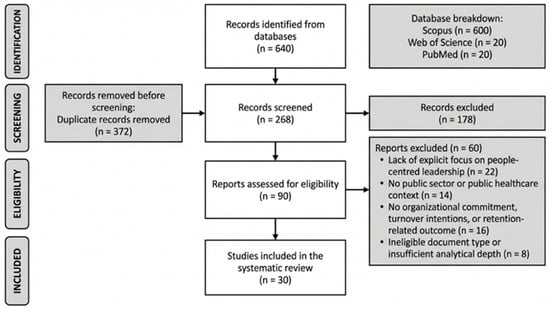
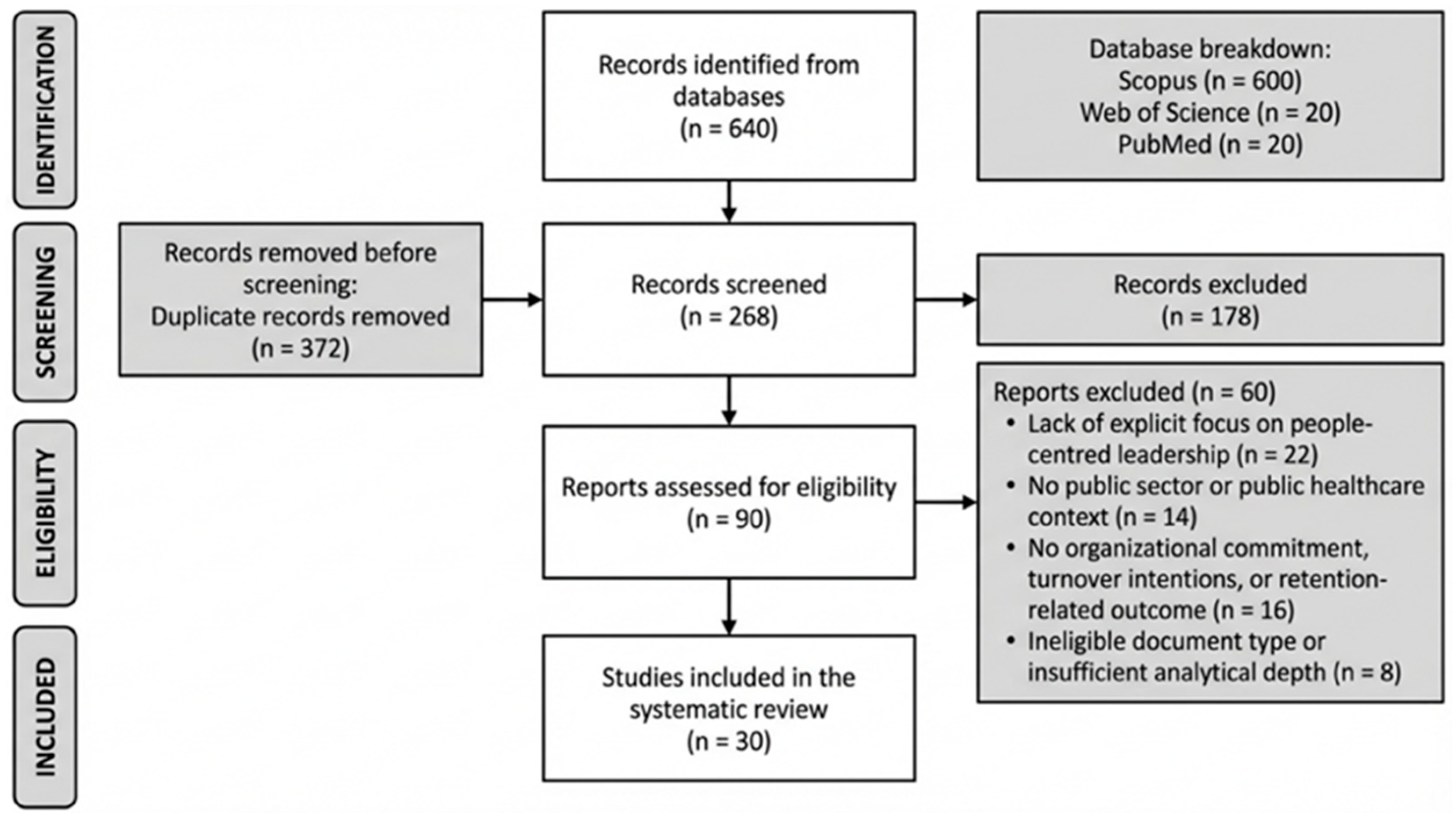
The study selection process is summarized in Figure 1. The review identified 640 records through database searching. After the removal of 372 duplicates, 268 records remained for title and abstract screening. Of these, 178 were excluded. Ninety full-text reports were then assessed for eligibility, and 60 were excluded, yielding a final analytical corpus of 30 sources (Supplementary File S3). The main exclusion reasons at the full-text stage were absence of an explicit leadership focus, lack of public or public healthcare context, lack of commitment or turnover outcomes, and document types that did not meet the review’s eligibility criteria.
Figure 1.
PRISMA 2020 flow diagram illustrating identification, screening, eligibility assessment, and inclusion (final corpus = 30 sources).
The final corpus was analytically heterogeneous but coherent in purpose. It included 8 primary empirical studies, 1 systematic review, 2 hybrid conceptual–empirical contributions, and 19 conceptual or theoretical sources. This balance is appropriate for a theory-refining review in public administration because the empirical studies anchor explanatory relationships, while conceptual works provide the governance and institutional framing that retention research often lacks (Supplementary File S4).
4.1. Descriptive Overview of the Final Corpus
Table 2 summarizes the structure of the final corpus. Most empirical evidence comes from public healthcare and broader public sector settings, whereas theoretical framing is provided mainly by public administration, governance, and organizational scholarship. The literature became markedly denser after 2010, which coincides with the consolidation of post-new public management debates, increased concern with public workforce sustainability, and renewed attention to administrative burden and relational governance (Pollitt & Bouckaert, 2017; Denhardt & Denhardt, 2000; Osborne, 2010; Bevir, 2013; Ferlie et al., 2016; Moore, 1995; Christensen & Lægreid, 2025) (Supplementary File S5).
Table 2.
Analytical structure of the final corpus.
Geographically, the corpus was weighted toward European and Anglo-Saxon administrative settings. Analytically, this is useful because those contexts combine strong state involvement, performance pressures, and hybrid governance arrangements. The broader implication is that retention has progressively shifted from being framed as a purely managerial or human resource issue to being understood as a governance and institutional capacity problem.
4.2. Dominant Explanatory Patterns
Three recurrent patterns emerge from the review. First, leadership is consistently associated with organizational commitment and retention-related outcomes, but the strongest studies do not model this as a simple direct effect. Instead, they show that leadership influences turnover intentions primarily through organizational commitment, especially affective commitment (Meyer & Allen, 1991; Meyer et al., 2002; Cummings et al., 2018; Wright & Pandey, 2010; Vandenabeele, 2009; Martins et al., 2023; Hom et al., 2017; Griffeth et al., 2000).
Second, public administration scholarship adds explanatory depth by showing that leadership in public organizations is institutionally constrained. Accountability systems, administrative burden, legalism, and professional discretion condition the meaning and feasibility of leadership practices (Pollitt & Bouckaert, 2017; Denhardt & Denhardt, 2000; Osborne, 2010; Bevir, 2013; Painter & Peters, 2010; Selznick, 1957; Ferlie et al., 2016; Van der Wal, 2017; Giauque, 2015; Hupe & Hill, 2007; Lipsky, 1980; Bozeman, 2000; Bozeman & Feeney, 2011; Moynihan et al., 2015; Hood & Lodge, 2006). This is where governance-sensitive explanation becomes indispensable: the same leadership practice can have different consequences depending on the surrounding institutional and material environment.
Third, red tape and working conditions are repeatedly present as substantive themes but comparatively under-specified as formal moderators. Many studies discuss them descriptively, yet only a smaller share incorporate them as conditioning mechanisms. This reveals a major analytical gap and directly supports their inclusion as central moderators in the conceptual model (Ferlie et al., 2016; Giauque, 2015; Cummings et al., 2018; Bozeman, 2000; Bozeman & Feeney, 2011; Moynihan et al., 2015; Demerouti et al., 2001; Martins et al., 2023). Unlike transformational, authentic, or ethical leadership, people-centered leadership is not conceptualized here as a distinct leadership theory. Rather, it is proposed as an integrative governance-sensitive orientation that emphasizes employees lived experience within institutionally constrained public organizations.
4.3. Generational Differences and Interpretive Heterogeneity
The corpus also indicates that generational differences are best interpreted as meaning-making dynamics rather than fixed causal drivers. Studies examining younger healthcare professionals often report stronger sensitivity to workload, flexibility, participation, and fairness, while studies of more experienced workers point to stronger institutional continuity and professional identity (Parry & Urwin, 2011; Costanza et al., 2012; Twenge et al., 2010; Winokur et al., 2024; Hu et al., 2025). However, the evidence does not support rigid cohort essentialism. More convincingly, it suggests that cohort location shapes the interpretation of organizational signals, especially under conditions of stress or administrative friction (Parry & Urwin, 2011; Costanza et al., 2012; Twenge et al., 2010; Winokur et al., 2024; Hu et al., 2025; Bevir & Rhodes, 2010).
Taken together, the results point to a clear theoretical asymmetry in the literature. Leadership is frequently conceptualized with considerable sophistication, and commitment is often measured with established instruments, yet the institutional context in which both operate is much less consistently modeled. This imbalance helps explain why the literature often identifies leadership effects but has greater difficulty explaining when those effects hold, why they weaken, or why ostensibly similar organizations exhibit different retention dynamics. For public administration research, the review therefore suggests that theoretical progress depends less on adding new leadership labels than on improving the specification of institutional contingencies, especially administrative burden, governance layering, and the material conditions of service delivery (Pollitt & Bouckaert, 2017; Denhardt & Denhardt, 2000; Osborne, 2010; Bevir, 2013; Ferlie et al., 2016; Van der Wal, 2017; Giauque, 2015; Bozeman, 2000; Bozeman & Feeney, 2011; Moynihan et al., 2015; Demerouti et al., 2001; Hood & Lodge, 2006; Moore, 1995; Christensen & Lægreid, 2025).
5. Governance-Sensitive Conceptual Framework and Research Hypotheses
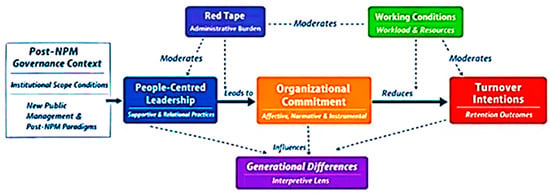
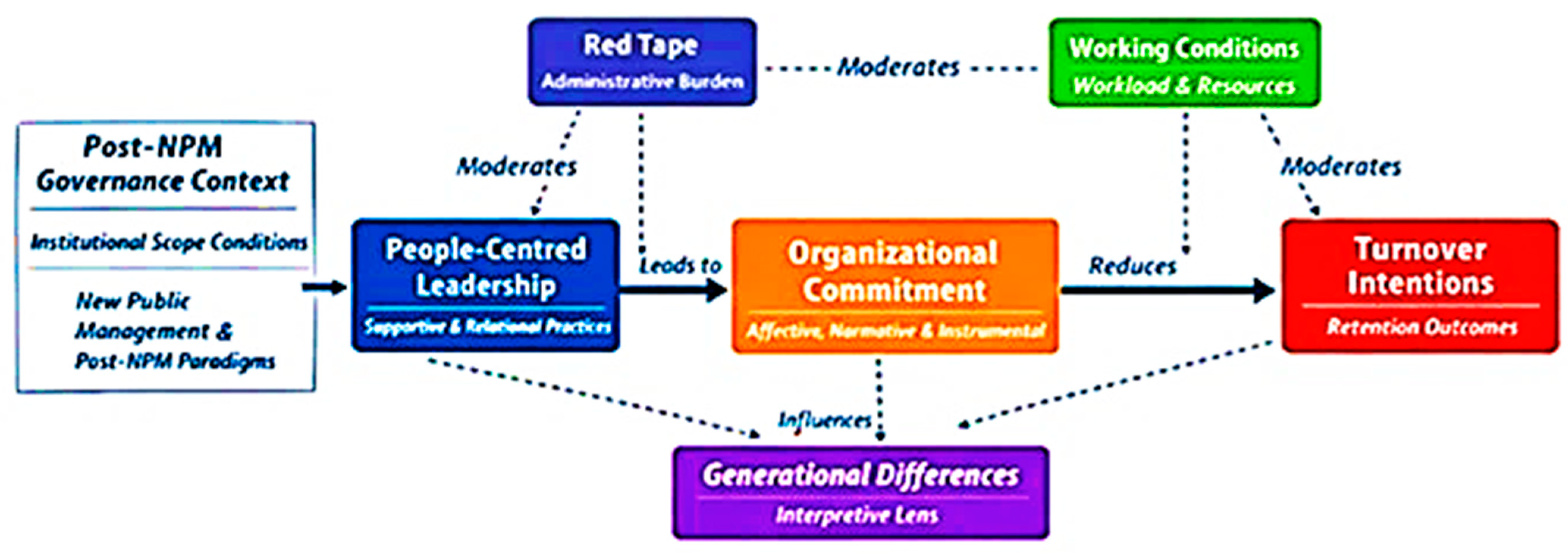
The evidence synthesized above supports an integrated model in which people-centered leadership operates as an upstream organizational influence, organizational commitment functions as the key mediating mechanism, turnover intentions represent the downstream outcome, and red tape and working conditions condition the translation of leadership into durable organizational attachment. Generational differences act as a transversal interpretive dynamic rather than a direct causal path. The model is explicitly situated in post-new public management public healthcare contexts, where governance arrangements and institutional density define scope conditions for explanation.
Figure 2 presents the conceptual framework, and Table 3 summarizes the hypotheses derived from the review. The model preserves parsimony while remaining institutionally realistic. It avoids overstating leadership as an autonomous corrective for structurally generated problems, but also avoids dismissing leadership as epiphenomenal. Its argument is that leadership matters because it is filtered through attitudinal mechanisms and constrained by organizational feasibility.
Figure 2.
Governance-sensitive conceptual framework linking people-centered leadership, organizational commitment, and turnover intentions in public service organizations.
Table 3.
Research hypotheses and conceptual roles.
Hypotheses
The following propositions are derived from the configurative synthesis presented above. They are not reported as empirical findings of the present review, nor do they imply that the relationships have been tested within this study. Instead, they translate the theoretical patterns identified in the literature into research expectations intended to guide future empirical investigation.
Hypothesis 1.
People-centered leadership is expected to be positively associated with organizational commitment among public sector employees.
Hypothesis 1a.
The positive association between people-centered leadership and organizational commitment is expected to be stronger for affective commitment than for normative and continuance commitment.
Hypothesis 2.
Organizational commitment is expected to be negatively associated with turnover intentions among public sector employees.
Hypothesis 2a.
Affective commitment is expected to exhibit a stronger negative association with turnover intentions than normative and continuance commitment.
Hypothesis 3.
Organizational commitment is expected to mediate the relationship between people-centered leadership and turnover intentions among public sector employees.
Hypothesis 4.
Red tape is expected to have a negative moderating effect on the relationship between people-centered leadership and organizational commitment, such that the positive effect of leadership is weaker under conditions of high perceived administrative burden.
Hypothesis 5.
Working conditions are expected to positively moderate the relationship between people-centered leadership and organizational commitment, such that the positive effect of leadership is stronger when working conditions are perceived as supportive.
Hypothesis 6.
Generational differences are expected to moderate the relationships among people-centered leadership, organizational commitment, and turnover intentions by shaping how leadership practices and organizational contexts are interpreted by public sector employees.
6. Discussion
The contribution of this article lies less in proposing entirely new variables than in re-specifying the terms under which leadership and retention should be analyzed in public administration. The synthesis suggests that the central weakness of the literature is not a shortage of studies, but a recurring tendency to detach leadership from the administrative and institutional settings that give it meaning (Pollitt & Bouckaert, 2017; Denhardt & Denhardt, 2000; Osborne, 2010; Bevir, 2013; Ferlie et al., 2016; Moore, 1995; Christensen & Lægreid, 2025; Bouckaert et al., 2025). In public service organizations, leadership is enacted within dense rule environments, professional jurisdictions, public value obligations, layered accountability, and coping pressures generated by constrained service delivery (Pollitt & Bouckaert, 2017; Denhardt & Denhardt, 2000; Osborne, 2010; Bevir, 2013; Ferlie et al., 2016; Van der Wal, 2017; Giauque, 2015; Hupe & Hill, 2007; Lipsky, 1980; Hood & Lodge, 2006; Moore, 1995; Christensen & Lægreid, 2025). Any explanatory model that ignores these conditions is likely to overstate direct leadership effects and understate organizational feasibility (Ferlie et al., 2016; Van der Wal, 2017; Giauque, 2015; Bozeman, 2000; Bozeman & Feeney, 2011; Moynihan et al., 2015; Demerouti et al., 2001; Hood & Lodge, 2006). This suggests that leadership should not be conceptualized as an independent explanatory variable, but as an institutionally mediated practice whose effects depend on governance arrangements and organizational feasibility conditions.
The first substantive implication concerns mediation. The review strongly supports organizational commitment, particularly affective commitment, as the key mechanism translating leadership into retention outcomes (Meyer & Allen, 1991; Meyer et al., 2002; Cummings et al., 2018; Wright & Pandey, 2010; Vandenabeele, 2009; Martins et al., 2023; Hom et al., 2017; Griffeth et al., 2000). This matters because it shifts the analytical focus away from simplistic leadership-outcome claims and toward the attitudinal pathways through which professionals interpret recognition, fairness, voice, and support (Perry & Wise, 1990; Meyer & Allen, 1991; Meyer et al., 2002; Cummings et al., 2018; Vandenabeele, 2009; Andersen et al., 2013). In public service contexts, these pathways are especially salient because work is normatively charged, emotionally demanding, and institutionally constrained, and because public service motivation and professional identity frequently shape commitment in ways that differ from private-sector settings (Ferlie et al., 2016; Perry & Wise, 1990; Meyer & Allen, 1991; Meyer et al., 2002; Cummings et al., 2018; Vandenabeele, 2009; Andersen et al., 2013; Freidson, 2001; Perry, 1996).
The second implication concerns context. Red tape and working conditions should not be treated as secondary variables introduced only to improve model fit. They form part of the causal environment in which leadership is enacted, interpreted, and sometimes neutralized (Ferlie et al., 2016; Giauque, 2015; Bozeman, 2000; Bozeman & Feeney, 2011; Moynihan et al., 2015; Demerouti et al., 2001; Ferlie et al., 1996; Hood & Lodge, 2006; Tummers et al., 2015; Maynard-Moody & Musheno, 2003). This is precisely where public administration theory provides analytical leverage, by explaining why leadership effects are contingent on governance arrangements, administrative burden, and institutional design (Pollitt & Bouckaert, 2017; Denhardt & Denhardt, 2000; Osborne, 2010; Bevir, 2013; Ferlie et al., 2016; Moore, 1995; Christensen & Lægreid, 2025; Bouckaert et al., 2025). Even supportive leadership may have attenuated effects under conditions of chronic overload, excessive reporting requirements, or misaligned accountability systems.
The third implication concerns the relationship between micro-processes and governance paradigms. The article treats post-new public management not as a dependent variable, but as a set of scope conditions shaping the environment within which leadership-retention dynamics unfold (Pollitt & Bouckaert, 2017; Denhardt & Denhardt, 2000; Osborne, 2010; Bevir, 2013; Moore, 1995; Christensen & Lægreid, 2025). This is analytically stronger than using governance or public value as abstract labels. It reconnects workforce outcomes with the meso- and macro-level conditions emphasized in contemporary public administration scholarship and aligns the article with core debates in public administration on institutional capacity, hybrid governance, administrative burden, and the human consequences of administrative design (Pollitt & Bouckaert, 2017; Denhardt & Denhardt, 2000; Osborne, 2010; Bevir, 2013; Ferlie et al., 2016; Moore, 1995; Christensen & Lægreid, 2025; Bouckaert et al., 2025; Liu et al., 2021).
A fourth implication concerns heterogeneity. The review supports a cautious treatment of generational differences. The relevant point is not that one cohort is universally more loyal or more likely to exit, but that cohort-specific expectations can influence how leadership, autonomy, flexibility, and administrative burden are interpreted (Parry & Urwin, 2011; Costanza et al., 2012; Twenge et al., 2010; Christensen & Lægreid, 2025; Winokur et al., 2024; Bevir & Rhodes, 2010; Weick, 1995). This strengthens the framework by preserving contextual realism, incorporating sensemaking processes, and avoiding generational essentialism.
Methodologically, the article also contributes by showing how PRISMA 2020 can be mobilized in public administration as more than a reporting checklist (Page et al., 2021a). Used rigorously, it enhances transparency, selection traceability, and analytical discipline. Used thoughtfully, it can also support conceptual clarification and hypothesis development without forcing the study into a biomedical template ill-suited to governance research (Page et al., 2021b; Webster & Watson, 2002; Gough et al., 2017; Dubois & Gadde, 2002; Timmermans & Tavory, 2012; Liu et al., 2021). This dual value is particularly important for review articles in public administration, where methodological transparency and theoretical contribution must be equally visible.
A further contribution lies in clarifying the scope conditions under which leadership-retention theorization in public healthcare is most persuasive. The framework proposed here is not intended as a universal explanation applicable to all organizational settings. Its strongest relevance lies in institutions marked by dense rules, public accountability, high professional discretion, and persistent pressures. In such settings, retention cannot be treated as a narrow labor-market outcome or a purely managerial matter. It is tied to the sustainability of public organizations, the credibility of leadership, and the capacity of administrative systems to maintain a workforce able and willing to perform demanding public service roles over time (Pollitt & Bouckaert, 2017; Denhardt & Denhardt, 2000; Osborne, 2010; Bevir, 2013; Ferlie et al., 2016; Moore, 1995; Christensen & Lægreid, 2025; Bouckaert et al., 2025).
The article also contributes methodologically by showing how a systematic review can support theory development without collapsing into a mechanical reporting exercise. PRISMA 2020 enhances transparency, but transparency alone is not the end point. In governance research, the value of a review lies equally in its ability to order fragmented evidence, expose explanatory blind spots, and provide a disciplined basis for conceptual integration. By combining explicit review procedures with institutionally grounded interpretation, the manuscript positions systematic review methodology as a legitimate and rigorous mode of knowledge production in public administration rather than as a borrowed template from adjacent fields (Page et al., 2021a, 2021b; Webster & Watson, 2002; Gough et al., 2017; Dubois & Gadde, 2002; Timmermans & Tavory, 2012).
From a practical perspective, the implications are equally significant. Public healthcare organizations cannot rely on leadership development initiatives alone if the surrounding environment continues to generate overload, friction, and distrust. Policies aimed at workforce stabilization must therefore align leadership capacity with administrative simplification, improved working conditions, and governance arrangements that preserve professional credibility. In that sense, the article’s message is deliberately balanced: leadership matters, but it matters most when administrative design and organizational conditions make commitment plausible and retention institutionally sustainable (Ferlie et al., 2016; Cummings et al., 2018; Bozeman, 2000; Bozeman & Feeney, 2011; Moynihan et al., 2015; Demerouti et al., 2001; Martins et al., 2023; Bouckaert et al., 2025; Tummers et al., 2015; Maynard-Moody & Musheno, 2003; Liu et al., 2021).
This practical implication is especially relevant for hospital systems facing simultaneous labor shortages and escalating expectations of responsiveness, equity, and quality. Under such conditions, retention becomes a proxy for institutional resilience: when experienced professionals disengage or leave, organizations lose not only labor, but also tacit knowledge, relational continuity, mentoring capacity, and the practical wisdom needed to navigate complex care environments. A governance-sensitive retention agenda therefore has consequences well beyond staffing ratios. It affects continuity of care, the absorptive capacity of hospitals during crises, and the long-term credibility of public service provision. Framed in this way, retention becomes analytically linked to state capacity and to the ability of public institutions to sustain legitimate and effective service delivery over time (Bevir, 2013; Painter & Peters, 2010; Selznick, 1957; Ferlie et al., 2016; Moore, 1995; Christensen & Lægreid, 2025; Bouckaert et al., 2025; Liu et al., 2021).
More broadly, the framework contributes to ongoing debates in public personnel administration by demonstrating that workforce retention cannot be adequately explained through micro-level managerial variables alone, but requires the integration of institutional, organizational, and attitudinal dimensions within a governance-sensitive analytical perspective.
Limitations
Because this review adopts a configurative and theory-oriented design, its objective is conceptual refinement rather than quantitative evidence aggregation. Consequently, the proposed framework should be interpreted as a theoretically informed explanation requiring future empirical validation.
7. Conclusions
This article has developed a governance-sensitive explanation of workforce retention in public service organizations by integrating people-centered leadership, organizational commitment, turnover intentions, red tape, working conditions, and generational interpretation into a single conceptual framework. The review indicates that leadership effects are mainly indirect, operating through organizational commitment, and that they are significantly conditioned by the administrative and material context in which public professionals work.
The argument has three central implications. First, retention in public service organizations, particularly in healthcare contexts, should be approached simultaneously as a leadership problem, an organizational problem, and a governance problem. Second, public administration theory provides indispensable analytical leverage for understanding why leadership cannot be separated from bureaucracy, accountability, administrative burden, and institutional path dependency. Third, a PRISMA 2020-compliant review design can strengthen conceptual integration in public administration when it is used not merely to report but also to structure a theory-oriented synthesis.
The framework proposed here is intended for subsequent empirical testing in public healthcare organizations characterized by high institutional density, strong professional norms, and recurrent workforce sustainability pressures. The broader contribution is to reposition healthcare retention research within core public administration concerns: institutional capacity, governance complexity, administrative design, and the human consequences of public management arrangements.
Future empirical research should test the framework in multi-level hospital settings and examine whether the interaction between leadership, red tape, and working conditions varies across professions, units, and governance arrangements. Such work would help determine whether people-centered leadership is most consequential in environments where administrative friction can realistically be reduced, or whether its importance grows precisely where institutional strain is highest and organizational credibility is most fragile. Either way, the central implication remains the same: explaining retention in public healthcare requires the analytical integration of leadership, commitment, working conditions, and governance design rather than the isolated study of any one of these dimensions. This makes the framework suitable for cumulative inquiry in public administration, particularly in public healthcare and other institutionally dense public service settings.
Supplementary Materials
The following supporting information can be downloaded at: https://www.mdpi.com/article/10.3390/admsci16080356/s1. Supplementary File S1, PRISMA 2020 Checklist; Supplementary File S2, PRISMA 2020 for Abstracts Checklist; Supplementary File S3, Full search strategies and coding framework; Supplementary File S4, Overview of the sources included in the final analytical corpus; Supplementary File S5, Full-text reports excluded after eligibility assessment, with primary reasons for exclusion.
Author Contributions
Conceptualization, P.M., G.N., A.C.F. and A.P.-M.; methodology, P.M., G.N., A.C.F., and P.V.; software, P.M. and P.V.; validation, P.M., G.N. and A.C.F. and A.P.-M.; formal analysis, P.M. and P.V.; investigation, P.M., G.N., A.C.F. and A.P.-M.; resources, P.M., G.N. and A.C.F.; data curation, P.M. and P.V.; writing—original draft preparation, P.M., G.N., A.C.F. and A.P.-M.; writing—review and editing, P.M., G.N., A.C.F., A.P.-M. and P.V.; visualization, P.M. and G.N.; supervision, P.M., G.N. and A.C.F.; project administration, P.M. and G.N.; funding acquisition, P.M. and P.V. All authors have read and agreed to the published version of the manuscript.
Funding
This research received no external funding.
Institutional Review Board Statement
Not applicable.
Informed Consent Statement
Not applicable.
Data Availability Statement
No new data were created or analyzed in this study. Data sharing is not applicable to this article.
Conflicts of Interest
The authors declare no conflicts of interest.
References
- Andersen, L. B., Jørgensen, T. B., Kjeldsen, A. M., Pedersen, L. H., & Vrangbæk, K. (2013). Public service motivation, user orientation, and job satisfaction: A question of employment sector? International Public Management Journal, 15, 252–274. [Google Scholar] [CrossRef] [Scilit]
- Bevir, M. (2013). A theory of governance. University of California Press. [Google Scholar]
- Bevir, M., & Rhodes, R. A. W. (2010). The state as cultural practice. Oxford University Press. [Google Scholar]
- Bouckaert, G., Hondeghem, A., Steen, T., & Van de Walle, S. (2025). Futures for the public sector. Leuven University Press. [Google Scholar]
- Bozeman, B. (2000). Bureaucracy and red tape. Prentice Hall. [Google Scholar]
- Bozeman, B., & Feeney, M. K. (2011). Rules and red tape: A prism for public administration theory and research. M.E. Sharpe. [Google Scholar]
- Christensen, T., & Lægreid, P. (2025). Future directions of public administration research-Addressing fundamental issues and questions. International Journal of Public Administration. Advance online publication. [Google Scholar] [CrossRef] [Scilit]
- Costanza, D. P., Badger, J. M., Fraser, R. L., Severt, J. B., & Gade, P. A. (2012). Generational differences in work-related attitudes: A meta-analysis. Journal of Business and Psychology, 27, 375–394. [Google Scholar] [CrossRef] [Scilit]
- Cummings, G. G., Tate, K., Lee, S., Wong, C. A., Paananen, T., Micaroni, S. P. M., & Chatterjee, G. E. (2018). Leadership styles and outcome patterns for the nursing workforce and work environment: A systematic review. International Journal of Nursing Studies, 85, 19–60. [Google Scholar] [CrossRef] [Scilit] [PubMed]
- Demerouti, E., Bakker, A. B., Nachreiner, F., & Schaufeli, W. B. (2001). The job demands-resources model of burnout. Journal of Applied Psychology, 86, 499–512. [Google Scholar] [CrossRef]
- Denhardt, R. B., & Denhardt, J. V. (2000). The new public service: Serving rather than steering. Public Administration Review, 60, 549–559. [Google Scholar] [CrossRef] [Scilit]
- Dixon-Woods, M., Agarwal, S., Jones, D., Young, B., & Sutton, A. (2005). Synthesising qualitative and quantitative evidence: A review of possible methods. Journal of Health Services Research & Policy, 10, 45–53. [Google Scholar] [CrossRef] [Scilit]
- Dubois, A., & Gadde, L.-E. (2002). Systematic combining: An abductive approach to case research. Journal of Business Research, 55, 553–560. [Google Scholar] [CrossRef] [Scilit]
- Ferlie, E., Ashburner, L., Fitzgerald, L., & Pettigrew, A. (1996). The new public management in action. Oxford University Press. [Google Scholar]
- Ferlie, E., Montgomery, K., & Reff Pedersen, A. (2016). The oxford handbook of health care management. Oxford University Press. [Google Scholar]
- Freidson, E. (2001). Professionalism: The third logic. University of Chicago Press. [Google Scholar]
- Giauque, D. (2015). Attitudes toward organizational change among public middle managers. Public Personnel Management, 44, 70–98. [Google Scholar] [CrossRef] [Scilit]
- Gough, D., Oliver, S., & Thomas, J. (2017). An introduction to systematic reviews (2nd ed.). SAGE. [Google Scholar]
- Griffeth, R. W., Hom, P. W., & Gaertner, S. (2000). A meta-analysis of antecedents and correlates of employee turnover. Journal of Management, 26, 463–488. [Google Scholar] [CrossRef]
- Hom, P. W., Lee, T. W., Shaw, J. D., & Hausknecht, J. P. (2017). One hundred years of employee turnover theory and research. Journal of Applied Psychology, 102, 530–545. [Google Scholar] [CrossRef] [Scilit] [PubMed]
- Hood, C. (1991). A public management for all seasons? Public Administration, 69, 3–19. [Google Scholar] [CrossRef] [Scilit]
- Hood, C., & Lodge, M. (2006). The politics of public service bargains. Oxford University Press. [Google Scholar]
- Hu, Y., Liu, Y., Chen, Y., & Wang, S. (2025). Generational differences in burnout and turnover intention among healthcare professionals. Journal of Nursing Management, 33, 45–58. [Google Scholar]
- Hupe, P., & Hill, M. (2007). Street-level bureaucracy and public accountability. Public Administration, 85, 279–299. [Google Scholar] [CrossRef] [Scilit]
- Lipsky, M. (1980). Street-level bureaucracy: Dilemmas of the individual in public services. Russell Sage Foundation. [Google Scholar]
- Liu, T.-A.-X., Wightman, G. B., Lee, E., & Hunter, J. (2021). Revisiting ‘big questions’ of public administration after COVID-19: A systematic review. Asia Pacific Journal of Public Administration, 43, 131–168. [Google Scholar] [CrossRef] [Scilit]
- Martins, P., Nascimento, G., & Moreira, A. (2023). Leadership and turnover intentions in a public hospital: The mediating effect of organisational commitment and moderating effect by activity department. Administrative Sciences, 13, 18. [Google Scholar] [CrossRef] [Scilit]
- Maynard-Moody, S., & Musheno, M. (2003). Cops, teachers, counselors: Stories from the front lines of public service. University of Michigan Press. [Google Scholar]
- Meyer, J. P., & Allen, N. J. (1991). A three-component conceptualization of organizational commitment. Human Resource Management Review, 1, 61–89. [Google Scholar] [CrossRef] [Scilit]
- Meyer, J. P., Stanley, D. J., Herscovitch, L., & Topolnytsky, L. (2002). Affective, continuance, and normative commitment to the organization. Journal of Vocational Behavior, 61, 20–52. [Google Scholar] [CrossRef] [Scilit]
- Moore, M. H. (1995). Creating public value: Strategic management in government. Harvard University Press. [Google Scholar]
- Moynihan, D. P., Herd, P., & Harvey, H. (2015). Administrative burden: Learning, psychological, and compliance costs in citizen-state interactions. Journal of Public Administration Research and Theory, 25, 43–69. [Google Scholar] [CrossRef] [Scilit]
- Osborne, S. P. (2010). The new public governance? Emerging perspectives on the theory and practice of public governance. Routledge. [Google Scholar]
- Page, M. J., E McKenzie, J., Bossuyt, P. M., Boutron, I., Hoffmann, T. C., Mulrow, C. D., Shamseer, L., Tetzlaff, J. M., A Akl, E., E Brennan, S., Chou, R., Glanville, J., Grimshaw, J. M., Hróbjartsson, A., Lalu, M. M., Li, T., Loder, E. W., Mayo-Wilson, E., McDonald, S., … Moher, D. (2021a). The PRISMA 2020 statement: An updated guideline for reporting systematic reviews. BMJ, 372, n71. [Google Scholar] [CrossRef] [Scilit] [PubMed]
- Page, M. J., Moher, D., Bossuyt, P. M., Boutron, I., Hoffmann, T. C., Mulrow, C. D., Shamseer, L., Tetzlaff, J. M., Akl, E. A., Brennan, S. E., Chou, R., Glanville, J., Grimshaw, J. M., Hróbjartsson, A., Lalu, M. M., Li, T., Loder, E. W., Mayo-Wilson, E., McDonald, S., … McKenzie, J. E. (2021b). PRISMA 2020 explanation and elaboration: Updated guidance and exemplars for reporting systematic reviews. BMJ, 372, n160. [Google Scholar] [CrossRef] [PubMed]
- Painter, M., & Peters, B. G. (2010). Tradition and public administration. Palgrave Macmillan. [Google Scholar]
- Parry, E., & Urwin, P. (2011). Generational differences in work values: A review of theory and evidence. International Journal of Management Reviews, 13, 79–96. [Google Scholar] [CrossRef] [Scilit]
- Perry, J. L. (1996). Measuring public service motivation: An assessment of construct reliability and validity. Journal of Public Administration Research and Theory, 6, 5–22. [Google Scholar] [CrossRef] [Scilit]
- Perry, J. L., & Wise, L. R. (1990). The motivational bases of public service. Public Administration Review, 50, 367–373. [Google Scholar] [CrossRef] [Scilit]
- Pollitt, C. (1993). Managerialism and the public services. Blackwell. [Google Scholar]
- Pollitt, C., & Bouckaert, G. (2017). Public management reform: A comparative analysis (4th ed.). Oxford University Press. [Google Scholar]
- Selznick, P. (1957). Leadership in administration: A sociological interpretation. Harper & Row. [Google Scholar]
- Timmermans, S., & Tavory, I. (2012). Theory construction in qualitative research: From grounded theory to abductive analysis. Sociological Theory, 30, 167–186. [Google Scholar] [CrossRef] [Scilit]
- Tummers, L. G., Bekkers, V., Vink, E., & Musheno, M. (2015). Coping during public service delivery: A conceptualization and systematic review of the literature. Journal of Public Administration Research and Theory, 25, 1099–1126. [Google Scholar] [CrossRef] [Scilit]
- Twenge, J. M., Campbell, S. M., Hoffman, B. J., & Lance, C. E. (2010). Generational differences in work values: Leisure and extrinsic values increasing, social and intrinsic values decreasing. Journal of Management, 36, 1117–1142. [Google Scholar] [CrossRef] [Scilit]
- Vandenabeele, W. (2009). The mediating effect of job satisfaction and organizational commitment on self-reported performance. International Review of Administrative Sciences, 32, 11–34. [Google Scholar] [CrossRef] [Scilit]
- Van der Wal, Z. (2017). The 21st century public manager. Palgrave Macmillan. [Google Scholar]
- Weber, M. (1978). Economy and society. University of California Press. [Google Scholar]
- Webster, J., & Watson, R. T. (2002). Analyzing the past to prepare for the future: Writing a literature review. MIS Quarterly, 26, xiii–xxiii. [Google Scholar] [CrossRef] [Scilit]
- Weick, K. E. (1995). Sensemaking in organizations. Sage. [Google Scholar]
- Winokur, E. J., Rutledge, C. M., & Kelly, J. M. (2024). Millennial nurses’ turnover intentions. The Journal of Nursing Administration, 54, 89–97. [Google Scholar]
- Wright, B. E., & Pandey, S. K. (2010). Transformational leadership in the public sector: Does structure matter? Journal of Public Administration Research and Theory, 20, 75–89. [Google Scholar]

Disclaimer/Publisher’s Note: The statements, opinions and data contained in all publications are solely those of the individual author(s) and contributor(s) and not of MDPI and/or the editor(s). MDPI and/or the editor(s) disclaim responsibility for any injury to people or property resulting from any ideas, methods, instructions or products referred to in the content. |
© 2026 by the authors. Licensee MDPI, Basel, Switzerland. This article is an open access article distributed under the terms and conditions of the Creative Commons Attribution (CC BY) license.