


Abstract
Rebranding has emerged as a complex organizational phenomenon, particularly in service contexts where value is created through interactive and process-based relationships. Despite extensive research in branding, the role of core service characteristics in shaping the rebranding process remains insufficiently examined. This study therefore investigates how intangibility, inseparability of production and consumption, heterogeneity, and perishability influence the rebranding process in service organizations, with particular attention to variations in the patterns and intensity of their influence across different service contexts. A mixed-methods research design was employed, combining semi-structured interviews with twelve purposively selected senior branding professionals and quantitative analysis of expert assessments using nonparametric statistical techniques appropriate for exploratory research. The findings indicate that core service characteristics are relevant to the rebranding process and contribute to its qualitative distinctiveness in comparison with the rebranding of physical goods. However, their influence is not uniform: intangibility and heterogeneity emerge as consistently strong and stable factors, whereas inseparability and perishability exhibit more variable and context-dependent patterns. Furthermore, the type of service industry is identified as an analytical condition systematically associated with these differentiated forms of influence. The study contributes by conceptualizing rebranding in service organizations as a context-sensitive and process-oriented phenomenon. It shows that core service characteristics do not influence rebranding uniformly but through differentiated patterns that vary across service-industry contexts. These findings extend the theoretical understanding of rebranding and support a more nuanced approach to strategic decision-making in service-based brand management.
1. Introduction
The intensive presence of corporate rebranding in the contemporary business context indicates that change has become an integral component of the optimization of corporate brand management processes (Stuart & Muzellec, 2004; Roy & Sarkar, 2015; Sangroya et al., 2025). Within branding research, rebranding has emerged as an increasingly significant concept, reflecting its role as a strategic response to structural imbalances in brand management. Given the inherited theoretical framework of marketing and branding, which has largely been developed within the paradigm of physical goods, it is especially important to examine the rebranding process, as a more narrowly defined domain, from the perspective of the service sector, which stands out as a specific organizational and process-oriented context in brand management. The service sector fundamentally differs from physical goods in the way brand value is created and managed, relying on interactive relationships with multiple actors (Grönroos, 1978; Bharadwaj et al., 1993; De Chernatony & Segal-Horn, 2003; Brodie, 2009; Stuart, 2018; Huang & Dev, 2020; Simmons & Durkin, 2023).
In early research, the role of services as brand carriers was largely neglected in the dominant theoretical models of brand management (Shostack, 1977; Turley & Moore, 1995; De Chernatony & Riley, 1999). Berry articulated this pattern by observing that “our natural inclination in marketing is to associate branding with goods” (Berry, 2000, p. 128). Today, services are increasingly prevalent, not only through their growing share in overall economic activity but also as an integral component of both the production and delivery of physical goods (Vargo & Lusch, 2004; Skaalsvik & Olsen, 2014; Witt & Gross, 2020). At the same time, there has been a gradual recognition that although the basic logic is similar, some concepts from the product branding literature may not be applicable to services (Turley & Moore, 1995). For this reason, the service sector is introduced in this study as an analytical framework for examining the phenomenon of rebranding. Rebranding in the service sector thus represents both an extension of the branding field and a distinct organizational challenge that, while reflecting key branding features, introduces additional layers of complexity in managing brand change (Gotsi & Andriopoulos, 2007; Merrilees & Miller, 2008; Miller & Merrilees, 2013; Sardovski, 2022).
To examine the rebranding process within the service sector, it is necessary to give particular attention to the distinctive characteristics of services themselves, which, as differentiating factors in relation to physical goods, require an adapted approach to managing change processes and strategic decision-making (Zeithaml et al., 1985; Parasuraman, 1987; De Chernatony & Segal-Horn, 2001; Grönroos, 2016; Wirtz & Lovelock, 2016; Splichalova et al., 2020). The existing literature has consistently examined the implications of service characteristics for brand management processes, indicating that service brands face additional layers of complexity that arise from their inherent characteristics, such as intangibility, inseparability of production and consumption, heterogeneity of quality (hereafter heterogeneity), and perishability. These characteristics are typically addressed through the processual and dynamic dimensions of service brand management (Parasuraman, 1987; Fitzgerald, 1987; De Chernatony & Segal-Horn, 2001; Turley & Fugate, 1992; Davis, 2007; Brodie et al., 2009; Leroi-Werelds & Matthes, 2022). Given that their influence on rebranding has not been sufficiently examined, it is justified to reassess the rebranding process, which still lacks a fully developed theoretical framework, from the perspective of the influence of service characteristic, as well (Muzellec & Lambkin, 2006; Goi & Goi, 2011; Chad, 2016; Blazquez et al., 2019; Mróz-Gorgoń & Haenlein, 2021). Examining the rebranding process itself enables a deeper understanding of its actual complexity and highlights the need for identifying the influence patterns through which core service characteristics shape the rebranding process in service settings.
Building on the above, the objective of this paper is not to reconsider service characteristics per se, but to examine the extent and ways in which they influence the rebranding process in service organizations. The main contribution of this study lies in developing an exploratory configurational understanding of how core service characteristics are perceived to influence the rebranding process in service organizations. Rather than merely confirming that rebranding differs between goods and services, the study indicates that the relevance of individual service characteristics varies according to service-industry context. In this way, service-industry type is conceptualized as an analytical condition associated with differentiated influence patterns: some characteristics, such as intangibility and heterogeneity, appear as more stable influences, whereas others, such as inseparability and perishability, become more salient in specific service contexts. This contribution is particularly relevant for anticipating process-related challenges and supporting more context-sensitive planning of rebranding in service organizations. Based on the stated objective, the analysis is guided by the following research questions (RQ):
- RQ1: How do core service characteristics influence the rebranding process?
- RQ2: How do the influence patterns of core service characteristics differ within the rebranding process?
- RQ3: In what way can the type of service industry be interpreted as a configurational factor associated with the influence patterns of core service characteristics?
2. Theoretical Framework
Rebranding has become an increasingly prevalent process in brand management practice and largely reflects the characteristics of corporate branding (Merrilees & Miller, 2008; Joseph et al., 2021; Ramos et al., 2024). It can be viewed as a phase within the cyclical model of brand development as an ongoing management process, in which brand revitalization is conducted (Lomax et al., 2002; Krisprimandoyo, 2015). In a dynamic environment, change has become an indispensable element of brand management and brands that fail to adapt tend to lose relevance and competitive advantage (Stuart & Muzellec, 2004; Gotsi & Andriopoulos, 2007; Iglesias & Ind, 2020; Wang & He, 2023). In this sense, brand change increasingly becomes embedded within overall management processes and strategies and, accordingly, should be supported by recovery plans as a part of the “post-rebranding strategy” (Nugroho & Harjanto, 2020, p. 980). The message of change is communicated through the act of rebranding itself, as rebranding is expected to reflect the authenticity, objectives, and underlying substance of organizational change (Lomax & Mador, 2006; Alhaimer, 2025). This process involves redefining the existing identity, restructuring the brand framework, and, to a certain extent, breaking continuity with the previous brand (Miller & Merrilees, 2013; Muzellec et al., 2003). Rebranding is thus positioned as an additional step in the strategic management process, deriving its specific characteristics in relation to branding from its intervention in an already established brand, where it seeks to reshape stakeholder perceptions (Udonde et al., 2022).
As rebranding represents a continuation and transformation of a brand’s foundational premises, the complexities inherent in branding are also reflected in the rebranding process itself. Research in the field of branding has historically developed within the context of the product sector, that is, physical goods, which has limited its contribution to understanding and managing brands in the service sector (Shostack, 1977; Faust & Eilertson, 1994; De Chernatony & Segal-Horn, 2003; De Chernatony et al., 2003; 2004; Merz et al., 2009). Whenever principles developed for physical goods are uncritically transferred to the service sector, the development of new theories required in services marketing is constrained (De Chernatony & Riley, 1999). As a result of such early marketing practices, which were grounded in the belief that concepts developed for physical goods were sufficient for the service sector as well, service organizations faced uncertainty due to the lack of adequate guidelines (Shostack, 1987). Marketing management processes directly influence branding outcomes and shape rebranding as a complex organizational process; nevertheless, rebranding remains insufficiently examined within the service sector context.
Service characteristics are widely identified in the literature as differentiating factors between services and physical goods, directly influencing marketing and branding processes (Zeithaml et al., 1985; Parasuraman, 1987; Turley & Moore, 1995; Berry, 2000; Klaus & Maklan, 2007; Grönroos, 2016; Huang & Dev, 2020). Understanding their influence in the field of branding represents a prerequisite for analysing the subsequent process of rebranding within the same context. Table 1 summarizes the existing literature on service characteristics and provides an analytical framework for examining their influence on the rebranding process. For this reason, the structural challenges that service characteristics impose on marketing on the one hand, and the strategies for addressing these challenges on the other, are of particular importance. Given that rebranding involves an intervention in an already established brand (Muzellec et al., 2003), the question arises as to whether, and in what way, these challenges and strategies retain their relevance, or change depending on individual service characteristics or the type of service industry. The conceptual links established in this way, as the result of a theoretical synthesis, lead to the formation of an analytical framework for interpreting the rebranding process in the service sector and the research findings (Table 1). This framework operationalizes the strategies identified in the service branding literature through a set of analytical continua and influence patterns, thereby enabling the examination of different service industries not in binary terms, but through nuanced positions along a continuum.
Table 1.
A theoretical synthesis of service characteristics relevant to brand management.
Despite the extensive literature on service characteristics and their implications for marketing and branding, the question remains as to how these theoretical insights can be consistently applied in the analysis of rebranding as a complex organizational process, particularly with regard to the relative importance of individual service characteristics and the influence patterns through which their effects vary depending on the type of service industry. This gap defines the focus of the present study.
3. Materials and Methods
The study of complex phenomena such as rebranding requires a combination of different research approaches and careful consideration of the context in which such phenomena manifest. In this study, the context is defined by the service sector, based on the assumption that the core service characteristics influence the rebranding process. Given the diversity of service characteristics on the one hand, and service industries on the other, this assumption was examined through an analysis of the relevant literature, as well as through a combination of qualitative and quantitative approaches, which together form the basis of a mixed-methods methodological framework.
3.1. Research Design
As the primary objective of this study is an in-depth understanding of patterns, the research adopts an analytical–interpretative design. Interpretative orientation enables the analytical depth required for understanding complex phenomena. The qualitative component of the study is focused on understanding the context and the ways in which service characteristics are linked to the rebranding process, while the quantitative component allows for the comparison of expert perspectives and for assessing the relative importance of individual service characteristics and specific service industries, rather than for testing theoretical models.
The sample was carefully selected by primarily relying on the perspectives of marketing experts who occupy key decision-making roles in rebranding processes in service industries (Appendix A, Table A1). Their assessments are grounded in professional experience within specific industrial contexts, which directly aligns with the objective and subject of the research.
Given the exploratory nature of the study, the research instrument was partially developed by the authors in order to adapt it to the requirements and objectives of the research. The instrument was developed on the basis of the relevant literature, with theoretical elements adapted to the context of rebranding. The grouping of these theoretical elements according to the core service characteristics was conducted on the basis of theoretical insights and the author’s interpretative judgment, whereby each characteristic of service was operationalized through three corresponding theoretical elements.
3.2. Instruments Development
As part of the qualitative research, a semi-structured interview was employed as a method of data collection from expert sources. The interview included a series of focused questions addressing respondents’ perceptions of the overall influence of service characteristics on the rebranding process. The central question examined the presence and nature of the influence of service characteristics on the rebranding process in the service sector, while the subsequent questions focused on approaches to rebranding in services and the differences relative to the rebranding of physical goods. The insights obtained provide a framework for interpreting and contextualizing the findings derived from the quantitative method.
Within the quantitative research, a questionnaire was used (Appendix B.1). It was designed as a set of 12 theoretical elements (items) that operationalize the implications of service characteristics by transferring them from the context of marketing to the context of rebranding. Although the questionnaire items were derived from established theoretical propositions concerning the differences between goods and services, the respondents were not asked to evaluate these propositions as general differences between the two domains, nor to express their degree of agreement with the given theoretical propositions. Instead, the respondents were instructed to assess the extent to which each statement influenced the rebranding process in their specific case. Accordingly, the items were used as theoretically grounded prompts that translated general service-branding implications into rebranding-specific assessments. The immediate unit of assessment was therefore the perceived influence of each theoretically derived implication on the rebranding process, rather than the mere existence of a difference between goods and services. These theoretical elements were aggregated into four groups representing an analytical framework for assessing the influence of the four key service characteristics. The individual statements do not function as interchangeable indicators of a latent construct; rather, they jointly form an assessment of the influence of service characteristics. Accordingly, aggregation was conducted based on theoretical and content-based logic, and the instrument is grounded in a formative rather than a reflective measurement approach. Theoretical elements were aggregated a priori, before the questionnaire design was finalized. Each theoretical element was derived from specific arguments and implications identified in the service branding literature and subsequently reformulated for the rebranding context. To ensure transparency of the operationalization, Appendix B provides the full list of items together with their original theoretical sources and their assignment to the four core service characteristics (Appendix B.2, Table A2). Prior to data collection, the questionnaire was reviewed for face validity by the first author, one co-author involved in instrument development, and the PhD supervisor. This review focused on whether the selected items were understandable, theoretically consistent, and aligned with the objective of assessing the influence of service characteristics on the rebranding process. A formal pilot study was not conducted, given the exploratory nature of the research, the small purposive expert sample, and the fact that the items were derived from established theoretical sources rather than developed as a psychometric scale. Instead, the suitability of the instrument was supported through its theoretical grounding, expert-oriented formulation, explicit rebranding-focused instruction, and subsequent examination of assessment patterns at the aggregated level. Accordingly, the instrument was not evaluated through internal homogeneity of individual items, but through the theoretical and content-based logic of its operationalization and the stability of assessment patterns at the aggregated level. Based on their professional experience and the perspective of the service industry to which they belong, respondents assessed the degree of influence of each theoretical element on the rebranding process in services using a five-point impact intensity scale (1—no influence; 5—extremely strong influence).
3.3. Sample
In line with recommendations for qualitative research (Patton, 2002; Guest et al., 2006), the sample comprised twelve purposively selected experts in the field of branding and rebranding within the service sector, all with demonstrated strong practical experience (Appendix A, Table A1). The sample included creative and executive directors; brand and communication strategists; brand consultants; strategic planners; project and creative team leaders; and founders and owners of marketing agencies.
The selection of respondents was based on criteria directly derived from the research problem. Each expert grounded their responses in experience gained through leading or directly participating in a specific rebranding process within their respective service industry. This focus resulted in respondents drawn from the following sectors: financial services (1 respondent); media and information services (1); telecommunications (1); design and engineering services (1); legal consulting (1); hospitality and health tourism (1); energy and distribution, retail of energy products and additional services (1); multi-layered service sector including real estate, logistics, and trade (1); retail and commercial chains (1); Business Process Outsourcing/Customer Relationship Management sector (BPO/CRM, IT-enabled) (1); and information technologies (2). This structure ensured a high degree of diversity in perspectives and contributed significantly to the relevance of the findings.
The analysis is based on rebranding processes implemented over the past two and a half decades, with particular emphasis on recent 21st-century cases situated within contemporary decision-making systems. Although not entirely, the sample is geographically predominantly situated within the regional context of Southeast Europe, which provides a relatively coherent institutional and market environment for comparison but may also reflect region-specific market conditions, organizational cultures, and competitive dynamics. Therefore, the findings should be interpreted as analytically relevant within this context, rather than as directly generalizable to all service markets.
3.4. Procedure and Data Analysis
The qualitative component was based on twelve semi-structured interviews conducted between October and December 2024. Nine interviews were conducted face to face, while three were conducted online. The interviews lasted approximately 75 min on average. With the prior consent of the participants, all interviews were recorded; face-to-face interviews were audio-recorded, whereas online interviews were recorded in audio-video format. All recordings were transcribed verbatim and served as the primary material for qualitative analysis. Since the interviews were retrospective, the accounts reflect respondents’ professional recollections and subsequent interpretations of completed rebranding processes, rather than real-time observations of the processes as they unfolded. The analysis followed an inductive thematic logic, as no a priori coding scheme was imposed on the material before data collection. Instead, the coding process was conducted after the interviews had been completed. The transcripts were read repeatedly in order to identify meaning units relevant to the study’s research questions. These meaning units were then coded, compared across interviews, and grouped into broader thematic patterns according to their conceptual similarity and analytical relevance. The first author carried out the initial coding and thematic grouping. To enhance the credibility and interpretative consistency of the analysis, the emerging themes were subsequently discussed with two external experts specializing in qualitative methodology from an independent research institute, who were not involved as co-authors. This procedure was not intended as an independent double coding, but as a peer debriefing and external methodological review of the clarity and consistency of the emerging themes. Their input was used to refine the boundaries of the thematic categories, while the final interpretation remained the responsibility of the author team. Quantitative data were processed using descriptive statistics, the Friedman test, the Wilcoxon test with Bonferroni correction, and Spearman’s correlation analysis. All analyses were conducted using IBM SPSS Statistics, version 26 (IBM Corp., Armonk, NY, USA), with the level of statistical significance set at p < 0.05. Graphical representations were used to present statistically significant findings.
In addition to the data collection instruments, a dedicated analytical framework based on theoretical insights into service characteristics was applied in the process of data analysis and interpretation. This framework does not constitute a research instrument, but rather an analytical–interpretative tool that enables the examination of findings in relation to differences in the type of service industries relevant to the research context. Starting from theoretically identified marketing and branding challenges (Table 1, Column 2), as well as corresponding theoretical responses (Table 1, Column 3), the intersectoral diversity of service industries, which formed the empirical basis of the analysis, was represented along appropriate continua. The conceptual boundaries of each continuum are defined in Table 1 (Column 4), establishing the analytical range within which service industries can be interpreted in relation to the four core characteristics. For the correlation analysis, each service industry represented in the sample was positioned along the analytical continua defined in Table 1. This positioning was conducted before the statistical analysis in order to avoid ex post interpretation of the results. The initial positioning was conducted by the first author and subsequently reviewed within the author team, based on the theoretical criteria underlying each continuum and the dominant characteristics of the rebranding case described by the respondent. In practical terms, cases were positioned according to the dominant side of each continuum indicated by the case description, including the degree of direct customer interaction, the extent of human involvement versus technological mediation, the continuity or time-boundedness of service delivery, and the extent to which the service outcome depended on provider–customer interaction.
The positioning did not aim to provide a fixed or universal classification of entire service industries, but to locate each empirical case within the analytical range relevant to the specific service characteristic under examination. The procedure was comparative and interpretative: each case was positioned in relation to the other service cases in the sample, rather than assessed against an externally validated measurement scale. The resulting ordinal positions were then used as analytical indicators of service-industry type in Spearman’s correlation analysis. Accordingly, the correlations should be interpreted as exploratory associations between theoretically derived industry positions and expert assessments of the perceived influence of service characteristics, rather than as evidence of causal relationships.
4. Results
This section presents the findings of the study, examining the existence of the influence of core service characteristics, as well as the forms and intensity of their impact on the rebranding process. The presentation of results is structured according to the research questions. Given the small, purposively selected expert sample, the results should be interpreted as exploratory patterns of perceived influence rather than as confirmatory or statistically generalizable findings.
4.1. Influence of Core Service Characteristics on the Rebranding Process
The qualitative component of the study, conducted through interviews, aimed to examine whether core service characteristics influence the rebranding process in service organizations. In response to the central interview question, all respondents (12/12; 100%) indicated the existence of such an influence, clearly stating that rebranding in the service sector has a different character compared to rebranding in the context of physical goods. As one interviewee summarized: “Rebranding of goods and services is like two different sports—both require physical fitness, but you end up doing different things” (Interviewee 6), illustrating that the differences do not concern the fundamental purpose of rebranding, but the nature of the process itself.
The analysis of responses enabled the identification of three dominant thematic patterns in the way respondents described this influence. The first and most prevalent theme relates to the processual and implementation dimension of rebranding, highlighted by five respondents (5/12; 41.67%), who emphasized differences in the manner of implementation and the organization of the rebranding process. As another respondent explained: “In complex service organizations, rebranding involves redefining processes from the perspective of users, employees, and the company—from technological and organizational solutions to training and the adjustment of the entire business” (Interviewee 11). The second thematic pattern represents a modified version of the first, emphasizing differences in approach, but without explicitly focusing on the process itself. This pattern encompasses issues related to hierarchy and overall strategic orientation and was identified by four respondents (4/12; 33.33%). The third thematic pattern relates to the specificities of marketing-related variables in the service context, such as the extended marketing mix (7P), the human factor, and the unique selling proposition (USP), highlighted by three respondents (3/12; 25%). This pattern was captured by a respondent who noted that “the mind seeks tangibility” (Interviewee 2), pointing to the inherent challenge of communicating intangible service attributes during the rebranding process.
In response to the subsequent questions concerning the existence of a different approach to rebranding services compared to physical goods, the answers can be grouped into two main directions. The minority position, expressed by three respondents (3/12; 25%), indicates that they apply a distinct approach, while the majority of respondents (9/12; 75%) indicated that they rely on the same fundamental philosophy and principles of rebranding in both goods and service sectors. This indicates a prevailing orientation that conceptually negates differences between services and physical goods, while addressing them at the process level.
In response to RQ1, the results show that core service characteristics are perceived to influence the rebranding process primarily through its process dimension and implementation conditions. Stakeholder relationships, implementation frameworks, and the alignment of value perceptions appear to be affected by service-specific characteristics, while the fundamental strategic logic of rebranding remains largely similar across goods and services. In this sense, rebranding in service organizations can be understood as a process that requires adjustments, balancing, and optimization in response to the specific conditions created by service characteristics.
4.2. Differences in the Influence Patterns of Core Service Characteristics Within the Rebranding Process
The quantitative findings obtained through the questionnaire enable a comparison of the degree of influence of individual service characteristics on the rebranding process. To clarify the link between item-level assessments and the aggregated results, each core service characteristic was represented by three theoretically derived items, as shown in Appendix B. For each respondent, a composite score for each characteristic was calculated as the arithmetic mean of the three corresponding item-level ratings, thereby producing a characteristic-level assessment of perceived influence on the rebranding process. Accordingly, the analysis does not interpret individual items separately, but uses them as theoretically grounded components of broader service-characteristic categories. The final interpretation is therefore based on aggregated characteristic-level scores and their comparative patterns, rather than on isolated item-level responses. This procedure enables the assessment of how each core service characteristic, represented as a theoretically defined group of items, was perceived to influence the rebranding process. The results of the descriptive analysis (Appendix C, Table A3) indicate differences in the relative importance of the examined characteristics, reflected in distinct influence patterns within the rebranding process:
- intangibility and heterogeneity emerge as the characteristics with the highest mean scores and the lowest dispersion, indicating a high level of consistency of their influence;
- inseparability of production and consumption and perishability exhibit lower mean values and greater variability in assessments, suggesting a more variable and less stable pattern of influence within the rebranding process.
A pattern of clustering among the characteristics can be observed, as characteristics at both the higher and lower levels of the assessed influence converge toward similar values, forming two relatively coherent groups.
The testing of differences among the fundamental service characteristics, conducted using the nonparametric Friedman test, indicates statistically supported differences among the examined characteristics (χ2(3, N = 12) = 17.895, p < 0.001). In order to identify the specific pairs of service characteristics for which significant differences exist, a post hoc analysis was performed. The results of this analysis, presented in Table 2, indicate that statistically significant differences are present between the following examined pairs:
Table 2.
Results of the post hoc analysis using the Wilcoxon test for pairwise comparisons.
- intangibility—inseparability of production and consumption;
- intangibility—perishability;
- inseparability of production and consumption—heterogeneity.
The post hoc analysis thus enabled the identification of specific pairs of characteristics between which differences in the degree of influence on the rebranding process are evident, indicating distinct influence patterns as well. The findings further indicate differences in the relative importance of service characteristics, as intangibility and heterogeneity consistently emerge as stronger factors with relatively stable influence patterns, whereas inseparability of production and consumption and perishability exhibit lower and more variable influence patterns. Overall, these results indicate that the influence of service characteristics on the rebranding process is differentiated.
The results respond to RQ2 by indicating that the rebranding process is influenced by core service characteristics in a differentiated manner. While inseparability of production and consumption and perishability exhibit lower and more variable influence, intangibility and heterogeneity show stronger and more consistent influence patterns.
4.3. Service-Industry Type as an Analytical Condition Associated with Influence Patterns of Core Service Characteristics
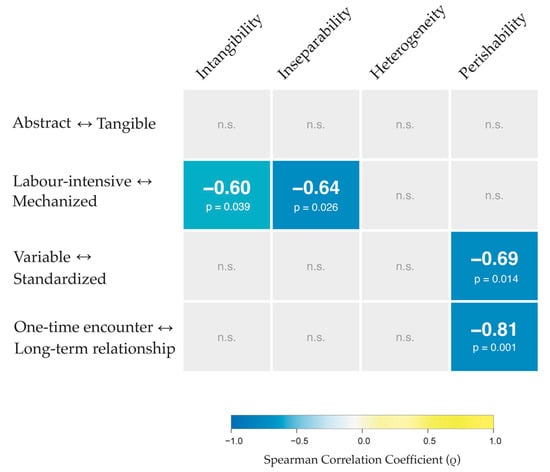
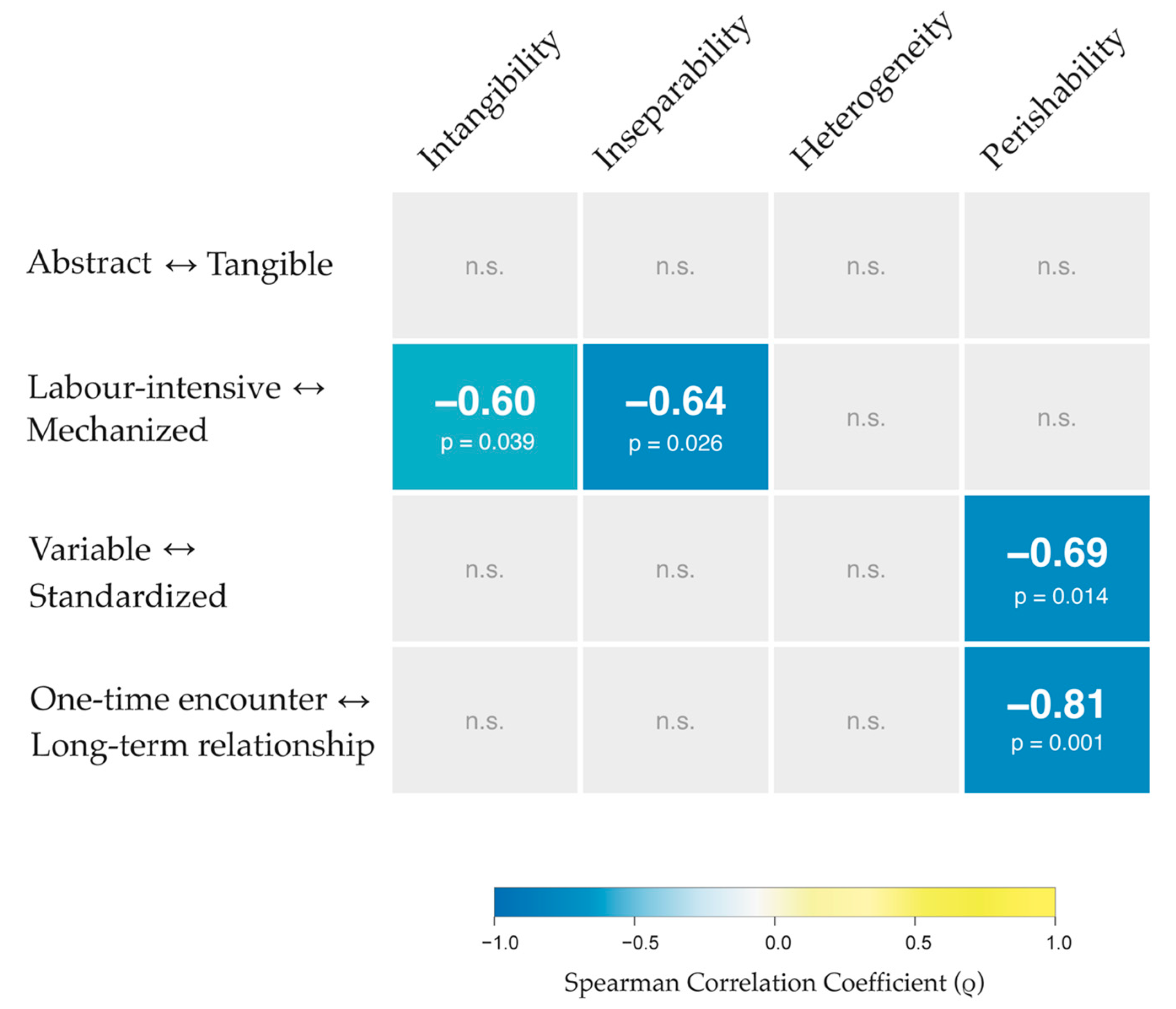
The relationship between the service industry type and the intensity and influence patterns of core service characteristics on the rebranding process was examined using Spearman’s correlation analysis (Figure 1). In the interpretation, only statistically supported relationships (p < 0.05) were considered, avoiding the interpretation of results that do not meet the significance criterion. The analysis suggests that the assessed influence of core service characteristics appears to vary across service-industry contexts. Thus, service-industry type may be interpreted not only as a contextual setting for the manifestation of these effects, but also as a configurational factor associated with variations in both the intensity and the form of service characteristics’ influence on the rebranding process.
Figure 1.
Relationship between the type of service industries and the influence of core service characteristics on the rebranding process (Spearman’s correlation analysis with values statistically significant from zero).
Building on the previous finding that inseparability of production and consumption and perishability exhibit less balanced and more context-dependent influence patterns, the association between service-industry type and assessed influence was interpreted through three statistically significant correlations involving these two characteristics:
- for service industries positioned closer to the labour-intensive pole of the continuum, the influence of inseparability of production and consumption on the rebranding process was assessed at higher values;
- for service industries positioned closer to the labour-intensive pole, the influence of perishability was assessed at higher values;
- for service industries positioned closer to the one-time service encounter pole, the influence of perishability on the rebranding process was assessed at higher values.
The positive direction of the correlation was interpreted as a higher intensity of the assessed influence of a characteristic in industries positioned closer to the corresponding pole of the analytical continuum.
The observed correlations are expressed in relation to the analytical continua of service industries employed in this study, which enables insight into differences in the intensity of influence of core service characteristics across different types of services, as well as into distinct influence patterns within the rebranding process. In this respect, the results suggest that service-industry type can be interpreted as a configurational and contextual factor associated with variations in both the intensity and manifestation of service characteristics influence on the rebranding process.
In direct response to RQ3, the findings suggest that service-industry type can be analytically interpreted as a configurational factor associated with differentiated influence patterns of core service characteristics in the rebranding process.
In this way, the research findings provide an integrated empirical framework for examining the influence of service characteristics on the rebranding process, integrating qualitative insights and quantitative comparisons while accounting for contextual differences, thereby concluding the empirical part of the study.
5. Discussion
The findings of this study support the interpretation that the differences between physical goods and services, well established in marketing and branding theory, are also reflected in the rebranding process. In the service sector, rebranding emerges as a distinct managerial and process-oriented phenomenon with its own logic and constraints, in which the influence of core service characteristics constitutes an integral and relevant element. This supports the interpretation of rebranding in services as having specific processual characteristics in comparison with the rebranding of physical goods. The results further indicate that the influence of core service characteristics on the rebranding process is not homogeneously distributed, but manifests through differentiated influence patterns. While intangibility and heterogeneity exhibit stable and consistently present influence patterns, the inseparability of production and consumption, as well as perishability, display variable levels and patterns of influence. Finally, the findings suggest that these differentiated influence patterns vary across service-industry contexts. Rather than serving solely as a contextual backdrop, service-industry type may be interpreted as a configurational factor associated with differences in both the patterns and intensity of the influence of core service characteristics on the rebranding process, thereby helping to explain the observed intersectoral variation.
The observed dualism between physical goods and services in the context of rebranding extends the existing discussion on service distinctiveness, grounded in the long-standing theoretical insights in marketing and branding, into a new domain—rebranding (Shostack, 1977; De Chernatony & Segal-Horn, 2001; Gotsi & Andriopoulos, 2007; Merrilees & Miller, 2008; Miller & Merrilees, 2013). This perspective contributes to a broader understanding of rebranding as a phenomenon that does not operate in isolation, but rather in continuity with existing dilemmas developed within the theory of the two aforementioned overarching concepts. The findings can be appropriately interpreted in line with the literature on service brands, which emphasizes that service-specific characteristics are most often manifested in the operational dimensions of brand management, rather than at the level of the substantive logic of the process itself, which suggests the processual nature of these differences (De Chernatony & Riley, 1999; Davis, 2007; Skaalsvik & Olsen, 2014). The finding that core service characteristics do not influence rebranding uniformly deepens the initial result. It shows not only that such influence exists, but also that it has a differentiated structure. In this respect, the dominant position of intangibility and its consistent presence across different contexts corresponds with early theoretical discussions that identify this characteristic as central, and even as a starting point for understanding other service characteristics (Zeithaml et al., 1985). In the context of rebranding, this finding gains additional importance, particularly in relation to the transfer of positive brand equity, as brand change processes in services largely unfold on the basis of previously “materialized” and inherited values that constitute brand equity. Similarly, the strong influence of heterogeneity can be explained by the direct grounding of the service sector in the human factor, which service brand theory consistently identifies as one of the key constitutive elements of quality, as well as a primary source of variability in service delivery (Grönroos, 2016; Lomax et al., 2002). By contrast, the weaker positioning of the inseparability of production and consumption suggests that the key challenges of rebranding in practice are not predominantly associated with the direct involvement of customers, through which this characteristic most commonly exerts its influence. This finding may be interpreted as an indicator that, within the perspectives of decision-makers managing rebranding processes in the service sector, attention continues to be directed primarily toward internal resources and organizational capabilities, while the potential of customers as co-creators of value and experience is less integrated into brand recovery and transformation strategies. This is partially consistent with the views emphasizing the prioritization of employee satisfaction over other key stakeholders (Krisprimandoyo, 2015), given its substantial potential in brand recovery processes (Michel et al., 2009), while the perspectives of other stakeholders in branding processes tend to be treated more uniformly. Finally, the fact that perishability emerges as the least constraining characteristic suggests that its influence in the rebranding process, primarily spilling over into broader categories of image and reputation, is not perceived as a core problem, but rather more often as a resource that is sought to be transferred and preserved (Muzellec & Lambkin, 2006; Rindell & Santos, 2021). Thus, perishability does not appear as an immediate obstacle, but rather as a dimension whose challenges are integrated into strategic brand management responses.
This provides a basis for understanding why, and under what conditions, the influence of these two characteristics varies across service contexts. The results suggest that variations in the influence of inseparability of production and consumption and perishability should not be interpreted as random, but as associated with differences among specific service industries and their positions along the analytical continua. Accordingly, service-industry type may be conceptualized as a configurational factor that helps interpret the relationship between core service characteristics and the rebranding process, accounting for variations in the intensity and influence patterns of their effects across different service industries. With regard to inseparability specifically, the study indicates that its relevance varies depending on the degree of labour intensity of the service. In industries that rely more heavily on human labour and direct interaction (e.g., hospitality and health tourism), this characteristic remains strongly present and relevant, whereas in sectors with higher levels of mechanization and technological mediation (e.g., information technologies), its significance becomes relativized. Technological and organizational capabilities may reduce the operational and strategic weight of simultaneity in service delivery, even in situations in which it remains present. A similar pattern is observed for perishability. This characteristic becomes more salient in those segments of the service sector oriented toward one-time and time-bound services (e.g., retail and commercial chains), where each individual act of delivery is strongly tied to the immediate balance of supply and demand and requires almost instantaneous confirmation of quality. In contrast, in long-term and continuous services (e.g., financial services), the ability to manage differences between supply and demand, as well as the “accumulation” of brand image and reputation over time, allows the influence of perishability to be amortized and integrated into more stable strategic patterns, making them less dependent on each individual customer interaction.
Considering these findings, the connection between service-branding strategies and service rebranding should be understood as a transfer with contextual transformation. Strategies such as tangibilization, organizational culture, customer co-creation, and the management of image and reputation retain their basic service-branding function: they help make intangible services more concrete, stabilize service quality, integrate users into value creation, and compensate for the absence of physical ownership or storage. However, in rebranding, these strategies operate on an already established brand field. Their role is therefore not only to support the creation and communication of service value, but also to manage the transition between existing and renewed brand meanings. In this sense, rebranding does not replace the logic of service branding, but extends the priority and function of its strategies by requiring them to preserve continuity, reduce uncertainty, and support the reinterpretation of existing brand elements within a changed brand framework.
These findings extend rebranding theory by recognizing the influence of service characteristics on the process itself and by directing attention toward understanding the patterns of that influence. Rather than assuming a uniform influence of service characteristics, the results of this study introduce differentiation both among service characteristics and among types of services. In this way, rebranding in services is theoretically positioned as a process that, in addition to the general requirement of preserving brand heritage, also demands differentiation across analytical levels within the rebranding process, rather than relying on the direct transfer of general branding principles developed for physical goods.
5.1. Implications
The findings have theoretical, methodological, and practical implications. The theoretical contribution of the study lies primarily in conceptualizing the rebranding of services through a configurational logic, in which the influence of core service characteristics is not treated as uniform, but as varying according to the type of service industry. This perspective extends rebranding theory by showing that the practical relevance of service characteristics depends not only on the characteristics themselves, but also on the service context in which rebranding is planned and implemented. Methodologically, the study confirms the value of an expert sample in the analysis of complex and weakly operationalized phenomena, as well as the justification for a mixed-methods approach in identifying patterns that cannot be observed through exclusively qualitative or quantitative techniques. The combined methodological framework further contributed to the systematic integration of different types of information and to identifying subtle differences that would be difficult to detect in large-scale samples. The practical implications relate to the enhancement of the management framework and the improvement of decision-making in rebranding within service organizations, with the aim of optimizing the rebranding process. This opens the possibility of formulating an analytical framework for planning and monitoring rebranding in services, which may be understood through the following interconnected phases:
- understanding the type of service, with analytical continua serving as an initial diagnostic foundation for understanding the service configuration;
- assessing the relative importance of individual service characteristics in relation to the rebranding process and the manner in which their influence manifests in the specific context;
- shaping appropriate strategic and operational responses based on the identified characteristics and the expected challenges of the rebranding process, aligned with the identified patterns of influence.
5.2. Limitations and Directions for Future Research
The findings should be interpreted in light of the study’s methodological limitations and analytical framework. The research is based on a small but purposefully selected expert sample, which limits the possibility of statistical generalization. The findings therefore primarily have an analytical and interpretative value, consistent with the exploratory nature of the study, and do not aim at population-level representativeness. In addition, the empirical insights predominantly reflect the perspectives of decision-makers and professionals involved in rebranding processes, while experiential and operational perspectives of other relevant participants, such as competitors, frontline employees in direct contact with customers, and service users themselves, are not directly captured within the observed decision-making system. Additionally, the predominantly Southeast European geographic scope of the sample may limit the transferability of the findings to service markets operating under different institutional, competitive, and consumer conditions.
Further limitations arise from the retrospective nature of expert assessments, as respondents evaluated rebranding processes that had already been implemented, often with a considerable time lag. Such an approach does not allow for the examination of the dynamics of the influence and potential changes in the patterns of service characteristics effects across different phases of the process, but rather reflects stabilized and rationalized interpretations based on professional experience. The study design also does not differentiate rebranding processes according to the scope and depth of change, although it is likely that the relative importance of individual service characteristics differs between incremental and radical forms of rebranding.
The analytical continua employed to interpret differences among service industries represent a theoretically grounded interpretative tool for systematic comparison rather than an empirically validated measurement instrument. Their application is based on the researcher’s interpretation and does not aim at a normative classification of services. The positioning of individual industries along the continua relies on theoretical criteria and interpretative judgment, which leaves room for alternative interpretations.
Given these limitations, future research may extend and deepen the present findings through several complementary avenues. The inclusion of a larger and more heterogeneous sample, as well as an incorporation of multiple stakeholder perspectives, such as decision-makers, competitors, employees, shareholders, and service users, would enable testing the stability of the identified patterns. Longitudinal research designs could contribute to a better understanding of the dynamics of influence of service characteristics across different stages of the rebranding process, thereby overcoming the limitations of retrospective assessments. Furthermore, differentiating rebranding processes according to the scope and depth of change would allow for a more precise interpretation of variations in the relative importance of individual service characteristics. Finally, future studies could quantitatively validate and standardize the proposed analytical continua as potential analytical instruments and expand the analytical focus by linking characteristics of the rebranding process to concrete outcomes, such as changes in reputation, brand value, and brand performance.
6. Conclusions
This study is grounded in the assumption that the differences between services and physical goods, already well-established in marketing and branding theory, are also transferred to the rebranding process, and that the service sector operates according to its own logic and constraints. The findings indicate that core service characteristics have a relevant influence on the rebranding process, rendering it qualitatively different from the rebranding of physical goods, while also suggesting that this influence does not manifest uniformly across the rebranding process. Intangibility and heterogeneity exhibit stable and consistently strong influence patterns, whereas the influence of the remaining two characteristics appears more selective and is associated with differences across service-industry contexts.
These findings indicate that theoretical and strategic rebranding frameworks, developed primarily in the context of physical goods, offer a limited analytical model for understanding the brand change process, which, in the service sector, unfolds through additional layers of complexity and requires a context-sensitive and differentiated approach. Rather than treating service characteristics as a homogeneous set of constraints with uniform effects, the results suggest that their relevance varies not only across service characteristics, but across different types of service industries as well. This positions rebranding as a process characterized by differentiated influence patterns of service characteristics, in which service-industry type can be interpreted as a configurational and contextual framework for understanding the manifestation of these influences.
The central contribution of the study lies in conceptualizing rebranding in the service sector as a process whose priorities shift depending on the service characteristics and the nature of the specific service industry. From a practical perspective, the findings suggest that rebranding strategies in services must be adapted to the additional challenges imposed by this context in order to support more informed decision-making. Importantly, these findings do not shift the focus away from the core purpose of rebranding, but rather further emphasize it: despite increased process-related and operational complexity, the balance between the old and the new brand, as well as its reinterpretation grounded in strategic decision-making, remains the fundamental task. In the service context, where these challenges are particularly pronounced, this imperative becomes even more demanding. The responses identified in this study should therefore be understood not as ends in themselves but as means of preserving brand equity, brand heritage, and brand continuity.
Author Contributions
Conceptualization, N.N., J.S. and D.L.; methodology, N.N., B.M. and H.H.; software, I.Ć.; validation, J.S. and H.H.; formal analysis, N.N., B.M. and H.H.; investigation, N.N. and J.S.; resources, N.N., J.S., H.H., B.M. and I.Ć.; data curation, N.N.; writing—original draft preparation, N.N. and J.S.; writing—review and editing, D.L., B.M. and H.H.; visualization, H.H.; supervision, I.Ć.; project administration, B.M. All authors have read and agreed to the published version of the manuscript.
Funding
This research received no external funding.
Institutional Review Board Statement
Ethical review and approval were waived for this study because the University of Novi Sad has no publicly mandated regulation that requires surveys or professional expert interviews to undergo a formal Ethics Committee review. Instead, our institution adheres to the Code of Ethics of the University of Novi Sad, where formal IRB approvals are strictly reserved for biomedical research involving invasive procedures. Since our study is non-invasive and focuses on professional evaluations and not on sensitive personal data, it falls under the category for which a formal approval code is not issued.
Informed Consent Statement
Informed consent was obtained from all subjects involved in the study.
Data Availability Statement
The original contributions presented in this study are included in the article. Further inquiries can be directed to the corresponding author.
Acknowledgments
During the preparation of this manuscript, the authors used AI-based tools for language editing. The authors have reviewed and edited the output and take full responsibility for the content of the publication.
Conflicts of Interest
The authors declare no conflicts of interest.
Appendix A
Table A1.
Overview of interviewees.
Appendix B
Appendix B.1. Questionnaire Items
Respondents evaluated each theoretical element (item) using a five-point impact intensity scale (1 = no influence; 5 = extremely strong influence).
- If customers are not able to understand the technical aspects of a service, they tend to believe that the best brand is the one that is most well-known.
- A product can be objectively measured against predefined specifications, whereas the evaluation of a service is performed through comparison with other services.
- In the case of products, the distribution channel does not exist until the product is manufactured, packaged, priced, and shipped. In the case of services, the distribution channel is identical to service delivery.
- In product development, a long period of time is required, whereas in services managers repeatedly go through the entire ‘product’ life cycle within a single day.
- When a service is purchased, nothing is owned; the customer merely acquires the right to use something.
- Due to the decentralization of service production processes, the potential for achieving cost-based competitive advantage through economies of scale is limited.
- In the service sector, employees have a greater influence on shaping brand value, whereas the brand value of consumer goods is embedded in the physical product and external marketing communications.
- Pilot testing is more important for service brands, as product brands can be refined behind closed doors, whereas service brands, as experiences occurring between employees and customers, cannot be fine-tuned without public exposure.
- Consumers are more likely to rely on word of mouth when evaluating services than when evaluating products, reflecting higher perceived risk.
- Assessing quality is more difficult for services than for goods, as most services contain few search attributes and are rich in experience and credence attributes.
- Products are suitable for individual branding, whereas services are perceived as parts of a single corporate brand.
- Products are easier for competitors to imitate, whereas services—due to organizational culture, employee training, and attitudes—are more difficult to replicate.
Appendix B.2. Theoretical Sources and Characteristic Assignment
Table A2.
Theoretical origin and service characteristic assignment of questionnaire items.
Appendix C
Table A3.
Summary of descriptive statistics.
References
- Alhaimer, R. (2025). Rebranding as a catalyst for organisational change: Insights and impacts. International Journal of Service Science, Management, Engineering, and Technology, 16, 1–20. [Google Scholar] [CrossRef] [Scilit]
- Berry, L. L. (1986). Big ideas in services marketing. Journal of Consumer Marketing, 3, 47–51. [Google Scholar] [CrossRef] [Scilit]
- Berry, L. L. (2000). Cultivating service brand equity. Journal of the Academy of Marketing Science, 28, 128–137. [Google Scholar] [CrossRef] [Scilit]
- Berry, L. L., Lefkowith, E. F., & Clark, T. (1988). In services, what’s in a name. Harvard Business Review, 66, 28–30. [Google Scholar]
- Bharadwaj, S. G., Varadarajan, P. R., & Fahy, J. (1993). Sustainable competitive advantage in service industries: A conceptual model and research propositions. Journal of Marketing, 57, 83–99. [Google Scholar] [CrossRef] [Scilit]
- Blankson, C., & Kalafatis, S. P. (1999). Issues and challenges in the positioning of service brands: A review. Journal of Product & Brand Management, 8, 106–118. [Google Scholar] [CrossRef] [Scilit]
- Blazquez, M., Mattich, K., Henninger, C. E., & Helberger, E. (2019). The effects of rebranding on customer-based brand equity. International Journal of Business and Globalisation, 22, 91–109. [Google Scholar] [CrossRef] [Scilit]
- Booms, B. H., & Bitner, M. J. (1981). Marketing strategies and organization structures for services firms. In J. H. Donnelly, & W. R. George (Eds.), Marketing of services (pp. 47–51). American Marketing. [Google Scholar]
- Brodie, R. J. (2009). From goods to service branding: An integrative perspective. Marketing Theory, 9, 107–111. [Google Scholar] [CrossRef] [Scilit]
- Brodie, R. J., Whittome, J. R., & Brush, G. J. (2009). Investigating the service brand: A customer value perspective. Journal of Business Research, 62, 345–355. [Google Scholar] [CrossRef] [Scilit]
- Chad, P. (2016). Corporate rebranding: An employee-focused nonprofit case study. Journal of Nonprofit & Public Sector Marketing, 28, 327–350. [Google Scholar] [CrossRef] [Scilit]
- Dall’Olmo Riley, F., & De Chernatony, L. (2000). The service brand as relationships builder. British Journal of Management, 11, 137–150. [Google Scholar] [CrossRef] [Scilit]
- Davis, J. C. (2007). A conceptual view of branding for services. Innovative Marketing, 3, 7–14. [Google Scholar]
- De Chernatony, L., Drury, S., & Segal-Horn, S. (2003). Building a services brand: Stages, people and orientations. Service Industries Journal, 23, 1–21. [Google Scholar] [CrossRef] [Scilit]
- De Chernatony, L., Drury, S., & Segal-Horn, S. (2004). Identifying and sustaining services brands’ values. Journal of Marketing Communications, 10, 73–93. [Google Scholar] [CrossRef] [Scilit]
- De Chernatony, L., & Riley, F. D. O. (1999). Experts’ views about defining services brands and the principles of services branding. Journal of Business Research, 46, 181–192. [Google Scholar] [CrossRef] [Scilit]
- De Chernatony, L., & Segal-Horn, S. (2001). Building on services’ characteristics to develop successful services brands. Journal of Marketing Management, 17, 645–669. [Google Scholar] [CrossRef] [Scilit]
- De Chernatony, L., & Segal-Horn, S. (2003). The criteria for successful services brands. European Journal of Marketing, 37, 1095–1118. [Google Scholar] [CrossRef] [Scilit]
- Faust, W. H., & Eilertson, A. (1994). You’ve got a logo, you need a brand. ABA Banking Journal, 86, 86–88. [Google Scholar]
- Fitzgerald, T. J. (1987). Understanding the differences and similarities between services and products to exploit your competitive advantage. Journal of Business & Industrial Marketing, 2, 29–34. [Google Scholar] [CrossRef] [Scilit]
- Fombrun, C. J. (1996). Reputation. Harvard Business School Press. [Google Scholar]
- Goi, C. L., & Goi, M. T. (2011). Review on models and reasons of rebranding. In Proceedings of the international conference on social science and humanity (pp. 445–449). IACSIT Press. [Google Scholar]
- Gotsi, M., & Andriopoulos, C. (2007). Understanding the pitfalls in the corporate rebranding process. Corporate Communications: An International Journal, 12, 341–355. [Google Scholar] [CrossRef] [Scilit]
- Grönroos, C. (1978). A service-orientated approach to marketing of services. European Journal of Marketing, 12, 588–601. [Google Scholar] [CrossRef] [Scilit]
- Grönroos, C. (2016). Service management and marketing: Managing the service profit logic (4th ed.). John Wiley & Sons. [Google Scholar]
- Guest, G., Bunce, A., & Johnson, L. (2006). How many interviews are enough? Field Methods, 18, 59–82. [Google Scholar] [CrossRef] [Scilit]
- Huang, M. H., & Dev, C. S. (2020). Growing the service brand. International Journal of Research in Marketing, 37, 281–300. [Google Scholar] [CrossRef] [Scilit]
- Iglesias, O., & Ind, N. (2020). Towards a theory of conscientious corporate brand co-creation: The next key challenge in brand management. Journal of Brand Management, 27, 710–720. [Google Scholar] [CrossRef] [Scilit]
- Joseph, A., Gupta, S., Wang, Y., & Schoefer, K. (2021). Corporate rebranding: An internal perspective. Journal of Business Research, 130, 709–723. [Google Scholar] [CrossRef] [Scilit]
- Klaus, P., & Maklan, S. (2007). The role of brands in a service-dominated world. Journal of Brand Management, 15, 115–122. [Google Scholar] [CrossRef] [Scilit]
- Krisprimandoyo, D. A. (2015, August 28). Corporate rebranding: A literature review. 2nd International Conference on Entrepreneurship (ICOEN) (pp. 152–165), Surabaya, Indonesia. [Google Scholar]
- Leroi-Werelds, S., & Matthes, J. (2022). Transformative value positioning for service brands: Key principles and challenges. Journal of Service Management, 33, 552–564. [Google Scholar] [CrossRef] [Scilit]
- Lomax, W., & Mador, M. (2006). Corporate re-branding: From normative models to knowledge management. Journal of Brand Management, 14, 82–95. [Google Scholar] [CrossRef] [Scilit]
- Lomax, W., Mador, M., & Fitzhenry, A. (2002). Corporate rebranding: Learning from experience (Kingston university occasional paper series No. 48). Kingston Business School, Kingston University. [Google Scholar]
- Lovelock, C. H. (1981). Why marketing management needs to be different for services. In J. H. Donnelly, & W. R. George (Eds.), Marketing of services (pp. 5–9). American Marketing. [Google Scholar]
- Lovelock, C. H. (1983). Classifying services to gain strategic marketing insights. Journal of Marketing, 47, 9–20. [Google Scholar] [CrossRef] [Scilit]
- Merrilees, B., & Miller, D. (2008). Principles of corporate rebranding. European Journal of Marketing, 42, 537–552. [Google Scholar] [CrossRef] [Scilit]
- Merz, M. A., He, Y., & Vargo, S. L. (2009). The evolving brand logic: A service-dominant logic perspective. Journal of the Academy of Marketing Science, 37, 328–344. [Google Scholar] [CrossRef] [Scilit]
- Michel, S., Bowen, D., & Johnston, R. (2009). Why service recovery fails: Tensions among customer, employee, and process perspectives. Journal of Service Management, 20, 253–273. [Google Scholar] [CrossRef] [Scilit]
- Miller, D., & Merrilees, B. (2013). Rebuilding community corporate brands: A total stakeholder involvement approach. Journal of Business Research, 66, 172–179. [Google Scholar] [CrossRef] [Scilit]
- Mróz-Gorgoń, B., & Haenlein, M. (2021). Corporate rebranding and its meaning–theory perspective. Problemy Zarządzania, 19, 76–90. [Google Scholar] [CrossRef] [Scilit]
- Muzellec, L., Doogan, M., & Lambkin, M. (2003). Corporate rebranding—An exploratory review. Irish Marketing Review, 16, 31–40. [Google Scholar]
- Muzellec, L., & Lambkin, M. (2006). Corporate rebranding: Destroying, transferring or creating brand equity? European Journal of Marketing, 40, 803–824. [Google Scholar] [CrossRef] [Scilit]
- Nugroho, M. A., & Harjanto, R. (2020). Impact of brand life cycle to extend product’s life cycle. International Journal of Management (IJM), 11(8), 970–981. [Google Scholar]
- Parasuraman, A. (1987). Customer-oriented corporate cultures are crucial to services marketing success. Journal of Services Marketing, 1, 39–46. [Google Scholar] [CrossRef] [Scilit]
- Parasuraman, A., Zeithaml, V. A., & Berry, L. L. (1985). A conceptual model of service quality and its implications for future research. Journal of Marketing, 49, 41–50. [Google Scholar] [CrossRef] [Scilit]
- Patton, M. Q. (2002). Qualitative research & evaluation methods (3rd ed.). Sage Publications. [Google Scholar]
- Ramos, M. A., Andersson, S., & Aagerup, U. (2024). Rebranding after international acquisitions: Challenges of legitimation in emerging and developed countries. International Marketing Review, 41, 84–116. [Google Scholar] [CrossRef] [Scilit]
- Rindell, A., & Santos, F. P. (2021). What makes a corporate heritage brand authentic for consumers? A semiotic approach. Journal of Brand Management, 28, 545–558. [Google Scholar] [CrossRef] [Scilit]
- Roy, S., & Sarkar, S. (2015). To brand or to rebrand: Investigating the effects of rebranding on brand equity and consumer attitudes. Journal of Brand Management, 22, 340–360. [Google Scholar] [CrossRef] [Scilit]
- Sangroya, D., Jebarajakirthy, C., Maseeh, H. I., Saha, R., & Gupta, Y. (2025). Evolution of rebranding: A structured literature review and research agenda. Marketing Intelligence & Planning, 44, 441–481. [Google Scholar] [CrossRef] [Scilit]
- Sardovski, V. B. (2022). The difference between the life cycle of the brand and the life cycle of the product. Rebranding and brand refresh. Innovations, 10, 13–16. [Google Scholar]
- Shostack, G. L. (1977). Breaking free from product marketing. Journal of Marketing, 41, 73–80. [Google Scholar] [CrossRef] [Scilit]
- Shostack, G. L. (1987). Service positioning through structural change. Journal of Marketing, 51, 34–43. [Google Scholar] [CrossRef] [Scilit]
- Simmons, G., & Durkin, M. (2023). Expanding understanding of brand value co-creation on social media from an SD logic perspective: Introducing structuration theory. Marketing Theory, 23, 607–629. [Google Scholar] [CrossRef] [Scilit]
- Skaalsvik, H., & Olsen, B. (2014). Service branding: Suggesting an interactive model of service brand development. Kybernetes, 43, 1209–1223. [Google Scholar] [CrossRef] [Scilit]
- Splichalova, A., Patrman, D., Kotalova, N., & Hromada, M. (2020). Managerial decision making in indicating a disruption of critical infrastructure element resilience. Administrative Sciences, 10, 75. [Google Scholar] [CrossRef] [Scilit]
- Stuart, H. (2018). Corporate branding and rebranding: An institutional logics perspective. Journal of Product & Brand Management, 27, 96–100. [Google Scholar] [CrossRef] [Scilit]
- Stuart, H., & Muzellec, L. (2004). Corporate makeovers: Can a hyena be rebranded? Journal of Brand Management, 11, 472–482. [Google Scholar] [CrossRef] [Scilit]
- Turley, L. W. (1990). Strategies for reducing perceptions of quality risk in services. Journal of Services Marketing, 4, 5–12. [Google Scholar] [CrossRef] [Scilit]
- Turley, L. W., & Fugate, D. L. (1992). The multidimensional nature of service facilities. Journal of Services Marketing, 6, 37–45. [Google Scholar] [CrossRef] [Scilit]
- Turley, L. W., & Moore, P. A. (1995). Brand name strategies in the service sector. Journal of Consumer Marketing, 12, 42–50. [Google Scholar] [CrossRef] [Scilit]
- Udonde, U. E., Ibok, N. I., & Eke, C. (2022). Mechanics of re-branding and the need for paradigm shift. Contemporary Marketing Research Journal, 9, 1–11. [Google Scholar]
- Vargo, S. L., & Lusch, R. F. (2004). The four service marketing myths: Remnants of a goods-based, manufacturing model. Journal of Service Research, 6, 324–335. [Google Scholar] [CrossRef] [Scilit]
- Wang, C. L., & He, J. (2023). Guest editorial: Global branding management in a rapidly changing environment. International Marketing Review, 40, 1–3. [Google Scholar] [CrossRef] [Scilit]
- Wirtz, J., & Lovelock, C. (2016). Services marketing: People, technology, strategy (8th ed.). World Scientific. [Google Scholar]
- Witt, U., & Gross, C. (2020). The rise of the “service economy” in the second half of the twentieth century and its energetic contingencies. Journal of Evolutionary Economics, 30, 231–246. [Google Scholar] [CrossRef] [Scilit]
- Zeithaml, V. A., Parasuraman, A., & Berry, L. L. (1985). Problems and strategies in services marketing. Journal of Marketing, 49, 33–46. [Google Scholar] [CrossRef] [Scilit]

Disclaimer/Publisher’s Note: The statements, opinions and data contained in all publications are solely those of the individual author(s) and contributor(s) and not of MDPI and/or the editor(s). MDPI and/or the editor(s) disclaim responsibility for any injury to people or property resulting from any ideas, methods, instructions or products referred to in the content. |
© 2026 by the authors. Licensee MDPI, Basel, Switzerland. This article is an open access article distributed under the terms and conditions of the Creative Commons Attribution (CC BY) license.