1. Introduction
The achievement of Sustainable Development Goal 16 (SDG16), which promotes peaceful, inclusive, and accountable institutions, has become one of the central governance challenges for contemporary democracies. In recent years, digital transformation processes have intensified across public administrations worldwide, particularly through the expansion of e-government systems aimed at improving administrative efficiency, transparency, citizen participation, and public service delivery. Within the European context, digital governance has increasingly been presented as a strategic instrument for strengthening institutional quality and democratic resilience.
The existing literature frequently assumes that digitalisation contributes directly to institutional strengthening and democratic quality (
Tolbert & Mossberger, 2006;
Myeong et al., 2014;
Adams & Paul, 2023). In this sense, e-government is commonly associated with higher levels of transparency, administrative efficiency, citizen participation, and institutional trust. From this perspective, digitalisation is often interpreted as a mechanism capable of improving the interaction between citizens and public institutions while facilitating more responsive and accountable governance systems.
However, more recent studies suggest that the effects of digital governance depend heavily on institutional capacity, political stability, and socio-economic conditions (
Dhaoui, 2022;
Doran et al., 2023). Consequently, important limitations remain in the existing literature. First, many previous studies rely primarily on cross-sectional or pooled empirical approaches, which may overestimate the positive effects of digitalisation by failing to distinguish between structural cross-country differences and within-country institutional changes over time. As a result, it remains unclear whether countries with more advanced e-government systems achieve stronger institutional outcomes because of digitalisation itself or because these countries already possess historically stronger economic, political, and administrative structures.
Second, the relationship between digitalisation and governance outcomes may not be homogeneous across institutional dimensions. While some studies suggest that e-government contributes positively to institutional trust and transparency, its effects on democratic participation, accountability, or corruption control remain less conclusive and often context-dependent. Increasingly, recent research suggests that digital governance should be understood as an institutionally embedded process whose effectiveness depends on broader governance structures, administrative capacity, economic development, digital inclusion, and political stability.
Third, comparatively limited attention has been devoted to analysing the European experience from a longitudinal perspective. This limitation is particularly relevant because European countries display substantial heterogeneity regarding digital transformation trajectories, institutional quality, economic structures, and democratic performance. Countries such as Denmark, Estonia, and the Netherlands have consistently combined high levels of digital governance with strong institutional outcomes, whereas other countries have experienced important advances in digitalisation without equivalent improvements in trust, accountability, or corruption control.
Against this background, this study analyses the relationship between e-government use and SDG16-related institutional outcomes across 27 European countries during the period of 2010–2022. In particular, the paper examines how technological, economic, and demographic factors influence three dimensions associated with SDG16: trust in public institutions, voice and accountability, and control of corruption.
More specifically, the study seeks to answer the following research question:
To what extent does e-government use contribute to SDG16-related institutional outcomes once structural country heterogeneity and within-country longitudinal dynamics are taken into account?
In addition, the paper explores whether the relationship between digitalisation and institutional quality differs across distinct dimensions of SDG16 and across different trajectories of e-government adoption within Europe.
To address these questions, the study employs panel data econometric techniques, including country and year fixed effects estimations, which make it possible to distinguish long-term structural differences across countries from within-country institutional dynamics over time. In addition, an exploratory cluster analysis is conducted to identify heterogeneous trajectories of e-government adoption across European countries.
The paper contributes to the literature in several ways. First, it provides longitudinal evidence regarding the relationship between e-government and SDG16 dimensions within the European context. Second, it contributes methodologically by demonstrating the importance of distinguishing between cross-country structural heterogeneity and within-country changes over time when analysing governance outcomes. Third, the study offers a more nuanced interpretation of digitalisation by showing that the relationship between e-government and institutional quality becomes substantially weaker once unobserved country-specific heterogeneity is controlled for. Finally, the paper highlights that the effects of digitalisation differ across institutional dimensions and are strongly conditioned by broader economic, institutional, and socio-political contexts.
The findings suggest that countries characterised by stronger digital development tend to exhibit better institutional outcomes overall, although these relationships are primarily structural rather than driven by short-term within-country transformations. More broadly, the results indicate that digitalisation alone is insufficient to strengthen governance outcomes unless accompanied by stable institutional structures, socio-economic development, and broader democratic capacity.
The remainder of the paper is structured as follows.
Section 2 presents the theoretical framework and develops the hypotheses.
Section 3 describes the data, variables, and empirical methodology.
Section 4 presents the empirical results.
Section 5 discusses the findings in relation to previous literature and Governance Theory. Finally,
Section 6 concludes the paper and outlines policy implications, limitations, and future research directions.
2. Theoretical Framework and Hypotheses
Sustainable Development Goal 16 (SDG16) emphasises the importance of peaceful, accountable, transparent, and inclusive institutions as a foundation for sustainable development (
UNDP, 2016). In this sense, governance quality, institutional trust, accountability, and corruption control have increasingly been recognised as key dimensions of democratic resilience and long-term socio-economic development (
OECD, 2016,
2022;
Kaufmann et al., 2011). Consequently, understanding the factors that strengthen institutional performance has become a central concern within governance and sustainability research.
From an Institutional Theory (IT) perspective, institutions shape social behaviour through formal and informal rules, norms, and governance structures (
Meyer & Rowan, 1977;
Powell & DiMaggio, 2012). Governance Theory (GT), in turn, emphasises the importance of effective, transparent, and participatory governance systems for achieving sustainable development and strengthening institutional resilience (
Kemp et al., 2005). Together, these perspectives suggest that digital governance initiatives such as e-government may contribute to SDG16 achievement by improving transparency, administrative responsiveness, accountability, and citizen participation. However, both theories also imply that the effectiveness of digitalisation depends on broader institutional and socio-economic conditions.
There are numerous works that relate the development of ICT and the use of e-government with the achievement of SDG16, from the perspective of Governance Theory.
Under a GT perspective, therefore, e-government use contributes to sustainable development (
Castro & Lopes, 2022), and particularly to the achievement of SDG16 (
Adams & Paul, 2023;
Agbozo, 2018;
ElMassah & Mohieldin, 2020;
Janowski, 2016;
Kim & Lee, 2012), as an enabler of e-transparency, citizen trust, e-democracy, and corruption control (
Lissitsa, 2021;
Doran et al., 2023;
Khan et al., 2021). While
Mantovani Ribeiro et al. (
2021) note that SDG16 does not involve targets directly associated with the use of ICT-enabled structures such as e-government, they suggest that their implementation can play a crucial role in improving the transparency, accountability, and efficiency of institutions and call for more research to address the intersection among governance, state of and investments in technology, and sustainable development. However,
Heeks (
2020) highlights that technology alone as key to enabling e-government is insufficient to achieve SDG16 goals and that economic and demographic factors need to be considered as well if we are to understand the reasons behind countries’ varying SDG16 performance. Factors such as user e-participation, income per capita and income disparities, spatial and age-conditioned inequalities in the accessibility of information due to a digital divide or unemployment all contribute to stronger public governance (
Amosun et al., 2022;
Friemel, 2014;
Glyptis et al., 2020;
Kaufmann et al., 2011;
Ochara & Mawela, 2015;
Pérez-Morote et al., 2020;
Zhang & Kimathi, 2022;
Zou et al., 2023). In this regard, there is limited research not only concerning the role of the aforementioned factors, but also regarding the study of the role of e-government in SDG16 achievement (
Adams & Paul, 2023;
Agbozo, 2018;
Janowski, 2016). We argue that filling these gaps in the literature is important for understanding the reasons behind the largely diverse, in terms of their success, efforts of UN Member States (
UN, 2015) to implement SDG16 and to establish whether e-government is implicated in this process. Understanding these reasons is also important to help identify appropriate policies to boost SDG16 achievement rates, bridge implementation gaps across countries, and to propose theoretical contributions to the literature regarding SDG16.
To ensure that governance and specifically e-government is relevant in building stronger institutions and achieving sustainable development, GT posits that it must be examined from the perspective of dimensions shaping any social system, proposing a causal role for economic, demographic and technological factors such as those identified above (
Marthandan & Tang, 2010;
Myeong et al., 2014;
Kaimuri & Kosimbei, 2017;
Castro & Lopes, 2022;
Dhaoui, 2022;
Glyptis et al., 2020;
Horobeț et al., 2023;
Iong & Phillips, 2022;
Khan et al., 2021;
Lissitsa, 2021).
From an IT perspective, strong institutions rely on the trust and confidence of citizens.
Tolbert and Mossberger (
2006) propose that e-government can enhance trust by fostering better interactions with citizens and strengthening the sense of governmental attentiveness, arguing for a positive correlation between the level of e-government and trust in less corrupted countries. Other authors also comment that the implementation of e-government can significantly influence trust in public institutions through improvements in transparency, efficiency, and effectiveness (
Amosun et al., 2022;
Balaskas et al., 2022;
Lissitsa, 2021;
McNeal et al., 2008;
Moon & Norris, 2005;
Pérez-Morote et al., 2020). In turn, trust in public institutions is representative of how satisfied citizens are with their management and how efficient they are proving to be (
Khan et al., 2021;
Othman et al., 2020).
Myeong et al. (
2014) highlight the complexity of and the various factors that influence the relationship between e-government and trust in government, showing both positive and neutral results, depending on the context and methodologies used. Yet, strong institutions also mean democratic quality proxied by their degree of voice openness and accountability. Voice and accountability mean that citizens participate in the selection of governments and their decisions and that governments are accountable (
Kaufmann et al., 2011;
Stratu-Strelet et al., 2021). Some research (
Leroux, 2020;
Amosun et al., 2022) has shown that e-government promotes voice and accountability improvement. In other research, such a relationship is less clear, however (
Lindquist & Huse, 2017;
Waheduzzaman & Khandaker, 2022). Another aspect of strong institutions within the objectives of SDG16 is corruption control. Research suggests that the digitalization of public services reduces opportunities for corrupt behaviour by automating procedures and reducing citizens’ direct interaction with officials. For example,
Mantovani Ribeiro et al. (
2021) focused on ICTs creating a culture of transparency and in curbing corruption. The accessibility of public data through online platforms promotes greater citizen and media oversight, strengthening institutional control. These technological advances increase the transparency and thus, the traceability, of government actions, limiting the scope for corruption (
Arayankalam et al., 2021;
Khan et al., 2021). However, according to
Park and Kim (
2020), advanced ICTs may be exploited to commit acts of corruption instead of being utilized for its detection and reduction.
In summary, trust, the quality of democracy, and corruption control are indispensable aspects of strong institutions as defined in SDG16, where e-government seems to be playing a role, while whose causal nature warrants clarification (
Zou et al., 2023).
Overall, existing literature suggests that e-government may contribute to several dimensions associated with SDG16, including institutional trust, democratic accountability, and corruption control. However, previous evidence also indicates that these relationships may vary substantially across countries, depending on broader institutional, economic, and demographic conditions. Consequently, the relationship between digitalisation and SDG16 dimensions requires further longitudinal and context-sensitive analysis.
Based on the above, we propose the following hypotheses:
H1. Economic, demographic, and technological factors are associated with variations in trust in public institutions across European countries.
H2. Economic, demographic, and technological factors are associated with variations in voice and accountability across European countries.
H3. Economic, demographic, and technological factors are associated with variations in corruption control across European countries.
H4. European countries exhibit heterogeneous trajectories of e-government adoption associated with different institutional, economic, and demographic profiles, reflecting varying levels of SDG16-related institutional performance.
3. Materials and Methods
3.1. Data and Measures
The sample was drawn from 30 countries featured in the EC e-government benchmark reports (e.g.,
EC, 2022). However, due to insufficient data for building the data panel, we had to exclude three countries, namely: Cyprus, Iceland, and Romania. The final sample included 27 EU countries, including the UK (as it was member of the EU until 2020), plus Norway, an EEA country closely affiliated with the EU, from which a cross-sectional and longitudinal analysis of panel data from the 2010–2022 period was conducted to test our hypotheses, with data collected for the years 2010, 2012, 2014, 2016, 2018, 2020, and 2022. Both dependent and independent variable values were sourced from secondary data.
The study proxies achievement of SDG16 through the following dependent variables, which constitute its three key dimensions, namely: trust in public institutions, quality of democracy, and control of corruption. For trust in public institutions, we deploy ‘% population with confidence in public institutions in EU and EEA’ (‘TRUST’); for quality of democracy, we use ‘Voice and Accountability’ (‘VAC’); and for corruption control, we employ ‘Control of Corruption’ (‘COC’). TRUST proxies sub-objective SDG16.6, which links confidence or trust to the transparency and efficiency of public institutions. VAC proxies sub-objective SDG16.7, which underscores inclusive, participatory, and representative decision making, addressing citizens’ demand for democratic public institutions. Finally, COC proxies sub-objective SDG16.5 that seeks to curb corruption in all its forms. Each dependent variable is measured as a percentage.
The choice of the variable ‘% population with confidence in public institutions in EU and EEA’, instead of trust in national institutions, is based on internal and construct validity considerations (
Bryman & Bell, 2011). Specifically, indicators of trust in supranational institutions (such as the European Parliament, the European Commission, or the European Central Bank) are standardised through harmonised surveys, guaranteeing cross-sectional comparability among countries by using identical metrics for definition, periodicity and methodology. In contrast, confidence in national institutions is usually measured with heterogeneous instruments (national surveys with non-equivalent questions), introducing biases in the analysis. Focusing on European institutions, the aim was to reflect perceptions of trust in a shared governance system, directly linked to transnational policies (e.g., cohesion funds, digital regulations) that influence the fulfilment of SDG16.
Economic, demographic and technological variables were previously used in research as independent variables to examine sustainable development and more specifically, trust in institutions, the quality of democracy, and the control of corruption. To study trust in European institutions,
Myeong et al. (
2014) selected the E-government Participation Index (EPI) as a technological variable, and gross national income per capita (GNIpc) as an economic variable, while
Alzena (
2024) and
Undilashvili (
2024) deployed the gender pay gap. To study voice and accountability, EPI and ICT were selected as technological variables (
Castro & Lopes, 2022;
Dhaoui, 2022;
Doran et al., 2023), and GNIpc (
Dhaoui, 2022;
Lopatkova et al., 2019) and the gender pay gap (
Pinto Hernández et al., 2023;
Gaweł & Toikko, 2024) were selected as economic variables. Demographic variables used in previous research to measure voice and accountability were the human capital index (HCI) (
Adams & Paul, 2023;
Dhaoui, 2022;
Doran et al., 2023;
Lopatkova et al., 2019), rurality, and the share of population over 65 (
De Toro et al., 2023;
Ullah et al., 2022). To study corruption control, investment in information technology (IIT) was identified as an explanatory economic variable by
Park and Kim (
2020), while the gender pay gap (GPG) was deployed as an economic variable in this context (
Bauhr et al., 2018;
Debsky & Jetter, 2015;
Jávor & Jancsics, 2016;
Mungiu, 2013;
Wang & Sun, 2015).
The economic variables used in our study are GNIpc, measured in euros, and unemployment (‘UNEMP’), measured as a percentage of the total labour force. As for the demographic variables, we use HCI to proxy the level of education of the population; the percentage of the population over 65 with (‘AGE65’); the percentage of rural population (‘Rurality’); and GPG. Finally, in regards to technological variables, we deploy EPI (
EC, 2010,
2012,
2014,
2016,
2018,
2020,
2022); the further investment in technological infrastructures, ‘ICT’; and the use of e-government (‘% users’), defined as the percentage of individuals who indicated they had used the internet to interact with public authorities. The values of these variables range between 0 and 100.
Table 1 shows the details of the variables incorporated, the indicators used for their measurement, and the source from which they have been obtained. It is important to mention that data extraction was influenced by a two-year lag for some variables. This is because the independent variables EPI, ICT, and HCI are released in year t, but their values correspond to responses gathered in year t-2. As the latest available UN’s E-government Survey report is for 2022, it reports data for year t-2, i.e.,: 2020, for variables EPI, ICT and HCI. As a result, and to maintain a consistent timeframe, the data on the other variables, i.e., GNIpc, RURAL, UNEMP, AGE65, GPG, UEG, COC, VAC, and TRUST, were taken with a two-year time lag.
3.2. Data Analysis
To test hypotheses H1, H2 and H3, we employ panel data econometric techniques that explicitly account for the longitudinal structure of the dataset, which includes 27 European countries observed over the period of 2010–2022. The empirical model is specified as follows:
where:
denotes country,
denotes time,
captures unobserved country-specific effects,
captures time-specific effects,
is the idiosyncratic error term.
Three dependent variables are estimated separately: TRUST (H1), VAC (H2), and COC (H3).
We estimate three alternative specifications: (a) pooled OLS, as a baseline reference model; (b) country fixed effects (FE); controlling for time-invariant unobserved heterogeneity across countries; (c) country and time fixed effects (two-way FE), controlling for both country-specific and common temporal shocks.
In addition, random effects (RE) estimations were computed as a robustness benchmark and compared with fixed effects specifications through Hausman tests (
Table 2). Results favoured fixed effects models for TRUST and VAC, indicating that unobserved country-specific heterogeneity is correlated with the explanatory variables. For COC, the Hausman test was inconclusive due to a non-positive definite covariance difference matrix, a common issue when FE and RE estimates are very similar. Nevertheless, fixed effects estimations were retained as the main specification for consistency and robustness purposes.
Standard errors are clustered at the country level to account for heteroskedasticity and serial correlation within panels.
To better characterise the panel structure of the data, we report descriptive statistics distinguishing overall variation, between-country variation and within-country variation.
This allows us to assess whether the explanatory variables vary primarily across countries or over time.
Table 3 reports descriptive statistics distinguishing between overall standard deviation, between-country standard deviation, and within-country standard deviation.
The results reveal substantial heterogeneity across countries, particularly in variables such as income per capita (GNIPC), e-government use (UEG), and the human capital index (HCI), where between-country variation is comparatively large. This suggests that structural differences between countries play an important role in explaining institutional performance.
By contrast, variables such as voice and accountability (VAC), ICT development, and unemployment exhibit relatively stronger within-country variation over time, indicating that these dimensions exhibit stronger temporal dynamics within countries.
Interestingly, UEG displays relatively limited within-country variation compared to its between-country variation, suggesting that differences in e-government adoption are primarily structural rather than driven by rapid changes over time.
Overall, the descriptive evidence confirms the relevance of panel data techniques and supports the use of fixed effects estimations to distinguish structural cross-country heterogeneity from within-country institutional dynamics over time.
To test H4, an exploratory k-means cluster analysis was conducted based on the level of e-government use (UEG). Similar approaches have been applied in previous studies on digital governance and public policy (
Calderón et al., 2022;
Przeybilovicz et al., 2018).
H4 proposes that countries with higher levels of e-government use tend to display stronger institutional performance in relation to SDG16 dimensions. In this context, the cluster analysis is intended to identify whether country–year observations characterised by different levels of e-government adoption also exhibit different institutional, economic, and socio-demographic profiles.
Given the exploratory purpose of H4, the cluster analysis is intentionally based exclusively on e-government use (UEG), allowing for the identification of distinct trajectories of digital public service adoption and their associated institutional profiles.
The analysis classified country–year observations into three groups representing low, medium, and high levels of e-government use. The objective of this analysis is descriptive rather than causal, aiming to identify patterns of association between e-government adoption and institutional outcomes.
Specifically, the cluster analysis explores differences across groups in relation to trust in public institutions (TRUST), voice and accountability (VAC), control of corruption (COC), income levels (GNIPC), and unemployment rates (UNEMP). The results of the cluster analysis are presented in the Results section, together with the average characteristics associated with each cluster.
Table 4 reports the average institutional and economic characteristics associated with each e-government usage cluster. In particular, the table presents the mean values of TRUST, VAC, COC, GNIPC, and UNEMP across low-, medium-, and high-use groups.
This descriptive comparison allows us to explore whether higher levels of e-government use are systematically associated with stronger institutional outcomes and more favourable socio-economic conditions, as proposed in H4.
4. Results
Table 5 reports the panel estimations for the three dimensions associated with SDG16: trust in public institutions (TRUST), voice and accountability (VAC), and control of corruption (COC). Four alternative specifications are presented for each dependent variable: pooled OLS, random effects (RE), country fixed effects (FE), and country plus year fixed effects (two-way FE). Robust standard errors clustered at the country level are reported in parentheses.
Overall, the comparison across specifications reveals that several relationships observed in pooled OLS and random effects models weaken substantially once country and year fixed effects are introduced. This suggests that part of the apparent association between digitalisation and institutional performance is driven by structural cross-country differences rather than by within-country changes over time.
4.1. Trust in Public Institutions (H1)
The results for TRUST reveal limited evidence supporting a robust within-country effect of digitalisation variables once the most demanding specifications are applied.
In pooled OLS and random effects models, several technological and economic variables appear to be statistically significant. E-government use (UEG) shows a positive association with TRUST, while unemployment (UNEMP) exhibits a strong negative effect. However, many of these relationships weaken considerably after controlling for country-specific heterogeneity through fixed effects estimations.
Under the country fixed effects specification, only the e-participation index (EPI) remains statistically significant, displaying a negative relationship with TRUST. Nevertheless, this effect disappears once year fixed effects are introduced, indicating that the relationship is not robust after controlling for common temporal shocks.
The two-way fixed effects model shows that ICT development and unemployment are the only variables that retain statistical significance. ICT displays a negative coefficient, suggesting that increases in ICT development within countries over time are not necessarily associated with higher institutional trust. At the same time, unemployment maintains a robust negative effect, indicating that worsening labour market conditions reduce confidence in public institutions.
Importantly, e-government use (UEG) does not display statistically significant effects in either fixed effects specification. This finding suggests that the positive relationships observed in pooled models are largely driven by structural differences between countries rather than by short-term institutional transformations within countries.
Similarly, demographic variables such as AGE65, GPG, and HCI do not exhibit robust effects once fixed effects are introduced. Rurality shows a weak negative association under country fixed effects, although the effect remains only marginally significant.
The findings provide moderate support for H1, suggesting that institutional trust is positively associated with favourable economic conditions and to a lesser extent, with certain dimensions of digitalisation. Nevertheless, the strength of these relationships decreases once structural country heterogeneity is controlled for.
4.2. Voice and Accountability (H2)
The results for VAC also reveal substantial differences across model specifications.
Pooled OLS and random effects estimations initially suggest positive associations between economic development and democratic quality. GNIPC displays a positive and statistically significant coefficient in both models. However, these effects disappear once country fixed effects are introduced.
Under the fixed effects specifications, none of the technological variables—including UEG, ICT, and EPI—display statistically significant effects. This indicates that increases in digital public service adoption within countries are not systematically associated with improvements in perceived democratic accountability or political participation.
Demographic variables also lose significance under the two-way fixed effects specification. Although AGE65 exhibits a negative effect in pooled OLS and random effects models, this relationship is no longer statistically robust after controlling for country and year heterogeneity.
Overall, the results suggest that the relationships observed in simpler specifications are primarily driven by structural cross-country differences rather than by dynamic within-country changes over time.
The findings generally support H2 from a comparative perspective, suggesting that stronger socio-economic and digital conditions are associated with higher levels of democratic accountability across countries. However, the within-country effects remain comparatively limited once structural country heterogeneity is controlled for.
4.3. Control of Corruption (H3)
The results for COC reveal an even weaker relationship between digitalisation variables and institutional outcomes once fixed effects are introduced.
In pooled OLS and random effects models, income per capita (GNIPC) displays a strong positive association with corruption control, suggesting that wealthier countries tend to exhibit better institutional performance. However, this relationship disappears entirely under both fixed effects specifications.
Similarly, variables related to digitalisation—including UEG, ICT, and EPI—do not display statistically significant coefficients in the fixed effects models. This finding indicates that increases in digitalisation within countries over time are not systematically associated with improved perceptions of corruption control.
Demographic variables also fail to show robust effects once country-specific heterogeneity is controlled for.
Overall, the results suggest that the apparent relationship between digitalisation and corruption control observed in pooled models is largely explained by persistent structural differences across countries rather than by within-country institutional change.
The findings support H3 primarily through structural cross-country differences, indicating that higher levels of economic and digital development are associated with stronger corruption control. However, most technological effects weaken substantially once country fixed effects are introduced.
4.4. Cross-Model Interpretation
A central contribution of the panel data approach is the distinction between cross-country structural differences and within-country institutional dynamics.
The comparison across pooled OLS, random effects, and fixed effects specifications shows that many significant relationships weaken or disappear once unobserved country heterogeneity is controlled for. This pattern is particularly visible for variables related to digitalisation and economic development.
These findings suggest that countries with historically stronger institutions, higher levels of economic development, and more advanced digital infrastructures tend to exhibit better SDG16 outcomes overall. However, increases in e-government use within countries over time do not necessarily translate into immediate improvements in institutional trust, democratic accountability, or corruption control.
Consequently, the results indicate that digitalisation alone is insufficient to strengthen institutional performance unless accompanied by broader structural, political, and socio-economic conditions.
4.5. Exploratory Cluster Analysis (H4)
To complement the panel estimations, an exploratory k-means cluster analysis was conducted based on levels of e-government use (UEG). The analysis classified country–year observations into low-, medium-, and high-use clusters.
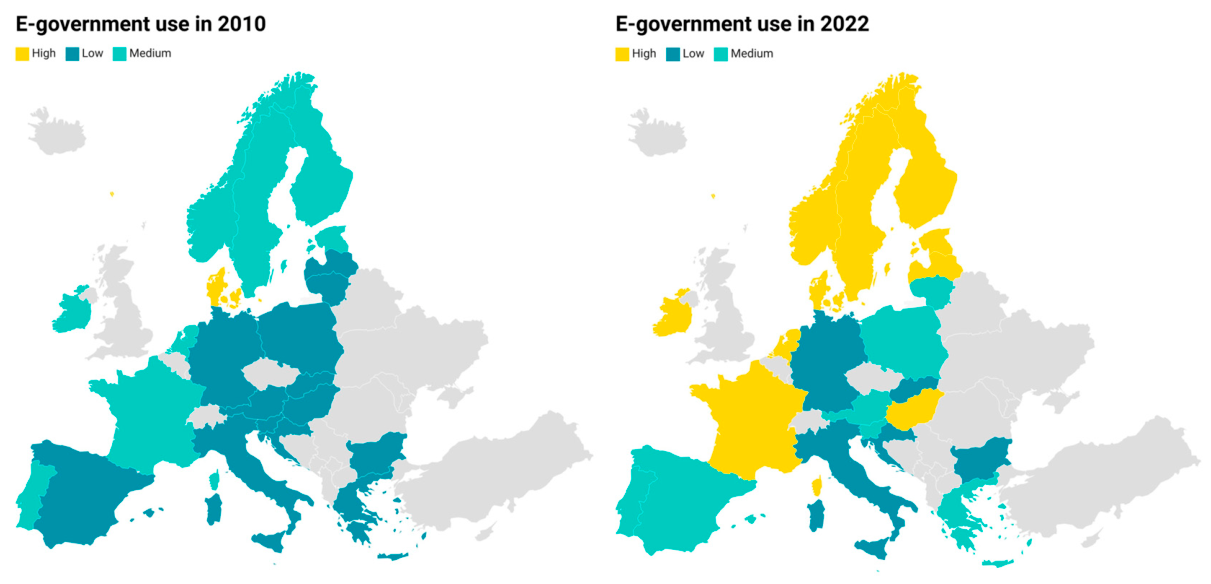
The results reveal clear differences across groups. Countries and observations belonging to the high-use cluster systematically display higher levels of trust in public institutions (TRUST), voice and accountability (VAC), and control of corruption (COC) compared to those of the low-use cluster. In addition, the high-use cluster is characterised by higher income levels and lower unemployment rates.
Figure 1 illustrates the evolution of e-government usage clusters across Europe between 2010 and 2022. The results reveal heterogeneous trajectories across countries. Some countries, such as Hungary and Latvia, moved from the low-use cluster at the beginning of the period to the high-use cluster by 2022, reflecting substantial progress in digital public service adoption. Other countries, including Greece and Luxembourg, followed more unstable trajectories and alternated between clusters during the analysed period.
Overall, the cluster analysis suggests that higher levels of e-government use tend to be associated with stronger institutional and socio-economic outcomes. However, these findings should be interpreted descriptively rather than causally, since the cluster analysis identifies patterns of association rather than causal effects.
Therefore, H4 is supported at a descriptive and exploratory level, as countries and observations characterised by higher levels of e-government use systematically exhibit stronger institutional and socio-economic outcomes.
5. Discussion
The findings of this study indicate that countries characterised by higher levels of e-government use (UEG) tend to exhibit stronger SDG16-related institutional outcomes, although these relationships become substantially weaker once country-specific and temporal heterogeneity are controlled for through fixed effects estimations. More specifically, the panel results suggest that part of the positive association frequently identified between digitalisation and governance quality reflects long-term structural differences across countries rather than rapid within-country institutional transformations over time.
This result represents one of the main contributions of the paper. Previous cross-sectional and pooled analyses commonly report strong positive relationships between e-government development and institutional quality (
Tolbert & Mossberger, 2006;
McNeal et al., 2008;
Pérez-Morote et al., 2020). However, our findings indicate that these relationships become considerably weaker under more demanding panel specifications. In this sense, the study suggests that digitalisation alone is insufficient to generate substantial improvements in governance outcomes unless accompanied by broader institutional, economic, and socio-political conditions.
The results for trust in public institutions (TRUST) illustrate this complexity particularly clearly. While pooled OLS and random effects models initially suggest positive associations between digitalisation variables and institutional trust, these effects weaken substantially once fixed effects are introduced. In the most demanding specifications, unemployment remains one of the most robust predictors of declining institutional trust, highlighting the importance of economic insecurity in shaping citizens’ confidence in public institutions. These findings are consistent with previous studies emphasising the relationship between socio-economic stability and institutional legitimacy (
Kaimuri & Kosimbei, 2017;
Ullah et al., 2022).
The results also provide a more nuanced interpretation of technological variables. E-government use (UEG) does not retain statistical significance in the fixed effects models, suggesting that increases in digital public service use within countries do not automatically translate into higher institutional trust over short periods of time. Similarly, the negative relationship observed between ICT development and TRUST under the two-way fixed effects specification suggests that technological expansion may sometimes coexist with increased citizen scrutiny, political dissatisfaction, or rising institutional expectations. In this regard, the findings nuance optimistic assumptions frequently present in the e-government literature, where digitalisation is often implicitly associated with automatic improvements in governance quality.
Regarding voice and accountability (VAC), the findings suggest that democratic participation and perceptions of accountability remain strongly conditioned by socio-demographic structures. Ageing populations and higher levels of rurality tend to be associated with lower levels of democratic participation and accountability across countries. These findings support previous research emphasising the persistence of socio-demographic barriers to digital inclusion and political participation (
De Toro et al., 2023). More importantly, the absence of robust within-country effects for UEG suggests that digital public services alone may not be sufficient to strengthen democratic engagement unless accompanied by broader policies aimed at inclusion, accessibility, and civic participation.
Similarly, the results for control of corruption (COC) indicate that countries with historically stronger economic and institutional structures tend to exhibit better corruption outcomes overall. However, once country-specific heterogeneity is controlled for, most technological and economic variables lose statistical significance. This finding suggests that the apparent relationship between digitalisation and corruption control observed in simpler specifications is largely structural rather than dynamic. In other words, countries with mature institutional systems also tend to possess more advanced digital infrastructures, but short-term increases in digitalisation do not necessarily produce immediate improvements in corruption control.
The cluster analysis reinforces this interpretation. Countries belonging to the high-use e-government cluster systematically display stronger institutional outcomes, higher income levels, and lower unemployment rates than do countries in the low-use cluster. Nevertheless, the trajectories observed across European countries reveal substantial heterogeneity in the relationship between digitalisation and governance performance.
Countries such as Denmark, Estonia, and the Netherlands consistently combine high levels of e-government use with strong institutional performance, illustrating how digitalisation may reinforce already mature governance systems characterised by high administrative capacity and institutional trust. By contrast, countries such as Hungary and Poland experienced substantial increases in e-government adoption during the analysed period without equivalent improvements across all SDG16 dimensions. These contrasting trajectories suggest that the effectiveness of digitalisation depends not only on technological development itself but also on the institutional and political contexts within which digital reforms are embedded.
The evolution observed after the COVID-19 pandemic further illustrates this complexity. Several European countries accelerated the adoption and use of digital public services during and after the crisis, confirming previous research highlighting the importance of e-government systems for maintaining administrative continuity under conditions of uncertainty (
Hodzic et al., 2021). However, the results also suggest that rapid technological expansion does not necessarily generate proportional improvements in institutional trust, democratic accountability, or corruption control. In some contexts, technological modernisation appears to coexist with political polarisation, institutional instability, or declining democratic confidence.
Overall, the findings contribute to Governance Theory by reinforcing the idea that digital governance should not be understood exclusively as a technological process, but rather as an institutional transformation conditioned by political, economic, and social factors. The study therefore supports perspectives emphasising the co-evolution between technology and institutional quality. E-government can facilitate transparency, participation, and administrative efficiency, but its capacity to strengthen SDG16 ultimately depends on the existence of stable governance structures, institutional accountability, socio-economic stability, and citizen trust.
The study also contributes methodologically to the literature by demonstrating the importance of distinguishing between cross-country structural differences and within-country longitudinal dynamics. The panel data approach adopted in this paper reveals that several relationships frequently identified in cross-sectional analyses weaken substantially once unobserved country-specific heterogeneity is controlled for through fixed effects estimations. This finding highlights the importance of longitudinal approaches when analysing the relationship between digitalisation and governance outcomes in comparative international contexts.
Overall, the findings provide a nuanced answer to the research question proposed in this study. The results indicate that e-government use is positively associated with SDG16-related institutional outcomes, primarily at the structural cross-country level. However, once within-country longitudinal dynamics and unobserved heterogeneity are controlled for, the effects of digitalisation become substantially weaker and more uneven across institutional dimensions. This suggests that digital governance contributes to institutional strengthening mainly when embedded within broader economic, administrative, and political structures capable of sustaining long-term governance quality.
The findings suggest that digitalisation operates less as an autonomous driver of institutional transformation and more as an amplifier of pre-existing governance capacity. In countries characterised by high institutional quality, administrative capacity, and social trust, e-government appears to reinforce already mature governance systems. By contrast, in more politically fragmented or institutionally fragile contexts, digital expansion alone does not necessarily generate proportional improvements in SDG16-related outcomes.
From a policy perspective, the findings suggest that investments in e-government should be accompanied by broader institutional reforms aimed at strengthening accountability, inclusiveness, administrative capacity, and citizen trust. Technological modernisation alone may be insufficient to generate substantial governance improvements without parallel efforts to reinforce democratic and institutional resilience.
6. Conclusions
This study examined the relationship between e-government use and SDG16-related institutional outcomes across 27 European countries during the period of 2010–2022. Using panel data techniques with country and year fixed effects, the analysis explored how technological, economic, and demographic factors influence trust in public institutions, voice and accountability, and control of corruption.
The findings indicate that countries characterised by higher levels of e-government use tend to exhibit stronger institutional performance at the cross-country level. However, the results also demonstrate that these relationships weaken substantially once structural country heterogeneity and common temporal shocks are controlled for through fixed effects estimations. This suggests that the positive association between digitalisation and governance quality observed in cross-sectional analyses is driven, to an important extent, by long-term structural differences across countries rather than by rapid within-country institutional transformations.
More specifically, the results show that the explanatory power of technological variables is heterogeneous across SDG16 dimensions. Digitalisation appears to be more closely associated with institutional trust than with improvements in democratic accountability or corruption control. At the same time, economic conditions—particularly unemployment and broader socio-economic stability—emerge as more robust determinants of governance outcomes than are technological variables alone.
The study also highlights the importance of institutional and contextual heterogeneity across European countries. Countries such as Denmark, Estonia, and the Netherlands consistently combine high levels of e-government use with strong institutional outcomes, suggesting that digitalisation may reinforce already mature governance systems characterised by administrative capacity, institutional trust, and stable governance structures. By contrast, other countries experienced substantial digital expansion without equivalent improvements across all SDG16 dimensions, illustrating that technological modernisation does not automatically generate stronger democratic or institutional performance.
These findings contribute to Governance Theory by reinforcing the idea that digital governance should be understood not merely as a technological transformation, but as a broader institutional process conditioned by political, economic, and social factors. In this sense, the study supports perspectives emphasising the co-evolution between digitalisation and institutional quality, while also questioning deterministic assumptions that equate technological adoption with automatic governance improvements.
The study also provides an important methodological contribution. By comparing pooled OLS, random effects, and fixed effects estimations, the analysis demonstrates the importance of distinguishing between cross-country structural differences and within-country longitudinal dynamics. Several relationships that appear statistically significant in simpler specifications become substantially weaker once unobserved country-specific heterogeneity is controlled for, highlighting the importance of longitudinal panel approaches in comparative governance research.
From a policy perspective, the findings suggest that investments in e-government should be accompanied by broader institutional reforms aimed at strengthening accountability, transparency, inclusiveness, administrative capacity, and citizen trust. Digitalisation alone is unlikely to generate substantial governance improvements unless embedded within stable institutional frameworks capable of supporting democratic resilience and effective public administration.
Finally, the study is subject to several limitations. The analysis focuses exclusively on European countries and does not explicitly incorporate variables related to political polarisation, social media influence, or institutional fragmentation, all of which may affect the relationship between e-government and SDG16 outcomes. In addition, the exploratory cluster analysis is based on a single digitalisation indicator and therefore should not be interpreted as evidence of causal or multidimensional country typologies. Future research could expand the analysis to other geographical contexts and explore interaction or moderation effects to better understand the institutional conditions under which e-government contributes more effectively to sustainable governance outcomes.



 ,
,