


Abstract
The aim of the paper is to precisely identify the impact of regulatory quality and the rule of law on business demographic dynamics in European countries during the 2015–2024 period. The first aim is to provide a theoretical approach by reviewing aspects of the regulatory system in European countries and the most relevant studies on the issue. The second aim is to develop a linear regression model to evaluate the roles of regulatory quality and the rule of law during periods of economic volatility and changing business demographics in European Countries. The OLS estimation technique for panel data models will be chosen. The results support the hypothesis of an institutional convergence effect, indicating that regulatory quality and the rule of law significantly enhance net firm performance creation, but this impact is conditional on the level of economic development. The paper offers a useful perspective on the complex relationship between regulatory quality and the rule of law in advancing business demographics and promoting performance in the business environment, thereby adding to the existing literature.
1. Introduction
Government institutions, in themselves, represent the “rules of the game,” and in this context, regulatory quality and rule of law create certainty and sustainability in the business environment. Regulatory quality measures the government’s ability to formulate and implement policies that enable and promote private sector development. The Rule of Law measures how well the law is respected in a country and how much trust people have in the governance system. Under the rule of law, all public powers always act within the constraints set out by law, in accordance with the values of democracy and fundamental rights, and under the control of independent and impartial courts (European Commission, 2026b).
The rule of law and regulatory quality create the basis for a healthy economic climate in democratic countries. The volatility of the business start-up/registration index is influenced by legislative changes and the administrative capacity of state institutions to enforce them. Unpredictable governance (frequent changes to tax codes and, more generally, laws) will increase volatility in business registrations, regardless of the broader economic cycle. Good rules without proper enforcement led to chaos, and strict enforcement of bad rules stifles economic initiative. Only the combination of quality regulations and a solid rule of law can support investment, business development, and long-term economic growth. The approach to the legal framework must be coherent at the national level, aligned with public policies, and harmonized at the international level. If well-designed and implemented, rules can provide certainty and enable well-functioning markets, supporting fair competition and fostering investor and consumer confidence (OECD, 2025).
Present-day and future Europe seeks to leverage regulatory quality and the rule of law to achieve more sustainable economic development by creating a mature business environment. In this context, regulatory quality and the rule of law satisfy the identity requirements of each business, ensuring its conservation and development, thereby, from an economic perspective, leading to faster economic growth. Achieving these goals requires developing theoretical and empirical research that examines the connections among regulatory quality, the rule of law, and business demographic dynamics.
The literature offers some answers to these relationships by establishing a positive effect of regulation quality and the rule of law, but it has not determined whether these relationships are influenced by the level of economic development, specifically, the marginal effect of regulation in European countries, which became a priority for us.
This paper explores the impact of regulatory quality and the rule of law on business demographic dynamics in European countries from 2015 to 2024. For the analysis, 21 European countries were selected based on the available database for the 2015–2024 period. The variables were identified through a comprehensive literature review. The novelty of the study is that it shows how the role of institutions fundamentally changes with economic development, shifting from a driver of growth (in Eastern European countries) to a more established mechanism (in Western European countries), highlighting a marginal effect. This research’s primary hypothesis and central question propose that regulatory quality and the rule of law positively influence the net business rate. Additionally, this impact depends on the level of economic development. In brief, the working hypotheses include:
H1.
The rule of law and regulatory quality positively influence business demographic dynamics.
H2.
There is an institutional convergence effect: the quality of regulation and rule of law greatly encourages net firm creation, but this effect depends on the level of economic development.
The paper is structured as follows: Section 2 provides an overview of the literature and the quality of regulation; Section 3 describes the method, variables, and data sources; Section 4 summarizes the results of the empirical study conducted on European countries, over the 2015–2024 period, and Section 5 discusses the results and how they can be interpreted from the perspective of previous studies and of the working hypotheses of our study. The paper ends with conclusions and references.
2. An Overview of the Literature and Regulation
Studies based on theoretical approaches and empirical findings have yielded mixed results regarding the impact of regulatory quality and the rule of law on the business environment or entrepreneurial dynamics.
Most studies view institutions as key drivers of entrepreneurship and economic growth (Agostino et al., 2020; Rodríguez-Pose, 2013; Rodríguez-Pose & Di Cataldo, 2015; D’Ingiullo et al., 2023). In particular, regulatory quality is seen as an important factor shaping the business environment (Bjørnskov & Foss, 2008; Van Stel et al., 2007). La Porta et al. (1997) showed that the legal environment significantly influences a country’s capital market size and scope. In 2002, La Porta et al. explained that investor legal protection is a key factor in financial market development. Claessens and Yurtoglu (2013) found that shareholder rights are less clearly defined in transition economies than in emerging markets and developed nations, and that stronger legal frameworks for creditor and shareholder rights are associated with more developed, deeper capital markets. Parker (1999) argued that an effective regulatory system must balance accountability, transparency, and consistency. Among these, consistency is particularly crucial, as it underpins public trust in regulation.
Beyond regulatory quality, studies show that the rule of law reduces uncertainty and transaction costs, supports production and trade, and promotes human capital development (Rodrik et al., 2004), enhances mutual trust and social capital (Efendic et al., 2015), attracts ambitious high-growth companies (Estrin et al., 2013), or encourages firms to operate more extensively with long-term planning (Aron, 2000). Álvarez et al. (2014) found that entrepreneurship legislation has a positive and significant impact on entrepreneurship across all 49 countries analyzed, but that the impact on entrepreneurial activity varies with a country’s level of economic development.
Roman and Rusu (2021) analyzed the relationship between business regulations and entrepreneurship, and examined how specific areas of business regulation affect the dynamics of new firm formation in 22 European countries from 2003 to 2019, using panel-data estimation techniques. The empirical results showed that not all areas of business regulation significantly affect new firm creation; only regulations on starting a business, registering property, and enforcing contracts are the most significant predictors of new firm formation in the European countries analyzed. At the same time, Elert et al. (2019) emphasize for the European Union countries that, to promote an entrepreneurial society, there is no substitute but to ensure that these foundational institutions are of high quality and operate effectively throughout the European Union based on the rule of law and regulatory quality.
Agostino et al. (2020) examined how institutions influence new business creation across Italian provinces from 2004 to 2012 and found that higher local institutional quality encourages new entries, especially in high-tech sectors, where the rule of law is particularly crucial in lagging southern regions, whereas regulatory quality is more influential in the more developed center–north. During economic downturns, the significance of institutional quality decreases, with entries becoming more affected by tendencies to innovate and by levels of human capital and infrastructure. The rule of law (the security of the legal framework) reduces uncertainty in contracts, promotes and improves transaction efficiency, and produces positive spillover effects. D’Ingiullo et al. (2024) examined the factors influencing economic development and productivity through an empirical analysis of how institutional quality affects export-related economic complexity within Italy. The study analyzed 103 provinces from 2004 to 2016 using System-GMM estimators, and the results showed that institutional quality (especially rule of law, regulatory quality, and voice and accountability) plays an essential role in enhancing economic complexity.
Lim et al. (2026), analyzing the effects of International Financial Reporting Standard 9 (IFRS 9) adoption and the moderating role of rule of law on earnings volatility of banks using Generalized Method of Moments (GMM), emphasize that countries with weaker institutions (rule of law) need to adopt stricter accounting standards, and these frameworks must effectively limit opportunistic earnings manipulation to significantly reduce earnings volatility. The greater role of the rule of law in entrepreneurship in developing and middle-income economies, compared to highly developed economies, was also identified by Aidis et al. (2009), who found that an effective regulatory framework is the most crucial institutional factor for entrepreneurship.
Some studies report mixed results; for example, Demirdag and Eraydin (2024) examined four regions in Turkey to understand how institutions influence different entrepreneurial pathways. The study highlighted the importance of normative and culture-cognitive institutions. It also revealed that government policies aimed at promoting entrepreneurship do not always have a positive effect; in some regions, they can even hinder innovative entrepreneurship. The literature (Alesina et al., 2003; World Bank, 2012) points out that excessively abundant regulation may create de facto barriers to otherwise competitive markets and even discourage investment and entry. Other studies, such as Soleimanof et al. (2025), found that stricter rule of law exacerbates the detrimental effects of cronyism (such as nepotism, awarding contracts based on connections, and appointing associates to key positions) on entrepreneurial productivity. However, Jalilian et al. (2007) argue that market regulation may not improve welfare relative to the economic outcome under imperfect market conditions, where information asymmetries can lead to imperfect regulation.
Institutions, through their functions, oversee various aspects, including fundamental trade laws, the enforcement of agreements and contracts (which promotes economic growth), and the overall protection of rights, insolvency, and bankruptcies. Debates on the resolution of small- and medium-sized enterprise (SME) insolvencies have attracted attention and criticism across countries (Lu, 2018; Gurrea-Martínez, 2021; Mrockova, 2022; Kavitha, 2022; Nsubuga, 2026). Gurrea-Martínez (2021) notes that the lack of an adequate insolvency framework for MSMEs can entail various costs for society, and we add that the entire legal framework governing MSMEs must be appropriate to the country’s economic context, complemented by efficient administrative capacity. The OECD (2025) observations on the enforcement of regulations, respectively, on the implementation of rules in European Union countries, are still less frequently addressed in better regulation strategies, creating potential gaps in the rulemaking cycle.
A closer examination of the quality of individual better regulation tools reveals that significant gaps still exist in the institutional foundations necessary to ensure their proper implementation, consistent with findings from the previous report (OECD, 2022). Most countries have a government body outside the ministry responsible for developing a draft regulatory impact assessment and reviewing its quality for primary legislation (Business Europe, 2018). Romania established the technical secretariat of the Consultative Council for the Impact Assessment of Normative Acts (CCEIAN) in 2022. In 11 European Union countries and at the EU level through the European Commission’s Regulatory Scrutiny Board, a regulatory oversight body can return a regulatory impact assessment for revision if deemed inadequate, thereby providing a gatekeeping function. In all these cases, the regulatory oversight body may return the regulatory impact assessment on the grounds of inadequate consultation. For ex post evaluation, quality control remains less developed. Since the last report, only Slovakia and Romania have assigned such responsibilities to a body outside the unit conducting the ex-post evaluation, bringing the total to 8 European Union countries. Enhancing oversight in these areas is crucial to fostering more consistent and effective use of better regulation tools. OECD (2025) concludes that monitoring and evaluating better regulation tools remain largely underdeveloped in European Union countries.
OECD (2025) identifies the following as powerful tools to unlock innovation and resilient growth and secure long-term prosperity: (i) keeping rules simple, streamlined, and proportionate; and (ii) cutting excessive burdens in existing legislation. The availability of a well-regulated financial system and access to financial services and products is a key factor that motivates business owners to effectively plan, manage and balance their income and expenses and to manage their current and expected financial and business risks in order to enhance business growth and productivity, especially in the SME sector (Laeven et al., 2008; Nsubuga, 2026). Performance-based regulation is a key lever for effective regulatory enforcement, enabling regulated entities, such as businesses, to comply with laws efficiently (Hodges, 2022).
In 2016, the European Parliament, Council, and Commission finalized an Interinstitutional Agreement on Better Law-Making (published in the Official Journal of the European Union, L 123, 12 May 2016). Through its ‘better regulation’ policy, the Commission has committed to designing, delivering, and supporting the implementation of high-quality policies (European Commission, 2023). Since 2021, a few countries have implemented key reforms to evaluation frameworks, resulting in significant improvements across all dimensions (OECD, 2025). Finland introduced its first policy on ex post evaluation in 2023, setting out shared principles for monitoring and assessing national laws, state treaties, and EU regulations. This policy created a new ex post evaluation methodology and processes, complemented by a dedicated website. Lithuania established legal rules for ex post evaluation via a subordinate regulation. The methodology outlines formal requirements—covering when ex post evaluation is obligatory and how related legal provisions should be drafted—along with the process from preparation to report publication and the roles and responsibilities of various stakeholders’ bodies. Romania established a fundamental ex post evaluation framework with Government Decision 443/2022, which mandates that public authorities assess the effectiveness and efficiency of emergency ordinances two years after their implementation. Additionally, the decision enhanced transparency by allowing for judicial reviews of current regulations. In 2022, the Slovak Republic developed a Unified Methodology to assess existing regulations, set guidelines, requirements, and oversight duties. This methodology ensures that the relevant ministry or agency systematically reviews both primary laws and subordinate regulations. Additionally, Slovakia improved transparency by requiring consultations during ex post evaluations. In December 2022, Spain implemented legislation (Law 27/2022) to institutionalize public policy evaluation within the General State Administration. It also provides a methodology for assessing additional costs, benefits, and impacts. Furthermore, the law establishes a national agency responsible for both ex ante and ex post evaluations of public policies.
3. Data and Methods
This study examines the roles of regulatory quality and the rule of law during periods of economic volatility and changing business demographics in European countries. Our analysis covers 21 European countries (Belgium, Bulgaria, Croatia, Denmark, Estonia, France, Germany, Iceland, Italy, Latvia, Lithuania, Luxembourg, Malta, Netherlands, Norway, Poland, Portugal, Romania, Slovakia, Slovenia, and Spain) over the 2015–2024 period, and the chosen period is justified by the availability of official World Bank (2025, 2026) and European Commission (2026a) databases. For empirical evidence, the Ordinary Least Squares (OLS) model was selected, employing a robust option to estimate standard errors with the Huber–White sandwich estimator. The estimated coefficients for the country-related dummy variables express the differential effect of each country compared to the reference country, which in our case is Belgium.
The regression model for model 1 (M1) and model 3 (M3) is:
where
= the dependent variable for country (), t refers to the year ();
= explanatory variables;
= intercept;
= slope;
= idiosyncratic error.n
To identify whether the impact of regulation is greater in poorer countries than in richer ones, we will use the interaction effect. Calculating the inflection point (or, more precisely, the threshold/break-even point) in an interaction model is essential as it indicates the level of wealth at which the impact of the quality of regulation or rule of law cancels out or changes its nature. The regression model with interactions for model 2 (M2) and model 4 (M4) is:
Model 2:
Model 4:
The research paper will run multiple OLS regressions because the relationship between the dependent variable and the explanatory variables can be approximated linearly. It will use a robust option for estimating standard errors with the Huber–White sandwich estimator, with the net business rate (net entry/exit rate: Registrations minus Bankruptcies) as the dependent variable. Independent variables include regulatory quality, which assesses the content and effectiveness of these rules, and the rule of law, which refers to compliance with existing rules, as measured by indicators developed by the World Bank (2025) using the Kaufmann and Kraay (2024) methodology. Also, the model includes GDP per capita (gdp_pc), which is the most widely used indicator of economic development (An et al., 2024; Zheng & Wong, 2024). The variables are detailed in Table 1.
Table 1.
The variables included in the analysis.
Table 2, Table 3, Table 4 and Table 5 provide descriptive statistics for the variables included in the models for the 21 European countries, examining the roles of regulatory quality and the rule of law during periods of economic volatility and changing business demographics over 2015–2024.
Table 2.
Pairwise correlations for models 1 and 3.
Table 3.
Pairwise correlations for models 2 and 4.
Table 4.
Summary statistics for models 1 and 3.
Table 5.
Summary statistics for models 2 and 4.
We employed a robust option for estimating standard errors using the Huber–White sandwich estimators. These robust standard errors address minor concerns about violations of assumptions, such as slight issues with normality, heteroscedasticity, or observations with large residuals, leverage, or influence. For such minor problems, the robust option effectively addresses them. With this approach, the point estimates of the coefficients remain the same as in regular OLS, but the standard errors account for heterogeneity and potential normality issues. The model is considered robust because it does not display severe multicollinearity either. We assessed multicollinearity using the variance inflation factor (VIF), which showed values of 6.30 for regressions 1 and 2, and 7.38 for regressions 3 and 4, both below 10.
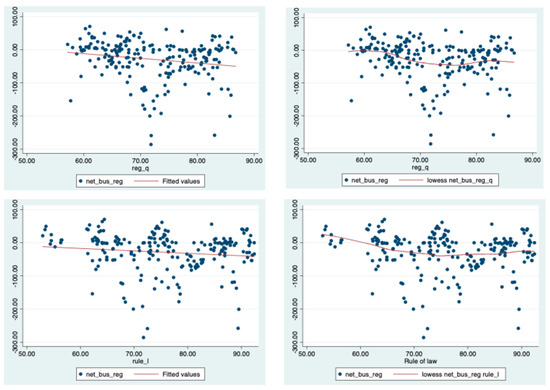
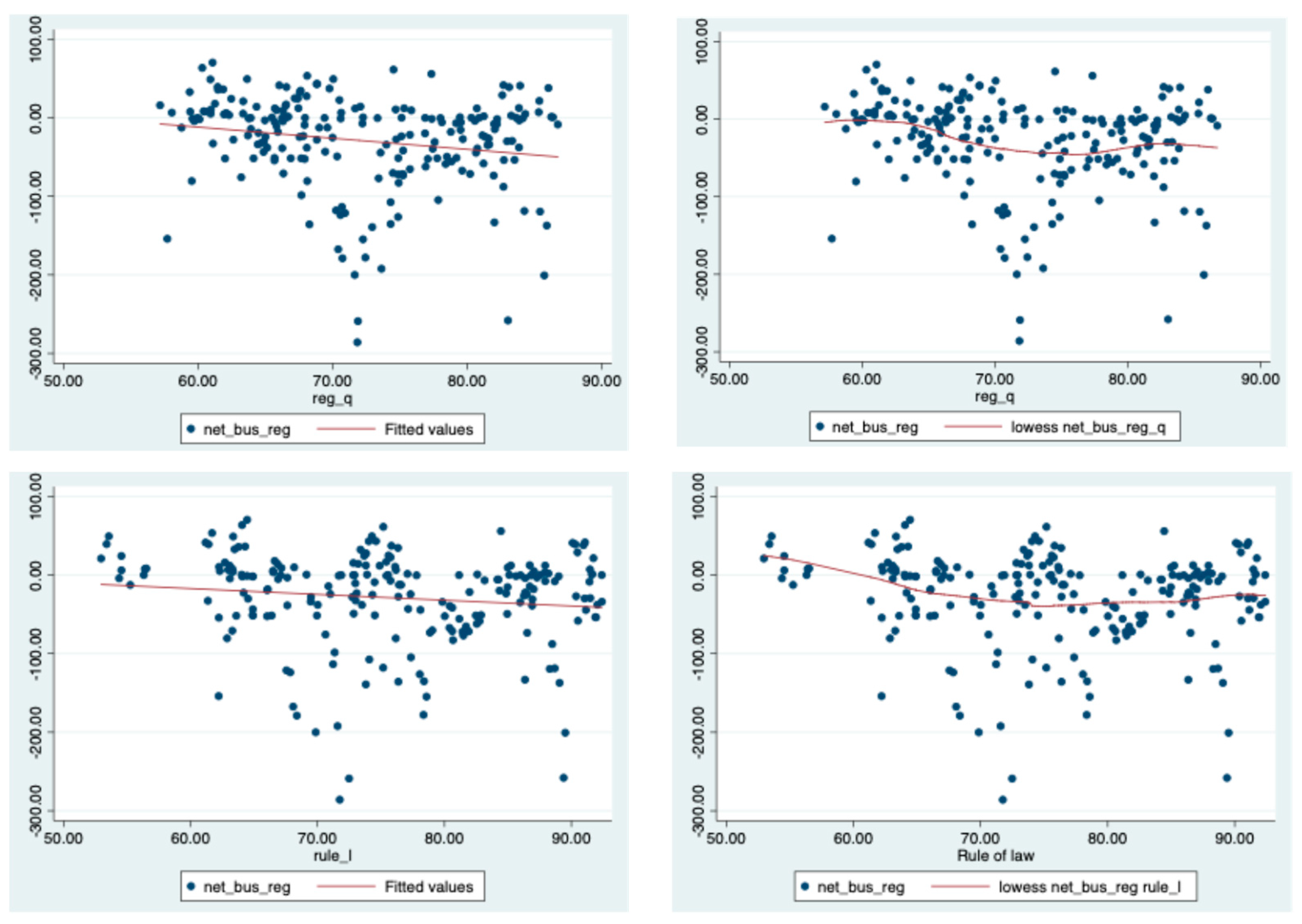
The scatter plot in Figure 1 indicates that the relationship can be approximated linearly, as no clear nonlinear pattern is observed, justifying the use of the OLS model. The estimated regression line suggests a weak linear relationship with considerable dispersion of observations around it, supporting the application of OLS regression. Graphical analysis with a LOWESS curve indicates a slightly nonlinear relationship, but the deviation from linearity is not significant, so the OLS model remains a reasonable approximation. The estimated coefficients for the country-related dummy variables express the differential effect of each country compared to the reference country, which in our case is Belgium.
Figure 1.
Scatter plot analysis. Source: Computed by the authors using Stata 14.2.
4. Findings
The results of the regression analysis are summarized in Table 6.
Table 6.
The results of the regression analysis.
We conducted four OLS regressions because the relationship between the dependent variable and the explanatory variables can be approximated as linear. Additionally, we employed a robust method for estimating standard errors using the Huber–White sandwich estimator. The models (M1–M4) explain between 54% and 58% of the variation in business demographics, a statistically significant result that supports both hypotheses of our research. Both explanatory variables, regulatory quality and rule of law, have a positive and highly significant impact on the net business rate. The first country, Belgium, is omitted from all four models to avoid perfect collinearity between the intercept and dummies, as is standard practice in regression with categorical variables, which is equivalent to including a fixed effect for the country.
The level of economic development, measured by GDP per capita, is a consistent predictor across all models, showing a positive and statistically significant relationship, which indicates that growth in GDP per capita encourages net business registrations.
By controlling for cross-sectional heterogeneity (country fixed effects) and the level of economic development (GDP per capita), the impact of regulatory quality and the rule of law on business demographics becomes significant, highlighting notable differences between countries with positive signs (Bulgaria, Croatia, Estonia, Italy, Latvia, Malta, Poland, Portugal, Romania, Slovakia, Slovenia, and Spain) and negative signs (Luxembourg for models with interactions, the Netherlands, and Norway). Some countries show no significant signs: positive for Germany, Denmark (for three of the models, excluding the one with impact on the rule of law without interactions), and Lithuania; negative for France (for three of the models, excluding the one with impact on the rule of law without interactions), and Luxembourg for models without interactions.
We note that models 2 and 4, which include interaction effects, are much more significant in explaining variation in business demographics. The interaction coefficient in model 2 (M2) c.reg_q#c.gdp_pc is negative (−0.00019) and highly significant, providing statistical evidence of “diminishing institutional returns.” Similarly, in model 4 (M4), c.rule_l#c.gdp_pc is negative (−0.00012) and highly significant.
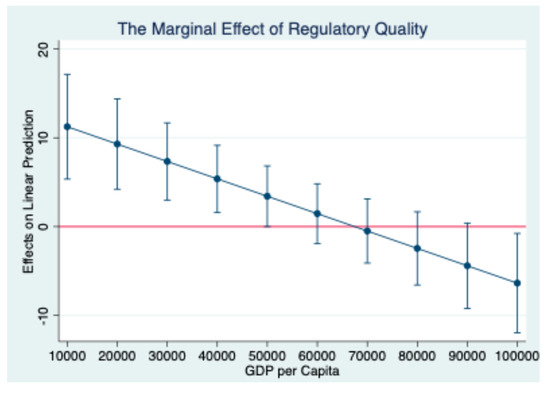
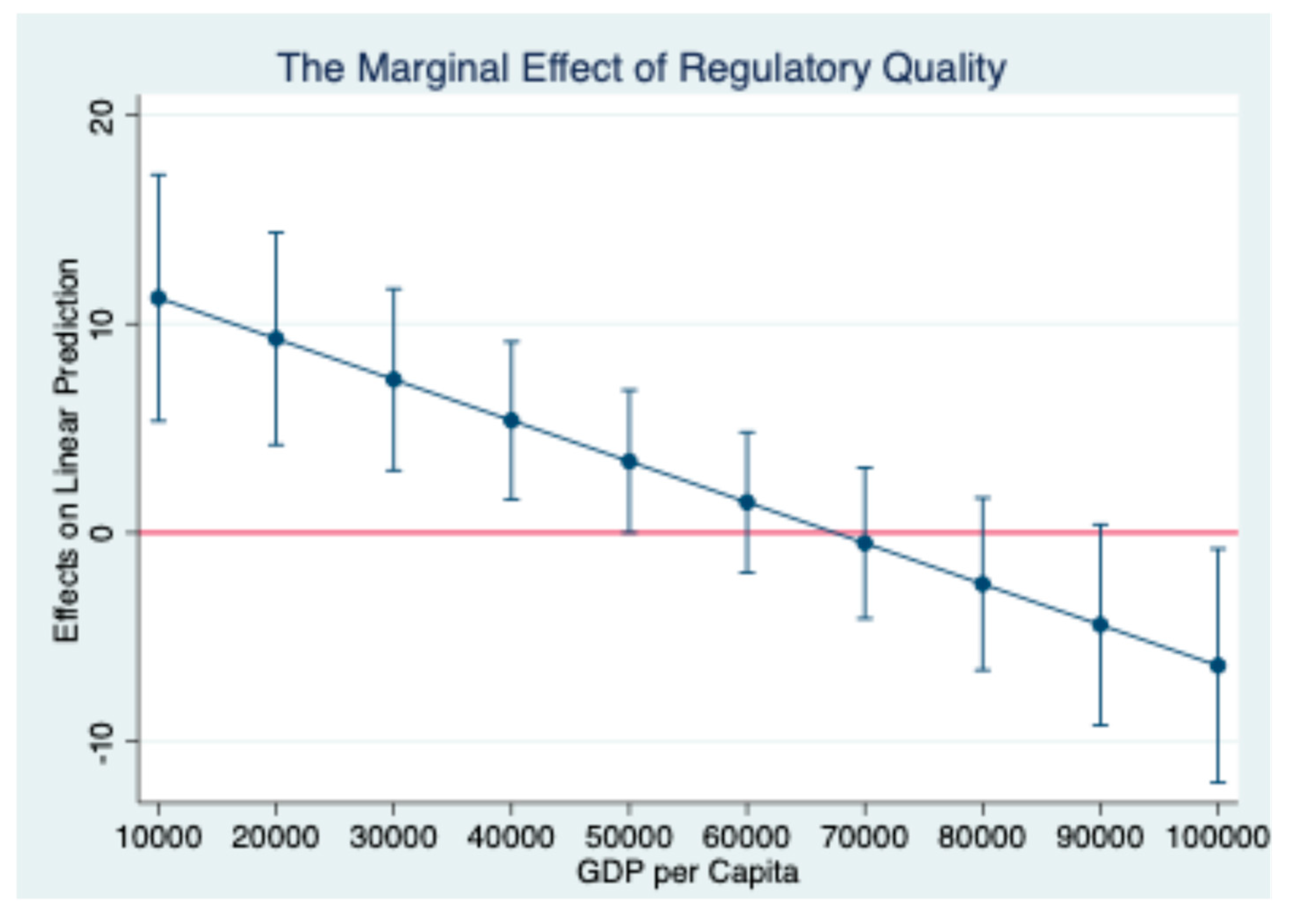
Considering these cross-country differences, it is important to assess the marginal effects of regulatory quality and the rule of law. Figure 2 illustrates the marginal effect of regulation.
Figure 2.
Marginal effect of regulatory quality. Source: Computed by the authors using Stata 14.2.
Figure 2 shows a downward-sloping line that intersects the zero axis at approximately 67,000 US dollars. For Romania (GDP per capita approx. 15,000 US dollars), the marginal effect is high (approx. +10.2). For a country with a GDP per capita of 67,000 US dollars, the effect becomes zero. Above this threshold, quality regulations begin to favor consolidation and efficiency over the net number of firms.
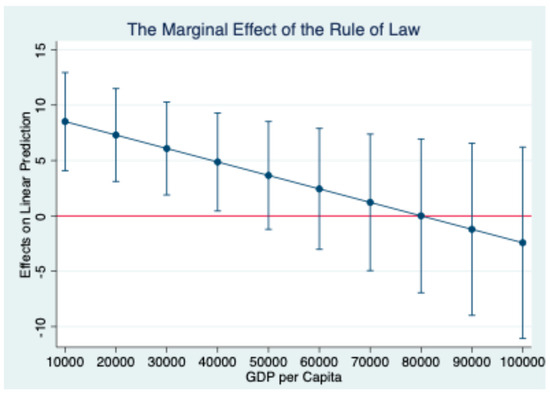
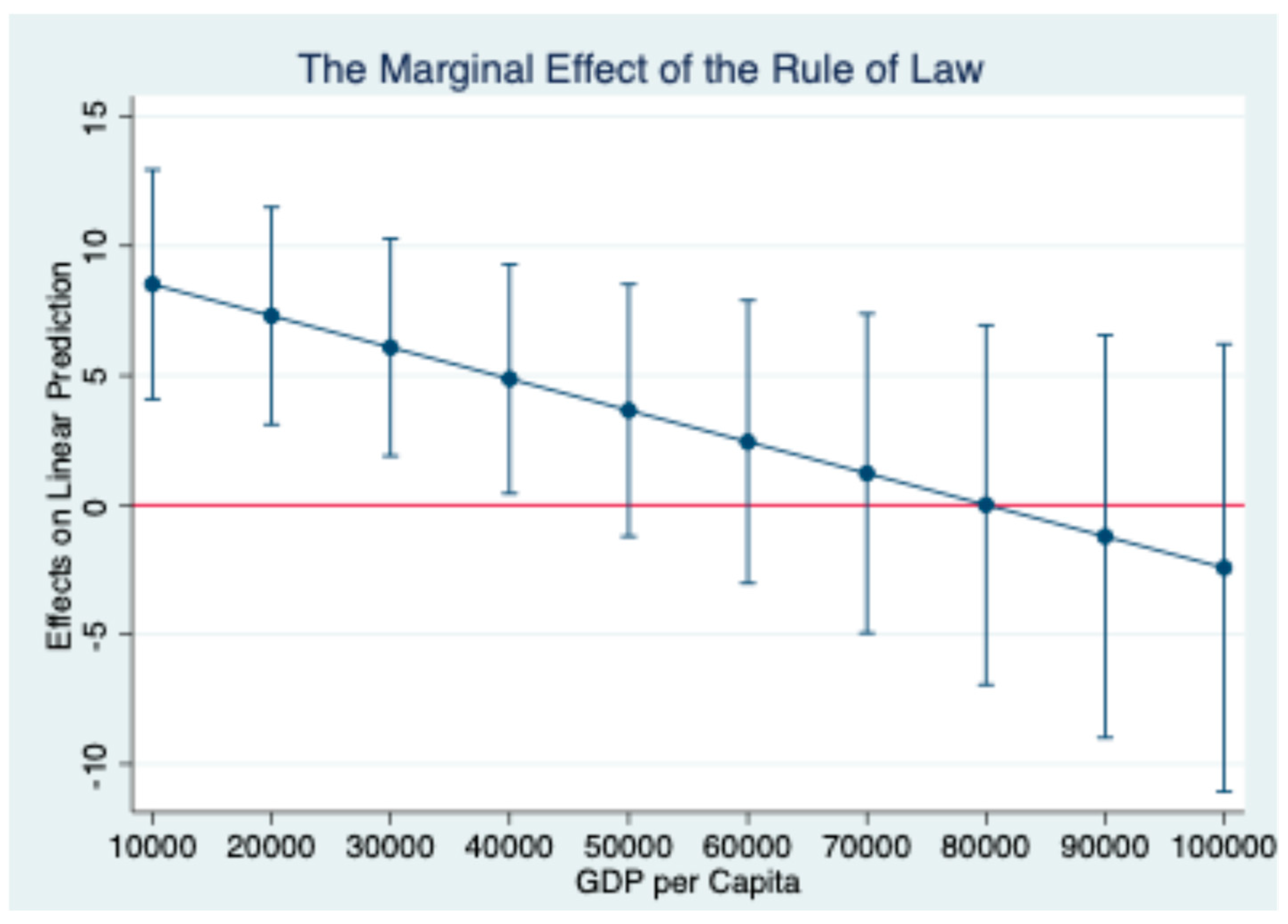
The marginal effect of the rule of law is shown in Figure 3.
Figure 3.
Marginal effect of rule of law. Source: Computed by the authors using Stata 14.2.
Figure 3 displays a downward-sloping line that intersects the zero point at roughly $80,000 US dollars. In Romania, with a GDP per capita around $15,000, the marginal effect is significant, approximately +8. For countries with a GDP per capita of $80,000, the effect drops to zero. Beyond this threshold, the rule of law tends to support consolidation and efficiency instead of focusing on the total number of firms.
5. Discussion
The study aimed to examine the roles of regulatory quality and the rule of law during periods of economic volatility and changing business demographics in European countries. It was based on two hypotheses: the first being that the rule of law and regulatory quality positively influence business demographic dynamics, and the second suggesting there is an institutional convergence effect. Specifically, the quality of regulation and the rule of law greatly encourage net firm creation, but this effect depends on the level of economic development. These results support both hypotheses, which we will explore further in this section.
The first model (M1) explains over 54% of the variation in business demographics, indicating that differences in countries’ culture, history, and geography, as well as governance and wealth, account for more than half of the phenomenon. Regulatory quality (+2.69) has a positive and strongly significant impact on the net business rate. This suggests that within the same country, regulatory improvements promote net growth registrations and confirm hypothesis 1, consistent with the literature (Bjørnskov & Foss, 2008; Van Stel et al., 2007; La Porta et al., 1997, 2002; Agostino et al., 2020). In highly developed countries, better institutions generate economic dynamism because markets are saturated. The level of economic development, as reflected by GDP per capita (+3.85), is a highly accurate predictor (An et al., 2024; Zheng & Wong, 2024), and growth in GDP per capita supports net business registrations.
By controlling for cross-sectional heterogeneity (country fixed effects) and the level of economic development (GDP per capita), the influence of regulatory quality on business demographics becomes positive and significant. This result indicates that institutional reforms targeting regulatory quality act as a growth engine for the entrepreneurial environment. The model explains 54.4% of the variation in the net index, while highlighting major differences between emerging countries (such as Romania and Bulgaria), which exhibit above-average firm-creation dynamics, and mature economies (the Netherlands and Luxembourg), where market consolidation dominates the demographic landscape. These results support hypothesis two, and further discussion is necessary. We note that the analysis of differences between countries shows that Romania (+221.39) and Bulgaria (+219.96) have the highest net business rates. This indicates that, relative to their level of governance and GDP, these countries have a much higher entrepreneurial “efference” than the European Union average, probably due to the economic recovery or catch-up process. In a factor-driven economy characterized by low levels of development, start-ups (new-business creation) are common because there are limited alternatives to shop-keeping, making self-employment a significant part of the economy (Wennekers et al., 2005; Anokhin & Wincent, 2012). According to Rangelova and Sariiski (2019), Bulgaria’s reform efforts have predominantly centered on granting special privileges to businesses rather than fostering a fair market and a more equitable distribution of value added among economic agents. Meanwhile, Romania prioritized strengthening its institutional framework before implementing other policies to improve competitiveness and create a more attractive investment climate (Rangelova & Sariiski, 2019). However, mature economies have negative coefficients, including the Netherlands (−111.3), Luxembourg (−130.0), and Norway (−84.5), indicating significant negative net rates. This confirms that in highly developed economies, the market is so consolidated that exits (bankruptcies/mergers) surpass entries. At the next stage of development, characterized by an efficiency-driven or investment-driven economy, countries tend to produce more complex products and services rather than creating new companies, where new entrants are less likely to introduce significant innovation (Schwab et al., 2001; Anokhin & Wincent, 2012). As nations advance to the third stage of economic development, characterized by an innovation-driven economy and increasing R&D per capita, they rapidly develop absorptive capacity, which enhances the likelihood and success of innovation. In this phase, countries gather entrepreneurial capital (Audretsch & Keilbach, 2004) and may be referred to as “entrepreneurial economies” (Audretsch & Thurik, 2001).
Model 2 (M2) with interaction effects explains over 57% of the variation in business demographics. The interaction coefficient (c.reg_q#c.gdp_pc) is negative and highly significant, which is statistical evidence of “diminishing institutional returns.” As a country becomes richer (gdp_pc increases), the positive impact of regulatory quality on net business registrations decreases. The “engine” effect of Regulation (reg_q) is evident, as it increased from 4.83 to 13.19, which is extremely significant because it represents the impact of regulation in countries with a hypothetical zero level of development. It shows that institutions have a huge potential to generate economic dynamism, much greater than what the simple model suggested.
The country analysis (fixed effects for the country) reflects a recalibration based on this interaction. In the case of Romania (+322.34) and Bulgaria (+325.87), the values have increased significantly. In emerging countries like Romania, implementing quality reform often leads to a significant surge in new development firms. In rich countries (such as Luxembourg or the Netherlands), the market is already so structured and mature that improved regulation can no longer generate the same volume of net inflows, but emphasizes innovation to produce more complex products (Schwab et al., 2001; Anokhin & Wincent, 2012). This suggests that these countries are the “ideal beneficiaries” of the combination of developing institutions and untapped market potential. In the case of Luxembourg (−55.30), although the coefficient is negative, its significance has decreased, indicating that the interaction model now better explains why business demographics in rich countries differ. Thus, it is not that the country is “weak”, but rather the wealth-institutions interaction mechanism.
The study shows an institutional convergence effect: the quality of regulation strongly influences net firm performance creation; however, this impact is conditional on the level of economic development, which confirms hypothesis 2. The results indicate a negative interaction coefficient, suggesting that the benefits of governance reforms are maximized in emerging economies (e.g., Romania, Bulgaria), whereas in mature economies, the same indicators correlate with market consolidation. The inflection point occurs at roughly 67,000 U.S. dollars (see Figure 2), where a country with a GDP per capita of above this level experiences no effect. Beyond this level, quality regulations tend to promote consolidation and efficiency rather than increase the total number of firms.
Model 3 (M3) explains 57% of the variation in business demographics, with the rule of law positively and significantly associated with entrepreneurship, confirming hypothesis 1, consistent with the literature (Rodrik et al., 2004; Efendic et al., 2015; Estrin et al., 2013; Aron, 2000; Álvarez et al., 2014; Agostino et al., 2020; D’Ingiullo et al., 2024). The level of economic development, measured by GDP per capita (+0.0019), has a positive and highly significant effect, suggesting that a wealthier economy fosters greater business dynamism, as also noted by Álvarez et al. (2014).
In model 4 (M4) with an interaction effect (c.rule_l#c.gdp_pc), the interaction coefficient is negative and highly significant, and explains over 58% of the variation in business demographics, fundamentally changing the interpretation by accounting for not only individual effects but also the rule-of-law impact as a function of a country’s wealth level. As a country becomes richer (gdp_pc increases), the positive impact of the rule of law on business registrations becomes weaker.
In impoverished or developing nations, enhancements to the legal framework significantly support the growth of new businesses. In already very rich countries, the rule of law is already at a high level, and an additional unit of “Rule of Law” no longer generates the same spectacular jump in entrepreneurship. Rule of law registers an increase from +7.34 (M3) to +9.73 (M4), confirming that institutions matter enormously in the early stages of development. GDP per capita is positive and significant (+0.0117) and reflects the impact of wealth when the Rule of Law index is zero.
At the country level, Luxembourg and Norway have insignificant coefficients, which demonstrates that in the previous model (M3), those countries seemed to perform poorly only because the interaction between their wealth and the rule of law was not taken into account, but once the interaction is introduced, these rich and developed countries are explained by the model. In model 4 (M4), the negative interaction suggests a convergence phenomenon, namely that the rule of law helps businesses most in countries that have not yet reached a very high standard of living and start-ups (new business creation) are common (Wennekers et al., 2005; Anokhin & Wincent, 2012). In this context, we note that Bulgaria (+362) and Romania (+282) are at the top of the net registration dynamics with high coefficients, suggesting a strong entrepreneurial magnetism that goes beyond what standard macroeconomic indicators can explain. In very rich countries (such as the Netherlands or Norway), where the rule of law is already well established, incremental improvements in the rule of law have a much smaller impact on business registration dynamics than in countries like Romania or Bulgaria. According to the model, in mature economies, other variables (such as innovation or the cost of capital) become more relevant than fine variations in the Rule of Law index (Gillanders & Whelan, 2014). The inflection point is at approximately 80,000 US dollars (see Figure 3). The Eastern European cluster (Romania, Bulgaria, Slovakia, Croatia, and Poland) benefits the most from this model. With an average GDP per capita and a strengthening rule of law, they are in the “high return” zone of Figure 3, explaining their large positive coefficients in the regression and confirming hypothesis two.
In conclusion, these results are consistent with hypothesis 1, regarding the greater role of the rule of law and regulatory quality in entrepreneurship, in general (Bjørnskov & Foss, 2008; Van Stel et al., 2007; La Porta et al., 1997, 2002; Agostino et al., 2020), and are also in line with hypothesis: regulations may have a different impact on entrepreneurial activity according to a country’s economic development (Aidis et al., 2009; Álvarez et al., 2014; Wennekers et al., 2005; Anokhin & Wincent, 2012; Audretsch & Keilbach, 2004; Audretsch & Thurik, 2001).
6. Conclusions
This study addresses the primary hypothesis and central question by examining how regulatory quality and the rule of law influence the business environment in a sample of 21 European countries from 2015 to 2024, using an OLS model with a robust option to estimate standard errors through the Huber–White sandwich estimator. The findings confirmed both hypotheses, highlighting that institutional reforms, regulatory quality, and rule of law are important for maintaining healthy business demographics, which is in accordance with the literature (Agostino et al., 2020; Rodríguez-Pose, 2013; Rodríguez-Pose & Di Cataldo, 2015; D’Ingiullo et al., 2023; Bjørnskov & Foss, 2008; Van Stel et al., 2007; Rodrik et al., 2004; Efendic et al., 2015; Estrin et al., 2013; Aron, 2000), and more importantly, the greater role of the rule of law and regulatory quality in entrepreneurship in developing and middle-income economies, compared to highly developed economies (Aidis et al., 2009; Álvarez et al., 2014; Wennekers et al., 2005; Anokhin & Wincent, 2012; Audretsch & Keilbach, 2004; Audretsch & Thurik, 2001).
In line with hypothesis 1, regulatory quality and the rule of law have a positive and highly significant effect on the net business rate. This indicates that regulatory quality and the rule of law influence the business environment or entrepreneurial activity within the same country and support hypothesis 1, consistent with the literature (Bjørnskov & Foss, 2008; Van Stel et al., 2007; La Porta et al., 1997, 2002; Agostino et al., 2020).
In line with hypothesis 2, the study shows an institutional convergence effect, in which regulatory quality and the rule of law influence net firm performance creation, but this impact depends on the level of economic development. The first two models suggest that at an inflection point of approximately 67,000 U.S. dollars of GDP per capita, improvements in regulations encourage more net registrations within a country, but above that point, more precisely in highly developed countries, better institutions generate economic dynamism because the markets are saturated. The last two models indicate that around an inflection point of about 80,000 US dollars in GDP per capita, enhancements in the legal system (rule of law) significantly accelerate new growth businesses, but above that point, in already very rich countries, the rule of law is already at a high level and an additional unit no longer generates the same significant jump in entrepreneurship.
In conclusion, in developing countries, strengthening the legal system—including the rule of law and regulatory quality—significantly encourages the growth of new businesses. However, in very rich countries, improvements in the legal system no longer have the same effect on new business creation due to their mature economies, where the focus is on innovation and on increasing R&D per capita (Audretsch & Keilbach, 2004; Audretsch & Thurik, 2001).
We believe that our research has various implications worth considering for researchers and practitioners in the field of entrepreneurship, because we conducted the study at a macro level, and the results show that new business creation depends on the country’s stage of development. Furthermore, our study offers valuable insights for policymakers by proposing a framework that helps craft effective policies to foster and support entrepreneurial initiatives, customized to a country’s development stage. Exploring the relationship between regulatory quality and the rule of law in light of our results could be a fruitful area for future research, and we encourage further investigations into this promising domain. The findings suggest that the paper may be particularly useful for policymakers aiming to identify the most impactful measures in business regulation, considering the level of economic development and the maturity of the business environment.
The study has some limitations that should be acknowledged. Because it relies on quantitative indicators, the primary constraint is the availability of data for only 21 European countries from 2015 to 2024. The chosen timeframe (2015–2025) is based on the availability of official datasets from the World Bank (2025, 2026) and the European Commission (2026a). A potential limitation of the analysis is the econometric model itself, which will be developed and expanded in future research, along with the identification of additional control variables.
Regarding future research directions, it is recommended to conduct a comprehensive analysis that includes expanding the scope to categorize countries as developed and developing worldwide and examining the effects of the rule of law and regulatory quality on business dynamics. To better validate the findings, considering the diverse economic and cultural characteristics of countries globally, adding more control variables and enlarging the econometric model would be beneficial.
Author Contributions
Conceptualization, E.R.C. and M.B.; methodology, E.R.C. and M.B.; software, E.R.C. and M.B.; validation, E.R.C. and M.B.; formal analysis, E.R.C. and M.B.; investigation, E.R.C. and M.B.; resources, E.R.C. and M.B.; data curation, E.R.C. and M.B.; writing—original draft preparation, E.R.C. and M.B.; writing—review and editing, E.R.C. and M.B.; visualization, E.R.C. and M.B.; supervision, E.R.C. and M.B. All authors have read and agreed to the published version of the manuscript.
Funding
This research received no external funding.
Institutional Review Board Statement
Not applicable.
Informed Consent Statement
Not applicable.
Data Availability Statement
The original contributions presented in this study are included in the article. Further inquiries can be directed to the corresponding author.
Conflicts of Interest
The authors declare no conflicts of interest.
Abbreviations
The following abbreviations are used in this manuscript:
| CCEIAN | Consultative Council for the Impact Assessment of Normative Acts |
| GDP | Gross domestic product |
| IFRS 9 | International Financial Reporting Standard 9 |
| MSME | Micro, Small and Medium Enterprises |
| OECD | Organisation for Economic Co-operation and Development Multidisciplinary |
| OLS | Ordinary Least Square |
| SME | Small and Medium Enterprises |
References
- Agostino, M., Nifo, A., Trivieri, F., & Vecchione, G. (2020). Rule of law and regulatory quality as drivers of entrepreneurship. Regional Studies, 54(6), 814–826. [Google Scholar] [CrossRef] [Scilit]
- Aidis, R., Estrin, S., & Mickiewicz, T. (2009). Entrepreneurial entry: Which institutions matter? (IZA Discussion Paper No. 4123). Institute for the Study of Labor (IZA). [Google Scholar]
- Alesina, A., Devleeschauwer, A., Easterly, W., Kurlat, S., & Wacziarg, R. (2003). Fractionalization. Journal of Economic Growth, 8, 155–194. [Google Scholar] [CrossRef] [Scilit]
- An, Q., Wang, R., Wang, Y., & Pavel, K. (2024). The impact of the digital economy on sustainable development: Evidence from China. Frontiers in Environmental Science, 12, 1341471. [Google Scholar] [CrossRef] [Scilit]
- Anokhin, S., & Wincent, J. (2012). Start-up rates and innovation: A cross-country examination. Journal of International Business Studies, 43, 41–60. [Google Scholar] [CrossRef] [Scilit]
- Aron, J. (2000). Growth and institutions: A review of the evidence. World Bank Research Observer, 15(1), 99–135. [Google Scholar] [CrossRef] [Scilit]
- Audretsch, D., & Keilbach, M. (2004). Does entrepreneurship capital matter? Entrepreneurship Theory and Practice, 28(5), 419–430. [Google Scholar] [CrossRef] [Scilit]
- Audretsch, D., & Thurik, R. (2001). What is new about the new economy? Sources of growth in the managed and entrepreneurial economies. Industrial and Corporate Change, 10(1), 267–315. [Google Scholar] [CrossRef] [Scilit]
- Álvarez, C., Amorós, J. E., & Urbano, D. (2014). Regulations and entrepreneurship: Evidence from developed and developing countries. Innovar, 24, 81–89. [Google Scholar] [CrossRef] [Scilit]
- Bjørnskov, C., & Foss, N. J. (2008). Economic freedom and entrepreneurial activity: Some cross-country evidence. Public Choice, 134, 307–328. [Google Scholar] [CrossRef] [Scilit]
- Business Europe. (2018). Strategy paper—Transparency of trilogues. Available online: https://www.businesseurope.eu/wp-content/uploads/2025/02/2018-07-17_transparency_of_trilogues_-_strategy_paper-ce4-2.pdf (accessed on 4 February 2026).
- Claessens, S., & Yurtoglu, B. B. (2013). Corporate governance in emerging markets: A survey. Emerging Markets Review, 15, 1–33. [Google Scholar] [CrossRef] [Scilit]
- Demirdag, I., & Eraydin, A. (2024). Regions, Entrepreneurship and institutions: The role of institutions on the entrepreneurship profiles of regions. Eastern European Economics, 62(6), 798–823. [Google Scholar] [CrossRef] [Scilit]
- D’Ingiullo, D., Di Berardino, C., Odoardi, I., & Quaglione, D. (2023). Rule of law as a determinant of the export performance of Italian provinces. Journal of Institutional Economics, 19(4), 548–563. [Google Scholar] [CrossRef] [Scilit]
- D’Ingiullo, D., Odoardi, I., Quaglione, D., & Di Berardino, C. (2024). Exploring the nexus between exports’ economic complexity and institutional quality: Insights from Italian provinces. Regional Studies, Regional Science, 11(1), 667–695. [Google Scholar] [CrossRef] [Scilit]
- Efendic, A., Mickiewicz, T., & Rebmann, A. (2015). Growth aspirations and social capital: Young firms in a post-conflict environment. International Small Business Journal: Researching Entrepreneurship, 33(5), 537–561. [Google Scholar] [CrossRef] [Scilit]
- Elert, N., Henrekson, M., & Sanders, M. (2019). Entrepreneurship, the rule of law, and protection of property rights. In The entrepreneurial society (Vol. 43). International Studies in Entrepreneurship. Springer. [Google Scholar] [CrossRef] [Scilit]
- Estrin, S., Korosteleva, J., & Mickiewicz, T. (2013). Which institutions encourage entrepreneurial growth aspirations? Journal of Business Venturing, 28(4), 564–580. [Google Scholar] [CrossRef] [Scilit]
- European Commission. (2023). Better regulation toolbox. Available online: https://commission.europa.eu/document/download/9c8d2189-8abd-4f29-84e9-abc843cc68e0_en?filename=BR%20toolbox%20-%20Jul%202023%20-%20FINAL.pdf (accessed on 12 February 2026).
- European Commission. (2026a). Eurostat database. Available online: https://ec.europa.eu/eurostat/data/database (accessed on 4 February 2026).
- European Commission. (2026b). What is the rule of law? Available online: https://commission.europa.eu/strategy-and-policy/policies/justice-and-fundamental-rights/upholding-rule-law/rule-law/what-rule-law_en (accessed on 24 February 2026).
- Gillanders, R., & Whelan, K. (2014). Open for business? Institutions, business environment and economic development. Kyklos, 67(4), 535–558. [Google Scholar] [CrossRef] [Scilit]
- Gurrea-Martínez, A. (2021). Implementing an insolvency framework for micro and small firms. International Insolvency Review, 30, 46–S66. [Google Scholar] [CrossRef] [Scilit]
- Hodges, C. (2022). Outcome-based cooperation: In communities, business, regulation, and dispute resolution. Hart Publishing. Available online: https://www.bloomsbury.com/uk/outcomebased-cooperation-9781509962525/ (accessed on 26 February 2026).
- Jalilian, H., Kirkpatrick, C., & Parker, D. (2007). The impact of regulation on economic growth in developing countries: A cross-country analysis. World Development, 35, 87–103. [Google Scholar] [CrossRef] [Scilit]
- Kaufmann, D., & Kraay, C. A. (2024). The worldwide governance indicators: Methodology and 2024 update. Policy Research Working Paper. World Bank Group. [Google Scholar]
- Kavitha, D. (2022). A panacea for small firm insolvencies? A critical review of the pre-pack scheme launched in India. International Journal of Law and Management, 64, 389–402. [Google Scholar] [CrossRef] [Scilit]
- Laeven, L., Levine, R., Beck, T., & Demirguc-Kunt, A. (2008). Finance, firm size and growth. Journal of Money, Credit and Banking, 40, 1380–1382. [Google Scholar] [CrossRef] [Scilit]
- La Porta, R., Lopez-de-Silanes, F., Shleifer, A., & Vishny, R. (1997). Legal determinants of external finance. The Journal of Finance, 52, 1131–1150. [Google Scholar] [CrossRef]
- La Porta, R., Lopez-de-Silanes, F., Shleifer, A., & Vishny, R. (2002). Investor protection and corporate valuation. The Journal of Finance, 57, 1147–1170. [Google Scholar] [CrossRef] [Scilit]
- Lim, R. S. Y., Ong, F. Y., & Wong, R. (2026). The nexus between IFRS 9 and rule of law on banks’ earnings volatility. Asian Review of Accounting, 1–17. [Google Scholar] [CrossRef] [Scilit]
- Lu, L. (2018). Solving the SME financing puzzle in the UK: Has online P2P lending got the Midas touch? Journal of International Banking Law and Regulation, 33(12), 449–460. [Google Scholar]
- Mrockova, N. (2022). Resolving SME insolvencies: An analysis of new Chinese rules. Journal of Corporate Law Studies, 22, 469–503. [Google Scholar] [CrossRef] [Scilit]
- Nsubuga, H. (2026). An insolvency toolkit for SMEs in emerging economies—A spotlight on Uganda. Laws, 15, 8. [Google Scholar] [CrossRef] [Scilit]
- OECD. (2022). Better regulation practices across the European Union 2022. OECD Publishing. [Google Scholar] [CrossRef] [Scilit]
- OECD. (2025). Better regulation practices across the European Union 2025. OECD Publishing. [Google Scholar] [CrossRef] [Scilit]
- Parker, D. (1999). Regulation of privatised public utilities in the UK: Performance and governance. International Journal of Public Sector Management, 12, 213–235. [Google Scholar] [CrossRef] [Scilit]
- Rangelova, R., & Sariiski, G. (2019). Comparing progress in Bulgaria and Romania. In International scientific conference proceedings “Bulgaria and Romania: Country members of the EU, part of the global economy”—2018 (pp. 23–37). ERI-BAS. Available online: https://inecoconference.wordpress.com/wp-content/uploads/2019/06/bg-ro-2019-book-final.pdf#page=23 (accessed on 1 April 2026).
- Rodrik, D., Subramanian, A., & Trebbi, F. (2004). Institutions rule: The primacy of institutions over geography and integration in economic development. Journal of Economic Growth, 9, 131–165. [Google Scholar] [CrossRef] [Scilit]
- Rodríguez-Pose, A. (2013). Do institutions matter for regional development? Regional Studies, 47(7), 1034–1047. [Google Scholar] [CrossRef] [Scilit]
- Rodríguez-Pose, A., & Di Cataldo, M. (2015). Quality of government and innovative performance in the regions of Europe. Journal of Economic Geography, 15(4), 673–706. [Google Scholar] [CrossRef] [Scilit]
- Roman, A., & Rusu, V. D. (2021). Entrepreneurship and business environment: Effects of regulations in European countries. Montenegrin Journal of Economics, 17(4), 133–144. [Google Scholar] [CrossRef] [Scilit]
- Schwab, K., Porter, M., & Sachs, J. (2001). The Global Competitiveness Report 2001–2002. World Economics Forum. Available online: https://static1.squarespace.com/static/5d59c0bdfff8290001f869d1/t/5f046e88f3633a029cee2f89/1594125961234/Global+Competitiveness+Report+2001-2002.pdf (accessed on 1 April 2026).
- Soleimanof, S., Payne, G. T., Moore, C., & Rutherford, M. W. (2025). Cronyism, rule of law, and entrepreneurship: A country-level examination. Journal of Management. [Google Scholar] [CrossRef] [Scilit]
- Van Stel, A., Storey, D. J., & Thurik, R. (2007). The effect of business regulations on nascent and young business entrepreneurship. Small Business Economics, 28(2–3), 171–186. [Google Scholar] [CrossRef] [Scilit]
- Wennekers, S., van Stel, A., Thurik, R., & Reynolds, P. (2005). Nascent entrepreneurship and the level of economic development. Small Business Economics, 24(3), 293–309. [Google Scholar] [CrossRef] [Scilit]
- World Bank. (2012). Doing business in a more transparent world. The World Bank and The International Finance Corporation. [Google Scholar]
- World Bank. (2025). The worldwide governance indicators: Revised methodology for measuring governance using perception data. World Bank Group. Available online: https://www.worldbank.org/en/publication/worldwide-governance-indicators (accessed on 26 February 2026).
- World Bank. (2026). Database. Available online: https://data.worldbank.org/ (accessed on 4 February 2026).
- Zheng, M., & Wong, C. Y. (2024). The impact of digital economy on renewable energy development in China. Innovation and Green Development, 3(1), 100094. [Google Scholar] [CrossRef] [Scilit]

Disclaimer/Publisher’s Note: The statements, opinions and data contained in all publications are solely those of the individual author(s) and contributor(s) and not of MDPI and/or the editor(s). MDPI and/or the editor(s) disclaim responsibility for any injury to people or property resulting from any ideas, methods, instructions or products referred to in the content. |
© 2026 by the authors. Licensee MDPI, Basel, Switzerland. This article is an open access article distributed under the terms and conditions of the Creative Commons Attribution (CC BY) license.