1. Introduction
In today’s work environments, Employee Experience (EX) has gone from being a transactional concern for Human Resource (HR) to a strategic priority across the entire organisation. EX is defined by several authors as the holistic and subjective perception that employees build up through touchpoints during their professional journey in the organisation, integrating the physical, technological and cultural domains (
Morgan, 2017;
Mohanty & Kulkarni, 2023;
Plaskoff, 2017;
Lee & Kim, 2023). This multifaceted perspective is in line with contemporary Human Resource Management (HRM) trends that link EX to engagement, commitment, and performance in unpredictable and hybrid settings. Employees’ perceptions of work are influenced by their demographics, particularly flexibility, purpose, and digital autonomy, according to recent studies on digital transformation, digital employee experience, and multigenerational dynamics (
Santos et al., 2025;
Saraiva & Nogueiro, 2025;
Al-Omari et al., 2025). Uncertain and even contradictory empirical conclusions regarding demographic differences are the result of a fragmented body of evidence and inconsistent effects, according to several analyses (
Das & Dhan, 2023;
Andrés-Reina et al., 2024;
Grover & Chawla, 2022).
Building on this observation, the present study problematizes the dominant logic of EX segmentation. Predominant approaches tend to privilege who employees are (age, gender, educational level) while potentially neglecting how organisations are structured—namely, hierarchical position, seniority and organisational size—which determine employees’ access to resources, autonomy, information and cultural integration (
Morgan, 2017;
Lee & Kim, 2023;
Al-Omari et al., 2025). Therefore, we argue that the demographic emphasis may be theoretically incomplete and that EX could be better understood through a structural–contextual perspective that prioritizes organisational design and sociotechnical systems.
Despite the growing attention to EX, literature continues to rely predominantly on demographic indicators to explain variation in experience. However, demographic predictors often produce unstable or modest effects, suggesting limited explanatory power on how EX is formed within organisations (
Das & Dhan, 2023;
Grover & Chawla, 2022;
Andrés-Reina et al., 2024). What is under-theorized is the role of organisational mechanisms—the distribution of resources and autonomy, proximity to leadership and decision-making, and the cumulative cultural integration that accumulates with seniority and organisational size. This reveals the following conceptual gap: EX may be shaped less by individual attributes and more by structural conditions embedded in organisational contexts. The empirical contrast between these two segmentation logics (demographic versus structural/contextual) can therefore clarify which levers are most significant for EXM.
Several theoretical perspectives help explain why structural positioning may shape EX more strongly than demographic attributes. Job Characteristics Theory highlights that autonomy, task significance and access to information depend on one’s role within the organisational hierarchy (
Hackman & Oldham, 1976). Social Exchange Theory suggests that employees develop more favourable perceptions when they receive resources, support and discretionary benefits from the organisation (
Blau, 2017), all of which are distributed asymmetrically across hierarchical levels. Power and status theories further emphasize that positional authority shapes voice, psychological safety and exposure to risk (
A. Edmondson, 1999;
Bunderson & Reagans, 2011). From a resource-based perspective, Conservation of Resources theory proposes that those occupying higher roles accumulate more tangible and psychosocial resources (
Hobfoll, 1989), placing them in structurally advantaged experiential conditions.
Building on these perspectives, this study proposes that EX segmentation should be understood as a competing logic, that is, demographic segmentation versus structural segmentation. Whereas the former assumes that experience varies according to who employees are, the latter suggests that experience is shaped by where employees are positioned within organisational systems and by the resources, autonomy and cultural integration associated with that position (
Morgan, 2017;
Lee & Kim, 2023). This reframing offers a theoretical contribution by challenging the demographic emphasis prevailing in EX research (
Das & Dhan, 2023;
Grover & Chawla, 2022) and advancing a structural–contextual explanation grounded in organisational design, resource distribution and sociotechnical systems (
Sungailė et al., 2024;
Al-Omari et al., 2025).
This theoretical shift from a person-centered view to a position-centered view of the employee experience is closely aligned with recent developments in Talent Management research. Studies in Strategic Human Resource Management demonstrate that contemporary Talent Management differentiates employees not primarily by demographic characteristics, but by the structural importance of the positions they hold within the organisation (
Collings & Mellahi, 2009;
Becker & Huselid, 2006). These authors argue that the creation of organisational value increasingly depends on “pivotal positions,” that is, positions differ in terms of access to autonomy, information flows, decision-making authority, and cultural integration, rather than individual characteristics such as age or gender. In parallel, recent research highlights that traditional talent approaches continue to rely on excessively binary and individualized distinctions, which obscure the structural conditions that shape the employee experience at work (
Vardi & Collings, 2023). This reinforces the need for a more nuanced and systemic understanding of the employee experience, one that recognizes how organisational design, resource allocation, and hierarchical positioning generate differentiated experiential conditions. By framing the segmentation of the employee experience (EX) as position-centric, this study builds directly on this line of reasoning and challenges the assumption that demographic categories remain the primary determinants of experiential variation in contemporary organisations.
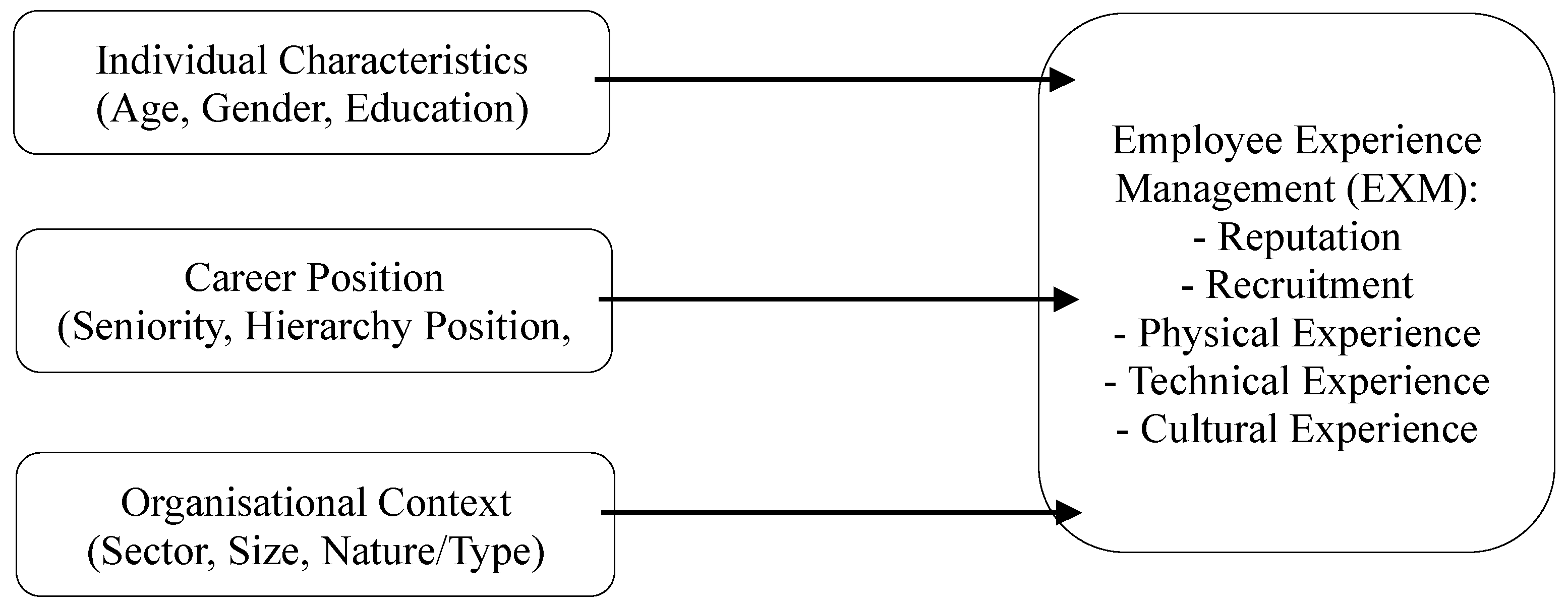
Guided by this gap, we pursue two objectives: (i) to test whether the perception of EX differs between individual profiles (age, gender, educational qualifications), career profiles (hierarchical level, seniority), and organisational profiles (sector, nature/type, size); and (ii) to identify which segmentation levers are most relevant for interventions aimed at managing EX. We approached these objectives using a multi-sector sample and a validated EX measure that encompasses reputational, recruitment, physical, technical, and cultural dimensions. We thus present a clear theoretical proposal by redefining the logic of segmentation in EX, shifting the analytical focus from who the employees are to how organisations are structured. Framing EX as a socio-structural phenomenon based on resource access, autonomy, and cultural integration, this study encourages further research beyond systemic explanations, organisational design, and demographic characteristics. Thus, this viewpoint is consistent with recent bibliometric research showing that organisational learning, knowledge management, and psychological safety function as structural mechanisms that influence EX at work (
P. Figueiredo et al., 2025).
3. Methods
3.1. Sample and Procedures
The study was conducted in Portugal and reflects the organisational, cultural and labour-market context of Portuguese employees. It used a non-probabilistic, heterogeneous sample of 403 employees working in organisations from different sectors and organisational contexts. Although the sample includes participants from both private and public organisations and represents multiple hierarchical levels and educational backgrounds, its composition does not allow claims of statistical representativeness. Instead, the sample should be understood as capturing a broad range of employee profiles, enabling exploratory examination of the segmentation logic underlying EX.
Participants’ ages ranged from 19 to 68 years (M = 41.99), and 64.0% of the respondents were women and occupied different hierarchical positions, including non-managerial roles and operational, middle, and top management positions. The sample included employees from both private (72.7%) and public (23.1%) organisations, predominantly from the tertiary sector (85.4%), and from organisations of varying sizes, with a higher representation of large organisations (more than 250 employees). These characteristics reflect the natural distribution of the professional networks through which the survey link circulated and are typical of convenience and snowball sampling procedures (
Dragan & Isaic-Maniu, 2022). Such imbalances may restrict the variability needed to detect differences across sectors or organisational types, and this limitation is explicitly recognized in the interpretation of H6–H8. However, the heterogeneity within hierarchical levels, educational backgrounds and organisational sizes provides sufficient variance for testing structural segmentation patterns related to EX.
Data were collected between October and December 2025 through an online questionnaire disseminated on professional networks, direct contact with organisations, and institutional mailing lists. Participation was voluntary, and no incentives were offered. As the survey link was distributed through open professional channels and organisational contacts, it was not possible to calculate the exact response rate. However, all completed responses that met the inclusion criteria (employment relationship and complete completion of the EXM scale) were retained for analysis.
Anonymity, confidentiality and voluntary participation were guaranteed, and informed consent was obtained on the first page of the online questionnaire. No identifying or sensitive personal data were collected. The study involved only anonymous, minimal-risk survey research with adults and is exempt from Ethics Committee approval under Portuguese Law No. 58/2019 (GDPR implementation).
3.2. Measures
EX was assessed using items adapted from two validated instruments: the Physical, Technological, and Cultural Experience scale developed by
Lee and Kim (
2023) and the Reputation and Recruitment multidimensional scale validated by
Sungailė et al. (
2024).
The combined 18-item EX measure used in this study was derived from these structures and organized into five dimensions: Reputation (4 items), Recruitment (4 items), Physical Experience (3 items), Technical Experience (3 items) and Cultural Experience (4 items). Responses were recorded on a 5-point Likert scale (1 = strongly disagree; 5 = strongly agree). The 18-item EXM scale showed adequate internal consistency across all five dimensions (Reputation α = 0.70; Recruitment α = 0.79; Physical Experience α = 0.74; Technical Experience α = 0.79; Cultural Experience α = 0.88), confirming the reliability of the adapted version for this sample.
To validate the measurement model, a confirmatory factor analysis (CFA) was conducted in AMOS (v29). The five-factor EXM structure demonstrated acceptable fit (χ
2/df = 2.64; CFI = 0.895; TLI = 0.886; RMSEA = 0.064, 90% CI [0.061–0.066]; SRMR = 0.053), consistent with recommended thresholds for models with multiple indicators (
Hair et al., 2018;
Kline, 2023). All standardized factor loadings were significant (
p < 0.001) and mostly above 0.50, supporting the coherence of the latent structure.
Internal consistency was high (α = 0.89 for the EXM total). Composite reliability values (CR > 0.90) and average variance extracted (AVE) values indicated strong convergent validity. Discriminant validity was confirmed following the Fornell–Larcker criterion, with the square root of AVE values exceeding corresponding inter-construct correlations.
All items were translated into Portuguese and back-translated into English by independent bilingual researchers, ensuring semantic equivalence. A pre-test with 12 employees confirmed clarity and cultural adequacy, requiring only minor wording adjustments.
3.3. Data Analysis
Data analyses were conducted using IBM SPSS Statistics (version 29). Prior to hypothesis testing, the psychometric properties of the measurement instruments were examined through principal component analysis (PCA) and Cronbach’s alpha, confirming one-dimensionality of each factor and internal consistency of the scales.
Descriptive statistics and Pearson correlation coefficients were computed for all study variables. The assumptions of normality and homogeneity of variances were assessed using distributional indicators (Kolmogorov–Smirnov, Shapiro–Wilk, skewness and kurtosis), graphical inspection, and Levene’s test, respectively. Given the large sample size, data were considered suitable for parametric analyses.
To test the research hypotheses, independent-samples t-tests and one-way analyses of variance (ANOVA) were performed to examine differences in EX dimensions across individual and organisational profiles.
In addition to significance testing, effect sizes were computed to assess the magnitude and practical relevance of group differences. Hedges’ g was used for t-tests and eta squared (η2) for ANOVA models, following common recommendations in HRM research.
Before testing the hypotheses, preliminary analyses were conducted to examine the assumptions of normality and the potential presence of common method bias. Skewness and kurtosis values fell within acceptable ranges (|Sk| < 2; |Ku| < 7), and Mardia’s coefficient did not indicate problematic multivariate non-normality, supporting the use of parametric tests.
As data were collected via a self-report questionnaire in a single wave, several diagnostics were performed. Harman’s single-factor test revealed that the first factor accounted for 50.76% of the variance, a borderline but acceptable value. Variance inflation factors (VIF = 2.2–5.7) were below the conservative threshold of 10, and a single-factor CFA showed substantially poorer fit than the proposed measurement model. Together, these indicators suggest that common method variance is not a dominant concern.
Differences in EXM dimensions across individual, career and organisational profiles were tested using independent-samples t-tests and one-way ANOVA. Given the exploratory nature of the analysis, effect sizes (Hedges’ g and η2) were reported to assess the practical relevance of group differences. Pearson correlations complemented the interpretation of associations between EXM dimensions.
To complement the hypothesis-driven tests, we conducted an exploratory cluster analysis to identify natural employee profiles based on the five EXM dimensions (Reputation, Recruitment, Physical Experience, Technical Experience, Cultural Experience). Because clustering is an unsupervised procedure, it was treated as an additional analytical objective, not associated with any formal hypothesis. To identify natural experiential profiles, a k-means clustering procedure was conducted. The selection of K = 2 was based on internal validation indices (silhouette = 0.356; Calinski–Harabasz = 301.84; Davies–Bouldin = 1.075) and on the interpretability and parsimony of the two-cluster solution.
Given the cross-sectional design, all findings reflect associations rather than causal effects.
4. Results
4.1. Descriptive Statistics and Correlations
The sample was predominantly composed of women (64%), highly educated employees, and workers from medium-to-large organisations. Educational qualifications were high, with 45.7% holding a bachelor’s degree and 25.3% a master’s degree. Regarding job roles, 45.7% were non-managers, while the remaining respondents were distributed across middle (25.3%), operational (17.1%), and top management levels (11.9%). Seniority in the company was heterogeneous, with 33.3% reporting that it was between 1 and 5 years in their current organisation and 17.4% more than 20 years (
Table 2).
Most participants worked in private-sector organisations (72.7%), predominantly within the tertiary sector (85.4%), and nearly half were employed in large organisations with more than 250 employees (46.4%). Overall, the sample reflects a highly educated, service-sector workforce concentrated in medium-to-large organisations, providing a robust empirical base for the study of EX and organisational dynamics.
Table 3 presents descriptive statistics, reliability coefficients and correlations among the five EXM dimensions. All dimensions exhibited satisfactory internal consistency (α ≥ 0.70). Correlations were positive and moderate to strong, supporting the multidimensional structure of EX.
4.2. Differences in EX Across Employee and Organisational Profiles
The analysis of the results presented in
Table 4 reveals a clear pattern that EX is shaped primarily by structural factors within the organisation, rather than by the individual characteristics of employees. More than ‘who’ people are, what matters most is ‘where’ they are positioned within the structure and ‘how’ they interact with organisational systems and cultures.
Overall, the results indicate that hierarchical level shows the most consistent associations with differences in EXM dimensions. Although effect sizes are modest, the pattern is systematic across Physical, Technical and Cultural Experience, suggesting that structural positioning within the organisation is meaningfully related to how employees perceive their work contexts. These findings align with theoretical perspectives linking role-based autonomy, resource access and decision-making proximity to experiential advantages.
In contrast, demographic characteristics such as age and educational level did not produce statistically significant differences. These null findings are theoretically informative, as they corroborate recent literature showing inconsistent or weak demographic effects on EX. However, they may also reflect restricted variability in the sample (e.g., high educational attainment and clustering in service-sector roles), which limits the ability to detect such differences. This dual interpretation is acknowledged and considered in the discussion.
Gender showed small but significant differences in overall EXM, Physical Experience and Cultural Experience. While effect sizes remain small, these results are aligned with prior studies showing that women tend to report lower perceptions of organisational fairness, psychological safety and support, which may subtly influence their EXM ratings. These patterns are consistent with research showing that women often report lower perceptions of organisational justice, inclusion and psychological safety due to heightened exposure to interpersonal risk and uneven distribution of informal support (
Ramalho & Porto, 2021;
A. Edmondson, 1999). Such mechanisms may contribute to subtle but systematic experiential disparities.
Seniority differences emerged only for Cultural Experience, suggesting that this dimension captures processes that develop gradually through exposure to organisational norms, routines and relational patterns. Larger organisations may offer more consolidated cultural ecosystems, with more stabilized communication flows, structured socialisation practices and clearer normative expectations. This interpretation aligns with theoretical views of culture as both a product of organisational history and a function of structural complexity.
The absence of significant differences for organisational nature, sector and industry may reflect a homogenization of EXM practices across organisational contexts or, alternatively, may stem from sample composition (e.g., 85.4% tertiary sector). This limitation is recognized and prevents overinterpretation of contextual null effects.
Although effect sizes were modest, such differences can accumulate over time in daily interactions, making them meaningful for HRM practice.
The results obtained provide partial support for the proposed conceptual model, as can be seen in the structured summary presented in
Table 5.
4.3. Exploratory Cluster Profiles of Employee Experience
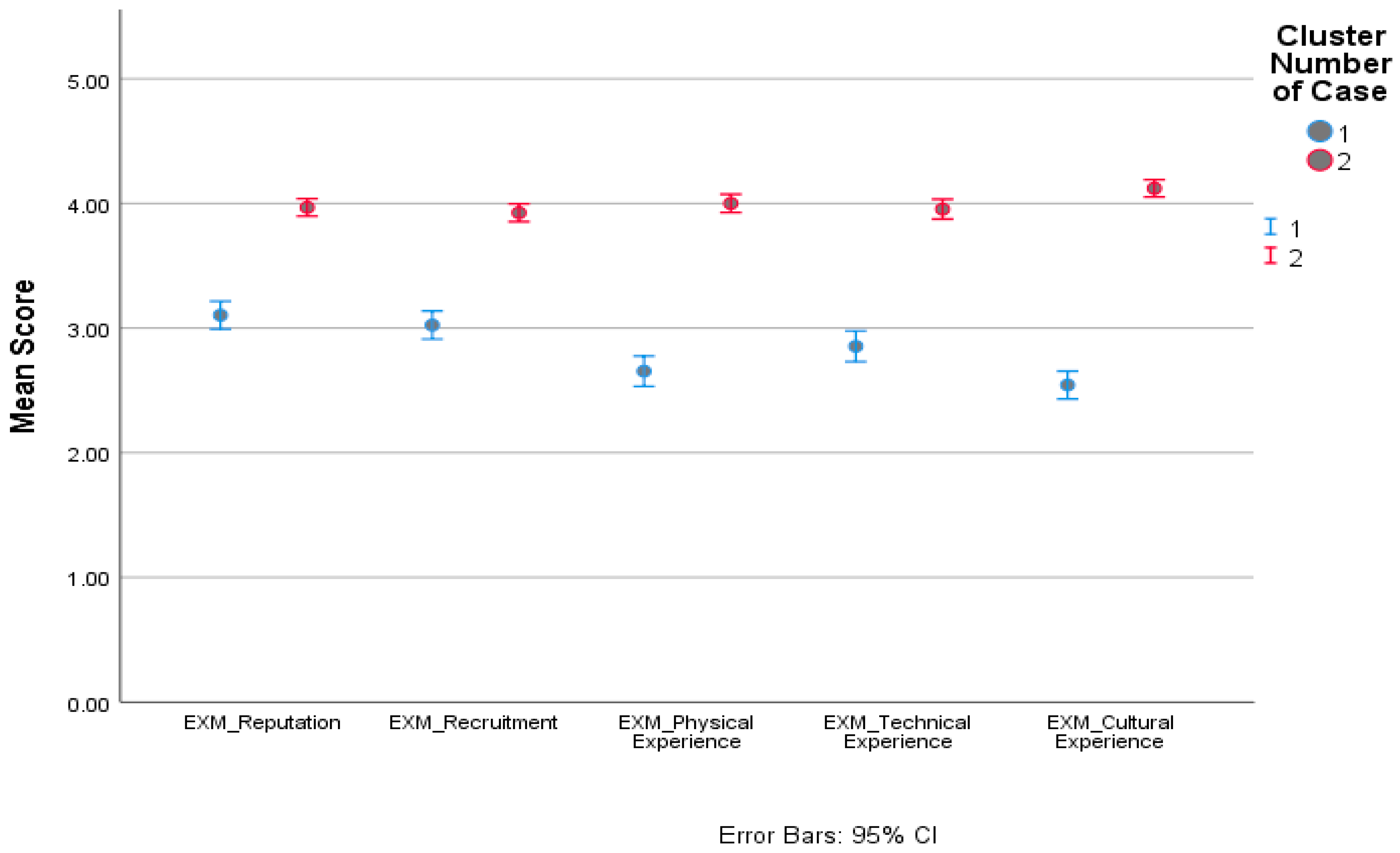
The exploratory k-means analysis (K = 2) identified two distinct experiential profiles. Cluster 1 (N = 157) showed systematically lower scores across all EXM dimensions (Reputation: M = 3.10; Recruitment: M = 3.02; Physical Experience: M = 2.65; Technical Experience: M = 2.85; Cultural Experience: M = 2.54). Cluster 2 (N = 246) presented consistently higher scores (Reputation: M = 3.97; Recruitment: M = 3.92; Physical Experience: M = 4.00; Technical Experience: M = 3.95; Cultural Experience: M = 4.12). The largest separation between clusters occurred in Cultural Experience, reinforcing the idea that cultural perceptions are particularly sensitive to structural and relational mechanisms within organisations. These patterns are visually represented in
Figure 2.
To enhance interpretability, the two clusters can be conceptualized as experiential personas. Cluster 1 reflects a profile we label Constrained Contributors: employees who report systematically lower scores across all EXM dimensions, typically experiencing reduced access to autonomy, information, physical resources and cultural clarity. This profile aligns with employees positioned closer to operational levels of the organisation, where resource asymmetries and limited decision latitude are more salient. In contrast, Cluster 2 represents Empowered Integrators: employees who experience consistently higher levels of physical, technical and cultural support, greater informational access and clearer integration into organisational norms and communication flows. These personas provide an intuitive basis for practitioners to design structurally sensitive EXM strategies that target resource access, leadership involvement, and cultural onboarding in differentiated ways.
This pattern suggests that Cultural Experience captures deeper qualitative aspects of work, such as communication routines, coherence of norms, socialisation processes and relational atmosphere, that tend to vary more sharply across structural positions. Unlike the more operational Physical or Technical Experience dimensions, Cultural Experience reflects deeper interpretive processes stemming from organisational history, relational patterns and the stability of norms. This helps explain why this dimension shows greater separation between clusters.
ANOVA on composite EXM Total confirmed substantial differences between clusters (F = 737.70, p < 0.001). Age did not differ significantly between the profiles (p = 0.133), reinforcing the broader pattern of weak demographic segmentation.
Cluster membership showed no alignment with demographic characteristics but was significantly associated with hierarchical level (χ2 = 21.14, p = 0.0001, Cramér’s V = 0.229) and organisational size (χ2 = 11.83, p = 0.019, Cramér’s V = 0.171). This strengthens the interpretation that experiential profiles reflect structural conditions, such as access to resources, autonomy, information and cultural stability, rather than demographic identity.
Overall, the cluster analysis provides convergent evidence for a structural segmentation of the EX. In other words, employees positioned differently within organisational systems tend to experience their work in systematically distinct ways, independent of age, education or other demographic factors.
5. Discussion
The results of this study indicate that differences in employee experience (EX) are more systematically associated with structural characteristics, such as hierarchical level and organisational size, than with demographic attributes. Although the statistical effects were modest, their practical relevance should not be underestimated, as structural differences tend to accumulate through daily interactions and shape employees’ ongoing perceptions of fairness, clarity and support.
Rather than implying causal mechanisms, these associations align with established theoretical perspectives showing that resource access, autonomy, decision-making proximity and relational safety vary according to role-based positioning within organisations (
Hackman & Oldham, 1976;
Blau, 2017;
A. Edmondson, 1999). These findings support the emerging view of EX as a sociotechnical phenomenon shaped by structural conditions and organisational design, rather than by individual traits.
The absence of significant effects for age and educational level is theoretically informative. Although demographic segmentation is common in EX research, evidence across the literature remains inconsistent and often weak. The present results therefore suggest that demographic characteristics may not be reliable predictors of how EX works. At the same time, the reduced variability in some demographic categories within this sample such as high educational attainment and strong service-sector representation, may have further limited the likelihood of detecting demographic differences. Both explanations are plausible and reinforce the need to revisit demographic segmentation as a central analytical logic in EX research.
Career-related attributes, particularly hierarchical level, showed the most consistent associations with differences in EXM. Although effect sizes were modest, the pattern was systematic across physical, technical and cultural dimensions, suggesting that structural positioning within the organisational system plays a meaningful role in shaping employees’ perceptions. This is coherent with theoretical accounts that highlight how autonomy, information access, organisational support and authority differentials vary across hierarchical levels, creating distinct experiential conditions.
This differentiation across dimensions clarifies that structural influences on EXM are multifaceted and operate through distinct mechanisms embedded in each experiential domain. In the case of Physical Experience, the structural effect manifests itself primarily through access to material resources, operational support, and working conditions, which are distributed according to hierarchy. In Technical Experience, the structural effect reflects differences in access to information, digital autonomy, and the ability to adapt technological tools. The dimensions of Reputation and Recruitment are shaped by hierarchical visibility, proximity to institutional narratives, and privileged access to formal communication channels. Finally, Cultural Experience is influenced by denser relational processes, including collective routines, relational climate, shared norms, and interpretative stability, which develop unevenly across structural positions. This differentiation by dimension clarifies that the structural impact is multifaceted and operates through distinct mechanisms within each experiential domain.
Employees in managerial positions reported higher EX scores across several dimensions. Although effect sizes were modest, this pattern is consistent with theoretical perspectives suggesting that hierarchical roles differ in access to autonomy, information and organisational support (
Alam et al., 2024;
Okolie et al., 2021). This aligns with COR theory, which argues that individuals in structurally advantaged positions accumulate resources that protect them from loss and enable more favourable experiential appraisals (
Hobfoll, 1989).
It is important to note that the present study did not aim to examine remote-work arrangements, and therefore the questionnaire did not include a measure of work modality (on-site, hybrid or remote). For this reason, no empirical comparison can be made regarding how Physical Experience varies across different work arrangements. Nevertheless, because the Physical Experience dimension captures employees’ perceptions of workspace conditions, ergonomic support and access to material resources, it is reasonable to expect that future research should explore how these structural conditions differ between remote and on-site roles. Such differences may interact with hierarchical positioning, given that access to physical and technical resources is often unevenly distributed across organisational levels. While this remains outside the scope of the present study, the findings highlight the relevance of investigating work modality as a structural factor in subsequent research on EX.
Cultural Experience emerged as the dimension most sensitive to structural variation. This pattern is theoretically coherent with the idea that cultural perceptions reflect deeper interpretive processes, such as belonging, relational climate, communication routines and value alignment, that evolve gradually through organisational socialisation. The finding that seniority only influenced Cultural Experience aligns with socialisation theories, which propose that cultural integration develops gradually through repeated interactions and accumulated relational history (
Jindal et al., 2024;
Wang & Ning, 2024). These mechanisms help explain why Cultural Experience showed greater differentiation across clusters and profile comparisons than physical or technical dimensions.
These results suggest that culture can operate as a higher-order structural condition, whose formation depends on time, scale, and organisational stability. Processes such as socialisation, normative alignment, and the construction of collective meaning crystallize slowly and are profoundly shaped by the organisation’s structural architecture. Thus, differences in hierarchical levels or organisational size contexts can translate into more pronounced variations in how culture is experienced. This suggests that culture may function as a higher-order structural condition that crystallizes gradually and is therefore more sensitive to positional asymmetries within the organisation.
The exploratory cluster analysis provided convergent evidence for the structural interpretation of EX. The two experiential profiles differed sharply across all dimensions, particularly Cultural Experience, yet showed no alignment with demographic attributes. Instead, cluster membership was associated with hierarchical level and organisational size, reinforcing the proposition that employees’ positions within organisational systems better explain experiential variation than individual characteristics.
Overall, these findings advance a clear theoretical proposition: EX is more accurately explained by a structural–contextual segmentation logic than by a demographic one. Whereas demographic segmentation assumes that experience varies according to ’who employees are’, the present study demonstrates that experience varies according to ‘where employees are positioned’ within organisational systems. This reframing challenges prevailing assumptions in EX research and introduces a structural conceptualization grounded in resource distribution, autonomy, socialisation processes and access to cultural information.
These results contribute to a more precise understanding of EX by showing that improvements in EXM depend primarily on organisational structures and leadership-related mechanisms rather than on demographic tailoring. If organisations aim to enhance employees’ lived experience, interventions should prioritize structural levers, including clearer communication, supportive leadership, equitable resource distribution and cultural integration, especially for employees with less access to autonomy, information and influence.
6. Conclusions
EX is shaped by structural conditions affecting autonomy, support, information and opportunities for cultural integration. The present study contributes to a clearer understanding of these mechanisms by showing that experiential differences align more closely with hierarchical positioning and organisational size than with demographic profiles. These findings reinforce the structural–contextual interpretation of EX proposed in this work.
The most consistent differences were observed between employees in managerial and non-managerial roles. Although effect sizes were modest, this pattern suggests that employees with greater autonomy, informational clarity, and organisational support tend to evaluate their work more positively. Cultural Experience reflects relational and normative processes that develop over time and are more salient in larger, more structured organisations.
Conversely, demographic attributes, such as age and educational level, did not significantly differentiate EX. These null findings contribute to ongoing debates in literature and indicate that demographic segmentation may have limited explanatory power in comparison with structural variables. This reinforces the need to reassess demographic assumptions in EXM research and practice.
Taken together, these results offer a clearer lens through which EXM can be approached. Improving EX requires interventions that prioritize structural levers, such as leadership support, communication practices, cultural integration and equitable access to resources, rather than strategies centred on demographic segmentation. Organisations seeking to enhance EX should focus on redesigning systems, not merely tailoring initiatives to demographic categories.
6.1. Practical Implications for HRM
Given that demographic characteristics were not the main drivers of Employee Experience (EX), HR departments should redesign their Employee Journey Maps using structural rather than demographic segmentation. This means differentiating touchpoints according to employees’ access to autonomy, information, decision-making proximity and cultural integration, which vary systematically across hierarchical positions. For operational employees, this involves reinforcing clarity of expectations, simplifying access to information, ensuring frequent leadership availability and creating routine communication touchpoints that replicate some of the visibility and support typically available to managers. In contrast, managerial roles may require touchpoints focused on strategic alignment, organisational stewardship and relational leadership capacities. Reframing journey maps in this structural way allows HR to address the structural EX gap between managers and non-managers and to design more equitable, role-sensitive experience interventions.
From a practical standpoint, the findings highlight that EXM interventions should prioritize structural conditions, particularly those affecting employees in non-managerial roles, who rely most heavily on leadership, communication and cultural integration to shape their daily experience.
For operational employees, targeted interventions may include simple digital autonomy tools (e.g., self-service HR platforms, shift-swap apps), structured daily or weekly feedback loops, micro-learning modules for cultural onboarding, visual communication dashboards, and simplified access to decision-support resources. These practices replicate, at scale, part of the informational clarity and autonomy typically available to managers.
The results of this study show that EX arises primarily from the structural conditions that the organisation creates—and that is where people management finds its most impactful space for intervention. Improving EX implies looking more closely at employees in non-managerial roles. These professionals experience the day-to-day life of the organisation more closely, more exposed, and often with less access to information, autonomy, and support. Thus, it is up to HRM to ensure that these employees find clarity in their tasks, accessible communication channels, opportunities for participation, and leaders who listen to them.
The Cultural Experience, so sensitive to time and organisational size, reveals the central role of socialisation, from the first day of work to the relationships that are built along the internal journey. This reinforces the need to invest in more human onboarding processes, in team rituals that promote belonging, and in communication practices that bring people closer to the decisions that affect them. The larger the organisation, the more important it becomes to preserve proximity, combat distance, and reinforce the culture with authenticity.
It is also clear that improving the experience requires not only large programs, but above all consistency in daily life. A functional workspace, technological tools that truly help, accessible managers, and clarity in expectations. Technology and organisational design play a key role here, not to automate relationships, but to remove friction that consumes energy and diminishes the sense of purpose.
For SMEs, cultural stability can be supported through lightweight rituals (e.g., team huddles, monthly culture touchpoints), informal but regular communication routines, onboarding narratives that clarify organisational identity, and relational leadership practices that compensate for the absence of large formal structures. These low-cost mechanisms help maintain cohesion and psychological safety even in fluid environments.
Finally, this study reminds us that the experience is not transformed with uniform strategies. Each layer of the organisation faces distinct challenges, and a segmented approach allows HR professionals to respond to these differences with truly relevant solutions. A policy that works for managers may be irrelevant to an operational team; a practice that enhances creativity in a technical team may not have an impact on an administrative department. Personalizing without losing consistency is probably the greatest challenge and the greatest opportunity for EXM.
6.2. Theoretical Implications
Theoretically, this study makes three contributions. First, it challenges the demographic segmentation logic that has dominated EX research by showing that demographic attributes have limited explanatory value. Second, it introduces a structural–contextual framework grounded in resource distribution, organisational design, socialisation and role-based conditions. Third, it demonstrates empirically that hierarchical positioning is a consistent differentiator of EX, supporting emerging perspectives that conceptualize experience as a relational and systemic phenomenon.
First, this study challenges a dominant assumption in the EX literature: that demographic segmentation is the primary and most informative way to explain variations in EX. Decades of EXM, HRM and organisational psychology research have implicitly assumed that age, gender or education generate systematic experiential differences. The present study contests this assumption by demonstrating empirically that demographic variables showed either weak or non-significant associations with EX, contributing to a growing body of evidence that demographic predictors have limited explanatory power in contemporary EX models.
Second, the study advances a structural–contextual segmentation logic. Drawing on traditions such as Job Characteristics Theory, Social Exchange Theory and power/status perspectives, the findings show that hierarchical level and organisational size provide a far more consistent lens for understanding experiential variation. These structural indicators capture fundamental differences in autonomy, access to information, resource availability, psychological safety and cultural integration, providing a theoretically grounded explanation for why employees in different organisational positions experience their work differently.
Third, the study offers empirical support for a relational-sociotechnical conceptualization of EX. Rather than seeing EX as the sum of isolated perceptual states, the results indicate that it is the interaction between structural positioning and relational conditions that shapes the lived experience of work. This aligns with COR theory, which argues that resource accumulation is unevenly distributed across organisational roles, and with socialisation theories that describe culture as a gradual interpretive process. By demonstrating that Cultural Experience is the most sensitive dimension to structural variation, the study strengthens conceptualizations of EX as embedded in organisational systems rather than rooted in individual attributes.
Fourth, the findings move the field forward by formalizing EX segmentation as a competing theoretical logic: demographic versus structural. The study empirically supports the structural view. Whereas demographic segmentation explains little experiential variation, structural segmentation explains patterned, theoretically coherent differences. This reframing clarifies a conceptual ambiguity in the literature and provides a testable theoretical proposition: that EX is primarily shaped by structural conditions—and only secondarily, or residually, by individual demographics.
Finally, by articulating these contributions, the study positions leadership, organisational design and cultural systems as central mechanisms in EXM theory. This expands existing EX frameworks beyond descriptive models and situates EX within broader organisational theories of structure, power, resource allocation and socialisation. In doing so, the study provides a theoretical foundation for future EXM research to integrate structural design principles into models traditionally dominated by demographic interpretations.
6.3. Limitations
Although the study provides robust insights, several limitations must be acknowledged. The non-probabilistic sample and its concentration in the tertiary sector may limit the generalisation of contextual effects. The cross-sectional design prevents causal inference, and although a CFA supported the validity of the EXM measure, future work should examine measurement invariance across groups.
Like any research focused on people’s lived experience, this study has limitations that need to be acknowledged to balance the interpretation of the results. First, the cross-sectional nature of the data prevents us from tracking the evolution of the experience over time. EX is dynamic, changing with internal events, leadership changes, or life moments. Capturing it at a single moment reveals only a clear, but inevitably static, snapshot.
Secondly, the data were collected through self-assessment, which means they depend on each participant’s perception. While this method is appropriate to the subjective nature of the EX, it can introduce biases associated with mood, memory, or individual expectations. It does not invalidate the results, but it reminds us that experience is always reported from the perspective of the person living it.
Another limitation is related to the composition of the sample, mostly from the tertiary sector and large organisations. This means that some conclusions may reflect more formal and structured practices, typical of these contexts. Future investigations would benefit from including more SMEs, industrial organisations, or highly regulated public contexts to understand the extent to which these patterns hold.
Although we ensured the reliability and one-dimensionality of the scales through PCA and Cronbach’s alphas, confirmatory validation of the framework was not performed. These procedures would allow us to deepen the robustness of the EXM model and ensure that comparisons between groups are accurate. Nevertheless, this choice is in line with the exploratory nature of the study.
Finally, although we explored differences between groups, we did not analyze the internal mechanisms that explain why certain dimensions (such as culture) are more sensitive to the seniority or size of the organisation. Nor did we explore moderators such as remote work intensity, team digital maturity, or leadership styles—factors that recent literature suggests have a significant impact on experience.
6.4. Future Research Directions
Given these limitations, several opportunities open up to deepen our understanding of EXM. A first line of research would be to develop longitudinal studies that allow us to track how experience changes throughout the professional lifecycle, especially during critical moments such as onboarding, job changes, or internal reorganisations. These moments are rich in meaning and can reveal how experience is built, lost, or recovered.
Another promising avenue would be to integrate multiple data sources, combining employee perceptions with objective indicators such as turnover, absenteeism, team performance, or leadership evaluations. This triangulation would reduce self-report biases and provide a better understanding of how experience translates into organisational behaviour.
Future research could also explore explanatory models, examining factors that mediate or moderate the relationship between employee profiles and their experience, for example, psychological safety, leadership styles, organisational justice, or the intensity of hybrid work.