Sustaining Interactional Justice Amid Work-Related Negative Emotions: A Moderated Mediation Model in Boundary-Spanning Bank Workers



Abstract
1. Introduction
2. Literature Review and Hypothesis Development
2.1. Negative Emotions and Interactional Justice
2.2. Negative Emotions and Organization-Based Self-Esteem
2.3. OBSE as Mediator
2.4. The Moderating Role of Work Self-Efficacy
2.5. The Moderating Role of Workplace Locus of Control
2.6. Moderated Mediation Model
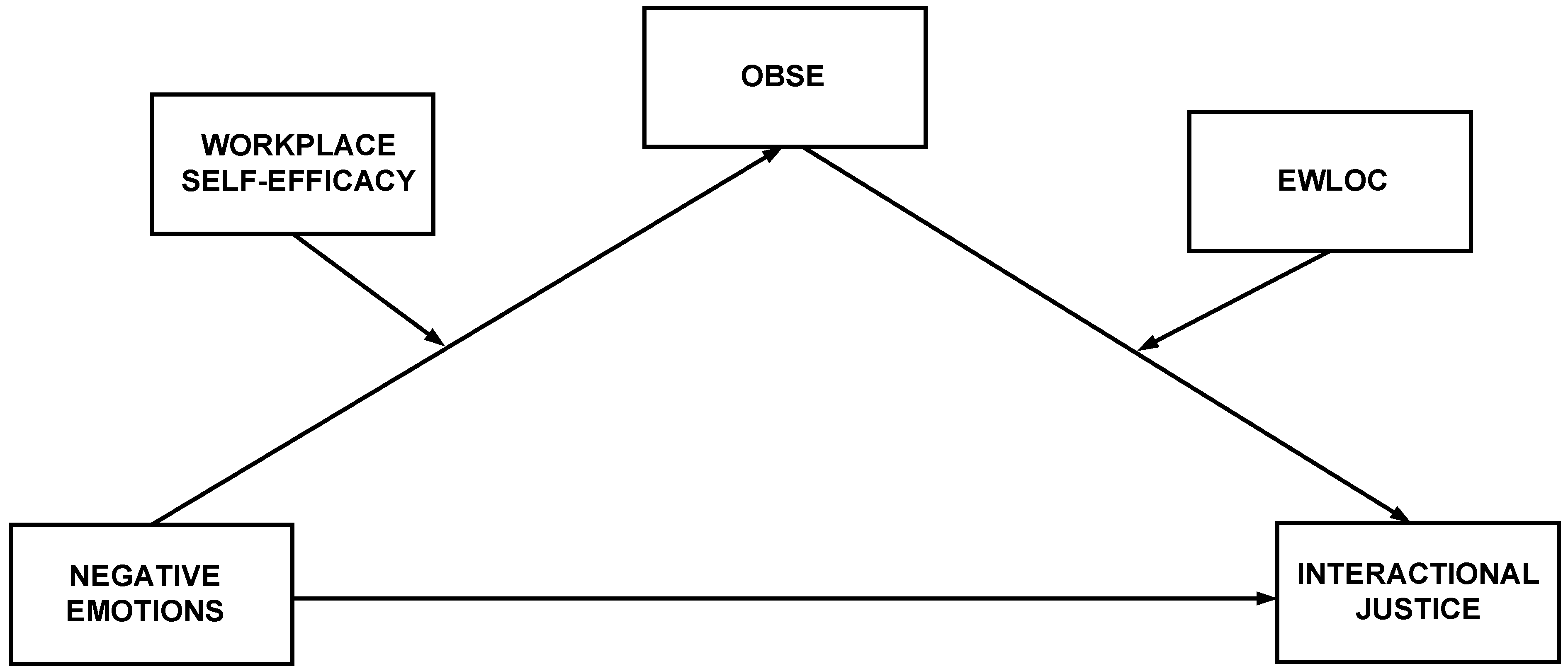
- Affective states (AET) influence self-evaluations (OBSE),
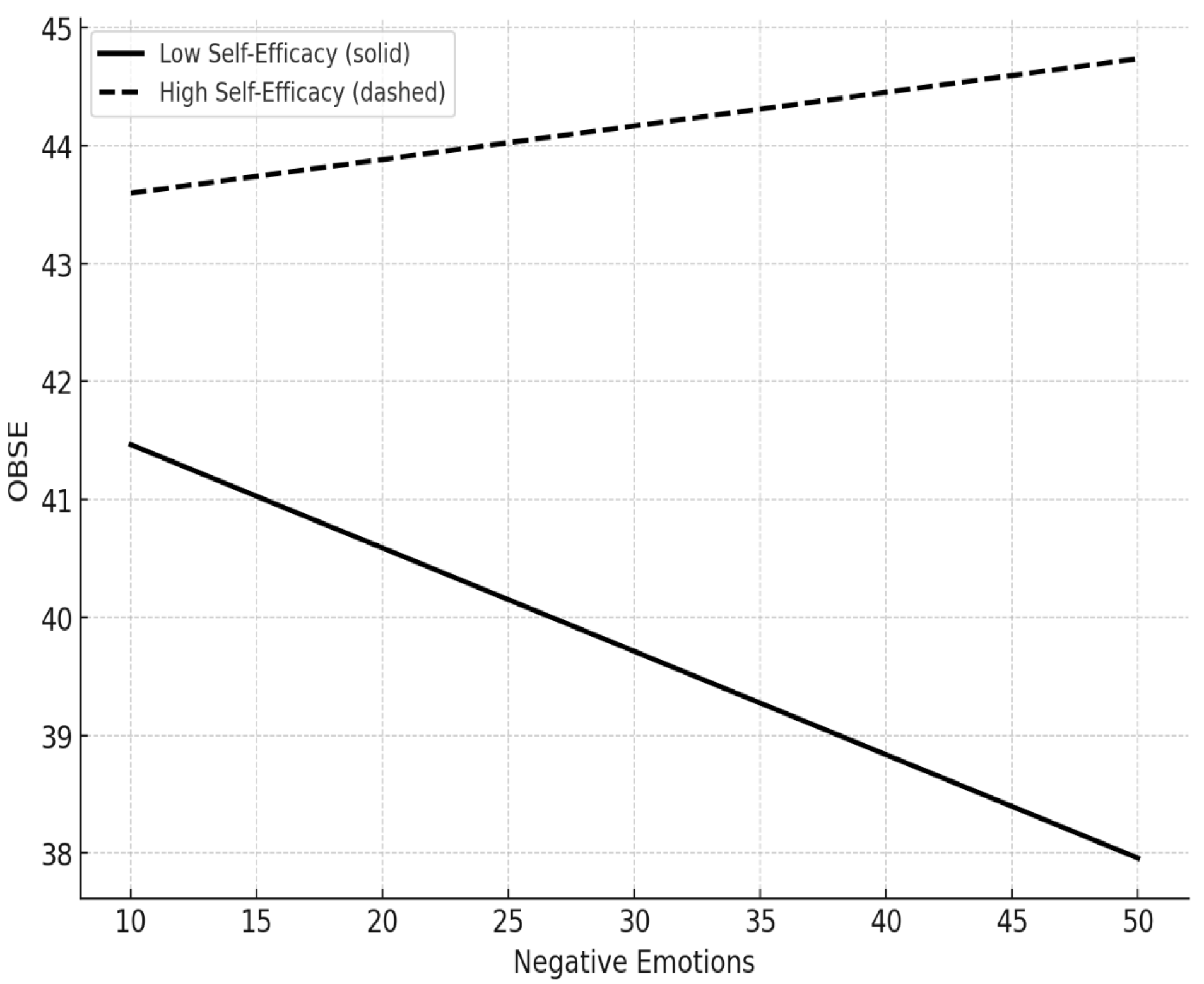
- This emotional impact is shaped by employees’ personal resources (self-efficacy),
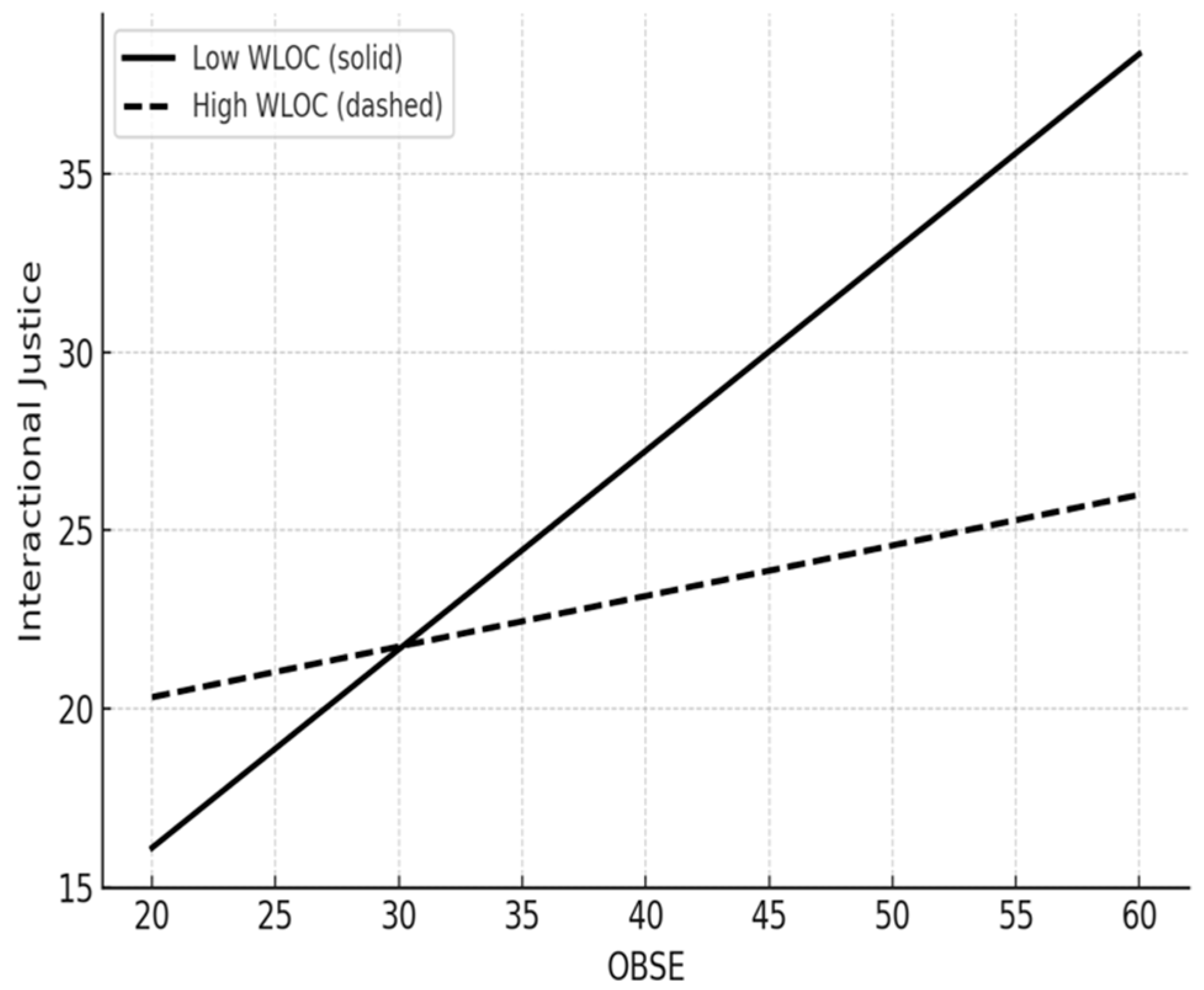
- And the translation of OBSE into justice perceptions depends on attributional tendencies (EWLOC).
3. Method
3.1. Sample
3.2. Measure
4. Results
5. Discussion
5.1. Practical Implications
5.2. Limitations and Future Directions
6. Conclusions
Author Contributions
Funding
Institutional Review Board Statement
Informed Consent Statement
Data Availability Statement
Conflicts of Interest
References
- Abu Elanain, H. M. (2010). Work locus of control and interactional justice as mediators of the relationship between openness to experience and organizational citizenship behavior. Cross Cultural Management: An International Journal, 17(2), 170–192. [Google Scholar] [CrossRef]
- Adams, J. S. (1965). Inequity in social exchange. In L. Berkowitz (Ed.), Advances in experimental social psychology (Vol. 2, pp. 267–299). Academic Press. [Google Scholar]
- Aggarwal, A., & Mittal, V. (2021). Modeling the effect of organizational justice on employee well-being, organizational citizenship behavior and turnover intentions through employee engagement. The Open Psychology Journal, 14, 238–252. [Google Scholar] [CrossRef]
- Ahmad, I., & Begum, K. (2023). Impact of abusive supervision on intention to leave: A moderated mediation model of organizational-based self-esteem and emotional exhaustion. Asian Business & Management, 22(2), 669–688. [Google Scholar] [CrossRef]
- Aisha, R., Channa, N. A., Mirani, M. A., & Qureshi, N. A. (2024). Investigating the influence of perceived organizational justice on counterproductive work behaviours: Mediating role of negative emotions. International Journal of Emerging Markets, 19(8), 2264–2292. [Google Scholar] [CrossRef]
- Aldrich, H., & Herker, D. (1977). Boundary spanning roles and organization structure. Academy of Management Review, 2(2), 217–230. [Google Scholar] [CrossRef]
- Bandura, A. (1977). Self-efficacy: Toward a unifying theory of behavioral change. Psychological Review, 84(2), 191. [Google Scholar] [CrossRef]
- Bandura, A. (1986). Social foundations of thought and action: A social cognitive theory. Prentice-Hall. [Google Scholar]
- Bandura, A. (1997). Self-efficacy: The exercise of control. Freeman. [Google Scholar]
- Barclay, L. J., Skarlicki, D. P., & Pugh, S. D. (2005). Exploring the role of emotions in injustice perceptions and retaliation. Journal of Applied Psychology, 90(4), 629–643. [Google Scholar] [CrossRef]
- Barsky, A., & Kaplan, S. A. (2007). If you feel bad, it’s unfair: A quantitative synthesis of affect and organizational justice perceptions. Journal of Applied Psychology, 92(1), 286–295. [Google Scholar] [CrossRef]
- Bauer, T. N., Bodner, T., Erdogan, B., Truxillo, D. M., & Tucker, J. S. (2007). Newcomer adjustment during organizational socialization: A meta-analytic review of antecedents, outcomes, and methods. Journal of Applied Psychology, 92(3), 707–721. [Google Scholar] [CrossRef] [PubMed]
- Bies, R. J., & Moag, J. S. (1986). Interactional justice: Communication criteria of fairness. In R. Lewicki, B. Sheppard, & M. Bazerman (Eds.), Research on negotiation in organizations (Vol. 1, pp. 43–55). JAI Press. [Google Scholar]
- Bobocel, D. R., & Brockner, J. (2024). Application of justice theory to address social issues: Introduction to the special issue. Organizational Behavior and Human Decision Processes, 189, 104406. [Google Scholar] [CrossRef]
- Bowling, N. A., Eschleman, K. J., & Wang, Q. (2010). A meta-analytic examination of the relationship between job satisfaction and subjective well-being. Journal of Occupational and Organizational Psychology, 83(4), 915–934. [Google Scholar] [CrossRef]
- Brislin, R. W. (1986). The wording and translation of research instruments. In W. L. Lonner, & J. W. Berry (Eds.), Field methods in cross-cultural research (Vol. 8, pp. 137–164). Cross-cultural research and methodology series. Sage Publications. [Google Scholar]
- Brockner, J. (1988). Self-esteem at work: Research, theory, and practice. Lexington Books/D.C Heath and Com. [Google Scholar]
- Brockner, J., & Bobocel, D. R. (2024). How justice theory and research can help address organizational and societal problems. Organizational Behavior and Human Decision Processes, 14(2), 288–306. [Google Scholar] [CrossRef]
- Brown, J. D., & Marshall, M. A. (2001). Self-esteem and emotion: Some thoughts about feelings. Personality and Social Psychology Bulletin, 27(5), 575–584. [Google Scholar] [CrossRef]
- Brown, M. E., Treviño, L. K., & Harrison, D. A. (2005). Ethical leadership: A social learning perspective for construct development and testing. Organizational Behavior and Human Decision Processes, 97(2), 117–134. [Google Scholar] [CrossRef]
- Caprara, G., Di Giunta, L., Eisenberg, N., Gerbino, M., Pastorelli, C., & Tramontano, C. (2008). Assessing regulatory emotional self-efficacy in three countries. Psychological Assessment, 20, 227–237. [Google Scholar] [CrossRef] [PubMed]
- Carmeli, A., Ben-Hador, B., Waldman, D. A., & Rupp, D. E. (2010). How leaders cultivate social capital and nurture employee vigor: Implications for job performance. Journal of Applied Psychology, 95(6), 1127–1137. [Google Scholar] [CrossRef] [PubMed]
- Chan, S. C., Huang, X., Snape, E., & Lam, C. K. (2013). The Janus face of paternalistic leaders: Authoritarianism, benevolence, subordinates’ organization-based self-esteem, and performance. Journal of Organizational Behavior, 34(1), 108–128. [Google Scholar] [CrossRef]
- Cohen-Charash, Y., & Spector, P. E. (2001). The role of justice in organizations: A meta-analysis. Organizational Behavior and Human Decision Processes, 86(2), 278–321. [Google Scholar] [CrossRef]
- Colquitt, J. A. (2001). On the dimensionality of organizational justice: A construct validation of a measure. Journal of Applied Psychology, 86(3), 386–400. [Google Scholar] [CrossRef]
- Colquitt, J. A., Conlon, D. E., Wesson, M. J., Porter, C. O., & Ng, K. Y. (2001). Justice at the millennium: A meta-analytic review of 25 years of organizational justice research. Journal of Applied Psychology, 86(3), 425–445. [Google Scholar] [CrossRef]
- Colquitt, J. A., Scott, B. A., Rodell, J. B., Long, D. M., Zapata, C. P., Conlon, D. E., & Wesson, M. J. (2013). Justice at the millennium, a decade later: A meta-analytic test of social exchange and affect-based perspectives. Journal of Applied Psychology, 98(2), 199–236. [Google Scholar] [CrossRef] [PubMed]
- De Cremer, D. (2003). Why inconsistent leadership is regarded as procedurally unfair: The role of social self-esteem. European Journal of Social Psychology, 33(4), 535–550. [Google Scholar] [CrossRef]
- Dimitri, C., Ficapal-Cusí, P., Enache-Zegheru, M., & Torrent-Sellens, J. (2025). A bibliometric analysis of organization-based self-esteem integrating sustainable human resource management perspectives. World, 6(2), 64. [Google Scholar] [CrossRef]
- Du, H., Huang, H., Li, D., & Zhang, X. (2024). The effect of inclusive leadership on turnover intention of intensive care unit nurses: The mediating role of organization-based self-esteem and interactional justice. BMC Nursing, 23(1), 690. [Google Scholar] [CrossRef]
- Folger, R. G., & Cropanzano, R. (1998). Organizational justice and human resource management. Sage Publications. [Google Scholar]
- Folger, R. G., & Cropanzano, R. (2001). Fairness theory: Justice as accountability. In J. Greenberg, & R. Cropanzano (Eds.), Advances in organizational justice (pp. 1–55). Stanford University Press. [Google Scholar]
- Follenfant, A., & Meyer, T. (2003). Pratiques déclarées, sentiment d’avoir appris et auto-efficacité au travail. Résultats de l’enquête quantitative par questionnaires. In P. Carré, & O. Charbonnier (Eds.), Les apprentissages professionnels informels (pp. 185–246). L’Harmattant. [Google Scholar]
- Forgas, J. P. (1995). Mood and judgment: The Affect Infusion Model (AIM). Psychological Bulletin, 117(1), 39–66. [Google Scholar] [CrossRef]
- Fox, S., Spector, P. E., & Miles, D. (2001). Counterproductive work behavior (CWB) in response to job stressors and organizational justice: Some mediator and moderator tests for autonomy and emotions. Journal of Vocational Behavior, 59(3), 291–309. [Google Scholar] [CrossRef]
- Gardner, D. G., Huang, G.-H., Niu, X., Pierce, J. L., & Lee, C. (2015). Organization-based self-esteem, psychological contract fulfillment, and perceived employment opportunities: A test of self-regulatory theory. Human Resource Management, 54(6), 933–953. [Google Scholar] [CrossRef]
- Gardner, D. G., Huang, G.-H., Pierce, J. L., Niu, X., & Lee, C. (2022). Not just for newcomers: Organizational socialization, employee adjustment and experience, and growth in organization-based self-esteem. Human Resource Development Quarterly, 33(3), 297–319. [Google Scholar] [CrossRef]
- Gardner, D. G., & Pierce, J. L. (1998). Self-esteem and self-efficacy within the organizational context. Group & Organization Management, 23(1), 48–70. [Google Scholar] [CrossRef]
- Grandey, A. A. (2000). Emotion regulation in the workplace: A new way to conceptualize emotional labor. Journal of Occupational Health Psychology, 5(1), 95–110. [Google Scholar] [CrossRef]
- Grandey, A. A., Dickter, D. N., & Sin, H. P. (2004). The customer is not always right: Customer aggression and emotion regulation of service employees. Journal of Organizational Behavior: The International Journal of Industrial, Occupational and Organizational Psychology and Behavior, 25(3), 397–418. [Google Scholar] [CrossRef]
- Grau, R., Salanova, M., & Peiró, J. M. (2001). Moderator effects of self-efficacy on occupational stress. Psychology in Spain, 5(1), 63–74. [Google Scholar]
- Greenberg, J. (1993). The intellectual adolescence of organizational justice: You’ve come a long way, maybe. Social Justice Research, 6(1), 135–148. [Google Scholar] [CrossRef]
- Harris, K. J., Harvey, P., & Kacmar, K. M. (2009). Do social stressors impact everyone equally? An examination of the moderating impact of core self-evaluations. Journal of Business and Psychology, 24(2), 153–164. [Google Scholar] [CrossRef]
- Hayes, A. F. (2018). Introduction to mediation, moderation, and conditional process analysis: A regression-based approach (2nd ed.). Guilford Press. [Google Scholar]
- Hui, C., & Lee, C. (2000). Moderating effects of organization-based self-esteem on organizational uncertainty: Employee response relationships. Journal of Management, 26(2), 215–232. [Google Scholar] [CrossRef]
- Jex, S. M., & Bliese, P. D. (1999). Efficacy beliefs as a moderator of the impact of work-related stressors: A multilevel study. Journal of Applied Psychology, 84(3), 349–361. [Google Scholar] [CrossRef] [PubMed]
- Judge, T. A., & Bono, J. E. (2001). Relationship of core self-evaluations traits—Self-esteem, generalized self-efficacy, locus of control, and emotional stability—With job satisfaction and job performance: A meta-analysis. Journal of Applied Psychology, 86(1), 80–92. [Google Scholar] [CrossRef] [PubMed]
- Judge, T. A., Scott, B. A., & Ilies, R. (2006). Hostility, job attitudes, and workplace deviance: Test of a multilevel model. Journal of Applied Psychology, 91(1), 126–138. [Google Scholar] [CrossRef]
- Kammeyer-Mueller, J. D., Judge, T. A., & Scott, B. A. (2009). The role of core self-evaluations in the coping process. Journal of Applied Psychology, 94(1), 177–195. [Google Scholar] [CrossRef]
- Kim, H., & Qu, H. (2023). Exploring the antecedents and consequences of hospitality employees’ organization-based self-esteem. Journal of Human Resources in Hospitality & Tourism, 22(4), 613–634. [Google Scholar] [CrossRef]
- Kim, M., & Beehr, T. A. (2018). Organization-based self-esteem and meaningful work mediate effects of empowering leadership on employee behaviors and well-being. Journal of Leadership & Organizational Studies, 25(4), 385–398. [Google Scholar]
- Kinicki, A. J., & Vecchio, R. P. (1994). Influences on the quality of supervisor–subordinate relations: The role of time-pressure, organizational commitment, and locus of control. Journal of organizational behavior, 15(1), 75–82. [Google Scholar] [CrossRef]
- Lam, W., & Chen, Z. (2012). When I put on my service mask: Determinants and outcomes of emotional labor among hotel service providers according to affective event theory. International Journal of Hospitality Management, 31(1), 3–11. [Google Scholar] [CrossRef]
- Lee, J., & Peccei, R. (2007). Perceived organizational support and affective commitment: The mediating role of organization-based self-esteem in the context of job insecurity. Journal of Organizational Behavior: The International Journal of Industrial, Occupational and Organizational Psychology and Behavior, 28(6), 661–685. [Google Scholar] [CrossRef]
- Lightsey, O. R., Jr., McGhee, R., Ervin, A., Gharghani, G. G., Rarey, E. B., Daigle, R. P., Wright, K. F., Constantin, D., & Powell, K. (2013). Self-efficacy for affect regulation as a predictor of future life satisfaction and moderator of the negative affect—Life satisfaction relationship. Journal of Happiness Studies: An Interdisciplinary Forum on Subjective Well-Being, 14(1), 1–18. [Google Scholar] [CrossRef]
- Lightsey, O. R., Jr., Nash, T. M., Maxwell, D. A., Rarey, E. B., & McKinney, V. A. (2011). Self-control and self-efficacy for affect regulation as moderators of the negative affect—Life satisfaction relationship. Journal of Cognitive Psychotherapy, 25, 142–154. [Google Scholar] [CrossRef]
- Lu, L., Kao, S. F., Cooper, C. L., & Spector, P. E. (2000). Managerial stress, locus of control, and job strain in Taiwan and UK: A comparative study. International Journal of Stress Management, 7(3), 209–226. [Google Scholar] [CrossRef]
- Makara-Studzińska, M., Golonka, K., & Izydorczyk, B. (2019). Self-efficacy as a moderator between stress and professional burnout in firefighters. International Journal of Environmental Research and Public Health, 16(2), 183. [Google Scholar] [CrossRef] [PubMed]
- Mao, Y., Wong, C. S., Tao, X., & Jiang, C. (2018). The impact of affect on organizational justice perceptions: A test of the affect infusion model. Journal of Management & Organization, 24(6), 893–916. [Google Scholar] [CrossRef]
- Mapuranga, M., Maziriri, E. T., Rukuni, T. F., & Lose, T. (2021). Employee organisational commitment and the mediating role of work locus of control and employee job satisfaction: The perspective of SME workers. Journal of Risk and Financial Management, 14(7), 306. [Google Scholar] [CrossRef]
- Maram, A., & Miller, K. (1998). An empirical assessment of the construct “work locus of control”. SA Journal of Industrial Psychology, 24(3), 48–51. [Google Scholar] [CrossRef]
- Minibas-Poussard, J., Bingöl, H. B., Ak Akyol, F., & Roland-Lévy, C. (2023). Procedural justice and well-being at work: Moderating role of self-variables and work locus of control. European Review of Applied Psychology, 73(6), 100924. [Google Scholar] [CrossRef]
- Minibas-Poussard, J., Le Roy, J., & Erkmen, T. (2017). The moderating role of individual variables in the relationship between organizational justice and organizational commitment. Personnel Review, 46(8), 1635–1650. [Google Scholar] [CrossRef]
- Muhonen, T., & Torkelson, E. (2004). Work locus of control and its relationship to health and job satisfaction from a gender perspective. Stress and Health: Journal of the International Society for the Investigation of Stress, 20(1), 21–28. [Google Scholar] [CrossRef]
- Mulki, J., & Lassk, F. G. (2019). Joint impact of ethical climate and external work locus of control on job meaningfulness. Journal of Business Research, 99, 46–56. [Google Scholar] [CrossRef]
- Nadi, M. A., & Aghanouri, V. (2017). The structural model of personality traits on organizational citizenship behavior with mediation role of interactional justice and work locus of control among employees. Research in Cognitive and Behavioral Sciences, 7(1), 91–107. [Google Scholar]
- Ng, T. W. H., Sorensen, K. L., & Eby, L. T. (2006). Locus of control at work: A meta-analysis. Journal of Organizational Behavior, 27(8), 1057–1087. [Google Scholar] [CrossRef]
- Niehoff, B. P., & Moorman, R. H. (1993). Justice as a mediator of the relationship between methods of monitoring and organizational citizenship behavior. Academy of Management Journal, 36(3), 527–556. [Google Scholar] [CrossRef] [PubMed]
- Niven, K. (2025). Interpersonal emotion regulation at work. In J. J. Gross (Ed.), Handbook of emotion regulation (2nd ed., pp. 309–324). Guilford Press. [Google Scholar] [CrossRef]
- Norman, S. M., Gardner, D. G., & Pierce, J. L. (2015). Leader roles, organization-based self-esteem, and employee outcomes. Leadership & Organization Development Journal, 36(3), 253–270. [Google Scholar] [CrossRef]
- Nunnally, J. C., & Bernstein, I. H. (1994). Psychometric theory. McGraw-Hill. [Google Scholar]
- Pan, X. F., Qin, Q., & Gao, F. (2014). Psychological ownership, organization-based self-esteem and positive organizational behaviors. Chinese Management Studies, 8(1), 127–148. [Google Scholar] [CrossRef]
- Pierce, J. L., & Gardner, D. G. (2004). Self-esteem within the work and organizational context: A review. Journal of Management, 30(5), 591–622. [Google Scholar] [CrossRef]
- Pierce, J. L., & Gardner, D. G. (2009). Relationships of personality and job characteristics with organization-based self-esteem. Journal of Managerial Psychology, 24(5), 392–409. [Google Scholar] [CrossRef]
- Pierce, J. L., Gardner, D. G., & Crowley, C. (2016). Organization-based self-esteem and well-being: Empirical examination of a spillover effect. European Journal of Work and Organizational Psychology, 25(2), 181–199. [Google Scholar] [CrossRef]
- Pierce, J. L., Gardner, D. G., Cummings, L. L., & Dunham, R. R. (1989). Organization-based self-esteem: Construct definition, measurement, and validation. Academy of Management Journal, 32(3), 622–648. [Google Scholar] [CrossRef]
- Qandeel, M. S., & Kuráth, G. (2025). A systematic review and meta-analysis: Leadership and interactional justice. Management Review Quarterly, 75(1), 391–427. [Google Scholar] [CrossRef]
- Rafaeli, A., & Sutton, R. I. (1987). Expression of emotion as part of the work role. Academy of Management Review, 12(1), 23–37. [Google Scholar] [CrossRef]
- Robbins, J. M., Ford, M. T., & Tetrick, L. E. (2012). Perceived unfairness and employee health: A meta-analytic integration. Journal of Applied Psychology, 97(2), 235–272. [Google Scholar] [CrossRef] [PubMed]
- Rotter, J. B. (1966). Generalized expectancies for internal vs. external control of reinforcement. Psychological Monographs, 80(1), 1–28. [Google Scholar] [CrossRef]
- Rupp, D. E., & Spencer, S. (2006). When customers lash out: The moderating role of justice perceptions. Academy of Management Journal, 49(5), 931–945. [Google Scholar] [CrossRef]
- Schwarzer, R., & Jerusalem, M. (1995). Generalized self-efficacy scale. In J. Weinman, S. Wright, & M. Johnston (Eds.), Measures in health psychology: A user’s portfolio. Causal and control beliefs (pp. 35–37). NFER-NELSON. [Google Scholar]
- Shabeer, S., Nasir, N., & Rehman, S. (2023). Inclusive leadership and career adaptability: The mediating role of organization-based self-esteem and the moderating role of organizational justice. International Journal of Leadership in Education, 26(3), 496–515. [Google Scholar] [CrossRef]
- Singh, J., Verbeke, W., & Rhoads, G. K. (1996). Do organizational practices matter in role stress processes? A study of direct and moderating effects for marketing-oriented boundary spanners. Journal of Marketing, 60(3), 69–86. [Google Scholar] [CrossRef][Green Version]
- Siu, O.-L., Spector, P. E., Cooper, C. L., & Lu, C.-Q. (2005). Work stress, self-efficacy, Chinese work values, and work well-being in Hong Kong and Beijing. International Journal of Stress Management, 12(3), 274–288. [Google Scholar] [CrossRef]
- Skarlicki, D. P., & Folger, R. G. (1997). Retaliation in the workplace: The roles of distributive, procedural, and interactional justice. Journal of Applied Psychology, 82(3), 434–443. [Google Scholar] [CrossRef]
- Song, Y., Hu, X., & Wang, Y. (2025). Woes of job burnout: The role of recovery experiences and organization-based self-esteem. Current Psychology, 44(1), 661–675. [Google Scholar] [CrossRef]
- Spector, P. E. (1988). Development of the work locus of control scale. Journal of Occupational Psychology, 61(4), 335–340. [Google Scholar] [CrossRef]
- Sprung, J. M., & Jex, S. M. (2012). Work locus of control as a moderator of the relationship between work stressors and counterproductive work behavior. International Journal of Stress Management, 19(4), 272–291. [Google Scholar] [CrossRef]
- Subramony, M., Groth, M., Hu, X., & Wu, Y. (2021). Four decades of frontline service employee research: An integrative bibliometric review. Journal of Service Research, 24(2), 230–248. [Google Scholar] [CrossRef]
- Tang, T. L.-P., & Gilbert, P. R. (1994). Organization-based self-esteem among mental health workers: A replication and extension. Public Personnel Management, 23(1), 127–134. [Google Scholar] [CrossRef]
- Tavolucci, S., Alessandri, G., Eisenberg, N., Filosa, L., Sommovigo, V., & Rosa, V. (2025). Regulatory emotional self-efficacy in managing negative emotions at work: A validation study. Journal of Personality Assessment, 108(1), 101–117. [Google Scholar] [CrossRef] [PubMed]
- Tepper, B. J. (2000). Consequences of abusive supervision. Academy of Management Journal, 43(2), 178–190. [Google Scholar] [CrossRef]
- Thibaut, J., & Walker, L. (1975). Procedural justice: A psychological analysis. Erlbaum. [Google Scholar]
- Tyler, T. R., & Lind, E. A. (1992). A relational model of authority in groups. Advances in Experimental Social Psychology, 25, 115–191. [Google Scholar] [CrossRef]
- Van Dyne, L., & Pierce, J. L. (2004). Psychological ownership and feelings of possession: Three field studies predicting employee attitudes and organizational citizenship behavior. Journal of Organizational Behavior: The International Journal of Industrial, Occupational and Organizational Psychology and Behavior, 25(4), 439–459. [Google Scholar] [CrossRef]
- Van Katwyk, P. T., Fox, S., Spector, P. E., & Kelloway, E. K. (2000). Using the job-related affective well-being scale (JAWS) to investigate affective responses to work stressors. Journal of Occupational Health Psychology, 5(2), 219. [Google Scholar]
- Wang, Q., Bowling, N. A., & Eschleman, K. J. (2010). A meta-analytic examination of work and general locus of control. Journal of Applied Psychology, 95(4), 761–768. [Google Scholar] [CrossRef]
- Weiner, B. (1985). An attributional theory of achievement motivation and emotion. Psychological Review, 92(4), 548. [Google Scholar] [CrossRef] [PubMed]
- Weiss, H. M., & Cropanzano, R. (1996). Affective events theory. Research in Organizational Behavior, 18(1), 1–74. [Google Scholar]
- Zapf, D. (2002). Emotion work and psychological well-being: A review of the literature and some conceptual considerations. Human Resource Management Review, 12(2), 237–268. [Google Scholar]
- Zhu, Y., Wang, Y., Song, B., Feng, Q., Lin, H., & Tang, J. (2023). The interactive effects of extrinsic and intrinsic motivations on service recovery performance in the hospitality industry: The mediating role of self-efficacy. Tourism & Management Studies, 19(3), 7–22. [Google Scholar] [CrossRef]



| M | SD | 1 | 2 | 3 | 4 | |
|---|---|---|---|---|---|---|
| 1. Negative emotions | 41.06 | 12.02 | ||||
| 2. Interactional justice | 26.50 | 5.63 | −0.15 * | |||
| 3. OBSE | 40.95 | 4.17 | −0.25 ** | 0.41 ** | ||
| 4. Work self-efficacy | 41.73 | 5.90 | −0.36 ** | 0.20 ** | 0.54 ** | |
| 5. EWLOC | 51.65 | 8.96 | 0.39 ** | −0.47** | −0.40 ** | −0.41 ** |
Disclaimer/Publisher’s Note: The statements, opinions and data contained in all publications are solely those of the individual author(s) and contributor(s) and not of MDPI and/or the editor(s). MDPI and/or the editor(s) disclaim responsibility for any injury to people or property resulting from any ideas, methods, instructions or products referred to in the content. |
© 2026 by the authors. Licensee MDPI, Basel, Switzerland. This article is an open access article distributed under the terms and conditions of the Creative Commons Attribution (CC BY) license.
Share and Cite
Minibas-Poussard, J.; Seckin, T.; Tuger, A.T.; Bingöl, H.B. Sustaining Interactional Justice Amid Work-Related Negative Emotions: A Moderated Mediation Model in Boundary-Spanning Bank Workers. Adm. Sci. 2026, 16, 102. https://doi.org/10.3390/admsci16020102
Minibas-Poussard J, Seckin T, Tuger AT, Bingöl HB. Sustaining Interactional Justice Amid Work-Related Negative Emotions: A Moderated Mediation Model in Boundary-Spanning Bank Workers. Administrative Sciences. 2026; 16(2):102. https://doi.org/10.3390/admsci16020102
Chicago/Turabian StyleMinibas-Poussard, Jale, Tutku Seckin, Ahmet Tugrul Tuger, and Haluk Baran Bingöl. 2026. "Sustaining Interactional Justice Amid Work-Related Negative Emotions: A Moderated Mediation Model in Boundary-Spanning Bank Workers" Administrative Sciences 16, no. 2: 102. https://doi.org/10.3390/admsci16020102
APA StyleMinibas-Poussard, J., Seckin, T., Tuger, A. T., & Bingöl, H. B. (2026). Sustaining Interactional Justice Amid Work-Related Negative Emotions: A Moderated Mediation Model in Boundary-Spanning Bank Workers. Administrative Sciences, 16(2), 102. https://doi.org/10.3390/admsci16020102