


Abstract
This study examines whether entrepreneurs’ creative personality is associated with company growth indirectly through management and employee ownership emphasis. Drawing on creativity and ownership perspectives, it proposes that creative personality is associated with an emphasis on co-ownership and that such ownership is associated with firm growth. Survey data were collected from owners and founders of Slovenian small and medium-sized enterprises. Creative personality captured self-reported creativity, management and employee ownership emphasis reflected firms’ emphasis on co-ownership, and growth was assessed through changes in employment, sales, and market share. Exploratory and confirmatory factor analyses were used to evaluate the measures, and structural equation modelling was used to test the hypotheses. Creative personality was positively associated with ownership emphasis, which was positively associated with growth. The indirect effect through ownership was positive and significant. The findings suggest that creative tendencies may be associated with small and medium-sized enterprises’ growth through organizational arrangements encouraging ownership participation. The study extends entrepreneurship research by identifying ownership as a potential mechanism linking entrepreneur-level characteristics with firm-level outcomes.
1. Introduction
In small firms, entrepreneurs often exert a particularly strong influence on strategic decisions and organizational outcomes. Their personal characteristics, especially those related to motivation and cognition, may help explain why firms operating in similar industries and market conditions achieve markedly different growth rates (Auer Antončič et al., 2018). Entrepreneurial personality is important because broad traits, such as openness, extraversion, and lower agreeableness, together with specific motivational characteristics, have been associated with entrepreneurial intentions and business start-up behavior (Antončič et al., 2015; Antončič & Auer Antončič, 2023). Research on managerial effects has long demonstrated that individual leaders can influence firm performance (Lieberson & O’Connor, 1972; Bertrand & Schoar, 2003; Crossland & Hambrick, 2011). Comparable arguments have been advanced in entrepreneurship research, where founders’ characteristics and decisions are viewed as important determinants of firm development and performance (Gimeno et al., 1997; Mollick, 2012; Auer Antončič et al., 2018).
Creative personality represents a potentially important but insufficiently examined explanation for differences in firm growth. Evidence from Slovenia indicates that entrepreneurs’ openness and creativity may contribute to firm growth, although creative personality alone does not necessarily constitute a sufficient pathway to growth (Peljko & Auer Antončič, 2022). More broadly, creativity, innovation, and entrepreneurship are frequently discussed as closely related concepts, yet the processes through which individual creative capabilities translate into entrepreneurial outcomes remain incompletely understood (Edwards-Schachter et al., 2015). Further research is needed to identify the organizational mechanisms that may transmit or strengthen the effect of an entrepreneur’s creative personality on firm growth.
One such mechanism may be managerial and employee ownership. Previous studies have associated ownership participation with firm performance, innovation, commitment, and growth-related outcomes (Kapopoulos & Lazaretou, 2007; Qin & Deng, 2009; Alabdullah, 2018; Klaneček et al., 2019; Bhakar et al., 2024). Ownership may align the interests of organizational members with those of the firm, strengthen their involvement in decision-making, and encourage a longer-term orientation. These effects may be of special relevance in smaller firms, where the entrepreneur’s personality and strategic preferences can be directly associated with ownership arrangements and organizational practices.
This study focus is on examining whether entrepreneurs’ creative personality is indirectly associated with firm growth through firms’ emphasis on managerial and employee ownership. By considering these relationships in a model, the study makes a scientific contribution as it helps clarify how entrepreneurs’ personal characteristics relate to organizational priorities and outcomes.
Creative personality may be used to explain why some firms grow faster than others, but its role remains insufficiently understood. Individuals with stronger creative personalities are more likely to recognize business opportunities and engage in creations of ventures (Shane & Nicolaou, 2015). However, these tendencies do not necessarily translate directly into growth at the firm level. Research on small firms indicates that the relationship between entrepreneurs’ creativity and firm performance may be linked through organizational and strategic mechanisms, such as entrepreneurial orientation (Khedhaouria et al., 2015). Evidence from Slovenia similarly suggests that entrepreneurs’ openness and creativity may contribute to firm growth, although creative personality alone does not necessarily constitute a sufficient pathway to growth (Peljko & Auer Antončič, 2022).
These findings support the examination of mediating mechanisms that connect individual creativity with organizational outcomes. One such mechanism may be managerial and employee ownership. Previous research relates ownership participation with performance, innovation, commitment, and growth-related outcomes (Kapopoulos & Lazaretou, 2007; Qin & Deng, 2009; Alabdullah, 2018; Klaneček et al., 2019; O’Boyle et al., 2016). However, evidence also indicates that the effects of ownership depend on its form, concentration, and organizational context (K. Y. Kim & Patel, 2017; Short & Keasey, 1999). The present study therefore examines whether managerial and employee ownership functions as a mechanism through which the entrepreneur’s creative personality is associated with firm growth.
2. Literature Review and Hypothesis Development
2.1. Creative Personality and Managerial and Employee Ownership
Creativity is a multidimensional construct that encompasses originality, usefulness, flexibility, and the capacity to move between different ideas or perspectives (Štemberger, 2013). This study focuses on creativity at the individual level. It draws on the creative-person approach, which examines the abilities, motivations, and relatively stable traits of individuals who consistently produce creative outcomes (Batey & Furnham, 2006; Carroll, 1993; Eysenck, 1993; Gough, 1979).
Individual creativity also develops within a social and organizational context. This is especially evident in tourism and other service industries, where interactions among people often create value. Hosts, visitors, employees, and other stakeholders can develop experiences together, while destinations provide spaces and conditions that support creative activity (Benhaida et al., 2024; Richards, 2011). Understanding individual creativity therefore requires attention to the organizational arrangements that help people share, develop, and implement ideas.
Research also suggests that creativity is partly domain-specific. Individuals may demonstrate high levels of creativity in areas such as business and advertising while displaying lower creativity in domains such as mathematics or science (Kaufman & Baer, 2004; Kaufman et al., 2009). This distinction is important for entrepreneurship research because it permits entrepreneurial or business creativity to be examined as a more context-specific construct that is closely connected to entrepreneurial behavior. For example, Puhakka (2005) conceptualized opportunity recognition as a cognitively creative process based on entrepreneurial human and intellectual capital. Similarly, entrepreneurship in turbulent environments requires individuals to search for novel solutions that fit changing market and organizational conditions (Ko & Butler, 2007).
Creative personality has also been examined as an entrepreneurial characteristic. Evidence from Shanghai, P. R. China, identifies it as an aspect of openness within the conative dimension of entrepreneurial competencies (Li & Antončič, 2023). It has likewise been reported as an important characteristic of women entrepreneurs in Slovenia, together with resilience and commitment to their firms and families across different historical periods (Klanšek & Antončič, 2026). Entrepreneurs may develop and express creativity because their work requires novel responses to uncertain and weakly structured problems. At the same time, individuals with stronger creative tendencies may be more likely to select entrepreneurial careers characterized by autonomy and relatively limited formal structure (Antonio et al., 2014; Tiwari & Verma, 2020).
A broad creative personality, however, does not necessarily translate directly into firm growth, as Peljko et al. (2017) reported mixed findings across national contexts. Peljko and Auer Antončič (2022) found that entrepreneurial creativity was directly associated with firm growth in Slovenia, while general creative personality showed no significant direct association. The two constructs are related but differ in scope (Kaufman & Baer, 2004; Peljko & Auer Antončič, 2022): creative personality describes a broad, relatively stable individual disposition, whereas entrepreneurial creativity concerns business activities such as recognizing opportunities and developing new solutions. The focus of this study is creative personality and examines whether it can be indirectly associated with firm growth through firms’ emphasis on managerial and employee ownership.
Ownership choices may provide a link between entrepreneurs’ preferences and personal characteristics and the way their firms are organized. Klaneček et al. (2019) described managerial and employee ownership as an important motivational arrangement and compared the introduction of new products and services in firms with and without such ownership. Their findings from Slovenian firms indicated that ownership was more prevalent and increasing among managers than among employees. Firms with managerial ownership also introduced more new products and services than those without it.
Previous research has additionally shown that ownership may shape the relationship between top-management-team characteristics and organizational outcomes, including corporate social responsibility (Hu et al., 2019; Zheng & Lin, 2021; Hąbek & Saeed, 2024). In small firms, the entrepreneur is frequently both a principal owner and a central decision-maker. An entrepreneur’s creative personality may therefore shape their preferences for participation, autonomy, control, and how ownership is shared within the firm. Entrepreneurs with stronger creative dispositions may be more willing to consider ownership arrangements that encourage managers and employees to take initiative and contribute more actively to the business.
The relevance of creative personality to entrepreneurship has received direct empirical support. Shane and Nicolaou (2015) found that individuals with stronger creative personalities were more likely to recognize business opportunities and start businesses. Their findings connect a general individual disposition with two central entrepreneurial outcomes. Recognizing opportunities and starting a venture do not necessarily lead to later firm growth. The relationship between creativity and firm performance may depend on organizational processes or strategic choices that help turn ideas into business outcomes.
Khedhaouria et al. (2015) provide relevant evidence for this proposed indirect relationship. Their study of French small-firm owners found that the relationship between entrepreneurs’ creativity and firm performance was fully mediated by entrepreneurial orientation. Creativity was therefore associated with performance through organizational behaviors characterized by innovativeness, proactiveness, and risk-taking. This finding supports the idea that organizational arrangements may help explain how creative personality relates to firm growth.
Managerial and employee ownership may serve this role because it can influence how financial interests, decision-making authority, and control are distributed within the firm. In small firms, entrepreneurs typically have considerable influence over these arrangements. Creative entrepreneurs may be more willing to consider unconventional organizational arrangements that encourage managers and employees to take initiative, participate in decisions, and assume responsibility. However, previous research has not directly established that creative personality leads to broader managerial or employee ownership. The proposed relationship therefore extends existing creativity research by examining ownership emphasis as a possible organizational expression of the entrepreneur’s individual characteristics.
Creative personality is understood here as a disposition toward imaginative and unconventional thinking; although it overlaps with openness to experience, research associates creativity with a broader configuration of personality characteristics rather than openness alone (Feist, 1998). It is also conceptually distinct from participative leadership, which concerns involving others in decision-making (Lam et al., 2015), and entrepreneurial orientation, which concerns entrepreneurial processes and strategic actions at the firm level (Lumpkin & Dess, 1996). Upper echelons theory provides a basis for connecting personality to ownership decisions by explaining how executives’ personal characteristics shape their interpretation of strategic alternatives and organizational choices (Hambrick, 2007). Extending this reasoning, we propose that entrepreneurs inclined toward imaginative and unconventional thinking may be more willing to reconsider established ownership arrangements and emphasize co-ownership as a means of securing collaborators’ commitment to implementing new ideas. This proposed mechanism draws on ownership theory, which explains how appropriately implemented formal ownership arrangements can strengthen organizational attachment through psychological ownership (Pierce et al., 1991).
H1.
The entrepreneur’s creative personality is positively associated with managerial and employee ownership emphasis.
2.2. Managerial and Employee Ownership and Firm Growth
Managerial and employee ownership may contribute to firm growth by strengthening motivation, commitment, and the alignment of individual and organizational interests. Klaneček et al. (2019) argued that managerial ownership can facilitate the introduction of new products and services, thereby supporting revenue generation, competitiveness, and growth. Previous empirical studies (Kapopoulos & Lazaretou, 2007; Qin & Deng, 2009; Alabdullah, 2018) have also reported positive relationships between managerial ownership and different indicators of firm performance.
The evidence concerning employee ownership is generally supportive but not unequivocal. In a meta-analysis of 102 samples encompassing 56,984 firms, O’Boyle et al. (2016) found a small but positive and statistically significant relationship between employee ownership and firm performance. The relationship remained generally positive across different research designs, performance measures including efficiency and growth, and publicly and privately held firms. This evidence suggests that employee ownership can produce performance benefits across diverse organizational contexts.
Evidence from European firms nevertheless indicates that these benefits are context dependent. Based on 12,648 firm-year observations from 1797 European firms, K. Y. Kim and Patel (2017) found that the effects of employee ownership were shaped by firm-, industry-, year-, and country-level conditions. Employee ownership should therefore not be viewed as an organizational arrangement that automatically improves performance. Its effects depend on how ownership is implemented and the management and organizational practices that support it.
The relationship between managerial ownership and firm performance is also complex. Holding an ownership stake can align managers’ interests with those of other shareholders, reduce agency costs, and encourage decisions that support the firm’s long-term value. However, Short and Keasey (1999) demonstrated that the relationship between managerial ownership and firm performance may be nonlinear. Ownership can align managers’ and shareholders’ interests, but it may also entrench managers when their stakes give them substantial control. Benefits of ownership are therefore more likely when ownership creates meaningful incentives while preserving accountability.
Managers and employees who invest in a firm gain a direct financial stake in its future development. Ownership may strengthen the persons’ attachment to the organization, encourage them to exercise control responsibly, and reinforce their expectations of future returns (Blair, 1995; Ravenscraft, 1996). Ownership may consequently encourage greater effort, longer-term decision-making, innovation, and support for growth-oriented activities. The theoretical arguments and accumulated empirical evidence support the following hypothesis:
H2.
Managerial and employee ownership emphasis is positively associated with firm growth.
3. Methods
3.1. Research Design and Sample
The hypotheses were tested using cross-sectional survey data collected from entrepreneurs in Slovenian small and medium-sized enterprises. The sampling frame was developed from national business databases containing the email addresses of Slovenian firms with no more than 250 employees. A probability sampling procedure was applied to the database records to compile the invitation list. Data were obtained in March 2026. The sampling frame for an online survey of Slovenian SMEs comprised 74,270 SMEs listed in the Slovenian Business Register, from which 5000 companies were randomly selected. Survey invitations were emailed to the selected companies and addressed to their owners and/or founders. The questionnaire was addressed specifically to firm owners and founders. Respondents could complete it online or return the completed questionnaire by email. After data screening, 359 usable responses were retained for analysis. A total of 359 usable questionnaires correspond to a usable response rate of 7.18%.
The participating firms were predominantly small: 96% employed no more than 50 people, and 92% generated annual sales of up to EUR 4 million. Most had operated for between 11 and 50 years. The sample covered a range of industries, although service firms were the most strongly represented. Women accounted for 63% of the participating entrepreneurs, and 75% of respondents were older than 40 years. Most firms in the sample (96%) had 50 or fewer employees, a pattern consistent with AJPES data showing that approximately 98% of companies filing annual reports for 2025 were classified as micro or small (Agencija Republike Slovenije za Javnopravne Evidence in Storitve, 2026).
3.2. Measures
Creative personality was assessed using 10 items adapted from Kaufman and Baer (2004) and Kaufman et al. (2009). Respondents rated statements about their general creativity across different activities and domains on a five-point Likert scale ranging from 1 (very untrue) to 5 (very true). Following the exploratory factor analysis, three items were retained: “Do strange things,” “Enjoy fantasy,” and “Love to daydream.” Higher scores indicated a stronger creative-personality orientation.
Managerial and employee ownership emphasis was measured with two items: “Your company’s emphasis on co-ownership by company managers” and “Your company’s emphasis on co-ownership by employees who are not company managers.” Responses were measured on a five-point scale ranging from 1 (significant reduction) to 5 (significant increase). Higher scores therefore represented an increased organizational emphasis on managerial and nonmanagerial employee co-ownership.
Firm growth was measured with three subjective indicators commonly applied in research on SMEs: growth in the number of employees, growth in sales, and growth in market share during the preceding period (Antončič & Hisrich, 2001; Auer Antončič & Antončič, 2011). Respondents assessed growth in employment, sales, and market share over three years preceding the survey. Subjective growth indicators are useful in SME research because comparable accounting information is often unavailable, incomplete, or difficult to obtain (Davidsson et al., 2010). Subjective growth assessments may differ from accounting-based measures because they reflect respondents’ judgments and can be affected by recall errors, response biases, and differences in the reporting periods considered (Wall et al., 2004).
3.3. Analytical Procedure
SPSS version 31 (IBM Corp., 2025) was used for the descriptive statistics, correlations, reliability analysis, and exploratory factor analysis. Exploratory factor analysis was conducted using maximum-likelihood extraction and oblimin rotation. Construct reliability was evaluated using Cronbach’s alpha and the reliability coefficient rho. Convergent validity was examined through the magnitude and significance of the standardized factor loadings and the average variance extracted.
Confirmatory factor analysis and structural equation modelling were conducted in EQS 6.1 (Bentler, 2006). The structural model was estimated using elliptically reweighted least squares because the normalized estimate of Mardia’s multivariate kurtosis coefficient was 8.54, indicating departure from multivariate normality. Model fit was evaluated using the chi-square statistic, the Bentler–Bonett normed fit index, the comparative fit index, and the root mean square error of approximation with its 90% confidence interval. The same 359 cases were used for exploratory factor analysis, confirmatory factor analysis, and structural equation modelling. Consequently, CFA provided a within-sample assessment of the measurement specification rather than an independent validation, particularly because the creative personality scale had been reduced from ten to three items using the same data. Using the same sample for item selection, measurement assessment, and structural model estimation may capitalize on sample-specific patterns, making independent replication necessary. Furthermore, the response rate of 7.18% raises the possibility of nonresponse bias, which random selection of the invited companies does not eliminate.
The possibility of common method variance was examined using Harman’s single-factor test (Harman, 1976; Podsakoff & Organ, 1986). Under this procedure, common method variance may be of concern when a single factor accounts for more than 50% of the total extracted variance. The first factor in Harman’s single-factor test explained 21.6% of the total variance; however, the test’s limited ability to detect common method bias means that such bias cannot be entirely ruled out, particularly because all study variables were reported by a single respondent per firm.
4. Results
4.1. Measurement Assessment
Exploratory factor analysis was first conducted on the creative-personality items. Three of the original ten items were retained based on their communalities and factor loadings. Item deletion was guided by the communalities obtained from the exploratory factor analysis. Items with communalities below 0.20 were excluded because the extracted factor solution explained less than 20% of their variance. This cutoff served as a screening criterion for items poorly represented by the factor solution. The retained items (“Do strange things,” “Enjoy fantasy,” and “Love to daydream”) primarily reflect unconventionality and imaginative engagement. Consequently, the reduced scale captures a narrower aspect of creative personality and may not adequately represent the full breadth of the original ten-item measure. Bartlett’s test of sphericity was statistically significant (p < 0.001), indicating that the correlation matrix was suitable for factor analysis. The Kaiser–Meyer–Olkin (KMO) value of 0.60 indicated marginally acceptable sampling adequacy, so the factor structure should be interpreted cautiously. Although the reliability estimates support internal consistency, they do not establish comprehensive content validity.
The three-item creative personality scale demonstrated acceptable internal consistency, with a Cronbach’s alpha of 0.71 and a rho coefficient of 0.79. In the structural model, the standardized factor loadings were 0.564, 0.894, and 0.745. The creative personality average variance extracted was 0.56, supporting convergent validity. The separate confirmatory factor analysis produced an NFI of 0.96 and a CFI of 0.96. However, the RMSEA of 0.15 exceeded generally accepted levels, meaning that the evidence concerning the fit of this measurement model was mixed.
The two items measuring managerial and employee ownership emphasis showed a strong positive correlation (r = 0.745, p < 0.001). Their estimated two-item Cronbach’s alpha was 0.85, indicating good internal consistency. The two indicators had standardized factor loadings of 1.000 and 0.746 in the structural model. The combined construct treats managerial and nonmanagerial employee ownership emphasis as two aspects of a firm’s broader support for internal co-ownership. Both managerial and employee co-ownership can help align financial interests (Jensen & Meckling, 1976; E. H. Kim & Ouimet, 2014): managerial ownership may reduce conflicts between managers and shareholders, whereas employee ownership may provide incentives that support productivity. Formal ownership arrangements may also improve connection to the firm when they lead to psychological ownership (Pierce et al., 1991), which supports examining a common organizational emphasis on co-ownership, in line with the wording of the survey items.
The mechanisms may also differ. Managerial ownership includes managers’ incentives and control, while employee ownership involves collective incentives that may be undermined by free riding (Jensen & Meckling, 1976; E. H. Kim & Ouimet, 2014). The combined measure offers a way to examine overall ownership emphasis, whilst separate analyses can clarify how its managerial and nonmanagerial components relate to firm growth. While the two ownership-emphasis indicators were strongly correlated (r = 0.745) and demonstrated good internal consistency (α = 0.85), the two-item specification limits assessment of construct validity, and the unstandardized loading of 1.000 was fixed as a reference parameter for model identification rather than freely estimated.
For firm growth, all three indicators were retained. Bartlett’s test was statistically significant (p < 0.001), and the KMO value of 0.66 indicated acceptable sampling adequacy. The scale demonstrated acceptable reliability, with a Cronbach’s alpha of 0.70 and a rho coefficient of 0.76. The separate confirmatory factor analysis produced an NFI of 0.96, a CFI of 0.97, and an RMSEA of 0.13. The incremental fit indices were satisfactory, but the RMSEA raised concerns about the model’s absolute fit. Standardized factor loadings in the structural model ranged from 0.611 to 0.755. The average variance extracted calculated from these loadings was approximately 0.46, indicating marginal rather than fully established convergent validity. The elevated RMSEA values for creative personality (0.15; 90% confidence interval from 0.075 to 0.248) and firm growth (0.13; 90% confidence interval from 0.049 to 0.223) suggest weak absolute fit, while the wide confidence intervals indicate considerable uncertainty in the fit estimates. Together with the firm growth AVE of 0.46, which suggests limited convergent validity, these measurement limitations warrant cautious interpretation of the estimated structural relationships.
4.2. Descriptive Statistics and Correlations
Table 1 presents the descriptive statistics and correlations. The two ownership emphasis indicators were strongly correlated. Creative personality was positively associated with both managerial ownership emphasis (r = 0.166, p = 0.002) and nonmanagerial employee ownership emphasis (r = 0.177, p < 0.001). Firm growth was positively associated with managerial ownership emphasis (r = 0.266, p < 0.001) and employee ownership emphasis (r = 0.129, p = 0.015). The correlation between creative personality and firm growth was small and nonsignificant (r = 0.042, p = 0.429).
Table 1.
Descriptive statistics and correlations.
4.3. Structural Model and Hypothesis Testing
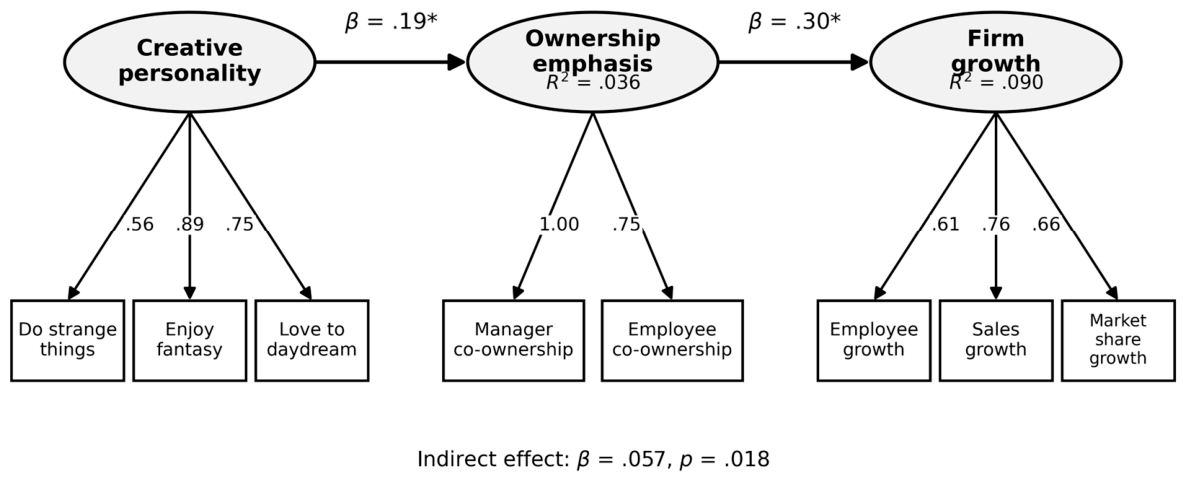
The hypothesized relationships were tested using structural equation modelling with the elliptically reweighted least-squares estimator. The model (Table 2 and Figure 1) produced the following fit statistics: χ2(19) = 33.07, p = 0.024, NFI = 0.951, CFI = 0.98, and RMSEA = 0.045, with a 90% confidence interval of [0.017, 0.071]. Although the chi-square test was statistically significant, the incremental fit indices and RMSEA indicated an acceptable overall fit. The unstandardized loading of managerial ownership emphasis was fixed at 1.000 to establish the latent factor’s scale, whereas that of employee ownership emphasis was freely estimated at 0.731 (the corresponding standardized loadings 1.000 and 0.746, respectively). The standardized loading of 1.000 for managerial ownership emphasis reflected an estimated residual variance of zero and is distinguished from the fixed reference loading constraint.
Table 2.
Structural model results.
Figure 1.
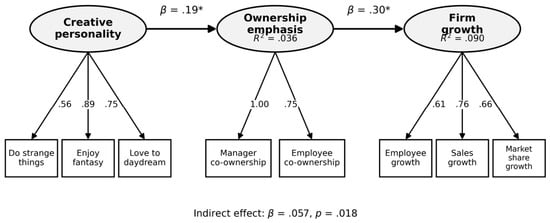
Structural model of creative personality, ownership emphasis, and firm growth. β = standardized coefficient; standardized coefficients are shown. * p < 0.05. R2 = coefficient of determination.
Creative personality had a positive and statistically significant relationship with managerial and employee ownership emphasis (B = 0.216, SE = 0.069, z = 3.135, p = 0.002; β = 0.190). Hypothesis 1 was therefore supported.
Managerial and employee ownership emphasis was also positively and significantly related to firm growth (B = 0.210, SE = 0.058, z = 3.593, p < 0.001; β = 0.301). Hypothesis 2 was consequently supported.
The indirect effect of creative personality on firm growth through ownership emphasis was positive and statistically significant (B = 0.045, SE = 0.019, z = 2.362, p = 0.018; β = 0.057). Thus, creative personality was indirectly associated with firm growth through a stronger emphasis on managerial and employee co-ownership. Creative personality explained 3.6% of the variance in ownership emphasis, while the model explained 9.0% of the variance in firm growth.
Figure 1 presents the standardized measurement and structural coefficients. Creative personality was positively associated with ownership emphasis (β = 0.190), which was positively associated with firm growth (β = 0.301). The standardized indirect effect of creative personality on growth was 0.057. Model fit indices were appropriate (χ2(19) = 33.07, p = 0.024, CFI = 0.98, NFI = 0.95, RMSEA = 0.045, 90% CI [0.017, 0.071]). The structural model specified an indirect pathway from creative personality to firm growth through ownership emphasis, with the direct path excluded from the model because of the Lagrange Multiplier Test results. The estimated indirect effect was positive, with an approximate 95% confidence interval from 0.008 to 0.082. The approximate normal theory confidence interval was calculated. The interval excluded zero, supporting a statistically significant positive indirect association under this approximation. The model total effect equaled the indirect effect. The direct path was not included because Lagrange Multiplier Test indicated it should not be added. Despite its statistical significance, the indirect association was small (β = 0.057), and the model explained only 3.6% of the variance in ownership emphasis and 9.0% in firm growth, indicating limited explanatory power and demanding caution in the assessment of findings.
As a robustness check, the structural model was re-estimated with industry, company age, and company size, measured by revenue, as control variables. Creative personality remained positively and significantly associated with ownership emphasis (β = 0.19), and ownership emphasis remained positively and significantly associated with firm growth (β = 0.27). These coefficients were similar to those obtained in the original model. Among the control variables, only industry was significantly associated with growth (β = −0.22), indicating that production firms reported lower growth than service firms in this sample, conditional on the other variables in the model. These findings support the stability of the two hypothesized associations after adjustment for the selected firm characteristics.
To examine the ownership dimensions separately, the structural model was reestimated with managerial and nonmanagerial employee ownership emphasis specified as distinct variables. The model demonstrated good fit (NFI = 0.96, CFI = 0.99, RMSEA = 0.036, 90% CI [0.000, 0.064]). Managerial ownership emphasis was positively and significantly associated with firm growth (β = 0.43), whereas the association between nonmanagerial employee ownership emphasis and growth was not statistically significant (β = 0.18). These findings warrant distinguishing the two ownership dimensions when interpreting their relationships with firm growth.
5. Discussion
The results indicate that the entrepreneur’s creative personality is positively associated with the firm’s emphasis on managerial and employee co-ownership. Ownership emphasis, in turn, is positively associated with firm growth, with managerial ownership having a stronger association. The significant indirect effect suggests that creative personality may be related to growth through organizational arrangements that extend participation in ownership to managers and employees. This pattern contributes to a more detailed understanding of how an individual characteristic of the entrepreneur may become connected with firm-level outcomes.
The findings are particularly relevant because creative personality was not directly correlated with firm growth. This result is consistent with previous evidence showing that a broad creative personality does not necessarily translate directly into SME growth (Peljko & Auer Antončič, 2022). Creative individuals may express their creativity in artistic, intellectual, interpersonal, or everyday domains that are not inherently related to business performance. Creative personality may therefore provide a general cognitive and motivational capacity, but its economic relevance depends on whether it is translated into entrepreneurial actions, strategic decisions, or organizational practices.
Previous research similarly suggests that creativity produces entrepreneurial outcomes through intervening mechanisms and has linked creative personality to opportunity recognition and the tendency to start new ventures (Shane & Nicolaou, 2015). Khedhaouria et al. (2015) also found an indirect relationship between entrepreneurs’ creativity and small-firm performance through entrepreneurial orientation. The present findings suggest that an emphasis on managerial and employee ownership may provide another organizational pathway linking creative personality to firm growth. This interpretation is consistent with the view that organizational structures and practices help explain how individual creativity relates to business outcomes.
The positive association between creative personality and ownership emphasis may reflect creative entrepreneurs’ willingness to consider arrangements that share responsibility, financial stakes, and involvement in decisions. Entrepreneurs with creative personalities may be more willing to explore alternatives to conventional, centralized ownership structures. This interpretation remains tentative, however, because the study did not examine why firms introduced co-ownership or when ownership changes occurred. The study cannot establish whether creative personality leads to co-ownership arrangements or whether they are influenced by other characteristics, such as openness, participative leadership, entrepreneurial orientation, or organizational culture.
The positive relationship between managerial and employee ownership emphasis and firm growth supports research (Kapopoulos & Lazaretou, 2007; Qin & Deng, 2009; Alabdullah, 2018; Klaneček et al., 2019; Bhakar et al., 2024), which bonds ownership participation to organizational performance. Ownership may bring managers’ and employees’ interests closer to those of the firm, strengthen commitment, encourage a longer-term perspective, and also motivate them to seek improvements, support innovation, control costs, and help the firm remain competitive.
This insight is consistent with the meta-analysis by O’Boyle et al. (2016), who found a slight positive association between employee ownership and firm performance across different settings and performance measures. The benefits of ownership may not be universal, since evidence from European firms suggests that outcomes depend on firm characteristics and institutional conditions (K. Y. Kim & Patel, 2017). Managerial ownership may also have a nonlinear relationship with performance (Short & Keasey, 1999): ownership can align interests, but concentrated managerial control may weaken accountability and lead to entrenchment. The findings of this study suggest that ownership participation can be relevant for firm growth without implying that all ownership arrangements have the same relationship with growth.
The standardized coefficient linking ownership emphasis to growth was larger than the coefficient linking creative personality to ownership emphasis. Yet, the model explained only 3.6% of the variance in ownership emphasis and 9.0% in firm growth. The indirect association was statistically significant and small, suggesting that creative personality and ownership emphasis are two of many factors relevant to firm growth. Other potential influences include resources, capabilities, strategy, market conditions, industry characteristics, innovation, access to finance, and entrepreneurs’ growth intentions.
The study connects research on individual creativity, ownership, and SME growth. Its theoretical contribution is the suggestion that entrepreneurs’ personal characteristics may be indirectly associated with firm outcomes through perceptions of organizational arrangements (the ownership emphasis). This perspective moves beyond a simple direct relationship between personality and growth and emphasizes the organizational effects linked to entrepreneurs’ characteristics.
A practical implication is that entrepreneurs should not expect creativity alone to generate growth, and organizational practices can help put ideas into action by drawing on the knowledge, motivation, and commitment of managers and employees. Carefully designed co-ownership structural arrangements may support this progression, but ownership rights, responsibilities, decision-making authority, and remuneration expectations should be clearly defined. Co-ownership should fit the firm’s governance arrangements, strategic goals, and organizational context, rather than be treated as a general solution for growth.
6. Limitations and Future Research Directions
Several limitations should be considered. First, the study used cross-sectional, self-reported data, which do not establish causality. Although the results are consistent with an indirect association between creative personality and firm growth through managerial and employee ownership emphasis, reverse relationships also remain possible. For example, growing companies may be more disposed to introduce co-ownership arrangements. The estimated pathway should be interpreted as an indirect association rather than evidence of causal mediation. The cross-sectional design does not establish temporal order, and reliance on a single respondent per firm means that common method bias cannot be entirely ruled out.
Second, all answers were reported by the same respondent, which increases the possibility of common method bias and social desirability bias. The subjective growth measures may also differ from accounting indicators.
Moreover, the sample consisted exclusively of Slovenian SMEs and was dominated by small firms. Differences in coverage and size classification (Agencija Republike Slovenije za Javnopravne Evidence in Storitve, 2026) limit conclusions about sample representativeness. The results therefore may not generalize directly to larger organizations, or countries with different ownership institutions and entrepreneurial environments.
Measurement limitations also warrant attention. Management and employee ownership was measured as the company’s emphasis on co-ownership rather than actual equity participation, ownership percentages, voting rights, or decision-making control. The two-item measure also combined managerial and non-managerial employee ownership, although these arrangements may have different motivational and governance consequences. In addition, the creative-personality measure was reduced from ten items to three items during the exploratory analysis. Although the retained construct showed acceptable reliability, its comparatively narrow content may not represent the full domain of creative personality. The reduced measure of creative personality requires further validation in independent samples. Some measurement-model indicators were also less than optimal, and the structural model explained relatively modest proportions of variance in ownership and company growth. The low proportions of explained variance in ownership emphasis (3.6%) and firm growth (9.0%), together with the small standardized indirect association (β = 0.057), indicate limited explanatory power and warrant caution when assessing the substantive importance of the findings. The findings provide preliminary indication of a statistically significant indirect association but do not establish causal mediation.
Future research should use longitudinal designs to clarify temporal order and combine entrepreneur surveys with employee reports, ownership records, and more objective firm data. Ownership, being managerial or nonmanagerial (employee), should be examined separately because they can involve different organizational roles and may be associated differently with innovation and firm performance (Klaneček et al., 2019).
Future measures should capture actual equity shares, voting and control rights, ownership duration, participation in decision-making, and the motives for adopting co-ownership. These dimensions would provide a more precise assessment of how combining ownership, management, and control affects organizational outcomes (Demsetz, 1983; Blair, 1995; Ravenscraft, 1996) and whether ownership aligns the interests of managers, employees, and shareholders (Alabdullah, 2018; Bhakar et al., 2024). Future research should test whether these effects vary across governance arrangements, organizational characteristics, and institutional environments, given that ownership structure can condition the effects of managerial characteristics on organizational outcomes (Blair, 1995; Klaneček et al., 2019).
7. Conclusions
This study examined whether managerial and employee ownership emphasis provides an organizational pathway connecting entrepreneurs’ creative personality with SME growth. Based on data from 359 Slovenian entrepreneurs, creative personality was positively associated with ownership emphasis, and ownership emphasis was positively associated with firm growth, with managerial ownership having a stronger association. The indirect relationship between creative personality and growth was also positive and statistically significant.
The findings suggest that a broad creative personality may become relevant to firm growth when it is expressed through organizational arrangements that encourage managerial and employee participation in ownership. The study extends research on entrepreneurial creativity by linking entrepreneurs’ creative personality with ownership emphasis and firm growth.
The sample consisted of Slovenian SMEs, 96% of which had 50 or fewer employees. The findings should therefore be generalized cautiously to larger firms or firms in other countries. The results indicate a modest indirect association but do not establish causal mediation. The cross-sectional design, subjective measures, limited explanatory power, and assessment of ownership emphasis rather than actual ownership stakes limit the conclusions that can be drawn. Nevertheless, the study provides a foundation for further research on how entrepreneurs’ personal characteristics are reflected in organizational structures and how these structures relate to SME development and growth.
Funding
This research received no external funding.
Institutional Review Board Statement
Ethical review and approval were waived for this study since the questionnaire survey did not involve ethical issues and was conducted in accordance with legal requirements and general ethical guidelines. Ethical review and approval were waived for this study because the data collection relied exclusively on an anonymous survey and non-interventional questionnaires, raising no structural ethical or privacy risks. The study was conducted in strict accordance with the EU Horizon Europe Guidance (EU Grants: How to complete your ethics self-assessment), which clarifies that low-risk, non-invasive social research does not necessitate a full ethics committee screening. Furthermore, the protocol aligns with national academic frameworks outlined in the University of Ljubljana’s Ethics and integrity in research guidelines and the specialized criteria provided by the University of Ljubljana, Faculty of Social Sciences (FDV), under which non-interventional questionnaires involving minimal participant risk and fully anonymized data processing are exempt from formal board approval. All participants provided informed consent prior to completing the questionnaire, and their human rights, dignity, and privacy were fully protected throughout the process.
Informed Consent Statement
Informed consent was obtained from all the subjects involved in the study.
Data Availability Statement
Data are available on request from the author.
Conflicts of Interest
The author declares no conflicts of interest.
References
- Agencija Republike Slovenije za Javnopravne Evidence in Storitve. (2026). Informacija o Poslovanju gospodarskih družb v Republiki Sloveniji v letu 2025. Available online: https://www.ajpes.si/Doc/LP/Informacije/Informacija_LP_GD_zadruge_2025.pdf (accessed on 19 October 2026).
- Alabdullah, T. T. Y. (2018). The relationship between ownership structure and firm financial performance: Evidence from Jordan. Benchmarking: An International Journal, 25(1), 319–333. [Google Scholar] [CrossRef] [Scilit]
- Antončič, B., & Auer Antončič, J. (2023). Psychological and sociological determinants of entrepreneurial intentions and behaviors. Frontiers in Psychology, 14, 1076768. [Google Scholar] [CrossRef] [Scilit] [PubMed]
- Antončič, B., Bratkovič Kregar, T., Singh, G., & DeNoble, A. F. (2015). The Big Five personality–entrepreneurship relationship: Evidence from Slovenia. Journal of Small Business Management, 53(3), 819–841. [Google Scholar] [CrossRef] [Scilit]
- Antončič, B., & Hisrich, R. D. (2001). Intrapreneurship: Construct refinement and cross-cultural validation. Journal of Business Venturing, 16(5), 495–527. [Google Scholar] [CrossRef] [Scilit]
- Antonio, T., Lanawati, S., Wiriana, T. A., & Christina, L. (2014). Correlations creativity, intelligence, personality, and entrepreneurship achievement. Procedia—Social and Behavioral Sciences, 115, 251–257. [Google Scholar] [CrossRef] [Scilit]
- Auer Antončič, J., & Antončič, B. (2011). Employee loyalty and its impact on firm growth. International Journal of Management & Information Systems, 15(1), 81–87. [Google Scholar] [CrossRef] [Scilit]
- Auer Antončič, J., Antončič, B., Kobal Grum, D., & Ruzzier, M. (2018). The Big Five personality of the SME manager and their company’s performance. Journal of Developmental Entrepreneurship, 23(4), 1850021. [Google Scholar] [CrossRef] [Scilit]
- Batey, M., & Furnham, A. (2006). Creativity, intelligence, and personality: A critical review of the scattered literature. Genetic, Social, and General Psychology Monographs, 132(4), 355–429. [Google Scholar] [CrossRef] [Scilit] [PubMed]
- Benhaida, S., Safaa, L., Perkumienė, D., & Labanauskas, G. (2024). Creative tourism: Two decades of conceptual evolution and characterization. Administrative Sciences, 14(8), 172. [Google Scholar] [CrossRef] [Scilit]
- Bentler, P. M. (2006). EQS 6 structural equations program manual. Multivariate Software. [Google Scholar]
- Bertrand, M., & Schoar, A. (2003). Managing with style: The effect of managers on firm policies. The Quarterly Journal of Economics, 118(4), 1169–1208. [Google Scholar] [CrossRef] [Scilit]
- Bhakar, S., Sharma, P., & Kumar, S. (2024). Ownership structure and firm performance: A comprehensive review and empirical analysis. Journal of the Knowledge Economy, 15(4), 19824–19865. [Google Scholar] [CrossRef] [Scilit]
- Blair, M. M. (1995). Ownership and control: Rethinking corporate governance for the twenty-first century. Brookings Institution Press. [Google Scholar]
- Carroll, J. B. (1993). Human cognitive abilities: A survey of factor-analytic studies. Cambridge University Press. [Google Scholar] [CrossRef] [Scilit]
- Crossland, C., & Hambrick, D. C. (2011). Differences in managerial discretion across countries: How nation-level institutions affect the degree to which CEOs matter. Strategic Management Journal, 32(8), 797–819. [Google Scholar] [CrossRef] [Scilit]
- Davidsson, P., Achtenhagen, L., & Naldi, L. (2010). Small firm growth. Foundations and Trends in Entrepreneurship, 6(2), 69–166. [Google Scholar] [CrossRef] [Scilit]
- Demsetz, H. (1983). The structure of ownership and the theory of the firm. The Journal of Law and Economics, 26(2), 375–390. [Google Scholar] [CrossRef] [Scilit] [PubMed]
- Edwards-Schachter, M., García-Granero, A., Sánchez-Barrioluengo, M., Quesada-Pineda, H., & Amara, N. (2015). Disentangling competences: Interrelationships on creativity, innovation and entrepreneurship. Thinking Skills and Creativity, 16, 27–39. [Google Scholar] [CrossRef] [Scilit]
- Eysenck, H. J. (1993). Creativity and personality: Suggestions for a theory. Psychological Inquiry, 4(3), 147–178. [Google Scholar] [CrossRef] [Scilit] [PubMed]
- Feist, G. J. (1998). A meta-analysis of personality in scientific and artistic creativity. Personality and Social Psychology Review, 2(4), 290–309. [Google Scholar] [CrossRef] [Scilit] [PubMed]
- Gimeno, J., Folta, T. B., Cooper, A. C., & Woo, C. Y. (1997). Survival of the fittest? Entrepreneurial human capital and the persistence of underperforming firms. Administrative Science Quarterly, 42(4), 750–783. [Google Scholar] [CrossRef] [Scilit]
- Gough, H. G. (1979). A creative personality scale for the adjective check list. Journal of Personality and Social Psychology, 37(8), 1398–1405. [Google Scholar] [CrossRef]
- Hambrick, D. C. (2007). Upper echelons theory: An update. Academy of Management Review, 32(2), 334–343. [Google Scholar] [CrossRef] [Scilit]
- Harman, H. H. (1976). Modern factor analysis (3rd ed., rev.). University of Chicago Press. [Google Scholar]
- Hąbek, P., & Saeed, F. (2024). Exploring the relationship between top management team characteristics and corporate social responsibility: A literature review and bibliometric analysis. Sustainability, 16(19), 8563. [Google Scholar] [CrossRef] [Scilit]
- Hu, Y., Zhang, Q., & Wang, X. (2019). Potentials of top management team career development and corporate social responsibility: A study on listed manufacturing companies in China. Career Development International, 24(6), 560–579. [Google Scholar] [CrossRef] [Scilit]
- IBM Corp. (2025). IBM SPSS statistics (Version 31.0) [Computer software]. IBM Corp. [Google Scholar]
- Jensen, M. C., & Meckling, W. H. (1976). Theory of the firm: Managerial behavior, agency costs and ownership structure. Journal of Financial Economics, 3(4), 305–360. [Google Scholar] [CrossRef] [Scilit]
- Kapopoulos, P., & Lazaretou, S. (2007). Corporate ownership structure and firm performance: Evidence from Greek firms. Corporate Governance: An International Review, 15(2), 144–158. [Google Scholar] [CrossRef] [Scilit]
- Kaufman, J. C., & Baer, J. (2004). Sure, I’m creative—But not in mathematics! Self-reported creativity in diverse domains. Empirical Studies of the Arts, 22(2), 143–155. [Google Scholar] [CrossRef] [Scilit]
- Kaufman, J. C., Cole, J. C., & Baer, J. (2009). The construct of creativity: A structural model for self-reported creativity ratings. The Journal of Creative Behavior, 43(2), 119–134. [Google Scholar] [CrossRef] [Scilit]
- Khedhaouria, A., Gurău, C., & Torrès, O. (2015). Creativity, self-efficacy, and small-firm performance: The mediating role of entrepreneurial orientation. Small Business Economics, 44(3), 485–504. [Google Scholar] [CrossRef] [Scilit]
- Kim, E. H., & Ouimet, P. (2014). Broad-based employee stock ownership: Motives and outcomes. The Journal of Finance, 69(3), 1273–1319. [Google Scholar] [CrossRef] [Scilit]
- Kim, K. Y., & Patel, P. C. (2017). Employee ownership and firm performance: A variance decomposition analysis of European firms. Journal of Business Research, 70, 248–254. [Google Scholar] [CrossRef] [Scilit]
- Klaneček, A., Antončič, B., Auer Antončič, J., & Jakačić, M. (2019). Lastništvo zaposlenih in managerjev v podjetjih v Sloveniji ter njegova vloga pri uvajanju novih izdelkov in storitev [Employee and management corporate ownership in Slovenia and its role in the introduction of new products and services]. Economic and Business Review, 21(Special issue), 149–157. [Google Scholar] [CrossRef] [Scilit]
- Klanšek, L., & Antončič, B. (2026). Identities of female entrepreneurs from different periods. Administrative Sciences, 16(1), 24. [Google Scholar] [CrossRef] [Scilit]
- Ko, S., & Butler, J. E. (2007). Creativity: A key link to entrepreneurial behavior. Business Horizons, 50(5), 365–372. [Google Scholar] [CrossRef] [Scilit]
- Lam, C. K., Huang, X., & Chan, S. C. H. (2015). The threshold effect of participative leadership and the role of leader information sharing. Academy of Management Journal, 58(3), 836–855. [Google Scholar] [CrossRef] [Scilit]
- Li, Z., & Antončič, B. (2023). Entrepreneurial competencies: An extended construct. Journal of Enterprising Culture, 31(2), 101–137. [Google Scholar] [CrossRef] [Scilit]
- Lieberson, S., & O’Connor, J. F. (1972). Leadership and organizational performance: A study of large corporations. American Sociological Review, 37(2), 117–130. [Google Scholar] [CrossRef] [Scilit]
- Lumpkin, G. T., & Dess, G. G. (1996). Clarifying the entrepreneurial orientation construct and linking it to performance. Academy of Management Review, 21(1), 135–172. [Google Scholar] [CrossRef] [Scilit]
- Mollick, E. (2012). People and process, suits and innovators: The role of individuals in firm performance. Strategic Management Journal, 33(9), 1001–1015. [Google Scholar] [CrossRef] [Scilit]
- O’Boyle, E. H., Patel, P. C., & Gonzalez-Mulé, E. (2016). Employee ownership and firm performance: A meta-analysis. Human Resource Management Journal, 26(4), 425–448. [Google Scholar] [CrossRef] [Scilit]
- Peljko, Ž., & Auer Antončič, J. (2022). Impacts of entrepreneurial openness and creativity on company growth. Frontiers in Psychology, 13, 860382. [Google Scholar] [CrossRef] [Scilit] [PubMed]
- Peljko, Ž., Jordan, G., Jeraj, M., Todorović, I., & Marič, M. (2017). Do entrepreneur’s creative abilities influence company’s growth? Management: Journal of Sustainable Business and Management Solutions in Emerging Economies, 22(1), 25–35. [Google Scholar] [CrossRef] [Scilit][Green Version]
- Pierce, J. L., Rubenfeld, S. A., & Morgan, S. (1991). Employee ownership: A conceptual model of process and effects. Academy of Management Review, 16(1), 121–144. [Google Scholar] [CrossRef] [Scilit]
- Podsakoff, P. M., & Organ, D. W. (1986). Self-reports in organizational research: Problems and prospects. Journal of Management, 12(4), 531–544. [Google Scholar] [CrossRef] [Scilit]
- Puhakka, V. (2005, June 15–18). The role of intellectual capital in opportunity recognition of entrepreneurs [Conference paper]. Golden Opportunities for Entrepreneurship: ICSB 50th World Conference, Washington, DC, USA. [Google Scholar]
- Qin, Z., & Deng, X. (2009). Ownership structure and performance in family businesses at early developmental stage: Evidence from China. Corporate Ownership & Control, 7(1), 138–150. [Google Scholar] [CrossRef] [Scilit]
- Ravenscraft, D. J. (1996). Review of the book Ownership and control: Rethinking corporate governance for the twenty-first century, by M. M. Blair. Journal of Economic Literature, 34(4), 1971–1972. [Google Scholar]
- Richards, G. (2011). Creativity and tourism: The state of the art. Annals of Tourism Research, 38(4), 1225–1253. [Google Scholar] [CrossRef] [Scilit]
- Shane, S., & Nicolaou, N. (2015). Creative personality, opportunity recognition and the tendency to start businesses: A study of their genetic predispositions. Journal of Business Venturing, 30(3), 407–419. [Google Scholar] [CrossRef] [Scilit]
- Short, H., & Keasey, K. (1999). Managerial ownership and the performance of firms: Evidence from the UK. Journal of Corporate Finance, 5(1), 79–101. [Google Scholar] [CrossRef] [Scilit]
- Štemberger, T. (2013). Stališča bodočih vzgojiteljic do ustvarjalnosti [Views of future preschool teachers on creativity]. Revija za Elementarno Izobraževanje, 6(2–3), 101–114. [Google Scholar]
- Tiwari, P. N., & Verma, N. (2020). Creativity and entrepreneurship: Complementing each other to create success stories. International Journal of Trade & Commerce-IIARTC, 9(1), 111–120. [Google Scholar] [CrossRef] [Scilit]
- Wall, T. D., Michie, J., Patterson, M., Wood, S. J., Sheehan, M., Clegg, C. W., & West, M. (2004). On the validity of subjective measures of company performance. Personnel Psychology, 57(1), 95–118. [Google Scholar] [CrossRef] [Scilit]
- Zheng, Q., & Lin, D. (2021). Top management team stability and corporate social responsibility: The moderating effects of performance aspiration gap and organisational slack. Sustainability, 13(24), 13972. [Google Scholar] [CrossRef] [Scilit]

Disclaimer/Publisher’s Note: The statements, opinions and data contained in all publications are solely those of the individual author(s) and contributor(s) and not of MDPI and/or the editor(s). MDPI and/or the editor(s) disclaim responsibility for any injury to people or property resulting from any ideas, methods, instructions or products referred to in the content. |
© 2026 by the author. Licensee MDPI, Basel, Switzerland. This article is an open access article distributed under the terms and conditions of the Creative Commons Attribution (CC BY) license.