


Abstract
Eco-anxiety has emerged as an important construct in environmental psychology. The Hogg Eco-Anxiety Scale (HEAS-13), which consists of 13 items, is a multidimensional instrument designed to assess affective symptoms, rumination, behavioral responses, and anxiety related to environmental issues. This study examined the psychometric properties of the HEAS-13 in a general population sample from Czechia. The study assessed the scale’s validity in relation to generalized anxiety and self-reported housing damage associated with adverse weather-related events. Data were collected by conducting face-to-face interviews with a population-based sample in Czechia (n = 1027), with respondents selected using address-based sampling. The psychometric evaluation included descriptive statistics, an internal consistency analysis, inter-item correlations, an exploratory factor analysis (EFA) based on principal axis factoring with oblimin rotation, a confirmatory factor analysis (CFA) using a Weighted Least Squares Mean and Variance (WLSMV) estimator appropriate for ordinal indicators, and convergent, discriminant, and known-groups validity testing. The HEAS-13 demonstrated high internal consistency (Cronbach’s alpha = 0.962; McDonald’s omega = 0.958 for the total scale). EFA supported the original four-factor structure and CFA showed a good fit of the original model. Score distributions were positively skewed, and substantial floor effects indicated generally low levels of eco-anxiety symptom endorsement in the general population. The HEAS-13 total score was strongly correlated with the GAD-7 (rho = 0.839) supporting convergence with generalized anxiety, but also indicating possible construct overlap. Known-groups validity was supported by higher HEAS-13 scores among respondents reporting hazard-related home damage. Measurement invariance was examined across sex and age groups. The HEAS-13 appears to be a reliable and structurally well-fitted instrument for assessing multidimensional eco-anxiety in population-based research. The results provide evidence that the construct is meaningfully associated with generalized anxiety and experience of environmentally disruptive events. The HEAS-13 may serve as a useful tool for future research on environmental distress and climate- and environment-related mental health. It may also be useful for studies examining risk perception as an explanatory, associated, or contextual variable.
1. Introduction
The accelerating environmental crisis is increasingly understood as not only an ecological and societal challenge, but also a mental health issue. Recent literature generally uses the term “eco-anxiety” to denote worry, fear, distress, or apprehension elicited by climate change and broader environmental degradation [1,2,3,4,5]. However, its conceptual boundaries still remain contested [6]. Existing reviews show that eco-anxiety has been framed as both a potentially maladaptive symptom [7] and a nonpathological [2,8,9], emotional response to ecological threat [10,11]. Empirical studies further suggest that eco-anxiety may be associated with depression [2,12], generalized anxiety [4,5], stress [1,2], insomnia [2,13], functional impairment [2,14], and reproductive concerns [15]. It may also co-occur with pro-environmental engagement [16,17] and climate-related action [16,18]. Based on previous conceptual and empirical work, eco-anxiety is best understood as a response that may range from adaptive concern to clinically relevant distress depending on severity, persistence, impairment, and context [1,3,6].
Although the terms “eco-anxiety” and “climate anxiety” are sometimes used interchangeably, they are not identical. Climate anxiety more narrowly refers to anxiety, worry, or functional impairment associated with climate change. In contrast, eco-anxiety refers to distress arising from climate change, as well as from broader ecological degradation, biodiversity loss, pollution, and perceived damage to natural systems [8,11,18]. This broader conceptual scope is particularly relevant to the HEAS-13, which was designed to evaluate affective symptoms, rumination, behavioral interference, and anxiety related to one’s personal environmental impact.
This conceptual ambiguity is closely mirrored in the measurement literature. A recent review identified 12 questionnaires designed to assess eco-anxiety, climate anxiety, or related constructs, demonstrating surprisingly limited symptom overlap [19]. Across 119 items, the measures covered 57 different symptoms, underscoring the lack of consensus regarding what is actually being measured when researchers refer to eco-anxiety. Recent psychometric syntheses have likewise concluded that although several instruments are now available, they vary considerably in their conceptual breadth, psychometric quality, and cross-cultural validation status [20].
Existing instruments differ in conceptual focus, symptom coverage, dimensionality, and validation status. The HEAS-13 was selected for this study because it explicitly operationalizes eco-anxiety as a multidimensional construct, and its four-factor structure has been examined in various cultural settings. Nevertheless, further validation in probability-based general population samples is needed, which is the rationale for the current Czech validation study [3,17,18,19].
Hogg et al. [21] developed the HEAS-13 as a multidimensional instrument designed to move beyond narrow operationalizations of ecological distress. The scale comprises 13 items that load onto four theoretically distinct dimensions, namely affective symptoms, rumination, behavioral symptoms, and anxiety related to the personal impact on the environment. The authors demonstrated that these dimensions were distinguishable from broader stress, anxiety, and depression constructs. The HEAS-13 offers an important advantage in that it measures emotional arousal as well as cognitive, behavioral, and self-referential manifestations of eco-anxiety.
Since its development, the HEAS-13 has been examined in a number of contexts. In Türkiye, Kıvanç et al. [22] found that their adapted version retained the multidimensional structure of the original scale. In Italy, Rocchi et al. [23] found support for the Italian version and concluded that the four-factor solution best represented the data. Sampaio et al. [24] replicated the original structure in Portuguese young adults sample, demonstrating good internal consistency and temporal reliability. They also established invariance by sex and showed that some HEAS-13 dimensions were positively associated with pro-environmental behavior. Ferrajão et al. [25] later extended this evidence to an adult sample (aged 18 to 83), confirming the scale’s satisfactory psychometric performance and invariance across key sociodemographic groups. Also, other research has strengthened this cross-cultural validation. Rodríguez Quiroga et al. [26] validated the Spanish-language HEAS-13 in samples from Argentina and Spain. They reported a good fit for the four-factor model, and measurement invariance across countries, sex, and age. In Poland, Larionow et al. [27] reported strong psychometric performance of the scale and supported its usefulness for studying eco-anxiety in the Polish context. Matijasevich et al. [28] examined Brazilian adolescents and supported the expected latent structure, concluding that the scale is suitable for assessing eco-anxiety in youth populations. In Germany, Henschel et al. [29] found the HEAS-13 to be a reliable and valid instrument. They extended the external validation framework by examining its associations with psychological distress, self-efficacy, and social support. The available evidence indicates a high degree of structural convergence across validation studies while suggesting that demographic variables and external correlates may vary significantly across samples and settings [20]. The question is how the HEAS-13 would perform within a population that considers environmental issues less salient and less frequently recognizes climate change as an urgent personal or societal problem. One example of such a population is the population of Czechia.
Recent Eurobarometer data [30] suggest that Czech respondents report comparatively lower levels of climate concern, perceived exposure, and recent climate-related action than the EU average. While the 2024 Eurobarometer survey on environmental attitudes found that 78% of EU citizens believe environmental issues directly affect their daily lives and health, Czech respondents appear less likely than the EU average to translate such concern into pro-environmental behaviors. A similar pattern emerged in relation to climate change. The 2025 Eurobarometer on climate change [31] showed that, while concern remained high across the EU as a whole, Czech respondents reported comparatively lower levels. Only 48% rated climate change as a “very serious problem”, compared with 77% EU-wide. Similarly, 21% of Czech respondents considered climate change “not a serious problem”, compared with 7% EU-wide. Czech respondents were also less likely to report having taken personal action to fight climate change in the previous six months (47% vs. 63% EU-wide), and only 24% reported feeling personally exposed to environmental and climate-related risks (compared with 37% EU-wide).
In terms of environmental determinants, it is worth mentioning that Czechia is a temperate inland country and does not experience continuously recurring large-scale hazard events. However, the last five years have included several disruptive weather- and environment-related events with substantial social and economic consequences. The Czech Hydrometeorological Institute indicated that 2021–2023 were temperature-normal years with annual precipitation in the normal range [32]. Although 2024 was rather warm, it still fell within the normal-to-above-normal range in annual precipitation. Even if it is not usual, Czechia has experienced several disruptive events during the last five years. For example, in 2021 an F4 tornado (which is rare in Europe) struck one of the regions [32]. According to the Czech Insurance Association, the event generated approximately 10,000 claims [33]. In 2022, drought began affecting much of the country in the spring, and the summer saw the largest wildfire on record in Czechia; in 2023 severe soil drought was documented, with soil water storage falling below 20% of the available capacity in more than half the country [32]. In 2024, extreme rainfall triggered major flooding, which insurers later quantified at around 100,000 property claims [33]. Further, insurance-sector data indicate that storm and wind damage are not negligible in Czechia, with approximately 200,000 wind-related claims from 2020 to 2024 [33]. These data suggest that, while major weather and environmental hazards in Czechia are not constant or ubiquitous, they are real and consequential to be a meaningful focus for study on eco-anxiety and perceived environmental threat.
The present study aimed to examine the psychometric characteristics of the Hogg Eco-Anxiety Scale in a population-based Czech sample. Building on the original multidimensional construct of eco-anxiety [21], we evaluated whether the Czech adaptation reproduced the four-factor structure, demonstrated satisfactory internal consistency, showed measurement invariance across relevant groups, and exhibited meaningful relationships with theoretically relevant external constructs. More specifically, we expected that (H1) the HEAS-13 would replicate the original four-factor structure, (H2) the total scale and its subscales would demonstrate satisfactory to high internal consistency, (H3) the HEAS-13 scores would demonstrate convergent validity based on positive associations with generalized anxiety and known-group validity through higher scores among respondents reporting weather-related home damage, and (H4) the scale would demonstrate configural, metric, and scalar invariance across sex and age groups.
2. Materials and Methods
2.1. Study Design
The study was based on a cross-sectional population survey conducted in Czechia using face-to-face interviews and an address-based sampling design. Because the objective was to validate the HEAS-13 in the general population, the theoretical population was defined as Czech residents aged 15–74 years. Address-based sampling was chosen because it enabled the recruitment of a probability sample from the household population, well-suited for adequate sociodemographic coverage.
The sampling frame was derived from the register of residential dwellings compiled for the 2021 Population and Housing Census. Within each household, the target respondent was identified using a Kish table [34] to reduce selection bias within households and ensure that each eligible household member had a known probability of being selected. Fieldwork was carried out in October 2025, during which 1871 addresses were contacted, and 1053 interviews were completed. The response rate computed by AAPOR Standard Definitions (RR5) was 56.3%. After excluding incomplete interviews and cases with missing responses on the HEAS-13, GAD-7, and validation variables, the final dataset included 1027 cases.
The study was reviewed by the INESAN Ethical Committee that granted ethical approval (IREBA/2025/618; 18 June 2025). All respondents received information about the purpose of the study, voluntary participation, confidentiality, and data protection, and provided informed consent before the interview. For respondents aged 15–17, participation was conditional upon receiving informed consent from a parent or legal guardian, as well as assent from the minor respondent. Interviewers were instructed to conduct interviews with minors only when these conditions were met. Respondents aged 18 years and older provided informed consent on their own behalf. The data collection procedures adhered to the principles of the Helsinki Declaration [35].
The data collection was not affected by an exceptional short-term meteorological disturbance. According to the Czech Hydrometeorological Institute [36], October 2025 in Czechia was normal in terms of temperature and precipitation, and there was no nationwide weather emergency. This is relevant because responses to eco-anxiety items may have been temporarily increased in case of salient events.
2.2. Participants
The sample of 1027 respondents was randomly divided into two approximately equal subsamples, the first subsample of 514 respondents for exploratory factor analysis (EFA), and the second subsample of 513 respondents for confirmatory factor analysis (CFA).
As shown in Table 1, the total sample was nearly balanced by sex, with 49.6% male and 50.4% female respondents. Sex was recorded using two categories, male or female, corresponding to the population benchmarks used for sample control. The largest age groups were 60–74 years (22.5%) and 40–49 years (21.1%), followed by 15–29 years (20.3%), 50–59 years (18.9%), and 30–39 years (17.2%). Regarding highest level of education achieved, the largest proportion of respondents had a secondary education (34.9%), followed by a vocational education (32.7%), a university education (18.5%), and an elementary education (13.9%). The EFA and CFA subsamples were highly similar in their sociodemographic composition, supporting the adequacy of the random split for EFA and CFA.
Table 1.
Selected socio-demographic characteristics.
Before interpreting the split-sample factor analyses, the equivalence of the EFA and CFA subsamples was examined. The results showed no statistically significant differences between the two subsamples in any HEAS-13 item, the subscale, or the total score. Mann–Whitney tests for individual items yielded non-significant results across all 13 items, and the same was observed for the affective symptoms, rumination, behavioral symptoms, anxiety about personal impact, and total HEAS-13 scores. In addition, the two subsamples did not differ significantly in sex (χ2 = 0.024, p = 0.876), age (χ2 = 3.547, p = 0.471), and education (χ2 = 3.023, p = 0.388). These findings indicate that the random split did not introduce systematic differences between the exploratory and confirmatory subsamples. Therefore, the subsequent EFA and CFA results can be interpreted as cross-validation of the factor structure rather than as analyses based on substantively different respondent groups.
2.3. Translation and Scale Adaptation
In this study, linguistic and conceptual equivalence was essential. Therefore, the translation procedure followed the established recommendations for adapting survey instruments [37,38,39]. First, two independent translations from English to Czech were produced in parallel. These were then compared and reconciled into a single version. Next, a third translator who had not participated in the initial translation stage performed a back-translation into English [40]. The back-translated version was compared with the original wording to assess semantic equivalence and identify significant deviations.
The translated scale was tested using cognitive interviewing [41] with 17 respondents recruited from the target population. Think-aloud protocols were used to examine how respondents understood individual items and whether any expressions were unclear or misleading [41]. This approach follows prior Czech scale-validation work using the same cognitive-interviewing logic and think-aloud procedure in a general-population setting [42]. This stage was intended to ensure that the Czech version preserved the original items’ intended meaning while remaining comprehensible to the general population.
Item 5 was the only one that required rewording during cognitive interviewing. The original statement “Unable to stop thinking about future climate change and other global environmental problems” was changed to “Unable to stop thinking about future climate change.” This modification was made because several respondents interpreted the original wording as potentially double-barreled. The change aimed to improve semantic clarity while preserving the item’s focus on repetitive thoughts about future climate change.
2.4. Measures
2.4.1. Hogg Eco-Anxiety Scale (HEAS-13)
The HEAS-13 comprises four dimensions, i.e., affective symptoms (four items), rumination (three items), behavioral symptoms (three items), and anxiety about personal impact on the environment (three items) [21]. The affective symptoms dimension reflects emotional responses such as nervousness, fear, and excessive worry. Rumination identifies repetitive and intrusive environmentally related thoughts. Behavioral symptoms refer to interference with everyday functioning, such as difficulty sleeping or concentrating. Anxiety about personal impact reflects distress linked to the responsibility for environmental problems. Respondents were asked to report how often they had experienced these reactions over the previous two weeks. Items were answered on a four-point scale ranging from 0 (“not at all”) to 3 (“nearly every day”). Subscale scores were computed as sums of the relevant items, and the total score was obtained by summing all 13 items. Thus, higher scores indicate higher eco-anxiety and the total scale range may be from 0 to 39.
2.4.2. Generalized Anxiety Disorder Scale (GAD-7)
To assess convergent validity, GAD-7 was applied as a widely used screening instrument [43]. The GAD-7 consists of seven items that assess the frequency of symptoms experienced over the previous two weeks. Response options range from 0 (“not at all”) to 3 (“nearly every day”), yielding a total score between 0 and 21 when higher scores indicate greater anxiety. The GAD-7 has demonstrated good psychometric properties across various populations [43,44] and it was recently validated in Czechia [44]. In the present sample, the GAD-7 demonstrated good to excellent internal consistency, with Cronbach’s alpha and McDonald’s omega values of 0.916. Given its theoretical relevance and satisfactory reliability in the present sample, the GAD-7 was used as an external correlate of the HEAS-13 [21].
2.4.3. Personal Experience with Weather-Related Hazards
Personal experience with weather-related hazard events was measured using a set of ad hoc screening items developed for this study. These items were designed to identify recent household-level damage or serious disruption caused by salient weather-related events in Czechia. Respondents were asked if their home had been damaged or seriously disrupted by any of the following events during the past five years: flooding, a tornado, a storm or strong winds, heavy snowfall or ice, drought-related damage, wildfire-related damage, or another weather-related event. Each item was answered dichotomously (yes or no). The responses were summed and recoded into three categories: (1) not affected by any event, (2) affected by one event, or (3) affected by more than one event. This variable was not intended to function as a scale. Rather, it was used as a self-reported, household-level grouping indicator for a known-groups validity analysis [45,46]. Because the count variable does not reflect severity, financial loss, recency, or duration, it should be interpreted as a broad exposure indicator rather than a dose measure. This variable was used as a self-reported household-level grouping indicator for known-groups validity analysis and should not be interpreted as an objective measure of exposure to weather-related hazards.
2.5. Data Analysis
The analyses proceeded in six steps. First, descriptive statistics were calculated for each item, subscale, and total score of the HEAS-13, including means, standard deviations, skewness, and kurtosis [47]. Floor and ceiling effects were defined as the proportion of respondents who obtained the lowest or highest possible score on the relevant item, subscale, or total scale [48]. Values above 15% were considered to indicate notable floor or ceiling effects [49].
Second, internal consistency was assessed using Cronbach’s alpha and McDonald’s omega [50,51,52,53]. Corrected item-total correlations and alpha-if-item-deleted values were examined to identify items that might weaken internal consistency.
Third, EFA was used to examine the internal structure of the HEAS-13 in the first randomly selected subsample. Principal axis factoring (PAF) was used because it was suitable for identifying latent structures based on shared variance, and it was more robust than principal components analysis to deviations from multivariate normality [54,55]. Since the HEAS-13 dimensions were theoretically expected to be correlated, oblimin rotation with Kaiser normalization was applied [56]. The factor solution was evaluated with respect to the number of extracted dimensions, factor loadings, communalities (h2), and the proportion of explained variance. In this context, high factor loadings and communalities were interpreted as evidence that the items converged on their intended latent dimension [57,58]. Local misfit and potential item dependence were assessed by inspecting the standardized residual correlation matrix from the ordinal CFA model. Because within-factor residuals in short three-item subscales can be uninformative or near-zero by model construction, interpretation focused primarily on residual correlations between items belonging to different HEAS-13 factors. The largest absolute between-factor residual correlation and the proportion of between-factor residuals exceeding 0.10 and 0.20 were reported as indicators of possible localized misfit.
Fourth, CFA was used to test the factor structure in the second subsample. Due to the ordinal response format, skewed distributions, and substantial floor effects, the CFA was estimated using the Weighted Least Squares Mean and Variance Adjusted (WLSMV) estimator. This estimator is appropriate for ordinal indicators and is based on the polychoric correlation matrix [59,60]. Model fit was evaluated using the scaled chi-square statistic, CFI, TLI, RMSEA, and SRMR; values of CFI and TLI ≥ 0.95, RMSEA ≤ 0.06–0.08, and SRMR ≤ 0.08 were interpreted as indicating an acceptable to good model fit.
Fifth, we examined measurement invariance using a hierarchical multigroup CFA with the same robust ordinal estimator [61]. Configural, metric, and scalar models were tested sequentially across sex and age groups. Because the HEAS-13 items were ordinal, scalar invariance was evaluated by constraining item thresholds across groups. Invariance decisions were based primarily on changes in CFI and RMSEA, with SRMR used as a supplementary indicator of localized misfit [62]. Metric invariance was interpreted as supported when ΔCFI ≤ 0.010 and ΔRMSEA ≤ 0.015. For scalar invariance, ΔCFI ≤ 0.010 and ΔRMSEA ≤ 0.015 were treated as the primary criteria, while ΔSRMR was interpreted cautiously because SRMR can be more sensitive to threshold constraints in ordinal models. Scalar invariance was therefore considered supported when ΔCFI and ΔRMSEA remained within the recommended limits and the absolute SRMR value remained acceptable [63].
Sixth, construct validity was examined using several complementary forms of evidence. Factorial validity was assessed using EFA and CFA results. This evaluation was supported by the average variance extracted (AVE) and composite reliability (CR) values calculated for each latent dimension [64]. AVE expressed the proportion of variance in the indicators explained by the latent factor, and CR reflected the internal consistency of the latent construct. Higher AVE and CR values indicated that the items converged well on the same underlying dimension. Item-level associations within the subscales were examined using Kendall’s tau-b because of the ordinal nature of the items and the presence of tied responses [50]. The magnitude and pattern of Kendall’s tau-b coefficients were interpreted as evidence of internal coherence. External convergent validity was assessed using Spearman correlations between HEAS-13 and GAD-7 scores [65]. Since both instruments use symptom-frequency wording, and generalized anxiety and eco-anxiety may overlap, these correlations were interpreted as evidence of association rather than construct distinctiveness. To assess discriminant validity, the Heterotrait–Monotrait ratio of correlations (HTMT) was calculated. HTMT values were used to evaluate whether the HEAS-13 dimensions were empirically distinguishable from each other and from generalized anxiety measured by the GAD-7. Values below commonly used thresholds were interpreted as supporting discriminant validity, while the magnitude of the HEAS-13–GAD-7 associations was interpreted cautiously because both instruments assess anxiety-related symptomatology using self-reported frequency items. Local item dependence and potential semantic redundancy were assessed by inspecting standardized residual correlations in the ordinal CFA model. Residual correlations above 0.20 were treated as indicating possible local dependence. Known-groups validity was examined by comparing HEAS-13 scores across ordered categories of self-reported housing damage associated with weather-related hazard events using the Jonckheere–Terpstra test as a directional test of ordered group differences, and Dunn–Bonferroni post hoc comparisons [66,67]. Correlations were evaluated using two-tailed significance tests. The potential influence of common method variance was assessed using Harman’s single-factor test. This test was used only as a descriptive diagnostic and not as a definitive test of common-method bias.
Statistical analyses were mostly performed in IBM SPSS Statistics version 28 (IBM Corp., Armonk, NY, USA); ordinal CFA and measurement invariance analyses were conducted in jamovi 2.7.33 for Windows using the SEMLj module. AMOS was used for graphical model presentation.
3. Results
3.1. Item Analysis
Table 2 presents the distributions of the HEAS-13 item, subscale, and total scores. The mean HEAS-13 score at the overall scale level was 8.36 (SD = 9.064), with a median of 6, indicating that the level of eco-anxiety in the sample was relatively low. The subscales and the total HEAS-13 score showed positive skewness, indicating that responses were concentrated toward the lower end of the scale and that a substantial proportion of respondents reported few or no eco-anxiety symptoms. Floor effect was substantial for all subscales, particularly for anxiety about personal impact, where the percentage of respondents with the lowest possible score was 66.5%. Floor effect of other dimensions were 62.3% for rumination, 51.2% for behavioral symptoms and 43.6% for affective symptoms; the floor effect for the total HEAS-13 was 37.5%. On the other hand, the ceiling effect, i.e., percentage of respondents with the highest possible score, was negligible ranging from 1.4% to 2.9% across the subscales and reaching 0.0% for the total scale.
Table 2.
Descriptive statistics of the HEAS-13 subscales and their items.
Cronbach’s alpha was 0.980 for affective symptoms, 0.985 for rumination, 0.983 for behavioral symptoms, 0.984 for anxiety about personal impact, and 0.962 for the HEAS-13. McDonald’s omega showed nearly identical values of 0.980, 0.986, 0.983, and 0.984 for the four subscales and 0.958 for the total scale. Although these values indicate high precision, their magnitude also suggests that some subscales may contain semantically overlapping items. Corrected ITC were high, ranging from 0.940 to 0.973 and the corresponding alpha-if-item-deleted coefficients indicated no need for items removal.
3.2. Dimensionality of the HEAS-13
The data suitability for factor analysis was supported when the Kaiser–Meyer–Olkin (KMO) measure of sampling adequacy reached 0.922. Additionally, Bartlett’s test of sphericity was statistically significant (χ2(78) = 12,177.735, p < 0.001). EFA using principal axis factoring (PAF) with oblimin rotation yielded a four-factor solution with eigenvalues 8.912 for factor 1 (affective symptoms), 1.425 for factor 2 (anxiety about personal impact), 1.153 for factor 3 (behavioral symptoms), and 1.016 for factor 4 (rumination). The scree plot and parallel analysis results supported retaining four factors; the extracted factors corresponded to the theoretically expected dimensions of the HEAS-13.
As shown in Table 3, all 13 items loaded strongly onto their factors and communalities were also high. The high loadings and communalities indicate a very clear structure, but they may also reflect semantic proximity among items within short subscales. The four factors accounted for 96.2% of the common variance.
Table 3.
HEAS-13 exploratory factor analysis.
Table 4 shows the results of Harman’s single-factor test demonstrating that the first unrotated factor accounted for 65.99% of the variance, indicating a strong general response component. The result indicates the presence of a strong general factor underlying responses to the HEAS-13 items which is consistent with the high internal consistency coefficients, high item-factor loadings, and strong inter-item correlations observed in the study. In this respect, it is important to point out that the HEAS-13 is a short and homogeneous scale, therefore a high proportion of variance explained by the first factor may reflect a substantive general eco-anxiety or general distress component. Even though the four-factor results together with the HTMT results suggest that the observed structure is not reducible to a single undifferentiated factor, the common method variance cannot be fully ruled out because all key variables were self-reported and collected in the same interview.
Table 4.
Harman’s Single Factor Test (HEAS-13 Scale).
As shown in Table 5, associations among items belonging to the same subscale were statistically significant. The magnitude of the Kendall’s tau-b coefficients suggests that the subscales are narrowly defined and psychometrically compact.
Table 5.
Correlations among HEAS-13 items.
The residual correlation matrix was inspected to evaluate localized misfit not captured by the four-factor model. Because the three-item subscales provide limited information for detecting within-factor residual dependence, the interpretation focused on residual correlations between items belonging to different HEAS-13 factors. Table 6 shows that across the 63 between-factor item pairs, the largest absolute residual correlation was 0.028, and the mean absolute residual correlation was 0.008. No residual correlations exceeded 0.10 or 0.20. These results indicate no substantial localized misfit between factors. Thus, the high zero-order item correlations appear to be largely explained by the intended latent factors, although the semantic proximity of several items remains a relevant psychometric caution.
Table 6.
Summary of between-factor residual correlations from the ordinal CFA model.
Although the four subscales were internally homogeneous, the correlations among subscales suggest related but distinguishable domains of eco-anxiety. As shown in Table 7, the intercorrelations among the HEAS-13 subscales were moderate to strong. Each subscale was also associated with the total HEAS-13 score.
Table 7.
Correlation of HEAS-13 overall score with subscales.
3.3. Four-Factor Model Confirmation
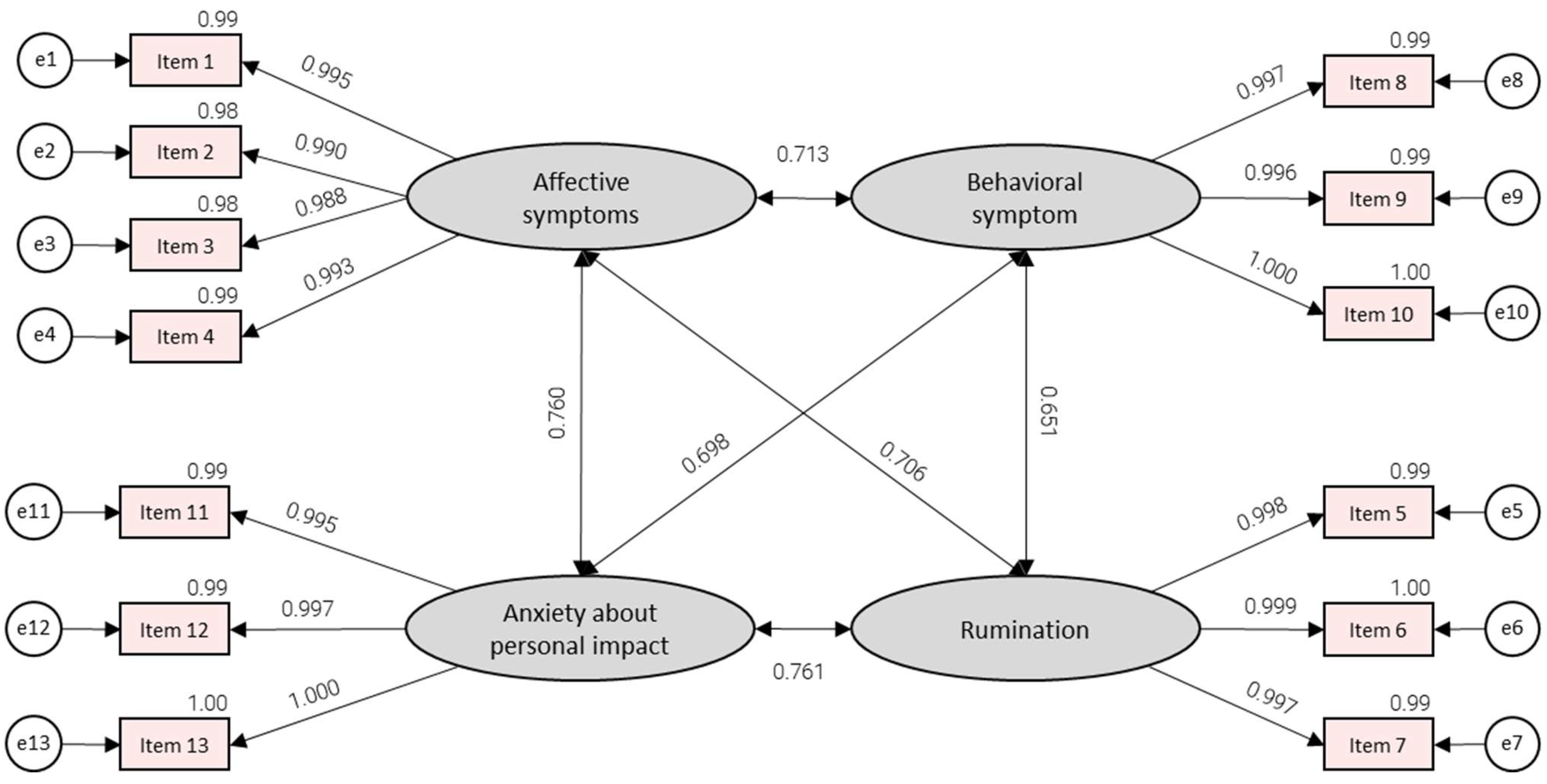
The four-factor HEAS-13 model was re-estimated using WLSMV with robust standard errors and polychoric correlations, which is appropriate for the ordinal four-point response format and the skewed item distributions. The hypothesized four-factor model presented in Figure 1 showed excellent fit [68]; Table 8 shows that the scaled chi-square was non-significant, RMSEA and SRMR were very low, and the incremental fit indices reached values indicating excellent model fit [69,70]. Because several standardized loadings approached 1.00, residual variances and model admissibility were inspected. The ordinal CFA results supported the four-factor structure of the HEAS-13 and were consistent with the exploratory factor solution. However, the nearly perfect fit indices should be interpreted with caution because the items are highly correlated and the subscales are psychometrically compact.
Figure 1.
HEAS-13 confirmatory factor analysis (original model tested on the second subsample). Note. Standardized estimates are shown. Loadings displayed as 1.000 are rounded values.
Table 8.
Absolute and Incremental Indices (HEAS-13).
Because the standardized loadings for Items 10 and 13 rounded to 1.000 in Figure 1, residual variances were inspected in detail. The residual variance for Item 10 was positive but extremely small (0.00039), whereas Item 13 showed a negligible negative residual variance (−0.00004). Given the very small magnitude of this estimate and the uniformly small modification indices (largest MI = 2.55), this was interpreted as a trivial boundary estimate rather than evidence of substantive model misspecification. The standardized loading of 1.000 in Figure 1 should therefore be understood as a rounded value indicating an extremely strong item-factor association.
To further evaluate whether the multidimensional structure of the HEAS-13 was preferable to a more parsimonious general-factor solution, an additional one-factor CFA model was estimated using the same WLSMV estimator and polychoric correlation matrix. The original four-factor model showed excellent absolute fit. By contrast, the one-factor HEAS-13 model showed poor absolute fit. Although some incremental fit indices were high in this one-factor model as well, the large scaled χ2 value and poor absolute fit indices indicated that a single-factor specification did not adequately reproduce the observed polychoric correlation matrix. These results provide additional support for the original four-factor structure and suggest that the HEAS-13 should not be treated as a unidimensional scale in this sample.
Further evidence of the factor solution robustness is provided by the convergent indicators. The AVE was high for all four factors, ranging from 0.92 (F1—affective symptoms) to 0.95 (F4—rumination) and CR reached 0.98 for each domain.
3.4. Associations with Generalized Anxiety and Discriminant Validity
Convergent validity was examined through the association between the HEAS-13 and the GAD-7. As shown in Table 9, all correlations with the GAD-7 were statistically significant, positive, and moderate to strong. The corresponding disattenuated correlation was 0.894, indicating substantial true-score overlap between HEAS-13 and GAD-7. Thus, the present findings support convergence with generalized anxiety but provide only qualified evidence of discriminant validity. At the subscale level, the strongest associations with the GAD-7 were observed for affective symptoms and behavioral symptoms, followed by rumination and anxiety about personal impact.
Table 9.
Correlation of HEAS-13 with GAD-7.
To formally examine discriminant validity, HTMT ratios were calculated as additional evidence. The HTMT values among the HEAS-13 dimensions presented in Table 10 were below commonly used thresholds of 0.85 which supports the interpretation that the four HEAS-13 dimensions are related but empirically distinguishable. The HTMT values between the GAD-7 and HEAS-13 dimensions were also below the conventional 0.85 threshold. The strongest association was observed between GAD-7 and affective symptoms, followed by behavioral symptoms, rumination, and anxiety about personal impact. HTMT results support empirical distinction between GAD-7 and the HEAS-13 dimensions, while also showing that eco-anxiety shares a substantial anxiety-related component with generalized anxiety.
Table 10.
Heterotrait–monotrait (HTMT) ratio of correlations.
Because of the strong correlation between HEAS-13 and GAD-7, an additional CFA was conducted using the Weighted Least Squares Mean and Variance Adjusted estimator (WLSMV) with robust standard errors to examine whether all HEAS-13 and GAD-7 items could be represented by a single factor. Table 11 shows that the one-factor model comprising all HEAS-13 and GAD-7 items demonstrated poor absolute fit. In contrast, the five-factor model, which distinguished the four HEAS-13 dimensions from the GAD-7 factor, showed a good fit, although the scaled χ2 remained statistically significant, as is common in larger samples and complex ordinal models. However, it is common in larger samples and complex ordinal models. The results thus indicate that the HEAS-13 and GAD-7 share a substantial anxiety-related component, especially through its affective and behavioral symptom dimensions, but the poor fit of the combined one-factor model suggests that eco-anxiety cannot be fully reduced to generalized anxiety symptomatology.
Table 11.
Comparison of one-factor and five-factor models including HEAS-13 and GAD-7 items.
3.5. Known-Groups Validity
The known-groups validity was examined by comparing the HEAS-13 scores of respondents who were grouped according to their self-reported housing damage associated with weather-related hazard events. Table 12 shows that the Jonckheere–Terpstra test revealed a statistically significant ordered association between the number of reported event categories and HEAS-13 scores when respondents who reported no household-level damage had the lowest scores whereas those who reported one event had higher scores, and those who reported more than one event had the highest total HEAS-13 scores. Respondents with direct personal experience with environmentally disruptive events reported higher eco-anxiety consistently across all dimensions of the scale. This pattern was especially pronounced for anxiety about personal impact and the total HEAS-13 score.
Table 12.
Associations between HEAS-13 scores and self-reported hazard-related home damage.
Post hoc comparisons showed that respondents without reported damage differed consistently from those affected by one or more events. For the total HEAS-13 score and anxiety about personal impact, differences were also observed between respondents affected by one event and those affected by more than one event. For affective symptoms, behavioral symptoms, and rumination, the main distinction was between unaffected respondents and affected respondents, whereas the difference between one event and multiple events was weaker or absent.
These results should be described as ordered cross-sectional associations consistent with known-groups validity, not as evidence of a causal or dose–response effect. They do not demonstrate that weather-related hazard experience caused higher eco-anxiety; it is also possible that respondents with higher anxiety are more likely to recall, interpret, or report weather-related disruption as serious.
3.6. Measurement Invariance
The measurement invariance results across sex, shown in Table 13, supported configural, metric, and approximate scalar invariance. Configural invariance indicates that the same four-factor structure was identified among male and female respondents. The transition from the configural to the metric model produced negligible changes in fit, indicating that factor loadings were comparable across male and female respondents. The scalar model also showed no change in CFI or RMSEA. Although the increase in SRMR exceeded the stricter 0.010 rule for scalar invariance, the absolute SRMR value remained well below the conventional 0.08 threshold. Because ΔCFI and ΔRMSEA were stable, scalar invariance was retained, with the SRMR increase interpreted as a localized sensitivity of the ordinal threshold model rather than as evidence of substantial non-invariance.
Table 13.
Measurement model invariance test by sex.
The same sequence of models was estimated across age groups. Table 14 shows that configural and metric invariance were supported, and the scalar model again showed stable CFI and RMSEA. The increase in SRMR was larger than the stricter scalar-invariance criterion, but the absolute SRMR remained within the acceptable range. Therefore, the results support approximate scalar invariance across age groups. These findings suggest that HEAS-13 scores can be compared across the tested sex and age groups, although age-group comparisons should be interpreted with some caution.
Table 14.
Measurement model invariance test by age.
4. Discussion
This study examined the psychometric properties of the Czech adaptation of the HEAS-13 scale in a probability-based, general-population sample. Overall, the findings support the Czech version of the scale while indicating issues requiring cautious interpretation. The first hypothesis was supported because the exploratory analysis reproduced the expected four-factor structure, which was then confirmed in an independent subsample using an ordinal CFA estimator. The second hypothesis was also supported when the total scale and all four subscales demonstrated high internal consistency. Regarding the third hypothesis, HEAS-13 scores were strongly associated with generalized anxiety, and were higher among respondents who reported housing damage from weather-related hazard events. Therefore, it was also supported. Similarly, the fourth hypothesis was supported because measurement invariance analyses indicated comparability of the scale across sex and age groups. Thus, all four main hypotheses were supported. However, the findings concerning convergent and discriminant validity require careful interpretation due to the strong association between the HEAS-13 and the GAD-7.
The results supported the hypothesized four-factor structure of the HEAS-13. Exploratory factor analysis yielded a theoretically coherent solution corresponding to affective symptoms, rumination, behavioral symptoms, and anxiety about personal impact. This structure was confirmed in an independent subsample using WLSMV estimation based on polychoric correlations, which are appropriate for ordinal indicators. Additional CFA comparisons further supported the multidimensional interpretation of the scale. The original four-factor model showed an excellent fit, whereas the one-factor HEAS-13 model showed a poor absolute fit. These findings suggest that the HEAS-13 should not be treated as a unidimensional instrument, even though the four dimensions are strongly related.
This pattern is consistent with the original development study [21] and subsequent validation studies in various linguistic and cultural contexts, including Turkish [22,71], Italian [23,72], Portuguese [24,25], Spanish [26,73], Argentinian [26], Polish [27], Brazilian [28], Chinese [74], Libyan [75], Indonesian [76], French [77], and German [29,78] samples. The present study extends this evidence by using a probability-based sample from the Czech general population. Compared with previous validation studies that relied on student, young adult, online, or convenience samples, the present study’s design strengthens the population relevance of the findings. Nevertheless, the results should be interpreted as additional validation evidence rather than definitive proof of cross-cultural robustness.
Reliability evidence was strong for both the total scale and the four subscales. High corrected item-total correlations and high alpha and omega coefficients suggest that the items are internally consistent and closely related to their intended domains. However, the magnitude of these coefficients also suggests that some items are semantically similar. This is particularly relevant because the HEAS-13 contains short subscales with items that capture similar symptom manifestations. Residual-correlation diagnostics did not indicate substantial unmodeled residual associations after the latent factors were specified. This suggests that the high item correlations were largely explained by the intended factors. Nevertheless, future studies should examine the possibility of local item dependence and redundancy using item response theory, bifactor models, and short-form analyses.
The distributional characteristics of the scale are also important. The mean HEAS-13 score was relatively low, and the score distributions were positively skewed, with substantial floor effects and negligible ceiling effects. These findings suggest that frequent or severe eco-anxiety symptoms are not widespread in the Czech general population. This pattern was expected in a population-based sample, particularly since the HEAS-13 measures symptom frequency rather than general environmental concern. Similar distributional tendencies have been reported in other HEAS-related studies [27,28,29,79]. In the Czech context, the substantial floor effects may reflect lower climate salience and perceived personal exposure to environmental and climate-related risks. Therefore, the floor effects should not be interpreted as only a psychometric limitation. They may also represent a substantively meaningful feature of a population in which high levels of environmental distress are concentrated in smaller subgroups.
The strong association between the HEAS-13 and the GAD-7 is theoretically meaningful but psychometrically challenging. This finding is consistent with the conceptualization of eco-anxiety as a form of anxiety-related environmental distress that includes affective and behavioral symptoms. However, the magnitude of the association indicates substantial overlap with generalized anxiety, raising the possibility of shared symptom wording, response tendencies, and method variance [21,80]. For this reason, the results should not be interpreted as showing that eco-anxiety is fully independent of generalized anxiety.
Additional discriminant-validity analyses provided a more balanced interpretation. HTMT values supported the distinction between the HEAS-13 and GAD-7 dimensions, and a CFA comparison showed that a general factor did not adequately represent all items. In contrast, a five-factor model distinguishing the four HEAS-13 dimensions and the GAD-7 factor showed a good fit. These findings suggest that the HEAS-13 and GAD-7 share a significant anxiety-related component, yet neither is reducible to a single, undifferentiated anxiety factor. The affective and behavioral dimensions of the HEAS-13 are most similar to generalized anxiety symptoms, while rumination and anxiety about personal impact are more environment-specific and self-referential. Future research should examine the HEAS-13’s incremental validity using additional external criteria, such as environmental concern, climate salience, pro-environmental behavior, perceived environmental exposure, and non-symptom-based indicators.
A known-groups analysis supported the validity of the HEAS-13 by showing an ordered association between self-reported housing damage from weather-related hazard events and HEAS-13 scores. Respondents without such experience had the lowest scores, while those reporting one or more disruptive events had higher scores. This pattern is consistent with the expectation that personally salient environmental disruption is associated with greater environmental distress. However, the cross-sectional design does not allow for conclusions about temporal ordering or causality. While hazard-related experience may increase the salience of environmental threats, it is also possible that respondents with higher anxiety are more likely to recall, interpret, or report such events as disruptive [81]. Therefore, the findings should be interpreted as evidence of known-groups validity, not as evidence of a causal effect.
Measurement invariance analyses further strengthened the psychometric evidence for the Czech HEAS-13. Configural and metric invariance were supported across sex and age groups, and the results also supported approximate scalar invariance. The scalar models showed stable CFI and RMSEA, while SRMR increased beyond the stricter scalar-invariance rule, especially in the age-group model. Because the absolute SRMR values remained within the acceptable range and the primary criteria based on ΔCFI and ΔRMSEA were satisfied, the scalar models were retained but interpreted cautiously. These findings suggest that HEAS-13 scores can be compared across the tested sex and age groups, although age-group comparisons should be interpreted with some caution.
However, several limitations should be acknowledged. First, the cross-sectional study design cannot establish causal relationships between weather-related hazard experience, generalized anxiety, and eco-anxiety. Second, the known-groups variable was based on self-reported household-level damage and should not be interpreted as an objective exposure measure. Respondents may have also experienced other environmentally relevant events that were not captured by this indicator, including indirect exposure, community-level disruption, or media exposure. Third, since all main variables were self-reported and collected in the same survey interview, shared method variance may have increased. Harman’s single-factor test should be interpreted cautiously because the HEAS-13 is a psychometrically homogeneous scale, so a strong general factor is expected. Therefore, the result does not necessarily indicate common method bias; however, shared method variance cannot be ruled out. Fourth, the high internal consistency coefficients and high item correlations suggest semantic proximity among some items. While retaining the original HEAS-13 supports comparability with previous studies, future work should examine shorter forms, bifactor structures, local dependence, and item response theory models. An additional limitation concerns translation and cross-cultural comparability. Cognitive interviews resulted in a minor modification to the wording of Item 5 to improve clarity and avoid a double-barreled interpretation. The strong loading of this item on the rumination factor suggests that its intended latent meaning was retained. However, since the final wording is not a literal translation of the original item, strict item-level comparisons with other language versions should be approached with caution. Future cross-national studies should consider this difference in wording when comparing item parameters.
Despite these limitations, the study contributes to the international literature on the validation of eco-anxiety measurement tools. The results provide evidence that the HEAS-13 retains its multidimensional structure in a Czech probability-based general population sample and can be used to make comparisons across sex and age groups. The results also show that the scale is meaningfully associated with generalized anxiety and self-reported housing damage related to weather hazards. At the same time, the findings suggest interpreting HEAS-13 scores cautiously because the scale measures a construct closely related to generalized anxiety; however, its multidimensional structure and environment-specific dimensions suggest that it is not merely a general anxiety measure [82,83]. Therefore, the Czech HEAS-13 appears to be a useful instrument for population-based research on eco-anxiety, provided that researchers interpret the total score and subscales in light of their overlap with general anxiety, the presence of floor effects, and the semantic proximity of some items.
5. Conclusions
The present study examined the psychometric properties of the Czech adaptation of the HEAS-13 in a probability-based, general population sample. The expected four-factor structure was supported, and the internal consistency was high. Measurement invariance analyses supported configural and metric invariance across the tested groups, and provided support for approximate scalar invariance. HEAS-13 scores were strongly associated with generalized anxiety and were higher among respondents who reported housing damage from weather-related hazard events. These findings support the usefulness of the HEAS-13 in population-based research on eco-anxiety while also indicating important considerations. Specifically, the strong relationship with the GAD-7, the presence of floor effects, and evidence of item redundancy suggest that HEAS-13 scores should be interpreted as multidimensional indicators of environmental distress rather than as evidence of a construct fully independent of generalized anxiety.
The present study extends previous HEAS-13 validation work in three ways; it evaluates the scale in a probability-based general-population sample, uses ordinal CFA and measurement invariance models appropriate for the response format, and examines known-groups validity in relation to self-reported household-level weather-hazard impacts. Future studies should examine discriminant and incremental validity, local item dependence, and the scale’s performance across populations with different levels of environmental salience.
Funding
This research received no external funding.
Institutional Review Board Statement
The study was conducted in accordance with the Declaration of Helsinki (https://www.wma.net/what-we-do/medical-ethics/declaration-of-helsinki/, accessed on 29 May 2026) and followed the AAPOR ethical code (https://aapor.org/standards-and-ethics/#aapor-code-of-professional-ethics-and-practices, accessed on 29 May 2026). The research design and the research instrument (the questionnaire) were approved in INESAN by the Research Ethics Board (IREBA/2025/618) on 18 June 2025. All links were accessed on 29 May 2026.
Informed Consent Statement
Informed consent was obtained from all participants prior to data collection. The survey was anonymous, and no identifying information was collected.
Data Availability Statement
The data supporting the findings of this study are available from the author upon reasonable request.
Acknowledgments
The author would like to thank all respondents and interviewers who engaged in this study, and all members of the supportive research team.
Conflicts of Interest
The author declares no conflicts of interest.
Abbreviations
The following abbreviations are used in this manuscript:
| AVE | Average Variance Extracted |
| CFA | Confirmatory Factor Analysis |
| CFI | Comparative Fit Index |
| CR | Composite Reliability |
| DF | Degrees of Freedom |
| EFA | Exploratory Factor Analysis |
| GAD-7 | Generalized Anxiety Disorder |
| GFI | Goodness of Fit Index |
| HEAS-13 | Hoggs Eco-Anxiety Scale |
| HTMT | Heterotrait–Monotrait |
| ITC | Item-Total Correlation |
| KMO | Kaiser–Meyer–Olkin |
| NFI | Normed Fit Index |
| PAF | Principal Axis Factoring |
| RMSEA | Root Mean Square Error of Approximation |
| SD | Standard Deviation |
| SRMR | Standardized Root Mean Squared Residual |
| TLI | Tucker–Lewis Index |
| WLSMV | Weighted Least Squares Mean and Variance |
References
- Abdullah, K.H.; Azizan, A. Ecoanxiety and mental health unveiled: A bibliometric analysis. Int. J. Public Health Sci. 2024, 13, 783–793. [Google Scholar] [CrossRef] [Scilit]
- Boluda-Verdú, I.; Senent-Valero, M.; Casas-Escolano, M.; Matijasevich, A.; Pastor-Valero, M. Fear for the future: Eco-anxiety and health implications, a systematic review. J. Environ. Psychol. 2022, 84, 101904. [Google Scholar] [CrossRef] [Scilit]
- Coffey, Y.; Bhullar, N.; Durkin, J.; Islam, M.S.; Usher, K. Understanding eco-anxiety: A systematic scoping review of current literature and identified knowledge gaps. J. Clim. Change Health 2021, 3, 100047. [Google Scholar] [CrossRef] [Scilit]
- Cosh, S.M.; Williams, S.E.; Lykins, A.D.; Bartik, W.; Tully, P.J. Detecting and classifying eco-anxiety: Development of clinical cut-off scores for the climate change anxiety scale. BMC Psychol. 2024, 12, 738. [Google Scholar] [CrossRef] [Scilit] [PubMed]
- Christodoulou, N.; Laaidi, K.; Geoffroy, P.A. Eco-anxiety: Towards a medical model and the new framework of ecolalgia. Bipolar Disord. 2024, 26, 532–547. [Google Scholar] [CrossRef] [Scilit] [PubMed]
- Wang, H.; Safer, D.L.; Cosentino, M.; Cooper, R.; Van Susteren, L.; Coren, E.; Nosek, G.; Lertzman, R.; Sutton, S. Coping with eco-anxiety: An interdisciplinary perspective for collective learning and strategic communication. J. Clim. Change Health 2023, 9, 100211. [Google Scholar] [CrossRef] [Scilit]
- Roberts, A. Climate Anxiety: Is It Adaptive or Maladaptive? Investigating Associations with Environmentally Relevant Behaviour. Ph.D. Thesis, Cardiff University, Cardiff, UK, 2024. [Google Scholar]
- Mosca, A.; Luciani, D.; Chiappini, S.; Miuli, A.; PsyClimate Research Group; Cianconi, P.; Pettorruso, M.; Janiri, L.; Martinotti, G. Eco-anxiety and mental health: Correlates of climate change distress. Int. J. Environ. Res. Public Health 2025, 22, 1768. [Google Scholar] [CrossRef] [Scilit] [PubMed]
- Gebhardt, N.; Westermann, F.; Kleinböhl, L.; Friederich, H.C.; Nikendei, C. Systematic review of the links between eco-distress and mental health. EcoHealth 2026, 23, 270–289. [Google Scholar] [CrossRef] [Scilit] [PubMed]
- Botero, C.; Malleville, M.E.; Gómez, D.; León, A.; Sampaio, F.; Bongiardino, L.; Quiroga, A.R. Structure of the relationships between psychological and environmental variables in response to the climate crisis in Argentine and Spanish populations: A psychometric network analysis. Res. Sq. Prepr. 2026. [Google Scholar] [CrossRef] [Scilit] [PubMed]
- Jalin, H.; Sapin, A.; Macherey, A.; Boudoukha, A.H.; Congard, A. Understanding eco-anxiety: Exploring relationships with environmental trait affects, connectedness to nature, depression, anxiety, and media exposure. Curr. Psychol. 2024, 43, 23455–23468. [Google Scholar] [CrossRef] [Scilit]
- Stanley, S.K.; Hogg, T.L.; Leviston, Z.; Walker, I. From anger to action: Differential impacts of eco-anxiety, eco-depression, and eco-anger on climate action and wellbeing. J. Clim. Change Health 2021, 1, 100003. [Google Scholar] [CrossRef]
- Tavolacci, M.; Ladner, J. Eco-anxiety: An additional burden for university students? Eur. J. Public Health 2024, 34, ckae144.1352. [Google Scholar] [CrossRef] [Scilit]
- Trifunović, M.; Rajčević, V. How does eco-anxiety among geography teachers affect their performance? Evidence from the Banja Luka region (B&H). J. Geogr. Inst. Jovan Cvijić SASA 2024, 74, 245–255. [Google Scholar] [CrossRef] [Scilit]
- Helm, S.; Kemper, J.; White, S.; Dean, D. Exploring climate-reproductive concern: Factors influencing hesitancy towards parenthood in the context of the climate crisis. Environ. Sociol. 2025, 11, 157–171. [Google Scholar] [CrossRef] [Scilit]
- Pasquariello, R.; Donizzetti, A.R.; Curcio, C.; Capasso, M.; Caso, D. From values to action: The roles of green self-identity, self-efficacy, and eco-anxiety in predicting pro-environmental behaviours in the Italian context. Sustainability 2025, 17, 6838. [Google Scholar] [CrossRef] [Scilit]
- Lutz, P.K.; Passmore, H.A.; Howell, A.J.; Zelenski, J.M.; Yang, Y.; Richardson, M. The continuum of eco-anxiety responses: A preliminary investigation of its nomological network. Collabra Psychol. 2023, 9, 67838. [Google Scholar] [CrossRef] [Scilit]
- Lutz, P.K.; Zelenski, J.M.; Newman, D.B. Eco-anxiety in daily life: Relationships with well-being and pro-environmental behavior. Curr. Res. Ecol. Soc. Psychol. 2023, 4, 100110. [Google Scholar] [CrossRef] [Scilit]
- van Dijk, S.; van Schie, K.; Smeets, T.; Mertens, G. Limited consensus on what climate anxiety is: Insights from content overlap analysis on 12 questionnaires. J. Anxiety Disord. 2025, 109, 102957. [Google Scholar] [CrossRef] [Scilit] [PubMed]
- Hogg, T.L.; Stanley, S.K.; O’Brien, L.V. Synthesising psychometric evidence for the Climate Anxiety Scale and Hogg Eco-Anxiety Scale. J. Environ. Psychol. 2023, 88, 102003. [Google Scholar] [CrossRef] [Scilit]
- Hogg, T.L.; Stanley, S.K.; O’Brien, L.V.; Wilson, M.S.; Watsford, C.R. The Hogg Eco-Anxiety Scale: Development and validation of a multidimensional scale. Glob. Environ. Change 2021, 71, 102391. [Google Scholar] [CrossRef] [Scilit]
- Uzun, K.; Öztürk, A.F.; Karaman, M.; Cebeci, F.; Altin, M.O.; Arici, A.; Artan, T. Adaptation of the Eco-Anxiety Scale to Turkish: A validity and reliability study. Arch. Health Sci. Res. 2022, 9, 110–115. [Google Scholar] [CrossRef] [Scilit]
- Rocchi, G.; Pileri, J.; Luciani, F.; Gennaro, A.; Lai, C. Insights into eco-anxiety in Italy: Preliminary psychometric properties of the Italian version of the Hogg Eco-Anxiety Scale, age and gender distribution. J. Environ. Psychol. 2023, 92, 102180. [Google Scholar] [CrossRef] [Scilit]
- Sampaio, F.; Costa, T.; Teixeira-Santos, L.; de Pinho, L.G.; Sequeira, C.; Luís, S.; Loureiro, A.; Soro, J.C.; Merino, J.R.; Poyato, A.M.; et al. Validating a measure for eco-anxiety in Portuguese young adults and exploring its associations with environmental action. BMC Public Health 2023, 23, 1905. [Google Scholar] [CrossRef] [Scilit] [PubMed]
- Ferrajão, P.; Torres, N.; Quelhas Martins, A. Adaptation of the eco-anxiety scale to adult Portuguese native speakers: A validity and reliability study. SAGE Open 2025, 15, 21582440251388161. [Google Scholar] [CrossRef] [Scilit]
- Quiroga, A.R.; Loray, J.S.P.; Poyato, A.M.; Merino, J.R.; Botero, C.; Bongiardino, L.; Aufenacker, S.I.; Stanley, S.K.; Costa, T.; Luís, S.; et al. Mental health during ecological crisis: Translating and validating the Hogg Eco-Anxiety Scale for Argentinian and Spanish populations. BMC Psychol. 2024, 12, 227. [Google Scholar] [CrossRef] [Scilit] [PubMed]
- Larionow, P.; Mackiewicz, J.; Mudło-Głagolska, K.; Michalak, M.; Mazur, M.; Gawrych, M.; Komorowska, K.; Preece, D.A. Measuring Eco-Anxiety with the Polish version of the 13-item Hogg Eco-Anxiety Scale (HEAS-13): Latent structure, correlates, and psychometric performance. Healthcare 2024, 12, 2255. [Google Scholar] [CrossRef] [Scilit] [PubMed]
- Matijasevich, A.; Xavier, M.O.; Tovo-Rodrigues, L.; Ribeiro, A.I.; Henriques, A.; Pastor-Valero, M.; Santos, I.S. Assessment of the Hogg Eco-Anxiety Scale (HEAS): Psychometric validation and associated characteristics in Brazilian adolescents. J. Environ. Psychol. 2025, 107, 102792. [Google Scholar] [CrossRef] [Scilit]
- Henschel, L.D.; Franke, G.H.; Jagla-Franke, M. Psychometric properties of the German Hogg Eco-Anxiety Scale and its associations with psychological distress, self-efficacy and social support. BMC Public Health 2025, 25, 1624. [Google Scholar] [CrossRef] [Scilit] [PubMed]
- European Commission. Special Eurobarometer 550: Attitudes of Europeans Towards the Environment; Publications Office of the European Union: Luxembourg, 2024. [Google Scholar] [CrossRef]
- European Commission. Special Eurobarometer 565: Climate Change; Publications Office of the European Union: Luxembourg, 2025. [Google Scholar] [CrossRef]
- Czech Hydrometeorological Institute. Klimatologická Ročenka České Republiky 2024 [Climatological Yearbook of the Czech Republic 2024]; Czech Hydrometeorological Institute: Prague, Czech Republic, 2024. [Google Scholar]
- Czech Insurance Association. Ani Čtyři Roky po Tornádu Nejsou České Nemovitosti Správně Pojištěné [Even Four Years After the Tornado, Czech Properties Are Not Properly Insured]. 23 June 2025. Available online: https://www.cap.cz/tiskove-centrum/tiskove-zpravy/9224767-ani-ctyri-roky-po-tornadu-nejsou-ceske-nemovitosti-spravne-pojistene (accessed on 29 May 2026).
- Kish, L. A procedure for objective respondent selection within the household. J. Am. Stat. Assoc. 1949, 44, 380–387. [Google Scholar] [CrossRef]
- World Medical Association. WMA Declaration of Helsinki: Ethical Principles for Medical Research Involving Human Participants. October 2024. Available online: https://www.wma.net/policies-post/wma-declaration-of-helsinki/ (accessed on 29 May 2026).
- Czech Hydrometeorological Institute (ČHMÚ). Říjen 2025 na Území ČR [October 2025 in Czechia]. 12 November 2025. Available online: https://www.chmi.cz/-/rijen-2025-na-uzemi-cr (accessed on 29 May 2026).
- Sousa, V.D.; Rojjanasrirat, W. Translation, adaptation and validation of instruments or scales for use in cross-cultural health care research: A clear and user-friendly guideline. J. Eval. Clin. Pract. 2011, 17, 268–274. [Google Scholar] [CrossRef] [Scilit] [PubMed]
- Beaton, D.E.; Bombardier, C.; Guillemin, F.; Ferraz, M.B. Guidelines for the process of cross-cultural adaptation of self-report measures. Spine 2000, 25, 3186–3191. [Google Scholar] [CrossRef] [Scilit] [PubMed]
- Gjersing, L.; Caplehorn, J.R.M.; Clausen, T. Cross-cultural adaptation of research instruments: Language, setting, time and statistical considerations. BMC Med. Res. Methodol. 2010, 10, 13. [Google Scholar] [CrossRef] [Scilit] [PubMed]
- Behr, D. Assessing the use of back translation: The shortcomings of back translation as a quality testing method. Int. J. Soc. Res. Methodol. 2017, 20, 573–584. [Google Scholar] [CrossRef] [Scilit]
- Willis, G.B. Cognitive Interviewing: A Tool for Improving Questionnaire Design; SAGE Publications: Thousand Oaks, CA, USA, 2004. [Google Scholar]
- Remr, J. Assessing system justification in Czech population using the System Justification Scale. Eur. J. Investig. Health Psychol. Educ. 2023, 13, 1801–1814. [Google Scholar] [CrossRef] [Scilit] [PubMed]
- Spitzer, R.L.; Kroenke, K.; Williams, J.B.W.; Löwe, B. A brief measure for assessing generalized anxiety disorder: The GAD-7. Arch. Intern. Med. 2006, 166, 1092–1097. [Google Scholar] [CrossRef] [Scilit] [PubMed]
- Cígler, H.; Daňsová, P.P.; Javůrková, A.; Raudenská, J.; Prikner, O. Validity and factor structure of the Czech GAD-7 across twenty samples and four independent translations. J. Anxiety Disord. 2026, 120, 103149. [Google Scholar] [CrossRef] [Scilit] [PubMed]
- Hattie, J.; Cooksey, R.W. Procedures for assessing the validities of tests using the known-groups method. Appl. Psychol. Meas. 1984, 8, 295–305. [Google Scholar] [CrossRef] [Scilit]
- Bolarinwa, O.A. Principles and methods of validity and reliability testing of questionnaires used in social and health science researches. Niger. Postgrad. Med. J. 2015, 22, 195–201. [Google Scholar] [CrossRef] [Scilit] [PubMed]
- Cain, M.K.; Zhang, Z.; Yuan, K.H. Univariate and multivariate skewness and kurtosis for measuring nonnormality: Prevalence, influence and estimation. Behav. Res. Methods 2017, 49, 1716–1735. [Google Scholar] [CrossRef] [Scilit] [PubMed]
- Šimkovic, M.; Träuble, B. Robustness of statistical methods when measure is affected by ceiling and/or floor effect. PLoS ONE 2019, 14, e0220889. [Google Scholar] [CrossRef] [Scilit] [PubMed]
- Ho, A.D.; Yu, C.C. Descriptive statistics for modern test score distributions: Skewness, kurtosis, discreteness, and ceiling effects. Educ. Psychol. Meas. 2015, 75, 365–388. [Google Scholar] [CrossRef] [Scilit] [PubMed]
- Raykov, T. Scale reliability, Cronbach’s coefficient alpha, and violations of essential tau-equivalence with fixed congeneric components. Multivar. Behav. Res. 1997, 32, 329–353. [Google Scholar] [CrossRef] [Scilit] [PubMed]
- Hayes, A.F.; Coutts, J.J. Use omega rather than Cronbach’s alpha for estimating reliability. But…. Commun. Methods Meas. 2020, 14, 1–24. [Google Scholar] [CrossRef] [Scilit]
- Dunn, T.J.; Baguley, T.; Brunsden, V. From alpha to omega: A practical solution to the pervasive problem of internal consistency estimation. Br. J. Psychol. 2014, 105, 399–412. [Google Scholar] [CrossRef] [Scilit] [PubMed]
- Taber, K.S. The use of Cronbach’s alpha when developing and reporting research instruments in science education. Res. Sci. Educ. 2018, 48, 1273–1296. [Google Scholar] [CrossRef] [Scilit]
- Pett, M.A.; Lackey, N.R.; Sullivan, J.J. Making Sense of Factor Analysis: The Use of Factor Analysis for Instrument Development in Health Care Research; SAGE Publications: Thousand Oaks, CA, USA, 2003. [Google Scholar] [CrossRef] [Scilit]
- Loewen, S.; Gonulal, T. Exploratory factor analysis and principal components analysis. In Advancing Quantitative Methods in Second Language Research; Plonsky, L., Ed.; Routledge: New York, NY, USA, 2015; pp. 182–212. [Google Scholar] [CrossRef] [Scilit]
- Henson, R.K.; Roberts, J.K. Use of exploratory factor analysis in published research: Common errors and some comment on improved practice. Educ. Psychol. Meas. 2006, 66, 393–416. [Google Scholar] [CrossRef] [Scilit]
- Fabrigar, L.R.; Wegener, D.T. Exploratory Factor Analysis; Oxford University Press: Oxford, UK, 2012. [Google Scholar] [CrossRef] [Scilit]
- Hogarty, K.Y.; Hines, C.V.; Kromrey, J.D.; Ferron, J.M.; Mumford, K.R. The quality of factor solutions in exploratory factor analysis: The influence of sample size, communality, and overdetermination. Educ. Psychol. Meas. 2005, 65, 202–226. [Google Scholar] [CrossRef] [Scilit]
- Fornell, C.; Larcker, D.F. Evaluating structural equation models with unobservable variables and measurement error. J. Mark. Res. 1981, 18, 39–50. [Google Scholar] [CrossRef] [Scilit]
- Li, C.H. Confirmatory factor analysis with ordinal data: Comparing robust maximum likelihood and diagonally weighted least squares. Behav. Res. Methods 2016, 48, 936–949. [Google Scholar] [CrossRef] [Scilit] [PubMed]
- Schreiber, J.B.; Nora, A.; Stage, F.K.; Barlow, E.A.; King, J. Reporting structural equation modeling and confirmatory factor analysis results: A review. J. Educ. Res. 2006, 99, 323–338. [Google Scholar] [CrossRef] [Scilit]
- Meredith, W. Measurement invariance, factor analysis and factorial invariance. Psychometrika 1993, 58, 525–543. [Google Scholar] [CrossRef] [Scilit]
- Chen, F.F. Sensitivity of goodness of fit indexes to lack of measurement invariance. Struct. Equ. Model. 2007, 14, 464–504. [Google Scholar] [CrossRef] [Scilit]
- Nunnally, J.C.; Bernstein, I.H. Psychometric Theory, 3rd ed.; McGraw-Hill: New York, NY, USA, 1994. [Google Scholar]
- Field, A. Discovering Statistics Using IBM SPSS Statistics, 5th ed.; SAGE Publications: London, UK, 2017. [Google Scholar]
- Jonckheere, A.R. A distribution-free k-sample test against ordered alternatives. Biometrika 1954, 41, 133–145. [Google Scholar] [CrossRef] [Scilit]
- Dinno, A. Nonparametric pairwise multiple comparisons in independent groups using Dunn’s test. Stata J. 2015, 15, 292–300. [Google Scholar] [CrossRef] [Scilit]
- Hu, L.T.; Bentler, P.M. Cutoff criteria for fit indexes in covariance structure analysis: Conventional criteria versus new alternatives. Struct. Equ. Model. 1999, 6, 1–55. [Google Scholar] [CrossRef] [Scilit]
- West, S.G.; Taylor, A.B.; Wu, W. Model fit and model selection in structural equation modeling. In Handbook of Structural Equation Modeling; Hoyle, R.H., Ed.; Guilford Press: New York, NY, USA, 2012; pp. 209–231. [Google Scholar]
- Steiger, J.H. Structural model evaluation and modification: An interval estimation approach. Multivar. Behav. Res. 1990, 25, 173–180. [Google Scholar] [CrossRef] [Scilit] [PubMed]
- Çimşir, E.; Şahin, M.D.; Akdoğan, R. Unveiling the relationships between eco-anxiety, psychological symptoms and anthropocentric narcissism: The psychometric properties of the Turkish version of the Hogg Eco-Anxiety Scale. Camb. Prism. Glob. Ment. Health 2024, 11, e26. [Google Scholar] [CrossRef] [Scilit] [PubMed]
- Spano, G.; Ricciardi, E.; Tinella, L.; Caffò, A.O.; Sanesi, G.; Bosco, A. Normative data and comprehensive psychometric evaluation of the Hogg Eco-Anxiety Scale in a large Italian sample. Heliyon 2025, 11, e41406. [Google Scholar] [CrossRef] [Scilit] [PubMed]
- Vecina, M.L.; Alonso-Ferres, M.; Díaz-Silveira, C. Eco-anxiety or simply eco-worry? Incremental validity study in a representative Spanish sample. Front. Psychol. 2025, 16, 1560024. [Google Scholar] [CrossRef] [Scilit] [PubMed]
- Wang, D.; Lu, Z.; Li, M.; Zhang, L.; Yu, H.; Tan, L.; Mao, W.; Qiao, X.; An, T.; Hu, Y. Measurement of eco-anxiety in the Chinese context: Development and validation of a new eco-anxiety scale based on the Hogg Eco-Anxiety Scale. Behav. Sci. 2025, 15, 985. [Google Scholar] [CrossRef] [Scilit] [PubMed]
- Ali, M.; Jahan, A.M.; Enaas, A. Investigating the impact of climate change on mental health among Libyan Arabs: A validation study of the Hogg Eco-Anxiety Scale. Curr. Psychol. 2024, 43, 31789–31801. [Google Scholar] [CrossRef] [Scilit]
- Cahyaningrum, N.; Jaro’ah, S.; Santosa, R.P. Hogg Eco-Anxiety Scale (HEAS-13): Adaptation and validation of the Ecological Anxiety Scale for the Indonesian context. Indig. J. Ilm. Psikol. 2026, 11, 14–26. [Google Scholar] [CrossRef] [Scilit]
- Mathé, M.; Grisetto, F.; Gauvrit, N.; Roger, C. Psychometric validation of the French version of the Hogg Eco-Anxiety Scale (HEAS-FR). Can. J. Behav. Sci. Rev. Can. Des. Sci. Du. Comport. 2025, 57, 59–65. [Google Scholar] [CrossRef] [Scilit]
- Heinzel, S.; Tschorn, M.; Schulte-Hutner, M.; Schäfer, F.; Reese, G.; Pohle, C.; Peter, F.; Neuber, M.; Liu, S.; Keller, J.; et al. Anxiety in response to the climate and environmental crises: Validation of the Hogg Eco-Anxiety Scale in Germany. Front. Psychol. 2023, 14, 1239425. [Google Scholar] [CrossRef] [Scilit] [PubMed]
- Remr, J. Psychometric performance of the Fear of COVID-19 Scale (FCV-19S) and its validation in Czechia. Sustainability 2023, 15, 8990. [Google Scholar] [CrossRef] [Scilit]
- Kaligis, F.; Pramatirta, B.; Darmawan, M.D.; Adnyani, C.I.A.D. Eco-anxiety in Indonesian adolescents and young adults and its influencing factors. Int. J. Adolesc. Youth 2025, 30, 2553733. [Google Scholar] [CrossRef] [Scilit]
- Remr, J. Development of the Scale for Measuring Perceived Daily Life Disruption. Healthcare 2023, 11, 874. [Google Scholar] [CrossRef] [Scilit] [PubMed]
- Samarawickrama, S.K.; Richmond, S.; Freeman, N.C.; Kirk, H. Assessing eco-anxiety across the lifespan: A systematic review of current global scales. J. Clim. Change Health 2025, 26, 100595. [Google Scholar] [CrossRef] [Scilit] [PubMed]
- Gallè, F.; Valeriani, F.; De Giorgi, A.; Grassi, F.; Mazzeo, E.; Napoli, C.; Protano, C. Assessing the presence of eco-anxiety in the general population: A systematic review, meta-analysis and meta-regression. Healthcare 2025, 13, 2716. [Google Scholar] [CrossRef] [Scilit] [PubMed]

Disclaimer/Publisher’s Note: The statements, opinions and data contained in all publications are solely those of the individual author(s) and contributor(s) and not of MDPI and/or the editor(s). MDPI and/or the editor(s) disclaim responsibility for any injury to people or property resulting from any ideas, methods, instructions or products referred to in the content. |
© 2026 by the author. Licensee MDPI, Basel, Switzerland. This article is an open access article distributed under the terms and conditions of the Creative Commons Attribution (CC BY) license.