


Abstract
The arrangement of common filter materials can influence urban runoff treatment, but initial removal does not establish whether performance persists during repeated loading. This study evaluated a proposed stratification of soil, geotextile, coarse sand, gravel, and tezontle (volcanic scoria) through nutrient and metal breakthrough curves. Nine laboratory columns, comprising three independent replicates each of the stratified configuration, soil alone, and tezontle alone, received synthetic urban runoff during 16 eight-hour feeding cycles. Feeding occurred on weekdays, with overnight and weekend interruptions; the effluent from each feeding period and 30 min of subsequent drainage was combined for analysis. The curves represent ratios of mean effluent to mean influent concentrations for the three columns per configuration. In the stratified configuration, ammonium removal ranged from 74.53% to 91.60%, and mean nitrate removal was 68.29%. Phosphate and metal removal declined over successive cycles, and effluent lead concentrations exceeded influent concentrations during part of the experiment. Soil-only columns showed broadly similar nutrient trends, whereas tezontle provided limited, transient metal removal. These results identify pollutant-specific differences in the persistence of treatment within the proposed stratification. Their main design implication is that favorable initial removal by common materials must be considered together with subsequent breakthrough and possible release. The findings apply to the tested materials and loading sequence rather than establishing field service life.
1. Introduction
Urban runoff transports nutrients and metals from urban surfaces to receiving waters. Managing these loads requires attention to water quality as well as runoff volume and peak flow. Infiltration and bioretention systems provide opportunities to combine these functions, although their performance depends on site conditions, filter media, and operation [1,2].
Filter beds commonly combine soil and mineral materials that differ in particle size, water retention, and chemical properties. Their arrangement determines the sequence in which runoff encounters the media. Bioretention research has established that medium composition influences treatment [3]. Design guidance addresses granular fill and geotextile separation in infiltration trenches [4], as well as site selection and evaluation of infiltration conditions [5]. A layered bed should therefore be evaluated as a specified configuration rather than assumed to provide sustained removal simply because its components are commonly used.
Previous column studies have examined pollutant removal by different media and the effects of layering on nitrogen behavior [6,7]. Building on this work, a specified arrangement can be evaluated by tracking the treatment of several pollutants over successive loadings. Breakthrough curves show changes in the effluent-to-influent concentration ratio, including declining removal and concentrations above the influent level. Such information can be obscured by a single removal percentage averaged over the entire experiment.
Recent work likewise emphasizes that filter performance develops over time and can include the release of constituents from the media. Studies of stormwater filter materials and engineered infiltration swales document both treatment and leaching behavior under their respective operating conditions [8,9]. These findings support examining the complete observed concentration trajectory without assuming that all pollutants follow a common breakthrough pattern.
This question is relevant to the use of locally available materials in central Mexico. Urban runoff quality in a semi-arid Mexican setting varies between wet and dry seasons [10]. Broader work on green infrastructure in drylands and on Mexican applications describes the importance of adapting systems to regional conditions [11,12]. Field-scale bioretention research in the region provides additional context for runoff treatment [13]. The laboratory feeding schedule used here provides a controlled, interrupted loading sequence; it is not intended to reproduce the rainfall distribution of the region.
The stratification was derived from the filter bed of a full-scale system constructed at the Ciudad del Conocimiento campus, with laboratory layer thicknesses reduced approximately in proportion to the field bed. The configuration therefore provides a specific design basis for evaluating treatment persistence, without assuming an optimal layer order. Ammonium, nitrate, phosphate, manganese, and lead were selected because they had previously been detected in local urban runoff [10]; Mn and Pb also permit comparison of potentially different retention and mobilization behavior under the same feeding conditions. The geochemical and mineralogical analyses reported by Zúñiga-Estrada et al. [14] concerned the final five cycles of the same stratified-column experiment. The present paper examines the complete 16-cycle breakthrough profiles and compares the stratified, soil-only, and tezontle-only (volcanic scoria) configurations. No vegetation treatment was included.
The objective was to evaluate the proposed soil–mineral stratification using breakthrough curves for ammonium, nitrate, phosphate, manganese, and lead, and to compare its behavior with soil-only and tezontle-only columns. Three independent columns were used per configuration. The comparison was designed to identify persistent removal, declining treatment, and possible release within the observed loading sequence. Specifically, we asked whether concentration reduction persisted for each constituent over successive feeding cycles and how the stratified response compared with the two single-material configurations. These profiles describe the combined configuration-level response rather than separately quantifying transport and transformation processes.
The original contribution of this work is the identification of constituent-specific treatment persistence and failure modes within common filter materials. Rather than assuming long-term safety based on initial removal, this research uncovers the precise transition points from high retention to capacity exhaustion, providing essential baseline evidence for designing sustainable green infrastructure in semi-arid urban regions.
2. Materials and Methods
2.1. Filter Materials
Soil was collected at the Universidad Autónoma del Estado de Hidalgo campus in Mineral de la Reforma, Mexico (20°05′39.97″ N, 98°42′30.51″ W). Tezontle is a volcanic scoria used in Mexico as a granular medium for water treatment [14]. Tezontle, gravel, and coarse sand were obtained from local quarries. Soil texture and cation exchange capacity are summarized in Table 1. The measured CEC of 31.25 cmol(+) kg−1 falls within the high category of 25–40 cmol(+) kg−1 in NOM-021-RECNAT-2000 [15]. Particle-size distributions are presented in Table 2. Comparable CEC measurements for the mineral materials and independently determined pore volumes were unavailable. The geochemical and mineralogical analyses in [14] concern the final five cycles of the same stratified-column experiment; they are used as qualitative context rather than as evidence of mechanisms throughout the full sequence.
Table 1.
Measured properties of the soil used in the columns.
Table 2.
Particle-size distributions of the filter materials expressed as cumulative percentage passing.
2.2. Column Configurations and Feeding Schedule
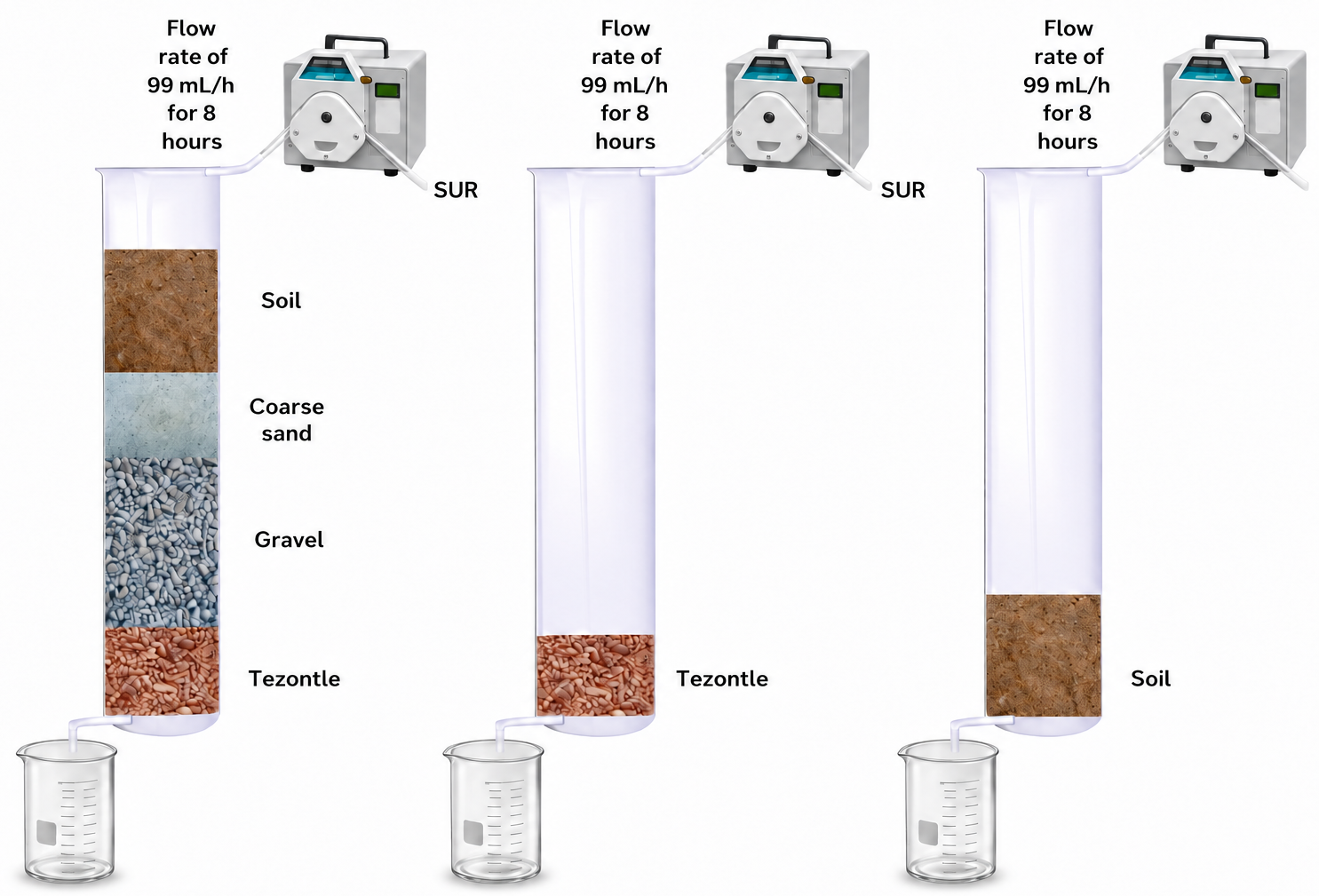
Nine glass columns, each 6.7 cm in diameter and 45 cm high, were divided among three configurations, with three independent columns per configuration. The stratified configuration contained, from bottom to top, 5.5 cm of tezontle, 16.65 cm of gravel, 5.5 cm of coarse sand, a geotextile layer (Hidro Coat, Mexico City, Mexico), and 9.2 cm of soil. The soil-only and tezontle-only configurations contained 9.2 cm of soil and 5.5 cm of tezontle, respectively. These depths matched the corresponding layers in the stratified bed; total bed depths therefore differed among configurations. Materials were sieved, and all size fractions were recombined for packing. No separate washing or drying of the materials was performed before assembly. Each layer was poured to its specified height without intentional compaction. After assembly, the columns were rinsed once with deionized water at 99 mL h−1 for eight hours and then allowed to dry at room temperature until no moisture was apparent by visual inspection; no fixed drying period was prescribed.
The layer sequence and thicknesses were derived from a full-scale filter bed at the Ciudad del Conocimiento campus. The field bed comprised, from top to bottom, 50 cm of soil, a geotextile separating soil and sand, 30 cm of coarse sand, 90 cm of gravel, and 30 cm of tezontle. The gravel layer contained mixed ½-inch and ¾-inch sizes. The laboratory layer thicknesses correspond to an approximate 1:5.4 reduction. This geometric correspondence does not establish hydraulic similarity or an optimal arrangement.
Synthetic urban runoff (SUR) was prepared before column feeding. Individual stock solutions of the target constituents were prepared at 1000 ppm, each with a final volume of 100 mL, using reagent-grade chemicals (Meyer, Mexico City, Mexico) and commercial bottled water. Aliquots were diluted with the same water to obtain the nominal concentrations listed in Table 3, using the source salts specified there. The target constituents and nominal concentrations were selected with reference to the local runoff characterization reported by Ortiz-Hernández et al. [10]. The Pb stock solution was prepared using PbSO4 in commercial bottled water acidified with nitric acid. All the chemicals used were reagent-grade (Meyer, Mexico City, Mexico). Local rainfall information informed the selected feeding rate, while the eight-hour period also provided sufficient sample volume for analysis. The protocol was not intended to reproduce complete natural rainfall events or establish hydraulic similarity with the field system.
Table 3.
Nominal composition of the synthetic urban runoff.
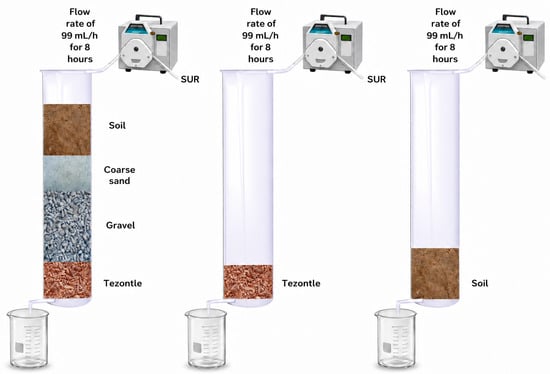
Each column received SUR through a peristaltic pump (Masterflex L/S, Cole Parmer, Vernon Hills, IL, USA) adjusted to 99 mL h−1 for eight hours per feeding cycle, for a total of 16 cycles. This flow rate corresponds to a nominal superficial filtration velocity of approximately 2.81 cm h−1 during feeding. The superficial velocity was calculated as Q/A, where Q is the nominal influent flow rate and A is the column cross-sectional area, using the internal column diameter of 6.7 cm. The pump was calibrated weekly. The nominal input volume was calculated from the set flow rate and feeding duration (792 mL per cycle), rather than measured separately for each cycle. Feeding took place from Monday to Friday and resumed on the following working day, with overnight pauses and longer interruptions over weekends. After each eight-hour feeding period, the outlet remained open for 30 min to allow additional drainage and was then closed until the next cycle. The entire effluent collected during feeding and the subsequent 30-min drainage period was combined as the cycle sample. The columns were not subjected to a drying stage between the 16 feeding cycles. Figure 1 illustrates the experimental arrangement.
Figure 1.
Laboratory arrangement for treatment of synthetic urban runoff (SUR). The study comprised three replicate columns per configuration. The stratified bed contained tezontle, gravel, coarse sand, geotextile, and soil from bottom to top; the geotextile separated the sand and soil. Each feeding period lasted eight hours, with collection of all effluent during feeding and 30 min of subsequent drainage.
Redox potential was measured during infiltration, approximately 5 cm below the soil surface in the three stratified columns, using a single HANNA HI98194 electrode (Hanna Instruments, Woonsocket, RI, USA) sequentially. One stabilized reading was taken per column during each feeding cycle. The electrode was calibrated weekly. No active aeration was applied between feeding cycles.
The decision to end the experiment after 16 feeding cycles was based on phosphate measurements indicating a loss of treatment performance. Mn and Pb were analyzed after completion of the feeding sequence, so their concentration profiles were interpreted retrospectively.
2.3. Sampling, Analysis, and Breakthrough Curves
Influent samples and the combined effluent collected during eight hours of feeding and 30 min of subsequent drainage were analyzed for each cycle. The measured influent concentrations of all five target constituents were used as C0 in the breakthrough curves, rather than their nominal preparation concentrations. Ammonium was determined by phenate colorimetry at 630 nm and phosphate by ascorbic acid colorimetry at 690 nm, using procedures adapted from Standard Methods 4500-NH3 and 4500-P, respectively [16]. Nitrate was determined by phenoldisulfonic acid colorimetry at 410 nm using the method described by Mubarak et al. [17]. Manganese and lead were determined by flame atomic absorption spectrometry (SpectrAA, Varian 880, Varian Inc., Mulgrave, VIC, Australia) following microwave digestion (Mars X, CEM Corporation, Matthews, NC, USA). Metal samples were not filtered before digestion. For each column and cycle, each parameter was determined in analytical triplicate, and the three determinations were averaged to obtain the column-level concentration. These repeated determinations are distinct from the three independent experimental columns per configuration. Samples for ammonium, nitrate, and phosphate analysis were refrigerated without acidification and analyzed weekly. Effluent collection containers were washed beforehand using phosphorus-free detergent and commercial bottled water. Samples for metal analysis were acidified and refrigerated until analysis after completion of the 16 feeding cycles. Analytical blanks were analyzed in triplicate for calibration and sample measurements.
Breakthrough was described using C/C0, where C and C0 are the mean effluent and measured influent concentrations for the corresponding configuration and feeding cycle. Each column-level concentration was the mean of three analytical determinations. Concentration means and sample standard deviations were calculated across the three independent columns per configuration. The plotted ratio is the mean effluent concentration divided by the mean influent concentration, rather than the mean of three column-specific ratios. Concentration-based removal was calculated as 100 × (1 − C/C0). Removal summaries are arithmetic means of cycle-specific percentages over the stated interval.
Relative deviations of measured influent concentrations from the nominal preparation targets were calculated as 100 × (measured − nominal)/nominal. Each configuration-cycle value was the mean of the three independent column-level concentrations. Across the 48 configuration-cycle means per constituent (three configurations × 16 cycles), the mean relative deviations were −1.73% for ammonium, −0.82% for nitrate, −0.79% for phosphate, −7.96% for Mn, and −5.50% for Pb. The corresponding maximum absolute deviations were 3.17%, 1.25%, 1.25%, 8.67%, and 6.07%, respectively.
Negative deviations indicate measured concentrations below the nominal targets. The corresponding measured influent concentration, rather than the nominal preparation value, was used as C0 for each configuration and cycle. These deviations describe departures from the preparation targets and do not, by themselves, establish analytical accuracy or identify the cause of the differences.
Each ratio represents the combined effluent from eight hours of feeding and 30 min of subsequent drainage; the curves therefore resolve changes among cycles. Successive cycles are repeated observations on the same columns, and comparisons are descriptive. The figures present these empirical profiles against cumulative applied SUR depth, reported in millimeters. Values below one indicate concentration reduction, and values above one indicate effluent concentration excess. The origin (0,0) was added as a graphical reference based on the analytical blank and excluded from calculations. These profiles do not establish field rainfall thresholds or service life.
Cumulative applied depth expresses the applied volume per unit filter surface area and provides a common surface-loading coordinate for the three configurations. Bed-volume normalization would rescale the applied-volume sequence without changing C/C0. Neither coordinate alone establishes hydraulic similarity or supports direct field extrapolation; pore-volume normalization was not possible because pore volumes were not independently determined.
2.4. Manuscript Preparation
During manuscript revision, an OpenAI Codex assistant (OpenAI; model GPT-6.1 Terra) supported wording, discussion organization, verification of bibliographic metadata, and independent checks of concentration-based calculations using the existing experimental records. Experimental observations were supplied by the authors, and Figure 2, Figure 3 and Figure 4 use the existing experimental records with graphical legends; no experimental observations were generated by the assistant.
3. Results
3.1. Breakthrough in the Stratified Configuration
The stratified configuration maintained lower effluent concentrations of ammonium and nitrate throughout the observed sequence (Figure 2). The nitrogen breakthrough profiles describe the net concentration response under mixed feeding conditions; they do not distinguish influent-derived nitrate from nitrate potentially formed by nitrification. Ammonium removal ranged from 74.53% to 91.60%, while the arithmetic mean of cycle-specific nitrate removals across the 16 cycles was 68.29%. Their comparatively stable profiles contrasted with the progressive loss of removal for phosphate and metals. The separation among pollutant trajectories is a central result: the same stratification did not maintain an equivalent treatment response for all constituents.
Figure 2.
Breakthrough curves for the stratified configuration. Each measured point represents the ratio of mean effluent to mean influent concentrations for three independent columns. Each column-level concentration is the mean of three analytical determinations. Effluent samples combine eight hours of feeding and 30 min of subsequent drainage. C/C0 is the effluent-to-influent concentration ratio; the horizontal axis reports cumulative applied SUR depth. Lines connect observations and do not represent fitted kinetic models. The point at (0,0) is a graphical reference based on the analytical blank, not a measured feeding-cycle ratio, and was excluded from removal calculations. Constituents are identified in the graphical legend.
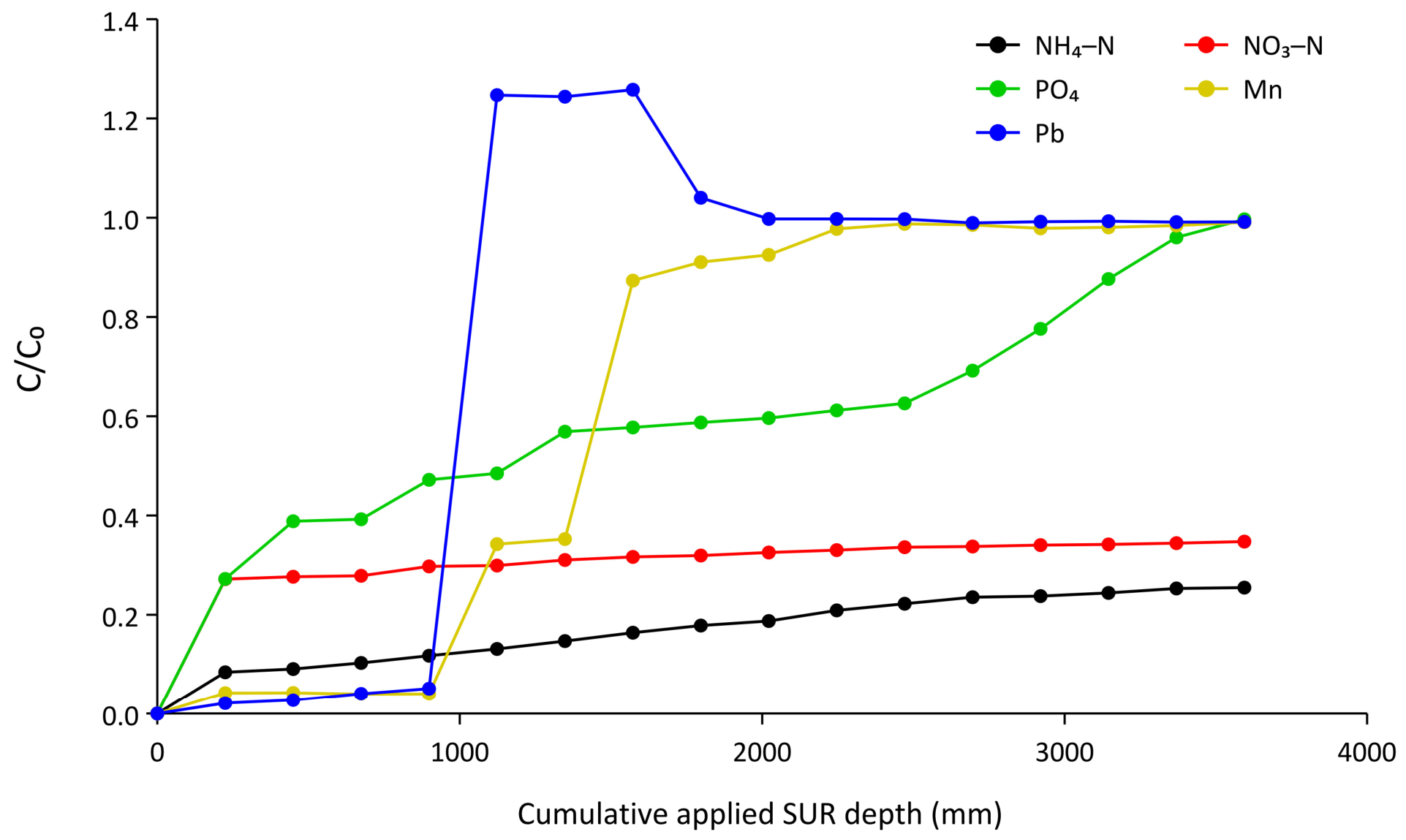
The soil CEC provides a plausible basis for some ammonium retention through ion exchange, although CEC alone cannot quantify the amount retained during these cycles. Research on clay minerals demonstrates that exchange behavior depends on mineralogical and morphological properties [18]. Biological transformations may also affect nitrogen concentrations, but neither the curve shape nor the observed redox range of 278.3–301.2 mV establishes a specific pathway. Engineered bioretention can promote nitrate removal under suitable conditions [19]; however, the present measurements do not distinguish denitrification, assimilation, and temporary retention or establish total nitrogen removal. Phosphate removal declined from 72.77% in the first cycle to 37.41% in the eleventh and 0.32% in the sixteenth. These observations identify the transition from initial treatment to little removal or concentration excess.
Metal behavior exhibited a sharp divergence between initial retention and long-term stability. In the stratified configuration, initial mean removal rates for Mn (95.90%) and Pb (96.51%) during cycles one to four were exceptionally high but decayed rapidly in subsequent loadings. The occurrence of Pb effluent concentrations exceeding influent levels (C/C0 > 1.0) during cycles five to eight is characteristic of competitive desorption, widely recognized in multicomponent column dynamics as the “roll-over” or “roll-up” effect [20]. As synthetic urban runoff continuously supplied cations (NH4+, Mn2+) to the soil layer, lower-affinity outer-sphere clay exchange sites released previously sorbed Pb2+ into the mobile porewater phase once the local exchange capacity approaches saturation. In contrast, the rapid decline in Mn removal (2.26% by cycle 10) may reflect limited retention and possible reductive mobilization. Although bulk redox potential measured in upper soil layers remained within an oxic range (278.3–301.2 mV), oxygen depletion can occur within soil aggregates when microbial respiration exceeds oxygen resupply. Such anoxic microsites may support the reductive dissolution of Mn (III/IV) oxides, releasing soluble Mn2+ into porewater and potentially increasing effluent concentrations even when the bulk soil remains oxic [21]. In waterlogged soils, conversion of reducible manganese into water-soluble and exchangeable forms can also occur at redox potentials of 200 to 300 mV and pH levels between 6 and 8 [22].
3.2. Comparison with Soil and Tezontle
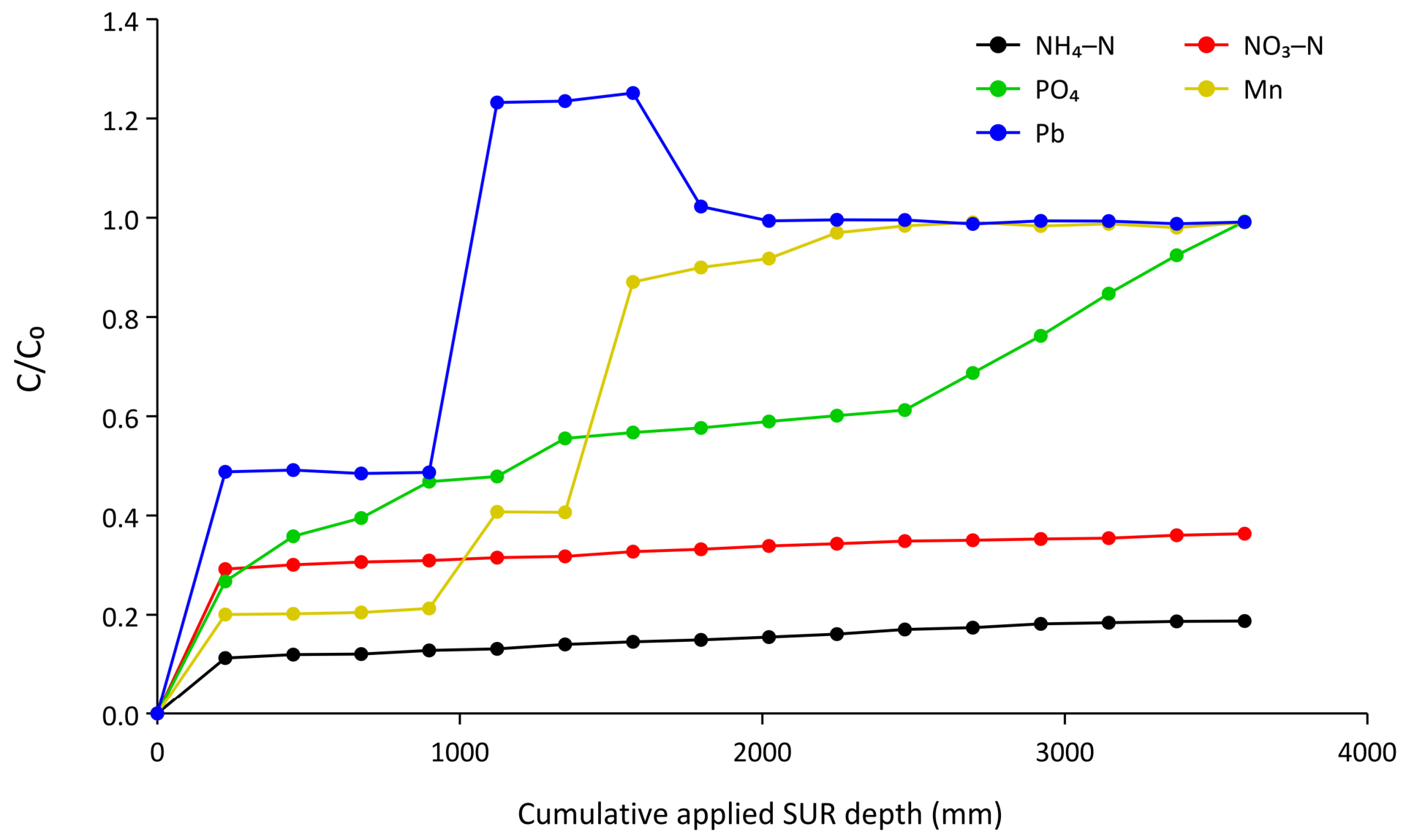
The soil-only curves showed broadly similar nutrient trends to those of the stratified configuration (Figure 3). This similarity is consistent with an important role for soil in the treatment response observed in the stratified column. It does not establish a quantitative fraction attributable to soil because the configurations differed in total bed depth and potentially in water storage and contact conditions. The soil-only configuration also showed declining phosphate and metal removal, including Pb concentration excess during part of the sequence.
The comparison therefore supports selecting soil on the basis of chemical properties as well as physical suitability, while avoiding the assumption that a soil layer provides indefinite removal. The measured CEC is relevant to cation retention, but it cannot explain nitrate or phosphate behavior on its own. Nor do the present data establish hydraulic conductivity, plant establishment, or clogging resistance. Those properties should not be inferred from the concentration curves.
Figure 3.
Breakthrough curves for the soil-only configuration. Each measured point represents the ratio of mean effluent to mean influent concentrations for three independent columns. Each column-level concentration is the mean of three analytical determinations. Effluent samples combine eight hours of feeding and 30 min of subsequent drainage. C/C0 is the effluent-to-influent concentration ratio; the horizontal axis reports cumulative applied SUR depth. Lines connect observations and do not represent fitted kinetic models. The point at (0,0) is a graphical reference based on the analytical blank, not a measured feeding-cycle ratio, and was excluded from removal calculations. Constituents are identified in the graphical legend.
The tezontle-only configuration showed little nutrient removal and transient metal retention (Figure 4). During the first four cycles, arithmetic mean concentration-based removals were 12.82% for Mn and 30.45% for Pb. The subsequent metal profiles included effluent concentration excess during cycles five to eight, followed by values approaching the influent concentration. Thus, tezontle did not provide sustained removal of the target constituents under these conditions. Its inclusion in a bed may serve other design functions, but those functions were not measured in this experiment. The mineralogical analyses of the final five cycles of the same stratified-column experiment identified unfavorable interactions involving local filter materials [14]. They provide geochemical context but do not establish the mechanism of release in the tezontle-only columns.
The presence of Fe (III) in volcanic material does not by itself establish the abundance or accessibility of phosphate-reactive surfaces under flow. Those surface properties were not quantified, so limited phosphate removal is not interpreted as an intrinsic equilibrium adsorption capacity. For tezontle, 65.56% of the recorded mass was in the 12.7–19 mm sieve fraction, compared with a column internal diameter of 67 mm and a tezontle-only bed depth of 55 mm. Wall effects, preferential flow, and uneven hydraulic contact cannot be excluded. The available measurements do not quantify these effects or identify them as the cause of the limited removal. Published batch experiments by Mekonnen et al. [23] used volcanic rocks ground to 0.075–0.425 mm and treated with iron salts. Those preparation and contact conditions differ from the coarse packed tezontle tested here and do not establish an expected removal efficiency for this bed.
Figure 4.
Breakthrough curves for the tezontle-only configuration. Each measured point represents the ratio of mean effluent to mean influent concentrations for three independent columns. Each column-level concentration is the mean of three analytical determinations. Effluent samples combine eight hours of feeding and 30 min of subsequent drainage. C/C0 is the effluent-to-influent concentration ratio; the horizontal axis reports cumulative applied SUR depth. Lines connect observations and do not represent fitted kinetic models. The point at (0,0) is a graphical reference based on the analytical blank, not a measured feeding-cycle ratio, and was excluded from removal calculations. Constituents are identified in the graphical legend.
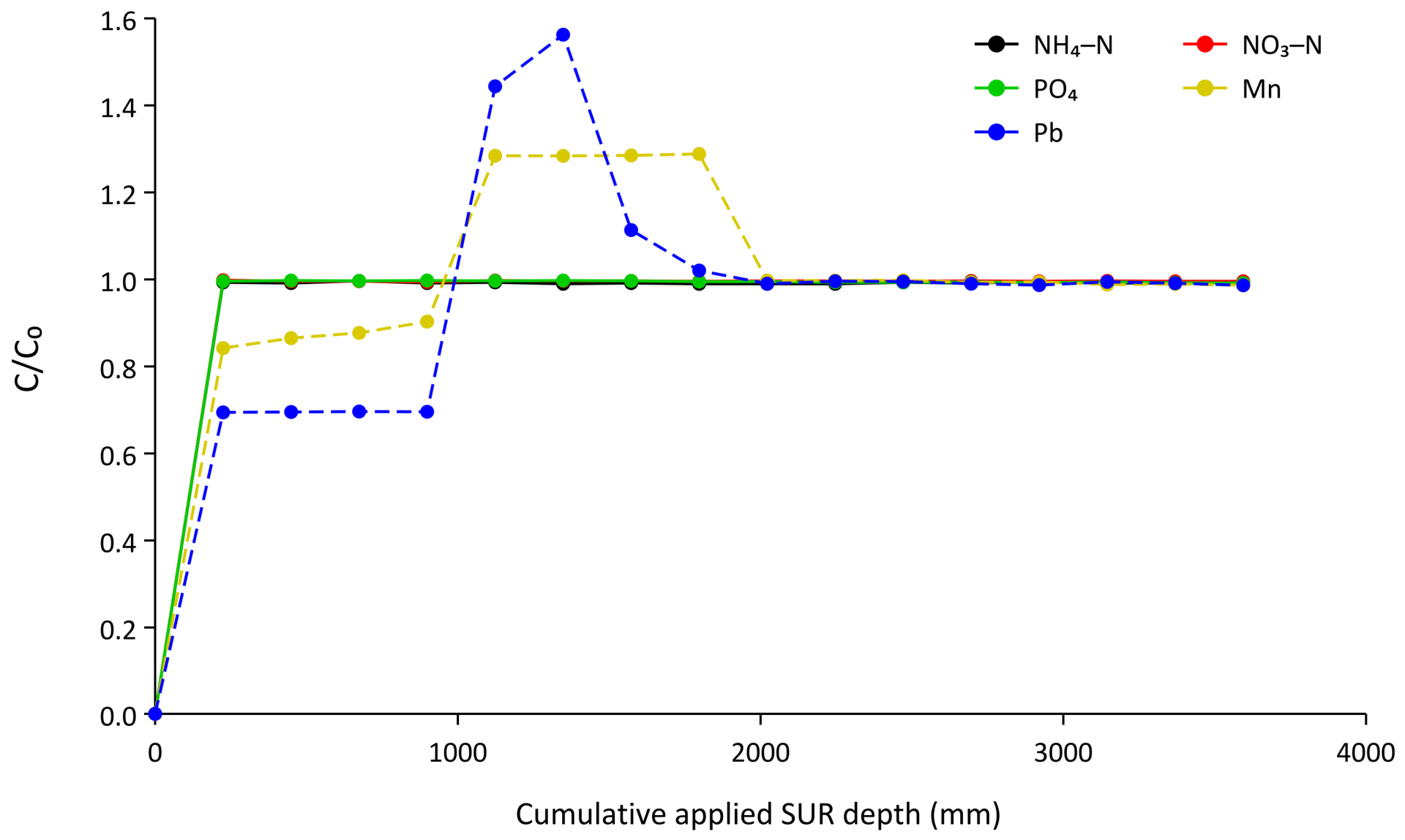
Table 4 summarizes effluent concentrations in the first and last feeding cycles, including the variability among the three independent columns. The complete cycle-by-cycle concentration records are available upon request.
Table 4.
Effluent concentrations in cycles 1 and 16, expressed as mean ± sample standard deviation across three independent columns per configuration. Column-level values are means of analytical triplicates. NH4-N and NO3-N are expressed as N, PO43− as phosphate, and Mn and Pb as the respective elements.
4. Discussion
In the experiments described herein, the operational schedule was characterized by semi-continuous weekday SUR feeding with overnight and weekend pauses, without a fixed air-drying stage. As the bibliography indicates, this schedule may have exerted an influence on pollutant removal trajectories. In bioretention systems, antecedent dry periods induce soil matrix shrinkage, pore desiccation, and structural reorganization [6]. Particularly, desiccation draws atmospheric oxygen into soil micropores and promotes slow intraparticle diffusion of sorbed phosphate from surface sites into internal mineral matrices, thereby regenerating short-term adsorption capacity. In the present study, persistent moisture within the stratified bed prevented this desiccation-driven site regeneration. Fast surface adsorption sites on soil hydroxyl groups saturated during initial cycles, and because persistent humidity inhibited intraparticle migration, PO43− removal diminished from 72.77% (in cycle 1) to 0.32% (in cycle 16).
Also, persistent humidity impacted Mn retention by suppressing oxygen entry into intra-aggregate pores, inhibiting the reoxidation of Mn2+ to insoluble Mn (III/IV) oxides [21]. Conversely, NH4-N retention (74.53–91.60%) showed resilient and independent of matrix drying because in based on ion exchange on soil surfaces. These observations support that while semi-continuous loading maintains exchange-driven cation removal, sustained phosphate and metal retention requires drying phases to enable site regeneration.
The temporal concentration trajectories observed in this study align with broader findings on urban runoff filter media behavior, while revealing critical pollutant-specific performance limits. Benchmark bioretention column investigations by Hsieh and Davis [6] and Sun and Davis [24] established that sandy loam bioretention filters achieve high initial removals of ammonium (>90%) and heavy metals (>80%), but warned that short-term sorption metrics overestimate operational lifespan. Recent studies on stormwater filter start-up dynamics by Johansson et al. [8] and pilot-scale swales by Stinshoff et al. [9] similarly document transient pollutant leaching and metal release during early loading cycles. Our observed Pb concentration excess (C/C0 > 1.0) directly illustrates the risk of competitive desorption (“roll-up”) in filter media, where accumulating background cations displace weakly bound heavy metals once exchange capacity saturates.
4.1. Implications and Scope of the Stratification Proposal
The value of the proposed stratification lies in the opportunity to assess a practical arrangement of common materials against their changing treatment behavior. The breakthrough curves reveal that nitrogen concentration reduction persisted while phosphate and metal removal weakened, which was discussed above. Reporting only the initial metal removal would therefore give an incomplete view of performance. This temporal contrast complements earlier media and layering studies [6,7] and more recent work on treatment and release from stormwater media [8,9].
The evidence supports assessing retention persistence and concentration excess when selecting materials. It does not support assigning a universal replacement interval, dismissing all mineral layers, or concluding that the tested arrangement is optimal. Interpretation is restricted to 16 interrupted feeding cycles, the specified synthetic solution, and these material sources. The phosphate basis, composite sampling, and weekday schedule are essential to comparisons with other studies. The recorded concentrations include three independent column-level means per configuration and cycle, allowing variability among columns to be described separately from analytical replication. Study-specific detection and quantification limits are unavailable in the retained records, which limits interpretation of very low effluent metal concentrations. Weekly nutrient analysis and the longer storage of early metal samples are also relevant when comparing the results with other sampling protocols. Because effluent volumes were not recorded individually for each cycle, the concentration profiles do not quantify retained or released masses. No field lifetime or geochemical mechanism is inferred from the present curves alone.
No stirred batch adsorption experiments, equilibrium isotherms, or conservative-tracer breakthrough dataset were available. Batch measurements could complement interpretation of solid–solution partitioning, but would not reproduce the packed layer arrangement or successive feeding and drainage periods. Tracer measurements would help characterize hydraulic behavior. Their absence limits mechanistic attribution and scale-up, while the measured concentration profiles support comparison of the tested configurations. The results can inform screening for persistent concentration reduction and concentration excess, but do not determine full-scale treatment capacity or a replacement interval. Effluent nitrate cannot be partitioned between influent nitrate and nitrate potentially produced by nitrification; neither nitrification nor biofilm activity was directly quantified.
4.2. Experimental Limitations
Three primary experimental limitations were identified:
- •
- Synthetic urban runoff vs. real urban runoff: Synthetic urban runoff (SUR) supplied fixed inorganic ionic concentrations (NH4-N, NO3-N, PO43−, Mn, and Pb) in commercial bottled water. It lacked total suspended solids, natural dissolved organic matter, and complexing organic ligands that influence colloidal metal transport and speciation in field runoff.
- •
- Abiotic and unamended filter bed: The experimental columns contained uncompacted, unamended local materials without vegetation or high-affinity sorptive amendments. Field bioretention facilities incorporate vegetation, whose root networks assimilate nutrients, maintain hydraulic conductivity, and prevent structural clogging.
- •
- Duration and scale: The 16-cycle feeding schedule evaluates early operational breakthrough under controlled hydraulic loading. It does not simulate field service life, seasonal climatic fluctuations, or natural storm-event hydrographs.
5. Conclusions
This study evaluated the temporal treatment behavior and breakthrough dynamics of synthetic urban runoff passing through a stratified soil–mineral filter configuration (soil, geotextile, coarse sand, gravel, and volcanic tezontle) alongside single-material soil and tezontle controls across 16 semi-continuous feeding cycles. The major scientific conclusions, design implications, and research perspectives are summarized below.
The stratified filter configuration exhibited distinct, constituent-specific performance trajectories over successive loadings. Ammonium removal remained consistently high and nitrate concentration ratios remained stable throughout the experiment. In contrast, phosphate removal decayed rapidly. Manganese retention collapsed after cycle 4, while effluent Pb concentrations exceeded influent levels (C/C0 > 1.0) during cycles 5–8 before stabilizing near unity.
The diverse pollutant trajectories reflect fundamental differences in retention mechanisms and were partially attributed to the intermittent feeding of the columns. Stable ammonium removal is governed by rapid ion exchange on soil clay fraction, which operates effectively under moist conditions. The rapid exhaustion of phosphate removal stems from the lack of inter-cycle air-drying stages; continuous internal humidity prevented intraparticle diffusion and structural matrix reorganization necessary to expose fresh mineral sorption sites. The temporary excess of effluent lead (C/C0 > 1.0) likely demonstrates competitive cation exchange displacement (“roll-up effect”), where accumulating runoff cations progressively displace weakly bound lead from exchange sites, while Mn breakthrough was accelerated by micro-scale reductive dissolution within oxygen-depleted micropores.
The primary scientific novelty of this work is the empirical demonstration that initial pollutant removal efficiency is an inadequate indicator of long-term filter safety. By evaluating complete concentration breakthrough curves rather than aggregate removal percentages, this study uncovers dynamic failure modes—specifically heavy metal competitive displacement and rapid phosphate exhaustion—in unamended, layered media configurations incorporating regional volcanic slag.
Our results also show that stormwater infrastructure designers should not rely on unamended soil–mineral beds for long-term phosphorus or heavy metal capture without incorporating targeted media enhancements. To prevent competitive metal leaching and rapid phosphate breakthrough, bioretention media should be amended with high-affinity sorbents. Unamended volcanic tezontle should be utilized primarily as a structural drainage layer rather than a primary pollutant retention medium.
However, these findings are subject to specific experimental constraints: (i) the use of an inorganic synthetic runoff matrix lacking natural dissolved organic matter and suspended solids; (ii) an uncompacted, abiotic laboratory column setup without vegetation; and (iii) a 16-cycle schedule that evaluates short-term breakthrough rather than a realistic field service life. Consequently, to effectively contribute to guiding the green infrastructure design in semi-arid urban regions, future research should evaluate the long-term performance of vegetated versus non-vegetated stratified beds under real urban stormwater hydrographs, representative of semi-arid regions.
Author Contributions
Conceptualization, G.A.V.-R. and L.L.-M.; investigation, M.A.Z.-E.; data curation, G.A.V.-R., L.L.-M. and M.R.-C.; writing—original draft preparation, M.A.Z.-E. and G.A.V.-R.; writing—review and editing, G.A.V.-R., L.L.-M., E.A.Z.-E., J.A.A.-V. and M.R.-C. All authors have read and agreed to the published version of the manuscript.
Funding
This research received no external funding.
Data Availability Statement
The concentration data underlying this study, including column-level means of analytical triplicates and the means and standard deviations across independent columns, are available from the corresponding authors upon reasonable request.
Acknowledgments
The authors acknowledge the institutional support of the Universidad Autónoma del Estado de Hidalgo (UAEH), the Universidad Politécnica de Francisco I. Madero (UPFIM), and the Consejo de Ciencia, Tecnología e Innovación de Hidalgo (CITNOVA).
Conflicts of Interest
The authors declare no conflicts of interest.
Abbreviations
The following abbreviations are used in this manuscript:
| CEC | Cation exchange capacity |
| SUR | Synthetic urban runoff |
References
- Roy, A.H.; Wenger, S.J.; Fletcher, T.D.; Walsh, C.J.; Ladson, A.R.; Shuster, W.D.; Thurston, H.W.; Brown, R.R. Impediments and Solutions to Sustainable, Watershed-Scale Urban Stormwater Management: Lessons from Australia and the United States. Environ. Manag. 2008, 42, 344–359. [Google Scholar] [CrossRef] [Scilit] [PubMed]
- Davis, A.P.; Hunt, W.F.; Traver, R.G.; Clar, M. Bioretention Technology: Overview of Current Practice and Future Needs. J. Environ. Eng. 2009, 135, 109–117. [Google Scholar] [CrossRef] [Scilit]
- Laurenson, G.; Laurenson, S.; Bolan, N.; Beecham, S.; Clark, I. The Role of Bioretention Systems in the Treatment of Stormwater. In Advances in Agronomy; Academic Press: Cambridge, MA, USA, 2013; Volume 120, pp. 223–274. [Google Scholar] [CrossRef] [Scilit]
- California Department of Transportation. Infiltration Trench Design Guidance; Caltrans: Sacramento, CA, USA, 2020. Available online: https://dot.ca.gov/-/media/dot-media/programs/design/documents/10_dg-infiltration-trench_ada.pdf (accessed on 16 September 2026).
- Tecca, N.P.; Gulliver, J.S.; Nieber, J.L.; Weiss, P.T. Design and Construction of Infiltration Facilities; Report MN 2021-14; Minnesota Department of Transportation: St. Paul, MN, USA, 2021. Available online: https://rosap.ntl.bts.gov/view/dot/56888 (accessed on 16 September 2026).
- Hsieh, C.H.; Davis, A.P. Evaluation and Optimization of Bioretention Media for Treatment of Urban Storm Water Runoff. J. Environ. Eng. 2005, 131, 1521–1531. [Google Scholar] [CrossRef] [Scilit]
- Hsieh, C.H.; Davis, A.P.; Needelman, B.A. Nitrogen Removal from Urban Stormwater Runoff Through Layered Bioretention Columns. Water Environ. Res. 2007, 79, 2404–2411. [Google Scholar] [CrossRef] [Scilit] [PubMed]
- Johansson, G.; Karlfeldt Fedje, K.; Modin, O.; Haeger-Eugensson, M.; Uhl, W.; Andersson-Sköld, Y.; Strömvall, A.M. Removal and release of microplastics and other environmental pollutants during the start-up of bioretention filters treating stormwater. J. Hazard. Mater. 2024, 468, 133532. [Google Scholar] [CrossRef] [Scilit] [PubMed]
- Stinshoff, P.; Busse, L.; Kick, D.; Helmreich, B. Stormwater treatment in infiltration swales with an engineered and planted soil media—Results of a pilot-scale approach. J. Environ. Manag. 2025, 385, 125693. [Google Scholar] [CrossRef] [Scilit] [PubMed]
- Ortiz-Hernández, J.; Lucho-Constantino, C.; Lizárraga-Mendiola, L.; Beltrán-Hernández, R.I.; Coronel-Olivares, C.; Vázquez-Rodríguez, G. Quality of urban runoff in wet and dry seasons: A case study in a semi-arid zone. Environ. Sci. Pollut. Res. 2016, 23, 25156–25168. [Google Scholar] [CrossRef] [Scilit] [PubMed]
- Meerow, S.; Natarajan, M.; Krantz, D. Green infrastructure performance in arid and semi-arid urban environments. Urban Water J. 2021, 18, 275–285. [Google Scholar] [CrossRef] [Scilit]
- Vázquez-Rodríguez, G.A.; Zúñiga-Estrada, M.A.; Ortiz-Hernández, J.E. Blue and Green Infrastructure: History and Experiences in Mexico and the Arid and Semi-Arid Global South. In Sustainable Spaces in Arid and Semiarid Zones of Mexico; Lizárraga-Mendiola, L., Bigurra-Alzati, C.A., Vázquez-Rodríguez, G.A., Eds.; Springer: Cham, Switzerland, 2024; pp. 69–89. [Google Scholar] [CrossRef] [Scilit]
- Zúñiga-Estrada, M.A.; Lizárraga-Mendiola, L.; Bigurra-Alzati, C.A.; Vázquez-Rodríguez, G.A. Depollution of first flush urban runoff in a field-scale bioretention cell adapted to semi-arid climates. Front. Environ. Sci. 2023, 11, 1271711. [Google Scholar] [CrossRef] [Scilit]
- Zúñiga-Estrada, M.A.; Vázquez-Rodríguez, G.A.; Ramírez-Cardona, M.; Lizárraga-Mendiola, L. Mineralogical evidence of unfavorable geochemical interactions between urban runoff pollutants and filter materials in low-impact systems. J. Hazard. Mater. 2020, 390, 122136. [Google Scholar] [CrossRef] [Scilit] [PubMed]
- Secretaría de Medio Ambiente y Recursos Naturales. Norma Oficial Mexicana NOM-021-RECNAT-2000, Que Establece Las Especificaciones de Fertilidad, Salinidad y Clasificación de Suelos. Estudios, Muestreo y Análisis. Diario Oficial de la Federación, 31 December 2002. Available online: https://www.ordenjuridico.gob.mx/Documentos/Federal/wo69255.pdf (accessed on 16 September 2026).
- APHA; AWWA; WEF. Standard Methods for the Examination of Water and Wastewater, 22nd ed.; American Public Health Association: Washington, DC, USA, 2012. [Google Scholar]
- Mubarak, A.; Howald, R.A.; Woodriff, R. Elimination of chloride interferences with mercuric ions in the determination of nitrates by the phenoldisulfonic acid method. Anal. Chem. 1977, 49, 857–860. [Google Scholar] [CrossRef] [Scilit]
- Delavernhe, L.; Steudel, A.; Darbha, G.K.; Schäfer, T.; Schuhmann, R.; Wöll, C.; Geckeis, H.; Emmerich, K. Influence of mineralogical and morphological properties on the cation exchange behavior of dioctahedral smectites. Colloids Surf. A Physicochem. Eng. Asp. 2015, 481, 591–599. [Google Scholar] [CrossRef] [Scilit]
- Kim, H.; Seagren, E.A.; Davis, A.P. Engineered Bioretention for Removal of Nitrate from Stormwater Runoff. Water Environ. Res. 2003, 75, 355–367. [Google Scholar] [CrossRef] [Scilit] [PubMed]
- Kapoor, A.; Yang, R.T. Roll-up in fixed-bed, multicomponent adsorption under pore-diffusion limitation. AIChE J. 1987, 33, 1215–1217. [Google Scholar] [CrossRef] [Scilit]
- Lacroix, E.M.; Aeppli, M.; Boye, K.; Brodie, E.; Fendorf, S.; Keiluweit, M.; Naughton, H.R.; Noël, V.; Sihi, D. Consider the Anoxic Microsite: Acknowledging and Appreciating Spatiotemporal Redox Heterogeneity in Soils and Sediments. ACS Earth Space Chem. 2023, 7, 1592–1609. [Google Scholar] [CrossRef] [Scilit] [PubMed]
- Gotoh, S.; Patrick, W.H., Jr. Transformation of Manganese in a Waterlogged Soil as Affected by Redox Potential and pH. Soil Sci. Soc. Am. J. 1972, 36, 738–742. [Google Scholar] [CrossRef] [Scilit]
- Mekonnen, D.T.; Alemayehu, E.; Lennartz, B. Adsorptive Removal of Phosphate from Aqueous Solutions Using Low-Cost Volcanic Rocks: Kinetics and Equilibrium Approaches. Materials 2021, 14, 1312. [Google Scholar] [CrossRef] [Scilit] [PubMed]
- Sun, X.; Davis, A.P. Heavy metal fates in laboratory bioretention systems. Chemosphere 2007, 66, 1601–1609. [Google Scholar] [CrossRef] [Scilit] [PubMed]

Disclaimer/Publisher’s Note: The statements, opinions and data contained in all publications are solely those of the individual author(s) and contributor(s) and not of MDPI and/or the editor(s). MDPI and/or the editor(s) disclaim responsibility for any injury to people or property resulting from any ideas, methods, instructions or products referred to in the content. |
© 2026 by the authors. Licensee MDPI, Basel, Switzerland. This article is an open access article distributed under the terms and conditions of the Creative Commons Attribution (CC BY) license.