


Abstract
The application of organic wastes as fertilisers is important for sustainable agriculture, provided that resulting changes in microbial communities do not disrupt nutrient cycling or soil fertility. To the authors’ knowledge, this study was the first to use PacBio 16S rRNA sequencing to characterise soil microbiota changes following waste application to land. This technology provides high taxonomic resolution, improving the characterisation of complex soil microbial communities. To assess the microbiota of five organic wastes and describe soil microbiota following field application, 18 plots received each waste in triplicate at nitrogen-equivalent rates simulating band spreading. Soil cores were collected at 0, 1, 3, 6, and 10 weeks post-application. The primary genera in pre-application soil were Niallia (7.6%) and Unclassified_type_III (7.3%). Following waste application, the dominant genera included UCG-001 (13.3%) and DMER64 (8.8%) in bovine-treated soil, Candidatus_Udaeobacter (8.5%) and unclassified_Xanthobacteraceae (7.9%) in ovine, Niallia (6.1%) and Candidatus_Udaeobacter (5.8%) in pig, Staphylococcus (27.3%) and Brachybacterium (26.7%) in poultry, and unclassified_Anaerolineaceae (25.8%) and Thiopseudomonas (14.2%) in anaerobically digestated wastewater treatment sludge (DWWTS). The time required for soil to return to its pre-application microbiota ranged from 0 to 6 weeks. Organic waste type strongly influenced disturbance magnitude and duration, with prolonged shifts potentially affecting microbial diversity, nutrient cycling and soil fertility.
1. Introduction
Soil microbiota plays an essential role in sustaining soil fertility through the transformation of organic matter and mineral substrates, the regulation of nutrient cycling, and the facilitation of bioremediation processes [1,2,3,4]. The application of organic wastes as soil amendments is widely documented to enhance the biomass and diversity of soil microbiota communities involved in organic matter decomposition and plant nutrition. For instance, cattle manure introduces organic carbon (C) into soil that improves its fertility, whereas pig and poultry wastes are typically richer in nitrogen and thus support nutrient availability [4]. The fertility of soil is characterised by the availability of nutrients and the movement and retention of water, which supports a diversity of organisms and sustains crops and vegetation [5,6]. A healthy soil microbiota is essential for nutrient cycling by mineralisation of soil organic carbon, nitrogen (N) fixation and solubilisation of potassium (K), phosphorus (P) and zinc (Zn). It also contributes to soil formation and evolution [7,8].
The use of organic wastes as fertilisers is a common practice with minimal or no cost to the farmer. The benefits of applying manure or biosolids to soil are well documented, with numerous studies showing improvements in soil health, fertility, and overall soil characteristics [5,6,9]. Manure amendments contain higher levels of C than other fertilisers and they also supply other nutrients such as N, K, P, sulphur (S), Zn, and copper (Cu) [5,6,10]. Their application improves physical properties, including water-holding capacity, porosity, infiltration, hydraulic conductivity, and water-stable aggregation, along with reductions in bulk density and surface crusting [10]. These organic wastes help stabilise soil organic matter content, maintain the carbon to nitrogen (C/N) ratio, and increase both buffering capacity and cation exchange [5,6]. They also stimulate greater microbial and enzymatic activity and diversity [9]. However, nutrient composition varies greatly depending on animal type and age, diet composition, housing type, and waste management practices [11,12]. This heterogeneous composition can modify soil physico-chemical properties, such as soil pH and organic matter content, which may induce shifts in microbial communities, favouring pathogenic or stress-tolerant taxa, potentially disrupting nutrient cycling processes and ultimately diminishing soil fertility [2,3]. Furthermore, applying manure at rates above optimal levels can increase the risk of nutrient leaching and surface runoff [6]. Other issues related to the application of manure to soil may be the introduction of pathogens to soil, posing potential risks to food safety by the contamination of fresh produce. Additionally, it can contribute to greenhouse gas emissions, as well as groundwater and air pollution [13].
Studies to date have used shotgun technologies to assess the effect on the soil microbiota after fertilisation [13,14,15,16,17,18,19,20,21]; however, there is no consensus on the effect of manure application on the soil microbiota. Shotgun technologies such as Illumina and Ion Torrent produce reads of 100–400 bp of hypervariable regions that allow microbial identification down to strain level; however, they can lead to underestimation of genome regions or ambiguous taxonomic assignment [22,23]. PacBio circular consensus sequencing (CCS) is a third-generation technology that performs multiple whole-genome sequencing (WGS) of the full-length 16S rRNA gene, offering an accuracy of taxonomic classification above 99.9% [23,24]. Due to the high complexity and diversity of the soil microbiome, long-read sequencing may offer a better assembly of these complex genomes than shotgun technologies [22,24].
Therefore, the first objective of this study was to characterise the microbiota in sandy-clay loam, in bovine, ovine and pig slurry, in poultry waste and in anaerobically digested wastewater treatment sludge (DWWTS) using long-read sequencing. A second aim was to describe the soil microbiota when these organic wastes were applied under field conditions for 10 weeks.
2. Materials and Methods
2.1. Field Preparation and Waste Application
The field trial was conducted from August to October 2025 in Johnstown Castle, Co. Wexford, Ireland (N 52 17.782, W 006 30.355). Grass was trimmed to 5 cm and 18 plots (1 m2 each) were prepared, separated by 1.5 m buffer zones to prevent run-off and cross-contamination. Soil properties before waste application are presented in Table S1. Weather conditions were recorded and are provided in the Supplementary Materials (Table S2).
Fresh slurry was collected one week prior to the field trial. Cattle, swine, and ovine slurry were collected from commercial farm slurry pits in counties Meath, Cork, and Cavan, respectively. Poultry waste was collected from inside broiler houses in County Cavan, while biosolids were collected from a wastewater treatment plant after anaerobic digestion and post-pasteurisation.
Organic wastes were randomly assigned to three plots each and were evenly spread in three equidistant lines per plot, mimicking band spreading (Figure S1). The remaining three plots were used as controls. Nutrient analysis of organic wastes was performed by Southern Scientific Services Ltd. (Farranfore, Ireland) and the results have been included in Supplementary Materials (Table S3). Application rates were based on N content as per the Teagasc Green Book, the agricultural manual used in Ireland for planning sustainable and efficient nutrient management on farms [25] resulting in application rates of 34 tonnes per hectare (t/ha) for bovine, 14.7 t/ha for ovine, 40.5 t/ha for pig slurry, 15.5 t/ha for poultry waste, and 15.0 t/ha for DWWTS, respectively.
2.2. Soil Sampling and DNA Extraction
Before spreading, immediately after land spreading, and after 1, 3, 6, and 10 weeks, samples were taken using a soil borer (Bürkle GmbH, Bad Bellingen, Germany). One core sample (10 cm depth) was taken from each of the three lines within a given plot for each of the three plots with that waste (n = 9), and these were pooled before DNA extraction. Samples were collected in 150 mL Ramboldisterile containers (Sparks Lab Supplies, Rathcoole, Dublin, Ireland) and were processed within 24 h.
DNA was extracted using the DNeasy PowerSoil Kit (Qiagen, Hilden, Germany) and quantified using a Qubit fluorometer (Thermo Fisher Scientific, Waltham, MA, USA), with purity measured using A260/280 and A260/230 ratios in a NanoDrop Spectrophotometer (Thermo Fisher Scientific, Waltham, MA, USA).
2.3. Full-Length 16S rRNA Amplicon Sequencing and Bioinformatics Analysis
Full-length 16S rRNA sequencing was conducted by Novogene (Cambridge, UK). The 16S rRNA gene was amplified from genomic DNA using primers 27F (AGRGTTYGATYMTGGCTCAG) and 1492R (RGYTACCTTGTTACGACTT). The PCR cycling conditions were initial denaturation (95 °C, 3 min), 20 cycles of denaturation (98 °C, 20 s), annealing (57 °C, 30 s), and extension (57 °C, 75 s), and a final extension (72 °C, 5 min). PCR amplicons were purified to remove primer dimers, end-repaired using Kinnex End Repair Enzyme (20 °C, 30 min), ligated to Kinnex-specific adapters using T4 DNA ligase (20 °C, 15 min), and concatenated into long 16S rRNA gene arrays with Kinnex Assembly Enzyme (37 °C, 1 h). Libraries were subsequently purified using SMRTbell magnetic beads for size selection and library quality improvement. The purified library was quantified using a Qubit 4.0 Fluorometer (Thermo Fisher Scientific, Waltham, MA, USA) and was sequenced on the Revio platform using Single Molecule, Real-Time (SMRT) sequencing. Raw reads were quality-filtered and cleaned using seqkit (version 2.9.0). DADA2 was run using a PacBio CCS/HiFi-optimised workflow, including primer removal (removePrimers), error learning (learnErrors with errorEstimationFunction = PacBioErrfun), and pooled denoising. Filtering parameters were: maxN = 0, minLen = 1240, maxLen = 1740, with primer sequences truncated prior to denoising. QIIME2 (version 202504) was used for species annotation using the Silva (version 138.2) database and multiple sequence alignment for phylogenetic relationships of Amplicon Sequence Variants (ASVs). The ASVs were normalized by rarefaction using QIIME2 default normalisation (qiime feature-table rarefy) before data analysis. Bar plots showing the ten most abundant bacterial phyla and thirty most abundant genera were plotted using dplyr (version 1.1.4), ggplot2 (version 4.0.2), tidyr (version 1.3.2), and paletteer (version 1.7.0) packages. In comparison, the heatmap of 10 phyla and 30 genera was produced using pheatmap (version 1.0.13) and paletteer (version 1.7.0) on R (version 4.5.0) [26]. ASVs from the class Clostridia were further analysed to determine if they corresponded to Clostridioides difficile using Kraken2 with the Silva database (version 138) in Galaxy [27].
Two alpha-diversity indices were calculated. Shannon Index (SI) incorporates both richness and evenness [28]. Higher values correspond to greater diversity and more even species distribution. It was calculated in QIIME2. Berger–Parker (BP) index quantifies dominance by measuring the ratio of the most abundant taxon relative to the total number of taxa in a sample [29]. Higher BP values indicate stronger dominance by a few taxa. BP was calculated, and both indices were visualised using R (version 4.5.0). Beta diversity ordination plots, including Principal Coordinates Analysis (PCoA) and Non-metric Multidimensional (NMDS) based on weighted UniFrac, unweighted UniFrac and Bray–Curtis distances were created using the packages biomformat (version 1.38.3), phyloseq (version 1.54.2), vegan (version 2.7.2), ape (version 5.8.1), dplyr (version 1.1.4), phangorn (version 2.12.1) and ggplot2 (version 4.0.2) in R.
3. Results
3.1. Variable Weather Conditions over the Ten-Week Study Period
The weather conditions throughout the ten weeks included an average precipitation of 3.5 mm (0–31 mm) of rainfall, an air temperature ranging from 5.8 to 23.3 °C, and soil temperatures of 11.8 to 21.0 °C (Table S2).
3.2. High Initial ASV Richness in Organic Wastes Followed by a Marked Decline After Land Application
A total of 40 samples were sequenced, obtaining an average of 35,098 ± 2933 sequencing reads and an average length of 1450 ± 3 bp. Sequences were quality-filtered and denoised to generate ASVs, yielding an average of 1034 ASVs per sample. The mean number of ASVs in the soil controls was 668 ± 158, while organic wastes averaged 2445 ± 952 ASVs, ranging from 1485 in pig slurry to 3992 in poultry waste. In waste-amended samples, the mean number of ASVs decreased from 2445 ± 952 immediately after land spreading to 746 ± 234 ten weeks post-application prior to rarefaction. Organic wastes exhibited substantially higher initial ASV richness than soil controls, reflecting the heterogeneous microbial communities introduced through slurry application. The sequencing reads and ASVs for 16S rRNA sequencing (Table S4) are available in the Supplementary Material. ASVs were classified into 31 phyla, 72 classes, 179 orders, 287 families, 462 genera, and 527 species.
3.3. Phylum-Level Dynamics Showed Temporary Waste-Driven Shifts and Gradual Return to Soil Microbiota
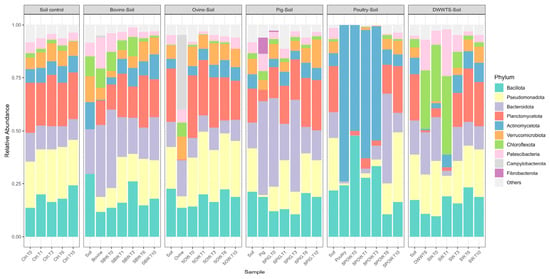
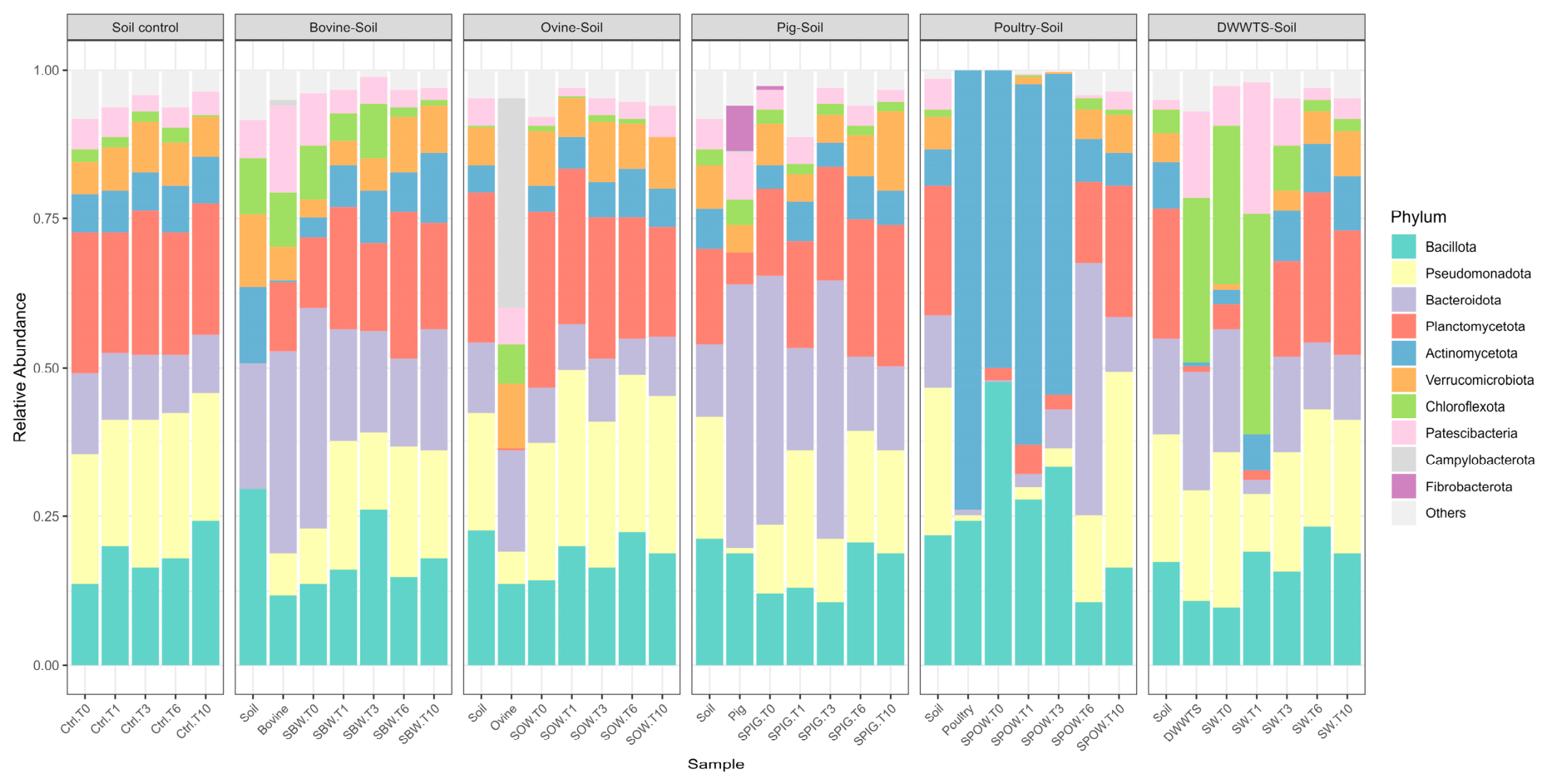
Figure 1 shows the relative abundance of the ten most abundant bacterial phyla across all samples.
Figure 1.
Ten most abundant bacterial phyla detected in untreated soil controls (Ctrl.T0–T10), Bovine-Soil plots (BW.S before application, ‘Bovine’ refers to waste alone and post-application SBW.T0–T10), Ovine-Soil (OW.S before application, ‘Ovine’ refers to waste alone and post-application SOW.T0–T10), Pig-Soil (Pig.S before application, ‘Pig’ refers to waste alone and post-application SPig.T0–T10), Poultry-Soil (POW.S before application, ‘Poultry’ refers to waste alone and post-application SPOW.T0–T10), and anaerobically digested wastewater treatment sludge (DWWTS)-Soil (WW.S before application, ‘DWWTS’ refers to waste alone and post-application SW.T0–T10).
Soil microbiota at the phylum level was characterised by the dominance of Pseudomonadota (22.3 ± 2%), Planctomycetota (21.8 ± 3%), and Bacillota (19.2 ± 3%). Additional phyla included Bacteroidota (11.9 ± 2%), Actinomycetota (6.8 ± 1%), Verrucomicrobiota (6.6 ± 1%), Patescibacteria (4.0 ± 1%), and Chloroflexota (2.2 ± 2%). Phyla with a relative abundance below 1% were grouped as ‘Others’, representing 5.3 ± 2% of the bacterial community.
The bovine slurry microbiota was dominated by Bacteroidota (33.9%), followed by Patescibacteria (14.5%), Bacillota (11.8%), Planctomycetota (11.5%), Chloroflexota (9.1%), Pseudomonadota (7.0%), Verrucomicrobiota (5.8%), and Others (5.2%).
Immediately after the application of bovine slurry, the soil microbiota was dominated by Bacteroidota (37.0%), followed by Bacillota (13.6%) and Planctomycetota (11.8%). After one week, the relative abundance of Pseudomonadota increased to 21.5%, accompanied by a rise in Planctomycetota (20.6%), while Bacteroidota declined to 18.8%. Three weeks post-application, the community was dominated by Bacillota (20.6%), Bacteroidota (17.0%), and Planctomycetota (14.8%). After six weeks, the most abundant phyla were Planctomycetota (24.5%), Pseudomonadota (21.8%), Bacteroidota (14.8%), and Bacillota (14.8%). By ten weeks, the community composition had shifted again, with Bacteroidota (20.3%), Pseudomonadota (18.2%), Bacillota (17.9%), and Planctomycetota (17.9%) representing the dominant phyla, which was more or less the microbial composition of the soil pre-application.
For ovine slurry, the dominant phyla were Campylobacterota (35.2%), Bacteroidota (17.0%), Bacillota (13.6%), Verrucomicrobiota (10.9%), Chloroflexota (6.7%), Patescibacteria (6.1%), Pseudomonadota (5.5%), and Others (4.8%).
When ovine slurry was applied to soil, Planctomycetota, Pseudomonadota, and Bacillota dominated, suggesting that, in contrast to all of the other wastes tested, the soil bacteria dominated those in ovine waste at the time of application. Planctomycetota was initially the dominant phylum (29.4%) immediately after land spreading, but its relative abundance declined to 18.5% after 10 weeks. Pseudomonadota became the dominant phylum from one week post-application onwards, with relative abundances ranging from 24.5% (T3) to 29.7% (T10). The relative abundance of Bacillota increased steadily over time from 14.2% immediately after application to 18.8% after ten weeks.
In pig slurry, the dominant phyla were Bacteroidota (44.2%), Bacillota (18.8%), Patescibacteria (7.9%), Fibrobacterota (7.6%), Others (6.1%), Planctomycetota (5.5%), Verrucomicrobiota (4.5%), and Chloroflexota (4.2%).
When pig slurry was applied to soil, Bacteroidota dominated immediately after land spreading (41.8%) and after three weeks (43.3%), decreasing to 14% at the end of the experiment. In contrast, the relative abundances of Planctomycetota, Bacillota and Pseudomonadota increased over time from 14.5% to 23.6%, 12.1% to 28.8% and 11.5% to 17.3%, respectively, becoming the three dominant phyla at the final sampling point, more or less reflecting a return to the original soil microbiota.
Poultry waste was dominated by Actinomycetota (73.9%) and Bacillota (24.2%). Following application to soil, these two phyla remained dominant during the first three weeks, with Actinomycetota ranging from 50.0% to 53.9% and Bacillota from 47.6% to 33.3%. The relative abundance of Actinomycetota then declined to 7.3% at six weeks and 5.5% at ten weeks. Six weeks post-application, Bacteroidota reached 42.4%, but decreased to 9% by the end of the experiment, while Pseudomonadota and Planctomycetota reached 14.5% and 13.6%, respectively. After ten weeks, the dominant phyla were Pseudomonadota (33.0%), Planctomycetota (22.1%), and Bacillota (16.4%). Although Pseudomonadota had a higher abundance than in the pre-treated soil samples (33.0% versus 22.3%), this bacterial composition was considered to be a re-establishment of the original soil bacterial population.
In DWWTS, the most abundant phyla were Chloroflexota (27.6%), Bacteroidota (20.0%), Pseudomonadota (18.5%), Patescibacteria (14.6%), and Bacillota (10.9%). These phyla also dominated in the soil immediately after application (Chloroflexota (26.7%), Pseudomonadota (26.1%), and Bacteroidota (20.6%)). After one week, the dominant phyla were Chloroflexota (37.0%), Patescibacteria (22.1%), and Bacillota (19.1%). Three weeks post-application, the community shifted to a dominance of Pseudomonadota (20.0%), Bacteroidota (16.1%), and Planctomycetota (16.1%). After six and ten weeks, the relative abundances of Planctomycetota, Bacillota and Pseudomonadota were 25.2% and 20.9%, 23.3% and 18.8%, and 19.7% and 22.4%, respectively.
3.4. Genus-Level Communities Dominated by Low-Abundance Taxa with Transient Waste-Driven Shifts and Return to Soil Profiles
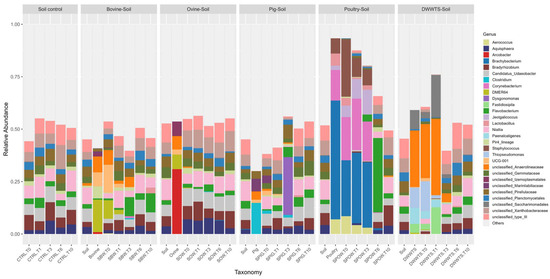
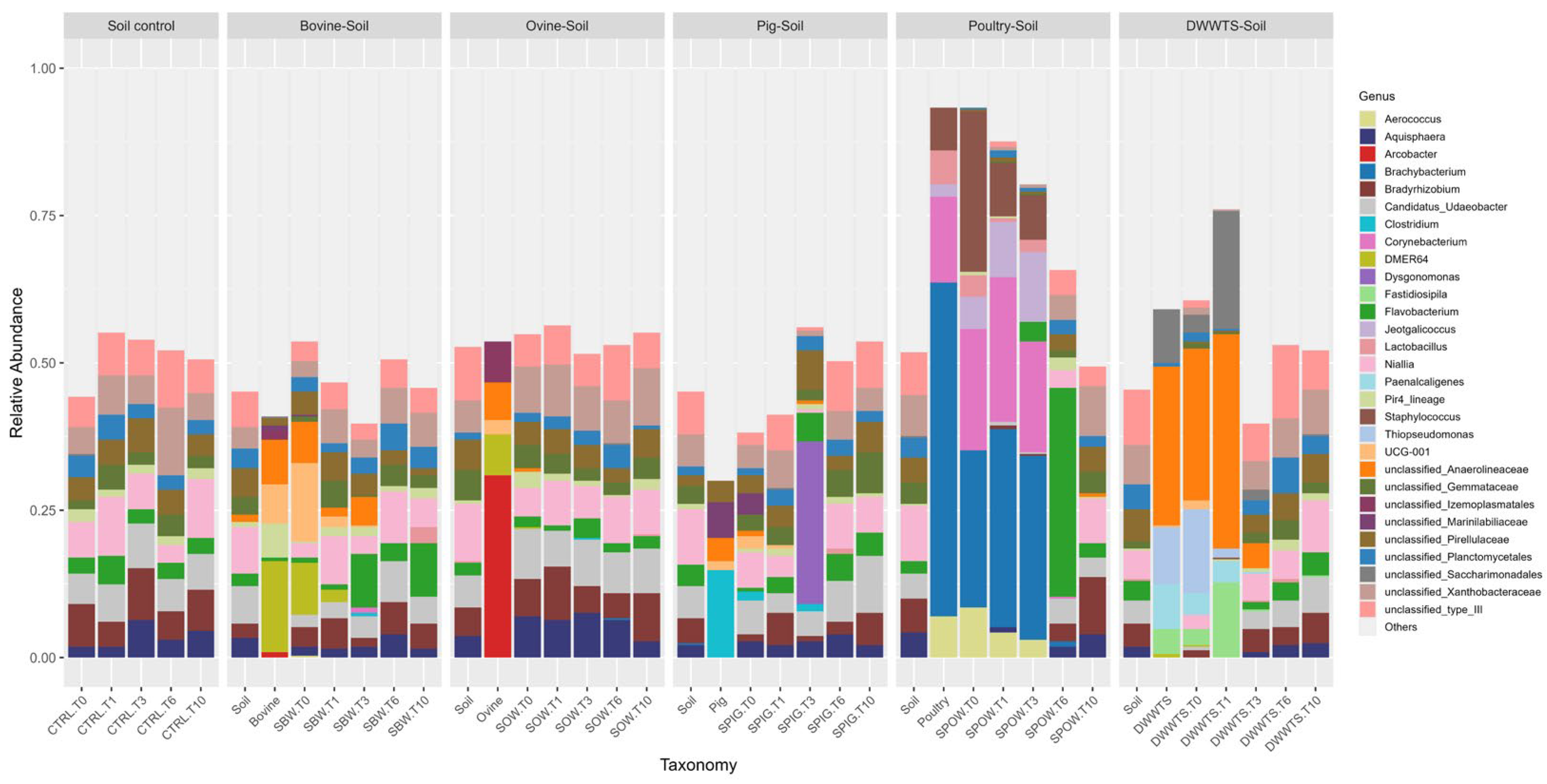
Most samples were characterised by microbial communities composed of numerous low-abundance genera rather than a few dominant taxa (Figure 2). Consequently, the ‘Others’ category represented the largest proportion of the community in most sample types and time points. A heatmap showing the most abundant 30 genera and 10 phyla from each of the 5 wastes (before application) and 10 weeks after soil application is included in the Supplementary Material, as well as the Venn diagrams (Figures S2 and S3).
Figure 2.
Thirty most abundant genera in each of soil controls (Ctrl.T0 to T10), soil plots before amendment application are referred as ‘Soil’, waste alone are referred as ‘Bovine’, ‘Ovine’, ‘Pig’, ‘Poultry’ and ‘DWWTS’, bovine-amended soil samples (SBW.T0 to T10), ovine-amended (SOW.T0 to T10), pig-amended (SPig.T0 to T10), poultry-amended (SPOW.T0 to T10) and DWWTS-amended (SW.T0 to T10).
The soil microbiota was characterised by the following genera: Niallia (7.6 ± 2%), Unclassified_type_III (7.3 ± 2%), unclassified_Xanthobacteraceae (6.0 ± 2%), Candidatus_Udaeobacter (5.6 ± 1%), Bradyrhizobium (5.3 ± 2%), unclassified_Pirellulaceae (4.3 ± 1%), Aquisphaera (3.3 ± 1%), unclassified_Planctomycetales (2.9 ± 1%), Flavobacterium (2.9 ± 1%), unclassified_Gemmataceae (2.5 ± 1%) and Pir4_lineage (1.1 ± 1%). No species were present at a relative abundance above 1%.
The genera in bovine slurry were DMER64 (15.5%), unclassified_Anaerolineaceae (7.6%), UCG-001 (6.7%), Pir4_lineage (5.8%), unclassified_Izemoplasmatales (1.5%), and unclassified_Pirellulaceae (1.2%). No species were present at a relative abundance above 1%.
In soil immediately amended with bovine slurry, the most abundant genera were UCG-001 (13.3%), DMER64 (8.8%), and unclassified_Anaerolineaceae (7.0%). After one week, the dominant genera shifted to Niallia (8.2%), unclassified_Xanthobacteraceae (5.8%), and unclassified_Pirellulaceae (4.8%). Three weeks post-application, Flavobacterium (9.1%) and unclassified_Anaerolineaceae (7.0%) were the most abundant genera. Six weeks after slurry application, the community was dominated by Niallia (8.8%), Candidatus_Udaeobacter (7.0%), and unclassified_Xanthobacteraceae (6.1%). By the end of the experiment (10 weeks), the most abundant genera were Flavobacterium (9.1%), unclassified_Xanthobacteraceae (5.8%), and Niallia (4.8%). No species were present at a relative abundance above 1%.
The relative abundance of the different genera in ovine slurry was Arcobacter (30.9%), DMER64 (7.0%), unclassified_Izemoplasmatales (7.0%), unclassified_Anaerolineaceae (6.4%), and UCG-001 (2.4%). No species were present at a relative abundance above 1%.
Immediately after land spreading ovine slurry, the most abundant genera were Candidatus_Udaeobacter (8.5%), unclassified_Xanthobacteraceae (7.9%), and Aquisphaera (7.0%). The same three genera remained dominant after three weeks, with relative abundances of 7.9%, 7.6%, and 7.6%, respectively. At weeks 1, 6 and 10, the most abundant genera were Bradyrhizobium (9.1%, 4.2% and 8.2%), unclassified_Xanthobacteraceae (8.8%, 7.3%, 9.7%), Niallia (7.6%, 7.9% and 7.6%) and Candidatus_Udaeobacter (6.1%, 7.0% and 7.6%). No species were present at a relative abundance above 1%.
Clostridium (14.8%), BBMC-4 (6.7%), unclassified_Marinilabiliaceae (6.1%), unclassified_Anaerolineaceae (3.9%), unclassified_Pirellulaceae (3.6%), and UCG-001 (1.5%) were the main genera in pig slurry. No species were present at a relative abundance above 1%. Considering that pigs are major shedders of Clostridioides difficile, Kraken2 was used to identify further the 50 ASVs assigned to the class Clostridia in pig slurry. However, none were identified as C. difficile.
In soil immediately amended with pig slurry, the most abundant genera were Niallia (6.1%) and Candidatus_Udaeobacter (5.8%), whereas after one week they were unclassified_Type_III (6.1%) and Bradyrhizobium (5.5%). At three weeks, the dominant genera were Dysgonomonas (27.6%) and unclassified_Pirellulaceae (6.7%). At six weeks, the most abundant genera were unclassified_Type_III (8.5%) and Niallia (7.6%), while at ten weeks the dominant genera were Candidatus_Udaeobacter (9.7%) and unclassified_Type_III (7.9%). No species were present at relative abundances above 1%.
Poultry was characterised by the dominance of Brachybacterium (56.7%), Corynebacterium (14.5%), followed by Staphylococcus (7.3%), Aerococcus (7.0%), Lactobacillus (5.8%) and Jeotgalicoccus (2.1%). From the time of land spreading until three weeks post-application, the dominant genera remained similar. At time 0, the most abundant genera were Staphylococcus (27.3%), Brachybacterium (26.7%), and Corynebacterium (20.6%). After one and three weeks, Brachybacterium (33.6% and 31.2%), Corynebacterium (24.5% and 18.8%), and Jeotgalicoccus (9.4% and 11.8%) dominated, respectively. Six weeks post-application, the dominant genera shifted to Flavobacterium (35.5%), Candidatus_Udaeobacter (4.2%), unclassified_Type_III (4.2%), and unclassified_Xanthobacteraceae (4.2%). By ten weeks, the most abundant genera were Bradyrhizobium (9.7%), unclassified_Xanthobacteraceae (8.5%), and Niallia (7.6%).
Only three microorganisms were identified at the species level at above 1% relative abundance. In poultry litter, these species had a relative abundance of 13.0% for Corynebacterium stationis, 5.2% for Staphylococcus arlettae, and 15.5% for Brachybacterium paraconglomeratum. C. stationis had a relative abundance of 19.7%, 23.0%, 17.0%, and 0.3%; S. arlettae, 21.8%, 7.9%, 6.7%, and 0%; and B. paraconglomeratum, 7.0%, 8.5%, 7.9%, and 0.3%, respectively, just after land spreading and after one, three, and six weeks.
In DWWTS, the principal genera were unclassified_Anaerolineaceae (27.0%), Thiopseudomonas (9.7%), unclassified_Saccharimonadales (9.1%), Paenalcaligenes (7.6%), and Fastidiosipila (4.2%). Immediately after soil amendment, the dominant genera remained similar, with unclassified_Anaerolineaceae (25.8%) and Thiopseudomonas (14.2%) being the most abundant. One week post-application, the highest relative abundances were observed for unclassified_Anaerolineaceae (36.4%), unclassified_Saccharimonadales (20.0%), and Fastidiosipila (12.7%). However, at three, six, and 10 weeks, the dominant genera shifted to unclassified_Type_III (6.4%, 12.4%, and 6.7%), unclassified_Xanthobacteraceae (4.8%, 6.7%, and 7.6%), and Niallia (4.5%, 4.8%, and 8.8%). No species were present at a relative abundance above 1%.
3.5. Alpha Diversity Indices Showed Reduced Diversity and Increased Dominance in Waste Communities with Gradual Return After Soil Application
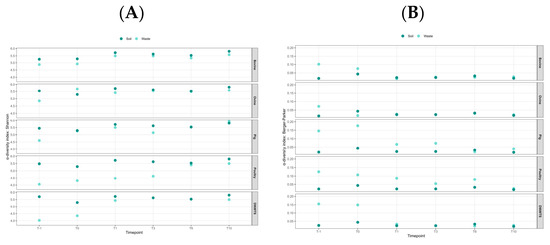
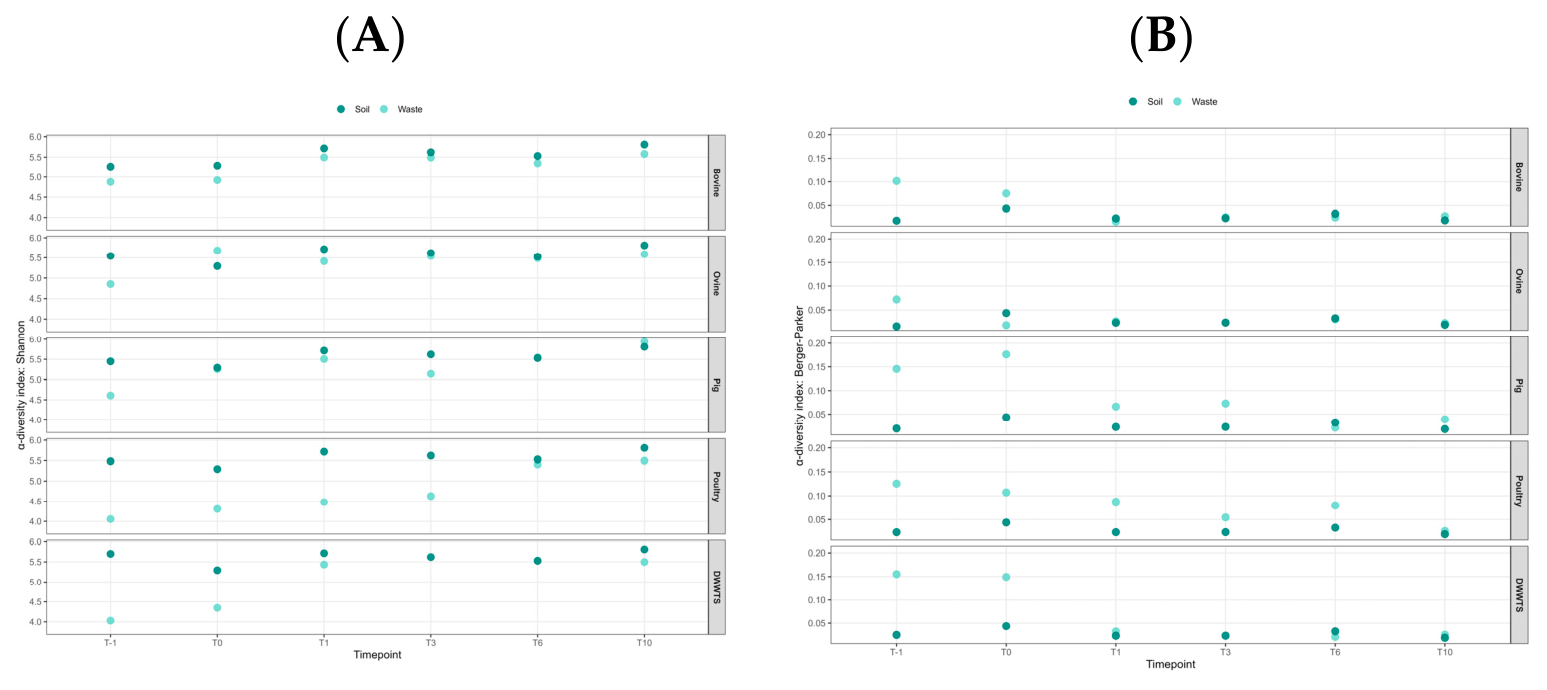
To evaluate microbial richness, evenness, and dominance across the different wastes applied, alpha-diversity indices of Berger–Parker (BP) and Shannon index (SI) (Figure 3) were calculated.
Figure 3.
Alpha diversity indices of the different wastes applied to soil over time using (A) Berger–Parker and (B) Shannon. ‘T-1’ denotes waste and soil before land spreading. For the subsequent time points, ‘Soil’ denotes the soil negative controls, whereas ‘Waste’ refers to soil-amended samples.
The BP index quantifies dominance by measuring the ratio between the most abundant taxon and the total number of taxa in a sample [29]. Higher BP values indicate stronger dominance by a few taxa. All five waste materials, when examined individually, had higher BP values than those obtained for the soil, with the highest values obtained in DWWTS (BP = 0.16) and poultry (BP = 0.13). When applied to soil, their BP values decreased over time.
SI incorporates both richness and evenness [28]. Higher values correspond to greater diversity and more even species distribution. Soil controls exhibited high microbial diversity with relatively even community distribution, with SI values ranging from 5.27 to 5.81. Bovine slurry and soil sampled immediately post-application showed reduced diversity (SI = 4.88 and 4.92); however, the amended soil microbiota reached SI values between 5.35 and 5.58 within one week. Ovine slurry had a lower SI (SI = 4.85); however, its application did not affect the soil microbiota diversity, as the SI values at all time points remained around 5.41 to 5.68. Pig slurry showed reduced diversity (SI = 6), whereas SI values in amended soil ranged from 5.14 to 5.94 immediately after application and until the end of the experiment. Three weeks post-application, a decrease in SI was observed (SI = 5.14), which may be caused by a high relative abundance of Dysgonomonas (27.6%). This genus has been isolated from the human gut, termites, nematodes, larvae, and anaerobic digesters [30,31,32,33,34,35,36,37]. Therefore, it is unclear whether its presence reflects a source-point contamination or a true shift in the soil microbiota. Consequently, the graphs excluding this genus have been included as Supplementary Materials (Figures S4 and S5).
Poultry waste (SI = 4.06) exhibited one of the lowest microbial diversities and the most uneven community composition of all the waste types tested. Moreover, it was associated with the greatest and longest shift in the soil microbiota, with SI values remaining below 5 until six weeks post-application, after which the diversity increased (SI = 5.4).
DWWTS also had relatively low SI values, as did the soil amended with this waste (SI values of 4.03 and 4.39, respectively), but the SI value in amended soil increased to 5.4 three weeks post-application.
3.6. Beta Diversity Dynamics Showed Distinct Clustering of Waste and Soil Communities with Temporal Convergence Following Application
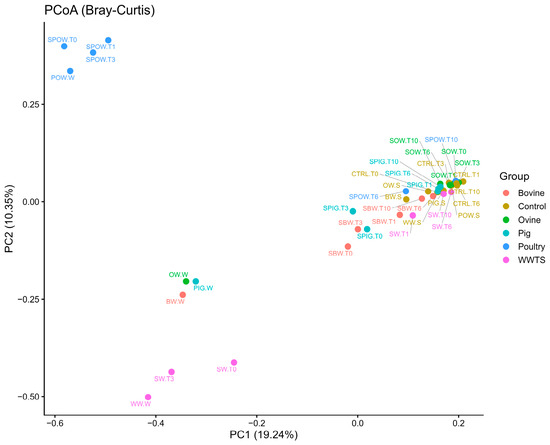
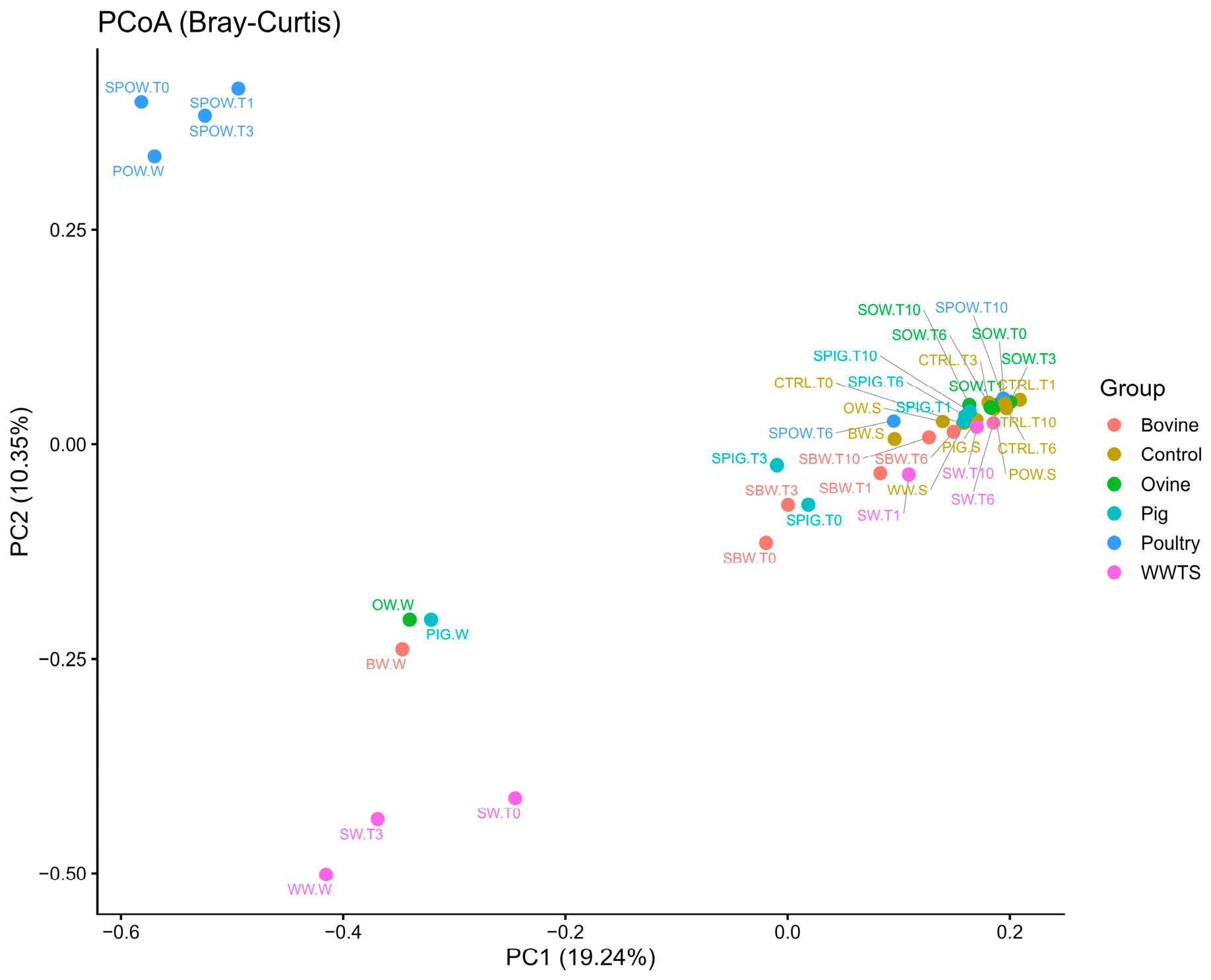
Beta diversity metrics were used to assess differences in community composition among groups. PCoA based on Bray–Curtis dissimilarity was performed to evaluate variation in microbial communities based on relative abundance (Figure 4). The first two axes explained 10.4% and 19.2% of the variation, respectively. Soil controls and the last time points of each treatment clustered together, while waste alone and the early time points after amendment application separated clearly, indicating a difference in community composition. Similar to the alpha diversity, PCoA and NMDS plots excluding Dysgonomonas at time three in soil amended with pig slurry have been included in the Supplementary Materials (Figures S6–S9).
Figure 4.
Principal Coordinates Analysis (PCoA) based on Bray–Curtis dissimilarities of soil controls (Ctrl.T0 to T10), soil plots before amendment application are referred as the name of the waste followed by ‘.S’, waste alone are referred as ‘BW.W’ (Bovine), ‘OW.W’ (Ovine), ‘PIG.W’ (Pig), ‘POW.W’ (Poultry) and ‘WW.W’ (DWWTS), bovine-amended soil samples (SBW.T0 to T10), ovine-amended (SOW.T0 to T10), pig-amended (SPig.T0 to T10), poultry-amended (SPOW.T0 to T10) and DWWTS-amended (SW.T0 to T10).
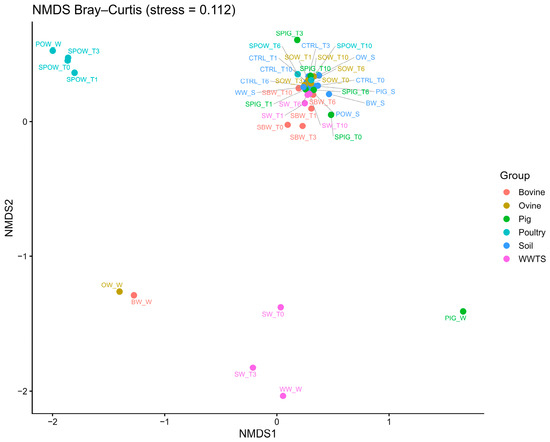
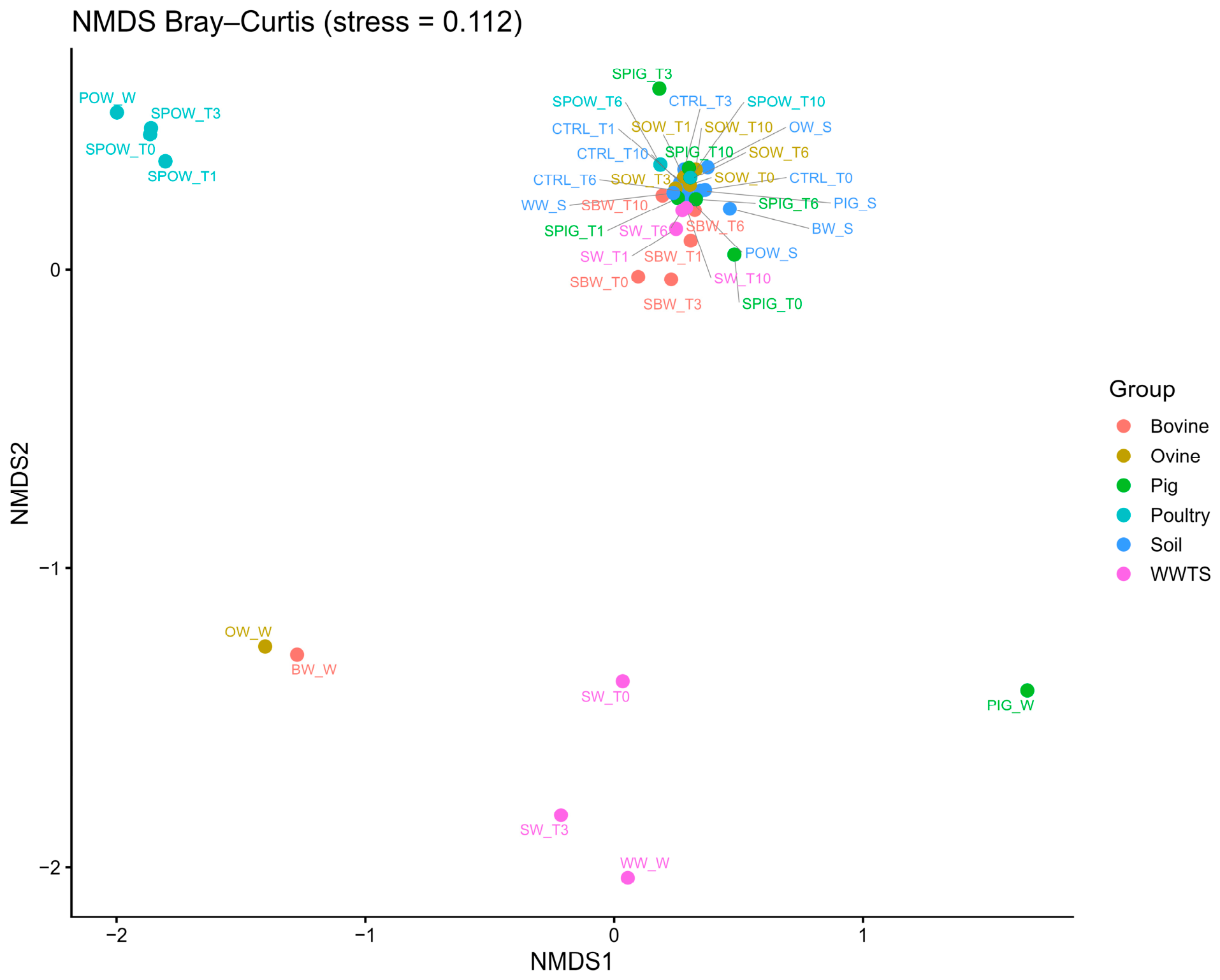
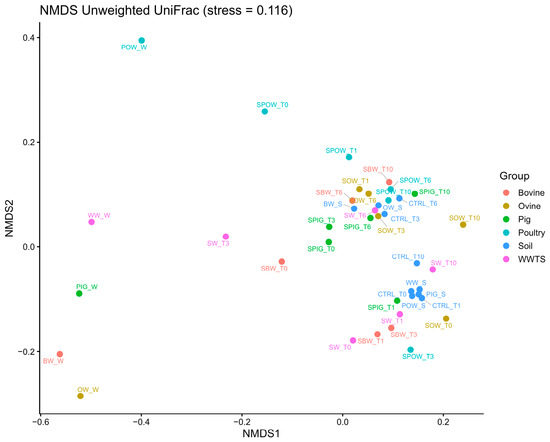
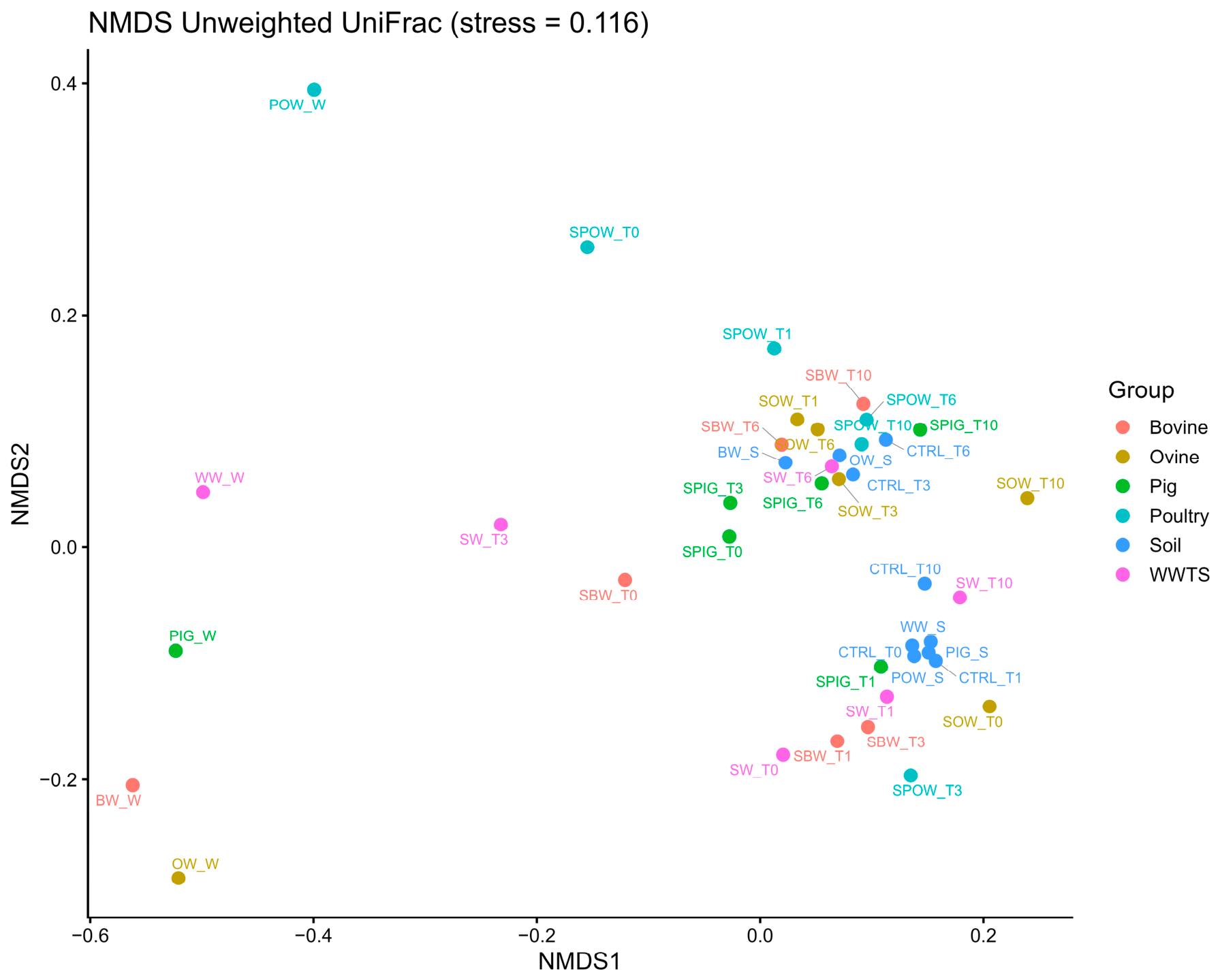
UniFrac and Bray–Curtis distances were used to create three NMDS ordination plots represented in Figure 5, Figure 6 and Figure 7.
Figure 5.
Non-metric multidimensional (NMDS) plot based on Bray–Curtis dissimilarity. Soil control samples are denoted as Ctrl.T0–T10. Soil samples collected before amendment application are identified by the waste type followed by ‘S’. Waste-only samples are denoted as BW.W (Bovine), OW.W (Ovine), PIG.W (Pig), POW.W (Poultry), and WW.W (DWWTS). Bovine-amended soil samples are denoted as SBW.T0–T10, ovine-amended soil samples as SOW.T0–T10, pig-amended soil samples as SPig.T0–T10, poultry-amended soil samples as SPOW.T0–T10, and DWWTS-amended soil samples as SW.T0–T10.
Figure 6.
NMDS plot based on unweighted UniFrac distance. Soil control samples are denoted as Ctrl.T0–T10 Soil control samples are denoted as Ctrl.T0–T10. Soil samples collected before amendment application are identified by the waste type followed by ‘.S’. Waste-only samples are denoted as BW.W (Bovine), OW.W (Ovine), PIG.W (Pig), POW.W (Poultry), and WW.W (DWWTS). Bovine-amended soil samples are denoted as SBW.T0–T10, ovine-amended soil samples as SOW.T0–T10, pig-amended soil samples as SPig.T0–T10, poultry-amended soil samples as SPOW.T0–T10, and DWWTS-amended soil samples as SW.T0–T10.
Figure 7.
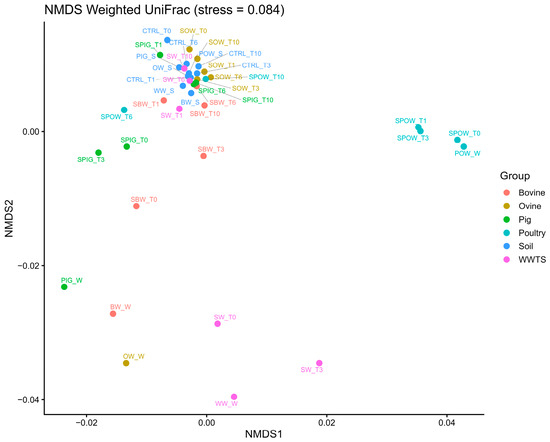
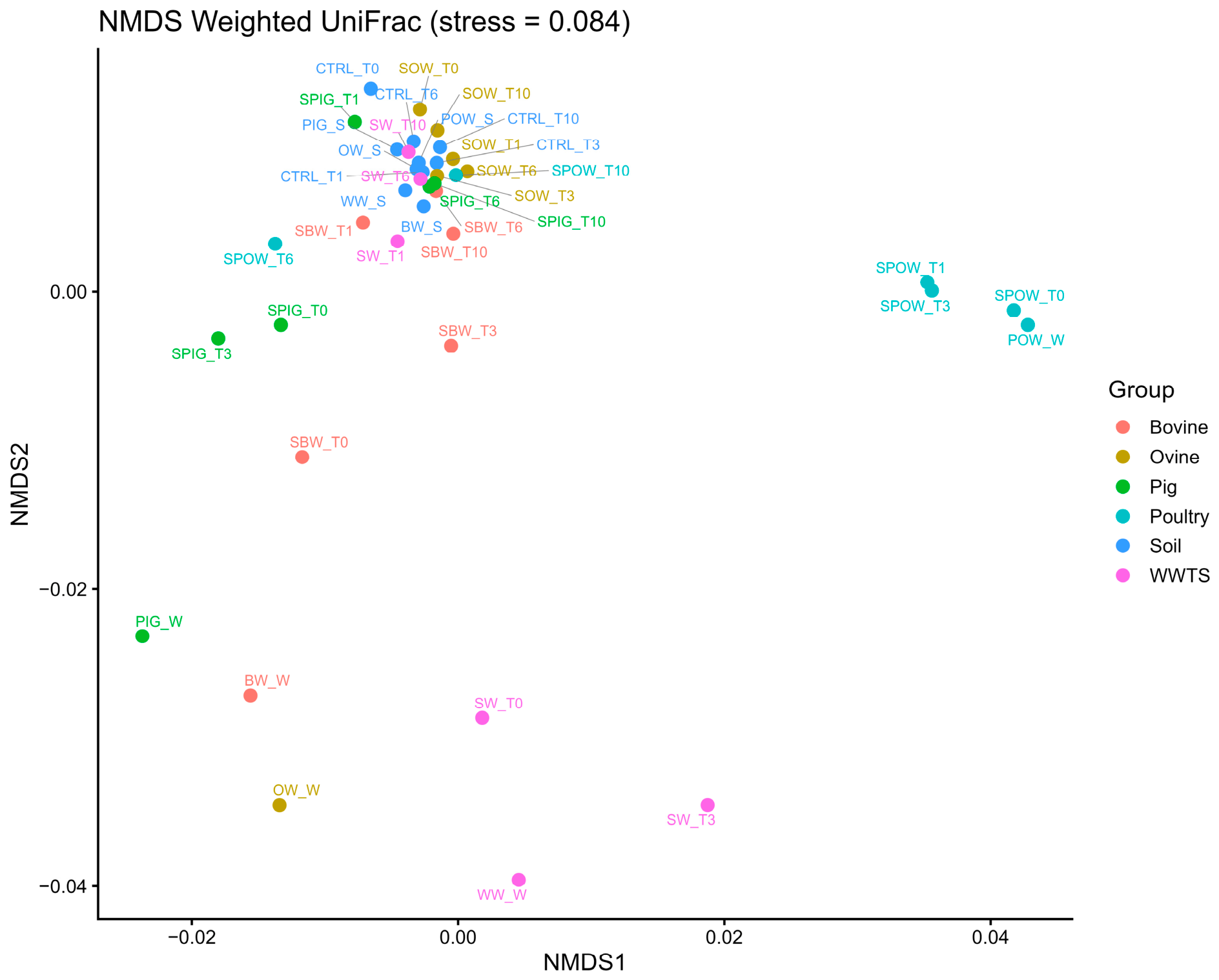
NMDS plot based on weighted UniFrac distance. Soil control samples are denoted as Ctrl.T0–T10. Soil samples collected before amendment application are identified by the waste type followed by ‘.S’. Waste-only samples are denoted as BW.W (Bovine), OW.W (Ovine), PIG.W (Pig), POW.W (Poultry), and WW.W (DWWTS). Bovine-amended soil samples are denoted as SBW.T0–T10, ovine-amended soil samples as SOW.T0–T10, pig-amended soil samples as SPig.T0–T10, poultry-amended soil samples as SPOW.T0–T10, and DWWTS-amended soil samples as SW.T0–T10.
Bray–Curtis-based NMDS visualises community composition differences driven by differences in taxon abundances, highlighting how the relative abundances of ASVs vary across samples. The ordination plot in Figure 5 revealed five distinct clusters corresponding to different waste types or soil, which showed distinct bacterial compositions in the wastes and early time points, and increasing overlap between later waste-amended samples and the soil control as time progressed.
Unweighted UniFrac-based NMDS emphasises presence–absence patterns of microbial lineages, in which greater distances between samples reflect more dissimilar phylogenetic compositions. Consequently, the waste samples were positioned far from the cluster formed by the soil samples (Figure 6), indicating that waste communities harbour unique taxa not shared with soil, many of which are lost following application.
NMDS based on weighted UniFrac distance reflects differences in microbial community composition that incorporate both phylogenetic and relative abundance of lineages. Samples from poultry and DWWTS alone, up to three weeks post-application, and the remaining waste-alone exhibited the greatest dissimilarity in NMDS (Figure 7), indicating unique high-abundance phylogenetic profiles. In contrast, soil-amended and soil control samples clustered together, indicating a convergence toward a soil communities’ structure after application.
4. Discussion
4.1. Bacterial Communities in Soil
In this study, sandy-clay loam soil was characterised by a dominance of Pseudomonadota, Planctomycetota and Bacillota at the phylum level, and by Niallia, unclassified_Type_III and unclassified_Xanthobacteraceae at a genus level. In contrast, the dominant soil phyla reported in a similar study, also conducted in Wexford (Ireland), were Acidobacteria (currently known as Acidobacteriota) (54.7–59.0%) and Actinobacteria (currently known as Actinomycetota) (22.4–28.3%), while the most predominant genera were Acinetobacter (79.1–82.9%) and Bradyrhizobium (14.0–19.9%) [14]. While these differences may be the result of different agricultural practices [38], they may also be related to the sequencing technologies used. Shotgun technologies such as Illumina and Ion Torrent produce reads of 100–400 bp of hypervariable regions that allow microbial identification down to strain level; however, they can lead to underestimation of genome regions or ambiguous taxonomic assignment [22,23]. Do, Smyth [14] applied shotgun sequencing, while our samples were analysed using 16S amplicon sequencing. Edwin, Duff [39], for example, analysed 136 Irish soil samples using both shotgun and 16S amplicon sequencing. The most abundant phyla using shotgun versus amplicon sequencing were Pseudomonadota (34.4% vs. 21.8%), Actinomycetota (26.4% vs. 13.3%), Verrucomicrobiota (4.5% vs. 9.4%), Bacteriodota (4.5% vs. 6.5%), Acidobacteriota (4.1% vs. 12.6%), and Planctomycetota (8.1% only detected by 16S amplicon sequencing) [39]. The differences in primer performance and between Illumina versus PacBio sequencing for the detection of Planctomycetota were further investigated by Vitorino, Gambardella [40]. In their in silico evaluation, 515F/Y926R-jed (Illumina) showed 85% coverage of Planctomycetota sequences in SILVA TestPrime and 57.36% coverage in the reference-genome dataset. The full-length primer pair 27F/1492R showed 69% SILVA coverage and 59.69% coverage in the genome-based analysis. Furthermore, PacBio (27F/1492R) identified 251 Planctomycetota ASVs (3.9% of total ASVs), whereas Illumina identified 154 Planctomycetota ASVs (4.8% of total ASVs).
Regardless, Pseudomonadota plays a crucial role in nutrient cycling and pathogen suppression [41], and Xanthobacteraceae can use urea as a nitrogen source and are capable of dissimilatory nitrate and nitrite reduction [42]. Phylum Planctomycetota has been described to contribute to nitrogen and metal cycling [43], while Bacillota provides mineral compounds to plants, regulates plant hormone production, and controls pathogen development [44]. The role of Niallia in soil as a nitrogen-fixing genus that produces secondary metabolites capable of stimulating plant growth and preventing fungal growth [45].
4.2. Bacterial Communities in Animal Wastes and Anaerobically Digested WWTS
In bovine waste, the most abundant phylum was Bacteroidota (34%), while the most abundant genus was DMER64. Similarly, Perez-Valera, Kyselkova [46] reported Bacteroidetes (currently known as Bacteroidota) (45%) and Firmicutes (currently known as Bacillota) (37%) as the main phyla in fresh cattle manure. Another study on community bacterial composition in beef, cattle, and dairy manure found Proteobacteria (currently known as Pseudomonadota), Actinobacteria (currently known as Actinomycetota), Bacteroidetes (currently known as Bacteroidota), and Tenericutes (currently known as Mycoplasmatota) as the main phyla [47]. These differences may be related to the animal diet and/or age of the bovine waste at sampling [48,49]. Talukder, Yang [49] reported that grass-fed cattle exhibited a significantly higher abundance of Firmicutes (currently known as Bacillota) compared with grain-fed cattle. Devane, Taylor [48] reported that Bacillota and Bacteroidota are dominant in fresh cattle manure, and as the manure ages, the microbial composition shifts to phyla such as Pseudomonadota or Actinomycetota. Bacteroidota is commonly found in the gastrointestinal tract of ruminants, and they are known to degrade complex carbohydrates [50]. The role of DMER64 has been previously described as an acetogen bacterium that oxidises propionic and butyric acids producing hydrogen. Its presence has been related to higher VFA levels, especially acetic acid [51,52,53].
In ovine slurry microbiota, Arcobacter was the most abundant genus within Campylobacterota. Considering that some species of Arcobacter can be pathogenic to humans and animals [54], these findings suggest that ovine slurry may act as a carrier and may pose a potential zoonotic risk. These results differed from those reported in other studies, in which Bacillota and Bacteroidota were the predominant taxa [55,56]. These phyla participate in the digestion of carbohydrates and proteins [55].
Bacteroidota (44%) and Bacillota (19%) were the most abundant phyla, while Clostridium (15%) was the most abundant genus in pig slurry. This is in line with other studies, in which Firmicutes (currently known as Bacillota) dominated, followed by Bacteroidetes (currently known as Bacteroidota) in pig slurry [47,57]. A high relative abundance of Clostridium in fresh pig slurry has been previously reported, and its presence was related to the decomposition of proteins and non-starch polysaccharides in anaerobic conditions [58].
Poultry waste was dominated by Actinomycetota (74%) and Bacillota (24%) at a phylum level and Brachybacterium (56%) and Corynebacterium (15%) at a genus level. Blazejewska, Zalewska [59] suggested that Bacteroidota, Bacillota, Pseudomonadota, and Actinomycetota are the four dominant phyla in poultry waste; however, the relative abundance of Actinomycetota in this study is much higher than that reported in other studies, which typically range from 9.0–53.2% [59,60,61,62]. The most abundant genera in this study were Brachybacterium and Corynebacterium, which were included in the phylum Actinomycetota. Similar results were reported by Wang, Mei [62], with Brachybacterium, Staphylococcus, and Corynebacterium from the phylum Actinomycetota dominating broiler manure. Brachybacterium is commonly found in faeces and poultry houses [63], while Corynebacterium is present in the gastrointestinal tract of broilers [64]. Three species were detected, which included B. paraconglomeratum (15.5%), C. stationis (13.0%), and S. arlettae (5.2%). C. stationis is a bacterium commonly isolated from diverse environments, including soil, animal skin, and sewage [65,66]. Similarly, S. arlettae has been reported as part of the skin of mammals and birds [67], whereas B. paraconglomeratum was associated with poultry deep litter [68]. All three species have also been implicated in human and/or animal clinical infections. C. stationis has been described as a medically relevant Corynebacterium species that has been isolated from human blood samples, stool, and seawater [69]; B. paraconglomeratum has been linked to ocular infections [68]; and S. arlettae has been associated with a range of conditions, including bovine mastitis, pig exudative epidermidis, dairy goat intramammary infection, and human rheumatic mitral stenosis [67,70].
In DWWTS, the most abundant phyla were Chloroflexota (28%), Bacteroidota (20%), and Pseudomonadota (19%), while the most abundant genus was unclassified_Anaerolineaceae. These results are in agreement with those reported by Walter, Probst [71], in which the dominant phyla in anaerobically digested WWTS were Chloroflexi (currently known as Chloroflexota), Firmicutes (currently known as Bacillota), Bacteroidetes (currently known as Bacteroidota) and Proteobacteria (currently known as Pseudomonadota). Anaerolineaceae is a family within the Chloroflexota phylum, frequently detected in AD systems, where they play a key role in breaking down carbohydrates and protein-rich sources [72].
4.3. Changes in Soil Microbiota After the Application of Wastes
In the present study, the effect on soil microbiota differed depending on the type of waste, with each requiring different times for the re-establishment of the original soil microbiota.
When bovine slurry was applied, waste-associated genera such as UCG-001 (Bacteroidota), DMER64 (Bacteroidota) and unclassified_Anaerolineaceae (Chloroflexota) were the most abundant only immediately after application. In contrast, soil-associated genera such as Flavobacterium (Bacteroidota), Niallia (Bacillota) and unclassified_Xanthobacteraceae (Pseudomonadota) predominated thereafter. There is no consensus on the effect of bovine slurry on the soil microbiota. Some studies reported no or a limited effect on soil microbiota [20,73,74]. In contrast, Fox, Ikoyi [73] reported that taxa in cattle slurry significantly changed soil bacterial communities only on day 5, while by day 65 the composition of both soil untreated and treated controls was significantly different than the composition at previous time points (5 and 30 days). They hypothesised that the limited effect on soil microbiota may be due to a rising growth of soil Gram-negative bacteria. This is in agreement with Laconi, Mughini-Gras [74], who observed that the only significant changes were found in a few phyla. In contrast, Peng, Wang [75] reported that manure fertilisation altered soil communities at a phylum level, increasing the abundance of Actinobacteria (currently known as Actinomycetota) and Proteobacteria (currently known as Pseudomonadota), and decreasing Planctomycetes (currently known as Planctomycetota), Chloroflexi (currently known as Chloroflexota) and Acidobacteria (currently known as Acidobacteriota).
The application of ovine slurry had no detectable effect on soil microbiota, with soil-associated genera remaining the most abundant throughout the experiment. Despite being applied at a rate of 14.7 t/ha, comparable to those of DWWTS (15.0 t/ha) and poultry waste (15.5 t/ha), ovine slurry exerted the weakest influence on the soil microbial community. In contrast, DWWTS and poultry waste produced the strongest effects. This suggests that the limited impact of ovine slurry may be attributed to its physicochemical properties such as pH, dry matter, or nutrient composition and availability [76]. A similar finding was reported by Liu, Liu and Hou [77], who observed that soil microbial communities in grasslands remained unaffected following sheep manure deposition.
When pig slurry was applied to soil, waste-associated phyla and genera were detected up to one week post-application. Tyrrell, Do [20] also reported that the application of swine slurry caused a small but statistically significant (p < 0.05) shift in the soil microbiota for up to a week after application.
The use of poultry litter as a soil amendment had the strongest effect on the soil microbiota, with waste-associated taxa being detected for up to six weeks post-application. This is in agreement with previous studies, which reported that poultry amendment led to medium-term soil microbial disruptions, with soil recovery happening after approximately two months [16,78]. This longer impact (as compared to the organic waste materials tested) may be due to higher total solids in broiler waste.
Poultry waste typically contains a high total solids content due to the presence of bedding materials, which can alter physicochemical properties, supporting the constituent bacteria, even when exposed to other environments such as soil [60].
When anaerobically digested WWTS was applied to soil, waste-associated phyla (Chloroflexota, Bacteroidota and Pseudomonadota) and genera (unclassified_Anaerolineaceae) were the most abundant after one week but still detectable after three weeks. De Corato, Cancellara [13] reported that the relative abundance of 13 out of 23 genera changed significantly following the application of digestates from a wastewater treatment plant, with Bacillus (31.8%) and Pseudomonas (23.6%) contributing most to this variation. In contrast, Coelho, Hennessy [79] did not observe any impact on soil microbiota following digestate application; however, their first sampling occurred five months after spreading, which most likely allowed time for soil microbial communities to recover. The use of digestates of sewage sludge as soil amendments may be beneficial for soil properties, including nutrient content (C, P, and N) [80,81].
4.4. Role of Physicochemical Properties of Wastes on Soil Microbiota
Soil pH has been described as one of the most important physicochemical properties influencing soil microbiota and nutrient cycling [82,83]. The composition of soil in terms of C, N, and P is closely linked to pH and can, therefore, affect a broad range of biological and biochemical properties, including microbial biomass, community composition and activity, enzymatic processes, plant growth and productivity, soil organic matter characteristics and nutrient cycling, and availability [83]. Both excessive soil acidification and alkalinization may adversely affect soil health and, consequently, soil fertility. Acidic conditions can inhibit microbial activity and increase nutrient leaching. In contrast, alkaline conditions may reduce microbial activity, promote soil compaction, and decrease soil permeability, potentially leading to reduced nutrient availability and lower organic matter content [83].
In the present study, broiler waste and DWWTS appeared to exert a stronger effect on soil microbiota than the slurries. While the pH of bovine, ovine, and pig slurry ranged from 7.2 to 7.5, poultry waste had a pH of 7.9 and a dry matter content of 71.4%, whereas DWWTS had a pH of 8.2. As a result, the application of these two amendments may have induced greater changes in soil pH, potentially favouring stress-tolerant taxa over soil-associated taxa. In addition, the high dry matter content of poultry waste may have contributed to fluctuations in soil moisture. Changes in soil moisture can influence the decomposition of organic matter by altering microbial community composition and the availability of carbon substrates to soil microorganisms, thereby affecting nutrient cycling processes [84]. The great variability in the physicochemical properties of digestates can make it difficult to assess the effect on soil microbiota. Furthermore, the application of digestates can lead to soil acidification, promoting the conversion of ammonium into nitrate and the production of volatile fatty acids. Heavy metal content in some digestates may also inhibit enzyme activity and respiration, again favouring stress-tolerant taxa [85].
4.5. One Health Considerations of Pathogen Dissemination Through Animal Wastes
The identification of Arcobacter at high relative abundance in ovine slurry, together with the persistence of B. paraconglomeratum, C. stationis and S. arlettae from broiler litter for up to six weeks after application, highlights the potential risk of pathogen dissemination in agricultural soils. Untreated manure may contaminate crops and fresh produce, as well as surface water and groundwater that can serve as sources of irrigation water, thereby increasing the risk of pathogen transfer to other crops or fresh produce [86,87]. Furthermore, animal waste generated on a farm should ideally be applied within that farm. The spreading of manure to other farms, a practice that commonly occurs with pig slurry, for example, may constitute a biosecurity breach that facilitates the dissemination of animal and human pathogens throughout the food production environment.
4.6. Limitations of the Study
This study had some limitations. First, each treatment was sampled only once per time point, which prevented the calculation of variability and the application of statistical tests, while also increasing the risk of point-source contamination. Second, the experiment was conducted using a single soil type. The field trial took place from August to October, during which the average rainfall was 3.5 mm, and the mean air and soil temperatures were 14.6 °C and 16.4 °C, respectively. In Ireland, the application of organic fertilisers is not permitted from October to the end of January [88]. Therefore, different weather conditions at other times of the year may lead to variations in outcomes. Nevertheless, to the authors’ knowledge, this was the first paper to describe the temporal effect on soil microbiota during 10 weeks after the application of five different organic wastes using full-length 16S rRNA sequencing.
5. Conclusions
To the authors’ knowledge, this study is the first to characterise the bacterial microbiota when organic wastes are applied to soil using PacBio 16S rRNA sequencing technology. The data generated provide detailed information on the bacterial communities present in economically and environmentally significant organic wastes commonly used as soil amendments. The results further indicate that changes in soil microbiota varied according to the type of waste applied. Waste-associated taxa from ovine slurry were not detected immediately after land spreading, while those associated with bovine and pig slurry were no longer detected one week following application. In contrast, the application of DWWTS and poultry waste was associated with the most pronounced shifts in soil microbiota composition, with communities returning towards pre-application profiles after three and ten weeks, respectively. These observations suggest that some organic waste amendments may exert more persistent effects on soil bacterial communities. Long-term shifts can reduce microbial diversity by favouring pathogen or stress-tolerant taxa and may weaken nutrient cycling and soil fertility.
Supplementary Materials
The following supporting information can be downloaded at: https://www.mdpi.com/article/10.3390/environments13100519/s1, Table S1: Soil properties before waste application; Table S2: Weather conditions recorded throughout the experiment; Table S3: Nutrient analysis of organic wastes; Table S4: Sequencing reads and ASVs; Figure S1: Waste spread in three equidistant lines in one plot, mimicking band spreading; Figure S2: Heatmap of the most abundant 30 genera and 10 phyla from organic waste alone to the application after 10 weeks; Figure S3: Venn diagram showing shared taxa between the different time points; Figure S4: Berger-Parker index excluding the presence of Dysgonomonas; Figure S5: Shannon Index excluding presence of Dysgonomonas; Figure S6: PCoA based on Bray–Curtis dissimilarity, excluding the presence of Dysgonomonas; Figure S7: NMDS based on Bray–Curtis dissimilarity, excluding the presence of Dysgonomonas; Figure S8: NMDS based on unweighted UniFrac distance, excluding the presence of Dysgonomonas; Figure S9: NMDS based on weighted UniFrac distance, excluding the presence of Dysgonomonas.
Author Contributions
Conceptualization, N.A.-N. and D.B.; methodology, N.A.-N., L.K. and K.R.; formal analysis, N.A.-N. and L.K.; investigation, N.A.-N.; data curation, N.A.-N. and L.K.; writing—original draft preparation, N.A.-N.; writing—review and editing, N.A.-N., L.K., K.R., P.W. and D.B.; visualization, N.A.-N.; supervision, L.K., P.W. and D.B.; project administration, D.B.; funding acquisition, D.B. All authors have read and agreed to the published version of the manuscript.
Funding
This research was funded by the Department of Agriculture, Food and the Marine (Project 2021R453). Natalia Alija-Novo was supported by the Teagasc Walsh Scholarship Programme (Number 2021204).
Data Availability Statement
The original data presented in the study are openly available in the Sequencing Read Archive (SRA) at https://www.ncbi.nlm.nih.gov/sra/PRJNA1503489, accessed on 14 September 2026, reference number PRJNA1503489.
Conflicts of Interest
The authors declare no conflicts of interest.
Correction Statement
This article has been republished with a minor correction to the Data Availability Statement. This change does not affect the scientific content of the article.
Abbreviations
The following abbreviations are used in this manuscript:
| C | Carbon |
| SOC | Soil Organic Carbon |
| N | Nitrogen |
| K | Potassium |
| P | Phosphorus |
| Zn | Zinc |
| S | Sulphur |
| Cu | Copper |
| C/N | Carbon to Nitrogen |
| t/ha | Tonnes per hectare |
| ASV | Amplicon Sequence Variants |
| SI | Shannon Index |
| BP | Berger-Parker |
| PCoA | Principal Coordinates Analysis |
| NMDS | Non-metric Multidimensional Scaling |
| NCBI | National Center for Biotechnology Information |
| SRA | Sequence Read Archive |
References
- Bei, S.; Zhang, Y.; Li, T.; Christie, P.; Li, X.; Zhang, J. Response of the soil microbial community to different fertilizer inputs in a wheat-maize rotation on a calcareous soil. Agric. Ecosyst. Environ. 2018, 260, 58–69. [Google Scholar] [CrossRef] [Scilit]
- DiLegge, M.J.; Manter, D.K.; Vivanco, J.M. Soil microbiome disruption reveals specific and general plant-bacterial relationships in three agroecosystem soils. PLoS ONE 2022, 17, e0277529. [Google Scholar] [CrossRef] [Scilit] [PubMed]
- Li, M.; Chen, X.; Cui, Y.; Yue, X.; Qi, L.; Huang, Y.; Zhu, C. Mechanism of soil microbial community degradation under long-term tomato monoculture in greenhouse. Front. Microbiol. 2025, 16, 1587397. [Google Scholar] [CrossRef] [Scilit] [PubMed]
- Sivojiene, D.; Kacergius, A.; Baksiene, E.; Maseviciene, A.; Zickiene, L. The Influence of Organic Fertilizers on the Abundance of Soil Microorganism Communities, Agrochemical Indicators, and Yield in East Lithuanian Light Soils. Plants 2021, 10, 2648. [Google Scholar] [CrossRef] [Scilit] [PubMed]
- Rayne, N.; Aula, L. Livestock Manure and the Impacts on Soil Health: A Review. Soil Syst. 2020, 4, 64. [Google Scholar] [CrossRef] [Scilit]
- Yost, J.L.; Schmidt, A.M.; Koelsch, R.; Schott, L.R. Effect of swine manure on soil health properties: A systematic review. Soil Sci. Soc. Am. J. 2022, 86, 450–486. [Google Scholar] [CrossRef] [Scilit]
- Ahammed, I.; Mondal, R.; Nesa, J.; Mandal, A.K.; Sadat, A. Understanding the role of soil microbiota and its’ interplay with environment to ensure sustainable development for the future generations. Appl. Soil Ecol. 2025, 212, 106217. [Google Scholar] [CrossRef] [Scilit]
- De Corato, U. Towards New Soil Management Strategies for Improving Soil Quality and Ecosystem Services in Sustainable Agriculture: Editorial Overview. Sustainability 2020, 12, 9398. [Google Scholar] [CrossRef] [Scilit]
- Köninger, J.; Lugato, E.; Panagos, P.; Kochupillai, M.; Orgiazzi, A.; Briones, M.J.I. Manure management and soil biodiversity: Towards more sustainable food systems in the EU. Agric. Syst. 2021, 194, 103251. [Google Scholar] [CrossRef] [Scilit]
- Howe, J.A.; McDonald, M.D.; Burke, J.; Robertson, I.; Coker, H.; Gentry, T.J.; Lewis, K.L. Influence of fertilizer and manure inputs on soil health: A review. Soil Secur. 2024, 16, 100155. [Google Scholar] [CrossRef] [Scilit]
- Rubio, R.; Marks, E.A.; Pérez-Espinosa, A.; Martínez-Sabater, E.; Andreu-Rodriguez, J.; Calvet, S.; Sanchis, E.; Orden, L.; Sáez-Tovar, J.; Estellés, F.; et al. How do beef cattle farm characteristics impact manure properties? Implications for agronomic circularization and sustainability. Waste Manag. Res. 2026, 44, 1017–1026. [Google Scholar] [PubMed]
- Wan, J.; Wang, X.; Yang, T.; Wei, Z.; Banerjee, S.; Friman, V.-P.; Mei, X.; Xu, Y.; Shen, Q. Livestock Manure Type Affects Microbial Community Composition and Assembly During Composting. Front. Microbiol. 2021, 12, 621126. [Google Scholar] [CrossRef] [Scilit] [PubMed]
- De Corato, U.; Cancellara, F.A.; Lacolla, G.; Caranfa, D.; Cucci, G. Short-term soil amendment by sewage sludge anaerobic digestate in a tomato monoculture suppresses Fusarium vascular wilt disease by changing the taxonomic characteristics of soil microbiota. Appl. Soil Ecol. 2023, 189, 104915. [Google Scholar] [CrossRef] [Scilit]
- Do, T.T.; Smyth, C.; Crispie, F.; Burgess, C.; Brennan, F.; Walsh, F. Comparison of soil and grass microbiomes and resistomes reveals grass as a greater antimicrobial resistance reservoir than soil. Sci. Total Environ. 2023, 857, 159179. [Google Scholar] [CrossRef] [Scilit] [PubMed]
- Martins, G.L.; Pellegrinetti, T.A.; de Freitas, A.S.; Rocha, G.S.; Monteiro, G.G.T.N.; Mendes, L.W.; Tsai, S.M.; Oliveira, F.C.; Regitano, J.B. Differential effects of fresh and composted organic wastes on soil bacterial community and maize growth. Appl. Soil Ecol. 2024, 204, 105715. [Google Scholar] [CrossRef] [Scilit]
- Mecik, M.; Buta-Hubeny, M.; Paukszto, L.; Mazdziarz, M.; Wolak, I.; Harnisz, M.; Korzeniewska, E. Poultry manure-derived microorganisms as a reservoir and source of antibiotic resistance genes transferred to soil autochthonous microorganisms. J. Environ. Manag. 2023, 348, 119303. [Google Scholar] [CrossRef] [Scilit] [PubMed]
- Meng, J.; Li, W.; Qiu, Y.; Li, Z.; Li, L.; Luo, Y.; Guo, H.; Yu, Y.; Shan, S.; Chen, H. Responses of soil microbial communities to manure and biochar in wheat cultivation of a rice-wheat rotation agroecosystem in East China. Pedosphere 2023, 33, 893–904. [Google Scholar] [CrossRef] [Scilit]
- Mora-Salguero, D.; Ranjard, L.; Morvan, T.; Dequiedt, S.; Jean-Baptiste, V.; Sadet-Bourgeteau, S. Long-term effect of repeated application of pig slurry digestate on microbial communities in arable soils. Heliyon 2025, 11, e41117. [Google Scholar] [CrossRef] [Scilit] [PubMed]
- Riber, L.; Poulsen, P.H.; Al-Soud, W.A.; Skov Hansen, L.B.; Bergmark, L.; Brejnrod, A.; Norman, A.; Hansen, L.H.; Magid, J.; Sorensen, S.J. Exploring the immediate and long-term impact on bacterial communities in soil amended with animal and urban organic waste fertilizers using pyrosequencing and screening for horizontal transfer of antibiotic resistance. FEMS Microbiol. Ecol. 2014, 90, 206–224. [Google Scholar] [CrossRef] [Scilit] [PubMed]
- Tyrrell, C.; Do, T.T.; Leigh, R.J.; Burgess, C.M.; Brennan, F.P.; Walsh, F. Differential impact of swine, bovine and poultry manure on the microbiome and resistome of agricultural grassland. Sci. Total Environ. 2023, 886, 163926. [Google Scholar] [CrossRef] [Scilit] [PubMed]
- Wang, H.; Li, H.; Lu, Z.; Li, W.; Guo, W. Development of a Species-Specific PCR Assay for Aerococcus urinaeequi Using Whole Genome Sequencing. Pathogens 2025, 14, 634. [Google Scholar] [CrossRef] [Scilit] [PubMed]
- Berg, M.; Reiter, T.; Emerson, J.; Brown, C.T.; Roux, S. Comparison of short-read and long-read metagenome assemblies in a natural soil community highlights systematic bias in recovery of high-diversity populations. NAR Genom. Bioinform. 2025, 7, lqaf163. [Google Scholar] [CrossRef] [Scilit] [PubMed]
- Veselovsky, V.; Romanov, M.; Zoruk, P.; Larin, A.; Babenko, V.; Morozov, M.; Strokach, A.; Zakharevich, N.; Khamidova, S.; Danilova, A.; et al. Comparative evaluation of sequencing platforms: Pacific Biosciences, Oxford Nanopore Technologies, and Illumina for 16S rRNA-based soil microbiome profiling. Front. Microbiol. 2025, 16, 1633360. [Google Scholar] [CrossRef] [Scilit] [PubMed]
- Reznikova, D.A.; Barannikova, M.V.; Shnakhova, L.M.; Mitkin, N.A.; Vatlin, A.A. Next-generation sequencing approaches for soil microbiome research. Front. Soil Sci. 2026, 5, 1706999. [Google Scholar] [CrossRef] [Scilit]
- Wall, D.; Plunkett, M. (Eds.) Teagasc Green Book. In Major and Micro Nutrient Advice for Productive Agricultural Crops; Agriculture and Food Development Authority: Carlow, Ireland, 2020. [Google Scholar]
- R Core Team. R: A Language and Environment for Statistical Computing; R Foundation for Statistical Computing: Vienna, Austria, 2024. [Google Scholar]
- The Galaxy Community. The Galaxy platform for accessible, reproducible, and collaborative data analyses: 2024 update. Nucleic Acids Res. 2024, 52, W83–W94. [Google Scholar] [CrossRef] [Scilit] [PubMed]
- Galloway-Peña, J.; Hanson, B. Tools for Analysis of the Microbiome. Dig. Dis. Sci. 2020, 65, 674–685. [Google Scholar] [CrossRef] [Scilit] [PubMed]
- Cassol, I.; Ibañez, M.; Bustamante, J.P. Key features and guidelines for the application of microbial alpha diversity metrics. Sci. Rep. 2025, 15, 622. [Google Scholar] [CrossRef] [Scilit] [PubMed]
- Bridges, C.M.; Nelson, M.C.; Graf, J.; Gage, D.J. Draft Genome Sequences of Dysgonomonas sp. Strains BGC7 and HGC4, Isolated from the Hindgut of a Lower Termite. Microbiol. Resour. Announc. 2021, 10. [Google Scholar] [CrossRef] [Scilit] [PubMed]
- Chen, Z.; Yang, H.; Fu, H.; Wu, L.; Liu, M.; Jiang, H.; Liu, Q.; Wang, Y.; Xiong, S.; Zhou, M.; et al. Gut bacterial species in late trimester of pregnant sows influence the occurrence of stillborn piglet through pro-inflammation response. Front. Immunol. 2022, 13, 1101130. [Google Scholar] [CrossRef] [Scilit] [PubMed]
- Chernitsyna, S.M.; Khalzov, I.A.; Sitnikova, T.Y.; Naumova, T.V.; Khabuev, A.V.; Zemskaya, T.I. Microbial Communities Associated with Bentic Invertebrates of Lake Baikal. Curr. Microbiol. 2021, 78, 3020–3031. [Google Scholar] [CrossRef] [Scilit] [PubMed]
- Deguenon, J.M.; Travanty, N.; Zhu, J.; Carr, A.; Denning, S.; Reiskind, M.H.; Watson, D.W.; Michael Roe, R.; Ponnusamy, L. Exogenous and endogenous microbiomes of wild-caught Phormia regina (Diptera: Calliphoridae) flies from a suburban farm by 16S rRNA gene sequencing. Sci. Rep. 2019, 9, 20365. [Google Scholar] [CrossRef] [Scilit] [PubMed]
- Janakiev, T.; Milošević, Đ.; Petrović, M.; Miljković, J.; Stanković, N.; Zdravković, D.S.; Dimkić, I. Chironomus riparius Larval Gut Bacteriobiota and Its Potential in Microplastic Degradation. Microb. Ecol. 2023, 86, 1909–1922. [Google Scholar] [CrossRef] [Scilit] [PubMed]
- Koch, H.; Lessard, B.; Escobar-Correas, S.; Thurman, J.H.; Paten, A.M.; Morgan, M.J. A Comparative Survey of Soldier Fly (Stratiomyidae) Larval Gut Microbiomes Across Five Subfamilies Reveals Novel Bacterial Diversity and a “Wild Core” in Hermetia illucens. Microb. Ecol. 2026, 89, 127. [Google Scholar] [CrossRef] [Scilit] [PubMed]
- Rama, H.; Ndaba, B.; Dhlamini, M.S.; Cochrane, N.; Maaza, M.; Roopnarain, A. Elucidating Key Microbial Drivers for Methane Production during Cold Adaptation and Psychrophilic Anaerobic Digestion of Cattle Manure and Food Waste. Fermentation 2024, 10, 370. [Google Scholar] [CrossRef] [Scilit]
- Takahashi, K.; Hisatomi, A.; Mori, K.; Yuki, M.; Noda, S.; Hongoh, Y.; Ohkuma, M.; Sakamoto, M. Reclassification of the genus Dysgonomonas and description of Dysgonomonas reticulitermitis sp. nov. and Viscerimonas tarda gen. nov., sp. nov. from the gut of the subterranean termite Reticulitermes speratus. Int. J. Syst. Evol. Microbiol. 2026, 76, 007031. [Google Scholar] [CrossRef] [Scilit] [PubMed]
- Fernandez-Gnecco, G.; Covacevich, F.; Consolo, V.F.; Behr, J.H.; Sommermann, L.; Moradtalab, N.; Maccario, L.; Sørensen, S.J.; Deubel, A.; Schellenberg, I.; et al. Effect of Long-Term Agricultural Management on the Soil Microbiota Influenced by the Time of Soil Sampling. Front. Soil Sci. 2022, 2, 837508. [Google Scholar] [CrossRef] [Scilit]
- Edwin, N.R.; Duff, A.; Deveautour, C.; Brennan, F.; Abram, F.; O’Sullivan, O. Consistent microbial insights across sequencing methods in soil studies: The role of reference taxonomies. mSystems 2025, 10, e01059-24. [Google Scholar] [CrossRef] [Scilit] [PubMed]
- Vitorino, I.R.; Gambardella, N.; Semedo, M.; Magalhães, C.; Lage, O.M. Diversity and Vertical Distribution of Planctomycetota in the Water Column of the Remote North Pacific. Environ. Microbiol. Rep. 2025, 17, e70063. [Google Scholar] [CrossRef] [Scilit] [PubMed]
- Chuai, H.; Li, G.; Tao, L.; Ouyang, L.; Ruan, R.; Wei, Z.; Whalen, J.; Nielsen, U.N.; Liu, T.; Li, H. Pseudomonadota bridge cross-trophic interactions to suppress plant pathogens. ISME J. 2026, 20, wrag011. [Google Scholar] [CrossRef] [Scilit] [PubMed]
- Šerá, J.; Pecina, V.; Mašláňová, V.; Brtnický, M.; Baťová, A.; Holátko, J.; Hammerschmiedt, T.; Kučabová, V.; Malíček, O.; Kadlečková, M.; et al. Unveiling the spatial architecture of biodegradable polyester plastisphere in soil and its implications for organic matter composition. Soil Biol. Biochem. 2026, 214, 110050. [Google Scholar] [CrossRef] [Scilit]
- Lage, O.M.; Godinho, O.; Garcia-Dominguez, R.; Ovreas, L.; Devos, D.P. A century of research on the Planctomycetota bacterial phylum, previously known as Planctomycetes. FEMS Microbiol. Rev. 2025, 49, fuaf056. [Google Scholar] [CrossRef] [Scilit] [PubMed]
- Hashmi, I.; Bindschedler, S.; Junier, P. Chapter 18—Firmicutes. In Beneficial Microbes in Agro-Ecology; Amaresan, N., Senthil Kumar, M., Annapurna, K., Kumar, K., Sankaranarayanan, A., Eds.; Academic Press: New York, NY, USA, 2020; pp. 363–396. [Google Scholar]
- Hafez, M.; Rashad, Y.M.; Ibrahim, O.M.; El-Sharkawy, H.H.A.; Abd-ElGawad, A.M.; Bourouah, M.; Abdalla, S.A.; Sleem, M.M.; Madbouly, A.K. Optimization of antifungal and nitrogen-fixing activities of Niallia circulans YRNF1 using response surface methodology to control Fusarium root rot of pepper and promote the plant growth. Rhizosphere 2025, 33, 101049. [Google Scholar] [CrossRef] [Scilit]
- Perez-Valera, E.; Kyselkova, M.; Ahmed, E.; Sladecek, F.X.J.; Goberna, M.; Elhottova, D. Native soil microorganisms hinder the soil enrichment with antibiotic resistance genes following manure applications. Sci. Rep. 2019, 9, 6760. [Google Scholar] [CrossRef] [Scilit] [PubMed]
- Ibekwe, A.M.; Bhattacharjee, A.S.; Phan, D.; Ashworth, D.; Schmidt, M.P.; Murinda, S.E.; Obayiuwana, A.; Murry, M.A.; Schwartz, G.; Lundquist, T.; et al. Potential reservoirs of antimicrobial resistance in livestock waste and treated wastewater that can be disseminated to agricultural land. Sci. Total Environ. 2023, 872, 162194. [Google Scholar] [CrossRef] [Scilit] [PubMed]
- Devane, M.L.; Taylor, W.; Dupont, P.Y.; Armstrong, B.; Weaver, L.; Gilpin, B.J. Exploring the Bacterial Community in Aged Fecal Sources from Dairy Cows: Impacts on Fecal Source Tracking. Microorganisms 2023, 11, 1161. [Google Scholar] [CrossRef] [Scilit] [PubMed]
- Talukder, S.; Yang, F.; Klopatek, S.; Oltjen, J.; Yang, X. Effect of conventional grain-fed and grass-fed feeding systems on fecal microbiota and shiga toxin-producing Escherichia coli in beef cattle. BMC Microbiol. 2025, 25, 351. [Google Scholar] [CrossRef] [Scilit] [PubMed]
- McKee, L.S.; La Rosa, S.L.; Westereng, B.; Eijsink, V.G.; Pope, P.B.; Larsbrink, J. Polysaccharide degradation by the Bacteroidetes: Mechanisms and nomenclature. Environ. Microbiol. Rep. 2021, 13, 559–581. [Google Scholar] [CrossRef] [Scilit] [PubMed]
- Chen, X.; Liu, W.; Zhao, Y.; He, H.; Ma, J.; Cui, Z.; Yuan, X. Optimization of semi-continuous dry anaerobic digestion process and biogas yield of dry yellow corn straw: Based on “gradient anaerobic digestion reactor”. Bioresour. Technol. 2023, 389, 129804. [Google Scholar] [CrossRef] [Scilit] [PubMed]
- Hu, Y.; Wang, X.; Zhang, S.; Liu, S.; Hu, T.; Wang, X.; Wang, C.; Wu, J.; Xu, L.; Xu, G.; et al. Microbial response behavior to powdered activated carbon in high-solids anaerobic digestion of kitchen waste: Metabolism and functional prediction analysis. J. Environ. Manag. 2023, 337, 117756. [Google Scholar] [CrossRef] [Scilit] [PubMed]
- Sicchieri, I.M.; de Quadros, T.C.F.; Bortoloti, M.A.; Fernandes, F.; Kuroda, E.K. Selection, composition, and validation of standard inoculum for anaerobic digestion assays. Biomass Bioenergy 2022, 164, 106558. [Google Scholar] [CrossRef] [Scilit]
- Mateus, C.; Martins, R.; Luís, Â.; Oleastro, M.; Domingues, F.; Pereira, L.; Ferreira, S. Prevalence of Arcobacter: From farm to retail—A systematic review and meta-analysis. Food Control 2021, 128, 108177. [Google Scholar] [CrossRef] [Scilit]
- Guo, W.; Liu, T.; Wang, W.; Yu, Y.; Neves, A.L.A.; Zhou, M.; Chen, X. Survey of the fecal microbiota of indigenous small ruminants living in different areas of Guizhou. Front. Microbiol. 2024, 15, 1415230. [Google Scholar] [CrossRef] [Scilit] [PubMed]
- Mamun, M.A.A.; Sandeman, M.; Rayment, P.; Brook-Carter, P.; Scholes, E.; Kasinadhuni, N.; Piedrafita, D.; Greenhill, A.R. The composition and stability of the faecal microbiota of Merino sheep. J. Appl. Microbiol. 2020, 128, 280–291. [Google Scholar] [CrossRef] [Scilit] [PubMed]
- Marin, C.; Migura-Garcia, L.; Rodriguez, J.C.; Ventero, M.P.; Perez-Gracia, M.T.; Vega, S.; Tort-Miro, C.; Marco-Fuertes, A.; Lorenzo-Rebenaque, L.; Montoro-Dasi, L. Swine farm environmental microbiome: Exploring microbial ecology and functionality across farms with high and low sanitary status. Front. Vet. Sci. 2024, 11, 1401561. [Google Scholar] [CrossRef] [Scilit] [PubMed]
- Lim, J.S.; Yang, S.H.; Kim, B.S.; Lee, E.Y. Comparison of microbial communities in swine manure at various temperatures and storage times. Asian-Australas. J. Anim. Sci. 2018, 31, 1373–1380. [Google Scholar] [CrossRef] [Scilit] [PubMed]
- Blazejewska, A.; Zalewska, M.; Grudniak, A.; Popowska, M. A Comprehensive Study of the Microbiome, Resistome, and Physical and Chemical Characteristics of Chicken Waste from Intensive Farms. Biomolecules 2022, 12, 1132. [Google Scholar] [CrossRef] [Scilit] [PubMed]
- Gurmessa, B.; Ashworth, A.J.; Yang, Y.; Savin, M.; Moore, P.A., Jr.; Ricke, S.C.; Corti, G.; Pedretti, E.F.; Cocco, S. Variations in bacterial community structure and antimicrobial resistance gene abundance in cattle manure and poultry litter. Environ. Res. 2021, 197, 111011. [Google Scholar] [CrossRef] [Scilit] [PubMed]
- Peng, M.; Tabashsum, Z.; Millner, P.; Parveen, S.; Biswas, D. Influence of Manure Application on the Soil Bacterial Microbiome in Integrated Crop-Livestock Farms in Maryland. Microorganisms 2021, 9, 2586. [Google Scholar] [CrossRef] [Scilit] [PubMed]
- Wang, Y.; Mei, L.; Xiao, S.; Yan, X.; Wang, Y. Effects of long-term application of different livestock manures on the spread characteristics of antibiotic resistance genes and exposure risks in the soil-lettuce system. Ecotoxicol. Environ. Saf. 2026, 311, 119891. [Google Scholar] [CrossRef] [Scilit] [PubMed]
- Dai, P.; Shen, D.; Tang, Q.; Huang, K.; Li, C. PM(2.5) from a broiler breeding production system: The characteristics and microbial community analysis. Environ. Pollut. 2020, 256, 113368. [Google Scholar] [CrossRef] [Scilit] [PubMed]
- Di Francesco, C.E.; Smoglica, C.; Profeta, F.; Farooq, M.; Di Giannatale, E.; Toscani, T.; Marsilio, F. Research Note: Detection of antibiotic-resistance genes in commercial poultry and turkey flocks from Italy. Poult. Sci. 2021, 100, 101084. [Google Scholar] [CrossRef] [Scilit] [PubMed]
- Cruz-Noriega, M.D.L.; Otiniano, N.M.; Rojas-Villacorta, W.; Rojas-Flores, S.; Cabanillas-Chirinos, L.; Abanto Marin, M. Bioremediation of Crude Oil by Corynebacterium stationis CsPe-1: A Preliminary In Vitro Study. Appl. Sci. 2025, 15, 3614. [Google Scholar] [CrossRef] [Scilit]
- Ouyang, Z.; Zhang, X.; Hou, X.; Huang, J.; Lin, Y.; Zheng, S. Development of a CRISPR/Cas9 genome editing toolbox for Corynebacterium stationis and its application in hypoxanthine biosynthesis. Synth. Syst. Biotechnol. 2025, 10, 1190–1199. [Google Scholar] [CrossRef] [Scilit] [PubMed]
- Lavecchia, A.; Chiara, M.; De Virgilio, C.; Manzari, C.; Monno, R.; De Carlo, A.; Pazzani, C.; Horner, D.; Pesole, G.; Placido, A. Staphylococcus arlettae Genomics: Novel Insights on Candidate Antibiotic Resistance and Virulence Genes in an Emerging Opportunistic Pathogen. Microorganisms 2019, 7, 580. [Google Scholar] [CrossRef] [Scilit] [PubMed]
- Murata, K.; Ozawa, K.; Kawakami, H.; Mochizuki, K.; Ohkusu, K. Brachybacterium paraconglomeratum Endophthalmitis Postcataract Operation. Case Rep. Ophthalmol. Med. 2020, 2020, 1513069. [Google Scholar] [CrossRef] [Scilit] [PubMed]
- Bernard, K. The genus corynebacterium and other medically relevant coryneform-like bacteria. J. Clin. Microbiol. 2012, 50, 3152–3158. [Google Scholar] [CrossRef] [Scilit] [PubMed]
- Dinakaran, V.; Shankar, M.; Jayashree, S.; Rathinavel, A.; Gunasekaran, P.; Rajendhran, J. Genome Sequence of Staphylococcus arlettae Strain CVD059, Isolated from the Blood of a Cardiovascular Disease Patient. J. Bacteriol. 2012, 194, 6615–6616. [Google Scholar] [CrossRef] [Scilit] [PubMed]
- Walter, A.; Probst, M.; Franke-Whittle, I.H.; Ebner, C.; Podmirseg, S.M.; Etemadi-Shalamzari, M.; Hupfauf, S.; Insam, H. Microbiota in anaerobic digestion of sewage sludge with and without co-substrates. Water Environ. J. 2018, 33, 214–222. [Google Scholar] [CrossRef] [Scilit]
- McIlroy, S.J.; Kirkegaard, R.H.; Dueholm, M.S.; Fernando, E.; Karst, S.M.; Albertsen, M.; Nielsen, P.H. Culture-Independent Analyses Reveal Novel Anaerolineaceae as Abundant Primary Fermenters in Anaerobic Digesters Treating Waste Activated Sludge. Front. Microbiol. 2017, 8, 1134. [Google Scholar] [CrossRef] [Scilit] [PubMed]
- Fox, A.; Ikoyi, I.; Creamer, R.; Lanigan, G.; Schmalenberger, A. Microbial community structure and function respond more strongly to temporal progression than to the application of slurry in an Irish grassland. Appl. Soil Ecol. 2017, 120, 97–104. [Google Scholar] [CrossRef] [Scilit]
- Laconi, A.; Mughini-Gras, L.; Tolosi, R.; Grilli, G.; Trocino, A.; Carraro, L.; Di Cesare, F.; Cagnardi, P.; Piccirillo, A. Microbial community composition and antimicrobial resistance in agricultural soils fertilized with livestock manure from conventional farming in Northern Italy. Sci. Total Environ. 2021, 760, 143404. [Google Scholar] [CrossRef] [Scilit] [PubMed]
- Peng, S.; Wang, Y.; Chen, R.; Lin, X. Chicken Manure and Mushroom Residues Affect Soil Bacterial Community Structure but Not the Bacterial Resistome When Applied at the Same Rate of Nitrogen for 3 Years. Front. Microbiol. 2021, 12, 618693. [Google Scholar] [CrossRef] [Scilit] [PubMed]
- Doyeni, M.O.; Suproniene, S.; Barcauskaite, K.; Tilvikiene, V. Animal manure digestate fertilization effect on the soil microbial activity and crop productivity in the northern part of temperate climate conditions-Lithuania. Geoderma Reg. 2023, 34, e00699. [Google Scholar] [CrossRef] [Scilit]
- Liu, Y.; Liu, L.; Hou, M. Sheep dung deposition disrupted the soil microbiome in degraded grassland but not in non-degraded grassland. Environ. Res. 2024, 252, 118922. [Google Scholar] [CrossRef] [Scilit] [PubMed]
- Agga, G.E.; Looft, T.; Sistani, K.R. Enrichment of soil microbiome and antimicrobial resistance genes following poultry litter application. Sci. Total Environ. 2025, 999, 180306. [Google Scholar] [CrossRef] [Scilit] [PubMed]
- Coelho, J.J.; Hennessy, A.; Casey, I.; Bragança, C.R.S.; Woodcock, T.; Kennedy, N. Biofertilisation with anaerobic digestates: A field study of effects on soil microbial abundance and diversity. Appl. Soil Ecol. 2020, 147, 103403. [Google Scholar] [CrossRef] [Scilit]
- Markowicz, A.; Bondarczuk, K.; Cycon, M.; Sulowicz, S. Land application of sewage sludge: Response of soil microbial communities and potential spread of antibiotic resistance. Environ. Pollut. 2021, 271, 116317. [Google Scholar] [CrossRef] [Scilit] [PubMed]
- Serwecinska, L.; Font-Najera, A.; Strapagiel, D.; Lach, J.; Toloczko, W.; Boldak, M.; Urbaniak, M. Sewage sludge fertilization affects microbial community structure and its resistome in agricultural soils. Sci. Rep. 2024, 14, 21034. [Google Scholar] [CrossRef] [Scilit] [PubMed]
- Xiao, G.; Wu, Y.; Meng, J.; Wu, X.; Gou, Q.; Han, X.; Qi, M.; Zhang, Y.; Xu, X.; Zhang, S. pH and Pb co-regulate soil bacterial communities and C/N/S Cycling processes in valley-type landfills under multi-factor interactions. Front. Microbiol. 2026, 17, 1780940. [Google Scholar] [CrossRef] [Scilit] [PubMed]
- Zhang, S.; Chen, Y.; Zhou, X.; Zhang, Y. Effects of pH thresholds on carbon, nitrogen, and phosphorus dynamics in Chinese terrestrial ecosystems: Differentiation of drivers in vegetation-soil-microorganisms. Sci. Total Environ. 2025, 999, 180319. [Google Scholar] [CrossRef] [Scilit] [PubMed]
- Reichart, N.J.; Bell, S.; Garayburu-Caruso, V.A.; Sadler, N.; Zhao, S.; Hofmockel, K.S. Impact of moisture on microbial decomposition phenotypes and enzyme dynamics. ISME J. 2025, 19, wraf250. [Google Scholar] [CrossRef] [Scilit] [PubMed]
- van Midden, C.; Harris, J.; Shaw, L.; Sizmur, T.; Pawlett, M. The impact of anaerobic digestate on soil life: A review. Appl. Soil Ecol. 2023, 191, 105066. [Google Scholar] [CrossRef] [Scilit]
- Gerba, C.P.; Smith, J.E. Sources of Pathogenic Microorganisms and Their Fate during Land Application of Wastes. J. Environ. Qual. 2005, 34, 42–48. [Google Scholar] [CrossRef] [Scilit]
- Heaton, J.C.; Jones, K. Microbial contamination of fruit and vegetables and the behaviour of enteropathogens in the phyllosphere: A review. J. Appl. Microbiol. 2008, 104, 613–626. [Google Scholar] [CrossRef] [Scilit] [PubMed]
- Department of Agriculture, Food and the Marine. Explanatory Handbook for Conditionality Requirements 2023–2027; Government of Ireland: Dublin, Ireland, 2023.
Disclaimer/Publisher’s Note: The statements, opinions and data contained in all publications are solely those of the individual author(s) and contributor(s) and not of MDPI and/or the editor(s). MDPI and/or the editor(s) disclaim responsibility for any injury to people or property resulting from any ideas, methods, instructions or products referred to in the content. |
© 2026 by the authors. Licensee MDPI, Basel, Switzerland. This article is an open access article distributed under the terms and conditions of the Creative Commons Attribution (CC BY) license.