


Abstract
Microplastic–heavy metal (MP-HM) complexes markedly modify HM migration, transformation and bioavailability in the environment, threatening ecosystem stability and public health. Many studies have examined the interfacial adsorption and toxicity of single-factor MP-HM contamination, yet existing reviews mostly rely on phenomenological descriptions, lacking systematic synthesis and critical discussion of core mechanisms, model constraints and field-scale evolutionary discrepancies. The long-term stability, interfacial reconstruction, and interconversion between free and MP-bound HMs under in situ dynamic conditions remain poorly understood. To fill this gap, this review clarifies divergent adsorption mechanisms governed by MP polymer properties and HM speciation, and identifies the fundamental limitations of conventional static models for dynamic environmental systems. We further analyze decoupling mechanisms underlying synergistic/antagonistic multi-factor interactions in complex matrices and explain inconsistencies across experimental observations. Accordingly, priority research directions are proposed, including in situ dynamic monitoring, coupled model refinement, and speciation-dependent risk assessment. This review provides new insights into the interfacial evolution of MP-HM co-contamination and supports targeted environmental risk mitigation strategies.
1. Introduction
Microplastics (MPs) are widely distributed throughout the natural environment, and in addition to common agricultural, industrial and urban soils, they are also found in remote mountainous areas, the Tibetan Plateau, and polar regions [1,2]. The source of MPs is closely related to a series of human production activities and related behaviors. In urban life, plastic waste is an important source of MPs. In terms of agricultural activities, agricultural films, pesticide packaging bags, fishing nets, etc., are also important sources of MPs [3]. Studies have proven that MP pollution is harmful or potentially harmful to multiple levels of biological tissue and human health [4,5].
MPs possess a high adsorption potential due to the arrangement of their molecular chains and their large specific surface area [6], making them prone to adsorb harmful substances such as organic pollutants and heavy metals (HMs) from the environment. Consequently, they contribute to the contamination of water sources and soil, as well as cause harm within animals and plants [4,7]. There are two main ways for toxic substances to be immobilized on the surface of MPs: (1) physical adsorption: charged particles are trapped in the pores on the MPs’ surface and adsorbed by oppositely charged sites on the MPs’ surface; and (2) chemical adsorption: the functional groups carried by toxic substances are adsorbed onto the surface of MPs through the formation of covalent bonds, π-bonds, hydrogen bonds, and other such bonds with the functional groups on the MPs’ surface [8].
HM pollution has become a growing problem due to factors such as industrial emissions, tailings loss, and agricultural fertilizers [9,10,11]. Long-term exposure to HMs may also cause chronic diseases, such as liver diseases and nervous system diseases. Accumulated HMs not only increase the toxic load in organisms, which may lead to physiological dysfunction, but also cause gene mutation and genotoxicity. HMs, which are highly resistant to biodegradation, adsorb onto the surfaces of MPs. Under the biomagnification of the food chain, they are enriched by thousands of times. With the transfer of the food chain, high-trophic organisms will face higher co-toxicity risks [12].
However, previous research on the co-exposure of MPs and HMs is predominantly based on laboratory simulation studies, which exhibit significant disparities compared to the complex and variable natural environment. Owing to the diversity of natural settings and the interactions within biological communities, there are substantial challenges in replicating environmental complexity. Meanwhile, in the real-world environment, organisms may be simultaneously exposed to MPs and HMs via multiple pathways. The processes of absorption, distribution, metabolism, and excretion of MPs and HMs vary across different exposure pathways, and their corresponding dose–response relationships also differ. MPs and HMs entering organisms through the oral ingestion pathway may undergo complex interactions in the digestive system, whereas those entering via the respiratory pathway primarily affect the respiratory system [13].
In the environment, MPs and HMs may come from different sources, but eventually lead to co-exposure in a region or organism. Current theoretical studies and data models are often based on laboratory conditions and often fail to accurately explain the changes in the adsorption mechanisms between MPs and HMs in complex environments. Most existing research reports and reviews focus on either MPs or HMs alone, while studies on the pathways, mechanisms, and ecological effects of co-exposure to MPs and HMs are rarely reported [14,15]. Existing studies on the toxicity of co-exposure to MPs and HMs have mostly focused on mechanisms of action or hazards in a single simulated environment, while their potential risks to ecosystems and human health remain poorly understood.
Herein, this review analyzes the interfacial interaction mechanisms between MPs and HMs, as well as the environmental fate of their complexes in soil and aqueous media. Comprehensive descriptions of the review methodology are presented in Supplementary S1. On the basis of a comprehensive review of existing research limitations, this review highlights priority research directions regarding in situ dynamic monitoring, coupled model optimization, and differentiated risk assessment for variable heavy metal speciation. It provides novel insights into understanding the interfacial evolution of MP-HM combined pollution and supports the development of targeted environmental risk management strategies.
2. The Interface Adsorption Mechanism of MPs and HMs
MPs possess a high specific surface area and abundant surface active sites, enabling them to continuously adsorb HMs via interfacial interactions in multiphase environments and thereby form structurally diverse and stable MP-HM composite systems. Such composites substantially alter the environmental mobility and bioavailability of HMs. The adsorption of HMs onto MPs is not a simple physical process but a comprehensive interfacial process governed by the intrinsic properties of MPs, the structural traits of HM ions, and environmental medium parameters. Although existing studies have clarified the fundamental pathways and key factors affecting adsorption, quantitative coupling models integrating direct interfacial effects and indirect environmental regulation remain lacking. The critical conditions dominating bidirectional aging modulation and the underlying long-term evolution mechanisms are still poorly understood. Conventional adsorption models fail to accommodate complex field conditions, and the interactive mechanisms among diverse influencing factors have not been fully elucidated [16]. Furthermore, systematic investigations into the stability and dissociation patterns of MP-HM complexes, alongside risk disparities among different metal species, remain insufficient. Collectively, these research gaps restrict our capacity to accurately predict MP-HM adsorption behavior under realistic environmental conditions.
Natural environments contain abundant organic matter, minerals and biofilms, which profoundly modulate HM partitioning and MP adsorption behavior (Figure 1A). In sedimentary systems, HMs can either form complexes with natural organic matter (NOM) or attach to MP surfaces mediated by biofilms. Competitive and synergistic effects exist among these coexisting components, together constituting a complex environmental matrix controlling HM adsorption onto MPs. Most current adsorption kinetic experiments are performed in simplified pure-water systems. The results verify that HM adsorption onto MPs exhibits typical multistage kinetic features: rapid surface adsorption followed by slow intraparticle diffusion until equilibrium, and most adsorption processes are spontaneous and exothermic [17,18]. Nevertheless, such idealized experimental systems cannot reproduce the realistic multi-medium interfacial environment.
After excluding complex coexisting matrices, MPs and HMs accomplish interfacial enrichment and equilibrium regulation via multiple microscopic interactions (Figure 1B). Interfacial coupling mechanisms between MPs and HMs fall into two categories: direct interfacial interactions and indirect medium modulation. These two pathways are mutually coupled and jointly determine adsorption strength and complex stability. As the core driving force, direct interfacial interactions mainly consist of electrostatic attraction, surface functional group coordination, cation bridging, cation–π interactions and co-precipitation [19,20]. Distinct MPs exhibit divergent dominant adsorption pathways: polar PVC and PA achieve coordination adsorption via abundant polar functional groups, whereas non-polar PS generates cation–π interactions through its benzene ring structure. The charge speciation of HMs also modulates adsorption modes. Anionic chromate binds to positively charged MPs through electrostatic attraction, while divalent Pb(II) and Cd(II) readily form ternary complexes via cation bridging to reinforce interfacial binding affinity [21,22]. Solution pH, ionic strength, temperature and competing ligands continuously tune the adsorption–desorption dynamic equilibrium and directly change HM loading and bioavailability. Existing adsorption models only characterize unidirectional adsorption processes and fail to capture dissociation after adsorption saturation, and thus cannot fully describe bidirectional reversible interfacial evolution.
Indirect medium modulation alters the interfacial adsorption efficiency across multiple dimensions. Various environmental factors do not function independently but exhibit complex synergistic and antagonistic coupling interactions [17,23,24,25]. Solution pH modulates MP protonation and HM speciation, thereby governing the intensity of electrostatic attraction. pH variation exerts dual regulatory effects on heavy metal sorption onto microplastics. On the one hand, pH modulates microplastic surface charge by altering the protonation and deprotonation of surface functional groups. On the other hand, pH directly governs the chemical speciation of heavy metals in aqueous solutions. Under varying pH conditions, metal ions transform into soluble hydroxyl species and inorganic complexes. These newly formed metal species exhibit distinct sorption affinities for microplastic surfaces, collectively regulating the overall sorption behavior together with microplastic surface charge properties.
High salinity suppresses adsorption via ion competition and electrical double-layer compression. Dissolved organic matter (DOM) exerts dual effects: facilitating adsorption through bridging and inhibiting adsorption via competitive site occupation. Drying–wetting cycles and microbial activities reshape the soil microenvironment and boost the migration potential of composite pollutants. Biofilms, NOM and mineral constituents all serve as typical indirect regulators. Such multi-factor coupling effects constitute the primary reason for discrepancies between ideal laboratory observations and field measurements, as well as inconsistent conclusions among different studies.
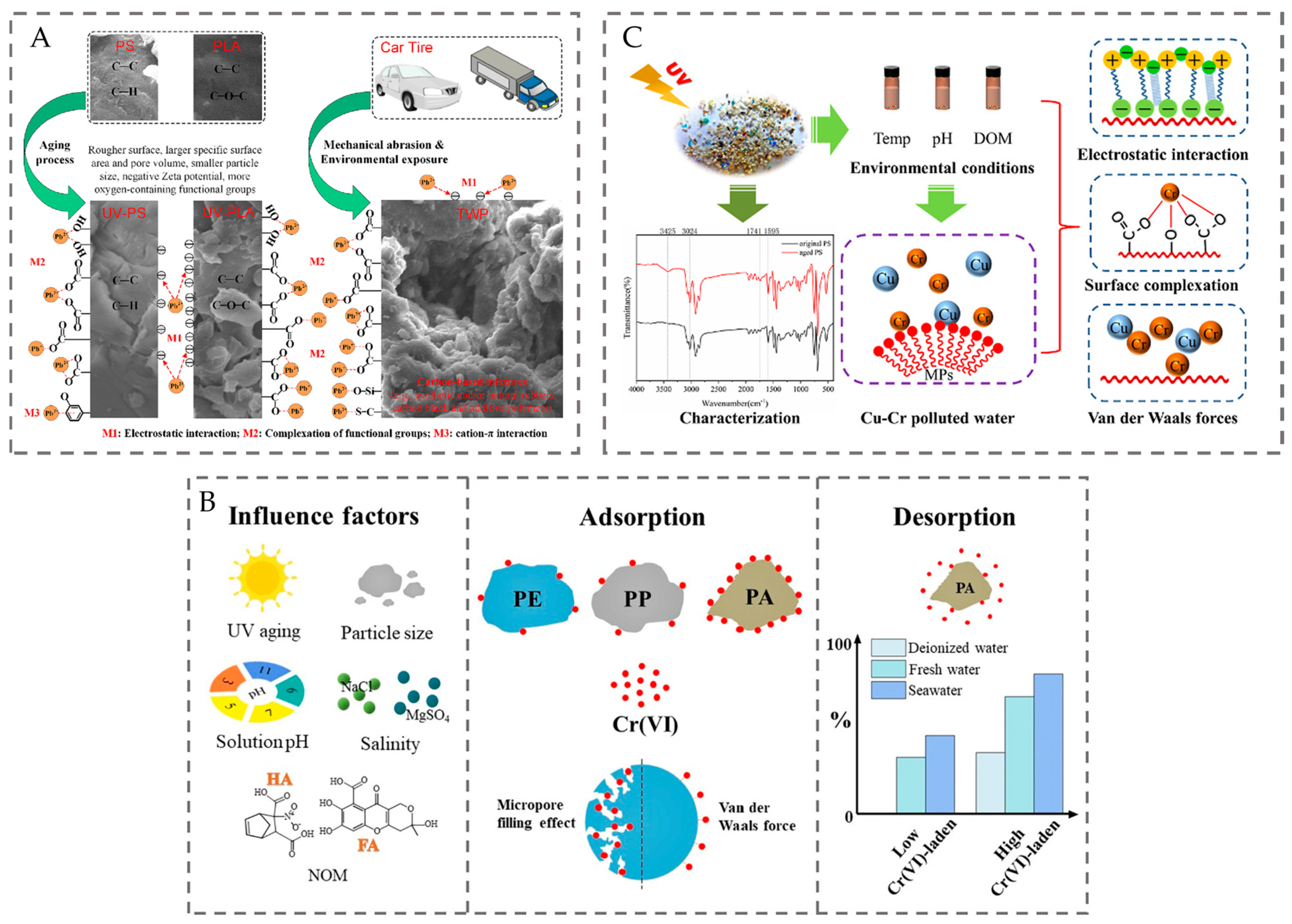
Once released into the environment, MPs undergo continuous aging and degradation. This process acts as a core variable reshaping MP adsorption performance and remains one of the most debated scientific topics in this research field. The long-term evolutionary pathway of aged MP-HM composite systems is illustrated in Figure 1C, while Figure 2 further provides quantitative evidence for adsorption patterns under distinct aging regimes. Moderate aging induced by photo-oxidation and mechanical abrasion breaks polymer chains, generates abundant oxygen-containing functional groups, enlarges the specific surface area, and substantially improves the HM adsorption capacity. For instance, UV-aged PS exhibits 2–3 times higher adsorption capacity toward Cu(II) and Pb(II) relative to pristine PS [26,27]. In contrast, prolonged excessive aging triggers polymer framework collapse, pore structural deterioration and depletion of active sites, which consequently hinders HM adsorption. Aging simultaneously releases MP-derived DOM, forming intricate competitive adsorption networks together with NOM and free HMs, representing a direct interaction within the system. Meanwhile, aged MPs and their associated MP-DOM complexes modify the physicochemical properties of ambient media and modulate the microbial community structure, further indirectly regulating HM immobilization and release. Free HMs and MP-bound HMs can interconvert driven by interfacial bond cleavage and structural reconstruction. Nevertheless, their long-term transformation dynamics, stability disparities and associated ecological risks have not been systematically elucidated. This bidirectional modulation is controlled by multiple variables, including aging type, aging duration, DOM concentration, ionic strength and HM species [27,28]. To date, no universal aging threshold has been defined for diverse polymer types, which restricts the reliable prediction of adsorption evolution during in situ dynamic aging processes.
To date, the Langmuir, Freundlich and other isotherm models, together with various adsorption kinetic models, have been widely adopted to fit MP-HM adsorption processes [16]. Nevertheless, all of them exhibit prominent limitations for field applications (Table 1). Parameter definitions in sorption equations and brief model characteristics are presented in Table S1. Isotherm models are built upon idealized assumptions: constant temperature, static conditions, single-pollutant systems and clean, homogeneous MPs. Kinetic models employ fixed static rate constants to describe adsorption rates and fail to capture dynamic variations induced by aging, continuous biofilm development, competitive interactions among coexisting HMs, and frequent drying–wetting cycles. In natural environments, MPs undergo continuous aging, biofilms constantly colonize MP surfaces, multiple HMs coexist and compete for adsorption sites, and drying–wetting cycles occur frequently. Accordingly, interfacial adsorption persists in a dynamically non-equilibrium state, which fundamentally violates the basic assumptions of these models.
Table 1.
Assumptions and environmental limitations of typical equilibrium isotherm and adsorption kinetic models for MP–HM interactions. The formulas and detailed definitions of their parameters are provided in Table S1.
Figure 1.
(A) Schematic of HM enrichment in sediments and MPs; (B) interactions between MPs and HMs; (C) mechanism of MPs and dissolved organic matter (DOM) regulating dissolved HMs. Cited from [29,30,31] with permission.
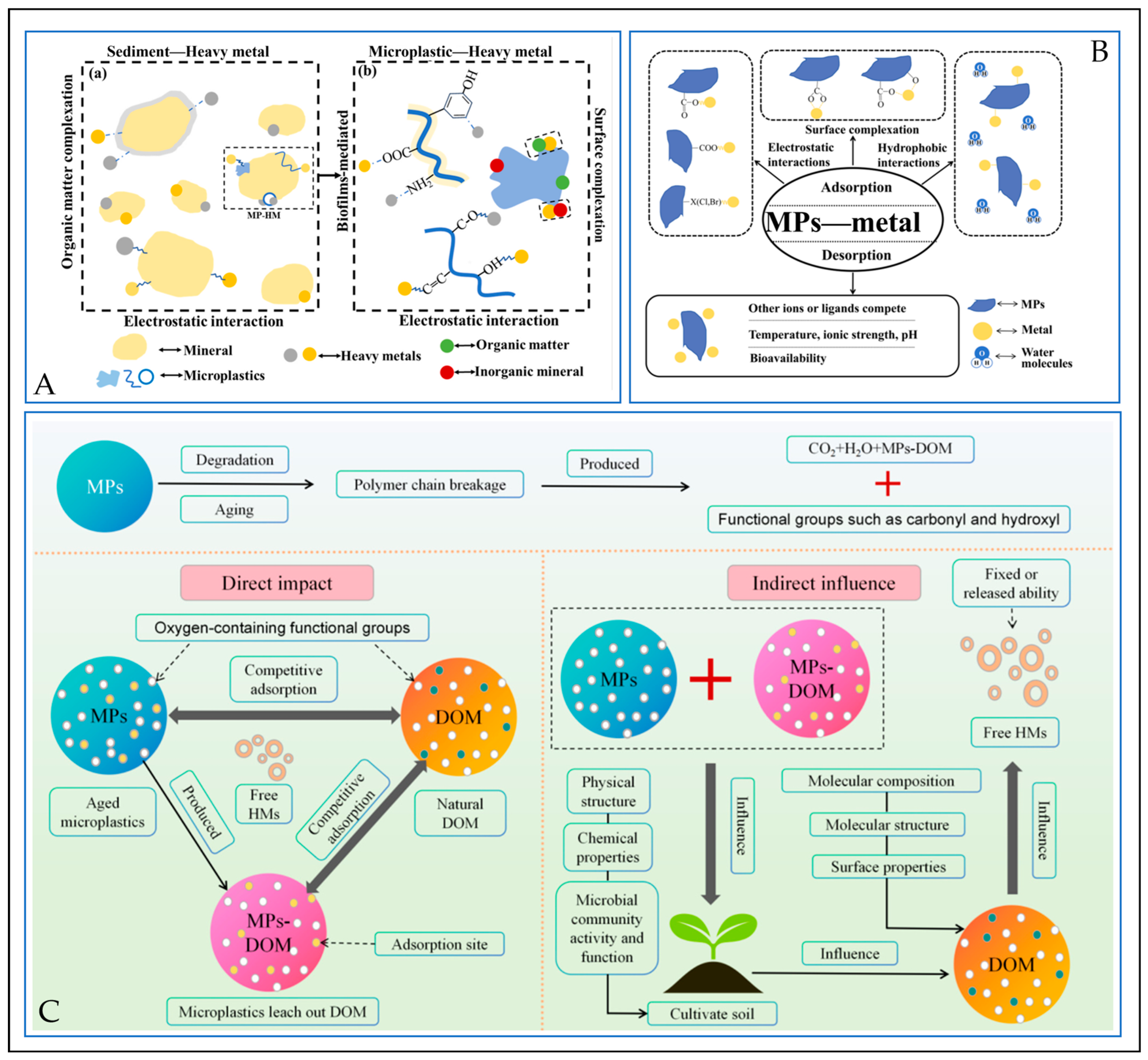
Figure 2.
Adsorption mechanisms and behaviors of HM ions onto aged MPs. (A) Adsorption mechanisms of Pb(II) on aged MPs; (B) adsorption and desorption behaviors of Cr(VI) by MPs in deionized water, fresh water and seawater; (C) adsorption behaviors of HM Cr(VI) on MPs before and after aging. Cited from [32,33,34] with permission.
Conventional equilibrium isotherm and kinetic models are only suitable for fitting short-term laboratory equilibrium datasets and cannot reproduce dynamic adsorption behavior under field conditions. Direct extrapolation of model parameters will lead to substantial deviations in actual pollution risk assessment. To address the drawbacks of single static models, researchers have progressively developed modified frameworks including the multicomponent competitive Langmuir model and aging-corrected isotherms. However, calibrated parameters for these revised models are only valid under specific laboratory conditions (Table 1), particular polymer types and fixed DOM concentrations. Parameter validity disappears once the environmental matrix changes. Furthermore, these modified models have not been validated using abundant in situ observational data collected from farmland and seawater, introducing considerable uncertainty into their predictions.
Based on the above analysis, most existing investigations rely on simplified single-variable static laboratory setups, which cannot adequately represent realistic field scenarios characterized by multi-medium coexistence, dynamic aging and multiple competing pollutants. Three interwoven processes govern the adsorption system: direct microscopic interfacial interactions, multi-factor indirect coupling modulation, and aging-mediated long-term interfacial transformation. Current quantitative models cannot realize coupled calculations integrating these multiple processes, and systematic quantitative approaches to distinguish ecological risks arising from free and MP-bound HMs remain absent. This constitutes the core bottleneck restricting the accurate identification and targeted control of MP-HM composite pollution.
3. MP-HM Complexes: Environmental Behavior, Biological Response, and Health Risks
The interfacial binding strength, existing forms and environmental stability of MP-HM complexes directly determine the migration and transformation patterns of HMs in soil, water and other multi-media environments, as well as their bioavailability. These properties ultimately govern the ecotoxicological responses of organisms across different trophic levels and relevant human health risks. Existing studies generally separate soil and aquatic environments and independently report toxicological observations for single species, which results in fragmented research content, repetitive findings and weak mechanistic connections. Critical thresholds triggering synergistic and antagonistic effects under MP-HM co-exposure remain unclear, and the coupling mechanisms controlling complex dissociation and bioaccumulation in soil and aqueous media are not fully elucidated. The interactive network of toxicological pathways requires further in-depth analysis, and human health risk assessment lacks support from field observational data. Moreover, laboratory findings can hardly be effectively extrapolated to natural ecosystems and realistic human exposure scenarios.
3.1. Migration Transformation and Bioavailability Regulation of Complexes in Soil–Water Media
The environmental behaviors of MP-HM complexes can exhibit cross-media consistency. The evolutionary patterns of such complexes in soil and aquatic systems are not completely isolated, and these consistent behaviors stem from the intrinsic interfacial binding properties of MPs. When MPs immobilize HMs via electrostatic adsorption, complexation and cation bridging, they can markedly change the original mobility and speciation of HMs, disrupt the native adsorption equilibrium in soil and aqueous media, and elevate the environmental migration potential and bioavailability of HMs [35,36].
In soil systems, MPs can achieve horizontal and vertical migration driven by root disturbance, soil dry–wet alternation, wind erosion, and surface runoff, which transports bound HMs and induces cross-regional diffusion of composite pollutants. Meanwhile, MPs can alter the rhizosphere pH, soil organic matter content, and microbial community structure, which further activates inert HMs and improves the phytoaccumulation efficiency of HMs [37]. In aquatic systems, MPs of different materials may efficiently accumulate waterborne HMs and form complexes with varying stability. These complexes can achieve long-term migration and retention through water flow transport and sediment deposition, which causes continuous accumulation of composite pollutants in water–sediment systems [38,39].
Environmental factors including temperature, pH and ionic strength can indirectly modulate HM bioavailability by altering the interfacial stability of MP-HM complexes. Rising temperature can strengthen the interfacial adsorption capacity and improve the enrichment efficiency of complexes. pH variations change the surface charge of MPs and the valence speciation of HMs, which determines the interfacial adsorption intensity and the risk of complex dissociation. High salinity can trigger ionic competition and electric double-layer compression, which weakens the interfacial binding stability and accelerates the dissociation and release of HMs [40,41]. In summary, MPs do not simply act as passive carriers for HM migration. Instead, they can facilitate dynamic pollutant transformation via interfacial regulation processes including immobilization, activation, transport and dissociation. Such dynamic physicochemical processes constitute the core mechanism behind the heterogeneous ecological risks of MP-HM composite pollution.
However, research conclusions diverge substantially, with several pot trials reporting entirely opposite regulatory outcomes. Single Cd stress induces severe phytotoxicity in tomato roots and triggers the widespread activation of pathways associated with cell wall biosynthesis, antioxidant systems, HM transporters, hormone signaling, and glutathione-mediated detoxification. Upon co-exposure to Cd and MPs, root Cd transporter genes are significantly downregulated, leading to reduced Cd uptake and intracellular accumulation. The alleviated intracellular Cd burden further mitigates oxidative stress and suppresses sustained activation of cell wall defense, hormone stress responses, and the glutathione detoxification pathway. Meanwhile, MPs restore nitrogen nutrient metabolism disrupted by Cd. Collectively, molecular transcriptional evidence demonstrates that MPs alleviate Cd toxicity in tomato roots via inhibiting Cd transport and lowering intracellular Cd loads, with the magnitude of this alleviation governed by the MP polymer type and particle size.
3.2. Differentiation of Combined Toxicity Effects
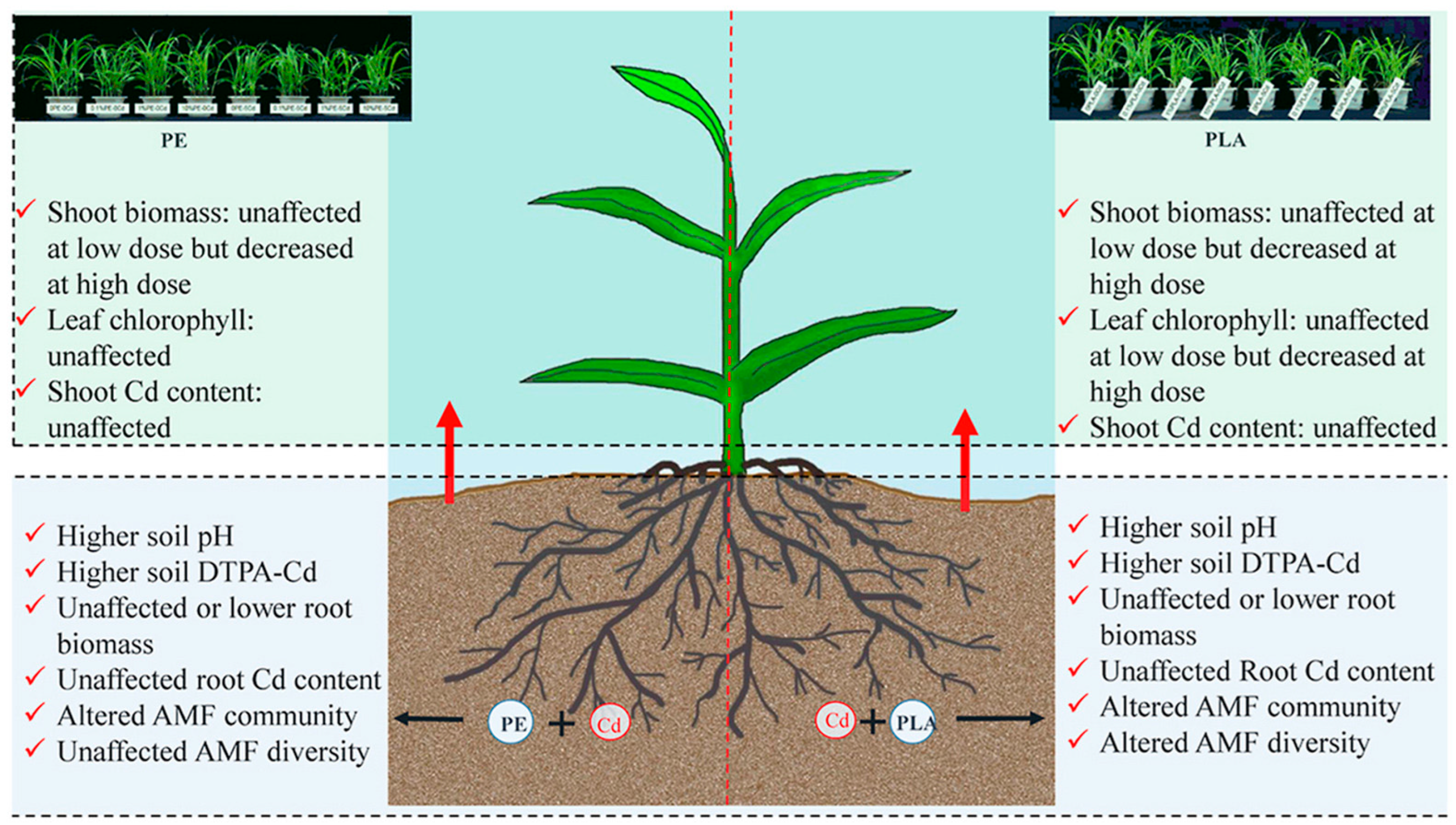
The polarity, particle size, and aging degree of MP materials can directly determine their adsorption capacity and biological internalization efficiency as pollutant carriers. Small-sized MPs penetrate biological cells more readily, boost intracellular HM accumulation, and thereby trigger synergistic toxic effects. Moderately aged MPs display stronger adsorption capacity and superior carrier performance, whereas excessive aging causes structural collapse, reduces pollutant loading capacity, and ultimately weakens the combined toxicity of MP-HM complexes [28]. In Cd-polluted agricultural soil planted with maize, equal doses of degradable PLA MPs impose severe phytotoxicity, drastically lowering the maize biomass and leaf chlorophyll concentrations, while PE MPs exert no obvious phytotoxic effects (Figure 3). Only PE interacts with Cd to reduce root biomass. From a microbial perspective, PE merely shifts the composition of arbuscular mycorrhizal fungal communities without altering community diversity, whereas high-dose PLA simultaneously remodels both the structure and diversity of mycorrhizal fungal assemblages. These results verify that degradable and non-degradable MPs pose entirely distinct ecological risks in Cd-contaminated systems. Polymer type and exposure dosage co-regulate crop performance and rhizosphere microecology, and MP-Cd co-contamination destabilizes agricultural ecosystems.
In addition to the intrinsic physicochemical properties of MPs, the species and concentration ratios of HM ions also determine the profile of combined toxic effects. Distinct HM ions possess unique ionic radii, surface charges and toxic thresholds, leading to divergent competitive adsorption patterns in co-contaminated systems [32,42,43]. Low-level co-exposure generally triggers synergistic toxicity, whereas intense site competition at high HM concentrations tends to generate antagonistic outcomes. Meanwhile, environmental factors including water pH, salinity and dissolved organic matter modulate the interfacial binding strength between MPs and HMs, alter HM dissociation rates and bioavailability, and thereby reshape biological toxic responses indirectly [23].
Figure 3.
Differential effects of polyethylene (PE) and polylactic acid (PLA) MPs on cadmium-contaminated agricultural soil, maize and arbuscular mycorrhizal fungal communities. Cited from [44] with permission.
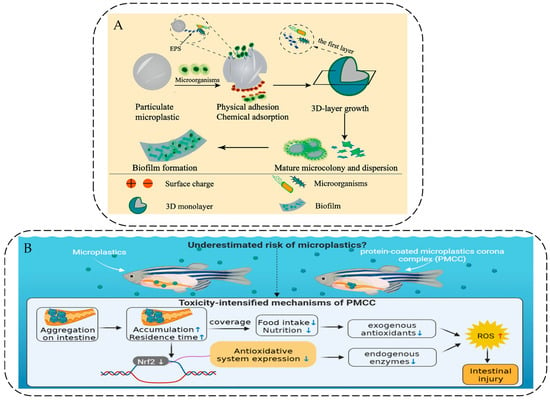
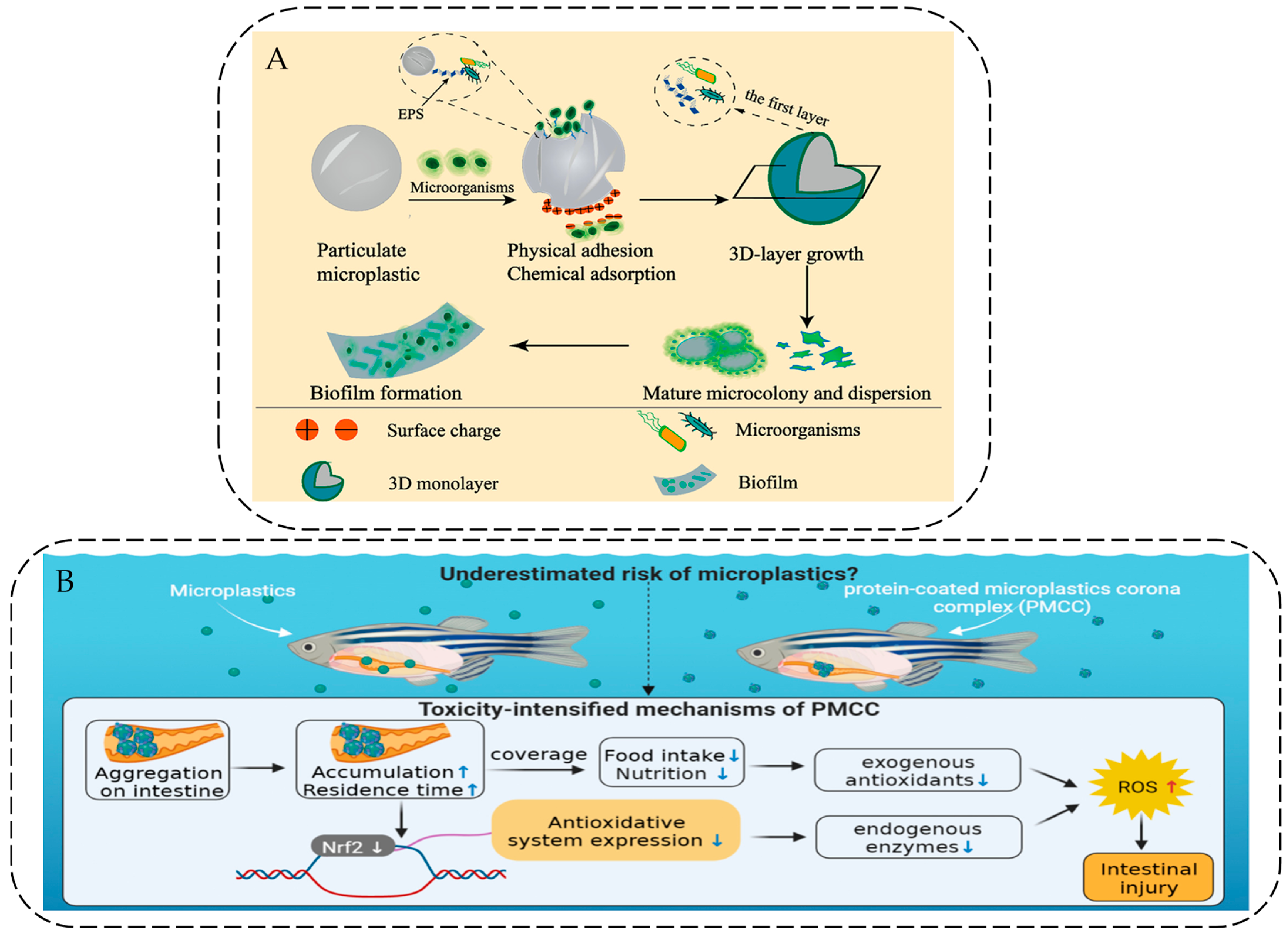
Biofilms undergo a full lifecycle of colonization, maturation and detachment on MP surfaces, which is comprehensively depicted in Figure 4. It illustrates the successive phases of microbial adhesion, 3D biofilm formation and mature community sloughing (Figure 4A). Moreover, Figure 4B reveals the understudied toxic risks posed by protein corona–MP complexes: these aggregates readily accumulate within animal intestines, suppress antioxidant signaling pathways, elevate reactive oxygen species (ROS) levels and ultimately trigger intestinal lesions. Collectively, these findings demonstrate that risk assessments relying solely on bare MPs will drastically underestimate the actual ecological hazards of MP-HM co-contamination [45,46,47,48].
Figure 4.
Biofilm colonization on MPs and its regulatory effects on pollutant sorption. (A) Succession of biofilm assembly on MPs; (B) protein corona–MP complexes as a previously overlooked environmental hazard of MPs. Cited from [45,48] with permission.
Table 2 summarizes how diverse confounding variables modulate MP-HM interactions. MPs’ intrinsic physicochemical properties alter interfacial adsorption affinity and metal loading capacities. Progressive aging introduces abundant oxygen-containing functional groups, thereby reshaping MPs’ pollutant carrier performance. The concentration ratio of HMs to MPs acts as a critical threshold governing the shift between synergistic and antagonistic effects. Solution pH, ionic strength and dissolved organic matter control metal speciation and competitive adsorption at the MP–water interface. Dynamic environmental processes including biofilm maturation and drying–wetting cycles may even reverse the initial MP-HM interaction trends over time. Furthermore, test organism taxa, developmental stages and selected toxic endpoints also affect the identification of synergistic or antagonistic outcomes.
Integrating the pollutant, environmental and biological variables analyzed above, a unified principle can be concluded: synergistic or antagonistic toxic interactions between MPs and HMs are not constant, but condition-dependent outcomes governed by multiple co-factors. Alteration of any critical variable can fully reverse the toxic profiles of MP-HM co-contamination.
MP-HM complexes can trigger cascading toxic effects across terrestrial food webs involving microorganisms and terrestrial plants, with divergent responses observed among distinct trophic groups. As essential decomposers in terrestrial ecosystems, soil microorganisms are highly susceptible to this combined contamination. Co-exposure reshapes the soil microbial community structure, reduces protozoan abundance, alters the relative dominance of core bacterial phyla including Proteobacteria and Acidobacteria, inhibits soil extracellular enzyme activities, disturbs the expression of functional genes, induces soil microecological imbalance, and impedes terrestrial biogeochemical cycling [49,50]. For terrestrial plants, combined stress from MPs and HMs suppresses photosynthetic efficiency, impairs antioxidant defense systems, and hinders plant growth and metabolism. Meanwhile, MPs elevate the bioavailability of HMs in the rhizosphere, exacerbating metal accumulation in plant tissues, triggering chlorophyll degradation and oxidative injury, degrading the nutritional quality of agricultural produce, and thereby generating pronounced synergistic toxicity [51,52].
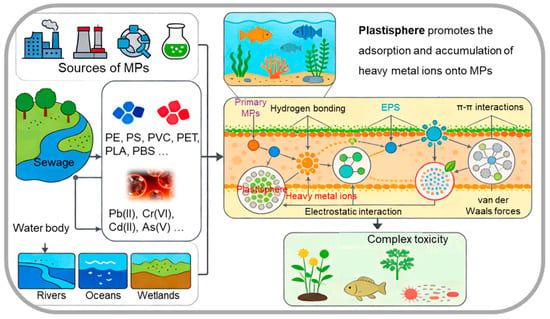
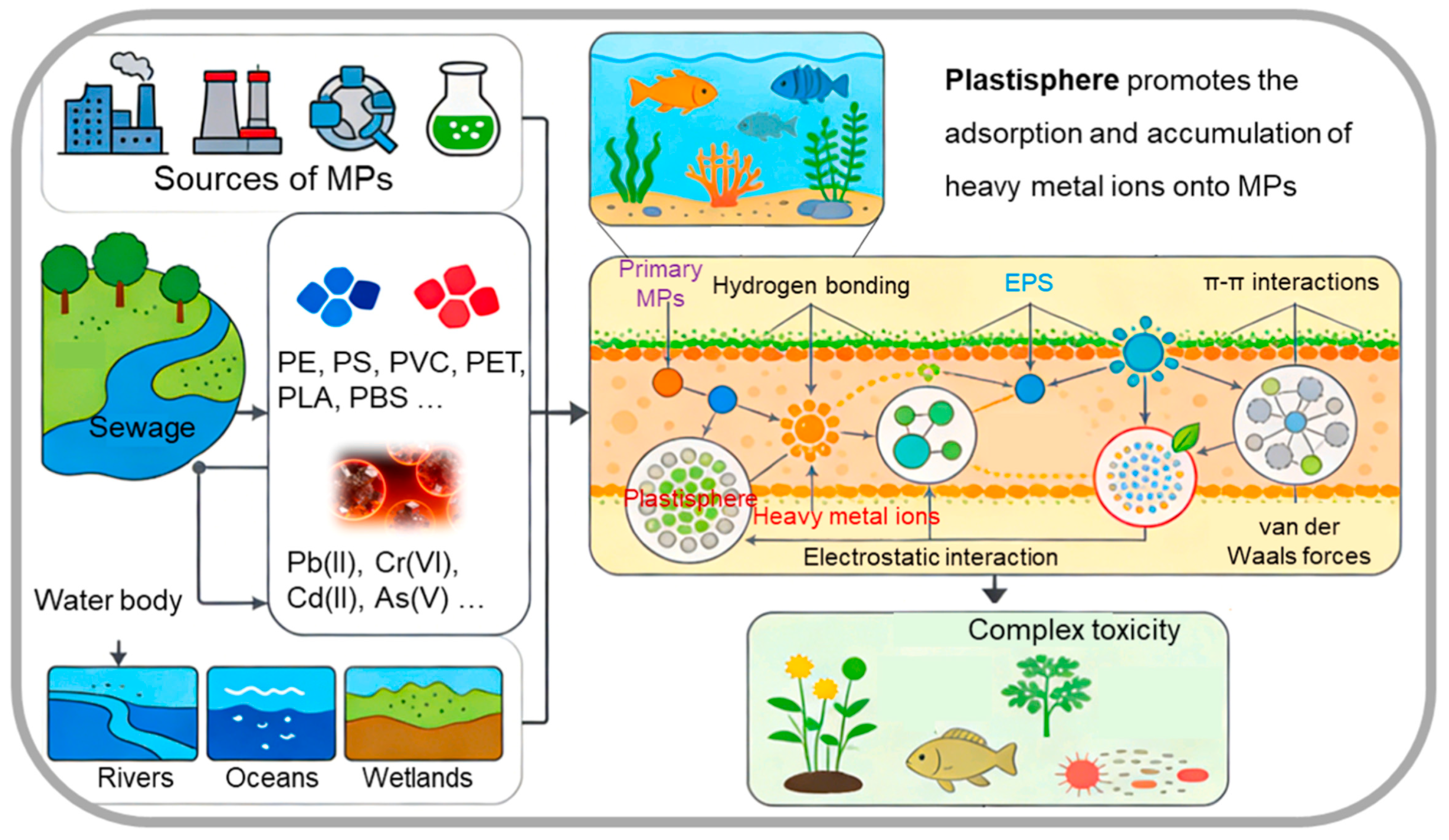
Unlike combined pollution derived from terrestrial organic toxins, MP-HM complexes are primarily transferred across trophic levels along aquatic food chains and possess stronger biomagnification potential. The plastisphere covering MP surfaces is enriched with polysaccharides and protein-based extracellular polymeric substances (EPSs), which drastically boost HM adsorption and sequestration to form stable complexes. These complexes are readily ingested and accumulated by primary producers such as algae and benthic invertebrates. When predated by high-trophic biota including fish, HMs bound within the complexes undergo bioaccumulation and even biomagnification along food webs. Combined exposure exerts far stronger toxic impacts on aquatic organisms than single-contaminant exposure, causing gill tissue degeneration, hepatic and renal oxidative damage, intestinal barrier disruption, developmental defects in reproductive organs, and immunosuppression [53,54]. The relevant action mechanisms are illustrated in Figure 5. These composite contaminants can enter the human body via aquatic products and raise severe food safety and public health concerns. Notably, published experimental findings remain contradictory. MPs amplify HM toxicity in certain systems, whereas specific MP variants alleviate HM-induced stress in others. Most current studies rely on short-term laboratory simulations; the food web transfer dynamics and long-term accumulation patterns of MP-HM complexes under field conditions remain poorly characterized, constituting a core bottleneck for assessing the ecological risks of co-contamination [55].
Figure 5.
Scheme of the plastisphere’s role in intensifying ecological risks of HM-MP complexes. Cited from [32] with permission.
Collectively, multilayer evidence from microorganisms, plants and aquatic biota demonstrates that two categories of composite pollutants of MPs coupled with HMs are transferable through food chains and generate cascading cross-trophic ecological risks. Nevertheless, their toxic effects exhibit bidirectional divergent patterns. Polymer type, particle size, aging status and ambient environmental parameters are core variables modulating the magnitude of composite toxicity, which explains the inconsistent outcomes reported by indoor simulation assays. Short-term standardized laboratory exposure systems fail to replicate complex in situ environmental conditions and cannot fully resolve the long-term biomagnification effects induced by co-exposure.
3.3. Human Health Risks and Mechanisms
Existing studies have confirmed that MPs have entered the human body through multiple pathways, including dietary intake, inhalation, and skin contact, and have widely accumulated in human tissues and organs such as the blood, placenta, liver, and kidneys, thereby posing potential risks of long-term chronic exposure and internal bioaccumulation [56,57,58,59]. The adverse effects induced by combined MP-HM exposure in humans have originated from the synergistic interactions between the carrier function of MPs and the inherent toxicity of HMs. MPs improve the uptake efficiency and intracellular accumulation of HMs in human tissues, can disrupt endogenous antioxidant and immune defense systems, and trigger the dysfunction of multiple toxicological pathways.
At the molecular level, combined co-exposure has activated the Nrf2-mediated oxidative stress pathway, the NF-κB inflammatory pathway, and the AMPK/mTOR metabolic and autophagic pathway. It has also triggered novel cell death patterns, including ferroptosis and pyroptosis, which have disturbed the homeostasis of lipid and iron metabolism. These molecular disruptions have been closely associated with the occurrence and progression of multiple human diseases, including neurodegenerative disorders, metabolic dysfunction, cardiovascular injury, and chronic inflammation [60,61]. Current basic experiments have preliminarily revealed the interactive regulatory mechanisms of these multi-pathway toxic responses and have explicitly verified that the potential health hazards induced by composite pollution have been significantly greater than those caused by single-pollutant exposure [62].
However, the present results were obtained using acute exposure doses far exceeding typical human environmental exposure levels. Under controlled conditions, high-dose in vitro assays are widely employed to uncover potential molecular toxicity pathways and assess whether the test substance can trigger these stress response and cell death pathways. Nevertheless, such acute cellular responses cannot be directly extrapolated to the activation of corresponding pathways in humans under chronic low-dose environmental exposure. Exposure duration, cellular adaptive capacity, tissue microenvironment, and disparities in in vivo metabolism all modify the biologically effective dose. Accordingly, the previous findings provide mechanistic evidence for pathway perturbation at elevated concentrations, rather than direct proof of adverse effects at environmentally relevant levels.
Although previous studies have preliminarily clarified the core toxicological pathways of combined toxicity, fundamental and unavoidable research bottlenecks remain in human health risk assessment. Most toxic mechanistic conclusions are derived from ultra-high-dose in vitro cell experiments and acute animal exposure tests, which may deviate substantially from real human exposure scenarios characterized by low-dose, long-term, and multi-pathway co-exposure. Current evidence lacks population epidemiological data and in situ human observational records, limiting the extrapolation of laboratory-derived findings to realistic human health risk scenarios [63,64,65]. Furthermore, the cross-regulatory networks and hierarchical relationships among oxidative stress, inflammation, autophagy, and ferroptosis remain poorly clarified. The interactive patterns of core signaling pathways are still ambiguous, and the dominant pathogenic mechanisms underlying combined toxicity have not been accurately determined. Importantly, no correction model is currently available to reconcile discrepancies between acute high-dose laboratory experiments and chronic low-dose human exposure scenarios, introducing considerable uncertainty into existing health risk assessment systems.
Meanwhile, unified evaluation criteria and systematic frameworks for determining human combined toxic effects have not yet been established. Researchers have been unable to distinguish the differential contributions of free HMs and MP-bound HMs to human tissue damage [63,64,65]. Notably, the majority of laboratory investigations rely on pristine MPs and single HM treatments, without accounting for environmentally relevant processes such as MP aging, biofilm colonization, and coexistence of multiple contaminants. This inherent simplification of experimental design risks over- or underestimating real-world human exposure risks and constitutes a major barrier to accurately forecasting health hazards triggered by MP–HM composite pollution.
Table 2.
Exposure parameters, combined toxic effects and key controlling variables of MP-HM composite pollution research.
4. Challenges and Prospects
To date, extensive basic data have been accumulated concerning the environmental behavior, interfacial mechanisms, ecological toxicity, and human health risks of MP-HM composite pollution. Nevertheless, existing investigations have remained fragmented, semi-quantitative, and poorly matched with real environmental scenarios. A unified mechanistic system, standardized evaluation criteria, and systematic risk control framework have not yet been established, leaving prominent bottlenecks across analytical methodologies, fundamental mechanisms, scale extrapolation, and risk regulation dimensions.
4.1. Analytical Detection and Experimental Methodology
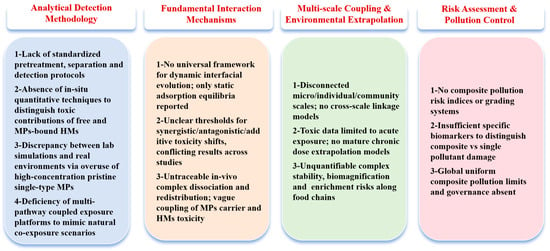
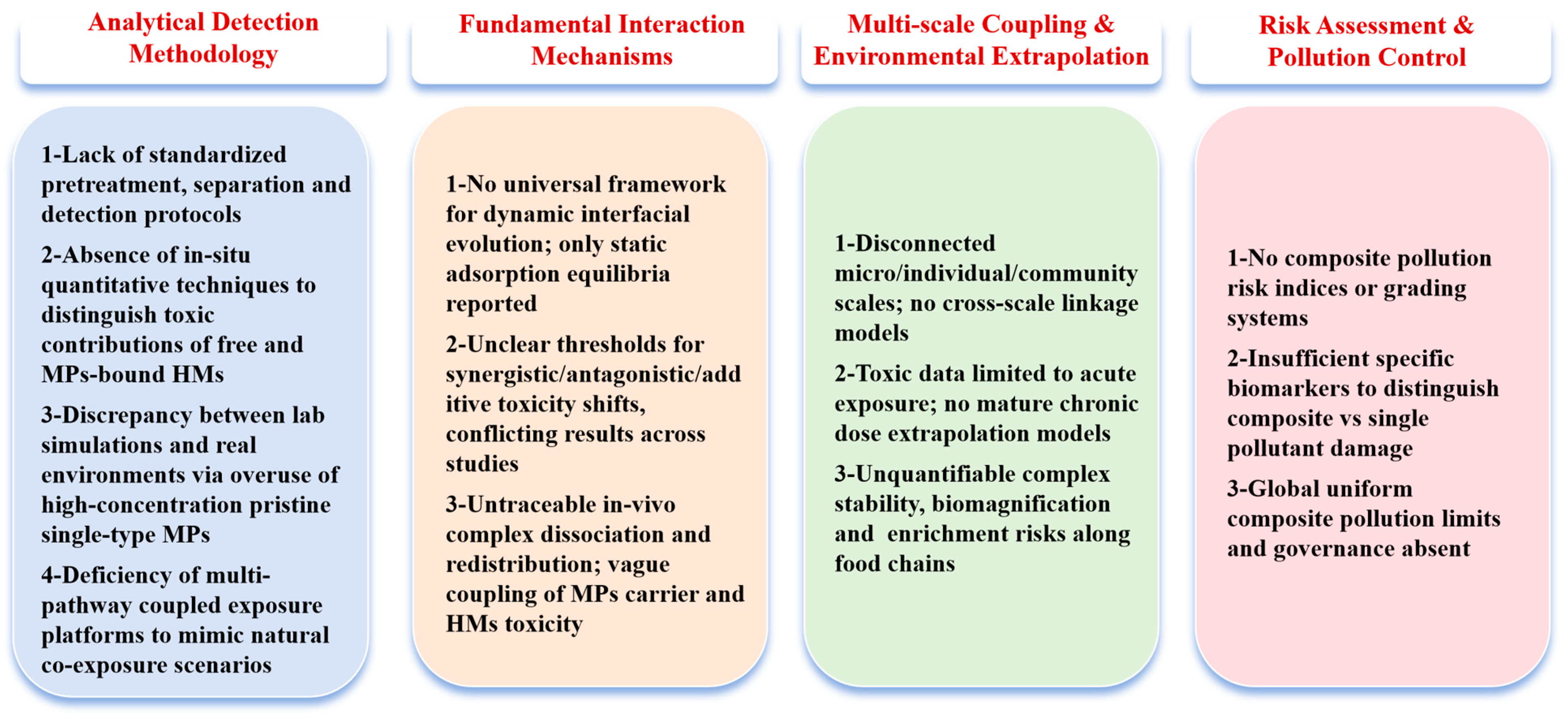
Globally, unified standard systems for the sampling, preservation, pretreatment, component analysis, and morphological identification of environmental MP-HM composites remain absent for both soil and aquatic environments [80,81]. Such methodological inconsistencies impede horizontal comparisons of adsorption and toxicological data across different studies and hinder unified pattern recognition and systematic data accumulation in this research field (Figure 6).
Figure 6.
The four core research bottlenecks in the research on MP-HM co-exposure pollution from four dimensions: analytical detection methods, basic interaction mechanisms, multi-scale coupling extrapolation, and risk management.
In situ quantitative characterization technologies exhibit critical technical blind spots and remain a core methodological deficiency. Laboratory simulation systems severely deviate from realistic field environments. Idealized experimental conditions differ substantially from in situ field scenarios, which easily causes mechanistic misjudgment and overestimation of actual pollution risks [82,83]. The superposition of multiple exposure pathways reshapes the entire processes of pollutant uptake, bioaccumulation, and metabolism [84]. However, integrated experimental systems for multi-pathway coupled exposure remain absent. This limitation distorts dose–response relationships and undermines the accurate assessment of ecological and human health risks.
Further investigations need to establish unified standard operating procedures for the whole process of multi-media sample collection, pretreatment, component identification, and HM speciation analysis. Standardized protocols help eliminate cross-study data heterogeneity and enable credible horizontal comparison of published results. Advanced in situ characterization techniques require further development to realize the dynamic tracking of MP interfacial reactions, with a core focus on solving the technical bottleneck of in situ quantitative differentiation between free and MP-bound HMs. Advanced in situ spectroscopic techniques (such as X-ray absorption fine structure and scanning transmission X-ray microscopy) hold great potential to experimentally distinguish bound and free metal species within complex environmental matrices. Moreover, integrated multi-pathway coupled exposure platforms require construction. The adoption of environmentally relevant concentrations and long-term continuous exposure modes reduces the risk overestimation bias caused by pristine MP materials and high-dose laboratory experiments, which effectively narrows the gap between laboratory simulations and real-field environments [80,81,84].
4.2. Basic Mechanism Research
Based on accumulated experimental evidence, researchers in this field have not yet established a unified and universal theoretical framework for the underlying mechanisms of MP-HM composite pollution. Significant cognitive gaps have remained regarding the dynamic interfacial evolution, transformation of toxicological effects, and in vivo dissociation mechanisms. MPs in natural environments undergo long-term aging, biofilm attachment, organic matter coating, and protein corona formation, which continuously reshape their interfacial structures and surface active sites. How these dynamic processes regulate the binding stability, adsorption reversibility, and environmental persistence of MP-HM complexes remains unclear. Previous studies lack dynamic and long-term mechanistic analysis, which hinders the interpretation of spatiotemporal heterogeneity in the field adsorption behaviors of MPs (Figure 6).
Previous studies have confirmed that MP-HM co-exposure has produced three distinct types of toxicological responses: synergistic, antagonistic, and additive effects [85,86]. The microscopic molecular mechanisms and physicochemical triggers for effect conversion under different MP materials, particle sizes, aging degrees, concentration ratios, and medium conditions have lacked consistent conclusions. To date, researchers are unable to precisely track the dissociation sequence, dissociation proportion, and bioaccumulation patterns of HMs in organisms. The coupling mechanisms between the carrier effect of MP complexes and the intrinsic toxicity of HMs are still ambiguous, which can restrict the in-depth exploration of molecular toxicological pathways.
Quantitative molecular-scale analysis via theoretical calculation approaches including quantum chemistry calculations and molecular dynamics simulations also represents an important research direction. Such methods will help determine the coordination configurations and binding energies between MP surface functional groups and HM ions, and will clarify the dynamic interfacial evolution mechanisms beyond static adsorption processes. Systematic studies will be conducted to explore the stability variations in MP-HM complexes under long-term environmental aging and biofilm coverage, which will reveal how dynamic interfacial reconstruction regulates the dissociation and migration behaviors of HMs. Gradient control experiments will further identify the key regulatory thresholds for the transformation of synergistic, antagonistic, and additive combined toxic effects, thereby establishing a unified theoretical framework for explaining the complex toxicity mechanisms of MP-HM composite pollution.
4.3. Multi-Scale Coupling and Environmental Extrapolation
The failure of short-term experimental data to characterize the long-term evolutionary patterns of natural environments has become a core bottleneck restricting the accurate prediction of composite pollution risks. Existing studies have not established cross-scale correlation models linking microscopic mechanisms to macroscopic ecological risks. Accordingly, scientific extrapolation from microscale interfacial behaviors to macroscale ecological consequences has not been achievable.
Most available toxicological datasets have been acquired from short-term acute exposure experiments, whereas environmental MP-HM pollution has occurred through low-dose, long-term, and continuously cumulative exposure modes. Acute toxicity thresholds and dose–response relationships have differed substantially from those under chronic long-term exposure conditions. To date, mature correction methods and systematic models for scale extrapolation have remained absent, and laboratory-derived data have failed to effectively support real-field ecological risk assessment (Figure 6). Nevertheless, researchers have not systematically clarified the stability variations, biomagnification potentials, enrichment risks, and residual characteristics of MP-HM complexes during trophic transmission [82,83].
Further research needs to couple microinterfacial adsorption kinetics, environmental migration processes and bioaccumulation frameworks for the development of cross-scale correlative models, to break the current disconnect between molecular-scale interfacial mechanisms, organismal toxic reactions and ecological effects at the community level. Combined with long-term in situ monitoring and field experimental data, future studies will fit the correction parameters required for the scale extrapolation from laboratory-controlled experiments to natural ecosystems and will establish standardized extrapolation methodologies. Continuous tracking will be performed to reveal the dynamic stability variations in MP-HM complexes during food chain transfer. Quantitative analysis will further clarify the dissociation and recombination rules of complexes across different trophic levels, providing robust model support for the risk assessment of pollutant enrichment in high-trophic organisms and humans [87,88,89].
4.4. Risk Assessment and Environmental Control
Current environmental standards and risk assessment frameworks are designed for individual MPs or HMs, overlooking combined risks induced by synergistic interactions, morphological transformation and carrier effects of MP-HM complexes. Without dedicated indicators, quantitative models and risk criteria for composite pollution, quantitative assessment of ecological and health risks cannot be realized (Figure 6). Discrepant evaluation metrics and thresholds across studies block data integration and the formation of unified composite toxicity theories [85,86]. MPs and HMs share overlapping sources and coupled migration routes, yet tracing techniques cannot quantify source contributions to composite pollution, impeding source apportionment and targeted remediation. Global unified criteria and governance frameworks for MP-HM co-contamination remain absent. Single-pollutant policies fail to cope with synergistic composite risks and provide an inadequate scientific basis for environmental management [90].
Constructing an integrated assessment framework for ecological and human health risks that adapts to the unique characteristics of MP-HM composite pollution effectively breaks through the limitations of traditional single-pollutant evaluation systems. Researchers unify and standardize the discrimination indicators and calculation criteria for composite toxic effects, screen specific biomarkers for combined pollution stress, and integrate multi-omics technologies to improve multi-level toxicological evaluation methodologies. Furthermore, machine learning and big data algorithms have enabled the high-precision dynamic simulation of pollutant migration in complex multi-media matrices and have reduced redundant experimental workload. Intelligent control systems have realized the automatic gradient adjustment of environmental factors in microcosm systems. Moreover, AI-based spectral and image recognition has enhanced the efficiency and accuracy of real-time interfacial kinetic analysis [91,92,93,94]. Advanced multi-source traceability technologies quantify the differential contributions of various pollution sources to MP-HM composite contamination. On the basis of systematic risk assessment results, researchers improve the theoretical foundation for composite pollution remediation, promote the establishment of environmental standards, regulatory strategies and governance systems that target the synergistic risks of MPs and HMs, and provide solid scientific support for pollution prevention and ecological environmental decision-making [95].
5. Conclusions
MP-HM composite pollutants can markedly alter the migration, transformation and bioavailability of HMs in the environment. Existing research mainly investigates the interfacial adsorption and toxic effects of MPs and HMs under single-factor conditions. The long-term stability of complexes, interfacial reconstruction, and interconversion between free and MP-bound HMs in real environmental systems remain poorly understood. Non-standardized detection protocols, ambiguous dynamic interfacial evolution mechanisms, shortage of multi-scale coupling models, imperfect composite pollution risk assessment and governance frameworks, and obvious mismatches between indoor simulation models and field conditions are the multiple bottlenecks and challenges.
This review elaborates the differentiated adsorption mechanisms co-controlled by microplastic polymer properties and heavy metal speciation. It summarizes the fundamental assumptions, inherent drawbacks and application limits of prevailing environmental models, and dissects the deficiencies of traditional static models when applied to dynamic environmental systems. The decoupling mechanisms governing synergistic or antagonistic interactions in complex matrices are analyzed to reveal the origins of inconsistent experimental observations across studies. This review identifies ongoing challenges including the development of multi-pathway co-exposure platforms, cross-scale linkage models and specific composite pollution biomarkers. Future breakthroughs are required in standardized detection systems, multi-media coupling mechanisms, model optimization, cross-scale extrapolation and tiered composite pollution management. It offers theoretical insights into the interfacial evolution of MP-HM co-contamination and supports targeted environmental risk mitigation.
Supplementary Materials
The following supporting information can be downloaded at: https://www.mdpi.com/article/10.3390/environments13100518/s1, Supplementary S1: Literature search and screening strategy; Table S1: Parameter definitions in sorption equations and brief model characteristics.
Author Contributions
Conceptualization, P.S., Y.D. and D.Z.; methodology, P.S.; software, P.S.; validation, P.S. and Y.W.; formal analysis, P.S.; investigation, P.S. and B.S.; writing—original draft preparation, P.S. and F.L.; writing—review and editing, P.S., Y.W., A.H. and D.Z.; visualization, P.S., A.H. and L.X.; supervision, D.Z.; project administration, D.Z.; funding acquisition, D.Z. All authors have read and agreed to the published version of the manuscript.
Funding
This research was funded by the National Natural Science Foundation of China (grant No. 22576185).
Data Availability Statement
The original contributions presented in this study are included in the article. Further inquiries can be directed to the corresponding author.
Conflicts of Interest
The authors declare no conflicts of interest.
References
- Carpenter, E.J.; Smith, K., Jr. Plastics on the sargasso sea surface. Science 1972, 175, 1240–1241. [Google Scholar] [CrossRef] [Scilit] [PubMed]
- Thompson, R.C.; Olsen, Y.; Mitchell, R.P.; Davis, A.; Rowland, S.J.; John, A.W.; McGonigle, D.; Russell, A.E. Lost at sea: Where is all the plastic? Science 2004, 304, 838. [Google Scholar] [CrossRef] [Scilit] [PubMed]
- Masciarelli, E.; Casorri, L.; Di Luigi, M.; Beni, C.; Valentini, M.; Costantini, E.; Aielli, L.; Reale, M. Microplastics in agricultural crops and their possible impact on farmers’ health: A review. Int. J. Environ. Res. Public Health 2024, 22, 45. [Google Scholar] [CrossRef] [Scilit] [PubMed]
- Liu, X.; Zheng, H.; Li, H.; Chen, Y. An investigation into the environmental and human health implications of microplastic toxicity. Soc. Sci. Humanit. Sustain. Res. 2023, 4, 110. [Google Scholar] [CrossRef] [Scilit]
- Kauts, S.; Shabir, S.; Yousuf, S.; Mishra, Y.; Bhardwaj, R.; Milibari, A.A.; Singh, S.K.; Singh, M.P. The evidence of in-vivo and in-vitro studies on microplastic and nano plastic toxicity in mammals: A possible threat for an upcoming generation? Phys. Chem. Earth Parts A/B/C 2023, 132, 103511. [Google Scholar] [CrossRef] [Scilit]
- Wu, X.; Gu, W.; Peng, S.; Bai, J. Investigating the distribution of microplastics in soils from e-waste dismantling sites and their adsorption of heavy metals. Waste Manag. Res. 2025, 43, 386–396. [Google Scholar] [CrossRef] [Scilit] [PubMed]
- Wang, Q.; Xu, C.; Tian, R.; Yang, F. Research progress on the adsorption and their mechanisms of polycyclic aromatic hydrocarbons in soil by microplastics. Acad. J. Sci. Technol. 2024, 13, 200–203. [Google Scholar] [CrossRef] [Scilit]
- Kumar, A.; Soni, D. Effect of calcium and chloride based stabilizer on plastic properties of fine grained soil. Int. J. Pavement Res. Technol. 2019, 12, 537–545. [Google Scholar] [CrossRef] [Scilit]
- Devic, G.; Djordjevic, D.; Sakan, S. Natural and anthropogenic factors affecting the groundwater quality in Serbia. Sci. Total Environ. 2014, 468, 933–942. [Google Scholar] [CrossRef] [Scilit] [PubMed]
- Tam, V.T.; Batelaan, O.; Le, T.T.; Nhan, P.Q. Three-dimensional hydrostratigraphical modelling to support evaluation of recharge and saltwater intrusion in a coastal groundwater system in Vietnam. Hydrogeol. J. 2014, 22, 1749–1762. [Google Scholar] [CrossRef] [Scilit]
- Wang, Y.; Guo, G.; Zhang, D.; Lei, M. An integrated method for source apportionment of heavy metal (loid)s in agricultural soils and model uncertainty analysis. Environ. Pollut. 2021, 276, 116666. [Google Scholar] [CrossRef] [Scilit] [PubMed]
- Espinosa, C.; Beltrán, J.M.G.; Esteban, M.A.; Cuesta, A. In vitro effects of virgin microplastics on fish head-kidney leucocyte activities. Environ. Pollut. 2018, 235, 30–38. [Google Scholar] [CrossRef] [Scilit] [PubMed]
- Sharma, N.; Kumar, V.; Umesh, M.; Chakraborty, P.; Basheer, T.; Sarojini, S.; Sharma, P.; Pasrija, R.; Barcelo, D. Microplastic residues in clinical samples: A retrospection on sources, entry routes, detection methods and human toxicity. TrAC Trends Anal. Chem. 2024, 173, 117618. [Google Scholar] [CrossRef] [Scilit]
- Xie, X.P.; Wang, K.X.; Shen, X.Y.; Li, X.; Wang, S.; Yuan, S.; Li, B.W.; Wang, Z.W. Potential mechanisms of aortic medial degeneration promoted by co-exposure to microplastics and lead. J. Hazard. Mater. 2024, 475, 134854. [Google Scholar] [CrossRef] [Scilit] [PubMed]
- Zhang, L.F.; Cao, Y.; Li, J.; Li, C.; Yang, Y.L.; Li, J.; Hu, X.W.; Cui, X.F.; Zhao, Q.; Song, H.R.; et al. Co-Exposure of airborne microplastics and chromium: Impairment of pulmonary surfactant monolayer. J. Hazard. Mater. 2025, 495, 138878. [Google Scholar] [CrossRef] [Scilit] [PubMed]
- Liu, B.; Zhao, S.; Qiu, T.; Cui, Q.; Yang, Y.; Li, L.; Chen, J.; Huang, M.; Zhan, A.; Fang, L. Interaction of microplastics with heavy metals in soil: Mechanisms, influencing factors and biological effects. Sci. Total Environ. 2024, 918, 170281. [Google Scholar] [CrossRef] [Scilit] [PubMed]
- Mou, Y.-z.; Xu, S.-q. Adsorption capacity of microplastics on Sb in water. Water Air Soil Pollut. 2026, 237, 351. [Google Scholar] [CrossRef] [Scilit]
- Rasool, A.; Halfar, J.; Brožová, K.; Čabanová, K.; Chromíková, J.; Malíková, P.; Motyka, O.; Pertile, E.; Drabinová, S.; Heviánková, S. Interactions of microplastics with heavy metals in the aquatic environment: Mechanisms and mitigation. J. Hazard. Mater. Adv. 2026, 21, 100984. [Google Scholar] [CrossRef] [Scilit]
- Vasudeva, M.; Warrier, A.K.; Kartha, V.B.; Unnikrishnan, V.K. Advances in microplastic characterization: Spectroscopic techniques and heavy metal adsorption insights. TrAC Trends Anal. Chem. 2025, 183, 118111. [Google Scholar] [CrossRef] [Scilit]
- Khalid, N.; Aqeel, M.; Noman, A.; Khan, S.M.; Akhter, N. Interactions and effects of microplastics with heavy metals in aquatic and terrestrial environments. Environ. Pollut. 2021, 290, 118104. [Google Scholar] [CrossRef] [Scilit] [PubMed]
- Liu, S.; Li, Y.; Qian, J.; Wang, J.; Li, W.; Chen, X.; Zhang, M. Activation phenomena and mechanism of heavy metals in brown soil by microplastics. J. Environ. Chem. Eng. 2025, 13, 118016. [Google Scholar] [CrossRef] [Scilit]
- Ho, W.-K.; Leung, K.S.-Y. The crucial role of heavy metals on the interaction of engineered nanoparticles with polystyrene microplastics. Water Res. 2021, 201, 117317. [Google Scholar] [CrossRef] [Scilit] [PubMed]
- Wang, Z.; Wang, B.; Liu, Q.; Huo, X.; Chang, T.; Sun, J.; Zhao, Z.; Wang, G.; Liu, J. Predicting heavy metals adsorption on microplastics and unraveling the adsorption mechanism with machine learning methods. Surf. Interfaces 2025, 72, 107101. [Google Scholar] [CrossRef] [Scilit]
- Wu, S.; Cai, C.; Wang, W.; Bao, M.; Huang, J.; Dai, Y.; Wang, Y.; Cheng, S. The interaction of microplastic and heavy metal in bioretention cell: Contributions of water-soil-plant system. Environ. Pollut. 2024, 361, 124853. [Google Scholar] [CrossRef] [Scilit] [PubMed]
- Ding, L.; Han, B.; Jia, R.; Yang, X.; Liang, X.; Guo, X. Molecular insights into the synergistic inhibition of microplastics-derived dissolved organic matter and anions on the transformation of ferrihydrite. Environ. Sci. Technol. 2025, 59, 4104–4112. [Google Scholar] [CrossRef] [Scilit] [PubMed]
- He, W.; Liu, S.; Zhang, W.; Yi, K.; Zhang, C.; Pang, H.; Huang, D.; Huang, J.; Li, X. Recent advances on microplastic aging: Identification, mechanism, influence factors, and additives release. Sci. Total Environ. 2023, 889, 164035. [Google Scholar] [CrossRef] [Scilit] [PubMed]
- Gao, X.; Hassan, I.; Peng, Y.; Huo, S.; Ling, L. Behaviors and influencing factors of the heavy metals adsorption onto microplastics: A review. J. Clean. Prod. 2021, 319, 128777. [Google Scholar] [CrossRef] [Scilit]
- Huang, X.N.; Zemlyanov, D.Y.; Diaz-Amaya, S.; Salehi, M.; Stanciu, L.; Whelton, A.J. Competitive heavy metal adsorption onto new and aged polyethylene under various drinking water conditions. J. Hazard. Mater. 2020, 385, 121585. [Google Scholar] [CrossRef] [Scilit] [PubMed]
- Zhang, P.; Yuan, Y.; Wang, H.; Hui, K.; Sun, J.; Tan, W. Role of competitive adsorption between microplastics and dissolved organic matter in triggering abrupt changes in soil free heavy metal dynamics. Environ. Chem. Ecotoxicol. 2026, 8, 2061–2073. [Google Scholar] [CrossRef] [Scilit]
- Xie, Y.; Irshad, S.; Jiang, Y.; Sun, Y.; Rui, Y.; Zhang, P. Microplastic-mediated environmental behavior of metal contaminants: Mechanism and implication. Environ. Sci. Pollut. Res. 2024, 31, 43524–43539. [Google Scholar] [CrossRef] [Scilit] [PubMed]
- Li, B.; Mao, R.; Chen, Z.; Zhang, Y.; Song, J.; Li, N.; Tang, B.; Feng, J.; Guan, M. The competition of heavy metals between hyporheic sediments and microplastics of driving factors in the Beiluo River Basin. J. Hazard. Mater. 2024, 473, 134538. [Google Scholar] [CrossRef] [Scilit] [PubMed]
- Gao, Y.; Gao, W.; Chen, L.; Liu, Y.; Zhao, J. Microplastic-heavy metal ions interactions in aquatic environments: Sources, biofilm-driven adsorption mechanisms, ecological risks, and remediation frontiers. J. Environ. Chem. Eng. 2026, 14, 121774. [Google Scholar] [CrossRef] [Scilit]
- Shao, X.; Zhang, Q.; Liang, W.; Gong, K.; Fu, M.; Saif, S.; Peng, C.; Zhang, W. Polyamide microplastics as better environmental vectors of Cr(VI) in comparison to polyethylene and polypropylene microplastics. Mar. Pollut. Bull. 2023, 186, 114492. [Google Scholar] [CrossRef] [Scilit] [PubMed]
- Li, Y.; Zhang, Y.; Su, F.; Wang, Y.; Peng, L.; Liu, D. Adsorption behaviour of microplastics on the heavy metal Cr(VI) before and after ageing. Chemosphere 2022, 302, 134865. [Google Scholar] [CrossRef] [Scilit] [PubMed]
- Kotnala, S.; Tiwari, S.; Nayak, A.; Bhushan, B.; Chandra, S.; Medeiros, C.R.; Coutinho, H.D.M. Impact of heavy metal toxicity on the human health and environment. Sci. Total Environ. 2025, 987, 179785. [Google Scholar] [CrossRef] [Scilit] [PubMed]
- Yuan, Y.D.; Yang, L.P.; Wan, X.; Zhao, Y.X.; Gong, Y.Z.; Xing, W.; Xue, T.T.; Tao, J. Microplastics in heavy metal-contaminated soil drives bacterial community and metabolic changes. Sci. Total Environ. 2024, 948, 174770. [Google Scholar] [CrossRef] [Scilit] [PubMed]
- Fang, S.; Hua, C.; Yang, J.; Liu, F.; Wang, L.; Wu, D.; Ren, L. Combined pollution of soil by heavy metals, microplastics, and pesticides: Mechanisms and anthropogenic drivers. J. Hazard. Mater. 2025, 485, 136812. [Google Scholar] [CrossRef] [Scilit] [PubMed]
- Gao, F.; Li, J.; Sun, C.; Zhang, L.; Jiang, F.; Cao, W.; Zheng, L. Study on the capability and characteristics of heavy metals enriched on microplastics in marine environment. Mar. Pollut. Bull. 2019, 144, 61–67. [Google Scholar] [CrossRef] [Scilit] [PubMed]
- Ji, K.; Yu, X.; Chen, L.; Wang, Y.; Guo, Z.; Chen, B.; Li, Q.; Li, Z.; Zhang, H.; Wang, G.; et al. Data-augmented deep learning algorithm for accurate control of bioethanol fermentation using an online Raman analyzer. Biotechnol. Bioeng. 2025, 122, 2366–2376. [Google Scholar] [CrossRef] [Scilit] [PubMed]
- Huang, X.; Wang, L.; Chen, J.Y.; Jiang, C.Y.; Wu, S.J.; Wang, H.X. Effective removal of heavy metals with amino-functionalized silica gel in tea polyphenol extracts. J. Food Meas. Charact. 2020, 14, 2134–2144. [Google Scholar] [CrossRef] [Scilit]
- Yang, H.; Dong, H.; Huang, Y.; Chen, G.; Wang, J. Interactions of microplastics and main pollutants and environmental behavior in soils. Sci. Total Environ. 2022, 821, 153511. [Google Scholar] [CrossRef] [Scilit] [PubMed]
- Benhadji, N.; Kurniawan, S.B.; Imron, M.F. Review of mayflies (Insecta Ephemeroptera) as a bioindicator of heavy metals and microplastics in freshwater. Sci. Total Environ. 2025, 958, 178057. [Google Scholar] [CrossRef] [Scilit] [PubMed]
- Lutz, W.K. Differences in individual susceptibility to toxic effects of chemicals determine the dose–response relationship and consequences of setting exposure standards. Toxicol. Lett. 2002, 126, 155–158. [Google Scholar] [CrossRef] [Scilit] [PubMed]
- Wang, F.; Zhang, X.; Zhang, S.; Zhang, S.; Sun, Y. Interactions of microplastics and cadmium on plant growth and arbuscular mycorrhizal fungal communities in an agricultural soil. Chemosphere 2020, 254, 126791. [Google Scholar] [CrossRef] [Scilit] [PubMed]
- Sooriyakumar, P.; Bolan, N.; Kumar, M.; Singh, L.; Yu, Y.; Li, Y.; Weralupitiya, C.; Vithanage, M.; Ramanayaka, S.; Sarkar, B.; et al. Biofilm formation and its implications on the properties and fate of microplastics in aquatic environments: A review. J. Hazard. Mater. Adv. 2022, 6, 100077. [Google Scholar] [CrossRef] [Scilit]
- Jia, J.; Liu, Q.; Zhao, E.; Li, X.; Xiong, X.; Wu, C. Biofilm formation on microplastics and interactions with antibiotics, antibiotic resistance genes and pathogens in aquatic environment. Eco-Environ. Health 2024, 3, 516–528. [Google Scholar] [CrossRef] [Scilit] [PubMed]
- Rochman, C.M.; Hentschel, B.T.; Teh, S.J. Long-term sorption of metals Is similar among plastic types: Implications for plastic debris in aquatic environments. PLoS ONE 2014, 9, e85433. [Google Scholar] [CrossRef] [Scilit] [PubMed]
- Luo, H.; Du, Q.; Zhong, Z.; Xu, Y.; Peng, J. Protein-coated microplastics corona complex: An underestimated risk of microplastics. Sci. Total Environ. 2022, 851, 157948. [Google Scholar] [CrossRef] [Scilit] [PubMed]
- Zhu, D.; Li, G.; Wang, H.-T.; Duan, G.-L. Effects of nano- or microplastic exposure combined with arsenic on soil bacterial, fungal, and protistan communities. Chemosphere 2021, 281, 130998. [Google Scholar] [CrossRef] [Scilit] [PubMed]
- Dong, Y.; Gao, M.; Qiu, W.; Song, Z. Effect of microplastics and arsenic on nutrients and microorganisms in rice rhizosphere soil. Ecotoxicol. Environ. Saf. 2021, 211, 111899. [Google Scholar] [CrossRef] [Scilit] [PubMed]
- Dong, Y.; Gao, M.; Qiu, W.; Song, Z. Uptake of microplastics by carrots in presence of As (III): Combined toxic effects. J. Hazard. Mater. 2021, 411, 125055. [Google Scholar] [CrossRef] [Scilit] [PubMed]
- Lian, J.; Wu, J.; Zeb, A.; Zheng, S.; Ma, T.; Peng, F.; Tang, J.; Liu, W. Do polystyrene nanoplastics affect the toxicity of cadmium to wheat (Triticum aestivum L.)? Environ. Pollut. 2020, 263, 114498. [Google Scholar] [CrossRef] [Scilit] [PubMed]
- Lu, K.; Qiao, R.; An, H.; Zhang, Y. Influence of microplastics on the accumulation and chronic toxic effects of cadmium in zebrafish (Danio rerio). Chemosphere 2018, 202, 514–520. [Google Scholar] [CrossRef] [Scilit] [PubMed]
- Liu, Q.-y.; Chen, Z.-m.; Li, D.-w.; Li, A.-f.; Ji, Y.; Li, H.-y.; Yang, W.-d. Toxicity and potential underlying mechanism of Karenia selliformis to the fish Oryzias melastigma. Aquat. Toxicol. 2023, 262, 106643. [Google Scholar] [CrossRef] [Scilit] [PubMed]
- Haider, F.U.; Liqun, C.; Coulter, J.A.; Cheema, S.A.; Wu, J.; Zhang, R.; Wenjun, M.; Farooq, M. Cadmium toxicity in plants: Impacts and remediation strategies. Ecotoxicol. Environ. Saf. 2021, 211, 111887. [Google Scholar] [CrossRef] [Scilit] [PubMed]
- Tang, S.; Yang, X.; Zhang, T.; Qin, Y.; Cao, C.; Shi, H.; Zhao, Y. Adsorption mechanisms of metal ions (Pb, Cd, Cu) onto polyamide 6 microplastics: New insight into environmental risks in comparison with natural media in different water matrices. Gondwana Res. 2022, 110, 214–225. [Google Scholar] [CrossRef] [Scilit]
- Leslie, H.A.; Van Velzen, M.J.; Brandsma, S.H.; Vethaak, A.D.; Garcia-Vallejo, J.J.; Lamoree, M.H. Discovery and quantification of plastic particle pollution in human blood. Environ. Int. 2022, 163, 107199. [Google Scholar] [CrossRef] [Scilit] [PubMed]
- Ragusa, A.; Svelato, A.; Santacroce, C.; Catalano, P.; Notarstefano, V.; Carnevali, O.; Papa, F.; Rongioletti, M.C.A.; Baiocco, F.; Draghi, S. Plasticenta: Microplastics in human placenta. bioRxiv 2020. [Google Scholar] [CrossRef] [Scilit]
- Massardo, S.; Verzola, D.; Alberti, S.; Caboni, C.; Santostefano, M.; Verrina, E.E.; Angeletti, A.; Lugani, F.; Ghiggeri, G.M.; Bruschi, M. MicroRaman spectroscopy detects the presence of microplastics in human urine and kidney tissue. Environ. Int. 2024, 184, 108444. [Google Scholar] [CrossRef] [Scilit] [PubMed]
- Chen, Q.; Liu, Y.; Bi, L.; Jin, L.; Peng, R. Understanding the mechanistic roles of microplastics combined with heavy metals in regulating ferroptosis: Adding new paradigms regarding the links with diseases. Environ. Res. 2024, 242, 117732. [Google Scholar] [CrossRef] [Scilit] [PubMed]
- Wei, Y.; Ni, L.; Pan, J.; Li, X.; Deng, Y.; Xu, B.; Yang, T.; Sun, J.; Liu, W. Methylmercury promotes oxidative stress and autophagy in rat cerebral cortex: Involvement of PI3K/AKT/mTOR or AMPK/TSC2/mTOR pathways and attenuation by N-acetyl-L-cysteine. Neurotoxicol. Teratol. 2023, 95, 107137. [Google Scholar] [CrossRef] [Scilit] [PubMed]
- Li, P.; Chang, M. Roles of PRR-mediated signaling pathways in the regulation of oxidative stress and inflammatory diseases. Int. J. Mol. Sci. 2021, 22, 7688. [Google Scholar] [CrossRef] [Scilit] [PubMed]
- Sun, A.; Wang, W.-X. Human exposure to microplastics and its associated health risks. Environ. Health 2023, 1, 139–149. [Google Scholar] [CrossRef] [Scilit] [PubMed]
- Senathirajah, K.; Attwood, S.; Bhagwat, G.; Carbery, M.; Wilson, S.; Palanisami, T. Estimation of the mass of microplastics ingested—A pivotal first step towards human health risk assessment. J. Hazard. Mater. 2021, 404, 124004. [Google Scholar] [CrossRef] [Scilit] [PubMed]
- Yang, X.; Man, Y.B.; Wong, M.H.; Owen, R.B.; Chow, K.L. Environmental health impacts of microplastics exposure on structural organization levels in the human body. Sci. Total Environ. 2022, 825, 154025. [Google Scholar] [CrossRef] [Scilit] [PubMed]
- Yu, F.; Ji, Y.; Han, Z.; Lyu, H.; Lyu, H.; Dong, T.; Li, Z. Revealing the key factors of synergistic transport of microplastics and heavy metals in groundwater: Batch experiments, density functional theory calculations, molecular dynamics simulations, and machine learning modeling. Chem. Eng. J. 2026, 534, 175301. [Google Scholar] [CrossRef] [Scilit]
- Liao, Y.-L.; Gan, C.-D.; Zhao, X.; Du, X.-Y.; Yang, J.-Y. Insight into the interactions between microplastics and heavy metals in agricultural soil solution: Adsorption performance influenced by microplastic types. Environ. Sci. Process. Impacts 2025, 27, 2049–2062. [Google Scholar] [CrossRef] [Scilit] [PubMed]
- Sarkar, D.J.; Das Sarkar, S.; Das, B.K.; Sahoo, B.K.; Das, A.; Nag, S.K.; Manna, R.K.; Behera, B.K.; Samanta, S. Occurrence, fate and removal of microplastics as heavy metal vector in natural wastewater treatment wetland system. Water Res. 2021, 192, 116853. [Google Scholar] [CrossRef] [Scilit] [PubMed]
- Yuan, W.; Zhou, Y.; Chen, Y.; Liu, X.; Wang, J. Toxicological effects of microplastics and heavy metals on the Daphnia magna. Sci. Total Environ. 2020, 746, 141254. [Google Scholar] [CrossRef] [Scilit] [PubMed]
- Kazmiruk, T.N.; Alava, J.J.; Palsson, E.; Bendell, L.I. Sorption of trace metals by macro- and microplastics within intertidal sediments: Insights from a long-term field study within Burrard Inlet, British Columbia, Canada. Sci. Total Environ. 2024, 951, 175413. [Google Scholar] [CrossRef] [Scilit] [PubMed]
- Wang, S.; Xie, S.; Zhang, C.; Pan, Z.; Sun, D.; Zhou, A.; Xu, G.; Zou, J. Interactions effects of nano-microplastics and heavy metals in hybrid snakehead (Channa maculata ♀ × Channa argus ♂). Fish Shellfish Immunol. 2022, 124, 74–81. [Google Scholar] [CrossRef] [Scilit] [PubMed]
- Yang, R.; Huo, L.; Yang, H.; Gong, Y.; Yang, G.; Tian, S.; Cao, S.; Li, X.; Ding, Q.; Fan, Y.; et al. Interactive effects of microplastics, heavy metals, and soil microecology under different irrigation water sources. Appl. Soil Ecol. 2026, 220, 106902. [Google Scholar] [CrossRef] [Scilit]
- Wang, J.-Y.; Wang, M.; Shi, J.-W.; Li, B.L.; Liu, L.; Duan, P.-F.; Chen, Z.-J. The Effects of Microplastics and Heavy Metals Individually and in Combination on the Growth of Water Spinach (Ipomoea aquatic) and Rhizosphere Microorganisms. Agronomy 2025, 15, 1319. [Google Scholar] [CrossRef] [Scilit]
- Yang, R.; Cheng, L.; Li, Z.; Cui, Y.; Liu, J.; Xu, D.; Liu, S.; Lin, Z.; Chen, J.; Zhang, Y. Mechanism of microplastics in the reduction of cadmium toxicity in tomato. Ecotoxicol. Environ. Saf. 2025, 289, 117621. [Google Scholar] [CrossRef] [Scilit] [PubMed]
- Qin, S.; Shang, L.; Liao, J.; Khan, I.; Huang, X.; Li, Y.; Zhang, L.; Wang, F.; Zou, B.; Zhuang, P. Temporal dynamics and synergistic pollution of microplastics and heavy metal(loid)s in subtropical mangrove sediments. Gondwana Res. 2026, 155, 1–13. [Google Scholar] [CrossRef] [Scilit]
- Jin, H.; Lin, G.; Ma, M.; Wang, L.; Liu, L. The effects of polystyrene microplastics and copper ion co-contamination on the growth of rice seedlings. Nanomaterials 2025, 15, 17. [Google Scholar] [CrossRef] [Scilit] [PubMed]
- Wei, L.; Liu, S.; Li, Y.; Zhu, C.; Qian, J.; Zhang, M. Environmental risk assessment of pollutant co-migration in microplastic-heavy metal composite contaminated soil. J. Environ. Chem. Eng. 2026, 14, 121756. [Google Scholar] [CrossRef] [Scilit]
- Shirin, J.; Abbasi, N.J.; Zahra, S.A.; Shah, A.H.; Sun, Q.; Xu, Q. Size-dependent impacts of polystyrene microplastics and heavy metals on soil microbiomes and spring onion (Allium fistulosum) health. J. Soils Sediments 2026, 26, 157. [Google Scholar] [CrossRef] [Scilit]
- Zhang, C.; Wang, X.; Song, Y.; Wang, S.; Wu, Z.; Bu, Y.; Li, H.; Zhang, X.; Zhang, J.; Sun, Y. Impacts of cadmium and microplastics on Neocaridina denticulata sinensis: Survival, growth, biochemistry, histopathology and gut microbiome. Environ. Pollut. 2025, 383, 126829. [Google Scholar] [CrossRef] [Scilit] [PubMed]
- Zhong, G.L.; Qiao, B.X.; He, Y.; Liu, H.Y.; Hong, P.J.; Rao, G.; Tang, L.X.; Tang, Z.X.; Hu, L.M. Co-exposure of arsenic and polystyrene-nanoplastics induced kidney injury by disrupting mitochondrial homeostasis and mtROS-mediated ferritinophagy and ferroptosis. Pestic. Biochem. Physiol. 2024, 201, 105904. [Google Scholar] [CrossRef] [Scilit] [PubMed]
- Sun, J.; Su, F.Y.; Chen, Y.; Wang, T.; Ali, W.; Jin, H.Q.; Xiong, L.; Ma, Y.G.; Liu, Z.P.; Zou, H. Co-exposure to PVC microplastics and cadmium induces oxidative stress and fibrosis in duck pancreas. Sci. Total Environ. 2024, 927, 172395. [Google Scholar] [CrossRef] [Scilit] [PubMed]
- Cao, Y.; Zhao, M.; Ma, X.; Song, Y.; Zuo, S.; Li, H.; Deng, W. A critical review on the interactions of microplastics with heavy metals: Mechanism and their combined effect on organisms and humans. Sci. Total Environ. 2021, 788, 147620. [Google Scholar] [CrossRef] [Scilit] [PubMed]
- Sabbioni, E.; Goetz, L.; Birattari, C.; Bonardi, M. Environmental biochemistry of current environmental levels of heavy metals: Preparation of radiotracers with very high specific radioactivity for metallobiochemical experiments on laboratory animals. Sci. Total Environ. 1981, 17, 257–276. [Google Scholar] [CrossRef] [Scilit] [PubMed]
- Chiu, W.A.; Slob, W. A unified probabilistic framework for dose-response assessment of human health effects. Environ. Health Perspect. 2015, 123, 1241–1254. [Google Scholar] [CrossRef] [Scilit] [PubMed]
- Reda, R.M.; Zaki, E.M.; AA Aioub, A.; Metwally, M.M.; Yassin, A.M.; Mahsoub, F. Behavioral, biochemical, immune, and histological responses of Nile tilapia (Oreochromis niloticus Linnaeus, 1758) to lead, mercury, and pendimethalin exposure: Individual and combined effects. Environ. Sci. Eur. 2025, 37, 11. [Google Scholar] [CrossRef] [Scilit]
- Narwal, N.; Kakakhel, M.A.; Katyal, D.; Yadav, S.; Rose, P.K.; Rene, E.R.; Rakib, M.R.J.; Khoo, K.S.; Kataria, N. Interactions between microplastic and heavy metals in the aquatic environment: Implications for toxicity and mitigation strategies. Water Air Soil Pollut. 2024, 235, 567. [Google Scholar] [CrossRef] [Scilit]
- Li, Z.; Liang, Y.; Hu, H.; Shaheen, S.M.; Zhong, H.; Tack, F.M.G.; Wu, M.; Li, Y.-F.; Gao, Y.; Rinklebe, J.; et al. Speciation, transportation, and pathways of cadmium in soil-rice systems: A review on the environmental implications and remediation approaches for food safety. Environ. Int. 2021, 156, 106749. [Google Scholar] [CrossRef] [Scilit] [PubMed]
- Li, Z.; Sun, P.; Zhang, C.; Zhu, N.; Xu, N.; Li, D.; Gao, Y.; Zhao, J. Translocation and transformation of uranium along the aquatic food chain: New insights into uranium risks to the environment. J. Hazard. Mater. 2024, 478, 135499. [Google Scholar] [CrossRef] [Scilit] [PubMed]
- Zhu, N.; Li, Z.; Yu, Y.; Liu, Z.; Liang, X.; Wang, W.; Zhao, J. Fate of microplastics in soil-water systems: View from free radicals driven by global climate change. Ecotoxicol. Environ. Saf. 2025, 295, 118138. [Google Scholar] [CrossRef] [Scilit] [PubMed]
- Lin, J.; Zhao, Y.-M.; Zhan, Z.-G.; Zheng, J.-Y.; Zhou, Q.-Z.; Peng, J.; Li, Y.; Xiao, X.; Wang, J.-H. Microplastics in remote coral reef environments of the Xisha Islands in the South China Sea: Source, accumulation and potential risk. J. Hazard. Mater. 2024, 469, 133872. [Google Scholar] [CrossRef] [Scilit] [PubMed]
- Li, Z.; Lu, S.; Qin, Q.; Huang, Y.; Zhao, J.; Yu, Y. Transfer learning and few-shot learning for breaking the small-sample bottleneck in food hyperspectral analysis. Trends Food Sci. Technol. 2026, 174, 105816. [Google Scholar] [CrossRef] [Scilit]
- Lu, S.; Zhao, J.; Qin, Q.; Deng, W.; Yu, Y.; Huang, Y.; Li, M.; Dong, H.; Li, Z. Identification of roasting degree and interpretability analysis of Yunnan arabica coffee beans based on multi-dimensional visual features and CNNs-SHAP. Food Chem. 2026, 508, 148367. [Google Scholar] [CrossRef] [Scilit] [PubMed]
- Deng, W.; Qin, Q.; Zhao, J.; Yu, Y.; Huang, Y.; Dong, H.; Cao, F.; Li, Z. Advances and challenges in multidimensional architectural applications of 1D/2D/3D convolutional neural networks in food quality assessment. Food Chem. 2026, 505, 147961. [Google Scholar] [CrossRef] [Scilit] [PubMed]
- Zhao, J.; Yu, Y.; Lu, S.; Huang, Y.; Yu, X.; Mao, X.; Yu, Y.; Li, Z.; Liu, H. Convolutional neural networks in the realm of food quality and safety evaluation: Current achievements and future prospects. Trends Food Sci. Technol. 2025, 163, 105162. [Google Scholar] [CrossRef] [Scilit]
- Zhou, Q.; Yang, S.; Sun, L.; Ye, J.; Sun, Y.; Qin, Q.; Xue, Y. Evaluating the protective capacity of soil heavy metals regulation limits on human health: A critical analysis concerning risk assessment—Importance of localization. J. Environ. Manag. 2024, 361, 121197. [Google Scholar] [CrossRef] [Scilit] [PubMed]

Disclaimer/Publisher’s Note: The statements, opinions and data contained in all publications are solely those of the individual author(s) and contributor(s) and not of MDPI and/or the editor(s). MDPI and/or the editor(s) disclaim responsibility for any injury to people or property resulting from any ideas, methods, instructions or products referred to in the content. |
© 2026 by the authors. Licensee MDPI, Basel, Switzerland. This article is an open access article distributed under the terms and conditions of the Creative Commons Attribution (CC BY) license.