


Abstract
Every year, crustacean shell waste amounts to nearly 8 million tons worldwide, representing both an environmental challenge and a valuable resource. Crustacean shells can be repurposed as raw material for products in various industries, including agriculture, construction, and biomedicine. They are a valuable resource for creating functional materials due to their high content of chitin, protein, and calcium carbonate. These compounds can be extracted and processed to create various products, such as the biopolymer chitosan, antioxidants like astaxanthin, and adsorbents for water treatment, aligning with a circular economy approach by converting waste into valuable by-products. Chitosan films from crustacean waste are promising active packaging materials developed over the last decade, featuring enhanced antimicrobial and antioxidant properties. Extensive research confirms that crustacean shell waste is an excellent, low-cost adsorbent for removing heavy metals from water. This review analyzes current trends and opportunities for crustacean shell waste utilization in packaging materials and wastewater treatment. Key applications include replacing conventional plastic in biodegradable packaging and improving water treatment, which enhances resource efficiency and minimizes environmental pollution.
1. Introduction
The increasing global consumption of seafood and the expansion of aquaculture have led to a substantial accumulation of shell waste, particularly from marine and freshwater crustaceans (e.g., crabs, lobsters, and invasive crayfish) [1,2]. Approximately 8 million tons of crayfish shells are generated annually as a by-product of crustacean processing and are repurposed into market-ready products like chitosan (for water treatment, agriculture), chitin nanomaterials, biodegradable packaging, and calcium carbonate. The apparent inconsistency arises from the dual nature of crustacean shell waste. When generated in large quantities and disposed of without proper treatment or management, discarded crayfish shells represent an environmental burden and may contribute to water and soil pollution. However, the same material can also be regarded as a valuable secondary resource. Owing to its chemical composition and surface properties, shellfish shell waste can be processed into functional materials with significant potential for water purification and soil bioremediation. Thus, the environmental risk is associated with improper disposal, whereas the beneficial properties emerge only after appropriate valorization and application. Growing concerns have sparked interest in sustainable waste management solutions and circular economy approaches aimed at transforming shell waste into valuable materials [2,3].
Recent research has explored diverse applications of shell-derived compounds, such as chitin, chitosan, calcium carbonate, protein, bioactive compounds in fields ranging from bioplastics and biofertilizers to water purification and biomedical materials [4,5,6]. However, despite the potential benefits, large-scale implementation of shell waste valorization faces challenges related to cost-effectiveness, regulatory constraints, and variability in raw material composition [7]. Shell waste decomposition requires high-temperature treatment of over 1000 °C, causing high energy use, greenhouse gas emissions, and significant financial and operational burdens for disposal. These non-biodegradable shells, often landfilled or dumped in the ocean, pose severe environmental risks [2]. Therefore, while numerous studies emphasize the positive impacts of shell waste utilization, some diverging perspectives question its economic feasibility and long-term sustainability, particularly in regions with limited processing infrastructure [8].
Important components of freshwater and marine crustacean shell waste, such as chitin, peptides and minerals, can be converted into value-added products. The application of chitin and chitosan is well known in numerous fields including food, cosmetics, agriculture and water purification [3]. Their conversion into other high-value products has great potential for achieving a circular economy and reducing environmental impact. Furthermore, key applications include using proteins from crustacean shells as a high value additive, while calcium carbonate, which generally ranges from 20% to over 50% of crustacean shells, has found application in the pigment, rubber, and plastic industries [9].
This review aims to provide a comprehensive analysis of current trends, challenges, and opportunities in crustacean shell waste valorization, with a particular focus on freshwater and marine shell waste. By examining recent advancements, regulatory frameworks, and potential industrial applications, this work seeks to highlight both the scientific and practical aspects of crustacean shell waste utilization in packaging materials and wastewater treatment. Ultimately, the study underscores the importance of integrating circular economy principles to minimize environmental impact and enhance resource efficiency in shell waste management.
2. Crustacean Shell Waste Composition and Properties
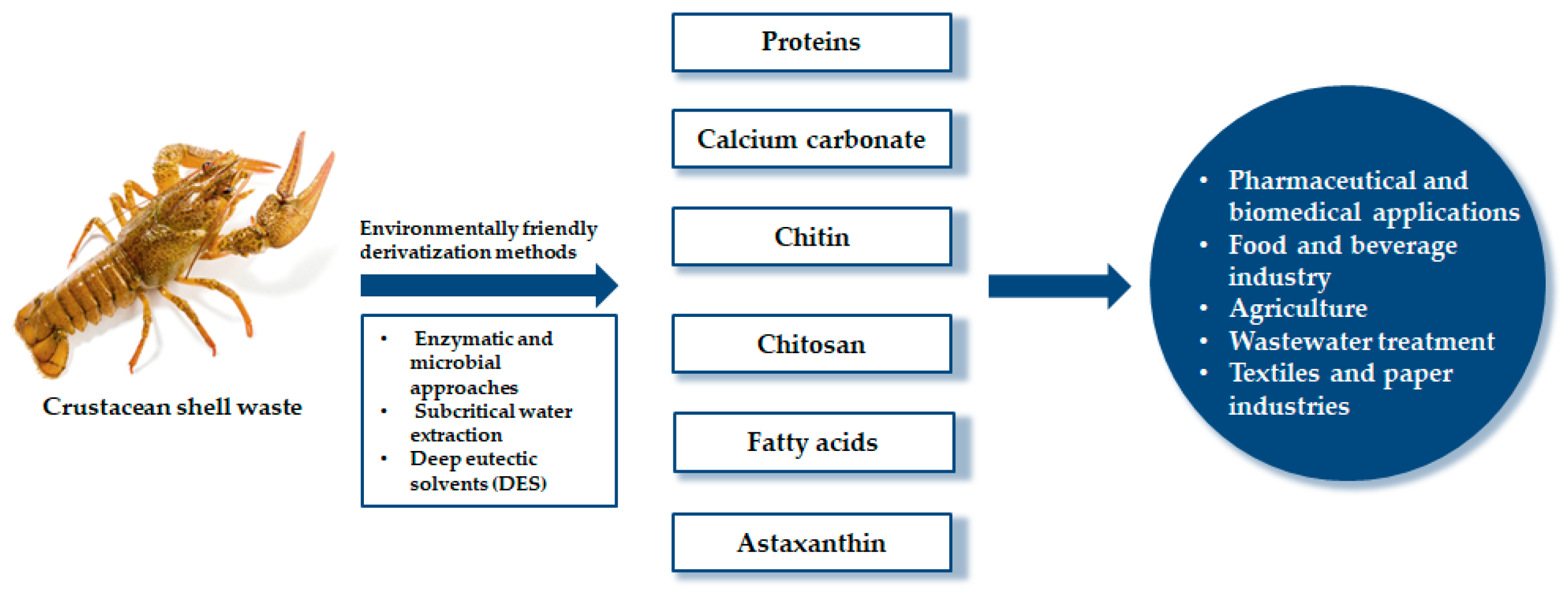
A crustacean shell has a unique composition (Figure 1), consisting primarily of 20–30% chitin, 30–40% proteins, and calcium carbonate ranging from 20% to over 50%, with minor components like lipids, astaxanthin, and other minerals [3].
Figure 1.
Composition of crustacean shell with industrial application.
2.1. Chitin
Chitin is a natural polysaccharide that is the second most abundant biopolymer after cellulose. However, the chitin fraction in the shells of crustaceans is tightly bound to calcium salts and proteins, making it insoluble in conventional solvents [10]. Due to its insolubility, it is inefficient to recover chitin using conventional solvent extraction methods. Instead, proteins and calcium salts must be removed from the shells, making the processes complicated and laborious. Commercially, NaOH is used to remove the proteins (deproteinization) and HCl is used to remove the calcium salts (demineralization), which allows the chitin to be concentrated. The demineralization and deproteinization of crustacean shells enable the hydrolysis of acetyl groups [11,12].
Chemical methods, although effective in extracting chitin, can have certain disadvantages, such as affecting the properties of chitin and being environmentally hazardous due to the large amounts of toxic waste. In addition, strong reagents can trigger the degradation of chitosan [13]. Therefore, biological extraction methods are gaining increasing attention due to their environmentally friendly and cost-effective nature, utilizing proteolytic microorganisms or enzymes to degrade non-chitin components from crustacean shells. These methods involve the use of microorganisms Lactobacillus plantarum and Bacillus licheniformis, or enzymes like proteinase to break down and remove proteins, along with demineralization to remove minerals such as calcium carbonate [14,15]. Although biological methods are promising in laboratory settings, they face significant challenges in scaling up for industrial production. These methods often involve lengthy fermentation processes, high enzyme costs, and limited ability to completely demineralize and deproteinize chitin [16].
Chitosan, a derivative of chitin, is a naturally occurring polysaccharide extracted from the shells of crustaceans like crabs, shrimp, and krill. It is a byproduct of the crustacean food processing industry and is valued for its low toxicity, biodegradability, and biocompatibility, along with its antimicrobial properties. These characteristics make chitosan suitable for applications in various industries, including pharmaceuticals, food production, and cosmetics. Its unique characteristics, such as the ability to form films, absorb substances, and interact with other materials, further enhance its versatility [11,13].
2.2. Proteins
Proteins are vital nutrients composed of amino acid chains that are essential for human health, performing crucial roles in the structure, function, and regulation of cells and tissues. They are also present in high amounts in crustacean waste, making up 30% to 40% of its total weight. Proteins from the protein-chitin-minerals complex in crustacean waste can be hydrolyzed into protein hydrolysates, which have diverse applications in pharmaceuticals, human and animal nutrition, and cosmetics. These hydrolysates contain valuable amino acids and other bioactive compounds, making them beneficial for various products and industries [17,18].
Enzymatic hydrolysis is a common method for extracting proteins from crustacean shell waste, yielding bioactive peptides that can be used in pharmaceuticals or aquaculture feeds. Crustacean shells contain inherent enzymes like proteases and lipases that can also degrade proteins through a process called autolysis [3]. This controlled, enzymatic process is favored over chemical methods because it uses mild conditions, avoids harmful residues, and yields higher-quality products with potential health benefits. Crustacean shells’ proteins are used as high-value additives in animal feed because they are rich in essential amino acids and have a nutritive value comparable to soybean meal. This approach is a sustainable way to valorize seafood processing waste, converting it into a valuable feed component while also offering environmental and economic benefits. On the other hand, although the use of crustacean shell protein hydrolysates in animal feed offers advantages like improved nutrition, it is important to note that it also presents specific disantvage and sanitation risks, such as the accumulation of heavy metals or pathogens from the environments, which require strict initial waste stabilization (freezing/preservation) and controlled processing (hydrolysis, purification) to control pathogens and contaminants, ensuring quality and safety for animals. Control measures focus on rapid waste handling, controlled enzymatic hydrolysis, purification steps to remove impurities, and rigorous testing for microbes, toxins, and heavy metals [17,19].
2.3. Calcium Carbonate
Calcium carbonate from crustacean shell waste makes up a significant portion, typically ranging from 20% to over 50% of crustacean shells. This mineral component is essential for the shell’s rigidity and is a valuable byproduct of seafood processing, with applications ranging from animal feed and fertilizers to industrial fillers and biomedical materials [20]. It has gained significant attention as a sustainable alternative to limestone, offering environmental benefits by transforming waste into a valuable material. This biomaterial is used to reduce waste accumulation, decrease reliance on mined limestone, and contribute to a more circular economy. Its applications range from advanced materials to uses in construction, often involving the processing of shell waste to create fine calcium carbonate powders with potential for enhanced reactivity or specific properties [4]. Recent developments show its utilization in water treatment by removing contaminants, as a bio-filler to reduce costs in polymer composites, and for creating bio-ceramics for biomedical uses, as well as in energy applications, pharmaceuticals, and drug delivery systems [21].
2.4. Astaxanthin
Astaxanthin is a valuable carotenoid found in crustacean shells and has multiple applications in the cosmetic, food, and potentially even the pharmaceutical industries. It is known to possess antioxidant and anti-inflammatory properties, while some research suggests it may also have anticancer effects. Enzymatic, fermentation, and chemical extraction techniques are most commonly used for extracting astaxanthin from crustacean shells [22]. Further, astaxanthin improves aquaculture by enhancing feed efficiency, primarily through optimizing protein and carbohydrate metabolism and improving the intestinal structure for better nutrient absorption. This leads to improved growth performance, such as increased final body weight, weight gain rate, and a lower feed conversion ratio [23].
3. Crustacean Shell Waste Valorization for the Purpose of Obtaining Packaging Materials
In recent decades, environmental issues have attracted increasing interest from scientists, industry and, ultimately, consumers. As packaging, especially plastic packaging, has a significant impact on the environment, much attention is being paid to finding ecological alternative solutions for this sector. Plastic packaging, like other plastic products, is petroleum-based and consumes large quantities of non-renewable raw materials, which has a negative impact on the earth’s resources. In addition, a large proportion of plastic waste comes from food packaging, which necessitates increased attention due to the significant environmental and health risks [24]. The generation of plastic waste as a result of the intensive use of plastic packaging by the food industry has been a cause of concern for society, but also for science. This waste causes serious environmental pollution as it is not biodegradable [25]. Petroleum-based plastics in packaging materials should be substituted with environmentally sustainable alternatives.
Packaging materials based on biopolymers have attracted considerable attention as environmentally suitable substitutes to synthetic plastics, as they offer both timely solutions and challenges in this regard [26,27,28]. Bio-packaging consists of renewable resources, such as plant, animal waste or metabolic products of microorganisms, most of which are biodegradable or compostable. This significantly reduces plastic waste and lowers the carbon footprint [29]. In addition to the environmental and biodiversity benefits, bio-packaging can also offer practical advantages, such as longer shelf life, improved food safety, and better product visibility [30].
A variety of agrifood waste types are suitable substrates for the production of bio-based materials, due to their non-toxicity, biocompatibility, and compostability, as well as their food safety status and their ability to act as a matrix for antimicrobial and antioxidant compounds, adding value to these products [31,32,33]. In this way, the use of agricultural waste and by-products promotes the circular economy and the zero-waste approach. The transition from the current linear, fossil-based materials to circular, bio-based materials based on abundant, non-toxic, renewable, and biodegradable sources is attracting enormous attention.
Many properties of biopackaging relate to its requirement to serve as a packaging material for food. The most important characteristics to consider are mechanical properties; barrier effect against moisture, gases, and oil; as well as thermal stability. Bio-based packaging can prolong food quality by delaying lipid oxidation due to its excellent gas barrier properties, reducing loss of protein functionality, discoloration, and moisture loss [34].
Biopolymers derived from waste shells, particularly chitin from crustacean shells and chitosan, can be used to produce bioplastics with potential applications in biomedical, industrial, and household goods, as well as bio-packaging. These shell-derived biopolymers are biocompatible and biodegradable, offering eco-friendly alternatives to conventional plastics, although their mechanical properties often require enhancement for specific uses [35].
In recent decades, sustainable packaging technology has begun to work on developing new types of materials, mostly derived from shellfish waste, such as chitosan (poly-β-(1–4)-N-acetyl-D-glucosamine), a polymer derived from the deacetylation of chitin. Interest in chitosan has increased dramatically and today research in many scientific fields involves the isolation and application of chitosan. Due to its biocompatible, non-toxic, biodegradable and excellent film-forming properties, chitosan is a promising candidate with a wide range of applications in many fields such as agriculture, food, pharmaceuticals, and cosmetics, directly or indirectly [36,37,38].
Chitosan is particularly interesting because it can replace plastic films [33]. Its good properties include biodegradability and sustainability (chitosan comes from renewable sources and is broken down by enzymes into non-toxic substances) [39]. Chitosan films have good barrier properties against water vapor and gases, and have an anti-spoilage and antioxidant effect. The mechanical properties of chitosan-based materials enable the production of films with good flexibility and transparency. Chitosan-based films are bioactive due to their antimicrobial, antioxidant, and enzyme-inhibiting properties, which stem from their chelating ability and cationic structure, and also have blending ability, as they can be combined with other polymers to improve their physical properties. All the good properties that chitosan films possess have made them the most promising packaging materials developed in the last decade [40].
Chitin is the most dominant component of the exoskeleton of crustaceans and insects [41,42]. The previous literature extensively covers the extraction of polysaccharides from various wastes. Chitin and chitosan derived from crab shell waste exhibit diverse applications, functioning as antimicrobials, additives, antioxidants, edible film-forming agents, and encapsulating materials for dietary supplements, particularly in conjunction with enzyme immobilization technologies [43,44]. However, there is a lack of literature describing the extraction of chitin, chitosan, and chitooligosaccharides from crustacean waste. Commercially, chitin is mainly obtained from seafood waste (Table 1) [45]. However, the demand for chitin is increasing [46,47], so it is important to look for new sources of this polymer. Among the different crayfish species, there are very few data on the use of Faxonius limosus shell waste.
Table 1.
Chitosan from different crustacean wastes, additives and potential applications of chitosan films.
According to the literature [7,53,54,55], shell waste from the crayfish F. limosus is a potential source of chitin and has been the subject of multiple research groups that studied its extraction and the subsequent derivation of chitosan. Studies have confirmed the presence of chitin in these shells and optimized extraction processes in order to yield polymers of comparable quality to commercial standards [47,56]. In a study conducted by Nuc et al. [47], two crustacean species were selected as potential sources of chitin, one of which was F. limosus.
The studies conducted by Seratlić et al. [57] and Hromiš et al. [58] aimed to utilize the shells of F. limosus for chitosan extraction, applying different chemical extraction procedures. The results showed that the modified process reduced chemical usage (by 66% for HCl and 51% for NaOH) and decreased wastewater by 45%. Both extraction methods produced structurally similar chitosan, with degrees of deacetylation of 79% and 75%, and molecular weights of 189 kDa and 146 kDa, respectively. This demonstrates the potential of using F. limosus shells to produce chitosan with the desired properties through a modified, more environmentally friendly method [59,60]. However, the authors indicated that omitting or reducing the number of baths in the deproteinization step does not yield a pure chitosan sample (FTIR analysis confirmed the presence of protein and other residues) after the deacetylation step, in the case of F. limosus shells. Depending on the intended use of the chitosan and the required purity, it is necessary to adjust the deproteinization phase.
In the next phase of the research, Seratlić et al. [61] used commercially available chitosan from F. limosus shells to evaluate the potential of chitosan-based coatings for fermented sausages. Chitosan-based biopolymer coatings were applied to thin slices of fermented dry sausage using two techniques: spraying and dipping. To assess the effectiveness of the coatings, samples were analyzed by instrumental color measurements and sensory evaluation of aroma, taste, and overall acceptability. The results show that the samples treated by immersion had brightness values closer to the control, while the samples treated by spraying had a higher brightness and a greater reduction in yellow color. Sensory evaluation revealed that all samples (except one) were acceptable, with one sample showing no significant difference from the control in terms of aroma, taste, and overall acceptability. These results suggest that chitosan-based coatings have the potential to be used in fermented dry sausages.
4. Crustacean Shell Waste as Efficient Biosorbents for Water and Wastewater Treatment
Heavy metals (HMs) are widespread contaminants in aquatic environments, primarily originating from anthropogenic activities such as industrial effluents [62,63]. Although conventional treatment methods are commonly used, growing attention has been given to biosorption as a sustainable alternative, which involves the passive uptake of metal ions by bio-based materials through physicochemical interactions [64].
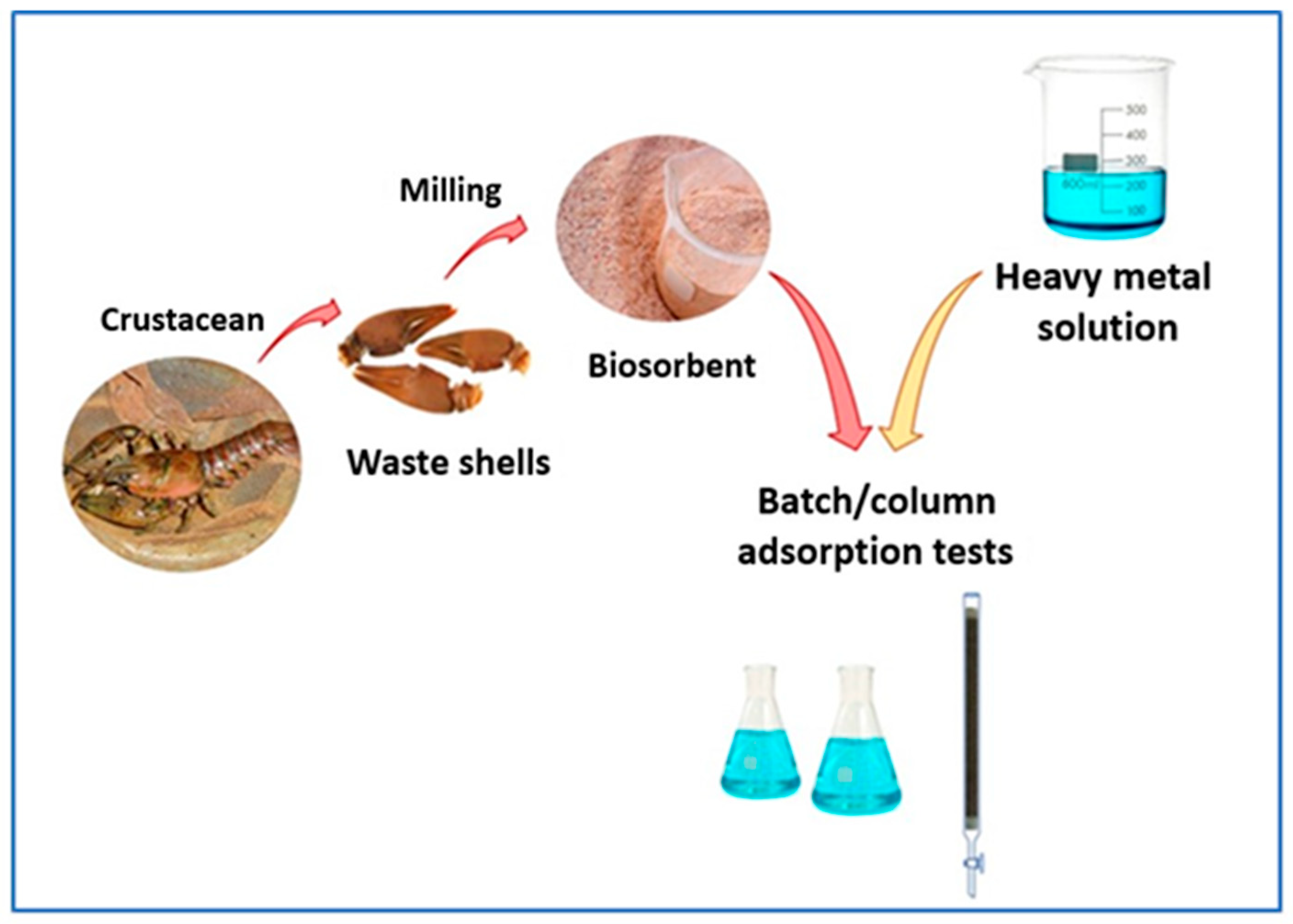
Utilization of bio-based waste materials as functional adsorbents for removing contaminants from wastewater emerged from the need for cost-effective alternatives to activated carbon. While activated carbon is highly efficient and easy to use, it is often expensive, and additional costs are incurred for its regeneration. An adsorbent is considered inexpensive if it requires minimal or no processing, is naturally abundant, or is available in large quantities throughout the year. Crab shell waste is one such material that is produced in large quantities annually [2,65]. Their performance depends on their physical characteristics and chemical composition, such as particle diameter, specific surface area, and abundance of active groups. In recent years, numerous studies have examined the effectiveness of this material in heavy metal removal from water showing very good adsorption property [66,67,68,69]. Figure 2 presents a schematic overview of the adsorption process using crustacean shell waste.
Figure 2.
Schematic representation of heavy metals adsorption tests using crustacean shells.
Fabbricino et al. [70] demonstrated, through laboratory-scale experiments, that ground shrimp shells are highly effective adsorbents for the removal of chromium (III) from tannery wastewater, achieving removal efficiencies greater than 90%. This result clearly indicates the strong adsorption capacity of crustacean shell-based materials for Cr (III). In a related study, Joen [71] evaluated crab shells as an adsorbent for the removal of silver ions from industrial wastewater, further supporting the applicability of shell-derived waste materials for heavy metal removal. Evaluations were conducted under various experimental conditions. A maximum removal efficiency of approximately 96% was achieved using an adsorbent dose of 30 g/L at an initial pH of 6.0. Moreover, a comparison of removal efficiencies for the same ions by the waste shells and a commercial cation exchange resin was reported. Results indicated higher removal efficiency of crab shells than that of commercial adsorbents. Furthermore, Gök et al. [72] reported that untreated shrimp shells exhibit notable potential as an adsorbent for cobalt ion removal from wastewater. Under optimized experimental conditions (adsorbent dosage of 1 g/L, pH 5.26, and a contact time of 10 min), a Co2+ removal efficiency of approximately 75% was achieved with the maximum calculated capacity as 7.69 mg/g.
The performance of crab shell material in removing Pb, Cd, Cu, and Cr was assessed through a comparative evaluation with conventional adsorbents, including cation exchange resins, zeolites, and both granular and powdered activated carbon. The tested crab shells demonstrated a better removal capacity for Pb, Cd, and Cr compared to all other sorbents. However, for Cu, the adsorption capacity of crab shells was negligibly lower than that of the cation exchange resin. At a heavy metal concentration of 1.0 mmol/L, the crab shell maintained a removal efficiency of 93–100%, which was significantly higher than that of any other sorbent. The preparation of crab shell material for biosorption is generally uncomplicated and rarely involves additional treatment. Cost-effective sorbents can be obtained using simple operations, including washing, milling, drying, and fractionation by sieving [73].
Chemical modification using acidic or alkaline agents may be applied depending on the characteristics of the biomass and has been shown to enhance the removal of heavy metal ions. Investigations into the use of acid-treated crab shell particles as biosorbents demonstrated a substantially higher adsorption capacity for Pb (II) (709 mg/g) compared to Zn (II) (117 mg/g). Kinetic evaluation indicated that the adsorption behavior of both metals followed the pseudo-second-order model, with Pb (II) exhibiting a markedly faster initial sorption rate than Zn (II) [74]. In a related study, Boddu et al. [75] systematically examined chemically treated shrimp shell waste as a biosorbent for the removal of Cu (II) and Pb (II) from industrial wastewater. Their results confirmed excellent sorption performance, achieving maximum removal efficiencies of 96.42% for Cu (II) at pH 5 and 89.77% for Pb (II) at pH 6, under an initial metal concentration of 20 mg/L, a biosorbent dosage of 0.1 g, and a temperature of 303 K.
Studies have evaluated acid-pretreated Portunus sanguinolentus crab shells as a cost-effective biosorbent for removing heavy metal ions from water, demonstrating high removal efficiencies for metals [73,76]. Tested crab shells showed good efficiency with nickel removal from effluents of two different electroplating industries. The removal percentages reached 65.4 for effluent 1 and 79.9% for effluent 2 [76]. The results obtained for the removal of Cu (II) and Co (II) ions showed that, at optimized operating conditions, including a particle size of 0.767 mm, a biosorbent loading of 5 g/L, and pH 6, crab shell material exhibited high adsorption capacities for copper and cobalt, reaching 243.9 and 322.6 mg/g, respectively [77]. Effective removal was also reported for manganese (Mn (II)) and zinc (Zn (II)) from aqueous media. The sorption kinetics were fast, with approximately 90% of Mn (II) removed within 120 min and a comparable removal of Zn (II) achieved in 90 min at an initial concentration of 500 mg/L. Equilibrium analyses further confirmed the strong sorption potential of crab shells, with maximum uptake capacities of 69.9 mg/g for Mn (II) and 123.7 mg/g for Zn (II) [64].
Furthermore, Dahiya et al. [78] investigated the adsorption of lead and copper onto an adsorbent prepared from pre-treated crab shell biomass. The tested material demonstrated very good properties and a high adsorption capacity for removing selected heavy metals from water. Crab shell biomass exhibited a greater uptake capacity for copper (38.62 ± 1.27 mg/g) compared to lead (19.83 ± 0.29). For both lead and copper, the experimental data were better described by the Langmuir isotherm compared to the Freundlich model, as indicated by higher coefficients of determination for both biomaterials. This behavior implies that adsorption predominantly occurs through surface-bound interactions. Azis et al. [79] recently investigated the batch adsorption of copper ions using shrimp shell waste modified with hydrochloric acid. The experiments were performed at an initial Cu concentration of 40 ppm, while the adsorbent dose varied between 2.5 and 10 g. Maximum removal efficiency (97.81%) was achieved at the highest applied adsorbent loading (10 g). In a comparative assessment, Kim [80] evaluated untreated, acid-modified, and alkali-treated crab shells for Pb (II) removal from aqueous solutions. The findings demonstrated superior performance of the alkali-treated material relative to both raw and acid-treated shells. Acid treatment resulted in substantial leaching of Ca2+ and Mg2+ from the shell matrix, leading to poor Pb2+ removal, whereas the amounts of Ca2+ and Mg2+ released from alkali-treated shells were comparable to those observed for the untreated material. The adsorption of pollutants is strongly influenced by the presence of reactive functional groups within the adsorbent structure, including hydroxyl, carboxyl, silanol, and related moieties, which play a key role in heavy metal binding in aquatic systems. Chitosan, obtained through the extraction and purification of shrimp shells, contains a high density of oxygen- and nitrogen-bearing functional groups—such as carboxyl, hydroxyl, amine, imidazole, amide, and phosphate groups—making it a highly effective material for metal ion removal from water. Rahman [81] recently evaluated the performance of modified shrimp-derived chitosan for heavy metal removal under varying operational conditions, including pH, sorbent dosage, and contact time. The results demonstrated that near-neutral pH conditions yielded the highest removal efficiencies, reaching 99.72% for Cu, 84.74% for Zn, 91.35% for Cd, and 99.92% for Pb, with corresponding adsorption capacities of 20.30 mg/g, 7.50 mg/g, 15.00 mg/g, and 76.34 mg/g, respectively. In another recent investigation, modified shrimp-based chitosan also exhibited strong adsorption performance toward arsenic, nickel, and cobalt at neutral pH, achieving removal efficiencies of 98.50%, 74.50%, and 47.82%, respectively, while chromium removal was maximized under acidic conditions (pH 3), with an efficiency of 97.40% [82]. Zinc removal using chitin extracted from crustacean waste (shrimp and crab shells) was further examined by Jaafarzadeh et al. [83]. When compared with conventional adsorbents such as bentonite, fungal biomass, and lignin, chitin derived from crustacean shells showed superior zinc uptake relative to most tested biosorbents. Additionally, chitin isolated from pink shrimp shells demonstrated excellent performance in Pb(II) removal from aqueous solutions, achieving a maximum removal efficiency of 99.7% [84].
A comparative study of removing heavy metals (Pb, Cr, and Se) using crawfish shells and commercial chitin was conducted by Beeram et al. [85]. The results showed that the tested shells absorbed more lead, selenium, and chromium from the model water than chitin. The results also indicated that shells absorbed more lead compared to chromium and selenium. Trends in the use of chitin and chitosan as adsorbents for the removal of heavy metals from water have increased in recent years due to their low cost and very high removal efficiency. However, further research is required, as well as testing of this material on real wastewater samples [86]. The majority of the reported studies employed batch adsorption experiments, whereas only a limited number investigated column-based adsorption systems [63,87,88,89]. This is mainly because continuous-flow setups are more technically demanding and typically require larger solution volumes.
As a whole, crustacean shells have been used to remove heavy metals from water and have showed very good efficiency. Despite pervasive research on various aspects of the usage of waste shells as biosorbents, there is still a gap in knowledge and challenges that need to be overcome to achieve successful commercialization. The integration of these materials into the water remediation market has been slow, partly due to the lack of substantial investment in new technologies. Additionally, technical feasibility concerns must be overcome to make biosorbents more competitive. Key challenges involve improving adsorption efficiency and selectivity toward individual or multiple contaminants, elucidating the underlying sorption mechanisms, integrating these materials into existing treatment systems, and addressing the safe handling and disposal of spent adsorbents [62].
5. Future Perspectives of Crustacean Shell Waste
Crustacean shell waste valorization is rapidly growing, shifting from mere disposal to creating high-value products like biodegradable packaging and advanced biosorbents for water purification, driven by circular economy and sustainability goals. Key trends involve extracting chitin and chitosan to form nanomaterials for antimicrobial films and heavy metal removal, while opportunities lie in improving material properties (strength, barriers) and scaling up production to replace plastics and tackle pollution, despite regulatory hurdles [2,17]. However, the industrial use of crustacean shell waste faces a number of limitations such as high processing and energy costs, chemical challenges requiring the use of acids and alkalis, as well as product purity issues (heavy metals, residual proteins) and the insolubility of chitin requiring expensive conversion to chitosan [3,15,16,17,18].
Packaging plays a crucial role in protecting food by blocking contaminants and providing structure, and as traditional plastics cause pollution, interest is being driven by biopolymers from renewable sources like crustacean waste (chitin, chitosan, protein, astaxanthin, and calcium carbonate). These natural materials offer biodegradability and biocompatibility, but often need enhancements (e.g., with nanoparticles or other polymers) to match plastic’s barrier and strength, creating advanced, sustainable films that can extend shelf life and reduce waste [2,3,5]. The antimicrobial packaging application of chitosan has gained importance due to its biodegradable, non-toxic, and antimicrobial properties, offering a sustainable alternative to traditional plastics for food preservation. By inhibiting the growth of spoilage and pathogenic microorganisms, chitosan-based films and coatings can extend the shelf life of various foods, including fresh produce, meat, and dairy products. This has led to increased research into using chitosan alone or in composite materials with other substances like nanoparticles, cellulose, or essential oils to enhance its effectiveness and create active, intelligent packaging solutions [90,91].
Recent studies have focused on the development of active and/or intelligent films based on chitosan [92,93]. Active packaging intends to maintain or improve the condition of the packaged food or extend its shelf life. This type of packaging interacts with the food, maintaining nutritional quality, inhibiting the growth of pathogenic and non-pathogenic microorganisms, or preventing the migration of contaminants. The literature showed that incorporating active compounds into chitosan films enhances their functionality by improving their mechanical, barrier, and functional properties. It has been found that the presence of phenolic compounds improves both the mechanical and barrier properties of chitosan films. In addition, the antimicrobial and antioxidant capacity of the films is significantly improved by the addition of essential oils, phenolic compounds, and other fruit extracts [93]. Typical examples of active packaging are oxygen scavengers, carbon dioxide emitters/absorbers, moisture absorbers, ethylene absorbers, ethanol emitters, antioxidants, flavor release/absorption systems, and antimicrobial films [92]. On the other hand, intelligent packaging systems help in ensuring the quality and safety of food products by monitoring their condition and the surrounding environment [94]. On the other hand, intelligent packaging monitors the condition of the packaged food or the surrounding environment. Intelligent films based on chitosan with a pH indicator have been extensively studied. Further research on chitosan and its combinations with other materials is needed to study which types of foods can be in contact with chitosan packaging [92,93,94].
Accelerated industrialization, urbanization, and transportation are the main drivers of water pollution, which has become a pressing environmental and public health challenge. Significant research is being conducted and new technologies are being developed in finding solutions for wastewater treatment. Some of them are focused on simple and inexpensive water treatment technologies based on bio-based natural polymers such as chitosan modified with nanoparticles such as silver, gold, graphene, etc. [95]. Crustacean shell waste is a sustainable, low-cost bio-adsorbent for wastewater treatment, utilizing high chitin/chitosan content to remove heavy metals, dyes, oils, and pathogens. This approach aligns with circular economy principles, offering an eco-friendly alternative to commercial activated carbon, though it requires efficient, green extraction methods [96].
6. Conclusions
Crustacean shells, a byproduct of the food industry, offer substantial potential as a novel research focus in biological resources. They are a rich source of valuable components like chitin, protein, and astaxanthin, which can be extracted and utilized in various applications. These natural substances are increasingly used as sustainable alternatives to synthetic materials, providing benefits like improved food safety, extended shelf life, and a natural, non-toxic profile. Crustacean shell waste is a valuable source for sustainable packaging by extracting chitin and chitosan, which are used to create biodegradable films, coatings, and composites with enhanced mechanical and barrier properties. Key trends include nano-enhancements and utilizing bioactive compounds for active/intelligent packaging, with antimicrobial and antioxidant functions, offering eco-friendly alternatives to plastics. Furthermore, crustacean shells can be converted into valuable carbon-based materials like biochar, offering a range of applications including adsorption of pollutants, antibacterial properties, and electrochemical uses. Specifically, crayfish shell biochar can act as an adsorbent for removing contaminants from wastewater and potentially be utilized in energy storage devices. Integrating circular economy principles in crustacean waste management is key to minimizing pollution, conserving raw resources, and creating economic value, where shells become valuable inputs (such as calcium for agriculture and construction, chitin for biomaterials), thereby reducing landfill burdens. This valorization supports an innovation in product design, leading to greater sustainability and resource efficiency. There is a recognized need for more research to address the scientific and technical challenges associated with utilizing crayfish shells and their derived functional materials. While there is growing interest in this area, particularly for applications like bioadsorbents and energy storage, significant hurdles remain in optimizing extraction methods, understanding material properties, and scaling up production.
Author Contributions
Conceptualization, Z.T., S.P., V.V., and I.Č.; methodology, Z.T., N.H., D.L., and I.Č.; investigation, Z.T., S.P., N.H., D.L., V.V., and I.Č.; resources, Z.T., S.P., V.V., and I.Č.; data curation, Z.T., S.P., V.V., and I.Č.; writing—original draft preparation, Z.T., S.P., V.V., and I.Č.; writing—review and editing, Z.T., S.P., N.H., D.L., V.V., and I.Č.; visualization, Z.T. and I.Č.; supervision, Z.T. and I.Č.; project administration, Z.T. and I.Č.; funding acquisition, I.Č. All authors have read and agreed to the published version of the manuscript.
Funding
This research was supported by the Science Fund of the Republic of Serbia, #GRANT No. 7417; “Reducing the negative impact of invasive crayfish Faxonius limosus in the Danube by smart exploitation of their meat and shells” (DANUBEcare).
Data Availability Statement
No data was used for the research described in this article.
Acknowledgments
The authors are also thankful for the continuous support of the Ministry of Science, Technological Development and Innovation of the Republic of Serbia (Contract number 451-03-136/2025-03/200222).
Conflicts of Interest
The authors declare no conflicts of interest.
References
- FAO. The State of World Fisheries and Aquaculture 2022, Towards Blue Transformation; Food and Agriculture Organization of the United Nations: Rome, Italy, 2022. [Google Scholar] [CrossRef] [Scilit]
- Topić Popović, N.; Lorencin, V.; Strunjak-Perović, I.; Čož-Rakovac, R. Shell waste management and utilization: Mitigating organic pollution and enhancing sustainability. Appl. Sci. 2023, 13, 623. [Google Scholar] [CrossRef] [Scilit]
- Chen, S.; Jiang, S.; Jiang, H. A review on conversion of crayfish-shell derivatives to functional materials and their environmental applications. J. Bioresour. Bioprod. 2020, 5, 238–247. [Google Scholar] [CrossRef] [Scilit]
- Azarian, M.H.; Sutapun, W. Biogenic calcium carbonate derived from waste shells for advanced material applications: A review. Front. Mater. 2022, 9, 1024977. [Google Scholar] [CrossRef] [Scilit]
- Priyadarshi, R.; Rhim, J.W. Chitosan-based biodegradable functional films for food packaging applications. Innov. Food Sci. Emerg. Technol. 2020, 62, 102346. [Google Scholar] [CrossRef] [Scilit]
- Shahidi, F.; Abuzaytoun, R. Chitin, chitosan, and co-products: Chemistry, production, applications, and health effects. Adv. Food Nutr. Res. 2005, 49, 93–135. [Google Scholar] [PubMed]
- Zhan, J.; Lu, J.; Wang, D. Review of shell waste reutilization to promote sustainable shellfish aquaculture. Rev. Aquac. 2021, 14, 477–488. [Google Scholar] [CrossRef] [Scilit]
- Riofrio, A.; Alcivar, T.; Baykara, H. Environmental and economic viability of chitosan production in Guayas-Ecuador: A robust investment and life cycle analysis. ACS Omega 2021, 6, 23038–23051. [Google Scholar] [CrossRef] [Scilit]
- Vidal, J.L.; Jin, T.; Lam, E.; Kerton, F.; Moores, A. Blue is the new green: Valorization of crustacean waste. Curr. Res. Green Sustain. Chem. 2022, 5, 100330. [Google Scholar] [CrossRef] [Scilit]
- Kurita, K. Chitin and chitosan: Functional biopolymers from marine crustaceans. Mar. Biotechnol. 2006, 8, 203–226. [Google Scholar] [CrossRef] [Scilit]
- Bezrodnykh, E.A.; Vyshivannaya, O.V.; Berezin, B.B.; Blagodatskikh, I.V.; Tikhonov, V.E. A Walkway from crayfish to oligochitosan. Appl. Sci. 2023, 13, 3360. [Google Scholar] [CrossRef] [Scilit]
- Lv, S.H. High-performance superplasticizer based on chitosan. In Biopolymers and Biotech Admixtures for Eco-Efficient Construction Materials; Woodhead Publishing: Sawston, UK, 2016; pp. 131–150. [Google Scholar]
- El-Naggar, M.M.; Abou-Elmagd, W.S.; Suloma, A.; El-Shabaka, H.A.; Khalil, M.T.; Abd El-Rahman, F.A. Optimization and physicochemical characterization of chitosan and chitosan nanoparticles extracted from the crayfish Procambarus clarkii wastes. J. Shellfish. Res. 2019, 38, 385–395. [Google Scholar] [CrossRef] [Scilit]
- Ruangwicha, J.; Cheirsilp, B.; Suyotha, W. Green biorefinery of shrimp shell waste for α-chitin and high-value co-products through successive fermentation by co-lactic acid bacteria and proteolytic fungus. Bioresour. Technol. 2024, 393, 130106. [Google Scholar] [CrossRef] [Scilit]
- Verardi, A.; Sangiorgio, P.; Moliterni, S.; Errico, S.; Spagnoletta, A.; Dimatteo, S. Advanced technologies for chitin recovery from crustacean waste. Clean Technol. Recycl. 2023, 3, 4–43. [Google Scholar] [CrossRef] [Scilit]
- Kim, Y.; Park, R.D. Progress in bioextraction processes of chitin from crustacean biowastes. J. Korean Soc. Appl. Biol. Chem. 2015, 58, 545–554. [Google Scholar] [CrossRef] [Scilit]
- Azelee, N.I.W.; Dahiya, D.; Ayothiraman, S.; Noor, N.M.; Rasid, Z.I.A.; Ramli, M.A.N.; Ravindran, B.; Iwuchukwu, F.U.; Selvasembian, R. Sustainable valorization approaches on crustacean wastes for the extraction of chitin, bioactive compounds and their applications—A review. Int. J. Biol. Macromol. 2023, 253, 126492. [Google Scholar] [CrossRef] [Scilit]
- Rossi, N.; Grosso, C.; Delerue-Matos, C. Shrimp waste upcycling: Unveiling the potential of polysaccharides, proteins, carotenoids, and fatty acids with emphasis on extraction techniques and bioactive properties. Mar. Drugs 2024, 22, 153. [Google Scholar] [CrossRef] [Scilit] [PubMed]
- Mathew, G.M.; Mathew, D.C.; Sukumaran, R.K.; Sindhu, R.; Huang, C.C.; Binod, P.; Sirohi, R.; Kim, S.H.; Pandey, A. Sustainable and eco-friendly strategies for shrimp shell valorization. Environ. Pollut. 2020, 267, 115656. [Google Scholar] [CrossRef] [Scilit] [PubMed]
- Gbenebor, O.P.; Adeosun, S.O.; Lawal, G.I.; Jun, S. Role of CaCO3 in the physicochemical properties of crustacean-sourced structural polysaccharides. Mater. Chem. Phys. 2016, 184, 203–209. [Google Scholar] [CrossRef] [Scilit]
- Piras, S.; Salathia, S.; Guzzini, A.; Zovi, A.; Jackson, S.; Smirnov, A.; Fragassa, C.; Santulli, C. Biomimetic use of food-waste sources of calcium carbonate and phosphate for sustainable materials—A Review. Materials 2024, 17, 843. [Google Scholar] [CrossRef] [Scilit]
- Šimat, V.; Rathod, N.B.; Čagalj, M.; Hamed, I.; Generalić Mekinić, I. Astaxanthin from crustaceans and their byproducts: A bioactive metabolite candidate for therapeutic application. Mar. Drugs 2022, 20, 206. [Google Scholar] [CrossRef] [Scilit]
- Peng, L.; Zhang, Z.; Li, Q.; Yang, H. Current challenges and issues in the application of astaxanthin. Fishes 2025, 10, 159. [Google Scholar] [CrossRef] [Scilit]
- Najahi, H.; Banni, M.; Nakad, M.; Abboud, R.; Assaf, J.C.; Operato, L.; Belhassen, M.; Gomes, L.; Hamd, W. Plastic pollution in food packaging systems: Impact on human health, socioeconomic considerations and regulatory framework. J. Hazard. Mater. Adv. 2025, 18, 100667. [Google Scholar] [CrossRef] [Scilit]
- Mittal, A.; Singh, A.; Benjakul, S.; Prodpran, T.; Nilsuwan, K.; Huda, N.; de la Caba, K. Composite films based on chitosan and epigallocatechin gallate grafted chitosan: Characterization, antioxidant and antimicrobial activities. Food Hydrocoll. 2021, 111, 106384. [Google Scholar] [CrossRef] [Scilit]
- Bigi, F.; Haghighi, H.; Siesler, H.W.; Licciardello, F.; Pulvirenti, A. Characterization of chitosan-hydroxypropyl methylcellulose blend films enriched with nettle or sage leaf extract for active food packaging applications. Food Hydrocoll. 2021, 120, 106979. [Google Scholar] [CrossRef] [Scilit]
- vanden Braber, N.L.; di Giorgio, L.; Aminahuel, C.A.; Vergara, L.I.D.; Costa, A.O.M.; Montenegro, M.A.; Mauri, A.N. Antifungal whey protein films activated with low quantities of water soluble chitosan. Food Hydrocoll. 2021, 110, 106156. [Google Scholar] [CrossRef] [Scilit]
- Roy, S.; Rhim, J.-W. Preparation of gelatin/carrageenan-based color-indicator film integrated with shikonin and propolis for smart food packaging applications. ACS Appl. Bio Mater. 2020, 4, 770–779. [Google Scholar] [CrossRef] [Scilit]
- Zhao, X.; Wang, Y.; Chen, X.; Yu, X.; Li, W.; Zhang, S.; Meng, X.; Zhao, Z.-M.; Dong, T.; Anderson, A.; et al. Sustainable bioplastics derived from renewable natural resources for food packaging. Matter 2023, 6, 97–127. [Google Scholar] [CrossRef] [Scilit]
- Mitrus, M.; Wojtowicz, A.; Moscicki, L. Biodegradable polymers and their practical utility. In Thermoplastic Starch; John Wiley & Sons: Hoboken, NJ, USA, 2009; pp. 1–33. [Google Scholar]
- Ahmed, J.; Mulla, M.; Arfat, Y.A.; Thai, L.A. Mechanical, thermal, structural and barrier properties of crab shell chitosan/graphene oxide composite films. Food Hydrocoll. 2017, 71, 141–148. [Google Scholar] [CrossRef] [Scilit]
- Akyuz, L.; Kaya, M.; Koc, B.; Mujtaba, M.; Ilk, S.; Labidi, J.; Salaberria, A.M.; Cakmak, Y.S.; Yildiz, A. Diatomite as a novel composite ingredient for chitosan film with enhanced physicochemical properties. Int. J. Biol. Macromol. 2017, 105, 1401–1411. [Google Scholar] [CrossRef] [Scilit]
- Liu, T.; Li, J.; Tang, Q.; Qiu, P.; Gou, D.; Zhao, J. Chitosan-based materials: An overview of potential applications in food packaging. Foods 2022, 11, 1490. [Google Scholar] [CrossRef] [Scilit]
- Darbasi, M.; Askari, G.; Kiani, H.; Khodaiyan, F. Development of chitosan based extended-release antioxidant films by control of fabrication variables. Int. J. Biol. Macromol. 2017, 104, 303–310. [Google Scholar] [CrossRef] [Scilit]
- Audrézet, F.; Pochon, X.; Floerl, O.; Le Guen, M.-J.; Trochel, B.; Gambarini, V.; Lear, G.; Zaiko, A. Eco-plastics in the sea: Succession of micro- and macro-fouling on a biodegradable polymer augmented with oyster shell. Front. Mar. Sci. 2022, 9, 891183. [Google Scholar] [CrossRef] [Scilit]
- Aranaz, I.; Acosta, N.; Civera, C.; Elorza, B.; Mingo, J.; Castro, C.; Heras Caballero, A.; Los, L.; Gandía, M.D. Cosmetics and cosmeceutical applications of chitin, chitosan and their derivatives. Polymers 2018, 10, 213. [Google Scholar] [CrossRef] [Scilit] [PubMed]
- Moeini, A.; Pedram, P.; Makvandi, P.; Malinconico, M.; d’Ayala, G.G. Wound healing and antimicrobial effect of active secondary metabolites in chitosan-based wound dressings: A review. Carbohydr. Polym. 2020, 233, 115839. [Google Scholar] [CrossRef] [Scilit] [PubMed]
- Yong, H.; Liu, J. Active packaging films and edible coatings based on polyphenol-rich propolis extract: A review. Compr. Rev. Food Sci. Food Saf. 2021, 20, 2106–2145. [Google Scholar] [CrossRef] [Scilit]
- Vadalà, R.; Di Bella, G.; Kosakowska, O.; Dugo, G.; Cicero, N.; Costa, R. Nutritional benefits of peanut by-products. In Sustainable Food Science—A Comprehensive Approach; Elsevier: Amsterdam, The Netherlands, 2023; pp. 289–301. [Google Scholar]
- Martinez, L.M.T. Handbook of Ecomaterials; Springer: New York, NY, USA, 2019; ISBN 978-3-319-68254-9. [Google Scholar]
- Kaya, M.; Seyyar, O.; Baran, T.; Erdogan, S.; Kar, M.A. Physicochemical characterization of the fully acetylated chitin structure isolated from two spider species. Int. J. Biol. Macromol. 2014, 65, 553–558. [Google Scholar] [CrossRef] [Scilit]
- Rinaudo, M. Chitin and chitosan: Properties and applications. Prog. Polym. Sci. 2006, 31, 603–632. [Google Scholar] [CrossRef] [Scilit]
- Taokaew, S.; Zhang, X.; Chuenkaek, T.; Kobayashi, T. Chitin from fermentative extraction of crab shells using okara as a nutrient source and comparative analysis of structural differences from chemically extracted chitin. Biochem. Eng. J. 2020, 159, 107588. [Google Scholar] [CrossRef] [Scilit]
- Narayan, O.P. Molecular basis of light-responsive dynamically tunable biomaterials in biomedical engineering. Biochem. Eng. J. 2021, 173, 108090. [Google Scholar] [CrossRef] [Scilit]
- Pakizeh, M.; Moradi, A.; Ghassemi, T. Chemical extraction and modification of chitin and chitosan from shrimp shells. Eur. Polym. J. 2021, 159, 110709. [Google Scholar] [CrossRef] [Scilit]
- Oyatogun, G.M.; Esan, T.A.; Akpan, E.I.; Adeosun, S.O.; Popoola, A.P.I.; Imasogie, B.I.; Akinluwade, K.J. Chitin, chitosan, marine to market. In Handbook of Chitin and Chitosan; Elsevier: Amsterdam, The Netherlands, 2020; pp. 335–376. [Google Scholar]
- Nuc, Z.; Brusotti, G.; Catenacci, L.; Grenha, A.; Pontes, J.F.; da Silva, J.P.; da Costa, A.M.R.; Moro, P.; Milanese, C.; Grisoli, P.; et al. Pontastacus leptodactylus (Eschscholtz, 1823) and Faxonius limosus (Rafinesque, 1817) as new, alternative sources of chitin and chitosan. Water 2023, 15, 3024. [Google Scholar] [CrossRef] [Scilit]
- De Carli, C.; Aylanc, V.; Mouffok, K.M.; Santamaria-Echart, A.; Barreiro, F.; Tomás, A.; Pereira, C.; Rodrigues, P.; Vilas-Boas, M.; Falcão, S.I. Production of chitosan-based biodegradable active films using bio-waste enriched with polyphenol propolis extract envisaging food packaging applications. Int. J. Biol. Macromol. 2022, 213, 486–497. [Google Scholar] [CrossRef] [Scilit]
- Qiu, L.; Luo, Q.; Bai, C.; Xiong, G.; Jin, S.; Li, H.; Liao, T. Preparation and characterization of a biodegradable film using irradiated chitosan incorporated with lysozyme and carrageenan and its application in crayfish preservation. Foods 2023, 12, 2642. [Google Scholar] [CrossRef] [Scilit] [PubMed]
- de Oca-Vásquez, G.M.; Esquivel-Alfaro, M.; Vega-Baudrit, J.R.; Jiménez-Villalta, G.; Romero-Arellano, V.H.; Sulbarán-Rangel, B. Development of nanocomposite chitosan films with antimicrobial activity from agave bagasse and shrimp shells. J. Agric. Food Res. 2023, 14, 100759. [Google Scholar] [CrossRef] [Scilit]
- Hamdi, M.; Nasri, R.; Li, S.; Nasri, M. Bioactive composite films with chitosan and carotenoproteins extract from blue crab shells: Biological potential and structural, thermal, and mechanical characterization. Food Hydrocoll. 2019, 89, 802–812. [Google Scholar] [CrossRef] [Scilit]
- Jankar, J.; Nagargoje, Y.; Chavan, Y.; Jankar, J.; Sahoo, A.K. Development of shrimp-based chitosan film and assessment of its mechanical, barrier and antimicrobial properties. E3S Web Conf. 2020, 170, 04003. [Google Scholar] [CrossRef] [Scilit]
- CABI. 2023 CABI Compendium. Available online: https://www.cabi.org (accessed on 30 March 2023).
- Pyšek, P.; Hulme, P.E.; Simberloff, D.; Bacher, S.; Blackburn, T.M.; Carlton, J.T.; Richardson, D.M. Scientists’ warning on invasive alien species. Biol. Rev. 2020, 95, 1511–1534. [Google Scholar] [CrossRef] [Scilit]
- Smietana, N.; Panicz, R.; Sobczak, M.; Smietana, P.; Nędzarek, A. Spiny-cheek crayfish, Faxonius limosus (Rafinesque, 1817), as an alternative food source. Animals 2020, 11, 59. [Google Scholar] [CrossRef] [Scilit]
- Kozma, M.; Acharya, B.; Bissessur, R. Chitin, chitosan, and nanochitin: Extraction, synthesis, and applications. Polymers 2022, 14, 3989. [Google Scholar] [CrossRef] [Scilit]
- Seratlić, N.; Hromiš, N.; Popović, S.; Šuput, D.; Pantić, J.; Čabarkapa, I. Valorization of shells from the invasive river crayfish Faxonius limosus: Chitosan extraction and characterizartion. In Proceedings of the 10th Conference of Young Chemists of Serbia, Belgrade, Serbia, 26 October 2024. [Google Scholar]
- Hromiš, N.; Pantić, J.; Popović, S.; Šuput, D.; Bulut, S.; Čabarkapa, I. The influence of the deproteinization step on the structural properties of chitosan obtained from the shell of the crayfish Faxonius limosus. In Proceedings of the 1st International Congress on Sustainable Food, Green Chemistry and Human Nutrition, Dubrovnik, Croatia, 7–9 April 2025. [Google Scholar]
- Dinculescu, D.D.; Apetroaei, M.R.; Gîjiu, C.L.; Anton, M.; Enache, L.; Schröder, V.; Isopescu, R.; Rău, I. Simultaneous optimization of deacetylation degree and molar mass of chitosan from shrimp waste. Polymers 2024, 16, 170. [Google Scholar] [CrossRef] [Scilit]
- Novikov, V.Y.; Derkach, S.R.; Konovalova, I.N.; Dolgopyatova, N.V.; Kuchina, Y.A. Mechanism of heterogeneous alkaline deacetylation of chitin: A review. Polymers 2023, 15, 1729. [Google Scholar] [CrossRef] [Scilit]
- Seratlić, N.; Hromiš, N.; Šojić, B.; Popović, S.; Šuput, D.; Pantić, J.; Čabarkapa, I. Potential application of chitosan-based biopolymer coatings on fermented dry sausages: Various application techniques and their impact on product quality. In Proceedings of the 9th International Conference Sustainable Postharvest and Food Technologies—INOPTEP 2025 and 37th National Conference Processing and Energy in Agriculture—PTEP 2025, Zlatibor, Serbia, 7–10 April 2025. [Google Scholar]
- Londono-Zuluaga, C.; Jameel, H.; Gonzalez, R.W.; Lucia, L. Crustacean shell-based biosorption water remediation platforms: Status and perspectives. J. Environ. Manag. 2019, 231, 757–762. [Google Scholar] [CrossRef] [Scilit] [PubMed]
- Lim, A.P.; Aris, A.Z. Continuous fixed-bed column study and adsorption modeling: Removal of cadmium (II) and lead (II) ions in aqueous solution by dead calcareous skeletons. Biochem. Eng. J. 2014, 87, 50–61. [Google Scholar] [CrossRef] [Scilit]
- Vijayaraghavan, K.; Winnie, H.J.N.; Balasubramanian, R. Biosorptio characteristics of crab shell particles for the removal of manganese (II) and zinc (II) from aqueous solutions. Desal 2011, 266, 195–200. [Google Scholar] [CrossRef] [Scilit]
- Vidosavljević, M.; Šojić, B.; Peulić, T.; Ikonić, P.; Lazarević, J.; Rakita, S.; Vasić, M.V.; Tomičić, Z.; Čabarkapa, I. From invasive species to sustainable nutrition: Safety, nutritional, and consumer perception study on Faxonius limosus in Serbia. Foods 2025, 14, 2523. [Google Scholar] [CrossRef] [Scilit]
- Darmokoesoemo, H.; Setianingsih, F.R.; Putranto, T.W.L.C.; Kusuma, H.S. Horn snail (Telescopium sp) and mud crab (Scylla sp) shells powder as low cost adsorbents for removal of Cu2+ from synthetic wastewater. Rasayan J. Chem. 2016, 9, 550–555. [Google Scholar]
- Hernández-Estévez, A.; Cristiani-Urbina, E. Nickel(II) biosorption from aqueous solutions by shrimp head biomass. Environ. Monit. Assess. 2014, 186, 7987–7998. [Google Scholar] [CrossRef] [Scilit]
- Foroutan, R.; Esmaeili, H.; Fard, M.K. Equilibrium and kinetics studies of Pb (II) biosorption from aqueous solution using shrimp peel. Int. Res. J. Appl. Basic Sci. 2015, 9, 1954–1965. [Google Scholar]
- Kim, D.S. The removal by crab shell of mixed heavy metal ions in aqueous solution. Bioresour. Technol. 2003, 87, 355–357. [Google Scholar] [CrossRef] [Scilit]
- Fabbricino, M.; Naviglio, B.; Tortora, G.; d’Antonio, L. An environmental friendly cycle for Cr (III) removal and recovery from tannery wastewater. J. Environ. Manag. 2013, 117, 1–6. [Google Scholar] [CrossRef] [Scilit]
- Jeon, C. Adsorption characteristics of waste crab shells for silver ions in industrial wastewater. Korean J. Chem. Eng. 2014, 31, 446–451. [Google Scholar] [CrossRef] [Scilit]
- Gök, G.; Kocyigit, H.; Gök, O.; Celebi, H. The use of raw shrimp shells in the adsorption of highly polluted waters with Co2+. Chem. Eng. Res. Des. 2022, 186, 229–240. [Google Scholar] [CrossRef] [Scilit]
- An, H.K.; Park, B.Y.; Kim, D.S. Crab shell for the removal of heavy metals from aqueous solution. Water Res. 2001, 35, 3551–3556. [Google Scholar] [CrossRef] [Scilit] [PubMed]
- Zhou, C.; Gong, X.; Han, J.; Guo, R. Removal of Pb (II) and Zn (II) from aqueous solutions by raw crab shell: A comparative study. Water Environ. Res. 2016, 88, 374–383. [Google Scholar] [CrossRef] [Scilit] [PubMed]
- Boddu, S.; Chandra, A.; Ali Khan, A. Biosorption of Cu (II), Pb (II) from electroplating industry effluents by treated shrimp shell. Mater. Today Proc. 2022, 57, 1520–1527. [Google Scholar] [CrossRef] [Scilit]
- Vijayaraghavan, K.; Jegan, J.R.; Palanivelu, K.; Velan, M. Nickel recovery from aqueous solution using crab shell particles. Adsorp. Sci. Technol. 2005, 23, 303–312. [Google Scholar] [CrossRef] [Scilit]
- Vijayaraghavan, K.; Palanivelu, K.; Velan, M. Biosorption of copper (II) and cobalt (II) from aqueous solutions by crab shell particles. Bioresour. Technol. 2006, 97, 1411–1419. [Google Scholar] [CrossRef] [Scilit]
- Dahiya, S.; Tripathi, R.M.; Hegde, A.G. Biosorption of lead and copper from aqueous solutions by pre-treated crab and arca shell biomass. Bioresour. Technol. 2008, 99, 179–187. [Google Scholar] [CrossRef] [Scilit]
- Azis, Y.; Mutamima, A.; Herman, S.; Alfarisi, C.A.; Ikrima, H. Isotherms studies of equilibrium sorption of Cu2+ unto hydrochloric acid modified shrimp shell waste. Mater. Today Proc. 2022, 63, 496–500. [Google Scholar]
- Kim, D.S. Pb2+ removal from aqueous solution using crab shell treated by acid and alkali. Bioresour. Technol. 2004, 94, 345–348. [Google Scholar] [CrossRef] [Scilit]
- Rahman, A. Promising and environmentally friendly removal of copper, zinc, cadmium, and lead from wastewater using modified shrimp-based chitosan. Water 2024, 16, 184. [Google Scholar] [CrossRef] [Scilit]
- Rahman, A.; Haque, M.A.; Ghosh, S.; Shinu, P.; Attimarad, M.; Kobayashi, G. Modified shrimp-based chitosan as an emerging adsorbent removing heavy metals (chromium, nickel, arsenic, and cobalt) from polluted water. Sustainability 2023, 15, 2431. [Google Scholar] [CrossRef] [Scilit]
- Jaafarzadeh, N.; Mengelizadeh, N.; Takdastan, A.; Heidari-Farsani, M.; Niknam, N. Adsorption of Zn (II) from aqueous solution by using chitin extraction from crustaceous shell. J. Adv. Environ. Health Res. 2014, 5, 131–139. [Google Scholar]
- Forutan, R.; Ehsandoost, E.; Hadipour, S.; Mobaraki, Z.; Saleki, M.; Mohebbi, G. Kinetic and equilibrium studies on the adsorption of lead by the chitin of pink shrimp (Solenocera melantho). Entomol. Appl. Sci. Lett. 2016, 3, 20–26. [Google Scholar]
- Beeram, S.; Morris, A.; Hardaway, C.J.; Richert, J.C.; Sneddon, J. Studies of whole crawfish shells for the removal of chromium, lead, and selenium ions in solution. Instrum. Sci. Technol. 2012, 40, 618–639. [Google Scholar] [CrossRef] [Scilit]
- Begum, S.; Yuhana, N.Y.; Md Saleh, N.; Kamarudin, N.H.N.; Sulong, A.B. Review of chitosan composite as a heavy metal adsorbent: Material preparation and properties. Carbohydr. Polym. 2021, 259, 117613. [Google Scholar] [CrossRef] [Scilit]
- Núñez-Gómez, D.; Rodrigues, C.; Lapolli, F.R.; Lobo-Recio, M.A. Adsorption of heavy metals from coal acid mine drainage by shrimp shell waste: Isotherm and continuous-flow studies. J. Environ. Chem. Eng. 2019, 7, 102787. [Google Scholar] [CrossRef] [Scilit]
- Rahman, M.A.; Hossain, M.M.; Samad, A.; Shafiqul Alam, A.M. Removal of arsenic from ground water with shrimp shell. Dhaka Univ. J. Sci. 2012, 60, 175–180. [Google Scholar] [CrossRef] [Scilit]
- Vijayaraghavan, K.; Jegana, J.; Palanivelu, K.; Velan, M. Removal of nickel (II) ions from aqueous solution using crab shell particles in a packed bed up-flow column. J. Hazard. Mater. 2004, 113, 223–230. [Google Scholar] [CrossRef] [Scilit]
- Chawla, R.; Sivakumar, S.; Kaur, H. Antimicrobial edible films in food packaging: Current scenario and recent nanotechnological advancements- a review. Carbohydr. Polym. Technol. Appl. 2021, 2, 100024. [Google Scholar] [CrossRef] [Scilit]
- Geeta; Shivani; Devi, N.; Shayoraj; Bansal, N.; Sharma, S.; Kumar Dubey, S.; Kumar, S. Novel chitosan-based smart bio-nanocomposite films incorporating TiO2 nanoparticles for white bread preservation. Int. J. Biol. Macromol. 2024, 267, 131367. [Google Scholar] [CrossRef] [Scilit]
- Flórez, M.; Guerra-Rodríguez, E.; Cazón, P.; Vázquez, M. Chitosan for food packaging: Recent advances in active and intelligent films. Food Hydrocoll. 2022, 124, 107328. [Google Scholar] [CrossRef] [Scilit]
- Zaghbib, I.; Abdullah, J.A.A.; Romero, A. Development of a multifunctional chitosan-based composite film from crab shell (Portunus segnis) and algae (Ulva lactuca) with enhanced antioxidant and antimicrobial properties for active food packaging. Foods 2025, 14, 53. [Google Scholar] [CrossRef] [Scilit] [PubMed]
- Liu, X.; Xu, F.; Yong, H.; Chen, D.; Tang, C.; Kan, J.; Liu, J. Recent advances in chitosan-based active and intelligent packaging films incorporated with flavonoids. Food Chem. X 2025, 25, 102200. [Google Scholar] [CrossRef] [Scilit] [PubMed]
- Lakshmi, S.G.; Gomez, L.A.; Shepherd, R.; Chandrapragasam, V.; Vijay, V.; Thathapudi, J.J. Exploring chitosan nanocomposites for wastewater treatment via solid phase extraction biorefinery. Bio Ref. Wastewater Treat. 2025, 271–287. [Google Scholar] [CrossRef] [Scilit]
- Hashem, A.; Farag, S. Chitosan-based adsorbents for water purification: Mechanisms, performance, and sustainability. Appl. Surf. Sci. Adv. 2025, 30, 100804. [Google Scholar] [CrossRef] [Scilit]

Disclaimer/Publisher’s Note: The statements, opinions and data contained in all publications are solely those of the individual author(s) and contributor(s) and not of MDPI and/or the editor(s). MDPI and/or the editor(s) disclaim responsibility for any injury to people or property resulting from any ideas, methods, instructions or products referred to in the content. |
© 2026 by the authors. Licensee MDPI, Basel, Switzerland. This article is an open access article distributed under the terms and conditions of the Creative Commons Attribution (CC BY) license.