


Abstract
Previous studies have highlighted that excessive use of AI in academic settings may be associated with academic AI dependency. However, the underlying mechanism remains unclear, indicating that academic AI use alone may not be sufficient and that other factors may also play important roles. Within the I-PACE model, this study examined how learning motivation, avoidance learning motivation, academic AI use, academic self-efficacy, and responsibility attribution interact to influence academic AI dependency. The participants consisted of 815 university students who completed the study through an online questionnaire. The research model was evaluated using the structural equation modelling (SEM) approach. The results revealed that learning motivation was positively associated with academic self-efficacy and academic AI use, whereas avoidance learning motivation was negatively related to academic self-efficacy but positively related to academic AI use and academic AI dependency. Academic AI use and academic self-efficacy fully mediated the relationship between learning motivation and academic AI dependency, whereas they partially mediated the relationship between avoidance learning motivation and academic AI dependency. In addition, responsibility attribution moderated the association of academic self-efficacy with academic AI dependency. The findings provide new evidence for understanding academic AI dependency from a psychological perspective and offer practical implications for guiding appropriate AI use in higher education.
1. Introduction
With the development of technology and people’s growing pursuit of convenience in daily routines, AI has become an indispensable part of modern life (Ye et al., 2025). In particular, academic AI use has greatly transformed students’ traditional learning methods by providing immediate feedback and interactive practice, thereby offering considerable convenience (L. Zhang & Xu, 2025). Students from different demographic backgrounds have become major users of various AI technologies and tools, using AI for a range of academic purposes, such as information retrieval, planning, summarizing, writing, and problem solving (Marshik et al., 2025).
The widespread use of AI in academic settings has raised concerns about academic AI dependency (Huang et al., 2024; W. Zhong et al., 2024). Although prior research has identified an association between academic AI use and dependency (S. Zhang et al., 2024), the two constructs are conceptually distinct. Academic AI use refers to students’ engagement with AI tools for academic tasks, such as retrieving information, summarizing readings, planning work, or receiving writing support (Marshik et al., 2025). Such use may be frequent, purposeful, and educationally beneficial, and frequency alone does not indicate dependency. In contrast, academic AI dependency refers to a potentially maladaptive pattern in which students experience difficulty regulating or reducing their AI use or feel discomfort when access is restricted (B. Hu et al., 2023). Thus, the relationship between academic AI use and dependency may depend on more than use frequency alone.
Academic AI dependency also depends on students’ motivational level, as motivation influences how students approach and regulate their use of AI tools (Backfisch et al., 2021). Motivation is widely acknowledged as a crucial factor that influences students’ academic behavior (Abdelrahman, 2020). Among its key dimensions, learning motivation and avoidance learning motivation are particularly relevant to students’ academic AI use (Elliot, 2006). Students with a high level of learning motivation are more likely to show active engagement, persistence, and a stronger willingness to solve academic problems on their own (Clark et al., 2014). In contrast, students with a high level of avoidance learning motivation tend to avoid difficult tasks and reduce effort when facing challenges (Ye et al., 2025). As a result, they may be more likely to turn to AI tools for quick support, which may affect their academic AI use in different ways.
Academic self-efficacy, defined as students’ confidence in organizing and completing academic tasks (Bandura, 1977), may be associated with how they use and rely on AI in academic settings (C. Chang et al., 2022; L. Zhang & Xu, 2025). Students with stronger self-efficacy may use AI as supplementary guidance while relying on their own knowledge and effort and remaining actively engaged in their learning, which may be associated with lower academic AI dependency (Jin et al., 2025; Rodríguez-Ruiz et al., 2025; Sari & Han, 2024). This association may further depend on students’ responsibility attribution for academic outcomes. Students who perceive themselves as primarily responsible for their academic tasks may be more likely to retain active engagement when using AI, whereas lower responsibility attribution may weaken the link between self-efficacy and independent academic engagement (Lei & Rau, 2021). Thus, academic self-efficacy may represent an important psychological link between academic AI use and dependency, with responsibility attribution serving as a potential boundary condition.
Despite growing interest in academic AI use, the psychological factors associated with academic AI dependency remain insufficiently understood. Drawing on the I-PACE model and achievement goal theory, this study examines whether learning motivation and avoidance learning motivation are differentially associated with academic AI use, academic self-efficacy, and academic AI dependency. In addition, the study examines whether responsibility attribution moderates the association between academic self-efficacy and academic AI dependency. By treating learning motivation and avoidance learning motivation as broad motivational orientations related to academic engagement, this study aims to clarify the psychological pathways and boundary conditions associated with students’ academic AI use and dependency.
2. Literature Review
2.1. I-PACE Model
The I-PACE model proposed by Brand et al. (2016) offers a conceptual framework for explaining how addictive behaviors associated with particular Internet applications or websites develop and persist. The model consists of four interrelated components: human, affective, cognitive, and executive. The human component includes individual characteristics such as personality and psychopathological traits, social cognition, and cognitive vulnerability. The affective component refers to emotional factors that shape behavior, including responses to specific stimuli and the coping strategies individuals adopt. The cognitive component encompasses the cognitive processes and biases that influence how individuals interpret and respond to Internet-related experiences. The executive component concerns behavioral regulation, including the extent of technology use, self-control, and decision-making related to Internet applications. According to the model, addictive habits arise and continue through the dynamic interaction of these four components.
The I-PACE model was initially developed to explain problematic Internet use, including excessive engagement with social media and other online entertainment activities. Although academic AI use is generally instrumental, it may still involve similar psychological processes (Brand et al., 2019; Ye et al., 2025). Accordingly, the I-PACE model also provides a useful framework for understanding the development of academic AI dependency.
In the present study, I-PACE is used as an organizing framework. Within the I-PACE model, learning motivation and avoidance learning motivation serve as key person-related antecedents, academic self-efficacy functions as a central cognitive resource, academic AI use represents the behavioral component, and responsibility attribution acts as an important control mechanism. The interaction among these factors may lead to academic AI dependency.
2.2. Learning Motivation and Avoidance Learning Motivation as Distinct Motivational Orientations
Motivation is a fundamental determinant of students’ use of learning technologies (Choi & Drumwright, 2021; Yurt & Kasarci, 2024). Learning motivation and avoidance learning motivation capture related but conceptually distinct aspects of students’ motivation. Learning motivation reflects students’ willingness to engage in and value learning, whereas avoidance learning motivation reflects a tendency to avoid difficulty, minimize effort, or withdraw when academic tasks become challenging (Elliot, 1999). These tendencies are not simply opposite. For example, a student may value learning and be willing to engage in it while also avoiding particular tasks because of anticipated failure, difficulty, or negative evaluation.
2.3. Motivational Orientations and Academic AI Use
Learning motivation is closely linked to approach-oriented goals, which generally foster greater persistence and deeper engagement in learning activities. This pattern also extends to the use of AI in educational settings. Prior studies suggest that students with stronger learning motivation are more likely to use AI purposefully and strategically to obtain timely information, feedback, and problem-solving support during learning (Xia et al., 2022). Thus, learning motivation may encourage students to engage with AI as a resource that supports their own learning efforts.
In contrast, avoidance learning motivation is characterized by concern about failure, negative evaluation, and poor performance (Elliot, 1999), which captures students’ tendency to avoid challenging academic tasks, choose easier ways of completing work, or withdraw when they encounter difficulty. Within achievement goal theory, this orientation is associated with anxiety, uncertainty, and lower perceived competence (Elliott & Dweck, 1988). Students high in avoidance learning motivation may be more likely to rely on AI tools as a coping strategy when facing academic tasks, especially to reduce difficulty, avoid mistakes, or obtain answers quickly (Ye et al., 2025). Overall, from the perspective of the I-PACE model, learning motivation and avoidance learning motivation can be understood as person-related factors that shape students’ cognitive and affective responses to academic AI use (Brand et al., 2016).
2.4. Motivational Orientations and Academic Self-Efficacy
Drawing on self-efficacy theory (Bandura, 1977), we propose that learning motivation is positively related to academic self-efficacy. Within the I-PACE framework, learning motivation represents a person-related factor, whereas academic self-efficacy reflects a cognitive factor associated with students’ responses to academic demands. Previous research suggests that learning motivation can energize students’ effort and persistence in pursuing academic goals (Ramadhani et al., 2026). Students with higher learning motivation are more likely to engage persistently in academic tasks and use AI tools strategically to support their learning. These behaviors may help them accumulate successful learning experiences and strengthen their confidence in handling academic tasks.
Similarly, as another person-related factor, avoidance learning motivation may be negatively related to academic self-efficacy (Alfiyah & Habiby, 2025). Students with stronger avoidance learning motivation are more likely to withdraw from challenging tasks and give up when difficulties arise, reflecting lower confidence in their academic abilities (Hong et al., 2019; Su et al., 2022). This is consistent with Ye et al. (2023), who found that avoidance learning motivation was associated with more instrumental and less autonomous use of new technologies, which may limit opportunities for mastery experiences and successful self-directed learning (Elliot, 1999; Ye et al., 2025).
2.5. Motivational Orientations and Academic AI Dependency
In addition, learning motivation may be associated with lower academic AI dependency under certain conditions. When AI is used as a learning aid rather than as a substitute for effort, students with stronger learning motivation may be more likely to regulate their technology use and engage in more purposeful learning behaviors (Ye et al., 2025; Zimmerman & Schunk, 2013). This aligns with the I-PACE model (Brand et al., 2016), which emphasizes that goal-directed and self-regulated technology use is more likely to support adaptive outcomes. Moreover, the association between learning motivation and lower academic AI dependency may also depend on other self-regulatory and contextual factors, such as critical thinking (Fabio & Iaconis, 2024) and AI literacy (J. Liu, 2025), which may help users evaluate AI-generated outputs more critically and reduce overreliance on these tools.
In contrast, avoidance learning motivation may be associated with a higher level of academic AI dependency (Ye et al., 2023, 2025). From the perspective of the I-PACE model (Brand et al., 2016), negative affect and low confidence may encourage repetitive reliance on AI as a means of avoiding difficulty and reducing discomfort, thereby increasing the likelihood of maladaptive use. Although such use may provide short-term relief, it may also reinforce overreliance and make self-regulation more difficult over time (Pan, 2020).
2.6. Academic AI Use, Academic Self-Efficacy, and Academic AI Dependency
According to the I-PACE model (Brand et al., 2016, 2019), academic AI use may have both adaptive and maladaptive implications for students. Prior studies have indicated that appropriate academic AI use can enhance individuals’ academic self-efficacy (C. Chang et al., 2022). When students use AI tools for academic purposes, they can receive timely feedback, task support, and problem-solving guidance (Hariguna & Ruangkanjanases, 2023), which may facilitate successful learning experiences and strengthen their confidence in handling academic tasks (Tanveer et al., 2024). However, frequent and maladaptive use may also encourage reliance on AI tools and increase the risk of academic AI dependency (Abbas et al., 2024; Klingbeil et al., 2024; Ye et al., 2025). Academic self-efficacy may serve as a protective factor against this risk. S. Zhang et al. (2024) suggested that academic self-efficacy may reduce this risk, because students who feel more capable of handling academic tasks are more likely to regulate their AI use, persist independently, and avoid overreliance on technology. Accordingly, academic AI use is expected to be positively associated with academic self-efficacy and academic AI dependency, whereas academic self-efficacy is expected to be negatively associated with academic AI dependency.
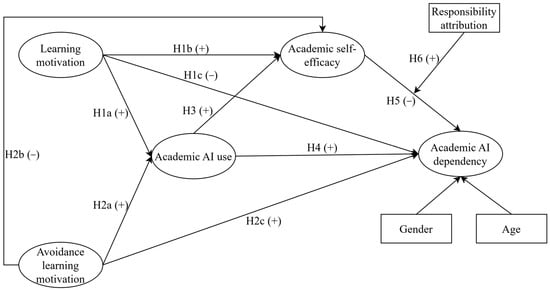
Accordingly, based on the discussion above, we propose the following hypotheses:
H1a.
Learning motivation is positively associated with academic AI use.
H1b.
Learning motivation is positively associated with academic self-efficacy.
H1c.
Learning motivation is negatively associated with academic AI dependency.
H2a.
Avoidance learning motivation is positively associated with academic AI use.
H2b.
Avoidance learning motivation is negatively associated with academic self-efficacy.
H2c.
Avoidance learning motivation is positively associated with academic AI dependency.
H3.
Academic AI use is positively associated with academic self-efficacy.
H4.
Academic AI use is positively associated with academic AI dependency.
H5.
Academic self-efficacy is negatively associated with academic AI dependency.
2.7. Moderating Effect of Responsibility Attribution
Attribution is closely related to self-efficacy (P.-H. P. Hsieh & Schallert, 2008). In Bandura’s early formulation of self-efficacy, individuals’ beliefs about their capabilities are partly shaped by how they interpret previous academic outcomes (Bandura, 1977). According to attribution theory (Weiner, 1976, 2000), when students attribute academic outcomes to internal and controllable causes, such as effort, they are more likely to believe that future performance can be improved through their own actions. This perceived controllability may help preserve self-efficacy, particularly after failure.
Appropriate attributions can also foster adaptive behavior (Peterson et al., 1993). Weiner (1976) indicated that attributions, which arise from students’ self-perceptions, can shape their expectations of their own abilities, as well as their values, emotions, and beliefs, thereby influencing their motivation to engage in behaviors such as AI-assisted learning. For instance, students who make adaptive attributions, such as attributing outcomes to controllable factors like effort, are more likely to monitor their own learning, adjust strategies, and use academic AI as a supplementary tool (Spangenberg & Lategan, 1993). As a result, they are less likely to develop overreliance on AI.
Attribution and self-efficacy interact with each other and influence academic achievement (P. P. Hsieh & Kang, 2010; P.-H. P. Hsieh & Schallert, 2008). Responsibility attribution, as a type of attribution, is mainly used to assess whether the effort required to complete a task in human–AI collaboration is perceived as depending on the individual or on the AI (Lei & Rau, 2021). In this study, it was measured using only one dimension, namely, the extent to which task completion is perceived as depending on one’s own effort. Previous research showed that the effects of academic self-efficacy on adaptive and maladaptive behaviors vary depending on responsibility attribution (Bandura, 1977). Specifically, when students attribute academic outcomes more strongly to their own responsibility, academic self-efficacy is more likely to be expressed through adaptive self-regulated behaviors, such as sustained engagement and reliance on personal effort, thereby reducing excessive dependence on AI tools (Elliot, 1999). Therefore, we hypothesize the following:
H6.
Responsibility attribution will moderate the relationship between academic self-efficacy and academic AI dependency, such that the relationship will be stronger with higher responsibility attribution.
Based on the above discussion, Figure 1 presents our proposed research model. We propose that learning motivation and avoidance learning motivation influence academic AI use and academic self-efficacy, which, in turn, affect academic AI dependency. Responsibility attribution is expected to moderate this process. In addition, gender and age are included as control variables.
Figure 1.
Research model.
3. Method
3.1. Study Procedures
Following approval from the Ethics Committee of Tianjin Normal University, the authors conducted an online survey and collected data through convenience sampling via Credamo in October 2025. Eligible participants were undergraduate or postgraduate students that were currently enrolled at a university and had prior experience using AI. Informed consent was obtained from all participants before they took part in the study.
Participants who failed the attention checks or submitted otherwise invalid responses were excluded. Invalid responses included those completed in an unusually short or long time and those showing patterned response behavior. A total of 815 valid responses from Tianjin Normal University and Shaoxing University were retained for analysis. The final dataset contained no missing values, and the retained responses accounted for 87.3% of all responses collected.
3.2. Participants
The mean age of the 815 participants was 20.94 years, with age ranging from 18 to 33 years. The gender distribution was 261 males (32%) and 554 females (68%). The sample consisted of 733 undergraduates (89.9%) and 82 postgraduates (10.1%). Participants represented multiple disciplines, with the largest proportion coming from the social sciences and humanities (n = 515, 63.2%), followed by engineering (n = 135, 16.6%), natural sciences (n = 93, 11.4%), medicine (n = 37, 4.5%), and arts and sports (n = 35, 4.3%). Detailed demographic characteristics are presented in Table 1.
Table 1.
Demographic information.
3.3. Measures
3.3.1. Learning Motivation
Learning motivation was measured using four items adopted from C.-T. Chang et al. (2019). Responses were recorded on a 5-point Likert scale ranging from 1 (strongly disagree) to 5 (strongly agree), with higher scores indicating stronger learning motivation. A sample item was ‘I am not doubtful about the value of a university degree’. The scale demonstrated acceptable reliability (Cronbach’s α = 0.836).
3.3.2. Avoidance Learning Motivation
Avoidance learning motivation was measured using the Avoidance Learning Motivation Scale developed by Ye et al. (2023). The scale consists of eight items, which are rated on a 5-point Likert scale (1 = strongly disagree, 5 = strongly agree). Higher scores indicate a stronger tendency to avoid learning. Example items include ‘While doing homework, I try to choose the easiest way to do it’ and ‘When I encounter difficulties in my studies, I am inclined to give up’. The scale showed good reliability (Cronbach’s α = 0.884).
3.3.3. Academic AI Use
Academic AI use was assessed using a 13-item scale adopted from Marshik et al. (2025). The scale measures the frequency with which participants use AI tools to complete various academic tasks. Items are scored on a 4-point Likert scale (1 = never, 4 = always), with higher scores indicating more frequent academic AI use. Sample items include ‘Creating professional materials’ and ‘Summarizing reading’. The scale showed acceptable reliability (Cronbach’s α = 0.887).
3.3.4. Academic Self-Efficacy
Academic self-efficacy was measured using four items from the short General Academic Self-Efficacy scale developed by Nielsen et al. (2018). The scale assesses participants’ confidence in performing academic learning tasks. Responses are rated on a 5-point Likert scale (1 = strongly disagree, 5 = strongly agree), with higher scores indicating higher levels of academic self-efficacy. An example item is ‘I will remain calm in my exam because I know I will have the knowledge to solve the problems’. The internal consistency of the scale was acceptable (Cronbach’s α = 0.783).
3.3.5. Academic AI Dependency
The measurements for academic AI dependency in the research were adopted from S. Zhang et al. (2024). The scale consists of six items rated on a 5-point Likert scale ranging from 1 (strongly disagree) to 5 (strongly agree). These items assess self-reported reliance-related experiences, including difficulty reducing AI use and discomfort when access to AI is restricted. Example items include ‘I have tried to cut down on the use of ChatGPT without success’ and ‘I become uneasy or troubled if I am prohibited from using ChatGPT’. The scale showed acceptable internal consistency (Cronbach’s α = 0.824).
3.3.6. Responsibility Attribution
A single item adopted from Lei and Rau (2021) was used to measure responsibility attribution. Responses are rated on a 5-point Likert scale ranging from 1 (strongly disagree) to 5 (strongly agree), with higher scores indicating a stronger tendency to believe that task completion depended on oneself. The item is ‘The task outcome was primarily dependent on me’. No Cronbach’s α was reported because this construct was measured with a single item.
3.4. Measures and Translation
The full original measures of learning motivation, avoidance learning motivation, academic AI use, academic self-efficacy, and academic AI dependency were administered. For responsibility attribution, one item was selected from the original measure because the present study focuses on the extent to which students attribute the effort involved in completing academic tasks to themselves, rather than on responsibility attribution in its broader sense, which includes attribution to both the student and AI. The English items were translated into Chinese by the first author and independently back-translated into English by a bilingual translator. The research team compared the back-translated items with the original items and discussed any discrepancies to ensure clarity and suitability for the study context. No changes were made to the item wording, response options, or scoring procedures beyond translation. The full questionnaire items are provided in Supplementary Materials: Table S1. Measurement Items.
3.5. Data Analysis
The present study used Statistical Package for Social Science (SPSS 27.0) and Smart PLS 4.0 to analyze the data. First, SPSS was used to conduct correlation analyses of the study variables. Next, Smart PLS 4.0 was used to assess the measurement model and test the hypotheses.
4. Results
4.1. Correlation Results of the Variables
As shown in Table 2, learning motivation was negatively correlated with avoidance learning motivation (r = −0.746, p < 0.01) and academic AI dependency (r = −0.373, p < 0.01) and positively correlated with academic self-efficacy (r = 0.657, p < 0.01). Avoidance learning motivation was positively correlated with academic AI use (r = 0.128, p < 0.01) and academic AI dependency (r = 0.494, p < 0.01) but negatively correlated with academic self-efficacy (r = −0.633, p < 0.01). Academic AI use was positively correlated with academic AI dependency (r = 0.538, p < 0.01). Academic self-efficacy was negatively correlated with academic AI dependency (r = −0.325, p < 0.01). The correlations of academic AI use with learning motivation and academic self-efficacy were not statistically significant (both r = 0.010).
Table 2.
Correlations between variables.
4.2. Measurement Model
Before testing the hypotheses, confirmatory factor analysis was used to assess the model’s convergent and discriminant validity. Convergent validity reflects the degree of correlation among indicators measuring the same construct. Higher correlations among these indicators indicate that they better reflect the same construct. Convergent validity was assessed using four indicators: outer loadings, Cronbach’s alpha, composite reliability (CR), and average variance extracted (AVE). According to Fornell and Larcker (1981), the recommended thresholds for evaluating the measurement model are outer loadings >0.5, Cronbach’s alpha > 0.7, CR > 0.7, and AVE > 0.5. As shown in Table 3, the outer loadings of the indicators ranged from 0.500 to 0.872. All outer loadings met or exceeded the minimum criterion of 0.50, although several items in the academic AI use construct showed relatively modest loadings. Cronbach’s alpha values ranged from 0.783 to 0.887, and composite reliability values ranged from 0.859 to 0.908, indicating satisfactory internal consistency. The AVE values ranged from 0.424 to 0.672. Although the AVE for academic AI use was 0.424, below the conventional 0.50 benchmark for convergent validity, the construct showed satisfactory internal consistency, with a Cronbach’s alpha of 0.887 and composite reliability of 0.904. Given the relatively low outer loadings of some items, we nevertheless retained the construct for the following reasons: The scale adopted from Marshik et al. (2025) was designed to capture a broad range of academic AI applications. The relatively modest loadings may partly reflect the breadth of these academic activities, as students may use AI tools for some tasks more frequently than for others. Removing items solely to increase the AVE could narrow the content coverage of the construct. In addition, all items met the minimum loading criterion of 0.50. Therefore, the academic AI use construct was retained in the analysis.
Table 3.
Measurement model results.
Discriminant validity refers to the extent to which one construct is empirically distinct from other constructs. It can be assessed using the Fornell–Larcker criterion and the heterotrait–monotrait (HTMT) ratio of correlations (Fornell & Larcker, 1981). However, the Fornell–Larcker criterion may be less sensitive, particularly when the AVE is low (Henseler et al., 2015). By contrast, HTMT.85 and HTMT.90 have been shown to have high sensitivity, and HTMT.90 is also considered acceptable for conceptually related constructs (Henseler et al., 2015). As shown in Table 4, all HTMT values were below 0.85 except for the relationship between learning motivation and avoidance learning motivation, which had an HTMT value of 0.870. This value is below the more liberal threshold of 0.90, but it exceeds the more conservative threshold of 0.85. Accordingly, the discriminant validity between these two constructs should be regarded as acceptable but borderline.
Table 4.
HTMT discriminant validity results.
The variance inflation factor (VIF) was used to test for multicollinearity, and the results showed that all VIF values were below 3.0, substantially lower than the commonly recommended threshold of 10.
This study used Smart PLS 4.0 to assess model fit. In PLS-SEM, model fit is commonly evaluated using the standardized root mean square residual (SRMR), with values below 0.08 generally indicating an acceptable fit (L. T. Hu & Bentler, 1998). The normed fit index (NFI) is also reported as a supplementary fit index, with values closer to 1 indicating a better model fit (Bentler & Bonett, 1980). The results were SRMR = 0.078 and NFI = 0.801. Although the NFI is below the conventional threshold of 0.90, a value above 0.80 is considered acceptable by some criteria (Baştuğ et al., 2024; Bentler & Bonett, 1980). Therefore, the model demonstrates a marginally acceptable fit.
4.3. Structural Model
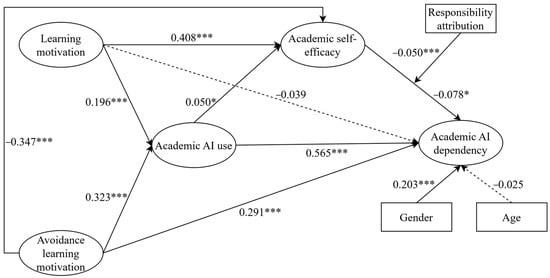
Structural equation modeling was used to test the hypotheses. Gender and age were included as observed covariates in the analysis of academic AI dependency. Gender was coded as a binary variable, with male coded as 0 and female coded as 1. Age was measured in years and entered into the model as a continuous observed covariate. The detailed results are reported in Figure 2 and Table 5. The results showed that learning motivation was positively associated with academic AI use (β = 0.196, p < 0.001) and academic self-efficacy (β = 0.408, p < 0.001) but was not significantly associated with academic AI dependency (β = −0.039, p = 0.363). In contrast, avoidance learning motivation was positively associated with both academic AI use (β = 0.323, p < 0.001) and academic AI dependency (β = 0.291, p < 0.001) while being negatively associated with academic self-efficacy (β = −0.347, p < 0.001). Academic AI use was also positively associated with academic AI dependency (β = 0.565, p < 0.001) and, to a lesser extent, with academic self-efficacy (β = 0.050, p < 0.05). In addition, academic self-efficacy was negatively associated with academic AI dependency (β = −0.078, p < 0.05). Consequently, H1a, H1b, H2a, H2b, H2c, H3, H4, and H5 were supported and H1c was not supported. Among the control variables, gender was significantly and positively associated with academic AI dependency (β = 0.203, p < 0.001), indicating stronger dependency among female students, whereas age was not significantly associated with academic AI dependency (β = −0.025, p > 0.05). The proportions of variance explained by academic AI use, academic self-efficacy, and academic AI dependency were 4.7%, 49.5%, and 53.3%, respectively.
Figure 2.
Results of SEM analysis. Note: * p < 0.05; and *** p < 0.001.
Table 5.
Result of direct effect testing.
Because learning motivation and avoidance learning motivation were estimated jointly, their path coefficients represent conditional associations after accounting for their shared variance. This is reflected in the differences between the correlations and structural paths: the negative correlation between learning motivation and academic AI dependency (r = −0.373) was not significant in the joint model (β = −0.039, p = 0.363), while the positive association for avoidance learning motivation decreased from r = 0.494 to β = 0.291. Thus, the paths should be interpreted as each dimension’s distinct contribution within the model, rather than as its overall association with academic AI dependency.
As shown in Table 6, avoidance learning motivation demonstrated a positive total indirect effect on academic AI dependency (β = 0.208, 95% CI [0.148, 0.273]) and a positive total effect (β = 0.500, 95% CI [0.404, 0.599]). Learning motivation also showed a positive total indirect effect (β = 0.078, 95% CI [0.013, 0.145]); however, its total effect was small and not statistically significant (β = 0.039, 95% bootstrap CI [−0.059, 0.137]).
Table 6.
Total Indirect and Total Effects of Learning Motivation and Avoidance Learning Motivation on Academic AI Dependency.
In addition, the model’s specific indirect effects were also tested using a bootstrapping procedure with 5000 resamples. Their statistical significance was assessed based on the 95% bootstrap confidence intervals, with an indirect effect being considered significant when its confidence interval did not include zero (see Table 7). The results indicated that learning motivation was positively associated with academic AI use, and academic AI use was positively associated with academic AI dependency. The indirect association between learning motivation and academic AI dependency through academic AI use was statistically significant (β = 0.111, 95% CI [0.053, 0.171]). The indirect association between learning motivation and academic AI dependency through academic self-efficacy was also statistically significant (β = −0.032, 95% CI [−0.063, −0.002]). Similarly, the indirect associations of avoidance learning motivation with academic AI dependency through academic AI use (β = 0.182, 95% CI [0.129, 0.241]) and academic self-efficacy (β = 0.027, 95% CI [0.002, 0.057]) were statistically significant.
Table 7.
Test for mediating effects.
4.4. Moderation Analysis
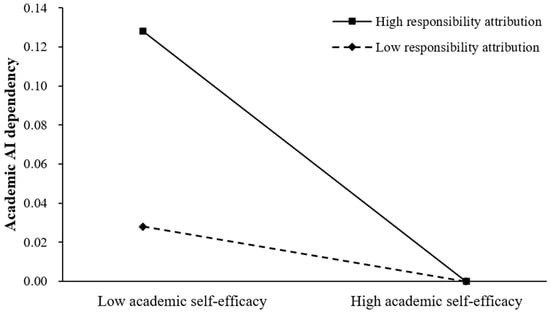
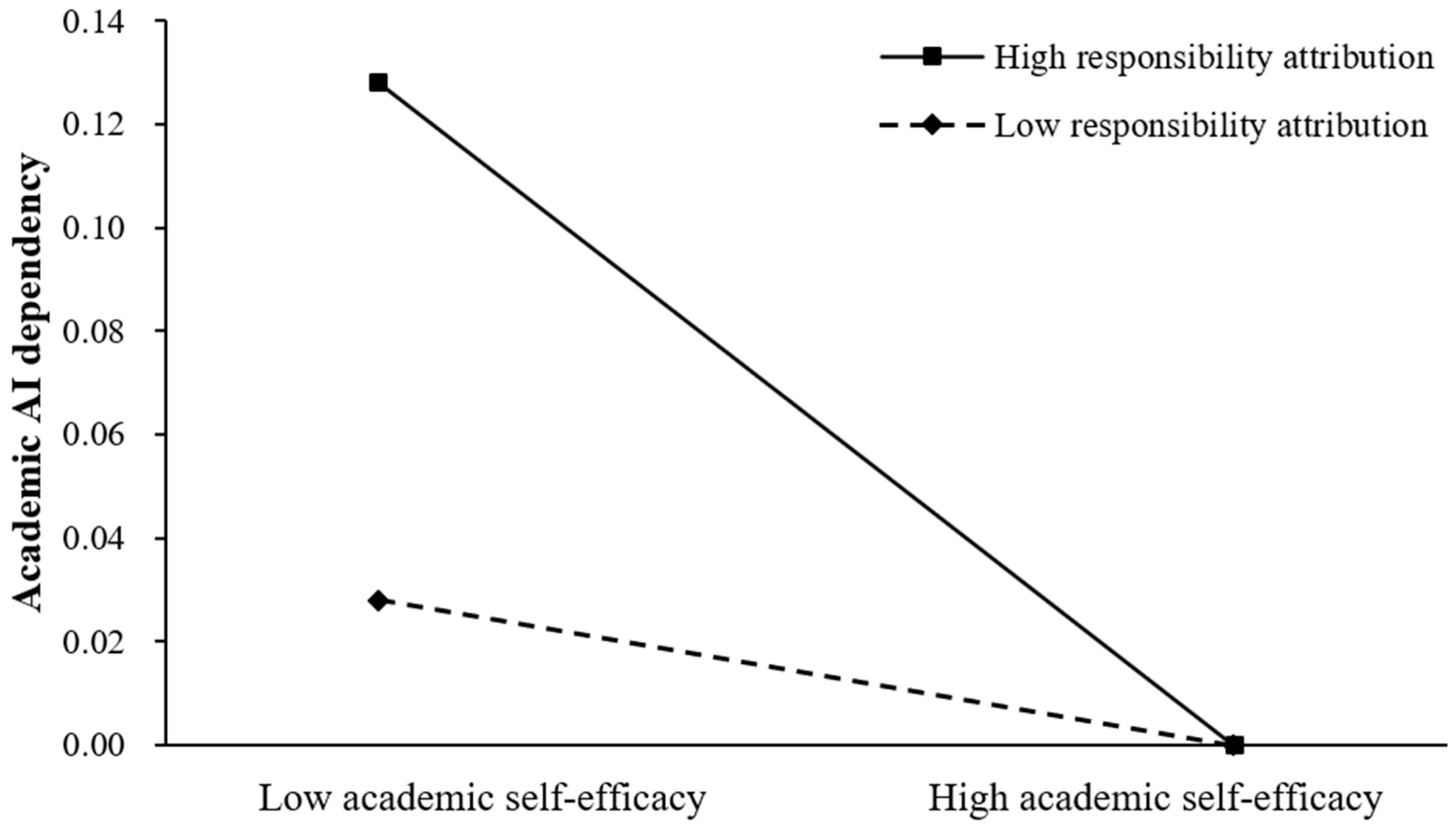
To explore the conditional association between responsibility attribution and academic self-efficacy, we conducted a simple slope analysis (see Figure 3). The test revealed that the association between academic self-efficacy and academic AI dependency was significant for participants with high responsibility attribution (β = −0.184, p < 0.01), while this association became non-significant for participants with low levels of responsibility attribution (β = −0.045, p > 0.05). This result indicated that responsibility attribution significantly moderated the association between academic self-efficacy and academic AI dependency. Thus, H6 was confirmed.
Figure 3.
Moderated effect of the responsibility attribution between academic self-efficacy and academic AI dependency.
4.5. Moderated Mediation Analyses
Based on the significant moderating effect, we further conducted a moderated mediation analysis. To further examine the moderating effect, conditional indirect effects were tested in the path analysis at different levels of the moderator. As shown in Table 8, among college students with higher levels of responsibility attribution (i.e., M + 1SD), the indirect effect of learning motivation on academic AI dependency through the mediation of academic self-efficacy was significant and stronger (β = −0.055; 95% CI = [−0.096; −0.018]) compared with those with a moderate level (i.e., M) (β = −0.034; 95% CI = [−0.067; −0.005]) and lower level (i.e., M − 1SD) (β = −0.014; 95% CI = [−0.041; 0.013]). In addition, the indirect effect of avoidance learning motivation on academic AI dependency through the mediation of academic self-efficacy also increased as responsibility attribution increased, from low level (β = 0.012; 95% CI = [−0.011; 0.036]) to medium (β = 0.030; 95% CI = [0.004; 0.061]) and, finally, to high level (β = 0.048; 95% CI = [0.016; 0.089]).
Table 8.
Conditional indirect effects of LM and ALM on AAD.
5. Discussion
The present study provides a more focused understanding of how learning motivation and avoidance learning motivation differentially relate to academic AI use, academic self-efficacy, and academic AI dependency, with gender and age serving as control variables. Overall, the findings support the core ideas of the I-PACE model (Brand et al., 2016, 2019), which posits that technology-related behaviors and problematic outcomes emerge from the dynamic interplay among personal characteristics, cognitive and affective responses, and executive control processes. Importantly, the results indicated that the effects of motivation on AI dependency were indirect and varied across behavioral and cognitive pathways, with further moderation by responsibility attribution. This process-oriented perspective significantly extends the I-PACE framework by demonstrating how motivational orientations may shape students’ academic AI dependency in both adaptive and maladaptive ways within educational contexts.
5.1. HTMT Value Between Learning Motivation and Avoidance Learning Motivation
The HTMT value between learning motivation and avoidance learning motivation was 0.87, indicating a relatively strong conceptual association between the two constructs. However, consistent with Elliot (2006), they represent distinct motivational tendencies, with learning motivation reflecting students’ willingness to engage in learning and avoidance learning motivation reflecting their tendency to disengage from or avoid learning activities. Moreover, these two motivational tendencies may coexist within the same individual. For instance, students may be willing to engage in learning while also avoiding certain learning activities because of fear of failure or concerns about negative evaluation (H. Liu et al., 2020). Students’ willingness to learn does not necessarily eliminate their tendency to avoid particular learning situations. This possibility helps explain why the two constructs may show a relatively strong association while still capturing different aspects of students’ motivational experiences. Accordingly, given their substantial overlap, the structural paths for these dimensions should be interpreted as conditional associations.
5.2. Gender and Age Differences in Academic AI Dependency
Female students reported higher levels of academic AI dependency than male students. This is consistent with Schokkenbroek et al. (2026), who found that women reported greater psychological dependency on social media and greater use of high-engagement platforms. One possible explanation is that female students may become more emotionally engaged when using technology. In academic contexts, AI may function as a readily available source of support, providing immediate assistance with academic difficulties and a sense of responsiveness when students face challenges. This combination of practical assistance and perceived emotional support may be associated with greater reliance on AI among female students. However, this finding requires further verification, given the uneven gender distribution in the sample and the possible effects of differences in participants’ AI experience and academic backgrounds. By contrast, the nonsignificant age effect may reflect the relatively narrow age range of the university sample.
5.3. Differential Effects of Learning Motivation and Avoidance Learning Motivation
Learning motivation was positively associated with academic AI use and academic self-efficacy, supporting H1a and H1b. This pattern suggests that students with higher learning motivation tend to use AI tools more frequently and strategically while also reporting higher levels of academic self-efficacy (Bai & Wang, 2025; Teng, 2025; Yang, 2026). Such findings align with achievement goal theory (Elliott & Dweck, 1988) and self-determination theory (Deci et al., 1991), indicating that highly motivated students are more likely to use AI strategically as a supplementary resource, engage in self-regulated learning, and report stronger academic self-efficacy (Brand et al., 2016; Elliot, 2006). However, learning motivation was not significantly associated with academic AI dependency, and H1c was not supported. The absence of a direct negative effect on dependency implies that even highly motivated students may not be immune to overreliance if AI use becomes habitual or overly convenient. This nuanced finding highlights that motivation alone may not be sufficient to explain academic AI dependency, and that additional regulatory factors may also play a role.
However, avoidance learning motivation demonstrated a predominantly maladaptive profile (Elliot & Sheldon, 1997; Jiang et al., 2020; Świątkowski & Dompnier, 2021). First, it was positively associated with academic AI use, supporting H2a. This suggests that students who are motivated to avoid failure or negative evaluation may use AI more frequently to manage academic pressure and reduce anxiety. From an I-PACE perspective, such use may function as an emotion-focused coping strategy rather than as a learning-oriented strategy (Brand et al., 2016; Elliot, 2006). Second, avoidance learning motivation was positively associated with academic AI dependency, supporting H2c. Students with stronger avoidance learning motivation may therefore be more likely to rely excessively on AI when facing difficult academic tasks or the possibility of failure. Repeated reliance on AI may reinforce avoidance-oriented patterns of engagement and increase dependency (Zander & Höhne, 2021; J. Zhong et al., 2023). Finally, avoidance learning motivation was negatively associated with academic self-efficacy, supporting H2b. This indicates that students who are more concerned with avoiding failure may have less confidence in their academic abilities, consistent with the view that avoidance goals are associated with negative perceptions of competence (Elliot, 2006). In a nutshell, these findings highlight the maladaptive nature of avoidance learning motivation and underscore the importance of distinguishing motivational orientations when examining technology use and dependency in academic settings (Vu et al., 2022).
5.4. Academic AI Use, Academic Self-Efficacy, and Academic AI Dependency
Academic AI use was positively associated with academic self-efficacy, supporting H3. This suggests that students who use AI for academic tasks may feel more capable of understanding course material and completing assignments, particularly when they use it to support their own learning. Academic AI use was also positively associated with academic AI dependency, indicating that frequent use may be accompanied by greater reliance on AI. The finding supports H4. This relationship highlights the importance of how students use these tools. AI can support learning, but relying on it too heavily may make it harder for students to work independently (Salas-Pilco & Yang, 2022). Finally, academic self-efficacy was negatively associated with academic AI dependency, supporting H5. Students who feel more confident in their academic abilities may be less likely to rely excessively on AI, whereas those with lower confidence may turn to it more often for support (S. Zhang et al., 2024). These findings suggest that academic AI use can be linked to both stronger self-efficacy and greater dependency, while self-efficacy may serve as a protective factor against dependency.
5.5. Mediating Mechanisms: Academic AI Use and Academic Self-Efficacy
Academic AI use and academic self-efficacy represented two distinct pathways linking motivational orientations with academic AI dependency. First, learning motivation was positively associated with academic AI use, and the indirect association between learning motivation and academic AI dependency through academic AI use was significant. This finding suggests that students with stronger learning motivation may use AI more frequently for academic purposes, and that more frequent AI use may be associated with greater AI dependency. A similar indirect pathway was observed for avoidance learning motivation, which was positively associated with academic AI use and, in turn, with academic AI dependency. These findings are consistent with the I-PACE framework, which proposes that repeated engagement with technology may become problematic when it is insufficiently regulated (Brand et al., 2019). Notably, although academic AI use was also positively associated with self-efficacy, the effect size was small, suggesting that the quality and purpose of AI use may determine whether it enhances competence beliefs or primarily fosters dependency (Scutelnicu & Ceobanu, 2024).
Academic self-efficacy represented a distinct cognitive pathway (Cabras et al., 2024; Pǎduraru et al., 2025). Learning motivation was positively associated with academic self-efficacy, whereas avoidance learning motivation was negatively associated with it. In turn, academic self-efficacy was negatively associated with academic AI dependency. The indirect association through academic self-efficacy was therefore significant for learning motivation and avoidance learning motivation. These results are consistent with self-efficacy theory (Bandura, 1977), which emphasizes the role of perceived competence in shaping individuals’ engagement and persistence in academic tasks. Collectively, these mediation findings suggest that the relationship between motivation and academic AI dependency operates through two distinct pathways: students’ academic AI use as a behavioral pathway and academic self-efficacy as a cognitive pathway (Chedrawi et al., 2025).
Importantly, the direct association between learning motivation and academic AI dependency was not statistically significant. This result does not necessarily indicate that learning motivation is unrelated to academic AI dependency; instead, the two indirect pathways may operate in opposite directions. The behavioral pathway, through more frequent academic AI use, may be associated with greater dependency, whereas the cognitive pathway, through stronger academic self-efficacy, may be associated with lower dependency. These opposing pathways may help explain why the direct association was not significant. Thus, the findings suggest that the relationship between learning motivation and academic AI dependency is complex.
5.6. The Moderating Role of Responsibility Attribution
A particularly novel contribution of this study lies in the moderating effect of responsibility attribution. The results showed that responsibility attribution significantly moderated the negative relationship between academic self-efficacy and academic AI dependency. Specifically, the protective effect of self-efficacy was significant only among students with high responsibility attribution but became non-significant at low levels. Importantly, however, the moderated mediation findings also suggested that responsibility attribution is not uniformly beneficial. The indirect protective pathway from learning motivation through self-efficacy to lower dependency was significant at both medium and high levels of responsibility attribution, while the indirect risk pathway from avoidance learning motivation through self-efficacy was also significant at both medium and high levels of responsibility attribution. Taken together, these results indicate that responsibility attribution functions as a double-edged moderator, amplifying both adaptive and maladaptive motivational processes.
These findings extend attribution theory (P.-H. P. Hsieh & Schallert, 2008; Weiner, 1976) by showing that responsibility attribution changes the strength of the relationship between academic self-efficacy and academic AI dependency. When students perceive academic outcomes as primarily contingent on their own effort, self-efficacy beliefs show a stronger association with self-regulated academic behavior. For students with stronger learning motivation, higher responsibility attribution may facilitate the role of self-efficacy in self-regulation and lower reliance on AI. However, for students with stronger avoidance learning motivation, the same sense of personal responsibility may intensify pressure and make low self-efficacy more strongly associated with AI dependency. Within the I-PACE framework (Brand et al., 2016, 2019), responsibility attribution may therefore be better understood not as a uniformly protective executive control factor, but as a context-dependent amplifier that strengthens the extent to which self-efficacy shapes technology-related behavior. This suggests that the protective role of self-efficacy against AI dependency is conditional rather than universal.
5.7. Theoretical and Practical Contributions
Theoretically, this study develops a framework that differentiates the effects of learning motivation and avoidance learning motivation on academic AI dependency. The findings indicate that avoidance learning motivation was directly associated with academic AI dependency and was also indirectly associated with it through academic AI use and academic self-efficacy, whereas learning motivation was associated with academic AI dependency only indirectly through these two variables. By demonstrating that academic AI dependency is shaped by motivational and self-efficacy factors in addition to AI use, this study extends previous research that primarily focused on the use–dependency relationship (Ye et al., 2025; L. Zhang & Xu, 2025; S. Zhang et al., 2024).
Furthermore, our study extends the application of achievement goal theory to academic AI use, providing a novel theoretical perspective for understanding AI use in academic settings. According to achievement goal theory, higher learning motivation is associated with approach-oriented goals (Carreira, 2011; Usán Supervía et al., 2019), which may encourage students to use AI to improve their own problem-solving ability, thereby enhancing academic self-efficacy and reducing dependency. It also extends the I-PACE model to academic AI dependency by showing that motivation, as a personal characteristic, is associated with dependency both directly and indirectly through AI use. Moreover, responsibility attribution moderates the negative relationship between academic self-efficacy and academic AI dependency, such that this relationship is stronger when students attribute greater responsibility for completing academic tasks to themselves.
Practically, this study indicates that learning motivation and avoidance learning motivation are indirectly associated with academic AI dependency through academic AI use and academic self-efficacy. The strength of the association between academic self-efficacy and academic AI dependency also varied according to levels of responsibility attribution. Based on this mechanism, schools should adopt targeted interventions to strengthen learning motivation and reduce avoidance learning motivation. For instance, instructors can require students to explain their reasoning, reflect on AI use, verify AI-generated information, and revise their work independently, thereby positioning AI as a support tool. Teachers should also promote adaptive attribution by emphasizing controllable factors such as effort, learning strategies, and persistence. Regular feedback, process-based assessment, and independent problem-solving opportunities can enhance students’ competence and responsibility, encourage active and self-regulated AI use, and reduce excessive dependence on AI.
5.8. Limitations and Future Studies
Although the current study makes some contributions, its limitations should also be acknowledged and addressed in future research. First, we used a cross-sectional design, so causal relationships among the variables cannot be determined (Monazam-Tabrizi et al., 2026). Future studies should adopt longitudinal and experimental designs to examine causal relations more clearly.
Second, the sample consisted predominantly of Chinese university students, female students, and students from the social sciences and humanities, which may limit the representativeness and generalizability of the findings across cultural, gender, and disciplinary groups (Jackson & Wang, 2013). Future research should use more balanced samples to further assess the generalizability of these findings.
Third, the motivation measures capture broad learning-oriented and avoidance-oriented motivational tendencies rather than specific achievement goal dimensions such as mastery approach, performance approach, or performance avoidance goals. Therefore, the theoretical interpretation, from the perspective of achievement goal theory, should be viewed as suggestive rather than as a direct test of the full theory. Future research should replicate these findings using measures that more closely align with achievement goal theory.
Fourth, the analyses relied mainly on participants’ self-report data, which may have affected the objectivity of the findings (Huang et al., 2024). Future research could use more objective indicators to assess the outcomes and relationships among the variables. In addition, the lack of pilot testing for the translated items may have affected participants’ interpretation and the study results. Future research should pilot test and further validate the translated measures. Moreover, responsibility attribution was measured with a single item focusing on students perceived responsibility for academic task outcomes, which may have reduced construct validity and the precision of the moderation and moderated mediation estimates. Future research should use a multi-item scale to assess this construct more comprehensively.
Finally, the academic AI use measure showed acceptable internal consistency but a relatively low AVE of 0.424, below the commonly used 0.50 benchmark for convergent validity. Although the construct was retained because its items provided important content coverage, findings involving this measure should be interpreted with caution. Future research should further validate the scale.
6. Conclusions
The present study examined the pathways through which learning motivation and avoidance learning motivation are related to academic AI dependency. Specifically, the indirect effects of learning motivation through academic AI use and academic self-efficacy were significant. Meanwhile, avoidance learning motivation was positively associated with academic AI dependency, with a significant indirect effect on dependency via academic AI use and academic self-efficacy. Furthermore, responsibility attribution significantly moderated the association between academic self-efficacy and academic AI dependency, such that the negative effect of academic self-efficacy on academic AI dependency became stronger when responsibility attribution was higher. Further moderated mediation analyses indicated that the indirect effects of learning motivation and avoidance learning motivation on academic AI dependency through academic self-efficacy were significant at both medium and high levels of responsibility attribution. In conclusion, these findings suggest that students’ motivation and academic self-efficacy are associated with academic AI dependency, and that responsibility attribution moderates the association between academic self-efficacy and academic AI dependency.
Supplementary Materials
The following supporting information can be downloaded at https://www.mdpi.com/article/10.3390/bs16122269/s1: Table S1. Measurement Items.
Author Contributions
Conceptualization, M.C.; methodology, M.C.; software, A.Q.; formal analysis, A.Q.; investigation, A.Q.; data curation, A.Q.; writing—original draft preparation, A.Q.; writing—review and editing, M.C.; supervision, M.C.; funding acquisition, M.C. All authors have read and agreed to the published version of the manuscript.
Funding
This work was funded by the National Social Science Fund of China [21CSH050].
Institutional Review Board Statement
The study was conducted in accordance with the Declaration of Helsinki and approved by the Ethics Committee of Tianjin Normal University (protocol code 2025070913 and date of approval 9 July 2025).
Informed Consent Statement
Informed consent was obtained from all subjects involved in the study.
Data Availability Statement
The datasets generated and analyzed during the current study are available from the corresponding author on reasonable request.
Conflicts of Interest
The authors have no conflicts of interest to declare.
References
- Abbas, M., Jam, F. A., & Khan, T. I. (2024). Is it harmful or helpful? Examining the causes and consequences of generative AI usage among university students. International Journal of Educational Technology in Higher Education, 21(1), 10. [Google Scholar] [CrossRef] [Scilit]
- Abdelrahman, R. M. (2020). Metacognitive awareness and academic motivation and their impact on academic achievement of Ajman university students. Heliyon, 6(9), e04192. [Google Scholar] [CrossRef] [Scilit] [PubMed]
- Alfiyah, H. D., & Habiby, W. N. (2025). Correlation between self-efficacy and motivation with self-direct learning of elementary school students. Pedagogia: Jurnal Pendidikan, 14(2), 102–120. [Google Scholar] [CrossRef] [Scilit]
- Backfisch, I., Lachner, A., Stürmer, K., & Scheiter, K. (2021). Variability of teachers’ technology integration in the classroom: A matter of utility! Computers & Education, 166, 104159. [Google Scholar] [CrossRef] [Scilit]
- Bai, Y., & Wang, S. (2025). Impact of generative AI interaction and output quality on university students’ learning outcomes: A technology-mediated and motivation-driven approach. Scientific Reports, 15(1), 24054. [Google Scholar] [CrossRef] [Scilit] [PubMed]
- Bandura, A. (1977). Self-efficacy: Toward a unifying theory of behavioral change. Psychological Review, 84(2), 191. [Google Scholar] [CrossRef] [Scilit] [PubMed]
- Baştuğ, M., Atasoy, M., & Öncü, B. (2024). Primary school teachers cannot give what they do not get: The teacher care scale. International Journal of Modern Education Studies, 8(2), 291–318. [Google Scholar] [CrossRef] [Scilit]
- Bentler, P. M., & Bonett, D. G. (1980). Significance tests and goodness of fit in the analysis of covariance structures. Psychological Bulletin, 88(3), 588. [Google Scholar] [CrossRef]
- Brand, M., Wegmann, E., Stark, R., Müller, A., Wölfling, K., Robbins, T. W., & Potenza, M. N. (2019). The interaction of person-affect-cognition-execution (I-PACE) model for addictive behaviors: Update, generalization to addictive behaviors beyond internet-use disorders, and specification of the process character of addictive behaviors. Neuroscience & Biobehavioral Reviews, 104, 1–10. [Google Scholar] [CrossRef] [Scilit] [PubMed]
- Brand, M., Young, K. S., Laier, C., Wölfling, K., & Potenza, M. N. (2016). Integrating psychological and neurobiological considerations regarding the development and maintenance of specific internet-use disorders: An interaction of person-affect-cognition-execution (I-PACE) model. Neuroscience & Biobehavioral Reviews, 71, 252–266. [Google Scholar] [CrossRef] [Scilit] [PubMed]
- Cabras, E., Pozo, P., Suárez-Falcón, J. C., Caprara, M., & Contreras, A. (2024). Stress and academic achievement among distance university students in Spain during the COVID-19 pandemic: Age, perceived study time, and the mediating role of academic self-efficacy. European Journal of Psychology of Education, 39(4), 4275–4295. [Google Scholar] [CrossRef] [Scilit]
- Carreira, J. M. (2011). Relationship between motivation for learning EFL and intrinsic motivation for learning in general among Japanese elementary school students. System, 39(1), 90–102. [Google Scholar] [CrossRef] [Scilit]
- Chang, C., Hwang, G., & Gau, M. (2022). Promoting students’ learning achievement and self-efficacy: A mobile chatbot approach for nursing training. British Journal of Educational Technology, 53(1), 171–188. [Google Scholar] [CrossRef] [Scilit]
- Chang, C.-T., Tu, C.-S., & Hajiyev, J. (2019). Integrating academic type of social media activity with perceived academic performance: A role of task-related and non-task-related compulsive internet use. Computers & Education, 139, 157–172. [Google Scholar] [CrossRef] [Scilit]
- Chedrawi, C., Haddad, G., Tarhini, A., Osta, S., & Kazoun, N. (2025). Exploring the impact of responsible AI usage on users’ behavioral intentions. Journal of Innovation & Knowledge, 10(6), 100813. [Google Scholar] [CrossRef] [Scilit]
- Choi, T. R., & Drumwright, M. E. (2021). “OK, google, why do I use you?” motivations, post-consumption evaluations, and perceptions of voice AI assistants. Telematics and Informatics, 62, 101628. [Google Scholar] [CrossRef] [Scilit]
- Clark, M. H., Middleton, S. C., Nguyen, D., & Zwick, L. K. (2014). Mediating relationships between academic motivation, academic integration and academic performance. Learning and Individual Differences, 33, 30–38. [Google Scholar] [CrossRef] [Scilit]
- Deci, E. L., Vallerand, R. J., Pelletier, L. G., & Ryan, R. M. (1991). Motivation and education: The self-determination perspective. Educational Psychologist, 26(3–4), 325–346. [Google Scholar] [CrossRef] [Scilit]
- Elliot, A. J. (1999). Approach and avoidance motivation and achievement goals. Educational Psychologist, 34(3), 169–189. [Google Scholar] [CrossRef] [Scilit] [PubMed]
- Elliot, A. J. (2006). The hierarchical model of approach-avoidance motivation. Motivation and Emotion, 30(2), 111–116. [Google Scholar] [CrossRef] [Scilit]
- Elliot, A. J., & Sheldon, K. M. (1997). Avoidance achievement motivation: A personal goals analysis. Journal of Personality and Social Psychology, 73(1), 171. [Google Scholar] [CrossRef] [PubMed]
- Elliott, E. S., & Dweck, C. S. (1988). Goals: An approach to motivation and achievement. Journal of Personality and Social Psychology, 54(1), 5. [Google Scholar] [CrossRef] [PubMed]
- Fabio, R. A., & Iaconis, S. M. (2024). The role of critical thinking in mitigating social network addiction: A study of TikTok and Instagram users. International Journal of Environmental Research and Public Health, 21(10), 1305. [Google Scholar] [CrossRef] [Scilit] [PubMed]
- Fornell, C., & Larcker, D. F. (1981). Evaluating structural equation models with unobservable variables and measurement error. Journal of Marketing Research, 18(1), 39–50. [Google Scholar] [CrossRef] [Scilit]
- Hariguna, T., & Ruangkanjanases, A. (2023). Exploring the flexibility and accuracy of sentiment scoring models through a hybrid KNN-RNN-CNN algorithm and ChatGPT. HighTech and Innovation Journal, 4(2), 315–326. [Google Scholar] [CrossRef] [Scilit]
- Henseler, J., Ringle, C. M., & Sarstedt, M. (2015). A new criterion for assessing discriminant validity in variance-based structural equation modeling. Journal of the Academy of Marketing Science, 43(1), 115–135. [Google Scholar] [CrossRef] [Scilit]
- Hong, J. C., Ye, J. H., & Shih, Y. Y. (2019). Positive affect creative self-efficacy on the ability and confidence to predict problem solving avoidance motivation in a digital advertisement design course. Bulletin of Educational Psychology, 51, 321–339. [Google Scholar]
- Hsieh, P.-H. P., & Schallert, D. L. (2008). Implications from self-efficacy and attribution theories for an understanding of undergraduates’ motivation in a foreign language course. Contemporary Educational Psychology, 33(4), 513–532. [Google Scholar] [CrossRef] [Scilit]
- Hsieh, P. P., & Kang, H. (2010). Attribution and self-efficacy and their interrelationship in the Korean EFL context. Language Learning, 60(3), 606–627. [Google Scholar] [CrossRef] [Scilit]
- Hu, B., Mao, Y., & Kim, K. J. (2023). How social anxiety leads to problematic use of conversational AI: The roles of loneliness, rumination, and mind perception. Computers in Human Behavior, 145, 107760. [Google Scholar] [CrossRef] [Scilit]
- Hu, L. T., & Bentler, P. M. (1998). Fit indices in covariance structure modeling: Sensitivity to underparameterized model misspecification. Psychological Methods, 3(4), 424. [Google Scholar] [CrossRef]
- Huang, S., Lai, X., Ke, L., Li, Y., Wang, H., Zhao, X., Dai, X., & Wang, Y. (2024). AI technology panic—Is AI dependence bad for mental health? A cross-lagged panel model and the mediating roles of motivations for AI use among adolescents. Psychology Research and Behavior Management, 17, 1087–1102. [Google Scholar] [CrossRef] [Scilit] [PubMed]
- Jackson, L. A., & Wang, J.-L. (2013). Cultural differences in social networking site use: A comparative study of China and the unite states. Computers in Human Behavior, 29(3), 910–921. [Google Scholar] [CrossRef] [Scilit]
- Jiang, Y., Kim, S., & Bong, M. (2020). The role of cost in adolescent students’ maladaptive academic outcomes. Journal of School Psychology, 83, 1–24. [Google Scholar] [CrossRef] [Scilit] [PubMed]
- Jin, F., Lin, C.-H., & Lai, C. (2025). Modeling AI-assisted writing: How self-regulated learning influences writing outcomes. Computers in Human Behavior, 165, 108538. [Google Scholar] [CrossRef] [Scilit]
- Klingbeil, A., Grützner, C., & Schreck, P. (2024). Trust and reliance on AI—An experimental study on the extent and costs of overreliance on AI. Computers in Human Behavior, 160, 108352. [Google Scholar] [CrossRef] [Scilit]
- Lei, X., & Rau, P.-L. P. (2021). Effect of relative status on responsibility attributions in human–robot collaboration: Mediating role of sense of responsibility and moderating role of power distance orientation. Computers in Human Behavior, 122, 106820. [Google Scholar] [CrossRef] [Scilit]
- Liu, H., Yao, M., & Li, J. (2020). Chinese adolescents’ achievement goal profiles and their relation to academic burnout, learning engagement, and test anxiety. Learning and Individual Differences, 83–84, 101945. [Google Scholar] [CrossRef] [Scilit]
- Liu, J. (2025). When usefulness fuels fear: The paradox of generative AI dependence and the mitigating role of AI literacy. International Journal of Human–Computer Interaction, 42(7), 5265–5286. [Google Scholar] [CrossRef] [Scilit]
- Marshik, T., McCracken, C., Kopp, B., & O’Marrah, M. (2025). Student and instructor perceptions and uses of artificial intelligence in higher education. Teaching of Psychology, 52(3), 339–346. [Google Scholar] [CrossRef] [Scilit]
- Monazam-Tabrizi, N., Kurt, Y., & Kang, W. i.-K. (2026). Navigating learning disruptions: The role of digital learning platforms in student motivation, feedback and emotion. Computers & Education, 246, 105534. [Google Scholar] [CrossRef] [Scilit]
- Nielsen, T., Dammeyer, J., Vang, M. L., & Makransky, G. (2018). Gender fairness in self-efficacy? A Rasch-based validity study of the general academic self-efficacy scale (GASE). Scandinavian Journal of Educational Research, 62(5), 664–681. [Google Scholar] [CrossRef] [Scilit]
- Pan, X. (2020). Technology acceptance, technological self-efficacy, and attitude toward technology-based self-directed learning: Learning motivation as a mediator. Frontiers in Psychology, 11, 564294. [Google Scholar] [CrossRef] [Scilit] [PubMed]
- Pǎduraru, A. E., Soponaru, C., Dîrţu, C., Gavrilovici, O., & Bucuţǎ, M. D. (2025). What do I need from myself as a student but also from others to reduce the impact of stress on academic performance? Self-efficacy and social support. Frontiers in Education, 9, 1469865. [Google Scholar] [CrossRef] [Scilit]
- Peterson, C., Maier, S. F., & Seligman, M. E. (1993). Learned helplessness: A theory for the age of personal control. Oxford University Press. [Google Scholar]
- Ramadhani, E., Setiyosari, P., Indreswari, H., Setiyowati, A. J., & Putri, R. D. (2026). Academic procrastination: A systematic review of causal factors and interventions. Journal of Behavioral and Cognitive Therapy, 36(1), 100552. [Google Scholar] [CrossRef] [Scilit]
- Rodríguez-Ruiz, J., Marín-López, I., & Espejo-Siles, R. (2025). Is artificial intelligence use related to self-control, self-esteem and self-efficacy among university students? Education and Information Technologies, 30(2), 2507–2524. [Google Scholar] [CrossRef] [Scilit]
- Salas-Pilco, S. Z., & Yang, Y. (2022). Artificial intelligence applications in Latin American higher education: A systematic review. International Journal of Educational Technology in Higher Education, 19(1), 21. [Google Scholar] [CrossRef] [Scilit]
- Sari, E., & Han, T. (2024). The impact of automated writing evaluation on English as a foreign language learners’ writing self-efficacy, self-regulation, anxiety, and performance. Journal of Computer Assisted Learning, 40(5), 2065–2080. [Google Scholar] [CrossRef] [Scilit]
- Schokkenbroek, J. M., Rebrean, M.-L., Rosca, C., Picout, M., Malgieri, G., Wagner, B., & Sánchez Chamorro, L. (2026). Mapping social media dependency: Functional and psychological platform reliance as mechanisms of digital vulnerability. In Proceedings of the 2026 CHI conference on human factors in computing systems (pp. 1–24). Association for Computing Machinery. [Google Scholar] [CrossRef] [Scilit]
- Scutelnicu, L. A., & Ceobanu, M. C. (2024, June). Impact of AI-powered platforms on academic learning: Exploring the purpose and evaluation used in the learning process. In KES international symposium on agent and multi-agent systems: Technologies and applications (pp. 371–381). Springer Nature Singapore. [Google Scholar] [CrossRef] [Scilit]
- Spangenberg, J. J., & Lategan, T. P. (1993). Coping, androgyny, and attributional style. South African Journal of Psychology, 23(4), 195–203. [Google Scholar] [CrossRef] [Scilit]
- Su, W., Sun, X., Guo, X., Zhang, W., & Li, G. (2022). An analysis of awe evoked by COVID-19 on green purchasing behavior: A dual-path effect of approach-avoidance motivation. Frontiers in Psychology, 13, 952485. [Google Scholar] [CrossRef] [Scilit] [PubMed]
- Świątkowski, W., & Dompnier, B. (2021). When pursuing bad goals for good reasons makes it even worse: A social value approach to performance-avoidance goal pursuit. Social Psychology of Education, 24(3), 653–677. [Google Scholar] [CrossRef] [Scilit] [PubMed]
- Tanveer, I., Iqbal, S., & Hussain, A. (2024). Examining the impact of ai based chatbots on academic self-efficacy and self-regulation among university students. Journal of Development and Social Sciences, 5(2), 468–477. [Google Scholar]
- Teng, M. F. (2025). Examining longitudinal development of writing motivation in the GenAI context: A self-determination theory perspective. Learning and Motivation, 91, 102157. [Google Scholar] [CrossRef] [Scilit]
- Usán Supervía, P., Salavera Bordás, C., & Teruel, P. (2019). School motivation, goal orientation and academic performance in secondary education students. Psychology Research and Behavior Management, 12, 877–887. [Google Scholar] [CrossRef] [Scilit] [PubMed]
- Vu, T., Magis-Weinberg, L., Jansen, B. R. J., Van Atteveldt, N., Janssen, T. W. P., Lee, N. C., Van Der Maas, H. L. J., Raijmakers, M. E. J., Sachisthal, M. S. M., & Meeter, M. (2022). Motivation-achievement cycles in learning: A literature review and research agenda. Educational Psychology Review, 34(1), 39–71. [Google Scholar] [CrossRef] [Scilit]
- Weiner, B. (1976). 5: An attributional approach for educational psychology. Review of Research in Education, 4(1), 179–209. [Google Scholar] [CrossRef] [Scilit] [PubMed]
- Weiner, B. (2000). Intrapersonal and interpersonal theories of motivation from an attributional perspective. Educational Psychology Review, 12(1), 1–14. [Google Scholar] [CrossRef] [Scilit]
- Xia, Q., Chiu, T. K. F., Lee, M., Sanusi, I. T., Dai, Y., & Chai, C. S. (2022). A self-determination theory (SDT) design approach for inclusive and diverse artificial intelligence (AI) education. Computers & Education, 189, 104582. [Google Scholar] [CrossRef] [Scilit]
- Yang, S. C. (2026). Integrating technology acceptance, self-determination, and self-regulation: A structural model of generative AI-supported learning and competence. Computers in Human Behavior, 179, 108933. [Google Scholar] [CrossRef] [Scilit]
- Ye, J.-H., He, Z., Yang, X., Lee, Y.-S., Nong, W., Ye, J.-N., & Wang, C.-L. (2023). Predicting the learning avoidance motivation, learning commitment, and silent classroom behavior of Chinese vocational college students caused by short video addiction. Healthcare, 11(7), 985. [Google Scholar] [CrossRef] [Scilit] [PubMed]
- Ye, J.-H., Zhang, M., Nong, W., Wang, L., & Yang, X. (2025). The relationship between inert thinking and ChatGPT dependence: An I-PACE model perspective. Education and Information Technologies, 30(3), 3885–3909. [Google Scholar] [CrossRef] [Scilit]
- Yurt, E., & Kasarci, I. (2024). A questionnaire of artificial intelligence use motives: A contribution to investigating the connection between AI and motivation. International Journal of Technology in Education, 7(2), 308–325. [Google Scholar] [CrossRef] [Scilit]
- Zander, L., & Höhne, E. (2021). Perceived peer exclusion as predictor of students’ help-seeking strategies in higher education: Differences by gender and university major. Zeitschrift für Entwicklungspsychologie und Pädagogische Psychologie, 53(1–2), 27–41. [Google Scholar] [CrossRef] [Scilit]
- Zhang, L., & Xu, J. (2025). The paradox of self-efficacy and technological dependence: Unraveling generative AI’s impact on university students’ task completion. The Internet and Higher Education, 65, 100978. [Google Scholar] [CrossRef] [Scilit]
- Zhang, S., Zhao, X., Zhou, T., & Kim, J. H. (2024). Do you have AI dependency? The roles of academic self-efficacy, academic stress, and performance expectations on problematic AI usage behavior. International Journal of Educational Technology in Higher Education, 21(1), 34. [Google Scholar] [CrossRef] [Scilit]
- Zhong, J., Wen, J., & Li, K. (2023). Do achievement goals differently orient students’ academic engagement through learning strategy and academic self-efficacy and vary by grade. Psychology Research and Behavior Management, 16, 4779–4797. [Google Scholar] [CrossRef] [Scilit] [PubMed]
- Zhong, W., Luo, J., & Lyu, Y. (2024). How do personal attributes shape AI dependency in Chinese higher education context? Insights from needs frustration perspective. PLoS ONE, 19(11), e0313314. [Google Scholar] [CrossRef] [Scilit] [PubMed]
- Zimmerman, B. J., & Schunk, D. H. (2013). Self-regulated learning and performance. In Handbook of self-regulation of learning and performance. Routledge. [Google Scholar] [CrossRef] [Scilit]

Disclaimer/Publisher’s Note: The statements, opinions and data contained in all publications are solely those of the individual author(s) and contributor(s) and not of MDPI and/or the editor(s). MDPI and/or the editor(s) disclaim responsibility for any injury to people or property resulting from any ideas, methods, instructions or products referred to in the content. |
© 2026 by the authors. Licensee MDPI, Basel, Switzerland. This article is an open access article distributed under the terms and conditions of the Creative Commons Attribution (CC BY) license.