


Abstract
The COVID-19 pandemic threatened psychological well-being, and social identity may help protect it. Chinese national identity (CNI) refers to individuals’ sense of belonging to the Chinese nation. Drawing on the social identity approach to health and well-being, we conducted a cross-sectional survey (Study 1, N = 1082) and a mixed-design experiment (Study 2, N = 80). Study 1 examined whether CNI is associated with well-being, directly and indirectly through social support. Study 2 examined whether prior exposure to national-symbol content attenuates the immediate effect of pandemic-related material. In Study 1, the CNI items did not support a single-factor model, so analyses used six subscale scores. All six were positively associated with well-being; indirect associations through social support were consistent across analyses for positive affective evaluation, self-categorization, and interdependence beliefs, and weaker and less consistent for the other three. In Study 2, participants who first viewed national symbols and depictions of collective national responses reported a smaller decline in well-being after pandemic-related material than those who first viewed neutral content. Together, the studies link specific CNI dimensions to social support and well-being and show that national-symbol and collective-response content can affect immediate well-being. Future research could examine these relationships longitudinally and compare national-symbol content with equally positive material without national references.
1. Introduction
The COVID-19 pandemic was the most severe global infectious disease outbreak in a century and, for China, the most challenging public health emergency since 1949 in terms of transmission speed, scope and difficulty of control (Shaw et al., 2020). It was accompanied by elevated anxiety, depression and social isolation (Nearchou et al., 2020; Racine et al., 2021; Samji et al., 2022). These consequences make it important to identify psychological resources associated with well-being among young adults in both educational and occupational settings.
National identity is a form of social identity that has been linked to collective resilience and individual mental health. Chinese national identity (CNI) refers to a shared sense of belonging to the “Chinese nation” among China’s diverse ethnic groups (Chen, 2004). According to social identity theory (Tajfel & Turner, 1979), identification with an in-group fosters positive emotions and a sense of similarity, connection and belonging. It is also positively associated with well-being (Haslam et al., 2009; Utsey et al., 2002; Park & Zhu, 2024). Uncertainty-identity theory (Hogg & Adelman, 2013) further proposes that people identify more strongly with groups when uncertainty is high, as during a pandemic. Survey evidence is consistent with these accounts. Using data from 67 countries, Bonetto et al. (2022) found that national identification was positively associated with well-being during the COVID-19 pandemic. In a four-wave UK survey, Carter et al. (2023) linked identity-related resources to perceived social support, although concurrent and prospective associations with health differed. Building on this work, Study 1 examines CNI together with social support and well-being and tests whether their associations fit the proposed indirect-association model.
The association between national identity and well-being also raises an experimental question: can cues intended to make national identity salient change how people respond to pandemic-related material? Study 2 addresses this question with Chinese national symbols and depictions of collective national responses. Given that these materials also convey solidarity and mutual aid, any effect cannot be attributed specifically to national identity. This study therefore asks (1) whether CNI is positively associated with well-being, directly and indirectly through social support, and (2) whether prior exposure to national symbols and collective national responses attenuates the decline in well-being that follows pandemic-related content. Study 1 examines associations among CNI, social support and well-being. Study 2 examines immediate responses to experimentally presented content and does not test the social-support process proposed in Study 1. The two studies support different conclusions: Study 1 shows associations, and Study 2 shows that a brief exposure changes self-reported well-being within a single laboratory session. Neither addresses the long-term protective value of national identity.
2. Theoretical Background and Hypotheses
2.1. Social Support as a Potential Link Between CNI and Well-Being
Well-being reflects positive functioning, expressed in good interpersonal relationships, a sense of meaning in life and a sense of achievement in pursuing goals (Seligman, 2018). The COVID-19 outbreak in early 2020 was followed by a rise in mental health problems and a fall in well-being worldwide (Sønderskov et al., 2020; Birmingham et al., 2023). It may have had lasting effects on university students’ social and academic environments (Gundogan, 2023; Allen et al., 2024). The pandemic disrupted daily life, social interaction and access to social support, with consequences for physical and mental health (Magson et al., 2021), and as a macro-level disturbance, it may continue to affect psychological states (Neville et al., 2021). Resources beyond the individual therefore warrant attention. For example, Liao et al. (2022) linked urban resilience to residents’ subjective happiness in China, which illustrates the relevance of the wider social environment to well-being.
Social identity theory proposes that group memberships give emotional significance and value to the self-concept (Tajfel, 1978). The social identity approach to health and well-being extends this account by showing how identification can provide meaning, support, control and belonging (Jetten et al., 2017; Haslam et al., 2018). Cruwys et al. (2015), for example, identified positive attributions as one link between social identity and reduced depression. These benefits are not universal, because devalued or stigmatized memberships can undermine well-being (Jetten et al., 2017). During the pandemic, shared identities were discussed as resources for collective responses and adaptation (Neville et al., 2021; Jetten et al., 2021). The present study applies this perspective to national identity.
CNI refers to identification with the Chinese nation. It was measured by self-report in Study 1 and guided the selection of national-symbol and collective-response materials in Study 2. The literature distinguishes ancestry-based understandings of ethnicity from civic understandings of national membership (Chandra, 2006; Reeskens & Hooghe, 2010); these distinctions do not correspond to the dimensions of the instrument used here. In Chinese official discourse, the “Chinese national community” provides a policy context for national belonging. We use this concept to situate the research, not to define the construct. CNI in Study 1 is an individual-level psychological variable, and the findings do not evaluate the policy concept itself.
Ethnic identification has been related to well-being and quality of life in several populations (Verkuyten & Kwa, 1994; Utsey et al., 2002; Moinolmolki, 2020), although ethnic and national identification are not interchangeable. Research on immigrants shows that the relation between ethnic and national identities and psychological adaptation depends on the receiving context (Phinney et al., 2001). Within the social identity approach, social support is one resource through which identification may relate to well-being, so stronger identification with the Chinese nation may be associated with greater reported support.
Social support is in turn related to well-being. Song et al. (2021) linked intergenerational support to subjective well-being among Chinese urban older adults living alone. During the pandemic, She et al. (2021) examined social support in the association between schooling-related stress and adolescent depression, and Szkody et al. (2021) found that support buffered stress. These studies concern different populations and forms of support, and they do not show that support originates from the national group, but together they motivate examining social support alongside CNI and well-being.
The instrument used in Study 1 groups the CNI items into six subscales. Whether they can be combined into an overall score is an empirical question. The expectation that identification is associated with well-being does not imply that all dimensions reflect one factor or relate to social support and well-being in the same way. We therefore examined the factor structure before testing the hypothesis.
H1.
CNI is positively associated with well-being, with a positive indirect statistical association through social support.
The hypothesis specifies the ordering of variables in the model. Given that Study 1 measures all three variables at the same time, it cannot establish their temporal order or show that social support is a causal mediator.
2.2. CNI Cues and Responses to Pandemic-Related Content
In late 2021 the Omicron variant emerged and became a new global concern because of its rapid spread. The pandemic increased psychological stress, isolation, self-injury and suicidal behavior (Miller, 2020), and the uncertainty it created was accompanied by rumors and cyberbullying. According to uncertainty-identity theory, people facing pervasive uncertainty identify with groups to reduce or manage it (Hogg & Adelman, 2013). Group identity can thus lead people affected by the same disaster to support one another, which may alleviate distress and sustain well-being (Frenzel et al., 2023; Song et al., 2021). During the pandemic, for instance, people with a stronger national identity endorsed public health policies more strongly and were more willing to engage in health-protective behaviors (Van Bavel et al., 2022). These findings provide a basis for examining whether cues intended to make CNI salient help sustain well-being when people encounter pandemic-related material.
This identity-based account complements motivational approaches to pandemic responses. Nerini et al. (2022) found that coping appraisals and values were positively associated with intentions to follow COVID-19 containment measures, whereas threat appraisal was related to these intentions indirectly, through fear of COVID-19. Although they examined behavioral intentions rather than well-being, their findings show that responses to collective threats also depend on how people appraise the threat and their capacity to respond. In this context, the present research examines national identification as a potential psychological resource for well-being during the pandemic.
In Study 2, participants first viewed either Chinese national symbols and depictions of collective national responses or neutral content, and then pandemic-related or neutral material.
H2.
After exposure to pandemic-related material, participants who previously viewed the national-symbol and collective-response materials will show a smaller decline in well-being than those who previously viewed neutral content.
Study 1 used a convenience sample of Chinese adults aged 18–40 recruited through university-linked online channels in south-western China and subsequent questionnaire sharing. It included students and employees from several occupational sectors and was not intended to represent the Chinese adult population.
3. Study 1
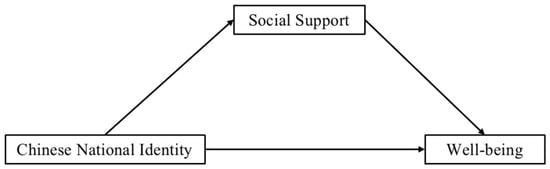
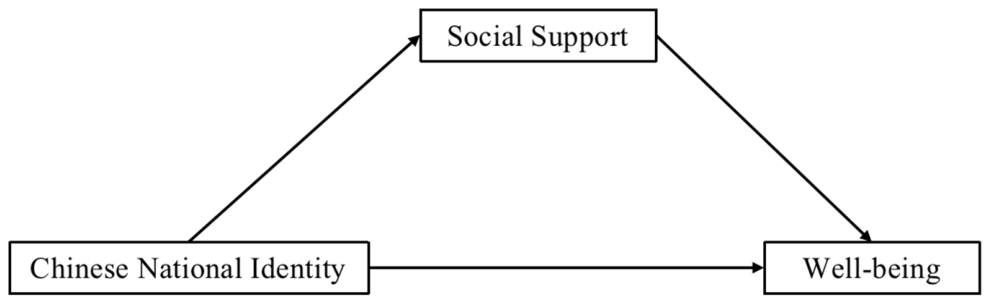
The hypothetical model for Study 1 is shown in Figure 1.
Figure 1.
Statistical model tested separately for each CNI subscale score in Study 1.
3.1. Methods
3.1.1. Participants
The survey was administered online through the Wenjuanxing platform (https://www.wjx.cn/, accessed on 30 October 2026). The link was distributed through channels at several universities in south-western China and the mental health platform of Sichuan Normal University, and recipients passed it on. The sample is therefore a convenience sample, not a random sample of a defined population. Students accounted for 14.3% of respondents; the others worked in healthcare (20.7%), government institutions (17.4%), enterprises (27.4%) and other sectors (20.2%) (Table 1).
Table 1.
Descriptive statistics of demographic information.
All participants gave electronic informed consent. Of 1131 responses, 49 were incomplete or internally inconsistent and were removed, leaving 1082 (95.7%). Because the link was passed on, the number of people invited is unknown, so this figure is a completion rate rather than a response rate. Three items recorded pandemic circumstances: 76 participants (7.0%) had been quarantined in the preceding year, most often for one to two weeks (52 at home, 18 in a designated facility and 6 elsewhere). In addition, 742 (68.6%) reported that the pandemic had affected their daily life. Participants received a small cash payment.
3.1.2. Measures
Chinese National Identity
CNI was measured using a 28-item abbreviated version of the National Identity Scale developed by Chen (2004). The scale draws on the cognitive, evaluative and affective components of group identification. In the scoring scheme used here, items were grouped into six subscales: positive affective evaluation (eight items), public collective self-esteem (five items), interdependence beliefs (four items), negative affect (four items), self-categorization (four items) and self-concept importance (three items). These subscales cover self-categorization, evaluations of the national group and emotional attachment to it, the aspects of identification on which H1 is based. The administered items are provided in Supplementary Materials, Section S8.
Items are rated from 1 (strongly disagree) to 5 (strongly agree). Eight negatively worded items (two public collective self-esteem items, the four negative affect items and two self-concept importance items) were reverse-scored. Dimension scores are item means, with higher scores indicating stronger identification. Because a single higher-order factor was not supported (Section 3.2.2), analyses use the six subscale scores rather than a global CNI score. Negative affect and self-concept importance are not interpreted as distinct constructs because their latent factors could not be separated in this sample. The 28-item sum (M = 113.42, SD = 11.26) is reported only for comparison with earlier studies.
Cronbach’s alpha was 0.797 for positive affective evaluation, 0.702 for public collective self-esteem, 0.696 for interdependence beliefs, 0.925 for negative affect, 0.703 for self-categorization and 0.573 for self-concept importance. The corresponding values of McDonald’s omega total, estimated from a one-factor model for each dimension, were 0.798, 0.669, 0.698, 0.925, 0.704 and 0.654. Alpha for the 28-item sum was 0.801. We do not report omega for the sum, because a single-factor model fitted poorly and the items’ loadings on it differed in sign (Section 3.2.2).
Social Support
Social support was measured with the 10-item Social Support Rating Scale (Xiao, 1994), which covers objective support, subjective support and support utilization. Items 1–4 and 8–10 are scored 1–4; item 5 has five sub-items scored 1–4 (from none to full support), which are summed; items 6 and 7 score 0 for “no source” and otherwise the number of sources. Higher totals indicate more support. In the social identity approach, support is one resource through which identification may relate to well-being; the scale, however, measures support in general rather than support from the national group. Internal consistency of the total was alpha = 0.704 and omega = 0.790. We report reliability for the total only, because several subscale items are counts of sources rather than rating-scale responses.
Well-Being
Well-being, the outcome in H1 and H2, was measured with the 18-item Chinese revision (Duan, 1996) of Fazio’s (1977) General Well-Being Schedule. It covers satisfaction and interest in life, health concerns, energy, depressed or cheerful mood, emotional and behavioral control, and relaxation versus tension. Items 1–14 have five or six response options and items 15–18 are rated from 0 to 10; higher totals indicate greater well-being. Internal consistency was alpha = 0.804 and omega = 0.832.
3.1.3. Data Analysis
Analyses were conducted in SPSS 26.0 and reproduced in Python 3.14. Confirmatory factor analyses of the CNI items used maximum likelihood estimation in semopy (Igolkina & Meshcheryakov, 2020), treating the five-point items as continuous. We compared single-factor, six-factor, five-factor (combining negative affect and self-concept importance), second-order and bifactor models, and added a method factor for the eight negatively worded items to the correlated-factor models. Solutions were first checked for admissibility: latent correlations within ±1, a positive definite latent correlation matrix and positive residual variances. Fit was then evaluated against conventional criteria (CFI and TLI ≥ 0.95, RMSEA ≤ 0.06 and SRMR ≤ 0.08 for good fit, and CFI and TLI ≥ 0.90 for adequate fit; Hu & Bentler, 1999). Indirect associations through social support were estimated for each dimension with ordinary least squares regression as in PROCESS Model 4 (Hayes, 2013), with 5000 bootstrap resamples and percentile confidence intervals. Gender, age band, political affiliation and job category were covariates on every path. Because all variables were measured at the same time, the indirect estimates are statistical associations, not evidence of causal mediation. We report unstandardized coefficients with standard errors and completely standardized indirect effects. Diagnostics included variance inflation factors, residual skewness and kurtosis, the Breusch–Pagan test, the Durbin–Watson statistic and Cook’s distance; because residual variance was not constant, HC3 standard errors were also computed. Correlations of 0.10, 0.30 and 0.50 were described as small, medium and large (Cohen, 1988).
Exploratory sensitivity analyses were added during revision. They used a score based on the 20 positively worded items and a combined negative affect and self-concept importance score, and they added quarantine experience and perceived pandemic impact as covariates. A final analysis excluded participants who, on average, agreed with both the negatively worded statements (mean ≥ 4 before reverse scoring) and the positively worded statements (mean ≥ 4).
3.2. Results
3.2.1. Common Method Bias Test
All Study 1 variables were self-reported in one questionnaire at a single time point, so common method variance is possible. In Harman’s single-factor test (Zhou & Long, 2004), with all 78 items entered into an unrotated principal components analysis, the first component accounted for 12.77% of the variance, below the conventional 40% criterion. This test detects only method variance large enough to dominate the first factor (Podsakoff et al., 2003; Fuller et al., 2016). The design included no stronger safeguard, such as temporal separation of measures, a marker variable or a latent method factor, so common method variance may have inflated the associations reported below.
3.2.2. Factor Structure of the Chinese National Identity Scale
A single factor fitted the CNI items poorly (CFI = 0.535, TLI = 0.498, RMSEA = 0.121, SRMR = 0.168), as did a second-order model (CFI = 0.765, RMSEA = 0.087, SRMR = 0.129) and a bifactor model (CFI = 0.792, RMSEA = 0.084, SRMR = 0.126). Six correlated factors gave better fit indices than the single-factor model (CFI = 0.903, TLI = 0.891, RMSEA = 0.056, SRMR = 0.060), but the solution was not admissible: the latent correlation between negative affect and self-concept importance was 1.01, and the latent correlation matrix was not positive definite. Combining these two dimensions yielded a five-factor model with similar fit indices (CFI = 0.902, TLI = 0.891, RMSEA = 0.056, SRMR = 0.061) and an admissible solution, with standardized loadings from 0.29 to 0.91. Adding a method factor for the eight negatively worded items improved fit (CFI = 0.949, TLI = 0.942, RMSEA = 0.041, SRMR = 0.054); this factor was defined almost entirely by the two negatively worded public collective self-esteem items. A second-order model based on the five factors did not fit (CFI = 0.857, RMSEA = 0.067, SRMR = 0.106). The five-factor solution was admissible, but its fit was mixed: TLI remained below 0.90. These results do not establish a single CNI factor or a clear distinction between negative affect and self-concept importance (Supplementary Materials, Tables S1–S3).
In the five-factor model, the combined negative affect and self-concept importance factor was negatively correlated with positive affective evaluation (latent r = −0.50) and self-categorization (−0.18). Six of its seven items are negatively worded, which can produce separate factors and weak or negative correlations with positively worded items (Marsh, 1996; Weijters et al., 2013). In an exploratory analysis, 155 participants (14.3%) met a response-pattern criterion: on average, they agreed with both the negatively and the positively worded statements. Without them, the correlation with positive affective evaluation was −0.25, and the correlations with the other factors were positive. The negative relations may therefore partly reflect responses to item wording. We retain the six subscale scores for reporting and examine the combined negative affect and self-concept importance score in a sensitivity analysis. The results for these two subscales should not be taken as evidence for separate constructs.
3.2.3. Descriptive Statistics and Correlations
Table 2 shows means, standard deviations and correlations. All six dimensions correlated positively with social support (r = 0.110 to 0.436) and with well-being (r = 0.284 to 0.454), all p < 0.001. Following Cohen (1988), positive affective evaluation, interdependence beliefs and self-categorization had medium correlations with social support, and the other three dimensions had small ones. All dimensions except public collective self-esteem (small) had medium correlations with well-being. Social support and well-being were strongly correlated (r = 0.526, 95% CI [0.482, 0.568]). The 28-item sum correlated 0.446 with social support and 0.635 with well-being. The latter exceeds every dimension-level correlation because the sum combines dimensions that are positively related to well-being but partly negatively related to one another; it should not be read as the strength of a single association.
Table 2.
Means, standard deviations and correlations of the CNI dimensions, social support and well-being (N = 1082).
3.2.4. Indirect Associations Through Social Support
Table 3 shows the indirect associations for each dimension. Each subscale score was associated with social support in the OLS models, and social support was associated with well-being in every model. The 95% confidence interval of the indirect association excluded zero for positive affective evaluation (b = 3.197, [2.426, 3.937]), self-categorization (b = 2.603, [1.976, 3.265]), interdependence beliefs (b = 2.557, [1.929, 3.164]), public collective self-esteem (b = 0.632, [0.146, 1.185]) and self-concept importance (b = 0.435, [0.033, 0.903]), but not for negative affect (b = 0.225, [−0.009, 0.489]). The direct association with well-being was significant for every dimension (all p < 0.001). Standardized indirect associations were about 0.16 for positive affective evaluation, self-categorization and interdependence beliefs and below 0.05 for the other three dimensions. For comparison, the indirect association for the 28-item sum was b = 0.108, 95% CI [0.079, 0.139], or 20.0% of its total association with well-being; the full results for this model are reported in Supplementary Materials.
Table 3.
Indirect associations of each CNI dimension with well-being through social support (covariates: gender, age band, political affiliation and job category; 5000 bootstrap resamples; percentile confidence intervals).
In the six models predicting well-being, variance inflation factors ranged from 1.04 to 2.57, Durbin–Watson values from 1.50 to 1.72, and the largest Cook’s distance was 0.085. Residuals were negatively skewed (−0.82 to −0.61) and leptokurtic (excess kurtosis 2.29 to 4.86), and their variance was not constant (Breusch–Pagan p < 0.001 in every model). Indirect associations were evaluated with bootstrap intervals, and HC3 standard errors were used as a sensitivity check. With HC3 standard errors, the paths from social support to well-being and the direct associations remained significant in every model, and the paths from the dimensions to social support remained significant except for negative affect (p = 0.068; Supplementary Materials, Table S5).
Participants who had been quarantined (7.0%) scored lower than other participants on the CNI sum, social support and well-being (d = −1.14 to −0.93; Supplementary Materials). With quarantine experience and perceived pandemic impact as additional covariates, the indirect associations remained for positive affective evaluation, interdependence beliefs and self-categorization, but the intervals for public collective self-esteem, negative affect and self-concept importance included zero.
Sensitivity analyses. A score based on the 20 positively worded items correlated 0.526 with social support and 0.559 with well-being, and its indirect association was b = 0.174, 95% CI [0.133, 0.214]. A combined negative affect and self-concept importance score had a small indirect association, b = 0.313, 95% CI [0.005, 0.646]. When the 155 participants who met the response-pattern criterion were excluded (n = 927), the indirect association excluded zero for all six dimensions. Across these analyses, the indirect associations were consistently present for positive affective evaluation, self-categorization and interdependence beliefs; for the other three dimensions they were small and depended on the analysis (Supplementary Materials, Table S4).
3.3. Discussion
In Study 1, all six CNI dimensions were positively associated with social support and well-being, and five showed a positive indirect association with well-being through social support, consistent with H1. Across the sensitivity analyses, the indirect associations were consistent only for positive affective evaluation, self-categorization and interdependence beliefs, which describe pride in the national group, perceived similarity to its members, and a sense of shared fate. This pattern agrees with research linking national identity to well-being and self-esteem (Manuela & Sibley, 2014; Haslam et al., 2009) and showing that group identity can strengthen perceived support and alleviate distress (Praharso et al., 2017). Given that all variables were measured at one time point, the data are equally consistent with reverse orderings, in which people with more support or higher well-being come to identify more strongly with the nation, and with reciprocal influences. The model tested here is one plausible ordering among several.
The results also clarify what the total score represents. Given that the dimensions did not form one higher-order factor, and two of them related to the rest of the scale largely through negatively worded items, the sum combines distinct aspects of identification rather than measuring one construct. Its correlation with well-being exceeds the correlations for the individual subscales, and studies using this instrument should establish its structure before forming a total score.
In practical terms, the findings suggest that social support should be considered alongside national identification when well-being is assessed during collective crises. A reported sense of national belonging is not a substitute for information about the support people have, where it comes from and whether they can use it; applied research in educational and occupational settings could examine these aspects. The cross-sectional association does not show that strengthening national identification would increase support or improve well-being, which would require longitudinal and intervention studies.
4. Study 2
Study 1 showed that CNI dimensions, social support and well-being covary, but it could not establish the direction of these relations or whether identity-relevant content affects well-being when people encounter a threat. Study 2 addresses the second question. It concerns changes over minutes after viewing national-symbol content and pandemic-related material, not stable differences between people. Social support was not measured, so Study 2 does not test the indirect association found in Study 1.
4.1. Methods
4.1.1. Participants
Sample size: The parameters of the original a priori power analysis could not be reconstructed. A sensitivity analysis for the obtained sample (N = 80, alpha = 0.05, one numerator degree of freedom) showed 80% power to detect a between-subjects effect of f = 0.32 (partial eta squared = 0.092). Participants: Eighty participants (40 men and 40 women) were recruited online and offline and received a small gift. None had taken part in a similar experiment, and all had normal or corrected-to-normal vision and normal reading comprehension. Within gender strata, participants were randomly assigned to one of four conditions formed by crossing national-symbol content (present vs. absent) with pandemic-related content (present vs. absent), giving 20 participants (10 men, 10 women) per condition. No participant withdrew or was excluded. Sessions were run individually in a quiet laboratory on a computer. Neither experimenter blinding nor formal allocation concealment was used; because the outcome was self-reported, the scope for experimenter influence is limited but not excluded. Baseline comparisons are reported in Section 4.2.1.
4.1.2. Materials and Measures
- (1)
- National-symbol and collective-response materials
National symbols such as the flag and anthem represent a nation’s shared knowledge, values and collective memory (Yu & Jin, 2013). Previous experiments have used national symbols and nation-related materials to increase the salience of national identity (Hassin et al., 2007; Butz, 2009; Cui, 2019). In the national-symbol condition, participants saw images and videos of the national flag, expressions of national strength, traditional festivals, and nationwide solidarity and collective action during disasters, including the response to COVID-19. The set comprised 10 still images, each presented for 500 ms, and three videos of about 90 s each. The control condition presented 10 images and three videos of comparable length showing landscapes, animals and popular-science content unrelated to the nation or the pandemic. Because the national materials also depicted solidarity and mutual aid, the two conditions differed in positive emotional content as well as in national content. The surviving still images are provided in Supplementary Material, Section S8. No manipulation check was administered, so we refer to exposure to national-symbol content rather than to increased national identity.
- (2)
- Pandemic-related materials
Disasters can elicit stress and anxiety (Roy et al., 2020), and emotional responses can be elicited by minimal input (Zajonc, 1980). The pandemic condition presented ten images, one news report and two video clips of about 90 s each showing the harms of COVID-19, including deaths and the helplessness and suffering of the public. The control condition presented ten images, one report and two clips of comparable length showing landscapes, animals and popular-science content. The original video files were not retained. No affective-state measure was administered after this phase, so the success of the induction cannot be verified.
- (3)
- Well-being
Well-being was measured with the same instrument as in Study 1, before and after the manipulation. Cronbach’s alpha for the post-test responses was 0.915. The items refer to the past month. Given that both administrations took place within one session, a difference between them reflects a change in how participants rated their well-being, not a change in their well-being over the preceding month. No alternate form, filler task or dedicated distractor interval was used to reduce repeated-measurement effects (Section 4.2.2).
4.1.3. Procedures
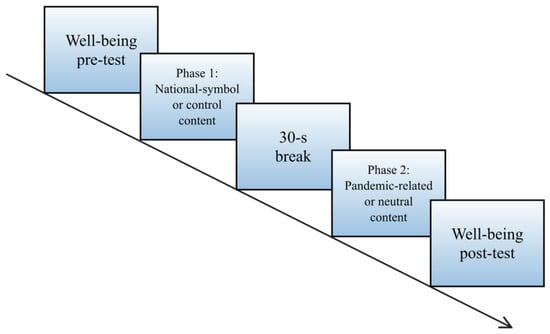
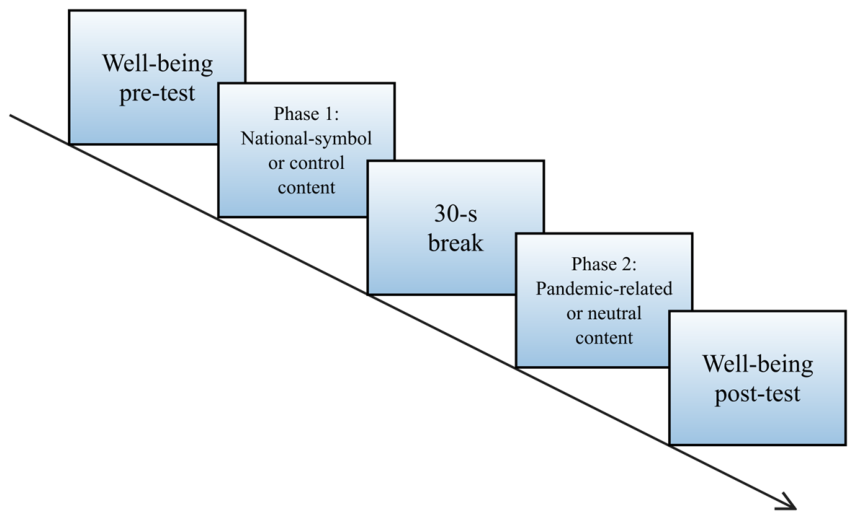
The procedure is shown in Figure 2. The design was a 2 (national-symbol content: present vs. absent) × 2 (pandemic-related content: present vs. absent) × 2 (time: pre-test vs. post-test) mixed factorial, with the content factors between subjects and time within subjects. The dependent variable was self-reported well-being; no implicit measure was administered.
Figure 2.
Experimental flow.
- (1)
- Preparation and pre-test: Participants gave written informed consent, completed a short demographic form (including age and gender), did a five-minute relaxation exercise and then completed the pre-test well-being measure.
- (2)
- Content exposure, phase 1: Participants viewed either the national-symbol materials or the control materials in a fixed order, following on-screen instructions. This phase took about ten minutes.
- (3)
- A 30 s break followed.
- (4)
- Content exposure, phase 2, and post-test: Participants viewed either the pandemic-related materials or the control materials and then completed the well-being measure again. This phase took about ten minutes.
- (5)
- Debriefing: Participants were told the purpose of the experiment and received a small gift.
4.1.4. Data Analysis
Analyses were conducted in SPSS 26.0 and verified in Python. The primary analysis was a 2 × 2 × 2 mixed analysis of variance on well-being. The three-way interaction was decomposed by testing the time × national-symbol content interaction at each level of pandemic-related content, followed by within-condition pre–post comparisons and between-condition comparisons at post-test. We also analyzed post-test scores with pre-test scores as a covariate (ANCOVA) and tested the effect of phase-1 content at each level of phase-2 content. We report partial eta squared for ANOVA and ANCOVA effects. Two-sided 90% confidence intervals for the key interactions were obtained by inverting the noncentral F distribution and converting the noncentrality limits using the error degrees of freedom. Pairwise comparisons are reported with Cohen’s d or dz. The condition in which control content was followed by neutral content served as the reference for change due to repeated administration and neutral viewing.
4.2. Results
4.2.1. Preliminary Checks and Overall Model
Pre-test well-being did not differ between conditions: a 2 × 2 between-subjects ANOVA showed no effect of national-symbol content; F(1, 76) = 1.03, p = 0.314, or pandemic-related content, F(1, 76) = 0.87, p = 0.353; and no interaction, F(1, 76) = 0.52, p = 0.472. Variances were homogeneous for post-test scores (Levene’s W = 1.26, p = 0.295) and change scores (W = 0.18, p = 0.910), and change scores were normally distributed (Shapiro–Wilk W = 0.983, p = 0.348). Table 4 reports descriptive statistics.
Table 4.
Well-being by condition in Study 2: means, standard deviations and 95% confidence intervals (n = 20 per condition).
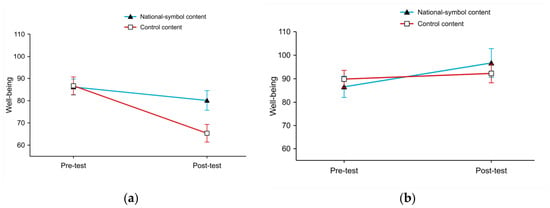
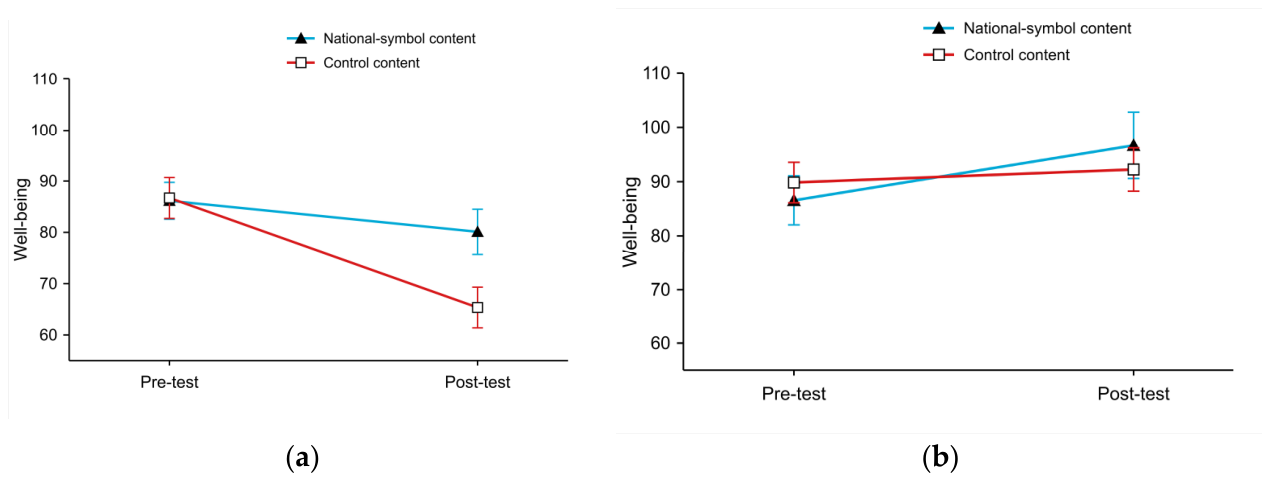
The mixed ANOVA showed a significant three-way interaction, F(1, 76) = 5.72, p = 0.019, partial eta squared = 0.070, 90% CI [0.006, 0.178]. This effect is smaller than the effect the design could detect with 80% power (0.092), and its confidence interval is wide, so it requires independent replication. Well-being changed over time, F(1, 76) = 22.13, p < 0.001, partial eta squared = 0.226; the change depended on national-symbol content, F(1, 76) = 53.31, p < 0.001, partial eta squared = 0.412, and on pandemic-related content, F(1, 76) = 160.15, p < 0.001, partial eta squared = 0.678. Averaged across time, there was a main effect of pandemic-related content, F(1, 76) = 37.36, p < 0.001, partial eta squared = 0.330; a borderline main effect of national-symbol content, F(1, 76) = 3.98, p = 0.050, partial eta squared = 0.050; and no interaction between the content factors, F(1, 76) = 2.87, p = 0.094 (Figure 3).
Figure 3.
Well-being before and after content exposure, by phase-1 content condition, shown separately for participants who received pandemic-related content (a) and neutral content (b) in phase 2. Error bars are 95% confidence intervals of the mean.
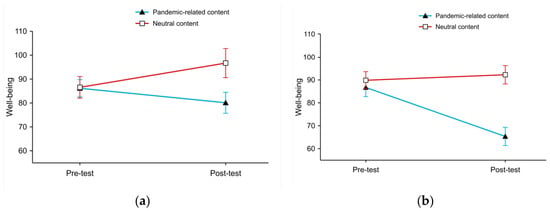
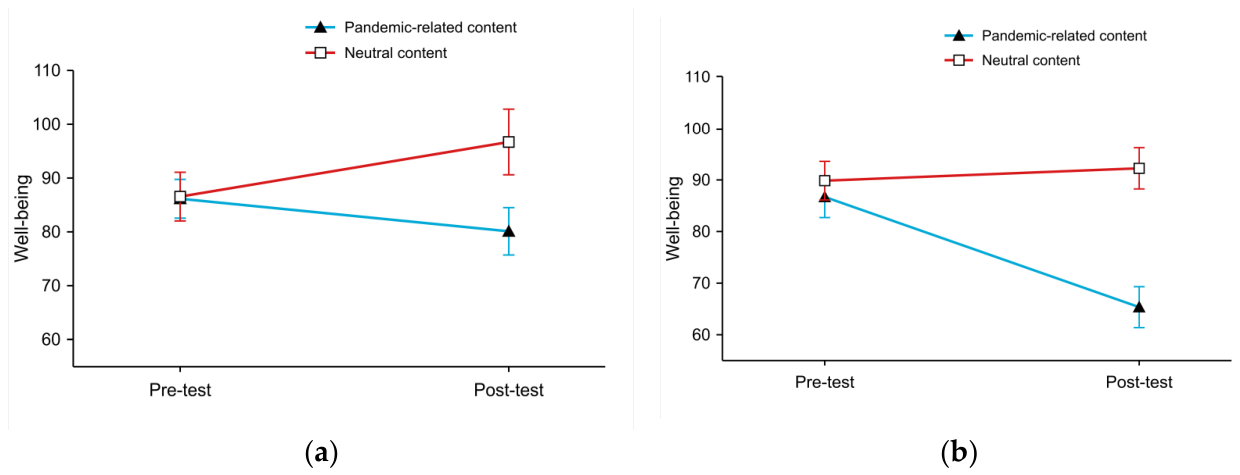
4.2.2. Change from Pre-Test to Post-Test Within Each Condition
Figure 4 shows the same data grouped by phase-1 content. After national-symbol content, well-being declined following pandemic-related content, M change = −6.05, 95% CI [−9.19, −2.91], t(19) = −4.04, p < 0.001, dz = −0.90, and rose following neutral content, M change = +10.15, 95% CI [6.82, 13.48], t(19) = 6.38, p < 0.001, dz = 1.43. After control content, the decline following pandemic-related content was larger, M change = −21.35, 95% CI [−24.82, −17.88], t(19) = −12.88, p < 0.001, dz = −2.88, and the change following neutral content was small and not significant, M change = +2.40, 95% CI [−0.87, 5.67], t(19) = 1.54, p = 0.141, dz = 0.34. With 20 participants per condition, these within-condition effect sizes are imprecise.
Figure 4.
The same data grouped by phase-1 content condition. Error bars are 95% confidence intervals of the mean. (a) National-symbol content in phase 1. (b) Control content in phase 1.
Given that the same instrument was administered twice, the control/neutral condition, in which participants saw neither type of experimental content, is the reference for change due to repetition and neutral viewing (+2.40 points, not significant). Comparisons between conditions control for repetition effects common to all groups, but not for effects that depend on the content viewed. For example, participants who had seen national-symbol content may have inferred the purpose of the study and adjusted their second responses. The 10.15-point rise after national-symbol and neutral content therefore cannot be attributed to the content alone. The unadjusted post-test comparison with the reference condition was not significant (Section 4.2.3), whereas the comparison adjusted for pre-test scores was significant (Section 4.2.4). The reference condition had a pre-test mean 3.30 points higher.
4.2.3. Decomposition of the Three-Way Interaction and Post-Test Differences
The time x national-symbol content interaction was significant both with pandemic-related content, F(1, 38) = 46.88, p < 0.001, partial eta squared = 0.552, and with neutral content, F(1, 38) = 12.08, p = 0.001, partial eta squared = 0.241. The three-way interaction therefore reflects a difference in the size of this effect rather than its presence in only one condition.
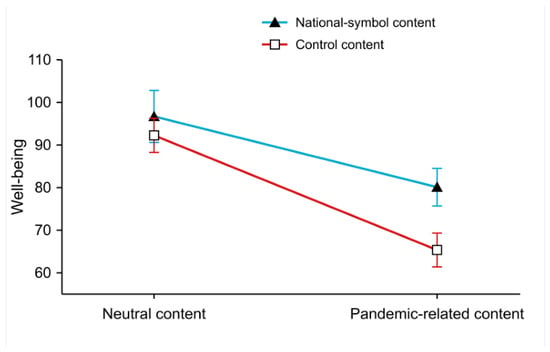
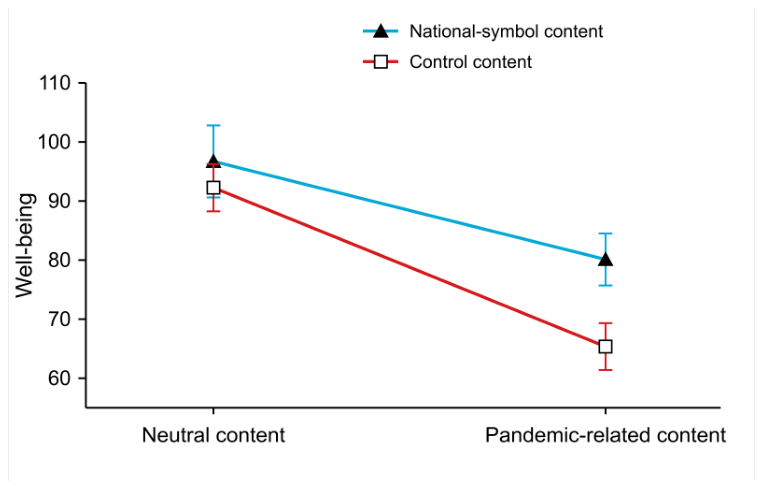
At post-test (Figure 5), the phase-1 conditions differed after pandemic-related content, 80.10 versus 65.35, mean difference = 14.75, 95% CI [9.02, 20.48], t(38) = 5.21, p < 0.001, d = 1.65, 95% CI [0.93, 2.37], but not significantly after neutral content, 96.70 versus 92.25, mean difference = 4.45, 95% CI [−2.61, 11.51], t(38) = 1.28, p = 0.209, d = 0.40, 95% CI [−0.22, 1.03].
Figure 5.
Post-test well-being by content condition. Error bars are 95% confidence intervals of the mean.
4.2.4. Analysis of Covariance Adjusting for Pre-Test Scores
After adjustment for pre-test scores, post-test well-being differed by national-symbol content, F(1, 75) = 51.35, p < 0.001, partial eta squared = 0.406, and pandemic-related content, F(1, 75) = 165.03, p < 0.001, partial eta squared = 0.688. Pre-test scores were associated with post-test scores, F(1, 75) = 81.65, p < 0.001, partial eta squared = 0.521. The content factors also interacted, F(1, 75) = 6.43, p = 0.013, partial eta squared = 0.079, 90% CI [0.009, 0.191]. Adjusted post-test means were 81.09 (national-symbol) and 65.87 (control) after pandemic-related content, and 97.35 and 90.09 after neutral content. The adjusted difference between phase-1 conditions was 15.22 points, 95% CI [10.81, 19.63], t(75) = 6.88, p < 0.001, after pandemic-related content, and 7.26 points, 95% CI [2.81, 11.71], t(75) = 3.25, p = 0.002, after neutral content. After adjustment, national-symbol content was thus associated with higher post-test well-being under both phase-2 conditions, and the difference was about twice as large after pandemic-related content. Adjusting for pre-test scores does not remove repeated-measurement effects that depend on the content viewed (Section 4.2.2), and the interaction is close to the smallest effect the design could detect.
4.3. Discussion
During the experimental session, participants who viewed national-symbol content reported a smaller decline in well-being after pandemic-related content than those who viewed control content. The mean decline was 6.05 points after national-symbol content and 21.35 points after control content, and the post-test difference was 14.75 points (d = 1.65, 95% CI [0.93, 2.37]). This pattern is consistent with H2. It concerns a short-term change produced by a laboratory procedure and exposure to a type of content, not participants’ stable national identification. With neutral phase-2 content, the post-test difference was not significant before adjustment for pre-test scores but was significant after adjustment; because both administrations used the same instrument, we do not attribute the rise in that condition to the content alone.
The design limits interpretation in two further ways. Given that the national materials also showed solidarity and mutual aid, the comparison cannot separate national identification from positive emotional content. In addition, no manipulation check confirmed that the national materials increased identification or that the pandemic materials induced negative emotion, so the processes behind the effects remain untested. Several accounts are possible. Reports of deaths and high transmissibility may have acted as reminders of mortality (Pyszczynski et al., 2021) and evoked fear and other negative emotions (Shao et al., 2021). National identity is associated with cooperation with public health measures such as social distancing, handwashing and mask wearing (Block et al., 2020; Van Bavel et al., 2022). Participation in collective activities and shared group emotions can also increase satisfaction, group efficacy and self-esteem (Khan et al., 2015; Zumeta et al., 2016). These accounts are interpretations; the study measured neither health-protective behavior nor group efficacy.
5. General Discussion
Guided by the social identity approach to health and well-being, this research examined associations among CNI, social support and well-being in a convenience sample of adults aged 18–40, together with short-term responses to national-symbol content in an experiment. In Study 1, the CNI dimensions were positively associated with well-being, and indirect associations through social support were consistent for three of them. In Study 2, prior exposure to national symbols and collective national responses attenuated the immediate decline in self-reported well-being that followed pandemic-related material.
The two studies provide different kinds of evidence. Study 1 concerns associations among self-reported identification, social support and well-being. Study 2 concerns immediate changes in self-reported well-being after identity-relevant content; it did not measure social support and cannot establish the causal ordering of the Study 1 variables. The experiment therefore complements the survey rather than confirming the social-support process proposed in it.
The findings are consistent with social identity theory and uncertainty-identity theory. The pandemic disrupted established routines, and under such conditions people turn to group memberships to restore predictability, especially when a threat is shared, and a common fate is salient (Drury et al., 2020). Identification with a large group has been linked to better coping through higher self-worth and through mutual aid among members who see one another as sharing a category (Canto & Vallejo-Martín, 2021; Khan et al., 2015). In Study 1, part of the association between CNI and well-being was statistically accounted for by social support, mainly for the dimensions describing pride in, similarity to and shared fate with the national group.
The experiment adds evidence that identity-relevant content can affect self-reported well-being immediately after exposure to pandemic-related material, which a cross-sectional survey cannot test. National identity becomes more salient during national crises (Bieber, 2022) and is associated with collective responses to them (Van Zomeren et al., 2008). Our results suggest that exposure to such content also has immediate consequences for responses to threat, at least over short intervals and under laboratory conditions. Given that implicit identity was not measured, the experiment cannot show whether implicit and explicit identity differ in this respect.
The findings concern CNI during the COVID-19 pandemic. In Study 2, responses may have depended on what the materials conveyed about national belonging and collective action in that setting, and these meanings may not transfer to other countries or periods. In Study 1, the support measure did not identify the national group as the source of support, so the results do not show that participants received support through their national identification. The studies are consistent with a social identity account but cannot show which findings reflect general identity processes and which depend on the context.
Cross-cultural replication could address this question. It would require evidence that the measures capture comparable constructs across groups (Davidov, 2009), locally meaningful national materials, and comparison conditions matched on emotional content. The type of threat also matters: findings obtained with pandemic-related material may not extend to natural disasters or intergroup conflict, where national belonging may have different implications for solidarity and group boundaries.
Other accounts are also compatible with the data. Unmeasured variables could relate to both national identity and well-being. Perceived collective efficacy, the belief that one’s group can act effectively against a shared threat, contributes to psychological adjustment (Bandura, 2000) and is likely to be higher among strong identifiers. Perceived governmental competence may play a similar role, particularly where the pandemic response was centralized and widely publicized, and optimism could raise both reports. None of these variables was measured.
Response processes offer further alternatives. National identity is a normatively endorsed attitude in this context, and well-being is a socially desirable self-description. Socially desirable responding could therefore inflate both reports and the association between them (Hebert et al., 1995), and conformity to approved positions could have a similar effect. These processes add to the common method variance discussed in Section 3.2.1. In Study 2, emotional contagion is a plausible alternative: several national-symbol items showed people, and observing others’ emotional expressions can transfer affect without any change in self-categorization (Hatfield et al., 1993). Future studies could measure collective efficacy, perceived institutional competence and social desirability, use indirect measures of identification, and match experimental and control stimuli on the presence of people and the intensity of displayed emotion.
Shared identity is also only one source of resilience in public health emergencies. Psychological flexibility, the capacity to stay in contact with unwanted internal experience while continuing to pursue one’s goals, is associated with health across many conditions (Kashdan & Rottenberg, 2010). Among intensive care nurses during the pandemic, difficulties in emotion regulation predicted higher perceived stress through psychological inflexibility (Di Gesto et al., 2025). Individual regulation and group resources may work together: people who regulate their emotions well may find it easier to seek group support, and identification may support regulation through other members. The present studies did not measure these processes.
The Study 1 sample extended beyond students (14.3% of respondents) to several occupational sectors, but it was a convenience sample recruited through university-linked channels in south-western China, so the findings should not be generalized to Chinese adults nationally. A study in 67 countries found that people with stronger national identities were more supportive of public health behaviors (Van Bavel et al., 2022). Together with the present results, this suggests that national identification is worth attending to in research on crisis communication and psychological adjustment. It does not follow that strengthening national identity would improve population mental health: no intervention was implemented or evaluated, and the Study 2 effect was obtained in a laboratory and measured within one session.
The research extends the study of social identity and well-being to a non-Western context, which may inform cross-cultural comparisons. Its practical implications are limited. First, research on crisis communication could measure group identification alongside the individual-level predictors more commonly assessed. Second, the indirect associations in Study 1 suggest that applied research should measure available social support alongside identification. Whether identity-based approaches improve well-being beyond support-focused approaches remains to be tested.
Limitations
Measurement: First, the National Identity Scale did not support a single higher-order factor, and two of its dimensions could not be distinguished from each other. Both were negatively related to positive affective evaluation, a pattern that may partly reflect responses to negatively worded items. The self-concept importance subscale had low internal consistency (alpha = 0.573; omega = 0.654). Its indirect association through social support was small and was not consistent across sensitivity analyses. We therefore interpret this association cautiously and base the main conclusions about indirect associations on the three subscales with consistent results. Future studies should establish the factor structure of the instrument before forming a total score and could rephrase the negatively worded items. Second, all Study 1 variables were self-reported in one administration, and Harman’s test cannot show that common method variance is negligible (Section 3.2.1). Separating measurements in time or by source, adding a marker variable or modeling a latent method factor would allow method effects to be estimated. Third, socially desirable responding may have affected the self-reports in both studies, and its extent was not assessed.
Design of Study 1: The cross-sectional design cannot establish the direction of the associations; reverse and reciprocal pathways are equally plausible and would require longitudinal data to distinguish. The sample was limited to adults aged 18–40 recruited through university-linked channels in south-western China, and generalization requires samples covering a wider range of ages and settings.
Design of Study 2: The main constraint is that national content and positive affect were confounded. The national-symbol materials included scenes of collective mutual aid during the outbreak, whereas the control materials were neutral rather than positive. A simpler account, in which any positive material attenuates the effect of subsequent negative material, predicts the same result. Separating the two would require a third phase-1 condition with affectively matched positive content unrelated to the nation. No affective-state or identification measure was taken after either phase, so neither the pandemic induction nor a change in identification can be verified. The video stimuli are no longer available. Finally, dispositional CNI was not measured in Study 2, so we cannot test whether the effects depended on participants’ initial identification.
The same 18-item instrument was administered twice within one session. Participants may have anchored on their earlier answers, inferred the purpose of the study or become sensitized to the constructs, and these effects cannot be separated from substantive change in this design (Section 4.2.2). Future studies could use an alternate form or a brief state measure at the second assessment, a group that completes both assessments without any manipulation, or a post-test-only design.
Scope of the conclusions. Study 2 examined changes in reported well-being within a single laboratory session, did not test changes in enduring national identification, and included no follow-up. The findings therefore do not demonstrate durable psychological protection or the effectiveness of identity-based public health interventions. Follow-up assessments, field studies during actual collective threats and direct evaluation of interventions would be needed for such conclusions.
6. Conclusions
The present research combined a cross-sectional survey of Chinese adults aged 18–40 with a laboratory experiment. (1) The six CNI dimensions were positively associated with well-being; indirect associations through social support were consistent for positive affective evaluation, self-categorization and interdependence beliefs. (2) Pandemic-related material lowered self-reported well-being within the session. (3) Prior exposure to national-symbol content attenuated this decline: the mean decline was 6.05 points after national-symbol content and 21.35 points after control content. (4) With neutral phase-2 content, participants reported a larger increase in well-being after national-symbol content than after control content, but given that the measure was administered twice, this rise cannot be attributed to the content alone. These findings link specific CNI dimensions to social support and well-being and provide experimental evidence that national-symbol and collective-response content can influence immediate self-reported well-being in a laboratory setting.
Supplementary Materials
The following supporting information can be downloaded at: https://www.mdpi.com/article/10.3390/bs16122270/s1. Supplementary text (Sections S1–S7), including regression diagnostics for the dimension models (Section S6) and full results for the 28-item sum (Section S7); Table S1: Fit and admissibility of factor models for the National Identity Scale; Table S2: Standardized loadings in the five-factor models (full sample); Table S3: Latent correlations in the five-factor model: full sample below the diagonal, excluding the criterion group (n = 927) above the diagonal; Table S4: Reliability, correlations and indirect associations through social support; Table S5: Diagnostics for the models predicting well-being, and HC3 p values for each path; Section S8: Questionnaires and surviving stimulus images.
Author Contributions
J.S.: Conceptualization; Formal analysis; Methodology; Validation; Writing—original draft; Writing—review and editing. Y.D.: Conceptualization; Investigation; Formal analysis; Methodology; Writing—review and editing. T.S.: Conceptualization; Methodology; Software; Writing—original draft. Y.J.: Writing—original draft; Project administration; Supervision. J.A.: Resources; Formal analysis; Software; Project administration. P.Z.: Writing—review and editing; Data curation; Visualization. All authors have read and agreed to the published version of the manuscript.
Funding
The research is supported by the National Social Science Fund of China (grant number 21BSH016).
Institutional Review Board Statement
The study was conducted in accordance with the Declaration of Helsinki and approved by the Ethics Committee of Sichuan Normal University (permit number: 2024LS019; date of approval: 24 January 2022).
Informed Consent Statement
Informed consent was obtained from all subjects involved in the study.
Data Availability Statement
The data presented in this study are available upon request from the corresponding author due to privacy/ethical restrictions.
Acknowledgments
We are grateful for the financial and personal support we received. The authors used Claude 5.5 (Anthropic) for language polishing and ChatGPT-6.1 (OpenAI) to assist with statistical analysis code and consistency checks during revision. The analyses were executed in SPSS and Python. The authors take responsibility for the final text, code and results.
Conflicts of Interest
The authors declare no conflicts of interest.
References
- Allen, R. E., Hochard, K. D., Kannangara, C., & Carson, J. (2024). The road to recovery: A two-year longitudinal analysis of mental health among university students during and after the COVID-19 pandemic. Behavioral Sciences, 14(12), 1146. [Google Scholar] [CrossRef] [Scilit] [PubMed]
- Bandura, A. (2000). Exercise of human agency through collective efficacy. Current Directions in Psychological Science, 9(3), 75–78. [Google Scholar] [CrossRef] [Scilit]
- Bieber, F. (2022). Global nationalism in times of the COVID-19 pandemic. Nationalities Papers, 50(1), 13–25. [Google Scholar] [CrossRef] [Scilit]
- Birmingham, W. C., Wadsworth, L. L., Lassetter, J. H., Graff, T. C., Lauren, E., & Hung, M. (2023). COVID-19 lockdown: Impact on college students’ lives. Journal of American College Health, 71(3), 879–893. [Google Scholar] [CrossRef] [Scilit] [PubMed]
- Block, P., Hoffman, M., Raabe, I. J., Dowd, J. B., Rahal, C., Kashyap, R., & Mills, M. C. (2020). Social network-based distancing strategies to flatten the COVID-19 curve in a post-lockdown world. Nature Human Behaviour, 4(6), 588–596. [Google Scholar] [CrossRef] [Scilit] [PubMed]
- Bonetto, E., Delouvée, S., Mahfud, Y., & Adam-Troian, J. (2022). National identification, a social cure for COVID-19? Evidence from 67 countries. International Journal of Social Psychiatry, 68(5), 1116–1126. [Google Scholar] [CrossRef] [Scilit] [PubMed]
- Butz, D. A. (2009). National symbols as agents of psychological and social change. Political Psychology, 30(5), 779–804. [Google Scholar] [CrossRef] [Scilit]
- Canto, J. M., & Vallejo-Martín, M. (2021). The effects of social identity and emotional connection on subjective well-being in times of the COVID-19 pandemic for a Spanish sample. International Journal of Environmental Research and Public Health, 18(19), 10525. [Google Scholar] [CrossRef] [Scilit] [PubMed]
- Carter, H., Dennis, A., Williams, N., & Weston, D. (2023). Identity-based social support predicts mental and physical health outcomes during COVID-19. British Journal of Social Psychology, 62(2), 845–865. [Google Scholar] [CrossRef] [Scilit] [PubMed]
- Chandra, K. (2006). What is ethnic identity and does it matter? Annual Review of Political Science, 9, 397–424. [Google Scholar] [CrossRef] [Scilit]
- Chen, J. (2004). The development of national identity in 11 to 20 years old Chinese adolescents [Unpublished Master’s thesis]. Central China Normal University.
- Cohen, J. (1988). Statistical power analysis for the behavioral sciences (2nd ed.). Lawrence Erlbaum Associates. [Google Scholar]
- Cruwys, T., South, E. I., Greenaway, K. H., & Haslam, S. A. (2015). Social identity reduces depression by fostering positive attributions. Social Psychological and Personality Science, 6(1), 65–74. [Google Scholar] [CrossRef] [Scilit]
- Cui, X. M. (2019). Young students’ implicit national identity status and its relationship with explicit national identity [Unpublished Master’s thesis]. China Youth University of Political Studies.
- Davidov, E. (2009). Measurement equivalence of nationalism and constructive patriotism in the ISSP: 34 countries in a comparative perspective. Political Analysis, 17(1), 64–82. [Google Scholar] [CrossRef] [Scilit]
- Di Gesto, C., Policardo, G. R., Bocci Benucci, S., Çela, E., & Grano, C. (2025). Difficulties in emotion regulation and stress in intensive care unit nurses during COVID-19: Exploring the mediating role of psychological inflexibility and the moderating effect of work experience. Healthcare, 13(13), 1575. [Google Scholar] [CrossRef] [Scilit] [PubMed]
- Drury, J., Reicher, S., & Stott, C. (2020). COVID-19 in context: Why do people die in emergencies? It’s probably not because of collective psychology. British Journal of Social Psychology, 59(3), 686–693. [Google Scholar] [CrossRef] [Scilit] [PubMed]
- Duan, J. H. (1996). Trial results and analysis of the overall well-being scale among Chinese college students. Chinese Journal of Clinical Psychology, 4(1), 56–57. [Google Scholar]
- Fazio, A. F. (1977). A concurrent validational study of the NCHS general well-being schedule. In Vital and health statistics, series 2, No. 73. National Center for Health Statistics. Available online: https://www.cdc.gov/nchs/data/series/sr_02/sr02_073.pdf (accessed on 12 August 2026).
- Frenzel, S. B., Junker, N. M., Häusser, J. A., Erkens, V. A., & van Dick, R. (2023). Team identification relates to lower burnout—Emotional and instrumental support as two different social cure mechanisms. British Journal of Social Psychology, 62(2), 673–691. [Google Scholar] [CrossRef] [Scilit] [PubMed]
- Fuller, C. M., Simmering, M. J., Atinc, G., Atinc, Y., & Babin, B. J. (2016). Common methods variance detection in business research. Journal of Business Research, 69(8), 3192–3198. [Google Scholar] [CrossRef] [Scilit]
- Gundogan, S. (2023). The relationship of COVID-19 student stress with school burnout, depression and subjective well-being: Adaptation of the COVID-19 student stress scale into Turkish. The Asia-Pacific Education Researcher, 32(2), 165–176. [Google Scholar] [CrossRef] [Scilit]
- Haslam, S. A., Jetten, J., Postmes, T., & Haslam, C. (2009). Social identity, health and well-being: An emerging agenda for applied psychology. Applied Psychology, 58(1), 1–23. [Google Scholar] [CrossRef] [Scilit]
- Haslam, S. A., McMahon, C., Cruwys, T., Haslam, C., Jetten, J., & Steffens, N. K. (2018). Social cure, what social cure? The propensity to underestimate the importance of social factors for health. Social Science & Medicine, 198, 14–21. [Google Scholar] [CrossRef] [Scilit] [PubMed]
- Hassin, R. R., Ferguson, M. J., Shidlovski, D., & Gross, T. (2007). Subliminal exposure to national flags affects political thought and behavior. Proceedings of the National Academy of Sciences, 104(50), 19757–19761. [Google Scholar] [CrossRef] [Scilit] [PubMed]
- Hatfield, E., Cacioppo, J. T., & Rapson, R. L. (1993). Emotional contagion. Current Directions in Psychological Science, 2(3), 96–100. [Google Scholar] [CrossRef] [Scilit]
- Hayes, A. F. (2013). Introduction to mediation, moderation, and conditional process analysis: A regression-based approach. Guilford Press. [Google Scholar]
- Hebert, J. R., Clemow, L., Pbert, L., Ockene, I. S., & Ockene, J. K. (1995). Social desirability bias in dietary self-report may compromise the validity of dietary intake measures. International Journal of Epidemiology, 24(2), 389–398. [Google Scholar] [CrossRef] [Scilit] [PubMed]
- Hogg, M. A., & Adelman, J. (2013). Uncertainty–identity theory: Extreme groups, radical behavior, and authoritarian leadership. Journal of Social Issues, 69(3), 436–454. [Google Scholar] [CrossRef] [Scilit]
- Hu, L., & Bentler, P. M. (1999). Cutoff criteria for fit indexes in covariance structure analysis: Conventional criteria versus new alternatives. Structural Equation Modeling, 6(1), 1–55. [Google Scholar] [CrossRef] [Scilit]
- Igolkina, A. A., & Meshcheryakov, G. (2020). semopy: A Python package for structural equation modeling. Structural Equation Modeling: A Multidisciplinary Journal, 27(6), 952–963. [Google Scholar] [CrossRef] [Scilit]
- Jetten, J., Bentley, S. V., Crimston, C. R., Selvanathan, H. P., & Haslam, S. A. (2021). COVID-19 and social psychological research: A silver lining. Asian Journal of Social Psychology, 24(1), 34–36. [Google Scholar] [CrossRef] [Scilit] [PubMed]
- Jetten, J., Haslam, S. A., Cruwys, T., Greenaway, K. H., Haslam, C., & Steffens, N. K. (2017). Advancing the social identity approach to health and well-being: Progressing the social cure research agenda. European Journal of Social Psychology, 47(7), 789–802. [Google Scholar] [CrossRef] [Scilit]
- Kashdan, T. B., & Rottenberg, J. (2010). Psychological flexibility as a fundamental aspect of health. Clinical Psychology Review, 30(7), 865–878. [Google Scholar] [CrossRef] [Scilit] [PubMed]
- Khan, S. S., Hopkins, N., Reicher, S., Tewari, S., Srinivasan, N., & Stevenson, C. (2015). Shared identity predicts enhanced health at a mass gathering. Group Processes & Intergroup Relations, 18(4), 504–522. [Google Scholar] [CrossRef] [Scilit]
- Liao, L., Du, M., & Huang, J. (2022). The effect of urban resilience on residents’ subjective happiness: Evidence from China. Land, 11(11), 1896. [Google Scholar] [CrossRef] [Scilit]
- Magson, N. R., Freeman, J. Y., Rapee, R. M., Richardson, C. E., Oar, E. L., & Fardouly, J. (2021). Risk and protective factors for prospective changes in adolescent mental health during the COVID-19 pandemic. Journal of Youth and Adolescence, 50(1), 44–57. [Google Scholar] [CrossRef] [Scilit] [PubMed]
- Manuela, S., & Sibley, C. G. (2014). Exploring the hierarchical structure of Pacific identity and wellbeing. Social Indicators Research, 118(3), 969–985. [Google Scholar] [CrossRef] [Scilit]
- Marsh, H. W. (1996). Positive and negative global self-esteem: A substantively meaningful distinction or artifactors? Journal of Personality and Social Psychology, 70(4), 810–819. [Google Scholar] [CrossRef] [PubMed]
- Miller, G. (2020, March 16). Social distancing prevents infections, but it can have unintended consequences. Science. [CrossRef] [Scilit]
- Moinolmolki, N. (2020). Correlates of general wellbeing among Bhutanese youths. Journal of Ethnic & Cultural Diversity in Social Work, 29(1), 185–202. [Google Scholar] [CrossRef] [Scilit]
- Nearchou, F., Flinn, C., Niland, R., Subramaniam, S. S., & Hennessy, E. (2020). Exploring the impact of COVID-19 on mental health outcomes in children and adolescents: A systematic review. International Journal of Environmental Research and Public Health, 17(22), 8479. [Google Scholar] [CrossRef] [Scilit] [PubMed]
- Nerini, A., Matera, C., Policardo, G. R., & Di Gesto, C. (2022). Containment measures against COVID-19 in Italy: The role of protection motivation and values. Journal of Human Behavior in the Social Environment, 32(6), 754–767. [Google Scholar] [CrossRef] [Scilit]
- Neville, F. G., Templeton, A., Smith, J. R., & Louis, W. R. (2021). Social norms, social identities and the COVID-19 pandemic: Theory and recommendations. Social and Personality Psychology Compass, 15(5), e12596. [Google Scholar] [CrossRef] [Scilit] [PubMed]
- Park, J., & Zhu, Y. (2024). Mortality risk of loneliness: Culture matters. Health Psychology, 43(11), 791–802. [Google Scholar] [CrossRef] [Scilit] [PubMed]
- Phinney, J. S., Horenczyk, G., Liebkind, K., & Vedder, P. (2001). Ethnic identity, immigration, and well-being: An interactional perspective. Journal of Social Issues, 57(3), 493–510. [Google Scholar] [CrossRef] [Scilit]
- Podsakoff, P. M., MacKenzie, S. B., Lee, J. Y., & Podsakoff, N. P. (2003). Common method biases in behavioral research: A critical review of the literature and recommended remedies. Journal of Applied Psychology, 88(5), 879–903. [Google Scholar] [CrossRef] [Scilit] [PubMed]
- Praharso, N. F., Tear, M. J., & Cruwys, T. (2017). Stressful life transitions and wellbeing: A comparison of the stress buffering hypothesis and the social identity model of identity change. Psychiatry Research, 247, 265–275. [Google Scholar] [CrossRef] [Scilit] [PubMed]
- Pyszczynski, T., Lockett, M., Greenberg, J., & Solomon, S. (2021). Terror management theory and the COVID-19 pandemic. Journal of Humanistic Psychology, 61(2), 173–189. [Google Scholar] [CrossRef] [Scilit] [PubMed]
- Racine, N., McArthur, B. A., Cooke, J. E., Eirich, R., Zhu, J., & Madigan, S. (2021). Global prevalence of depressive and anxiety symptoms in children and adolescents during COVID-19: A meta-analysis. JAMA Pediatrics, 175(11), 1142–1150. [Google Scholar] [CrossRef] [Scilit] [PubMed]
- Reeskens, T., & Hooghe, M. (2010). Beyond the civic-ethnic dichotomy: Investigating the structure of citizenship concepts across thirty-three countries. Nations and Nationalism, 16(4), 579–597. [Google Scholar] [CrossRef] [Scilit]
- Roy, D., Tripathy, S., Kar, S. K., Sharma, N., Verma, S. K., & Kaushal, V. (2020). Study of knowledge, attitude, anxiety and perceived mental healthcare need in Indian population during COVID-19 pandemic. Asian Journal of Psychiatry, 51, 102083. [Google Scholar] [CrossRef] [Scilit] [PubMed]
- Samji, H., Wu, J., Ladak, A., Vossen, C., Stewart, E., Dove, N., Long, D., & Snell, G. (2022). Mental health impacts of the COVID-19 pandemic on children and youth–a systematic review. Child and Adolescent Mental Health, 27(2), 173–189. [Google Scholar] [CrossRef] [Scilit] [PubMed]
- Seligman, M. (2018). PERMA and the building blocks of well-being. The Journal of Positive Psychology, 13(4), 333–335. [Google Scholar] [CrossRef] [Scilit]
- Shao, R., He, L., Chang, C. H., Wang, M., Baker, N., Pan, J., & Jin, Y. (2021). Employees’ reactions toward COVID-19 information exposure: Insights from terror management theory and generativity theory. Journal of Applied Psychology, 106(11), 1601–1614. [Google Scholar] [CrossRef] [Scilit] [PubMed]
- Shaw, R., Kim, Y. K., & Hua, J. (2020). Governance, technology and citizen behavior in pandemic: Lessons from COVID-19 in East Asia. Progress in Disaster Science, 6, 100090. [Google Scholar] [CrossRef] [Scilit] [PubMed]
- She, R., Wong, K., Lin, J., Leung, K., Zhang, Y., & Yang, X. (2021). How COVID-19 stress related to schooling and online learning affects adolescent depression and Internet gaming disorder: Testing conservation of resources theory with sex difference. Journal of Behavioral Addictions, 10(4), 953–966. [Google Scholar] [CrossRef] [Scilit] [PubMed]
- Song, L., Ge, Y., & Zhang, X. (2021). The relationship between WeChat use by Chinese urban older adults living alone and their subjective well-being: The mediation role of intergenerational support and social activity. Psychology Research and Behavior Management, 14, 1543–1554. [Google Scholar] [CrossRef] [Scilit] [PubMed]
- Sønderskov, K. M., Dinesen, P. T., Santini, Z. I., & Østergaard, S. D. (2020). The depressive state of Denmark during the COVID-19 pandemic. Acta Neuropsychiatrica, 32(4), 226–228. [Google Scholar] [CrossRef] [Scilit] [PubMed]
- Szkody, E., Stearns, M., Stanhope, L., & McKinney, C. (2021). Stress-buffering role of social support during COVID-19. Family Process, 60(3), 1002–1015. [Google Scholar] [CrossRef] [Scilit] [PubMed]
- Tajfel, H. (Ed.). (1978). Differentiation between social groups: Studies in the social psychology of intergroup relations. Academic Press. [Google Scholar]
- Tajfel, H., & Turner, J. C. (1979). An integrative theory of intergroup conflict. In W. G. Austin, & S. Worchel (Eds.), The social psychology of intergroup relations (pp. 33–47). Brooks/Cole. [Google Scholar]
- Utsey, S. O., Chae, M. H., Brown, C. F., & Kelly, D. (2002). Effect of ethnic group membership on ethnic identity, race-related stress, and quality of life. Cultural Diversity & Ethnic Minority Psychology, 8(4), 366–377. [Google Scholar] [CrossRef] [Scilit] [PubMed]
- Van Bavel, J. J., Cichocka, A., Capraro, V., Sjåstad, H., Nezlek, J. B., Pavlović, T., Alfano, M., Gelfand, M. J., Azevedo, F., Birtel, M. D., Cislak, A., Lockwood, P. L., Ross, R. M., Abts, K., Agadullina, E., Aruta, J. J. B., Besharati, S. N., Bor, A., Choma, B. L., … Boggio, P. S. (2022). National identity predicts public health support during a global pandemic. Nature Communications, 13(1), 517. [Google Scholar] [CrossRef] [Scilit] [PubMed]
- Van Zomeren, M., Postmes, T., & Spears, R. (2008). Toward an integrative social identity model of collective action: A quantitative research synthesis of three socio-psychological perspectives. Psychological Bulletin, 134(4), 504–535. [Google Scholar] [CrossRef] [Scilit] [PubMed]
- Verkuyten, M., & Kwa, G. A. (1994). Ethnic self-identification and psychological well-being among minority youth in the Netherlands. International Journal of Adolescence and Youth, 5(1–2), 19–34. [Google Scholar] [CrossRef] [Scilit]
- Weijters, B., Baumgartner, H., & Schillewaert, N. (2013). Reversed item bias: An integrative model. Psychological Methods, 18(3), 320–334. [Google Scholar] [CrossRef] [Scilit] [PubMed]
- Xiao, S. Y. (1994). The theoretical basis and research application of “social support rating scale”. Journal of Clinical Psychiatry, 4(2), 98–100. [Google Scholar]
- Yu, H., & Jin, S. (2013). The status quo of national identity and its trends. Psychological Research, 6(4), 3–9. [Google Scholar]
- Zajonc, R. B. (1980). Feeling and thinking: Preferences need no inferences. American Psychologist, 35(2), 151–175. [Google Scholar] [CrossRef]
- Zhou, H., & Long, L. (2004). Statistical remedies for common method biases. Advances in Psychological Science, 12(6), 942–950. [Google Scholar] [CrossRef]
- Zumeta, L., Basabe, N., Wlodarczyk, A., Bobowik, M., & Páez, D. (2016). Shared flow and positive collective gatherings. Anales de Psicología, 32(3), 717–727. [Google Scholar] [CrossRef] [Scilit]

Disclaimer/Publisher’s Note: The statements, opinions and data contained in all publications are solely those of the individual author(s) and contributor(s) and not of MDPI and/or the editor(s). MDPI and/or the editor(s) disclaim responsibility for any injury to people or property resulting from any ideas, methods, instructions or products referred to in the content. |
© 2026 by the authors. Licensee MDPI, Basel, Switzerland. This article is an open access article distributed under the terms and conditions of the Creative Commons Attribution (CC BY) license.