


Abstract
Many people believe that deception is a prerequisite for placebo effects to occur. This belief may contribute to negative attitudes toward open-label placebos (OLPs), which are administered with full transparency. However, in everyday life, people knowingly use inert objects, such as lucky charms, to achieve positive outcomes. The present preregistered experiment investigated whether providing information about evidence that lucky charms can influence people’s experiences and behavior increases acceptance of OLPs. A brief online intervention incorporating estimation tasks was developed to inform participants about the beneficial effects associated with lucky charms. Participants from Austria (n = 120) and Italy (n = 120) matched for age and gender (M = 23.59 years, SD = 5.27; 82% female) rated their attitudes toward OLPs before and after completing either the lucky charm intervention or a control estimation task. The intervention increased participants’ perceived effectiveness of OLPs for both emotional and somatic complaints, enhanced the plausibility of the OLP concept, and increased their reported willingness to take an OLP. Furthermore, it reduced the belief that deception is necessary for placebo effects to occur. Overall, effect sizes were small to medium (partial eta2: 0.03–0.10). These findings suggest that providing information about the positive effects of lucky charms may be a low-cost, time-efficient approach for changing attitudes toward OLPs.
1. Introduction
Traditional placebos—that is, placebos administered deceptively with the verbal suggestion of an active treatment—have been shown to produce significant improvements in both clinical and non-clinical populations, as evidenced by changes in self-reports, neurobiological parameters and overt behavior (Wager & Atlas, 2015; Evers et al., 2018). However, despite their demonstrated efficacy, deceptive placebos are not permissible in clinical practice because their use contravenes ethical standards, particularly those concerning informed consent and respect for patient autonomy. As an ethical alternative to deceptive placebos, open-label placebos (OLPs) can be administered (Colloca & Howick, 2018). Using this fully transparent method, the recipients are informed that the treatment aimed at improving their condition contains no pharmacologically active components. This approach is effective with small-to-medium effect sizes (Fendel et al., 2025; von Wernsdorff et al., 2021) but has been associated with polarized attitudes among recipients (Haas et al., 2021, Schienle & Seibel, 2024). A key belief among individuals who are unconvinced about OLPs is that the placebo effect necessarily depends on deception (Haas et al., 2021). When placebo recipients are explicitly informed that the treatment lacks an active ingredient (e.g., an inert pill), many find it difficult to anticipate any positive effects (Schienle et al., 2025b).
However, in other areas of life, inert objects are routinely used to promote positive outcomes. Such items are commonly referred to as lucky charms, which do not objectively contain or produce luck, but can influence affective states, motivation, and overt behavior (Wiseman & Watt, 2004; Lindeman & Aarnio, 2007). According to a representative YouGov poll (YouGov, 2022) of 1000 Americans, 31% said they at least occasionally carry or wear a lucky charm.
Lucky charms and OLPs share several mechanisms that may contribute to their perceived or actual effects. Expectancy may be a central mechanism in both cases (Kaptchuk, 2018, Colloca & Howick, 2018). When individuals believe that a lucky charm or an OLP will improve their somatic or emotional state, improve their performance, or help them cope with a challenging situation, this expectation may shape their experience and behavior. These expectancies may influence attention, the interpretation of bodily sensations, emotional responses, and motivation in ways that are consistent with the anticipated outcome (Buergler et al., 2023).
A second potential mechanism is self-efficacy: individuals’ beliefs in their capacity to successfully manage a situation or perform a task. Both lucky charms and OLPs may serve as psychological resources that strengthen perceived control and confidence. Changes in self-efficacy may alter how one approaches and responds to a challenge (Kogler & Schienle, in press).
Associative learning (conditioning) may provide a third explanation for the effects of both interventions (Kaptchuk, 2018). Through repeated pairings with positive outcomes or subjective states, a lucky charm may acquire the capacity to elicit positive affect or a sense of hope. Once established, these associations may be activated when the charm is used in a stressful situation. OLPs may also benefit from learned associations, when their administration incorporates familiar elements (e.g., taking a pill).
Finally, the symbolic meaning of a lucky charm and an OLP as well as the associated rituals may contribute to the psychological impact of both interventions (Moerman & Jonas, 2002). Both approaches represent protection, self-care, or an active step toward improving one’s well-being. The proposed mechanisms are not mutually exclusive but may work together.
On this basis, an online intervention incorporating estimation tasks was developed to challenge beliefs about the necessity of deception for placebo effectiveness. Participants were first asked to estimate a charm’s potential effects in a specific context before being presented with positive findings from the corresponding study. This line of research was selected to illustrate that even objects without intrinsic efficacy can meaningfully influence individuals’ experiences and behavior. For example, participants were introduced to the study by Damisch et al. (2010), in which participants attempted to putt a golf ball from a distance of one meter across ten trials. They were randomly assigned to one of two conditions. When handing over the (identical) ball, the experimenter either said: “Here is your ball. So far, it has proven to be a lucky ball” (Group A) or “This is the ball that everyone has used so far” (Group B). The results showed that participants who believed they were using a “lucky ball” were more successful.
The online intervention in the current study involved presenting participants with the designs and procedures of three experiments investigating lucky charms. Participants first estimated the expected effects and then received feedback on the observed positive effects. Measures assessing participants’ attitudes toward OLPs were completed immediately before and after the intervention (or a control estimation task). The study included two national samples (Austria, Italy) to evaluate the consistency and generalizability of the results. Our central research question was: can exposure to positive findings from studies on lucky charms change attitudes toward OLPs? Two specific hypotheses were preregistered: the intervention would increase (1) self-reported acceptance of OLPs for emotional/physical complaints (primary outcome) and (2) the perceived plausibility of the OLP approach (secondary outcome).
2. Materials and Methods
2.1. Participants
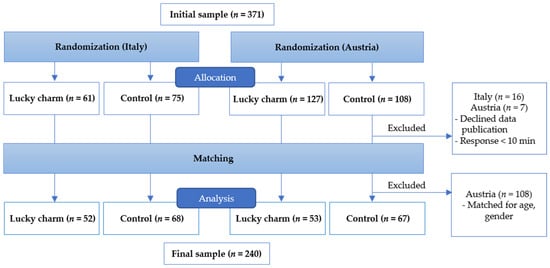
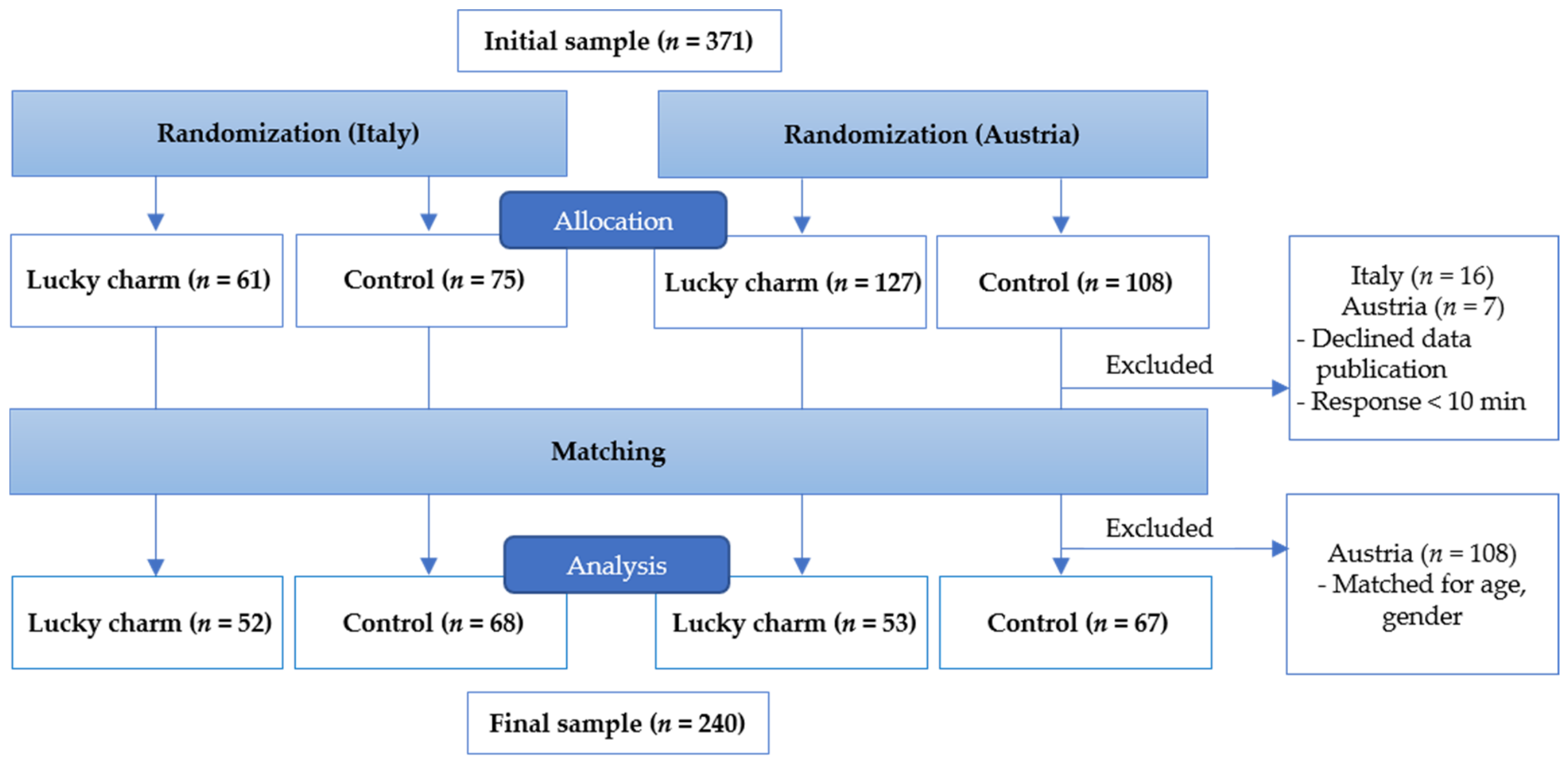
Participants in this fully anonymized online study were recruited by distributing the study link through academic contacts at various universities in Austria and Italy. Accordingly, the sample consisted primarily of university students (90%), with the remainder being university employees. Individuals aged 18 years or older were eligible to participate. Participants did not receive monetary compensation for participating in the study. A total of 371 individuals accessed the study link (for the CONSORT diagram, see Figure 1). They were randomly allocated to one of two groups that either received the lucky charm intervention (estimation task and feedback about effects of lucky charms) or a control intervention (estimation tasks and feedback about matched contents of the intervention; e.g., number of holes on a typical golf course).
Figure 1.
CONSORT diagram.
Participants who completed the study in an implausibly short time (less than 10 min) or did not agree to the publication of their data were excluded (n = 23). Due to unexpected unequal sample sizes of the national groups, a post-hoc matching procedure was introduced: 120 participants from Austria were matched to 120 participants from Italy in terms of gender, age and intervention type, resulting in a sample of 240 participants (mean age = 23.59 years, SD = 5.27, 82% female). Matching was conducted with the MatchIt-Package in R (version 4.8.2), with age as the matching variable and gender as an exact matching constraint. Pairs were formed based on the Mahalanobis distance, and matching was performed 1:1 without replacement.
A sensitivity analysis for the computed ANCOVAs (two 2-level between-subject factors, one covariate; n = 240, α = 0.05, 80% power) indicated that the design can detect effects of f ≥ 0.11 (partial eta2 ≈ 0.01), assuming the smallest observed pre-post correlation (r = 0.80).
2.2. Procedure
The online intervention was designed, administered and hosted on a server at the University of Graz, Austria. Study participation lasted approximately 12 min. Participants first completed questions regarding their sociodemographic background (age, gender). Then, they read a brief introductory text about placebos. This text first defined deceptive placebos (DPs) and provided information about their clinical efficacy. It was mentioned that DPs cannot be used in clinical practice due to ethical issues and the concept of OLPs was explained (the procedure followed Schienle & Seibel, 2024). After having read the text, participants provided slider ratings (0 = completely disagree, 100 = completely agree) for the following statements:
- I can imagine that open-label placebos could be effective for psychological (emotional) complaints.
- I can imagine that open-label placebos could be effective for physical complaints.
- I would be willing to take an open-label placebo myself.
- I find the concept of open-label placebos plausible.
- I believe deception is necessary for the placebo effect to occur.
Subsequently, participants of the lucky charm group were given the following instruction: “We would like to ask you to complete some estimation tasks. The presentation summarizes three studies and surveys that were conducted as described. Please answer spontaneously, as we are interested in your personal opinions and assessments”.
[Example] “In a study conducted in the United Kingdom (Wiseman, 2004), 100 participants were given a “lucky penny” to always carry with them. Over the course of one month, they kept a diary recording their feelings and experiences. What do you think—how many participants reported at the end of the month that they had felt happier with the penny than in the previous month?”
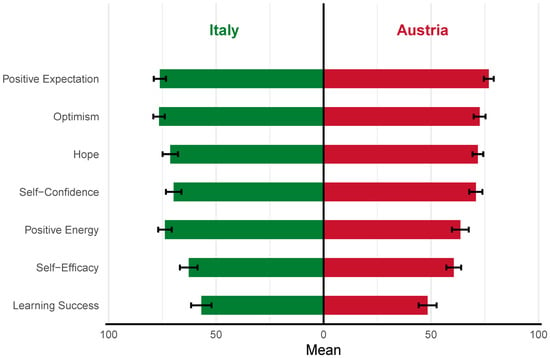
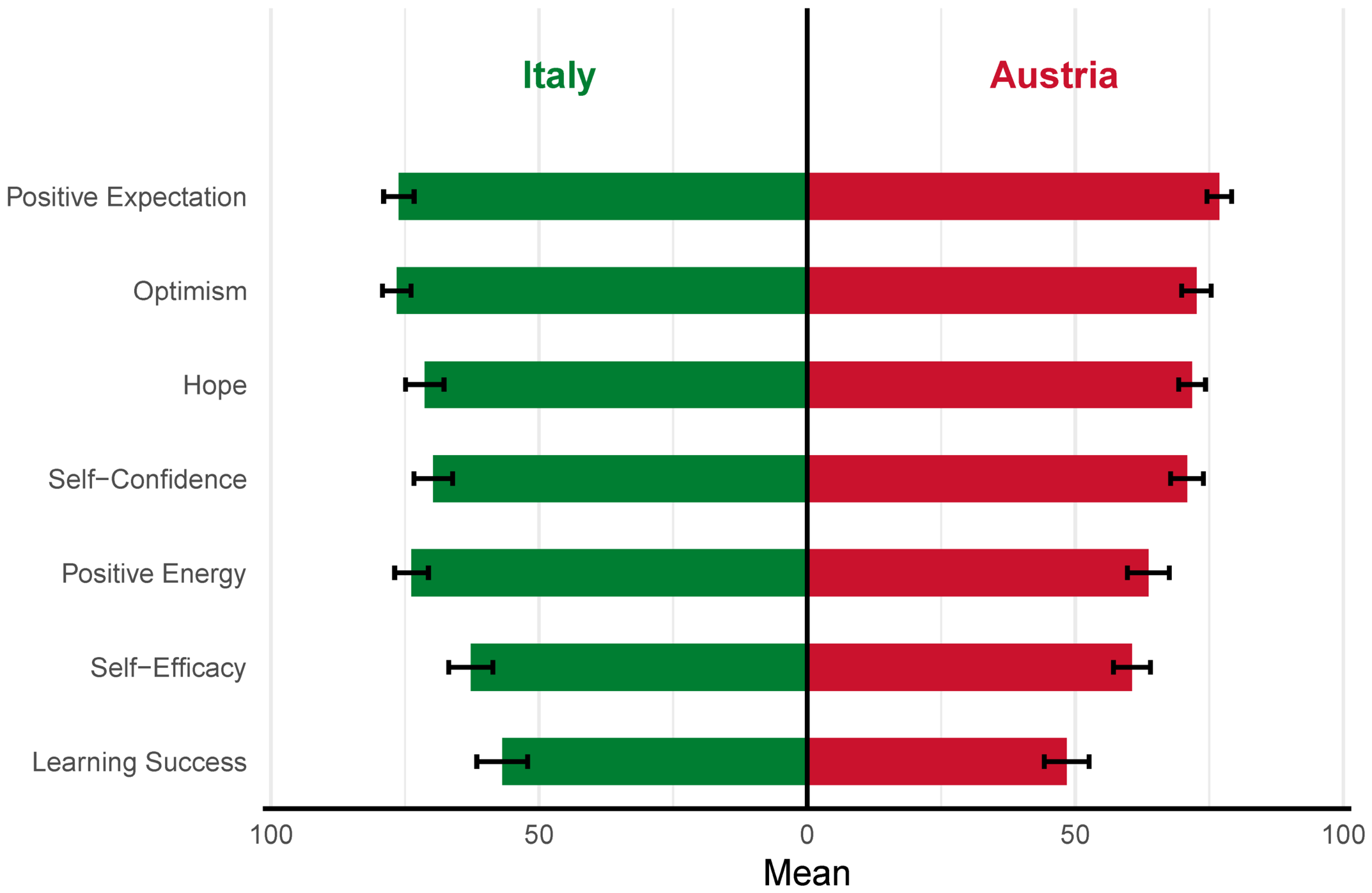
Following the presentation of the lucky-charm studies (Table 1) and their results, participants were invited to reflect on potential mechanisms that could account for the observed effects. They were asked: “How strongly do you think the following mechanisms played a role in the three studies?”—Prior learning experiences, positive expectations, optimism, hope, positive energy, self-efficacy, and self-confidence (slider ratings; 0: does not play any role at all; 100: plays a very large role; see Supplementary Figure S1).
Table 1.
Estimation tasks.
Finally, participants completed the adapted German/Italian version of the trait positive superstition scale (Cronbach’s alpha = 0.92 in the Austrian sample and 0.94 in the Italian sample) by Carlson et al. (2009). The 10 items (e.g., “I sometimes perform little rituals to bring good luck to myself”) are answered on a 7-point Likert scale (1 = strongly disagree, 7 = strongly agree). The scale development involved forward and backward translation. A recent validation study (Stopper et al., 2026) demonstrated that participants with higher levels of positive superstition reported greater OLP-related pain reduction.
2.3. Statistical Analysis
Differences in post-intervention scores on the five OLP-related questions were examined using separate ANCOVAs, with Intervention (lucky charm, control) and Country (Italy, Austria) as between-subjects factors and the corresponding pre-intervention score as a covariate. Differences in positive trait superstition were examined using an ANOVA, with the two between-subjects factors Intervention (lucky charm, control) and Country (Italy, Austria). Differences in assumed lucky charm mechanisms between Austria and Italy were investigated by means of Welch’s t-tests. Results were considered statistically significant when p < 0.01 (Bonferroni correction: α = 0.05/5 = 0.01). All statistical analyses were conducted with JAMOVI (v. 2.7.30).
3. Results
3.1. Sample Characteristics
Descriptive statistics for the sample (age, gender) can be found in Table 2.
Table 2.
Group characteristics.
3.2. Intervention Effects
3.2.1. OLPs for Reducing Emotional Complaints
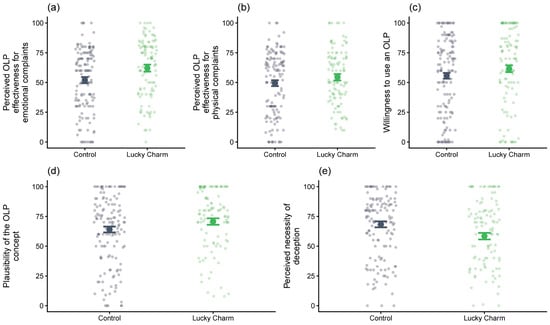
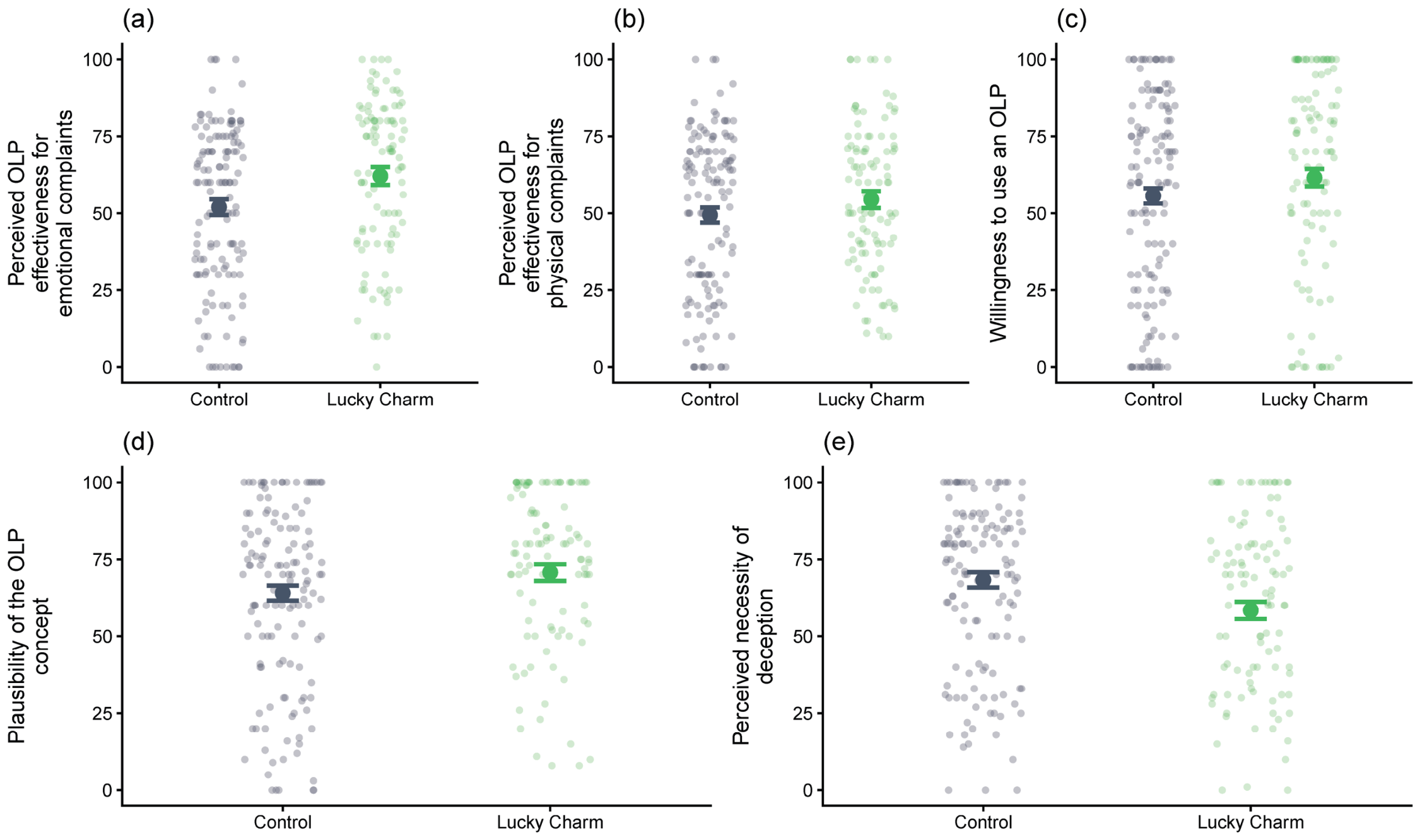
The ANCOVA revealed a significant main effect of Intervention, F(1, 235) = 27.07, p < 0.001, partial eta2 = 0.10. The main effect of Country, F(1, 235) = 4.29, p = 0.039 [MS1.1], partial eta2 = 0.02, and the Country × Intervention interaction, were not significant, F(1, 235) = 0.30, p = 0.583, partial eta2 < 0.01. Baseline ratings were significantly associated with post-intervention ratings, F(1, 235) = 447.33, p < 0.001, partial eta2 = 0.66. Adjusted estimated marginal means showed that the lucky charm group gave higher ratings (M = 62.09, SE = 1.46, 95% CI [59.21, 64.98]) than those in the control group (M = 51.93, SE = 1.29, 95% CI [49.39, 54.47]; Figure 2a).
Figure 2.
Intervention effects on (a) perceived OLP effectiveness for emotional complaints, (b) perceived OLP effectiveness for physical complaints, (c) plausibility of OLP concept, (d) willingness to use an OLP, (e) perceived necessity of deception. Note: Points with error bars show covariate-adjusted means (adjusted for pre-intervention scores) with 95% confidence intervals; semi-transparent dots show observed individual post-intervention scores (jittered horizontally for visibility). Adjusted means may therefore differ slightly from raw group means.
3.2.2. OLPs for Reducing Physical Complaints
The ANCOVA revealed a significant main effect of Intervention, F(1, 235) = 7.15, p = 0.008, partial eta2 = 0.03. The main effect of Country, F(1, 235) = 0.32, p = 0.570, partial eta2 < 0.01, and the Country × Intervention interaction, F(1, 235) = 1.09, p = 0.298, partial eta2 < 0.01, were not significant. Baseline ratings were significantly associated with post-intervention ratings, F(1, 235) = 470.97, p < 0.001, partial eta2 = 0.67. Adjusted estimated marginal means showed that participants in the lucky charm group rated the expected effectiveness of OLPs for physical complaints higher (M = 54.43, SE = 1.41, 95% CI [51.65, 57.21]) than participants in the control group (M = 49.40, SE = 1.24, 95% CI [46.95, 51.85]; Figure 2b).
3.2.3. Plausibility of OLP Concept
The ANCOVA revealed a significant main effect of Intervention, F(1, 235) = 12.95, p < 0.001, partial eta2 = 0.05. The main effect of Country, F(1, 235) = 1.28, p = 0.258, partial eta2 = 0.01, and the Country × Intervention interaction, F(1, 235) = 0.24, p = 0.626, partial eta2 = 0.00, were not significant. Baseline ratings were significantly associated with post-intervention ratings, F(1, 235) = 581.32, p < 0.001, partial eta2 = 0.71. Adjusted estimated marginal means showed that participants in the lucky charm group rated the concept of OLPs as more plausible (M = 70.71, SE = 1.40, 95% CI [67.95, 73.47]) than participants in the control group (M = 63.97, SE = 1.23, 95% CI [61.54, 66.40]; Figure 2c).
3.2.4. Willingness to Take an OLP
The ANCOVA revealed a significant main effect of Intervention, F(1, 235) = 9.65, p = 0.002, partial eta2 = 0.04. The main effect of Country, F(1, 235) = 0.84, p = 0.362, partial eta2 < 0.01, and the Country × Intervention interaction, F(1, 235) = 0.13, p = 0.715, partial eta2 < 0.01, were not significant. Baseline ratings were significantly associated with post-intervention ratings, F(1, 235) = 894.23, p < 0.001, partial eta2 = 0.79. Adjusted estimated marginal means indicated that participants in the lucky charm group reported greater willingness to use OLPs (M = 61.54, SE = 1.44, 95% CI [58.71, 64.37]) than participants in the control group (M = 55.59, SE = 1.27, 95% CI [53.10, 58.08]; Figure 2d).
3.2.5. Necessity of Deception for the Occurrence of Placebo Effects
The ANCOVA revealed a significant main effect of Intervention, F(1, 235) = 26.52, p < 0.001, partial eta2 = 0.10. The main effect of Country, F(1, 235) = 1.11, p = 0.292, partial eta2 < 0.01, and the Country × Intervention interaction, F(1, 235) = 0.73, p = 0.392, partial eta2 < 0.01 were not significant. Baseline ratings were significantly associated with post-intervention ratings, F(1, 235) = 605.39, p < 0.001, partial eta2 = 0.72. Adjusted estimated marginal means indicated that participants in the lucky charm group perceived less necessity of deception for the occurrence of placebo effects (M = 58.41, SE = 1.43, 95% CI [55.60, 61.22]) than participants in the control group (M = 68.23, SE = 1.26, 95% CI [65.75, 70.70]; Figure 2e).
3.2.6. Whole-Group Analyses
The ANCOVAs for the five OLP questions were also conducted for the whole group (n = 348) with the factors Intervention (lucky charm, control), and Country (Austria, Italy). The effects were comparable to the matched sample (the complete statistical analyses can be found in Supplementary Table S1).
3.3. Estimations of the Lucky Charm Group
Participants in the lucky charm group (n = 105) expected significantly more successful putts with the “lucky golf ball” (M = 6.88, SD = 1.43) than with the control ball (M = 4.75, SD = 1.26, t(104) = 12.66, p < 0.001, d = 1.24). The estimate for the “lucky golf ball” was significantly higher than the actual hit rate of M = 6 reported in the original study (p < 0.001). Moreover, participants in this group estimated that, on average, 69% (SD = 15.06) of individuals who received a “lucky penny” reported being happier over the past month—substantially overestimating the study’s observed rate of 30%. They also believed that 76% (SD = 18.64) of participants would want to keep the “lucky penny” after one month (compared to 70% in the original study). Finally, the percentage of participants in an experiment who experienced reduced emotional distress due to the lucky charm (M = 66.50%, SD = 16.71), was underestimated relative to the true effect (80%).
3.4. Positive Trait Superstition
The ANOVA revealed a significant main effect of Country, F(1, 236) = 9.50, p = 0.002, partial eta2 = 0.04. Participants from Austria reported higher positive superstition (M = 3.92, SE = 0.15, 95% CI [3.62–4.21]) relative to Italians (M = 3.26, SE = 0.15, 95% CI [2.97–3.56]). The main effect of Intervention, as well as the interaction Intervention x Country did not reach statistical significance (ps > 0.497).
3.5. Assumed Lucky Charm Mechanisms
The perceived relevance of specific lucky charm mechanisms was similar across both countries (all ps > 0.082), with optimism, positive expectations, and self-confidence emerging as the three most strongly endorsed mechanisms (see Figure 3).
Figure 3.
Assumed mechanisms of lucky charms. Whiskers depicting 95% confidence intervals. Note: 0: plays no role; 100: plays a large role.
4. Discussion
The present experiment examined whether providing information about evidence that lucky charms can meaningfully influence people’s experiences and behaviors can change their attitudes toward open-label placebos (OLPs). The findings support this assumption. A brief online intervention (approximately 12 min) increased the perceived plausibility of the OLP concept, expectations regarding the effectiveness of OLPs for both emotional and physical conditions, and participants’ reported willingness to take an OLP. In addition, the lucky-charm intervention reduced the belief that deception is necessary for placebo effects to occur. The corresponding effect sizes were small to medium (partial eta2: 0.03–0.10).
Estimation performance in the lucky-charm group indicated both under- and overestimation of effects, though overestimation was more common (e.g., regarding increased happiness through the lucky penny, improved performance through the lucky golf ball).
The intervention may have been effective, independently of the accuracy of participants’ estimates, because it targeted underlying assumptions about how placebos might work, rather than merely presenting isolated facts. The standard instruction used in OLP studies, originally developed by Kaptchuk et al. (2010), includes four key statements: “(1) the placebo effect is powerful, (2) the body can automatically respond to taking placebo pills, similar to Pavlov’s dogs that salivated when they heard a bell, (3) a positive attitude helps but is not necessary, and (4) taking the pills faithfully is critical” (p. 2). More recent OLP studies often supplement these instructions with additional findings from placebo research (e.g., Heiss et al., 2021). However, simply providing OLP information may not be sufficient to change attitudes, particularly given that many individuals are unfamiliar with non-deceptive placebos and may encounter the concept for the first time when entering a treatment.
In contrast, lucky charms are widespread and generally positively perceived, as also reflected in the present sample. Their use tends to increase in situations involving personal difficulty or high stakes. For example, college students report more superstitious behaviors before exams (Vyse, 1997) and use lucky charms more frequently as perceived stakes increase (Rudski & Edwards, 2007). These patterns may extend beyond performance contexts to emotional and physical challenges, making lucky charms a particularly accessible and relatable framework for introducing OLP mechanisms. The intervention appears to make the concept of non-deceptive placebos more intelligible by linking optimism and positive expectations with increased self-confidence. These mechanisms associated with lucky charms identified by participants in the present study may directly generalize to OLPs.
Limitations
Several limitations of the present study should be acknowledged. First, the intervention relied on single items to assess changes in attitudes toward OLPs; multi-item measurements may be more appropriate to cover the complex constructs. Second, it remains to be shown that attitudinal changes translate into actual behavior (e.g., intake of OLPs for specific conditions). Third, the sample was predominantly female, young and highly educated. However, gender and age alone are not consistent predictors of placebo responsiveness (Enck & Klosterhalfen, 2019). Fourth, the present study demonstrated short-term effects, but it remains unclear whether the observed attitudinal changes are sustained over time. Fifth, we observed differences between Italian and Austrian participants in positive trait superstition. This unexpected finding warrants further investigation, particularly through systematic cross-cultural comparisons. Importantly, these differences were not associated with the effectiveness of the lucky-charm intervention. Finally, the lucky charm intervention had two components serving distinct purposes: the initial estimation tasks aimed to demonstrate the phenomenon itself (i.e., that lucky charms may have beneficial effects), whereas the additional task encouraged participants to consider the potential mechanisms underlying these effects. Thus, the intervention involved a slightly more complex task than the control condition.
Alternative explanations for the observed effects should also be considered. The lucky charm intervention provided exclusively positive information, which may have introduced response bias or persuasive effects. Although the rationale most commonly used in OLP research by Kaptchuk et al. (2010) also incorporates positive statements (e.g., “the placebo effect is powerful”) and is often combined with positive research findings on placebos (e.g., Guevarra et al., 2020), future studies could investigate whether presenting the lucky charm framework and its hypothesized mechanisms without explicitly positive statements would be sufficient to induce changes in attitudes.
5. Conclusions
Overall, the findings suggest that a brief, low-cost online intervention grounded in familiar everyday beliefs—such as the effects of lucky charms—can change attitudes toward OLPs. By targeting assumptions about how mind–body processes operate, rather than relying solely on abstract information, such approaches may facilitate broader acceptance and potential application of OLPs. Before this approach can be applied in practical or clinical settings, further studies are needed to demonstrate behavioral effects of the lucky charm intervention beyond changes in attitudes. The findings should therefore be interpreted cautiously until behavioral and longitudinal evidence is available.
Supplementary Materials
The following supporting information can be downloaded at: https://www.mdpi.com/article/10.3390/bs16122268/s1. Figure S1: Screenshots of the two online interventions; Table S1: ANCOVA results for the total sample (n = 348).
Author Contributions
Conceptualization, writing of the manuscript (A.S. (Anne Schienle)); analysis (A.W.), writing—review and editing (A.W., A.S. (Arved Seibel) and M.S.). All authors have read and agreed to the published version of the manuscript.
Funding
This research received no external funding.
Institutional Review Board Statement
The study was conducted in accordance with the Declaration of Helsinki, and approved by the responsible ethics committee of the University of Graz (GZ. 39/264/63 ex 2024/25, 5 November 2025). The study was preregistered at the German Clinical Trial Register on 25 February 2026 and conducted from 16 March to 4 May 2026 (the registration ID: DRKS00039442).
Informed Consent Statement
Participants indicated their informed consent to participate in the study and to the publication of their anonymized responses by ticking a checkbox.
Data Availability Statement
The original contributions presented in this study are included in the article/Supplementary Material. Further inquiries can be directed to the corresponding author.
Acknowledgments
Open Access Funding by the University of Graz.
Conflicts of Interest
The authors declare no conflicts of interest.
References
- Buergler, S., Sezer, D., & Gaab, J. (2023). The roles of expectation, comparator, administration route, and population in open-label placebo effects: A network meta-analysis. Scientific Reports, 13, 11827. [Google Scholar] [CrossRef] [Scilit]
- Carlson, B. D., Mowen, J. C., & Fang, X. (2009). Trait superstition and consumer behavior: Re-conceptualization, measurement, and initial investigations. Psychology & Marketing, 26, 689–777. [Google Scholar] [CrossRef] [Scilit]
- Colloca, L., & Howick, J. (2018). Placebos without deception: Outcomes, mechanisms, and ethics. International Review of Neurobiology, 138, 219–240. [Google Scholar] [CrossRef] [Scilit]
- Damisch, L., Stoberock, B., & Mussweiler, T. (2010). Keep your fingers crossed! How superstition improves performance. Psychological Science, 21(7), 1014–1020. [Google Scholar] [CrossRef] [Scilit]
- Enck, P., & Klosterhalfen, S. (2019). Does sex/gender play a role in placebo and nocebo effects? Conflicting evidence from clinical trials and experimental studies. Frontiers in Neuroscience, 13, 160. [Google Scholar] [CrossRef] [Scilit]
- Evers, A. W. M., Colloca, L., Blease, C., Annoni, M., Atlas, L. Y., Benedetti, F., Bingel, U., Büchel, C., Carvalho, C., Colagiuri, B., Crum, A. J., Enck, P., Gaab, J., Geers, A. L., Howick, J., Jensen, K. B., Kirsch, I., Meissner, K., Napadow, V., … Kelley, J. M. (2018). Implications of placebo and nocebo effects for clinical practice: Expert consensus. Psychotherapy and Psychosomatics, 87, 204–210. [Google Scholar] [CrossRef] [Scilit]
- Fendel, J. C., Tiersch, C., Sölder, P., Gaab, J., & Schmidt, S. (2025). Effects of open-label placebos across populations and outcomes: An updated systematic review and meta-analysis of randomized controlled trials. Scientific Reports, 15(1), 29940. [Google Scholar] [CrossRef] [Scilit]
- Guevarra, D. A., Moser, J. S., Wager, T. D., & Kross, E. (2020). Placebos without deception reduce self-report and neural measures of emotional distress. Nature Communications, 11, 3785. [Google Scholar] [CrossRef] [Scilit]
- Haas, J. W., Rief, W., & Doering, B. K. (2021). Open-label placebo treatment: Outcome expectations and general acceptance in the lay population. International Journal of Behavioral Medicine, 28(4), 444–454. [Google Scholar] [CrossRef] [Scilit]
- Heiss, U., Rosenfield, M., & Bernstein, M. H. (2021). Can the open label placebo rationale be optimized? Frontiers in Pain Research, 2, 734882. [Google Scholar] [CrossRef] [Scilit]
- Kaptchuk, T. J. (2018). Open-label placebo: Reflections on a research agenda. Perspectives in Biology and Medicine, 61(3), 311–334. [Google Scholar] [CrossRef] [Scilit]
- Kaptchuk, T. J., Kelley, J. M., & Conboy, L. A. (2010). Placebos without deception: A randomized controlled trial in irritable bowel syndrome. PLoS ONE, 5(12), e15591. [Google Scholar] [CrossRef] [Scilit]
- Kogler, W., & Schienle, A. (in press). Self-efficacy moderates open-label placebo effects on public speaking anxiety: A single-session randomized controlled trial. Scientific Reports.
- Lindeman, M., & Aarnio, K. (2007). Superstitious, magical, and paranormal beliefs: An integrative model. Journal of Research in Personality, 41(4), 731–744. [Google Scholar] [CrossRef] [Scilit]
- Moerman, D. E., & Jonas, W. B. (2002). Deconstructing the placebo effect and finding the meaning response. Annals of Internal Medicine, 136(6), 471–476. [Google Scholar] [CrossRef] [Scilit]
- Rudski, J. M., & Edwards, A. (2007). Malinowski goes to college: Factors influencing students’ use of rituals and superstition. The Journal of General Psychology, 134, 389–403. [Google Scholar] [CrossRef] [Scilit]
- Schienle, A., Kogler, W., & Wabnegger, A. (2025a). A simple alternative to nondeceptive placebos for reducing emotional distress: Encouragement. Social Cognitive and Affective Neuroscience, 20, nsaf100. [Google Scholar] [CrossRef] [Scilit]
- Schienle, A., & Seibel, A. (2024). Would you take an open-label placebo pill or give one to your child? Findings from a cross sectional survey. Psychological Research and Behavior Management, 17, 393–400. [Google Scholar] [CrossRef] [Scilit]
- Schienle, A., Wilhelm, J., & Tanzmeister, S. (2025b). Transitioning from deceptive to nondeceptive placebo treatment to reduce pathological skin-picking. Discover Mental Health, 5, 154. [Google Scholar] [CrossRef] [Scilit]
- Stopper, M., Tanzmeister, S., & Schienle, A. (2026). The role of treatment choice in open-label placebo analgesia: A randomized controlled trial. The Journal of Pain, 52, 106484. [Google Scholar] [CrossRef] [Scilit]
- von Wernsdorff, M., Loef, M., Tuschen-Caffier, B., & Schmidt, S. (2021). Effects of open-label placebos in clinical trials: A systematic review and meta-analysis. Scientific Reports, 11(1), 3855. [Google Scholar] [CrossRef] [Scilit]
- Vyse, S. A. (1997). Believing in magic: The psychology of superstition. Oxford University Press. [Google Scholar]
- Wager, T., & Atlas, L. (2015). The neuroscience of placebo effects: Connecting context, learning and health. Nature Reviews Neuroscience, 16, 403–418. [Google Scholar] [CrossRef] [Scilit]
- Wiseman, R. (2004). A charmed life for those who believe in luck. The Guardian. Available online: https://www.theguardian.com/education/2004/jan/05/highereducation.uk (accessed on 27 April 2026).
- Wiseman, R., & Watt, C. (2004). Measuring superstitious belief: Why lucky charms matter. Personality and Individual Differences, 37(8), 1533–1541. [Google Scholar] [CrossRef] [Scilit]
- YouGov. (2022). Which superstitions are Americans most likely to believe? Available online: https://yougov.com/en-us/articles/42425-which-superstitions-are-americans-most-likely-beli (accessed on 27 April 2026).

Disclaimer/Publisher’s Note: The statements, opinions and data contained in all publications are solely those of the individual author(s) and contributor(s) and not of MDPI and/or the editor(s). MDPI and/or the editor(s) disclaim responsibility for any injury to people or property resulting from any ideas, methods, instructions or products referred to in the content. |
© 2026 by the authors. Licensee MDPI, Basel, Switzerland. This article is an open access article distributed under the terms and conditions of the Creative Commons Attribution (CC BY) license.