


Abstract
The construct of adolescent psychological well-being has long been a focus of both public discourse and scholarly inquiry. With the widespread adoption of the Internet, there have been growing concerns about adolescents’ exposure to escalating online risks. Parental mediation has been hypothesised to facilitate the guidance and regulation of adolescents’ Internet use. However, the specific mediating role of the parent–adolescent relationship in the association between problematic Internet use and psychological well-being has remained underexamined, a gap explored in the current study. Based on the theoretical underpinnings provided by Phase Three of Bronfenbrenner’s Bioecological Model of Human Development, a cross-sectional survey using validated psychometric instruments was conducted, involving 1598 students (mean age 16.0 years; 51% female) from secondary schools in Selangor, Malaysia. For data analysis, inferential statistics and partial least squares–structural equation modelling (PLS–SEM) were used to examine the complex structural relationships among the variables. Mean scores for problematic Internet use and psychological well-being indicated moderate severity levels. SEM results indicated the negative influence of problematic Internet use on psychological well-being (β = −0.104 *, p = 0.040) and parent–adolescent relationship (β = −0.241 **, p < 0.001) and a significant positive influence of parent–adolescent relationship on psychological well-being (β = 0.328 **, p < 0.001). Subsequent mediation analysis confirmed the partial mediating effect of parent–adolescent relationship (indirect association: β = −0.079) on the relationship between problematic Internet use and psychological well-being among Malaysian adolescents. This was consistent with Bronfenbrenner’s Bioecological Model of Human Development. Strengthening the parent–adolescent relationship could mitigate the adverse psychological effects of excessive Internet use. From a policy perspective, these findings supported the use of family-focused intervention as a strategy to address the adverse psychological effects of problematic Internet use among adolescents.
1. Introduction
Adolescence is a pivotal developmental stage characterised by rapid physical, cognitive, emotional, and social transformation. Within this developmental phase, adolescents attain greater independence, cultivate complex social identities, and establish behavioural patterns that have significant implications for their long-term well-being. In the 21st century, rapid advancements in digital technologies have reshaped adolescent experience. Internet use has become a central aspect of adolescents’ academic, social, and recreational lives, with global reports of more than 90% of adolescents in developed countries and an increasing proportion of adolescents in developing countries having access to the Internet daily (Hällgren & Björk, 2022). While the Internet offers substantial benefits, such as facilitating access to educational resources, supporting skill development, and fostering global communication, there are growing concerns regarding the potential of excessive or maladaptive use, including problematic Internet use (PIU). This condition is characterised by compulsive use of online platforms, loss of control over the usage patterns, and continued use despite negative consequences (Young, 1998). PIU has been linked to a range of adverse outcomes in diverse cultural contexts, including reduced academic performance, disrupted sleep, social withdrawal, and emotional distress (Aderinto, 2022). Global prevalence estimates range between 8% and 26%, depending on the definitions and measurement tools (Astarini & Yudiarso, 2020). In Southeast Asia, rapid digitalisation and high smartphone penetration have contributed to elevated Internet engagement, with Malaysia ranking among the top countries in the region for connectivity (Asian Development Bank & UN.Escap, 2018). Although this enhances digital inclusion, it increases the risk of PIU, thereby necessitating robust preventative interventions.
1.1. Adolescent Problematic Internet Use and Psychological Well-Being
Psychological well-being (PWB) is a multidimensional construct encompassing self-acceptance, autonomy, personal growth, purpose in life, environmental mastery, and positive relationships. The relationship between PIU and PWB among adolescents is complex and often bidirectional (Ryff, 1989). Studies have consistently reported the relationships of excessive Internet use with higher levels of depression, anxiety, and stress and diminished life satisfaction (Sanghvi & Rai, 2015). Conversely, adolescents seeking to alleviate psychological distress may utilise online platforms, such as social media and gaming, as coping strategies to obtain validation and escape offline challenges (Kostyrka-Allchorne et al., 2023).
1.2. Parental Mediation on Internet Use and Its Impact on Adolescent Psychological Well-Being
A positive parent–adolescent relationship (PAR) can mitigate the psychological effects of PIU. On the other hand, conflicts or distant relationships between adolescents and parents may heighten vulnerabilities, leading to greater engagement in maladaptive online behaviours (De Simone et al., 2025; O’Reilly & Mohan, 2023). PAR that fosters self-regulation, emotional resilience, and decision-making (Pontes & Macur, 2021; Lan et al., 2022) enhances adolescents’ capacity for association-based technology management. Parental involvement manifests in diverse modalities, including active mediation (through discussion of online content), restrictive mediation (by setting limits), and co-use through shared online activities (Livingstone & Helsper, 2008). Evidence suggests that active mediation is particularly associated with promoting healthier online behaviours and greater adolescent well-being (Giovanelli et al., 2025). However, the use of these different modalities may vary, depending on cultural norms and parenting styles, underscoring the importance of context-specific research.
1.3. Current Study
There are gaps in the literature on the direct influence of adolescents’ Internet use on PWB and the mediating role of PAR. There is a pressing need to fill these gaps, especially for countries in Southeast Asia, such as Malaysia, where cultural norms emphasise family cohesion (Faudzi et al., 2020). Understanding the interplays between these variables within an Asian society is necessary for comparison with existing studies from predominantly Western contexts that feature differing cultural norms and family dynamics (Ratten et al., 2023). This is crucial for formulating locally relevant and culturally sensitive strategies that balance the benefits of digital engagement with the need to safeguard adolescents’ well-being.
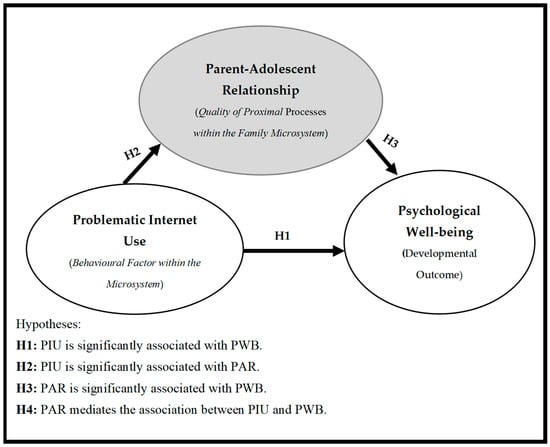
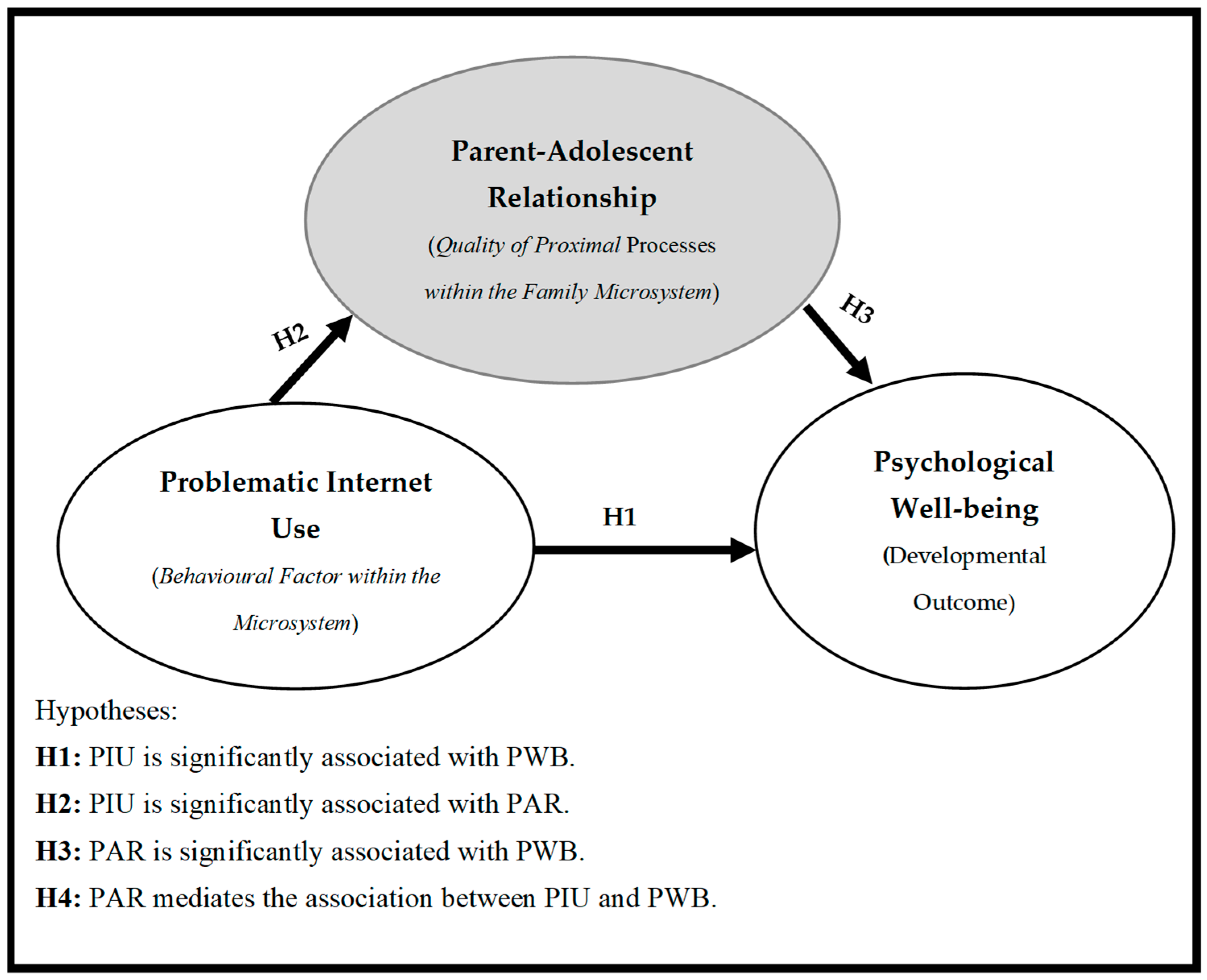
This study was underpinned by Bronfenbrenner’s Bioecological Model of Human Development, emphasising the dynamic interactions between individuals and their multiple environmental systems over time. According to this model, developmental outcomes are shaped by proximal processes, which are regular, sustained interactions with people, objects, and symbols in one’s immediate environment, and are associated with the characteristics of the individual and the surrounding context (Bronfenbrenner & Morris, 2007). In the context of this study, Internet use was conceptualised as a behavioural factor situated within the adolescent’s microsystem, in which frequent engagement with digital devices and online platforms is a significant part of daily interactions. PWB is a developmental outcome that may be adversely affected by PIU. PAR is a key microsystem factor that functions as either a protective or a risk factor, depending on the quality of the relationship.
The framework posited that a strong parental relationship, characterised by care, trust, and open communication, can buffer the detrimental influence of PIU on PWB. Conversely, weaker parental relationship may exacerbate these associations, leading to poorer mental health outcomes. Guided by this theoretical lens, the model (Figure 1) illustrated the hypothesised direct relationship between PIU and PWB, as well as the mediating role of PAR in this association.
Figure 1.
Conceptual Framework for the Study.
With that, this study aimed to assess the levels of PIU, PWB, and PAR; examine the relationships between PIU and PWB, PAR and PWB, and between PIU and PAR; and determine whether PAR mediates the relationship between PIU and PWB. The study’s findings would significantly contribute to the growing body of literature on the psychosocial impacts of Internet use during adolescence, thereby yielding practical implications for the development of school-based interventions, parental guidance programmes, and national digital well-being strategies. Furthermore, the study’s incorporation of a theoretically grounded model and its focus on a culturally specific context offered globally relevant and locally applicable insights, enabling a comprehensive understanding of the phenomenon in question.
2. Materials and Methods
2.1. Study Design
An analytical cross-sectional survey was conducted from 7 September 2023 to 5 October 2023 at selected public secondary schools in the Petaling district of Selangor, a state in Peninsular Malaysia.
2.2. Participants
In Malaysia, students aged 15 to 17 years enrol in Form 4 (equivalent to Grade 10 in many international systems). They were selected because they are still in their mid-adolescent stage, which is a critical developmental period marked by routine exposure to formal education systems and digital resources. This cohort was not involved in preparation for national public examinations, thereby mitigating potential confounding from stress levels and Internet usage patterns.
2.3. Procedure
A three-stage sampling procedure was employed: (i) simple random sampling to select nine schools out of 62 schools in the Petaling district (administrative division); (ii) proportionate sampling to determine the number of students from the selected schools; (iii) total sampling of Form 4 students from each class. For proportionate sampling, the OpenEpi® software, Version 3.01 was used to calculate the sample size with Sullivan et al. (2009) formula. A minimum sample size of 1128 was determined based on an estimated population size (N = 17,565), design effect (DEFF = 3), anticipated proportion (p = 50%), and a desired absolute precision (d) at a 95% confidence level. After factoring in the potential dropout rate of 10%, this study targeted a total of 1241 students for the survey. The subset for mediation analysis was selected using proportionate random sampling to preserve the representativeness of the original sample across the participating schools. Approximately 44 respondents were randomly selected from each of five schools and 45 respondents from each of four schools, yielding a total sample of 400 participants for the measurement and structural model analyses.
The obtained sample size substantially exceeded the recommended minimum requirements for PLS-SEM and mediation analysis and was considered adequate to achieve stable parameter estimates and sufficient statistical power (Ajayi & Adebayo, 2021; Kline, 2017; Memon et al., 2020). PLS-SEM was employed because its prediction-oriented objective aligns with our research goals, and it effectively accommodates hierarchical component models (HCMs) through a two-stage approach; this allowed for the seamless estimation of higher-order constructs, the preservation of multidimensionality, and a significant reduction in model complexity while ensuring the total avoidance of indicator reuse bias.
Although covariance-based SEM is commonly used for theory confirmation, the present study primarily sought to estimate and predict relationships among higher-order latent constructs following measurement model validation. Therefore, PLS-SEM was considered the more appropriate analytical approach for this study’s objectives.
2.4. Measures
Formal permission was obtained for the adoption and translation of the Compulsive Internet Use Scale (CIUS), the Brief Scale of Psychological Well-Being for Adolescents (BSPWB-A), and the parent attachment domain of the Inventory of Parent and Peer Attachment (IPPA). The translation process from English to Malay was undertaken by bilingual experts using a rigorous forward–backward translation methodology in accordance with the recommended procedural guidelines (Ling et al., 2019). The Malay-adapted versions employed in this study were derived from previously validated psychometric work conducted among Malaysian adolescents. The construct reliability and validity of these versions were re-evaluated in the present sample.
Sociodemographic characteristics: Sociodemographic parameters in this study encompassed age, gender, weight, height, ethnicity, parental education, parental employment status, household size, and number of siblings.
Internet Usage Patterns: The assessment examined respondents’ digital device ownership, daily usage duration, peak access periods, and engagement across diverse online activities (e.g., social media, streaming, gaming, and educational platforms).
CIUS: The original CIUS consisted of 14 items, distributed across five distinct subdomains, namely loss of control (Items 1, 2, 5, and 9), preoccupation (Items 4, 6, and 7), withdrawal symptoms (Item 14), coping or mood modification (Items 12 and 13), and conflict (Items 3, 8, 10, and 11). Items were rated on a five-point Likert scale (0 = “Never” to 4 = “Very Often”), thereby yielding a total score between 0 and 56 (Meerkerk et al., 2008, p. 22; Pérez-Sáenz et al., 2023, p. 140). The original instrument demonstrated robust psychometric properties, as evidenced by Cronbach’s alpha (α) of 0.89 (Meerkerk et al., 2008). The Malay-adapted version used in this study comprised nine items, grouped into two subdomains: loss of control (six items) and preoccupation (three items).
BSPWB-A: Viejo et al. (2018) developed this instrument, which was an adaptation of Ryff’s original psychological well-being scale, comprising 20 items rated on a six-point Likert scale (1 = “Completely Disagree” to 6 = “Completely Agree”). The original instrument included four subdomains of self-acceptance, positive interpersonal relationships, autonomy, and life development (Viejo et al., 2018). The Malay-adapted version utilised in this study featured 16 items across four subdomains: self-acceptance (four items), autonomy (three items), continuous development (two items), and life experiences (two items).
IPPA: The parent attachment subscale of the revised IPPA was adapted by Gullone and Robinson (2005), comprising 28 items to assess adolescents’ perceptions of attachment to their parents across three subdomains: trust, communication, and alienation. Items were rated on a three-point Likert scale, with higher scores indicating greater agreement with each statement. The adapted Malay version used in this study comprised 14 items, organised into four subdomains: perceived care (five items), trust (four items), communication (three items), and alienation (three items).
2.5. Ethical Approval
Ethical approval for this study was obtained from the Research Ethics Committee. Additionally, permission to conduct the study was obtained from the management of each participating school. Informed consent was obtained from both parents or legal guardians and adolescent participants prior to data collection. All procedures were carried out in accordance with the Declaration of Helsinki, thereby upholding ethical research standards.
2.6. Data Collection Procedure
Parents and legal guardians were informed of the study through official communication distributed by the school management, which outlined the study’s purpose and procedures. Only students whose parents or legal guardians provided written consent and who themselves assented to participate in the study were included in the sample. Data collection was conducted using a paper-based questionnaire administered in a classroom setting. Prior to the distribution of the questionnaire, respondents received verbal instructions on how to complete it. Each session lasted approximately one hour and took place in a quiet, minimally disruptive environment, ensuring optimal data quality and participant focus.
2.7. Data Analysis
Data analysis was performed using IBM SPSS Statistics (Version 30) and SmartPLS (Version 4). A comprehensive manual review of the raw dataset was conducted to minimise data entry errors, detect missing-response patterns, and address ambiguous or extreme-value distributions, thereby enhancing data integrity. Outliers were identified using z-scores, and normality was assessed through skewness and kurtosis. Prior to the statistical analysis, all variables were systematically coded, and reverse scoring was applied to all negatively worded items to ensure consistency in scale direction. Missing data management was carried out using a structured methodological approach. As for cases with more than 10% missing values across key variables, listwise deletion was applied to prevent statistical bias. Datasets with missing values for essential sociodemographic characteristics, such as age, gender, ethnicity, parental employment status, number of siblings, and household size, were excluded. For continuous variables with less than 10% missing data, mean imputation was used. Descriptive analysis was conducted on the full dataset of 1598 respondents. For the mediation analysis, partial least squares–structural equation modelling (PLS–SEM) was performed on a randomly selected subset of 400 respondents.
In line with J. F. Hair et al. (2021) guidelines, SmartPLS (Version 4) was utilised to assess both the measurement and structural models. PLS–SEM was employed because the study involved multidimensional constructs modelled as hierarchical component models (HCMs) using the two-stage approach and aimed to explain and predict the relationships among PIU, parent–adolescent relationship quality, and psychological well-being. In the first stage, lower-order components and their indicators were estimated to establish reliability and validity, and latent variable scores were extracted. In particular, PIU comprised loss of control and preoccupation; PWB comprised self-acceptance, autonomy, continuous development, and life experiences; and PAR comprised perceived care, trust, communication, and alienation. In the second stage, these latent variable scores were used as indicators of their respective higher-order constructs in the structural model. The assessment of the measurement model included indicator reliability, internal consistency reliability, convergent validity, and discriminant validity. As for the structural model, path coefficients, coefficients of determination (R2), association sizes (f2), and predictive relevance (Q2) were estimated. Bootstrapping with 5000 resamples was employed to test the proposed hypotheses, with statistical significance set at p < 0.05 (Sarstedt et al., 2020).
3. Results
The total number of questionnaires collected from students in selected classes was 1921. After excluding 323 responses that were incomplete or contained data errors, the final analysis comprised 1598 valid responses.
3.1. Sociodemographic Characteristics and Internet Use
Table 1 presents the sociodemographic characteristics of the survey respondents. The sample consisted predominantly of 16-year-old students (M = 16.0, SD = 0.42), with a nearly equal gender distribution and the majority identifying as Malay. Most parents had completed at least secondary education, and the majority were employed. Over two-thirds of the respondents lived in households with four to six members and had three to five siblings.
Table 1.
Sociodemographic Background of Adolescents (N = 1598).
As shown in Table 2, mobile phones were the most commonly owned device, and over half of the respondents used multiple digital tools. Daily Internet use was substantial: 78% of respondents reported spending five hours or more online per day. Peak usage occurred in the late afternoon and evening, with a high proportion (70.5%) reporting digital content creation. Such trends indicated extensive integration of Internet access into adolescents’ daily routines across academic, social, and recreational domains, thereby highlighting its developmental relevance.
Table 2.
Internet Usage Patterns among Adolescents (N = 1598).
3.2. Validation of Psychometric Properties of Study Instruments
3.2.1. Adaptation of the Validated Malay Version of the CIUS
The original one-factor model entailed five correlated error terms. As demonstrated by parallel analysis and EFA, the two-domain model led to the reduction of the instrument to a nine-item CIUS. The indicators of Subdomain 1 measured “LC”, and those in Subdomain 2 measured “PO”. Outer loadings ranged from 0.562 to 0.762. Those with values under 0.7 were not deleted, as these items did not contribute to an increase in AVE. Referring to J. Hair et al. (2023), loadings of 0.4 or higher are deemed acceptable. The goodness-of-fit values indicated acceptable model fit. The original one-factor model with five correlated error terms was compared with the two-factor model (see Table 3), with the latter demonstrating adequate fit indices for the representative sample (Okafor-Emeagha et al., 2025).
Table 3.
Comparison of Model Fit before and after Modification.
3.2.2. Adaptation of the Validated Malay Version of the BSPWB-A
The original model contained 20 items and four subdomains (Gómez-López et al., 2019). In this study, the EFA with parallel analysis generated four factors with 16 items. Some indicators with outer loadings of 0.323 (Item 10), 0.414 (Item 4), 0.5028 (Item 14), 0.478 (Item 13), and 0.512 (Item 18) were deleted because they increased α and AVE. The four subdomains in this study featured 11 items with adequate fit indices. The original four-factor model with 20 items was compared with the four-factor model with 11 items, which demonstrated fairly suitable model fit indices. Regardless, RMSEA remained above 0.08 (see Table 3).
3.2.3. Adaptation of the Validated Malay Version of the Parent Attachment Domain
The original IPPA paradigm consisted of a 28-item, three-subdomain model of the parent attachment domain and a 25-item, three-subdomain model of the peer attachment domain (Gullone & Robinson, 2005). The factorial structure generated by parallel analysis and EFA, specifically a four-subdomain model with 18 items, was intended for the parent attachment domain. Based on the EFA, the subdomains of the parent attachment domain were renamed as “perceived care”, “trust”, “communication”, and “alienation”, in reference to Gullone and Robinson’s (2005) work. Responses on a three-point Likert scale for the negatively worded items in the alienation subdomain, such as “I feel embarrassed when expressing my concerns to my parents” and “I can’t rely on my parents”, were reverse-coded. The parent attachment domain demonstrated poor goodness-of-fit indices and low standardised outer weight loadings for some items. Those with lower loadings, such as Item 1 (0.486), Item 3 (0.476), Item 13 (0.464), and Item 25 (0.494), were deleted to improve goodness of fit, reliability, and validity. This resulted in four subdomains with 14 items (see Table 3).
3.3. Descriptive Statistics
Questionnaires with the following attributes were excluded: (1) incomplete data on sociodemographic characteristics (e.g., age, gender, and ethnicity); (2) errors in the response selection (not adhering to the instruction to choose a single option); (3) more than 10% of questions skipped. The response rate of 82.2% was deemed acceptable for survey-based research and indicated robust participation. Prior to hypothesis testing, a normality test, which included visual inspection, descriptive statistics (central tendency, skewness, and kurtosis), and formal statistical analysis, was conducted to assess whether the dataset was normally distributed.
When a large sample size is involved, skewness values between −2 and +2 and kurtosis values between −7 and +7 are considered acceptable for normality (J. F. Hair, 2009). Table 4 presents the obtained skewness and kurtosis values for all the variables in this study. Based on these metrics and visual inspection, data were found to align with the assumptions of normality. In addition, variance inflation factor values ranged from 1.000 to 1.184, indicating that the variables were not completely uncorrelated and that standard errors were not inflated. The descriptive statistics presented were based on the full sample (N = 1598), whereas the subsequent analyses of measurement and structural models were conducted using a randomly selected subset of 400 respondents. Similar structural relationships were observed when analyses were repeated using the full sample (N = 1598), supporting the stability of the randomly selected subset.
Table 4.
Skewness and Kurtosis Values for Normality Assessment, Descriptive Statistics (N = 1598).
3.3.1. Problematic Internet Use
The overall mean score for problematic Internet use, rated on a 5-point Likert scale, was M = 2.64, SD = 0.71, reflecting a moderate level of problematic Internet use in this sample. Further subdomain analysis (Table 4) showed a higher score for Loss of Control (M = 2.79, SD = 1.09) than for Preoccupation (M = 2.47, SD = 0.79), suggesting greater difficulties with Loss of Control than with Preoccupation.
3.3.2. Psychological Well-Being
The overall mean score for psychological well-being, rated on a 6-point Likert scale, was M = 4.03, SD = 0.66, indicating moderate levels of psychological well-being among the adolescents. Among the constituent subdomains (Table 4), Continuous Development (CD) had the highest mean (M = 4.50, SD = 1.05), indicating a moderate-to-high level of engagement with learning and self-improvement initiatives. Life Experiences (LE) had a mean of M = 4.01 and an SD of 0.95, indicating a moderate inclination towards engaging in new and meaningful experiences. Self-Acceptance (SA) scores also indicated moderate levels of self-regard and resilience. Conversely, the Autonomy (AT) subdomain exhibited the lowest mean (M = 3.83, SD = 1.08), indicating comparatively lower levels of independent decision-making capacity among the participant cohort.
3.3.3. Parent–Adolescent Relationship
The derived overall mean score for the parent–adolescent relationship construct, assessed using a 3-point Likert scale with the Malay version of the IPPA, was M = 2.18, SD = 0.39, indicating a moderate level of attachment between adolescents and their parents. Among the sub-domains (Table 4), Perceived Care (PC) had the highest mean (M = 2.50, SD = 0.65), indicating moderate-to-high perceptions of parental care. Trust (TR) and Communication (COM) exhibited comparable mean scores, indicating moderate levels of parental trust and communication, respectively. Notably, the Alienation (AL) subdomain registered the lowest score (M = 1.93, SD = 0.74), thereby indicating that adolescents predominantly reported low levels of emotional distance or disconnection from their parents.
3.4. Structural Model Results and Hypothesis Testing
As shown in Table 5, the two-factor model of the CIUS–Malay version demonstrated adequate construct reliability, with an overall α of 0.797. Its composite reliability (rho_c) and convergent validity were also found to be adequate. Likewise, the constructs in the four-factorial model of the BSPWB-A–Malay version demonstrated good α values and an overall internal consistency of 0.781. Results also demonstrated adequate convergent validity. The parent attachment domain in the Malay version demonstrated acceptable α values, an overall internal consistency of 0.709, and adequate convergent validity.
Table 5.
Structural Model Testing (N = 400 Random Subset).
The model accounted for 25.7% of total variance in PWB (R2 = 0.259) and 4.8% of total variance in the parent–adolescent relationship (R2 = 0.048). The analysis of association size was conducted in accordance with Cohen’s guidelines. Results revealed a modest association between PIU and both the parent–adolescent relationship (f2 = 0.051) and PWB (f2 = 0.058). The parent–adolescent relationship demonstrated a moderate association with PWB (f2 = 0.149). Meanwhile, the model’s predictive capability was assessed using Stone–Geisser’s Q2 test. Notably, Q2 values for both endogenous constructs exceeded 0, indicating acceptable predictive relevance. As shown in Table 5, parent–adolescent relationship recorded Q2 of 0.047 (small predictive relevance), while PWB recorded Q2 of 0.072 (medium predictive relevance). Following the item reduction procedure, LE was not retained as a single-indicator construct because it did not demonstrate reliability indices (e.g., α). Its composite reliability was not estimated conventionally for single-item constructs. Therefore, it was deleted.
3.4.1. Path Coefficients and Significance Testing
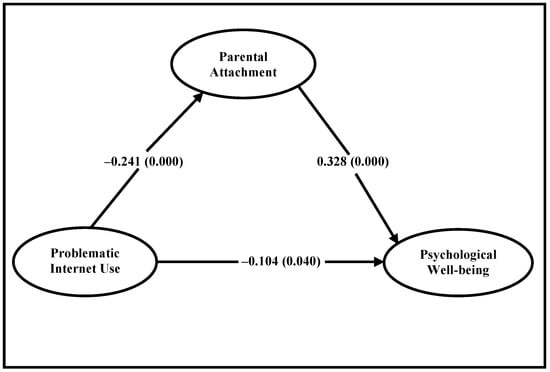
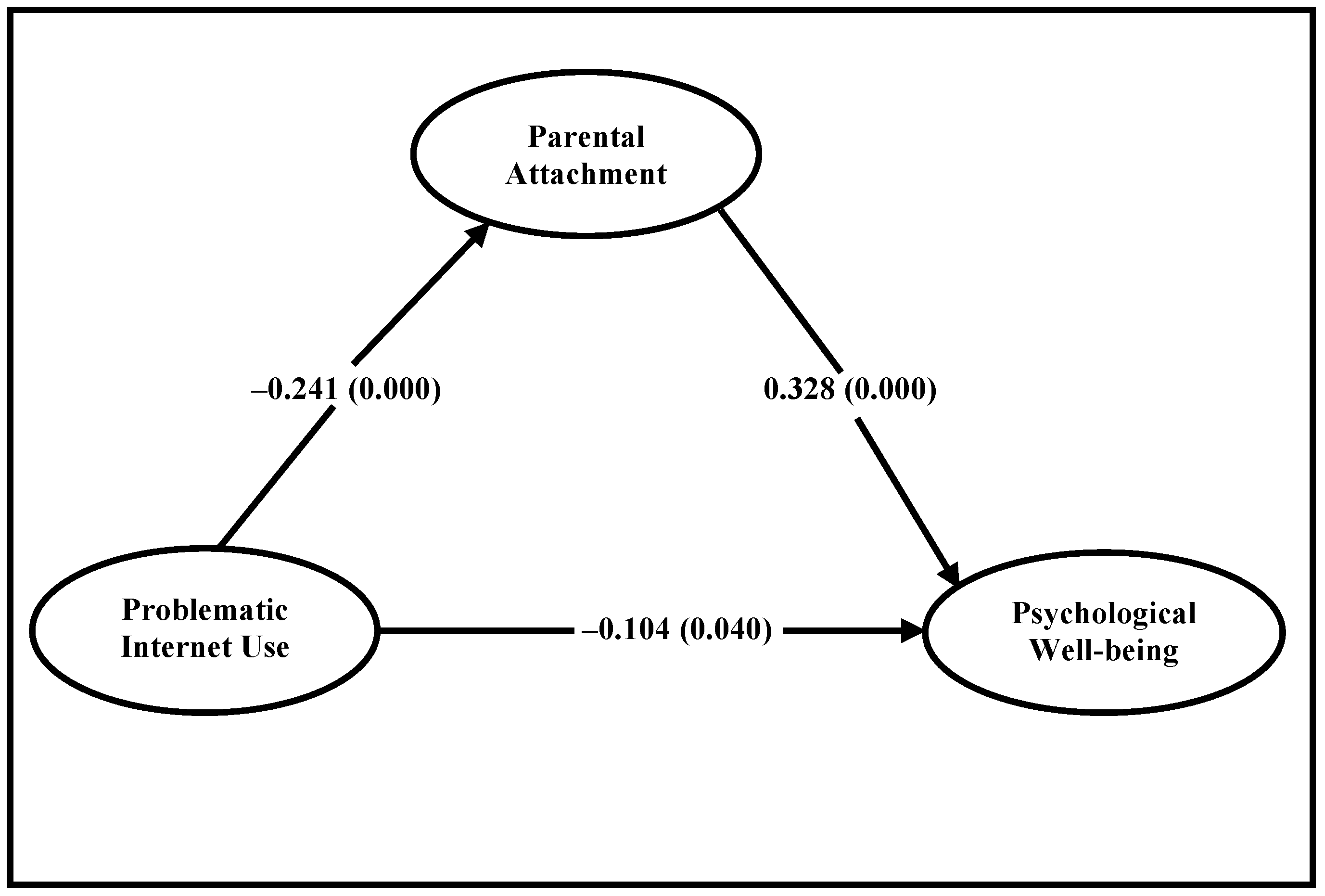
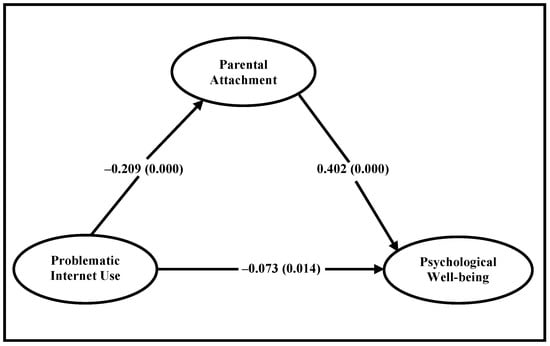
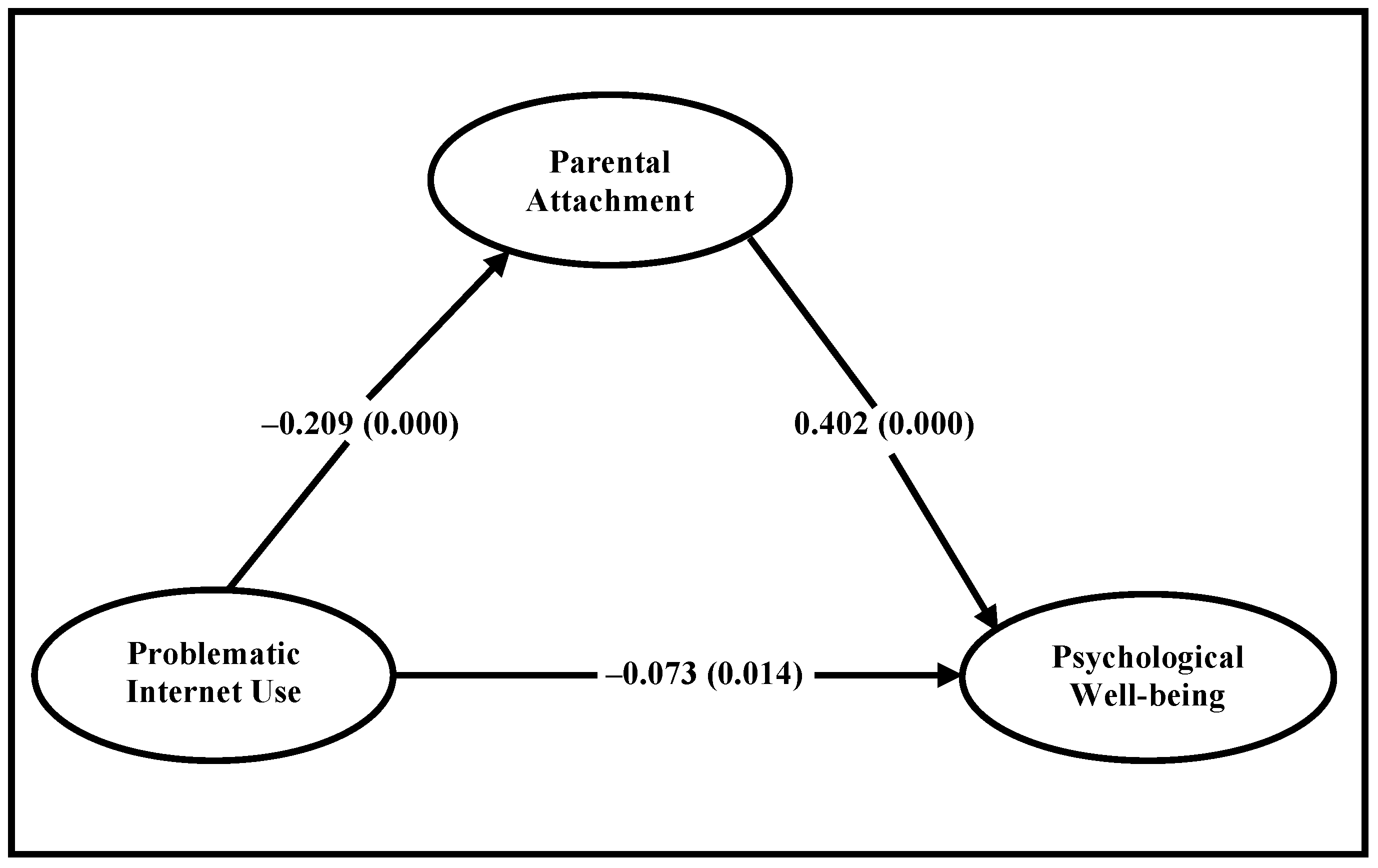
PLS-SEM was conducted using SmartPLS to assess the structural relationships of PIU, PAR, and PWB. From Figure 2, PIU demonstrated a statistically significant and negative association with both PWB (β = −0.104, p = 0.040) and PAR (β = −0.241, p < 0.001). PAR also demonstrated a statistically significant positive association with PWB (β = 0.328, p < 0.001). These results consequently supported H1 and H2, which indicated that elevated PIU levels were associated with diminished PWB and attenuated PAR. Furthermore, positive PAR quality was associated with optimal PWB (H3).
Figure 2.
Mediation Model with Constructs (Subset Data N = 400).
Additional analyses were conducted to compare the random subset data (400) with the full sample (1598) (Figure 3). The comparison between the subset data and the full sample still yielded stable and comparable results. PIU is significantly and negatively associated with PWB and PAR, and findings from both samples demonstrate a partial mediating effect. Detailed comparisons of Figure 2 and Figure 3 can be found in the Supplementary Materials Section.
Figure 3.
Mediation Model with Constructs (Full Data N = 1598).
3.4.2. Mediation Analysis
Bootstrapping with 5000 resamples was employed to evaluate indirect associations. Results demonstrated that PAR significantly mediated the relationship between PIU and PWB (β = −0.079, p < 0.001), thereby supporting H4. The observed mediation in this relationship was partial, given that the direct relationship remained statistically significant (β = −0.104, p = 0.040), and the total effect was notably stronger (β = −0.183, p < 0.001), as presented in Table 6. This suggested that, while PAR might mitigate the negative relationships involving PIU, its detrimental influence on adolescents’ well-being persisted.
Table 6.
Hypothesis Testing Summary and Mediation Analysis (N = 400).
4. Discussion
This study examined the structural relationships among PIU, PWB, and PAR, and assessed PAR’s mediating role between PIU and PWB.
4.1. Adolescent Problematic Internet Use
Results revealed that adolescents in this study exhibited moderate levels of PIU, a condition consistent with trends observed in regional studies (Afolabi et al., 2022). In this context, technology use emerged as a key environmental stimulus, thereby influencing cognitive, emotional, and behavioural development. Elevated scores in LC were consistent with prior studies. This reflected neurodevelopmental immaturity of the prefrontal cortex in adolescence, with consequent impairments in their abilities to regulate impulses, make decisions, and exercise behavioural restraints (Dalamaria et al., 2020; Díaz-López et al., 2021). Conversely, PO’s lower scores indicated evident early-stage signs of dependency among the adolescents who have not yet reached complete behavioural immersion. This suggested a transitional phase in which habitual usage patterns are forming, even if they have not yet displaced essential activities. Such a behavioural profile signals a critical window for early intervention to prevent progression towards severe addiction. Overall, the moderate level of PIU observed in this study underscored the need for preventive strategies and digital literacy interventions targeted at early adolescence, focusing on impulse control, time management, and awareness of healthy Internet use amid increasing digital integration across academic and social domains.
4.2. Psychological Well-Being of Adolescents
Overall, moderate levels of autonomy, continuous development, and life experiences were observed among adolescents in this study. AT, reflecting the ability to make independent decisions and to resist undue social pressure, was consistent with developmental expectations for mid-adolescence, when independence emerged yet remained associated with ongoing parental or institutional guidance. However, in testing the structural model, AT demonstrated no direct relationship with PWB in both the subset data and the full sample. This may suggest that in this specific target population, adolescents’ general psychological well-being does not structurally drive or alter their level of independence (autonomy).
Meanwhile, CD scores indicated willingness to engage in personal growth and learning, suggesting adaptive coping and resilience. LE scores reflected openness to new experiences, suggesting healthy psychological adjustment. While these findings were encouraging, they contradicted global reports of declining youth mental health (Varadkar & Gadgil, 2024). The moderate scores across these subdomains highlighted the need for targeted interventions to strengthen autonomy and emotional coping strategies during this formative period, thereby promoting optimal psychosocial development.
4.3. Parent–Adolescent Relationships
Respondents reported low-to-moderate parental relationship quality, aligning with existing empirical evidence that emotional connectedness, parental supervision, and trust often decline during adolescence (Sugimura et al., 2023; Waters et al., 2019). This developmental period is characterised by an increase in behavioural and emotional autonomy, which may contribute to diminished closeness and communication with parents (Waters et al., 2019). In the absence of intentional efforts to maintain open communication, these developmental shifts can lead to a perceived reduction in parental support. The Bioecological Model of Human Development emphasised the significance of proximal processes in shaping psychosocial outcomes, specifically reciprocal interactions between parents and adolescents (Gard et al., 2022). Diminished communication and trust may inhibit disclosure and help-seeking for personal concerns, limiting opportunities for early detection of risky behaviours (e.g., PIU). Consequently, targeted interventions that equip parents to consider adolescents’ perspectives, recognise emotional and behavioural cues of psychological distress, and adopt supportive communication styles that promote discussion are recommended to strengthen relational bonds and foster adolescents’ resilience.
4.4. Problematic Internet Use and Psychological Well-Being
This study’s results on the significant negative relationship between PIU and PWB (H1) aligned with prior studies linking excessive Internet use with adverse mental health outcomes, including depression, anxiety, and emotional dysregulation (Dermani & Perdikaris, 2022; Soriano-Molina et al., 2025). A bidirectional relationship may be plausible; specifically, psychological vulnerabilities may predispose adolescents to maladaptive online coping mechanisms, subsequently exacerbating existing mental health challenges (Trumello et al., 2021). From a developmental standpoint, limited emotional regulation skills and restricted offline support networks may lead adolescents to rely on digital platforms for social validation and distraction. Within Bronfenbrenner’s Bioecological Model of Human Development, the Internet functions as a proximal environmental stimulus that can either support or hinder developmental trajectories, contingent on the Internet usage patterns. This study’s findings underscore the essential importance of early detection and preventive programmes that combine digital literacy with emotional resilience training to facilitate optimal psychosocial development in adolescents.
4.5. Problematic Internet Use and Parent–Adolescent Relationships
The significant negative relationship observed between PIU and PAR (H2) in this study supported previous findings that weakened parental attachment and less supportive family environments are associated with greater susceptibility to excessive Internet use among adolescents (Agung et al., 2018; Ballarotto et al., 2018). Conversely, supportive and emotionally responsive home environments exert a protective influence over maladaptive Internet behaviours. Adolescents who perceive greater familial alienation or diminished parental warmth may be more likely to seek online environments for compensatory psychosocial fulfilment and relational engagement (Hwang & Toma, 2021; Sarfika et al., 2023). Such compensatory online engagement may gradually become habitual and further strain parent–adolescent interactions. These reciprocal patterns of increasing Internet engagement and weakening interpersonal relationships have been reported across both Western and Asian contexts (Yankouskaya et al., 2025). Interventions should adopt a multifaceted approach that addresses not only adolescents’ digital behaviours but also the quality of family interactions and communication.
Notably, PIU explained only 4.8% of the total variance in PAR, indicating PIU’s relatively modest explanatory contribution despite its statistically significant relationship with PAR. From a bioecological perspective, PAR is shaped by multiple interacting influences within adolescents’ immediate environments. Therefore, a substantial proportion of the variance in relationship quality in this study is likely attributable to other microsystem factors, including parenting practices, attachment experiences, peer interactions, and academic stressors. This suggested the potential influence of PIU on relationship difficulties. However, it may be unlikely to be the primary determinant of family relationship quality. Future research should examine PIU alongside these broader family and contextual factors to develop a more comprehensive understanding of adolescents’ relational well-being.
4.6. Parent–Adolescent Relationships and Psychological Well-Being
The significant positive relationship between PAR and PWB (H3) in this study supports previous findings that positive parent–adolescent relationships promote optimal wellbeing (Guy-Evans, 2020). In Phase 3 of the Bioecological Model, Bronfenbrenner introduced the concept of proximal processes. These are regular, face-to-face forms of interaction in the immediate environment. Parent–adolescent interactions, such as daily conversations, shared meals, conflict resolution, and emotional support, are the ultimate proximal processes. When these processes are positive, high-quality, and consistent, they help actualise an adolescent’s potential for resilience, emotional regulation, and self-esteem. Thus, optimal well-being is the direct psychological output of these highly functional, everyday interactions (Li et al., 2023; Zhu & Shek, 2021).
4.7. Mediating Role of Parent–Adolescent Relationships
The results of mediation analysis in this study demonstrated the partial mediating effect of PAR on the established relationship between PIU and PWB (H4), which aligned with extant empirical evidence indicating that parental warmth, consistent monitoring, and supportive communication can reduce adolescents’ vulnerability to psychosocial risks associated with PIU (De Simone et al., 2025). From a bioecological systems perspective, PAR constitutes a critical microsystem factor. Therefore, proactive parental mediation strategies, encompassing modelling healthy technology use, establishing dedicated tech-free periods, and actively promoting offline activities, can foster resilience and concomitantly reduce reliance on virtual environments for emotional fulfilment, thereby supporting adolescents’ developmental trajectories.
4.8. Implications and Recommendations
The current study’s findings suggested the need to adopt a multilevel approach to strengthen PAR as part of the strategic interventions for adolescents’ PIU. At the individual level, interventions should promote digital self-regulation skills, particularly strategies that address adolescents’ LC and PO with Internet use. At the family level, interventions should strengthen communication, trust, and emotional connectedness between parents and adolescents, as these relational factors may protect against poorer psychological well-being. From a policy perspective, school-based digital literacy programmes should integrate healthy technology use with parent–adolescent communication and relationship-building components to promote adolescents’ digital well-being.
4.9. Limitations and Future Research
Several limitations in this study warrant consideration. Firstly, this study’s cross-sectional design precluded causal inferences. Secondly, the reliance on self-report measures introduced potential biases, including social desirability associations. Thirdly, the focus on a specific age group (Form 4 students in Malaysia) limited the generalisability of this study’s findings to other adolescent populations. Further longitudinal investigation is necessary to examine these relationships over time. The weak structural path between PWB and AT also requires further investigation to ascertain whether a significant relationship exists between them and to examine whether the indicators used to measure AT accurately capture adolescents’ interpretations of independence. While this study focused on the mediating role of PAR, there is a need to explore additional mediating and moderating variables, including peer relationships and school connectedness, thereby enhancing the understanding of complex developmental trajectories.
4.10. Strengths of the Study
Despite the identified limitations, this study demonstrated several notable strengths. A notable strength of this study resided in its comprehensive, theory-driven design, anchored in Bronfenbrenner’s Bioecological Model of Human Development. This theoretical framework enabled this study to examine how individual, relational, and contextual factors interact to influence adolescents’ PIU and PWB. By incorporating both proximal (e.g., parental relationships) and contextual (e.g., school and digital environments) associations, this study provided a nuanced understanding of adolescents’ digital behaviour in the Malaysian context. Another key strength involved the use of total (universal) sampling and the integration of correlational and multivariate analyses (including mediation analysis), thereby strengthening the study’s methodological robustness. These analytical approaches allowed the investigation of both direct and indirect pathways, contributing to theoretical refinement and practical insights.
5. Conclusions
Grounded in Bronfenbrenner’s Bioecological Model of Human Development, this study identified PIU as a significant proximal process negatively affecting Malaysian adolescents’ PWB. PAR partially mediated this relationship, highlighting the protective role of the family microsystem. This study’s findings underscore the need for targeted interventions involving families, educators, and health professionals.
Supplementary Materials
The following supporting information can be downloaded at: https://www.mdpi.com/article/10.3390/bs16081341/s1.
Author Contributions
Conceptualization, I.M.O.-E., V.R. and M.J.M.; methodology, I.M.O.-E., V.R., M.J.M. and L.W.L.; software, I.M.O.-E.; validation, I.M.O.-E., V.R., M.J.M. and L.W.L.; formal analysis, I.M.O.-E.; investigation, I.M.O.-E.; resources, I.M.O.-E.; data curation, I.M.O.-E.; writing—original draft preparation, I.M.O.-E.; writing—review and editing, V.R., M.J.M. and L.W.L.; visualization, I.M.O.-E.; supervision, V.R., M.J.M. and L.W.L.; project administration, I.M.O.-E.; funding acquisition, I.M.O.-E. All authors have read and agreed to the published version of the manuscript.
Funding
This research received no external funding.
Institutional Review Board Statement
The study was conducted in accordance with the Declaration of Helsinki and approved by the University of Malaya Research Ethics Committee (protocol code: UM.TNC2/UMREC_2793, date of approval: 16 August 2023) and the Ministry of Education, Malaysia (protocol code: JPNS.SPD 600-1/1/2 JLD. 30 (2), date of approval: 28 June 2023).
Informed Consent Statement
Informed consent was obtained from all subjects involved in the study.
Data Availability Statement
The data presented in this study are available on request from the corresponding author due to privacy and ethical restrictions.
Acknowledgments
We thank all the authors cited in this study. In particular, the works of Gert-Jan Meerkerk, Carmen Viejo, and Eleonora Gullone-Parhar on data collection tools have proven invaluable.
Conflicts of Interest
The authors declare no conflicts of interest.
Abbreviations
| AL | Alienation |
| AT | Autonomy |
| AVE | Average Variance Extracted |
| BSPWBA | Brief Scale of Psychological Well-being for Adolescents |
| CD | Continuous Development |
| CFA | Confirmatory Factor Analysis |
| CFI | Comparative Fit Index |
| CIUS | Compulsive Internet Use Scale |
| COM | Communication |
| EFA | Exploratory Factor Analysis |
| IPPA | Inventory of Parents and Peers Attachment |
| LC | Loss of Control |
| LE | Life Experiences |
| PC | Perceived Care |
| PAR | Parent Adolescent Relationship |
| PIU | Problematic Internet Use |
| PLS-SEM | Partial Least Squares Structural Equation Modelling |
| PO | Preoccupation |
| PWB | Psychological Well-being |
| RMSEA | Root Mean Square Error of Approximation |
| SA | Self-acceptance |
| SRMR | Standardised Root Mean Square Residual |
| TLI | Tucker–Lewis Index |
| TR | Trust |
References
- Aderinto, N. (2022). Impact of internet addiction on mental health among undergraduates in Nigeria. International Journal of Surgery: Global Health, 5(6), e88. [Google Scholar] [CrossRef] [Scilit]
- Afolabi, A. A., Ilesanmi, O. S., & Adebayo, A. M. (2022). Prevalence and pattern of internet addiction among adolescents in Ibadan, Nigeria: A cross-sectional study. Cureus, 14(2), e22293. [Google Scholar] [CrossRef] [Scilit] [PubMed]
- Agung, G., Suryani, S., & Hernawaty, T. (2018). Relationship between academic stress, family and peer attachment with internet addiction in adolescents. Jurnal Keperawatan Padjadjaran, 6, 215–226. [Google Scholar] [CrossRef] [Scilit]
- Ajayi, L., & Adebayo, A. T. (2021). Structural Equation Model (SEM). American Journal of Humanities and Social Sciences Research, 5, 11–19. [Google Scholar] [CrossRef] [Scilit]
- Asian Development Bank & UN.Escap. (2018). Embracing the e-commerce revolution in Asia and the Pacific. Available online: https://hdl.handle.net/20.500.12870/552 (accessed on 4 March 2026).
- Astarini, N., & Yudiarso, A. (2020). Personality does not determine internet addiction: A meta-analysis. Makara Human Behaviour Studies in Asia, 24, 166. [Google Scholar] [CrossRef] [Scilit]
- Ballarotto, G., Volpi, B., Marzilli, E., & Tambelli, R. (2018). Adolescent internet abuse: A study on the role of attachment to parents and peers in a large community sample. BioMed Research International, 2018, 5769250. [Google Scholar] [CrossRef] [Scilit] [PubMed]
- Bronfenbrenner, U., & Morris, P. A. (2007). The bioecological model of human development. In Handbook of child psychology (Vol. 1). Wiley. [Google Scholar] [CrossRef] [Scilit]
- Dalamaria, T., Pinto, W. d. J., Farias, E. d. S., & Souza, O. F. d. (2020). Internet addiction among adolescents in a western Brazilian amazonian city. Revista Paulista de Pediatria, 39, e2019270. [Google Scholar] [CrossRef] [Scilit]
- Dermani, H., & Perdikaris, P. (2022). Internet addiction and psychological impact on adolescents: A scoping review. International Journal of Biological and Pharmaceutical Sciences Archive, 4, 73–87. [Google Scholar] [CrossRef] [Scilit]
- De Simone, E., Rollo, S., & Rochira, A. (2025). Digital ambivalence in the online era: A social-ecological study of parental monitoring. Journal of Child and Family Studies, 34, 2290–2304. [Google Scholar] [CrossRef] [Scilit]
- Díaz-López, A., Mirete-Ruiz, A. B., & Maquilón-Sánchez, J. (2021). Adolescents’ perceptions of their problematic use of ICT: Relationship with study time and academic performance. International Journal of Environmental Research and Public Health, 18(12), 6673. [Google Scholar] [CrossRef] [Scilit] [PubMed]
- Faudzi, F. N. M., Armitage, C. J., Bryant, C., & Brown, L. J. E. (2020). Cultural adaptations to the measurement of attitudes to ageing: Psychometric assessment of the malay reactions to ageing questionnaire. Assessment, 27(6), 1272–1284. [Google Scholar] [CrossRef] [Scilit] [PubMed]
- Gard, A. M., Hein, T. C., Mitchell, C., Brooks-Gunn, J., McLanahan, S. S., Monk, C. S., & Hyde, L. W. (2022). Prospective longitudinal associations between harsh parenting and corticolimbic function during adolescence. Development and Psychopathology, 34(3), 981–996. [Google Scholar] [CrossRef] [Scilit] [PubMed]
- Giovanelli, J., Silva, L., Oliveira, W., Scatena, A., Semolini, F., & Andrade, A. (2025). Parental mediation of screen use by children and adolescents: A systematic literature review. Ciencias Psicológicas, 19, e4130. [Google Scholar] [CrossRef] [Scilit]
- Gómez-López, M., Viejo, C., & Ortega-Ruiz, R. (2019). Psychological well-being during adolescence: Stability and association with romantic relationships. Frontiers in Psychology, 10, 1772. [Google Scholar] [CrossRef] [Scilit] [PubMed]
- Gullone, E., & Robinson, K. (2005). The Inventory of Parent and Peer Attachment—Revised (IPPA-R) for children: A psychometric investigation. Clinical Psychology & Psychotherapy: An International Journal of Theory & Practice, 12(1), 67–79. [Google Scholar] [CrossRef] [Scilit]
- Guy-Evans, O. (2020). Bronfenbrenner’s ecological systems theory. Simply psychology, 10518–10046. Available online: https://www.simplypsychology.org/bronfenbrenner.html (accessed on 3 May 2026).
- Hair, J., Jr., Hair, J. F., Jr., Sarstedt, M., Ringle, C. M., & Gudergan, S. P. (2023). Advanced issues in partial least squares structural equation modelling. Sage Publications. [Google Scholar]
- Hair, J. F. (2009). Multivariate data analysis. Cengage. [Google Scholar]
- Hair, J. F., Hult, G. T. M., Ringle, C. M., Sarstedt, M., Danks, N. P., & Ray, S. (Eds.). (2021). An introduction to structural equation modelling. In Partial least squares structural equation modelling (PLS-SEM) using R: A workbook (pp. 1–29). Springer International Publishing. [Google Scholar] [CrossRef] [Scilit]
- Hällgren, C., & Björk, Å. (2022). Young people’s identities in digital worlds. The International Journal of Information and Learning Technology, 40, 49–61. [Google Scholar] [CrossRef] [Scilit]
- Hwang, J., & Toma, C. L. (2021). The role of mental well-being and perceived parental supportiveness in adolescents’ problematic internet use: Moderation analysis. JMIR Mental Health, 8(9), e26203. [Google Scholar] [CrossRef] [Scilit] [PubMed]
- Kline, T. J. (2017). Sample issues, methodological implications, and best practices. Canadian Journal of Behavioural Science/Revue Canadienne des Sciences du Comportement, 49(2), 71. [Google Scholar] [CrossRef] [Scilit]
- Kostyrka-Allchorne, K., Stoilova, M., Bourgaize, J., Rahali, M., Livingstone, S., & Sonuga-Barke, E. (2023). Review: Digital experiences and their impact on the lives of adolescents with pre-existing anxiety, depression, eating and nonsuicidal self-injury conditions—A systematic review. Child and Adolescent Mental Health, 28(1), 22–32. [Google Scholar] [CrossRef] [Scilit] [PubMed]
- Lan, M., Pan, Q., Tan, C. Y., & Law, N. W. Y. (2022). Understanding protective and risk factors affecting adolescents’ well-being during the COVID-19 pandemic. NPJ Science of Learning, 7(1), 32. [Google Scholar] [CrossRef] [Scilit] [PubMed]
- Li, M., Lan, R., Ma, P., & Gong, H. (2023). The effect of positive parenting on adolescent life satisfaction: The mediating role of parent-adolescent attachment [original research]. Frontiers in Psychology, 14, 1183546. [Google Scholar] [CrossRef] [Scilit] [PubMed]
- Ling, L. W., Chinna, K., Lim Abdullah, K., & Zainal Abidin, I. (2019). The forward-backwards and dual-panel translation methods are comparable in producing equivalent semantic versions of a heart quality-of-life questionnaire. International Journal of Nursing Practice, 25(1), e12715. [Google Scholar] [CrossRef] [Scilit] [PubMed]
- Livingstone, S., & Helsper, E. (2008). Parental mediation of children’s internet use. Journal of Broadcasting & Electronic Media, 52, 581–599. [Google Scholar] [CrossRef] [Scilit]
- Meerkerk, G. J., Eijnden, R. J. J. M. v. d., Vermulst, A. A., & Garretsen, H. F. L. (2008). The Compulsive Internet Use Scale (CIUS): Some psychometric properties. CyberPsychology & Behaviour, 12(1), 1–6. [Google Scholar] [CrossRef] [Scilit] [PubMed]
- Memon, M. A., Ting, H., Cheah, J.-H., Ramayah, T., Chuah, F., & Cham, T.-H. (2020). Sample size for survey research: Review and recommendations. Journal of Applied Structural Equation Modelling, 4, i–xx. [Google Scholar] [CrossRef] [Scilit] [PubMed]
- Okafor-Emeagha, I. M., Ramoo, V., Ling, L. W., Marret, M. J., & Piaw, C. Y. (2025). Cross-cultural adaptation and psychometric properties of the Malay version of the compulsive internet use scale. Computers in Human Behaviour Reports, 19, 100744. [Google Scholar] [CrossRef] [Scilit]
- O’Reilly, C., & Mohan, G. (2023). Parental influences on adolescents’ excessive internet use. Internet Research, 33, 86–110. [Google Scholar] [CrossRef] [Scilit]
- Pérez-Sáenz, J., Ortuño-Sierra, J., Pérez-Albéniz, A., Mason, O., & Fonseca-Pedrero, E. (2023). Prevalence of problematic internet use among spanish adolescents. Clínica y Salud, 34(3), 139–144. [Google Scholar] [CrossRef] [Scilit]
- Pontes, H. M., & Macur, M. (2021). Problematic internet use profiles and psychosocial risk among adolescents. PLoS ONE, 16(9), e0257329. [Google Scholar] [CrossRef] [Scilit] [PubMed]
- Ratten, V., Chrisman, J., Mustafa, M., Sciascia, S., Seaman, C., Discua Cruz, A., & Feranita, F. (2023). Learning from family business researchers. Journal of Family Business Management, 14, 735–747. [Google Scholar] [CrossRef] [Scilit]
- Ryff, C. D. (1989). Happiness is everything, or is it? Explorations on the meaning of psychological well-being. Journal of Personality and Social Psychology, 57(6), 1069–1081. [Google Scholar] [CrossRef]
- Sanghvi, H., & Rai, D. (2015). Internet addiction and its relationship with emotional intelligence and perceived stress experienced by young adults. International Journal of Indian Psychology, 3, 64–76. [Google Scholar] [CrossRef] [Scilit]
- Sarfika, R., Zein, G., Andreni, R., Refnandes, R., & Saifudin, I. M. M. (2023). Comparing parenting styles: Their influence on adolescents’ internet addiction. Healthcare in Low-Resource Settings, 13, 11932. [Google Scholar] [CrossRef] [Scilit]
- Sarstedt, M., Hair, J. F., Jr., Nitzl, C., Ringle, C. M., & Howard, M. C. (2020). Beyond a tandem analysis of SEM and PROCESS: Use of PLS-SEM for mediation analyses! International Journal of Market Research, 62(3), 288–299. [Google Scholar] [CrossRef] [Scilit]
- Soriano-Molina, E., Limiñana-Gras, R. M., Patró-Hernández, R. M., & Rubio-Aparicio, M. (2025). The association between internet addiction and adolescents’ mental health: A meta-analytic review. Behavioral Sciences, 15(2), 116. [Google Scholar] [CrossRef] [Scilit] [PubMed]
- Sugimura, K., Hihara, S., Hatano, K., Nakama, R., Saiga, S., & Tsuzuki, M. (2023). Profiles of emotional separation and parental trust from adolescence to emerging adulthood: Age differences and associations with identity and life satisfaction. Journal of Youth and Adolescence, 52(3), 475–489. [Google Scholar] [CrossRef] [Scilit] [PubMed]
- Sullivan, K. M., Dean, A., & Soe, M. M. (2009). On academics: OpenEpi: A web-based epidemiologic and statistical calculator for public health. Public Health Reports, 124(3), 471–474. [Google Scholar] [CrossRef] [Scilit] [PubMed]
- Trumello, C., Vismara, L., Sechi, C., Ricciardi, P., Marino, V., & Babore, A. (2021). Internet addiction: The role of parental care and mental health in adolescence. International Journal of Environmental Research and Public Health, 18(24), 12876. [Google Scholar] [CrossRef] [Scilit] [PubMed]
- Varadkar, S. M., & Gadgil, P. (2024). Closing the mental health gap to support good life chances for children and young people. The Lancet Global Health, 12(1), e10–e11. [Google Scholar] [CrossRef] [Scilit] [PubMed]
- Viejo, C., Gómez-López, M., & Ortega-Ruiz, R. (2018). Adolescents’ psychological well-being: A multidimensional measure. International Journal of Environmental Research and Public Health, 15(10), 2325. [Google Scholar] [CrossRef] [Scilit] [PubMed]
- Waters, L., Loton, D. J., Grace, D., Jacques-Hamilton, R., & Zyphur, M. J. (2019). Observing change over time in strength-based parenting and subjective wellbeing for pre-teens and teens. Frontiers in Psychology, 10, 2273. [Google Scholar] [CrossRef] [Scilit] [PubMed]
- Yankouskaya, A., Ali, R., AlShakhsi, S., Delvecchio, E., Manesis, N., Mazzeschi, C., Turan, S. G., & Panourgia, C. (2025). Emerging impact of parental Internet addiction on adolescent Internet use: A cross-cultural perspective. New Directions for Child and Adolescent Development, 2025(1), 4336597. [Google Scholar] [CrossRef] [Scilit]
- Young, K. S. (1998). Caught in the Net: How to recognise the signs of internet addiction—And a winning strategy for recovery. Wiley. Available online: https://books.google.com.ng/books?id=kfFk8-GZPD0C (accessed on 4 October 2024).
- Zhu, X., & Shek, D. T. L. (2021). Parental factors and adolescent well-being: Associations between developmental trajectories. Children and Youth Services Review, 127, 106071. [Google Scholar] [CrossRef] [Scilit]

Disclaimer/Publisher’s Note: The statements, opinions and data contained in all publications are solely those of the individual author(s) and contributor(s) and not of MDPI and/or the editor(s). MDPI and/or the editor(s) disclaim responsibility for any injury to people or property resulting from any ideas, methods, instructions or products referred to in the content. |
© 2026 by the authors. Licensee MDPI, Basel, Switzerland. This article is an open access article distributed under the terms and conditions of the Creative Commons Attribution (CC BY) license.