4.1. Common Method Bias and Discriminant Validity
Because the data in this study were collected through teacher self-reports, common method bias may be a concern. To minimize this risk, the Organisation for Economic Co-operation and Development (OECD) implemented several procedural remedies during the design and administration of the TALIS 2024 questionnaire, including ensuring respondent anonymity, using varied item wording, and adopting different scale anchors. At the statistical level, this study employed two methods to assess common method bias.
First, Harman’s single-factor test showed that an unrotated exploratory factor analysis of all 21 measurement items extracted four factors with eigenvalues greater than 1, and the first factor accounted for 46.809% of the variance, which is below the critical threshold of 50%. This result suggests that a single factor did not account for the majority of the variance.
Second, as shown in
Table 2, this study compared a series of nested CFA models to further examine common method bias and discriminant validity. The four-factor model, in which distributed leadership, teacher collaboration, teacher empathy, and SEL teaching practices were specified as distinct constructs, demonstrated good fit:
χ2/df = 4.684, CFI = 0.974, TLI = 0.970, RMSEA = 0.053, and SRMR = 0.030. Compared with alternative models, the four-factor model fit the data significantly better than the three-factor model combining teacher empathy and SEL teaching practices (Δ
χ2 = 2481.065, Δ
df = 3,
p < 0.001), the two-factor model (Δ
χ2 = 5271.355, Δ
df = 5,
p < 0.001), and the one-factor model (Δ
χ2 = 10178.788, Δ
df = 6,
p < 0.001). The one-factor model showed very poor fit (CFI = 0.585, RMSEA = 0.210), indicating that the data structure could not be explained by a single latent factor and further confirming that common method bias did not pose a serious threat to this study.
In addition, discriminant validity was assessed using the Fornell-Larcker criterion (
Fornell & Larcker, 1981). As shown in
Table 3, the average variance extracted (AVE) for each construct exceeded its shared variance with the other constructs (i.e., AVE >
r2), supporting discriminant validity among the four constructs. In particular, the
r2 between teacher empathy and SEL teaching practices was 0.582, whereas the AVE for teacher empathy was 0.791 and the AVE for SEL teaching practices was 0.795, both exceeding this shared variance value. These findings indicate that although teacher empathy and SEL teaching practices were strongly related, they remained empirically distinguishable as independent constructs at the measurement level.
To examine whether the measurement model was equivalent across gender groups, this study conducted a multigroup confirmatory factor analysis to test measurement invariance of the four-factor model across male and female teachers (
Cheung & Rensvold, 2002). As shown in
Table 4, the configural invariance model demonstrated good fit (CFI = 0.970, RMSEA = 0.041), and both metric invariance (ΔCFI = 0.000) and scalar invariance (ΔCFI = 0.003) satisfied the criterion of ΔCFI < 0.01. These results indicate full measurement invariance of the four-factor measurement model across male and female teachers, ensuring that the effects observed when gender was included as a control variable reflect true differences at the construct level (
Cheung & Rensvold, 2002). Because the male teacher subsample was relatively small (
n = 351), this study did not conduct gender-specific comparisons of the mediation paths. Instead, gender was included as a control variable in all regression models. Future research may further examine the moderating role of gender using larger samples.
4.2. Descriptive Statistics and Correlation Analysis
Table 5
presents the means, standard deviations, and correlation coefficients for all study variables. Distributed leadership (M = 3.314, SD = 0.565), teacher empathy (M = 3.414, SD = 0.577), and SEL teaching practices (M = 3.371, SD = 0.547) were all measured on four-point scales, with mean scores ranging from 3.314 to 3.414. These values suggest that teachers in the sample generally reported moderately high levels on these constructs. Teacher collaboration was measured on a six-point scale (M = 4.344, SD = 1.063), with a mean above the scale midpoint of 3.5, likewise indicating a moderately high frequency of collaborative activities. Notably, teacher empathy showed the highest relative level within its scale range, whereas teacher collaboration showed the lowest relative level among the four variables.
The correlation analysis showed that all variables were significantly and positively correlated with one another (p < 0.001). Specifically, distributed leadership was significantly and positively correlated with teacher collaboration (r = 0.341, p < 0.001), teacher empathy (r = 0.369, p < 0.001), and SEL teaching practices (r = 0.428, p < 0.001). Teacher collaboration was also significantly and positively correlated with teacher empathy (r = 0.335, p < 0.001) and SEL teaching practices (r = 0.341, p < 0.001). Particularly noteworthy was the strong positive correlation between teacher empathy and SEL teaching practices (r = 0.763, p < 0.001), suggesting a close association between these two constructs. Although this correlation coefficient was relatively high, the discriminant validity tests reported above indicated that the two constructs remained empirically distinguishable at the measurement level.
These preliminary findings provide initial support for the hypothesized sequential mediation model, as the correlations among distributed leadership, teacher collaboration, teacher empathy, and SEL teaching practices were all in the expected directions.
4.3. Hypothesis Testing
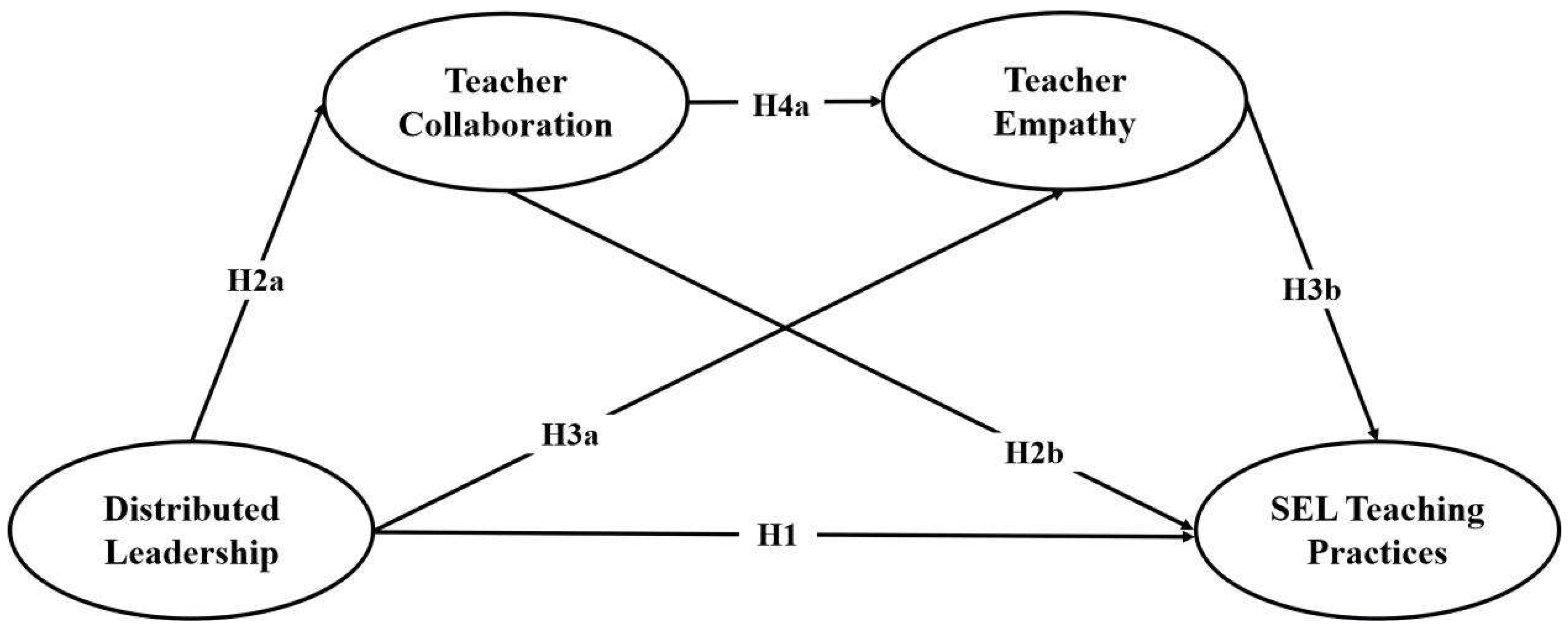
This study used Model 6 of the PROCESS macro in SPSS 27.0 to test the sequential mediating roles of teacher collaboration and teacher empathy in the relationship between distributed leadership and teachers’ SEL teaching practices. In this model, distributed leadership was specified as the independent variable, teachers’ SEL teaching practices as the dependent variable, teacher collaboration as the first mediator, and teacher empathy as the second mediator. Gender, age, employment status, and target class size were included as control variables. The regression results are presented in
Table 6.
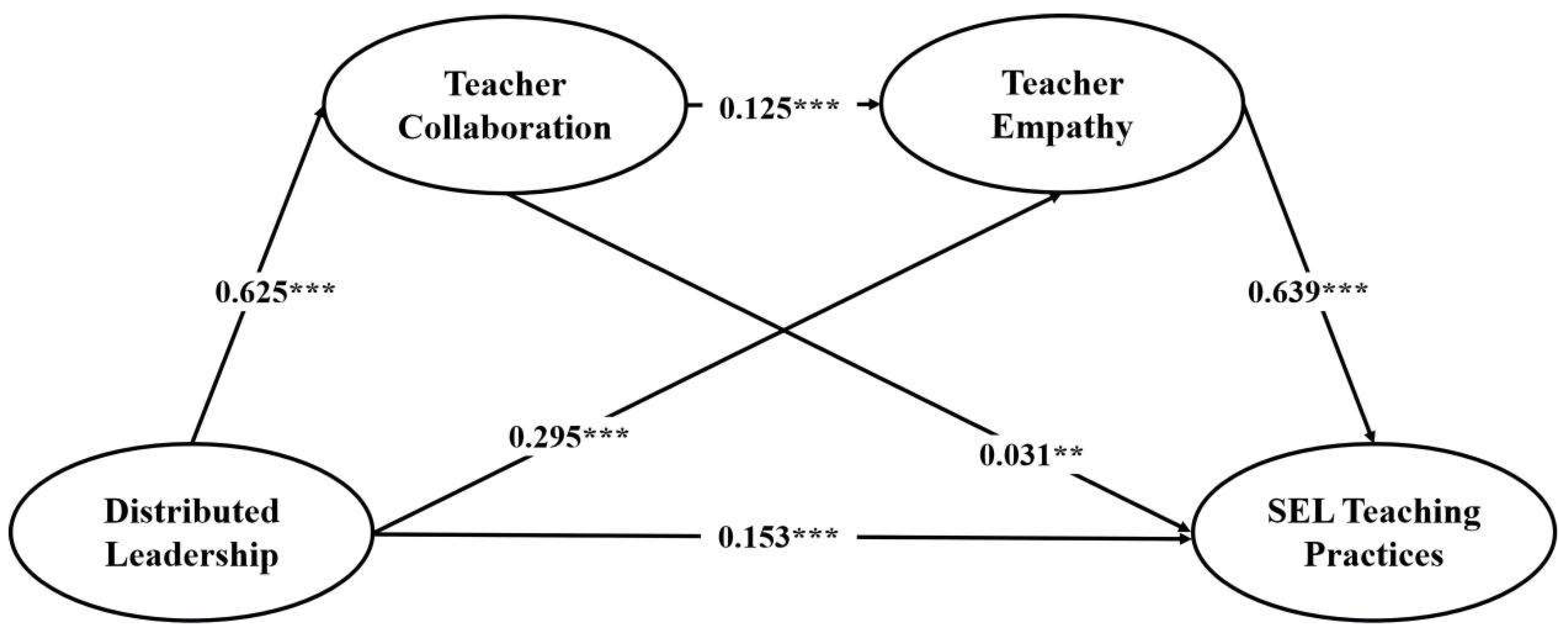
First, the direct effect was examined. The results showed that, after controlling for the mediators, distributed leadership still significantly and positively predicted teachers’ SEL teaching practices (B = 0.153, 95% CI [0.117, 0.190], p < 0.001), supporting Hypothesis 1. Second, the mediating pathway through teacher collaboration was tested. Distributed leadership significantly and positively predicted teacher collaboration (B = 0.625, 95% CI [0.530, 0.720], p < 0.001), and teacher collaboration also significantly and positively predicted teachers’ SEL teaching practices (B = 0.031, 95% CI [0.012, 0.051], p < 0.01). Thus, Hypotheses 2a and 2b were supported. Third, the mediating pathway through teacher empathy was examined. Distributed leadership significantly and positively predicted teacher empathy (B = 0.295, 95% CI [0.242, 0.347], p < 0.001), and teacher empathy also significantly and positively predicted teachers’ SEL teaching practices (B = 0.639, 95% CI [0.603, 0.676], p < 0.001). Therefore, Hypotheses 3a and 3b were supported. Finally, the precondition for the sequential mediation pathway was tested. Teacher collaboration significantly and positively predicted teacher empathy (B = 0.125, 95% CI [0.097, 0.154], p < 0.001), supporting Hypothesis 4a.
With respect to the control variables, gender showed significant effects in multiple models. Female teachers scored higher than male teachers on teacher empathy (B = −0.172,
p < 0.001) and SEL teaching practices (
B = −0.055,
p < 0.05). Because gender was coded as 1 = female and 2 = male, the negative coefficients indicate higher scores for female teachers. This pattern is consistent with previous findings on gender differences among teachers (
Graziano et al., 2024). Age also significantly and positively predicted teacher empathy (
B = 0.054,
p < 0.001) and SEL teaching practices (
B = 0.023,
p < 0.05), suggesting that the accumulation of teaching experience may contribute to the development of teachers’ social–emotional competence. Employment status and target class size were not significant in the final model after all mediators were included.
Given that gender showed significant effects across multiple models, this study conducted additional gender-stratified analyses. Specifically, PROCESS Model 6 was run separately for the male teacher subsample (n = 351) and the female teacher subsample (n = 948) to examine the robustness of the mediation mechanisms across gender groups. The results showed that, in the female teacher subsample, the pattern of the three indirect effects was consistent with that observed in the full sample: the specific indirect effect through teacher empathy was the largest (B = 0.193, SE = 0.025, 95% CI [0.145, 0.244]), followed by the sequential indirect effect (B = 0.040, SE = 0.008, 95% CI [0.025, 0.057]), whereas the specific indirect effect through teacher collaboration was the smallest (B = 0.018, SE = 0.007, 95% CI [0.004, 0.033]). In the male teacher subsample, the total indirect effect was also significant (B = 0.268, SE = 0.053, 95% CI [0.171, 0.380]), and the relative pattern of the indirect pathways was generally similar to that in the full sample. The specific indirect effect through teacher empathy was the largest (B = 0.169, 95% CI [0.082, 0.272]), followed by the sequential indirect effect (B = 0.076, 95% CI [0.046, 0.112]). However, the specific indirect effect through teacher collaboration did not reach statistical significance (B = 0.023, 95% CI [−0.005, 0.054]), which may be attributable to the relatively small male subsample and the resulting limited statistical power. Overall, these supplementary gender-stratified analyses suggest that the mediation mechanisms identified in this study were generally robust across male and female teachers.
To further examine the mediating roles of teacher collaboration (M1) and teacher empathy (M2) in the relationship between distributed leadership and teachers’ SEL teaching practices, this study used a bias-corrected percentile bootstrap procedure with 5000 resamples to test the mediation effects. The results are presented in
Table 7.
The total effect of distributed leadership on teachers’ SEL teaching practices was significant (B = 0.411, SE = 0.024, 95% CI [0.364, 0.458]). After the two mediators were included, the direct effect remained significant (B = 0.153, SE = 0.019, 95% CI [0.117, 0.190]), accounting for 37.23% of the total effect. The total indirect effect was also significant (B = 0.258, SE = 0.023, 95% CI [0.213, 0.306]), accounting for 62.77% of the total effect.
A further decomposition of the total indirect effect showed that all three mediation pathways were significant, and the 95% confidence interval for each pathway did not include zero. Indirect Path 1 (distributed leadership → teacher collaboration → SEL teaching practices) was significant (B = 0.020, SE = 0.007, 95% CI [0.007, 0.033]), accounting for 4.87% of the total effect, thereby supporting Hypothesis 2c. Indirect Path 2 (distributed leadership → teacher empathy → SEL teaching practices) was also significant (B = 0.188, SE = 0.023, 95% CI [0.145, 0.235]), accounting for 45.74% of the total effect, thereby supporting Hypothesis 3c. Indirect Path 3 (distributed leadership → teacher collaboration → teacher empathy → SEL teaching practices), representing the sequential mediation pathway, was likewise significant (B = 0.050, SE = 0.007, 95% CI [0.036, 0.065]), accounting for 12.16% of the total effect, thereby supporting Hypothesis 4b.
Given the cross-sectional design, these mediation results should be interpreted as reflecting statistical associations rather than established causal sequences. Taken together, the association between distributed leadership and teachers’ SEL teaching practices reflects a dual pattern in which indirect effects play the primary role and the direct effect plays a secondary role. Among the three indirect pathways, the specific indirect effect through teacher empathy contributed the most (45.74%), followed by the sequential indirect effect (12.16%), whereas the specific indirect effect through teacher collaboration contributed the least (4.87%). These findings indicate that teacher empathy plays a central mediating role in the relationship between distributed leadership and SEL teaching practices. It should be noted that the proportions reported above for the indirect effects (e.g., 45.74%) reflect the relative contribution of each pathway to the total effect rather than absolute effect sizes. These proportions should therefore be interpreted alongside the absolute effect estimates: the absolute value of the specific indirect effect through teacher empathy was 0.188 (BootSE = 0.023), the absolute value of the specific indirect effect through teacher collaboration was 0.020 (BootSE = 0.007), and the absolute value of the sequential indirect effect was 0.050 (BootSE = 0.007). The relatively large proportion associated with the teacher empathy pathway is partly attributable to the strong association between teacher empathy and SEL teaching practices (
r = 0.763), as discussed earlier in the analysis of discriminant validity. The mediation model is depicted in
Figure 3.