


Abstract
Helping can cost the helper or fail to benefit the recipient. We examined how these prospects and the child’s relationship with the recipient were associated with children’s stated willingness to help. At one primary school in China, 190 children aged 9–12 responded to hypothetical scenarios involving friends or unfamiliar peers at three stated likelihoods of personal loss or helping failure. Separate logistic models used child-clustered standard errors. Children were more willing to help friends than unfamiliar peers and more willing to help when adverse outcomes were described as less likely. The odds ratios for friends versus unfamiliar peers were 6.82 (95% confidence interval 5.46–8.51) for personal loss and 5.39 (4.45–6.54) for helping failure. Differences in endorsement rates were larger at higher stated likelihoods, while recipient-by-likelihood interactions in the primary logistic models did not meet the corrected threshold. Evidence for age differences was limited. The findings extend prior work on helping friends to situations where an action is described as potentially costly or ineffective.
1. Introduction
Helping a peer can put a child in a difficult position: the action may do little good, or it may expose the helper to criticism, inconvenience, or personal loss. Whether the child accepts that prospect may depend on who needs help. A child who declines to intervene for an unfamiliar peer might accept the same prospect for a friend. Such choices raise a question that overall helping rates cannot answer: how do recipient relationships shape willingness to help as the prospects of the proposed action worsen? Examining this question across late childhood can clarify whether age differences concern willingness to help in general or selectivity about whom to help and under what conditions.
1.1. Prosocial Risk-Taking and Uncertain Benefits
Prosocial risk-taking involves a possible benefit to another person alongside a possible personal downside for the helper (Armstrong-Carter & Telzer, 2025; Do et al., 2017). Corbett et al. (2023), for example, measured children’s willingness to risk a guaranteed prize so that a peer might also receive a good prize. The possibility that help will fail creates a related but distinct decision: the recipient may receive no benefit when the scenario specifies no personal loss to the helper. Personal loss therefore concerns what a child is willing to risk for someone else; helping failure concerns whether the child is willing to attempt an action of uncertain effectiveness.
Effective helping depends on attending to the recipient’s goal, and a greater willingness to perform a proposed action need not mean better help. Martin and Olson (2013) found that three-year-olds sometimes supplied a useful alternative when an adult requested an object that could not achieve that goal. More recently, Sierksma (2023) showed that children distinguish forms of help that differ in the opportunity they provide for learning. A review of helping in childhood likewise identifies circumstances in which well-intentioned assistance has unwanted consequences (Sierksma & Shutts, 2025). When effectiveness is uncertain, a reluctance to act may reflect concern about whether the proposed assistance will be useful. This makes helping-failure likelihood relevant to interpreting children’s stated helping intentions.
1.2. Relationship Selectivity Under Adverse Prospects
Children’s prosocial decisions are sensitive to their relationship with a recipient. They allocate resources differently to friends and unfamiliar peers and recognize special expectations within friendship (Engelmann et al., 2019; Moore, 2009; Paulus et al., 2020). These relationships may also matter when assistance is uncertain or costly. Greater concern for a friend’s welfare, or a stronger obligation to respond, could make an unfavorable prospect more acceptable. At the same time, children may become less willing to help either recipient as failure or personal loss becomes more likely. The resulting question concerns how a preference for helping friends is expressed as the prospects of helping become less favorable. Social discounting research also examines how benefits to others are valued across perceived interpersonal distance (Jones & Rachlin, 2006). Here, however, recipient relationship denotes only the contrast between a good friend and an unfamiliar peer; it does not estimate a continuous social-discounting function.
Children’s decisions may also reflect what they expect the proposed action to achieve. Children can underestimate how positively a recipient will respond to kindness (Echelbarger & Epley, 2023), and expectations about being liked are distinct from liking another child (J. Liu et al., 2025). In an intergroup study, children sometimes helped an outgroup peer more despite evaluating their ingroup more positively (Sierksma et al., 2018). These findings leave room for both recipient preferences and expectations about the action to shape a helping choice.
Studies of helping dilemmas in adults have examined personal-cost and helping-failure risks alongside situational urgency and peer presence (C. Liu et al., 2023). Less is known about how children express a preference for friends when helping may be costly or ineffective. Several school-helping situations also overlap with defending peers. The participant-role approach distinguishes defending a victim from assisting or reinforcing bullying and from remaining outside the interaction (Salmivalli et al., 1996). Research on defending also considers moral responsibility and anticipated social costs at the individual and classroom levels (Pouwels et al., 2019). This literature makes it important to distinguish concern for a recipient from the costs and expected effectiveness of intervening. Examining recipient relationship and adverse-outcome likelihood within the same child describes when selective helping is most apparent. Separate personal-loss and helping-failure tasks distinguish possible hesitation about personal downsides from uncertainty about whether an intervention will work, without assuming that the materials isolate these processes completely.
1.3. What May Change with Age
Development can alter both a child’s concern for others and the way the child evaluates an intervention. A developmental-relational account locates prosocial development in the interplay of individual capacities and social relationships (Malti & Speidel, 2024). Greater concern may encourage helping, while a clearer appreciation of ineffective or costly assistance may encourage restraint. Recipient selectivity could also change even when overall willingness remains similar. Marshall et al. (2025) challenge the assumption that development invariably expands the moral circle, reviewing evidence that concern for distant others can become more restricted in some domains. Age differences in overall helping, in the preference for friends, and in responses to unfavorable prospects may therefore follow different patterns.
Late childhood offers a useful period in which to examine these possibilities. Nine- to twelve-year-olds encounter requests from close friends as well as peers outside their friendships. Studies distinguishing recipients and forms of prosocial behavior show that developmental patterns cannot be summarized by a single helpfulness score (Asscheman et al., 2020; Margoni et al., 2026; Sweijen et al., 2025). In longitudinal research with adolescents, sensitivity to expected value when taking risks for a best friend changed with grade and friendship continuity (Kwon et al., 2024). Comparing children of different ages using the same recipient and likelihood descriptions allows us to examine age differences in late childhood. Within-person change would require longitudinal data.
How children understand uncertainty is also relevant to an age comparison. Quantitative interpretations of everyday uncertainty terms approached adult patterns from around age nine in Meder et al. (2022), although the expressions remained imprecise. Research on probabilistic testimony and uncertainty sensitivity further distinguishes the information children represent from how they use it in a decision (Plate et al., 2021; Wan & Sloutsky, 2026). Verbal descriptions therefore offer a way to study choices under uncertainty, provided that responsiveness to a description is distinguished from accurate understanding of its likelihood. The present tasks measure willingness to help under such descriptions; comprehension requires a separate assessment.
1.4. The Present Research
We examined how recipient relationship and adverse-outcome likelihood relate to hypothetical helping intentions in Chinese children aged 9–12. The same children completed a personal-loss task (A1) and a helping-failure task (A2), each combining friend and unfamiliar-peer recipients with high, medium, and low verbal likelihood descriptions across ten stories. RQ1 asked whether willingness differed by recipient relationship; RQ2 asked whether it differed by adverse-outcome likelihood. RQ3 examined recipient differences across likelihood levels, distinguishing log-odds interactions from absolute probability differences. RQ4 explored age differences in overall willingness, recipient selectivity, and responsiveness to likelihood across four age groups.
Previous research motivates two directional expectations: greater willingness to help friends than unfamiliar peers, and greater willingness when the adverse outcome is described as less likely. The age and interaction questions were exploratory because concern for others and caution about an intervention permit competing predictions. By examining both kinds of adverse prospect within the same children, the study extends the question from whether friends are favored to how that preference appears when helping may be ineffective or personally costly. The tasks were analyzed separately and were not matched to determine which type of consequence has the stronger psychological influence.
2. Materials and Methods
2.1. Participants
Data were collected in June and July 2025 at one primary school in Zhengzhou, Henan Province, China. Of 195 questionnaire records, five were excluded because questionnaire information was incomplete, as confirmed by the study team. All five had 120 formal-item responses in the electronic file, which does not identify the missing information. Four of these records listed age 8 and one listed age 13. The analytic sample comprised the remaining 190 children, aged 9–12 years. The sample included 100 boys and 90 girls. The mean age was 10.64 years (SD = 1.10). The groups aged 9, 10, 11, and 12 years included 36, 53, 44, and 57 children, respectively. Age was recorded in whole years. Table S13A reports the distribution of ages by grade. Sample size reflected the available records, and no prospective power calculation was reported for these analyses.
2.2. Questionnaire Tasks and Outcome
This was one questionnaire study in which the same children completed two tasks: the personal-loss booklet (A1) and the helping-failure booklet (A2). Each had a 3 (adverse-outcome likelihood: high, medium, low) × 2 (recipient relationship: good friend, unfamiliar peer) × 4 (age: 9, 10, 11, 12 years) mixed structure. Likelihood and recipient relationship varied within children; age was an observed between-child characteristic, not a manipulated factor. Both booklets were recorded for the same children and analyzed separately. The outcome was a hypothetical choice to help or not help, rather than observed helping behavior.
2.3. Materials
Each booklet contained ten stories, with six judgments per story and 120 judgments per child across both tasks. Scenarios were adapted from risky-helping and moral-decision paradigms (C. Liu et al., 2023; Zhan et al., 2019). Personal losses included criticism, ridicule, inconvenience, or poorer performance. Helping could fail because an intervention was unsuccessful or the recipient refused assistance. Consequence severity was not matched across stories or tasks. Recipient wording also carried different implications across stories. In Story 2 the peer was involved in an argument, and in Story 7 the peer was damaging a poster wall. Table S14 in Supplementary Material S2 describes these and other features of the original materials.
The likelihood phrases were “非常大的可能” (a very large possibility), “一半的可能” (a half possibility), and “非常小的可能” (a very small possibility). The high and low categories had no assigned numerical probabilities; all three levels were analyzed as categories. Recipient relationship was represented by a friend versus an unknown or unfamiliar peer. The dataset contained no separate measures of subjective likelihood, consequence comprehension, or manipulation checks. The middle expression was not independently validated as a subjective probability of one half. Ordered responses to these descriptions therefore cannot establish equal interpretation across children or ages. Supplementary Material S2 provides the key Chinese phrases and English scenario translations; the reported factor labels should be distinguished from the exact wording used in individual stories.
2.4. Procedure and Data Inclusion
Paper questionnaires were administered by class. Children supplied demographic information, read the scenarios, and indicated whether they would help. Each story elicited all six recipient-by-likelihood judgments. The reported procedure involved Latin-square rotation across stories, a common arrangement within each booklet, and different booklet orders across classes. The exact position matrices and individual booklet orders were unavailable. The source booklets group the six versions together, but the available records do not establish which versions were visible to children as they answered. Class and booklet-order identifiers were unavailable in the analysis dataset. Each booklet included one practice story with six judgments, which were excluded from analysis. Instructions stated that there were no right or wrong answers and referred to bravery, honesty, and conscientiousness. Responses to both tasks were stored within the same participant record and analyzed separately.
Helping was coded as 1 and non-helping as 0. All 22,800 eligible judgments had valid A/B responses. Three children endorsed helping on all 120 judgments; they were retained in the main analyses and excluded in a sensitivity analysis. Supplementary Material S2 describes the additional six-item A1 scale, for which responses were not recorded.
2.5. Statistical Analysis
We fitted a separate binomial logistic model for each task, including stated likelihood, recipient relationship, categorical age, all interactions among these three factors, and fixed effects for stories. Standard errors were clustered by child using HC1 (Zeileis et al., 2020). Classroom identifiers were unavailable, so dependence among classmates could not be modeled.
We report odds ratios and pointwise 95% confidence intervals for contrasts averaged equally across the other factor levels and stories. Holm corrections were applied separately to the 14 omnibus tests, eight follow-up contrasts, 12 exploratory age-pair comparisons, and six secondary probability contrasts (Holm, 1979). Percentage-point differences complemented the odds ratios. The probability-scale summaries weighted the four age groups equally and used bootstrap intervals obtained by resampling whole children within age groups. Supplementary Material S1 specifies the contrasts, weights, and intervals.
Sensitivity analyses assessed whether the findings depended on story content, sex adjustment, uniform responders, or model specification (Tables S4–S7). To describe how children responded across the three likelihood levels, we tabulated the eight possible response patterns (Table S8). We also examined differences across stories and used continuous age in exploratory analyses, including a within-grade sensitivity analysis. Supplementary Material S1 gives the model specifications and correction families (Tables S9–S13).
Analyses used R 4.6.0 (R Core Team, 2026): stats::glm for the main models, sandwich 3.1-3 for clustered covariance, stats::p.adjust for Holm correction, and glmmTMB 1.1.15.2 for mixed models (Brooks et al., 2017). Main figures were drawn in Origin from the R-derived estimates; R base graphics generated the supplementary figures. Codex (OpenAI, GPT-6.1 Sol) assisted with drafting revisions and with writing and checking the supplementary R scripts. The statistical results were computed in R. The supplementary analyses used base R, including a direct implementation of the same child-clustered HC1 covariance formula; the accompanying script records the R session.
3. Results
3.1. Personal-Loss Task (A1)
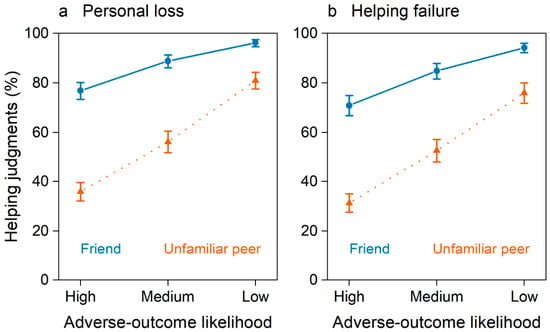
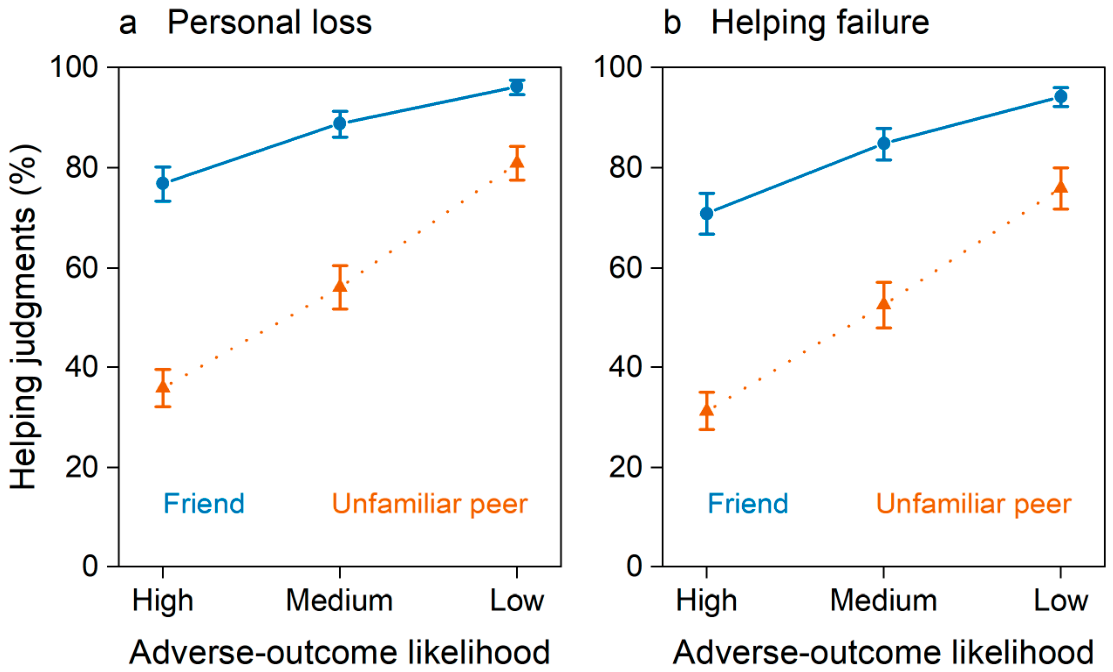
Children were more willing to help friends and to help when personal loss was described as less likely (Figure 1a). Helping was endorsed in 8313 of 11,400 judgments (72.92%). At high loss likelihood, rates pooled across children were 77.68% for friends and 36.74% for unfamiliar peers; at low likelihood, they were 96.05% and 81.11%. Both likelihood and recipient relationship were associated with helping after correction (both adjusted p < 0.001; Table 1). Figure S1 shows the age-specific responses.
Figure 1.
Helping intentions in both tasks by recipient relationship and adverse-outcome likelihood. Panel (a) shows the personal-loss task (A1); panel (b) shows the helping-failure task (A2). Each point is the unweighted mean of the four age-group means, each based on ten stories per condition (190 children; 11,400 judgments per task). Error bars are pointwise 95% percentile intervals from 10,000 bootstrap samples of whole children within age groups. Colors, symbols, and line types distinguish recipients. High, medium, and low are verbal likelihood categories. Age-specific responses appear in Figures S1 and S2.
Table 1.
Omnibus tests from the separate full-factorial models.
With equal weights across ages and the other within-child factor, the odds ratio was 6.82 (95% CI [5.46, 8.51]) for friends versus unfamiliar peers and 8.66 [6.72, 11.17] for low versus high personal-loss likelihood (Table 2). Both adjacent likelihood comparisons also met the corrected threshold. Overall age differences and all interactions were not significant after correction (Table 1).
Table 2.
Follow-up odds ratios with equal age-group weights.
3.2. Helping-Failure Task (A2)
Children were more willing to help friends and to help when failure was described as less likely (Figure 1b). They endorsed helping in 7837 of 11,400 judgments (68.75%). At high failure likelihood, helping rates pooled across children were 71.74% for friends and 32.32% for unfamiliar peers; at low likelihood, they were 94.21% and 76.00%. Both likelihood and recipient relationship were associated with helping after correction for multiple testing (both adjusted p < 0.001; Table 1). The age-specific responses are shown in Figure S2. With equal weights across ages and the other within-child factor, the odds ratio was 5.39 (95% CI [4.45, 6.54]) for friends versus unfamiliar peers and 7.10 [5.54, 9.10] for low versus high failure likelihood. Both adjacent likelihood comparisons also met the corrected threshold (Table 2). Tests of overall age differences and interactions, including the relationship-by-likelihood interaction, were not significant after correction (Table 1).
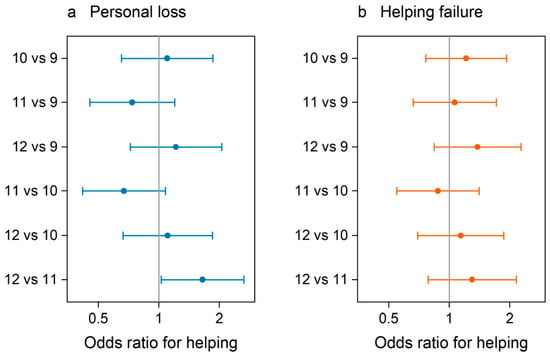
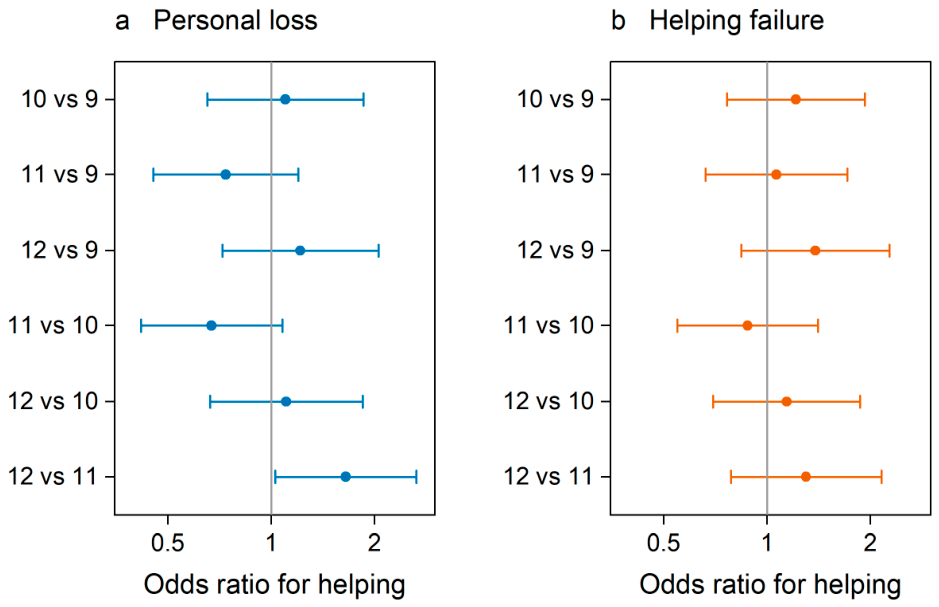
Age-pair comparisons were inconclusive after Holm correction (Figure 2 and Table S3). The exploratory continuous-age models also gave imprecise estimates for overall willingness to help. One of 12 condition-specific slopes met its Holm threshold: older children more often endorsed helping an unfamiliar peer when helping failure was described as highly likely (OR = 1.289, 95% CI [1.090, 1.523], adjusted p = 0.035; Table S9). The likelihood-by-linear-age test met its separate Holm threshold for personal loss (adjusted p = 0.009) and was inconclusive for helping failure (adjusted p = 0.086; Table S12). Within-grade estimates were imprecise in both tasks (Table S13B).
Figure 2.
Age-group comparisons in helping intentions. (a) Personal loss. (b) Helping failure. Both panels show all six age-pair odds ratios in each task, averaged equally over recipients, likelihoods, and stories. Values above one indicate greater helping odds in the older group. Bars are pointwise 95% child-clustered confidence intervals on a logarithmic axis; the vertical line marks an odds ratio of one. All 12 comparisons share one Holm correction (smallest adjusted p = 0.461). The displayed intervals are not adjusted for multiple comparisons. These comparisons concern different children in each age group.
3.3. Recipient Differences Across Likelihood Levels
On the probability scale, recipient differences were larger when the adverse outcome was more likely. Averaged equally across ages and likelihood levels, the friend–unfamiliar peer gap was 29.66 percentage points [26.78, 32.54] in the personal-loss task and 29.98 points [27.06, 32.96] in the helping-failure task. From low to high likelihood, this gap widened by 25.82 points [21.57, 30.24] and 21.34 points [16.10, 26.53], respectively. All six secondary probability contrasts met the corrected threshold (adjusted p < 0.001; Table S2). These are absolute probability contrasts, not evidence for a significant recipient-by-likelihood interaction on the log-odds scale. Low-likelihood helping rates for friends were already near the upper boundary in both tasks, constraining further increases and affecting the size of absolute gaps.
The direction of the friend advantage and of the likelihood contrasts was consistent across the ten stories in each task, although their magnitudes varied (Tables S10 and S11A,B). The main pattern also held in the sensitivity models (Tables S4 and S5). Nonmonotonic responses accounted for 1.87% of response patterns in the personal-loss task and 3.29% in the helping-failure task. Table S8 reports the distribution of response patterns across the three ordered likelihood categories.
4. General Discussion
Children more often said they would help a friend than an unfamiliar peer, both when helping could bring a personal loss and when it could fail. For both recipients, children were more willing to help when the adverse outcome was described as less likely.
4.1. Relational Value and the Consequences of Helping
The preference for friends found in allocation studies was also evident in our helping scenarios. Earlier studies found friendship preferences in helping and resource allocation (Engelmann et al., 2019; Moore, 2009; Paulus et al., 2020). Kirby et al. (2023), by contrast, found that personal cost reduced preschoolers’ compassionate responding while minimal ingroup membership did not reliably increase it. Friendship may involve expectations of mutual support that minimal group membership does not. Differences in age and task preclude a direct comparison, but the contrast suggests that the kind of relationship matters when interpreting selective helping.
The friend advantage is compatible with greater concern for a friend’s welfare or a stronger obligation to intervene. Several personal-loss scenarios stated that declining to help would entail no personal loss. Children might still have anticipated a social cost of refusing a friend, such as straining the relationship or failing to return past support. Children may also have expected a friend to return the favor. We did not measure these expectations or the costs and benefits children perceived. Children can also underestimate the positive impact of kindness (Echelbarger & Epley, 2023), so an identical likelihood phrase need not elicit identical expectations across recipients. Measuring the perceived consequences of both helping and refusing would help distinguish concern, obligation, reciprocal expectations, and anticipated effectiveness.
The distinction between helping failure and personal loss is conceptually important but only partly isolated by these materials. Corbett et al. (2023) linked a personal stake directly to a peer’s possible gain. Our personal-loss task concerns intentions to accept a possible downside, a component of prosocial risk-taking (Armstrong-Carter & Telzer, 2025; Do et al., 2017). Helping failure instead concerns the expected effectiveness of a specified action; declining it need not indicate indifference to the recipient. Nevertheless, refused help may also carry a social cost to the helper, and different stories may introduce additional moral demands. Consequently, similar effect directions across booklets do not establish equivalent mechanisms, and the tasks cannot determine which type of consequence matters more.
Refusal is therefore informative only in relation to the available action. Work on paternalistic helping shows that useful assistance can involve departing from a requested action (Martin & Olson, 2013), and research on educational help shows that providing an answer and supporting learning can have different implications for a recipient (Sierksma, 2023). Sierksma and Shutts (2025) develop the broader point that help can have unintended negative consequences. In our tasks, children could accept or reject a specified intervention but could not propose another form of support. Their responses cannot establish whether a refusal would be followed by seeking adult help, choosing a safer action, or doing nothing. A choice among these alternatives would distinguish reluctance to help a person from reluctance to perform a particular intervention.
The pattern is also compatible with cognitive balance: a positive relationship with the peer may make helping more appealing, while expected loss or failure may make the action less appealing (Heider, 1946). However, the study did not measure triadic evaluations or identification and cannot distinguish this account from concern for a friend, obligation, or anticipated reciprocity. These are alternative interpretations of the choices rather than mechanisms directly tested by the tasks.
4.2. The Scale and Developmental Scope of Selectivity
Recipient selectivity was most visible in absolute helping rates at higher adverse-outcome likelihood. This is not evidence that friendship had a stronger psychological influence in those conditions. The recipient-by-likelihood interaction on the log-odds scale was nonsignificant, and nonlinear models can produce changing absolute differences without a log-odds interaction (McCabe et al., 2022). At low adverse likelihood, friend helping rates were already near the upper probability boundary. This ceiling leaves little room for further increases and can reduce the absolute friend–unfamiliar peer gap. The probability contrasts describe where stated choices differ most; they do not identify a change in the motive underlying friendship preference.
When adverse outcomes were described as highly likely, twelve-year-olds in this sample endorsed helping unfamiliar peers more often than younger children did (Table S1). The corrected age-group comparisons and the within-grade estimates were imprecise. Age and grade overlapped closely, and the cross-sectional design compared different children at each age. Earlier work has also found limited age differences in a childhood risk task (Stengelin et al., 2024), while longitudinal data suggest that risk taking for friends can change during adolescence (Kwon et al., 2024). Following the same children would help establish whether responses change with age. Comparing these responses with adults’ judgments would require an adult sample.
Children may regard an unfamiliar peer as deserving help while declining the particular action offered. Measuring concern alongside choices between different ways to help would connect these judgments more directly to accounts of the developing moral circle (Marshall et al., 2025).
4.3. Limitations and Future Directions
Children judged all six versions of each story. Repeated comparison may have encouraged a consistent response rule and amplified the differences relative to a design in which each child saw only one version. The response patterns in Tables S7 and S8 show how often children answered consistently, but they do not reveal the strategies children used. References to bravery, honesty, and conscientiousness may also have encouraged socially desirable answers. Without independent comprehension checks, it is unclear whether children of different ages understood the verbal likelihood descriptions in the same way.
Children in the same classroom may have shared experiences that shaped their responses. The models account for repeated judgments within a child. If responses were also positively correlated within classrooms, the confidence intervals could be too narrow, especially for comparisons between age groups. Classroom identifiers were unavailable, so we could not assess the extent of this dependence. Because the booklets reused stories, the first booklet may also have influenced answers to the second. Booklet order reportedly varied across classes, but the order for each child could not be verified.
The materials do not isolate recipient relationship or consequence type perfectly. Relationship wording can also alter a person’s role in an event; the reported exclusions of Stories 2 and 7 address selected cases rather than establish construct purity across all stories. Personal-loss scenarios combine social evaluation, inconvenience, performance, and other moral considerations. Some helping-failure scenarios may also imply social costs for the helper, such as rejection. Such heterogeneity limits comparison between the two tasks and makes story-level estimates important for assessing the consistency of the pattern.
Generalization is limited to hypothetical judgments from one primary school in Zhengzhou. Hwang’s (1987) account of relational obligations in Chinese social exchange provides one context for considering the cost a child might anticipate when declining to help a friend. Expectations may also differ across schools and peer groups. This study did not measure these obligations or compare cultural settings. Future studies could recruit several classrooms per grade and counterbalance booklet order within classrooms. Under neutral instructions, each child could see a single version of each story and choose among responses such as intervening or seeking adult help. Matched materials across schools and cultural settings would help establish how broadly the pattern applies. Personal-loss likelihood and helping-failure likelihood could also be varied independently within matched scenarios, after piloting comprehension; the current separate tasks cannot estimate that interaction. Behavioral choices and repeated assessments of the same children would help test whether the reported intentions predict action and how relationship selectivity changes over time.
5. Conclusions
In this school-based questionnaire, children more often said they would help a friend than an unfamiliar peer and were more willing to help when adverse outcomes were described as less likely. Future studies could use independently presented scenarios and observe children’s choices among several ways of helping.
Supplementary Materials
The following supporting information can be downloaded at: https://www.mdpi.com/article/10.3390/bs16122272/s1, Supplementary Material S1 provides the statistical methods, sensitivity analyses, and exploratory results (Tables S1–S13 and Figures S1 and S2). Table S10 is supplied as Table_S10_Story_Probability_Contrasts.csv. Supplementary Material S2 provides the English task materials, key Chinese wording, administration information, and a story-feature matrix (Table S14). R scripts for the added analyses accompany these materials. Participant-level data remain subject to the Data Availability Statement.
Author Contributions
Conceptualization, X.G., M.Z. and C.L.; methodology, X.G., M.Z. and C.L.; investigation, X.G., B.Z. and F.Z.; data curation, X.G., B.Z. and F.Z.; writing—original draft preparation, X.G.; writing—review and editing, X.G., B.Z., F.Z., W.X., M.Z. and C.L.; supervision, X.G., M.Z. and C.L. All authors have read and agreed to the published version of the manuscript.
Funding
This research was funded by the Henan Provincial Science and Technology Research Project (grant number 252102320194). Additional support was provided by the Henan Provincial Education Policy Research Project “Research on the Scientific Education System Connecting Primary, Secondary and Higher Education” (grant number 2026-DDJYZC-20).
Institutional Review Board Statement
The study was approved by the Ethics Committee of Xinxiang Medical University (approval number XYLL-20250428; 15 April 2025). Xinxiang Medical University has since been renamed Henan Medical University.
Informed Consent Statement
Written informed consent was obtained from the children’s parents or legal guardians, and assent was obtained from the children.
Data Availability Statement
Access to the children’s de-identified questionnaire responses requires institutional approval and a signed data-use agreement. For this reason, the participant-level data are not available in a public repository. Researchers may submit access requests to either corresponding author. The Supplementary Materials include aggregate results and the R scripts used for the additional analyses.
Acknowledgments
The authors thank the children and their parents or guardians for their participation. During manuscript preparation, the authors used ChatGPT (OpenAI, GPT-6.0) to improve the clarity and readability of the English text. The authors take full responsibility for the content of the manuscript.
Conflicts of Interest
The authors declare no conflicts of interest.
References
- Armstrong-Carter, E., & Telzer, E. H. (2025). The development of prosocial risk-taking behavior: Mechanisms and opportunities. Child Development Perspectives, 19(2), 63–71. [Google Scholar] [CrossRef] [Scilit] [PubMed]
- Asscheman, J. S., He, J., Koot, S., Buil, J. M., Krabbendam, L., & van Lier, P. A. C. (2020). Classroom peer preferences and the development of sharing behavior with friends and others. International Journal of Behavioral Development, 44(5), 412–423. [Google Scholar] [CrossRef] [Scilit]
- Brooks, M. E., Kristensen, K., van Benthem, K. J., Magnusson, A., Berg, C. W., Nielsen, A., Skaug, H. J., Mächler, M., & Bolker, B. M. (2017). glmmTMB balances speed and flexibility among packages for zero-inflated generalized linear mixed modeling. The R Journal, 9(2), 378–400. [Google Scholar] [CrossRef] [Scilit]
- Corbett, B., Feeney, A., & McCormack, T. (2023). Prosocial risk taking and interpersonal regret in children: An individual differences study. Social Development, 32(1), 171–187. [Google Scholar] [CrossRef] [Scilit]
- Do, K. T., Guassi Moreira, J. F., & Telzer, E. H. (2017). But is helping you worth the risk? Defining prosocial risk taking in adolescence. Developmental Cognitive Neuroscience, 25, 260–271. [Google Scholar] [CrossRef] [Scilit] [PubMed]
- Echelbarger, M., & Epley, N. (2023). Undervaluing the positive impact of kindness starts early. Journal of Experimental Psychology: General, 152(10), 2989–2994. [Google Scholar] [CrossRef] [Scilit] [PubMed]
- Engelmann, J. M., Haux, L. M., & Herrmann, E. (2019). Helping in young children and chimpanzees shows partiality towards friends. Evolution and Human Behavior, 40(3), 292–300. [Google Scholar] [CrossRef] [Scilit]
- Heider, F. (1946). Attitudes and cognitive organization. The Journal of Psychology, 21(1), 107–112. [Google Scholar] [CrossRef] [Scilit] [PubMed]
- Holm, S. (1979). A simple sequentially rejective multiple test procedure. Scandinavian Journal of Statistics, 6(2), 65–70. Available online: https://www.jstor.org/stable/4615733 (accessed on 22 November 2026).
- Hwang, K.-K. (1987). Face and favor: The Chinese power game. American Journal of Sociology, 92(4), 944–974. [Google Scholar] [CrossRef] [Scilit] [PubMed]
- Jones, B., & Rachlin, H. (2006). Social discounting. Psychological Science, 17(4), 283–286. [Google Scholar] [CrossRef] [Scilit] [PubMed]
- Kirby, J. N., Kirkland, K., Wilks, M., Green, M., Tanjitpiyanond, P., Chowdhury, N., & Nielsen, M. (2023). Testing the bounds of compassion in young children. Royal Society Open Science, 10(2), 221448. [Google Scholar] [CrossRef] [Scilit] [PubMed]
- Kwon, S.-J., Prinstein, M. J., Lindquist, K. A., & Telzer, E. H. (2024). Friendship changes differentially predict neural correlates of decision-making for friends across adolescence. Developmental Cognitive Neuroscience, 65, 101342. [Google Scholar] [CrossRef] [Scilit] [PubMed]
- Liu, C., Xiao, X., Pi, Q., Tan, Q., & Zhan, Y. (2023). Are you more risk-seeking when helping others? Effects of situational urgency and peer presence on prosocial risky behavior. Frontiers in Psychology, 14, 1036624. [Google Scholar] [CrossRef] [Scilit] [PubMed]
- Liu, J., Mo, K., Yan, Z., & Zeng, X. (2025). Who will be my friend? The role of the liking gap in preschooler friend selection. Behavioral Sciences, 15(2), 196. [Google Scholar] [CrossRef] [Scilit] [PubMed]
- Malti, T., & Speidel, R. (2024). Development of prosociality and the effects of adversity. Nature Reviews Psychology, 3(8), 524–535. [Google Scholar] [CrossRef] [Scilit]
- Margoni, F., Nava, F., Sotis, C., Levy, M. R., Capraro, V., & Nava, E. (2026). Stable intuition and the rise of deliberative prosociality in childhood. Nature Human Behaviour, 10(9), 1686–1697. [Google Scholar] [CrossRef] [Scilit] [PubMed]
- Marshall, J., Wilks, M., Caviola, L., & Neldner, K. (2025). When development constricts our moral circle. Nature Human Behaviour, 9(8), 1537–1545. [Google Scholar] [CrossRef] [Scilit] [PubMed]
- Martin, A., & Olson, K. R. (2013). When kids know better: Paternalistic helping in 3-year-old children. Developmental Psychology, 49(11), 2071–2081. [Google Scholar] [CrossRef] [Scilit] [PubMed]
- McCabe, C. J., Halvorson, M. A., King, K. M., Cao, X., & Kim, D. S. (2022). Interpreting interaction effects in generalized linear models of nonlinear probabilities and counts. Multivariate Behavioral Research, 57(2–3), 243–263. [Google Scholar] [CrossRef] [Scilit] [PubMed]
- Meder, B., Mayrhofer, R., & Ruggeri, A. (2022). Developmental trajectories in the understanding of everyday uncertainty terms. Topics in Cognitive Science, 14(2), 258–281. [Google Scholar] [CrossRef] [Scilit] [PubMed]
- Moore, C. (2009). Fairness in children’s resource allocation depends on the recipient. Psychological Science, 20(8), 944–948. [Google Scholar] [CrossRef] [Scilit] [PubMed]
- Paulus, M., Christner, N., & Wörle, M. (2020). The normative status of friendship: Do young children enforce sharing with friends and appreciate reasonable partiality? Journal of Experimental Child Psychology, 194, 104826. [Google Scholar] [CrossRef] [Scilit] [PubMed]
- Plate, R. C., Shutts, K., Cochrane, A., Green, C. S., & Pollak, S. D. (2021). Testimony bias lingers across development under uncertainty. Developmental Psychology, 57(12), 2150–2164. [Google Scholar] [CrossRef] [Scilit] [PubMed]
- Pouwels, J. L., van Noorden, T. H. J., & Caravita, S. C. S. (2019). Defending victims of bullying in the classroom: The role of moral responsibility and social costs. Journal of Experimental Social Psychology, 84, 103831. [Google Scholar] [CrossRef] [Scilit]
- R Core Team. (2026). R: A language and environment for statistical computing (Version 4.6.0) [Computer software]. R Foundation for Statistical Computing. Available online: https://www.R-project.org/ (accessed on 22 November 2026).
- Salmivalli, C., Lagerspetz, K., Björkqvist, K., Österman, K., & Kaukiainen, A. (1996). Bullying as a group process: Participant roles and their relations to social status within the group. Aggressive Behavior, 22(1), 1–15. [Google Scholar] [CrossRef] [Scilit]
- Sierksma, J. (2023). Children perpetuate competence-based inequality when they help peers. npj Science of Learning, 8(1), 41. [Google Scholar] [CrossRef] [Scilit] [PubMed]
- Sierksma, J., Lansu, T. A. M., Karremans, J. C., & Bijlstra, G. (2018). Children’s helping behavior in an ethnic intergroup context: Evidence for outgroup helping. Developmental Psychology, 54(5), 916–928. [Google Scholar] [CrossRef] [Scilit] [PubMed]
- Sierksma, J., & Shutts, K. (2025). The unintended negative consequences of help in childhood. Current Directions in Psychological Science, 34(4), 247–252. [Google Scholar] [CrossRef] [Scilit] [PubMed]
- Stengelin, R., Maurits, L., Hepach, R., & Haun, D. B. M. (2024). Children’s risk preferences vary across sexes, social contexts, and cultures. Communications Psychology, 2(1), 79. [Google Scholar] [CrossRef] [Scilit] [PubMed]
- Sweijen, S. W., te Brinke, L. W., van de Groep, S., & Crone, E. A. (2025). A longitudinal study of multidimensional prosocial behavior during adolescence. Child Development, 96(6), 1946–1967. [Google Scholar] [CrossRef] [Scilit] [PubMed]
- Wan, Q., & Sloutsky, V. M. (2026). Development of uncertainty sensitivity: Early competence or protracted development? Developmental Science, 29(2), e70137. [Google Scholar] [CrossRef] [Scilit] [PubMed]
- Zeileis, A., Köll, S., & Graham, N. (2020). Various versatile variances: An object-oriented implementation of clustered covariances in R. Journal of Statistical Software, 95(1), 1–36. [Google Scholar] [CrossRef] [Scilit]
- Zhan, Y., Xiao, X., Tan, Q., Zhang, S., Ou, Y., Zhou, H., Li, J., & Zhong, Y. (2019). Influence of self-relevance and reputational concerns on altruistic moral decision making. Frontiers in Psychology, 10, 2194. [Google Scholar] [CrossRef] [Scilit] [PubMed]

Disclaimer/Publisher’s Note: The statements, opinions and data contained in all publications are solely those of the individual author(s) and contributor(s) and not of MDPI and/or the editor(s). MDPI and/or the editor(s) disclaim responsibility for any injury to people or property resulting from any ideas, methods, instructions or products referred to in the content. |
© 2026 by the authors. Licensee MDPI, Basel, Switzerland. This article is an open access article distributed under the terms and conditions of the Creative Commons Attribution (CC BY) license.