


Abstract
In recent years, the population of companion animal owners has been growing, and companion animals have increasingly come to be regarded as family members. Accordingly, greater attention is being devoted to the psychological difficulties associated with their death and loss. This study examined whether self-compassion moderates the relationship between trait anxiety and companion animal death anxiety, as well as the moderating effects of individual self-compassion components. Participants consisted of 312 companion animal owners. Hierarchical regression and simple slope analyses were conducted, controlling for gender, age, duration of companion animal ownership, and previous bereavement experience. The results were as follows: First, self-compassion significantly negatively predicted companion animal death anxiety (B = −0.124, β = −0.147, p = 0.015), whereas the main association between trait and death anxiety was not significant. Second, the interaction between trait anxiety and self-compassion was significant (B = −0.314, β = −0.131, p = 0.032), accounting for 1.3% of the variance (ΔR2 = 0.013). Further, trait anxiety was significantly positively associated with companion animal death anxiety only at low levels of self-compassion. Third, analyses of individual components revealed significant moderating effects of self-kindness (B = −0.294, β = −0.132, p = 0.027) and mindfulness (B = −0.354, β = −0.165, p = 0.005), but not of common humanity (B = −0.086, β = −0.038, p = 0.520). Collectively, these findings highlight that self-compassion, particularly self-kindness and mindfulness, may function as a psychological protective factor that buffers the relationship between trait anxiety and companion animal death anxiety. Furthermore, the findings suggest that self-compassion may be incorporated into counseling and psychoeducational approaches aimed at supporting individuals experiencing psychological difficulties associated with companion animal death and loss.
1. Introduction
1.1. Study Background and Purpose
Human–animal interaction positively influences various aspects of individuals’ lives, including physical health, psychological well-being, and overall quality of life (Hosey & Melfi, 2014; Krause-Parello et al., 2019; Pandey et al., 2024). Companion animals are increasingly perceived not merely as pets but as family members and sources of emotional support. These animals become key attachment figures that foster a sense of security and psychological satisfaction among owners (S. Y. Kim & Park, 2018). Simultaneously, the number of owners experiencing companion animal loss is increasing; inevitably, most owners experience the death of a companion animal during their lifetime (S. A. Han & Yoo, 2022). Companion animal loss may trigger prior trauma, anxiety, feelings of loss associated with the deaths of significant others, depression, and guilt, alongside symptoms such as reduced appetite, sleep disturbances, and social withdrawal (Cleary et al., 2022; Compitus, 2019). Approximately 7.5% of individuals bereaved of a companion animal meet the diagnostic criteria for prolonged grief disorder, indicating that the death of a companion animal may constitute a significant loss that elicits enduring grief responses comparable to those experienced following human bereavement (Hyland, 2026). Collectively, these findings suggest that companion animal loss may extend beyond sadness to become a mental health concern warranting professional psychological intervention.
All owners do not experience companion animal death anxiety to the same degree. According to state–trait anxiety theory (Spielberger, 1972), state anxiety concerns a transient emotional state encompassing subjective tension, worry, fear, and autonomic nervous system activation at a particular moment. By contrast, trait anxiety is a relatively stable and enduring personality characteristic that reflects a broader tendency to perceive diverse situations as more threatening than they actually are and to excessively anticipate negative future events. Individuals with high trait anxiety are particularly sensitive to potential threats even in situations that are not objectively dangerous and experience more intense anxiety, worry, and rumination in threatening situations (Zwemer & Deffenbacher, 1984). Thus, trait anxiety constitutes a psychological vulnerability factor that may impede adjustment to the environment and precipitate various forms of anxiety. Therefore, it may be closely associated with varied psychological difficulties, including death anxiety. Nevertheless, few studies have directly examined the relationship between trait anxiety and owners’ anxiety concerning the death of their companion animals. A meta-analysis reported that higher general anxiety was significantly associated with higher death anxiety (Li et al., 2024). Additionally, death anxiety has been identified as a core psychological mechanism most closely associated with anxiety-related symptoms across various forms of psychopathology (Menzies et al., 2024). Furthermore, death anxiety has been described as a relatively stable psychological characteristic closely associated with psychological distress, rather than merely a transient emotional response (Pashak et al., 2020). Owners with high trait anxiety may experience higher companion animal death anxiety when anticipating their animal’s death or recognizing the possibility of loss. This evidence suggests that trait anxiety may be a crucial psychological antecedent of companion animal death anxiety.
A more comprehensive understanding of this relationship warrants consideration of both individual vulnerability to anxiety and psychological protective factors that may buffer it. H. J. Park and Jeong (2022) empirically demonstrated that cognitive emotion regulation strategies may function as protective factors that buffer loss reactions during psychological adjustment following companion animal loss. Building on this perspective, this study examined whether self-compassion buffers the relationship between trait anxiety and companion animal death anxiety. This approach carries preventive significance because it extends the buffering role of psychological protective factors from post-loss adjustment to pre-loss death anxiety. Self-compassion entails responding to psychological suffering or failure with kindness and compassion rather than self-criticism, recognizing one’s experiences as part of the broader human experience rather than as isolated occurrences, and realistically acknowledging and accepting painful thoughts and feelings without overidentifying with them (Neff, 2003a). Individuals with low self-compassion are more likely to experience anxiety symptoms under stress than those with high self-compassion (Adams & Leary, 2007; Neff, 2003b). Further, higher self-compassion has been associated with lower perceived stress, anxiety, rumination, and self-criticism (Cho & Hyun, 2011). Studies targeting emerging adults (G. Y. Lee & Kim, 2020) and Chinese nursing students (Y. Luo et al., 2019) have found negative correlations between self-compassion and anxiety. Additionally, a study of patients with generalized anxiety disorder reported significant improvements in anxiety and depression following a self-compassion intervention (X. Luo et al., 2024). Overall, these findings suggest that self-compassion—beyond its correlation with anxiety—may function as a beneficial psychological resource that facilitates a balanced perspective through awareness of one’s emotions without suppressing them or becoming overwhelmed by them, thereby mitigating negative affect or heightening positive affect (Leary et al., 2007). Self-compassion encompasses self-kindness, mindfulness, and common humanity. Self-kindness entails understanding and accepting oneself with warmth and kindness, rather than engaging in harsh self-criticism when experiencing suffering or failure (Neff, 2003a). Self-compassion interventions significantly mitigate self-criticism (Wakelin et al., 2022). Research on individuals bereaved of a companion animal has found that self-kindness and common humanity are associated with continuing-bond behaviors and that self-compassion buffers the relationship between grief and depression (Bussolari et al., 2021). Overall, these findings suggest that self-kindness may buffer the relationship between trait anxiety and companion animal death anxiety by helping individuals accept anxiety and fear concerning their animal’s death as natural emotional responses and by mitigating self-blame. Mindfulness encompasses nonjudgmental awareness and balanced acceptance of painful thoughts and feelings (Neff, 2003a), thereby helping individuals maintain psychological distance from negative thoughts and emotions rather than becoming excessively absorbed in them (Biehler & Naragon-Gainey, 2022). Therefore, mindfulness may buffer the relationship between trait anxiety and companion animal death anxiety by enabling owners to view anxious thoughts regarding the possibility of their animal’s death in a balanced manner and focus on their present experience. Common humanity entails understanding suffering and difficulties as universal aspects of life that anyone may experience (Neff, 2003a). Common humanity helps individuals accept their suffering as a natural human experience (Allen & Leary, 2010), potentially buffering the relationship between trait anxiety and companion animal death anxiety by allowing owners to understand their fear of their animal’s death within the broader context of universal experiences of loss. Hence, self-compassion serves as an internal resource and protective factor that supports psychological health (Wetterneck et al., 2013) and alleviates maladaptive anxiety-related symptoms (Neff, 2003b; Neff & McGehee, 2010). Accordingly, self-compassion may function as a moderator that psychologically buffers the association between trait anxiety and companion animal death anxiety. Specifically, the positive relationship between trait anxiety and companion animal death anxiety is expected to diminish as self-compassion increases.
Recent South Korean studies on companion animal loss have investigated psychological characteristics and risk factors following loss, including depression, anxiety, emptiness, and complicated grief (Jeong, 2023; Jung et al., 2023); relationships among attachment, social support, social constraints, and grief (H. J. Choi, 2026; S. A. Han & Yoo, 2022; Y. C. Lee, 2025); and the development of grief programs, virtual reality-based interventions, and counseling programs (H. M. Choi et al., 2021; Chang & Lyu, 2024; Go, 2025; Ma, 2024). International research has addressed several related areas: a literature review of the effects of companion animal ownership and loss on death acceptance, sorrow, and grief (Farone et al., 2026); a systematic review of companion animal loss experiences (Cleary et al., 2022); a review of companion animal loss and coping mechanisms (R. M. Park et al., 2023); a study on continuing bonds (Hughes & Harkin, 2025); an investigation of the effectiveness of metacognitive grief therapy (Wenn et al., 2019); and a study examining the roles of deliberate rumination and continuing bonds (Wu & Song, 2025).
However, most South Korean and international studies have examined grief, psychological adjustment, and therapeutic interventions following companion animal loss. Relatively scant research has assessed companion animal death anxiety experienced before loss and its associated psychological factors. Specifically, the literature remains limited regarding the relationship between trait anxiety and companion animal death anxiety, as well as self-compassion’s moderating role in this relationship. Therefore, understanding companion animal death anxiety as a psychological phenomenon experienced before loss is necessary, as is jointly evaluating trait anxiety and self-compassion.
Accordingly, this study investigated the relationship between trait anxiety and companion animal death anxiety among companion animal owners and assessed whether self-compassion functions as a moderator that buffers this relationship. It focused on death anxiety experienced before companion animal loss, thereby seeking to understand owners’ psychological difficulties from a preventive perspective rather than limiting them to post-loss grief responses. Furthermore, the findings could provide a foundation for counseling and psychotherapy professionals to understand psychological vulnerabilities associated with owners’ death anxiety and to develop counseling and psychoeducational approaches that incorporate the components of self-compassion. This study has practical significance for the early identification of psychological difficulties among owners anticipating the loss of a companion animal and for informing professional interventions that facilitate psychological preparation and adjustment before loss.
1.2. The Present Study and Hypotheses
H1.
Trait anxiety is positively associated with companion animal death anxiety.
H2.
Self-compassion is negatively associated with companion animal death anxiety.
H3.
Self-compassion moderates the relationship between trait anxiety and companion animal death anxiety, such that the positive association between trait anxiety and companion animal death anxiety is weaker at higher levels of self-compassion.
2. Materials and Methods
2.1. Participants
The participants in this study were adults residing in South Korea who were currently raising companion animals. Participants were recruited through online communities related to companion animals and university students. The purpose and procedures of the study were explained to the participants, and those who voluntarily agreed to participate completed the survey via Google Forms (https://forms.google.com; accessed on 30 April 2026). A total of 312 responses deemed suitable for analysis were included in the final analyses.
2.2. Measures
2.2.1. Companion Animal Death Anxiety
As no instrument has been specifically developed to assess anxiety concerning the death of companion animals, this study adapted the Fear of Death of Others (DO) subscale from the Collett–Lester Fear of Death and Dying Scale (FDD), originally developed by Collett and Lester (1969) and adapted into Korean by Suh (1987). The original scale is a 36-item, 4-point Likert-type measure of death-related anxiety, whose Cronbach’s α coefficients ranged from 0.72 to 0.91 (M. J. Han, 2001). From this scale, the 10-item DO subscale, which assesses fear of others’ death, was selected and adapted for the present study following expert review of its content validity.
To develop a measure appropriate for this study’s context and purpose, references to “others” were replaced with “companion animals,” and the item wording was modified while maintaining the original scale’s meaning. Following these modifications, seven experts—including three animal-assisted psychotherapy and counseling professionals, three psychological counseling professionals, and one clinical psychologist—evaluated the content validity of the revised items. The content validity index (CVI) values for the items ranged from 0.86 to 1.00. As seven experts participated in the evaluation, a CVI value of 0.72 or higher was considered indicative of adequate content validity based on Lynn’s (1986) criteria for panels of 6–10 experts. One of the 10 items was excluded because its CVI was 0.14, which the experts judged as inappropriate, difficult to interpret in relation to anxiety, and insufficiently associated with the construct of anxiety. Consequently, nine items were retained as the final measure of companion animal death anxiety. In this study, the nine-item scale demonstrated a Cronbach’s α of 0.695.
2.2.2. Trait Anxiety
To measure anxiety, this study employed the Korean version of the State-Trait Anxiety Inventory (STAI), originally developed by Spielberger et al. (1970), translated by J. T. Kim (1978), and standardized by D. W. Han et al. (1993). The STAI comprises 40 items, with 20 items assessing state anxiety and 20 items assessing trait anxiety. State anxiety represents a temporary level of anxiety experienced in a specific situation, whereas trait anxiety reflects a general tendency or disposition toward anxiety. As this study aimed to examine the effect of an individual’s general tendency toward anxiety on companion animal death anxiety, only the 20 items measuring trait anxiety were utilized. Each item was rated on a 4-point Likert scale ranging from 1 (“Not at all”) to 4 (“Almost always”), with higher total scores indicating higher trait anxiety levels. K. H. Kim (2019) reported a Cronbach’s α of 0.90 for the scale. In the present study, the Cronbach’s α for this scale was 0.729.
2.2.3. Korean Self-Compassion Scale
Self-compassion was measured using the Korean version of the Self-Compassion Scale (SCS), originally developed by Neff (2003a) and translated and validated by K. Y. Kim et al. (2008). This scale, which assesses individuals’ typical ways of responding to challenging situations, contains six subscales organized into three paired dimensions, comprising positive and negative aspects of self-compassion—namely, self-kindness (5 items) and self-judgment (5 items), common humanity (4 items) and isolation (4 items), and mindfulness (4 items) and over-identification (4 items), totaling 26 items. Each item is rated on a 5-point Likert scale ranging from 1 (“Almost never”) to 5 (“Almost always”). Higher total scores indicate higher self-compassion levels. M. H. Kim (2023) reported Cronbach’s α coefficients of 0.76 for self-kindness, 0.82 for self-judgment, 0.76 for common humanity, 0.82 for isolation, 0.74 for mindfulness, 0.76 for over-identification, and 0.88 for the total scale. In the present study, Cronbach’s α coefficients were 0.805 for the self-kindness/self-judgment dimension, 0.662 for the common humanity/isolation dimension, 0.741 for the mindfulness/over-identification dimension, and 0.892 for the total scale.
2.3. Procedure
Participants were adults who were currently living with and caring for companion animals in South Korea during the study period. They were recruited through voluntary online sampling from companion animal community groups and university student networks. Data were collected using an online survey between 1 February and 30 April 2026. The survey was administered using Google Forms and took approximately 25 min to complete. Overall, 400 individuals participated. Following the exclusion of questionnaires with repetitive identical responses or incomplete responses, the final analyses comprised data from 312 participants.
2.4. Ethical Considerations
This study was conducted after obtaining approval from the Institutional Review Board (IRB) of the first author’s affiliated institution (approval number: WKIRB-202512-SB-097). The study information provided to participants included a detailed explanation of the study’s purpose and procedures, participation requirements, participants’ rights (including anonymity, confidentiality, and the right to withdraw at any time), instructions for completing the survey, and the intended use of the collected data. Participants were informed that they would not experience any disadvantage if they chose not to participate or discontinued their participation at any point. The online survey was accessible only to individuals who had read the study information and voluntarily agreed to participate. Participants who completed the survey received an online mobile gift voucher in compensation for their time.
2.5. Data Analysis
Statistical analyses were performed using IBM SPSS Statistics (Version 29.0, IBM Corp., Armonk, NY, USA) and jamovi (Version 2.6, The jamovi project, https://www.jamovi.org; accessed on 30 April 2026). First, descriptive statistical analyses were conducted to examine the general characteristics of the participants and the overall distributions of the major study variables. Means, standard deviations, skewness, and kurtosis were calculated to assess the normality of the data. Second, Pearson’s product–moment correlation analysis was performed to examine the relationships among trait anxiety, self-compassion, and pet death anxiety. Third, multiple regression analysis was conducted to examine the effects of trait anxiety and self-compassion on pet death anxiety. Fourth, hierarchical regression analysis was performed to test the moderating effect of self-compassion on the relationship between trait anxiety and pet death anxiety. To examine the moderation effect, trait anxiety (the independent variable) and self-compassion (the moderator) were mean-centered, and an interaction term was subsequently generated. In the hierarchical regression analysis, gender, age, pet-care duration, and previous pet loss experience were entered as control variables in Step 1. Trait anxiety and self-compassion were added in Step 2, and the interaction term between trait anxiety and self-compassion was entered in Step 3. The increase in explained variance and the statistical significance of the interaction effect were examined to determine the moderating effect. Fifth, simple slope analysis was conducted to further explore the nature of the significant moderation effect. Specifically, the relationship between trait anxiety and pet death anxiety was examined at different levels of self-compassion (the mean and ±1 standard deviation). Sixth, a sensitivity analysis using G*Power 3.1 was conducted to evaluate the adequacy of the sample size for detecting the moderating effect in the final research model. The analysis was based on linear multiple regression with fixed model and R2 increase. The final sample size was set at 312, with eight total predictors, one tested predictor (the interaction term), an alpha level of 0.05, and statistical power of 0.80. This analysis was used to determine the minimum interaction effect size detectable with the current sample.
3. Results
3.1. Demographic Characteristics
A total of 312 participants were included in the study. In the final sample, 138 participants (44.2%) were male, while 174 (55.8%) were female. Concerning age, 137 participants (43.9%) were aged 30–49 years, 99 (31.7%) were aged 50 years or older, and 76 (24.4%) were aged 19–29 years. Regarding the type of companion animal, 220 participants (70.5%) reported raising dogs; 60 (19.2%), cats; 14 (4.5%), fish; 6 (1.9%), hamsters; 4 (1.3%), reptiles; 4 (1.3%), other types of animals; 3 (1.0%), birds; and 1 (0.3%), a rabbit. Pet-care duration was less than 5 years for 166 participants (53.2%) and 5 years or longer for 146 participants (46.8%). Regarding previous experiences of losing a companion animal, 171 participants (54.8%) reported having experienced a loss, whereas 141 (45.2%) had not. Among the 171 participants who had experienced a companion animal loss, 112 (65.5%) reported that the loss had occurred two or more years earlier, 24 (14.0%) reported one to less than two years, 18 (5.8%), four to six months; 9 (2.9%), seven to eleven months; 5 (1.6%), one to three months; and 3 (1.0%), less than one month. Concerning the cause of death, 119 participants (38.1%) reported natural death, including death owing to aging or other natural causes; 26 (8.3%), euthanasia owing to disease or accidental injury based on a veterinarian’s decision; 14 (4.5%), accidents or disasters; and 11 (3.5%), other causes.
3.2. Descriptive Statistics of Major Variables
Descriptive analyses were conducted to examine the overall patterns of the main variables and assess normality. The mean scores were 2.295 (SD = 0.332), 3.347 (SD = 0.564), and 2.692 (SD = 0.478) for trait anxiety, overall self-compassion, and companion animal death anxiety, respectively. The mean scores for the self-compassion components were 3.22 (SD = 0.659), 3.33 (SD = 0.587), and 3.29 (SD = 0.683) for self-kindness, common humanity, and mindfulness, respectively. Skewness and kurtosis were examined to assess normality. Skewness ranged from 0.196 to 0.307, while kurtosis ranged from −0.375 to 0.748. These values satisfied the criteria of ±2 for both skewness and kurtosis proposed by George and Mallery (2020), suggesting no major violations of the normality assumption for the main variables (Table 1 and Table 2).
Table 1.
Descriptive Statistics for Study Variables (n = 312).
Table 2.
Descriptive Statistics for Study Variables (n = 312).
3.3. Relationships Among Trait Anxiety, Self-Compassion, and Companion Animal Death Anxiety
Pearson correlation analyses examined the relationships among trait anxiety, self-compassion, and companion animal death anxiety (Table 3). Trait anxiety was significantly negatively correlated with overall self-compassion (r = −0.391, p < 0.01), self-kindness (r = −0.331, p < 0.01), common humanity (r = −0.342, p < 0.01), and mindfulness (r = −0.387, p < 0.01), and significantly positively correlated with companion animal death anxiety (r = 0.175, p < 0.01). Overall self-compassion was significantly positively correlated with self-kindness (r = 0.873, p < 0.01), common humanity (r = 0.772, p < 0.01), and mindfulness (r = 0.885, p < 0.01), and significantly negatively correlated with companion animal death anxiety (r = −0.215, p < 0.01). Self-kindness was significantly positively correlated with common humanity (r = 0.577, p < 0.01) and mindfulness (r = 0.725, p < 0.01), but not significantly correlated with companion animal death anxiety (r = −0.100, p > 0.05). Common humanity was significantly positively correlated with mindfulness (r = 0.658, p < 0.01), but not significantly correlated with companion animal death anxiety (r = −0.057, p > 0.05). Finally, mindfulness was significantly negatively correlated with companion animal death anxiety (r = −0.120, p < 0.05). In sum, trait anxiety was significantly positively correlated with companion animal death anxiety, whereas overall self-compassion was significantly negatively correlated with it. Among the self-compassion components, only mindfulness was significantly negatively correlated with companion animal death anxiety. Overall, these results suggest that mindfulness may function as a psychological protective factor that is negatively associated with companion animal death anxiety.
Table 3.
Correlations among Trait Anxiety, Self-Compassion, and Companion Animal Death Anxiety (n = 312).
3.4. Effects of Trait Anxiety and Self-Compassion on Companion Animal Death Anxiety
Hierarchical regression analysis assessed the effects of trait anxiety and self-compassion on companion animal death anxiety (Table 4). Considering that pet death anxiety may vary according to sociodemographic characteristics and experiences related to pet caregiving and loss, gender and age were included as sociodemographic control variables, while pet-care duration and previous pet loss experience were included as control variables related to the relationship with companion animals and loss experiences. In Step 1, gender, age, the duration of companion animal ownership, and previous bereavement experience were entered as control variables. In Step 2, trait anxiety and self-compassion were added. The Step 1 regression model was significant (F = 5.709, p < 0.001), accounting for 8.5% of the variance in companion animal death anxiety (R2 = 0.085). The addition of trait anxiety and self-compassion in Step 2 increased the explained variance to 11.8% (R2 = 0.118), and this increase was significant (ΔR2 = 0.033, ΔF = 5.714, p = 0.004). The final regression model was also significant (F = 5.836, p < 0.001).
Table 4.
Hierarchical Regression Analysis of Trait Anxiety and Self-Compassion Predicting Companion Animal Death Anxiety.
Following adjustment for the control variables, self-compassion significantly negatively predicted companion animal death anxiety (β = −0.147, p = 0.015), indicating that higher self-compassion was associated with lower companion animal death anxiety. Trait anxiety exhibited a positive regression coefficient; however, its effect was not significant (β = 0.080, p = 0.181). Among the control variables, gender exhibited a significant positive association (β = 0.225, p < 0.001), whereas age, duration of companion animal ownership, and previous bereavement experience were not significant predictors.
Collectively, these findings indicate that self-compassion significantly explains companion animal death anxiety after accounting for sociodemographic characteristics and experiences of companion animal ownership, whereas trait anxiety’s independent explanatory contribution was not supported. Additionally, multicollinearity and residual characteristics were examined in the final regression model. The multicollinearity diagnostics indicated that the variance inflation factor (VIF) values ranged from 1.035 to 1.736, and the tolerance values ranged from 0.576 to 0.966, suggesting no multicollinearity concerns. The Durbin–Watson statistic for the final regression model was 1.885, indicating no substantial concerns regarding residual independence. Standardized residuals ranged from −2.764 to 2.828, with no extreme standardized residuals exceeding an absolute value of 3.
3.5. Self-Compassion’s Moderating Effect on the Relationship Between Trait Anxiety and Companion Animal Death Anxiety
Hierarchical regression analysis assessed self-compassion’s moderating effect on the relationship between trait anxiety and companion animal death anxiety, controlling for gender, age, duration of companion animal ownership, and previous bereavement experience. Control variables were entered in Step 1, and trait anxiety was added in Step 2. Subsequently, self-compassion was entered in Step 3, while the trait anxiety × self-compassion interaction term was added in Step 4 (Table 5).
Table 5.
Moderating Effect of Self-Compassion on the Relationship between Trait Anxiety and Companion Animal Death Anxiety.
The model comprising only the control variables in Step 1 was significant (R2 = 0.085, F = 5.709, p < 0.001). The addition of trait anxiety in Step 2 increased the explained variance by 1.6% (ΔR2 = 0.016, ΔF = 5.372, p = 0.021). The addition of self-compassion in Step 3 increased the explained variance by 1.7% (ΔR2 = 0.017, ΔF = 5.968, p = 0.015). Finally, the addition of the interaction term in Step 4 accounted for an additional 1.3% of the variance (ΔR2 = 0.013, ΔF = 4.662, p = 0.032). The final model was significant (F = 5.751, p < 0.001) and accounted for 13.2% of the total variance (R2 = 0.132). In the final model, the interaction between trait anxiety and self-compassion was significantly negatively associated with companion animal death anxiety (B = −0.314, SE = 0.146, β = −0.131, t = −2.159, p = 0.032). This result indicates that the association between trait anxiety and companion animal death anxiety differs depending on self-compassion, thereby supporting its moderating role.
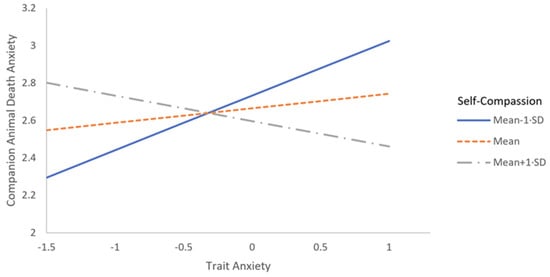
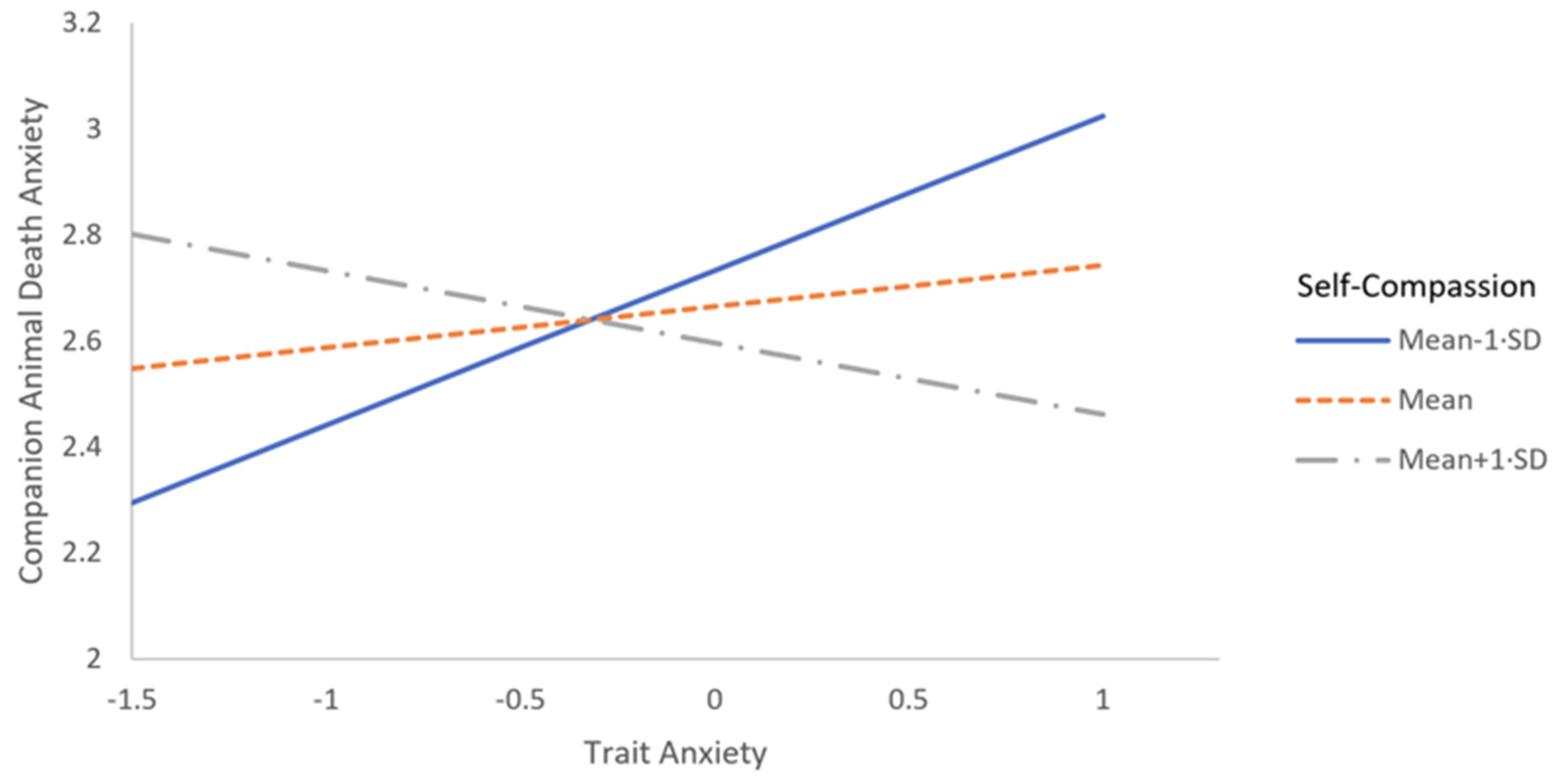
Simple slope analyses examined the interaction in greater detail across levels of self-compassion. Table 6 and Figure 1 present the results. At low levels of self-compassion (−1 SD), trait anxiety was significantly positively associated with companion animal death anxiety (B = 0.231, SE = 0.101, t = 2.293, p = 0.023). By contrast, the relationship was not significant at mean (B = 0.053, p = 0.555) or high (+1 SD; B = −0.125, p = 0.373) levels of self-compassion. Overall, these results indicate that the positive association between trait anxiety and companion animal death anxiety was evident at low self-compassion but weakened as self-compassion increased.
Table 6.
Simple Slopes of Trait Anxiety at Different Levels of Self-Compassion.
Figure 1.
Relationship between trait anxiety and companion animal death anxiety at different levels of self-compassion.
3.6. Additional Analyses of Moderating Effects of Self-Compassion Components
Component-specific moderating effects were examined by conducting additional analyses with self-kindness, common humanity, and mindfulness as separate moderators. Gender, age, duration of companion animal ownership, and bereavement experience were controlled for, while the interaction between trait anxiety and each component was entered in the final step. As presented in Table 7, the interaction involving overall self-compassion was significant (B = −0.314, β = −0.131, p = 0.032), accounting for an additional 1.3% of the variance. Among the components, the interaction terms comprising self-kindness (B = −0.294, β = −0.132, p = 0.027) and mindfulness (B = −0.354, β = −0.165, p = 0.005) were significant, with increases in explained variance of 1.4% and 2.3%, respectively. The interaction involving common humanity was not significant (B = −0.086, β = −0.038, p = 0.520), with an increase in explained variance of 0.1%; thus, its moderating effect was not supported.
Table 7.
Moderating Effects of Overall Self-Compassion and Its Components.
Simple slope analyses further assessed the significant interactions involving self-kindness and mindfulness (Table 8). The positive relationship between trait anxiety and companion animal death anxiety was significant at low levels of self-kindness (B = 0.296, p = 0.003), but not at mean (B = 0.103, p = 0.253) or high (B = −0.091, p = 0.533) levels of self-kindness. Likewise, the positive relationship was significant at low levels of mindfulness (B = 0.334, p = 0.001), but not at mean (B = 0.092, p = 0.311) or high (B = −0.150, p = 0.302) levels of mindfulness. For overall self-compassion, the positive relationship was significant at low levels (B = 0.231, p = 0.023), but not at mean (B = 0.053, p = 0.555) or high (B = −0.125, p = 0.373) levels. The simple slope was significant at low common humanity (B = 0.219, p = 0.033); however, this result was not interpreted as evidence of moderation because the interaction term itself was not significant. Collectively, these findings indicate that self-compassion’s moderating effect—though not uniform across all components—was evident for self-kindness and mindfulness. Specifically, the positive relationship between trait anxiety and companion animal death anxiety was significant only at low levels of self-kindness and mindfulness, suggesting that these components contribute to moderating the relationship between the two variables.
Table 8.
Simple Slopes of the Relationship between Trait Anxiety and Companion Animal Death Anxiety across Levels of Self-Compassion and Its Components.
4. Discussion
This study investigated trait anxiety as a risk factor and self-compassion as a protective factor in companion animal death anxiety, focusing on whether self-compassion moderates the relationship between trait anxiety and companion animal death anxiety. The findings underscore the criticality of considering both risk and protective factors to understand companion animal death anxiety.
First, trait anxiety was positively correlated with companion animal death anxiety and negatively correlated with self-compassion, which, in turn, was negatively correlated with companion animal death anxiety. Overall, these results suggest that higher trait anxiety is associated with higher companion animal death anxiety and lower self-compassion, whereas higher self-compassion is associated with lower companion animal death anxiety.
The positive correlation between trait anxiety and companion animal death anxiety aligns with Abdel-Khalek (2005), who found significantly higher death anxiety among individuals with higher general anxiety, and with Abdel-Khalek and Tomás-Sábado (2005), who reported a significant positive association between general anxiety and death anxiety. Trait anxiety—reflecting a general disposition toward anxiety—may heighten sensitivity to death-related threats and foster excessive anticipation of future loss. Additionally, it may lead owners to perceive their companion animal’s aging, illness, and possible death as more threatening than they actually are, thereby contributing to higher companion animal death anxiety. The negative correlation between trait anxiety and self-compassion and that between self-compassion and companion animal death anxiety align with reviews reporting that higher self-compassion is associated with lower anxiety and depression (Egan et al., 2022; Hughes et al., 2021). Moreover, these associations concur with meta-analytic evidence that self-compassion-based interventions mitigate anxiety, depression, and stress across diverse age groups and populations (A. Han & Kim, 2023).
Among the self-compassion components, self-kindness and common humanity were not significantly correlated with companion animal death anxiety, whereas mindfulness exhibited a significant negative correlation. This result aligns with previous research suggesting that mindfulness may help individuals maintain balanced awareness of painful thoughts and feelings and mitigate excessive anticipatory responses to uncertain future threats (Xu et al., 2022). Therefore, mindfulness may function as a psychological resource that helps owners accept anxiety and negative emotions surrounding the possibility of their animal’s death without becoming excessively absorbed in them.
Second, the hierarchical regression analysis controlling for gender, age, duration of companion animal ownership, and previous bereavement experience revealed that the final model comprising trait anxiety and self-compassion significantly explained companion animal death anxiety (R2 = 0.118). Self-compassion significantly negatively predicted companion animal death anxiety (B = −0.124, β = −0.147, p = 0.015), whereas the independent predictive association between trait anxiety and death anxiety was not significant (B = 0.115, β = 0.080, p = 0.181). Thus, trait anxiety and companion animal death anxiety were significantly positively correlated at the bivariate level; however, when other variables were considered, trait anxiety did not make a significant independent contribution, whereas self-compassion remained a significant predictor. Overall, these findings may be understood in light of research linking self-compassion to individuals’ acceptance and regulation of negative emotional experiences. According to Gross’ (2015) process model of emotion regulation, cognitive reappraisal facilitates the regulation of emotional responses by changing how an event is interpreted and differs from expressive suppression. Bates et al. (2021) reported that higher self-compassion is associated with greater use of cognitive reappraisal and less expressive suppression, while reduced expressive suppression mediated the relationship between self-compassion and social anxiety. Further, Yu et al. (2023) identified the mediating effects of cognitive reappraisal, expressive suppression, and resilience on the relationship between self-compassion and depression. Likewise, South Korean research has demonstrated that mindful self-compassion training enhances self-compassion and emotional acceptance strategies (S. H. Kim et al., 2022). Collectively, these studies substantiate the possibility that self-compassion is a resource that helps regulate responses to negative emotions and facilitates psychological adjustment.
The model explained 11.8% of the variance, indicating limitations in its ability to account for companion animal death anxiety, which may be associated not only with self-compassion and trait anxiety but also with diverse psychological and environmental factors, including attachment to the animal, loss experiences, and social support. Previous studies have observed that attachment to companion animals and social support are associated with grief and psychological adjustment following bereavement (King & Werner, 2012; Lykins et al., 2024). Animals’ health status and illness characteristics have been associated with their owners’ anticipatory grief (Spitznagel et al., 2021). Nevertheless, the finding that self-compassion remained a significant predictor following adjustment for the control variables indicates that it is a crucial psychological resource for understanding companion animal death anxiety. Therefore, counseling and psychological interventions addressing this anxiety should consider self-compassion-based approaches that enhance mindfulness and self-acceptance alongside efforts to mitigate anxiety.
Third, self-compassion significantly moderated the relationship between trait anxiety and companion animal death anxiety. The interaction term was significantly negatively associated with companion animal death anxiety (B = −0.314, β = −0.131, p = 0.032), accounting for an additional 1.3% of the variance (ΔR2 = 0.013). The positive relationship was significant only at low self-compassion (B = 0.231, p = 0.023) but not at mean (B = 0.053, p = 0.555) or high self-compassion (B = −0.125, p = 0.373). This result underscores that the relationship between trait anxiety and companion animal death anxiety may differ according to self-compassion. Specifically, higher trait anxiety was associated with higher companion animal death anxiety only when self-compassion was low, suggesting that self-compassion may function as a psychological resource that buffers this relationship. Bussolari et al.’s (2021) study of individuals bereaved of a companion animal reported that self-compassion moderated the relationship between grief severity following companion animal loss and depression and may help alleviate loss-related psychological difficulties. This evidence concurs with the present findings, which suggest that self-compassion may influence individuals’ responses to negative emotions associated with companion animal loss. Importantly, the current study identified this moderating role not only within the context of post-bereavement grief but also in the relationship between trait and death anxiety when anticipating an animal’s death. This finding suggests that self-compassion may be involved in regulating anxiety when owners anticipate the possibility of death or loss. Its moderating role may be understood in terms of its influence on attitudes toward negative emotional experiences and on emotion regulation strategies.
According to Gilbert’s (2017) compassion-focused theory, human emotion regulation comprises the threat, drive, and soothing systems. Self-compassion may contribute to the regulation of excessive threat-system responses by activating the soothing system. Individuals with high trait anxiety may respond sensitively to potential danger or loss; however, a self-compassionate attitude may help them regulate emotional responses more flexibly by fostering understanding and acceptance, rather than criticism or avoidance, of their anxiety and suffering. Rockliff et al.’s (2011) and Kirschner et al.’s (2019) studies on compassion-focused imagery training reported that compassion- and self-compassion-related approaches may mitigate self-criticism, enhance psychological security, and facilitate the regulation of stress responses. This perspective substantiates the possibility that self-compassion helps individuals cope with anxiety and psychological distress in difficult-to-control situations, such as a companion animal’s aging, illness, or possible death.
Accordingly, counseling and psychological interventions for companion animal death anxiety should incorporate self-compassion-based approaches that help owners accept anxiety and suffering without judgment and develop an emotionally grounded perspective, alongside approaches aimed at directly mitigating anxiety. Programs that help enhance self-compassion, including mindfulness and self-acceptance, may promote emotional coping and psychological adjustment, particularly when an animal’s death is imminent or anxiety regarding possible loss intensifies.
Fourth, additional analyses of the individual components revealed that self-kindness and mindfulness significantly moderated the relationship between trait anxiety and companion animal death anxiety, whereas common humanity did not. Specifically, the interaction between self-kindness and trait anxiety was significantly negatively associated with companion animal death anxiety (B = −0.294, β = −0.132, p = 0.027), as was the interaction between mindfulness and trait anxiety (B = −0.354, β = −0.165, p = 0.005). Meanwhile, the interaction involving common humanity was not significant (B = −0.086, β = −0.038, p = 0.520). Overall, these findings indicate that self-compassion’s moderating effect was not uniform across all components but was primarily evident for self-kindness and mindfulness.
Self-kindness moderated the relationship between trait anxiety and companion animal death anxiety. Simple slope analyses indicated a significant positive relationship only at low levels of self-kindness (B = 0.296, p = 0.003), but not at mean or high levels. Therefore, when experiencing anxiety and suffering, treating oneself with understanding and warmth, rather than criticism, may buffer the relationship between trait and death anxiety. A self-compassion writing program, though not directly focused on companion animal death anxiety, has been demonstrated to mitigate social anxiety and self-criticism (Yang & Kim, 2022). This evidence suggests that a self-compassionate attitude may help individuals cope with negative emotions, such as anxiety. Accordingly, when experiencing anxiety and psychological difficulties associated with an animal’s aging, illness, or possible death, understanding and accepting oneself may be vital, rather than engaging in self-blame. Self-kindness pertains to how one relates to oneself while experiencing anxiety rather than the elimination of anxiety itself; this attitude may influence how trait anxiety is linked to companion animal death anxiety. Thus, self-kindness may function as a psychological resource that buffers the escalation of negative emotions when anticipating the possibility of a companion animal’s death.
Mindfulness significantly moderated the relationship between trait anxiety and companion animal death anxiety. The positive relationship was significant at low levels of mindfulness (B = 0.334, p = 0.001), but not at mean (B = 0.092, p = 0.311) or high (B = −0.150, p = 0.302) levels. Notably, in the earlier correlation analysis, mindfulness was significantly negatively correlated with companion animal death anxiety. Therefore, mindfulness may also have a direct association with companion animal death anxiety while also moderating its relationship with trait anxiety. Likewise, Herms et al. (2026) identified a moderating effect of mindfulness on the relationship between trait anxiety and negative affect under stress. Beshai et al. (2022) suggested that mindfulness may buffer the relationship between COVID-19-related stress and psychological difficulties. Overall, these studies align with the present findings in emphasizing that mindfulness may influence the process through which anxiety or stress results in negative emotional experiences rather than eliminating anxiety or stress itself. An attitude of noticing and accepting present experience as it is, rather than excessively amplifying or avoiding anxious thoughts and feelings, may be a vital psychological resource for managing anxiety surrounding the possibility of a companion animal’s death.
By contrast, common humanity did not significantly moderate the relationship between trait anxiety and companion animal death anxiety. Although the simple slope was significantly positive at low common humanity (B = 0.219, p = 0.033), the interaction term itself was not significant; hence, this result cannot be interpreted as evidence of moderation. Common humanity entails recognizing that suffering and difficulties are not unique but universal experiences (Neff, 2003a). However, in this study, this attitude was not identified as a moderator that changes the relationship between trait anxiety and companion animal death anxiety. The findings suggest that the self-compassion components do not all function identically within this context, and that self-kindness and mindfulness may play comparatively crucial moderating roles. Understanding one’s suffering as part of the universal human experience alone may have been insufficient to alter how trait anxiety is linked to companion animal death anxiety. These component-specific findings help clarify the direction of self-compassion-based psychological interventions. Beyond enhancing overall self-compassion, psychological support for companion animal death anxiety should explicitly address self-kindness (i.e., treating oneself warmly rather than critically) and mindfulness (i.e., maintaining balanced awareness of present emotional experience).
5. Conclusions and Recommendations
This study examined the relationships of trait anxiety and self-compassion with companion animal death anxiety, as well as self-compassion’s moderating role and differences among its components. The main findings are summarized as follows: First, trait anxiety was positively correlated with companion animal death anxiety, whereas self-compassion was negatively correlated with it. Among the self-compassion components, only mindfulness was significantly negatively correlated with companion animal death anxiety. Second, self-compassion significantly negatively predicted companion animal death anxiety following adjustment for relevant variables, whereas the independent association between trait and death anxiety was not significant. Third, self-compassion significantly moderated the relationship between trait anxiety and companion animal death anxiety. The positive relationship was significant only at low levels of self-compassion, suggesting that self-compassion may function as a psychological resource that buffers this relationship. Fourth, analyses of the individual components revealed significant moderating effects of self-kindness and mindfulness but not common humanity. Collectively, these findings indicate that self-kindness (i.e., understanding and acceptance of one’s suffering) and mindfulness (i.e., awareness of present experience) may play key roles in the psychological processes associated with companion animal death anxiety.
The results emphasize that understanding companion animal death anxiety warrants attention not only to owners’ anxious dispositions but also to how these dispositions are associated with their anxiety and suffering. The significant moderating effects of overall self-compassion, self-kindness, and mindfulness underscore that self-compassion may function as a psychological protective factor that buffers the relationship between trait anxiety and companion animal death anxiety. Overall, these findings highlight the criticality of strengthening self-kindness and mindfulness when developing counseling approaches and programs to support owners experiencing psychological difficulties related to their animal’s aging, illness, or possible death.
This study’s limitations and directions for future research are as follows: First, the final regression model explained 11.8% of the variance, suggesting the need to account for additional factors in explaining companion animal death anxiety. Future research should evaluate attachment to the companion animal, its health status and age, previous loss experiences, social support, and caregiving burden, as well as the specific psychological functions of the self-compassion components. Second, constraints in participant diversity and data collection methods indicate the need to include owners from more diverse age groups and sociocultural backgrounds and to employ qualitative methods, such as interviews. Third, the findings may provide a foundation for developing psychological and emotional support programs to help owners understand and cope with anxiety regarding a companion animal’s anticipated death; they may also inform the development of questionnaires and scales to assess companion animal death anxiety.
Author Contributions
Conceptualization, K.Y.O. and W.G.K.; methodology, K.Y.O.; software, K.Y.O.; validation, K.Y.O.; formal analysis, K.Y.O.; investigation, W.G.K.; resources, W.G.K.; data curation, W.G.K.; writing—original draft preparation, K.Y.O. and W.G.K.; writing—review and editing, W.G.K.; visualization, W.G.K.; supervision, K.Y.O. and W.G.K.; project administration, K.Y.O. and W.G.K.; funding acquisition, K.Y.O. and W.G.K. All authors have read and agreed to the published version of the manuscript.
Funding
This paper was supported by Wonkwang University in 2025.
Institutional Review Board Statement
This study was conducted in accordance with the Declaration of Helsinki and was approved by the Institutional Review Board of Wonkwang University (IRB; Approval No.: WKIRB-202512-SB-097, Approved on 15 December 2025).
Informed Consent Statement
Informed consent was obtained from all the subjects involved in the study.
Data Availability Statement
The datasets generated and analyzed during the current study are not publicly available but are available from the corresponding author upon reasonable request.
Acknowledgments
We sincerely thank all participants who took the time to complete the survey for this study.
Conflicts of Interest
The authors declare no conflicts of interest.
References
- Abdel-Khalek, A. M. (2005). Death anxiety in clinical and non-clinical groups. Death Studies, 29(3), 251–259. [Google Scholar] [CrossRef] [Scilit] [PubMed]
- Abdel-Khalek, A. M., & Tomás-Sábado, J. (2005). Anxiety and death anxiety in Egyptian and Spanish nursing students. Death Studies, 29(2), 157–169. [Google Scholar] [CrossRef] [Scilit] [PubMed]
- Adams, C. E., & Leary, M. R. (2007). Promoting self-compassionate attitudes toward eating among restrictive and guilty eaters. Journal of Social and Clinical Psychology, 26(10), 1120–1144. [Google Scholar] [CrossRef] [Scilit]
- Allen, A. B., & Leary, M. R. (2010). Self-compassion, stress, and coping. Social and Personality Psychology Compass, 4(2), 107–118. [Google Scholar] [CrossRef] [Scilit] [PubMed]
- Bates, G. W., Elphinstone, B., & Whitehead, R. (2021). Self-compassion and emotional regulation as predictors of social anxiety. Psychology and Psychotherapy: Theory, Research and Practice, 94(3), 426–442. [Google Scholar] [CrossRef] [Scilit] [PubMed]
- Beshai, S., Salimuddin, S., Refaie, N., & Maierhoffer, J. (2022). Dispositional mindfulness and self-compassion buffer the effects of COVID-19 stress on depression and anxiety symptoms. Mindfulness, 13, 3028–3042. [Google Scholar] [CrossRef] [Scilit] [PubMed]
- Biehler, K. M., & Naragon-Gainey, K. (2022). Clarifying the relationship between self-compassion and mindfulness: An ecological momentary assessment study. Mindfulness, 13(4), 843–854. [Google Scholar] [CrossRef] [Scilit] [PubMed]
- Bussolari, C., Habarth, J. M., Phillips, S., Katz, R., & Packman, W. (2021). Self-compassion, social constraints, and psychosocial outcomes in a pet bereavement sample. OMEGA—Journal of Death and Dying, 82(3), 389–408. [Google Scholar] [CrossRef] [Scilit] [PubMed]
- Chang, H. J., & Lyu, J. Y. (2024). A study on the development of mourning programs for adults who have lost their companion animals. Korea and World Review, 6(4), 687–724. [Google Scholar] [CrossRef]
- Cho, H. J., & Hyun, M. H. (2011). The effects of perceived stress and self-compassion on the relationship between self-criticism and depression. Korean Journal of Health Psychology, 16(1), 49–62. [Google Scholar] [CrossRef] [Scilit]
- Choi, H. J. (2026). The effect of adult attachment anxiety on prolonged grief in pet loss survivors: The mediating role of loneliness and the moderated mediation of social support. Korean Journal of Health Psychology, 31(1), 191–211. [Google Scholar] [CrossRef]
- Choi, H. M., Moon, M., & Lee, G. H. (2021). A VR companion animal interaction system for pet loss syndrome. Proceedings of the Korean Society of Computer Information Conference, 29(2), 563–564. [Google Scholar]
- Cleary, M., West, S., Thapa, D. K., Westman, M., Vesk, K., & Kornhaber, R. (2022). Grieving the loss of a pet: A qualitative systematic review. Death Studies, 46(9), 2167–2178. [Google Scholar] [CrossRef] [Scilit] [PubMed]
- Collett, L. J., & Lester, D. (1969). The fear of death and the fear of dying. Journal of Psychology, 72, 179–181. [Google Scholar] [CrossRef] [Scilit] [PubMed]
- Compitus, K. (2019). Traumatic pet loss and the integration of attachment-based animal assisted therapy. Journal of Psychotherapy Integration, 29(2), 119. [Google Scholar] [CrossRef] [Scilit]
- Egan, S. J., Rees, C. S., Delalande, J., Greene, D., Fitzallen, G., Brown, S., Webb, M., & Finlay-Jones, A. (2022). A review of self-compassion as an active ingredient in the prevention and treatment of anxiety and depression in young people. Administration and Policy in Mental Health and Mental Health Services Research, 49(3), 385–403. [Google Scholar] [CrossRef] [Scilit] [PubMed]
- Farone, A., Leeman, R. F., & Applebaum, J. W. (2026). A qualitative study using metacognition to evaluate the impacts of pet ownership and loss on existential thinking, mortality acceptance, and grief. Death Studies, 1–15. [Google Scholar] [CrossRef] [Scilit] [PubMed]
- George, D., & Mallery, P. (2020). IBM SPSS 26 statistics step by step: A simple guide and reference (16th ed.). Routledge Taylor & Francis Group. [Google Scholar] [CrossRef] [Scilit]
- Gilbert, P. (2017). Compassion as a social mentality: An evolutionary approach. In P. Gilbert (Ed.), Compassion: Concepts, research and applications (pp. 31–68). Routledge. [Google Scholar] [CrossRef] [Scilit]
- Go, S. Y. (2025). A narrative inquiry of the integrative arts therapy experiences of adults with pet-loss syndrome [Master’s thesis, Dongduk Women’s University]. [Google Scholar]
- Gross, J. J. (2015). Emotion regulation: Current status and future prospects. Psychological Inquiry, 26(1), 1–26. [Google Scholar] [CrossRef] [Scilit]
- Han, A., & Kim, T. H. (2023). Effects of self-compassion interventions on reducing depressive symptoms, anxiety, and stress: A meta-analysis. Mindfulness, 14, 1553–1581. [Google Scholar] [CrossRef] [Scilit] [PubMed]
- Han, D. W., Lee, C. H., & Tak, J. K. (1993). Standardization of the spielberger state-trait anxiety inventory. Journal of Student Guidance, 10(1), 214–222. [Google Scholar]
- Han, M. J. (2001). Developmental study of death anxiety according to coping style, locus of control, and self-esteem [Doctoral dissertation, Seoul Women’s University]. [Google Scholar]
- Han, S. A., & Yoo, S. K. (2022). The relationship between companion animal loss grief and psychological growth: The moderated mediating effect of meaning reconstruction and positive social reactions. Korean Journal of Counseling and Psychotherapy, 34(2), 623–642. [Google Scholar] [CrossRef] [Scilit]
- Herms, S., Sutton, A., & Näswall, K. (2026). Trait mindfulness and acute stress: A test of the stress-buffering mechanism. Current Psychology, 45, 580. [Google Scholar] [CrossRef] [Scilit]
- Hosey, G., & Melfi, V. (2014). Human-animal interactions, relationships and bonds: A review and analysis of the literature. International Journal of Comparative Psychology, 27(1), 117–142. [Google Scholar] [CrossRef] [Scilit]
- Hughes, M., Brown, S. L., Campbell, S., Dandy, S., & Cherry, M. G. (2021). Self-compassion and anxiety and depression in chronic physical illness populations: A systematic review. Mindfulness, 12(7), 1597–1610. [Google Scholar] [CrossRef] [Scilit]
- Hughes, M., & Harkin, L. (2025). The impact of continuing bonds between pet owners and their pets following the death of their pet: A systematic narrative synthesis. OMEGA—Journal of Death and Dying, 90(1), 165–191. [Google Scholar] [CrossRef] [Scilit] [PubMed]
- Hyland, P. (2026). No pets allowed: Evidence that prolonged grief disorder can occur following the death of a pet. PLoS ONE, 21(1), e0339213. [Google Scholar] [CrossRef] [Scilit] [PubMed]
- Jeong, H. A. (2023). Pet loss syndrome tendency according to attachment with pets: Moderating effects of adult attachment. The Journal of Humanities and Social Science, 14(1), 1875–1890. [Google Scholar] [CrossRef] [Scilit]
- Jung, J. Y., Shin, J. E., & Kang, Y. S. (2023). Pet loss and complicated grief: The moderating role of perceived social constraints. Science of Emotion & Sensibility, 26(3), 101–114. [Google Scholar] [CrossRef] [Scilit]
- Kim, J. T. (1978). The relationship between trait anxiety and sociality: Focusing on spielberger’s STAI [Master’s thesis, Korea University]. [Google Scholar]
- Kim, K. H. (2019). Mediating effect of self-compassion in the relationship between perfectionism and trait anxiety of university students [Master’s thesis, Yeungnam University]. [Google Scholar]
- Kim, K. Y., Lee, K. D., Cho, Y., Chae, S. H., & Lee, W. K. (2008). The validation study of the Korean version of the Self-Compassion Scale. Korean Journal of Health Psychology, 13(4), 1023–1044. [Google Scholar] [CrossRef] [Scilit]
- Kim, M. H. (2023). The relationship between socially prescribed perfectionism and subjective well-being among university students: The dual mediating effects of perceived social support and self-compassion [Master’s thesis, Ajou University]. [Google Scholar]
- Kim, S. H., Song, Y. S., & Lee, K. U. (2022). Effect of mindful self-compassion training on anxiety, depression and emotion regulation. Anxiety and Mood, 18(1), 10–16. [Google Scholar] [CrossRef]
- Kim, S. Y., & Park, H. I. (2018). The effect of pet on happiness through support-seeking emotion regulation: A mediation model moderated by mindfulness. Korean Journal of Health Psychology, 23(4), 1001–1018. [Google Scholar] [CrossRef] [Scilit]
- King, L. C., & Werner, P. D. (2012). Attachment, social support, and responses following the death of a companion animal. OMEGA—Journal of Death and Dying, 64(2), 119–141. [Google Scholar] [CrossRef] [Scilit] [PubMed]
- Kirschner, H., Kuyken, W., Wright, K., Roberts, H., Brejcha, C., & Karl, A. (2019). Soothing your heart and feeling connected: A new experimental paradigm to study the benefits of self-compassion. Clinical Psychology Science, 7(3), 545–565. [Google Scholar] [CrossRef] [Scilit] [PubMed]
- Krause-Parello, C. A., Gulick, E. E., & Basin, B. (2019). Loneliness, depression, and physical activity in older adults: The therapeutic role of human–animal interactions. Anthrozoös, 32(2), 239–254. [Google Scholar] [CrossRef] [Scilit]
- Leary, M. R., Tate, E. B., Adams, C. E., Batts Allen, A., & Hancock, J. (2007). Self-compassion and reactions to unpleasant self-relevant events: The implications of treating oneself kindly. Journal of Personality and Social Psychology, 92(5), 887–904. [Google Scholar] [CrossRef] [Scilit] [PubMed]
- Lee, G. Y., & Kim, J. M. (2020). The effect of adult attachment on anxiety in early adulthood: The mediating effect of self-compassion and the moderating effect of stress coping strategy. The Journal of Humanities and Social science, 11(5), 963–978. [Google Scholar] [CrossRef] [Scilit]
- Lee, Y. C. (2025). The impact of pet loss-induced depression on self-regulation in caregivers: The moderated mediating effect of mindfulness and the grieving process [Master’s thesis, Graduate School of Future Rehabilitation and Welfare, Korea Nazarene University]. [Google Scholar]
- Li, Y., Dong, W., Tang, H., Guo, X., Wu, S., Lu, G., Li, X., & Chen, C. (2024). Correlates of death anxiety for patients with cancer: A systematic review and meta-analysis. Journal of Clinical Nursing, 33(5), 1933–1947. [Google Scholar] [CrossRef] [Scilit] [PubMed]
- Luo, X., Shen, Y., Sun, L., Qi, X., Hong, J., Wang, Y., Che, X., & Lei, Y. (2024). Investigating the effects and efficacy of self-compassion intervention on generalized anxiety disorders. Journal of Affective Disorders, 359, 308–318. [Google Scholar] [CrossRef] [Scilit] [PubMed]
- Luo, Y., Meng, R., Li, J., Liu, B., Cao, X., & Ge, W. (2019). Self-compassion may reduce anxiety and depression in nursing students: A pathway through perceived stress. Public Health, 174, 1–10. [Google Scholar] [CrossRef] [Scilit] [PubMed]
- Lykins, A. D., McGreevy, P. D., Bennett, B., Paul, N. K., & Gotsis, N. (2024). Attachment styles, continuing bonds, and grief following companion animal death. Death Studies, 48(7), 698–705. [Google Scholar] [CrossRef] [Scilit] [PubMed]
- Lynn, M. R. (1986). Determination and quantification of content validity. Nursing Research, 35(6), 382–385. [Google Scholar] [CrossRef] [Scilit]
- Ma, S. H. (2024). A narrative inquiry based on integrated arts therapy among middle-aged women regarding the loss of a pet and mourning [Master’s thesis, Graduate School of Culture and Arts, Dankook University]. [Google Scholar]
- Menzies, R. E., McMullen, K., Riotto, G. D., Iliescu, S., Petrovic, B., & Remfrey, M. (2024). From dread to disorder: A meta-analysis of the impact of death anxiety on mental illness symptoms. Clinical Psychology Review, 113, 102490. [Google Scholar] [CrossRef] [Scilit] [PubMed]
- Neff, K. D. (2003a). Self-compassion: An alternative conceptualization of a healthy attitude toward oneself. Self and Identity, 2(2), 85–101. [Google Scholar] [CrossRef] [Scilit]
- Neff, K. D. (2003b). The development and validation of a scale to measure self-compassion. Self and Identity, 2(3), 223–250. [Google Scholar] [CrossRef] [Scilit]
- Neff, K. D., & McGehee, P. (2010). Self-compassion and psychological resilience among adolescents and young adults. Self and Identity, 9(3), 225–240. [Google Scholar] [CrossRef] [Scilit]
- Pandey, R. P., Himanshu, G., Mukherjee, R., & Chang, C.-M. (2024). The role of animal-assisted therapy in enhancing patients’ well-being: Systematic study of the qualitative and quantitative evidence. JMIRx Med, 5, e51787. [Google Scholar] [CrossRef] [Scilit] [PubMed]
- Park, H. J., & Jeong, G. C. (2022). Relationship between attachment to pet and post-traumatic growth after pet loss: Mediated moderating effect of cognitive emotion regulation strategy through separation pain. Behavioral Sciences, 12(8), 291. [Google Scholar] [CrossRef] [Scilit] [PubMed]
- Park, R. M., Royal, K. D., & Gruen, M. E. (2023). A literature review: Pet bereavement and coping mechanisms. Journal of Applied Animal Welfare Science: JAAWS, 26(3), 285–299. [Google Scholar] [CrossRef] [Scilit] [PubMed]
- Pashak, T. J., Justice, M. D., Burns, B. R., Lahar, K. I., Handal, P. J., & Creech, C. (2020). Separation of church and trait: Trait death anxiety is universal, distressing, and unbuffered by worldview in emerging adults. Journal of Religion and Health, 59(2), 725–742. [Google Scholar] [CrossRef] [Scilit] [PubMed]
- Rockliff, H., Karl, A., McEwan, K., Gilbert, J., Matos, M., & Gilbert, P. (2011). Effects of intranasal oxytocin on “compassion focused imagery”. Emotion, 11(6), 1388–1396. [Google Scholar] [CrossRef] [Scilit] [PubMed]
- Spielberger, C. D. (1972). Anxiety: Current trends in theory and research: I. Academic Press. [Google Scholar] [CrossRef] [Scilit]
- Spielberger, C. D., Gorsuch, R. L., & Lushene, R. E. (1970). STAI manual for the state-trait anxiety inventory (self-evaluation questionnaire). Consulting Psychologists Press. [Google Scholar]
- Spitznagel, M. B., Anderson, J. R., Marchitelli, B., Sislak, M. D., Bibbo, J., & Carlson, M. D. (2021). Owner quality of life, caregiver burden and anticipatory grief: How they differ, why it matters. Veterinary Record, 188(9), e74. [Google Scholar] [CrossRef] [Scilit] [PubMed]
- Suh, H. K. (1987). The relationships among life satisfaction, locus-of-control, and death anxiety as perceived by Korean and American older adults using selected personal demographic variables. The Ohio State University. [Google Scholar]
- Wakelin, K. E., Perman, G., & Simonds, L. M. (2022). Effectiveness of self-compassion-related interventions for reducing self-criticism: A systematic review and meta-analysis. Clinical Psychology & Psychotherapy, 29(1), 1–25. [Google Scholar] [CrossRef] [Scilit] [PubMed]
- Wenn, J. A., O’Connor, M., Kane, R. T., Rees, C. S., & Breen, L. J. (2019). A pilot randomised controlled trial of metacognitive therapy for prolonged grief. BMJ Open, 9(1), e021409. [Google Scholar] [CrossRef] [Scilit] [PubMed]
- Wetterneck, C. T., Lee, E. B., Smith, A. H., & Hart, J. M. (2013). Courage, self-compassion, and values in obsessive-compulsive disorder. Journal of Contextual Behavioral Science, 2, 68–73. [Google Scholar] [CrossRef] [Scilit]
- Wu, Y., & Song, J. (2025). The relationship between pet attachment and pet loss griefin Chinese undergraduates: A conditional process model. Behavioral Sciences, 15(4), 431. [Google Scholar] [CrossRef] [Scilit] [PubMed]
- Xu, Y., Huang, W., Yan, X., Lu, F., & Li, M. (2022). Anticipatory threat responses mediate the relationship between mindfulness and anxiety: A cross-sectional study. Frontiers in Public Health, 10, 988577. [Google Scholar] [CrossRef] [Scilit] [PubMed]
- Yang, N. E., & Kim, H. S. (2022). The effect of self-compassion writing program on social anxiety of undergraduate students: A focus on self-criticism, self-concept clarity, and social comparison tendency. Korean Journal of Counseling and Psychotherapy, 34(4), 1003–1038. [Google Scholar] [CrossRef]
- Yu, S., Zhang, C., & Xu, W. (2023). Self-compassion and depression in Chinese undergraduates with left-behind experience: Mediation by emotion regulation and resilience. Journal of Clinical Psychology, 79(1), 168–185. [Google Scholar] [CrossRef] [Scilit] [PubMed]
- Zwemer, W. A., & Deffenbacher, J. L. (1984). Irrational beliefs, anger, and anxiety. Journal of Counseling Psychology, 31(3), 391–393. [Google Scholar] [CrossRef]

Disclaimer/Publisher’s Note: The statements, opinions and data contained in all publications are solely those of the individual author(s) and contributor(s) and not of MDPI and/or the editor(s). MDPI and/or the editor(s) disclaim responsibility for any injury to people or property resulting from any ideas, methods, instructions or products referred to in the content. |
© 2026 by the authors. Licensee MDPI, Basel, Switzerland. This article is an open access article distributed under the terms and conditions of the Creative Commons Attribution (CC BY) license.