


Abstract
A range of factors affect performance on tasks associated with creativity, including stress, pharmacology, behavioral interventions, and neural stimulation strategies. Most of the pharmacological impacts have focused on the dopaminergic and noradrenergic systems. However, some evidence suggests that these systems may differ in their impact on performance on divergent and convergent tasks. We performed a systematic PubMed review examining the results for ‘creativity and (dopamine or dopaminergic)’ and ‘creativity and (norepinephrine or noradrenergic or adrenergic)’. The dopaminergic search yielded 238 articles. The noradrenergic search yielded 102 articles. The articles were screened for actually targeting these systems (for example, by pharmacological intervention or by examining genetics relevant to these systems) and examining performance on divergent or convergent tasks. Results of the review of the qualifying articles lent some support to an impact of the dopaminergic system on divergent task performance, and suggested an impact of the noradrenergic system on convergent task performance, but often required additional factors such as stress to reveal robust effects. This review suggests a differential impact of the dopaminergic system and noradrenergic system on divergent and convergent task performance, but studies to systematically address this question across conditions are lacking, and would be needed going forward.
1. Introduction
A range of factors have been identified that influence performance on tasks associated with creativity. Creativity performance is known to be impacted by psychiatric conditions (Andreasen, 2008; Power et al., 2015). Additionally, stress has been shown to impact performance on creativity-associated tasks (Beversdorf, 2020; Martindale & Greenough, 1975). This has led to a particular interest in the dopaminergic and noradrenergic systems for their impact on creativity (Beversdorf, 2020). Past research has demonstrated that performance on the alternate uses task is related to eyeblink rate, a marker associated with dopaminergic activity (Chermahini & Hommel, 2010), and additionally, D2 receptor polymorphisms predict performance on tasks such as object use fluency (Reuter et al., 2006). The noradrenergic system is most widely recognized for its role in arousal (Coull et al., 2004; Smith & Nutt, 1996). Drugs that block the beta-adrenergic receptors have been shown to reverse the effects of test anxiety (Faigel, 1991), an effect also observed for performance on anagram tasks (Alexander et al., 2007). However, there are two broad categories of creativity-associated tasks utilized in these exemplars. Tasks such as the alternate uses task and object use fluency involve a search to generate multiple potential ‘creative’ responses (divergent tasks). This requires the individual to come up with an open-ended set of responses to a query, like how many uses can you think of for a brick, and the novelty (often rated for novelty by blinded raters), fluency (how many responses are generated), and number of different categories covered amongst the responses are all potential outcomes that can be monitored to assess ‘creativity’ as it relates to divergence. For tasks such as the anagrams task, the unconstrained search converges onto one correct answer (convergent tasks) (Beversdorf, 2020; Heilman et al., 2003). This requires the individual to look at a problem, such as unscrambling sets of letters to form a word (anagrams—the solution for ‘dhilnop’ is ‘dolphin’), finding a word that forms a compound with three presented cue words (Compound Remote Associates—The solution for ‘apple, cone, tree’ is ‘pine’), or rearranging matchsticks to form a novel figure. These problems, as assessed in creativity research, involve a search through a broad network of potential solutions in order to converge on one correct answer, thus assessing ‘creativity’ as it relates to convergence. Problems that do not engage any such broad search of potential solutions, but rather simply iterative processing to derive the solution, would not be appropriate tasks in this setting as no creativity is required. To the author’s knowledge, there has never been a systematic effort to determine how the dopaminergic and noradrenergic systems might differentially impact performance on divergent and convergent tasks. To begin to address this, we performed a systematic PubMed review to examine the extant literature regarding the effects of the dopaminergic and noradrenergic systems on divergent and convergent task performance.
2. Methods
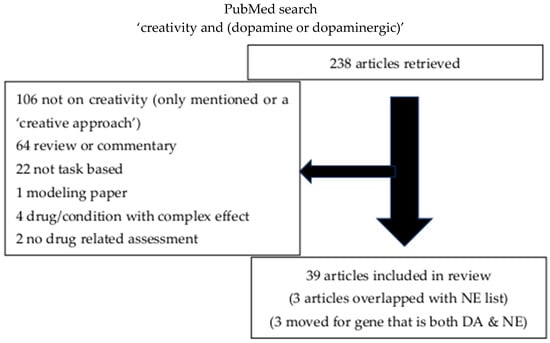
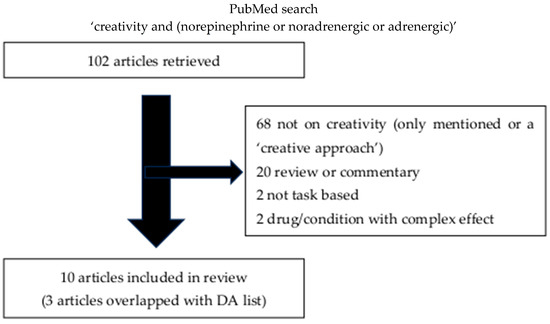
We performed a PubMed review examining the results for ‘creativity and (dopamine or dopaminergic’ and for ‘creativity and (norepinephrine or noradrenergic or adrenergic)’, from the entire PubMed database up until 24 March 2024 (INPLASY202570102). This search revealed 238 articles for the dopaminergic system and 102 for the noradrenergic system. The titles and abstracts were then screened for appropriateness. For the dopaminergic system, 106, and for the noradrenergic system, 68 were excluded as creativity was only mentioned, including cases where it appeared as describing their ‘creative approach’, and was not the focus of the research. Articles that did not produce new data, including review articles and commentaries, resulted in the additional exclusion of 64 articles for the dopaminergic system, and 20 for the noradrenergic system. There were an additional 22 dopaminergic system articles and 2 noradrenergic system articles excluded as they were not based on a task that could be utilized for the contrast between divergent and convergent creativity tasks. One additional paper was excluded for the dopaminergic system as it was exclusively a modeling paper, and four dopaminergic system articles and two noradrenergic system articles were excluded as they examined drugs impacting too broad a set of neuropharmacological systems to assess specific impact, and two additional dopaminergic system articles were excluded because they did discuss creativity and did discuss dopaminergic drugs, but not the effect of dopaminergic drugs on tasks related to creativity. The resulting set included 39 articles for the dopaminergic system, and 10 articles for the noradrenergic system (see Supplemental Figure S1 for summary). There were several articles that were relevant to BOTH the dopaminergic system and the noradrenergic system, and additionally, 3 of the dopaminergic papers were moved to the BOTH category as they involved genes that impact both the dopaminergic and noradrenergic systems (catechol-O-methyl transferase (COMT)), so the final categorization was 33 articles for the dopaminergic system, 7 articles for the noradrenergic system, and 7 articles for the category of both the dopaminergic and noradrenergic systems. Additionally, 12 articles known to the author were added to the noradrenergic system category that were not captured by the search strategy, as some of the earlier literature used the term ‘cognitive flexibility’ rather than ‘creativity’ for this particular topic. Furthermore, eight articles known to the author were added to the BOTH category, as the pharmacological systems were not always revealed by the search strategy for some studies on the effects of stimulants.
3. Results
The remaining articles were studies examining the effect of pharmacological systems on either divergent or convergent tasks (Figure 1 and Figure 2). Results were tabulated according to which task type of assessment of the pharmacological system was examined for each pharmacological group. Within each table, articles were divided into 1—Studies with dopaminergic (DA) and/or noradrenergic (NE) drugs, 2—Studies with DA- and/or NE-associated diseases (DA only), 3—Studies with DA- and/or NE-associated diseases and drugs (DA only), 4—Studies with DA- and/or NA-related tasks, 5—Studies with DA and/or NE genes, 6—studies with DA and/or NE targeted by stress (NE only), 7—Studies with DA and/or NE targeted via sleep phase (NE only), 8—Studies with DA and/or NE imaging correlates (DA only), and 9—Studies with DA and/or NE targeted via electrical stimulation (Table 1, Table 2 and Table 3). Of note, the direction of the genetic studies as well as the imaging studies could have varying implications, so the direction of effect was not indicated in the table for these categories. For example, increased activation on imaging could relate to better performance, or could relate to greater effort required to perform the task, and decreased function of one specific receptor due to a genetic variant might result in compensatory increased activity of the system acting on other receptors for that neurotransmitter. Additionally, the COMT gene, which is usually reported as a dopaminergic gene, can impact both the dopaminergic and noradrenergic systems, so it was categorized under the grouping for both DA and NE (See Table 3).
Figure 1.
Articles retrieved on updated search (3/24/24) included and reasons for article exclusion for dopamine.
Figure 2.
Articles retrieved on updated search (3/24/24) included and reasons for article exclusion for norepinephrine.
Table 1.
Effects on convergent and divergent performance associated with dopaminergic (DA) system manipulations and proxies; x = not assessed. Directionality of effect was deferred for anatomical and genetic measures, due to the complexity of causality on directionality. Tasks utilized are underlined. Articles added after the described search are indicated in italics. (tx = treatment; BIST = Berlin Intelligence Structure Test; RAT = Remote Associates Test; PCT = Picture Concepts Task; TOL = Tower of London; AUT = Alternate Uses Test; PLMT = Pattern/Line Meanings Task; TTCT = Torrence Test of Creative Thinking; FCIT = Finke’s Creative Invention Task; ASK = Analyse Schlussfolgernden und Kreativen Denkens; ATTA = Abbreviated Torrance Test for Adults; IPS = Insight Problem Solving; CRA = Compound Remote Associates; rCAB = Runco Creative Assessment Battery; TCIA = Test of Creative Imagery Abilities, PD = Parkinson’s disease, Conv = convergent, Div = divergent, ↑ = increased, ↓ = decreased, No eff = no effect).
Table 2.
Effects on convergent and divergent performance associated with noradrenergic (NE) system manipulations and proxies. x = not assessed. Directionality of effect was deferred for anatomical and genetic measures, due to the complexity of causality on directionality. Tasks utilized are underlined. Articles added after the described search are indicated in italics. (RAT = Remote Associates Test; AUT = Alternate Uses Test; CRA = Compound Remote Associates, Conv = convergent, Div = divergent, ↑ = increased, ↓ = decreased, No eff = no effect).
Table 3.
Effects on convergent and divergent performance associated with manipulations and proxies of both DA and NE. x = not assessed. Directionality of effect was deferred for anatomical and genetic measures, due to the complexity of causality on directionality. Tasks utilized are underlined. Articles added after the described search are indicated in italics. (RAT = Remote Associates Test; AUT = Alternate Uses Test; TTCT = Torrence Test of Creative Thinking; ATTA = Abbreviated Torrance Test for Adults; CRA = Compound Remote Associates; rCAB = Runco Creative Assessment Battery; ANT = Alternate Names Task; GEFT = Group Embedded Figures Task, Conv = convergent, Div = divergent, ↑ = increased, ↓ = decreased, No eff = no effect).
Overall, it is readily apparent that the number of studies examining the effect of the DA system (33) exceeds the number of studies examining the effect of the NE system (21), even after inclusion of the added articles.
Of the articles examining the DA system, 29 examined the effect on divergent tasks, and for the directionality of the effects, 6 showed increased performance with increased DA activity (2 studies with dopaminergic tasks, 2 studies with dopaminergic diseases, 1 with dopaminergic diseases plus dopaminergic medications, and 1 with dopaminergic medications), 1 showed decreased performance (a study in Parkinson’s disease), 1 showed mixed effects (a cocaine study), and 3 showed no effect with increased DA (2 studies with dopaminergic diseases and 1 with dopaminergic diseases plus dopaminergic medications). Additionally, 10 examined the effect on convergent tasks. For those with clear directionality, two showed increased performance with increased DA activity (one study with dopaminergic tasks, one with dopaminergic diseases), three showed decreased performance (two studies with dopaminergic drugs, and one with dopaminergic tasks), and two showed no effect on performance with increased DA (one study with dopaminergic drugs, and one with dopaminergic diseases plus dopaminergic drugs) (Table 1).
Of the articles examining the NE system, only two examined the effect on divergent tasks, and for those with clear directionality, only one showed increased performance with NE antagonism (a study examining the relationship between performance and monitoring of sympathetic stress systems). All 21 of the articles examined the effect on convergent tasks, and for those with clear directionality, 17 showed increased performance with NE antagonism (8 noradrenergic drug studies, 6 stress studies, 1 stress plus noradrenergic drug study, 2 sleep phase studies, and 1 study examining body position effects), and 3 showed no effect (1 noradrenergic drug study, and 2 stress studies) (Table 2).
Of the 15 articles examining the impact of both the DA and NE systems, 14 examined effects on divergent tasks, and for those with clear directionality, 3 showed increased performance, 2 showed mixed performance, and 5 showed no effect. Additionally, 6 examined effects on convergent tasks, with 2 showing increased performance, and 2 showing no effect among those with clear directionality. Of note, all but one of these studies with clear directionality were drug studies with stimulants impacting both DA and NE systems, and 1 was with administration of a precursor, tyrosine, to both DA and NE (Colzato et al., 2015) (Table 3).
Of all of the 36 studies examining the impact of DA systems, only 6 examined effects on both divergent and convergent tasks. Administration of cocaine showed mixed effects on divergent tasks and decreased performance on convergent tasks (Hutten et al., 2019). Patients with Parkinson’s showed worse performance on divergent tasks (better performance with greater DA) but no effect on convergent tasks (Heldmann et al., 2024), and patients with Tourette’s showed no effect on divergent task performance but better convergent performance (Colautti et al., 2023). Administration of DA drugs in Parkinson’s patients showed no effect on either divergent or convergent performance (Salvi et al., 2021). Eyeblink rate was associated with better divergent task performance but worse performance on convergent tasks (Chermahini & Hommel, 2010), and fMRI activation in DA-associated region was found to be associated with performance on both divergent and convergent tasks (Aberg et al., 2017) (Table 1).
Among the 21 studies examining impact of NE systems, stress-related monitoring of the sympathetic system was associated with impact on divergent tasks, but not convergent tasks (Guo et al., 2024), and vagal nerve stimulation impacted performance on both divergent and convergent tasks (Ghacibeh et al., 2006). No other studies on NE systems examined effects on both divergent and convergent tasks (Table 2).
Among the 15 studies examining impact of BOTH systems, stimulants in ADHD patients improved divergent task performance with no effect on convergent tasks (McBride et al., 2021), or demonstrated no effect on either type of task (Boot et al., 2017), but when administered to individuals without ADHD, there was no effect on either type of task (Baas et al., 2020), or situational effects on convergent tasks only (Farah et al., 2009). Administration of the catecholaminergic precursor tyrosine, which is a precursor to both dopamine and norepinephrine, in healthy individuals increased convergent task performance without effect on divergent task performance (Colzato et al., 2015). No other studies on BOTH systems examined effects on both divergent and convergent tasks (Table 3), a gap in the literature noted in a recent review on this topic (Hoogman et al., 2020).
4. Discussion
This is, to our knowledge, the first effort to comprehensively review the literature on the relationships between the DA and NE systems and creativity. The current literature is rather limited in its ability to definitively determine selectivity of effects of the DA and NE systems on divergent and convergent task performance.
Overall, there is a tendency for the DA system to impact performance on divergent tasks, with increased DA associated with better performance. The literature on the DA system and convergent tasks is quite limited. Systematic studies examining the effect of the DA system on both divergent and convergent tasks are needed. An effect of DA on divergent task performance is also of interest given evidence that the DA system can impact a range of generative tasks not typically associated with creativity, as supported by its impact on motivational behaviors (Salamone & Correa, 2012), as well as persistence and effort (Walton & Bouret, 2019). Future studies will need to disentangle these effects for specificity to creativity.
There is also a tendency for the NE system to impact performance on convergent tasks, with decreased NE associated with better performance, and the literature on divergent tasks is limited. Systematic studies are also needed examining the effect of the NE system on both divergent and convergent tasks. Of further note, many of the studies demonstrating effects of the NE system on convergent task performance required the presence of an additional condition increasing the NE activity, alongside medications to decrease NE activity, in order to maximize the contrast, such as the induction of stress reversed by the effect of propranolol, a beta-adrenergic antagonist (Alexander et al., 2007) This methodological challenge will need to be considered in future explorations in this regard.
Regarding the studies examining the effect of stimulants, subsequent work demonstrated that autonomic arousal as assessed by heart rate variability did not predict the effect of stimulants on creativity task performance (Appling et al., 2025), suggesting that the effects of stimulants on divergent task performance from the same dataset in ADHD patients (McBride et al., 2021) were not mediated by NE effects.
The effects of stimulants deserve special attention. Many remain concerned regarding whether medications for neuropsychiatric conditions might interfere with creativity (Carson, 2011). However, our examination of this topic, as well as a recent review focusing on creativity and ADHD (Hoogman et al., 2020), show that while there is mixed evidence for the benefit for stimulants for creativity, there is not substantial evidence that it interferes with creativity. However, recreational use for performance enhancement for productivity and creativity is an important topic that deserves further consideration going forward, handled with considerable ethical equipoise.
Finally, further imaging studies may be helpful in disentangling these effects, including studies examining activation of regions associated with these systems, anatomical correlates, and potentially tracer imaging studies examining the functionality of these systems more directly. Very few papers have examined both convergent and divergent task performance with imaging paradigms. Recent reviews have highlighted the complex networks involved with creativity, with the highly overlapping networks associated with curiosity, involving the frontal, hippocampal, and subcortical areas, and areas involved in dopaminergic reward systems (Ivancovsky et al., 2024), and recent work has shown that frontopolar neurons are engaged during exploration (Nougaret et al., 2024), also known to be related to dopaminergic activity, and activity of the frontopolar region and its connectivity are critical in creativity task performance (Green et al., 2015). Also, the subthalamic medial zona incerta has been implicated in novelty-seeking behavior, with connectivity to the hippocampus, frontal cortex, and dopaminergic-associated networks (Ahmadlou et al., 2021; Londei et al., 2024). Systematic efforts at understanding how neurotransmitter systems interact with these brain regions during creativity is critical.
Disentangling these effects may have significant clinical implications. It would be informative for patients with conditions impacting the dopaminergic system (Parkinson’s and Tourette’s, for example), conditions impacting the noradrenergic system (anxiety disorders, for example), and conditions impacting both systems (ADHD, for example), to know the impact of their condition on performance, as well as the effect of their treatments on such performance. Finally, while the bulk of the literature on neurotransmitter systems has focused on NE and DA, there is evidence for the involvement of other systems, such as the serotonergic and cholinergic systems, which deserves attention in future studies, both as independent aspects and for how they interact with other systems (Beversdorf, 2018).
Supplementary Materials
The following supporting information can be downloaded at: https://www.mdpi.com/article/10.3390/bs15091185/s1, Figure S1: PRISMA 2020 flow diagram reviews which included searches of databases.
Funding
This research received no external funding.
Conflicts of Interest
The author declares no conflicts of interest.
References
- Aberg, K. C., Doell, K. C., & Schwartz, S. (2017). The “creative right brain” revisited: Individual creativity and associative priming in the right hemisphere relate to hemispheric asymmetries in reward brain function. Cerebral Cortex, 27(10), 4946–4959. [Google Scholar] [CrossRef] [Scilit]
- Agnoli, S., Mastria, S., Zanon, M., & Corazza, G. E. (2023). Dopamine supports idea originality: The role of spontaneous eye blink rate on divergent thinking. Psychological Research, 87(1), 17–27. [Google Scholar] [CrossRef] [Scilit]
- Ahmadlou, M., Houba, J. H. W., Van Vierbergen, J. F. M., Giannouli, M., Gimenez, G. A., Van Weeghel, C., Darbanfouladi, M., Shirazi, M. Y., Dziubek, J., Kacem, M., De Winter, F., & Heimel, J. A. (2021). A cell type-specific cortico-subcortical brain circuit for investigatory and novelty-seeking behavior. Science, 372(6543), eabe9681. [Google Scholar] [CrossRef] [Scilit]
- Alexander, J. K., Hillier, A., Smith, R. M., Tivarus, M. E., & Beversdorf, D. Q. (2007). Noradrenergic modulation of cognitive flexibility during stress. Frontiers in Human Neuroscience, 19, 468–478. [Google Scholar]
- Andreasen, N. C. (2008). The relationship between creativity and mood disorders. Dialogues in Clinical Neuroscience, 10, 251–255. [Google Scholar] [CrossRef] [Scilit] [PubMed]
- Ang, Y. S., Manohar, S., Plant, O., Kienast, A., Le Heron, C., Muhammed, K., Hu, M., & Husain, M. (2018). Dopamine modulates option generation for behavior. Current Biology, 28(10), 1561–1569.e3. [Google Scholar] [CrossRef] [Scilit] [PubMed]
- Appling, C., Nuraini, N., Hart, E., Wang, D., Tosh, A., Beversdorf, D., & Ferguson, B. (2025). Heart rate variability prediction of stimulant-induced creativity gains in attention-deficit/hyperactivity disorder. Journal of Clinical Medicine, 14(10), 3570. [Google Scholar] [CrossRef] [Scilit]
- Baas, M., Boot, N., van Gaal, S., de Dreu, C. K. W., & Cools, R. (2020). Methylphenidate does not affect convergent and divergent creative processes in healthy adults. Neuroimage, 205, 116279. [Google Scholar] [CrossRef] [Scilit]
- Beversdorf, D. Q. (2018). Neuropsychopharmacological regulation of performance on creativity-related tasks. Current Opinion in Behavioral Sciences, 27, 55–63. [Google Scholar] [CrossRef] [Scilit]
- Beversdorf, D. Q. (2020). The role of the noradrenergic system in autism spectrum disorders, implications for treatment. Seminars in Pediatric Neurology, 35, 100834. [Google Scholar] [CrossRef] [Scilit]
- Beversdorf, D. Q., Carpenter, A. L., Alexander, J. K., Jenkins, N. T., Tilley, M. R., White, C. A., Hillier, A. J., Smith, A. M., & Gu, H. H. (2018). Influence of serotonin transporter SLC6A4 genotype on the effect of psychosocial stress on cognitive performance: An exploratory pilot study. Cognitive and Behavioral Neurology, 31, 79–85. [Google Scholar] [CrossRef] [Scilit]
- Beversdorf, D. Q., Carpenter, A. L., Miller, R. F., Cios, J. S., & Hillier, A. (2008). Effect of propranolol on verbal problem solving in autism spectrum disorder. Neurocase, 14, 378–383. [Google Scholar] [CrossRef] [Scilit]
- Beversdorf, D. Q., Hughes, J. D., Steinberg, B. A., Lewis, L. D., & Heilman, K. M. (1999). Noradrenergic modulation of cognitive flexibility in problem solving. Neuroreport, 10(13), 2763–2767. [Google Scholar] [CrossRef] [Scilit]
- Beversdorf, D. Q., White, D. M., Chever, D. C., Hughes, J. D., & Bornstein, R. A. (2002). Central beta-adrenergic modulation of cognitive flexibility. Neuroreport, 13(18), 2505–2507. [Google Scholar] [CrossRef] [Scilit]
- Boot, N., Nevicka, B., & Bass, M. (2017). Subclinical symptoms of attentiondeficit/hyperactivity disorder (ADHD) are associated with specific creative processes. Personality and Individual Differences, 114, 73–81. [Google Scholar] [CrossRef] [Scilit]
- Cai, D. J., Mednick, S. A., Harrison, E. M., Kanady, J. C., & Mednick, S. C. (2009). REM, not incubation, improves creativity by priming associative networks. Proceedings of the National Academy of Sciences of the United States of America, 106(25), 10130–10134. [Google Scholar] [CrossRef] [Scilit]
- Campbell, H. L., Tivarus, M. E., Hillier, A., & Beversdorf, D. Q. (2008). Increased task difficulty results in greater impact of noradrenergic modulation of cognitive flexibility. Pharmacology Biochemistry and Behavior, 88, 222–229. [Google Scholar] [CrossRef] [Scilit] [PubMed]
- Canesi, M., Rusconi, M. L., Moroni, F., Ranghetti, A., Cereda, E., & Pezzoli, G. (2016). Creative thinking, professional artists, and Parkinson’s disease. Journal of Parkinson’s Disease, 6(1), 239–246. [Google Scholar] [CrossRef] [Scilit] [PubMed]
- Carson, S. H. (2011). Creativity and psychopathology: A shared vulnerability model. The Canadian Journal of Psychiatry, 56(3), 144–152. [Google Scholar] [CrossRef] [Scilit] [PubMed]
- Chermahini, S. A., & Hommel, B. (2010). The (b)link between creativity and dopamine: Spontaneous eye blink rates predict and dissociated divergent and convergent thinking. Cognition, 115, 458–465. [Google Scholar] [CrossRef] [Scilit]
- Chermahini, S. A., & Hommel, B. (2012). More creative through positive mood? Not everyone! Frontiers in Human Neuroscience, 6, 319. [Google Scholar] [CrossRef] [Scilit]
- Choi, Y., Novak, J., Hillier, A., Votolato, N. A., & Beversdorf, D. Q. (2006). The effect of α-2 adrenergic agonists on memory and cognitive flexibility. Cognitive and Behavioral Neurology, 19, 204–207. [Google Scholar] [CrossRef] [Scilit] [PubMed]
- Chong, A., Tolomeo, S., Xiong, Y., Angeles, D., Cheung, M., Becker, B., Lai, P. S., Lei, Z., Malavasi, F., Tang, Q., Chew, S. H., & Ebstein, R. P. (2021). Blending oxytocin and dopamine with everyday creativity. Scientific Reports, 11(1), 16185. [Google Scholar] [CrossRef] [Scilit] [PubMed]
- Colautti, L., Magenes, S., Rago, S., Camerin, S., Zanaboni Dina, C., Antonietti, A., & Cancer, A. (2023). Creative thinking in Tourette’s syndrome: A comparative study of patients and healthy controls. Journal of Clinical and Experimental Neuropsychology, 45(5), 482–497. [Google Scholar] [CrossRef] [Scilit]
- Colzato, L. S., de Haan, A. M., & Hommel, B. (2015). Food for creativity: Tyrosine promotes deep thinking. Psychological Research, 79(5), 709–714. [Google Scholar] [CrossRef] [Scilit]
- Coull, J. T., Jones, M. E. P., Egan, T. D., Frith, C. D., & Maze, M. (2004). Attentional effects of noradrenaline vary with arousal level: Selective activation of thalamic pulvinar in humans. NeuroImage, 22, 315–322. [Google Scholar] [CrossRef] [Scilit] [PubMed]
- Cristofori, I., Salvi, C., Beeman, M., & Grafman, J. (2018). The effects of expected reward on creative problem solving. Cognitive, Affective, & Behavioral Neuroscience, 18(5), 925–931. [Google Scholar] [CrossRef] [Scilit]
- de Manzano, O., Cervenka, S., Karabanov, A., Farde, L., & Ullén, F. (2010). Thinking outside a less intact box: Thalamic dopamine D2 receptor densities are negatively related to psychometric creativity in healthy individuals. PLoS ONE, 5(5), e10670. [Google Scholar] [CrossRef] [Scilit]
- Douglas, V. I., Barr, R. G., Desilets, J., & Sherman, E. (1995). Do high doses of stimulants impair flexible thinking in attention-deficit hyperactivity disorder? Journal of the American Academy of Child & Adolescent Psychiatry, 34(7), 877–885. [Google Scholar] [CrossRef] [Scilit]
- Drago, V., Foster, P. S., Okun, M. S., Haq, I., Sudhyadhom, A., Skidmore, F. M., & Heilman, K. M. (2009). Artistic creativity and DBS: A case report. Journal of the Neurological Sciences, 276(1–2), 138–142. [Google Scholar] [CrossRef] [Scilit]
- Faigel, H. C. (1991). The effect of beta blockade on stress-induced cognitive dysfunction in adolescents. Clinical Pediatrics, 30, 441–445. [Google Scholar] [CrossRef] [Scilit]
- Farah, M. J., Haimm, C., Sankoorikal, G., Smith, M. E., & Chatterjee, A. (2009). When we enhance cognition with Adderall, do we sacrifice creativity? A preliminary study. Psychopharmacology, 202, 541–547. [Google Scholar] [CrossRef] [Scilit]
- Faust-Socher, A., Kenett, Y. N., Cohen, O. S., Hassin-Baer, S., & Inzelberg, R. (2014). Enhanced creative thinking under dopaminergic therapy in Parkinson disease. Annals of Neurology, 75(6), 935–942. [Google Scholar] [CrossRef] [Scilit] [PubMed]
- Funk, J. B., Chessare, J. B., Weaver, M. T., & Exley, A. R. (1993). Attention deficit hyperactivity disorder, creativity, and the effects of methylphenidate. Pediatrics, 91, 816–819. [Google Scholar] [CrossRef] [Scilit]
- Gao, Z., Liu, X., Zhang, D., Liu, M., & Hao, N. (2021). Subcortical structures and visual divergent thinking: A resting-state functional MRI analysis. Brain Structure & Function, 226(8), 2617–2627. [Google Scholar] [CrossRef] [Scilit]
- Ghacibeh, G. A., Shenker, J. I., Shenal, B., Uthman, B. M., & Heilman, K. M. (2006). Effect of vagus nerve stimulation on creativity and cognitive flexibility. Epilepsy & Behavior, 8(4), 720–725. [Google Scholar] [CrossRef] [Scilit]
- González-Carpio Hernández, G., & Serrano Selva, J. P. (2016). Medication and creativity in attention deficit hyperactivity disorder (ADHD). Psicothema, 28(1), 20–25. [Google Scholar] [CrossRef] [Scilit] [PubMed]
- Green, A. E., Cohen, M. S., Raab, H. A., Yedibalian, C. G., & Gray, J. R. (2015). Frontopolar activity and connectivity support dynamic conscious augmentation of creative state. Human Brain Mapping, 36, 923–934. [Google Scholar] [CrossRef] [Scilit]
- Guo, X., Wang, Y., Kan, Y., Wu, M., Ball, L. J., & Duan, H. (2024). The HPA and SAM axis mediate the impairment of creativity under stress. Psychophysiology, 61(3), e14472. [Google Scholar] [CrossRef] [Scilit]
- Gvirts, H. Z., Mayseless, N., Segev, A., Lewis, D. Y., Feffer, K., Barnea, Y., Bloch, Y., & Shamay-Tsoory, S. G. (2017). Novelty-seeking trait predicts the effect of stimulant medication on creativity. Journal of Psychopharmacology, 31(5), 599–605. [Google Scholar] [CrossRef] [Scilit]
- Hecht, P. M., Will, M. J., Schachtman, T. R., Welby, L. M., & Beversdorf, D. Q. (2014). Beta-adrenergic antagonist effects on a novel cognitive flexibility task in rodents. Behavioural Brain Research, 260, 148–154. [Google Scholar] [CrossRef] [Scilit]
- Heilman, K. M., Nadeau, S. E., & Beversdorf, D. Q. (2003). Creative innovation: Possible brain mechanisms. Neurocase, 9, 369–379. [Google Scholar] [CrossRef] [Scilit]
- Heldmann, M., Rinckens, C., Brüggemann, N., Al-Khaled, M., & Münte, T. F. (2024). Creative thinking and cognitive estimation in Parkinson’s disease. Neurological Research and Practice, 6(1), 9. [Google Scholar] [CrossRef] [Scilit]
- Hillier, A., Alexander, J. K., & Beversdorf, D. Q. (2006). The effect of auditory stressors on cognitive flexibility. Neurocase, 12, 228–231. [Google Scholar] [CrossRef] [Scilit]
- Hoogman, M., Stolte, M., Baas, M., & Kroesbergen, E. (2020). Creativity and ADHD: A review of behavioral studies, the effect of psychostimulants and neural underpinnings. Neuroscience & Biobehavioral Reviews, 119, 66–85. [Google Scholar] [CrossRef] [Scilit]
- Hutten, N. R. P. W., Steenbergen, L., Colzato, L. S., Hommel, B., Theunissen, E. L., Ramaekers, J. G., & Kuypers, K. P. C. (2019). Cocaine enhances figural, but impairs verbal ‘flexible’ divergent thinking. European Neuropsychopharmacology, 29(7), 813–824. [Google Scholar] [CrossRef] [Scilit] [PubMed]
- Ishizuka, K., Hillier, A., & Beversdorf, D. Q. (2007). Effect of the cold pressor test on memory and cognitive flexibility. Neurocase, 13, 154–157. [Google Scholar] [CrossRef] [Scilit] [PubMed]
- Ivancovsky, T., Baror, S., & Bar, M. (2024). A shared novelty-seeking basis for creativity and curiosity. Behavioral and Brain Sciences, 47, e89. [Google Scholar] [CrossRef] [Scilit]
- Jauk, E., Neubauer, A. C., Dunst, B., Fink, A., & Benedek, M. (2015). Gray matter correlates of creative potential: A latent variable voxel-based morphometry study. Neuroimage, 111, 312–320. [Google Scholar] [CrossRef] [Scilit] [PubMed]
- Käckenmester, W., Bott, A., & Wacker, J. (2019). Openness to experience predicts dopamine effects on divergent thinking. Personality Neuroscience, 2, e3. [Google Scholar] [CrossRef] [Scilit]
- Kelley, B. J., Yeager, K. R., Pepper, T. H., Bornstein, R. A., & Beversdorf, D. Q. (2007). The effect of propranolol on cognitive flexibility and memory in acute cocaine withdrawal. Neurocase, 13, 320–327. [Google Scholar] [CrossRef] [Scilit] [PubMed]
- Lipnicki, D. M., & Byrne, D. G. (2005). Thinking on your back: Solving anagrams faster when supine than when standing. Cognitive Brain Research, 24, 719–722. [Google Scholar] [CrossRef] [Scilit]
- Londei, F., Arena, G., Ferrucci, L., Russo, E., Ceccarelli, F., & Genovesio, A. (2024). Connecting the dots in the zona incerta: A study of neural assemblies and motifs of inter-area coordination in mice. iScience, 27(1), 108761. [Google Scholar] [CrossRef] [Scilit]
- Martindale, C., & Greenough, J. (1975). The differential effect of increased arousal on creative and intellectual performance. The Journal of Genetic Psychology, 123, 329–335. [Google Scholar] [CrossRef] [Scilit]
- Mayseless, N., Uzefovsky, F., Shalev, I., Ebstein, R. P., & Shamay-Tsoory, S. G. (2013). The association between creativity and 7R polymorphism in the dopamine receptor D4 gene (DRD4). Frontiers in Human Neuroscience, 7, 502. [Google Scholar] [CrossRef] [Scilit] [PubMed]
- McBride, M., Appling, C., Ferguson, B., Gonzalez, A., Schaeffer, A., Zand, A., Wang, D., Sam, A., Hart, E., Tosh, A., Fontcha, I., Parmacek, S., & Beversdorf, D. (2021). Effects of stimulant medication on divergent and convergent thinking tasks related to creativity in adults with attention-deficit hyperactivity disorder. Psychopharmacology, 238(12), 3533–3541. [Google Scholar] [CrossRef] [Scilit] [PubMed]
- Nair, N., Hegarty, J. P., II, Ferguson, B. J., Hecht, P. M., Tilley, M., Christ, S. E., & Beversdorf, D. Q. (2020). Effects of stress on functional connectivity during problem solving. NeuroImage, 208, 116407. [Google Scholar] [CrossRef] [Scilit]
- Nougaret, S., Ferrucci, L., Ceccarelli, F., Sacchetti, S., Benozzo, D., Fascianelli, V., Saunders, R. C., Renaud, L., & Genovesio, A. (2024). Neurons in the monkey frontopolar cortex encode learning stage and goal during a fast learning task. PLoS Biology, 22(2), e3002500. [Google Scholar] [CrossRef] [Scilit]
- Power, R. A., Steinberg, S., Bjornsdottir, G., Rietveld, C. A., Abdellaoui, A., Nivard, M. M., Johannesson, M., Galesloot, T. E., Hottenga, J. J., Willemsen, G., Cesarini, D., Benjamin, D. J., Magnusson, P. K., Ullén, F., Tiemeier, H., Hofman, A., van Rooij, F. J., Walters, G. B., Sigurdsson, E., … Stefansson, K. (2015). Polygenic risk scores for schizophrenia and bipolar disorder predict creativity. Nature Neuroscience, 18, 953–955. [Google Scholar] [CrossRef] [Scilit] [PubMed]
- Rahmani, F., Sanjari Moghaddam, H., & Aarabi, M. H. (2020). Intact microstructure of the right corticostriatal pathway predicts creative ability in healthy adults. Brain and Behavior, 10(12), e01895. [Google Scholar] [CrossRef] [Scilit]
- Renner, K., & Beversdorf, D. Q. (2010). Effects of naturalistic stressors on cognitive flexibility and working memory performance. Neurocase, 16, 293–300. [Google Scholar] [CrossRef] [Scilit]
- Reuter, M., Roth, S., Holve, K., & Hennig, J. (2006). Identification of first candidate gene for creativity: A pilot study. Brain Research, 1069, 190–197. [Google Scholar] [CrossRef] [Scilit]
- Salamone, J. D., & Correa, M. (2012). The mysterious motivational functions of mesolimbic dopamine. Neuron, 76(3), 470–485. [Google Scholar] [CrossRef] [Scilit] [PubMed]
- Salvi, C., Leiker, E. K., Baricca, B., Molinari, M. A., Eleopra, R., Nichelli, P. F., Grafman, J., & Dunsmoor, J. E. (2021). The effect of dopaminergic replacement therapy on creative thinking and insight problem-solving in Parkinson’s disease patients. Frontiers in Psychology, 12, 646448. [Google Scholar] [CrossRef] [Scilit]
- Sayalı, C., van den Bosch, R., Määttä, J. I., Hofmans, L., Papadopetraki, D., Booij, J., Verkes, R. J., Baas, M., & Cools, R. (2023). Methylphenidate undermines or enhances divergent creativity depending on baseline dopamine synthesis capacity. Neuropsychopharmacology, 48(13), 1849–1858. [Google Scholar] [CrossRef] [Scilit] [PubMed]
- Si, S., Su, Y., Zhang, S., & Zhang, J. (2020). Genetic susceptibility to parenting style: DRD2 and COMT influence creativity. Neuroimage, 213, 116681. [Google Scholar] [CrossRef] [Scilit] [PubMed]
- Silver, J. A., Hughes, J. D., Bornstein, R. A., & Beversdorf, D. Q. (2004). Effect of anxiolytics on cognitive flexibility in problem solving. Cognitive and Behavioral Neurology, 17(2), 93–97. [Google Scholar] [CrossRef] [Scilit]
- Smith, A., & Nutt, D. (1996). Noradrenaline and attention lapses. Nature, 380, 291. [Google Scholar] [CrossRef] [Scilit]
- Smyth, S. F., & Beversdorf, D. Q. (2007). Lack of dopaminergic modulation of cognitive flexibility. Cognitive and Behavioral Neurology, 20(4), 225–229. [Google Scholar] [CrossRef] [Scilit]
- Solanto, M. V., & Wender, E. H. (1989). Does methylphenidate constrict cognitive functioning? Journal of the American Academy of Child & Adolescent Psychiatry, 28(6), 897–902. [Google Scholar] [CrossRef] [Scilit]
- Swartwood, M. O., Swartwood, J. N., & Farrell, J. (2003). Stimulant treatment of ADHD: Effects on creativity and flexibility in problem solving. Creativity Research Journal, 15(4), 417–419. [Google Scholar] [CrossRef] [Scilit]
- Takeuchi, H., Taki, Y., Sassa, Y., Hashizume, H., Sekiguchi, A., Fukushima, A., & Kawashima, R. (2010). Regional gray matter volume of dopaminergic system associate with creativity: Evidence from voxel-based morphometry. Neuroimage, 51(2), 578–585. [Google Scholar] [CrossRef] [Scilit] [PubMed]
- Takeuchi, H., Tomita, H., Taki, Y., Kikuchi, Y., Ono, C., Yu, Z., Sekiguchi, A., Nouchi, R., Kotozaki, Y., Nakagawa, S., Miyauchi, C. M., Iizuka, K., Yokoyama, R., Shinada, T., Yamamoto, Y., Hanawa, S., Araki, T., Hashizume, H., Kunitoki, K., … Kawashima, R. (2015a). Cognitive and neural correlates of the 5-repeat allele of the dopamine D4 receptor gene in a population lacking the 7-repeat allele. Neuroimage, 110, 124–135. [Google Scholar] [CrossRef] [Scilit]
- Takeuchi, H., Tomita, H., Taki, Y., Kikuchi, Y., Ono, C., Yu, Z., Sekiguchi, A., Nouchi, R., Kotozaki, Y., Nakagawa, S., Miyauchi, C. M., Iizuka, K., Yokoyama, R., Shinada, T., Yamamoto, Y., Hanawa, S., Araki, T., Hashizume, H., Kunitoki, K., … Kawashima, R. (2015b). The associations among the dopamine D2 receptor Taq1, emotional intelligence, creative potential measured by divergent thinking, and motivational state and these associations’ sex differences. Frontiers in Psychology, 6, 912. [Google Scholar] [CrossRef] [Scilit] [PubMed]
- Varrone, A., Svenningsson, P., Marklund, P., Fatouros-Bergman, H., Forsberg, A., Halldin, C., Nilsson, L. G., & Farde, L. (2015). 5-HT1B receptor imaging and cognition: A positron emission tomography study in control subjects and Parkinson’s disease patients. Synapse, 69(7), 365–374. [Google Scholar] [CrossRef] [Scilit]
- Walker, M. P., Liston, C., Hobson, J. A., & Stickgold, R. (2002). Cognitive flexibility across the sleep-wake cycle- REM-sleep enhancement of anagram problem solving. Cognitive Brain Research, 14, 317–324. [Google Scholar] [CrossRef] [Scilit]
- Walton, M. E., & Bouret, S. (2019). What is the relationship between dopamine and effort? Trends in Neurosciences, 42(2), 79–91. [Google Scholar] [CrossRef] [Scilit] [PubMed]
- Wu, X., Yang, W., Tong, D., Sun, J., Chen, Q., Wei, D., Zhang, Q., Zhang, M., & Qiu, J. (2015). A meta-analysis of neuroimaging studies on divergent thinking using activation likelihood estimation. Human Brain Mapping, 36(7), 2703–2718. [Google Scholar] [CrossRef] [Scilit]
- Zabelina, D. L., Colzato, L., Beeman, M., & Hommel, B. (2016). Dopamine and the Creative Mind: Individual differences in creativity are predicted by interactions between dopamine genes DAT and COMT. PLoS ONE, 11(1), e0146768. [Google Scholar] [CrossRef] [Scilit]
- Zamzow, R. M., Ferguson, B. J., Ragsdale, A. S., Lewis, M. L., & Beversdorf, D. Q. (2017). Effects of acute beta-adrenergic antagonism on verbal problem solving in autism spectrum disorder and exploration of treatment response markers. Journal of Clinical and Experimental Neuropsychology, 39, 596–606. [Google Scholar] [CrossRef] [Scilit]
- Zanaboni Dina, C., Porta, M., Saleh, C., & Servello, D. (2017). Creativity assessment in subjects with Tourette syndrome vs. patients with Parkinson’s disease: A preliminary study. Brain Sciences, 7(7), 80. [Google Scholar] [CrossRef] [Scilit] [PubMed]
- Zhang, S., & Zhang, J. (2016). The Association of DRD2 with Insight Problem Solving. Frontiers in Psychology, 7, 1865. [Google Scholar] [CrossRef] [Scilit] [PubMed]
- Zhang, S., Zhang, M., & Zhang, J. (2014). Association of COMT and COMT-DRD2 interaction with creative potential. Frontiers in Human Neuroscience, 8, 216. [Google Scholar] [CrossRef] [Scilit] [PubMed]

Disclaimer/Publisher’s Note: The statements, opinions and data contained in all publications are solely those of the individual author(s) and contributor(s) and not of MDPI and/or the editor(s). MDPI and/or the editor(s) disclaim responsibility for any injury to people or property resulting from any ideas, methods, instructions or products referred to in the content. |
© 2025 by the author. Licensee MDPI, Basel, Switzerland. This article is an open access article distributed under the terms and conditions of the Creative Commons Attribution (CC BY) license (https://creativecommons.org/licenses/by/4.0/).