


Abstract
Hydrothermal aquifers are natural systems useful for understanding deep fluid–rock interaction processes and, in particular, the fate of strategic raw materials, such as Rare Earth Elements (REE). This study investigates the geochemical behavior of dissolved REEs in hydrothermal systems of western Sicily (Italy), a tectonically active area of the south Mediterranean. These waters are discharged at a wide range of temperatures (18 °C to 56.1 °C) and electrical conductivities (0.81 to 35.06 mS cm−1). Three major hydrochemical groups were individuated in the Langelier–Ludwig diagram: Group I (chloride–sulfate alkaline waters, with a seawater-like composition), Group II (chloride–sulfate earth-alkaline waters), and Group III (bicarbonate earth-alkaline waters, governed by CO2 circulation). Total dissolved REE concentrations variate in a two-order magnitude range, from 10.2 to 954 ng L−1. Patterns of shale-normalized REE show a progressive enrichment from light (LREE) to heavy (HREE) REEs, together with persistent negative Ce (Ce/Ce∗ = 0.16–0.88) and prominent positive Eu (Eu/Eu∗ = 1.87–4.42) anomalies. A shallow oxidative scavenging of Ce onto iron oxyhydroxide surfaces (Ce3+ → Ce4+) is suggested by its negative anomaly. The strong positive Eu is attributed to the preferential leaching of Eu2+ from feldspars, occurring at high temperatures at depth, before the upwelling of hydrothermal fluids. The amplitude of the third (T3) and fourth (T4) lanthanide tetrad effects was used for reconstructing the non-CHARAC (Charge And Radius Controlled) fractionation pathways, isolating distinct trajectories: Group I and II fluids are characterized by combined tetrad amplitudes, driven by the competitive complexation between un-fractionated deep sulfate/halide species and shallow, highly fractionating carbonate ligands. Furthermore, the middle-REE (δMREE) enrichment highlights interactions with fluids circulating in evaporitic deposits, and iron reductive dissolution by deep gas forcing. This comprehensive REE behavior is a useful geochemical tool for the characterization of the low-to-medium enthalpy geothermal systems in the south Mediterranean structural domain.
1. Introduction
Despite their name, REEs are not exceptionally rare in the Earth’s crust. Total concentrations can reach nearly 70 ppm for some elements like cerium (Ce), which has an average crustal abundance of approximately 63 ppm, and Lanthanum (La), at about 31 ppm, thereby exceeding the crustal prevalence of common metals, like copper and lead [1].
The term rare earths is historically related to the scarcity of economically exploitable mineral deposits, rather than their absolute crustal abundance. This distinction between geochemical prevalence and economic scarcity is fundamental. Although REEs are relatively widespread at trace levels, their concentration in exploitable deposits represents an uncommon geological event. Many different environments and rock types are enriched in REEs: quartz and fluorite [2], ion adsorption and placer deposit type [3,4], peralkaline to, e.g., agpaitic rocks and/or carbonatites [5], and peralkaline igneous rocks formed through magmatic, metasomatic, and hydrothermal alteration [6] in addition to black sand deposits. This stimulates targeted research into processes, such as hydrothermal activity, which might facilitate such enrichments [1]. The comprehension of mobilization and concentration mechanisms is therefore crucial for looking at these elements not as mere geochemical curiosities but as potential strategic resources. Generally, transport and mobility of REEs in hydrothermal fluids are strictly governed by a complex interplay of ligand speciation, pH, temperature, fluid salinity, and redox state. As discussed by [7], hydrothermal REE mobilization is primarily driven by aqueous chloride and sulfate complexation. Fluoride, carbonate, and phosphate ligands act predominantly as depositional sinks, rather than effective transporting agents, due to the extremely low solubility of their corresponding solid phases. Fluid acidity and temperature exert a primary control on complex stability and mineral solubility. Under low pH, chloride complexes facilitate highly efficient REE mobilization, operating independently of internal solubility constraints, due to the extreme solubility of REE-chloride phases. As temperature increases, chloride and sulfate complexes achieve remarkable thermodynamic stability [7]. Specifically, high-temperature sulfate complexation dominates the fluid chemistry, effectively out-competing chloride species and expanding the viable transport window from highly acidic environments into weakly acidic and near-neutral pH regimes. Fluid inclusion data demonstrate that high-salinity brines (rich in Cl− and SO42−) dramatically enhance the carrying capacity of the fluids. In these saline systems, trivalent REEs form stable mono- and di-chloride species that increase in stability with rising temperature, allowing high metal loads to be sustained in solution [7]. The oxidation state of the hydrothermal system critically modifies the behavior of specific multivalent REEs, most notably europium and cerium. Under high-temperature (>200 °C) reducing hydrothermal conditions, trivalent Eu3+ is reduced to divalent Eu2+. Because Eu2+ forms highly stable and soluble aqueous and chlorine complexes, structurally similar to alkaline earth metals (like Sr2+), europium behaves decoupled from the other trivalent lanthanides. This often leads to prominent positive europium anomalies in the transporting fluids. Conversely, highly oxidizing conditions can stabilize Ce4+, promoting its rapid removal via the precipitation of insoluble cerianite [7]. While fluoride forms exceptionally strong complexes at lower temperatures, its capacity for high-temperature transport is critically restricted by retrograde solubility. Any subsequent fluid neutralization, drop in temperature, or introduction of volatile CO2 or phosphate disrupts the transport mechanisms. This triggers the immediate precipitation of highly insoluble minerals, like fluocerite, bastnäsite, or monazite/xenotime, which effectively strips the metals from solution and buffers dissolved REE concentrations to negligible levels [7].
The study of aqueous REE geochemistry is crucial not only for deciphering the evolution of terrestrial fluid systems but also for providing essential theoretical insights for mineral exploration [8,9,10,11,12,13,14].
REEs are among the least soluble trace elements in most aqueous environments, leading to their general immobility during low-temperature rock alteration, resulting in aqueous concentrations typically in parts per trillion (ppt) or nanograms per liter (ng/L) for most natural systems [15]. Their low concentrations, while fostering analytical challenges, make aqueous REE systems extremely sensitive to geochemical perturbations, making them valuable indicators of subtle environmental changes.
The extreme sensitivity implies that even minor alterations in the thermodynamic and chemical conditions of a geothermal reservoir, such as pH variations due to CO2 injection, temperature fluctuations, or the mixing between different water types, can leave a distinguishable REE fingerprint, positioning them as excellent early indicators of subsurface processes [16].
Reported measurements of dissolved REE concentrations in natural waters span nearly ten orders of magnitude. This wide variability underscores that the geological setting, specific fluid chemistry, and prevailing pressure-temperature conditions of a system exert primary control over its REE signature.
Geothermal fluids, in particular, can exhibit significantly higher REE concentrations compared to typical shallow water systems, especially those characterized by low-pH, acid-sulfate waters, which show the highest REE concentrations among terrestrial thermal fluids [17]. The knowledge of natural processes governing the transport and fate of REE in different hydrothermal systems is important for studies aimed to explore their potential exploitability, since what spontaneously happens in nature can be the base for developing analogous industrial processes.
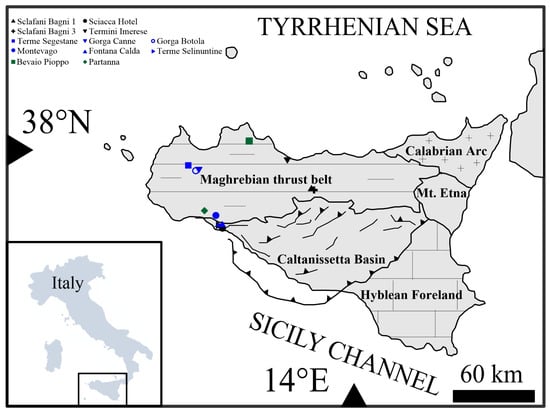
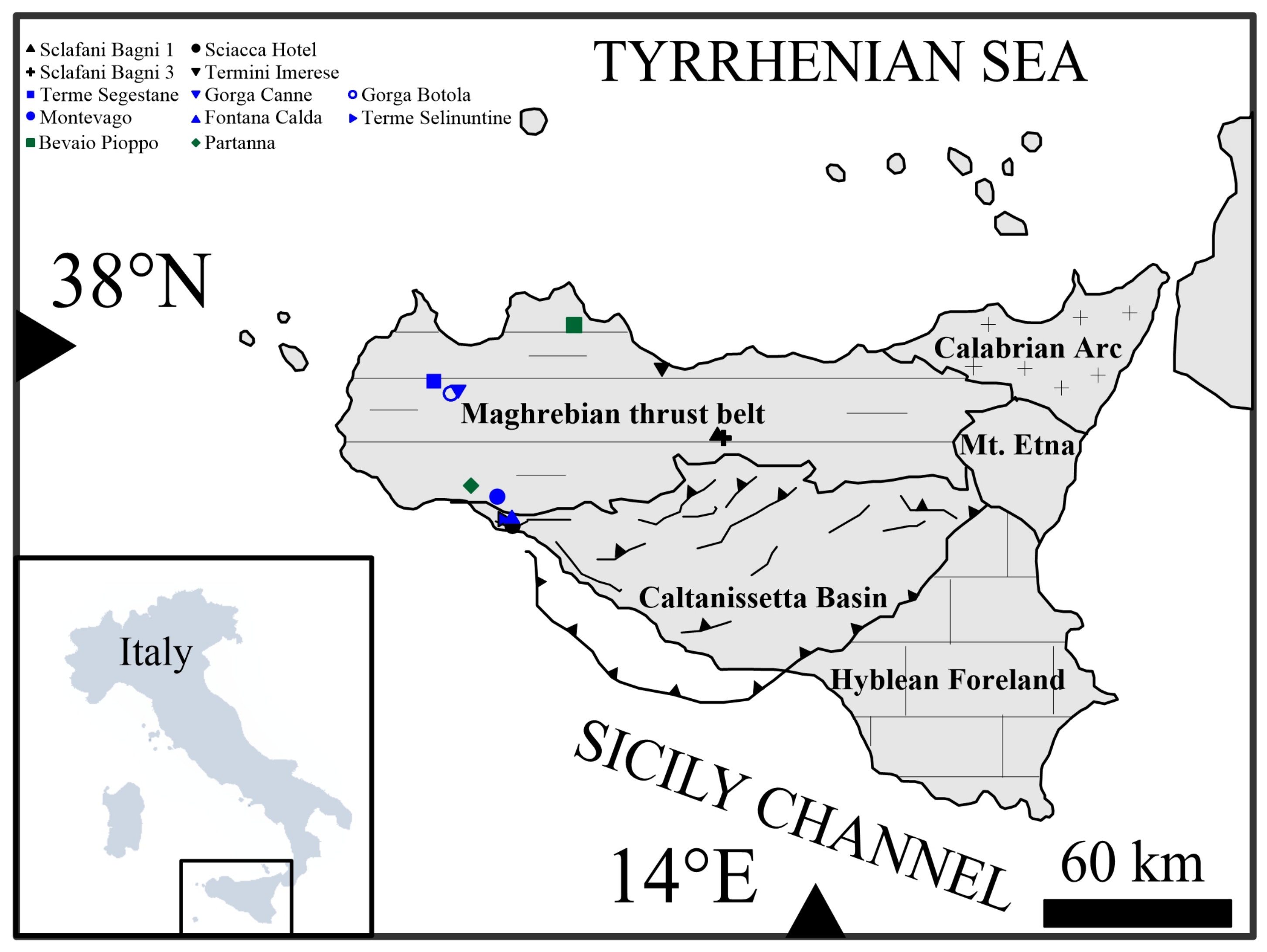
Numerous hydrothermal aquifers, at different degrees of enthalpy and very variable chemical fingerprints, are located in Sicily (Italy), in the south Mediterranean area at the boundary between the African and Eurasian plates (Figure 1), making it an interesting study area for investigating REE distribution in such systems.
Figure 1.
General geodynamic sketch of Sicily and the location of the studied thermal springs.
A first inventory of the geothermal springs in Sicily was proposed by Carapezza et al. [18], who individuated 16 sites (including minor islands, as Pantelleria and Vulcano), describing their major ions and water and dissolved sulphur isotopic composition.
A later comprehensive and detailed study by Donato et al. [19] individuated and investigated 65 hydrothermal systems, including groundwaters, mud volcanoes and bubbling pools, reporting chemical and isotopic data. Nevertheless, no information about minor and trace elements, and in particular REE, have been given since now.
With the aim of contributing to the knowledge of the general comprehension of the transport and fate of REE in hydrothermal systems of Sicily, and in continental collision margins more generally, we analyzed their distribution in the thermal springs of western Sicily, located in different geological settings and characterized by a variable mixing between meteoric and deep fluids.
2. REE Background
REEs are a group of elements characterized by the same outer electron configuration ([Xe]4fn5d16s2; n varying from 0 to 14). The progressive filling of the 4f orbital determines a decrease in the ionic radius of rare earths (lanthanide contraction) which modifies the reactivity of the elements along the series.
In seawater, the aqueous state of REEs determines the stability of their aqueous complexes and authigenic processes involving dissolved species; here, REEs are mainly complexed by [CO3]2− complexes [20,21,22] and their stability increases along the series as a consequence of lanthanide contraction [23]. When REE concentration is normalized to standard shale composition, the even–odd effect due to the Oddo–Harkins rule is filtered out and the abundance of REE carbonate complexes increases from La to Lu. The low stability of Ce3+, and its oxidation to insoluble CeO2 oxide, produces a depletion of Ce in seawater, determining a negative anomaly [24]. The typical REE trend in seawater in the shale-normalized spectrum is ascending and is interrupted by the negative Ce anomaly [25].
The REE pattern can be modified through external input due to the dissolution of atmospheric solids or the removal of aqueous REEs through the crystallization of authigenic minerals along the water column, as well as by scavenging processes on the surfaces of suspended particles [26,27,28]. Modifications of the REE pattern allow for the identification of the nature of neogenic processes.
Generally, REE enrichments or depletions are evaluated as positive/negative anomalies along their series, according to the normalization expressed by the following equation:
in which the concentrations in square brackets are normalized [29].
The La anomaly, the first element of the REE series, and that of Ga are expressed by the following equations:
[29];
[30].
A possible anomaly in δMREE can be calculated according to the equation of Ding et al. [31]:
In this equation, the sums of LREE, MREE and HREE are calculated as follows:
Variations in the shale-normalized pattern, from the typical ascending trend along the series, result from authigenic processes, which will lead to enrichments or depletions along the water column, involving the donor–acceptor bonds of the 4f orbitals [32,33]. Consequently, the crystallization of authigenic minerals, and/or the leaching of lithogenic solids, are capable of producing enrichments or depletions of some REEs.
During primary processes, such as the formation of new magma and the relative crystallization of igneous minerals, Y shows a strong geochemical similarity with HREEs, particularly with Ho due to their highly similar charges and ionic radii in solids [34]. Geochemical pathways that do not cause fractionation of Y with respect to Ho and REEs are defined as ‘‘CHARAC (CHarge And RAdius Controlled) processes’’ by Bau [35]. Conversely, if Y and Ho and the entire lanthanide series are involved in non-CHARAC processes, such as aqueous reactions in which the electronic configuration and hydration sphere of the elements play an important role, the above-mentioned Y–Ho similarities diminish (i.e., Y3+ and Ho3+ have different electronic external configurations, [Kr]4d0 and [Xe]4f10, respectively), inducing the distinct lanthanide tetrad effect.
3. Materials and Methods
3.1. Geological and Tectonic Settings
Sicily forms part of the Apennine–Maghrebian chain, an orogenic belt that developed during the late Oligocene along the boundary between the African and European plates [36]. Positioned as a crucial link, this structural segment connects the African Maghrebids to the Southern Apennines via the Calabrian–Peloritan Arc. The modern architecture of the region is the result of diverse geodynamic environments and tectonic regimes acting in concert over geological time [37,38,39,40,41,42].
The Sicilian Fold and Thrust Belt is structured as an articulated chain–foredeep–foreland system, exceeding 15 km in thickness and covering a large part of the island as well as its adjacent marine areas. The exposed African foreland domain emerges in southeastern Sicily and extends offshore into the Sicily Channel and the Ionian Sea, featuring a roughly 7 km thick Meso-Cenozoic sedimentary sequence of platform carbonates and Tertiary clastic deposits resting atop a crystalline basement.
A narrow, WNW–ESE-trending Pliocene–Quaternary foredeep lies partially buried beneath the external sector of the chain, corresponding to the Gela Thrust System [43]. According to Catalano [44], the chain consists of three primary structural components, starting with the European element, which outcrops in northeastern Sicily near the Peloritani Mountains as part of the Calabro–Peloritan Arc [45]. The second component is the Tethyan element, associated with the Upper Jurassic to Lower Miocene basin carbonates and pelitic–arenaceous successions known as the Sicilides, which detached from their underlying substrate [46]. The third component is the African element, dominated by Mesozoic to Lower Miocene deep-sea carbonate and silicoclastic rocks derived from the Imerese and Sicano domains, alongside Meso-Cenozoic carbonate platform deposits originating from the Pre-Panormide, Panormide, Trapanese, Saccense, and Ibleo-Pelagiana domains [37,47].
Tectonic styles vary markedly across different sectors of the island, and active deformation under contrasting regimes continues to occur today. Historically, Sicily has experienced intense seismic activity, major destructive events [48,49,50,51], and widespread volcanism (e.g., [52]). On a regional scale, Carminati and Doglioni [53] and Carafa and Barba [54] identified two main macro-tectonic regimes across the island: an extensional zone in the peri-Tyrrhenian area linked to the back-arc opening of the Southern Tyrrhenian Basin, and a compressional zone in central and southern Sicily associated with ongoing continental collision along the European–African margin.
Thermal signatures mirror this complex setting, with western Sicily exhibiting high surface heat flow up to 100 mW/m2, whereas values decrease to between 50 and 70 mW/m2 in the central–northern sector between the Nebrodi and Madonie Mountains. Thermal flux reaches up to 150 mW/m2 in the Sicily Channel and 200 mW/m2 in the Aeolian Archipelago, while values up to 80 mW/m2 characterize the southeastern Iblean area. On the mainland, carbonate rock formations serve as a major regional hydrothermal reservoir [55,56].
3.2. Sampling and Analytical Methods
Twelve thermal discharges (Sclafani Bagni 1 and 3, Sciacca Hotel, Terme Selinuntine, Termini Imerese, Terme Segestane, Gorga Canne e Gorga Botola, Montevago, Fontana Calda, Bevaio Pioppo e Partanna) located in western Sicily were sampled and analyzed (Figure 1). Major ion concentrations and chemical–physical data are from [18,19], with the exception of Bevaio Pioppo (INGV, Sezione di Palermo database, sampled in 2004) and Termini Imerese (sampled in 2018, analyzed at SIDERCEM laboratory, Caltanissetta, Italy). REE data were acquired in the years 2016–2019 by the research group of Prof. Paolo Censi (who has passed away), Earth and Marine Science Department (DiSTeM) of the University of Palermo, and left as his legacy to the authors of the present work. Measured values are reported in the Supplementary Materials, where their origins are also indicated.
Water samples for REE analysis were filtered in the field (Millipore™ manifold filter, Merck KGaA, Darmstadt, Germany, diameter 47 mm, pore size 0.45 µm) and 5% HNO3 ultrapure acid solution was then added to attain pH ≈ 2. REE analyses on water samples were carried out following the method of Raso et al. [57]. An excess of FeCl3 (1%) solution was added to each sample (1 L) and a suitable volume of NH4OH (25%) solution was then added to attain a pH of 8 to induce the precipitation of solid Fe(OH)3. During this process, Zr, Hf and REEs were scavenged onto the surface of the crystallizing solid and then separated from the remaining liquid by filtration. To be sure that the crystallization of Fe(OH)3 was complete, the solution was left in a closed flask for 48–72 h in a stirrer manifold. In this way, the iron concentration was measured to assess the recovery of the process, which was always higher than 95%. Precipitated Fe(OH)3 was collected on a membrane filter (Millipore™ manifold filter, diameter 47 mm, pore size 0.45 µm). Then, the solid filtrate was dissolved in 3 M HCl and the obtained solution was diluted to 1 M and analyzed by Quadrupole-ICP-MS (Agilent, Santa Clara, CA, USA, 7500 series,) with an external calibration procedure. The overall procedure and a detailed evaluation of the analytical errors are reported in [57]. Treated samples were analyzed by Inductively Coupled Plasma–Mass Spectrometry (ICP-MS) using an Agilent (Santa Clara, CA, USA) 7500ce instrument, equipped with a collision cell. Instrumental sensitivity fluctuations were monitored using 103Rh, 115In, and 185Re. The instrument was optimized daily and operated as recommended by the manufacturer in order to optimize the studied elements and minimize isobaric interferences and interferences from molecular ions. A standard solution with a Ba/Eu molar ratio of 100:1 was used for controlling the interferences due to Ba-oxide and hydroxide on Eu. The accuracy of REE concentrations calculated compared to internal standard solutions is <5%. Measured values are reported in the Supplementary Materials, as the mean of three measurements.
Thermodynamic speciation calculations were performed using Visual MINTEQ, version 4.0.13, and its standard thermodynamic database. Measured pH, temperature, concentrations of major ions and total REE concentrations were used as model inputs. Ionic strength was calculated automatically by the software, based on the chemical composition of each sample, while activity coefficients were calculated using the Davies equation. For Sclafani Bagni 3, in the absence of a direct pH measurement, a value of 6.5 was adopted, corresponding to that measured in Sclafani Bagni 1, based on the marked similarity in the major-ion composition of the two samples. For Termini Imerese, a temperature of 25 °C was assumed in the absence of a direct measurement. For Montevago, no Eh value was available and redox calculations were not performed. The modeling was therefore limited to the aqueous speciation of REEs in their trivalent state. The reported modeling results include the free trivalent REE ions, Ln3+, and the aqueous complexes [LnCO3]+, [LnSO4]+, and [Ln(CO3)2]−, calculated separately for each REE and each investigated source.
4. Results
4.1. General Aspects of Water Chemistry
The physicochemical and major element compositions of the investigated spring waters are summarized in the Supplementary Materials. Water temperature spans a wide range, from 18 (Partanna) to 56.1 °C (Terme Selinuntine), accompanied by electrical conductivity (EC) values varying across more than an order of magnitude, between 0.811 mS cm−1 (Partanna) and 35.06 mS cm−1 (Bevaio Pioppo), with circumneutral pH ranging from 6 to 7.5.
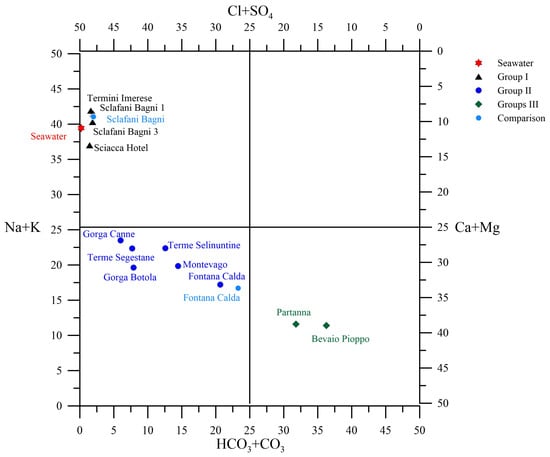
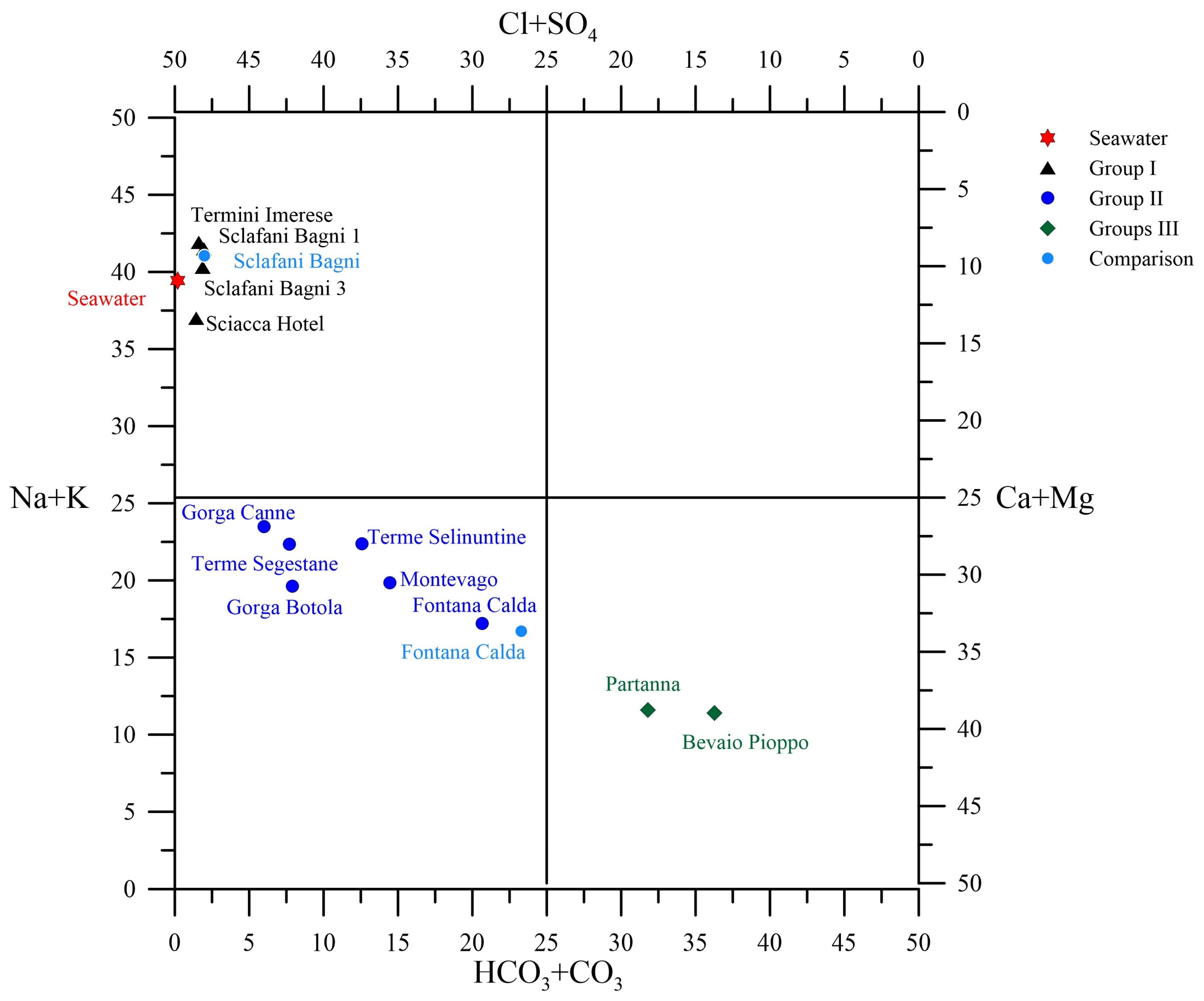
According to the Langelier–Ludwig diagram (Figure 2), the relative abundance of the major dissolved ions separates the samples into three distinct hydrochemical groups: (1) Group I, comprising four samples (Sclafani Bagni 1, Sclafani Bagni 3, Sciacca Hotel, and Termini Imerese) that plot strictly within the chloride–sulfate alkaline quadrant, displaying a chemical composition close to seawater; (2) Group II, represented by six samples (Terme Selinuntine, Fontana Calda, Montevago, Gorga Botola, Terme Segestane, Gorga Canne), which fall within the chloride–sulfate earth-alkaline quadrant; (3) Group III, comprising the Partanna and Bevaio Pioppo discharges, which plot within the bicarbonate earth-alkaline quadrant.
Figure 2.
Langelier–Ludwig diagram reporting the chemical data of springs of the three different group waters (Group I: black triangle; Group II: blue circles; Group III: green diamonds). The composition of Mediterranean seawater is also given (red star). Data related to Sclafani Bagni and Fontana Calda are duplicated for comparison: light blue circles represent data from [18], acquired more than 30 years before the others in the same springs. Their proximity in the graph supports the idea that no significant variations in water chemistry affected the studied hydrothermal circuits durin the sample collection period.
It should be noted that the points in the graph refer to samples collected over a long time period (about 40 years), causing possible biases when used for the determination of the main REE ligands. However, the two samples (Fontana Calda and Sclafani Bagni) for which both old and new data are available, fall in a close range, suggesting that no significant chemical variations have occurred over time.
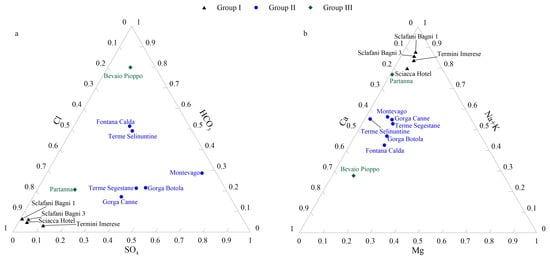
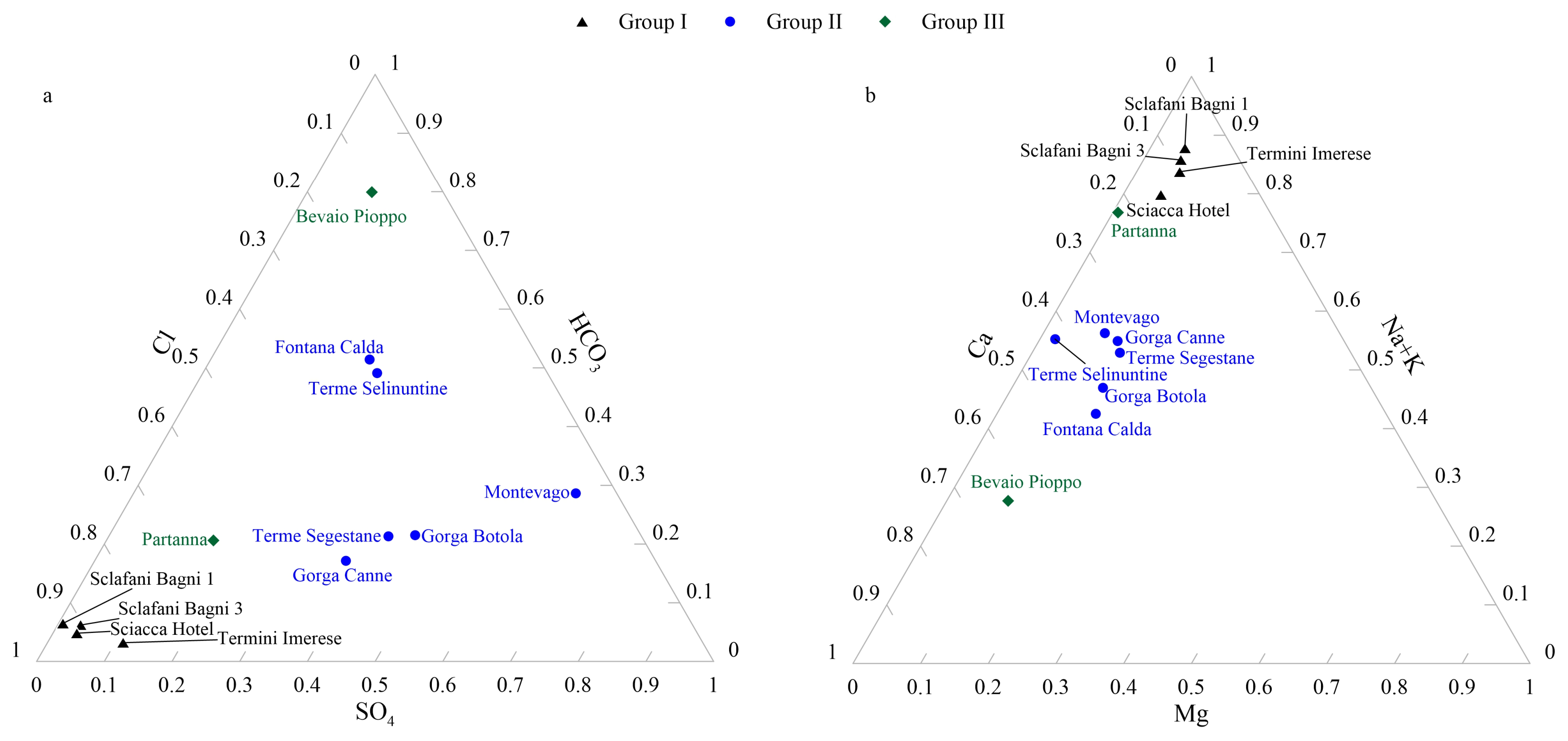
Ternary diagrams for major anions and cations further clarify these relationships (Figure 3a,b). Group I waters cluster tightly near the Cl corner; Group II waters trend progressively toward the sulfate-rich domain; Bevaio Pioppo (Group III) projects directly toward the bicarbonate corner whereas Partanna sample is close to the Cl corner. Cation distributions show that Na + K are the dominant cations for Group I, whereas waters from Group II and III are characterized by variable amounts of Na + K and Ca.
Figure 3.
Ternary diagrams of main (a) anions and (b) cations reporting the chemical data of springs of the three different group waters (Group I: black triangle; Group II: blue circle; Group III: green diamond).
4.2. REE Concentrations and Fractionation Profiles
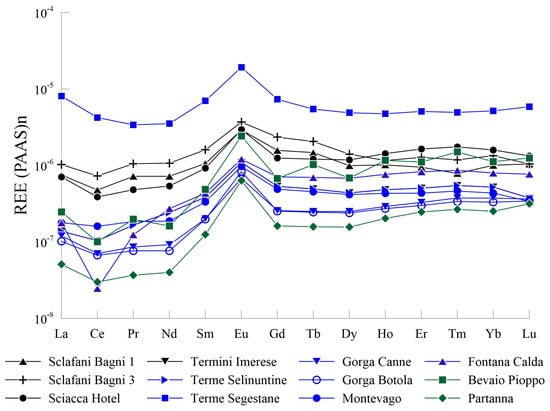
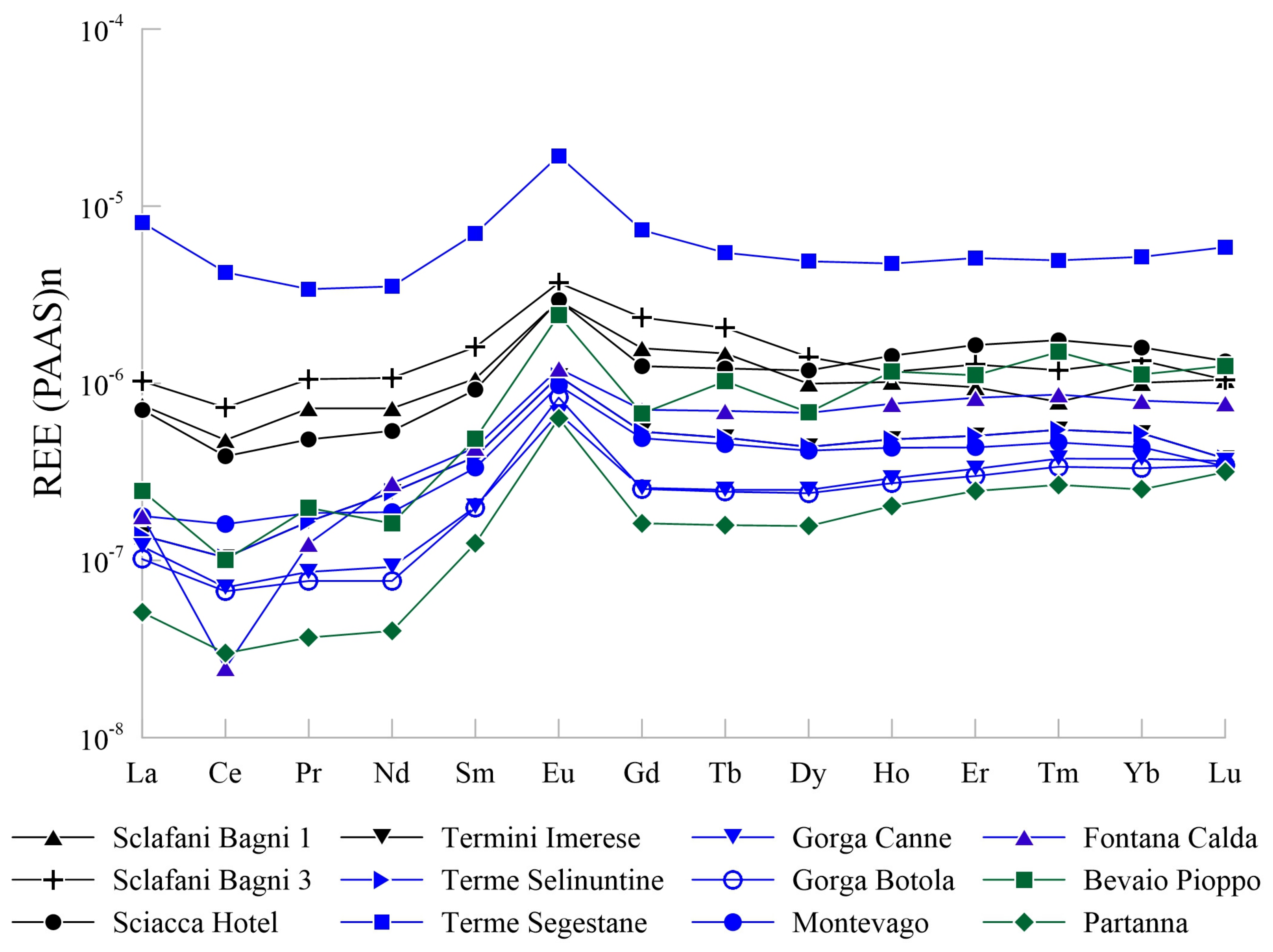
The total dissolved REE concentrations (ΣREEs) display significant variability, spanning from 10.2 to 954 ng L−1. Shale-normalized REE patterns (Figure 4) exhibit a systematic, non-linear increase along the lanthanide series, marked by a distinct enrichment hump in the middle REEs (MREE). All samples are characterized by persistent negative Ce/Ce* anomalies, coupled with prominent positive Eu/Eu* anomalies.
Figure 4.
PAAS-normalized [58] REE patterns of the spring waters belonging to the three different groups (Group I: black symbols; Group II: blue symbols; Group III: green symbols).
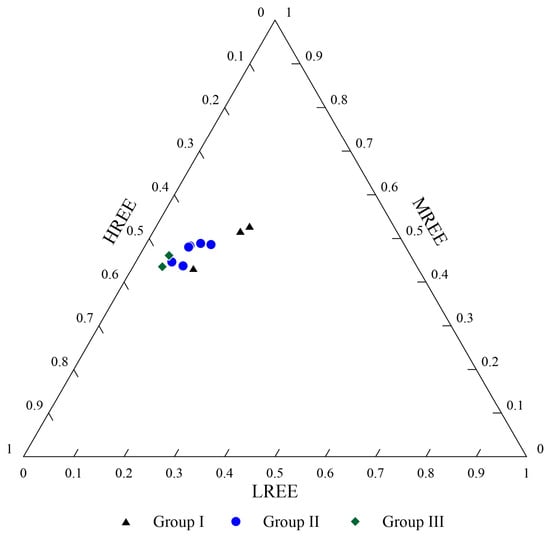
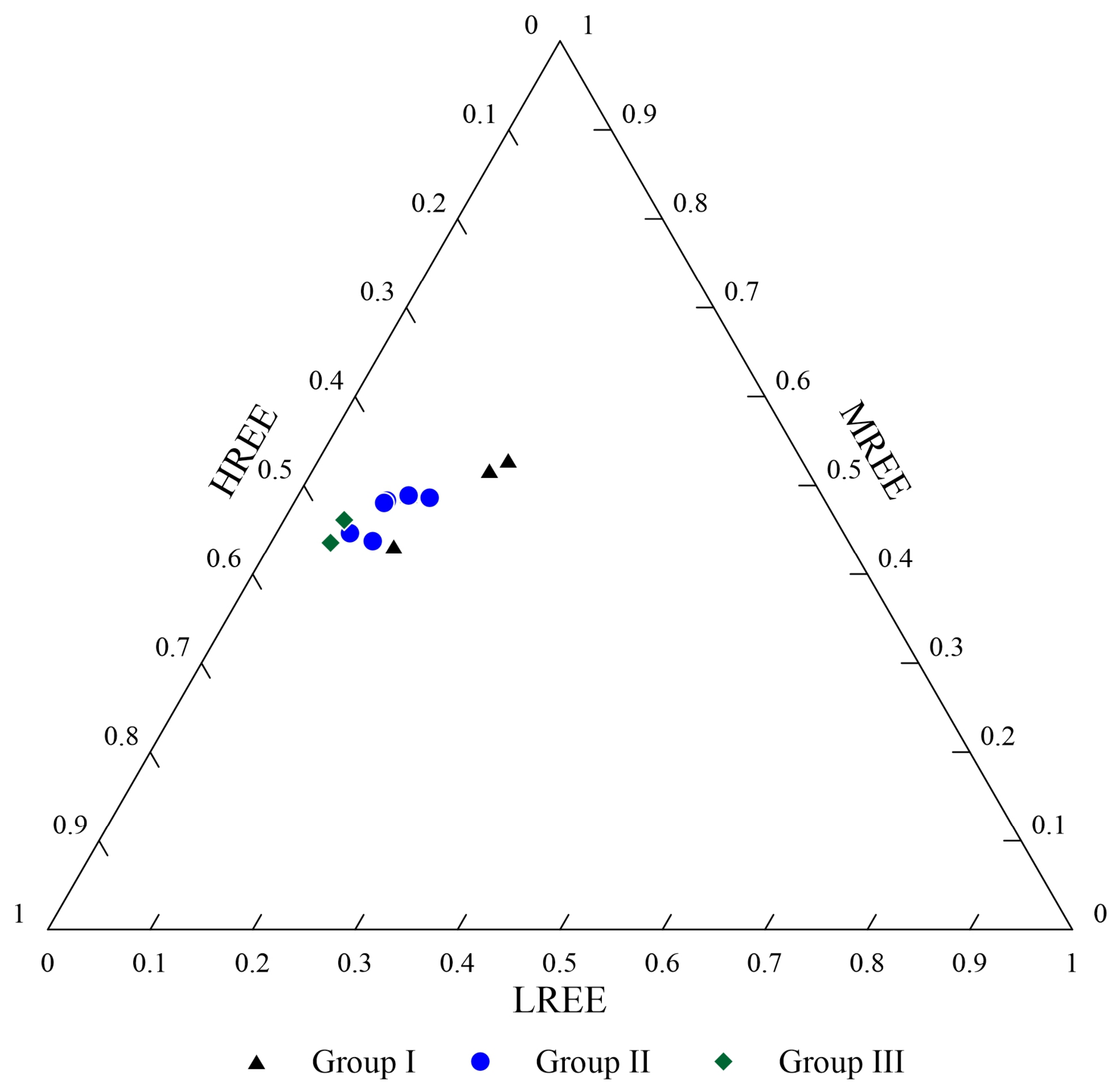
The ternary plot (Figure 5) displaying the relative proportions of LREE, MREE, and HREE, reveals divergent evolutionary pathways among the groups. Data define two trajectories: one directed toward a pronounced MREE enrichment and another trending toward a HREE enrichment.
Figure 5.
LREE–MREE–HREE ternary diagram. Group I: black triangle; Group II: blue circle; Group III: green diamond.
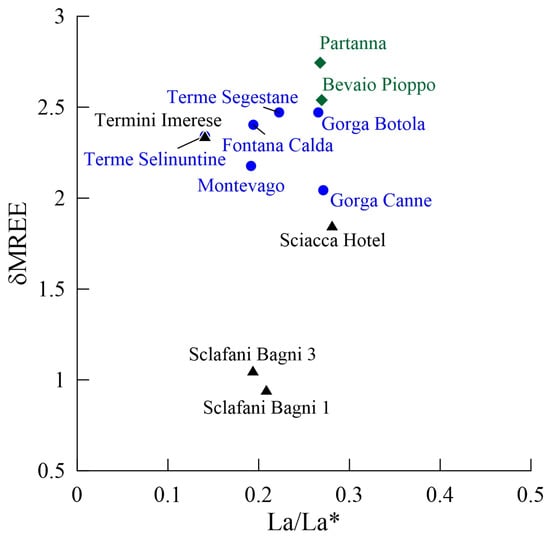
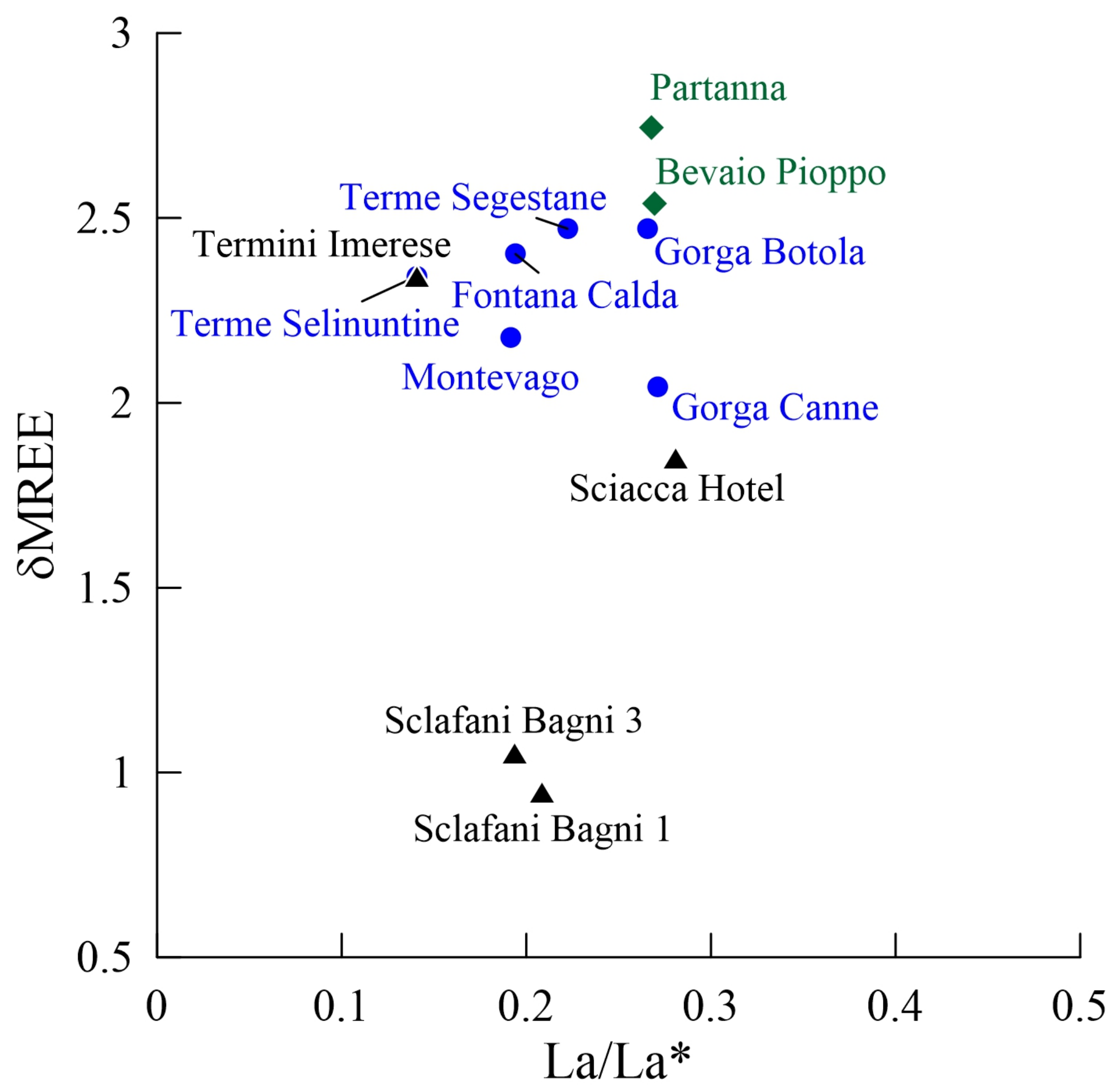
The binary distribution of La/La* vs. δMREE (Figure 6) provides a high-resolution view of the behavioral variability. Elevated δMREE values are driven by specific interactions with sulfate-bearing matrices (gypsum–anhydrite) or phosphate weathering [59], as well as by the reductive dissolution of subsurface iron oxyhydroxides [60]. This can be further modulated by localized microbial communities that reduce Fe(III) to Fe(II), releasing adsorbed intermediate rare earths into the fluid phase [60,61,62]. The lowest values of δMREE are shown in Sclafani Bagni samples, whereas the highest are those of samples belonging to Group II.
Figure 6.
La/La* vs. δMREE showing a mean enrichment in MREE starting from Sclafani samples toward the other sites (Group I: black triangle; Group II: blue circle; Group III: green diamond).
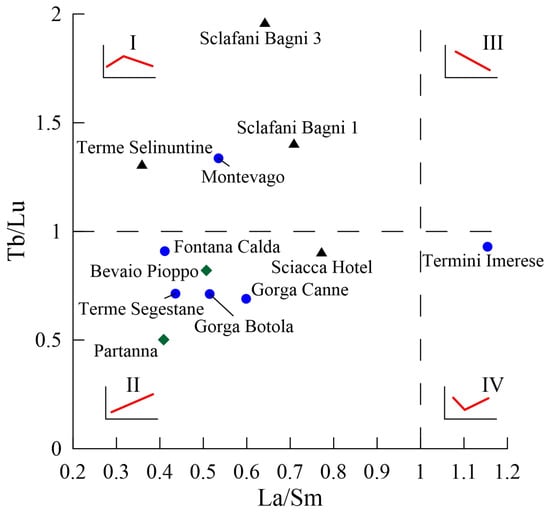
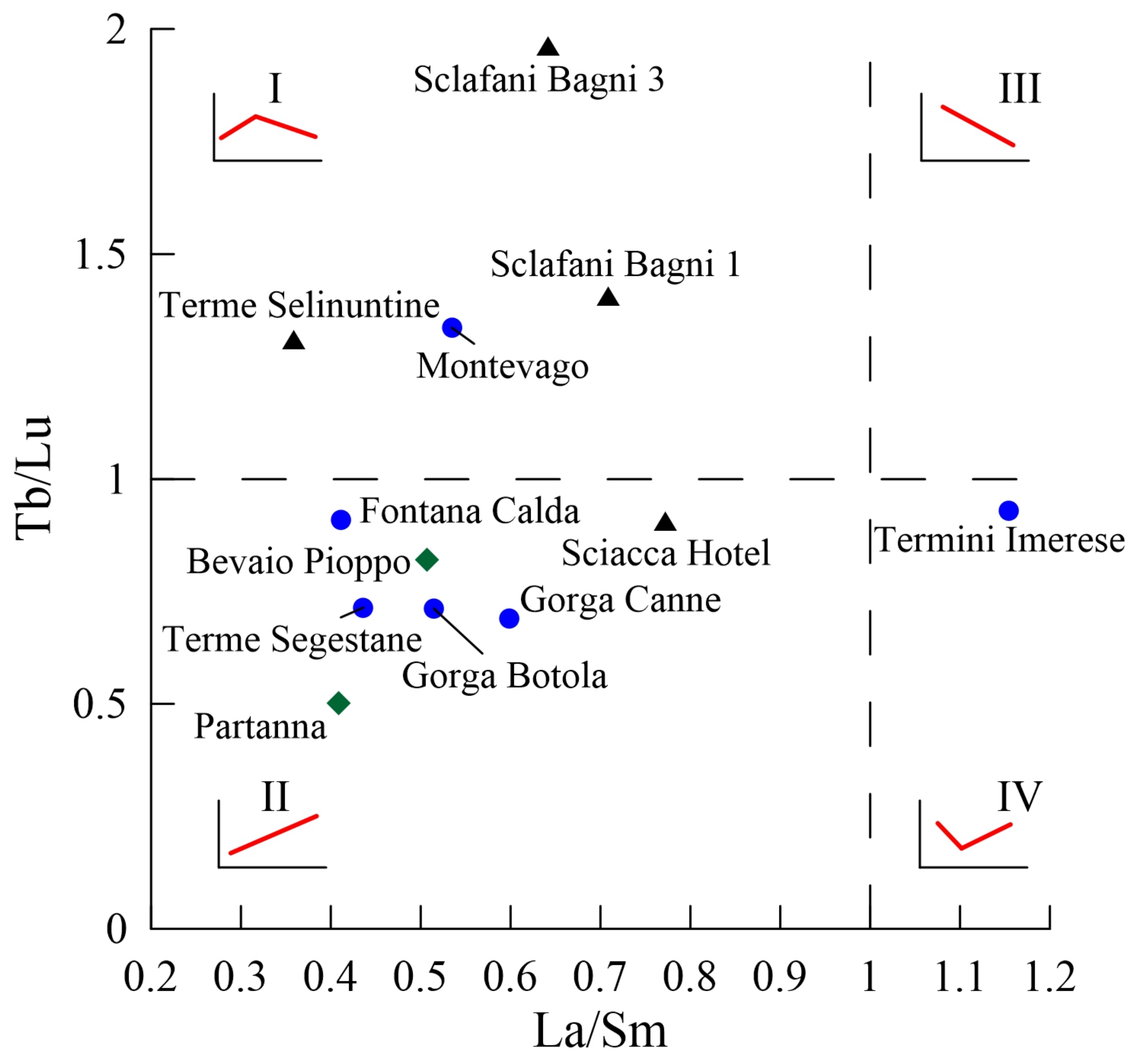
Plotting (La/Sm)PAAS vs. (Tb/Lu)PAAS (Figure 7) confirms HREE enrichment for the vast majority of the samples, already observed in the PAAS-normalized REE patterns, with Group III and most of the Group II fluids displaying a continuous increase toward the heaviest lanthanides. In contrast, the Montevago (Group II) sample exhibits a marked MREE hump, while specific Group I samples (Sclafani Bagni 1 and 3 and Termini Imerese) display a distinct decreasing pattern across the series.
Figure 7.
Scatterplot showing the La/Sm vs. Tb/Lu ratios of data of the three different water groups (Group I: black triangles; Group II: blue circles; Group III: green diamonds).
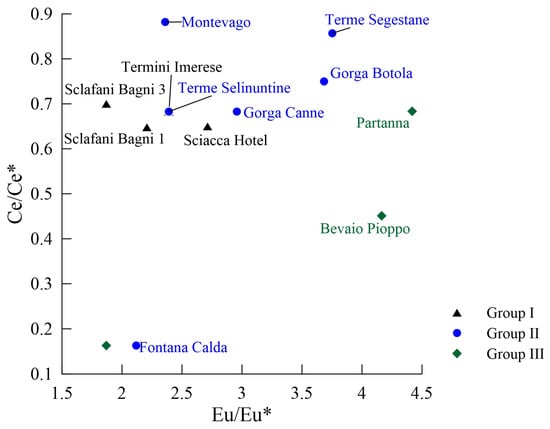
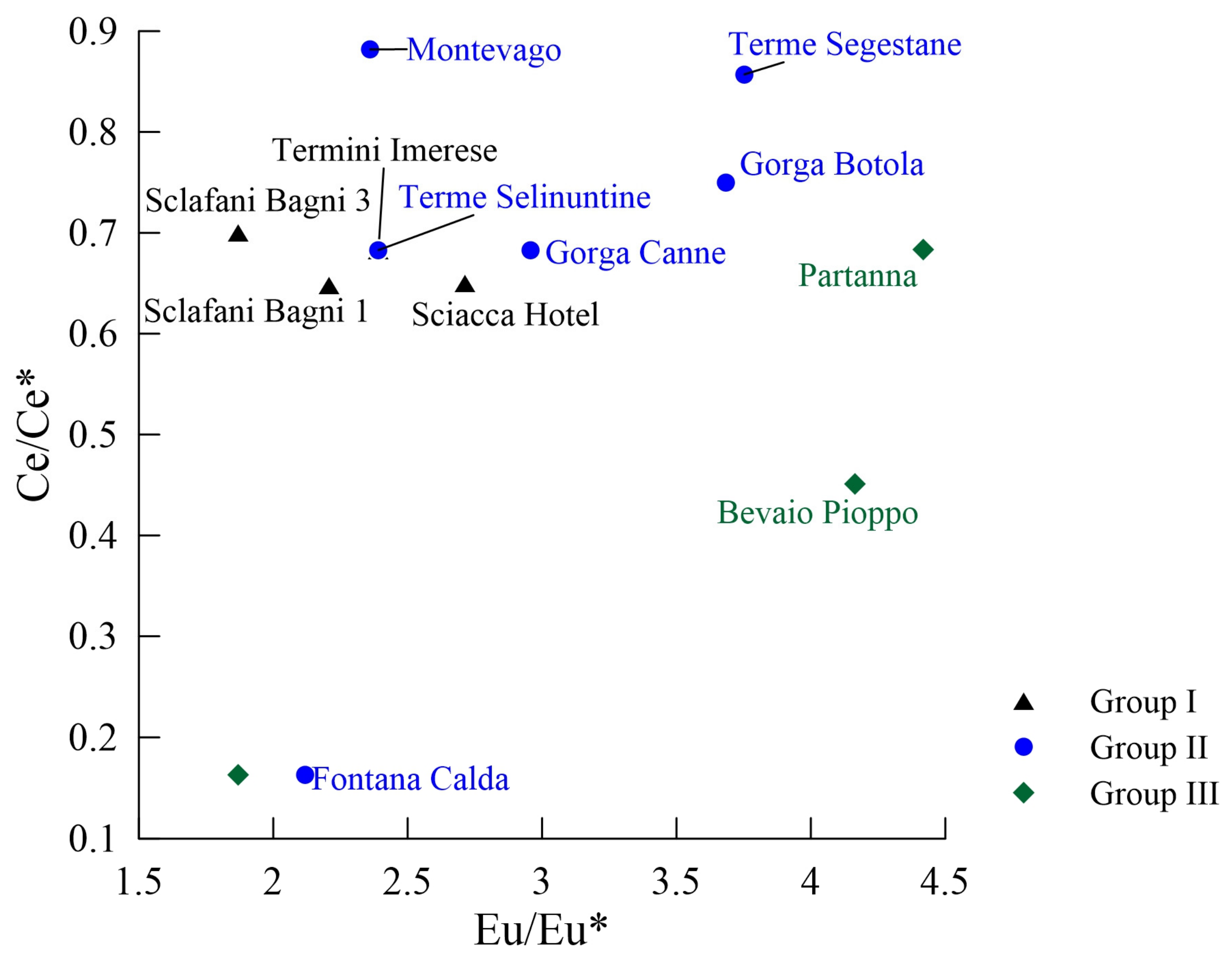
The calculated anomalies show that Eu/Eu* ranges from 1.87 to 4.42, while Ce/Ce* values vary between 0.163 and 0.882 (Figure 8). Both Eu and Ce have a dual oxidation state and, for this reason, they are sensitive to redox conditions. Ce occurs in Ce3+ and Ce4+ oxidation states, while Eu occurs in Eu2+ and Eu3+ forms. Negative Ce/Ce* anomalies, caused by the scavenging of Ce as CeO2 under oxidizing conditions on Fe-oxyhydroxide surfaces [63,64], are accompanied by positive Eu anomalies (the highest recorded in samples belonging to Group III). Fontana Calda shows the lowest Ce/Ce* value, whereas Montevago shows the highest; all the other samples are compressed in a narrow band.
Figure 8.
Scatterplot diagram reporting the Eu/Eu* vs. Ce/Ce* data of the three different water groups (Group I: black triangles; Group II: blue circles; Group III: green diamonds).
5. Discussion
5.1. Hydrochemistry and Complexation Controls
Physicochemical parameters and major element compositions of thermal springs in western Sicily reflect a complex, multi-component hydrogeological framework, controlled by the regional fault systems; here, the mixing between meteoric and deep fluids can modify the geochemical facies expected for groundwater circulating in a given hydrostructure, according to its lithological nature.
Group I springs are enriched in chloride and sodium and fall very close to seawater composition; this facies is inconsistent with the prevailing carbonate nature of the hosting rocks [43], suggesting deep circulation pathways involving interactions with fossil marine brines and/or seawater (for springs located close to the coastline).
Group II (Fontana Calda, Montevago, Gorga Botola, Terme Segestane, and Gorga Canne) plots in the earth-alkaline Cl−SO4 quadrant, coherently with the local geological setting, dominated by the Messinian Gessoso-Solfifera evaporitic sequence [64], but not excluding the mixing with deep, non-meteoric fluids.
Group III (Partanna and Bevaio Pioppo) falls in the bicarbonate earth-alkaline quadrant. These springs are characterized by the lower discharge temperature and electrical conductivity values among the studied sites, indicating a shallower groundwater circulation dominated by the congruent dissolution of the Mesozoic–Cenozoic carbonate unit outcropping in the area [64], under a high-pCO2 regime, and weakly modified by the mixing with a minor, deep component.
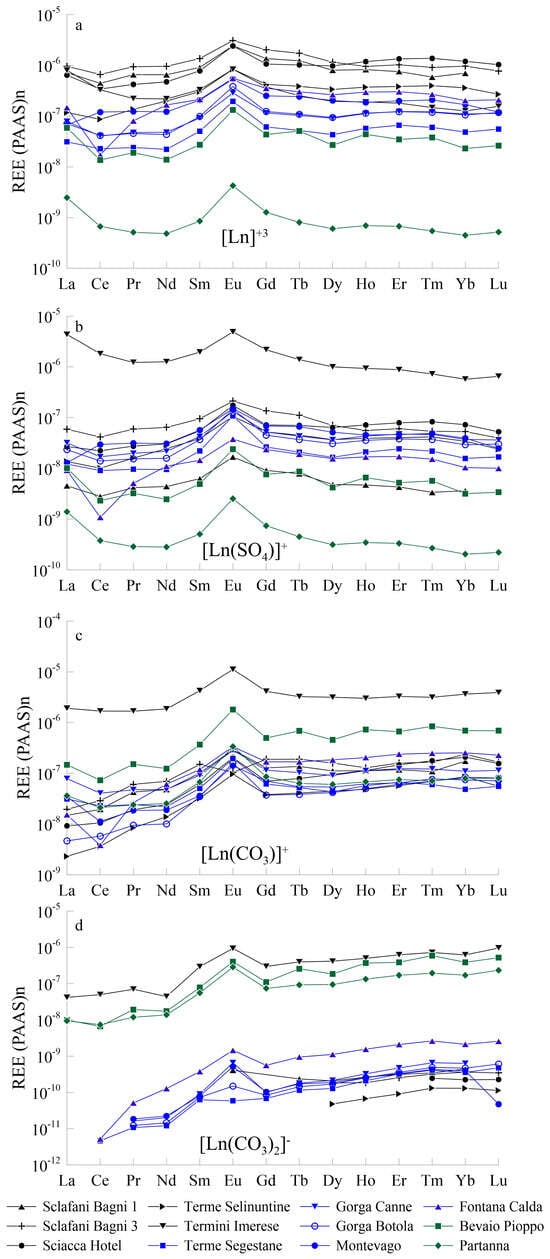
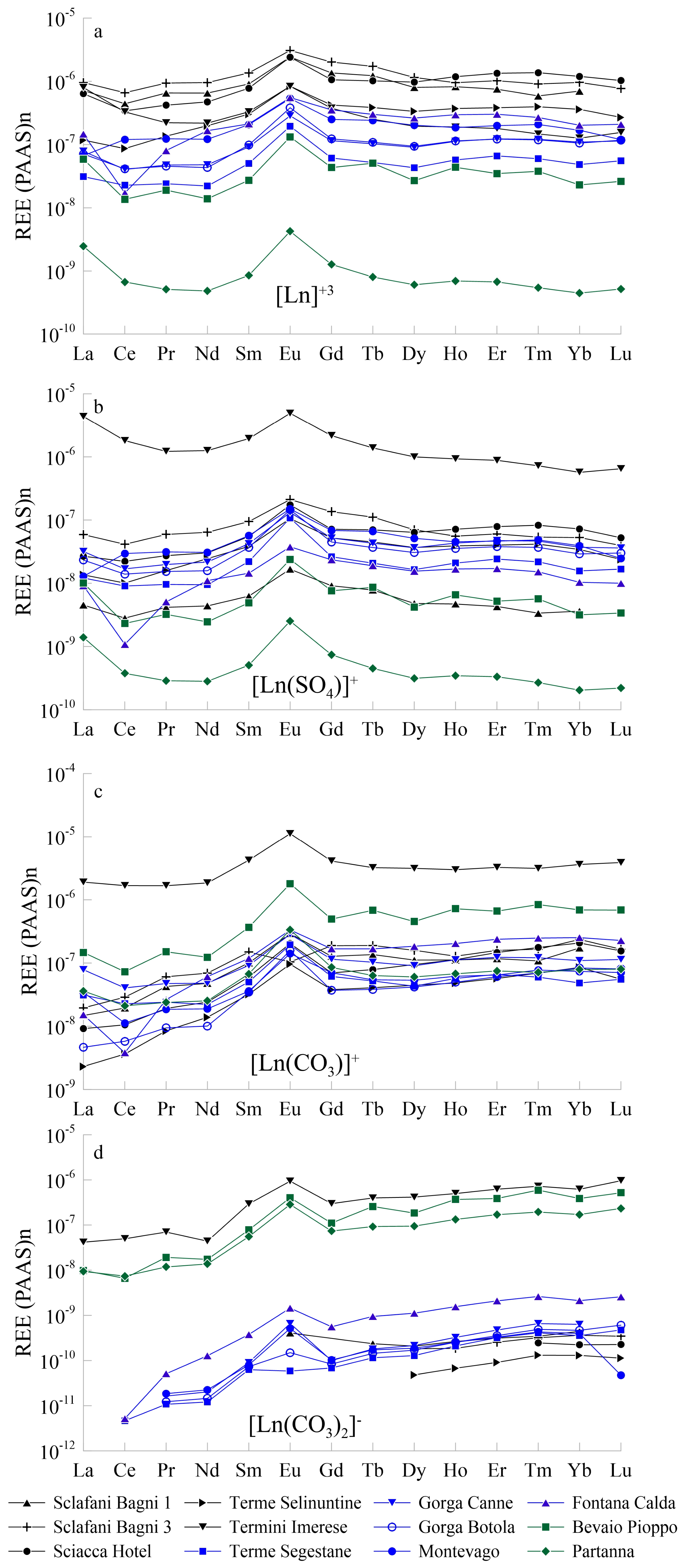
Thermodynamic speciation calculations and PAAS-normalized concentrations of aqueous REE species (Ln3+, [Ln(SO4)]+, [Ln(CO3)]+, and [Ln(CO3)2]−) illustrate the fundamental control exerted by pH, alkalinity, and ligand availability across the three hydrochemical groups:
Ln3+ + nLx− ⇌ [LnLn]3−nx.
Uncomplexed free lanthanide ions, Ln3+ (Figure 9a) and the monosulfate species [Ln(SO4)]+ (Figure 9b), exhibit essentially flat to slightly humped PAAS-normalized patterns across the series. In deep, high-salinity hydrothermal fluids, where pH is moderate to low and sulfate activities are high (Group I and II circuits), aqueous REEs are predominantly present as free aquo-ions, or bound to sulfate ligands. Because sulfate and halide complexation constants show minimal variation across the lanthanide series, these complexes do not induce significant internal LREE/HREE fractionation, thereby preserving the primary source-rock signature.
Figure 9.
PAAS-normalized [58] REE-complex patterns of the spring waters belonging to the three different groups (Group I: black symbols; Group II: blue symbols; Group III: green symbols): (a) free ions; (b) sulphate complex; (c) carbonate complex; (d) dicarbonate complex.
In contrast, carbonate species exhibit marked internal fractionation along the lanthanide series. Monocarbonate complexes [Ln(CO3)]+ (Figure 9c) show a steady increase from La to Lu. Dicarbonate complexes [Ln(CO3)2]− (Figure 9d) display an upward trend, spanning several orders of magnitude from LREE to HREE. In circumneutral to slightly alkaline, bicarbonate-dominated environments (Group III and Group II circuits), aqueous REE behavior is governed by carbonate complexation. Due to the lanthanide contraction, stability constants for dicarbonate complexes increase systematically with increasing atomic number. Consequently, HREEs form significantly stronger, highly soluble dicarbonate complexes ([HREE(CO3)2]−), remaining preferentially sequestered in solution, while LREEs are selectively removed via adsorption onto carbonate mineral matrices or Fe-oxyhydroxide surfaces. This speciation mechanism directly generates the pronounced heavy-REE enrichment trends observed in the thermal waters.
5.2. Geochemical Decoupling of Cerium and Europium Anomalies
The decoupled behavior between Ce and Eu anomalies provides independent, high-fidelity constraints on shallow redox boundaries and deep reservoir temperatures. The negative Ce/Ce* anomalies are generated within shallow, oxic or sub-oxic horizons during fluid ascent. Under these oxidizing conditions, dissolved Ce3+ is selectively converted in its tetravalent state (Ce4+), forming highly insoluble CeO2, which precipitates or undergoes rapid oxidative scavenging onto upwelling iron oxyhydroxides or active microbial cell walls [64,65,66]. Because adjacent trivalent lanthanides (La and Pr) are unaffected by this redox pathway, the ascending fluids develop a marked negative Ce anomaly.
In contrast, the prominent positive Eu/Eu* anomalies suggest high-temperature fluid–rock interactions occurring in a deep geothermal horizon. In deep, reducing reservoirs, trivalent Eu3+ is reduced to divalent Eu2+ [67]. In its divalent state, europium exhibits an expanded ionic radius, which allows it to substitute for Sr2+ and Ca2+ within plagioclase and K-feldspar lattices [34]. Consequently, Eu2+ is preferentially stripped from these minerals during deep hydrothermal leaching. The systematic preservation of these strong positive spikes in groundwater collected at the surface, at temperatures as low as 18 °C, demonstrates that fluids ascend rapidly along regional damage zones, preventing re-oxidation or structural re-equilibration with shallow host rocks during their path to the Earth’s surface [68].
5.3. Interfacial Mineral Chemistry and Non-CHARAC Tetrad Forcing
The significant middle-REE enrichment (δMREE) and accompanying non-linear fractionation, observed when moving toward peripheral Group II and Group III springs, mark a complete transition from classical CHARAC behavior to non-CHARAC pathways. To evaluate these trends, the electrochemical behavior at the mineral-water interface must be considered. As demonstrated by Al-Mahrouqi et al. [69], the zeta potential (ζ) of carbonate phases is strongly dependent on the activity of potential-determining ions and the total ionic strength of the fluid matrix.
In deep, high-salinity brines (Group I), a positive zeta potential creates an electrostatic repulsion barrier that inhibits the approach of dissolved trivalent lanthanides to mineral surfaces, suppressing adsorption-driven fractionation and preserving matrix-proportionate profiles. As upwelling fluids mix with shallow meteoric waters, with transition to circumneutral bicarbonate compositions, the mineral surfaces develop a net negative zeta potential, accelerating the selective scavenging of rare earths [69]. At this interface, the steric displacement of coordinated water molecules from the aquo-ions ([REE(H2O)n]3+) is highly sensitive to the progressive filling of the 4f electron shell. This non-isovalent interaction triggers the lanthanide tetrad effect, forcing segmented discontinuities across the tetrad groups (T1–T4) [35,70].
The pronounced middle-REE enrichment hump (δMREE), associated with these tetrad trends, could be linked to i) evaporitic matrix leaching, where the interaction with upper Messinian or Triassic evaporitic sequences injects a primary MREE-enriched signature via the congruent dissolution of gypsum and anhydrite; ii) reductive Fe-oxyhydroxide dissolution, driven by the upwelling of deep reducing fluids, rich in gases (CO2, CH4, and H2S). This process remobilizes previously adsorbed lanthanides back into solution. Because iron oxyhydroxides preferentially accumulate intermediate lanthanides, during initial low-temperature scavenging loops, their subsequent reductive dissolution generates the prominent middle-REE hump recorded across the regional spring networks [53,58].
5.4. Hydrogeological Circuits and REE Signatures
REE signature evidences the double nature of the hydrogeological circuits feeding the studied springs: all the samples exhibit a negative Ce anomaly, typical of the oxidized conditions of shallow groundwater circulation, paired to a positive Eu anomaly, indicating the presence of a deep hydrothermal component in the aquifers.
The total content of REE is higher on average in the Group I sites (Figure 4), confirming the predominance of the hydrothermal component, already evidenced in the Langelier–Ludwig diagram (Figure 2 and related discussion), and further supported by the isotopic data presented by Carapezza et al. [12], which found in this group less negative values.
On the other hand, the Group III springs shows the minor REE contents, supporting the presence of a minor deep hydrothermal component in aquifers dominated by a meteoric circulation.
6. Conclusions
The hydrothermal aquifers of western Sicily have been categorized into three major hydrochemical groups (alkaline Cl-SO4, Earth-alkaline Cl-SO4, and Earth-alkaline HCO3), primarily controlled by regional tectonics along the Maghrebian thrust belt and by the variable-mixing proportions between deep hydrothermal components and a shallow meteoric contribution.
Dissolved Rare Earth Element patterns exhibit a systematic LREE/HREE fractionation: deep, reducing circuits are dominated by un-fractionated sulfate and halide complexes, whereas shallow, oxygenated paths are controlled by carbonate complexation, which selectively enriches upwelling fluids in heavy rare earths via lanthanide contraction mechanisms.
Diagnostic negative Ce anomalies highlight shallow oxidative scavenging processes, modulated by mineral zeta potentials at the fluid–rock interface. The preservation of strong positive Eu anomalies suggests that these waters inherit their trace element signatures from a deep, high-temperature fluid–rock interaction, where europium is highly mobile in its reduced Eu2+ state.
The observed middle rare earth enrichment (δMREE) indicates active subsurface interaction with evaporitic matrices or the reductive dissolution of iron, driven by deep gas forcing. These distinctive non-CHARAC REE fingerprints are sensitive tracers for mapping fluid structural pathways and classifying geothermal reservoirs in the south Mediterranean structural domain.
Supplementary Materials
The following supporting information can be downloaded at https://www.mdpi.com/article/10.3390/geosciences16090379/s1.
Author Contributions
Conceptualization, M.C.; methodology, M.C.; formal analysis, M.C. and Y.O.; investigation, M.C., Y.O., S.I., R.F. and P.M.; data curation, M.C. and Y.O.; writing—original draft preparation, M.C. and P.M.; writing—review and editing, M.C., Y.O., S.I., R.F. and P.M.; All authors have read and agreed to the published version of the manuscript.
Funding
This research received no external funding.
Data Availability Statement
All relevant data are available as Supplementary Materials.
Acknowledgments
Data analyzed in this manuscript are a legacy of Paolo Censi who, prior to passing away, gave them to the authors, expressing his desire that they will be shared with the scientific community. During the preparation of this manuscript the authors used Gemini for the first revision of the original text. The authors have deeply reviewed and edited the AI output and take full responsibility for the content of this publication.
Conflicts of Interest
The authors declare no conflicts of interest.
References
- Balaram, V. Rare earth elements: A review of applications, occurrence, exploration, analysis, recycling, and environmental impact. Geosci. Front. 2019, 10, 1285–1303. [Google Scholar] [CrossRef] [Scilit]
- Mondillo, N.; Boni, M.; Balassone, G.; Spoleto, S.; Marino, A.; Santoro, L.; Spratt, J. Rare earth elements (REE)-minerals in the Silius fluorite vein system (Sardinia, Italy). Ore Geol. Rev. 2016, 74, 211–224. [Google Scholar] [CrossRef] [Scilit]
- Kanazawa, Y.; Kamitani, M. Rare earth minerals and resources in the world. J. Alloys Compd. 2006, 408–412, 1339–1343. [Google Scholar] [CrossRef] [Scilit]
- Ling, M.X.; Liu, Y.L.; Williams, I.S.; Teng, F.Z.; Yang, X.Y.; Ding, X.; Wei, G.J.; Xie, L.W.; Deng, W.F.; Sun, W.D. Formation of the world’s largest REE deposit through protracted fluxing of carbonatite by subduction-derived fluids. Sci. Rep. 2013, 3, 1776. [Google Scholar] [CrossRef] [Scilit]
- Smith, M.P.; Moore, K.; Kavecsánszki, D.; Finch, A.A.; Kynicky, J.; Wall, F. From mantle to critical zone: A review of large and giant sized deposits of the rare earth elements. Geosci. Front. 2016, 7, 315–334. [Google Scholar] [CrossRef] [Scilit]
- Gysi, A.P.; Williams-Jones, A.E. Hydrothermal REE and Zr mobilization in the Strange Lake peralkaline granitic system: A reaction path model linked to petrological and geochemical observations. Geochim. Cosmochim. Acta 2013, 122, 324–352. [Google Scholar]
- Migdisov, A.; Williams-Jones, A.E.; Brugger, J.; Caporuscio, F.A. Hydrothermal transport, deposition, and fractionation of the REE: Experimental data and thermodynamic calculations. Chem. Geol. 2016, 439, 13–42. [Google Scholar] [CrossRef] [Scilit]
- Bau, M.; Möller, P. Rare earth element fractionation in metamorphogenic hydrothermal calcite, magnesite and siderite. Mineral. Petrol. 1992, 45, 231–246. [Google Scholar] [CrossRef] [Scilit]
- Bau, M.; Dulski, P. Comparative study of yttrium and rare-earth element behaviours in fluorine-rich hydrothermal fluids. Contrib. Mineral. Petrol. 1995, 119, 213–223. [Google Scholar] [CrossRef]
- Bau, M.; Dulski, P. Comparing yttrium and rare earths in hydrothermal fluids from the Mid-Atlantic Ridge: Implications for Y and REE behaviour during near-vent mixing and for the Y/Ho ratio of Proterozoic seawater. Chem. Geol. 1999, 155, 77–90. [Google Scholar] [CrossRef] [Scilit]
- Censi, P.; Raso, M.; Yechieli, Y.; Ginat, H.; Saiano, F.; Zuddas, P.; Brusca, L.; D’Alessandro, W.; Inguaggiato, C. Geochemistry of Zr, Hf, and REE in a wide spectrum of Eh and water composition: The case of Dead Sea Fault system (Israel). Geochem. Geophys. Geosyst. 2017, 18, 844–857. [Google Scholar] [CrossRef] [Scilit]
- Censi, P.; Zuddas, P.; Caracausi, A.; Sortino, F.; Cangemi, M.; Piazzese, D.; Censi, V.; Falcone, E. Anomalous behavior of zirconium and hafnium in volcanic fumarolic fluids. Geophys. Res. Lett. 2022, 49, e2021GL094674. [Google Scholar] [CrossRef] [Scilit]
- Oliveri, Y.; Cangemi, M.; Capasso, G.; Saiano, F. Pathway and fate of REE in the shallow hydrothermal aquifer of Vulcano island (Italy). Chem. Geol. 2019, 512, 121–129. [Google Scholar] [CrossRef] [Scilit]
- Sasmaz, A.; Zuddas, P.; Cangemi, M.; Piazzese, D.; Ozek, G.; Venturi, M.; Censi, P. Zirconium and hafnium fractionation and distribution of Rare Earth Elements in neutral–alkaline waters: Case study of Lake Van hydrothermal system, Turkey. J. Geochem. Explor. 2021, 226, 106784. [Google Scholar] [CrossRef] [Scilit]
- Johannesson, K.H.; Stetzenbach, K.J.; Hodge, V.F. Rare earth elements as geochemical tracers of regional groundwater mixing. Geochim. Cosmochim. Acta 1997, 61, 3605–3618. [Google Scholar] [CrossRef] [Scilit]
- Rillard, J.; Pourret, O.; Censi, P.; Inguaggiato, C.; Zuddas, P.; Toulhoat, P.; Gombert, P.; Brusca, L. Behavior of rare earth elements in an aquifer perturbed by CO2 injection: Environmental implications. Sci. Total Environ. 2019, 687, 978–990. [Google Scholar] [CrossRef] [Scilit] [PubMed]
- Wood, S.A. The geochemistry of Rare Earth Elements and Yttrium in geothermal waters. In Volcanic, Geothermal, and Ore-Forming Fluids: Rulers and Witnesses of Processes Within the Earth; Simmons, S.F., Graham, I., Eds.; Society of Economic Geologists: Littleton, CO, USA, 2005; Volume 10, pp. 133–158. [Google Scholar] [CrossRef] [Scilit]
- Carapezza, M.; Leone, M.; Tonani, F. Risorse Termali Della Sicilia ed Isole Minori; Istituto di Mineralogia, Petrografia e Geochimica, Università di Palermo; Regione Siciliana, Assessorato Territorio e Ambiente: Palermo, Italy, 1987; pp. 1–227.
- Donato, A.; Tassi, F.; Pecoraino, G.; Manzella, A.; Vaselli, O.; Gagliano Candela, E.; Santilano, A.; La Pica, L.; Scaletta, C.; Capecchiacci, F. Geochemical investigations of the geothermal system from the Island of Sicily (southern Italy). Geothermics 2021, 95, 102120. [Google Scholar] [CrossRef] [Scilit]
- Cantrell, K.J.; Byrne, R.H. Rare earth element complexation by carbonate and oxalate ions. Geochim. Cosmochim. Acta 1987, 51, 597–605. [Google Scholar] [CrossRef] [Scilit]
- Byrne, R.H.; Kim, K.H. Rare earth element scavenging in seawater. Geochim. Cosmochim. Acta 1990, 54, 2645–2656. [Google Scholar] [CrossRef] [Scilit]
- Lee, J.H.; Byrne, R.H. Complexation of trivalent rare-earth elements (Ce, Eu, Gd, Tb, Yb) by carbonate ions. Geochim. Cosmochim. Acta 1993, 57, 295–302. [Google Scholar] [CrossRef] [Scilit]
- Byrne, R.H.; Sholkovitz, E.R. Marine chemistry and geochemistry of the lanthanides. In Handbook on the Physics and Chemistry of Rare Earths; Gschneidner, K.A., Jr., Eyring, L., Eds.; Elsevier: Amsterdam, The Netherlands, 1996; Volume 23, pp. 497–593. [Google Scholar] [CrossRef] [Scilit]
- Bertram, C.J.; Elderfield, H. The geochemical balance of the rare earth elements and neodymium isotopes in the oceans. Geochim. Cosmochim. Acta 1993, 57, 1957–1986. [Google Scholar] [CrossRef] [Scilit]
- De Baar, H.J.W.; Bacon, M.P.; Brewer, P.G. Rare earth element distributions with a positive Ce anomaly in the Atlantic and Pacific Oceans. Nature 1983, 301, 324–327. [Google Scholar] [CrossRef] [Scilit]
- Censi, P.; Inguaggiato, C.; Chiavetta, S.; Schembri, C.; Sposito, F.; Censi, V.; Zuddas, P. The behaviour of zirconium, hafnium and rare earth elements during the crystallisation of halite and other salt minerals. Chem. Geol. 2017, 453, 80–91. [Google Scholar] [CrossRef] [Scilit]
- Censi, P.; Raso, M.; Saiano, F.; Zuddas, P.; Oliveri, E. Zr/Hf ratio and REE behaviour: A coupled indication of lithogenic input in marginal basins and deep-sea brines. Deep-Sea Res. Part II Top. Stud. Oceanogr. 2019, 164, 216–223. [Google Scholar] [CrossRef] [Scilit]
- Haley, B.A.; Klinkhammer, G.P.; McManus, J. Rare earth elements in pore waters of marine sediments. Geochim. Cosmochim. Acta 2004, 68, 1265–1279. [Google Scholar] [CrossRef] [Scilit]
- Alibo, D.S.; Nozaki, Y. Rare earth elements in seawater: Particle association, shale-normalization, and Ce oxidation. Geochim. Cosmochim. Acta 1999, 63, 363–372. [Google Scholar] [CrossRef] [Scilit]
- Möller, P.; Rosenthal, E.; Geyer, S.; Guttman, J.; Dulski, P.; Rybakov, M.; Zilberbrand, M.; Jahnke, C.; Flexer, A. Hydrochemical processes in the lower Jordan valley and in the Dead Sea area. Chem. Geol. 2007, 239, 27–49. [Google Scholar] [CrossRef] [Scilit]
- Ding, S.; Liang, T.; Zhang, C.; Huang, Z.; Xie, Y.; Chen, T. Fractionation mechanisms of rare earth elements (REEs) in hydroponic wheat: An application for metal accumulation by plants. Environ. Sci. Technol. 2006, 40, 2686–2691. [Google Scholar] [CrossRef] [Scilit] [PubMed]
- Löble, M.W.; Keith, J.M.; Altman, A.B.; Stieber, S.C.E.; Batista, E.R.; Boland, K.S.; Conradson, S.D.; Clark, D.L.; Lezama Pacheco, J.; Kozimor, S.A.; et al. Covalency in lanthanides. An X-ray absorption spectroscopy and density functional theory study of LnCl6x− (x = 3, 2). J. Am. Chem. Soc. 2015, 137, 2506–2523. [Google Scholar] [CrossRef] [Scilit] [PubMed]
- Lukens, W.W.; Speldrich, M.; Yang, P.; Duignan, T.J.; Autschbach, J.; Kögerler, P. The roles of 4f- and 5f-orbitals in bonding: A magnetochemical, crystal field, density functional theory, and multi-reference wavefunction study. Dalton Trans. 2016, 45, 11508–11521. [Google Scholar] [CrossRef] [Scilit] [PubMed]
- Shannon, R.D. Revised effective ionic radii and systematic studies of interatomic distances in halides and chalcogenides. Acta Crystallogr. Sect. A 1976, 32, 751–767. [Google Scholar] [CrossRef] [Scilit]
- Bau, M. Controls on the fractionation of isovalent trace elements in magmatic and aqueous systems: Evidence from Y/Ho, Zr/Hf, and lanthanide tetrad effect. Contrib. Mineral. Petrol. 1996, 123, 323–333. [Google Scholar] [CrossRef] [Scilit]
- Catalano, R.; Di Stefano, P.; Sulli, A.; Vitale, F.P. Paleogeography and structure of the central Mediterranean: Sicily and its offshore area. Tectonophysics 1996, 260, 291–323. [Google Scholar] [CrossRef] [Scilit]
- Catalano, R.; D’Argenio, B. Schema geologico della Sicilia. In Guida alla Geologia della Sicilia Occidentale; Catalano, R., D’Argenio, B., Eds.; Memorie della Società Geologica Italiana (Suppl. A): Roma, Italy, 1982; Volume 24, pp. 9–41. [Google Scholar]
- Roure, F.; Howell, D.G.; Müller, C.; Moretti, I. Late Cenozoic subduction complex of Sicily. J. Struct. Geol. 1990, 12, 259–266. [Google Scholar] [CrossRef] [Scilit]
- Nigro, F.; Renda, P. Structural model of North-Central Sicily. Mem. Soc. Geol. Ital. 1999, 55, 61–70. [Google Scholar]
- Bello, M.; Franchino, A.; Merlini, S. Structural model of Eastern Sicily. Mem. Soc. Geol. Ital. 2000, 55, 61–70. [Google Scholar] [CrossRef] [Scilit]
- Catalano, R.; Franchino, A.; Merlini, S.; Sulli, A. A crustal section from North Algeria to the Ionian ocean (Central Mediterranean). Mem. Soc. Geol. Ital. 2000, 55, 71–85. [Google Scholar]
- Accaino, F.; Catalano, R.; Di Marzo, L.; Giustiniani, M.; Tinivella, U.; Nicolich, R.; Sulli, A.; Valenti, V.; Manetti, P. A crustal seismic profile across Sicily. Tectonophysics 2011, 508, 52–61. [Google Scholar] [CrossRef] [Scilit]
- Catalano, R.; Valenti, V.; Albanese, C.; Accaino, F.; Sulli, A.; Tinivella, U.; Gasparo Morticelli, M.; Zanolla, C.; Giustiniani, M. Sicily fold-thrust belt and slab roll-back: The SI.RI.PRO. seismic crustal transect. J. Geol. Soc. 2013, 170, 451–464. [Google Scholar] [CrossRef] [Scilit]
- Catalano, R. Geology of Sicily: An introduction. Bocconea 2004, 17, 33–46. [Google Scholar]
- Amodio-Morelli, L.; Bonardi, G.; Colonna, V.; Dietrich, D.; Giunta, G.; Ippolito, F.; Liguori, V.; Lorenzoni, V.; Paglionico, A.; Perrone, V.; et al. L’arco Calabro-Peloritano nell’orogene appenninico-maghrebide. Mem. Soc. Geol. Ital. 1976, 17, 1. [Google Scholar]
- Ogniben, L. Note illustrative dello schema geologico della Sicilia nord-orientale. Riv. Min. Sicil. 1960, 64–65, 183–212. [Google Scholar]
- Catalano, R.; D’Argenio, B. An essay of palinspastic restoration across western Sicily. Geol. Rom. 1978, 17, 145–159. [Google Scholar]
- Gasparini, P.; Iannaccone, G.; Scandone, P.; Scarpa, R. Seismotectonics of the Calabrian Arc. Tectonophysics 1982, 84, 267–286. [Google Scholar] [CrossRef] [Scilit]
- Anderson, H.; Jackson, J. The deep seismicity of the Tyrrhenian Sea. Geophys. J. Int. 1987, 91, 613–637. [Google Scholar] [CrossRef] [Scilit]
- Monaco, C.; Mazzoli, S.; Tortorici, L. Active thrust tectonics in Western Sicily (southern Italy): The 1968 Belice earthquake sequence. Terra Nova 1996, 8, 372–381. [Google Scholar] [CrossRef] [Scilit]
- Giammanco, S.; Palano, M.; Scaltrito, A.; Scarfì, L.; Sortino, F. Possible role of fluid overpressure in the generation of earthquake swarms in active tectonic areas: The case of the Peloritani Mts. (Sicily, Italy). J. Volcanol. Geotherm. Res. 2008, 178, 795–806. [Google Scholar] [CrossRef] [Scilit]
- Peccerillo, A. The Sicily Province. In Cenozoic Volcanism in the Tyrrhenian Sea Region; Advances in Volcanology; Springer: Cham, Switzerland, 2017; pp. 265–312. [Google Scholar] [CrossRef] [Scilit]
- Carminati, E.; Doglioni, C. Alps vs. Apennines: The paradigm of a tectonically asymmetric Earth. Earth-Sci. Rev. 2012, 112, 67–96. [Google Scholar] [CrossRef] [Scilit]
- Carafa, M.M.C.; Barba, S. The stress field in Europe: Optimal orientations with confidence limits. Geophys. J. Int. 2013, 193, 531–548. [Google Scholar] [CrossRef] [Scilit]
- Montanari, D.; Albanese, C.; Catalano, R.; Contino, A.; Fedi, M.; Gola, G.; Iorio, M.; La Manna, M.; Monteleone, S.; Trumpy, E.; et al. Contour map of the top of the regional geothermal reservoir of Sicily (Italy). J. Maps 2014, 10, 655–662. [Google Scholar] [CrossRef] [Scilit][Green Version]
- Montanari, D.; Minissale, A.; Doveri, M.; Gola, G.; Trumpy, E.; Santilano, A.; Manzella, A. Geothermal resources within carbonate reservoirs in western Sicily (Italy): A review. Earth-Sci. Rev. 2017, 169, 180–201. [Google Scholar] [CrossRef] [Scilit]
- Raso, M.; Censi, P.; Saiano, F. Simultaneous determinations of zirconium, hafnium, yttrium and lanthanides in seawater according to a co-precipitation technique onto iron-hydroxide. Talanta 2013, 116, 1085–1090. [Google Scholar] [CrossRef] [Scilit] [PubMed]
- Taylor, S.R.; McLennan, S.M. The geochemical evolution of the continental crust. Rev. Geophys. 1995, 33, 241–265. [Google Scholar] [CrossRef] [Scilit]
- Hannigan, R.E.; Sholkovitz, E.R. The development of middle rare earth element enrichments in freshwaters: Weathering of phosphate minerals. Chem. Geol. 2001, 175, 495–508. [Google Scholar] [CrossRef] [Scilit]
- Censi, P.; Sortino, F.; Zuddas, P.; Saiano, F.; Brusca, L.; Chiavetta, S.; Falcone, E.E. Rare earth behaviour during the deposition of volcanic sublimates. J. Volcanol. Geotherm. Res. 2017, 331, 53–63. [Google Scholar] [CrossRef] [Scilit]
- Shaked, Y.; Erel, Y.; Sukenik, A. Phytoplankton-mediated redox cycle of iron in the epilimnion of Lake Kinneret. Environ. Sci. Technol. 2002, 36, 460–467. [Google Scholar] [CrossRef] [Scilit] [PubMed]
- Koschinsky, A.; Hein, J.R. Uptake of elements from seawater by ferromanganese crusts: Solid-phase associations and seawater speciation. Mar. Geol. 2003, 198, 331–351. [Google Scholar] [CrossRef] [Scilit]
- Seto, M.; Akagi, T. Chemical condition for the appearance of a negative Ce anomaly in stream waters and groundwaters. Geochem. J. 2008, 42, 371–380. [Google Scholar] [CrossRef] [Scilit]
- Lentini, F.; Carbone, S. Geology of Sicily; Memorie Descrittive della Carta Geologica d’Italia; ISPRA-Servizio Geologico d’Italia: Roma, Italy, 2014; Volume XCV.
- Bau, M. Scavenging of dissolved yttrium and rare earths by precipitating iron oxyhydroxide: Experimental evidence for Ce oxidation, Y-Ho fractionation, and lanthanide tetrad effect. Geochim. Cosmochim. Acta 1999, 63, 67–77. [Google Scholar] [CrossRef] [Scilit]
- Takahashi, Y.; Châtellier, X.; Hattori, K.H.; Kato, K.; Fortin, D. Adsorption of rare earth elements onto bacterial cell walls and its implication for REE sorption onto natural microbial mats. Chem. Geol. 2005, 219, 53–67. [Google Scholar] [CrossRef] [Scilit]
- Bau, M. Rare-earth element mobility during hydrothermal and metamorphic fluid-rock interaction and the significance of the oxidation state of europium. Chem. Geol. 1991, 93, 219–230. [Google Scholar] [CrossRef] [Scilit]
- Langmuir, C.H.; Vocke, R.D.; Hanson, G.N.; Hart, S.R. A general mixing equation with applications to Icelandic basalts. Earth Planet. Sci. Lett. 1978, 37, 380–392. [Google Scholar] [CrossRef] [Scilit]
- Al Mahrouqi, D.; Vinogradov, J.; Jackson, M.D. Zeta potential of artificial and natural calcite in aqueous solution. Adv. Colloid Interface Sci. 2017, 240, 60–76. [Google Scholar] [CrossRef] [Scilit] [PubMed]
- Ohta, A.; Kagi, H.; Nomura, M.; Tsuno, H.; Kawabe, I. Coordination study of rare earth elements on Fe oxyhydroxide and Mn dioxides: Part II. Correspondence of structural change to irregular variations of partitioning coefficients and tetrad effect variations appearing in interatomic distances. Am. Mineral. 2009, 94, 476–486. [Google Scholar] [CrossRef] [Scilit]
Disclaimer/Publisher’s Note: The statements, opinions and data contained in all publications are solely those of the individual author(s) and contributor(s) and not of MDPI and/or the editor(s). MDPI and/or the editor(s) disclaim responsibility for any injury to people or property resulting from any ideas, methods, instructions or products referred to in the content. |
© 2026 by the authors. Licensee MDPI, Basel, Switzerland. This article is an open access article distributed under the terms and conditions of the Creative Commons Attribution (CC BY) license.