


Abstract
The Indosinian granitoids of Guangdong Province, South China, record a complex history of crust–mantle interactions during the Triassic assembly of the South China Block (SCB) and Indochina Block (ICB). Integrated zircon U–Pb geochronology, geochemistry, and Sr–Nd–Hf isotopes from these plutons reveal two magmatic episodes: an Early Indosinian phase (253–230 Ma) of large, west-to-east younging batholiths, and a later scattered phase (230–200 Ma). While most granitoids are peraluminous S-types formed by the melting of the Paleoproterozoic crust with limited mantle input (0–30%), the Taibao pluton and its enclaves are anomalous. They are more mafic and record a substantial mantle contribution (40–65%), pointing to focused, high-heat flux magmatism. This spatial and petrogenetic heterogeneity, coupled with the granitoids’ NE–SW trend orthogonal to the collisional zone, cannot be explained by simple crustal thickening. We propose that these features are the direct result of the slab tearing of the subducting Paleo-Tethys oceanic plate, triggered by an oblique collision between the SCB and ICB. This tearing induced asthenospheric upwelling, providing the thermal engine for widespread crustal anatexis and localized mantle melting. Our findings establish slab tearing as a key catalyst for syn-collisional, high-temperature magmatism, offering a unified framework for interpreting lithospheric processes during continental collisions.
1. Introduction
The Triassic Indosinian orogeny was a pivotal tectonic event in the assembly of Southeast Asia. Within the South China Block (SCB), this orogeny manifested as extensive crustal deformation, metamorphism, and voluminous magmatism, leaving a lasting imprint on the region’s crustal architecture [1,2,3,4,5]. The most prominent magmatic expression is the widespread emplacement of peraluminous S-type granitoids, covering an area of ~21,000 km2 and representing ~12.3% of the exposed granitic rocks in the SCB. These intrusions occurred in two main pulses: the Early Indosinian (253–230 Ma) and the Late Indosinian (220–200 Ma) [6,7,8]. These S-type granitoids are attributed to the crustal thickening and subsequent anatexis of ancient metasedimentary basement during the continent–continent collision between the SCB and the Indochina Block (ICB) [9]. However, this classical model faces a fundamental paradox that challenges our understanding of the Indosinian tectonics. First, crustal thickening alone is thermally insufficient to generate the large volumes of high-temperature granitic melts observed [10,11]. Second, the spatial relationship between the granitoids and the primary suture presents a significant geometric constraint. The NW–SE trend of the Indosinian suture is empirically established onshore, yet its offshore trajectory remains conjectural. The salient feature, however, is a pronounced rotational trend of the magmatic belt extending from Ailaoshan to Hainan [5]. This rotation dictates a spatial relationship that evolves from near-parallel to significantly oblique, a configuration that precludes simple models of vertical tectonics like crustal thickening or collapse. These models fundamentally cannot accommodate the observed along-strike rotational dynamics of the magmatic arc. This unresolved contradiction between the required thermal budget, the observed spatial pattern, and the predicted collisional geometry hinders a coherent understanding of the East Asia tectonic configuration during the Permian–Triassic transition.
Recent petrological and geochemical evidence has further complicated this picture, effectively ruling out a pure crustal melting model. The widespread occurrence of mafic microgranular enclaves (MMEs) within these S-type granitoids, coupled with hybrid geochemical and isotopic signatures, provide unequivocal proof of significant mantle input [12,13]. This discovery transforms the central scientific question from “how did the crust melt?” to “what geodynamic mechanism could simultaneously drive crustal anatexis, facilitate substantial mantle contribution, and produce a magmatic belt orthogonal to the collision front?” Several competing hypotheses have been proposed to address this, including post-collisional lithospheric extension, thermal effects from the Permian Emeishan mantle plume, early westward subduction of the Paleo-Pacific Plate, and subduction of the Paleo-Tethys Ocean. However, each model struggles to fully reconcile the petrogenetic requirements (a high temperature and mantle input) with the unique spatiotemporal distribution of the granitoids [13,14].
Guangdong Province in southeastern China provides an ideal natural laboratory to resolve this controversy. It exposes a well-developed belt of Indosinian granitoids representing both major intrusive phases. Notably, the western Guangdong Neihan pluton hosts high-temperature S-type granites bearing cordierite and orthopyroxene, whose crystallization temperatures significantly exceed those of coeval granites elsewhere in the SCB [13]. These rare high-temperature granites are sensitive indicators of extreme crustal thermal regimes [7,9]. Furthermore, the abundant mafic enclaves in these plutons offer direct evidence for magma mingling and crust–mantle interactions, making this region a key area to quantify the mantle’s role.
This study synthesizes field geology and published data, including zircon U–Pb geochronology, mineralogy, whole-rock geochemistry, and Sr–Nd–Hf isotopes from representative Indosinian plutons across Guangdong Province. We have three primary objectives: (1) to precisely constrain the magma sources and petrogenetic processes, with a focus on quantifying the extent and mechanism of the crust–mantle interaction; (2) to critically evaluate prevailing geodynamic models against these petrogenetic constraints and the distinct spatial geometry of the granitoid; and (3) to propose a coherent, unified geodynamic model that reconciles the full spectrum of petrological, geochemical, and spatiotemporal characteristics.
2. Geological Setting and Data Compilation
2.1. Regional Geology
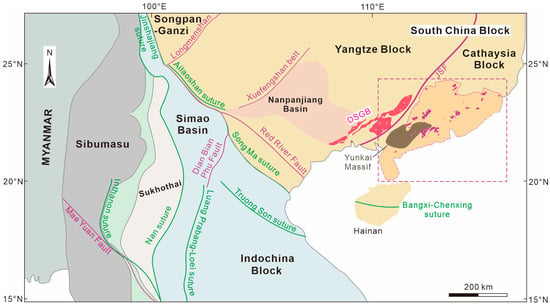
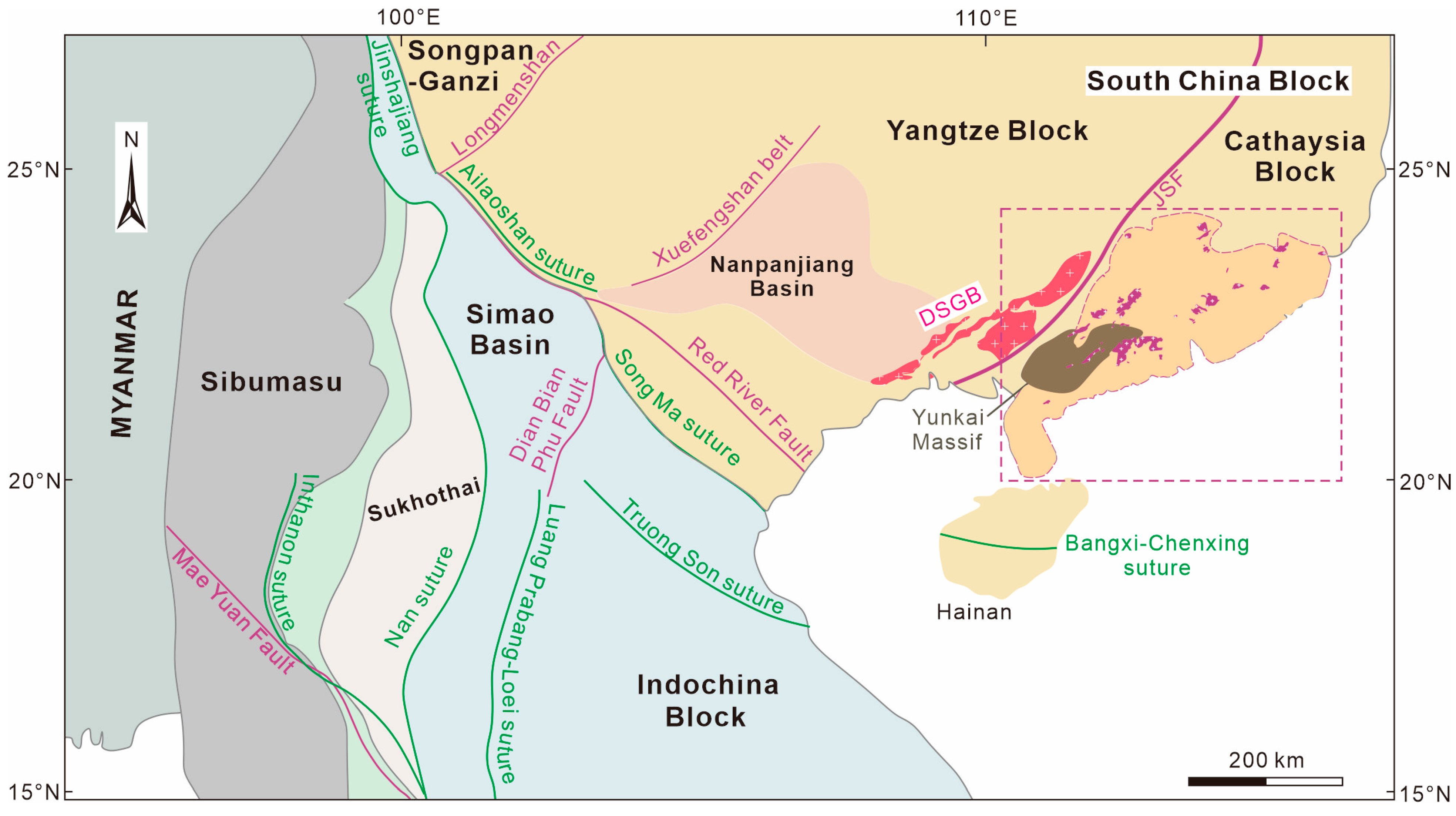
The SCB, a fundamental continental component of East Asia, was formed through the Neoproterozoic amalgamation of the Yangtze and Cathaysia blocks (ca. 1.0–0.8 Ga) [3,4,15,16]. This composite block is bounded by four major structural features (Figure 1): the Qinling–Dabie–Sulu orogen to the north; the Ailaoshan–Song Ma suture zone (marking Paleo-Tethyan closure) separating it from the ICB to the south; the Longmenshan Fault (related to Cenozoic Tibetan Plateau uplift) abutting the Songpan–Gantze Block to the west; and the subducting Pacific Plate, which has influenced its Mesozoic–Cenozoic evolution to the east.
Figure 1.
Simplified tectonic framework of Southeast Asia showing major crustal blocks, suture zones, and Indosinian granites in Guangdong Province [6,7]. DSGB = Darongshan–Shiwandashan Granitic Belt; JSF = Jiangshan–Shaoxing Fault.
The basement architecture reveals fundamental compositional differences between the constituent blocks. The Cathaysia Block comprises Paleoproterozoic (ca. 2.0–1.8 Ga) granitoids, paragneisses, migmatites, and minor amphibolites recording intense crustal anatexis. In contrast, the Yangtze Block contains older Archean to Paleoproterozoic (ca. 3.8–1.8 Ga) tonalite–trondhjemite–granodiorite (TTG) gneisses intercalated with metasedimentary rocks [4]. Phanerozoic tectono–sedimentary evolution progressed through several distinct stages. During the Cambrian–Ordovician period, a transition from siliciclastic-dominated to mixed carbonate–siliciclastic sedimentation reflects a shift from a passive margin to stable platform conditions [17]. The Silurian period saw thick siliciclastic successions accumulate in the Yangtze Block under shallow marine to coastal plain settings, while the Cathaysia Block experienced widespread Caledonian orogeny-related magmatism, ductile deformation, and low-to-high-grade metamorphism [18]. Carboniferous–Permian tectonic quiescence enabled stable carbonate platform development across both blocks [15]. The Permian–Triassic (Indosinian Orogeny) period marked a major transition, characterized by large-scale folding, thrusting, and granitic magmatism linked to Paleo-Tethyan closure and SCB–ICB collision [19]. Jurassic–Cretaceous (Yanshanian Orogeny) evolution was dominated by Paleo-Pacific Plate subduction, triggering widespread granitoid emplacement and a shift from marine to terrestrial sedimentation [20,21]. The SCB’s tectonic framework was profoundly reworked during the Triassic Indosinian orogeny—a pivotal event in assembling modern Southeast Asia. This orogeny was caused by the closure of the Paleo-Tethys Ocean and the subsequent continent–continent collision between the SCB and ICB to the southwest [22,23], marked by the NW–SE-trending Jinshajiang–Ailaoshan–Song Ma tectonic zone (Figure 1). The Indosinian event generated extensive intracontinental deformation, high-grade metamorphism, and voluminous granitoid emplacement across the SCB interior, far from the main suture zone [1,2,11,14].
Guangdong Province, situated in the southeastern SCB, hosts a significant belt of these Indosinian granitoids (Figure 2). Magmatism intensified during the Early–Middle Triassic (Early Indosinian), with intrusive activity strongest in western and central regions, while remaining subdued in northern and eastern areas [24,25]. The Indosinian granitoids in Guangdong are distributed along two NE–SW-trending tectono–magmatic belts (Neihan–Deqing–Hetai and Xinxing–Shaodongjing–Xinwei), along with numerous smaller plutons in northern and eastern Guangdong (e.g., Taibao, Shixing, and Yehua) [14]. This distribution reveals a decrease in the magmatic intensity both from north to south and from west to east. By the Late Triassic–Jurassic, the province transitioned to an active continental margin setting, driving large-scale magmatic intrusions and volcanic eruptions [26]. Since the Middle–Late Jurassic period, Guangdong has been incorporated into the western Pacific active margin trench–arc–basin system, where frequent tectonic activity drove extensive Yanshanian magmatism [27,28].
Figure 2.
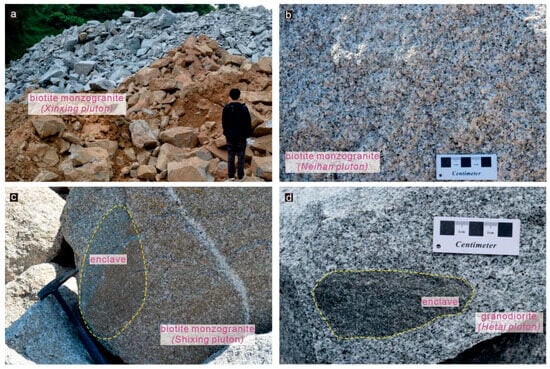
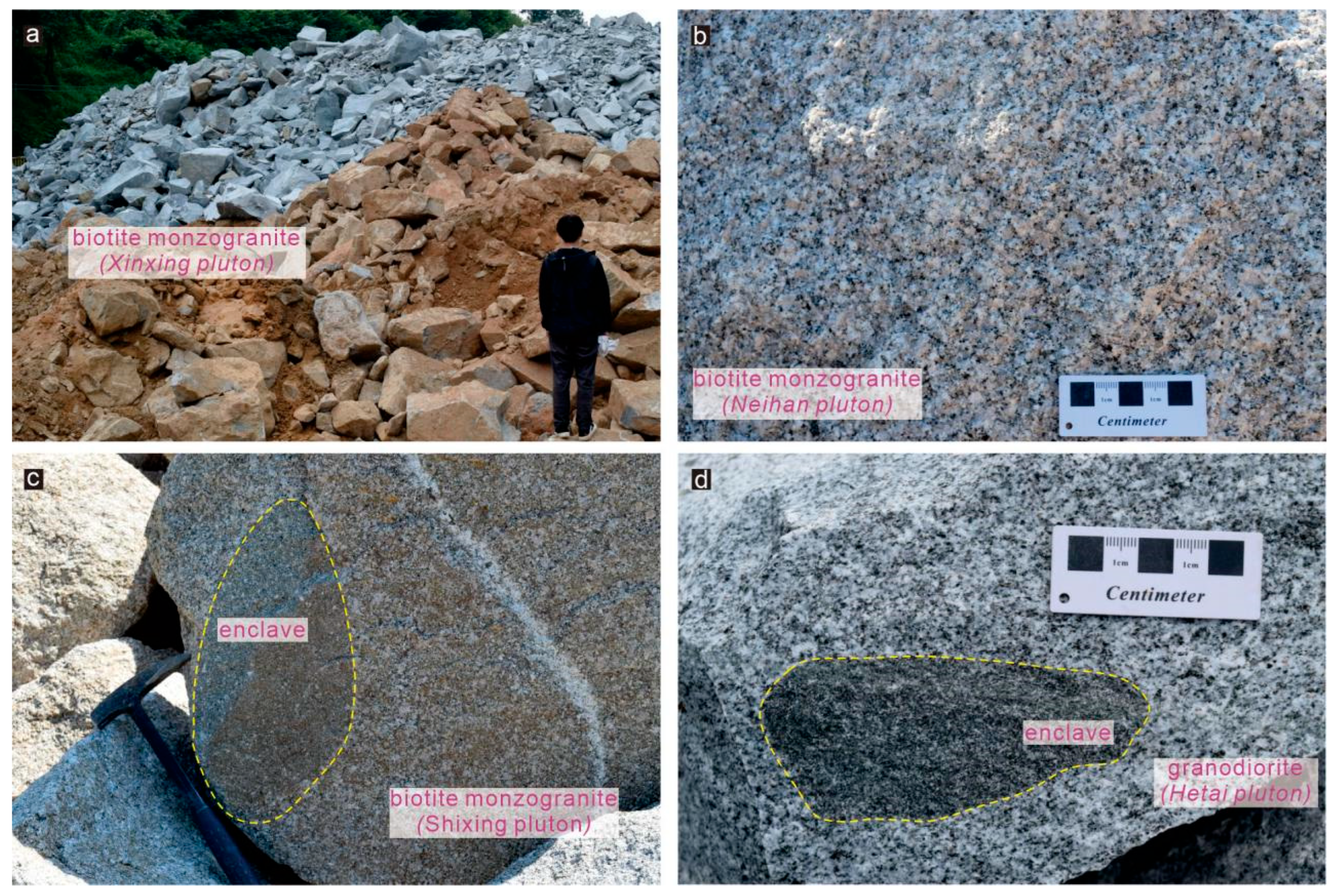
Field photographs of Indosinian granitoids in Guangdong Province. (a,b) Coarse-grained biotite monzogranite from the Xinxing and Neihan plutons. (c) Coarse-grained biotite monzogranite from Shixing pluton containing an enclave (30 cm × 20 cm). (d) Granodiorite from the Hetai pluton with an enclave (12 cm × 5 cm).
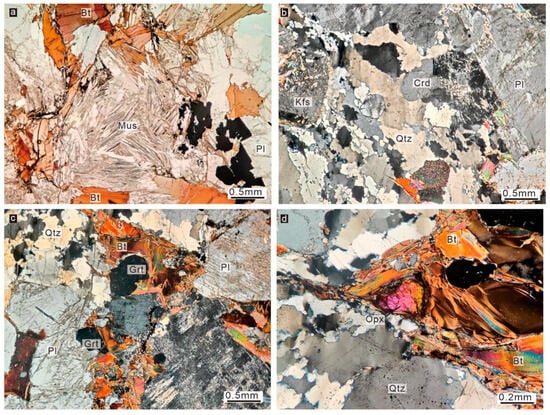
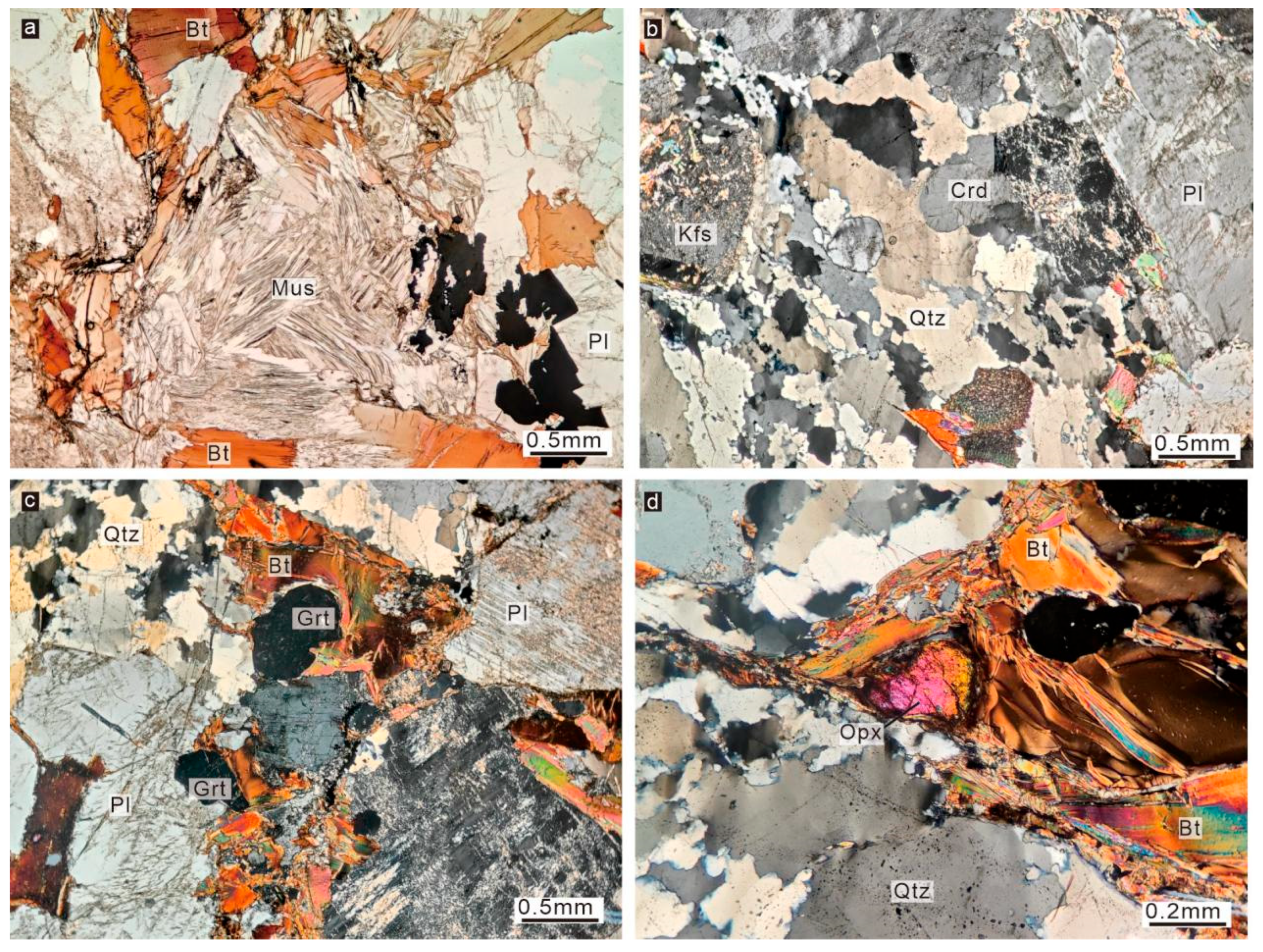
The NE–SW-trending Indosinian granitoids in Guangdong extend into neighboring Guangxi Province (e.g., the Darongshan–Shiwandashan Granitic Belt), collectively forming the largest granite massif within the SCB [13]. The Darongshan–Shiwandashan Granitic Belt in eastern Guangxi Province constitutes a major NE–SW-trending igneous province spanning >10,000 km2 (400 km × 20–75 km). These granitoids exhibit high-K calc-alkaline compositions and weakly to strongly peraluminous S-type affinities, characterized by peraluminous minerals [9,11]. Zircon SHRIMP/LA–ICP–MS U–Pb and monazite EMPA U–Th–Pb dating reveal a protracted magmatic history spanning 265–224 Ma [14,29,30,31]. Indosinian granitoids in Guangdong Province consists predominantly of granites and granodiorites, with minor syenites (Figure 2a,b). These granitoids are predominantly peraluminous (S-type), containing diagnostic minerals such as muscovite, aluminum-rich garnet, cordierite, and orthopyroxene (Figure 3). A ubiquitous feature is the presence of enclaves (Figure 2c,d), which provide direct field evidence for the interaction between felsic crustal melts and more mafic, mantle-derived magmas.
Figure 3.
Photomicrographs showing petrographic features of Indosinian granitoids from the Neihan pluton, Guangdong Province. (a,b) Two-mica granite containing peraluminous minerals such as muscovite (Mus) and cordierite (Crd). (c,d) Two-mica granite containing high-temperature minerals including garnet (Grt) and orthopyroxene (Opx). Mineral abbreviations: Qtz = quartz, Pl = plagioclase, Kfs = K-feldspar, Bt = biotite.
2.2. Data Compilation and Synthesis
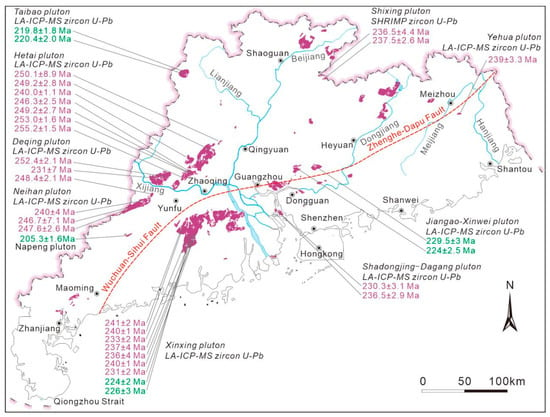
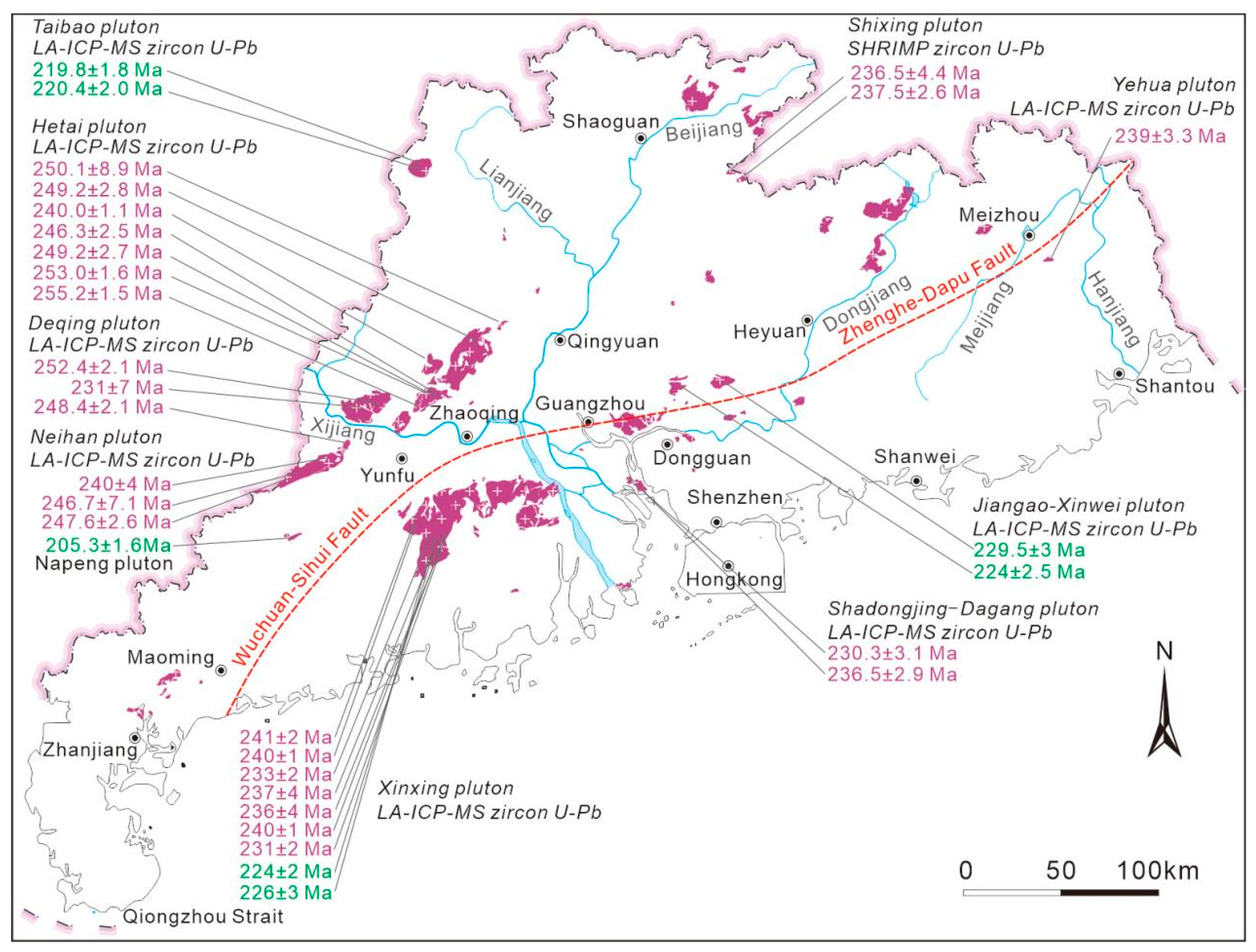
This study integrates a comprehensive synthesis of the published geoscientific literature [14,30,31,32,33], regional geological reports [24,25], and 1:50,000-scale geological survey data from Guangdong Province. Our analysis focuses on representative samples from major plutons including Neihan, Deqing, Hetai, Napeng, Xinxing, Sanhe, Jiangao–Xinwei, Shaodongjing, Dayanshan, Dagang, Huangshanlv, Shixing, Yehua, and Taibao (Figure 4).
Figure 4.
Spatial distribution of published geochronological data for Early and Late Indosinian granitoids in Guangdong Province. Data sources are listed in Supplementary Table S1.
The compiled database encompasses four integrated components: (1) detailed petrographic descriptions and mineral chemistry data, particularly for peraluminous phases; (2) thirty-two representative LA–ICP–MS and SHRIMP zircon U–Pb ages (Supplementary Table S1); (3) a comprehensive dataset of 113 whole-rock major and trace element compositions for representative samples and their hosted enclaves (Supplementary Tables S2 and S3); and (4) forty-nine whole-rock Sr–Nd analyses (Supplementary Table S4) and one hundred eighty-seven in situ zircon Hf analyses from these granitoids and hosted enclaves (Supplementary Table S5).
Our synthesis systematically evaluates spatial and temporal variations in their age, geochemical composition, isotopic signature, and estimated P–T conditions. We focus on (1) the spatiotemporal distribution and evolutionary characteristics of Indosinian granites in Guangdong Province and (2) the petrogenesis and geodynamic processes responsible for their formation, with particular emphasis on evaluating the significance of crust–mantle interaction signatures.
3. Geochronology
Indosinian granitoids in Guangdong span 253–205 Ma, divisible into two distinct episodes: Early Indosinian (253–230 Ma) and Late Indosinian (230–205 Ma) (Figure 4) [31,33]. Early Indosinian granitoids dominate the province, forming major batholiths and plutons including Neihan, Deqing, and Hetai in western Guangdong, and Xinxing, Shaodongjing, Xinwei, and Yehua further east. The western Neihan–Deqing–Hetai belt is characterized by high-temperature (HT) cordierite- and/or orthopyroxene-bearing S-type granites and granodiorites [33]. These HT granitoids crystallized under exceptionally high temperatures (up to 820 °C) and at low pressures (~3–6 kbar), indicating elevated geothermal gradients during formation. A key regional pattern emerges from the spatial-age distribution: emplacement ages systematically young from west (~253–250 Ma for Neihan–Deqing–Hetai) to east (~240–230 Ma for Xinxing–Shaodongjing–Xinwei and Yehua). Distinct spatial zonation also occurs within individual plutons; the Xinxing pluton displays ages of ~240 Ma in its western portion and ~237–231 Ma and 226–224 Ma in the east [31]. This pronounced eastward younging trend provides compelling evidence for diachronous Indosinian magmatism in Guangdong, implying the eastward migration of the thermal center during the Early Indosinian.
The Late Indosinian phase (230–200 Ma) represents a less voluminous but spatially scattered episode, primarily expressed in the Xinxing, Jiangao–Xinwei, and Taibao plutons (Figure 4). The most prominent representative is the Taibao pluton in northern Guangdong, which exhibits distinct petrological and geochemical characteristics compared to other Indosinian suites. Given that the closure of the eastern Paleo-Tethys Ocean occurred between 260 and 250 Ma [1,2], the Late Indosinian granitoids likely formed during collision-related crustal thickening or post-collisional extension [9].
4. Whole-Rock Geochemistry and Sr–Nd–Hf Isotopes
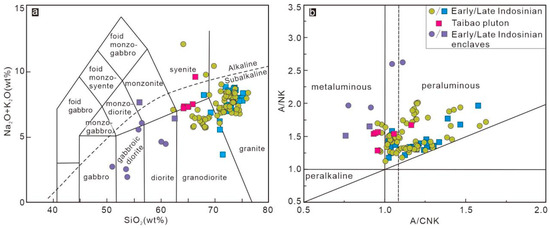
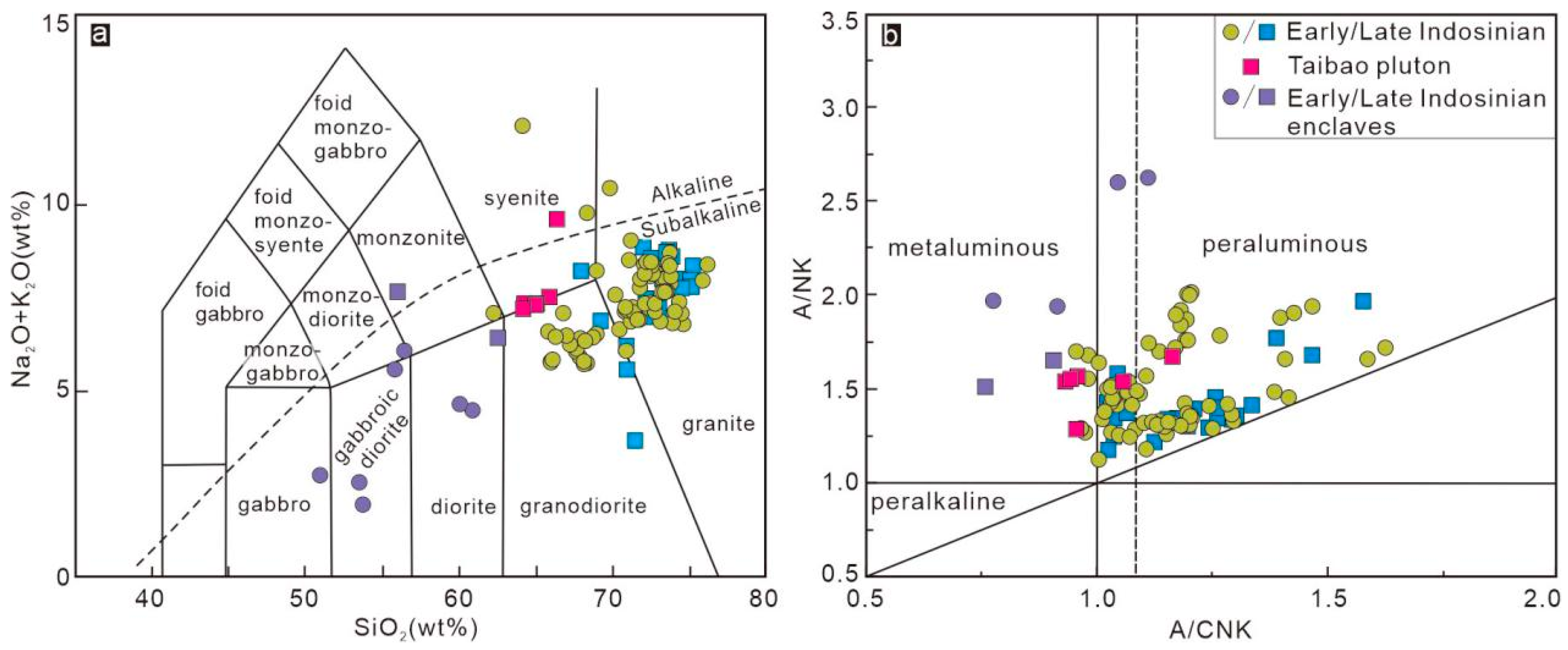
Early Indosinian granitoids (n = 79) exhibit significant major element variations, with ranges as follows: SiO2 (62.3–76.2 wt%), Al2O3 (11.0–18.1 wt%), FeOT (0.69–5.91 wt%), MgO (0.10–2.47 wt%), CaO (0.13–3.90 wt%), and K2O (1.75–8.80 wt%). On the Total Alkalis–Silica (TAS) diagram (Figure 5a) [34], they mostly plot within the sub-alkaline field. Their A/CNK values (0.96–1.12; mean = 1.15) indicate strongly peraluminous affinity (Figure 5b) [35]. Late Indosinian granitoids (n = 25) show comparable compositional ranges: SiO2 (64.2–75.3 wt%), Al2O3 (11.8–16.2 wt%), FeOT (1.17–6.46 wt%), MgO (0.15–2.04 wt%), CaO (0.19–3.54 wt%), and K2O (2.85–6.50 wt%), with A/CNK values (0.93–2.56; mean = 1.22) confirming their peraluminous character (Figure 5b). Notably, Taibao granitoids display lower A/CNK values (0.93–1.17; mean = 1.00), approaching metaluminous affinity. Enclaves (n = 9) are basaltic to andesitic in composition and characterized by lower SiO2 (51.0–62.6 wt%) and K2O (1.44–3.53 wt%), higher FeOT (5.77–11.4 wt%), MgO (2.31–9.18 wt%), and CaO (1.93–6.76 wt%), with comparable Al2O3 (14.0–16.4 wt%) relative to the host granitoids.
Figure 5.
Geochemical classification diagrams for the Indosinian granitoids. (a) Na2O + K2O vs. SiO2 (TAS) [34]. (b) A/CNK vs. A/NK diagram [35].
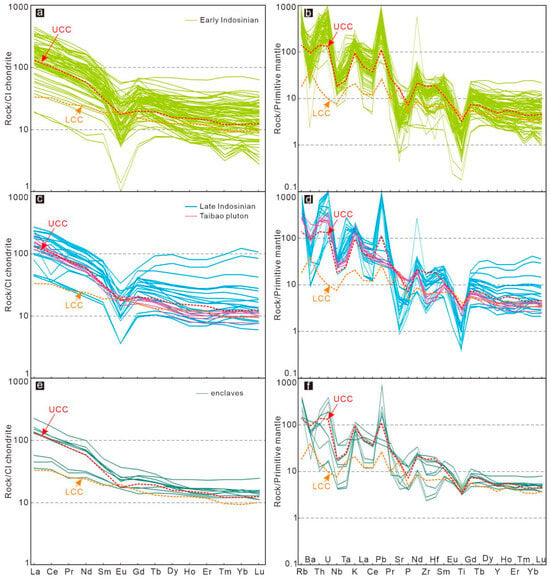
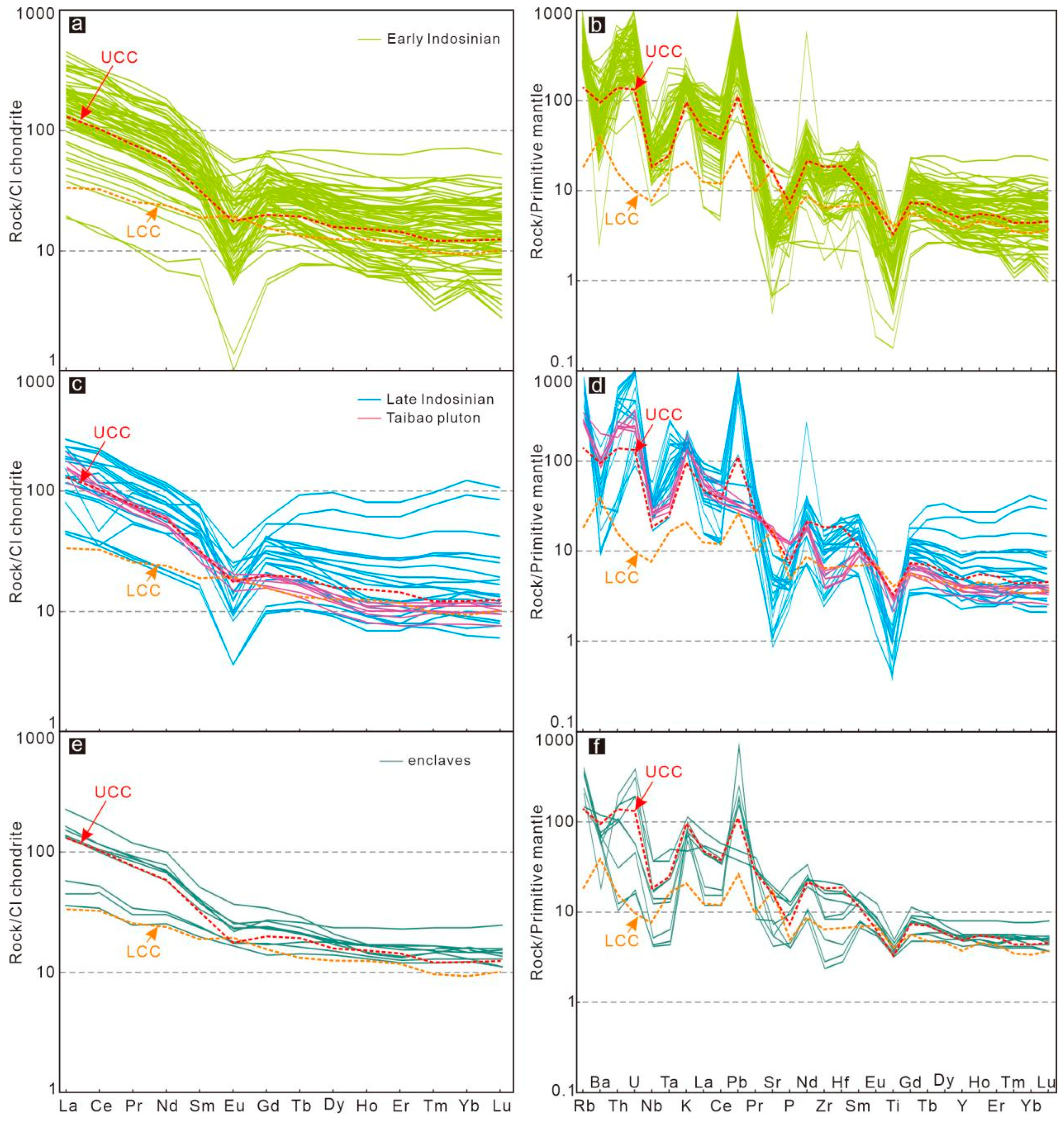
Chondrite-normalized REE patterns and primitive-mantle normalized spider diagrams reveal similarities between Early and Late Indosinian granitoids. Early Indosinian samples show (La/Yb)N ratios of 1.56–137 (mean = 15.4) and pronounced negative Eu anomalies (Eu/Eu* = 0.10–0.78, mean = 0.39, excluding two outliers at 1.1 and 1.3; Figure 6a). Late Indosinian granitoids exhibit lower (La/Yb)N variations (0.85–17.7, mean = 9.3) and higher Eu anomalies (Eu/Eu* = 0.23–0.85, mean = 0.48) (Figure 6c). Taibao granitoids display distinctively higher (La/Yb)N ratios (13.4–17.7, mean = 15.7) and Eu/Eu* values (0.73–0.85, mean = 0.79). Enclaves also show elevated (La/Yb)N ratios (2.9–14.2, mean = 7.8) and Eu/Eu* values (0.65–0.97, mean = 0.82) (Figure 6e). All units exhibit enrichment in large-ion lithophile elements (LILEs: Rb, Th, U, K, and Pb) and depletion in high-field-strength elements (HFSEs: Nb, Ta, P, and Ti) on primitive-mantle normalized diagrams (Figure 6b,d,f), with trace element patterns resembling the upper continental crust (UCC) [36].
Figure 6.
Chondrite-normalized REE patterns (a,c,e) and primitive mantle-normalized trace element diagrams (b,d,f) for Early Indosinian granitoids, Late Indosinian granitoids (including the Taibao pluton), and associated enclaves in Guangdong Province [36,37]. Data sources are provided in Supplementary Table S3.
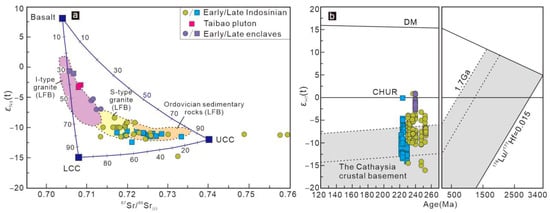
Whole-rock Sr–Nd isotopic compositions vary significantly. Early Indosinian granitoids (n = 40) show variable initial 87Sr/86Sr ratios (0.67365–0.76065) and εNd(t) values (−14.7 to −8.3), yielding two-stage depleted mantle model ages (T2DM) of 1.61–2.21 Ga (mean = 1.73 Ga; Figure 7a). Late Indosinian granitoids (n = 18) have initial 87Sr/86Sr ratios of 0.70728–0.73326, εNd(t) values of −12.3 to −2.89, and T2DM ages of 1.30–1.74 Ga (mean = 1.60 Ga). Taibao granitoids (n = 3) display fewer evolved signatures: lower initial 87Sr/86Sr ratios (0.70728–0.70786), higher εNd(t) values (−3.24 to −2.89), and younger T2DM ages (1.30–1.35 Ga). In contrast, enclaves (n = 6) exhibit the juvenile isotopic compositions: initial 87Sr/86Sr ratios (0.70571–0.71350), εNd(t) values (−6.97 to −0.64), and T2DM ages of 1.10–1.58 Ga (mean = 1.38 Ga; Figure 7a).
Figure 7.
Isotopic characteristics of Indosinian granitoids from Guangdong. (a) Initial Sr–Nd isotopic composition, shown with mixing curves between three end-members: Basalt (εNd = +8, 87Sr/86Sr = 0.704), Lower Continental Crust (LCC; εNd = −15, 87Sr/86Sr = 0.708), and Upper Continental Crust (UCC; εNd = −12, 87Sr/86Sr = 0.74) [38]. Data for Ordovician sedimentary rocks and S- and I-type granites are from the Lachlan Fold Belt (LFB) [39]. (b) Zircon Hf isotopic data for the Indosinian granitoids.
Zircon Hf isotopic data further distinguish these units. Early Indosinian zircons (n = 97) yield εHf(t) values of −15.9 to 0.90 (mean = −7.20) and T2DM ages of 1.20–2.28 Ga (mean = 1.73 Ga) (Figure 7b). Late Indosinian zircons (n = 61) show more evolved εHf(t) values (−26.0 to −0.10; mean = −9.96) and older T2DM ages (1.27–3.30 Ga; mean = 1.93 Ga). Enclave zircons (n = 29) exhibit significantly higher εHf(t) values (−2.60 to 1.00; mean = −1.37) and younger T2DM ages (1.22–1.44 Ga; mean = 1.36 Ga) (Figure 7b).
5. Discussion
5.1. Nature of Magma Sources and Petrogenetic Processes
The Indosinian granitoids in Guangdong Province are derived from crustal sources, as indicated by a convergence of petrographic, geochemical, and isotopic evidence. Petrographically, their classification as S-type granites is established by the prevalence of peraluminous minerals like muscovite, Al-rich garnet, and cordierite (Figure 3), and by strongly peraluminous bulk compositions (A/CNK = 0.96–2.56; mean = 1.18; Figure 5b) [11,12]. Geochemically, most plutons are remarkably uniform, displaying classic S-type signatures: high differentiation indices (DI = 79.2–95.2 for the Neihan, Deqing, and Hetai plutons) [33], pronounced LREE enrichment [(La/Yb)N = 0.85–136], and significant negative Eu anomalies (Eu/Eu* = 0.10–0.85). Primitive mantle-normalized patterns show enrichment in LILE (Rb, Th, U, K, Pb) and depletion in HFSE (Nb, Ta, P, Ti), a fingerprint of crustal melting. The presence of inherited Paleozoic–Proterozoic zircons [30,33], further confirms the involvement of ancient crustal materials.
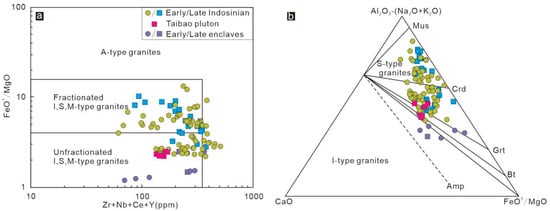
Radiogenic isotopes further corroborate this crustal origin [31,33]. The granitoids possess evolved Sr–Nd–Hf compositions, including high initial 87Sr/86Sr ratios (0.67365–0.76065), uniformly negative εNd(t) values (−14.7 to −8.3), and zircon εHf(t) values from −26.0 to 0.90. Proterozoic model ages (TDM2 = 1.61–2.21 Ga for Sr–Nd; 0.98–3.03 Ga for Hf) point to Paleoproterozoic metasedimentary protoliths, setting them apart from more juvenile, coeval I-type granites in the SCB [31]. Discrimination diagrams reinforce this S-type classification, with most samples plotting within the S-type domain, whereas the Taibao granitoids and enclaves fall into unfractionated and transitional I-S-type fields, respectively (Figure 8).
Figure 8.
Rock type classification for the Indosinian granitoids. (a) FeOT/MgO vs. Zr + Nb + Ce + Y [40]; (b) CaO–FeOT + MgO–Al2O3–(Na2O + K2O) [41]. Data sources are provided in Supplementary Tables S2 and S3.
Despite the dominant crustal signature, the extent of mantle involvement in their genesis is a key point of debate. While a purely crustal melting model has been proposed based on characteristic S-type features [42,43,44], a hybrid origin involving mantle-derived magmas is increasingly supported. Xu et al. [12] suggested mantle-derived magmas acted as essential mafic end-members, a view consistent with the coexistence of ~250 Ma granitoids and mafic enclaves in the Darongshan–Shiwandashan belt [13]. Experimental petrology also supports this, showing that most S-type granitoids incorporate minor basaltic contributions rather than representing pure crustal melts [45].
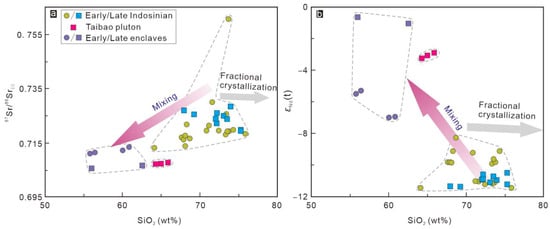
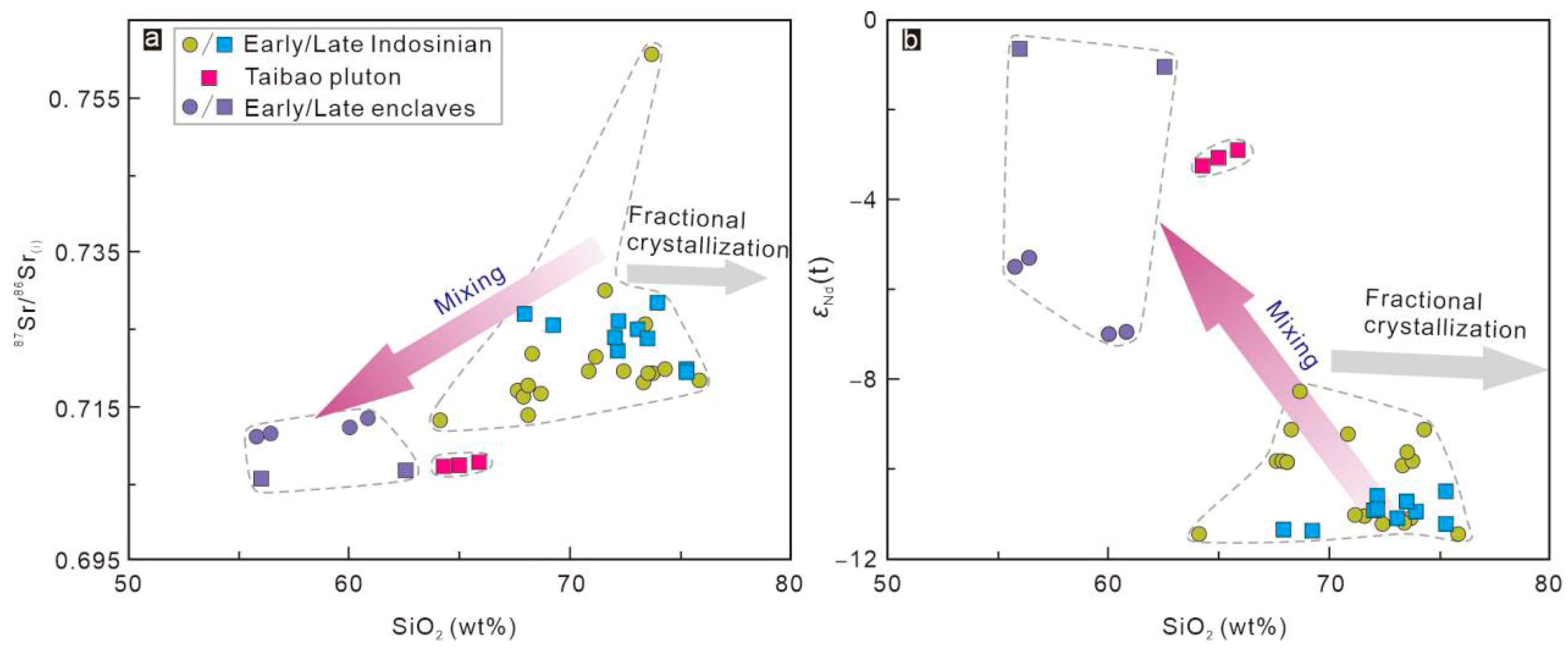
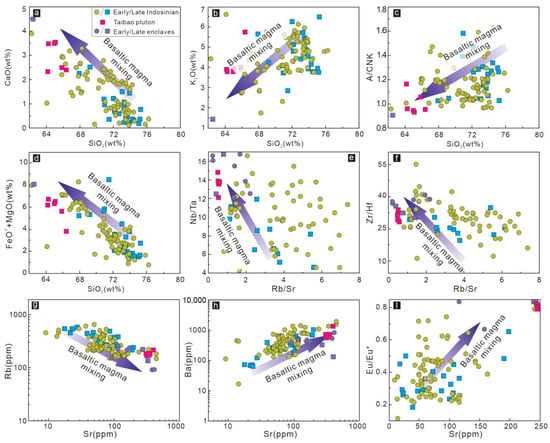
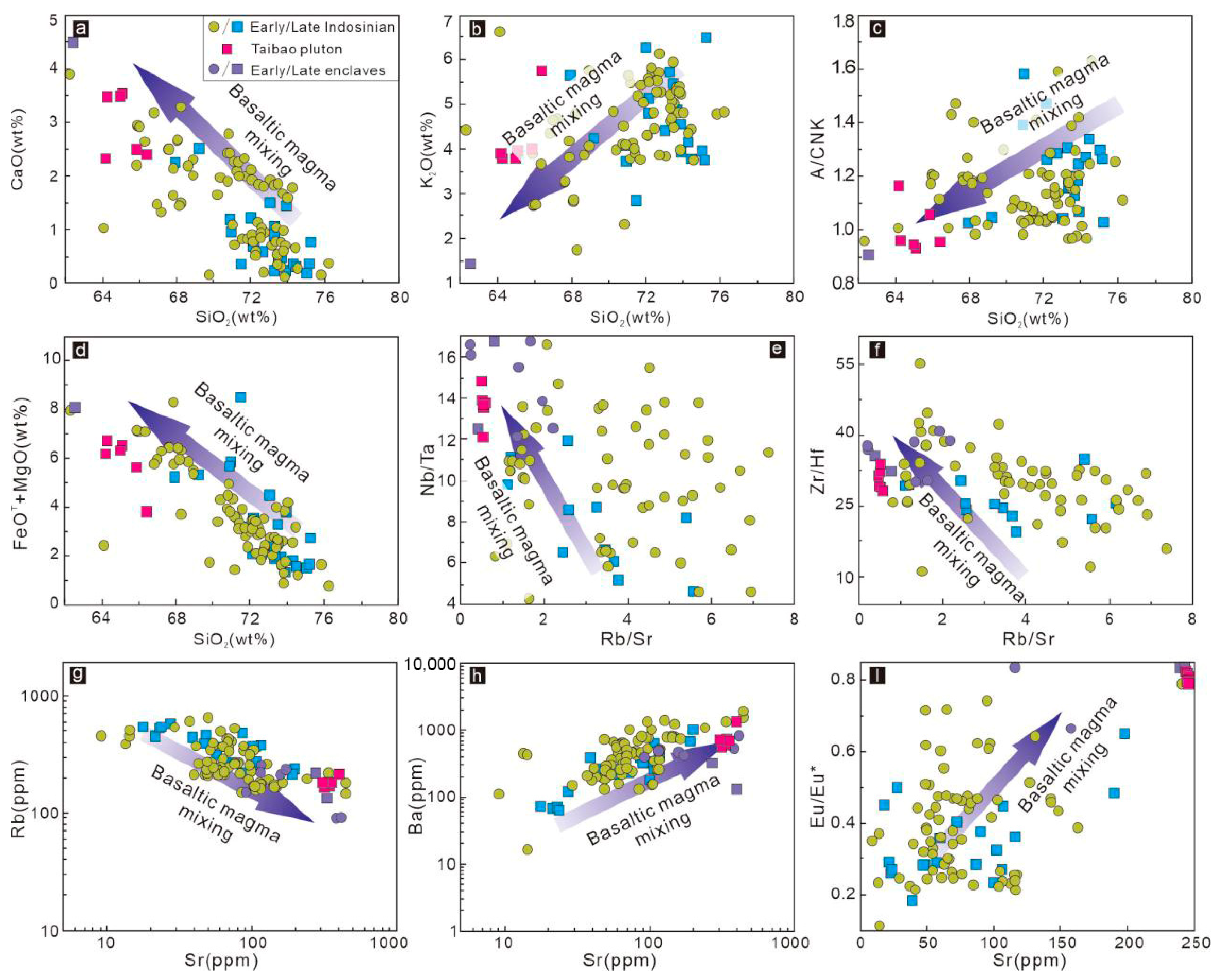
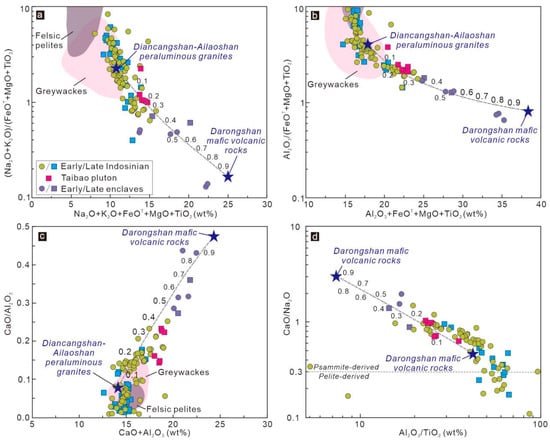
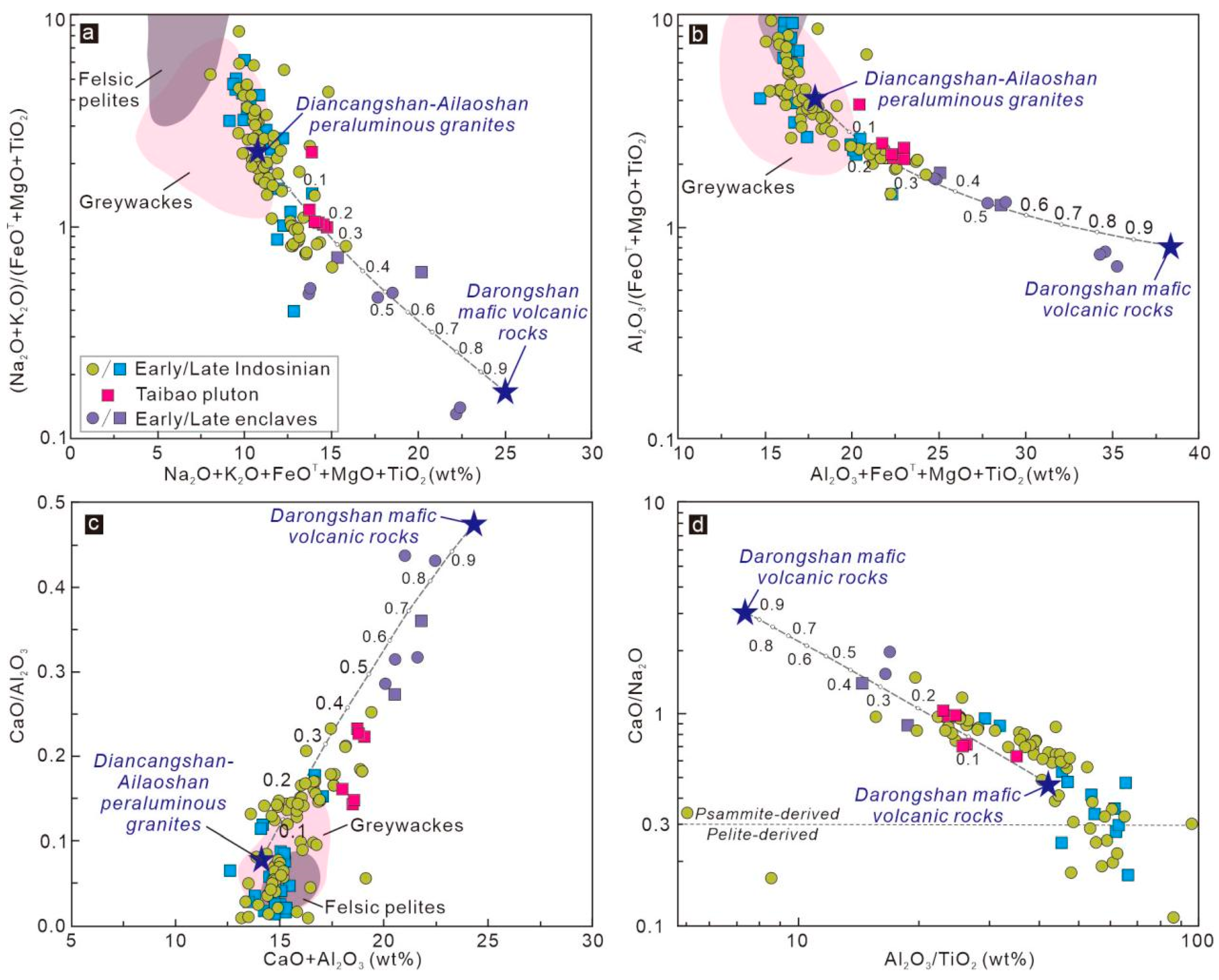
The isotopic data reveal significant source heterogeneity best explained by magma mixing (Figure 7a). High and variable initial 87Sr/86Sr ratios (0.67365–0.76065) reflect mixing between diverse Sr reservoirs. The positive covariance between SiO2 and 87Sr/86Sr(i)t and the negative covariation between SiO2 and εNd(t) for the Early Indosinian granitoids further support the magma mixing (Figure 9). We propose that variable degrees of mixing between crustal and mantle-derived magmas are the most plausible explanation for the compositional variability of the Guangdong Indosinian granitoids. Plots of initial 87Sr/86Sr vs. εNd(t) indicate derivation from three end-members: the mantle-derived basaltic magma, lower continental crust (LCC), and upper continental crust (UCC). Quantitative estimates suggest mantle-derived mafic contributions of 0–30% for most Indosinian granitoids. The Taibao granitoid, however, stands in marked contrast. It exhibits lower SiO2, A/CNK, Rb, and Rb/Sr, but higher CaO, FeOT + MgO, Ba, Sr, Nb/Ta, Zr/Hf, and Eu/Eu* (Figure 10). Isotopically, it is significantly less evolved, with lower initial 87Sr/86Sr (0.70728–0.70786), higher εNd(t) values (−3.24 to −2.89), and younger T2DM ages (1.30–1.35 Ga), indicating a substantial mantle contribution (~60%) (Figure 7a). The enclaves provide further evidence; they are compositionally distinct from their hosts, with lower SiO2 (51.0–62.6 wt%) and higher FeOT (5.77–11.4 wt%), MgO (2.31–9.18 wt%), CaO (1.93–6.76 wt%), and TiO2 (0.70–1.11 wt%). Their juvenile isotopic signatures, including Sr–Nd isotope [87Sr/86Sr(i) = 0.70571–0.71350, εNd(t) = −6.97 to −0.64 (mean = 1.38 Ga)] and zircon Hf isotope [εHf(t) = −2.60 to 1.00 (mean = −1.37), and T2DM = 1.22–1.44 Ga (mean = 1.36 Ga)], closely resemble Taibao granitoids, with estimated mantle contributions of 40–65%. Furthermore, compositional deviations from experimental melts of metasedimentary rocks further support the addition of mantle-derived mafic components. Regional end-members for magma mixing include the Diancangshan–Ailaoshan S-type granites (254–248 Ma [46]) as crustal end-members and the Darongshan mafic volcanic rocks as mantle end-members [13]. Quantitative mixing modeling confirms mantle contributions of 0–30% for most granitoids, 20–40% for the Taibao granitoids, and 40–85% for enclaves (Figure 11).
Figure 9.
Plots of (a) initial 87Sr/86Sr vs. SiO2 and (b) εNd(t) vs. SiO2 for the Indosinian granitoids of Guangdong Province. Detailed isotopic data are provided in Supplementary Tables S4 and S5.
Figure 10.
Variations of major and trace element compositions for the Indosinian granitoids of Guangdon. (a–d) CaO, K2O, A/CNK, and FeOT+MgO vs. SiO2. (e,f) Nb/Ta and Zr/Hf vs. Rb/Sr. (g–i) Rb, Ba and, Eu/Eu* vs. Sr. The blue arrow indicates the differentiation trend potentially influenced by basaltic magma mixing. Data sources are listed in Supplementary Tables S2 and S3.
Figure 11.
Compositional comparison of the Indosinian granitoids from Guangdong with experimental melts derived from various metasedimentary sources [45,47]. (a) (Na2O + K2O)/(FeOT + MgO + TiO2) vs. Na2O + K2O + FeOT + MgO + TiO2; (b) Al2O3/(FeOT + MgO + TiO2) vs. Al2O3 + FeOT + MgO + TiO2; (c) CaO/Al2O3 vs. CaO+Al2O3; (d) CaO/Na2O vs. Al2O3/TiO2. The Darongshan mafic volcanic rocks and the Diancangshan–Ailaoshan peraluminous granites (interpreted as pure sediment-derived melts) are plotted as two end members [12,13,46]. Numbers along the mixing curves indicate the proportion (in %) of the Darongshan mafic component. Data for the Guangdong Indosinian granitoids are from Supplementary Table S2.
A hybrid origin is further supported by compositional deviations from experimental melts of metasedimentary rocks. The average FeOT (2.89 wt%) and MgO (0.79 wt%) contents in most granitoids match experimental melts, but Taibao granitoids (FeOT = 4.13 wt%; MgO = 1.75 wt%) and enclaves (FeOT = 7.82 wt%; MgO = 5.20 wt%) are significantly more mafic [48]. This Fe–Mg excess necessitates input from a mafic component, consistent with magma mixing and the ubiquitous presence of enclaves (Figure 2c,d). While peritectic garnet entrainment has been proposed to explain mafic compositions, key observations argue against this: (1) garnets commonly display irregular zoning indicative of magmatic, not peritectic, origins [13], and (2) critical peritectic indicators (sillimanite, orthopyroxene) are absent [33]. Therefore, peritectic mineral entrainment had a negligible influence on the bulk chemistry.
In conclusion, Sr–Nd–Hf isotopic and geochemical trends indicate that the Indosinian granitoids are formed via complex crustal anatexis with variable mantle-derived inputs. Most granitoids represent S-type melts with minor mantle contributions (0–30%), while Taibao granitoids and mafic enclaves record significantly greater mantle components (40–65%). This hybrid petrogenetic model reconciles the dominant S-type mineralogical and geochemical characteristics with compelling evidence for mantle involvement, highlighting that the degree of the crust–mantle interaction, rather than source heterogeneity alone, is the principal control on their compositional diversity.
5.2. Geodynamic Implications
The integrated petrogenetic and geochronological data from the Guangdong granitoids provide robust constraints on their geodynamic setting during the Indosinian orogeny [2,14]. The bimodal age distribution records two distinct thermal events. The predominant ~250 Ma cluster marks the main magmatic pulse, contemporaneous with the peak of the SCB–ICB collision [1,49]. This temporal correlation is evident with widespread Early Indosinian magmatism across the SCB, including the Darongshan–Shiwandashan belt (Guangxi; ~250 Ma [13]), central Hunan (244–239 Ma [1,50]), Fujian (242–232 Ma [8,29]), and Hainan (267–262 Ma [51]), thus signifying a regional thermal event. The subordinate ~230–220 Ma ages represent a later, post-collisional event characterized by crustal reworking and localized melting [31].
These granitoids, as archives of Southeast Asia’s assembly, are central to several competing geodynamic hypotheses: (1) thermal perturbation from the Emeishan mantle plume [7,52,53]; (2) westward Paleo-Pacific Plate subduction [11,12,46]; and (3) crustal thickening-driven anatexis during syn- to post-collisional stages of the SCB–ICB amalgamation following the northward subduction of the Paleo-Tethys Ocean [9,10,13,19,33]. Our data reveal fundamental inconsistencies with the first two models. The Emeishan plume model is challenged on both chronological and spatial grounds. The main phase of plume activity ceased at 259 Ma [54], creating a temporal hiatus of ~10 Ma before the onset of major granitoid magmatism. Spatially, the distance from the proposed plume center to the Darongshan area (>900 km) far exceeds the estimated radius of the plume’s thermal influence (660 km [55]), rendering a direct causal link implausible. The Paleo-Pacific subduction model is similarly untenable. A notable absence of coeval late Permian–Middle Triassic arc magmatic records within the SCB argues against an active subduction zone at that time [29]. Furthermore, the initiation of the Paleo-Pacific subduction beneath East Asia is robustly constrained to the Jurassic [56], postdating the Indosinian event. Petrologically, the reducing, low-pressure mineral assemblages characteristic of these S-type granites are atypical of typically more oxidized subduction zone magmas generated in subduction zones [9].
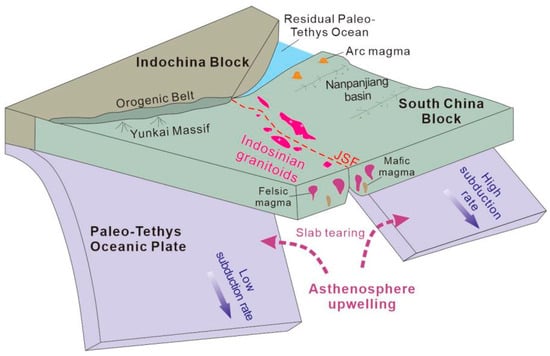
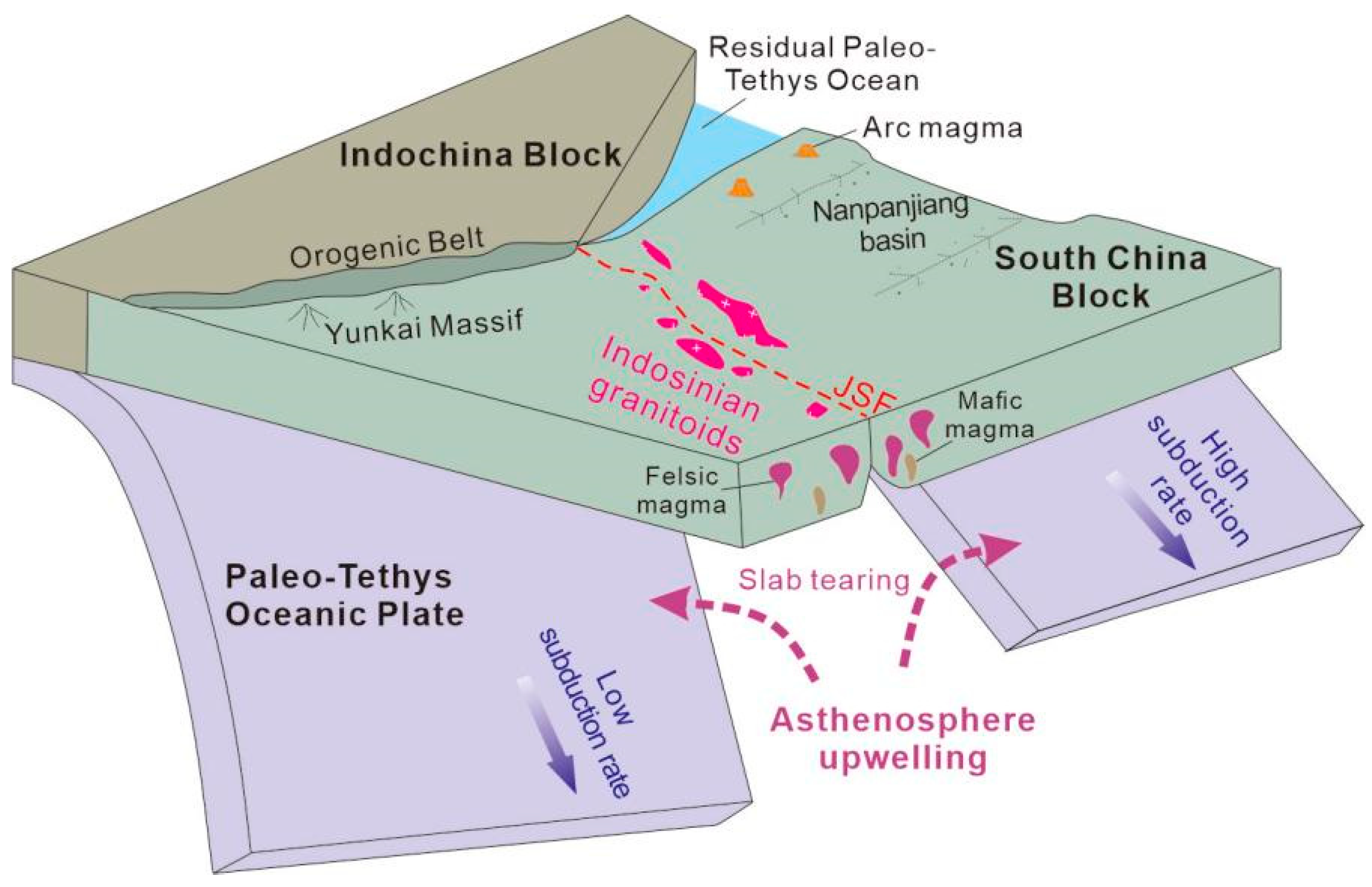
Consequently, northward Paleo-Tethys Ocean subduction and the ensuing SCB–ICB collision emerge as the only viable framework. This collision (250–230 M [1]) provided the tectonic driver for crustal thickening and the initial melting of the metasedimentary crust, which generated the voluminous ca. 250 Ma S-type granites [7]. The SCB–ICB collision is widely regarded as the primary driver of Early Indosinian magmatism, initiated during the Late Permian period (267–262 Ma [50]), which triggered basement metamorphism in Vietnam and widespread zircon crystallization (U–Pb ages: 258–243 Ma [22,23]). The collision reached its acme between 250 and 230 Ma [1], predating the high-grade metamorphic peak in the Qinling–Dabie–Sulu orogenic belt (228–209 Ma [57]). This temporal progression of magmatism and metamorphism defines a south–to–north younging trend for Indosinian tectonic events across East China, consistent with a model of sequential continental collisions: first between the SCB and ICB, followed by the SCB–North China Craton collision. However, this collisional framework alone cannot resolve a critical spatial paradox: the formation of a major, high-temperature granitoid belt oriented perpendicular to the orogenic front. The pure crustal thickening model is further challenged by the quantitative insufficiency of radiogenic heating to produce high-temperature melts without an additional mantle heat source [11], and by petrological constraints indicating low-pressure crystallization conditions [9,10]. Furthermore, the NE–SW trending granitoid belt is orthogonal to the NW–SE trending Jinshajiang–Ailaoshan–Song Ma suture zone, the principal collisional front (Figure 1). This orthogonal relationship is inconsistent with the typical generation of magmatic belts, which are generally parallel to orogenic fronts in classic collisional or post-collisional extensional settings. To reconcile these observations, we propose that the slab tearing of the subducting Paleo-Tethys slab acted as the direct, localized catalyst within the broader collisional setting (Figure 12) [13,33,58].
Figure 12.
Conceptual schematic tectonic model illustrating the diachronous collision between the SCB and ICB from the Late Permian to Middle Triassic, and the associated tearing of the Paleo-Tethyan oceanic slab [13]. The Paleo-Tethys Ocean closed progressively from southeast to northwest along the Ailaoshan–Song Ma suture zone, resulting in variable subduction rates and the tearing of mechanically weak zones under heterogeneous stresses. Decompression melting of the SCB lithospheric mantle generated mafic magmas that underplated/intruded the crust, providing the heat and material input for the production of peraluminous granitic melts, including the Indosinian granitoids in Guangdong. This is a conceptual scheme illustrating the proposed process and is not intended as a detailed, to-scale geological cross-section. Note: DSGB = Darongshan–Shiwandashan Granitic Belt; JSF = Jiangshan–Shaoxing Fault.
A coherent geodynamic framework emerges by integrating the observed temporal association with geometric decoupling. We propose a three-stage evolutionary model to reconcile these features: (i) The SCB–ICB collision was a diachronous, oblique impingement that propagated northwestward from the Yunkai promontory during the late Permian to Middle Triassic [59,60]. This oblique convergence would have created strong differential stresses along the subducting Paleo-Tethys slab, with the northwestern segment (beneath Nanpanjiang) likely subducting faster than the obstructed southeastern segment beneath the Yunkai promontory. This stress differential might have led to progressive slab bending and, ultimately, mechanical tearing along pre-existing zones of weaknesses [61]. (ii) The resultant slab tear would have created a window facilitating asthenospheric upwelling. Such induced decompression melting of the overlying SCB lithospheric mantle would generate high-temperature, enriched basaltic magmas [13]. These mafic melts would have ascended and underplated the base of the continental crust. (iii) Underplated basaltic magmas would provide a crucial external heat source, significantly elevating the local geotherm and triggering the widespread partial melting of the metasedimentary crust [62]. Concurrently, physical mixing between mantle-derived melts and crust-derived felsic melts could have occurred, as evidenced by ubiquitous enclaves, and systematic isotopic and geochemical mixing trends (Figure 7, Figure 9 and Figure 10). This model contrasts with alternative proposals involving the SCB subduction beneath the ICB [5,58] or an early Paleozoic collision [22], and provides a geodynamic framework comparable to that recently proposed for the adjacent Darongshan–Shiwandashan belt [13].
This slab tear model elegantly explains the observed petrogenetic variations. A pluton’s spatial position relative to the inferred tear axis would have dictated the intensity of the mantle-derived heat and material flux. The Taibao pluton, interpreted to be situated directly above the tear, exhibits the strongest geochemical and isotopic evidence for a significant mantle contribution (~50–60%). Western plutons (e.g., Neihan, Deqing), located along the propagating western limb of the tear, record the highest estimated crystallization temperatures, mirroring the thermal regime of the adjacent Darongshan–Shiwandashan belt to the west [13,33]. In contrast, eastern and northernmost plutons, positioned on distal flanks or outside the primary zone of tear influence, received minimal mantle input and, consequently, preserve near ‘pure’ S-type characteristics.
Regional tectonic correlations corroborate this interpretation. The presence of contemporaneous, NE–SW trending granitic belts perpendicular to the Indosinian suture—most notably the Darongshan–Shiwandashan belt and the Diancangshan–Ailaoshan belt [13,46]—suggest a shared, regional-scale tectonic driver rather than a localized anomaly. Their collective geometry is most plausibly explained by a regional slab tearing or slab window event. Additional support comes from the development of coeval basins. The Shiwandashan basin, for instance, exhibits characteristics of a transtensional pull-apart basin (e.g., fault-bounded margins, asymmetric sedimentation, and rapid subsidence [62,63]). Such basins are typically formed in strike-slip and transtensional regimes associated with mantle upwelling and crustal weakening related to slab tearing.
In summary, the Indosinian granitoids of Guangdong record a complex petrogenetic history that developed within a unique geodynamic niche. While the northward subduction of the Paleo-Tethys Ocean and the subsequent SCB–ICB collision provided the essential tectonic framework and crustal source materials for plutonism, we posit that a localized slab tearing event was the decisive catalyst, as illustrated in our conceptual model (Figure 12). This tear supplied the requisite high heat flow and mantle-derived material through underplating and mixing, directly triggering high-temperature crustal anatexis. This model successfully reconciles the temporal link to continental collision with the spatially decoupled, orthogonal orientation of the magmatic belt. Consequently, it offers a unified explanation for the belt’s distinctive high-temperature character, systematic compositional variations, and its broader regional tectonic correlations.
6. Conclusions
The Indosinian granitoids of Guangdong are products of dynamic crust–mantle interactions, not pure crustal anatexis. Emplaced during two pulses (253–200 Ma), these rocks form a compositional spectrum from classic S-type granites to mantle-rich hybrids. This diversity is a direct result of variable mixing between Paleoproterozoic metasedimentary melts and mantle-derived magmas, with the Taibao pluton and its enclaves representing the mantle-rich end-member.
We conclude that this hybrid magmatism was catalyzed by the tearing of the subducting Paleo-Tethys slab, an event triggered by the oblique collision between the SCB and ICB. The slab tear created a window that facilitated asthenospheric upwelling and basaltic underplating, supplying the heat and material for widespread crustal melting. The slab-tearing model resolves the key paradox of a high-temperature magmatic belt trending orthogonal to the collisional front, providing a unified explanation for the granitoids’ spatial distribution, thermal history, and compositional variations. This study establishes that localized lithospheric processes can be the primary control on magmatism within major continental collisions, offering a new framework for interpreting orogenic belts.
Supplementary Materials
The following supporting information can be downloaded at: https://www.mdpi.com/article/10.3390/geosciences16030097/s1, Table S1: Statistical Table of Geochronological Data for the Indosinian Granitoids in Guangdong Province; Table S2: Statistical Table of Whole-Rock Major Element Composition of the Indosinian Granitoids in Guangdong Province; Table S3: Statistical Table of Whole-Rock Trace Element Composition of the Indosinian Granitoids in Guangdong Province; Table S4: Statistical Table of Whole-Rock Sr-Nd Isotopic Composition of the Indosinian Granite in Guangdong Province; Table S5: Statistical Table of Zircon Lu-Hf Isotopic Composition of the Indosinian Granite in Guangdong Province. References [64,65,66,67,68,69,70,71,72] are cited in the supplementary materials.
Author Contributions
Conceptualization: J.W. and Z.X.; Methodology: Z.X.; Software: X.S.; Validation: C.X., W.L., and Z.X.; Formal analysis: W.W.; Investigation: X.S.; Resources: L.D.; Data curation: W.W.; Writing—original draft preparation: J.W.; Writing—review and editing: Z.X.; Visualization: L.D.; Supervision: C.X. and W.L.; Project administration: C.X., W.L., and Z.X.; Funding acquisition: C.X., W.L., and Z.X. All authors have read and agreed to the published version of the manuscript.
Funding
This research was financially supported by the Guangdong Province Geological Exploration and Urban Geology Special Project (update and comprehensive mapping of regional geological survey results in Guangdong Province; grant No. 2024-02) to J.R., Wang, the Deep Earth Probe and Mineral Resources Exploration National Science and Technology Major Project (grant No. 2025ZD1005807) awarded to Z.P., Xie, and the Major Science and Technology Special Plan of Yunnan Province (grant No. 202202AG050006) to W.C., Li.
Data Availability Statement
This study synthesizes existing data and does not present new analytical results. All data used, including geochronological, geochemical, and isotopic information, were compiled from peer-reviewed publications and publicly available geological reports. These original sources are fully cited in the reference list, to which readers are directed for access to the primary data.
Conflicts of Interest
The authors declare that they have no known competing financial interests or personal relationships that could have appeared to influence the work reported in this paper.
References
- Wang, Y.J.; Fan, W.M.; Sun, M.; Liang, X.Q. Geochronological, geochemical and geothermal constraints on petrogenesis of the Indosinian peraluminous granites in the South China Block: A case study in the Hunan Province. Lithos 2007, 96, 475–502. [Google Scholar] [CrossRef] [Scilit]
- Wang, Y.J.; Fan, W.M.; Zhang, G.W.; Zhang, Y.H. Phanerozoic tectonics of the South China Block: Key observations and controversies. Gondwana Res. 2013, 23, 1273–1305. [Google Scholar] [CrossRef] [Scilit]
- Cawood, P.A.; Wang, Y.J.; Xu, Y.J.; Zhao, G.C. Locating South China in Rodinia and Gondwana: A fragment of greater India lithosphere? Geology 2013, 41, 903–906. [Google Scholar] [CrossRef] [Scilit]
- Cawood, P.A.; Zhao, G.; Yao, J.; Wang, W.; Xu, Y.; Wang, Y. Reconstructing South China in Phanerozoic and Precambrian supercontinents. Earth-Sci. Rev. 2018, 186, 173–194. [Google Scholar] [CrossRef] [Scilit]
- Faure, M.; Lin, W.; Chu, Y.; Lepvrier, C. Triassic tectonics of the Ailaoshan Belt (SW China): Early Triassic collision between the South China and Indochina Blocks, and Middle Triassic intracontinental shearing. Tectonophysics 2016, 683, 27–42. [Google Scholar] [CrossRef] [Scilit]
- Sun, T. A new map showing the distribution of granites in South China and its explanatory notes. Geol. Bull. China 2006, 25, 332–335. [Google Scholar]
- Chen, C.H.; Hsieh, P.S.; Lee, C.Y.; Zhou, H.W. Two episodes of the Indosinian thermal event on the South China Block: Constraints from LA-ICPMS U-Pb zircon and electron microprobe monazite ages of the Darongshan S-type granitic suite. Gondwana Res. 2011, 19, 1008–1023. [Google Scholar] [CrossRef] [Scilit]
- Mao, J.R.; Takahashi, Y.; Kee, W.S.; Li, Z.L.; Ye, H.M.; Zhao, X.L. Characteristics and geodynamic evolution of Indosinian magmatism in South China: A case study of the Guikeng pluton. Lithos 2011, 127, 535–551. [Google Scholar] [CrossRef] [Scilit]
- Charoy, B.; Barbey, P. Ferromagnesian silicate association in S-type granites: The Darongshan granitic complex (Guangxi, South China). Bull. Soc. Geol. Fr. 2008, 179, 13–27. [Google Scholar] [CrossRef] [Scilit]
- Zhao, L.; Guo, F.; Fan, W.M.; Li, C.W.; Qin, X.F.; Li, H.X. Origin of the granulite enclaves in Indo-Sinian peraluminous granites, South China and its implication for crustal anatexis. Lithos 2012, 150, 209–226. [Google Scholar] [CrossRef] [Scilit]
- Jiao, S.J.; Li, X.H.; Huang, H.Q.; Deng, X.G. Metasedimentary melting in the formation of charnockite: Petrological and zircon U-Pb-Hf-O isotope evidence from the Darongshan S-type granitic complex in southern China. Lithos 2015, 239, 217–233. [Google Scholar] [CrossRef] [Scilit]
- Xu, W.C.; Luo, B.J.; Xu, Y.J.; Wang, L.; Chen, Q. Geochronology, geochemistry, and petrogenesis of late Permian to early Triassic mafic rocks from Darongshan, South China: Implications for ultrahigh-temperature metamorphism and S-type granite generation. Lithos 2018, 308, 168–180. [Google Scholar] [CrossRef] [Scilit]
- Yue, Y.F.; Xia, X.P.; Li, P.F.; He, B.; Peng, T.P.; Sun, M.; Xu, J.; Manu Parsanth, M.P. Revisiting the high temperature Darongshan-Shiwandashan granitoids in the South China: A response to slab tearing associated with diachronous collision between Indochina and South China blocks. Lithos 2025, 494–495, 107898. [Google Scholar] [CrossRef] [Scilit]
- Wang, L.X.; Xu, D.R.; Lin, H.; Wang, X.Y.; Chen, G.W.; Jiao, Q.Q. Whole-rock geochemical and zircon U-Pb-Hf isotopic compositions of the Yunlougang and Wucun granitic plutons in the Hetai area of South China: Implications for petrogenesis and geodynamic setting. Geochemistry 2024, 84, 126085. [Google Scholar]
- Chu, Y.; Faure, M.; Lin, W.; Wang, Q.C.; Ji, W.B. Tectonics of the Middle Triassic intracontinental Xuefengshan Belt, South China: New insights from structural and chronological constraints on the basal décollement zone. Int. J. Earth Sci. 2012, 101, 2125–2150. [Google Scholar] [CrossRef] [Scilit]
- Shu, L.S.; Wang, B.; Cawood, P.A.; Santosh, M.; Xu, Z.Q. Early Paleozoic and Early Mesozoic intraplate tectonic and magmatic events in the Cathaysia Block, South China. Tectonics 2015, 34, 1600–1621. [Google Scholar] [CrossRef] [Scilit]
- Wang, Y.; Zhang, F.; Fan, W.; Zhang, G.; Chen, S.; Cawood, P.A.; Zhang, A. Tectonic setting of the South China Block in the early Paleozoic: Resolving intracontinental and ocean closure models from detrital zircon U-Pb geochronology. Tectonics 2010, 29, TC6020. [Google Scholar] [CrossRef] [Scilit]
- Xia, Y.; Xu, X.; Zou, H.; Liu, L. Early Paleozoic crust–mantle interaction and lithosphere delamination in South China Block: Evidence from geochronology, geochemistry, and Sr–Nd–Hf isotopes of granites. Lithos 2014, 184–187, 416–435. [Google Scholar] [CrossRef] [Scilit]
- Li, Y.J.; Wei, J.H.; Santosh, M.; Tan, J.; Fu, L.B.; Zhao, S.Q. Geochronology and petrogenesis of Middle Permian S-type granitoid in southeastern Guangxi Province, South China: Implications for closure of the eastern Paleo-Tethys. Tectonophysics 2016, 682, 1–16. [Google Scholar] [CrossRef] [Scilit]
- Li, W.S.; Ni, P.; Wang, G.G.; Yang, Y.L.; Pan, J.Y.; Wang, X.L.; Chen, L.L.; Fan, M.S. A possible linkage between highly fractionated granitoids and associated W-mineralization in the Mesozoic Yaogangxian granitic intrusion, Nanling region, South China. J. Asian Earth Sci. 2020, 193, 104314. [Google Scholar] [CrossRef] [Scilit]
- Kong, J.; Xu, Z.; Liang, Y.; Cheng, R. Sedimentary records of the late early cretaceous compressional setting in the South China block: A case study of the Xingning Basin, Guangdong Province. Isl. Arc 2021, 30, e12399. [Google Scholar] [CrossRef] [Scilit]
- Carter, A.; Roques, D.; Bristow, C.; Kinny, P. Understanding Mesozoic accretion in Southeast Asia: Significance of Triassic thermotectonism (Indosinian orogeny) in Vietnam. Geology 2001, 29, 211–214. [Google Scholar] [CrossRef] [Scilit]
- Lepvrier, C.; Maluski, H.; Van Tich, V.; Leyreloup, A.; Thi, P.T.; Van Vuong, N. The Early Triassic Indosinian orogeny in Vietnam (Truong Son Belt and Kontum Massif); implications for the geodynamic evolution of Indochina. Tectonophysics 2004, 393, 87–118. [Google Scholar] [CrossRef] [Scilit]
- GDGBMR (Bureau of Geology and Mineral Resources of Guangdong Province). Regional Geology of Guangdong Province; Geological Publishing House: Beijing, China, 1988; (In Chinese with English Summary). [Google Scholar]
- GDGBMR (Bureau of Geology and Mineral Resources of Guangdong Province). Regional Geology of China Guangdong Province, Hong Kong and Macao Special Administrative Regions; Geological Publishing House: Beijing, China, 2022; pp. 579–1162, (In Chinese with English Summary). [Google Scholar]
- He, Z.Y.; Xu, X.S.; Niu, Y.L. Petrogenesis and tectonic significance of a Mesozoic granite-syenite-gabbro association from inland South China. Lithos 2010, 119, 621–641. [Google Scholar] [CrossRef] [Scilit]
- Mao, J.W.; Zheng, W.; Xie, G.Q.; Lehmann, B.; Goldfarb, R. Recognition of a Middle-Late Jurassic arc-related porphyry copper belt along the southeast China coast: Geological characteristics and metallogenic implications. Geology 2021, 49, 592–596. [Google Scholar] [CrossRef] [Scilit]
- Yan, Q.H.; Wang, H.; Wu, Y.M.; Chi, G.X. Simultaneous development of arc-like and OIB-like mafic dikes in eastern Guangdong, SE China: Implications for late Jurassic–early Cretaceous tectonic setting and deep geodynamic processes of South China. Lithos 2021, 388–389, 106021. [Google Scholar] [CrossRef] [Scilit]
- Gao, W.L.; Wang, Z.X.; Li, C.L. Triassic magmatism in the eastern part of the South China Block: Geochronological and petrogenetic constraints from Indosinian granites. Geosci. Front. 2017, 8, 445–456. [Google Scholar] [CrossRef] [Scilit]
- Jiao, Q.Q.; He, C.K.; Dong, Y.P.; Xu, D.R.; Chen, G.W.; Chen, C.; Shi, S.; Gao, Y.W. The petrogenetic links of Indosinian granitoid and migmatite in the Hetai goldfield, Guangdong Province of South China and the tectonic implication. Acta Petrol. Sin. 2020, 36, 893–912, (In Chinese with English Abstract). [Google Scholar]
- Zhou, D.; Hu, J.; Yang, W.Q.; Chen, Q.; Wang, X.D.; Wang, L.; Xu, D.M. Formation age and petrogenesis of the Xinxing pluton in western Guangdong: Constraint on the closure of the East Paleo-Tethys Ocean. Geol. China 2021, 48, 1896–1923, (In Chinese with English Abstract). [Google Scholar]
- Peng, S.B.; Jin, Z.M.; Liu, Y.H.; Fu, J.M.; He, L.Q.; Cai, M.H.; Wang, Y.B. Petrochemistry, Chronology and Tectonic Setting of Strong Peraluminous AnatecticGranitoids in Yunkai Orgenic Belt, Western Guangdong Province, China. Earth Sci. (J. China Univ. Geosci.) 2006, 31, 110–119, (In Chinese with English Abstract). [Google Scholar]
- Wang, J.R.; Xie, Z.P.; Li, W.C.; Xue, C.D.; Dou, L.; Zhao, H.W.; Wang, W.; Song, X.W. Petrogenesis and Geodynamic Mechanism of Indosinian Magmatism in South China Block: Insights from the Neihan–Deqing–Hetai Granitic Belt, Western Guangdong. Acta Geochim. 2026. [Google Scholar] [CrossRef] [Scilit]
- Middlemost, E.A.K. Naming materials in the magma/igneous rock system. Earth-Sci. Rev. 1994, 37, 215–224. [Google Scholar] [CrossRef] [Scilit]
- Frost, B.R.; Barnes, C.G.; Collins, W.J.; Arculus, R.J.; Ellis, D.J.; Frost, C.D. A geochemical classification for granitic rocks. J. Petrol. 2001, 42, 2033–2048. [Google Scholar] [CrossRef] [Scilit]
- Rudnick, R.L.; Gao, S. Composition of the continental crust. In Treatise on Geochemistry; Holland, H.D., Turekian, K.K., Eds.; Elsevier Pergamon: Oxford, UK, 2003; Volume 3, pp. 1–64. [Google Scholar]
- Sun, S.S.; McDonough, W.F. Chemical and isotopic systematics of oceanic basalts: Implications for mantle composition and processes. Geological Society of London Spec. Publ. 1989, 42, 313–345. [Google Scholar] [CrossRef] [Scilit]
- Wu, F.Y.; Jahn, B.M.; Wilde, S.A.; Lo, C.H.; Yui, T.F.; Lin, Q.; Ge, W.C.; Sun, D.Y. Highly fractionated I-type granites in NE China (I): Geochronology and petrogenesis. Lithos 2003, 66, 241–273. [Google Scholar] [CrossRef] [Scilit]
- Healy, B.; Collins, W.J.; Richards, S.W. A hybrid origin for Lachlan S-type granites: The Murrumbidgee Batholith example. Lithos 2004, 78, 197–216. [Google Scholar] [CrossRef] [Scilit]
- Whalen, J.B.; Currie, K.L.; Chappell, B.W. A-type granites: Geochemical characteristics, discrimination and petrogenesis. Contrib. Mineral. Petrol. 1987, 95, 407–419. [Google Scholar] [CrossRef] [Scilit]
- White, A.J.R.; Chappell, B.W. Ultrametamorphism and granitoid genesis. Tectonophysics 1977, 43, 7–22. [Google Scholar] [CrossRef] [Scilit]
- Driver, L.A.; Creaser, R.A.; Chacko, T.; Erdmer, P. Petrogenesis of the Cretaceous Cassiar batholith, Yukon-British Columbia, Canada: Implications for magmatism in the North American Cordilleran Interior. Geol. Soc. Am. Bull. 2000, 112, 1119–1133. [Google Scholar] [CrossRef]
- Le Maitre, R.W.; Streckeisen, A.; Zanettin, B.; Le Bas, M.J.; Bonin, B.; Bateman, P.; Bellieni, G.; Dudek, A.; Efremova, S.; Keller, J.; et al. Igneous Rocks: A Classification and Glossary of Terms; Cambridge University Press: Cambridge, UK, 2002; p. 236. [Google Scholar]
- Xie, Z.P.; Xue, C.D.; Yang, T.N.; Xiang, K.; Xin, D. Petrogenesis and geodynamic implications of Early Cretaceous highly fractionated leucogranites in the northern Lanping–Simao terrane, Eastern Tibetan Plateau. J. Asian Earth Sci. 2020, 197, 104340. [Google Scholar] [CrossRef] [Scilit]
- Douce, A.E.P.; Castro, A.; Fernandez, C.; Vigneresse, J.L. What do experiments tell us about the relative contributions of crust and mantle to the origin of granitic magmas? In Understanding Granites: Integrating New and Classical Techniques; Geological Society: London, UK, 1999; Volume 168, pp. 55–75. [Google Scholar]
- Xu, J.; Xia, X.P.; Wang, Q.; Spencer, C.J.; Lai, C.K.; Ma, J.L.; Zhang, L.; Cui, Z.X.; Zhang, W.F.; Zhang, Y.Q. Pure sediment-derived granites in a subduction zone. Geol. Soc. Am. Bull. 2021, 134, 599–615. [Google Scholar]
- Sylvester, P.J. Postcollisional strongly peraluminous granites. Lithos 1998, 45, 29–44. [Google Scholar] [CrossRef] [Scilit]
- Zhu, Y.; Lai, S.C.; Qin, J.F.; Zhu, R.Z.; Zhao, S.W.; Liu, M.; Zhang, F.Y.; Zhang, Z.Z.; Yang, H. Peritectic assemblage entrainment (PAE) model for the petrogenesis of Neoproterozoic high-maficity I-type granitoids in the Western Yangtze Block, South China. Lithos 2021, 402–403, 106247. [Google Scholar]
- Chen, C.; Liu, Y.; Lee, C.; Sano, Y.; Zhou, H.; Xiang, H.; Takahata, N. The Triassic reworking of the Yunkai massif (South China): EMP monazite and U-Pb zircon geochronologic evidence. Tectonophysics 2017, 694, 1–22. [Google Scholar] [CrossRef] [Scilit]
- Wang, Y.J.; Fan, W.M.; Liang, X.Q.; Peng, T.P.; Shi, Y.R. SHRIMP zircon U-Pb geochronology of Indosinian granites in Hunan Province and its petrogenetic implications. Chin. Sci. Bull. 2005, 50, 1395–1403. [Google Scholar] [CrossRef] [Scilit]
- Li, X.H.; Li, Z.X.; Li, W.X.; Wang, Y.J. Initiation of the Indosinian Orogeny in South China: Evidence for a Permian magmatic arc on Hainan Island. J. Geol. 2006, 114, 341–353. [Google Scholar] [CrossRef] [Scilit]
- Jiao, S.J.; Guo, J.H.; Peng, S.B. Petrogenesis of garnet in the DarongshanShiwandashan granitic suite of the South China Block and the metamorphism of the granulite. Acta Petrol. Sin. 2013, 29, 1740–1758, (In Chinese with English Abstract). [Google Scholar]
- Zhao, L.; Guo, F.; Fan, W.M.; Li, C.W.; Qin, X.F.; Li, H.X. Crustal evolution of the Shiwandashan area in South China: Zircon U-Pb-Hf isotopic records from granulite enclaves in Indo-Sinian granites. Chin. Sci. Bull. 2010, 55, 2028–2038. [Google Scholar]
- Zhong, Y.T.; He, B.; Mundil, R.; Xu, Y.G. CA-TIMS zircon U-Pb dating of felsic ignimbrite from the Binchuan section: Implications for the termination age of Emeishan large igneous province. Lithos 2014, 204, 14–19. [Google Scholar]
- He, L. Emeishan mantle plume and its potential impact on the Sichuan Basin: Insights from numerical modeling. Phys. Earth Planet. Inter. 2022, 323, 106841. [Google Scholar] [CrossRef] [Scilit]
- Hao, W.; Zhu, R.; Zhu, G. Jurassic tectonics of the eastern North China Craton: Response to initial subduction of the Paleo-Pacific Plate. Geol. Soc. Am. Bull. 2020, 133, 19–36. [Google Scholar] [CrossRef] [Scilit]
- Zheng, Y.F. Metamorphic chemical geodynamics in continental subduction zones. Chem. Geol. 2012, 328, 5–48. [Google Scholar] [CrossRef] [Scilit]
- Meng, L.T.; Lin, W.; Vuong, N.V.; Faure, M.; Wang, Y.; Liu, F.; Hoai, L.T.T. From oceanic subduction to continental collision: Revisiting the Permian–Triassic magmatism of the Indosinian orogenic belt, Vietnam. Lithos 2026, 522–523, 108383. [Google Scholar]
- Li, J.; Zhao, G.; Johnston, S.T.; Dong, S.; Zhang, Y.; Xin, Y.; Wang, W.; Sun, H.; Yu, Y. Permo-Triassic structural evolution of the Shiwandashan and Youjiang structural belts, South China. J. Struct. Geol. 2017, 100, 24–44. [Google Scholar] [CrossRef] [Scilit]
- Zhang, X.; Li, H.; Lai, C.K.; Tan, Q. New sedimentary constraints for the late Devonian north-dipping Paleo-Tethys subduction and its eastern continuation on Hainan Island, South China. Mar. Pet. Geol. 2022, 142, 105743. [Google Scholar]
- Rosenbaum, G.; Piana Agostinetti, N. Crustal and upper mantle responses to lithospheric segmentation in the northern Apennines. Tectonics 2015, 34, 648–661. [Google Scholar] [CrossRef] [Scilit]
- Ma, S.-Y.; He, B.; Xia, X.-P.; Li, P.-F.; Lai, C.-K.; Bartoli, O. The development of a pull-apart basin in response to collision of the irregular South China continental margin with Indochina. Geol. Soc. Am. Bull. 2024, 137, 1687–1702. [Google Scholar] [CrossRef] [Scilit]
- Jiao, S.; Brown, M.; Mitchell, R.N.; Chowdhury, P.; Clark, C.; Chen, L.; Chen, Y.; Korhonen, F.; Huang, G.; Guo, J. Mechanisms to generate ultrahightemperature metamorphism. Nat. Rev. Earth Environ. 2023, 4, 298–318. [Google Scholar] [CrossRef] [Scilit]
- Regional Geological Survey Report of the 1:50,000 Jinzhuxu, Liantan Town, Silunxu, Luoding County Sheets, Guangdong. (In Chinese)
- Regional Geological Survey Report of the 1:50,000 Dapoxu, Guangpingxu, Yunan County, Jiancheng Sheets, Guangdong. (In Chinese)
- Regional Geological Survey Report of the 1:50,000 Fenggangxu, Beishi, Gushui, Jiangtunxu Sheets, Guangdong. (In Chinese)
- Regional Geological Survey Report of the 1:50,000 Houjiexu, Xiaolan Town, Rongqi Town, Taiping Town Sheets, Guangdong. (In Chinese)
- Regional Geological Survey Report of the 1:50,000 Aizi Gongshe, Bazai Gongshe, Wengcheng, Wengyuan County, Lianping County Sheets, Guangdong. (In Chinese)
- Regional Geological Survey Report of the 1:50,000 Mingshanzhang Coal Mine, Gaobeixu, Shatianxu, Tanjiangxu Sheets, Guangdong. (In Chinese)
- Regional Geological Survey Report of the 1:50,000 Chonglouxu, Shalan, Guanghai Town, Haiyanjie Sheets, Guangdong. (In Chinese)
- Regional Geological Survey Report of the 1:50,000 Fuchuan County, Taoxu, Guilingxu, Taibaoxu Sheets, Guangdong. (In Chinese)
- Regional Geological Survey Report of the 1:50,000 Paitan, Zengcheng County, Shilong Town Sheets, Guangdong. (In Chinese)
Disclaimer/Publisher’s Note: The statements, opinions and data contained in all publications are solely those of the individual author(s) and contributor(s) and not of MDPI and/or the editor(s). MDPI and/or the editor(s) disclaim responsibility for any injury to people or property resulting from any ideas, methods, instructions or products referred to in the content. |
© 2026 by the authors. Licensee MDPI, Basel, Switzerland. This article is an open access article distributed under the terms and conditions of the Creative Commons Attribution (CC BY) license.