


Abstract
The Chang 8 Member in the Longdong area of the Ordos Basin hosts significant petroleum resources, demonstrating substantial potential for tight oil exploration and development. Astronomical forcing exerts a discernible influence on the evolution of its petroleum system. To elucidate the impact of Milankovitch orbital cycles on organic enrichment and the development of source rocks, reservoirs and cap rocks, we conducted a high-resolution cyclostratigraphic analysis of the Chang 8 Member stratigraphy. This study utilized gamma-ray (GR) well log series as the primary dataset. This lacustrine succession preserves distinct Milankovitch cycles, including ~405 ka long eccentricity, ~125 ka short eccentricity, obliquity, and precession periods, with eccentricity cycles showing particularly strong expression. These diagnostic eccentricity signals provided the framework for delineating high-frequency sequences. Subsequent astronomical tuning and base-level reconstruction constrain the depositional age of the Chang 8 Member to 242.22–241.23 ± 1.4 Ma. During this interval, the lacustrine system exhibited a pronounced trend of base-level fall followed by rise, punctuated by higher-frequency fluctuations. Milankovitch cycles govern the development of high-quality reservoirs and cap rocks and organic enrichment by modulating climate and lake-level fluctuations. These orbital forcings drive weathering processes, control fluvial sediment supply and lacustrine accommodation space, and influence biological productivity. Our results demonstrate a pronounced association between the long eccentricity cycle (~405 ka) and enhanced reservoir quality development, while the short eccentricity cycle (~125 ka) exhibits a stronger correlation with organic matter enrichment, cap rocks, and source rock formation. Ultimately, the interplay of eccentricity cycles jointly governs the formation of the hydrocarbon system within the continental Chang 8 Member.
1. Introduction
Conventional hydrocarbon resources exhibit declining production trends as exploration theories and development methodologies approach maturity. However, global energy dependency and demand remain persistently high. Against this backdrop, research on unconventional hydrocarbon resources has advanced rapidly [1,2], spurring a surge in targeted exploration and development operations for shale and tight oil. Consequently, unconventional resources like tight oil and shale oil have swiftly emerged as pivotal replacement targets for reserves and production growth [3,4]. The Ordos Basin, ranking among China’s premier petroliferous basins, hosts substantial hydrocarbon resources [5,6] and possesses significant exploration and development potential [6,7]. In recent years, it has become a focal region for shale oil exploration [8]. Successive discoveries of major oil accumulations in the southwestern sectors of the basin by the Changqing Oilfield led to the pioneering establishment of the Longdong Demonstration Area, which has yielded significant results [3,9].
In the Ordos Basin, the Yanchang Formation is subdivided into ten stratigraphic units (designated Chang 10 to Chang 1 from base to top) [10]. Among these, the Chang 7 serves as the primary source rock and represents the current focal zone for both shale oil development and research. The Chang 8 Member benefits from its proximity to this high-quality source rock. Driven by formation pressure, hydrocarbons have migrated from the Chang 7 into the Chang 8 [11]. Consequently, Chang 8 reservoirs exhibit a characteristic “formed a typical ‘above-source and below-reservoir’ hydrocarbon accumulation model” configuration, signifying proximal accumulation [11,12]. Bolstered by these favorable geological attributes, the Chang 8 Member has progressively emerged as a principal exploration target and research focus. To enhance reserve replacement and boost production, comprehensive studies have been undertaken on the Chang 8, encompassing oil–source correlation, sedimentary facies distribution, diagenetic evolution, petrophysical properties, densification processes, hydrocarbon accumulation mechanisms, and recovery techniques. Crucially, crude oil isotopic and biomarker signatures within the Chang 8 Member consistently indicate derivation primarily from the Chang 7 source rock [13,14,15].
Significant prior research has focused on the reservoir petrology and pore architecture of the Chang 8 Member [16,17]. Furthermore, reservoir heterogeneity and densification mechanisms have been analyzed from multiple perspectives, encompassing sedimentary controls and diagenetic processes [18,19,20,21,22,23]. Collectively, these studies elucidate the hydrocarbon accumulation mechanisms and governing controls within the Chang 8 play through integrated analysis of five key aspects: source rock characteristics, reservoir properties, facies architecture, accumulation processes, and structural evolution [15,24,25,26,27,28]. However, our synthesis of existing literature reveals persisting limitations in understanding the depositional chronology, oil–water distribution patterns and mechanisms, and the spatial configuration between source rocks and reservoirs within the Chang 8. Specifically, ambiguity in the depositional timeframe constrains robust analysis of reservoir formation mechanisms and hydrocarbon accumulation timing. Uncertainties in source–reservoir spatial relationships impact interpretations of hydrocarbon migration pathways. Furthermore, poorly defined oil–water distribution directly constrains development planning and productivity assessment.
Consequently, fundamental questions regarding the Chang 8 Member remain imperative for advancing both theoretical frameworks and practical production strategies: When did deposition initiate, and what was its duration? What mechanisms govern source rock development and organic matter enrichment, and do discernible enrichment models exist? What controls oil–water distribution within the reservoir, and which factors dominate the formation of reservoirs which were high quality? Can predictive patterns be established to identify prospective oil-bearing intervals? Cyclostratigraphy offers a promising approach to address these critical questions.
Sequence stratigraphy and sedimentological analysis have undergone rapid advancement within petroleum geology. Both disciplines have demonstrated efficacy in characterizing and predicting sandbody distribution and source-reservoir-seal configurations [29,30]. Sequence stratigraphic investigations of the Yanchang Formation within the Ordos Basin remain relatively limited. Existing studies predominantly focus on either the entire formation or the Chang 7 Member and focus on utilizing conventional sequence stratigraphic theory. These analyses typically employ outcrop, core, geochemical, and seismic data to identify sequence boundaries, construct sequence stratigraphic frameworks, and characterize sedimentary facies distribution, sandbody evolution, and spatial patterning within these frameworks [31,32,33]. While third-order sequence subdivision within the Yanchang Formation has been reasonably well-delineated, proposed schemes exhibit notable variations among researchers [33]. Other studies have explored the relationship between base-level fluctuations and sandbody architecture/distribution [34].
Cyclostratigraphic investigations of the Yanchang Formation remain limited, with particularly sparse analyses focused on the depositional chronology and geochronology of the Chang 8 Member. Some studies targeting other intervals within the formation have established high-frequency sequences to reconstruct paleoenvironments, decipher paleoclimate evolution, and elucidate organic enrichment patterns [35,36]. That works to further explore linkages between orbital-scale forcing and the evolution of paleoenvironmental conditions/organic matter accumulation. Current approaches, reliant on field-based facies analysis and seismic interpretation for sequence delineation, demand significant expertise and remain inadequate for robust high-frequency sequence identification. In contrast, cyclostratigraphic methodologies have progressively matured. The Milankovitch theory of orbital forcing provides foundational quantitative tools for chronostratigraphy and represents a central focus in contemporary research investigating the coupling mechanisms between basin subsidence dynamics, paleoclimatic fluctuations, and fine-grained depositional processes [37,38,39]. Cyclostratigraphic analysis demonstrates significant strengths in constructing high-resolution isochronous stratigraphic frameworks, enabling precise quantitative reconstruction of paleoenvironmental and paleobathymetric conditions, predicting hydrocarbon “sweet spots,” and delineating the spatial distribution patterns of source rocks and reservoirs. Consequently, this study focuses on three central issues: (1) deciphering the spatial distribution and stacking configuration of source rocks and high-quality reservoirs within the Chang 8 Member; (2) forecasting hydrocarbon-bearing intervals; and (3) elucidating the genetic mechanisms governing the development of both source rocks and reservoirs. Owing to its distinctive capabilities, cyclostratigraphy serves as a pivotal analytical methodology and a promising research avenue for addressing these objectives.
Addressing the aforementioned challenges—including sequence subdivision uncertainties within the Yanchang Formation, the depositional chronology and astrochronology of the Chang 8 Member (Ch-8), source–reservoir–seal configurations, organic enrichment mechanisms, and the prediction of high-quality reservoirs and prospective oil-bearing intervals—this study employs Milankovitch cyclostratigraphic theory. Utilizing the Gamma-ray (GR) well log series as the primary dataset, we conducted an astronomical cyclostratigraphic analysis. This enabled the identification and subdivision of high-frequency sequences within the Ch-8 of the Longdong area, optimization of the sedimentation rate model, and construction of a floating astronomical time scale alongside an isochronous sequence stratigraphic framework. This high-resolution chronostratigraphic framework provides a critical reference for resolving the above-mentioned knowledge. Furthermore, it holds significant theoretical and practical implications for elucidating paleoenvironmental and paleoclimatic evolution, guiding refined hydrocarbon exploration strategies, characterizing the distribution and controls of organic-rich intervals, and predicting the spatial distribution patterns of oil-bearing zones within the Chang 8 Member.
2. Geological Background and Materials
Spanning Shaanxi, Gansu, and Ningxia provinces in the western North China plate, the Ordos Basin possesses prolific hydrocarbon resources and belongs to a stable craton basin. This large, superimposed basin, underlain by Archean to Paleoproterozoic crystalline basement, attained its present configuration through multiple phases of tectonic evolution [40,41]. The basin comprises six first-order structural elements: the Yimeng Uplift to the north, the Jinxi Flexural Fold Belt to the east, the Weibei uplift to the south, and the Tianhuan depression coupled with the Western Margin Thrust Belt to the west. These peripheral elements enclose the central Yishan Slope, collectively forming the present-day rectangular-shaped depression (Figure 1) [42].
During the Late Triassic, the Ordos Basin underwent a complete lacustrine depositional cycle, accumulating a succession approximately 1000–1500 m thick designated as the Yanchang Formation (Figure 1) [43]. Within the depositional interval of the Chang 8 Member, delta-front subfacies predominated across the study area. This specific depositional setting provides a favorable context for the recognition of Milankovitch orbital cycles. Reservoirs within the Chang 8 Member are predominantly composed of sandbodies deposited in subaqueous distributary channels, characteristic of the delta-front environment. Subsequently, during Chang 7 deposition, lake transgression reached its maximum extent, resulting in the accumulation of fine-grained sediments that constitute the primary source rock of the Yanchang Formation. Located in the southwestern sector of the Ordos Basin, the Longdong area hosts the Chang 8 Member as its principal oil-bearing and development target. Influenced by paleo-uplift structures, the Chang 8 interval within the study area received sediment supply from five distinct provenance directions: northwestern, southwestern, northeastern, western, and southern. This multi-directional input has resulted in significant reservoir heterogeneity [44].
Figure 1.
Structural outline map and comprehensive bar chart of the Ordos Basin (modified from [45,46]).
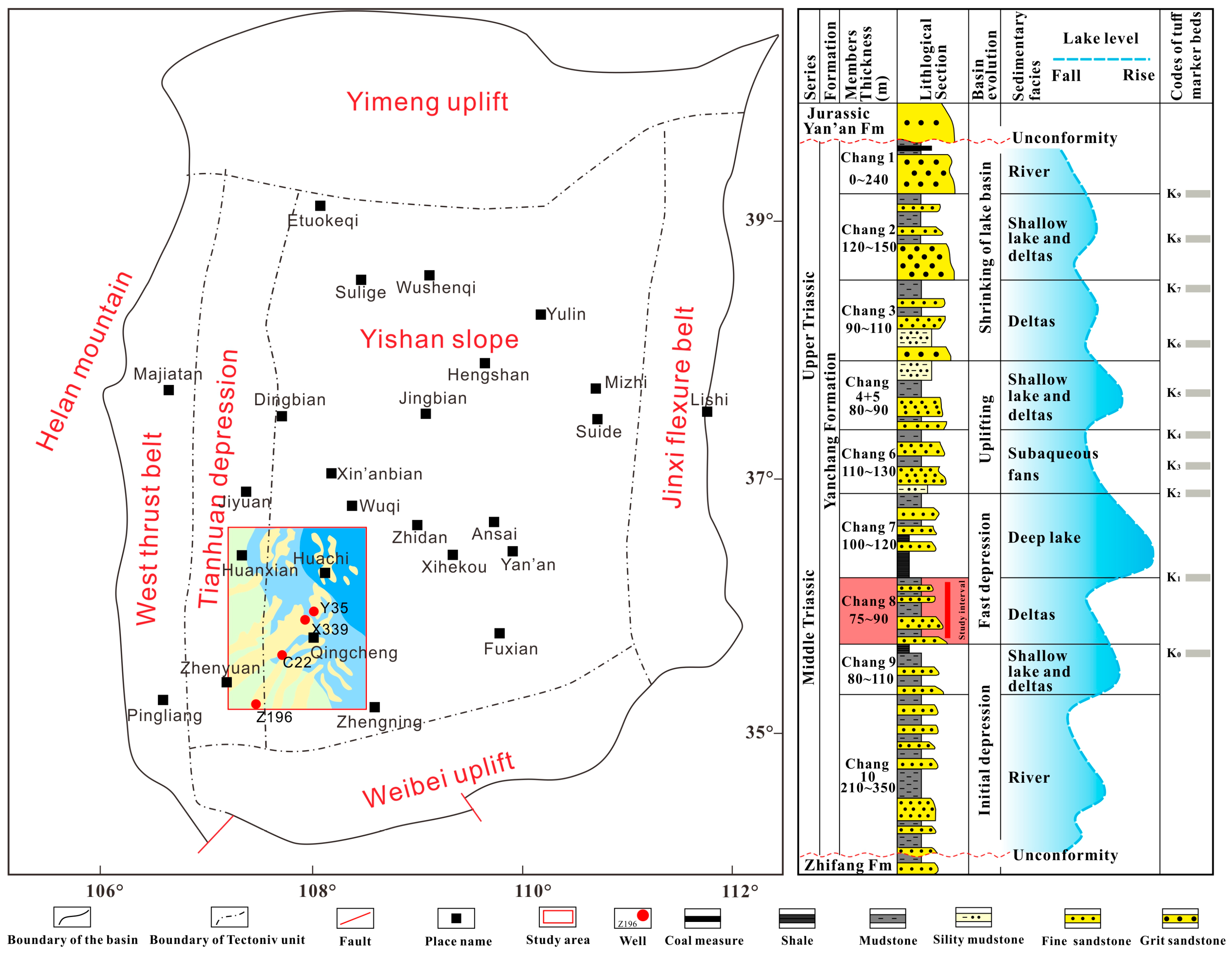
The Longdong area is situated on the southwestern margin of the Ordos Basin. Substantial sediment supply from the southwest has developed a delta-shallow lacustrine depositional system in this region, which provides favorable preconditions for the preservation of Milankovitch cycle signals. For cyclostratigraphic analysis, four wells—Z196, C22, X339, and Y35—were selected along a southwest–northeast transect (Figure 1). This orientation reflects a depositional trend from the distal part of the lake basin toward the depocenter, corresponding to a gradual transition from deltaic to shallow-lacustrine facies and an increase in water depth. The wells, located in different sedimentary facies and depositional settings, offer a robust basis for investigating the development and spatial distribution of source rocks and reservoirs while also providing strong spatial representativeness. Comprehensive data from these four wells were systematically collected as the primary material for further cyclostratigraphic analysis. It is emphasized that all data were provided by the Changqing Oilfield Company, PetroChina (Xi’an, China).
3. Results of Cyclic Stratigraphy Analysis
The Milankovitch theory, a seminal contribution established in the 1940s, elucidates the linkage between Quaternary ice-age cycles and orbitally paced variations in solar insolation. This discovery has been extensively applied within paleoclimatic research [47,48]. Building upon this theoretical framework, cyclostratigraphy has advanced rapidly. Driven by the periodic variations in Earth’s orbital parameters, the solar insolation received at the Earth’s surface and the resultant behavior of the global climate system exhibit inherent cyclicity. This periodicity is faithfully encoded within the sedimentary record, imparting cyclicity to stratigraphic successions. Such cyclic patterns often demonstrate demonstrable linkages to sequence stratigraphic units [49,50]. The orbital parameters currently recognized to influence sedimentary cyclicity are eccentricity, obliquity, and precession, each exhibiting distinct periodicities. The long eccentricity cycle (~405 ka), associated with the gravitational interaction between Venus and Jupiter, remains remarkably stable throughout the geological record [51]. Short eccentricity cycles primarily manifest at 95 ka and 125 ka, averaging ~100 ka. Obliquity cycles occur at periods including 39 ka, 41 ka, and 54 ka, with a mean value approximating ~40 ka. In contrast, precession cycles are often imperfectly preserved within the stratigraphic record, posing significant identification challenges. Their theoretical periods include 17 ka, 19 ka, 20 ka, 22 ka, and 24 ka. The approximate mean durations of the long eccentricity, short eccentricity, obliquity, and precession cycles are ~405 ka, ~100 ka, ~40 ka, and ~20 ka, respectively [52,53]. Based on these periods, the theoretical orbital period ratios are calculated as approximately 1:2:5:20. This ratio suite serves as a key diagnostic tool for verifying the presence of Milankovitch (orbital) cycles within stratigraphic successions. However, given that orbital periods exhibit secular variations throughout Earth’s history, it is essential to determine the specific theoretical orbital parameters applicable to the depositional interval under investigation by deriving its corresponding paleo-astronomical solution.
The La2004 and La2010 solutions provide astronomical models since the Triassic [52,53]. Notably, La2010 demonstrates superior accuracy and reliability for intervals within 250 Ma. Utilizing this solution, spectral analyses reveal dominant orbital periodicities between 245 Ma and 250 Ma: eccentricity cycles at 405 ka, 125 ka, and 95 ka; obliquity cycles at 40.5 ka and 32.8 ka; and precession cycles at 20.7 ka, 19.7 ka, and 17.0 ka [54]. Within the Ordos Basin, spectral analysis of the Chang 7 Member yielded comparable cycles: eccentricity at 405 ka, 124.48 ka, and 95.31 ka; obliquity at 33.07 ka; and precession at 20.80 ka, 19.78 ka, and 17.07 ka [55]. The La2010 solution was adopted as the reference model for this study.
Cyclostratigraphic analysis encompasses diverse methodological approaches. Time-series analysis represents a fundamental technique within this discipline and constitutes the prevailing methodology in contemporary research. This approach utilizes paleoclimatic proxy datasets to extract evolutionary information about paleoenvironmental and paleoclimatic conditions through temporal decomposition. Spectral analysis is employed to isolate cyclic signals within these datasets—specifically, revealing the Milankovitch cycles information in the stratigraphic record. Core procedural steps in time-series analysis comprise: (1) data selection and preprocessing, (2) spectral analysis, (3) filtering, and (4) tuning. All data processing and analyses presented herein were conducted using the Acycle 2.8 software [56] within the MATLAB (vers. R2022b) environment. This integrated toolkit effectively incorporates the aforementioned functionalities, serving as a robust analytical platform. While the identification of Milankovitch cycles and associated paleoclimatic evolution within the Chang 7 Member of the Ordos Basin’s Yanchang Formation benefits from an established research basis [57], comparable studies on the Chang 8 Member remain less frequently documented. Consequently, conducting a comprehensive cyclostratigraphic analysis of the Chang 8 Member—specifically targeting the determination of its depositional duration and the establishment of an astrochronological constraint framework—constitutes a significant research endeavor.
3.1. Data and Preprocessing
Conducting robust cyclostratigraphic analysis necessitates selecting a continuous, high-resolution proxy record exhibiting strong sensitivity to paleoclimatic fluctuations. Widely utilized paleoclimatic proxies encompass geophysical log data, geochemical parameters, magnetic susceptibility, mineralogical assemblages, sediment color indices, and lithological grain-size variations [55,57,58,59,60,61]. Among these, Gamma-ray (GR) logs are particularly well-suited for astronomical cycle analysis. GR response demonstrates sensitivity to radioactive elements within sediments, covaries with clay mineral content and lithological changes, and effectively records paleoclimatic shifts. Furthermore, GR data typically offer high resolution and exceptional continuity [37,57,62,63,64]. The Chang 8 depositional interval coincided with a phase of rapid lacustrine basin expansion, characterized by frequent and pronounced lake-level fluctuations. This dynamic environmental context provides favorable conditions for detecting orbitally forced sedimentary cyclicity.
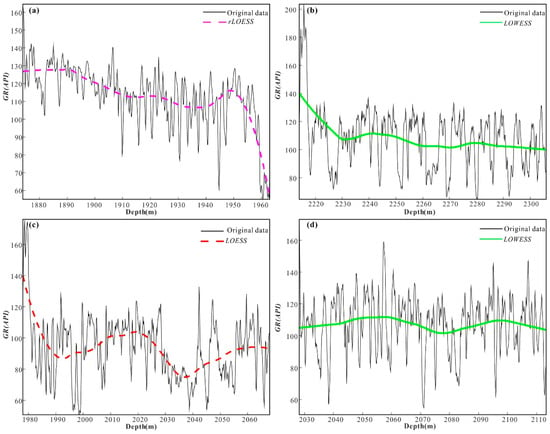
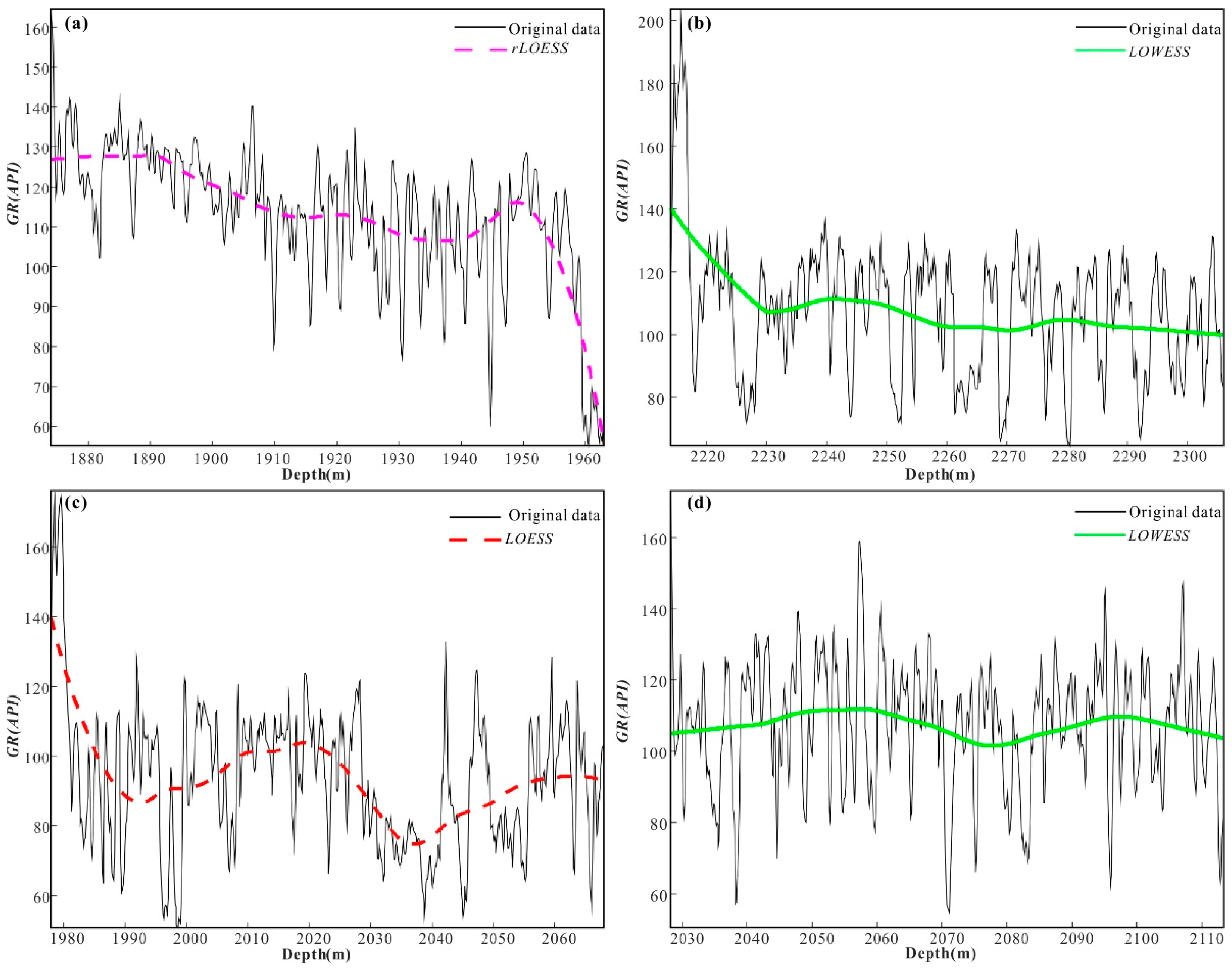
Four wells within the study area exhibiting complete Gamma-ray (GR) log coverage were selected for cyclostratigraphic analysis. The acquired GR datasets are devoid of outliers and data gaps, with a consistent sampling interval of 0.125 m, satisfying the resolution requirements for high-frequency cycle detection. Therefore, natural gamma-ray logging data from the four wells can be directly subjected to detrending. It should be noted, however, that excessive detrending may lead to the loss of high-frequency signals, while insufficient detrending can allow low-frequency interference to obscure the astronomical signals. Thus, selecting an optimal detrending window is essential to preserve high-frequency components while minimizing the influence of long-term trends, thereby enabling more reliable and effective cyclostratigraphic analysis. Following iterative optimization, a 35–40% window size and the most appropriate fitting method were employed for long-term trend removal in each well (Figure 2). The resultant detrended data exhibited optimal characteristics for subsequent spectral analysis.
Figure 2.
Detrending process: (a) Well Z196: 35% window, rLOESS method; (b) Well C22: 35% window, LOWESS method; (c) Well X339: 40% window, LOESS method; (d) Well Y35: 37% window, LOWESS method.
3.2. Identification of Astronomical Cycle Signals and Sedimentation Rate Analysis
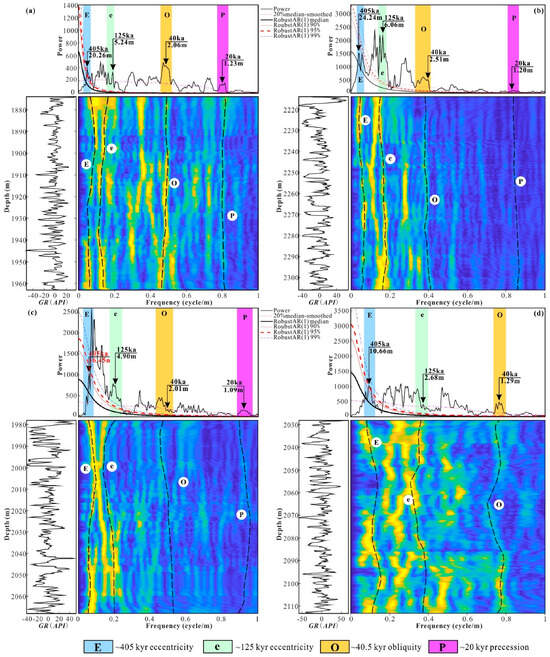
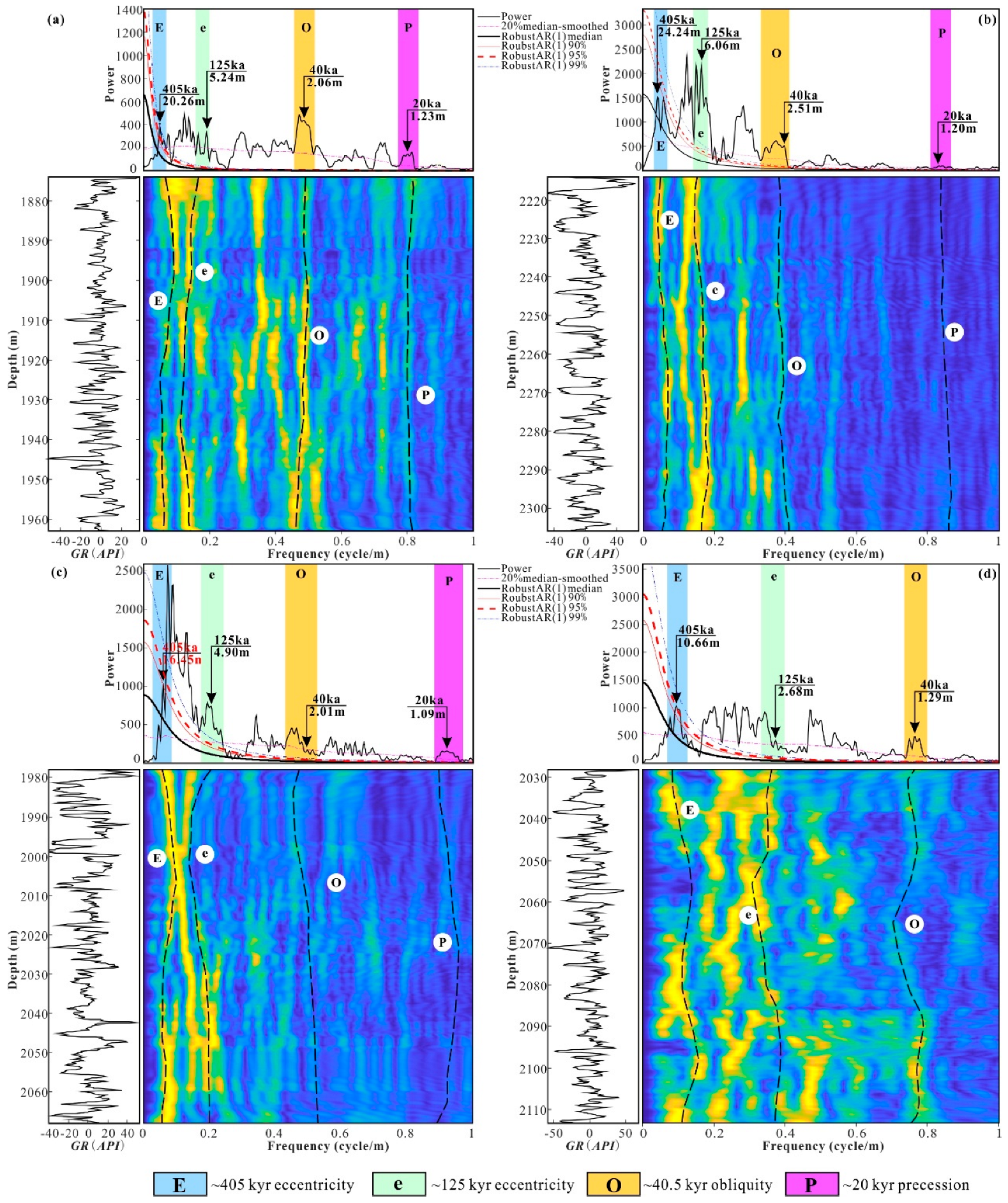
Following effective preprocessing, the Gamma-ray (GR) data exhibit optimal removal of long-term trends. Multi-taper Method (MTM) spectral analysis and Fast Fourier Transform (FFT) evolutionary spectral analysis were subsequently applied to the detrended GR datasets from all four wells (Figure 3). To mitigate frequency omission and enhance the accuracy of cyclostratigraphic interpretation, frequencies meeting stringent selection criteria were prioritized for detailed analysis: (1) confidence levels exceeding 90% and (2) relative errors in observed cycle thickness ratios versus theoretical orbital period ratios of less than 10%.
Figure 3.
Results of spectral analysis and evolutionary spectral analysis for the wells of the study area. (a) Z196; (b) C22; (c) X339; (d) Y35.
Spectral analysis of the four wells collectively indicates the preservation of identifiable Milankovitch cycles within the Chang 8 Member across the study area. However, post-depositional geological complexities have partially degraded higher-frequency cycle components, as evidenced by the absence of precession signals in Well Y35. Eccentricity and obliquity cycles remain discernible in all other investigated wells. It is important to note that all data processing and analyses presented herein were conducted using the Acycle 2.8 software [56] within the MATLAB environment.
Spectral analysis employing the 2π-MTM and FFT methods confirms the preservation of long eccentricity, short eccentricity, obliquity, and precession cycles within Well Z196. These cycles exhibit vertical continuity in the depth domain, with the 405 ka orbital period demonstrating particular stability. Based on cycle ratio analysis and confidence level assessment, distinct spectral peaks are observed at frequencies of 0.04, 0.35, 0.43, and 0.81 cycles/meter. These correspond to depositional cycle thicknesses of 20.26 m, 5.24 m, 2.06 m, and 1.23 m, yielding a ratio of approximately 16.45:4.25:1.68:1. This ratio closely matches the theoretical orbital period ratios established for the Early Triassic. Calculated sedimentation rates for Well Z196 range from approximately 0.04 m/ka to 0.06 m/ka.
Following the identification of dominant orbital periodicities and their associated cycle thicknesses, five long eccentricity cycles (405 ka) and sixteen short eccentricity cycles (125 ka) were quantified within Well Z196. Well C22 exhibits well-preserved Milankovitch cycle signals, characterized by distinct spectral peaks at frequencies of 0.04, 0.16, 0.40, and 0.83 cycles/meter. These correspond to cycle thicknesses of 24.24 m, 6.06 m, 2.51 m, and 1.20 m, yielding a ratio of approximately 20.16:5.04:2.09:1. This ratio closely approximates the theoretical orbital period ratios, confirming the presence and excellent preservation of Milankovitch cycles. Consequently, five long eccentricity cycles and fifteen short eccentricity cycles were identified within Well C22. Calculations indicate that Well C22 exhibits an average sedimentation rate ranging from 0.04 to 0.06 m/ka. Within Well X339, four orbital cycles are identified; however, Milankovitch cycle signals are not distinctly expressed. Spectral analysis reveals marked peaks at frequencies of 0.06, 0.20, 0.50, and 0.92 cycles/meter, corresponding to sedimentary cycle thicknesses of 17.33 m, 4.90 m, 2.01 m, and 1.08 m, respectively. The estimated average sedimentation rate for this well is approximately 0.03 to 0.06 m/ka. Analysis of Well Y35 identified three primary periodic signals. The precessional signal exhibits weak expression, likely suppressed by subsequent geological processes. Spectral analysis reveals discernible peaks at frequencies of 0.09, 0.37, and 0.78 cycles/meter, corresponding to long eccentricity, short eccentricity, and obliquity cycle signals, respectively. The associated cycle thicknesses are 10.66 m, 2.68 m, and 1.28 m, yielding a ratio of approximately 9.6:2.4:1.1. This ratio closely aligns with theoretical expectations. The calculated average sedimentation rate for Well Y35 ranges from 0.01 to 0.03 m/ka.
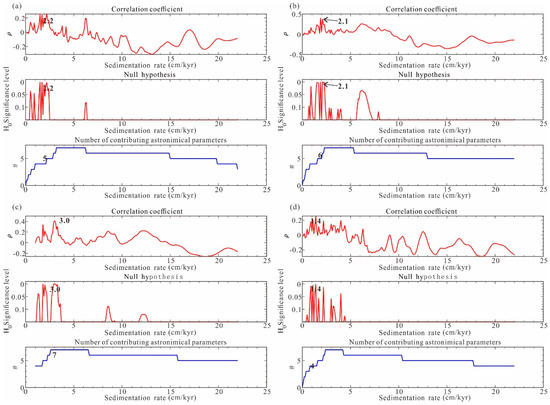
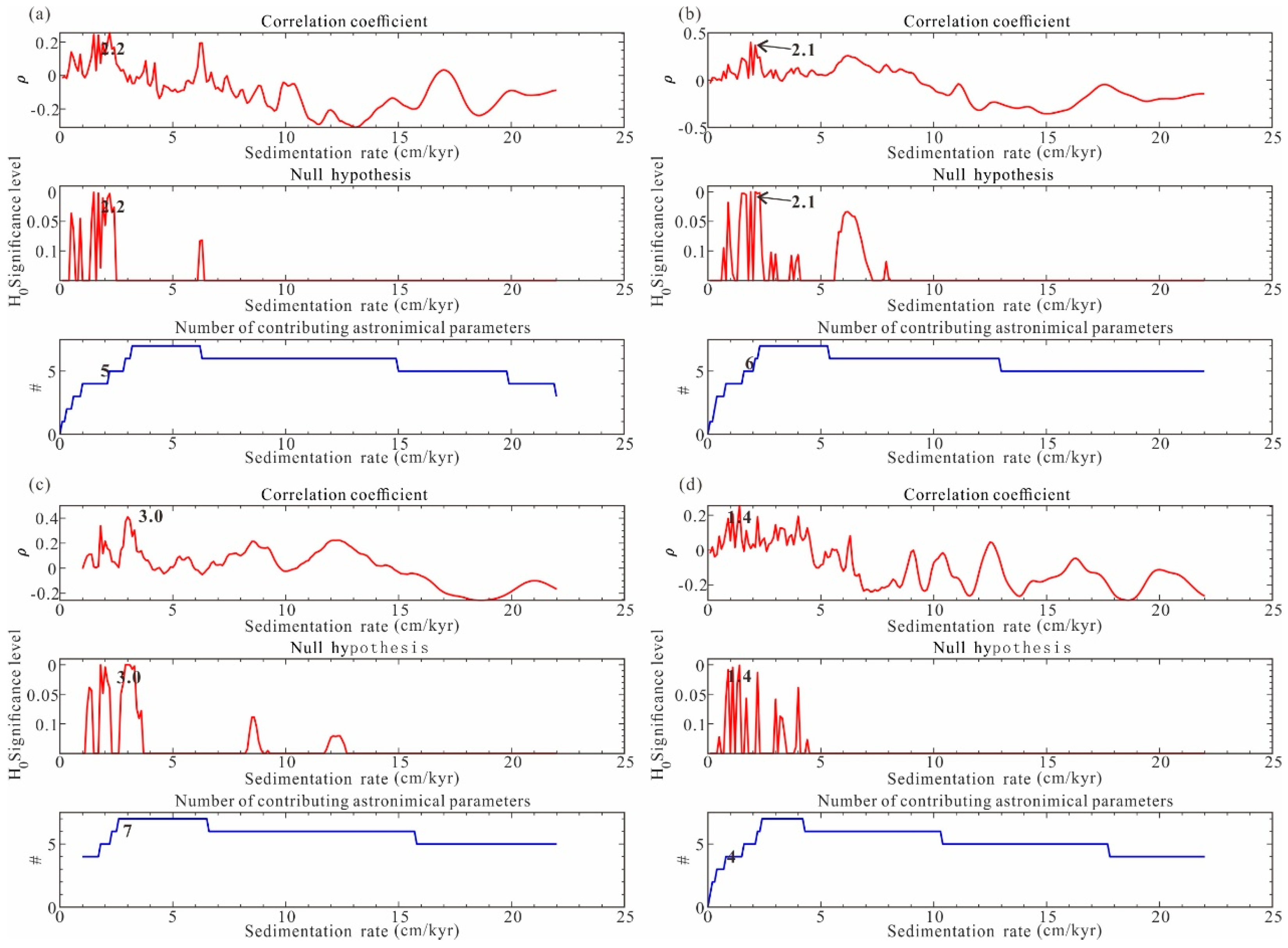
The correlation coefficient method (COCO) is widely employed in astronomical tuning and sedimentation rate optimization, demonstrating robust application efficacy. This method was applied to Gamma-ray (GR) log data from four study wells (Figure 4). Simulated sedimentation rates spanned 0 to 22 cm/ka, with an increment of 0.1 cm/ka. Monte Carlo simulations, each comprising 3000 iterations, were performed. The results reveal a significant influence of Milankovitch orbital forcing within the study interval, affirming the presence of astronomically forced signals. The optimized sedimentation rates cluster within the range of 1.4 to 3.0 cm/ka. Based on null hypothesis significance levels and correlation coefficients, the optimal sedimentation rates and their governing orbital parameters are determined as follows: Well Z196: 2.2 cm/ka (driven by 5 orbital parameters); Well C22: 2.1 cm/ka (driven by 6 orbital parameters); Well X339: 3.0 cm/ka (driven by 7 orbital parameters); Well Y35: 1.4 cm/ka (driven by 4 orbital parameters).
Figure 4.
Correlation coefficient analysis results for study wells. (a) Z196; (b) C22; (c) X339; (d) Y35. ρ denotes the sedimentation rate assessed via the correlation coefficient method, while # represents the number of astronomical orbital components involved.
Spatially, sedimentation rates decrease systematically from the southwest to the northeast within the study area. This trend corroborates the location of the depocenter proximal to Well Y35, with sediment provenance originating from the southwest. These findings are consistent with the depositional facies distribution documented for the Chang 8 sedimentary period in the Ordos Basin. Furthermore, the limited influence of astronomical forcing on sedimentation at Well Y35 corresponds to the absence of a distinct precessional signal. Collectively, the stratigraphic record at Well Y35 exhibits significant modification by erosional processes, resulting in the attenuation of higher-frequency cyclicity.
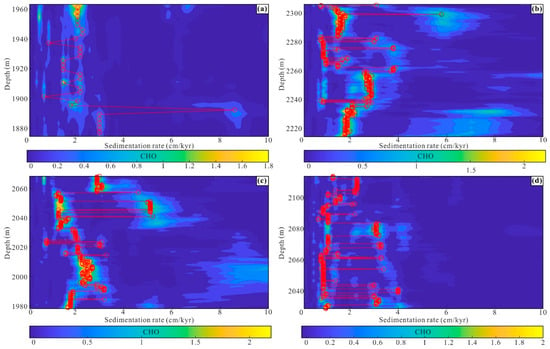
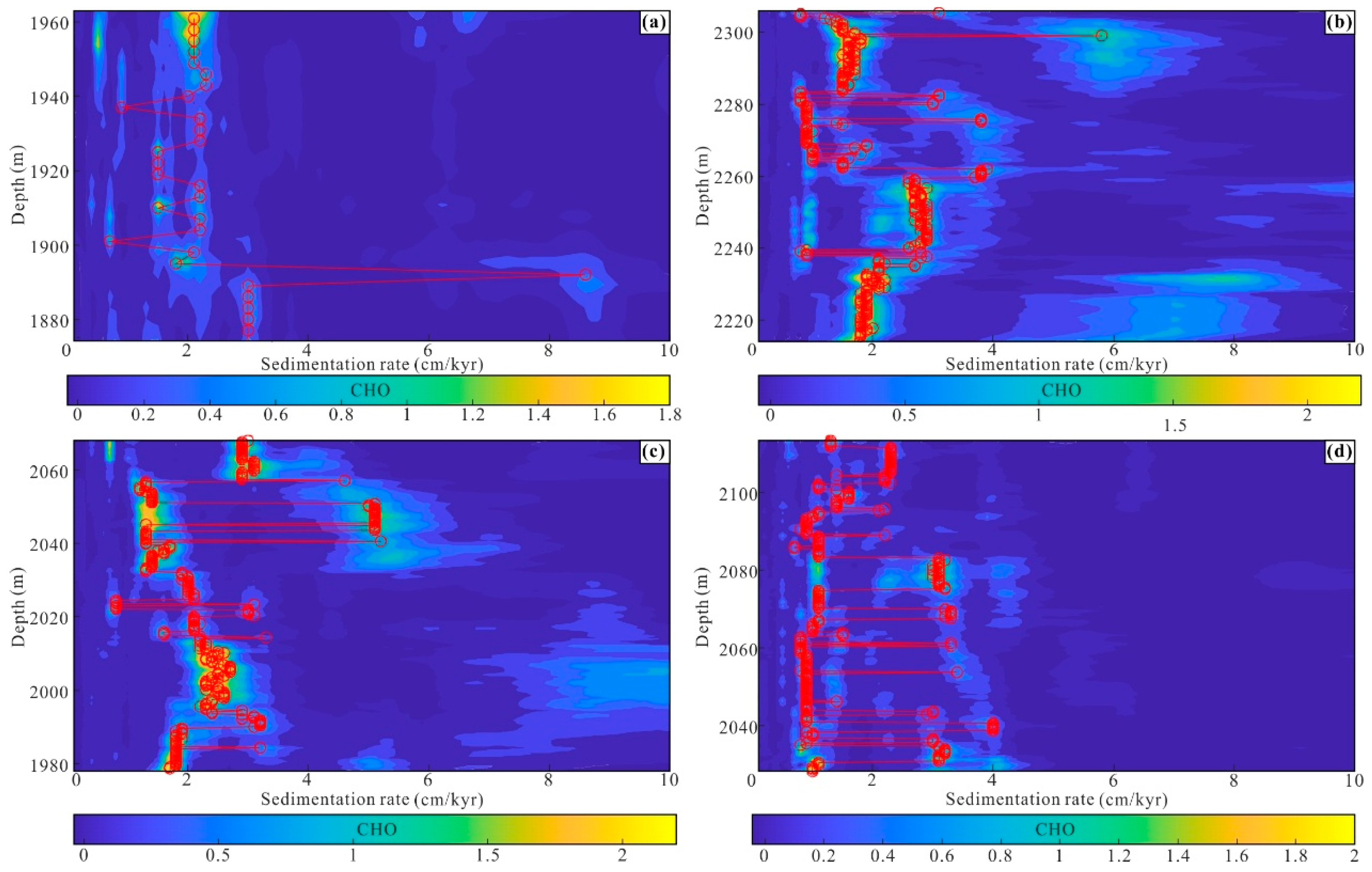
Sedimentation rates are intrinsically linked to depositional environments and sediment supply, exerting cascading controls on organic matter enrichment. Application of the Evolutionary Correlation Coefficient (eCOCO) method enables dynamic tracking of sedimentation rate evolution, which was implemented for the four study wells (Figure 5). Temporally, the basin exhibits an overarching trend of increasing sedimentation rates followed by a subsequent decrease. However, spatio-temporal variations in depositional architecture impart distinct sedimentation rate patterns among individual wells. Well Z196 shows a progressive increase in sedimentation rate, with notable acceleration during the late Chang 8 depositional phase. As Well C22 approaches the depocenter, its sedimentation rate trajectory displays a tripartite trend: initial increase, subsequent decline, and final resurgence. This pattern reflects synergistic effects of fluctuating sediment supply and hydrodynamic energy. Positioned nearer to the depocenter, Well X339 likely occupied a transitional zone between lacustrine basin-center and delta-front settings. Despite waning hydrodynamic energy, sustained sediment influx promoted substantial accumulation, resulting in progressively increasing sedimentation rates. Well Y35, situated within the probable basin center, accumulated fine-grained suspension load under low-energy conditions, resulting in persistently diminished sedimentation rates throughout the interval.
Figure 5.
Sedimentation rate evolution results for study wells. (a) Z196; (b) C22; (c) X339; (d) Y35. The red curve and circles denote the trend of dynamic sedimentation rate assessed via the correlation coefficient method.
3.3. Signal Filtering and Astronomical Tuning
Within the geological record, the 405 ka long eccentricity cycle represents a persistent and stable signal with high fidelity, maintaining stability for at least 250 Ma [50,57]. Consequently, this cyclicity serves as the primary target for bandpass filtering across the study wells. Other orbital signals, being more susceptible to noise contamination, provide secondary constraints during the tuning process.
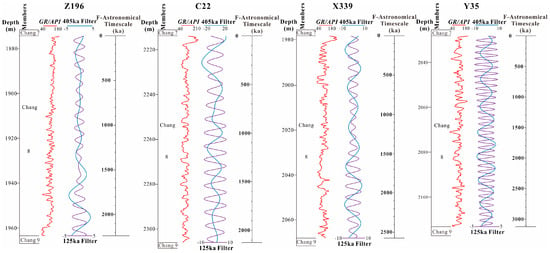
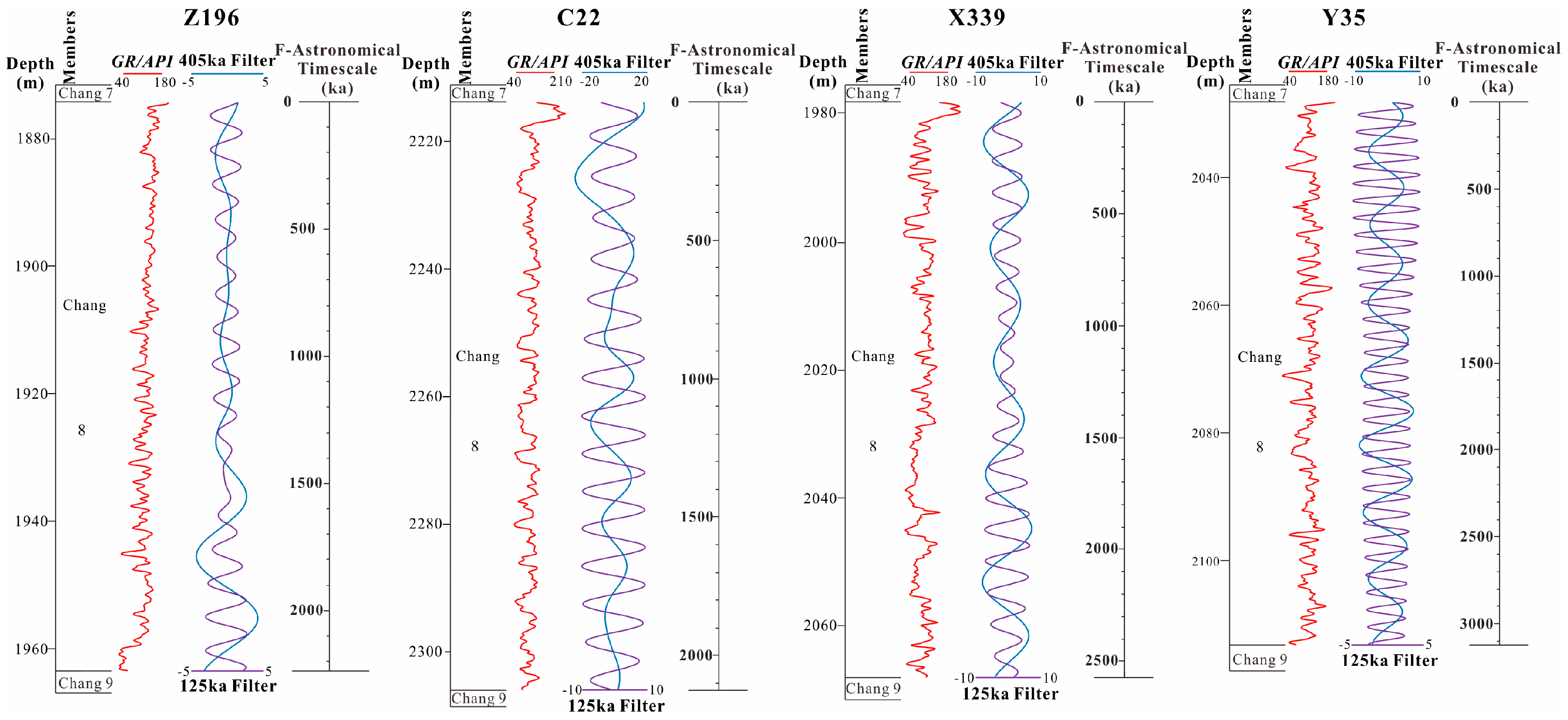
Distinct signals reflecting eccentricity and obliquity cycles have been identified within the Gamma-ray (GR) log series from Wells Z196, C22, X339, and Y35. These signals were subsequently isolated through targeted bandpass filtering. The dominant frequencies corresponding to the 405 ka and 125 ka cycles are as follows: Well Z196: 0.049 and 0.191 cycles/meter; Well C22: 0.041 and 0.165 cycles/meter; Well X339: 0.058 and 0.204 cycles/meter; Well Y35: 0.094 and 0.373 cycles/meter. Following the extraction of these signals, filtered curves representing the 405 ka and 125 ka components were generated (Figure 6).
Figure 6.
Filtered signals and floating astronomical time scales for study wells. The blue curve denotes the long eccentricity filtering curve, while the purple curve represents the short eccentricity filtering curve.
Owing to the exceptional stability of the long eccentricity cycle, the 405 ka filtered curve was selected as the target signal for constructing an age model. By tuning the GR data to this target curve, a floating astronomical time scale was established for the Chang 8 within the study area, constraining its depositional duration (Figure 6). Results indicate a depositional timeframe of approximately 2.1–3.2 Ma for the Longdong region. Notably, the depositional duration increases progressively from the southwestern to northeastern sectors toward the lacustrine depocenter, reflecting decreasing sedimentation rates, enhanced accumulation of fine-grained sediments, and weakening hydrodynamic energy toward the basin center. Published U-Pb ages from the base of the Chang 73 subunit range from 241.30 ± 2.4 Ma to 239.10 ± 1.4 Ma [57,65]. Using the older anchor age (241.3 ± 2.4 Ma), the depositional interval of the Ch-8 is constrained to 244.42–243.42 ± 2.4 Ma. Alternatively, with the younger anchorage (239.1±1.4 Ma), deposition occurred between 242.22 and 241.23 ± 1.4 Ma. Temporally, this places the Chang 8 deposition within or near the Anisian–Ladinian boundary.
3.4. Well-Specific Cyclostratigraphic Analysis and Sequence Stratigraphic Framework
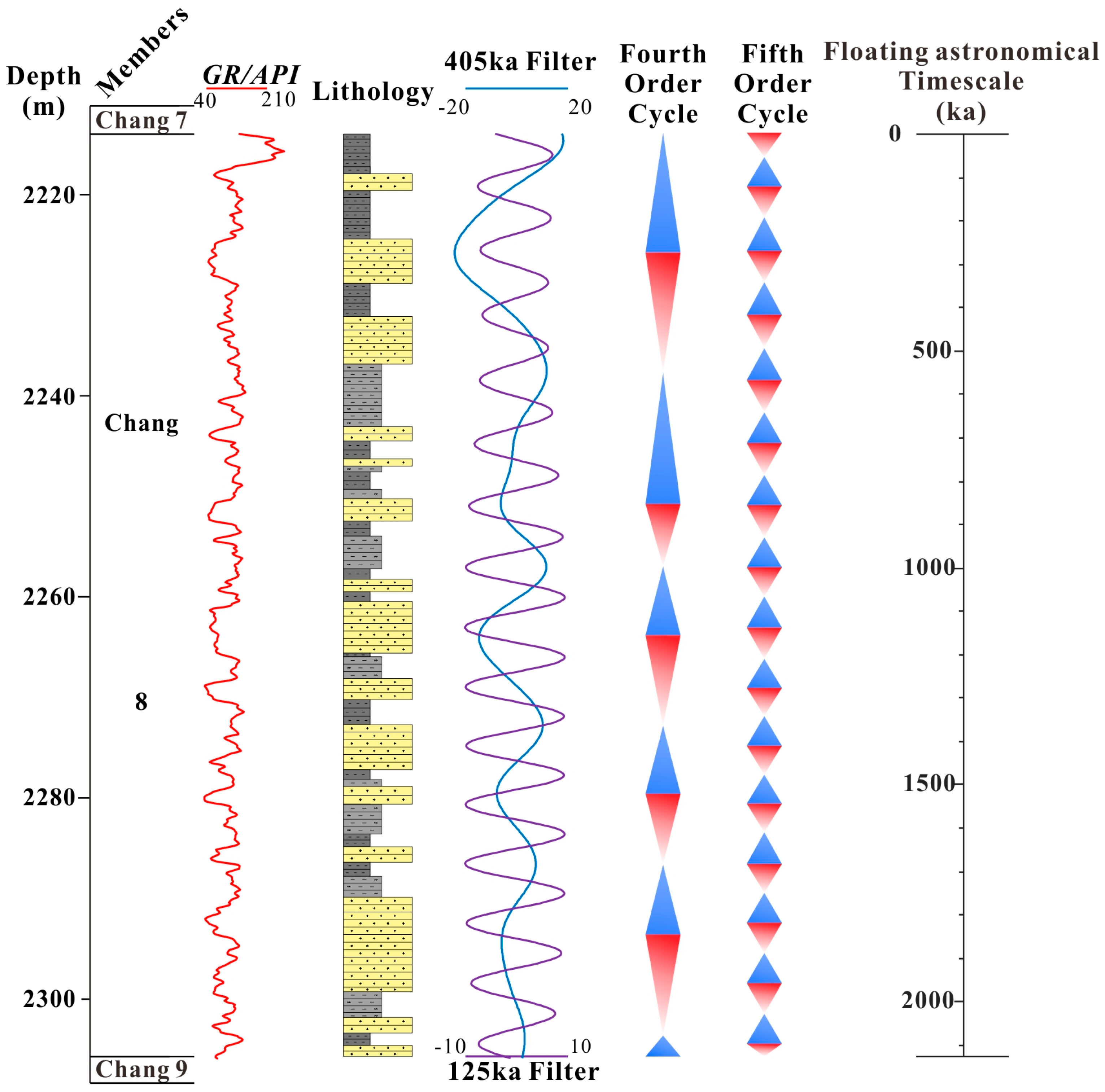
Lower-frequency sequences are predominantly controlled by major tectonic events, whereas higher-frequency sequences exhibit linkages to climatic, insolation, and astronomical forcings with demonstrable hierarchical correspondence. Specifically, fourth-order sequences correlate with long eccentricity cycles (405 ka), fifth-order cycles align with short eccentricity cycles (~100 ka), and sixth-order cycles correspond to precessional and related orbital bands [49]. Previous studies have extensively addressed third-order sequence stratigraphy within the Yanchang Formation. Building upon this foundation, we conducted high-resolution cyclostratigraphic analysis of Well C22 to establish a robust sequence stratigraphic framework (Figure 7).
Figure 7.
High-frequency sequence analysis of Well C22. The blue curve denotes the long eccentricity filtering curve, while the purple curve represents the short eccentricity filtering curve; the blue triangles indicate the transgressive systems tract, and the red triangles signify the regressive systems trac.
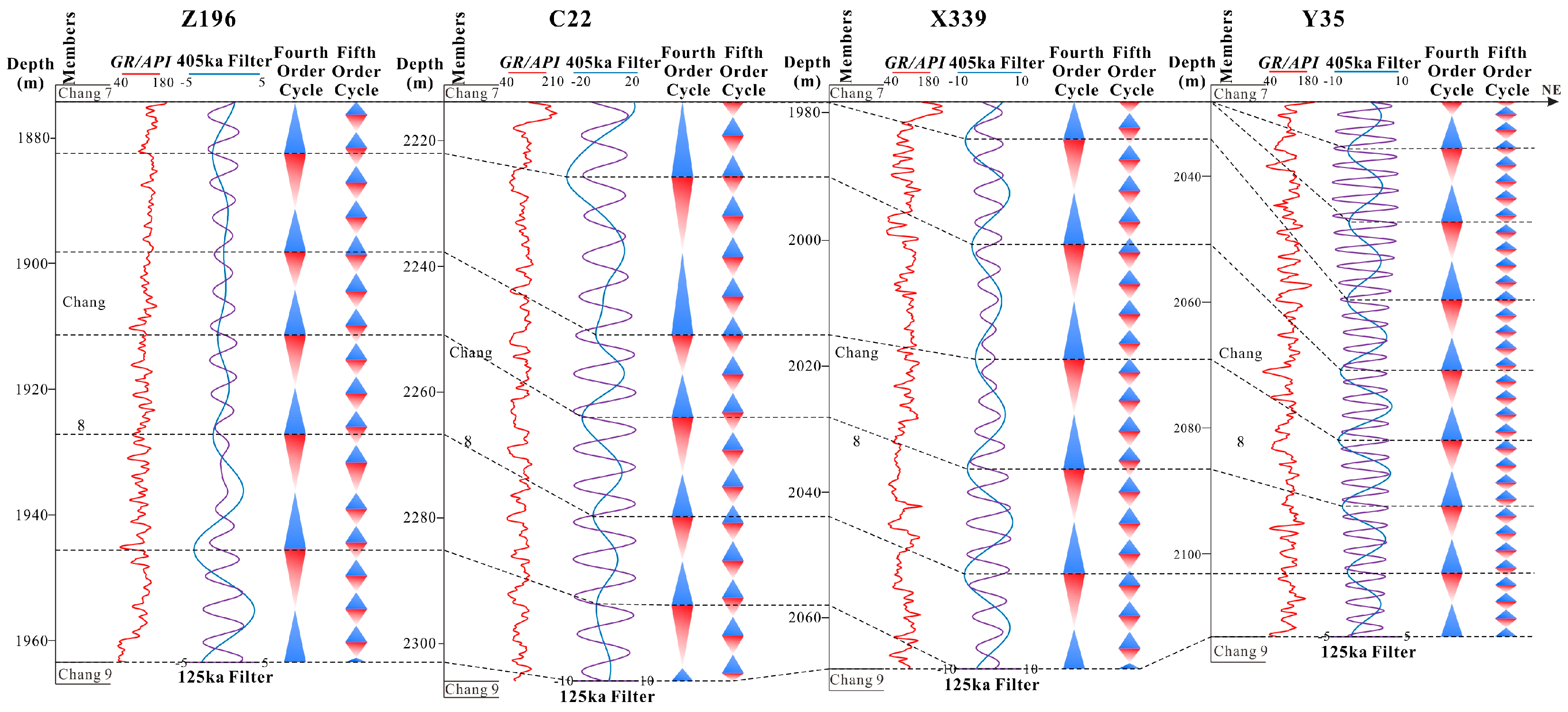
Based on the 405 ka (long eccentricity) filtered curve, five complete fourth-order cycles and one transgressive hemicycle were delineated within the Chang 8 Member. Similarly, the short eccentricity (∼100 ka) filtered curve facilitated identification of fifth-order sequences, comprising one regressive hemicycle and 15 full fifth-order cycles. Cyclic stratigraphic division applied to all four study wells reveals: Well Z196 contains five fourth-order and 15 fifth-order cycles; Well X339 exhibits five fourth-order and 18 fifth-order cycles; and Well Y35, situated within the depocenter, demonstrates heightened cyclicity with eight fourth-order and 32 fifth-order cycles. It is noteworthy that there is a significant variation in the number of sedimentary cycles identified among the four wells. From well Z196 to well Y35, the cycle count increases. This pattern is closely related to changes in depositional environment and differences in sedimentation rate. A lower sedimentation rate is the primary factor leading to a higher number of recorded cycles, as it results in a thinner stratigraphic thickness deposited per orbital cycle. Conversely, wells with higher sedimentation rates exhibit the opposite trend, often amalgamating or obscuring higher-frequency cyclic signals.
Integrated interpretation of Milankovitch cycle recognition and stratigraphic division across the study wells, combined with established sediment provenance directions, enabled the construction of a high-resolution sequence stratigraphic framework. This framework was established by correlating stratigraphic sections along the dominant sediment transport pathway (SW-NE) within the study area (Figure 8).
Figure 8.
Depositional-dip-oriented sequence stratigraphic framework for the study area. The blue curve denotes the long eccentricity filtering curve, while the purple curve represents the short eccentricity filtering curve; the blue triangles indicate the transgressive systems tract, and the red triangles signify the regressive systems tract.
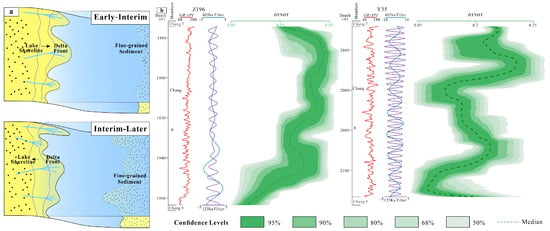
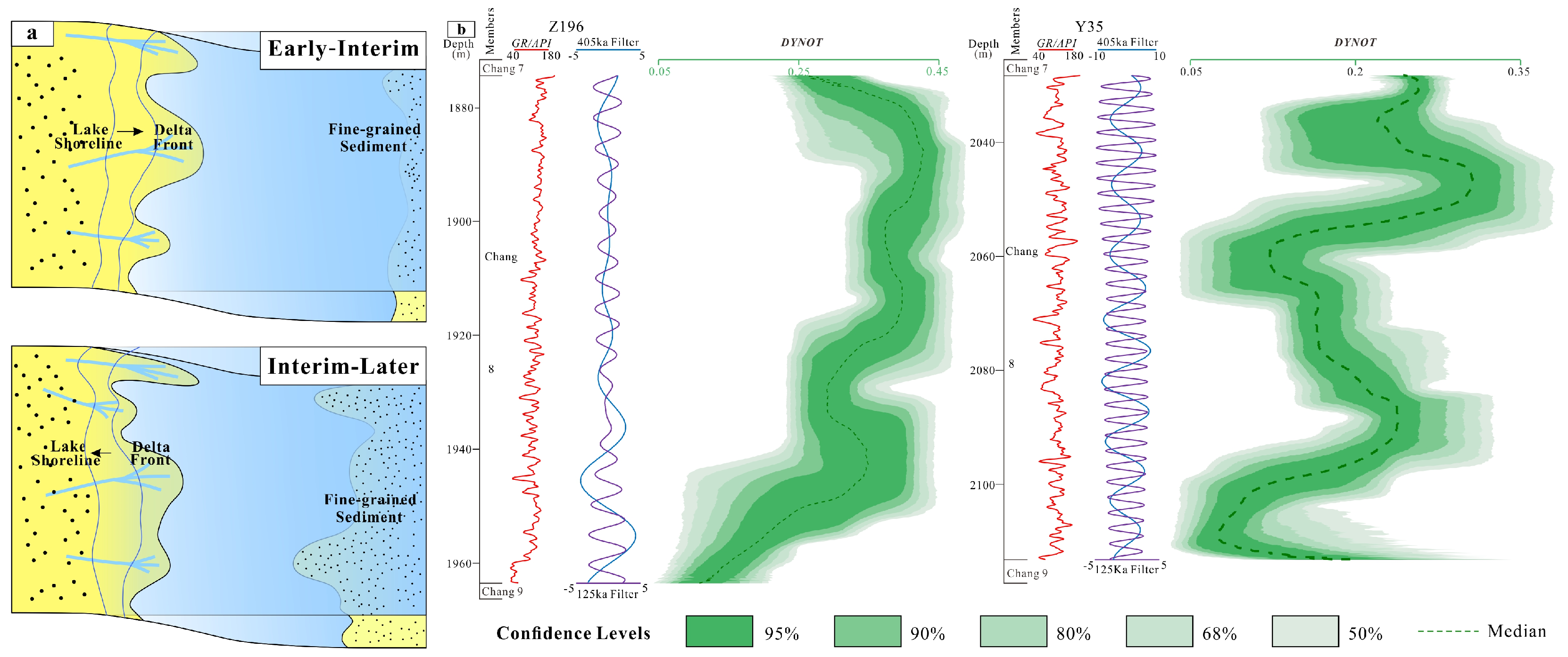
During the Chang 8 depositional phase, deltaic systems constituted the dominant depositional regime in the southwestern study area. As illustrated by the evolutionary process (Figure 9a), these deltas prograded basinward under high-energy hydrodynamic conditions, depositing sand-dominated successions. During the late depositional stage, a gradual rise in base level triggered localized lacustrine transgression, forcing deltaic retrogradation. This transition resulted in attenuated hydrodynamic energy and progressive sediment fining. Quantitative reconstruction of lacustrine base-level fluctuations is essential to validate this depositional trajectory.
Figure 9.
Depositional evolution and lake-level history of the Ch-8 in the study area. (a) Schematic diagram showing the sedimentary evolution process during the Chang 8 member depositional period in the study area; (b) relative paleo-water depth variation curve during the Chang 8 member depositional period reconstructed based on the DYNOT model. Purple curve represents the short eccentricity filtering curve.
Lake-level reconstructions commonly employ geochemical proxies; however, astronomical forcing exerts fundamental controls on eustasy, climatic oscillations, sediment flux, and insolation patterns. Grounded in this theoretical framework, the DYNOT (Dynamic Noise Model) has demonstrated efficacy in reconstructing sea-level variations, with robust validation documented in [66,67]. Using Gamma-ray (GR) logs from Wells Z196 and Y35 as climatic proxies, we applied the DYNOT model following astronomical tuning to reconstruct lacustrine base-level fluctuations during Chang 8 deposition (Figure 9b). This approach investigated paleo-lake-level dynamics and established their coupling with sequence architecture. Results reveal an overall trajectory from falling to rising base levels across the study area. The Well Z196 simulation indicates an initial base-level fall succeeded by a rise, consistent with published lacustrine records. In contrast, Well Y35 exhibits higher-frequency fluctuations, recording three complete transgressive–regressive cycles.
4. Discussion of Petroleum Implications
Milankovitch cycles exhibit profound linkages to global climate dynamics, effectively governing paleoclimatic evolution. Climate perturbations exert far-reaching influences on petroleum systems, directly controlling hydrocarbon source rock development, organic matter enrichment, and the formation of reservoirs that have high-quality or cap rocks. Periodically, Milankovitch forcing indirectly modulates climatic oscillations, lacustrine base-level fluctuations, and biotic proliferation across geological timescales, thereby generating stratigraphic heterogeneity in sediment composition and organic carbon accumulation. Consequently, high-frequency sequence analysis delivers not only refined chronostratigraphic frameworks and sedimentological interpretations but also provides critical constraints for deciphering depositional evolution processes, organic enrichment mechanisms, and reservoir quality development.
As previously noted, sedimentation rates exhibit a progressively decreasing trend from the southwestern to the northeastern part of the basin. During this depositional period, the variation in sedimentation rate aligns well with the distribution of sedimentary facies, indicating a close relationship with sediment supply and depositional conditions. Higher sedimentation rates are generally associated with well-developed distributary channel sandbodies, whereas toward the northeast, closer to the lacustrine setting, clay content increases and sedimentation rates decrease. Notably, lower sedimentation rates combined with a stable terrigenous clastic flux are more conducive to the enrichment of organic matter, thereby further facilitating the formation of source rocks. The spatial variation in sedimentation rate thus offers supporting evidence for understanding the formation mechanisms of both source rocks and reservoirs.
Taking Well C22 with its comprehensive dataset as a representative case, we integrate cyclostratigraphic analysis to investigate the development of organic-rich strata and high-quality reservoirs. This approach elucidates the mediating role of astronomical forcing in their formation mechanisms, providing a theoretical foundation for their genesis. Furthermore, by correlating limited production test data with sequence stratigraphic architecture, we identify hydrocarbon-bearing intervals to predict prospective zones, delivering practical value for exploration targeting.
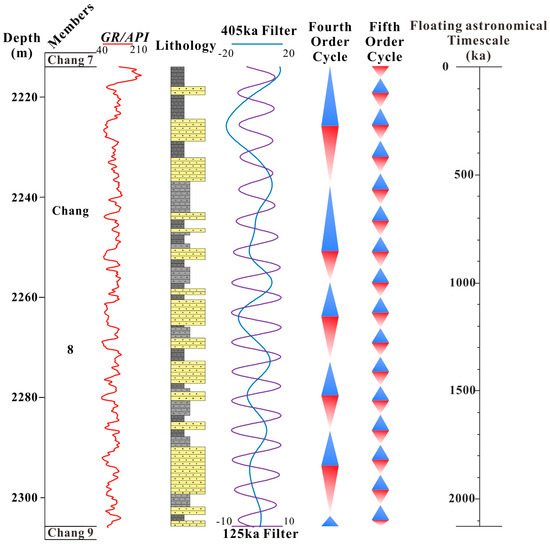
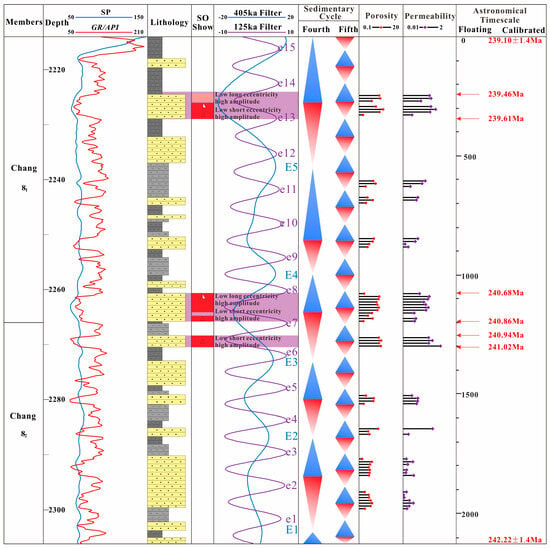
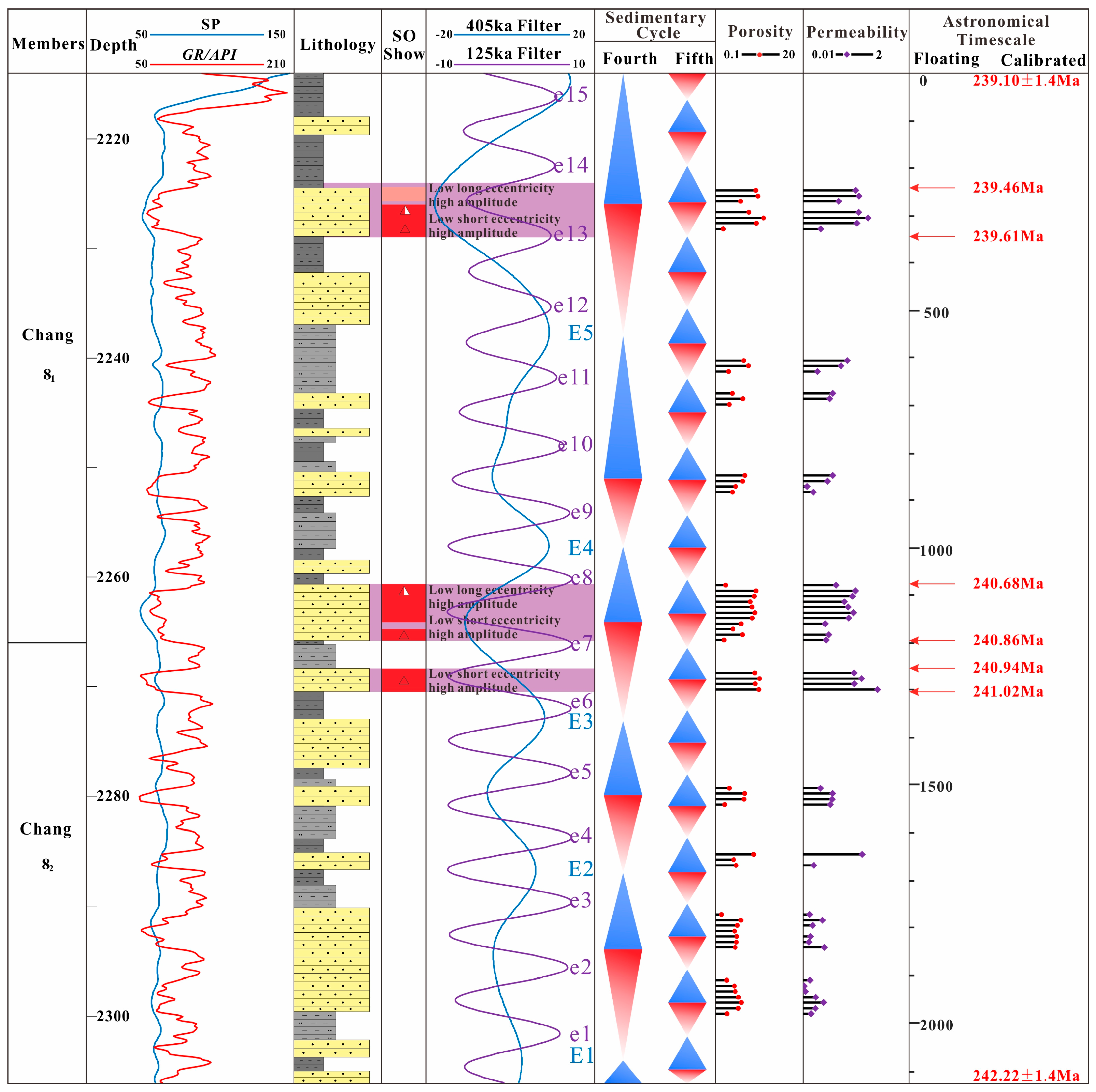
Hydrocarbon accumulation requires an effective source-reservoir-seal triplet, resulting from the interplay of structural, depositional, and diagenetic processes. Hydrocarbon migration from source rocks to viable reservoirs preferentially follows pathways with favorable porosity-permeability networks or fracture systems. When reservoirs within identical structural settings and depositional facies undergo comparable diagenetic modification, their homogeneity is enhanced. This principle enables high-frequency sequences derived from cyclostratigraphic analysis to effectively predict hydrocarbon-bearing intervals. In Well C22, cyclostratigraphic analysis identified five fourth-order cycles and fifteen fifth-order cycles. Production tests confirm productive zones within: (1) the regressive hemicycle of E3, (2) the transgressive hemicycle of E4, and (3) the regressive hemicycle of E5—corresponding to fifth-order sequences e6, e7, e8, and e13. It is postulated that analogous depositional settings in adjacent areas with similar structural histories may host high-quality reservoir units within these sequences, providing critical analogs for predicting hydrocarbon-bearing zones. Additionally, cyclostratigraphic analysis offers distinct advantages in constructing high-resolution, isochronous stratigraphic frameworks. It enables stratigraphic division and correlation at a scale of tens of thousands of years. Consequently, this approach allows for the precise temporal delineation of hydrocarbon-bearing intervals, thereby facilitating the prediction of high-quality reservoirs and their distribution. Through astronomically calibrated geochronology, we have derived a refined temporal framework for the Chang 8 Member. The analysis indicates that three principal oil-bearing units were deposited during the intervals of 239.61–239.46 Ma, 240.86–240.68 Ma, and 241.02–240.94 Ma, with an estimated absolute age uncertainty of approximately 1.4 Ma.
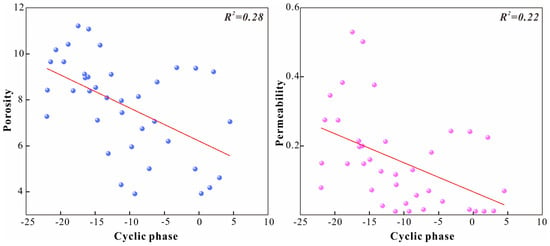
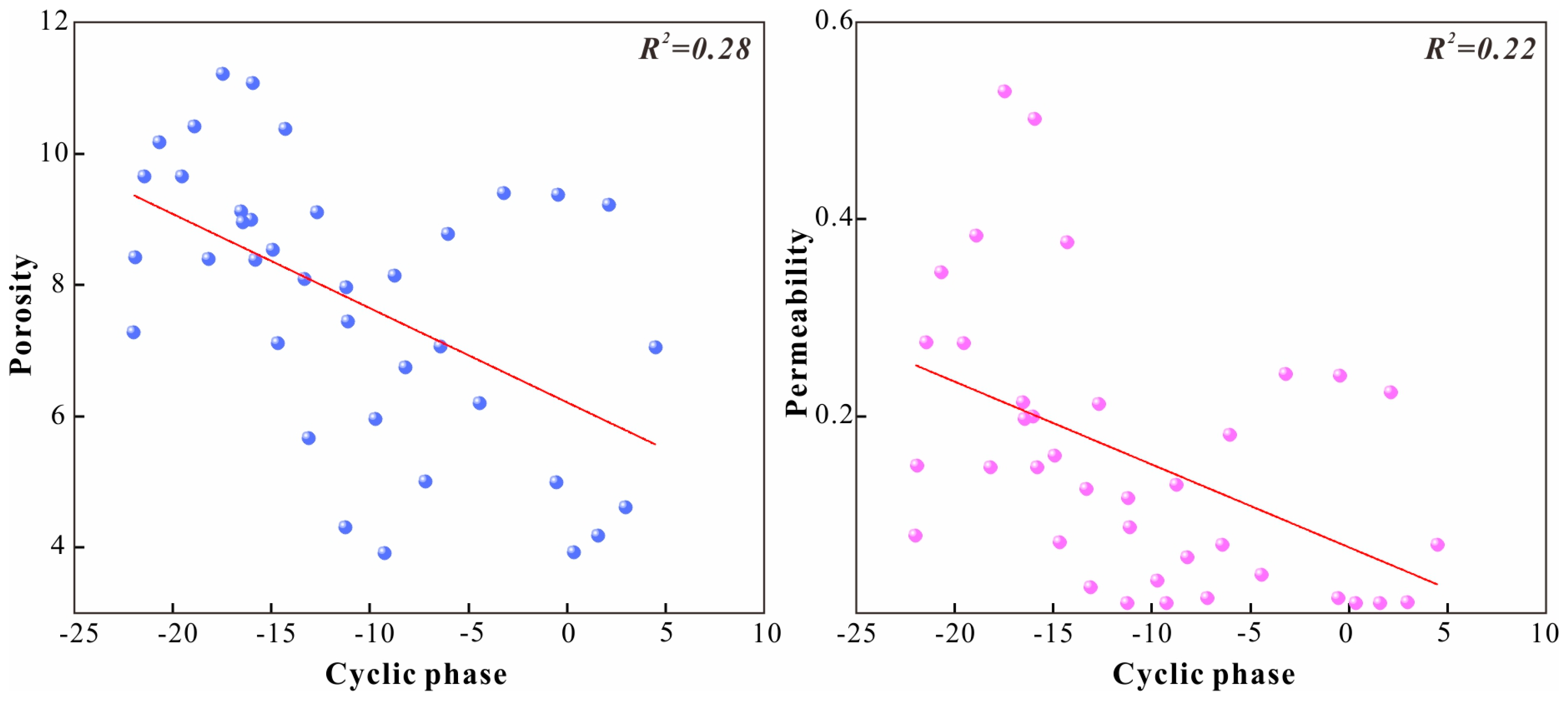
Reservoir property analysis of Well C22 indicates sandstone porosity ranging from 0.1% to 14.89% (average: 7.08%) and permeability between 0.01 and 1.85 mD (average: 0.15 mD). Integrated analysis of cyclostratigraphic and petrophysical data demonstrates that reservoir quality correlates with eccentricity cycle amplitude. Optimal reservoir properties coincide with minimum eccentricity phases exhibiting high amplitudes, facilitating the development of high-quality reservoirs with superior storage capacity. Conversely, diminished amplitudes correspond to poorer reservoir properties that restrict hydrocarbon accumulation potential. To further investigate the correlation between reservoir properties and astronomical forcing, well-log-derived porosity and permeability data from Well C22 were analyzed in conjunction with the phase of astronomical cycles. Initial observations between the waveform characteristics and reservoir development suggest that reservoir quality is influenced by both the 405 kyr (long eccentricity) and 125 kyr (short eccentricity) orbital cycles. To examine their combined effect without altering their respective phases, the filtered signals of the 405 kyr and 125 kyr cycles were superimposed based on the principle of wave addition, resulting in a composite filtered curve. Although the correlation between the phase of this composite curve and reservoir properties is relatively weak—reflecting the multifactorial control on reservoir quality—the analysis indicates that reservoir properties tend to be comparatively better when both the 405 kyr and 125 kyr orbital cycles simultaneously approach their minima (Figure 10).
Figure 10.
Correlation between physical properties of sandstone reservoirs in Well C22 and cyclical phases.
Production tests confirm exceptional reservoir properties across four hydrocarbon-bearing intervals, representing the primary control on hydrocarbon accumulation. Cyclostratigraphic analysis reveals that optimal reservoir development correlates with minimum phases of both long- and short-eccentricity cycles exhibiting high amplitudes. The mechanistic sequence operates as follows: eccentricity minima promote climatic stability, yet elevated amplitudes disrupt this equilibrium, inducing high-frequency oscillations in climate and precipitation (Figure 11). This triggers the following: (1) intensified physical weathering, (2) vegetation degradation, and (3) enhanced denudation. Riverine transport capacity undergoes pulsed amplification due to flood events, increasing sediment flux to the basin despite limited accommodation space. Consequently, rapid sandbody progradation ensues. Elevated fluvial energy drives active distributary channel migration and accelerated mouth bar advancement, resulting in basinward deltaic progradation. These conditions generate laterally extensive, sheet-like sandbodies characterized by significant volumetric dimensions and superior connectivity—ultimately forming high-quality reservoirs.
Figure 11.
Cyclostratigraphic analysis and interpreted petroleum significance of Well C22. The letter E denotes the ~405 ka long eccentricity cycle, while the letter e represents the ~125 ka short eccentricity cycle. The blue curve corresponds to the long eccentricity filtering curve, and the purple curve signifies the short eccentricity filtering curve; the blue triangles indicate the transgressive systems tract, whereas the red triangles represent the regressive systems tract.
Integrated analysis of reservoir properties reveals significantly enhanced quality at minimum long- and short-eccentricity phases exhibiting high amplitudes, whereas diminished amplitudes correspond to inferior reservoir characteristics. This observation infers that Milankovitch forcing governs paleoclimatic perturbations, thereby controlling the development of high-quality reservoirs. From an applied exploration perspective, a systematic workflow emerges: (1) astronomical cycle identification, (2) reservoir property analysis, and (3) integration with depositional facies and diagenetic evolution. The work enables predictive modeling of premium reservoirs through synergistic controls of sedimentary cyclicity, petrophysical attributes, and diagenetic modification. The approach not only deciphers reservoir distribution patterns within the study area but also establishes a replicable framework for high-potential reservoir targeting—forging a logical chain from cycle tracking and lithological characterization to petrophysical evaluation, reservoir delineation, and accumulation assessment.
Effective source rocks and cap rocks constitute critical prerequisites for hydrocarbon accumulation. Milankovitch forcing also exerts fundamental controls on mudstone development. During eccentricity maxima, significantly higher insolation at perihelion versus aphelion intensifies seasonal contrasts. Summer radiation surges amplify monsoon intensity and precipitation, creating warm-humid conditions conducive to biological proliferation. Elevated temperatures and rainfall enhance chemical weathering, mobilizing terrestrial plant debris into lacustrine systems. Clay minerals facilitate adsorptive enrichment of organic matter, forming organo-clay complexes deposited within basin centers. Concurrently, increased fluvial discharge delivers augmented plant detritus and nutrient fluxes, stimulating aquatic productivity and triggering algal blooms. The combined deposition of organo-clay complexes and enhanced biogenic productivity drives substantial organic enrichment, ultimately forming organic-rich mudstones that establish the foundation for effective source rock development. Enhanced insolation and freshwater influx intensified lacustrine water stratification, establishing anoxic conditions conducive to organic matter preservation. This constitutes the primary mechanism by which Milankovitch forcing governs source rock development. Within the Chang 8 Member at Well C22, however, source rocks are notably underdeveloped. Despite occurring during an eccentricity maximum phase, the diminished amplitude precluded significant organic enrichment, resulting instead in effective sealing facies. Collectively, long- and short-eccentricity maxima drive source rock and cap rock formation through a tripartite control mechanism: (1) climatic modulation, (2) productivity enhancement, and (3) organic preservation efficiency. The transition from reservoir sandstone deposition to source/cap rock development represents a dynamic stratigraphic response. Following arenaceous deposition, the progressive shift toward eccentricity maxima coincided with base-level rise, initiating mudstone-dominated depositional phases.
Long- and short-eccentricity cycles synergistically govern the development of reservoirs, cap rocks, and source rocks. Premium reservoirs and source rocks exhibit distinct relationships with these orbital parameters: long-eccentricity cycles principally control high-quality reservoir formation, while short-eccentricity cycles modulate organic enrichment alongside source rock and cap rock development. Through astronomically mediated processes, a vertically stacked source-reservoir-cap rock assemblage emerges. This framework establishes an astronomically driven hydrocarbon accumulation mechanism governed by coupled orbital controls on source potential, reservoir quality, and cap rock integrity.
5. Conclusions
Guided by Milankovitch cyclostratigraphic theory, this study systematically analyzes the lacustrine succession of the Chang 8 Member in the Longdong area, Ordos Basin. Through high-resolution cyclostratigraphic investigation, we elucidate the geological implications of high-frequency sequences for mudstone development and premium reservoir formation, yielding the following key findings:
- Utilizing cyclostratigraphic principles, spectral analysis of the Chang 8 lacustrine succession in the Longdong area, Ordos Basin, reveals diagnostic Milankovitch cycle signatures. Evolutionary spectral analysis and bandpass filtering resolved long eccentricity (405 ka), short eccentricity (~100 ka), obliquity, and precession signals, enabling the delineation of 5~8 fourth-order cycles and 15~32 fifth-order cycles. This high-resolution framework establishes a robust sequence stratigraphic architecture for the interval;
- Building upon the identified Milankovitch signals, sedimentation rates were determined, and astronomical tuning was performed. Simulations indicate optimal sedimentation rates of 1.4–3.0 cm/ka for the Chang 8 Member across the study area. Astronomical tuning constrains the depositional duration to approximately 2.1–3.2 Ma. Using the published U-Pb age of 239.1 ± 1.4 Ma from the base of the Chang 73 subunit as an anchor point, the depositional age of the Chang 8 Member is calculated as 241.23–242.22 ± 1.4 Ma;
- DYNOT (Dynamic Noise Model) simulations of the Chang 8 Member reveal a lacustrine base-level evolution characterized by an initial fall-to-rise trajectory;
- Taking Well C22 as a representative case, integrated analysis of available production test data and long/short eccentricity cycles suggests that—assuming other primary reservoir controls remain consistent—hydrocarbon charging and accumulation are preferentially facilitated within specific fourth- and fifth-order sequences. This relationship provides critical constraints for predicting hydrocarbon-bearing intervals;
- Development of both mudstones and high-quality reservoirs within the Chang 8 Member exhibits a fundamental control by astronomical forcing. Long eccentricity cycles are critically linked to the formation of high-quality reservoirs, whereas short eccentricity cycles govern the development of mudstone. During minimum phases of long eccentricity, climatic stability prevails; however, high amplitudes disrupt this equilibrium, generating high-frequency oscillations in climate and precipitation. This triggers intensified physical weathering, enhanced denudation, and active distributary channel migration, collectively fostering the development of well-connected, sheet-like sand bodies. Conversely, maximum phases of short eccentricity amplify seasonal contrasts under warm-humid conditions, intensifying chemical weathering. This process increases nutrient flux into the lacustrine basin, boosting productivity and facilitating the deposition of organic-rich mudstones. Concurrently, these conditions promote water column stratification and anoxia, enhancing organic matter preservation. Thus, through their modulation of paleoclimate, long and short eccentricity cycles synergistically control the spatial and genetic configuration of source rocks, reservoirs, and cap rocks.
Author Contributions
Conceptualization, W.W., J.L., X.D., S.L., J.Q., X.L. and Y.D.; Methodology, W.W., J.L., X.D., J.C., J.Q. and X.L.; Software, W.W., J.L., X.D., J.C., J.Q. and X.L.; Validation, W.W., J.L., X.D., S.L., J.Q. and X.L.; Formal analysis, W.W., J.L., X.D., S.L., J.Q. and X.L.; Investigation, W.W., S.L., J.C. and Y.D.; Resources, S.L., J.C. and Y.D.; Data curation, W.W. and Y.D.; Writing—original draft, W.W.; Writing—review & editing, W.W. and J.C.; Visualization, W.W., X.D., S.L., J.C. and X.L.; Supervision, W.W., X.D., S.L., J.C. and X.L.; Project administration, S.L., J.C. and X.L.; Funding acquisition, S.L. All authors have read and agreed to the published version of the manuscript.
Funding
This work was supported by the Major Project of Gansu Province Joint Scientific Research Fund (Grant No. 25JRRM017, Grantee: Shutong Li).
Data Availability Statement
The datasets presented in this article are not readily available because the confidentiality of the data, coupled with its requirement for subsequent research, necessitates its retention. Requests to access the datasets should be directed to Corresponding Author.
Conflicts of Interest
Author Jihong Li and Xiuqin Deng was employed by the company PetroChina Changqing Oilfield Company. The remaining authors declare that the research was conducted in the absence of any commercial or financial relationships that could be construed as a potential conflict of interest.
References
- Zou, C.N.; Qiu, Z.; Zhang, J.Q.; Li, Z.Y.; Wei, H.Y.; Liu, B.; Zhao, J.H.; Yang, T.; Zhu, S.F.; Tao, H.F.; et al. Unconventional Petroleum Sedimentology: A Key to Understanding Unconventional Hydrocarbon Accumulation. Engineering 2022, 18, 62–78. [Google Scholar] [CrossRef] [Scilit]
- Zou, C.; Yang, Z.; Zhang, G.; Zhu, R.; Tao, S.; Yuan, X.; Hou, L.; Dong, D.; Guo, Q.; Song, Y.; et al. Theory, Technology and Practice of Unconventional Petroleum Geology. Earth Sci. 2023, 48, 2376–2397. [Google Scholar] [CrossRef] [Scilit]
- Jia, C.; Wang, Z.; Jiang, L.; Zhao, W. Progress and key scientific and technological problems of shale oil exploration and development in China. World Pet. Ind. 2024, 31, 1–11+13. [Google Scholar] [CrossRef]
- Niu, X.; Lyu, C.; Feng, S.; Zhou, Q.; Xin, H.; Xiao, Y.; Li, C.; Dan, W. Lamina combination characteristics and differential shale oil enrichment mechanisms of continental organic-rich shale: A case study of Triassic Yanchang Formation Chang 73 sub-member, Ordos Basin, NW China. Pet. Explor. Dev. 2025, 52, 316–329. [Google Scholar] [CrossRef] [Scilit]
- Deng, X.Q.; Chu, M.J.; Wang, L.; Chen, X.; Wang, Y.X. Two stages of subsidence and its formation mechanisms in Mid-Late Triassic Ordos Basin, NW China. Pet. Explor. Dev. 2024, 51, 576–588. [Google Scholar] [CrossRef] [Scilit]
- Zhang, M.; Ji, L.; Wu, Y.; He, C. Palynofacies and geochemical analysis of the Triassic Yanchang Formation, Ordos Basin: Implications for hydrocarbon generation potential and the paleoenvironment of continental source rocks. Int. J. Coal Geol. 2015, 152, 159–176. [Google Scholar] [CrossRef] [Scilit]
- Feng, Y.; Jiang, L.; Jiang, H.; Gao, Y.; Zhao, W.; Zhang, T.; Hu, Y. Sedimentary model controlled by alternating dry-wet climatic cycles environment of Yanchang Formation and exploration significance in upper Triassic, Ordos basin. Front. Earth Sci. 2025, 13, 1587896. [Google Scholar] [CrossRef] [Scilit]
- Wang, Z.; Chen, H.; He, F.; Zeng, L.; Li, C.; Xiang, B.; Liu, X.; Ostadhassan, M. Sequence of Tight Sandstone Reservoir Densification and Oil Charging in the Yanchang Formation of the Southern Ordos Basin, China. Acta Geol. Sin.-Engl. Ed. 2025, 99, 1134–1152. [Google Scholar] [CrossRef] [Scilit]
- Liu, H.L.; Qiu, Z.; Xu, L.M.; Wang, F.Q.; Tong, Q.; Lin, J.H.; Yin, S.; Wang, W.Q. Distribution of shallow water delta sand bodies and the genesis of thick layer sand bodies of the Triassic Yanchang Formation, Longdong Area, Ordos Basin. Pet. Explor. Dev. 2021, 48, 123–135. [Google Scholar] [CrossRef] [Scilit]
- Zhang, J.; Qiu, Z.; Li, S.; Gao, S.; Guo, R.; Ma, X.; Qiu, J.; Li, S.; Tao, H.; Chen, J.; et al. Linking environmental changes and organic matter enrichment in the middle part of the Yanchang Formation (Ordos Basin, China) to the rollback of an oceanic slab in the eastern Paleo-Tethys. Sediment. Geol. 2023, 455, 106480. [Google Scholar] [CrossRef] [Scilit]
- Zhao, Y.D.; Hui, X.; Zhang, Z.Y.; Yang, M.Y.; Luo, A.X.; Guo, Q. Studying the Accumulation Characteristics of Crude Oil in an Oil Formation in the Aspect of Predicting the Effectiveness of Crude Oil Exploration. Chem. Technol. Fuels Oils 2024, 60, 703–713. [Google Scholar] [CrossRef] [Scilit]
- Wu, J.; Shi, J.; Hu, C.; Pu, Y.; Tang, G. Hydrocarbon accumulation modes of Chang 8 oil reservoir group in Zhenyuan area, Ordos Basin, China. J. ChengDu Univ. Technol. (Sci. Technol. Ed.) 2015, 42, 553–558. [Google Scholar] [CrossRef]
- Zhao, Y.; Deng, X.; Qi, Y.; Shao, X.; Yang, B.; Lu, X.; Luo, A.; Xie, X. Geochemical Characteristics of Source Rocks of M53 Well and Chang-8 Member Oil-source in Pingliangbei Exploration Area, Ordos Basin. Geoscience 2020, 34, 800–811. [Google Scholar] [CrossRef]
- Yao, J.L.; Xiao, Z.L.; Liu, G.L.; Han, M.M. Source of crude oil in Chang-8 member of Wuqi oil-field, Ordos Basin, China. Pet. Sci. Technol. 2019, 37, 2288–2294. [Google Scholar] [CrossRef] [Scilit]
- Wang, Y.; Chang, X.C.; Sun, Y.Z.; Shi, B.B.; Qin, S.J. Investigation of fluid inclusion and oil geochemistry to delineate the charging history of Upper Triassic Chang 6, Chang 8, and Chang 9 tight oil reservoirs, Southeastern Ordos Basin, China. Mar. Pet. Geol. 2020, 113, 104115. [Google Scholar] [CrossRef] [Scilit]
- Liu, K.; Wang, R.; Shi, W.Z.; Travé, A.; Martín-Martín, J.D.; Baqués, V.; Qi, R.; Lin, J.W.; Ye, H. Diagenetic controls on reservoir quality and heterogeneity of the Triassic Chang 8 tight sandstones in the Binchang area (Ordos Basin, China). Mar. Pet. Geol. 2022, 146, 105974. [Google Scholar] [CrossRef] [Scilit]
- Zhang, F.; Jiang, Z.; Xiao, H.; Hu, B.; Chen, P.; Tang, X.; Sun, W.; Zhu, L.; Wang, Q. Testing origin of reservoir quality difference of tight sandstones in the Yanchang Formation, Ordos Basin, China. Mar. Pet. Geol. 2022, 137, 105507. [Google Scholar] [CrossRef] [Scilit]
- Zhang, X.; Zhang, J.; Yuan, J.; Cui, X.; Mao, Z. Micro pore throat structure and its influence on seepage of Chang 81 tight reservoir in Nanliang-Huachi area, Ordos Basin. Lithol. Reserv. 2021, 33, 36–48. [Google Scholar] [CrossRef]
- Ye, B.; Ma, X.; Cui, X.; Xin, H.; Luo, B.; Zhu, L. Causes of Chang 81 sandstone reservoir densification in Wuqi-Ansai area, Ordos Basin and its influence on reservoir distribution. Nat. Gas Geosci. 2024, 35, 1789–1799. [Google Scholar] [CrossRef]
- Xiao, Z.; Liu, X.; Zhang, Z.; Luo, A.; Zhang, X.; Hou, Y.; Lu, J.; Li, Y. Geochemical characteristics and accumulation models of the Chang-8 oil reservoir in western Tianhuan Depression, Ordos Basin: A case study of the Hongde area, Gansu Province. Geol. Bull. China 2024, 06, 1–8. Available online: https://link.cnki.net/urlid/11.4648.p.20240921.1704.002 (accessed on 3 January 2026).
- Zhang, Y.; Bai, Q.; Shu, Q.; Lu, Z.; Zhang, G.; Dou, X.; Li, Z.; He, Z. Mechanism of tight sandstone reservoirs with shallow burial in southwest of Ordos Basin. J. China Univ. Pet. (Ed. Nat. Sci.) 2024, 48, 24–36. [Google Scholar] [CrossRef]
- Li, P.; Sun, W.; Wu, B.L.; Huang, R.; Gao, Y.L.; Yan, J.; Huang, H.X. Occurrence characteristics and main controlling factors of movable fluids in Chang 81 reservoir, Maling Oilfield, Ordos Basin, China. J. Pet. Explor. Prod. Technol. 2019, 9, 17–29. [Google Scholar] [CrossRef] [Scilit]
- Wang, Y.; Liu, L.F.; Li, S.T.; Ji, H.T.; Xu, Z.J.; Luo, Z.H.; Xu, T.; Li, L.Z. The forming mechanism and process of tight oil sand reservoirs: A case study of Chang 8 oil layers of the Upper Triassic Yanchang Formation in the western Jiyuan area of the Ordos Basin, China. J. Pet. Sci. Eng. 2017, 158, 29–46. [Google Scholar] [CrossRef] [Scilit]
- Zhang, X.; Tang, Y.; Li, Z.; Yang, Y.; Cui, Y.; Ren, Y.; Wei, M. Hydrocarbon Accumulation Patterns of Chang 8Low-Charging Oil Reservoirs in Southwestern Margin of Ordos Basin:Taking Huanxi-Pengyang Area as an Example. J. Xi’an Shiyou Univ. (Nat. Sci. Ed.) 2023, 38, 31–44. [Google Scholar] [CrossRef]
- Su, M.; Ma, M.; Liang, Y.; Hu, G.; Liu, C.; Wang, X. Enrichment rules of Chang 8 Member of Yanchang Formation in southern Ansai area, Ordos Basin. J. Guilin Univ. Technol. 2023, 43, 202–210. [Google Scholar] [CrossRef]
- Ding, C.; Guo, S.; Guo, L.; Guo, X. Relationship between tight sandstone reservoir diagenetic process and hydrocanbon charging: A case study of Chang8 reservoir in Fuxian area, Ordos Basin. Unconv. Oil Gas 2024, 11, 29–38. [Google Scholar] [CrossRef]
- Liu, H.L.; Yang, Y.Y.; Wang, F.Q.; Deng, X.Q.; Liu, Y.; Nan, J.X.; Wang, J.; Zhang, H.J. Micro pore and throat characteristics and origin of tight sandstone reservoirs: A case study of the Triassic Chang 6 and Chang 8 members in Longdong area, Ordos Basin, NW China. Pet. Explor. Dev. 2018, 45, 239–250. [Google Scholar] [CrossRef] [Scilit]
- Wang, R.F.; Chi, Y.G.; Zhang, L.; He, R.H.; Tang, Z.X.; Liu, Z. Comparative studies of microscopic pore throat characteristics of unconventional super-low permeability sandstone reservoirs: Examples of Chang 6 and Chang 8 reservoirs of Yanchang Formation in Ordos Basin, China. J. Pet. Sci. Eng. 2018, 160, 72–90. [Google Scholar] [CrossRef] [Scilit]
- Zhu, Z.; Zhang, Z. Depositional System Evolution Characteristic in the Framework of Sequences of Silurian and Prediction of Favorable Zones in Eastern Sichuan-Western Hubei. Sci. Technol. Eng. 2016, 16, 13–21. [Google Scholar] [CrossRef]
- Jiang, D. High-frequency sequence division reveals the intergrowth development regularity between source rocks and reservoirs of deep lake facies strata in the faulted depression:Taking the Eocene Liushagang 2 interval in Haizhong Depression, Beibuwan Basin as an example. J. Northwest Univ. (Nat. Sci. Ed.) 2024, 54, 527–540. [Google Scholar] [CrossRef]
- Meng, H.; Zhong, D.; Zhu, X.; Liu, Z.; Liao, J.; Zhang, X. Sequence stratigraphic framework and sedimentary facies of LSC3 of Yanchang Formation in Longdong area, Ordos Basin. Lithol. Reserv. 2016, 28, 77–87. [Google Scholar] [CrossRef]
- Hui, X.; Zhao, Y.; Shao, X.; Zhang, W.; Cheng, D.; Luo, A. The geological conditions, resource potential, and exploration direction of oil in Ordos Basin. Mar. Orig. Pet. Geol. 2019, 24, 14–22. [Google Scholar] [CrossRef]
- Liu, M.; Wu, S.; Wan, X.; Li, Z.; Fan, J.; Chen, Z.; Wang, Z.; Liu, H. Sequence stratigraphy and sedimentary facies characteristics of the shale strata of Yanchang Formation in Qingcheng Oilfield, Ordos Basin. J. Palaeogeogr. (Chin. Ed.) 2024, 26, 779–795. [Google Scholar] [CrossRef]
- Xu, X.; Zhao, J.; Xie, G.; Xin, H.; Shi, L.; Chen, X.; Peng, S.; Feng, S.; Zhang, L.; Sun, W. Study on the coupling relationship between base level changes and sand body configuration of lake delta front:a case study of chang 6 to chang 8 of the yanchang formation in the southeastern part of the ordos basin. Mineral. Petrol. 2024, 44, 178–192. [Google Scholar] [CrossRef]
- Zhang, K.; Liu, R.; Liu, Z.J. Sedimentary sequence evolution and organic matter accumulation characteristics of the Chang 8-Chang 7 members in the Upper Triassic Yanchang Formation, southwest Ordos Basin, central China. J. Pet. Sci. Eng. 2021, 196, 107751. [Google Scholar] [CrossRef] [Scilit]
- Chen, G.; Gang, W.; Liu, Y.; Wang, N.; Guo, Y.; Zhu, C.; Cao, Q. High-resolution sediment accumulation rate determined by cyclostratigraphy and its impact on the organic matter abundance of the hydrocarbon source rock in the Yanchang Formation, Ordos Basin, China. Mar. Pet. Geol. 2019, 103, 1–11. [Google Scholar] [CrossRef] [Scilit]
- Li, Y.; Yang, R.; Loon, A.J.V.; Dong, L. Astronomical cycles and climate change as determined from a continuous core of the Triassic Yanchang Formation (Ordos Basin, China). Mar. Pet. Geol. 2023, 151, 106183. [Google Scholar] [CrossRef] [Scilit]
- Shi, J.; Jin, Z.; Liu, Q.; Fan, T.; Gao, Z.; Wang, H. Application of astronomical cycles in shale oil exploration and in high-precision stratigraphic isochronous comparison of organic-rich fine-grain sedimentary rocks. Earth Sci. Front. 2023, 30, 142–151. [Google Scholar] [CrossRef]
- Zhu, X.; Wang, X.; Zhang, M.; Lin, X.; Zhang, Q. Sedimentary environments and lithofacies characteristics of fine-grained sediments in typical continental basins in China. Oil Gas Geol. 2024, 45, 873–892. [Google Scholar] [CrossRef]
- Wang, C.E.; Chen, L.; Cao, J.; Liu, Z. Sequence stratigraphic characteristics of Triassic Yanchang formation in Fuxian-Huangling area of Ordos basin. Pet. Geol. Eng. 2018, 32, 12–17. [Google Scholar] [CrossRef]
- Zhang, J.; Bai, Y.; Yan, X.; Zhao, J.; Xu, N. Sedimentary Characteristics of Deep-Water Gravity Flow in the Chang 7 Member of the Yanchang Formation in the Fuxian Area, Ordos Basin and Its Significance for Petroleum Exploration. Acta Sedimentol. Sin. 2024, 1–21. [Google Scholar] [CrossRef]
- Wu, Y.; Liu, C.; Xia, D.; Fu, Y.; Xia, D.; Li, Q. Geological evaluation of Chang 73 shale oil in Jinghe Oilfield, Ordos Basin. Nat. Gas Geosci. 2024, 35, 1214–1222. [Google Scholar] [CrossRef]
- Jiang, Y.; Gong, H.; Pu, R. Geochemical characteristics of source rocks in the Chang 9–Chang 7 members and their correlation with the tight oil sources of Chang 8 member in the Ganquan-Fuxian area, Ordos Basin. Sediment. Geol. Tethyan Geol. 2024, 44, 656–670. [Google Scholar] [CrossRef]
- Xiao, L.; Hu, R.; Zhou, S.; Chen, W.; Li, T. Provenance analysis of Chang 8 oil-bearing formation in Longdong area, Ordos Basin. J. Guilin Univ. Technol. 2024, 44, 194–203. Available online: https://xbz.glut.edu.cn/CN/Y2024/V44/I2/194 (accessed on 3 January 2026).
- Chen, J.L.; Deng, X.Q.; Li, S.X.; Chu, M.J.; Li, S.T.; Qiu, J.L.; Zhang, S.; Guo, R.L. Oil-Source Correlation and Secondary Migration Paths in the Triassic Chang 10 of the Yanchang Formation in the Zhidan Area, Ordos Basin, China: Evidence from Biomarkers, Rare Earth Elements, and Carbazole Signatures. Nat. Resour. Res. 2023, 32, 1683–1710. [Google Scholar] [CrossRef] [Scilit]
- Guo, R.; Li, S.; Zhou, X.; Guo, Q.; Li, S.; Chen, J.; Zhang, J.; Hao, L.; Ma, X.; Qiu, J.; et al. Multi-Isothermal Stage Pyrolysis of the Chang 73 Shale Oil Reservoirs, Ordos Basin: Implications for Oil Occurrence States and In Situ Conversion Exploitation. ACS Earth Space Chem. 2022, 6, 1143–1162. [Google Scholar] [CrossRef] [Scilit]
- Cheng, H.; Li, H.; Sha, L.; Sinha, A.; Shi, Z.; Yin, Q.; Lu, Z.; Zhao, D.; Cai, Y.; Hu, Y.; et al. Milankovitch theory and monsoon. Innovation 2022, 3, 100338. [Google Scholar] [CrossRef] [Scilit]
- De Vleeschouwer, D.; Percival, L.M.E.; Wichern, N.M.A.; Batenburg, S.J. Pre-Cenozoic cyclostratigraphy and palaeoclimate responses to astronomical forcing. Nat. Rev. Earth Environ. 2024, 5, 59–74. [Google Scholar] [CrossRef] [Scilit]
- Zhao, Z.; Chen, X.; Pan, M.; Wu, X.; Zheng, X.; Pan, W. Study on the Milankovitch Cyclical Sedimentary Records of the Upper Ototung-Litag Formation in the Tazhong-Bachu area of the Tarim Basin. Acta Geol. Sin. 2010, 84, 518–536. [Google Scholar] [CrossRef]
- Li, Y.; Li, X.; Zhang, T.; Zou, B.; Chen, C.; Li, J.; Zhou, X.; Wang, G.; Liu, Y.; Qi, X.; et al. Identification of Astronomical Cycles in Fine-Grained Rocks and Their Application in Fine Stratigraphic Division: A case study of the Fourth member of the Shahejie Formation in the Leijia area, Western Sag of the Liaohe Depression. Acta Sedimentol. Sin. 2024, 43, 1–19. [Google Scholar] [CrossRef]
- Xiong, M.; Chen, L.; Tan, X.; Chen, X.; Zheng, J.; Yang, Y.; Jing, C.; Wang, G. Effects of the astronomical orbital cycle on organic matter accumulation during the Late Ordovician-early Silurian in the Upper Yangtze area, South China. J. Asian Earth Sci. 2023, 242, 105496. [Google Scholar] [CrossRef] [Scilit]
- Laskar, J.; Robutel, P.; Joutel, F.; Gastineau, M.; Correia, A.C.M.; Levrard, B. A long-term numerical solution for the insolation quantities of the Earth. Astron. Astrophys. 2004, 428, 261–285. [Google Scholar] [CrossRef] [Scilit]
- Laskar, J.; Fienga, A.; Gastineau, M.; Manche, H. La2010: A new orbital solution for the long-term motion of the Earth. Astron. Astrophys. 2011, 532, 784–785. [Google Scholar] [CrossRef] [Scilit]
- Zhang, T.; Zhang, C.; Fan, T.; Zhang, L.; Zhu, R.; Tao, J.; Li, M. Cyclostratigraphy of Lower Triassic terrestrial successions in the Junggar Basin, northwestern China. Palaeogeogr. Palaeoclimatol. Palaeoecol. 2020, 539, 109493. [Google Scholar] [CrossRef] [Scilit]
- Zhang, R.; Jin, Z.; Liu, Q.; Li, P.; Huang, Z.; Shi, J.; Ge, Y.; Du, K. Astronomical constraints on deposition of the Middle Triassic Chang 7 lacustrine shales in the Ordos Basin, Central China. Palaeogeogr. Palaeoclimatol. Palaeoecol. 2019, 528, 87–98. [Google Scholar] [CrossRef] [Scilit]
- Li, M.; Hinnov, L.; Kump, L. Acycle: Time-series analysis software for paleoclimate research and education. Comput. Geosci. 2019, 127, 12–22. [Google Scholar] [CrossRef] [Scilit]
- Li, Y.; Yang, R. Astronomical calibration of a ten-million-year Triassic lacustrine record in the Ordos Basin, North China. Sedimentology 2023, 70, 407–433. [Google Scholar] [CrossRef] [Scilit]
- Ma, C.; Li, M. Astronomical time scale of the Turonian constrained by multiple paleoclimate proxies. Geosci. Front. 2020, 11, 1345–1352. [Google Scholar] [CrossRef] [Scilit]
- Ren, C.; Fang, Q.; Wu, H.; Fang, J.; Zhang, S.; Yang, T.; Li, H. Cyclostratigraphic correlation of Middle–Late Ordovician sedimentary successions between the South China Block and Tarim Basin with paleoclimatic and geochronological implications. J. Asian Earth Sci. 2023, 246, 105577. [Google Scholar] [CrossRef] [Scilit]
- Zhang, J.; Zhong, Q.; Wang, F.; Wang, S.; Jiang, Z.; Li, J.; Zhang, P.; Wu, J.; Xian, B.; Huang, H.; et al. Application of astronomical cycle theory to sedimentary evolution and sweet spot prediction of shale oil-gas reservoir. Acta Pet. Sin. 2024, 45, 1507–1521+1551. [Google Scholar] [CrossRef]
- Shi, J.; Jin, Z.; Liu, Q.; Huang, Z. Depositional process and astronomical forcing model of lacustrine fine-grained sedimentary rocks: A case study of the early Paleogene in the Dongying Sag, Bohai Bay Basin. Mar. Pet. Geol. 2020, 113, 103995. [Google Scholar] [CrossRef] [Scilit]
- Wang, M.; Chen, H.; Huang, C.; Kemp, D.B.; Xu, T.; Zhang, H.; Li, M. Astronomical forcing and sedimentary noise modeling of lake-level changes in the Paleogene Dongpu Depression of North China. Earth Planet. Sci. Lett. 2020, 535, 116116. [Google Scholar] [CrossRef] [Scilit]
- Cao, J.; Gang, W.; Yang, S. Pyritization and Preservation Model of Chrysophyte Cyst Fossils in Shales during the Triassic Carnian Pluvial Episode, Ordos Basin, China: Evidence from Cyclostratigraphy, Radiometric Dating and Geochemical Analyses. Minerals 2023, 13, 991. [Google Scholar] [CrossRef] [Scilit]
- Zhang, R.; Jin, Z.; Gillman, M.; Liu, Q.; Wei, R.; Li, P.; Zhang, Z. Long-term cycles of the Solar System concealed in the Mesozoic sedimentary basin record. Sci. China Earth Sci. 2023, 66, 358–376. [Google Scholar] [CrossRef] [Scilit]
- Wang, D.Y.; Xin, B.S.; Yang, H.; Fu, J.H.; Yao, J.L.; Zhang, Y. Zircon SHRIMP U-Pb age and geological implications of tuff at the bottom of Chang-7 Member of Yanchang Formation in the Ordos Basin. Sci. China-Earth Sci. 2014, 57, 2966–2977. [Google Scholar] [CrossRef] [Scilit]
- Li, M.; Hinnov, L.A.; Huang, C.; Ogg, J.G. Sedimentary noise and sea levels linked to land–ocean water exchange and obliquity forcing. Nat. Commun. 2018, 9, 1004. [Google Scholar] [CrossRef] [Scilit] [PubMed]
- Feng, X.; Zhao, X.; Zhang, X.; Ge, J.; Yang, C.; Liang, Y.; Massine, B. Astronomically forced lake-level fluctuation and sediment distribution patterns during the early Middle Jurassic, central Sichuan Basin. Oil Gas Geol. 2024, 45, 1368–1382. [Google Scholar] [CrossRef]
Disclaimer/Publisher’s Note: The statements, opinions and data contained in all publications are solely those of the individual author(s) and contributor(s) and not of MDPI and/or the editor(s). MDPI and/or the editor(s) disclaim responsibility for any injury to people or property resulting from any ideas, methods, instructions or products referred to in the content. |
© 2026 by the authors. Licensee MDPI, Basel, Switzerland. This article is an open access article distributed under the terms and conditions of the Creative Commons Attribution (CC BY) license.