


Abstract
We report, for the first time, waimirite-(Y) in Egypt. This is only the third reported occurrence of this mineral in the world. This observation arose during our study of the rare earth element (REE) mineralization associated with the Neoproterozoic rare-metal granite intrusion in Wadi Abu Rusheid in the Eastern Desert of Egypt. The principal lanthanide and yttrium (Y) hosts in the area are waimirite-(Y) and bastnäsite-(Ce) in leucogranite and bastnäsite-(Y) in adjacent metasedimentary country rock. The leucogranite is a strongly fractionated, metaluminous to weakly peraluminous (A/CNK = 0.98–1.03), medium- to high-K calk-alkaline I-type granite. The metasediments are composed of upper greenschist to lower amphibolite-grade biotite schists with variable amounts of amphibole, graphite, and garnet. Leucogranite contains accessory Li-bearing mica, garnet, zircon, fluorite, and columbite in addition to the REE minerals. It is enriched by three orders of magnitude relative to primitive mantle in Li, Rb, Th, Ta, Nb, Pb, U, and Sn; relative to these highly enriched elements the concentrations of Sr, Ba, Ga, Zr, Hf, and Y are notably low. The REE patterns of most samples show strong enrichment in heavy relative to light REE but occasional samples have light REE-enriched patterns controlled by accessory REE minerals, and all display strong negative Eu anomalies (Eu/Eu* ≤ 0.05). The whole-rock chemistry of the metasedimentary units are different; relative to average upper continental crust they show enrichments of one to two orders of magnitude in Li, Rb, Pb, Sn, Cs, and sometimes Cr and Zn. The REE patterns of the metasedimentary units are nearly flat, with some samples showing negative Eu anomalies. Waimirite-(Y), nominally YF3, also contains several weight percent each of Yb, Dy, and Er. The empirical formula (based on one cation) is (Y0.55Ce0.02Pr0.01Nd0.02Sm0.02Gd0.02Dy0.05Er0.04Yb0.05Th0.05Ca0.16Pb0.01)∑1.00(F2.48O0.52)∑3.00. Bastnäsite-(Ce) in leucogranite samples, nominally Ce(CO3)F, also has several weight percent each of Nd2O3 and La2O3. The REE host in metasedimentary rocks is bastnäsite-(Y), nominally Y(CO3)F, but also rich in Nd2O3 (11–19 wt.%) and La2O3 (4–14 wt.%). It is intimately associated with fluorophlogopite. The geochemical, mineralogical, and textural evidence indicates that waimirite-(Y) and bastnäsite-(Ce) in leucogranite crystallized from granite-derived F- and CO2-bearing hydrothermal fluids, whereas the source of Y for growth of the bastnäsite-(Y) in the metasedimentary rocks is unclear; the large negative Ce anomaly in bastnäsite-(Y) suggests an oxidizing supergene setting. Despite their proximity, if there is a genetic connection between the mineralization in the granite and in its country rocks, the relationship is not evident from elemental patterns or host mineralogy.
1. Introduction
Rare-earth elements (REEs) are necessary raw materials for manufacture of devices required for clean sustainable energy production, computing, communication, and transportation. More than 100 minerals contain essential REEs in their formulae, yet only three mineral groups are commercially exploited at present to supply REEs from hard rock mining or placer deposits: monazite, xenotime and bastnäsite [1].
Bastnäsite was first described from the type locality at the Bastnäs mine in Sweden by [2]. The nomenclature of the bastnäsite group, generally REE(CO3)(F, OH), is based on which REE is dominant and whether fluorine or hydroxyl is dominant, leading to the species bastnäsite-(Ce), Ce(CO3)F (the most common species); bastnäsite-(La), La(CO3)F; bastnäsite-(Nd), Nd(CO3)F; bastnäsite-(Y), Y(CO3)F; hydroxybastnäsite-(Ce), Ce(CO3)(OH); hydroxybastnäsite-(La), (La,Nd,Ce)(CO3)(OH); and hydroxybastnäsite-(Nd), Nd(CO3)(OH) [3,4,5]. There is extensive solid solution between all these end-member species. Thorbastnäsite ThCa(CO3)2F2•3H2O is also considered a member of the bastnäsite group. Bastnäsite occurrences are known from carbonatites [6], alkali granites [7], pegmatites, and metasomatites [8]. Bastnäsite is preferred to monazite as a resource for light rare earth elements because its refining produces far less radioactive thorium as a by-product [9].
Waimirite-(Y) was first described from hydrothermal veins cutting the albite-enriched granite at the Pitinga mine, Brazil [10] and from an ore body at Gabal Tawlah, Saudi Arabia [11]. The name waimirite is for the Waimiri Atroari indigenous people of Roraima and Amazonas states in Brazil, while the suffix “(Y)” is attached to conform to standards for nomenclature of rare-earth minerals. Waimirite-(Y), nominally YF3, is orthorhombic (unlike the trigonal fluorides fluocerite-(Ce) and fluocerite-(La) and characterized by (HREE + Y)/LREE ~ 18 and Y/(LREE + HREE) ~ 2.5 [10]. To date only the two original occurrences of waimirite-(Y) have been documented.
Shear zones are critical mineralization traps because they serve as both high-permeability pathways for ore-forming fluids and structural containers for the subsequent precipitation of metals. The Abu Rusheid area lies to the northeast of the major shear zone known as the Nugrus thrust fault. The genetic model for REE mineralization along shear zones and within leucogranites involves a multi-stage process where highly evolved peraluminous granites act as source and structural deformation (shear zones) acts as a conduit for hydrothermal fluids that mobilize, transport and concentrate REEs.
The Abu Rusheid area is one of the most important economic areas in the South Eastern Desert of Egypt because of its abundant mineralization, especially in the rare metals. Hassan and Hilmy [12,13] studied the geochemistry of radioactive columbite-bearing psammitic gneiss in Wadi Abu Rusheid. Sabet, Saleh, Abdel Gawad, and Raslan [14,15,16,17,18] each reported on several types of mineralization in the area, including Nb-Ta oxides, zircon, thorite, lithium mica and secondary uranium minerals. Ibrahim [19] recorded the occurrence of total REE concentrations up to 1.5 wt.% in lamprophyre dykes.
Small quantities of bastnäsite have been recorded at a few other localities in the deserts of Egypt. Ref. [20] recorded the occurrence of bastnäsite-(Ce) in granitic rocks at Nusab El Balgum in the Southwestern Desert. Other occurrences of bastnäsite in the Southwestern Desert were reported by [21,22,23]. Recently, ref. [24] recorded bastnäsite-(Ce) as an accessory mineral in albitized granite in the Umm Naggat area in the south Eastern Desert of Egypt. Very recently, ref. [25] reported the presence of bastnäsite-(La) within shear zones in the psammitic gneiss of the Abu Rusheid area, not far from the current study area.
The present work represents the first record of the presence of waimirite-(Y), bastnäsite-(Ce), and bastnäsite-(Y) in the Abu Rusheid area of the south Eastern Desert of Egypt. Waimirite-(Y) and bastnäsite-(Ce) were found in leucogranite, whereas bastnäsite-(Y) is present in adjacent metasedimentary country rocks. We present the mineral chemistry of waimirite-(Y), bastnäsite-(Ce), bastnäsite-(Y), and associated minerals as well as the geology, petrography and whole-rock geochemistry of the host rocks, with the aim of constraining the origin of fluorine-associated REE mineralization in the study area.
2. Geologic Setting
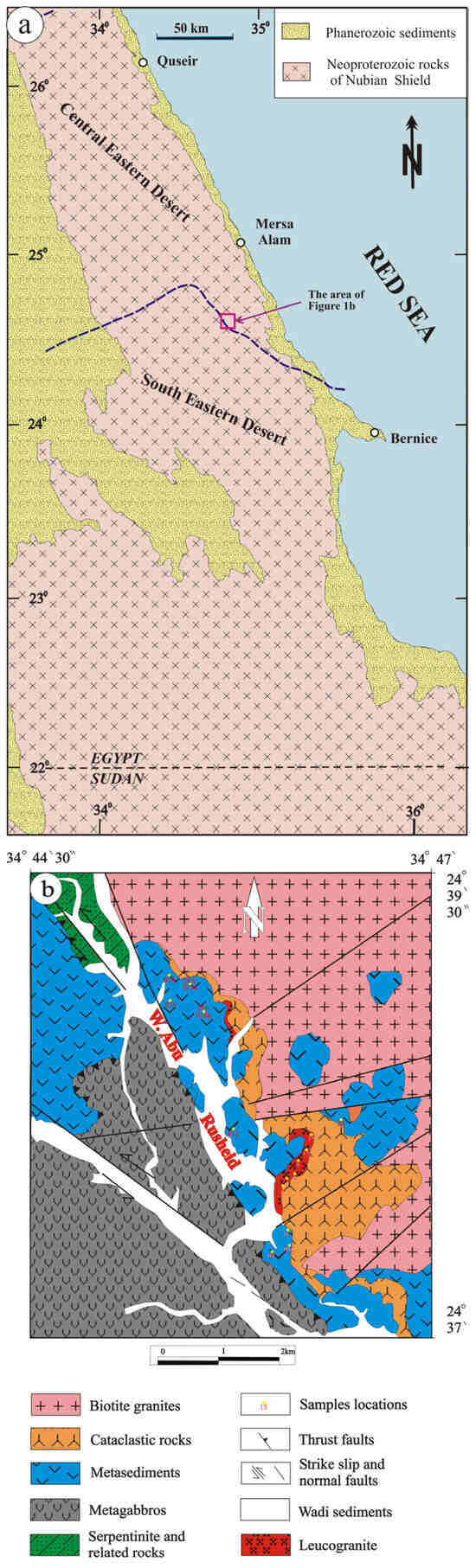
The Wadi Abu Rusheid area is located about 60 km southeast of the Egyptian Red Sea coast city of Mersa Alam (Figure 1a). Here we focus on a small area in Wadi Abu Rusheid along the western edge of the larger Abu Rusheid granite pluton; the study area of 0.33 km2 is bounded by latitudes 24°38′20″ and 24°38′40″ N and longitudes 34°45′41″ and 34°46′00″ E. The basement rocks in this area are divided into metasediments, cataclastic rocks, biotite granite and leucogranite (Figure 1b).
Figure 1.
(a) General geologic map of the central and southern sectors of the Eastern Desert of Egypt (dividing line after [26]), showing the location of the study area. (b) Geological map of Abu Rusheid area (modified after [16]).
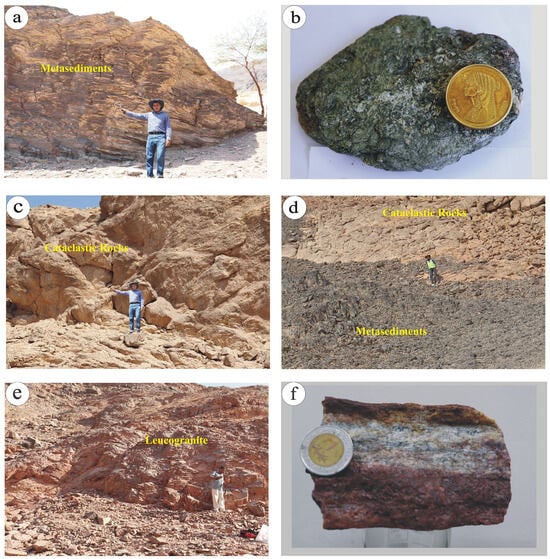
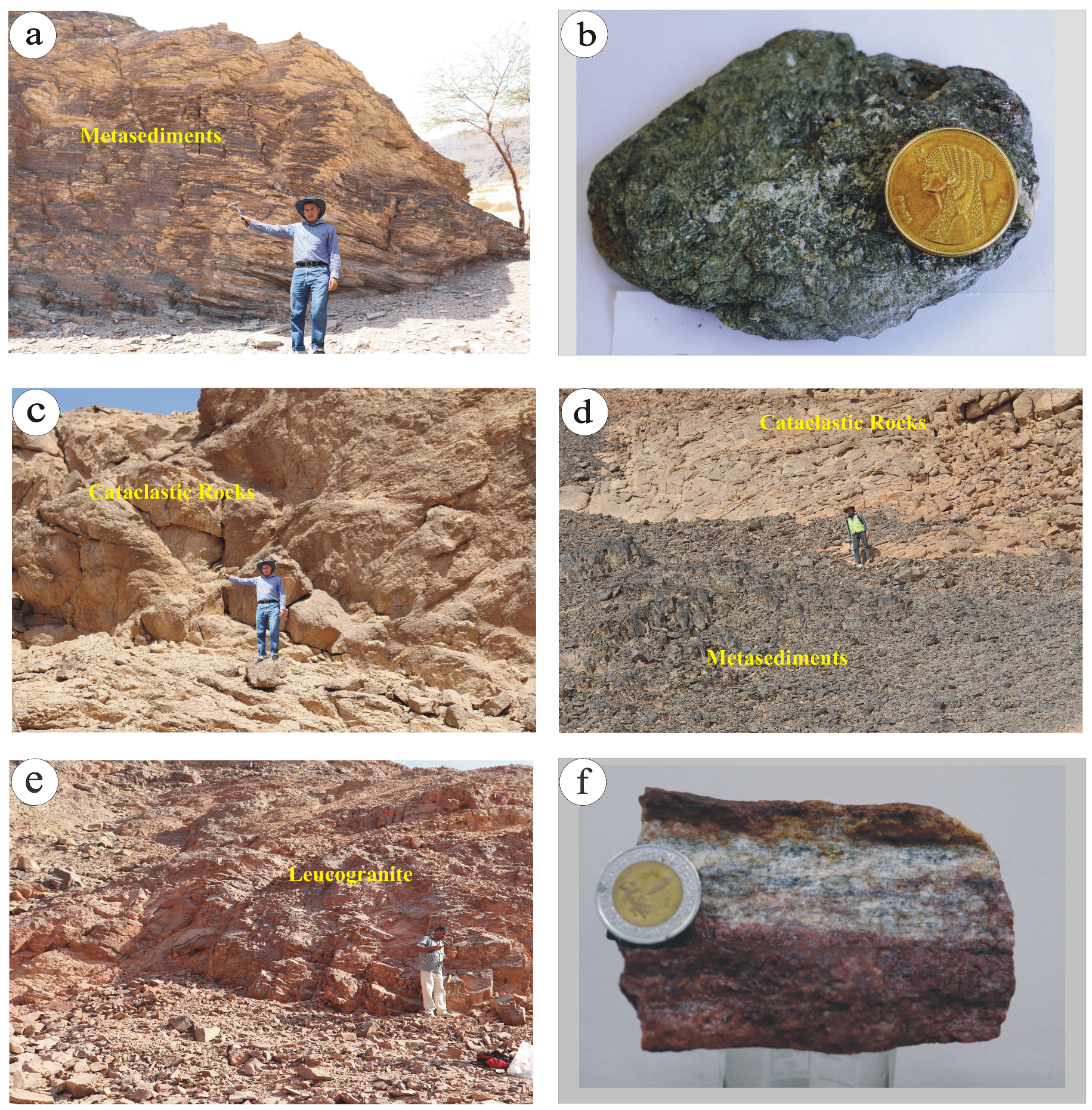
Metasediments are composed of three varieties of biotite-rich schist, divided here into amphibole–biotite schist, graphite–biotite schist and garnet–biotite schist. These rocks are fine- to medium-grained, exhibit whitish–gray-to-greenish–gray colors, display strong schistose foliation, and in most cases are strongly folded (Figure 2a,b). Cataclastic rocks outcrop in areas of low to medium relief and display reddish to light grey colors (Figure 2c). They are medium-grained and foliated and exhibit augen texture. In exposures along Wadi Abu Rusheid, the sharp contact between metasediments and cataclastic rocks is obvious and is interpreted as a thrust fault (Figure 1b and Figure 2d). Biotite granite forms hills of medium to high relief, extending out of the study area to the north, east, and southeast. It is medium- to coarse-grained and pink in color. It was not analyzed further for this study. Leucogranite forms a narrow (~about 20 m wide) selvage close to the thrust fault between the metasediments and cataclastic rocks. It is medium-grained, pink in color, highly sheared, and heavily fractured (Figure 2e,f).
Figure 2.
Field photographs. (a) Foliated metasediments in the study area. (b) Greenish–gray hand-specimen of metasediment showing schistosity. (c) Reddish color of cataclastic rock. (d) The contact between metasediments and cataclastic rocks. (e) Sheared leucogranite showing pink color. (f) Highly sheared granite hand-specimen.
3. Analytical Techniques
Metasedimentary, cataclastic, and granite hand-specimen rock samples were collected from the study area, totaling 100 grab samples. The samples were prepared as polished thin sections and whole-rock powders for petrography, mineral chemistry and geochemical analyses. The petrographic characteristics of the different rocks were determined by investigation of seventy thin sections using a polarizing microscope.
Mineral chemical analyses and electron backscatter images were obtained from polished, carbon-coated thin sections using a JEOL JXA-iHP200F field-emission electron microprobe (JEOL USA, Peadody, MA, USA) at the Division of Geological and Planetary Sciences (GPS), California Institute of Technology, USA. This instrument is equipped with five wavelength-dispersive X-ray spectrometers (WDS) and one energy-dispersive X-ray spectrometer (EDS). Because of the variety of accessory minerals with essential concentrations of rare elements, an expanded multi-element protocol was developed and applied in this work. Operating conditions were 15 kV, 20 nA, and a focused beam. The Mean Atomic Number background subtraction and CITZAF matrix correction routine were used. Supplementary Table S1 presents the details of the analytical protocol, including which diffracting crystal, counting time, standard, and interference corrections were applied for the analysis of each of the 35 elements considered. Mixed-phase analyses and points on anhydrous minerals with analytical totals <97 wt% were rejected. All data were originally reduced and reported as oxides; for waimirite-(Y) and fluorite this yields anomalously high totals, whereas phases containing CO2, H2O, and Li have anomalously low totals because of unanalyzed components. Calculations of structural formulae were done with either custom spreadsheets in Microsoft Excel or MinPet software-version 2.02 [27]. The mineral formulae were normalized to the most appropriate number of oxygens or fluorines for each mineral to obtain atoms per formula unit (a.p.f.u.).
Major, trace and rare-earth elements for representative samples from both granites and metasediments were analyzed at California Institute of Technology (Caltech, USA). Sample powders were ground in an agate ball mill. Loss on ignition (LOI) was determined by weight difference after ignition at 1000 °C. Precision and accuracy were controlled by analysis of international reference materials and replicate analyses and are estimated to be 1% for major elements and 2% to 5% for trace elements. Whole-rock composition of major and minor elements (Si, Ti, Al, Fe, Mg, Ca, Na, K, P, and Mn expressed as weight percent oxides; Rb, Ba, Sr, Nb, Zr, Hf, Y, Zn, Cu, Ni, Co, Cr, V, La, Ce, Nd, Pb, and Th expressed as elemental μg/g) were determined using a Panalytical Zetium XRF system (Malvern Panalytical, Malvern, Worcestershire, UK). Fused-glass beads were prepared from fired powders by mixing with 9 times their weight in 66.67% Li2B4O7-32.83% LiBO2-0.50% LiI flux and fusing at 1200 °C. The XRF protocol is calibrated against USGS standards AGV-1, AGV-2, BCR-1, BCR-2, BHVO-2, BIR-1, DNC-1, DTS-2, G-2, GSP-2, MAG-1, NKT-1, NOD-A-1, QLO-1, RGM-2, SBC-1, SCO-1, SDC-1, SGR-1, STM-1, and W-2. USGS standards AGV-2, GSP-2, and RGM-2 are routinely analyzed along with unknowns for quality control and drift correction.
Additional whole-rock measurements were conducted with powder pellets. Samples of 330 ± 0.5 mg and 70 ± 0.5 mg of cellulose binder were finely ground together until the mixture passed entirely through a 100 mm sieve and pressed into 13 mm diameter pellets. These pellets were analyzed by laser-ablation ICP-MS with an UP-193 laser ablation system from New Wave Research (Fremont, CA, USA), equipped with the Supercell ablation chamber and coupled to an Agilent 8800 Triple-Quad ICP-MS (Santa Clara, CA, USA) operated in no-gas single-quad mode with Ar carrier gas (See [28], for a full description of the development of this method). Samples were loaded in a 3D-printed PLA holder with NIST 610 and 612 glass standards and inserted into the chamber. The laser was warmed up for at least 30 min, until a negligible variation in the reported fluence, then tuned at the beginning of each session. The sample chamber was purged until counts on specific masses, corresponding to CO2+, N2+, and 27Al+, had stabilized. Spots and lines were located and programmed using the New Wave Research program. Before each analysis, the laser was fired at the closed shutter for 15 s to both warm up the laser and establish a background-count rate for each line. Pressed pellets were then ablated via line analyses with a 120 µm spot size at a frequency of 10 Hz at 80% laser power. A 500 µm line was analyzed at a scan rate of 10 µm/s, resulting in 50 s of total ablation time. After each analysis a 60 s washout period was included. Calibration was achieved by measuring replicates of NIST SRM 612 at the beginning of each batch of 9 pressed pellets, collecting 7 lines on each.
Fifty-three analyses were selected ranging from lithium (mass 7) to uranium (mass 238), including 8 major elements and 41 trace elements (two isotopes of Ca, two isotopes of Si, and three isotopes of Pb were analyzed). 28Si (as measured by XRF on the same sample) was the reference internal standard for all unknowns. This list of analytes includes elements found in phases known to be resistant to grinding, such as Zr and Hf in zircon [29,30], as well as elements that are challenging to ionize, including B and As. The Agilent Mass Hunter software-version 7.08 (Santa Clara, CA, USA) was used to set integration intervals for each analyzed spot, make background corrections, and implement the calibration with NIST SRM 612 using 28Si as an internal standard.
Finally, the pellets, which were prepared from unfired sample powders, were analyzed by XRF for the volatile elements that do not readily from positive ions in the ICP inlet: F, Cl, and S. The same Panalytical Zetium instrument described above was configured for 13 mm diameter samples and standardized against USGS standards BCR-2 and GSP-2, which have certified concentrations for F, Cl, and S. Detection limits are estimated to be 115, 28, and 9 μg/g for F, Cl, and S, respectively.
4. Petrography
4.1. Leucogranite
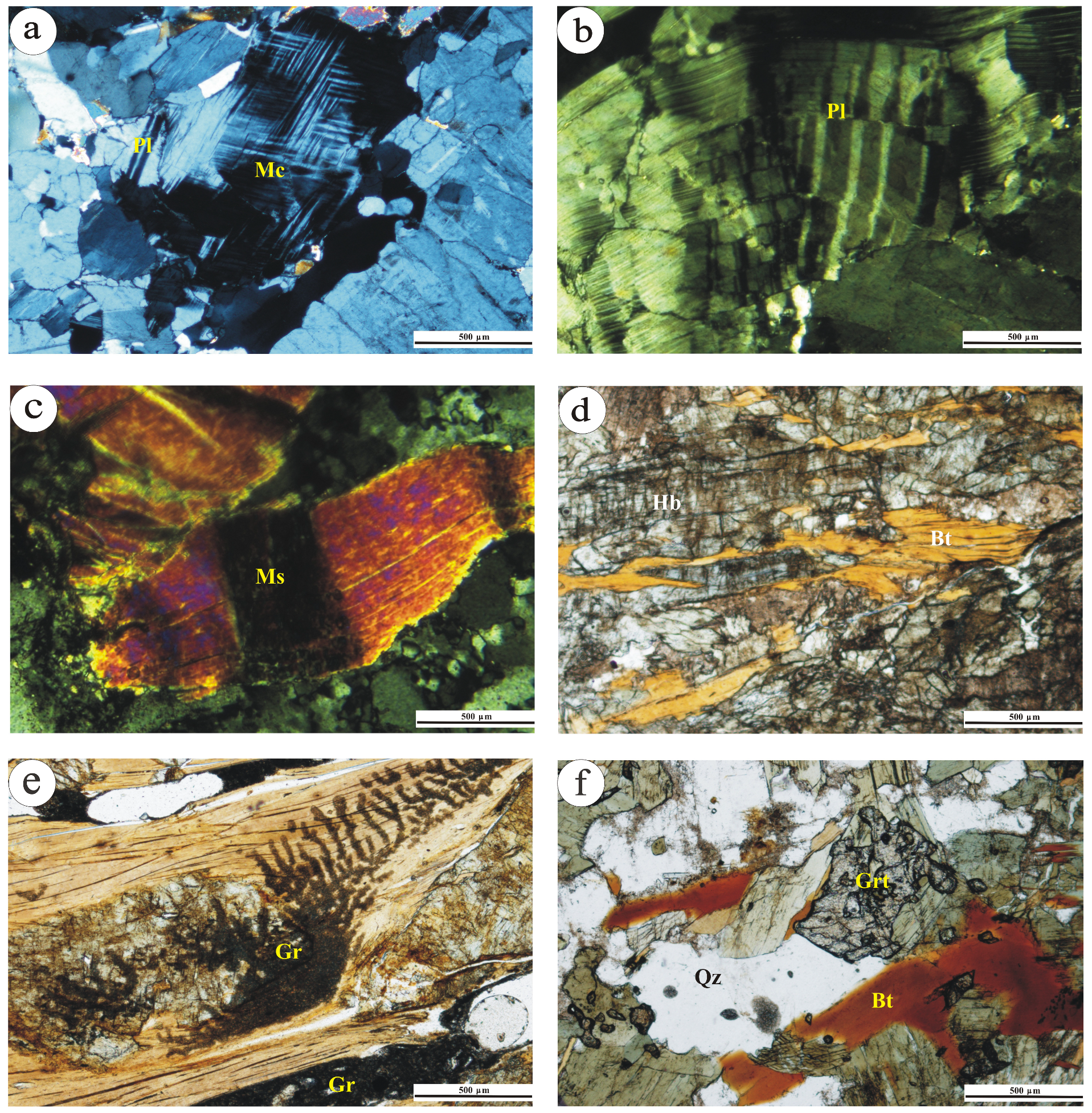
Leucogranite exhibits a hypidiomorphic texture. It is composed mainly of quartz, plagioclase and K-feldspar with subordinate muscovite (Figure 3a). The accessory minerals are zircon, columbite, bastnäsite, fluorite and opaque minerals. Quartz is medium-grained, cracked, and exhibits undulose extinction. Plagioclase occurs as subhedral to euhedral medium crystals, twinned according to the albite and Carlsbad laws. K-feldspars include both orthoclase and microcline. Orthoclase occurs as subhedral to anhedral crystals. Microcline occurs as subhedral crystals and exhibits tartan twinning. Muscovite is present as subhedral crystals or as flakes exhibiting one perfect cleavage.
Figure 3.
Photomicrographs of the studied host rocks. (a) Leucogranite composed mainly of quartz (Qz), plagioclase (Pl), microcline (Mc) and muscovite (Ms) (C.N.). (b) Plagioclase crystal (Pl) shows kinking, bending and tapering in the twin lamellae in cataclastic granite (C.N.). (c) Kinking and bending in muscovite crystal (Ms) in cataclastic granite (C.N.). (d) Biotite (Bt) and hornblende (Hb) of amphibole–biotite schist (P.P.L.). (e) Stringer and veinlet of graphite (Gr) in graphite schist (P.P.L.). (f) Garnet (Grt) and biotite (Bt) in garnet-biotite-schist (P.P.L.). (C.N. = Crossed Nicols; P.P.L = Plane Polarized Light).
4.2. Cataclastic Granite
The cataclastic rocks exhibit granitic (hypidiomorphic) texture and are mainly composed of quartz, orthoclase perthite, microcline and plagioclase as essential minerals with subordinate amounts of muscovite and biotite. The accessory minerals are opaque minerals (including magnetite, columbite and a few specks of pyrite), zircon, fluorite and garnet.
Quartz occurs as subhedral to anhedral crystals, fine to medium-grained and exhibiting undulose extinction. Some quartz grains are angular, flattened and fractured. K-feldspars are represented by orthoclase perthite and microcline. Orthoclase perthite occurs as subhedral crystals that contain worm-like blebs of exsolved albite and exhibit fractures filled by microcrystalline silica and muscovite. Microcline occurs as euhedral to subhedral crystals, sometimes fractured, and exhibits tartan (cross-hatching) texture. Plagioclase occurs as subhedral to euhedral crystals exhibiting Carlsbad and Carlsbad-plus-albite twinning. It is sometimes zoned. Some plagioclase crystals show kinking and bending of twin planes (Figure 3b). Biotite occurs as medium grains and shows a brown color with one set of cleavages. Muscovite occurs as subhedral to euhedral crystals, with one set of cleavages. Some muscovite crystals are folded and kinked (Figure 3c).
4.3. Metasediments
4.3.1. Amphibole–Biotite Schist
This rock is fine to medium-grained and gray to dark gray in color. Microscopically, it is composed of quartz, plagioclase, biotite and amphiboles as essential minerals. Opaque minerals, bastnäsite, talc, beryl, tourmaline and zircon are accessories. This rock exhibits granular to slightly foliated textures (Figure 3d).
Quartz occurs as fine-to-medium-grained fragmented and subhedral crystals, sometimes exhibiting wavy extinction. Plagioclase is present as fine to medium subhedral crystals showing lamellar twinning. Amphiboles occur as subhedral elongated or prismatic crystals; some exhibit simple twinning. Talc occurs as acicular crystals. Beryl is present as individual subhedral crystals or as aggregates. Tourmaline forms long, prismatic colorless crystals free from cleavage. Bastnäsite exists as anhedral to subhedral interstitial crystals, colorless with earthy alterations.
4.3.2. Graphite Schist
This rock is medium-grained and exhibits gray, dark gray and grayish–black colors. Microscopically, it is slightly foliated and composed mainly of quartz, biotite, amphibole and graphite as essential minerals. Bastnäsite, beryl, tourmaline, fluorite and opaques are present as accessory minerals.
Quartz occurs as fine-to-medium-grained subhedral to anhedral crystals. Biotite is present as medium subhedral platy brown crystals (up to 1.5 mm) and exhibits perfect cleavage in one direction. Graphitic materials occur as massive aggregates forming stringers and veinlets (Figure 3e). Beryl exists as fine to medium euhedral to subhedral cracked crystals and contains inclusions of muscovite. Tourmaline occurs as platy or prismatic subhedral crystals with some cracks. Bastnäsite is present as anhedral to subhedral crystals, colorless with earthy alterations.
The metamorphic assemblage of quartz + plagioclase + biotite + graphite + chlorite ± bastnäsite indicates greenschist facies.
4.3.3. Garnet–Biotite Schist
This rock is fine-to-medium-grained, compact, and exhibits gray to dark gray colors. Microscopically, it is foliated and composed of quartz, plagioclase, orthoclase and biotite as essential minerals, whereas muscovite, garnet, bastnäsite, tourmaline, zircon, beryl, talc and opaque minerals are accessories. The foliation is defined by the preferred orientation of the biotite and muscovite flakes as well as quartz and plagioclase grains flattened in the same foliation plane.
Quartz occurs as subhedral to anhedral crystals and exhibits undulose extinction. Plagioclase is present as unzoned subhedral to euhedral crystals twinned according to albite and Carlsbad laws. Biotite occurs as subhedral prismatic crystals with one perfect cleavage or as flakes. Garnet exists as subhedral to rounded grains, colorless and high relief (Figure 3f).
The mineral assemblage of quartz + plagioclase + biotite + bastnäsite ± garnet ± muscovite ± tourmaline ± beryl indicates garnet zone metamorphic grade (upper greenschist to lower amphibolite facies).
5. Mineral Chemistry
5.1. Waimirite-(Y), Bastnäsite-(Ce) and Co-Existing Minerals in Leucogranite
The chemical composition and structural formulae of waimirite-(Y) and bastnäsite-(Ce) hosted in leucogranite and those of co-existing albite, K-feldspars, zircon, columbite, zinnwaldite, and fluorite are given in the Supplementary File (Tables S2–S9).
5.1.1. Waimirite-(Y)
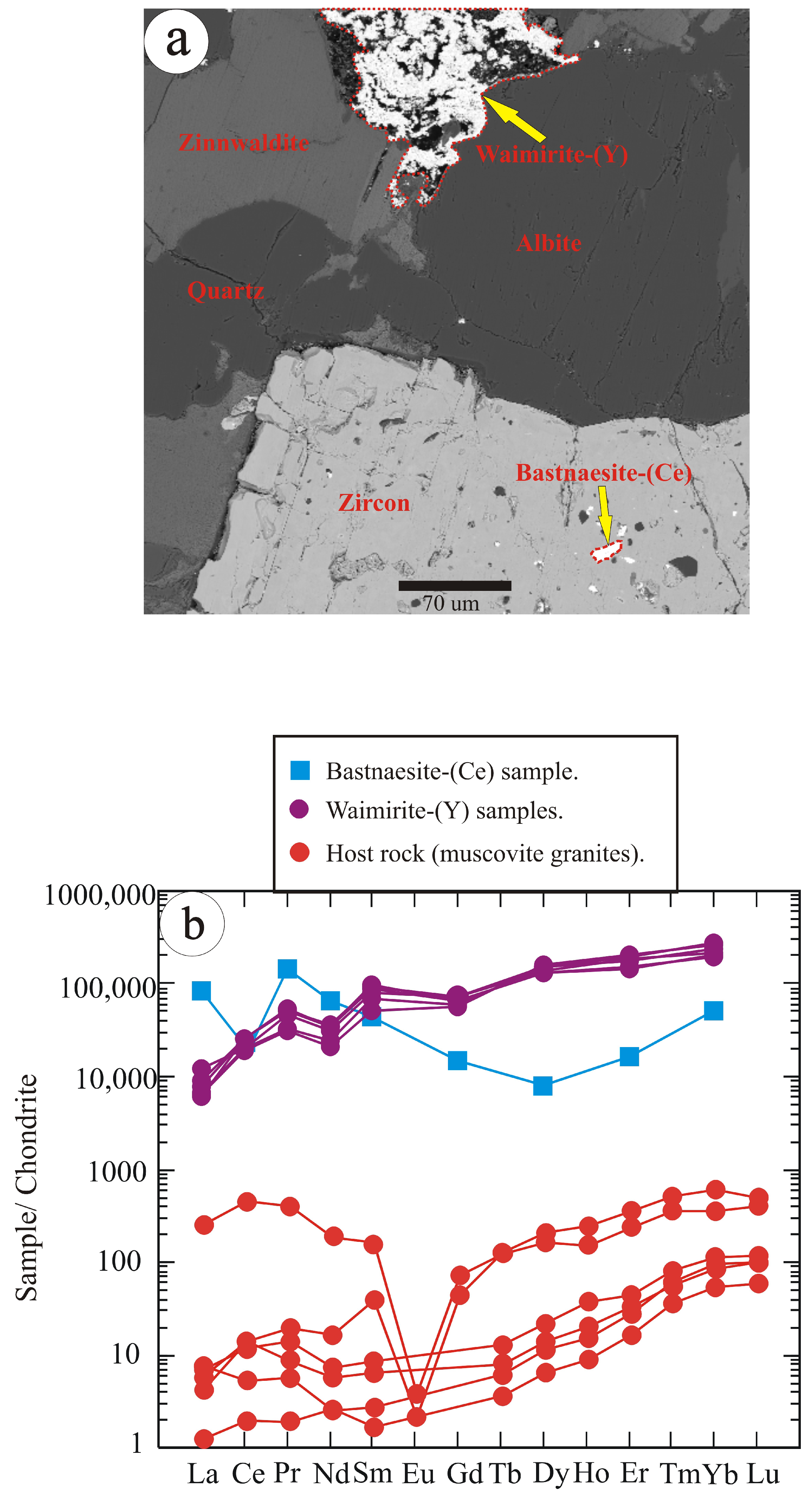
Waimirite-(Y) occurs as large anhedral grains co-existing with albite, quartz, and zinnwaldite. The contacts suggest corrosion and replacement of adjacent phases (Figure 4a). Waimirite-(Y) has high contents of Y2O3 (39.8–46.6 wt.%), F (27.1–34.8 wt.%), Yb2O3 (5.7–7.7 wt.%), Dy2O3 (5.9–7.1 wt.%), Er2O3 (4.2–6.0 wt.%) and Gd2O3 (2.0–2.5 wt.%) with lower amounts of Sm2O3 (1.4–2.6 wt.%), Ce2O3 (2.1–2.9 wt.%) and Nd2O3 (1.8–3.1 wt.%) and a considerable amount of ThO2 (3.9–7.9 wt.%). Total REE abundance is extremely high (∑REE = 2.35–2.56 × 10⁵ µg/g) (Table S2). Chondrite-normalized REE patterns (Figure 4b) indicate that waimirite-(Y) is strongly enriched in HREE (Gd, Dy, Er, Yb) relative to LREE (La, Ce, Pr, Nd, Sm).
To calculate the chemical formula of the Abu Rusheid waimirite-(Y), Si and Al were subtracted from the total of analyzed elements because these two elements normally do not belong to waimirite-(Y) [10]. The charge-balanced formula of waimirite-(Y) likely requires the presence of both F and O anions [10,31]. The investigated waimirite-(Y) mineral contains two anions, oxygen and fluorine. In this case, two atoms of fluorine replace one oxygen atom in this mineral [31], thus the excess oxygens can be estimated by the equation [−O≡F = F × 16 ÷ 38] and subtracted from the total to obtain the real total.
Figure 4.
(a) Back-scatter electron image showing a grain of bastnäsite-(Ce) enclosed within zircon, with interstitial waimirite-(Y) in the surrounding leucogranite, and (b) chondrite-normalized REE patterns of bastnäsite-(Ce), waimirite-(Y) and their host rock. Data for minerals were obtained by EPMA analyses; those for the host rock are from ICP-MS analyses after [32]; normalization values after [33].
Calculations proved that the abundance of F in the chemical analyses of the Abu Rusheid waimirite-(Y) is not sufficient to neutralize the cations and the presence of oxygen is required to balance the charge in the chemical formula. Thus, oxygen abundance average value of 5.16 wt.% is required to obtain charge-balanced formula and the empirical formula of the Abu Rusheid waimirite-(Y) can be expressed as follows:
(Y0.55Ce0.02Pr0.01Nd0.02Sm0.02Gd0.02Dy0.05Er0.04Yb0.05Th0.05Ca0.16Pb0.01)∑1.00(F2.48O0.52)∑3.00.
We attempted to verify the crystal structure of waimirite-(Y) by both Raman spectroscopy and electron backscatter diffraction (EBSD). Neither method yielded a meaningful result. The Raman spectrum is so dominated by broad-spectrum fluorescence that no peaks can be observed. The EBSD pattern showed no apparent diffraction bands, likely because the material is too metamict to express sufficient crystalline order. Nonetheless, waimirite-(Y) is the only mineral phase with composition YF3, so we are confident in the mineral species assignment.
5.1.2. Bastnäsite-(Ce)
Bastnäsite-(Ce) occurs as minor grains or specks enclosed in zircon crystals in leucogranite (Figure 4a). We were not able to obtain a clean single-phase analytical point on this phase; incorporation of some zircon and thorite (or a solid solution of these two) in the analytical volume is indicated by the presence of SiO2 (6.30 wt.%), ZrO2 (10.18 wt.%), ThO2 (16.32 wt.%), and UO2 (6.01 wt.%) in the analysis. In the Supplementary Tables S1–S16 we show a composition estimated by subtracting the adjacent Th-bearing zircon analysis from the bastnäsite-(Ce) analysis until ZrO2 = 0. There is still considerable residual ThO2 in this calculated composition, implying the additional presence of a Th-rich phase. Nonetheless, the REE budget and F in the analysis are dominated by contributions from the Bastnäsite-(Ce) itself. The presence of high concentrations of Ce2O3 (19.5 wt.%), Nd2O3 (5.5 wt.%), La2O3 (3.7 wt.%) and F (7.3 wt.%) indicate the predominance of Ce > Nd > La and allow unambiguous assignment of the mineral species to bastnäsite–(Ce), with a formula (Ce, Nd, La)CO3F. The total REE abundance in this phase is 3.0 × 10⁵ μg/g (Table S3).
The slope of the chondrite-normalized REE pattern is opposite to that of waimirite-(Y), being enriched in LREE (La, Ce, Pr, Nd) relative to HREE (Gd, Dy, Er, Yb) (Figure 4b).
5.1.3. Co-Existing Minerals in Leucogranite
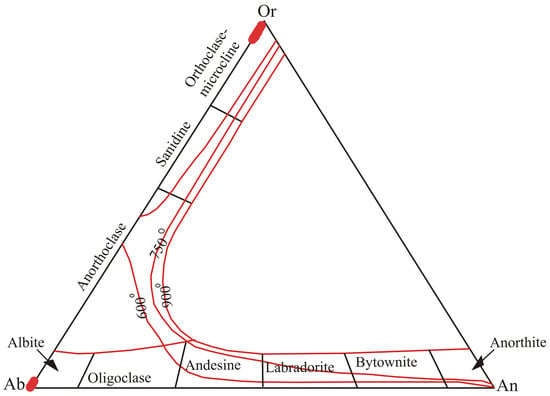
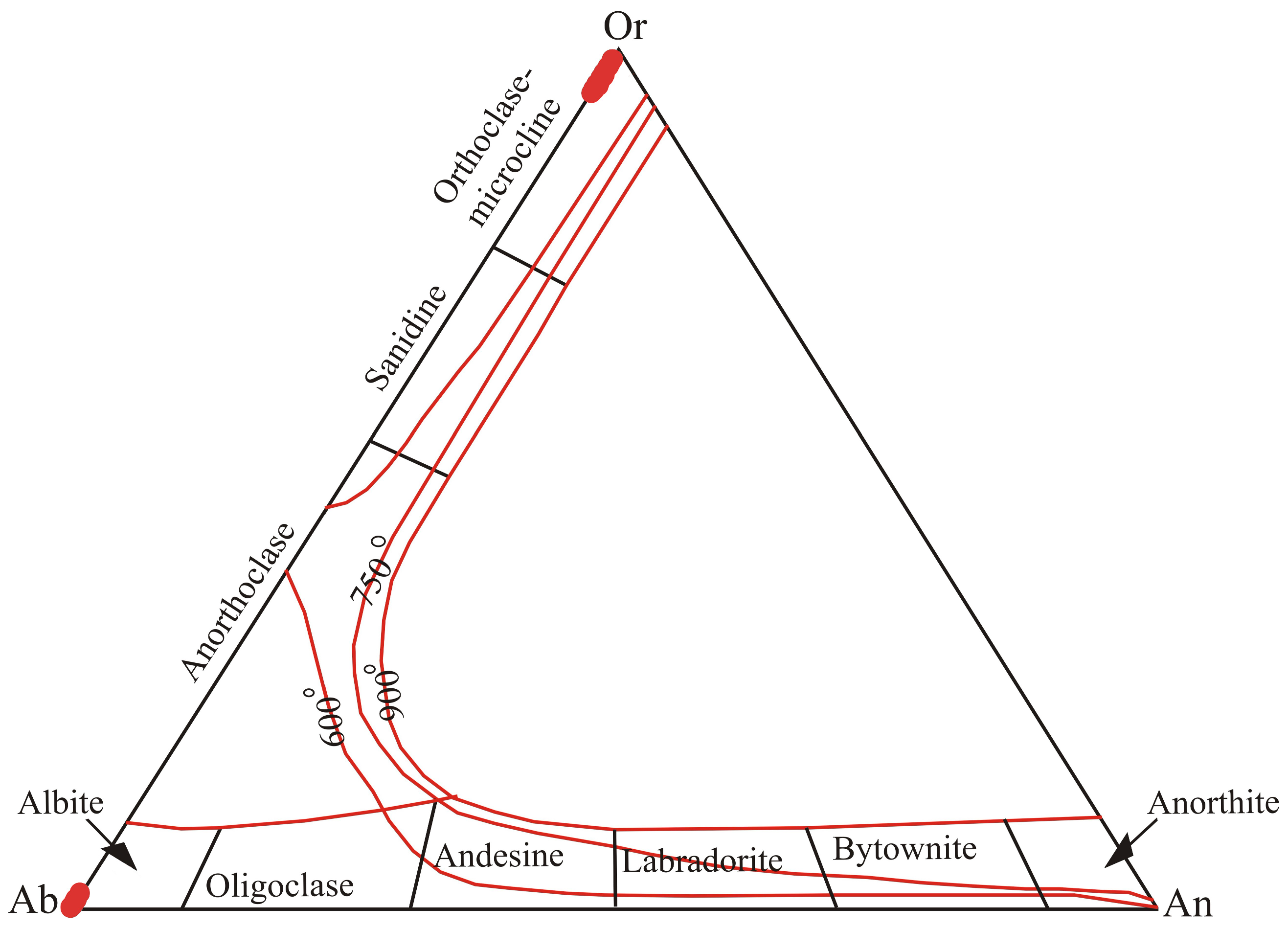
The analyzed minerals co-existing with waimirite-(Y) and bastnäsite-(Ce) in the leucogranite include feldspars, zircon, columbite, mica, and fluorite (Supplementary Tables S4–S9). The chemical composition and structural formulae of plagioclase in leucogranite (Table S4) reveal very low CaO (<0.02 wt.%) and K2O (0.03–0.33 wt.%) contents, rendering them nearly pure end-member albite (Ab98.1–99.8Or0.2–1.9An0.0–0.09) (Figure 5). K-feldspars (Table S5) have low concentrations of FeO* (≤0.12 wt.%), Na2O (0.17–0.58 wt.%) and CaO (≤0.06 wt.%), indicating nearly pure end-member orthoclase composition (Or94.7–98.4Ab1.6–5.3An0) (Figure 5). Zircon (Table S6) deviates from ZrSiO4 end-member composition only due to significant HfO2 concentration (2.8–5.5 wt.%).
Figure 5.
Composition of the feldspars based on the albite (Ab)-orthoclase (Or)-anorthite (An) triangular diagram [31].
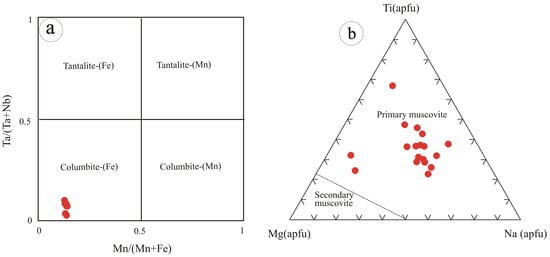
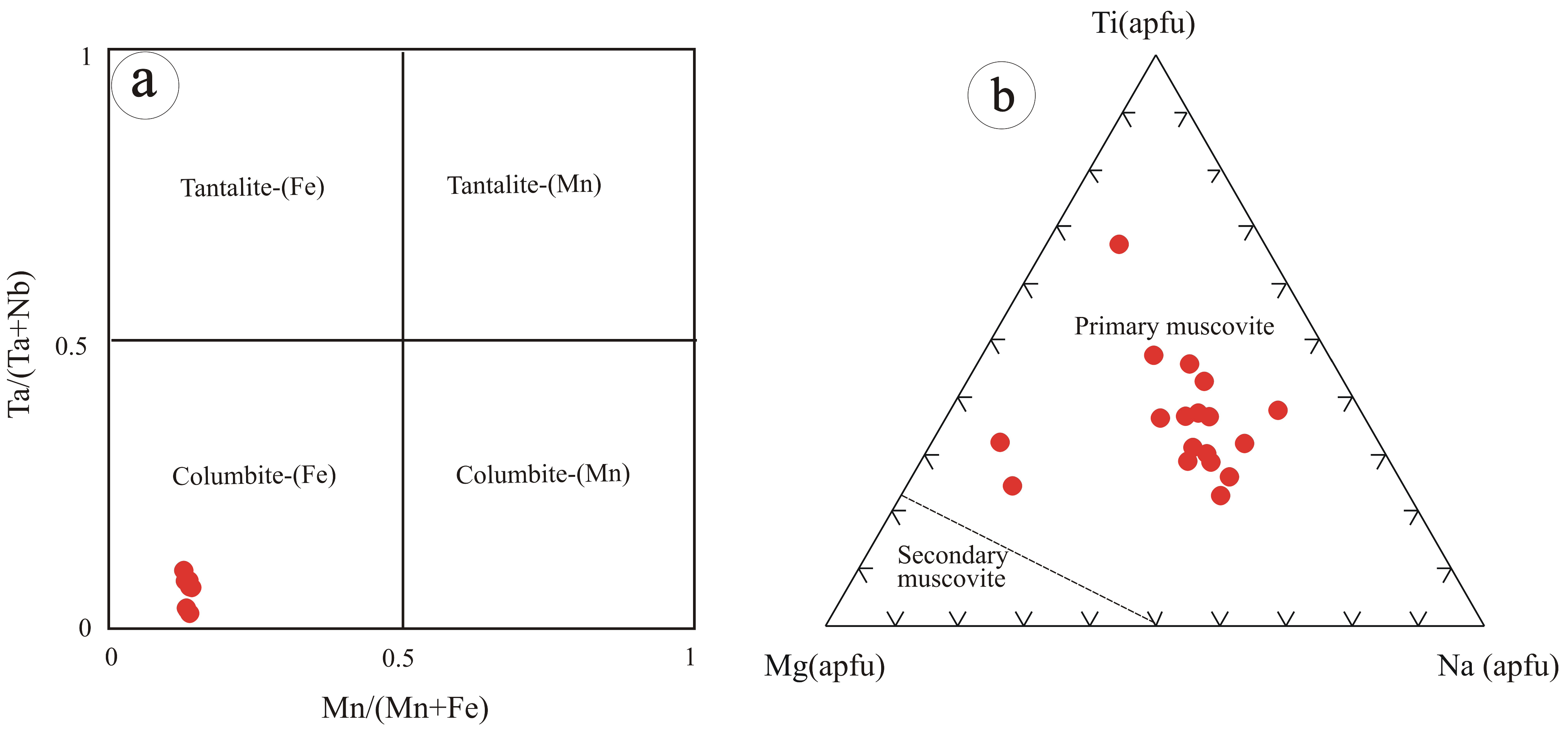
Columbite in the leucogranite is columbite-(Fe) (Table S7). It contains high concentrations of Nb2O5 (65.9–73.8 wt.%), FeO* (17.4–18.2 wt.%) and Ta2O5 (4.0–11.9 wt.%) but low levels of MnO (2.7–3.0 wt.%), and minor F (0.88–1.33 wt.%) and TiO2 (0.38–0.71 wt.%). The assignment to columbite-(Fe) is evident on the Ta/(Ta + Nb) vs. Mn/(Mn + Fe) quadrilateral diagram of [34] (Figure 6a).
Figure 6.
(a) Ta/(Ta + Nb) vs. Mn/(Mn + Fe) diagram of the columbite-group minerals [34]. (b) Ti-Mg-Na ternary diagram for the compositional fields of muscovite after [35].
The chemical composition and structural formula of the analyzed mica (Table S8) indicate the presence of both high FeO* (12.8–28.4 wt.%) and Al2O3 (15.1–21.0 wt.%) as well as F (3.6–7.3 wt.%). Although Li was not measured, we assign this phase to a solid solution between siderophyllite and polylithionite, commonly known as zinnwaldite. Although it was not intended for Li-rich micas, the Ti-Mg-Na ternary discrimination diagram of [35] suggests that this mica is a primary magmatic phase (Figure 6b). To be clear, we retain the field-based classification of this rock type as “leucogranite”, even though it technically does not contain muscovite; all the white mica in the analyzed samples is apparently zinnwaldite.
The composition of fluorite in leucogranite (Table S9) is dominated by Ca (26.2–37.8 wt.%) and F (48.0–50.5 wt.%) and characterized by significant levels of Y (12.8–16.1 wt.%). Several REE are also present at levels readily measurable by electron microprobe: Ce (0.15–4.2 wt.%), Nd (0.10–1.4 wt.%), Dy (0.81–2.5 wt.%), Er (1.6–3.1 wt.%), and Yb (3.3–5.3 wt.%).
5.2. Bastnäsite and Co-Existing Minerals in Metasedimentary Host Rocks
The chemical compositions and structural formulae of bastnäsite analyses from metasedimentary samples those of the co-existing minerals amphibole, biotite, chlorite, Cr-spinel, talc and fluorite are given in the Supplementary File (Tables S10–S16).
5.2.1. Bastnäsite-(Y)
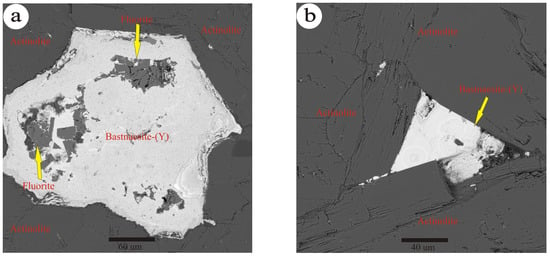
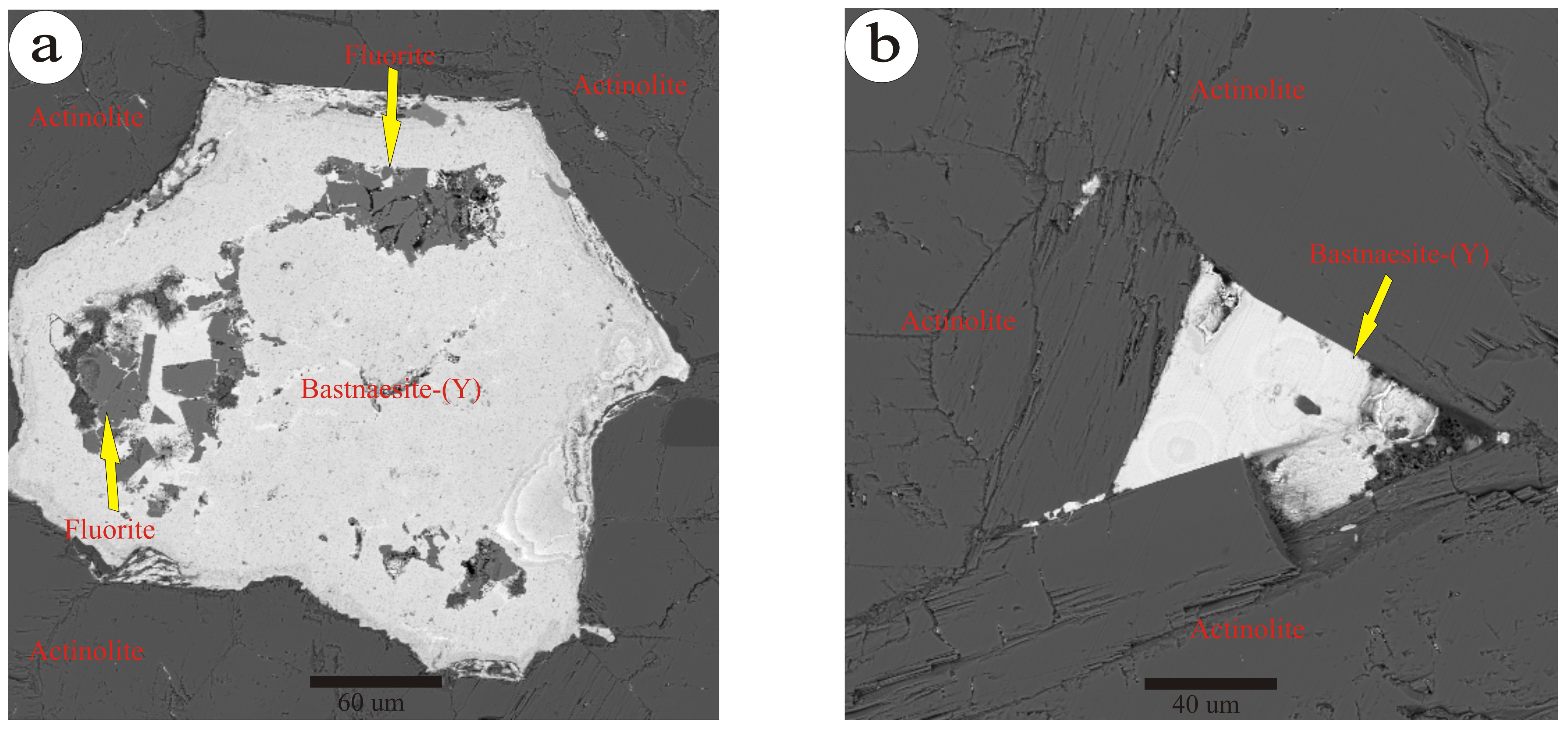
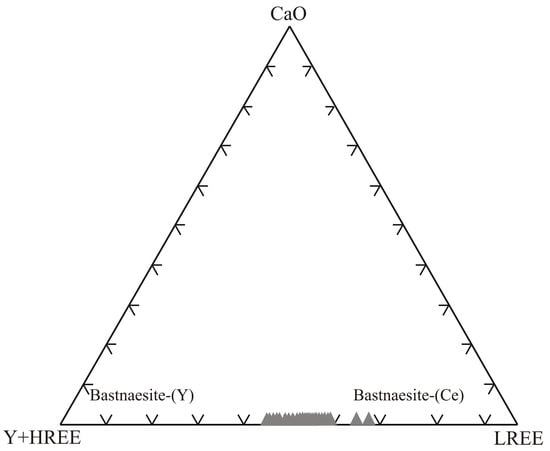
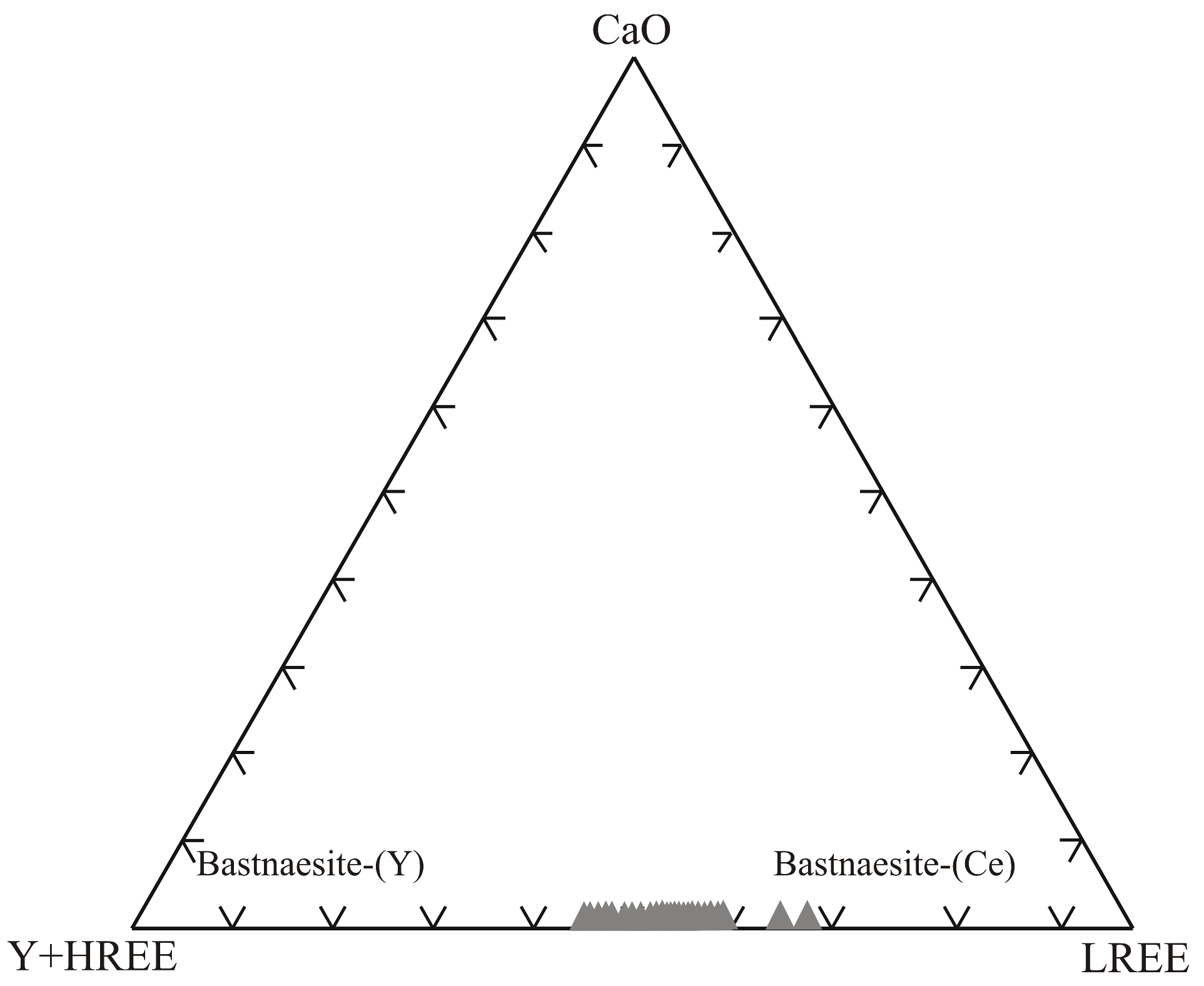
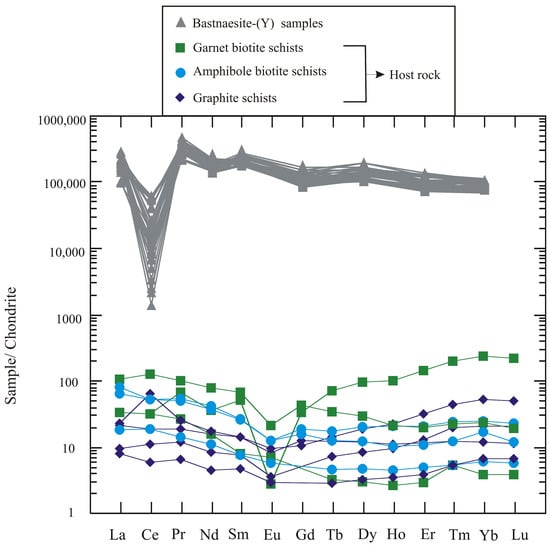
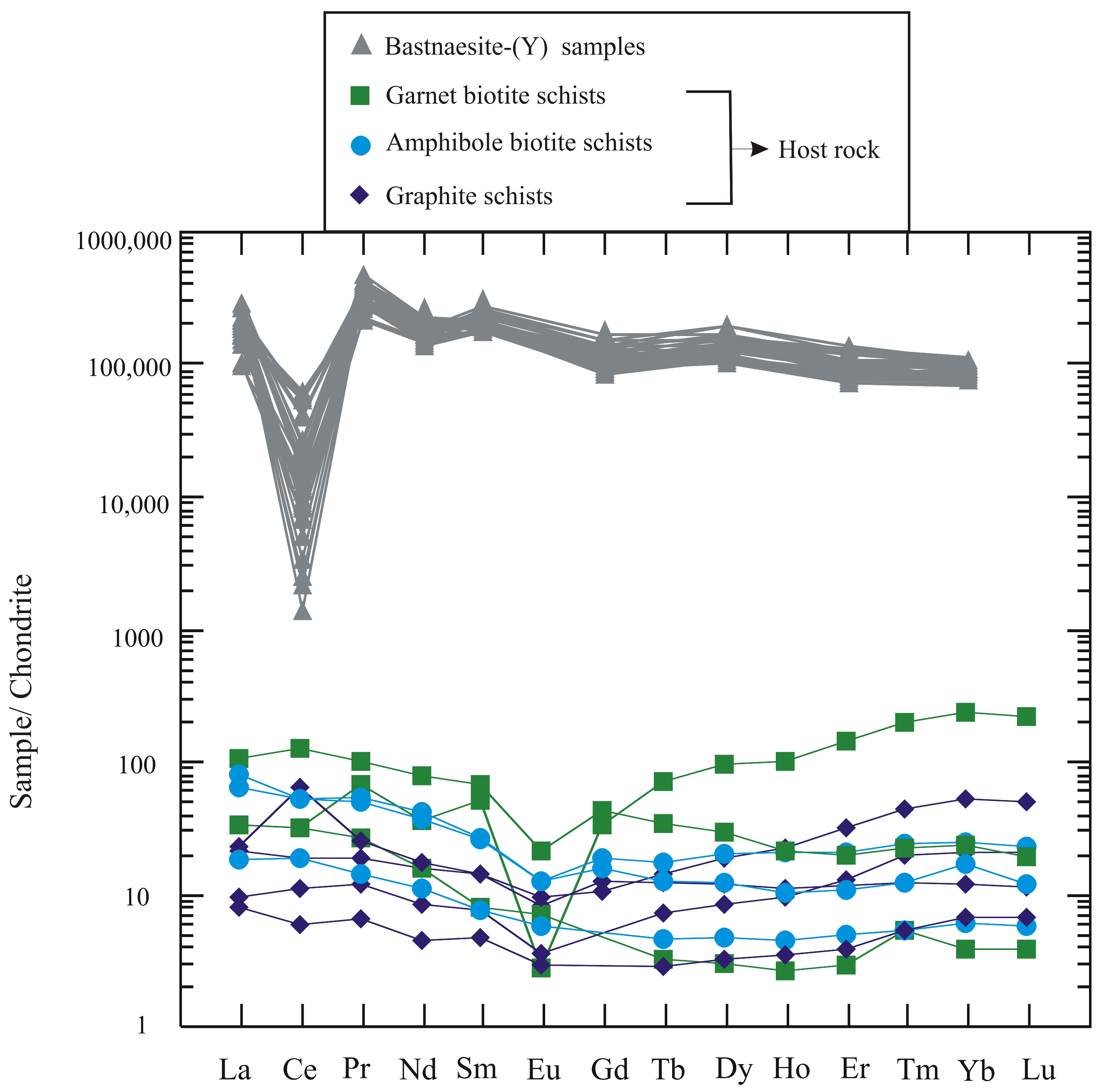
Bastnäsite hosted in metasediments occurs as well-developed euhedral crystals with hexagonal cross-sections, associated with actinolite and containing fluorite inclusions (Figure 7a), or as subhedral crystals enclosed by actinolite (Figure 7b). The composition is dominated by Y2O3 (11.4–21.7 wt.%), Nd2O3 (11.7–19.0 wt.%), La2O3 (4.2–13.7 wt.%), Pr2O3 (3.5–7.7 wt.%), Sm2O3 (4.6–7.3 wt.%), Dy2O3 (4.5–8.5 wt.%), Gd2O3 (3.0–5.3 wt.%), Er2O3 (2.0–3.9 wt.%) and Yb2O3 (1.9–3.3 wt.%). The even-numbered REE Ce2O3 is conspicuous by its low concentration (0.16–6.83 wt.%) relative to its odd-numbered neighbors. Some other elements in the analyses that are likely to be constituents of single-phase bastnäsite are CaO (2.5–4.0 wt.%) and F (3.6–6.3 wt.%). Some analysis points show significant amounts of other oxides, e.g., FeO* up to 4.6 wt.% and SiO2 up to 1.3 wt.%. These analyses may also have up to 5.8 wt.% CaO and are likely to be contaminated by silicate, fluorite, or oxide inclusions. According to the predominance of Y > Nd > La, the mineral species is assigned to bastnäsite-(Y), with a formula [(Y, Nd, La)CO3F]. This bastnäsite type has very high REE content (Ʃ REE = 4.56–6.37 × 10⁵ µg/g) (Table S10). Plotting the analyzed bastnäsite on a CaO-Y + HREE-LREE ternary diagram shows that the compositions have subequal amounts of Ʃ(Y + HREE) and ƩLREE (Figure 8), but the single dominant element is always Y. Chondrite-normalized REE patterns show a slight enrichment of LREE over HREE and a very large and prominent negative Ce anomaly (Figure 9). Although the amplitude of the negative Ce anomaly is quite variable, it is always present (Ce/Ce* = 0.005–0.27), and it is analytically very well-resolved, with La and Pr both present at ≥27× the detection limit.
Figure 7.
(a,b) Back-scattered electron images in metasediments show complete interstitial crystals of bastnäsite-(Y).
Figure 8.
CaO-Y + HREE-LREE ternary diagram of [36].
Figure 9.
Chondrite-normalized REE patterns of bastnäsite-(Y) and their host rock. Data for bastnäsite-(Y) were obtained by EPMA analyses (analytical conditions in Table S1); those for host rock are from ICP-MS analyses after [32]; normalization values after [33].
5.2.2. Co-Existing Minerals in Metasediments
The analyzed minerals co-existing with bastnäsite-(Y) in the metasedimentary rocks include amphibole, biotite, talc, fluorite, chlorite and Cr-spinel (Supplementary Tables S11–S16). The chemical composition and structural formula of the analyzed amphiboles are given in Table S11. The analyzed amphiboles are classified according to [37] into actinolite, tremolite, magnesio-hornblende and magnesio-ferri-hornblende. All the studied amphiboles are assigned to secondary (i.e., metamorphic, not detrital) origin on the basis of low TiO2 contents (TiO2 ˂ 0.75 wt.%; Ti ˂ 0.1 a.p.f.u) [38].
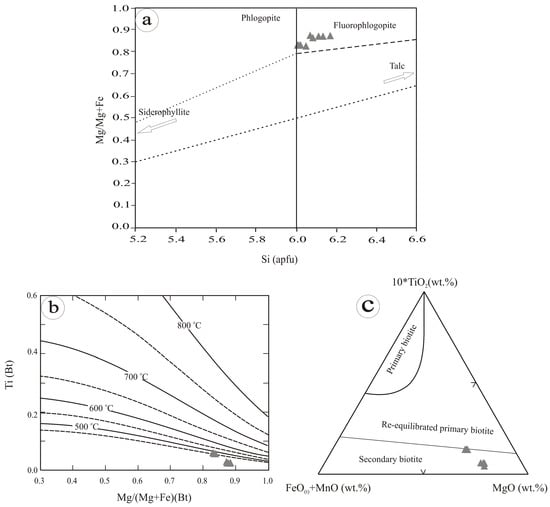
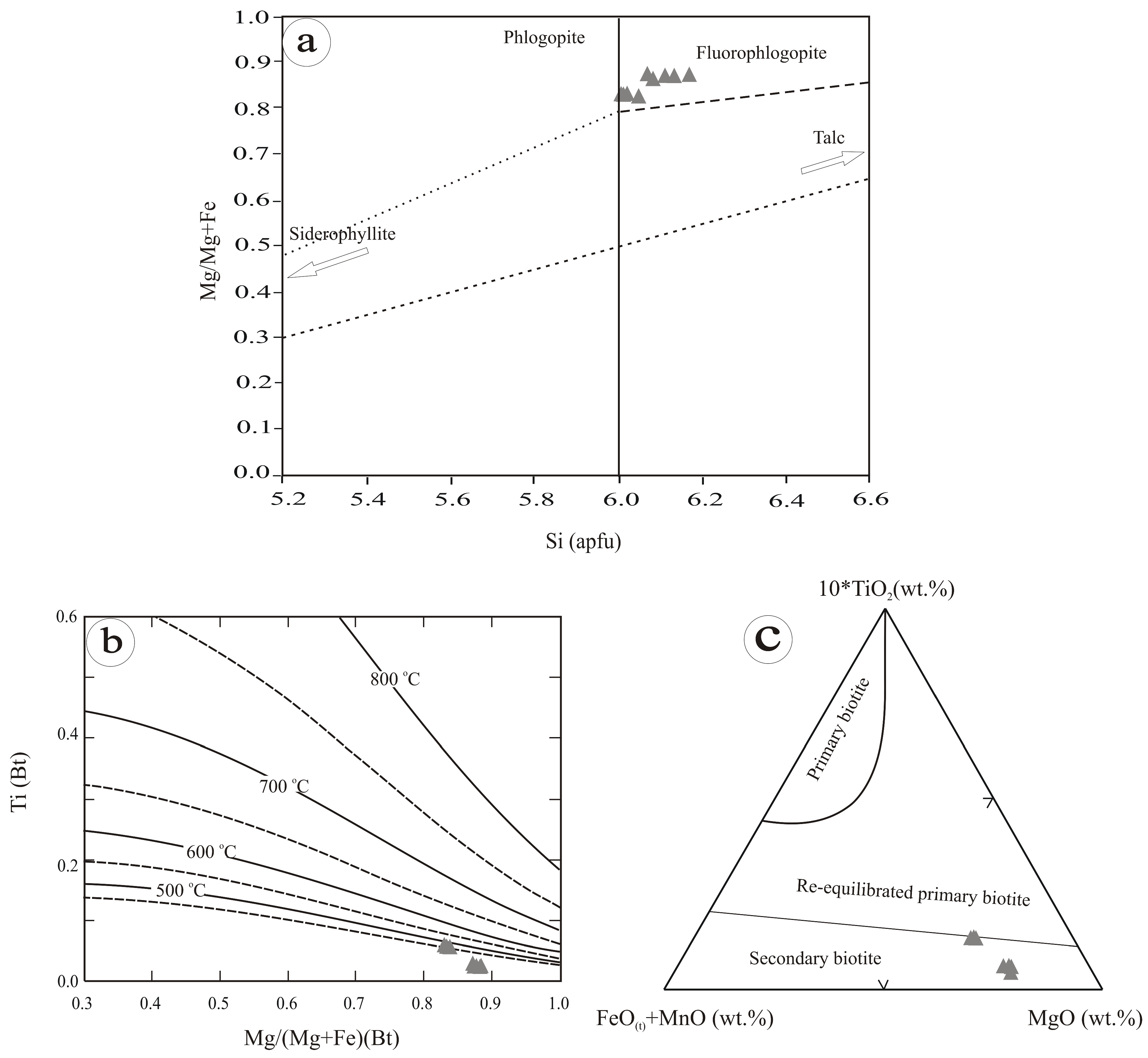
The chemical composition and structural formula of the analyzed biotite are given in Table S12. The biotite analyses are characterized by high XMg (molar Mg/(Mg + Fe) = 0.83–0.88) and Si > 6 a.p.f.u., a fluorophlogopite composition with a trend toward a low-alkali talc component (Figure 10a). Plotting the biotite analyses on the Ti versus Mg/Mg + Fe diagram of [39] indicates formation at temperature ˂ 500 °C (Figure 10b), and the 10 × TiO2-MgO-(FeO(t) + MnO) ternary diagram of [40] confirms secondary origin (Figure 10c).
Figure 10.
(a) Biotite compositions plotted on a XMg = Mg/(Mg + Fe) vs. Si (a.p.f.u) diagram of [32]. (b) Ti versus Mg/[Mg + Fe] diagram of [39]. (c) 10 × TiO2-MgO-(FeO(t) + MnO) ternary diagram of [40].
Talc analyses (Table S13) have high SiO2 (59.0–62.3 wt.%), MgO (27.1–28.7 wt.%) and FeO* (3.45–4.64 wt.%) and very low Al2O3 (0.25–0.85 wt.%) and Na2O (0.05–0.27 wt.%).
The chemical composition of the analyzed fluorite (Table S14) revealed essentially pure CaF2, composed of Ca (56.1–60.0 wt.%) and F (52.2–53.3 wt.%).
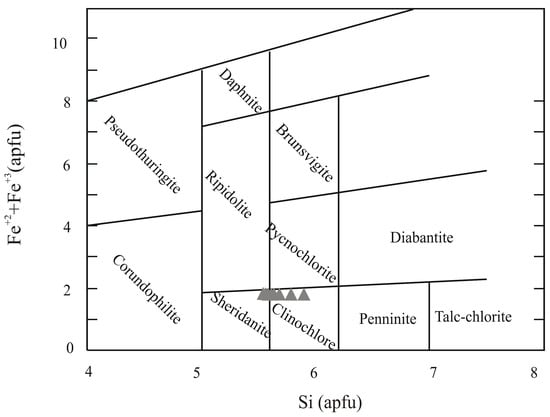
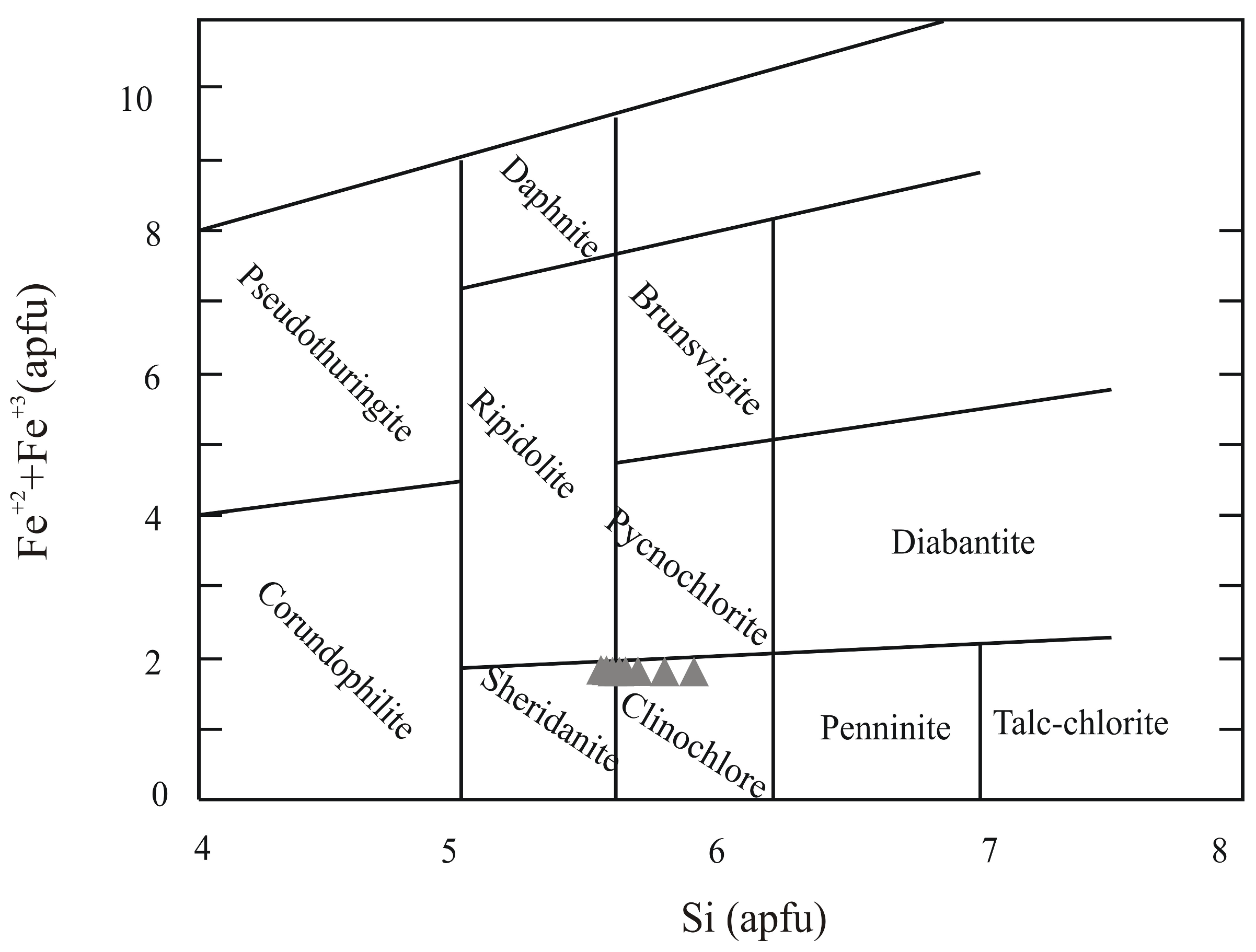
The chlorite analyses (Table S15) revealed fairly homogeneous composition, with narrow range of SiO2 (24.0–29.5 wt.%), Al2O3 (17.7–21.5 wt.%), MgO (23.9–26.3 wt.%) and FeO* (9.3–9.9 wt.%) contents. Plotting the analyzed chlorites on the (Fe+2 + Fe+3) vs. Si diagram classifies them mainly as clinochlore with subordinate sheridanite (Figure 11).
Figure 11.
Si vs. (Fe+2 + Fe+3) discrimination diagram for chlorites after [41].
The analyzed Cr-spinel (Table S16) is mainly composed of Cr2O3 (53.2–54.7 wt.%), FeO* (28.2–29.3 wt.%), and Al2O3 (8.6–10.3 wt.%) with minor amounts of MnO (0.81–1.48 wt.%) and MgO (0.59–1.50 wt.%).
6. Whole-Rock Chemistry of Host Rocks
6.1. Leucogranite
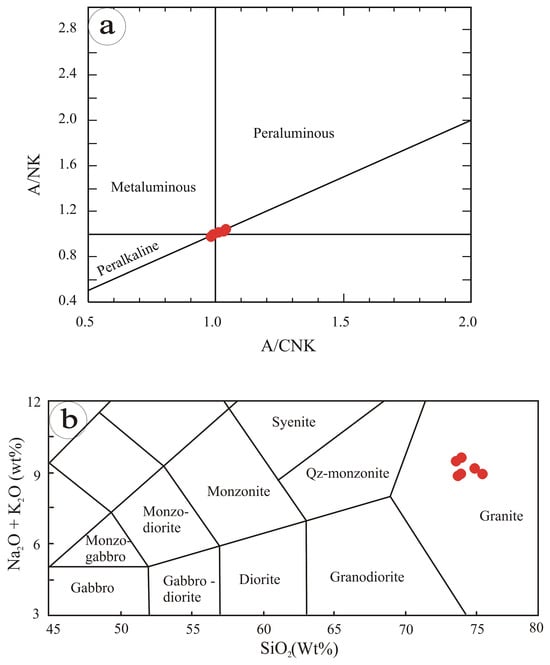
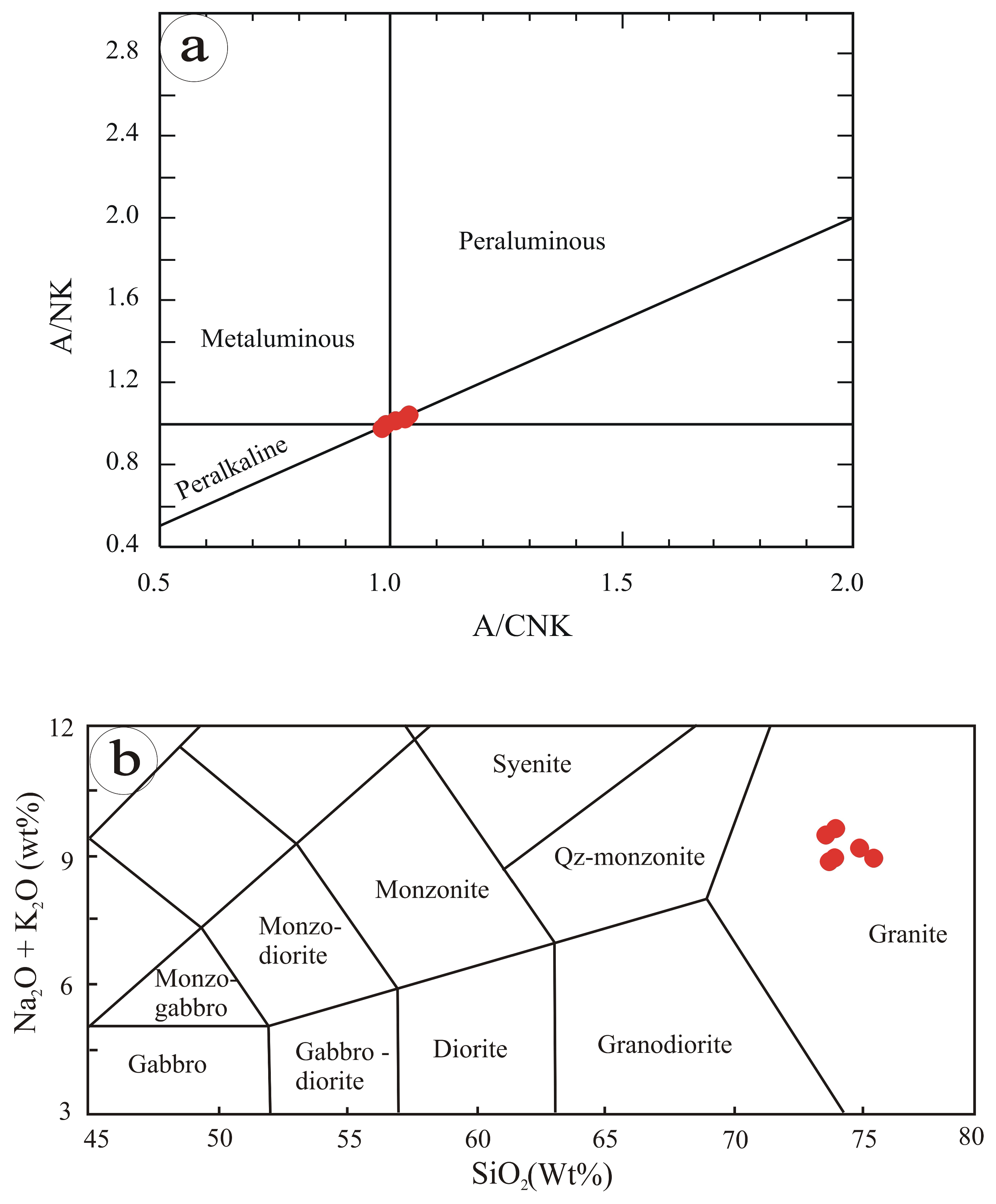
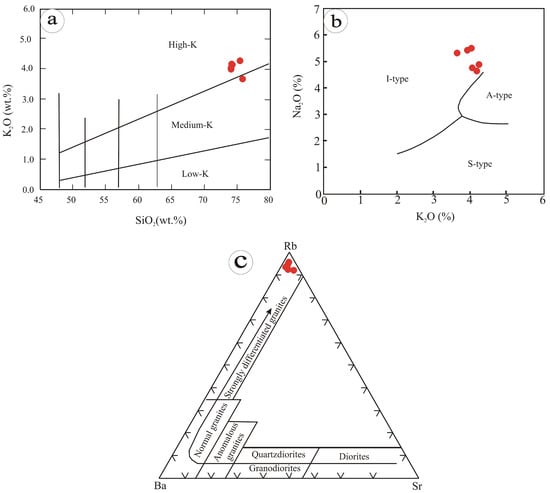
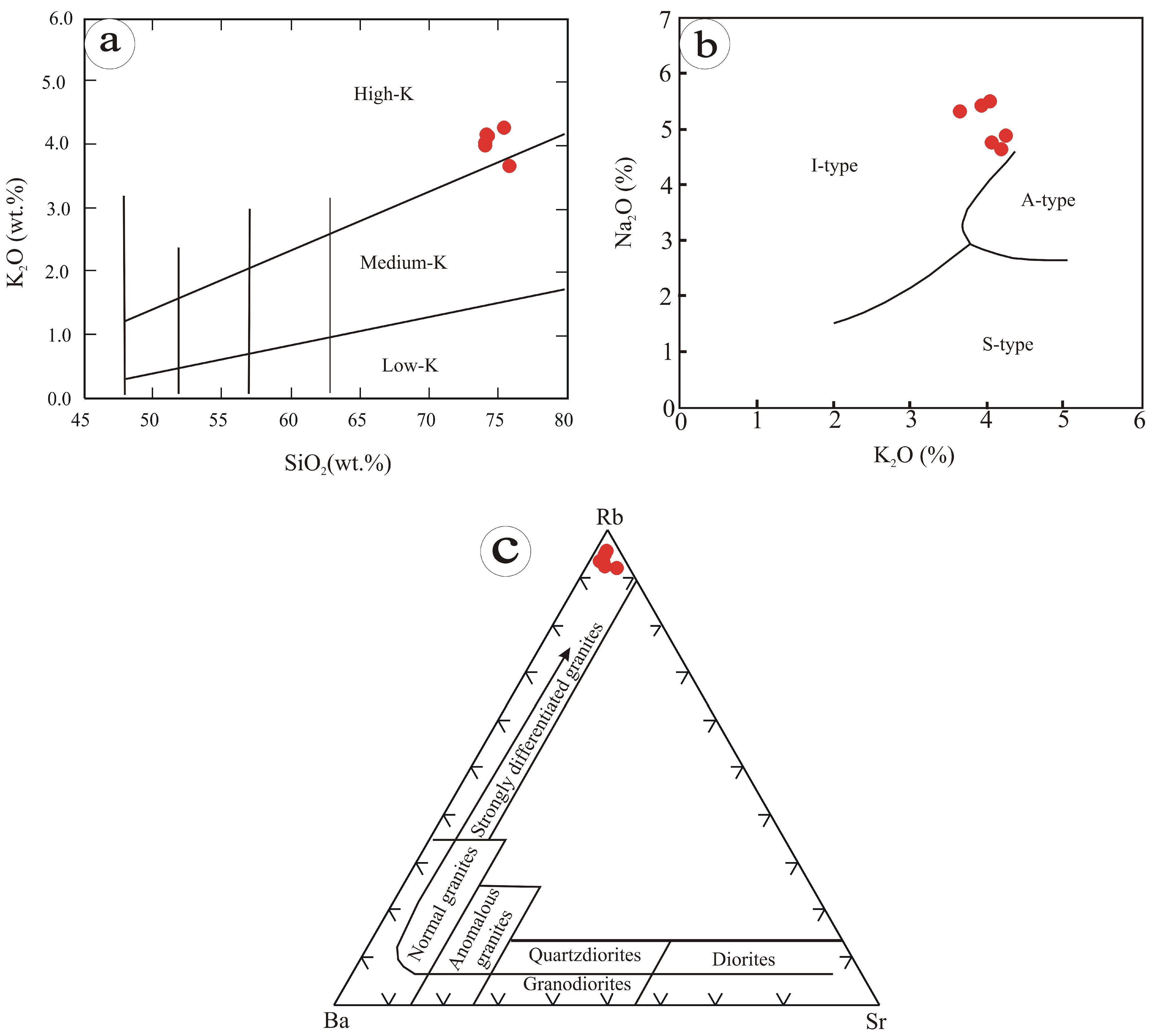
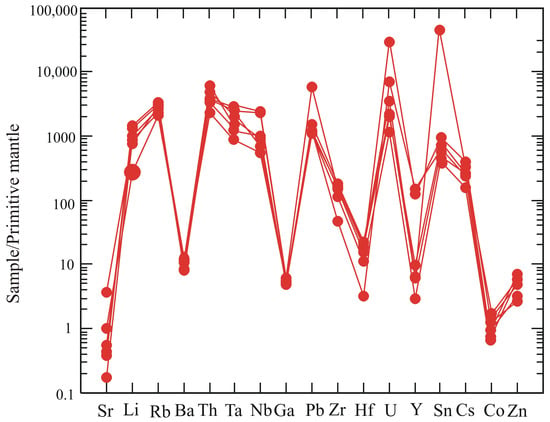
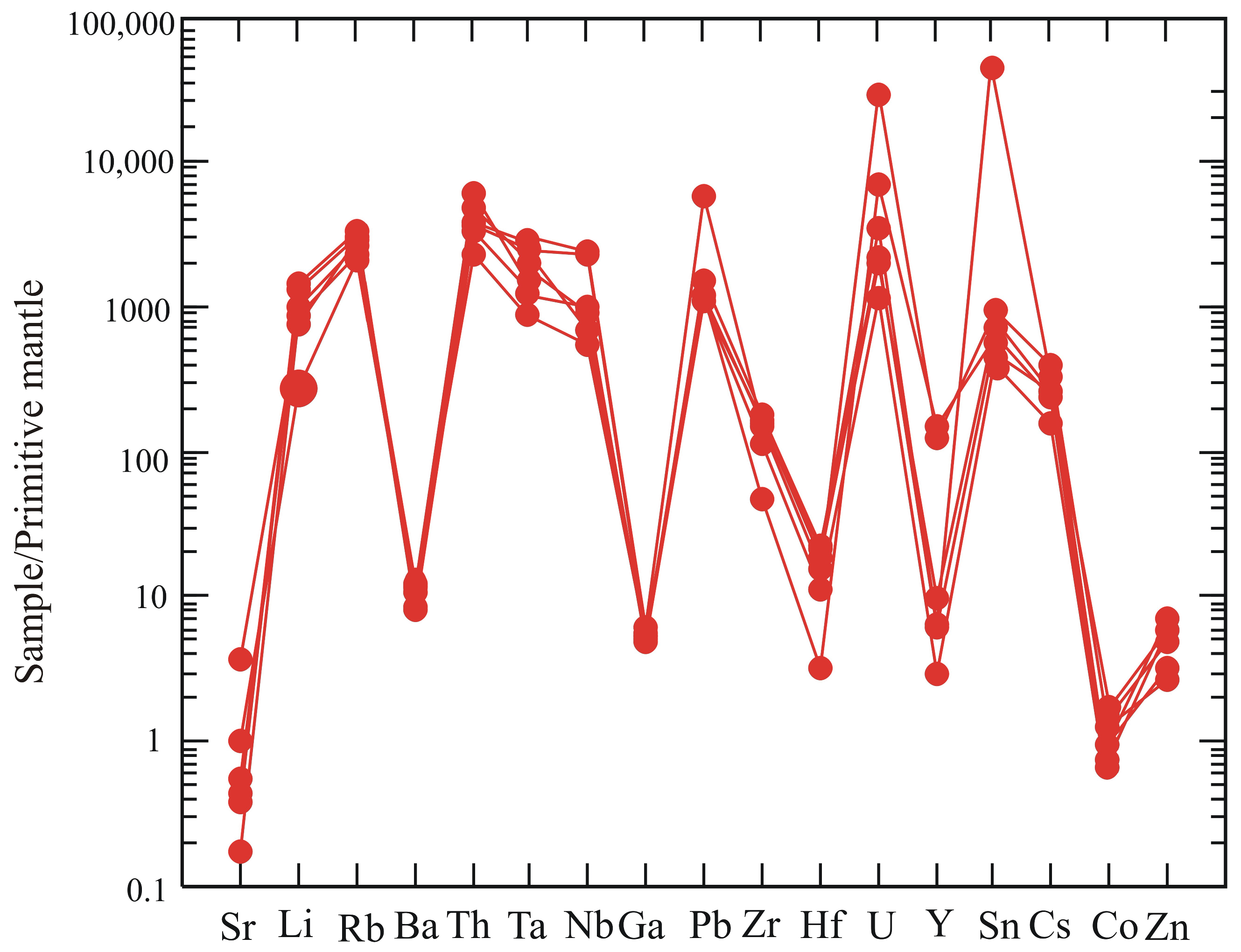
Major oxides, trace and rare earth element concentrations in six representative samples of leucogranite are given in Table 1, Table 2 and Table 3. The leucogranite samples are typical high-SiO2 granites, dominated by SiO2 (74.1–75.9 wt.%), Al2O3 (13.1–14.1 wt.%), Na2O (4.7–5.5 wt.%), and K2O (3.7–4.3 wt.%), with subordinate Fe2O3* (0.61–2.6 wt.%). Other oxides are very minor: MnO ≤ 0.15 wt.%, TiO2 ≤ 0.02 wt.%, CaO ≤ 0.10 wt.%, and P2O5 ≤ 0.01 wt.%. There is minor corundum in the norm and molar A/CNK (0.98–1.04) indicates metaluminous to weakly peraluminous character (Figure 12a). The compositions plot in the field of granite (Figure 12b) on the total alkalis vs. SiO2 diagram of [42] and belong to the medium to high–K series (Figure 13a). The relative contents of Na2O and K2O suggest an I-type granite (Figure 13b) and trace element chemistry indicates strongly differentiated character (Figure 13c). The very low P2O5 contents (≤0.01 wt.%) are consistent with the I-type designation [43]. There are notable enrichments in a number of trace elements, including F (1466–5537 µg/g), Li (226–1194 µg/g), Rb (1140–1836 µg/g), Zr (387–1508 µg/g), Pb (128–689 µg/g), Th (146–387 µg/g), Ta (39–153 µg/g), Nb (297–1360 µg/g), and Zn (132.4–347.6 µg/g). However, there is a relative depletion in some trace elements, including Sr (3–67 µg/g), Cs (2.8–7.0 µg/g), Ba (41–63 µg/g), Hf (19–128 µg/g) and Y (10–34 µg/g, except for two samples with anomalous Y enrichment, 497 and 427 µg/g) (Figure 14).
Table 1.
Major oxides (wt%) and calculated normative compositions in leucogranite samples.
Table 2.
Trace element contents (μg/g) and some ratios in leucogranite samples.
Table 3.
Rare earth element contents (μg/g) in leucogranite samples.
Figure 12.
(a) A/CNK versus A/NK diagram of [44]. (b) Classification of the studied granitic rocks based on total alkalis vs. silica [42].
Figure 13.
(a) SiO2 vs. K2O diagram after [45]. (b) K2O vs. Na2O discrimination diagram (the base map is derived from [46]). (c) Ba-Rb-Sr ternary diagram [47].
Figure 14.
Primitive mantle-normalized multi-element patterns for the leucogranite samples; normalization values after [33].
6.2. Metasedimentary Host Rocks
Major oxides, trace and rare earth element concentrations in ten representative metasedimentary samples are given in Table 4, Table 5 and Table 6. These samples are highly variable in composition: SiO2 = 35–76 wt.%, Al2O3 = 4.9–15.1 wt.%, Fe2O3* = 1.4–15.5 wt.%, CaO = 0.64–8.7 wt.%, MgO = 0.09–23.5 wt.%, Na2O = 0.22–6.4 wt.%, and K2O = 0.07–6.6 wt.%.
Table 4.
Major oxides (wt%) and some ratios in metasedimentary samples.
Table 5.
Trace element contents (μg/g) and some ratios in metasedimentary samples.
Table 6.
Rare earth element contents (μg/g) of metasedimentary samples.
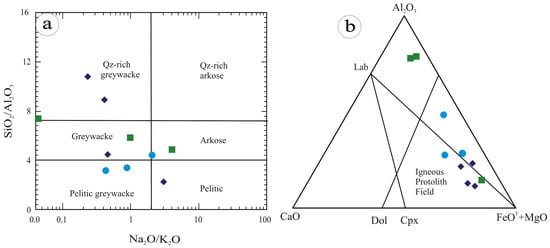
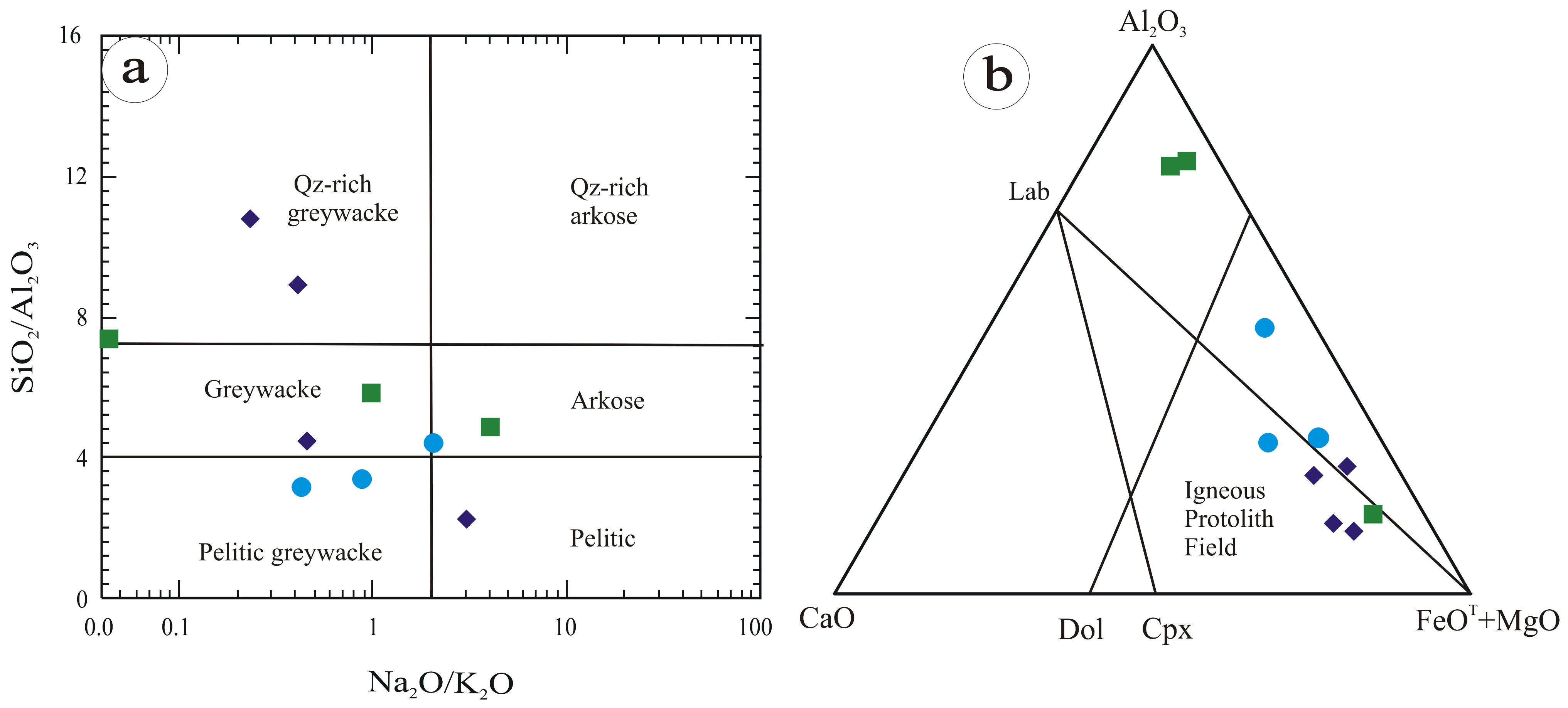
Plotting the analyzed samples on a SiO2/Al2O3 vs. Na2O/K2O diagram [48] reveals that the garnet–biotite schist lies in the greywacke and arkose fields, the amphibole–biotite schist lies in the pelitic greywacke and arkose fields, and the graphite schist lies in the quartz-rich greywacke, greywacke, and pelite fields (Figure 15a). SiO2/Al2O3 ratios are low (2.32–10.9), indicating immature sedimentary protoliths [49]. Indeed, the ACF diagram of [50] (Figure 15b) indicates that many of the sedimentary protoliths consisted of first-generation sediment from igneous sources, although some samples extend into fields suggesting recycling of pre-existing sedimentary rocks. Rb/K ratios (0.004 to 0.073) suggest that the protoliths were deposited as marine sediments [51].
Figure 15.
(a) Chemical classification of the Abu Rusheid metasedimentary host rocks according to the diagram of [48]. (b) ACF provenance diagram (after [50]) for the chemical composition of the Abu Rusheid metasedimentary host rocks, the composition of Lab, Cpx and Dol are given as reference points. Symbols are shown in the legend of Figure 9.
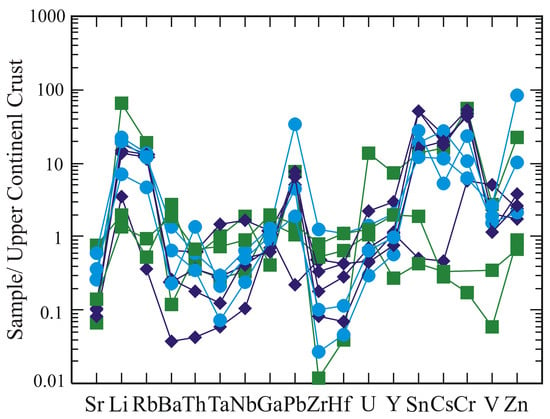
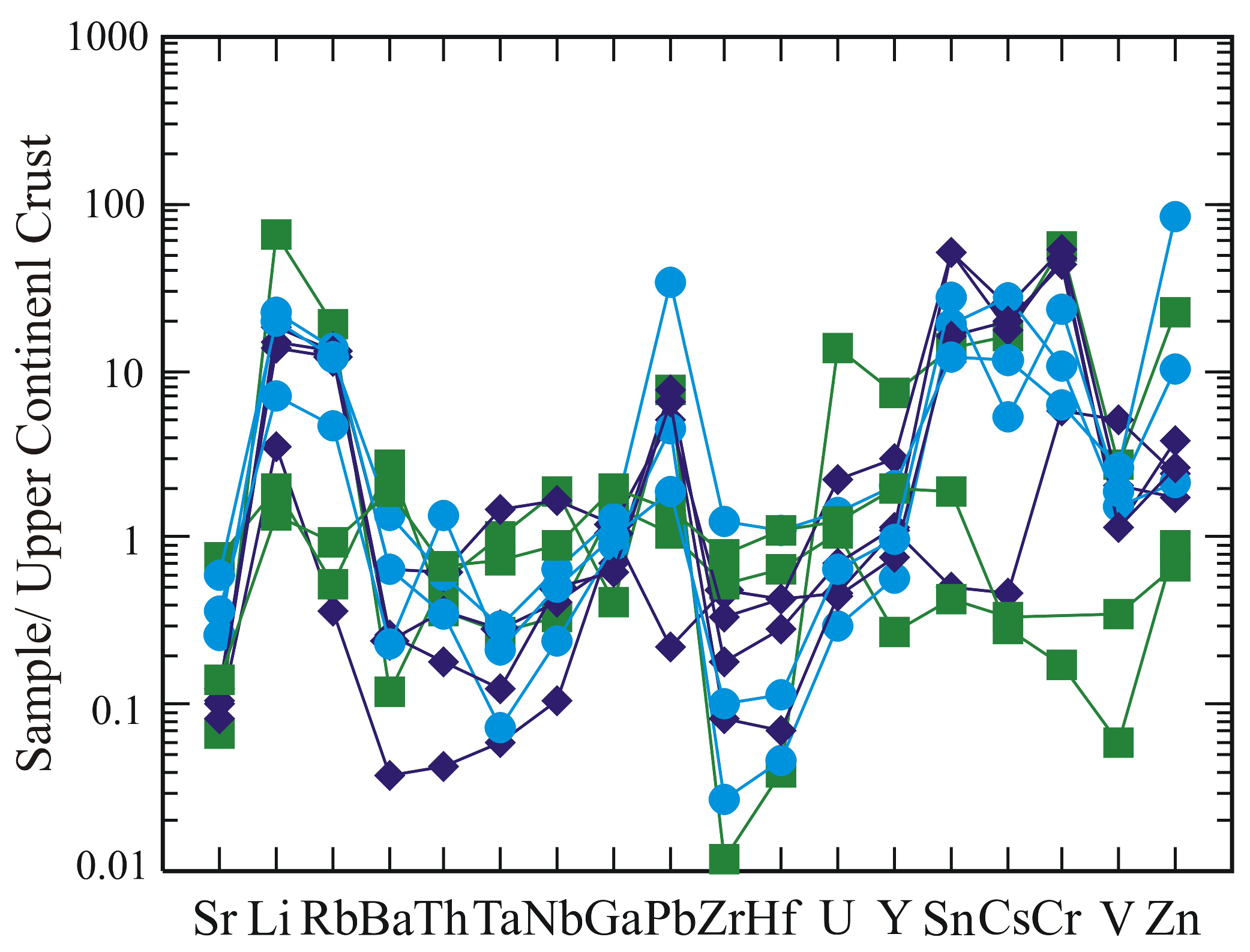
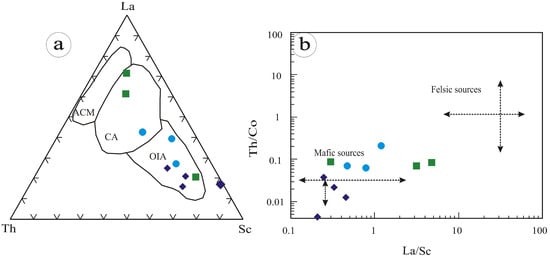
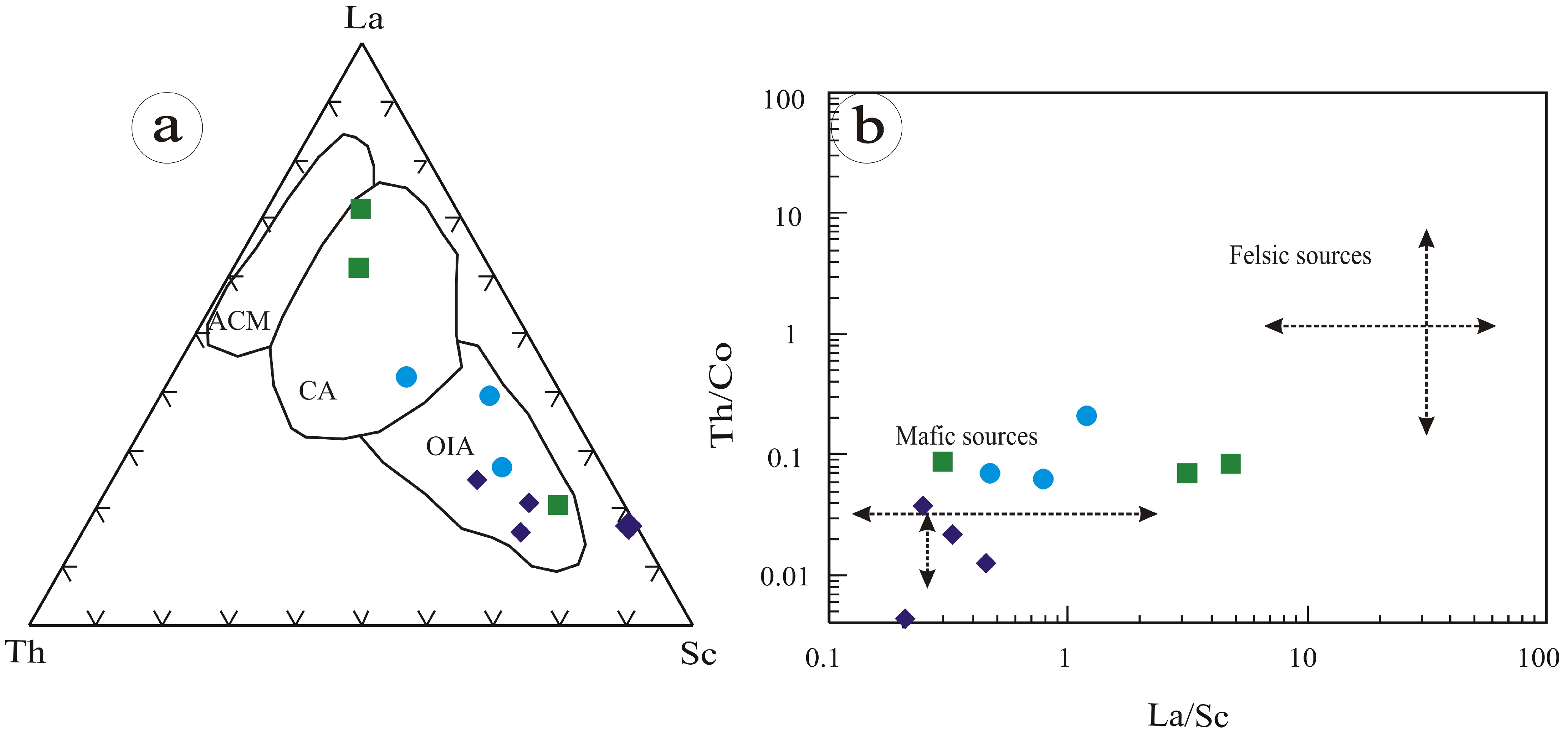
The metasedimentary samples are highly variable in trace element contents, with some samples exhibiting profound enrichments in Li (28–1314 µg/g), Rb (40–2123 µg/g), Ba (21–1525 µg/g), Pb (4.5–676 µg/g), Cs (1.0–103 µg/g), and Cr (6–1980 µg/g). Other elements are also highly variable, e.g., Sr (24–267 µg/g), Zr (2.3–237 µg/g), and Y (6.0–161 µg/g). Plotting the trace element contents of the metasedimentary samples on a UCC-normalized multi-element diagram reveals the highly variable character of the samples as well as the positive anomalies in Li, Rb, Pb, Cs, Cr, and Zn and occasional negative anomalies in Zr, Hf, and V (Figure 16). A La-Th-Sc ternary diagram (Figure 17a) indicates that most of the metasedimentary samples lie in the ocean island arc field whereas the rest of samples lie in the continental arc field. These are quite reasonable sources for the metasedimentary rocks of this area of the Eastern Desert, which mostly belong to volcanic-arc related volcano-sedimentary successions. A Th/Co-La/Sc diagram indicates that most of the samples were derived from mafic sources, whereas three samples extend into an intermediate source range (Figure 17b). Thus, the metasediments were largely derived from mafic-intermediate, subduction-related igneous sources, likely deposited in the marine setting of the Mozambique Ocean.
Figure 16.
Multi-element diagram for metasedimentary samples normalized to UCC [52]. Symbols are shown in the legend of Figure 9.
Figure 17.
(a) La—Th—Sc ternary plot with fields defined by [53]. (b) Th/Co versus La/Sc diagram after [54]. Symbols are shown in the legend of Figure 9.
Similarly to the highly variable trace element contents, the metasediments have a wide range of REE content (∑REE = 19–279 µg/g), increasing from graphite schist through amphibole–biotite schist to garnet–biotite schist. Some of the analyzed samples have ∑REE values comparable with the average of upper continental crust (146 µg/g) given by [52]. Chondrite-normalized REE patterns (Figure 9) mostly exhibit modest enrichment in LREE relative to HREE, except one sample of garnet–biotite schist that is enriched in HREE (presumably related to the presence of garnet). Most of the investigated metasediments exhibit significant negative Eu anomalies (Eu/Eu* = 0.07–0.78). Notably, the whole-rock patterns exhibit no negative Ce anomaly, even in the samples of the same lithology as RD022, the graphite schist containing abundant bastnäsite-(Ce) with a profound negative Ce anomaly observed in situ (this particular sample was not analyzed for whole-rock chemistry).
7. Discussion and Origin of Waimirite-(Y) and Bastnäsite
In the Abu Rusheid leucogranite selvage, waimirite-(Y) and bastnäsite-(Ce) are found as accessory minerals co-existing with quartz, orthoclase, plagioclase, zinnwaldite, columbite, zircon and fluorite. Whereas bastnäsite-(Y) found as accessory minerals co-existing with amphibole, biotite, chlorite, Cr-spinel, talc and fluorite in metasediments. The two known occurrences of waimirite-(Y) have been assigned to growth from fluorine-rich fluids containing large amounts of REE [10]. Bastnäsite species, on the other hand, may form in magmatic, hydrothermal, and contact metasomatic processes and may represent either primary or secondary minerals [55]. They are found in carbonatites [56,57], alkaline granites and syenites [32,58], pegmatites, hydrothermal deposits, and metasomatites [8]. Among silicate magmas, the most likely hosts for bastnäsite species are highly fractionated I-type granites because elevated alkali and volatile contents increase the solubility of rare earth elements in the melts, allowing differentiation processes to concentrate incompatible REEs to the point of bastnäsite saturation [59,60].
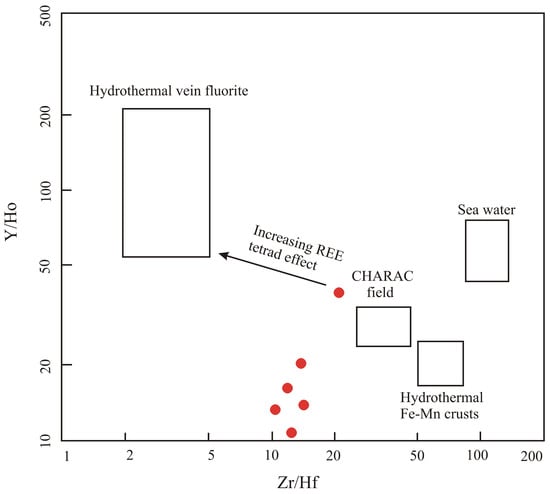
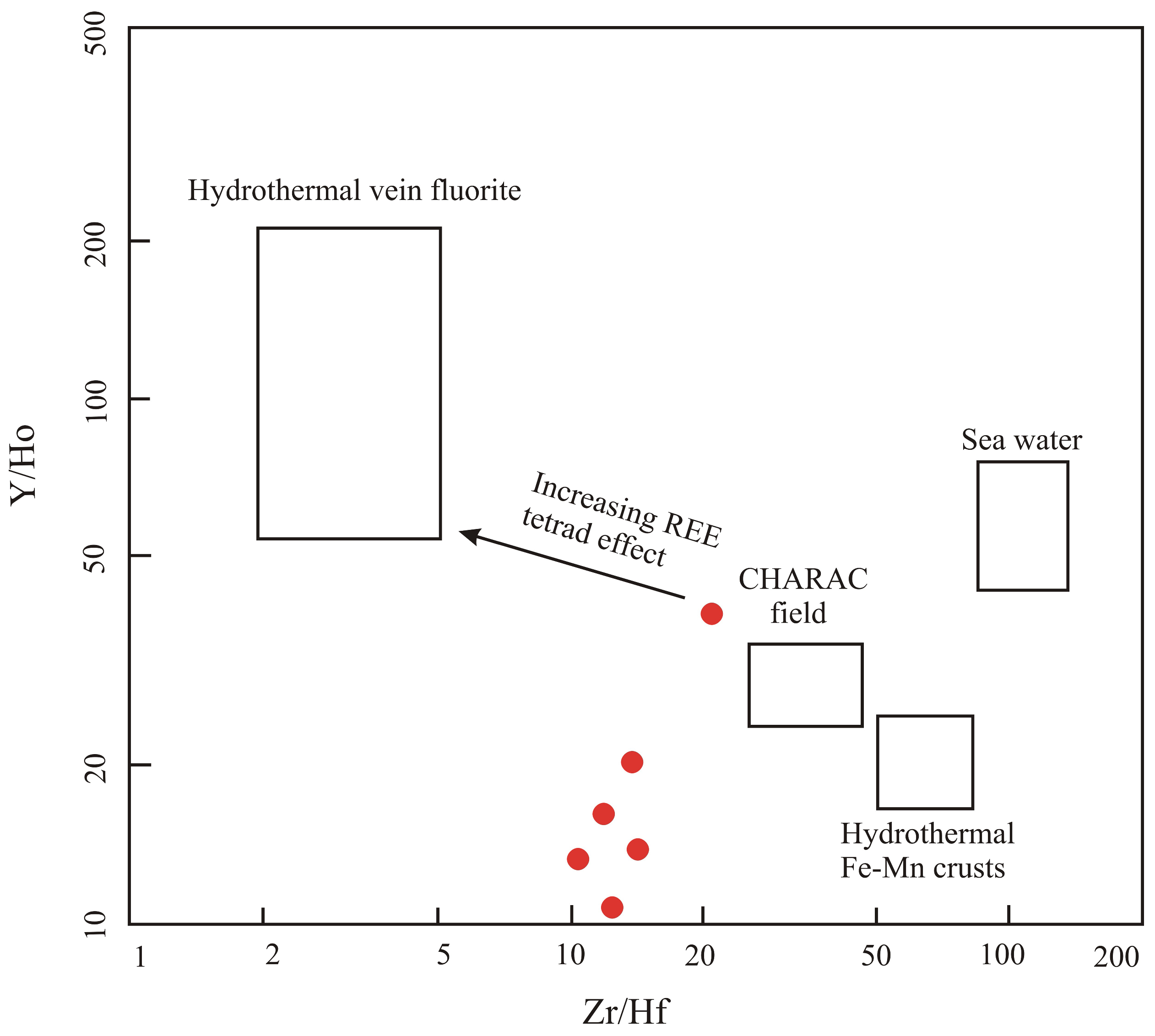
The host of waimirite-(Y) and bastnäsite-(Ce) (leucogranite) is a strongly differentiated I-type granite with high silica and metaluminous to peraluminous character. The low Zr/Hf (10.4–20.8) and low Nb/Ta (4.6–13.5) ratios of the granite samples (Figure 18) suggest that the rocks do not preserve purely magmatic compositions, and that hydrothermal fluids played a significant role in their formation. We infer that they experienced strong interaction with late- to post-magmatic hydrothermal solutions [61]. The proximity of the field area to the regional Nugrus shear zone may explain the focused ascent and circulation of hydrothermal solutions rich in F, Cl, and CO2. These hydrothermal fluids were likely derived from crystallization of deeper-seated alkaline granitoids that led to pre-concentration of REE in the fluids, making them potential sources of waimirite-(Y) and bastnäsite-(Ce) [36].
Figure 18.
Leucogranite samples plotted on a Y/Ho vs. Zr/Hf diagram after [62].
During the hydrothermal event, it is likely that the most effective agent for REE transport was an F-rich fluid [32]. The co-precipitation of waimirite, bastnäsite and fluorite is explained by changes in the concentration of the ligands F− and (CO3)2−, which stabilize REEs in the fluid phase. Hydrothermal alteration of plagioclase (albitization) results in the release of Ca to the fluid phase [63]. In turn, this triggers precipitation of fluorite, which strips F− from the fluid and triggers the crystallization of bastnäsite-(Ce). The association of bastnäsite and fluorite in the leucogranite can be attributed to deposition from neutral to slightly acidic fluids at ~300 °C [64]. The textural relations suggest that precipitation of fluorite and bastnäsite-(Ce) preceded growth of waimirite-(Y), in that bastnäsite-(Ce) is found included in a large zircon whereas waimirite-(Y) is interstitial to albite and zinnwaldite (Figure 4a).
Savko [65] suggested that bastnäsite can be formed under greenschist facies conditions by recrystallization of monazite or from partial decomposition of silicates (e.g., chlorite, biotite and plagioclase). These are plausible sources for REEs in crystalline rocks. However, in metasedimentary rocks, there is an additional source to consider, namely REE-rich organic matter incorporated into the sedimentary protolith. Thus, in principle the REE budget responsible for the growth of bastnäsite-(Y) under metamorphic conditions in the metasedimentary country rocks might be endogenous (from recrystallization of detrital monazite or xenotime or from organic constituents) or exogenous (transported from the adjacent granite intrusion by hydrothermal metasomatic fluids). One of the coexisting phases associated with bastnäsite-(Y) is fluorophlogopite. This mineral species, first described by [66], is closely associated with REE mineralization [32] and generally formed by metasomatism under greenschist facies conditions at <500 °C. The high Si content in fluorophlogopite (>6 a.p.f.u) is accompanied by a decrease in the concentration of alkalis and appears as a substitution toward a talc component [32]. Such high Si fluorophlogopite closely resembles the occurrence associated with bastnäsite in the giant Bayan Obo deposit in China [67] (though we make no claim about the size of the REE resource at Abu Rusheid).
The strong but variable negative Ce anomaly that we observe in the in situ analysis of bastnäsite-(Y) is puzzling but likely provides the key to understanding the origin of the REEs in this phase. Mineyev et al. [68] described “yttrian bastnäsite” formed by alteration of gagarinite, but this material lacked a negative Ce anomaly. The present material is more akin to the bastnäsite-(La) described from Abu Rusheid shear zones by El-Naby [25] and attributed to supergene processes. Ce normally behaves coherently with its neighbors La and Pr under igneous and metamorphic conditions. These anomalies are often interpreted as evidence of strongly oxidizing conditions, under which Ce is tetravalent and can be readily fractionated from its trivalent neighbors [32]. However, there is no other evidence of oxidizing conditions in the host rock of the bastnäsite-(Y); in fact, quite the opposite—it is a graphite-bearing schist, indicating that sedimentation, diagenesis, and metamorphism maintained reducing conditions. On the other hand, Ref. [69] noted strong negative Ce anomalies in kerogen (organic matter) in shale, interpreted to be inherited from biosynthesis in the oxidizing photic zone of the ocean. Thus a possible origin for the negative Ce anomaly in bastnäsite-(Y) in the graphite schist is inheritance of REEs from organic matter during kerogen maturation to form graphite. However, the absence of negative Ce anomalies in the whole-rock chemistry of other samples of graphite schist makes this explanation unlikely. Instead, supergene alteration, taking place in proximity to the modern oxidizing atmosphere, is a much more likely explanation for the development of variably Ce-depleted material. We concur with El-Naby [25] that the metasedimentary units adjacent to shear zones in Abu Rusheid experienced supergene alteration that results in crystallization of unusual REE minerals. In the current example, Y and Nd are significantly enriched compared to the La and Pr that dominate the example studied by El-Naby [25], enough to change the mineral designation from bastnäsite-(La) to bastnäsite-(Y).
8. Summary and Conclusions
We report the first record of the presence of accessory waimirite-(Y) and bastnäsite-(Ce) in a leucogranite selvage and of bastnäsite-(Y) in associated metasedimentary schist in the Wadi Abu Rusheid area of the south Eastern Desert of Egypt. The present work demonstrated the presence of two spatially associated but probably independent REE mineralization events including one that formed waimirite-(Y) and bastnäsite-(Ce) in leucogranite and another than formed bastäsite-(Y) in adjacent schist.
The waimirite-(Y) coexists with accessory bastnäsite-(Ce) included in zircon; this phase is rich in Ce, Nd, and La. While most of the leucogranite samples exhibit whole-rock REE patterns characterized by depletion in LREE relative to HREE and negative Eu anomalies, similar to the in situ patterns of waimirite-(Y), one granite sample exhibits significant abundance in both LREE and HREE with LREE-enriched patterns resembling a superposition of the REE patterns of waimirite-(Y) and bastnäsite-(Ce). The formation of these phases is attributed to a series of events triggered by the infusion into the protolith of granite-derived hydrothermal fluids carrying F, REEs, and CO2. The analyzed plagioclase of leucogranite has composition of nearly pure end-member albite, which reflects metasomatic modification (albitization) by magmatic hydrothermal fluids. Metasomatic modification of plagioclase composition resulted in the release of Ca and triggered precipitation of fluorite, and, in turn bastnäsite-(Ce). Continued evolution of the hydrothermal system led to precipitation of interstitial waimirite-(Y).
Adjacent to the leucogranite selvage are metasedimentary schists formed after immature sediments largely derived from subduction-related mafic sources. The graphite schist unit is found to contain bastnäsite-(Y), dominated by Y, Nd, and La. This is likely a supergene phase, developed under conditions oxidizing enough to fractionate tetravalent Ce from adjacent REEs. The results of this study suggest that leucogranite and associated metasedimentary schist in the Wadi Abu Rusheid area may be a target for future REE prospecting; the leucogranites contain up to 422 μg/g Ce and 1000 μg/g total REEs.
Supplementary Materials
The following supporting information can be downloaded at https://www.mdpi.com/article/10.3390/geosciences16030122/s1, Supplementary Tables S1–S16.
Author Contributions
Conceptualization, M.K.A. and H.E.M.; validation, M.K.A., H.E.M., A.A.S., M.A.E., A.E.M. and P.D.A.; investigation, M.K.A., M.A.E., O.D.W., A.A.S. and M.M.N.T.; writing—original draft preparation, M.K.A. and H.E.M.; visualization, M.K.A., M.A.E., A.E.M. and P.D.A.; writing—review and editing, A.E.M., P.D.A., M.K.A., H.E.M., A.A.S., M.M.N.T., O.D.W. and M.A.E.; data curation: M.A.E. and M.M.N.T.; project administration, M.K.A., H.E.M. and A.E.M.; formal analysis, P.D.A. and O.D.W.; software, A.A.S., M.A.E., O.D.W. and M.M.N.T.; methodology, M.K.A., P.D.A. and O.D.W. All authors have read and agreed to the published version of the manuscript.
Funding
This research received no external funding.
Data Availability Statement
Data from our research are available upon request.
Acknowledgments
The present manuscript is a part of the PhD thesis of the first author (Mustafa A. Elsagheer) and this thesis was supported by the National Research Centre, Egypt.
Conflicts of Interest
The authors declare that they have no known competing financial interests or personal relationships that could have appeared to influence the work reported in this paper.
References
- Morteani, G.; Satir, M. The bastnäsite-fluorite-barite deposit of the Kizilcaören district, Eskisehir, Turkey. In Lanthanides, Tantalum and Niobium: Mineralogy, Geochemistry, Characteristics of Primary Ore Deposits, Prospecting, Processing and Applications Proceedings of a Workshop in Berlin, 1986; Springer: Berlin/Heidelberg, Germany, 1989; pp. 189–194. [Google Scholar]
- Hisinger, W. Lethoea Svecica: Seu, Petrificata Svecioe, Iconibus et Characteribus Illustrate; Norstedt et Filii: PA Norstedt et Filii: Stockholm, Sweden, 1838. [Google Scholar]
- Nagendra Babu, G.; Sai Baba, M.; Kumar, M.K.; Singh, Y.; Ramesh Babu, P.V.; Parihar, P.S. Bastnäsite from Kanigiri granite, Prakasam district, Andhra Pradesh. J. Geol. Soc. India 2013, 81, 447–450. [Google Scholar] [CrossRef] [Scilit]
- Miyawaki, R.; Yokoyama, K.; Husdal, T.A. Bastnäsite-(Nd), a new Nd-dominant member of the bastnäsite group from the Stetind pegmatite, Tysfjord, Nordland, Norway. Eur. J. Mineral. 2013, 25, 187–191. [Google Scholar] [CrossRef] [Scilit]
- Tombal, T.D. Bastnäsite: One of the lead sources of rare earth elements. In Interdisciplinary Engineering Sciences Concepts, Researches and Applications; Islak, S., Ed.; Livre de Lyon: Lyon, France, 2022; Chapter XVII; pp. 255–270. [Google Scholar]
- Wall, F.; Mariano, A.N. Rare earth minerals in carbonatites: A discussion centered on the Kangankunde carbonatite, Malawi. In Rare Earth Minerals: Chemistry, Origin and Ore Deposits; Jones, A.P., Wall, F., Williams, C.T., Eds.; Chapman & Hall: London, UK, 1996; pp. 193–225. [Google Scholar]
- Laresen, A. Rare earth minerals from the syenites and pegmatites in the Oslo Region, Norway. In Rare Earth Minerals: Chemistry, Origin and Ore Deposits; Jones, A.P., Wall, F., Williams, C.T., Eds.; Chapman & Hall: London, UK, 1996; pp. 151–166. [Google Scholar]
- Gieré, R. Formation of rare earth minerals in hydrothermal systems. In Rare Earth Minerals: Chemistry, Origin and Ore Deposits; Jones, A.P., Wall, F., Williams, C.T., Eds.; Chapman & Hall: London, UK, 1996; pp. 105–150. [Google Scholar]
- Lahti, S.I.; Suominen, V. Occurrence, crystallography and chemistry of the fluocerite-bastnäsite-cerianite intergrowth from the Fjälskär granite, southwestern Finland. Bull. Geol. Soc. Finl. 1989, 60, 45–53. [Google Scholar] [CrossRef] [Scilit]
- Atencio, D.; Neto, A.C.B.; Pereira, V.P.; Ferron, J.T.; Hoshino, M.; Moriyama, T.; Watanabe, Y.; Miyawaki, R.; Coutinho, J.M.V.; Andrade, M.B.; et al. Waimirite-(Y), orthorhombic YF3, a new mineral from the Pitinga mine, Presidente Figueiredo, Amazonas, Brazil and from Jabal Tawlah, Saudi Arabia: Description and crystal structure. Mineral. Mag. 2015, 79, 767–780. [Google Scholar] [CrossRef] [Scilit]
- Watanabe, Y.; Hoshino, M.; Moriyama, T. Jabal Tawlah, a heavy REE-rich prospect in northwest Saudi Arabia. In 21st General Meeting of the International Mineralogical Association, Johannesburg, South Africa; Abstract; International Mineralogical Association: Tohoku, Japan, 2014; p. 62. [Google Scholar]
- Hassan, M.A. Geology and geochemistry of radioactive columbite bearing psammitic gneiss of Wadi Abu Rusheid, south Eastern Desert, Egypt. Ann. Geol. Surv. Egypt 1973, 3, 207–225. [Google Scholar]
- Hilmy, M.; El-Bayoumi, R.; Eid, A. Geology, geochemistry and mineralization of the psammitic gneiss of Wadi Abu-Rusheid, Eastern Desert, Egypt. J. Afr. Earth Sci. 1990, 11, 197–205. [Google Scholar] [CrossRef] [Scilit]
- Sabet, A.H.; Bykov, B.A.; Butenko, B.P. A short account on the results of geochemical and panning prospecting in the Eastern Desert of Egypt. Ann. Geol. Surv. Egypt. 1976, 6, 237–243. [Google Scholar]
- Saleh, G. The Potentiality of Uranium Occurrences in Wadi Nugrus Area, South Eastern Desert, Egypt. Ph.D. Thesis, Faculty of Sciences, Mansoura University, Mansoura City, Egypt, 1997; p. 171. [Google Scholar]
- Abdel Gawad, A.E.; Ali, M.A.; Ghoneim, M.M.; El-Taher, A. Natural radioactivity and mineral chemistry aspects of rare metal mineralisation associated with mylonite at Wadi Sikait, South Eastern Desert, Egypt. Int. J. Environ. Anal. Chem. 2023, 103, 2300–2317. [Google Scholar] [CrossRef] [Scilit]
- Raslan, M.F. Mineralogy and physical upgrading of Abu Rusheid radioactive gneiss, South Eastern Desert, Egypt. In The 9th International Mining, Petroleum, and Metallurgical Engineering Conference; Faculty of Engineering, Cairo University, Min: Cairo, Egypt; 2005, Volume 27.
- Raslan, M.F. Occurrence of ishikawaite (uranium-rich samarskite) in the mineralized Abu Rusheid Gneiss, Southeastern Desert, Egypt. Int. Geol. Rev. 2008, 50, 1132–1140. [Google Scholar] [CrossRef] [Scilit]
- Ibrahim, M.E.; El Tokhi, M.M.; Saleh, G.M.; Rashed, M.A. Lamprophyre bearing-REEs South Eastern Desert, Egypt. In The 7th International Conference on Geochemistry; Alexandria University: Alexandria, Egypt, 2006; pp. 12–38. [Google Scholar]
- Ibrahim, M.E.; El-Kalioby, B.A.; Aly, G.M.; El-Tohamy, A.M.; Watanabe, K. Altered granitic rocks, Nusab El Balgum area, Southwestern Desert, Egypt: Mineralogical and geochemical aspects of REEs. Ore Geol. Rev. 2015, 70, 252–261. [Google Scholar] [CrossRef] [Scilit]
- Mahdy, M.; El Hazek, N.M.T.; Shazily, E.M.E.L. Leaching Characteristics of west Aswan Thorogummite-Bastnäsite Ore Material. Western Desert, Egypt. In Conference of Nuclear Sciences and Applications; Egyptian Society of Nuclear Sciences and Applications: Cairo, Egypt, 1988; Volume 1, pp. 306–311. [Google Scholar]
- Elatta, S.A.; Assran, H.M.; Ahmed, A.A. Preliminary study on HFSE mineralization in the peralkaline granites of Nusab El Balgum area, South Western Desert, Egypt. Sci. Res. 2013, 3, 90–101. [Google Scholar] [CrossRef]
- Abdallah, S.A.E.; Mohamed, G.A.; Bakry, A.R. Rare metal mineralization (Zr, U, Th, REE) associated to El Seboah Acidic Peralkaline Rocks, South Western Desert of Egypt: Recovery technique. Amer. J. Earth Sci. 2014, 1, 73–85. [Google Scholar]
- Khedr, M.Z.; Khashaba, S.M.A.; El-Shibiny, N.H.; Takazawa, E.; Hassan, S.M.; Azer, M.K.; Ichiyama, Y. Integration of remote sensing and geochemical data to characterize mineralized A-type granites, Egypt: Implications for origin and concentration of rare metals. Int. J. Earth Sci. 2023, 112, 1717–1745. [Google Scholar] [CrossRef] [Scilit]
- Abd El-Naby, H.H. The genesis of the supergene REE-fluorocarbonate and uranyl mineralization in the Abu Rusheid area of the South Eastern Desert of Egypt. Geosci. J. 2025, 29, 49–70. [Google Scholar] [CrossRef] [Scilit]
- Stern, R.J.; Hedge, C.E. Geochronologic and isotopic constraints on late Precambrian crustal evolution in the Eastern Desert of Egypt. Am. J. Sci. 1985, 285, 97–127. [Google Scholar] [CrossRef] [Scilit]
- Richard, L.R. MinPet: Mineralogical and Petrological Data Processing System, Version 2.02; MinPet Geological Software: Québec, QC, Canada, 1995.
- Wilner, O.D.; Dalleska, N.; Asimow, P.D.; Bucholz, C.E. Laser ablation of silicate rock pressed powders as an efficient trace-element analysis method. In Proceedings of the Goldschmidt 2025 Conference, Prague, Czech Republic, 6–11 July 2025. [Google Scholar]
- Feldman, N. Zirconium Additives for Residual Fuel Oil. U.S. Patent 4404002, 13 September 1983. [Google Scholar]
- Garbe-Schönberg, D.; Müller, S. Nano-particulate pressed powder tablets for LA-ICP-MS. J. Anal. At. Spectrom. 2014, 29, 990–1000. [Google Scholar] [CrossRef] [Scilit]
- Deer, W.A.; Howie, R.A.; Zussman, J. An Introduction to the Rock Forming Minerals, 2nd ed.; Longman Group Limited: London, UK, 1992; p. 696. [Google Scholar]
- Rasoamalala, V.; Salvi, S.; Béziat, D.; Ursule, J.P.; Cuney, M.; De Parseval, P.; Guillaume, D.; Moine, B.; Andriamampihantona, J. Geology of bastnäsite and monazite deposits in the Ambatofinandrahana area, central part of Madagascar: An overview. J. Afr. Earth Sci. 2014, 94, 128–140. [Google Scholar] [CrossRef] [Scilit]
- Taylor, S.R.; McLennan, S.M. The Continental Crust: Its Composition and Evolution; Oxford Universit Press: Oxford, UK, 1985; pp. 1–328. [Google Scholar]
- Černý, P.; Ercit, T.; Wise, M. The tantalite-tapiolite gap; natural assemblages versus experimental data. Canad. Mineral. 1992, 30, 587–596. [Google Scholar]
- Miller, C.F.; Stoddard, E.F.; Bradfish, L.J.; Dollase, W.A. Composition of plutonic muscovite: Genetic implications. Canad. Mineral. 1981, 19, 25–34. [Google Scholar]
- Guo, D.; Liu, Y. Occurrence and geochemistry of bastnäsite in carbonatite-related REE deposits, Mianning–Dechang REE belt, Sichuan Province, SW China. Ore Geol. Rev. 2019, 107, 266–282. [Google Scholar] [CrossRef] [Scilit]
- Hawthorne, F.C.; Oberti, R.; Harlow, G.E.; Maresch, W.V.; Martin, R.F.; Schumacher, J.C.; Welch, M.D. Nomenclature of the amphibole supergroup. Am. Min. 2012, 97, 2031–2048. [Google Scholar] [CrossRef] [Scilit]
- Girardeau, J.; Mevel, C. Amphibolitized sheared gabbros from ophiolites as indicators of the evolution of the oceanic crust: Bay of Islands, Newfoundland. Earth Planet. Sci. Lett. 1982, 61, 151–165. [Google Scholar] [CrossRef] [Scilit]
- Henry, D.J.; Guidotti, C.V.; Thomson, J.A. The Ti-saturation surface for low-to-medium pressure metapelitic biotites: Implications for geothermometry and Ti-substitution mechanisms. Am. Min. 2005, 90, 316–328. [Google Scholar] [CrossRef] [Scilit]
- Nachit, H.; Ibhi, A.; Ohoud, M.B. Discrimination between primary magmatic biotites, reequilibrated biotites and neoformed biotites. Comptes Rendus. Geosci. 2005, 337, 1415–1420. [Google Scholar] [CrossRef] [Scilit]
- Hey, M.H. A new review of the chlorites. Mineral. Mag. 1954, 30, 277–292. [Google Scholar] [CrossRef] [Scilit]
- Le Maitre, R.W. Igneous Rocks a Classification and Glossary of Terms Recommendations of the International Union of Geological Sciences, SubCommission on the Systematics of Igneous Rocks; Cambridge University Press: Cambridge, UK, 2002; p. 236. [Google Scholar]
- Fan, C.; Xu, C.; Shi, A.; Smith, M.P.; Kynicky, J.; Wei, C. Origin of heavy rare earth elements in highly fractionated peraluminous granites. Geochim. Cosmochim. Acta 2023, 343, 371–383. [Google Scholar]
- Maniar, P.D.; Piccoli, P.M. Tectonic discrimination of granitoids. Geol. Soc. Am. Bull. 1989, 101, 635–643. [Google Scholar] [CrossRef] [Scilit]
- Peccerillo, A.; Taylor, S.R. Geochemistry of Eocene calc-alkaline volcanic rocks from the Kastamonu area, northern Turkey. Contrib. Mineral. Petrol. 1976, 58, 63–81. [Google Scholar] [CrossRef] [Scilit]
- Collins, W.J.; Beams, S.D.; White, A.J.R.; Chappell, B.W. Nature and origin of A-type granites with particular reference to southeastern Australia. Contrib. Mineral. Petrol. 1982, 80, 189–200. [Google Scholar] [CrossRef] [Scilit]
- El Bouseily, A.M.; El Sokkary, A.A. The relation between Rb, Ba and Sr in granitic rocks. Chem. Geol. 1975, 16, 207–219. [Google Scholar] [CrossRef] [Scilit]
- Wimmenauer, W. Das Praevariszische Kristallin im Schwartzwald. Fortschr. Miner. 1984, 62, 69–86. [Google Scholar]
- Asiedu, D.K.; Hegner, E.; Rocholl, A.; Atta-Peters, D. Provenance of late Ordovician to early Cretaceous sedimentary rocks from southern Ghana, as inferred from Nd isotopes and trace elements. J. Afr. Earth Sci. 2005, 41, 316–328. [Google Scholar] [CrossRef] [Scilit]
- Dorais, M.J.; Wintsch, R.P.; Becker, H. The Massabesic gneiss complex, New Hampshire: A study of a portion of the Avalon Terrane. Am. J. Sci. 2001, 301, 657–682. [Google Scholar] [CrossRef] [Scilit]
- Campbell, F.A.; Williams, G.D. Chemical composition of shales of Mannville group (lower Cretaceous) of central Alberta, Canada. AAPG Bull. 1965, 49, 81–87. [Google Scholar] [CrossRef] [Scilit]
- Rudnick, R.; Gao, S. Composition of the Continental Crust. In Treatise on Geochemistry; Holland, H.D., Turekian, K.K., Eds.; Elsevier–Pergamon: Oxford, UK, 2003; Volume 3, pp. 1–64. [Google Scholar]
- Girty, G.H.; Barber, R.W. REE, Th, and Sc evidence for the depositional setting and source rock characteristics of the Quartz Hill chert, Sierra Nevada, California. Processes Controlling the Composition of Clastic Sediments. Geol. Soc. Am. Spec. Pap. 1993, 284, 109–119. [Google Scholar]
- Cullers, R.L. Implications of elemental concentrations for provenance, redox conditions, and metamorphic studies of shales and limestones near Pueblo, CO, USA. Chem. Geol. 2002, 191, 305–327. [Google Scholar] [CrossRef] [Scilit]
- Perhac, R.M.; Heinrich, E.W.M. Fluorite-Bastnäsite Deposits of the Gallians Mountains, New Mexico and Bastnäsite Paragenesis. Econ. Geol. 1964, 39, 226–239. [Google Scholar] [CrossRef] [Scilit]
- Drew, L.J.; Qingrun, M.; Weijun, S. The Bayan Obo iron-rare-earth-niobium deposits, Inner Mongolia, China. Lithos 1990, 26, 43–65. [Google Scholar] [CrossRef] [Scilit]
- Lottermoser, B.G. Rare-earth element mineralisation within the Mt. Weld carbonatite laterite, Western Australia. Lithos 1990, 24, 151–167. [Google Scholar] [CrossRef] [Scilit]
- Taylor, R.P.; Pollard, P.J. Rare earth element mineralization in peralkaline systems: The T-Zone REE-Y-Be deposit, Thor Lake, Northwest Territories, Canada. In Rare Earth Minerals—Chemistry, Origin and Ore Deposits; Jones, A.P., Frances, W., Williams, C.T., Eds.; The Mineralogical Society Series; Chapman and Hall: New York, NY, USA, 1996; pp. 167–192. [Google Scholar]
- Frost, C.D.; Frost, B.R. On ferroan (A-type) granitoids: Their compositional variability and modes of origin. J. Petrol. 2011, 52, 39–53. [Google Scholar] [CrossRef] [Scilit]
- Bernard, C.; Estrade, G.; Salvi, S.; Béziat, D.; Smith, M. Alkali pyroxenes and amphiboles: A window on rare earth elements and other high field strength elements behavior through the magmatic-hydrothermal transition of peralkaline granitic systems. Contrib. Mineral. Petrol. 2020, 175, 81. [Google Scholar] [CrossRef] [Scilit]
- Ouyang, Y.; Zeng, R.; Meng, D.; Li, T.; Wei, J. Geochronology and geochemistry characteristics of Dongcao leucogranite in the Yifeng area, Jiangxi Province, China: Implications for petrogenesis and mineralization. Minerals 2023, 13, 503. [Google Scholar] [CrossRef] [Scilit]
- Bau, M. Controls on the fractionation of isovalent trace elements in magmatic and aqueous systems: Evidence from Y/Ho, Zr/Hf, and lanthanide tetrad effect. Contrib. Mineral. Petrol. 1996, 123, 323–333. [Google Scholar] [CrossRef] [Scilit]
- Schmandt, O.S.; Cook, N.J.; Ciabanu, C.I.; Ehrig, K.; Wade, B.P.; Gilbert, S.; Kamentsky, V.S. Rare Earth Element Flurocarbonate Mineral from The Olympic Dam Cu- U- Au- Ag deposit, South Australia. Minerals 2017, 7, 202. [Google Scholar] [CrossRef] [Scilit]
- Mollé, V.; Gaillard, F.; Nabyl, Z.; Tuduri, J.; Di Carlo, I.; Erdmann, S. Crystallisation sequence of a REE-rich carbonate melt: An experimental approach. Comptes Rendus. Geosci. 2021, 353, 217–231. [Google Scholar] [CrossRef] [Scilit]
- Savko, K.A.; Bazikov, N.S. Phase equilibria of bastnäsite, allanite, and monazite: Bastnäsite-out isograde in metapelites of the Vorontsovskaya group, Voronezh crystalline massif. Petrology 2011, 19, 445–469. [Google Scholar] [CrossRef] [Scilit]
- Gianfagna, A.; Scordari, F.; Mazziotti-Tagliani, S.; Ventruti, G.; Ottolini, L. Fluorophlogopite from Biancavilla (Mt. Etna, Sicily, Italy): Crystal structure and crystal chemistry of a new F-dominant analog of phlogopite. Am. Min. 2007, 92, 1601–1609. [Google Scholar] [CrossRef] [Scilit]
- Xu, J.; Shen, G. Mineralogical study on fluorophlogopite from the Bayan Obo ore deposit. Acta Min. Sinica 2005, 25, 213–216. [Google Scholar]
- Mineyev, D.A.; Lavrisheva, T.I.; Bykova, A.V. Yttrian bastnaesite, an alteration product of gagarinite. Int. Geol. Rev. 2009, 13, 644–648. [Google Scholar] [CrossRef] [Scilit]
- Pi, D.H.; Liu, C.Q.; Shields-Zhou, G.A.; Jiang, S.Y. Trace and rare earth element geochemistry of black shale and kerogen in the early Cambrian Niutitang Formation in Guizhou province, South China: Constraints for redox environments and origin of metal enrichments. Precambrian Res. 2013, 225, 218–229. [Google Scholar] [CrossRef] [Scilit]

Disclaimer/Publisher’s Note: The statements, opinions and data contained in all publications are solely those of the individual author(s) and contributor(s) and not of MDPI and/or the editor(s). MDPI and/or the editor(s) disclaim responsibility for any injury to people or property resulting from any ideas, methods, instructions or products referred to in the content. |
© 2026 by the authors. Licensee MDPI, Basel, Switzerland. This article is an open access article distributed under the terms and conditions of the Creative Commons Attribution (CC BY) license.