


Abstract
The identification of calcareous foraminifera and nannofossils in archaeological ceramics (tiles and bricks from the Archaic to Roman ages) of Naxos and Taormina (Sicily) has, along with other evidence and archaeometric analyses, addressed aspects of technology and raw material source areas. Microfossils, like the other aplastic inclusions, help to interpret ceramic pastes. This paper provides, for northeastern Sicily, a contribution demonstrating the importance of an integrated approach in the study of archaeological ceramics; micropaleontological analysis supports mineralogical, petrographic and chemical data to constrain interpretations of provenance and technology. The preservation of foraminifera calcitic tests and coccoliths is an additional key to identifying errors, failures and strategies during the ancient ceramic firing process. Comparisons with the micropaleontological content of locally outcropping clay deposits have allowed for the unambiguous identification of the clay sources used for ancient ceramic production in the region.
1. Introduction
Thin-section observations of archaeological ceramics from various geographic areas and ages often highlight the presence of calcareous skeletal remains of microscopic organisms within the clay matrix. Detailed studies that use microfossils as technological and provenance markers for ancient pottery have gradually emerged from the 1950s to the present. Several authors have highlighted the discovery of microfossils in such artifacts [1,2,3,4,5,6,7,8,9,10,11,12,13,14,15].
As is known, microfossils, specifically planktonic and benthonic foraminifera, are indicative of the geological age and paleoenvironment in which they lived, giving them high informative potential. The micropaleontological analysis of ceramics can provide information on: (a) the type of raw materials used (continental or marine sediments), based on the presence or absence of marine microfossils; (b) the age of the used raw materials; (c) reworking processes, both natural (from primary sedimentation or resedimentation) and artificial (from the mixing of clay raw materials of different ages by ancient potters), based on the recognized micro- and nannofossil assemblages; and (d) the firing conditions of artifacts through evaluation of the abundance and preservation state of micro- and nannofossils.
In 1998, the term “ceramic micropaleontology” was coined by P.S. Quinn, highlighting the importance of microfossils in studying the provenance of raw materials used to produce ceramics. The first detailed research on the potential of microfossils in archaeological ceramics was reported by [16,17], who developed a methodology for the study of microfossils to advance ceramic compositional analysis.
Nevertheless, detailed micropaleontological analyses of archaeological ceramics that compare the microfossil assemblages in the clay matrix with those in field samples of potential raw materials in order to reconstruct ancient ceramic technology or to obtain information about the nature and origin of raw materials used in ceramic manufacture are currently few in number [13,16,17,18,19,20,21,22,23,24]. In terms of ceramic provenance, attempts have been made in the past by other authors (e.g., [5,11]) to locate the source of raw materials exploited in the ancient manufacture or individuate non-local artifacts, but most of the studies have utilized microfossils in a similar way to other inclusions seen in thin sections to characterize the composition of the artifacts.
Regarding the technological aspects, most of the previous studies have used microfossils mainly to determine methods of mix preparation (e.g., the mixture of different clays or the addition of temper) [7,12,17,25,26,27,28,29] while only a few papers have focused on the behaviour of microfossils during firing, which is one of the most heavily studied aspects of ceramic technology [1,12,20,30].
In this context, our research contributes to corroborating the importance of an integrated approach in the study of archaeological ceramics.
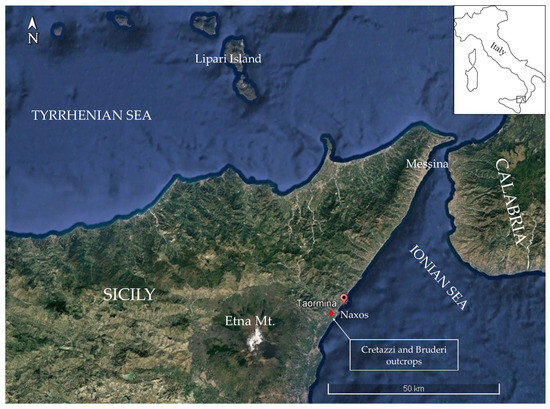
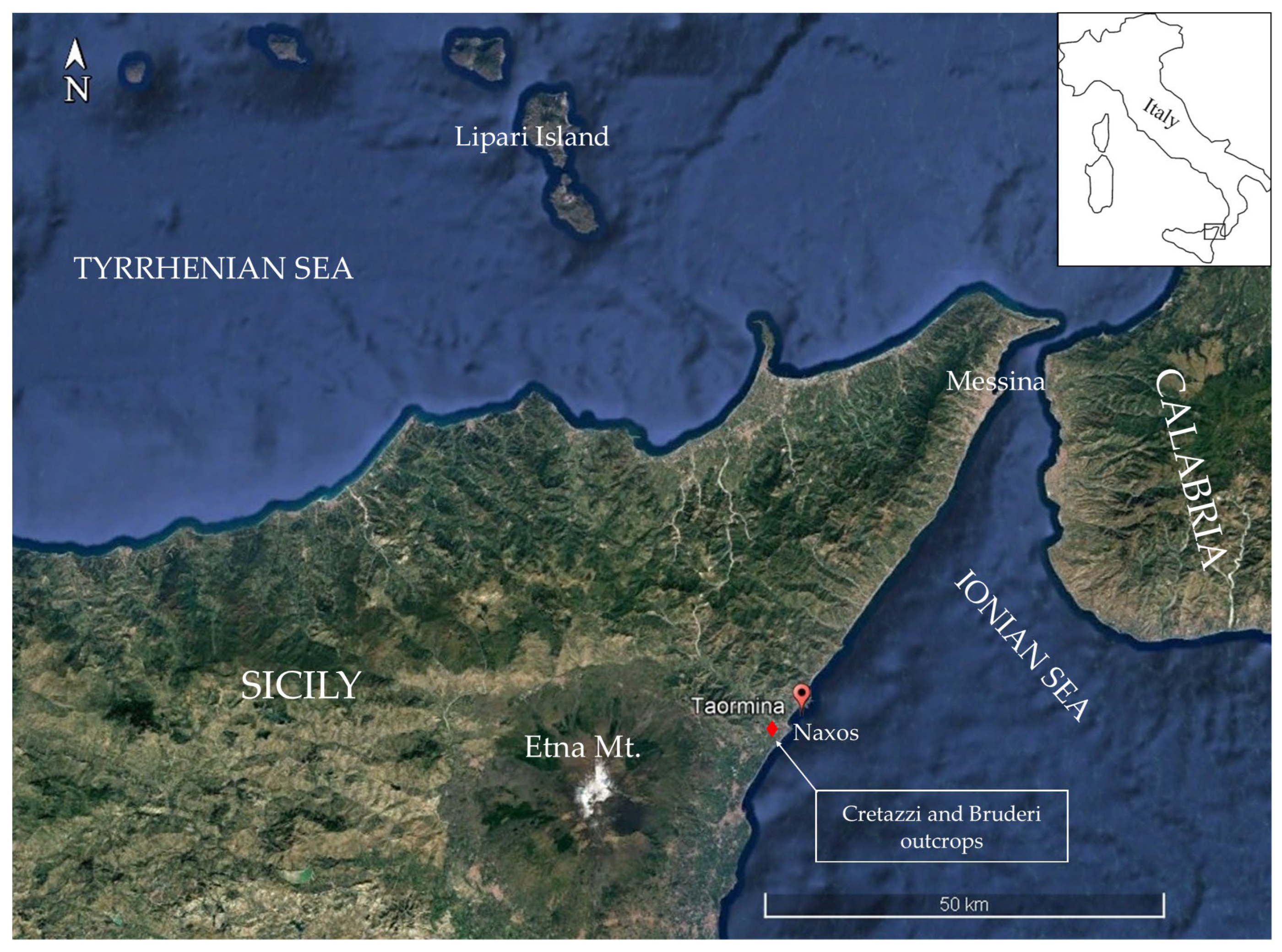
The archaeological ceramics examined in this paper consist of bricks and tiles dating from the Archaic to Roman Ages, coming from two relevant sites of Naxos and Taormina in the province of Messina (northeastern Sicily) (Figure 1). A detailed first study on the same ceramic samples has been carried out by the authors [31], focusing the attention on the volcanic temper present in the pastes to determine their provenance. Based on the identification of the source area of the temper used in ancient ceramic production in this area, a local origin was hypothesized. The inclusions showed marked similarities with the textures and mineral phase compositions of the mugearitic volcanics outcropping along the Alcantara River Valley, which is located near the ancient settlement of Naxos.
Figure 1.
Sketch map of northeastern Sicily (rectangle in the small outline of Italy, right the top) showing the locations of the archaeological sites of Taormina and Naxos and the clay sources (red rhombus) at the Bruderi and Cretazzi outcrops.
Based on this research, some of the authors of this work were also able to create comparative distribution maps of the clay sequences used for ceramic products, bricks and vases at various archaeological sites in the provinces of Messina and Reggio Calabria [32].
This paper aims to increase the knowledge of both the clay raw material sources exploited in the past for ceramic production in this area and the key role of micro- and nannofossil assemblages in identifying the ancient production technology, with inferences about the firing process and duration. Thus, microfossils become a tool for archaeometric research.
2. Geological Framework of the Area Surrounding the Archaeological Sites
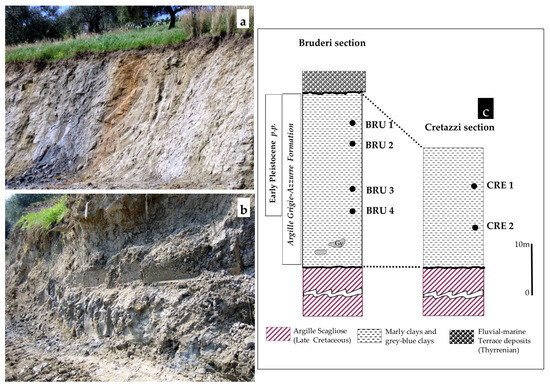
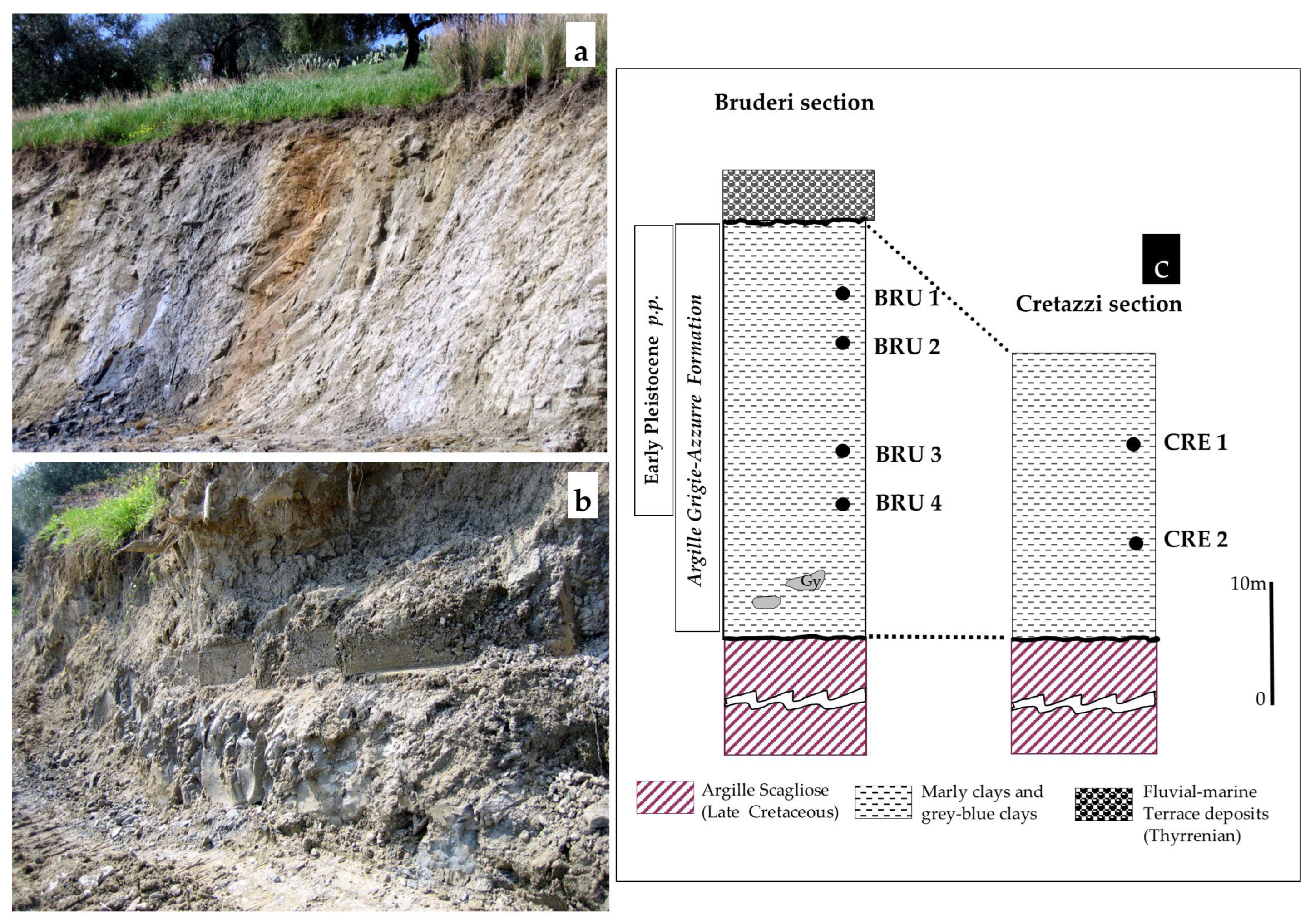
The field exploration, conducted to identify adequate raw materials along the Ionian coast near Taormina and Naxos, revealed two outcrops of clay deposits in the Cretazzi and Bruderi localities to the northwest of the archaeological site of Naxos [22,32]. The deposits belong to the Quaternary marine succession, and the Argille grigie-azzurre Formation is represented here by an estimated 30 m of marly clays and gray-blue clays (Figure 1 and Figure 2). The basal portion is attributed to the Early Pleistocene (MPl6 biozone sensu [33] and MNQ19a subzone, sensu [34]) while the uppermost portion corresponds to the late Early Pleistocene (MNQ19c subzone, sensu [34]). The widest outcrop is in the Bruderi area (Figure 2a,c), consisting of marly clays with chaotically embedded decimetric to metric olistoliths of selenitic gypsum in the lower portion (ascribed to the Tortonian–Lower Messinian by [35] and clays in the upper portion. The Cretazzi outcrop (Figure 2b,c) consists of gray-blue marine clays belonging to early Pleistocene deposits.
Figure 2.
Panoramic view of the two sections emerging near the modern urban center of Giardini Naxos: Bruderi (a), Cretazzi (b) and related schematic stratigraphic logs (c).
3. Materials and Methods
3.1. Archaeological Ceramics and Contexts
The examined ceramic materials include seven bricks and four tiles from the archaeological sites of Naxos and Taormina. These samples cover a wide chronological range from the Archaic (Naxos) to the Roman (Taormina) Ages.
The Naxos samples consist of: (a) two bricks, one (NF-VI) from the firing chamber of a kiln (VI century B.C.) and the other (NM-V) from a tomb (V century B.C.); (b) three tiles dating to the V century B.C., two of which (NT1-V, NT2-V) are from a house and one is (NT3-V) from a tomb.
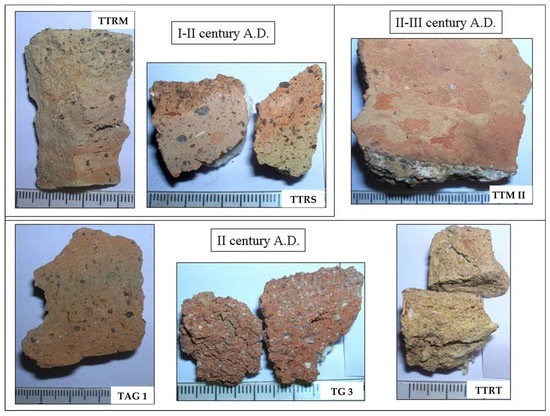
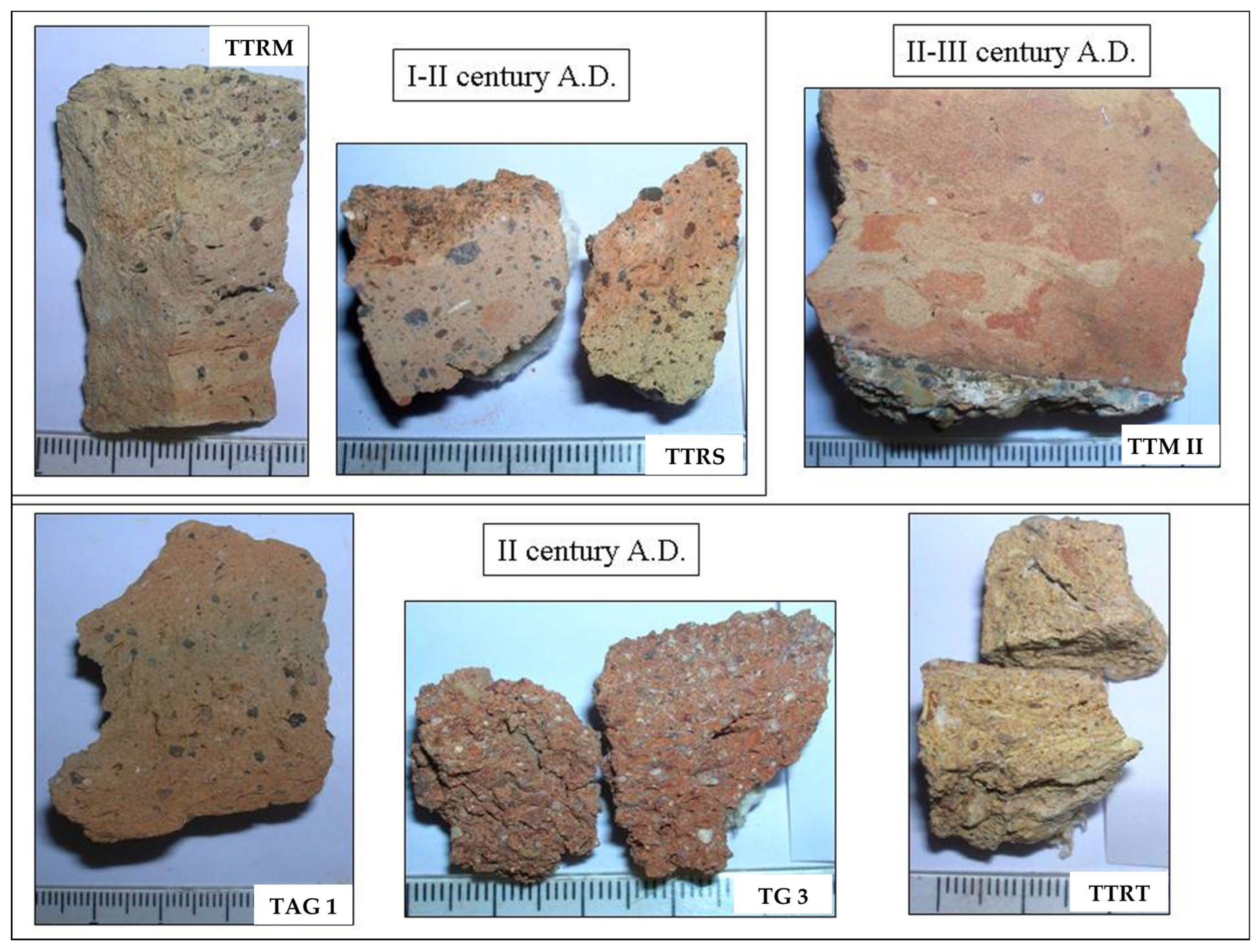
The Taormina samples (Figure 3) include: (a) five bricks, two (TAG1 and TG3) from a house (II century A.D.), two (TTRM, TTRS) from the Thermae (I-II century A.D.) and one (TTM-II) from the Antique Theatre (II-III century A.D.); and (b) one tile from the Thermae (TTRT, I-II century A.D.).
Figure 3.
Archaeological ceramic fragments and related chronological attributions: bricks and tile (TTRT) from Taormina.
Naxos was the first Greek colony of Sicily, founded in the second half of the VIII century B.C. from Calcidesi of the Eubea and from Nassi from the homonym Naxos of the Cicladi. Naxos prospered as a commercial center in the Archaic period for about three centuries and declined after the destruction carried out in 403 B.C. by Dionisio I, the tyrant of Syracuse. In the 358 B.C., the urban life moved on top of the nearby Mt. Tauro where a town was founded: this town became the Roman Tauromeniun (in our time Taormina). The urban and necropolis areas of Naxos provided the analyzed ceramic samples.
The Thermae complex discovered on the north side of the Piazza Vittorio Emanuele, in the courtyard behind the Carabinieri barrack in Taormina, extended north under the so-called “Zecca” neighborhood, where the remains of walls and brick arches are incorporated into eighteenth-century houses. The construction of the thermal building, located on the northern side of the Forum, took place during the early centuries of the Roman imperial age (end of the I-II century AD). The remains of a previous public building, perhaps a Hellenistic Bouleuterion, below the level of the Baths, were identified by excavation tests carried out on the west side of the area. In this area, four bases of honorary inscribed statues were found, dedicated to illustrious citizens and notable figures, dating back to the Hellenistic age. Of the thermal baths, three large rooms remain, functioning as calidarium or tepidarium, with marble slab floors (crustae) heated by praefurnia (rooms intended for combustion). The round or square brick pillars are also visible, which allowed the circulation of hot air under the floors (suspensurae) and are also fed through terracotta tubules placed close to the plaster-covered walls of the rooms [36].
The Ancient Theatre of Taormina, located within the Archaeological Park of Naxos-Taormina (Naxos was the first Greek colony in Sicily), stands along the ridge of the hill bearing the same name, which was completely excavated to create the “cavea” and to obtain the large blocks used in its construction during the Greek era. With a cavea measuring 109 m in diameter, it is the second largest theater after that of Syracuse, not only in Sicily but also in all of mainland Italy and Africa. Its origins date back to the 3rd century B.C., as evidenced by the remains of the isodomic block walls incorporated into the stage building and some of the inscribed seats in the cavea. However, what is visible today is the result of Roman renovation, particularly that which was carried out in the first half of the 2nd century A.D. under Emperor Trajan [37]. During this period, the theater was rebuilt entirely in brick, a material readily available in the nearby clay formations of the Giardini-Naxos plain, which is the subject of the current study.
3.2. Samples from Clay Deposit Outcrops
To obtain information on the source area of the clay raw materials used to produce the examined ceramics, local clay samples were collected for comparison from two clay outcrops in the Bruderi and Cretazzi areas (NW of the archaeological site of Naxos, Figure 2), where the so-called “potters’ neighborhood” is located. The outcrops were identified and reported by [32]. These deposits are currently the only significant ones identified along the entire Ionian coast of the Messina province and represent a suitable local source of clay for ancient ceramic production in this area.
Two samples (BRU 1 and BRU 2) were collected at 70 m a.s.l. and two samples (BRU 3 and BRU 4) at 50 m a.s.l. in the first outcrop (Figure 2a,c).
The second outcrop (Figure 2b,c), located on the Cretazzi Hill about 300 m northeast of the first outcrop, consists of gray-blue clays. Two samples were taken from this outcrop: CRE 1 (at ca. 45 m above sea level) and CRE 2 (at ca. 40 m).
Analytical techniques for the complete characterization of microfossils within the examined sherds include:
- (a)
- polarizing optical microscopy (POM) for both thin sections and smear slides; the latter prepared by adapting the technique of Bown and Young [38] for incoherent sediments;
- (b)
- micromorphological investigation using an Environmental Scanning Electron Microscope (ESEM-FEI Inspect-S) coupled with an Oxford INCA PentaFETx3 energy-dispersive spectrometer at the MIFT Department of the University of Messina. The system is equipped with a Si(Li) detector fitted with an ultra-thin window (ATW2), providing an energy resolution of 137 eV at 5.9 keV. Measurements were conducted under environmental conditions at a working distance of 10 mm with an acceleration voltage of 20 kV. Data acquisition employed counting times of 60 s, maintaining approximately 3000 counts per second with dead time below 30%. Spectral processing and quantification were performed using INCA Energy software, which implements the XPP matrix correction scheme developed by Pouchou and Pichoir [39] to account for atomic number, absorption and fluorescence effects.
The preparation of clay outcrop samples (standard chemical treatment with water solution of H2O2) to obtain washed micropaleontological residues and the preparation of smear slides [37] were carried out at the laboratory of the Department of Physics and Geology of the University of Perugia.
4. Results
Thin-section observations of the tiles and bricks revealed a marked compositional and textural homogeneity in their fabric, characterized by abundant (25 to 40%) coarse inclusions of volcanic origin [31]. As shown in Figure 4, the groundmass varies in colour from orange to gray and dark brown, depending on the sample. The inclusions consist of: (a) predominant volcanic rock fragments, along with single crystals of zoned plagioclase and augitic clinopyroxene, which are compositionally similar to the locally outcropping mugearitic products attributed to the eruptive activity of Mt. Mojo; (b) common metamorphic rock fragments (gneiss and micaschist); (c) a few olivine and quartz grains, along with argillaceous rock fragments; (d) rare quartzarenite fragments and microcline crystals; and (e) very rare micas [31].
Figure 4.
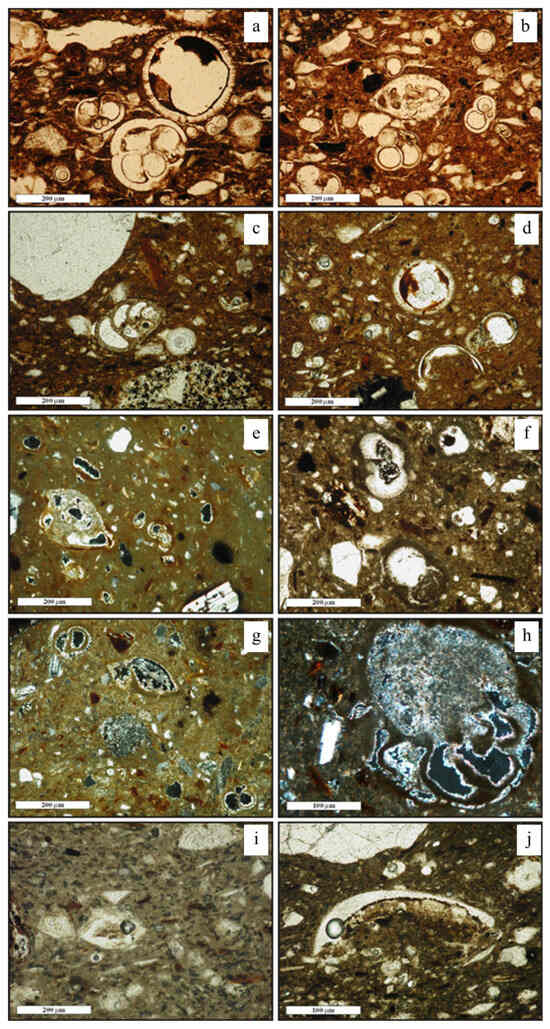
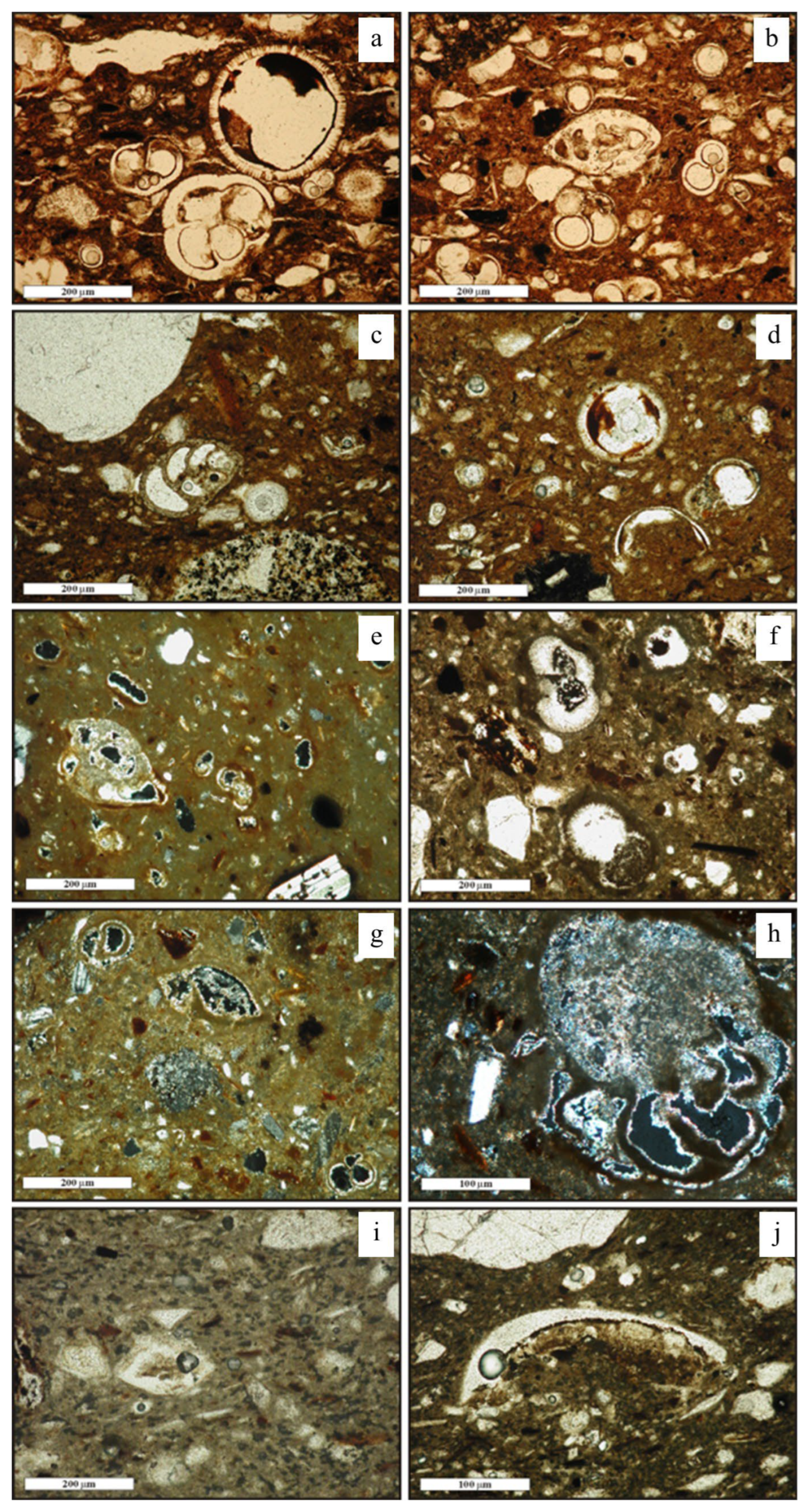
Photomicrographs of selected ceramics, showing the presence of planktonic and benthonic foraminifera and other skeletal remains. (a,b) Brick sample TAG1 (PPL; 2.5×): Globigerinoides spp., Orbulina universa and Amphistegina sp.; (c,d) tile sample NT1-V (PPL; 2.5×): Bulimina marginata, O. universa and Globigerinids; (e) brick sample TTRS (XPL; 2.5×): Amphistegina sp. and Globigerinids; (f) brick sample TG3 (PPL; 2.5×): small Globigerinids; (g,h) brick sample TTRM (XPL; 2.5× and 10×): poorly preserved Amphistegina and benthonic specimen; (i) tile sample NT2-V (PPL; 2.5×): poorly preserved benthonic specimens; (j) tile sample NT2-V (XPL; 10×): ostracod carapace. PPL: plane parallel light; XPL: crossed polarized light.
4.1. Foraminifera
Calcareous skeletal remains of benthic and planktonic foraminifera within the groundmass of all examined ceramic samples have been analyzed.
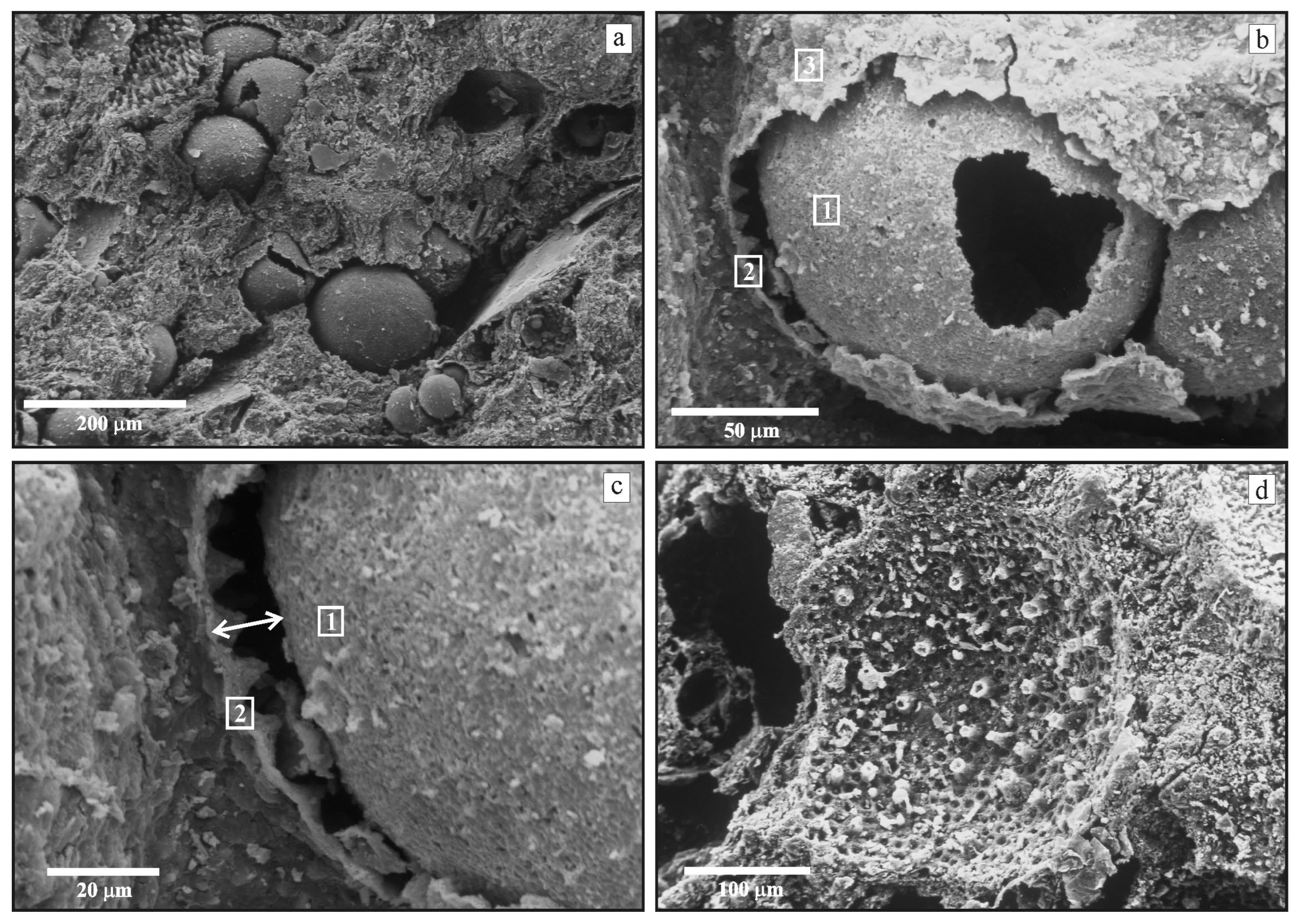
Microfossils identified among planktonic foraminifera include Orbulina universa, Globigerinoides spp., Globorotalia inflata, Globigerinoides ruber and Globigerina bulloides, while the benthic foraminifera are represented by Bolivina spathulata, Bulimina marginata and Amphistegina spp. (Figure 4 and Figure 5). The other invertebrate fossils, such as ostracods and thin bivalve shells, are also present. The planktonic assemblage is indicative of early Pleistocene age (MPl6 biozone, sensu [33]).
Figure 5.
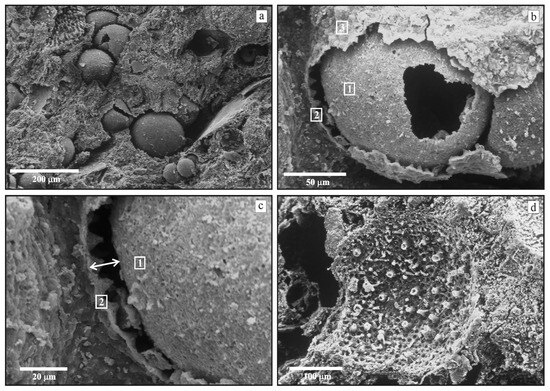
Scanning Electron Microscope (SEM) images of brick sample TAG1 show well-preserved morphological features of microfossil tests: (a) planktonic foraminifera (Globigerinids and Globigerinoids) present within the clay matrix; (b) test of a planktonic foraminifer displaying detachment between internal and external layers caused by the firing process of the brick (1 = internal layer; 2 = external layer; 3 = clayey coating); (c) detail of the detachment between internal and external layers of the test wall; (d) proximal side of the external wall layer with a detail of conical-shaped channels.
The abundance and preservation state of calcareous microfossils in the examined pastes are quite variable, depending on the sample (Table 1). Specifically, the amounts range from very abundant (TAG1) to abundant (NT1-V, TTRM, TTRS) to common (TTM-II, TG3) to rare (NM-V, NF-VI, NT2-V, NT3-V, TTRT).
Table 1.
Micropaleontological and chemical information for the bricks and tiles from Naxos as well as Taormina sites and firing temperature estimates and raw materials from the Bruderi and Cretazzi outcrops. Keys: **** very abundant; *** abundant; ** common; * rare; IV degree—initial vitrification; V degree—extensive vitrification. Yellow colour to medium/good and sky blue colour for medium/poor microfossil preservation state.
Regarding preservation state, three of the examined thin sections (NF-VI, NT3-V, TG3) show only traces of microfossils, so their preservation state is considered poor.
Conversely, in other samples, the preservation state of the morphological features of the foraminifera tests was observed to be medium to medium/good (NM-V, NT1-V, NT2-V, TTM-II, TTRT), good (TTRS, TTRM) or even very good (TAG1).
4.2. Calcareous Nannofossils
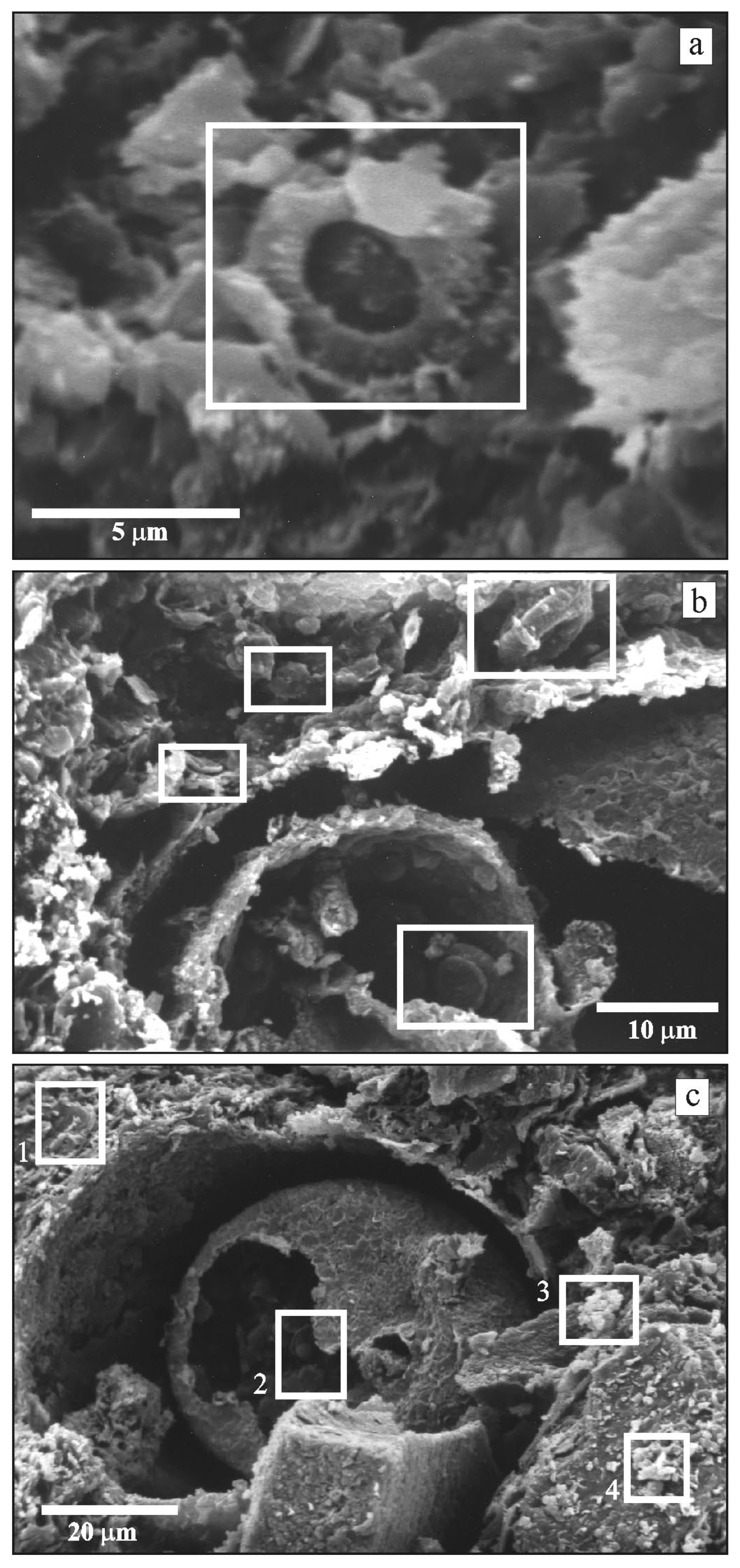
Observations of smear slides (prepared from artifact sherds) under a polarizing microscope revealed that six of the eleven investigated samples (NM-V, NT1-V, NT2-V, TTRM, TTRS, TAG1) contain calcareous nannofossils (Table 1). The assemblages, which range from well to moderately preserved, are mainly composed of Small and Medium Gephyrocapsa (markers for the Early Pleistocene age, MNQ 19a subzone sensu [34]), Coccolithus pelagicus and Helicosphaera sellii. The genera Gephyrocapsa and Coccolithus are commonly present, while Calcidiscus and Helicosphaera, as well as reworked specimens of Discoasters, are more rare. Micromorphological analysis performed under SEM examination confirmed the presence of the same species found in the smear slides, along with a few reworked specimens such as Discoasters sp. (Figure 6).
Figure 6.
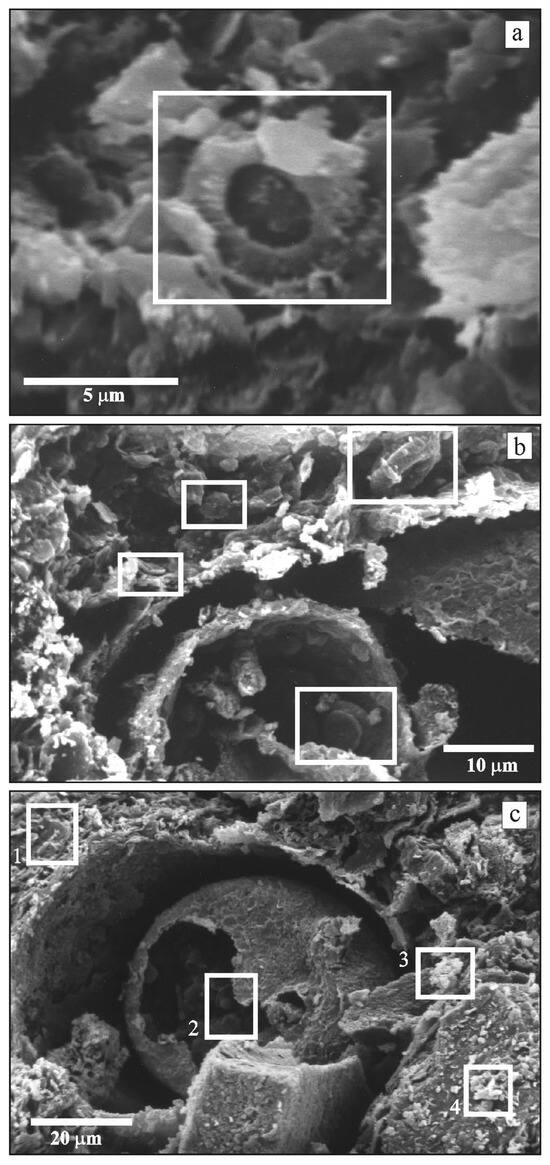
SEM images showing several species of nannofossils identified in brick sample TAG1: (a) Coccolithus pelagicus; (b) Gephyrocapsa sp., Calcidiscus sp., Helicosphaera sp. (within rectangles) and others coccolith species, occurring both in the clay matrix and within the test chambers of foraminifera; (c) 1–2: coccoliths; 3–4: rosette-shaped nannofossils (Discoaster spp.).
The identified calcareous nannofossil assemblages are important because they confirm the type and age of the clay raw materials used in ancient manufacturing, as already indicated by microfossil assemblages. The Early Pleistocene marine clay sediments were the raw materials used for ceramic production.
4.3. Microfossils and Age of Outcrop Samples
The analysis of the micropaleontological content of local clay samples revealed varying abundances of the biogenic component between specimens from the two outcrops as well as among samples from the same outcrop.
In particular, the two samples from the Cretazzi outcrop (CRE1 and CRE2) furnished a scarce amount of washing residues (ca. 0.20 g/100 g of total sample) indicating a very low contribution of the biogenic component to the original sediment. In these samples, the planktonic foraminifera association consists of Globigerina bulloides, Neogloboquadrina spp. and Globorotalia inflata (markers of the Early Pleistocene age, MPl6 biozone sensu [33]), while the rare benthonic foraminifera present include Bolivina spathulata, Bulimina marginata and Gyroidina altiformis.
The calcareous nannofossil assemblages contain Small Gephyrocapsa, Medium Gephyrocapsa, Coccolithus pelagicus, Helicosphaera sellii, H. carterii, Large Gephyrocapsa and rare reworked Cretaceous and Miocene nannofossil species. The identified assemblages allow these clay samples to be assigned to the Early Pleistocene (MNQ19b subzone, sensu [34]).
Regarding the clay samples from the Bruderi outcrop, some differences were observed among the four specimens collected. Specifically, samples BRU3 and BRU4 were barren of foraminifera, while the calcareous nannofossils showed a very poor association with Small Gephyrocapsa and rare Calcidiscus leptoporus.
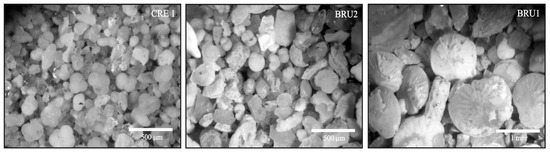
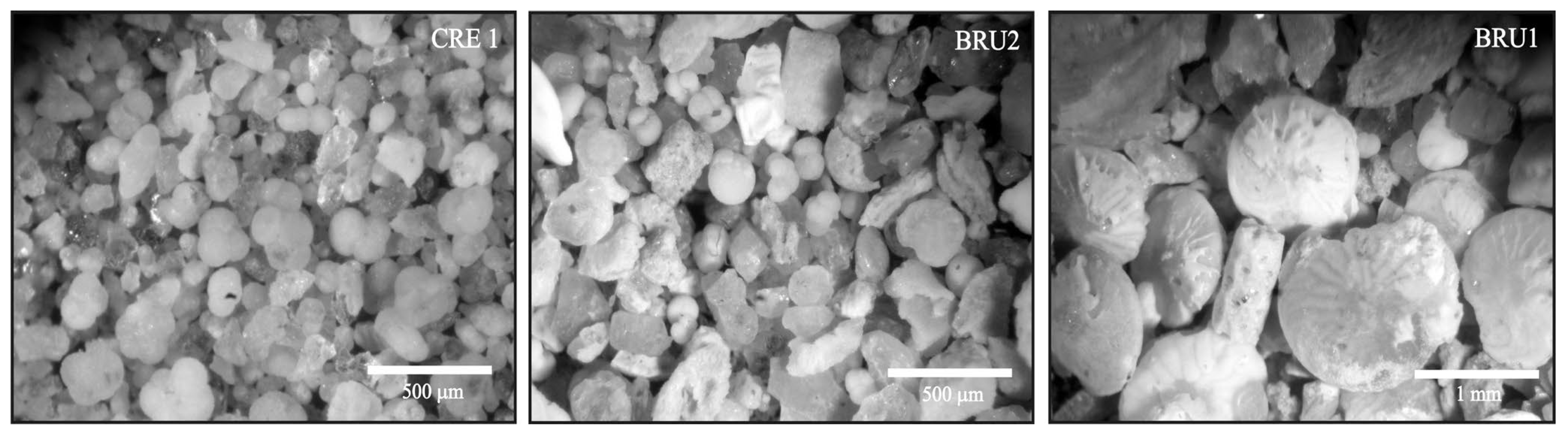
In contrast, samples BRU1 and BRU2 showed an abundant biogenic component, with numerous planktonic foraminifera such as Globorotalia inflata, Globigerina bulloides, Globigerinoides ruber, Globigerinoides sacculifer, Orbulina universa and Neogloboquadrina spp. (Figure 7), along with rich calcareous nannofossil associations (Large Gephyrocapsa, Helicosphaera sellii, Coccolithus pelagicus, Medium Gephyrocapsa and Pseudoemiliania lacunosa). The planktonic foraminifera assemblage is referable to the MPl6 biozone (Early Pleistocene, sensu [33]) and the calcareous nannofossil association identified in these clay samples can be dated to the Early Pleistocene (MNQ19d subzone, sensu [34]). In addition, sample BRU1 is characterized by a very abundant specimens of benthonic foraminifera Amphistegina lessonii and Amphistegina radiata (Figure 7), identified by [22] within the Early Pleistocene clayey sediments of the Sicilian Ionian coast.
Figure 7.
Stereomicroscope photographs of the washed residues show the biogenic component of representative clay samples from the Cretazzi (CRE1) and Bruderi (BRU 1–2) outcrops. The Bruderi 1 sample contains abundant specimens of Amphistegina lessonii and Amphistegina radiata.
5. Discussion
5.1. Microfossil Preservation vs. Firing Temperature, Duration and Factors: Resolving the Paradox
The coexistence of well-preserved calcareous microfossils and mineralogical evidence for high firing temperatures (>850–900 °C), such as diopside, anorthite, gehlenite and matrix vitrification, in most examined samples presents an apparent paradox. As is known, calcareous microfossils are very sensitive to the various steps of manufacture, both in terms of composition and state of preservation. The experiments of Quinn [20] demonstrated that calcareous nannofossils are degraded by heating above 600 °C and can survive a maximum firing temperature of 800 °C in an oxidizing atmosphere and 700 °C in a reducing atmosphere. Therefore, ceramics containing well-preserved microfossils have traditionally been considered low-fired, while samples with poorly preserved microfossil assemblages are assumed to have been subjected to higher firing temperatures. However, as reported in Table 1, the firing temperatures (>850–900 °C) and the vitrification grades (V) estimated by [31] for samples containing abundant and well-preserved foraminifera appear to contradict this expectation. This apparent contradiction can be resolved by considering multiple factors related to the kinetic nature of calcite decomposition and the specific characteristics of ancient ceramic production.
The thermal decomposition of calcite (CaCO3 → CaO + CO2) is a kinetically controlled process rather than an instantaneous phase transition. Although equilibrium temperature at atmospheric pressure is approximately 898 °C, the decomposition rate under real firing conditions depends on temperature, time, atmosphere and local CO2 partial pressure [40,41]. High-temperature mineral phases require only brief exposure for nucleation, while complete calcite decomposition demands prolonged heating [42]. Experimental studies demonstrate that time at maximum temperature is as critical as temperature itself [43,44]. Short “flash firing” cycles, common for mass-produced construction materials, allow matrix vitrification and Ca-silicate formation while preserving carbonates in the ceramic interior [45]. The bricks and tiles examined here, produced to meet building demands, were likely fired using such rapid cycles.
Quinn and Day [46] noted that open porosity significantly influences calcite decomposition during firing. In our samples, the poorly sorted mixture of marine clays and coarse volcanic temper creates heterogeneous porosity, visible as voids, channels and planar voids in thin sections (Figure 4). In porous ceramic bodies, CO2 released during incipient calcite decomposition accumulates in low-permeability zones, shifting local equilibria toward carbonate stability and protecting microfossils from thermal degradation [47,48,49].
Significant temperature gradients develop between the surface and core during firing: microfossils in the inner portions may experience 50–100 °C lower peak temperatures than vitrified surfaces [50,51]. Additionally, ancient updraft kilns produced heterogeneous atmospheric conditions with fluctuations between the oxidizing and reducing phases. The variable groundmass colours (orange to gray-brown) in our samples reflect these fluctuations [20,52,53].
Preservation Patterns in Samples: Who Are Survivors?
In the studied samples, preservation varies systematically among microfossil groups: robust benthic foraminifera such as Amphistegina (thick hyaline walls) are better preserved than thin-walled planktonic and delicate nannofossils (2–20 μm), whose survival also depends on matrix position [17,46]. Most examined ceramics contain foraminifera in medium–good to very good preservation, sometimes with well-preserved nannofossils (NM-V, NT2-V, TTRM, TAG1) (Table 1). Sample TAG1 shows exceptional preservation suggesting rapid heating–cooling cycles. Only a few samples (NF-VI, NT3-V, TG3) contain poorly preserved foraminifera, indicating higher temperatures or longer exposure. This confirms that microfossil preservation reflects the complex interplay of kinetic factors, firing duration, paste characteristics and atmospheric conditions.
Microfossil preservation alone cannot provide reliable firing temperature estimates. However, integrating micropaleontological and mineralogical data allows for a distinction between high-temperature/short-duration regimes (vitrification with preserved microfossils) and lower-temperature/long-duration firing (greater microfossil degradation despite lower peaks). Our samples indicate that Naxos–Taormina potters employed rapid firing techniques driven by construction demands. Future research should include controlled firing experiments using local Pleistocene clays from Bruderi and Cretazzi outcrops, varying temperature (700–1000 °C), soaking time (0.5–8 h), heating/cooling rates and atmosphere. This would establish a regional framework for interpreting microfossil preservation and ancient firing technologies in northeastern Sicily.
5.2. Archaeometric Tools
The determination of provenance and technology remains the principal aim of most analytical research on archaeological ceramics. Micropaleontology can support and increase the data obtained by conventional methods such as petrography and chemistry.
In two case studies [23,24] concerning Richborough 527 amphorae (I–III century A.D.) and architectural ceramics (antefixes, VI–V century B.C.) from Lipari Island (Figure 1), micropaleontological analyses provided fundamental results. The foraminifera identified in antefixes suggest that early Pleistocene marine clay deposits along the Tyrrhenian coast of the Peloritani Mountains are possible sources. The mixture components (Pleistocene marine clays and sands with metamorphic elements) are unrelated to Lipari’s geological context but show strong affinity with Sicilian materials. Comparisons with Messina terracottas indicate a probable use of the same raw materials by a single production center in Zancle-Messana [24]. Similarly, microfossil content in Richborough 527 amphorae supports the hypothesis that Messina area clays, rather than Lipari clays, were used [23].
In our research, provenance interpretation was made possible by comparing microfossil assemblages in sherds with field samples from potential sources. The foraminifera and nannofossil assemblages in sampled clay sediments are equivalent to those in our ceramics, identifying Bruderi and Cretazzi outcrops (early Pleistocene marine clays) as the local supply area for brick and tile production from VI–V centuries B.C. to I–III centuries A.D. Moreover, the presence of Amphistegina in various artifacts unequivocally indicates the use of Bruderi clays, where this genus is abundant. This demonstrates how micropaleontology, combined with archaeological evidence, addresses provenance and technology aspects, providing a complete picture of past ceramic production. By applying microfossil biostratigraphy within archaeological and petrographic frameworks, specific raw material sources can be identified, as shown in our case study. The approach referred to as ‘ceramic micropalaeontology’ [46] has become an indispensable tool in archaeometric research.
6. Conclusions
The clay formations in the area surrounding Taormina have led to its continuous use over time, as demonstrated by the etymology of some districts (for example, Contrada “Cretazzi”, which refers to clay deposits, and Contrada “Calcarone”, linked to kilns for firing clay and limestone), as well as street names (Via delle Fornaci). Also noteworthy is the large kiln complex located within the archaeological site of Naxos, which was the center of a significant industrial activity focused on the production of bricks and terracotta pots since VI century B.C. This production tradition continued beyond the classical age, persisting in the modern era through specialized local workshops.
The approach adopted in this study highlights how an interdisciplinary and diversified methodology allows the origins of the clays used in various construction phases to be distinguished and characterized paleontologically, to the point of identifying the individual quarries of origin.
The new data from Taormina and Naxos, along with the previous research (Lipari Island [23,24]) developed over the last seven years on archaeological ceramics, demonstrate that microfossils are not only an archaeometric tool but can also indirectly indicate the periods of exploitation of raw material areas. The bricks and tiles of Taormina and Naxos analyzed here have been produced for centuries, and the archaeological ceramics of Lipari also show that the exploitation of the eastern Tyrrhenian coast for ceramic production in Zancle-Messana was continuous from the Archaic period, from the 5th century B.C. to the 3rd century A.D.
The study also addresses the apparent contradiction between the high firing temperatures indicated by mineralogical analysis and the presence of well-preserved calcareous microfossils. Key factors include the kinetic nature of calcite decomposition, firing duration, the effect of paste porosity on CO2 pressure and thermal gradients within ceramics. Evidence shows that bricks and tiles were produced using rapid firing cycles that reached high temperatures for short periods, allowing matrix vitrification without completely destroying the microfossils. This suggests that microfossil preservation and high-temperature mineralogical indicators can coexist when firing duration is considered.
This approach can establish a regional framework for interpreting microfossil preservation in archaeological ceramics and enhance our understanding of ancient firing technologies in northeastern Sicily.
Author Contributions
Conceptualization, A.B. and M.T.; Methodology, A.B., M.T. and M.D.B.; Formal analysis, A.B., M.T. and M.D.B.; Investigation, A.B., M.T., M.D.B. and G.S.; Writing—original draft, A.B. and M.T.; Writing—review and editing, A.B., M.T., M.D.B. and G.S. All authors have read and agreed to the published version of the manuscript.
Funding
This research received no external funding.
Data Availability Statement
Data is contained within the article and is available to all.
Acknowledgments
Thanks are also due to P. Pino, who provided valuable help in previous similar research in the area, both in field surveys and in stratigraphic reconstructions.
Conflicts of Interest
The authors declare no conflicts of interest.
References
- Davis, A.D. An Iron Age site on the Chilterns: Pottery containing fossil shells. Antiqu. J. 1951, 31, 148. [Google Scholar]
- Farnsworth, M. Greek pottery: A mineralogical study. Am. J. Archaeol. 1964, 68, 221–228. [Google Scholar] [CrossRef] [Scilit]
- Williams, D.F. A petrological examination of pottery from Thera. In Thera and the Aegean World I: Papers Presented at the Second International Scientific Congress, Santorini, Greece, August 1978; Doumas, C., Ed.; The Thera Foundation: London, UK, 1978; pp. 507–514. [Google Scholar]
- Alhonen, P.; Matiskainen, H. Diatom analysis of prehistoric pottery sherds—An archaeological evaluation. In Nordic Meeting of Diatomologist; Lammi Biological Station: Lammi, Finland, 1980; pp. 45–62. [Google Scholar]
- Riley, J.A. Petrological examination of coarse-ware stirrup jars from Mycenae. Annu. Br. Sch. Athens 1981, 76, 335–340. [Google Scholar] [CrossRef] [Scilit]
- Riley, J.A. The petrological analysis of Aegean ceramics. In Current Research in Ceramics: Thin-Section Studies; Freestone, I., Johns, C., Potter, T., Eds.; British Museum Occasional Paper 32; British Museum: London, UK, 1982; pp. 1–7. [Google Scholar]
- Jansma, M.J. Diatom analysis of prehistoric pottery. In Proceedings of the 7th International Diatom Symposium Philadelphia 1982; Mann, D.G., Ed.; Otto Koeltz Science Publishers: Koenigstein, Germany, 1984; pp. 529–536. [Google Scholar]
- Håkansson, H.; Hulthén, B. On the dissolution of pottery for Diatom studies. Nor. Archaeol. Rev. 1986, 19, 243–259. [Google Scholar] [CrossRef] [Scilit]
- Vaughan, S.J. Petrographic analysis of the Early Cycladic wares. In Thera and the Aegean World III; Hardy, D.A., Ed.; The Thera Foundation: London, UK, 1990; Volume I, pp. 470–487. [Google Scholar]
- Day, P.M. Pottery production and consumption in the Siteia Bay area during the New Palace period. In Achladia: Scavi e Ricerche della Missione Greco-Italiana in Creta Orientale (1991–1993); Tsipopoulou, M., Vagnetti, L., Eds.; CNR/GEI: Rome, Italy, 1995; pp. 148–175. [Google Scholar]
- Whitbread, I.K. Greek Transport Amphorae: A Petrological and Archaeological Study; Brithish School at Athens: Athens, Greece, 1995. [Google Scholar]
- Montana, G. Ceramic raw materials: How to recognize them and locate the supply basins—Mineralogy, petrography. Archaeol. Anthropol. Sci. 2020, 12, 175. [Google Scholar] [CrossRef] [Scilit]
- Troja, S.O.; Cro, A.; Gueli, A.M.; La Rosa, V.; Mazzoleni, P.; Pezzino, A.; Romeo, M. Characterization and thermoluminescence dating of prehistoric pottery sherds from Milena. Archaeometry 1996, 38, 113–128. [Google Scholar] [CrossRef] [Scilit]
- Montana, G.; Mommsen, H.; Iliopoulous, L.; Schwedt, A.; Denaro, M. The petrography and chemistry of thin-walled ware from a Hellenistic Roman Site at Segesta (Sicily). Archaeometry 2003, 45, 375–387. [Google Scholar] [CrossRef] [Scilit]
- Quinn, P.S. Ceramic Petrography: The Interpretation of Archaeological Pottery & Related Artefacts in Thin Section; Archaeopress: Oxford, UK, 2013. [Google Scholar] [CrossRef] [Scilit]
- Quinn, P.S.; Day, P.M. Calcareous microfossils in Bronze Age Aegean ceramics: Illuminating technology and provenance. Archaeometry 2007, 49, 775–793. [Google Scholar] [CrossRef] [Scilit]
- Quinn, P.S. The occurrence and research potential of microfossils in inorganic archaeological materials. Geoarchaeology 2008, 23, 275–291. [Google Scholar] [CrossRef] [Scilit]
- Alaimo, R.; Montana, G.; Palumbo, V. La ceramica punica di Mozia (Trapani): Natura delle materie prime e tecnologie di cottura dei reperti della zona K (VI-V secolo a.C.). Acta Mineral. Petrogr. 1997, 40, 1–23. [Google Scholar]
- Quinn, P.S.; Alaimo, R.; Montana, G. Calcareous nannofossil analysis of ceramics and probable raw materials from an ancient Punic kiln site on the island of Mozia, western Sicily. J. Nannoplankton Res. 1998, 20, 85–87. [Google Scholar] [CrossRef] [Scilit]
- Quinn, P.S. A note on the behavior of calcareous nannofossils during the firing of ceramics. J. Nannoplankton Res. 1999, 21, 31–32. [Google Scholar] [CrossRef] [Scilit]
- Baldanza, A.; Belfiore, C.M.; Sabatino, G.; Triscari, M. I microfossili nelle ceramiche archeologiche come “marker” tecnologici e di provenienza: Un caso studio su mattoni e tegole di età romana da Taormina e Naxos (Sicilia nord-orientale). In Proceedings of the Abstract XIII Giornata di Archeometria della Ceramica “Nuove Metodologie Analitiche e di Trattazione dei Dati Nello Studio della Ceramica in Archeologia ed in Architettura”, Catania, Italy, March 26–27 March 2009; pp. 20–21. [Google Scholar]
- Baldanza, A.; Belfiore, C.M.; Di Bella, M.; Pino, P.; Sabatino, G.; Triscari, M. Georisorse per le costruzioni in laterizio di Taormina e Naxos (Sicilia Nord-Orientale): Dati petro-chimici e micropaleontologici. In Atti Congresso Nazionale di Archeometria, AIAr “Riflessioni e Trasparenze: Diagnosi e Conservazione di Opere e Manufatti Vetrosi”, Ravenna, Italy, 24–26 February 2009; Patron Editore: Bologna, Italy, 2010; pp. 339–350. [Google Scholar]
- Di Bella, M.; Mastelloni, M.A.; Baldanza, A.; Quarteri, S.; Italiano, F.; Tripodo, A.; Romano, D.; Leonetti, F.; Sabatino, G. Archaeometric constraints by multidisciplinary study of Richborough 527 Amphorae and yellow clays from the Contrada Portinenti pottery workshop (Lipari Island, Italy). Archaeol. Anthropol. Sci. 2019, 11, 2957–2970. [Google Scholar] [CrossRef] [Scilit]
- Mastelloni, M.A.; Di Bella, M.; Baldanza, A.; Sabatino, G. Terrecotte Architettoniche di Lipari, note su influssi formali e dati tecnici da analisi sperimentali. In Deliciae Fictiles V. Networks and Workshops. Architectural Terracottas and Decorative Roof Systems in Italy and Beyond; Oxford Books: Oxford, UK, 2019; pp. 217–228. [Google Scholar]
- Jansma, M.J. Diatom analysis of pottery. In Ex Horreo; van Beek, B.L., Brandt, R.W., Groenman-van Waateringe, W., Eds.; Cingula: Amsterdam, The Netherlands, 1977; Volume 4, pp. 77–85. [Google Scholar]
- Jansma, M.J. Diatom analysis from coastal sites in the Netherlands. In Environmental Aspects of Coasts and Islands; Brothwell, D., Dimbleby, G., Eds.; B.A.R. International Series: Oxford, UK, 1981; Volume 94, pp. 145–162. [Google Scholar]
- Gibson, A.M. Preliminary results of diatom analysis of clays and pre-historic pottery from the Millfield basin. North. Archaeol. 1983, 4, 33–44. [Google Scholar]
- Matiskainen, H.; Alhonen, P. Diatoms as indicators of provenance in Finnish sub-Neolithic pottery. J. Archeol. Sci. 1984, 11, 147–157. [Google Scholar] [CrossRef] [Scilit]
- Stilborg, O.H. Shards of Iron Age Communication: A Ceramological Study of Internal Structure and External Contacts in the Gud-me-Lundeborg Area, Funen During the Late Roman Iron Age; Lunds Universitet: Lund, Sweden, 1997. [Google Scholar]
- Jansma, M.J. Diatoms from a Neolithic excavation on the former Island of Schokland, Ijselmeerpolders, The Netherlands. Diatom Res. 1990, 5, 301–309. [Google Scholar] [CrossRef] [Scilit]
- Belfiore, C.M.; Di Bella, M.; Triscari, M.; Viccaro, M. Production technology and provenance study of archaeological ceramics from relevant sites in the Alcantara River Valley (North-eastern Sicily, Italy). Mater. Charact. 2010, 61, 440–451. [Google Scholar] [CrossRef] [Scilit]
- Triscari, M.; Baldanza, A.; Belfiore, C.; Di Bella, M.; Pino, P.; Sabatino, G.; Tigano, G. Clay units in NE Sicily: An integrated map and database finalized to archaeometric provenance studies. In Proceedings of the Geoitalia 2007, VI Forum Italiano di Scienze della Terra, Rimini, Italy, 12–14 September 2007; p. 469. [Google Scholar]
- Lirer, F.; Foresi, L.M.; Iaccarino, S.M.; Salvatorini, G.; Turco, E.; Cosentino, C.; Sierro, F.J.; Caruso, A. Mediterranean Neogene planktonic foraminifer biozonation and biochronology. Earth-Sci. Rev. 2019, 196, 102869. [Google Scholar] [CrossRef] [Scilit]
- Di Stefano, A.; Baldassini, N.; Raffi, I.; Fornaciari, E.; Incarbona, A.; Negri, A.; Bonomo, S.; Villa, G.; Di Stefano, E.; Rio, D. Neogene-Quaternary Mediterranean calcareous nannofossil biozonation and biochronology: A review. Stratigraphy 2023, 20, 259–302. [Google Scholar] [CrossRef] [Scilit]
- Lentini, F.; Catalano, S.; Carbone, S. Carta Geologica Della Provincia di Messina; Servizio Geologico: Rome, Italy, 2000. [Google Scholar]
- Raneri, S.; Torre, S.; Mazzoleni, P.; Portale, C.; Barone, G. From βαλανεῖα to thermae: Unveiling the transition from Greek to Roman architectural models of baths by technological and provenance archaeometric studies on bricks and tiles. ArcheoSciences 2019, 43, 187–202. [Google Scholar] [CrossRef] [Scilit]
- Muscolino, F.; Triscari, M. Sectilia del Teatro Antico reimpiegati in un altare del Duomo di Taormina; Edizioni Scripta: Roma, Italy, 2014; pp. 223–230. [Google Scholar]
- Bown, P.R.; Young, J.R. Techniques. In Calcareous Nannofossil Biostratigraphy; Bown, P.R., Ed.; Kluwer Academic Publishers: Cambridge, UK, 1998; pp. 16–28. [Google Scholar]
- Pouchou, J.L.; Pichor, F. Surface film X-ray microanalysis. Scanning 1990, 12, 212–224. [Google Scholar] [CrossRef] [Scilit]
- Rodriguez-Navarro, C.; Ruiz-Agudo, E.; Luque, A.; Rodriguez-Navarro, A.B.; Ortega-Huertas, M. Thermal decomposition of calcite: Mechanisms of formation and textural evolution of CaO nanocrystals. Am. Mineral. 2009, 94, 578–593. [Google Scholar] [CrossRef] [Scilit]
- Maciejewski, M.; Reller, A. How (un)reliable are kinetic data of reversible solid-state decomposition processes? Thermochim. Acta 1987, 110, 145–152. [Google Scholar] [CrossRef] [Scilit]
- Cultrone, G.; Rodriguez-Navarro, C.; Sebastian, E.; Cazalla, O.; De La Torre, M.J. Carbonate and silicate phase reactions during ceramic firing. Eur. J. Mineral. 2001, 13, 621–634. [Google Scholar] [CrossRef] [Scilit]
- Maritan, L.; Nodari, L.; Mazzoli, C.; Milano, A.; Russo, U. Influence of firing conditions on ceramic products: Experimental study on clay rich in organic matter. Appl. Clay Sci. 2006, 31, 1–15. [Google Scholar] [CrossRef] [Scilit]
- Duminuco, P.; Messiga, B.; Riccardi, M.P. Firing process of natural clays. Some microtextures and related phase compositions. Thermochim. Acta 1998, 321, 185–190. [Google Scholar] [CrossRef] [Scilit]
- Rathossi, C.; Pontikes, Y. Effect of firing temperature and atmosphere on ceramics made of NW Peloponnese clay sediments. Part I: Reaction paths, crystalline phases, microstructure and colour. J. Eur. Ceram. Soc. 2010, 30, 1841–1851. [Google Scholar] [CrossRef] [Scilit]
- Quinn, P.S.; Day, P.M. Ceramic micropalaeontology: The analysis of microfossils in ancient ceramics. J. Micropaleontol. 2007, 26, 159–168. [Google Scholar] [CrossRef] [Scilit]
- Riccardi, M.P.; Messiga, B.; Duminuco, P. An approach to the dynamics of clay firing. Appl. Clay Sci. 1999, 15, 393–409. [Google Scholar] [CrossRef] [Scilit]
- Maniatis, Y.; Tite, M.S. Technological examination of Neolithic-Bronze Age pottery from central and southeast Europe and from the Near East. J. Archaeol. Sci. 1981, 8, 59–76. [Google Scholar] [CrossRef] [Scilit]
- Tite, M.S.; Maniatis, Y. Examination of ancient pottery using the scanning electron microscope. Nature 1975, 257, 122–123. [Google Scholar] [CrossRef] [Scilit]
- Livingstone Smith, A. Bonfire II: The return of pottery firing temperatures. J. Archaeol. Sci. 2001, 28, 991–1003. [Google Scholar] [CrossRef] [Scilit]
- Nodari, L.; Marcuz, E.; Maritan, L.; Mazzoli, C.; Russo, U. Hematite nucleation and growth in the firing of carbonate-rich clay for pottery production. J. Eur. Ceram. Soc. 2007, 27, 4665–4673. [Google Scholar] [CrossRef] [Scilit]
- Traoré, K.; Kabré, T.S.; Blanchart, P. Gehlenite and anorthite crystallization from kaolinite and calcite mix. Ceram. Int. 2003, 29, 377–383. [Google Scholar] [CrossRef] [Scilit]
- Földvári, M. Handbook of Thermogravimetric System of Minerals and Its Use in Geological Practice; Occasional Papers of the Geological Institute of Hungary; Geological Institute of Hungary: Budapest, Hungary, 2011; Volume 213. [Google Scholar]

Disclaimer/Publisher’s Note: The statements, opinions and data contained in all publications are solely those of the individual author(s) and contributor(s) and not of MDPI and/or the editor(s). MDPI and/or the editor(s) disclaim responsibility for any injury to people or property resulting from any ideas, methods, instructions or products referred to in the content. |
© 2026 by the authors. Licensee MDPI, Basel, Switzerland. This article is an open access article distributed under the terms and conditions of the Creative Commons Attribution (CC BY) license.