


Abstract
The Xujiaweizi Fault Depression in the Songliao Basin is a significant area for deep natural gas exploration, and the Shahezi Formation has been recognized as the primary hydrocarbon-source rock. This research integrates core, logging, and seismic data from Well SK2, the world’s first scientific drilling well to reach a depth of 7018 m and obtain 2624 m of continuous cores from the Shahezi Formation. The study aims to redefine the stratigraphic framework, resource characteristics, and sedimentary evolution of the formation in the Cretaceous period. The Shahezi Formation, dating from 118 to 112 Ma (mid-Aptian to early Albian), is divided into five third-order sequences (SQ1–SQ5). The upper section of SQ5 and SQ2 shows the highest potential for deep gas, featuring high-maturity Type III kerogen, 35 gas anomaly layers with a total thickness of 79 m, and a 59% proportion of dark mudstone. A three-stage sedimentary evolution model, including initial faulting, intense faulting, and contraction, is proposed, establishing a link between terrestrial sedimentation and global Early Cretaceous events (e.g., OAE1b). This research provides crucial insights for deep gas exploration and global marine–terrestrial sedimentary comparisons.
1. Introduction
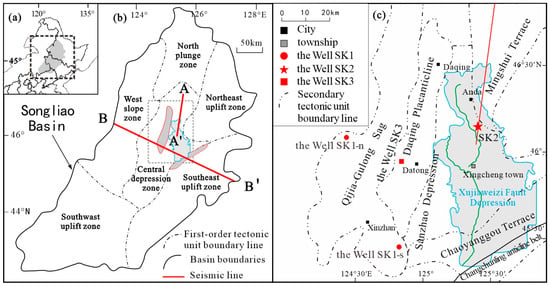
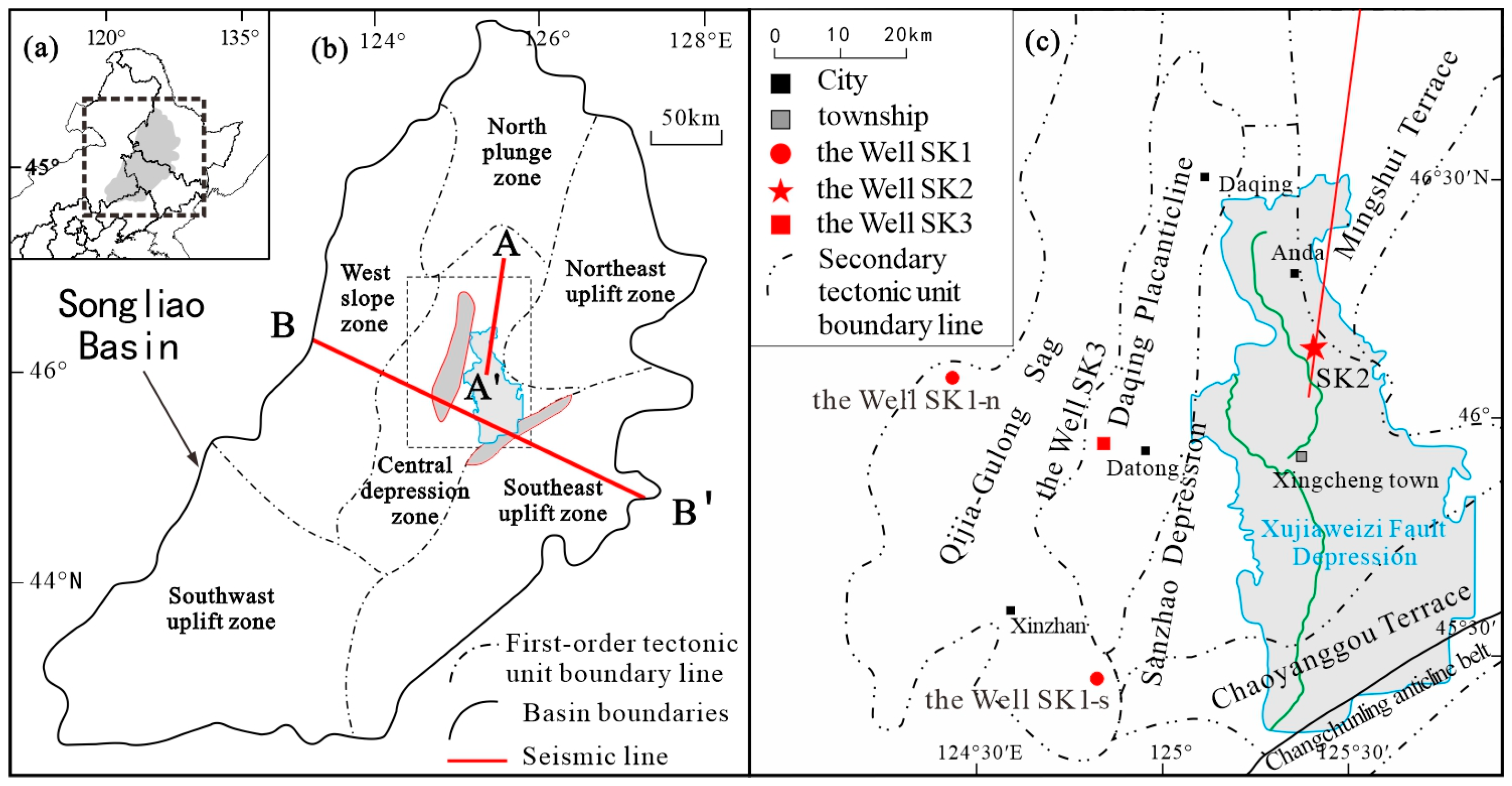
The Songliao Basin, located in northeastern China (Figure 1), is one of the world’s richest Mesozoic onshore oil and gas basins, contributing significantly to China’s petroleum industry. With over half a century of exploration, it hosts substantial oil reserves, including the Daqing Oil Field, which has proven reserves of 6370 million tons, with a proven reserve ratio of 62.3% [1]. The basin is strategically important, offering both sandstone reservoirs and abundant hydrocarbon resources that continue to play a crucial role in China’s energy sector [2]. There are also notable unconventional natural gas reservoirs. The Xujiaweizi Fault Depression, located in the northern part of the basin, is a pivotal region for achieving breakthroughs in deep natural gas exploration. In this fault depression, the stratigraphic sequence from bottom to top includes the Huoshiling Formation, the Shahezi Formation, and the Yingcheng Formation. It is noteworthy that the Shahezi Formation is the main source layer for hydrocarbon-source rocks in this sequence. It is characterized by a high organic matter content, wide spatial distribution, and a long-term hydrocarbon-generation process, thus providing a crucial material basis for the accumulation of deep natural gas [3].
Figure 1.
(a) Position of Songliao Basin; (b) the distribution of Xujiaweizi Fault Depression; (c) borehole distribution of deep continental scientific drilling project in Songliao Basin (modified after [3]). The green solid line represents the Xuxi Fault.
Previous research has systematically assessed the deep hydrocarbon-source rocks in the Xujiaweizi Fault Depression. The results indicate that these rocks are notably thick, rich in organic matter, predominantly composed of type II kerogen, and generally in the range of high to over-maturity. The estimated total natural gas generation in the deep layers of the Xujiaweizi Fault Depression amounts to 33.75 × 10¹² m3. The gas content of the hydrocarbon-source rocks from the Shahezi Formation accounts for 75.78% of the total gas volume, and the gas content of the coal-bearing system constitutes 25.61% of the total gas volume from the deep-layer hydrocarbon-source rocks [4]. The deep natural gas discovered in this region primarily originates from the dark mudstones of the Shahezi Formation to the Yingcheng Formation [5]. The organic carbon content in the source rocks of the Shahezi and Yingcheng Formations in the Xujiaweizi area is relatively high, approaching the threshold for good source rocks. The organic matter is primarily of Type III, which suggests a relatively high oil generation potential. The gas reservoirs in the Shahezi Formation are all characterized by a source–reservoir coexistence model, with two types identified: rock-type and structural-type reservoirs. The favorable depositional facies in the gentle and steep slopes control the distribution of these reservoirs. Moreover, the gravel reservoir exhibits low maturity and high densification. The reservoir primarily consists of secondary porosity, which usually contains gas. The tight conglomerate gas within the Shahezi Formation represents the most promising strategic new exploration area [6].
Nonetheless, previous studies have predominantly concentrated on the geochemical evaluation of source rocks and the analysis of hydrocarbon-accumulation conditions. Systematic research on the Shahezi Formation itself remains relatively scarce. Specifically, there is a dearth of high-precision sequence-stratigraphic division based on continuous and complete core data, reconstruction of sedimentary evolution processes, and correlation analysis between these characteristics and global Early Cretaceous events. This situation has constrained the in-depth understanding of the distribution patterns of good source rocks, the development mechanisms of effective reservoirs, and the key factors influencing natural gas accumulation in this area.
To acquire continuous, high-resolution continental sedimentary records and identify key play fairway elements for deep-energy resources, the deep continental scientific drilling project in the Songliao Basin has planned and implemented Well SK2. This project also aims to explore the genetic mechanisms of the Daqing Oilfield and enrich the theory of continental hydrocarbon generation. Well SK2 is located in the Songzhan area, where the lacustrine mudstones of the Shahezi Formation are extensively developed in the Xujiaweizi Fault Depression [7]. Cores spanning from the Lower Cretaceous to the Carboniferous and Permian periods in the Songliao Basin were sequentially retrieved from a depth of 2843 m. This drilling operation represents the deepest continental scientific drilling well conducted by an Asian country to date and is also the world’s first scientific drilling well penetrating the terrestrial strata of the Cretaceous Period [8]. The drilling project of Well SK2 obtained the most complete fracture-layer core and successfully acquired more than 2600 m of stratigraphic core and logging data of the Shahezi Formation in the Xujiaweizi Fault Depression, providing suitable data for the study of the Shahezi Formation stratigraphy in the Songliao Basin.
2. Geological and Structural Framework
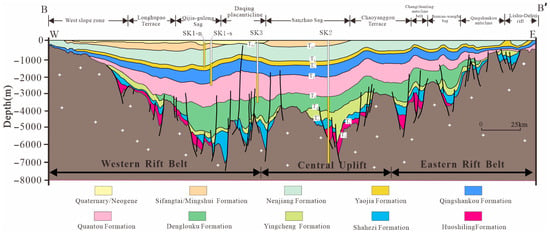
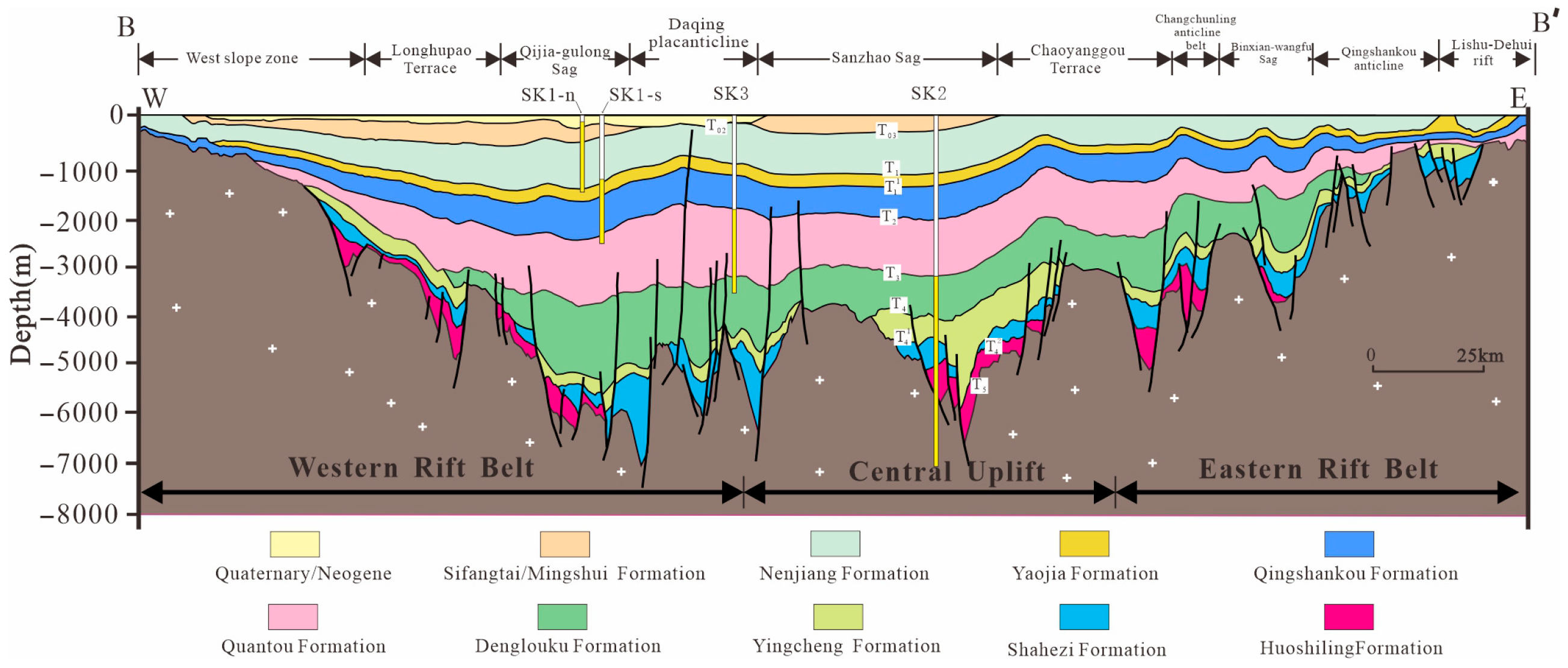
The Songliao Basin represents a typical large-scale Meso-Cenozoic continental rift basin [9,10]. It is acknowledged as a Cretaceous continental hydrocarbon-bearing sedimentary basin in eastern China, stretching in a north–northeast direction with a rhombic configuration (Figure 1). The Songliao Basin is developed upon the Paleozoic–Proterozoic basement within the continental interior, situated at the rear of the Mesozoic volcanic belt. It belongs to the back-arc rift basin [11] and has experienced four stages of tectonic evolution, namely mantle upwelling, rifting, post-rift thermal subsidence, and structural reversal [12]. The Songliao Basin features a typical fault-fold dual structure. It underwent early extensional rifting, mid-stage overall subsidence, and late-stage folding, successively developing three sets of structural layers: the lower rift layer, the middle fault layer, and the upper structural inversion layer [13] (Figure 2).
Figure 2.
Schematic tectonic cross-section based on regional seismic data (B–B’) across the central Songliao Basin (modified after [2]).
The Xujiaweizi Fault Depression is situated in the central depression zone of the Songliao Basin (Figure 1). Having formed from the Late Jurassic to the Early Cretaceous, it represents a crucial deep-seated fault-depression tectonic unit within the basin. Its structural framework is typified by a precipitous western margin, a gentle eastern margin, a north–south zonal arrangement, and the alternation of sags and uplifts. Generally, it assumes a nearly north–south trending half-graben structure. It can be further classified into secondary tectonic units such as sags, uplifts, and slopes [14].
The formation and evolution of this fault depression are mainly controlled by the intensity of faulting and subsidence processes and can be divided into three tectonic stages, namely the initial faulting stage, the intense faulting stage, and the fault depression attenuation stage, which respectively correspond to the sedimentary stages of the Huoshiling Formation, the Shahezi Formation, and the Yingcheng Formation [15]. Among these, the Xuxi Fault, as the major boundary fault controlling the Xujiaweizi Fault Depression, exercises significant control over its sedimentary framework. During the deposition of the Huoshiling Formation, this fault presented as a segmented, small-scale fault system [16]. By the early sedimentary stage of the Shahezi Formation, it had evolved into a northeast-trending fault and further developed into a large-scale extensional fault extending in a nearly north–south direction in the middle to late stages, dominating the extensional deformation of the fault depression during this period [17].
In the subsidence phase of the Shahezi Formation, the Xujiaweizi Fault Depression was in an extensional tectonic regime. Volcanic activity was relatively subdued, and the distribution of volcanic rocks was restricted. Sedimentation was primarily characterized by clastic rocks. Multiple strata of black mudstone intercalated with thin coal seams are developed within this formation, suggesting a predominantly reducing sedimentary milieu. This is a crucial factor that renders the Shahezi Formation a potential deep-seated source rock sequence in the Songliao Basin. Moreover, the mudstone content of this formation increases gradually from the bottom upwards, indicating a continuous deepening of the sedimentary water body and a gradual stabilization of the sedimentary environment, which offered conducive conditions for the formation of high-quality source rocks.
3. Methods
The field acquisition of deep seismic reflection profile data was completed in November 2016, using a linear construction method, with a total coverage length of 100 km. The survey line starts from Qinggang County in Heilongjiang Province, passes through Anda City, goes south to Zhaodong County, ultimately crossing the Songliao Basin, and passes through the location of the Continental Scientific Drilling ‘SK2 Well’ (as shown in Figure 1).
The normal shot spacing was set at 200 m, with increased density of shot points in key areas to improve the coverage frequency. To obtain imaging data from different depths of the crust, three different shot weights were used for stimulation: small shots (20 kg), medium shots (72 kg), and large shots (480 kg). In terms of the receiving system, a long-line array was employed. For small and medium shots, 800 receiving channels were placed on each side, with a channel spacing of 50 m. In the vicinity of Well SK2, the receiving channels were densified with a channel spacing of 25 m. For large shots, at least 1000 receiving channels were used on each side.
Data processing was carried out with the goal of highlighting deep reflections while ensuring effective reflections from shallow and middle layers. Based on the characteristics of the data, a high-fidelity, high-amplitude processing flow was adopted, with reasonable parameter selection. The combination static correction method was employed to address the static correction issues along the survey line. Pre-stack multi-domain combination denoising technology was used for noise suppression, while predictive deconvolution was applied to remove multiple reflections. On this basis, high-precision velocity analysis and residual static correction were iteratively applied to resolve residual static correction problems. A high-precision well-to-seismic calibration and time–depth conversion were conducted using the well log data from Well SK2, resulting in an accurate depth-domain profile.
4. Results and Interpretation
4.1. Geophysical Response Characteristics
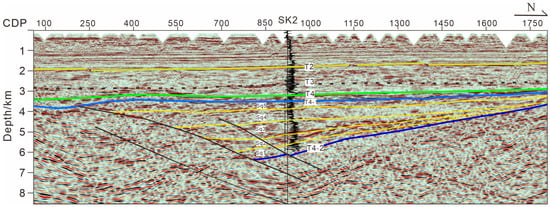
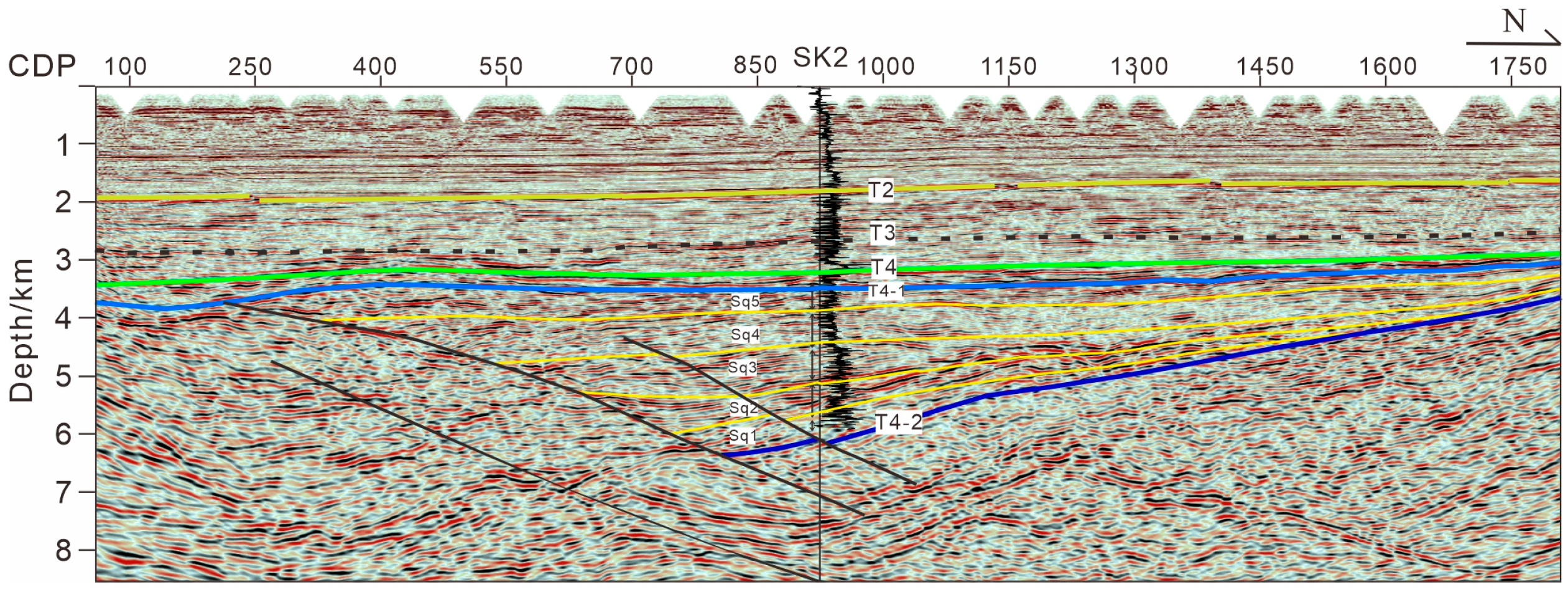
The top interface of the Shahezi Formation is presented as the T4-1 reflection layer on the seismic section (Figure 3). This reflection layer demonstrates more distinct paraconformity across the central area of the region, which exhibits a typical divergent seismic facies. The upper seismic facies of the Shahezi Formation is distinguished by low-to-medium-frequency parallel or sub-parallel reflections. The sedimentary strata of the Shahezi Formation mainly consist of thin interbeds of sandstone and mudstone with minimal impedance contrast, resulting in overall weak reflections with intermittent reflection axes. The lower part of the Shahezi Formation has a relatively limited depositional range, and the seismic reflection homoclinic axis mostly displays onlap upward characteristics. The bottom interface of the Shahezi Formation is a strong reflection layer T4-2, showing good continuity on one side, high-frequency strong amplitudes, representing a basin-source unconformity [18], and reaching a depth of 5960.0 m at Well SK2. Well SK2 penetrated the lower section of the Shahezi Formation, which is identified as Triassic basement rather than Huoshiling Formation strata [19].
Figure 3.
The depth-domain seismic reflection section of the Shahezi Formation, as revealed by Well SK2 (with a core depth ranging from 3335.99 m to 5960.00 m, corresponding to the AA’ encrypted section in Figure 1b), shows the following characteristics: The dark-yellow solid line represents the stratigraphic interface T2 between the Quantou Formation and the Qingshankou Formation; the black dashed line represents the stratigraphic interface T3 between the Dengloukou Formation and the Quantou Formation; the green line denotes the interface T4 between the Yingcheng Formation and the Dengloukou Formation. The blue solid lines signify the top and bottom interfaces of the Shahezi Formation (T4-1 and T4-2), and the black solid lines represent faults.
The latest data from Well SK2 reveals that the thickness of the Shahezi Formation is 2624.01 m (from a core depth of 3335.99 m to 5960.00 m), and the total thickness of dark mudstone encountered during drilling is 1359.37 m, with the maximum thickness of a single layer reaching 23.21 m. The grain size of this formation gradually coarsens from top to bottom, exhibiting an overall normal cycle characteristic: the upper part is dominated by gray-black and dark-gray shale, which is distributed in layers with large sedimentary thickness, high argillaceous content, fine grain size, high organic matter abundance, and good hydrocarbon-generating quality, thus having significant potential for deep-seated hydrocarbon accumulation; the lower section is composed of alternating layers of variegated argillaceous siltstone, fine sandstone, coarse sandstone, and shale, showing peak-shaped or finger-shaped natural gamma curves. Although it has a coarse sedimentary grain size and low organic matter content, it contains several types of tight gas-bearing reservoirs. The source rocks within it have a relatively high total organic carbon (TOC) content.
In the adjacent area of Well SK2, the Q value of the Shahezi Formation is considerably smaller than that of the surrounding rocks, with the dominant frequency decreasing rapidly. This indicates that the gas-bearing intervals exhibit strong absorption and attenuation characteristics of seismic wave energy [20]. The Q value results for the Shahezi Formation are based on previously published data from our research group (e.g., [20]), which show similar attenuation behavior and support the interpretation of gas-bearing reservoir properties in this region. The gas logging anomaly data also align with these findings, further confirming the gas-bearing characteristics of the formation. The shale and sandstone reservoirs within this formation have a favorable source–reservoir configuration, making it a promising target interval for the exploration of deep shale gas and tight sandstone gas.
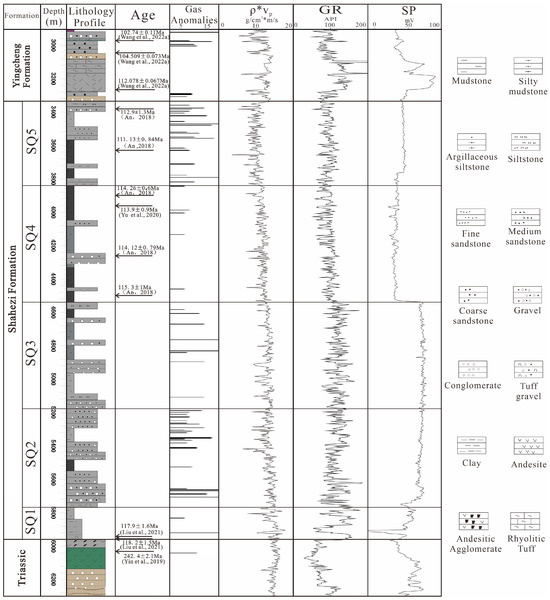
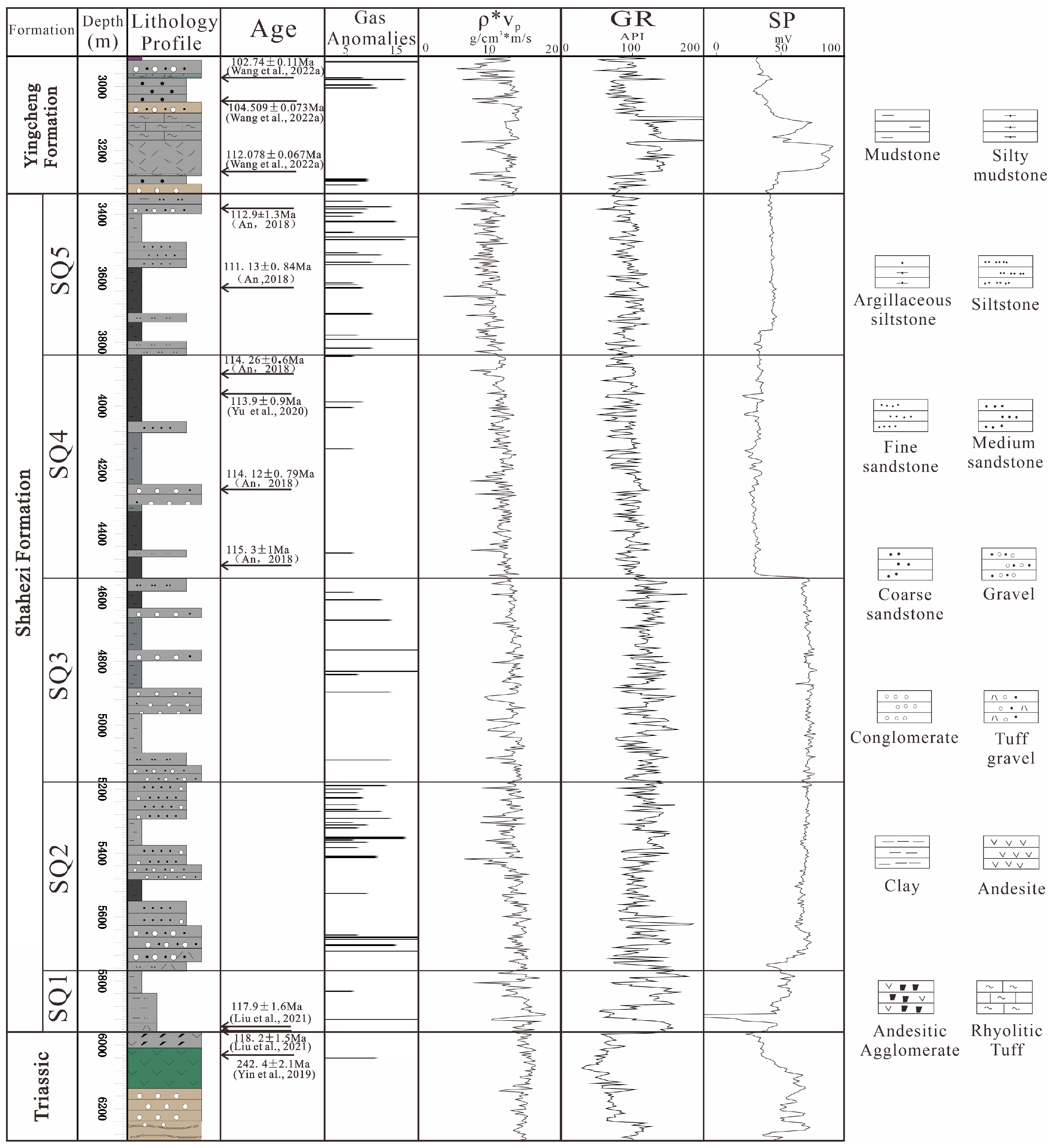
On the basis of previous studies [21,22,23,24,25], the stratigraphy of the Shahezi Formation is further divided into five third-order sequences according to the new information (Figure 4).
Figure 4.
Stratigraphy and logging response of the Shahezi Formation in Well SK2, China (ρ × Vp represents wave impedance; GR represents natural gamma-ray log; SP represents spontaneous-potential log) [19,26,27,28,29].
SQ1 sequence (5768~5960 m): the Xujiaweizi Fault Depression entered into a period of intense faulting, with the main controlling Xuxi Fracture trending nearly north–south, and the distribution of the fracture area is narrow. There are very few gas anomalies, and the logging curves all show large variance, representing a turbulent depositional environment during this period.
SQ2 sequence (5178–5768 m): This period belongs to the early sedimentation of the Xujiaweizi fault depression, with a slightly expanded basin range, marked by the development of fan deltas and shallow lacustrine sediments. The lithology is mainly sandy conglomerate. The proportion of mudstone is more than 40%. On the seismic profile, it exhibits a good continuity of strong reflectors along the facies axis, with relatively clear gas anomalies detected, identifying 30 layers of gas anomaly zones with a cumulative thickness of 73 m, showing promising oil and gas prospects.
SQ3 sequence (4528–5178 m): The seismic profile exhibits a robust reflection along the same axis, featuring a distinct top interface and feeble reflection attributes within the sequence. The spontaneous potential value experiences a mutation to a high value at the top interface of the sequence. There are fewer gas anomalies within the layer (Figure 4).
SQ4 sequence (3840–4528 m): During the sedimentation phase of SQ4, the scope of the basin further expanded, still primarily characterized by fan-delta facies, with lacustrine facies discontinuously distributed within deep fault zones [25]. The spontaneous potential values at the bottom interface of SQ4 are significantly smaller than those of the underlying SQ3 sequence.
SQ5 sequence (3335.99–3840 m): This period pertains to the late stage of the Xujiaweizi Fault Depression. It is distinguished by a contracting basin range and shallower water bodies. Lithologically, it undergoes a transition from the clastic sedimentary rocks of the Shahezi Formation to the volcanic rocks of the Yingcheng Formation. This sequence displays strong reflection characteristics in seismic profiles. This sequence is predominantly composed of mudstone, accounting for 59% of the thickness, with well-developed sandstone and the top consisting of siltstone and sandstone conglomerates. Gas anomalies are prominent, with 35 gas anomaly layers detected in the well, totaling 79 m in thickness, indicating favorable oil and gas prospects in this interval. The electrical characteristics reveal that the spontaneous potential curves transition from low to medium–high amplitudes upwards.
4.2. Resource Potential
The composition of the Shahezi Formation reservoir is predominantly made up of feldspar lithic sandstone and lithic feldspar sandstone. Nevertheless, differences are discerned among different blocks. Generally, the reservoir’s physical properties are poor, with extremely low porosity and permeability. This type of reservoir is defined by its poor physical properties [30].
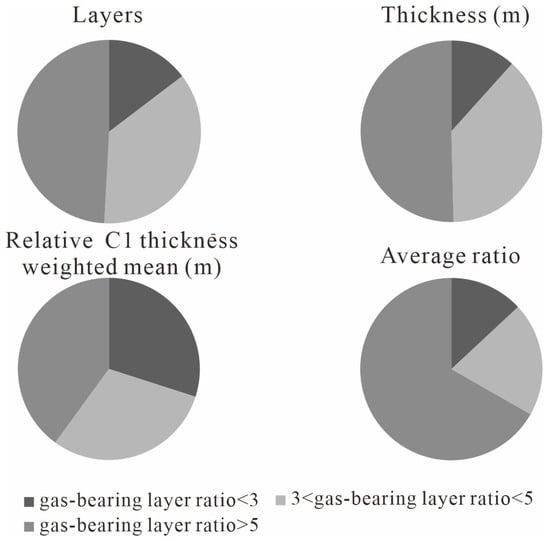
Gas logging data from Well SK2 indicated the existence of numerous gas anomaly layers within the deep Shahezi Formation, with an average gas anomaly ratio of 8.20. A total of 116 gas anomaly layers were identified, with an aggregate thickness of 266 m. Among them, 57 layers had a gas anomaly ratio exceeding 5. The gas anomalies were primarily concentrated in the upper section of the formation.
Based on [31], three-dimensional CT imaging of cores from the Shahezi Formation revealed high porosity and strong connectivity. The results suggested the presence of regions with high permeability, significant gas anomalies, and favorable conditions for shale gas exploration. The analysis of light hydrocarbon components through continuous sampling at Well SK2 demonstrated distinct vertical distribution patterns with clear segmentation.
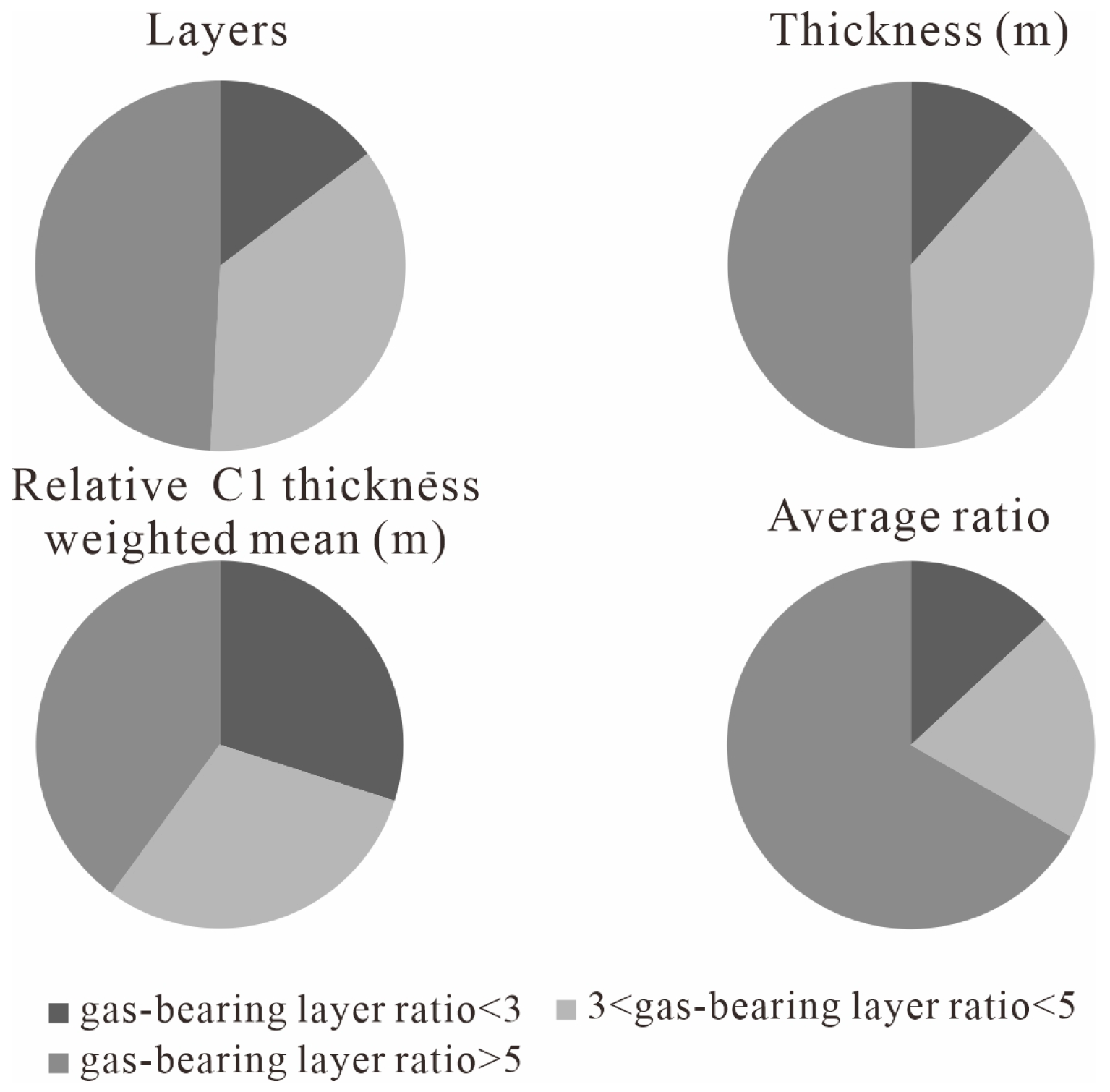
Recent re-evaluations of the upper section (3400–3800 m) of the Shahezi Formation at Well SK2 revealed the presence of highly mature hydrocarbon-source rocks. These rocks were found to be rich in Type III kerogen, rendering them suitable for dry gas extraction. The source rocks have considerable thickness and have transitioned from the high-maturity stage to the over-maturity stage. The gas distribution is uneven, with scattered peaks throughout, and the methane content typically exceeds 90%, indicating favorable gas-bearing characteristics. An analysis of the gas anomalies in the upper section revealed 25 gas anomaly layers, with a total thickness of 56 m. These layers’ average gas anomaly ratio exceeds the mean ratio of the formation (Figure 5). The interbedding of sandstone and mudstone has the potential to generate various forms of unconventional natural gas, making it a crucial area for future exploration.
Figure 5.
Statistical analysis of abnormal gas ratios in the Shahei Group of Well SK2.
The gas anomalies are primarily concentrated at the top of the Shahezi Formation (3800–4500 m), where higher methane concentrations are observed at both the top (3340–4500 m) and bottom (5600–5910 m) of the formation. This corresponds to the dispersed distribution of gas reservoir peaks. Due to the heterogeneity of the reservoir, the accumulation of tight gas exhibits significant non-homogeneity, which aligns with the uneven distribution of gas anomalies. Geochemical data indicate that the primary gas source of the Shahezi Formation is coal-derived gas, with two distinct accumulation periods identified during the Nenjiang and Qingshankou epochs [32]. The accumulation of tight gas follows a continuous source–reservoir model, characterized by dense reservoirs with low permeability and porosity. The source–reservoir configuration is vertically stacked, similar to the tight gas reservoirs of the Paleozoic in the Ordos Basin.
4.3. Chronostratigraphy and Synchronous Events of the Early Cretaceous
The Songliao Basin represents the largest and longest-evolving rift basin in Northeast Asia, having preserved nearly continuous continental evolution throughout the majority of the Cretaceous period. Reliable age constraints serve as a prerequisite for investigating the correlation between the structural events in the Songliao Basin and the global events of that period.
Previous research has involved numerous geochronological investigations of the Shahezi Formation in the Songliao Basin. Wang et al. [26] obtained high-precision U-Pb zircon ages of 102.74 ± 0.11 Myr, 104.509 ± 0.073 Myr, and 112.078 ± 0.067 Myr for tuffaceous samples at depths of 2972.28 m, 3044.83 m, and 3266.6 m, respectively, in Well SK2. An et al. [27] determined the U-Pb ages of sandstones at depths of 3383.96 m, 3624.69 m, 3902.15 m, 4263.74 m, and 4491.55 m in Well SK2 to be approximately 112.9 ± 1.3 Myr, 111.13 ± 0.84 Myr, 114.26 ± 0.6 Myr, 114.12 ± 0.79 Myr, and 115.3 ± 1 Myr, suggesting a sedimentation age of about 118–111 Myr for the Shahezi Formation. SIM U-Pb ages of 113.9 ± 0.9/1.5 Myr were acquired from tuffaceous layers at 3961 m in Well SK2 [28]. Employing various zircon dating methods, Huang et al. [33] determined an age of 113.8 ± 1.5 Myr for the base of the Yingcheng Formation. Liu et al. [29] discovered a 6 mm thick tuff layer at a depth of 5958.62 m, with a 206Pb/238U age of 118.2 ± 1.5 Myr. Yin et al. obtained a weighted average age of 242.4 ± 2.1 Ma from seven zircons in andesite at 6031.9 m, confirming that the volcanic–sedimentary strata underlying the Shahezi Formation in Well SK2 were deposited during the Triassic, with no absence of Jurassic strata [19]. The tuff layer near the top boundary of the Shahezi Formation in Well SK2 has an age of 112.078 ± 0.067 Myr [26], while the bottom tuff layer has an age of 118.2 ± 1.5 Myr [19], constraining the age of the Shahezi Formation to approximately 118–112 Myr, related to the mid-Aptian to early Albian stages. Existing geochemical data show that the average vitrinite reflectance (Ro) at the bottom and top of the Shahezi Formation is 2.40% and 1.82%, and Tmax is 532 °C and 457 °C, respectively, suggesting that the source rocks are generally mature. The average total organic carbon (TOC) content is 4.03% and 48.86%, indicating medium- to high-quality source rocks [34]. The mudstones of the Shahezi Formation are rich in organic matter, mainly of Type II kerogen, while the coals have relatively high organic matter and belong to Type III kerogen. This period is a crucial oil and gas generation period for the fault-depression layers in the Songliao Basin, mainly composed of dark shale, variegated mudstone, siltstone, and sandstone.
To better illustrate the coupling relationship between marine and terrestrial records of key Early Cretaceous geological events, we summarize records from several typical global basins (Table 1). The construction of this table follows these principles: (1) Typicality of events: The selected events represent major global or regional geological events during the Early Cretaceous (e.g., OAE1a, Oceanic Red Beds, high-latitude glaciation); (2) Representativeness of records: The selected basins (e.g., Songliao Basin, Brazilian marginal basins, Italian Umbria–Marche Basin) are internationally well-studied, with their marine/terrestrial records effectively responding to the aforementioned events; (3) Literature support: Each record is accompanied by authoritative references to ensure data reliability.
The Cretaceous era is characterized by a distinctive greenhouse climate [35,36]. This climate led to a sequence of major geological events, including oceanic anoxic events, marine red beds [37], and large-scale volcanic activities [38], all of which have been comprehensively documented and preserved in both marine and terrestrial stratigraphy. During the Aptian–Albian, the ancient oceans of the Cretaceous period experienced oceanic anoxic events (OAEs), specifically identified as OAE1, which can be further classified into OAE1a, 1b, 1c, and 1d intervals, with OAE1a exerting a global influence. These Cretaceous OAEs signify profound paleoenvironmental and paleoclimatic changes, recorded in widespread deposits of organic-rich black shales, which serve as indicators of global warming periods [39]. Notably, black shales with high total organic carbon (TOC) content and extensive distribution have been identified at Shatsky Rise in the northern Pacific Ocean [40]. OAE1a likely represents a crucial paleoceanic productivity event, marking the onset of the Cretaceous greenhouse climate, characterized by complex and multifaceted developmental processes. Some scholars propose a connection between the emergence and evolution of OAE1a and the eruption of the Ontong–Java Pacific superplume [41], which is consistent with the abundance of organic-rich black shales in the lower strata of the Shahezi Formation.
Table 1.
Marine and terrestrial records of several typical Early Cretaceous global events.
The characteristics of Oceanic Anoxic Event 1b (OAE1b) include organic carbon enrichment and negative carbon isotope values [51,52,53]. The extensive deposition of multiple black shale layers during OAE1b is predominantly confined to Mexico, the North Atlantic, and the Mediterranean regions [54,55]. The primary climatic characteristics of this period are cooling and a sea-level fall near the end of the Aptian, succeeded by a sea-level rise in the early Albian [56]. The deposition of organic carbon continued to augment during the mid-Aptian, in accordance with the rising sea levels. This organic carbon burial offers potential for deep-seated resources. Isotopic geochemical analysis was conducted on the core samples from the 4514–4559 m layer of Well SK2 (upper Shahezi Formation). This interval contains silty mudstone, muddy siltstone, siltstone, fine sandstone, medium sandstone, and coarse sandstone. The resulting δ13Corg values show little variation and are relatively stable, ranging from −24.51‰ to −25.79‰, with an average of −25.36‰. The δ15N values range from −0.56‰ to 4.22‰, with an average of 2.33‰. The three significant negative excursions of δ13Corg in the upper Shahezi Formation may correspond to sub-events of OAE1b [57], with analogous carbon isotope shifts in the middle and lower sections associated with climate change [58]. The appearance of Australian glendonites during the Aptian and the transition period between the Aptian and Albian and the presence of low temperatures provide evidence for high-latitude glaciation [50]. The occurrence of the OAE1b event is likely closely associated with climate change, productivity, and sea-level fluctuations [59].
In the mid-Cretaceous (Aptian–Cenomanian) black shales of the Umbria–Marche Basin in Italy, eight sets of red sediments of varying thicknesses have been discovered, indicating the periodic development of seafloor oxygenation conditions [47]. These geological events have mostly been identified through in-depth investigations of marine sediments, while research on their geological responses on land has recently drawn extensive scholarly attention. The widespread distribution of gypsum salt rocks and black shales in the Cretaceous strata of eastern China may be influenced by the terrestrial greenhouse climate of the Cretaceous period, such as the dark shales of the Shahezi Formation in the Songliao Basin and early Cretaceous lacustrine salinization in some parts of eastern China. The sedimentation of the Fajiaying Formation in the Lower Cretaceous Leiyang Group on Lingshan Island occurred in a terrestrial salt lake environment and was accompanied by the development of abundant black shales. During its deposition, two anoxic events, OAE1a and OAE1b, occurred successively, with Zhang [45] suggesting a possible correlation between the salinization of the Fajiaying Formation sedimentary water body and marine anoxic events. The Songliao Basin deposited organic-rich carbon sediments during marine anoxic periods. The organic-rich sedimentation in the basin occurred during periods of rising water levels and saline water intrusion [60]. The Barreirinhas, Ceará, and Potiguar basins, located on the edge of the equatorial region of Brazil, represent Barremian–Lower Aptian rift sedimentary sequences with freshwater terrestrial and lacustrine deposits [42]. The post-rift sequences consist of marine and transitional strata, possibly indicating the initiation of continental rifting and marine flooding [42]. Within this sequence, salt and shallow marine facies exceeding 100 m have been found, and transitional deposits record the late Aptian marine incursion into the continental crust [48]. This sequence has been recognized as a component of the post-rift phase in basin tectonic evolution [61]. In the Ceará and Potiguar basins, the Upper Aptian–Lower Aptian interval is characterized by a shift from terrestrial to marginal marine deposits with regional lateral continuity, representing marine incursions [48].
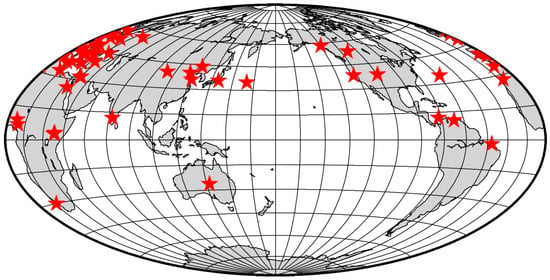
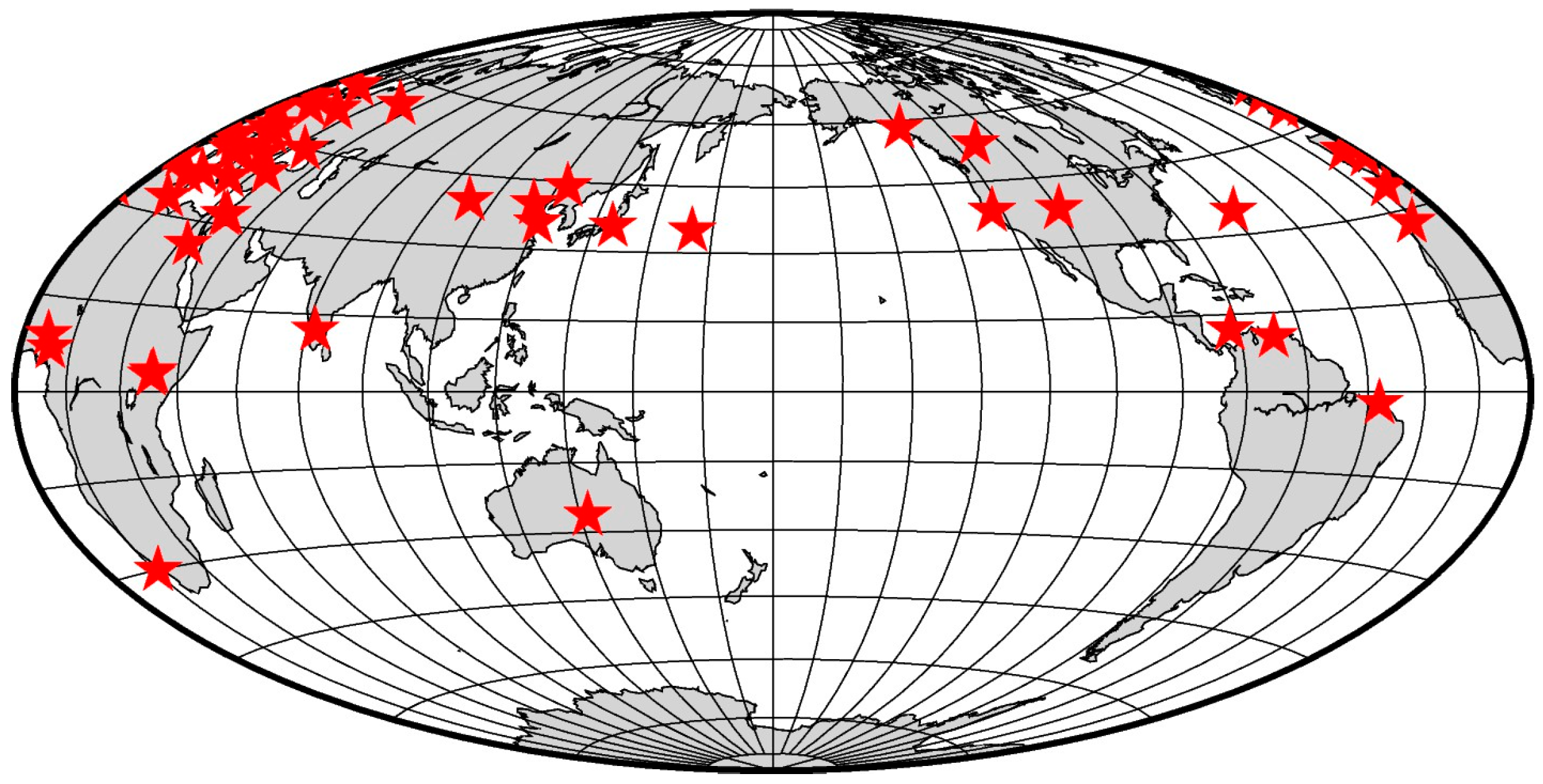
The Shahezi Formation in the Songliao Basin captures the terrestrial response to a global event during the mid-Cretaceous period [62,63,64]. Ocean anoxic events typically correspond to the rapid production of organic matter and massive burial of organic matter in a short period [59]. During the Cretaceous period, the global temperature increase promoted continental water circulation, enhanced nutrient transport, elevated biological productivity, and increased concentrations of carbon dioxide and volcanic activity, which intensified the release and deposition of nutrients. Throughout the deposition of the Shahezi Formation, the organic material primarily originated from lake algae and aquatic plants, with some terrestrial organic matter [65]. Changes in paleoclimate and sedimentary environments exert a significant influence on the preservation of organic matter. Additionally, the accumulation of organic matter consumes CO2 and counteracts the greenhouse effect. Various factors, such as unique geographical location and development period, jointly contribute to the significant resource enrichment potential of the Shahezi Formation in the Xujiaweizi Fault Depression. Figure 6 illustrates the locations of typical events during the Cretaceous period, providing a visual representation of these significant occurrences.
Figure 6.
Distribution of typical marine and terrestrial records of Early Cretaceous global events ([66,67] and references therein; shoreline data were derived from The Generic Mapping Tools version 6 [68]).
5. Discussion
The exploration of deep natural gas resources in the Songliao Basin has long been a focal point in the national energy strategy. This research, relying on the recent well-logging data obtained from Well SK2, verifies that the upper sections of the Shahezi Formation exhibit favorable geological conditions for the development of large-scale natural gas reservoirs. When combined with the previously published data concerning hydrocarbon-source rock quality and reservoir properties [5], the direct evidence from Well SK2 further strengthens this understanding.
Notably, the gas-logging anomalies identified in this study have a cumulative thickness of 266 m. Among them, 57 intervals display anomaly ratios exceeding 5, and these anomalies are predominantly concentrated in the upper section. This discovery is consistent with the strong absorption and attenuation characteristics indicated by geophysical data [21], suggesting that these intervals are not only hydrocarbon-generating beds but also potential reservoirs enriched with free or adsorbed natural gas.
The “sandwich-style” source–reservoir interbedded structure developed within the Shahezi Formation, characterized by the alternation of thick mudstones, sandstones, and glutenites, creates unique geological conditions for the coexistence of multiple unconventional natural gas types, including shale gas and tight sandstone gas [7,27]. Therefore, the Shahezi Formation in the Xujiaweizi Fault Depression should be regarded as a composite gas-bearing system with promising prospects for three-dimensional exploration, rather than a single hydrocarbon-source rock interval.
The correlation between the sediments of the Shahezi Formation and global events (such as OAE1b) is not merely a chronological coincidence but is based on a series of multiple lines of evidence. Various dating methods restrict the age of the main sedimentary sequence of the Shahezi Formation to the middle Aptian–early Albian (~118–112 Ma) [30,31,33], which coincides with the core period of the global OAE1b event [53]. OAE1b is marked by the widespread accumulation of organic-rich black shale in marine environments [44]. The lower and middle parts of the Shahezi Formation also feature dark mudstones with a total thickness exceeding one kilometer and high organic carbon content in the Songliao Basin. Sedimentological data from Well SK2 imply that the lake basin during this period was in an anoxic, reducing environment, which was conducive to organic matter preservation. Previous studies have identified three significant negative δ13Corg excursions in the upper section of the Shahezi Formation [58], which can be compared to the global carbon isotope negative excursions caused by carbon cycle perturbations during OAE1b [52].
The Early Cretaceous was a typical greenhouse climate period, characterized by high global temperatures, high sea levels, and high atmospheric CO2 concentrations [36]. In this climatic context, an enhanced hydrological cycle likely transported more nutrients into inland lake basins, which may have significantly increased the primary productivity of these lakes. Additionally, large igneous province activities, potentially associated with OAE events (such as the Ontong Java Plateau), could have released CO2 and nutrients that indirectly influenced terrestrial ecosystems through atmospheric and oceanic circulation [42,61]. Therefore, the development of organic-rich layers in the Shahezi Formation is likely a regional response to global greenhouse climate and carbon cycle perturbation events within the large inland lake basins of East Asia. This insight elevates the study of terrestrial hydrocarbon-source rocks from the analysis of local basins to a broader framework of global paleoenvironmental changes, providing a new perspective on the “right time and place” for the formation of high-quality source rocks in large terrestrial oil and gas basins. This conclusion suggests that, during specific global climate window periods (such as the Cretaceous greenhouse period), large, stable inland lake basins may have played a vital role in global carbon burial and hydrocarbon generation.
6. Conclusions
- The Shahezi Formation primarily consists of thick-bedded sandstone, conglomerate, sandstone–mudstone interbeds, and mudstone, with a relatively small proportion of volcanic rocks. Distinct boundaries between the upper and lower sections of the stratigraphic layers can be discerned in seismic profiles and well-logging curves. Based on previous studies, the age of the Shahezi Formation is estimated to range from 112 Ma to 118 Ma, rendering it a crucial period for hydrocarbon generation in the Songliao Basin rift.
- The Shahezi Formation is subdivided into five third-order sequences. Among them, the SQ5 sequence (3335.99–3840 m) has a relatively high proportion of mudstone thickness, and a significant number of gas anomalies have been detected within this sequence. SQ5 represents the most favorable section for oil and gas storage in the Shahezi Formation. In the vicinity of Well SK2, obvious gas anomalies are observed in the Shahezi Formation, with these anomalies concentrated in the upper part, suggesting deep-seated enrichment potential. The lower Shahezi Formation has developed sandstone reservoirs, and the SQ2 sequence (5178–5768 m) also holds certain potential for deep-seated gas exploration.
- The organic matter in the hydrocarbon-source rocks of the Shahezi Formation possesses good hydrocarbon-generating potential, with shale intervals containing high-quality oil and gas. The sediment thickness is considerable, and the stratigraphic continuity is excellent. The shale and sandstone reservoirs show a favorable source–reservoir relationship, positioning them as promising prospects for the accumulation of deep-seated shale gas and tight sandstone gas. This is anticipated to offer a fresh viewpoint for energy exploration in the deep Songliao Basin.
- Global anoxic events are linked to the significant burial of organic carbon, aligning with the widespread occurrence of organic-rich black mudstones in the lower Shahezi Formation. The terrestrial deposits in the Songliao Basin of China display similar geological responses to global events during the mid-Cretaceous period, offering a new perspective for global sea-land stratigraphic correlation.
Author Contributions
Conceptualization, H.H.; methodology, H.H. and W.F.; software, W.F.; validation, Y.Z., J.Z. and F.M.; formal analysis, Y.G., D.A. and Y.Z.; investigation, J.Z., D.A. and Y.G.; resources, H.H., Y.G. and F.M.; data curation, H.H., D.A. and Y.G.; writing—original draft preparation, Y.Z.; writing—review and editing, H.H. and W.F.; visualization, Y.Z., W.F. and F.M.; supervision, H.H., Y.G. and F.M.; project administration, H.H.; funding acquisition, H.H. All authors have read and agreed to the published version of the manuscript.
Funding
This study was supported by the Deep Earth Probe and Mineral Resources Exploration-National Science and Technology Major Project (No. 2024ZD1000100), the National Natural Science Foundation of China (No. 42430305 and 42230303), and the Geological Survey Projects (Grant No. DD20190010).
Data Availability Statement
The raw data supporting the conclusions of this article will be made available by the authors upon request.
Acknowledgments
The authors used Generic Mapping Tools [68] to generate the figures.
Conflicts of Interest
The authors declare no conflicts of interest.
References
- Yang, W.L. Daqing Oil Field, People’s Republic of China; a Giant Field with oil of Nonmarine Origin. AAPG Bull. 1985, 69, 1101–1111. [Google Scholar] [CrossRef] [Scilit]
- Feng, Z.Q.; Jia, C.Z.; Xie, X.N.; Zhang, S.; Feng, Z.H.; Cross, T.A. Tectonostratigraphic Units and Stratigraphic Sequences of the Nonmarine Songliao Basin, Northeast China. Basin Res. 2010, 22, 79–95. [Google Scholar] [CrossRef] [Scilit]
- Dong, T.; Gao, Y.; Huang, H.; Tian, X.; Yang, Q.; Li, Y.Y.; Niu, L.; Cao, Y.Q. Mineralogical Evolution of the Cretaceous Strata in the Songliao Basin, Northeastern China: Implications for Thermal History and Paleoenvironmental Evolution. Minerals 2021, 11, 1101. [Google Scholar] [CrossRef] [Scilit]
- Wang, M.; Sun, Y.F.; Wang, W.G.; Wang, Y.; Shi, L. Gas Generation Characteristics and Resource Potential of the Deep Source Rock in Xujiaweizi Fault Depression, Northern Songliao Basin. Nat. Gas. Geosci. 2014, 25, 1011–1018, (In Chinese with English Abstract). [Google Scholar] [CrossRef]
- Tang, Y.; Yang, R.Z.; Zhu, J.F.; Yin, S.; Fan, T.L.; Dong, L.F.; Hou, Y.C. Analysis of continental shale gas accumulation conditions in a rifted basin: A case study of Lower Cretaceous shale in the southern Songliao Basin, northeastern China. Mar. Pet. Geol. 2019, 101, 389–409. [Google Scholar] [CrossRef] [Scilit]
- Zhao, Z.H.; Xu, S.J.; Jiang, X.H.; Lin, C.S.; Cheng, H.G.; Cui, J.F.; Jia, L. Deep Strata Geologic Structure and Tight Conglomerate Gas Exploration in Songliao Basin, East China. Pet. Explor. Dev. 2016, 43, 12–23. [Google Scholar] [CrossRef] [Scilit]
- Xiang, Z.; Sun, Y. Research on the Reservoir of Shahezi Formation in Xujiaweizi Fault Depression. J. Phys. Conf. Ser. 2025, 3048, 012193. [Google Scholar] [CrossRef] [Scilit]
- Han, S.B.; Xiang, C.H.; Du, X.; Xie, L.F.; Huang, J.; Wang, C.S. Geochemistry and origins of hydrogen-containing natural gases in deep Songliao Basin, China: Insights from continental scientific drilling. Pet. Sci. 2024, 21, 741–751. [Google Scholar] [CrossRef] [Scilit]
- He, W.Y.; Meng, Q.A.; Lin, T.F.; Wang, R.; Liu, X.; Ma, S.M.; Li, X.; Yang, F.; Sun, G.X. Evolution Features of in-Situ Permeability of Low-Maturity Shale with the Increasing Temperature, Cretaceous Nenjiang Formation, Northern Songliao Basin, NE China. Pet. Explor. Dev. 2022, 49, 516–529. [Google Scholar] [CrossRef] [Scilit]
- Chen, J.S.; Wang, L.W.; Zhang, Y.L.; Ge, W.C.; Yang, H.; Ji, Z.; Zhang, L.D.; Tian, D.X. Chronological and Geochemical Characterisitics of Volcanic Rocks of the Yingcheng Formation in the Southern Songliao Basin: Constraints on the Early Cretaceous Evolution of the Songliao Basin. Acta Geol. Sin. 2020, 94, 1276–1300. [Google Scholar] [CrossRef] [Scilit]
- Li, Z.Q.; Chen, J.L.; Zou, H.; Wang, C.S.; Meng, Q.A.; Liu, H.L.; Wang, S.Z. Mesozoic–Cenozoic tectonic evolution and dynamics of the Songliao Basin, NE Asia: Implications for the closure of the Paleo-Asian Ocean and Mongol-Okhotsk Ocean and subduction of the Paleo-Pacific Ocean. Earth Sci. Rev. 2021, 218, 103471. [Google Scholar] [CrossRef] [Scilit]
- Feng, Z.Q.; Zhang, S.; Cross, T.A.; Feng, Z.H.; Xie, X.N.; Zhao, B.; Fu, X.L.; Wang, C.S. Lacustrine Turbidite Channels and Fans in the Mesozoic Songliao Basin, China. Basin Res. 2010, 22, 96–107. [Google Scholar] [CrossRef] [Scilit]
- Liu, C.Y.; Nicotra, E.; Shan, X.L.; Yi, J.; Ventura, G. The cretaceous volcanism of the songliao basin: Mantle sources, magma evolution processes and implications for the NE china geodynamics—A review. Earth Sci. Rev. 2023, 237, 104294. [Google Scholar] [CrossRef] [Scilit]
- Nian, T.; Wang, G.W.; Cang, D.; Tan, C.Q.; Tan, Y.H.; Zhang, F.S. The diagnostic criteria of borehole electrical imaging log for volcanic reservoir interpretation: An example from the Yingcheng Formation in the Xujiaweizi Depression, Songliao Basin, China. J. Petrol. Sci. Eng. 2022, 208, 109713. [Google Scholar] [CrossRef] [Scilit]
- Fu, Y.; Cheng, R.H.; Gao, Y.F.; Zhou, Y.; Xu, Z.J. Early Cretaceous sedimentary records of the early-stage continental rifting in the Songliao Basin, NE China. Asian Earth Sci. 2024, 259, 105913. [Google Scholar] [CrossRef] [Scilit]
- Di, J.X.; Jiang, H. The Controlling Effect of Fault Structure on the Development of Shahezi Formation in Xujiaweizi Fault De-pression. IOP Conf. Ser. Earth Environ. Sci. 2020, 510, 42030. [Google Scholar] [CrossRef] [Scilit]
- Fu, G.; Wu, W.; Li, N. Controlling Effect of Three Major Faults on Gas Accumulation in the Xujiaweizi Faulted Depression, Songliao Basin. Nat. Gas Ind. B 2014, 1, 159–164. [Google Scholar] [CrossRef] [Scilit]
- Yang, X.B.; Wang, H.Y.; Li, Z.Y.; Guan, C.; Wang, X. Tectonic-sedimentary evolution of a continental rift basin: A case study of the Early Cretaceous Changling and Lishu fault depressions, southern Songliao Basin, China. Mar. Petrol. Geol. 2021, 128, 105068. [Google Scholar] [CrossRef] [Scilit]
- Yin, Y.K.; Gao, Y.F.; Wang, P.J.; Qu, X.J.; Liu, H.B. Discovery of Triassic Volcanic-Sedimentary Strata in the Basement of Songliao Basin. Sci. Bull. 2019, 64, 644–646. [Google Scholar] [CrossRef] [Scilit] [PubMed]
- Guo, R.; Hou, H.S.; Fu, W.; Yang, J.; Feng, X.; Lu, Z.W.; Zhou, H.L. Q Value Analysis of Deep Seismic Reflection Data of the Well SK-2 and Its Determination of Gas-Bearing Stratum. Geol. China 2019, 46, 1137–1145, (In Chinese with English Abstract). [Google Scholar] [CrossRef]
- Shao, K.; Shao, L.Y.; Ma, D.M.; Wang, D.D.; Wang, S.; Gao, D. A Study of Sequence Stratigraphy of the Early Cretaceous Coal-bearing Series in the Southeastern Songliao Basin, NE China. Int. J. Coal Sci. Technol. 2020, 7, 263–272. [Google Scholar] [CrossRef] [Scilit]
- Gao, Y.; Gao, Y.F.; Ibarra, D.E. Core Investigation of the International Continental Scientific Drilling Program from the Cretaceous Songliao Basin (SK-1/SK-2/SK-3), NE China. In Field Trip Guidebook on Chinese Sedimentary Geology; Hu, X., Ed.; Springer: Singapore, 2024; pp. 31–119. [Google Scholar] [CrossRef] [Scilit]
- Xie, H.Y.; Jiang, Z.X.; Wang, L.; Xue, X.Y. Organic matter enrichment model of fine-grained rocks in volcanic rift lacustrine basin: A case study of lower submember of second member of Lower Cretaceous Shahezi Formation in Lishu rift depression of Songliao Basin, NE China. Pet. Explor. Dev. 2024, 51, 1232–1246. [Google Scholar] [CrossRef] [Scilit]
- Wang, S.Y.; Shan, X.L.; Yang, Q.C.; Wang, P.; He, W.T.; Xiao, M.; Liu, C.L.; Ma, X.T. Tight Gas Accumulation in Middle to Deep Successions of Fault Depression Slopes: Northern Slope of the Lishu Depression, Songliao Basin. Mar. Petrol. Geol. 2025, 174, 107302. [Google Scholar] [CrossRef] [Scilit]
- Cai, Q.S.; Hu, M.Y.; Ngia, N.R.; Hu, Z.G. Sequence stratigraphy, sedimentary systems and implications for hydrocarbon exploration in the northern Xujiaweizi Fault Depression, Songliao Basin, NE China. J. Petrol. Sci. Eng. 2017, 152, 471–494. [Google Scholar] [CrossRef] [Scilit]
- Wang, T.T.; Wang, C.S.; Ramezani, J.; Wan, X.Q.; Yu, Z.Q.; Gao, Y.F.; He, H.Y.; Wu, H.C. High-Precision Geochronology of the Early Cretaceous Yingcheng Formation and its Stratigraphic Implications for Songliao Basin, China. Geosci. Front. 2022, 13, 101386. [Google Scholar] [CrossRef] [Scilit]
- An, D.Z. Early Cretaceous Sedimentary Records and Provenance Analysis of the Upper Member of Shahezi Formation in Songliao Basin. Master’s Thesis, China University of Geosciences, Beijing, China, 2018. (In Chinese with English Abstract). [Google Scholar]
- Yu, Z.Q.; He, H.Y.; Deng, C.L.; Lu, K.; Shen, Z.S.; Li, Q.L. New Sims U-Pb Geochronology for the Shahezi Formation from CCSD-SK-IIe Borehole in The Songliao Basin, Ne China. Sci. Bull. 2020, 65, 1049–1051. [Google Scholar] [CrossRef] [Scilit]
- Liu, H.B.; Wang, P.J.; Gao, Y.F.; Hou, H.S.; Yin, Y.K.; Li, H.H.; Feng, Y.H. New Data from ICDP Borehole SK2 and its Constraint on the Beginning of the Lower Cretaceous Shahezi Formation in The Songliao Basin, Ne China. Sci. Bull. 2021, 66, 411–413. [Google Scholar] [CrossRef] [Scilit] [PubMed]
- Zhou, N.W.; Lu, J.M.; Lu, S.F.; Zhang, P.F.; Wang, M.; Lin, Z.Z.; Jiang, X.Y.; Liu, Y.; Xiao, G.S. Depositional and Diagenetic Controls over Reservoir Quality of Tight Sandstone and Conglomerate In the Lower Cretaceous Shahezi Formation, Xujiaweizi Fault Depression, Songliao Basin, China. Mar. Pet. Geol. 2023, 155, 106374. [Google Scholar] [CrossRef] [Scilit]
- Yang, J.; Hou, H.S.; Fu WGuo, R.; Pan, Z.D.; Zhang, J.D.; Zhang, H.T. 3d Microscopic CT Imaging and Significance of Sk-2 Deep Mudstone of Shahezi Group. Geol. Bull. China 2020, 39, 1006–1014, (In Chinese with English Abstract). [Google Scholar]
- Ran, Y.; Zhou, X. Geochemical characteristics and genesis of tight gas in Shahezi Formation, Xujiaweizi Fault Depression, North Songliao Basin, China. J. Nat. Gas. Geosci. 2020, 5, 69–79. [Google Scholar] [CrossRef] [Scilit]
- Huang, Q.H.; Wu, H.C.; Wan, X.Q.; He, H.Y.; Deng, C.L. New Progress of Integrated Chronostratigraphy in Songliao Basin. Stratigraphy 2011, 35, 250–257, (In Chinese with English Abstract). [Google Scholar] [CrossRef]
- Zhou, X.; Sun, L.D. Factors controlling the formation and evolution of source rocks in the shahezi formation, xujiaweizi fault depression, songliao basin. Energy Geosci. 2023, 4, 100140. [Google Scholar] [CrossRef] [Scilit]
- Huber, B.T.; MacLeod, K.G.; Watkins, D.K.; Coffin, M.F. The rise and fall of the Cretaceous Hot Greenhouse climate. Global Planet. Change 2018, 167, 1–23. [Google Scholar] [CrossRef] [Scilit]
- Xiang, F.; Zhang, D.Y.; Chen, K.; Feng, Q. Early Cretaceous Paleoclimate Characteristics of China: Clues from Continental Climate-Indicative Sediments. Acta Geol. Sin. 2015, 89, 1307–1318. [Google Scholar] [CrossRef] [Scilit]
- Wang, C.S.; Hu, X.M. Cretaceous world and oceanic red beds. Earth Sci. Front. 2005, 12, 11–21. [Google Scholar]
- Bryan, S.E.; Ferrari, L. Large Igneous Provinces and Silicic Large Igneous Provinces: Progress in our Understanding over the Last 25 Years. GSA Bull. 2013, 125, 1053–1078. [Google Scholar] [CrossRef] [Scilit]
- Bargen, D.V.; Lehmann, J. Benthic Ecosystem Response to the Deposition of Lower Aptian Black Shales in an Epicontinental Sea. Cretac. Res. 2014, 51, 208–224. [Google Scholar] [CrossRef] [Scilit]
- Dumitrescu, M.; Brassell, S.C. Compositional and Isotopic Characteristics of Organic Matter for the Early Aptian Oceanic Anoxic Event at Shatsky Rise, ODP Leg 198. Palaeogeogr. Palaeoclimatol. Palaeoecol. 2006, 235, 168–191. [Google Scholar] [CrossRef] [Scilit]
- Matsumoto, H.; Shirai, K.; Ishikawa, A.; Ohkouchi, N.; Ogawa, N.O.; Tejada, M.L.G.; Ando, A.; Kuroda, J.; Suzuki, K. Multidisciplinary Evidence for Synchroneity Between Ontong Java Nui Volcanism and Early Aptian Oceanic Anoxic Event 1a. Sci. Adv. 2025, 11, eadt0204. [Google Scholar] [CrossRef] [Scilit] [PubMed]
- Pessoa Neto, O.C.; Soares, U.; Silva, J.G.; Roesner, E.H.; Florencio, C.P.; Souza, C.A.V. Bacia Potiguar. Boletim Geociências Petrobras 2007, 15, 357–369. [Google Scholar]
- De Almeida, N.M.; Alves, T.M.; Filho, F.N.; Freire, G.S.S.; De Souza, A.C.B.; Normando, M.N.; Oliveira, K.M.L.; Da Silva Barbosa, T.H. Tectono-sedimentary Evolution and Petroleum Systems of the Mundaú Subbasin: A New Deep-water Exploration Frontier in Equatorial Brazil. AAPG Bull. 2020, 104, 795–824. [Google Scholar] [CrossRef] [Scilit]
- Ramos, J.M.F.; Savian, J.F.; Franco, D.R.; Figueiredo, M.F.; Pontel, C.A.; Lacerda, J.N.L.; Kuchle, J.; Souza, P.A.; Silva, R.P., Jr. New insights into the early opening of the Equatorial Atlantic Gateway revealed through a magneto-cyclostratigraphy framework from the Brazilian Equatorial Margin. Commun. Earth Environ. 2025, 6, 958. [Google Scholar] [CrossRef] [Scilit]
- Zhang, X.Y.; Li, S.J.; Yan, M.M.; Wang, X.X.; Geng, G. Early Cretaceous Black Shale in the Fajiaying Formation (Lingshan Island, East China): Terrestrial Record of Hothouse Climate. Asian Earth Sci. 2020, 191, 104200. [Google Scholar] [CrossRef] [Scilit]
- Zheng, D.; Wang, H.; Li, S.; Wang, B.; Jarzembowski, E.A.; Dong, C.; Fang, Y.; Teng, X.; Yu, T.; Yang, L.; et al. Synthesis of a chrono- and biostratigraphical framework for the Lower Cretaceous of Jiuquan, NW China: Implications for major evolutionary events. Earth-Sci. Rev. 2021, 213, 103474. [Google Scholar] [CrossRef] [Scilit]
- Hu, X.; Jansa, L.; Sarti, M. Mid-Cretaceous oceanic red beds in the Umbria–Marche Basin, central Italy: Constraints on paleoceanography and paleoclimate. Palaeogeogr. Palaeoclimatol. Palaeoecol. 2005, 233, 163–186. [Google Scholar] [CrossRef] [Scilit]
- Condé, V.C.; Lana, C.C.; Neto, O.D.; Roesner, E.H.; de Morais Neto, J.M.; Dutra, D.C. Bacia do Ceará. Boletim Geociencias Petrobras 2007, 15, 347–355. [Google Scholar]
- Akinlua, A.; Adekola, S.A.; Swakamisa, O.; Fadipe, O.A.; Akinyemi, S.A. Trace Element Characterisation of Cretaceous Orange Basin Hydrocarbon Source Rocks. Appl. Geochem. 2010, 25, 1587–1595. [Google Scholar] [CrossRef] [Scilit]
- De Lurio, J.L.; Frakes, L.A. Glendonites as a Paleoenvironmental Tool: Implications for Early Cretaceous High Latitude Climates in Australia. Geochim. Cosmochim. Acta 1999, 63, 1039–1048. [Google Scholar] [CrossRef] [Scilit]
- Herrle, J.O.; Kößler, P.; Friedrich, O.; Erlenkeuser, H.; Hemleben, C. High-Resolution Carbon Isotope Records of the Aptian to Lower Albian from SE France and the Mazagan Plateau (DSDP Site 545): A Stratigraphic Tool for Paleoceanographic And Paleobiologic Reconstruction. Earth Planet. Sci. Lett. 2004, 218, 149–161. [Google Scholar] [CrossRef] [Scilit]
- Coccioni, R.; Sabatino, N.; Frontalini, F.; Gardin, S.; Sideri, M.; Sprovieri, M. The Neglected History of Oceanic Anoxic Event 1b: Insights and New Data from the Poggio Le Guaine Section (Umbria–Marche Basin). Stratigraphy 2014, 11, 245–282. [Google Scholar] [CrossRef] [Scilit]
- Sabatino, N.; Ferraro, S.; Coccioni, R.; Bonsignore, M.; Core, M.D.; Tancredi, V.; Sprovieri, M. Mercury Anomalies in Upper Aptian-Lower Albian Sediments from the Tethys Realm. Palaeogeogr. Palaeocl. 2018, 495, 163–170. [Google Scholar] [CrossRef] [Scilit]
- Matsumoto, H.; Shirai, K.; Huber, B.T.; MacLeod, K.G.; Kuroda, J. High-resolution marine osmium and carbon isotopic record across the Aptian–Albian boundary in the southern South Atlantic: Evidence for enhanced continental weathering and ocean acidification. Palaeogeogr. Palaeoclimatol. Palaeoecol. 2023, 613, 111414. [Google Scholar] [CrossRef] [Scilit]
- Bodin, S.; Charpentier, M.; Ullmann, C.V.; Rubra, A.; Sanei, S. Carbon cycle during the late Aptian–early Albian OAE 1b: A focus on the Kilian–Paquier levels interval. Global Planet. Change 2023, 222, 104074. [Google Scholar] [CrossRef] [Scilit]
- Föllmi, K.B. Early cretaceous life, climate and anoxia. Cretac. Res. 2012, 35, 230–257. [Google Scholar] [CrossRef] [Scilit]
- Zhang, Z.H.; Lü, D.W.; Wang, T.T.; An, D.Z.; Liu, H.Y.; Wang, D.D.; Wang, C.S. Intensive Peatland Wildfires During the Aptian–Albian Oceanic Anoxic Event 1b: Evidence From Borehole SK-2 in The Songliao Basin, Ne China. J. Paleontol. 2022, 11, 448–467. [Google Scholar] [CrossRef] [Scilit]
- Wang, P.; Shan, X.L.; He, W.T.; Fan, D.J.; Shi, Y.Q. Organic Matter Source of Mud Shale in Upper Shahezi Formation (Aptian Stage), Songliao Basin and Its Sedimentary Environment. World Geol. 2022, 41, 307–314, (In Chinese with English Abstract). [Google Scholar] [CrossRef]
- Xu, X.T.; Shao, L.Y.; Eriksson, K.A.; Pang, B.; Wang, S.; Yang, C.X.; Hou, H.H. Terrestrial Records of the Early Albian Ocean Anoxic Event: Evidence from the Fuxin Lacustrine Basin, NE China. Geosci. Front. 2022, 13, 101275. [Google Scholar] [CrossRef] [Scilit]
- Wang, C.S.; Feng, Z.Q.; Zhang, L.M.; Huang, Y.J.; Cao, K.; Wang, P.J.; Zhao, B. Cretaceous Paleogeography and Paleoclimate and The Setting of SKI Borehole Sites in Songliao Basin, Northeast China. Palaeogeogr. Palaeoclimatol. Palaeoecol. 2013, 385, 17–30. [Google Scholar] [CrossRef] [Scilit]
- Morais Neto, J.; Neto, O.; Lana, C.; Zalán, P. Bacias Sedimentares Brasileiras: Bacia Do Ceará. Phoenix 2003, 57, 5. [Google Scholar]
- Ludvigson, G.A.; Joeckel, R.M.; Murphy, L.R.; Stockli, D.F.; González, L.A.; Suarez, C.A.; Kirkland, J.I.; Al-Suwaidi, A. The Emerging Terrestrial Record of Aptian-Albian Global Change. Cretac. Res. 2015, 56, 1–24. [Google Scholar] [CrossRef] [Scilit]
- Ludvigson, G.; Joeckel, R.M.; Lez, L.; Gulbranson, E.; Rasbury, T.; Hunt, G.; Kirkland, J.; Madsen, S. Correlation of Aptian-Albian Carbon Isotope Excursions in Continental Strata of the Cretaceous Foreland Basin, Eastern Utah, USA. J. Sediment. Res. 2010, 80, 955–974. [Google Scholar] [CrossRef] [Scilit]
- Sun, Y.W.; Li, X.; Zhao, G.W.; Liu, H.; Zhang, Y.L. Aptian and Albian Atmospheric CO2 Changes During Oceanic Anoxic Events: Evidence from Fossil Ginkgo Cuticles in Jilin Province, Northeast China. Cretac. Res. 2016, 62, 130–141. [Google Scholar] [CrossRef] [Scilit]
- Wang, Y.Z. Evaluation of Deep Hydrocarbon Source Rocks and Distribution Characteristics of the Xujiawizi Fault in The Northern Songliao Basin. West-China Explor. Eng. 2017, 29, 75–77+81, (In Chinese with English Abstract). [Google Scholar]
- Gernon, T.M.; Mills, B.J.W.; Hincks, T.K.; Merdith, A.S.; Alcott, L.J.; Rohling, E.J.; Palmer, M.R. Solid Earth forcing of Mesozoic oceanic anoxic events. Nat. Geosci. 2024, 17, 926–935. [Google Scholar] [CrossRef] [Scilit]
- Denaro, M.; Steuber, T.; Alsuwaidi, M. Environmental change on the eastern Arabian shelf during the early Aptian Oceanic Anoxic Event (OAE1a): A chemostratigraphic approach. Palaeogeogr. Palaeocl. 2025, 6779, 113225. [Google Scholar] [CrossRef] [Scilit]
- Wessel, P.; Luis, J.F.; Uieda, L.; Scharroo, R.; Wobbe, F.; Smith, W.H.F.; Tian, D. The Generic Mapping Tools version 6. Geochem. Geophys. Geosyst. 2019, 20, 5556–5564. [Google Scholar] [CrossRef] [Scilit]
Disclaimer/Publisher’s Note: The statements, opinions and data contained in all publications are solely those of the individual author(s) and contributor(s) and not of MDPI and/or the editor(s). MDPI and/or the editor(s) disclaim responsibility for any injury to people or property resulting from any ideas, methods, instructions or products referred to in the content. |
© 2026 by the authors. Licensee MDPI, Basel, Switzerland. This article is an open access article distributed under the terms and conditions of the Creative Commons Attribution (CC BY) license.