


Abstract
The Shitoukoumen area in central Jilin Province, NE China, preserves a Permian blocks-in-matrix assemblage containing pre-Permian mafic and sedimentary blocks that provides an important record of the Paleozoic evolution of the eastern Paleo-Asian Ocean. We present petrographic, zircon U-Pb geochronological and Lu-Hf isotopic, and whole-rock geochemical and Sr-Nd isotopic data for newly discovered amphibolites. Zircons from the amphibolites show metamorphic characteristics, and zircon U-Pb dating yielded an age of 503 ± 4 Ma, recording Late Cambrian metamorphism. The amphibolite is tholeiitic, with low SiO2 (48.46–52.22 wt.%) and K2O (0.07–0.17 wt.%) and relatively high MgO (4.48–6.31 wt.%), Fe2O3T (11.01–15.48 wt.%), and CaO (9.07–12.55 wt.%). It has low total REE abundances and slightly LREE-depleted patterns, with no negative Nb-Ta anomalies. Its εHf(t) and εNd(t) values are +14.9 to +20.4 and +7.2 to +8.4, respectively, while the initial 87Sr/86Sr ratios are slightly elevated, consistent with seawater alteration. These geochemical and isotopic characteristics are consistent with an N-MORB-like oceanic crustal protolith derived from partial melting of a depleted spinel-facies mantle source. Together with the spatial association with the Zhangjiatun–Toudaogou–Xiaosuihe SSZ ophiolite, the amphibolite may represent a component of a metamorphic sole related to Late Cambrian intra-oceanic subduction initiation of the Paleo-Asian Ocean, although this interpretation remains tentative.
1. Introduction
The Paleo-Asian Ocean (PAO) tectonic domain preserves one of the most prolonged and intricate records of Phanerozoic continental crustal accretion and reworking, documenting key geological processes that shaped the Paleozoic global paleogeographic framework [1,2,3,4,5,6,7,8,9]. The Bainaimiao Arc Belt (BAB), situated along the southern margin of the PAO tectonic domain, is an approximately E-W-trending Early Paleozoic arc belt extending across Inner Mongolia, Liaoning, and Jilin provinces in Northeast (NE) China [10,11,12,13,14,15,16,17,18]. It hosts abundant Early Paleozoic metavolcanic-sedimentary and intrusive rocks with arc or adakitic affinities, making the BAB a critical natural laboratory for investigating the subduction-accretion processes of the PAO and the Early Paleozoic paleogeographic configuration. Detailed studies of various Early Paleozoic units have provided important constraints on the tectonic affinity of the BAB and the Early Paleozoic evolution of the PAO [9,10,11,12,13,14,15,16,17,18,19,20,21,22,23,24,25,26,27,28,29,30,31,32,33,34,35,36,37,38,39,40,41,42]. However, considerable uncertainty remains, and proposed models interpret the BAB as a Japan-type island arc [19,20], an Andean-type magmatic arc [9,21], an Alaskan-type magmatic arc [18,22,23] or an exotic accreted terrane/microcontinent [10,12,13,14,15,16,17,24,25,26,27,28,29,30,31,32,33,34,35]. These contrasting interpretations have resulted in different tectonic reconstruction scenarios for the Early Paleozoic evolution of the PAO and, more broadly, the southeastern Central Asian Orogenic Belt (CAOB) [9,10,11,12,13,14,15,16,17,18,19,20,21,22,23,24,25,26,27,28,29,30,31,32,33,34,35,36,37,38,39,40,41,42].
In recent decades, arc magmatic rocks identified in the BAB have provided substantial evidence for Early Paleozoic subduction of the Paleo-Asian oceanic plate (PAOP) [10,11,13,14,15,17,18,21,23,24,25,26,27,28,30,36,38,39,40,41,42]. Previous studies have primarily focused on the development of arc magmatism, slab subduction, and ocean closure, whereas the initiation of subduction has received comparatively less attention. Although several studies have investigated SSZ-type ophiolites in the Tulinkai area of Inner Mongolia and the Zhangjiatun–Toudaogou–Xiaosuihe (ZTX) area of Jilin Province [30,40], the timing and mechanisms of Early Paleozoic subduction initiation of the PAOP remain debated. Identifying and characterizing geological units that record the early stages of subduction are therefore essential for constraining the timing, tectonic context, and geodynamic mechanisms of subduction initiation. Such investigations can provide new constraints on the Early Paleozoic tectonic evolution of the southeastern CAOB.
The Shitoukoumen–Bonihe area in Jilin Province, located in the eastern BAB, exposes a distinctive assemblage of diabase dikes, mafic volcanic lavas, mafic-ultramafic complexes, and radiolarian-bearing pelagic siliceous rocks [42,43,44]. The assemblage commonly exhibits a “blocks-in-matrix” texture and has previously been compared with dismembered ophiolitic assemblages [41,42,43,44]. It therefore provides an important target for investigating the evolution of oceanic lithosphere and subduction initiation in the eastern PAO. Published geological, paleontological, petrographic, geochronological, and geochemical studies have established several important characteristics of the Shitoukoumen blocks-in-matrix assemblage. In particular, the matrix has been interpreted to have formed during the Early Permian [41,42,43], whereas Early Carboniferous metamorphosed oceanic crustal fragments and Late Carboniferous carbonate blocks have also been identified within the mélange [44]. These published data provide important constraints on the Paleozoic evolution of the mélange; however, they do not clearly establish whether the mélange also preserves geological records of the Early Paleozoic evolution of the PAO.
Isotopic geochronology and radiogenic isotope geochemistry are widely used to constrain the age, protolith, and petrogenesis of metamorphosed igneous rocks. Zircon U-Pb dating provides constraints on magmatic crystallization and metamorphic recrystallization, whereas zircon Lu-Hf isotopes can help evaluate magma sources and crustal evolution [45,46,47]. Whole-rock Sr–Nd isotopic compositions are widely used to constrain the characteristics of magma sources and crust–mantle evolution [48,49]. Together, these methods can help identify the protolith and tectonic significance of metamorphosed igneous rocks, particularly in complex accretionary belts [50].
During our field investigations in the Shitoukoumen area, amphibolite was observed within the blocks-in-matrix assemblage and selected for detailed study. We therefore present petrographic, zircon U-Pb geochronological and Lu-Hf isotopic, and whole-rock geochemical and Sr-Nd isotopic data for the amphibolite to constrain its protolith, metamorphic history, and tectonic significance. Our results provide new constraints on the nature and tectonic significance of the amphibolite and its relationship to the pre-Permian mafic assemblages in the Shitoukoumen area.
2. Geological Setting and Sample Descriptions
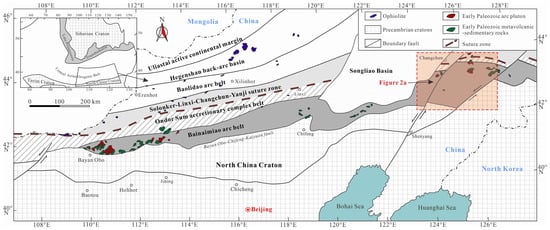
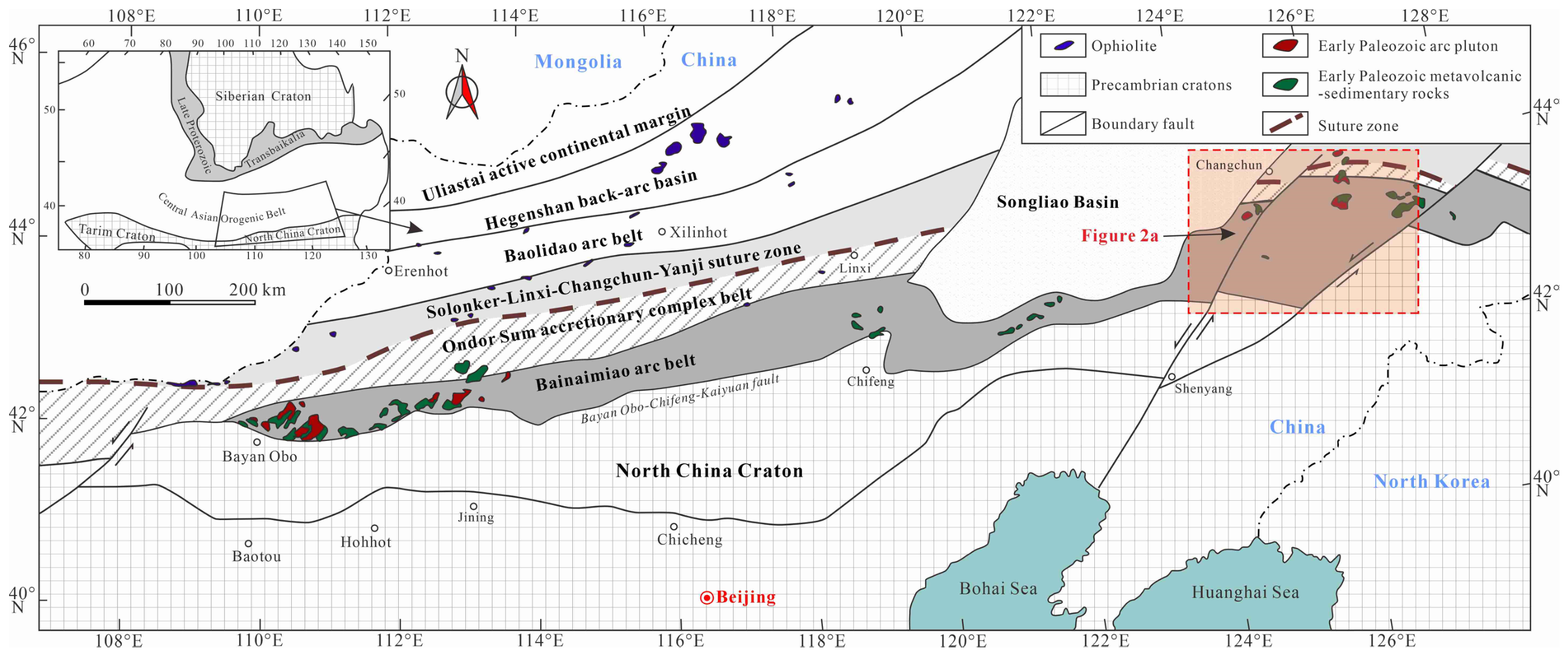
The BAB is located in the composite zone between the southeastern CAOB and the northern margin of the North China Craton (NCC) (Figure 1). From south to north, this composite zone comprises the northern NCC margin, the BAB, the Ondor Sum subduction-accretion complex, the Erdaojing subduction complex, the Baolidao arc accretionary complex, the Hegenshan back-arc basin, and the Uliastai active continental margin. The BAB lies south of the Solonker–Xar Moron–Changchun Suture Zone and north of the Bayan Obo–Duolun–Chifeng–Kaiyuan Fault and extends nearly E–W for approximately 1300 km [10]. The Solonker–Xar Moron–Changchun Suture Zone is generally regarded as an important tectonic boundary associated with the evolution of the PAO, but its exact position, age, and tectonic significance remain debated [9,51,52]. In particular, the nature and age of the mafic and so-called ophiolitic rocks exposed along the suture have been interpreted differently in different studies [53,54].
Figure 1.
Tectonic location of CAOB and sketch tectonic map of the northern margin of the NCC, modified from [10].
The BAB hosts Early Paleozoic metasedimentary rocks of greenschist to lower amphibolite facies (e.g., the Baoerhantu and Bainaimiao groups), as well as Late Cambrian to Early Silurian calc-alkaline volcanic rocks and intermediate–felsic intrusions. These magmatic rocks are attributed to subduction of the PAOP [10,11,13,14,15,17,18,21,23,24,25,26,27,28,30,35,36,37,38,39,40]. Locally, these rocks are unconformably overlain by Late Silurian to Early Devonian molasse deposits or intruded by Devonian syn-collisional granite. These relationships have been interpreted to indicate collision between the Bainaimiao Arc and the NCC during the Late Silurian to Early Devonian [15,16,17,18,23,24,25,26,27,28,29,30]. However, alternative models have proposed different configurations for Early Paleozoic convergence and collision in the southeastern CAOB [55,56]. Furthermore, a series of Precambrian basement fragments have recently been identified in the BAB. These include Mesoproterozoic metamorphic strata in the Damao area (western segment) [15], Neoproterozoic diabase within the Xiaowulanhua mélange [14], Neoarchean to Mesoproterozoic metamorphic and magmatic rocks in the Shaolanghe, Jiefangyingzi, Shuangsheng, and Reshui areas (middle segment) [57,58]; and the Paleo- to Mesoproterozoic Chenjiatun metamorphic complex and Mesoproterozoic granites near Yitong and Gongzhuling (eastern segment) [22,34,59].
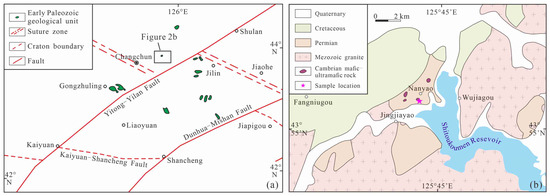
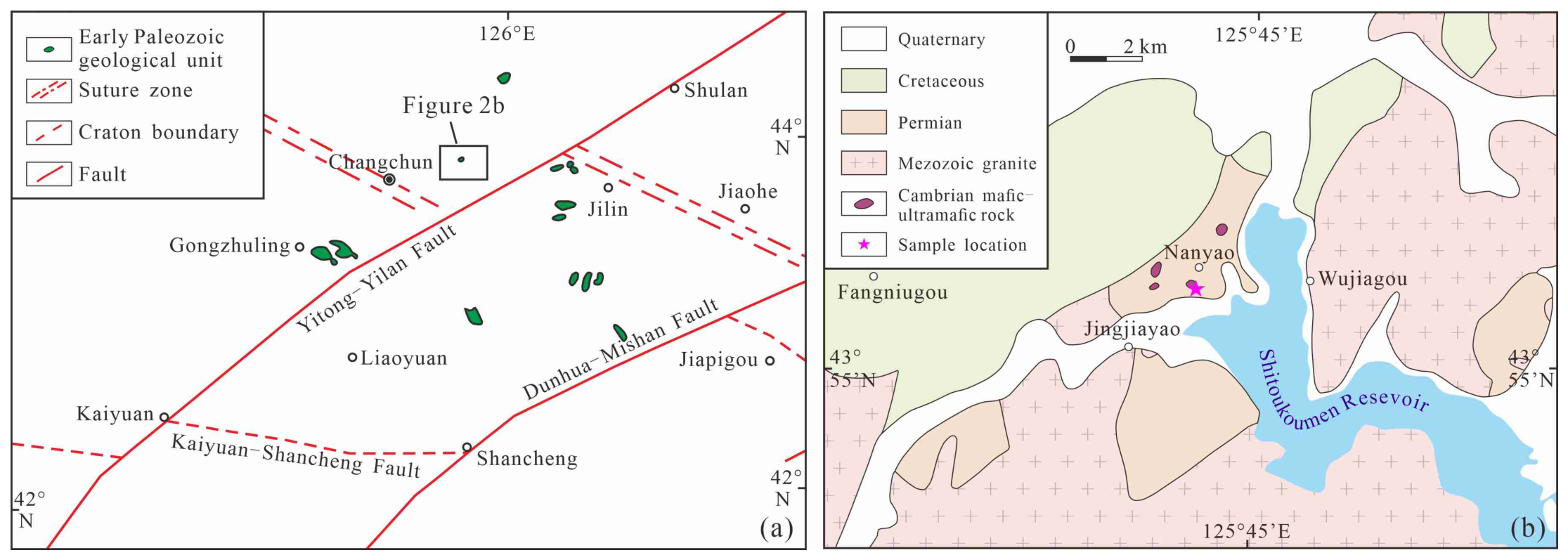
The study area lies in the eastern segment of the BAB, where the tectonic setting is more complex than in the western segment. During the Paleozoic, the eastern BAB evolved within the PAO tectonic domain; in the Mesozoic, however, the Paleo-Pacific tectonic regime strongly overprinted and modified it [1,2,3,4,5,6,7,8]. This transition triggered multiple episodes of dynamic metamorphism and extensive granite emplacement, which largely destroyed the original sedimentary structures and primary stratigraphic relationships of the Paleozoic rocks. Consequently, Early Paleozoic rocks occur only as isolated outcrops, lenses, or roof pendants and have generally undergone later metamorphism; most rock assemblages are highly incomplete (Figure 2a). These conditions hinder reconstruction of the Early Paleozoic tectonic evolution of the eastern BAB.
Figure 2.
Tectonic sketch map of central Jilin Province (a) and geological map of the Shitoukoumen area (b), modified from [42].
Given this poor preservation, Permian and Cretaceous strata are the most widely exposed in the study area (Figure 2b). The Permian succession consists predominantly of marine sedimentary rocks, including crystalline limestone, siliceous mudstone, graywacke, siltstone, polymictic conglomerate, and minor calc-alkaline volcanic rocks. Although this sequence has been assigned various stratigraphic names in the literature (e.g., the Fanjiatun, Yangjiagou, and Shitoukoumen formations), recent geochronological data consistently indicate an Early Permian age [41,42,43]. The area also contains scattered Carboniferous fragments, including Early Carboniferous metamorphosed oceanic crustal rocks consisting chiefly of basaltic andesite and basaltic trachyandesite, and Late Carboniferous fusulinid-bearing bioclastic limestone [42,43,44]. Together with the amphibolite we identified, these fragments occur as olistoliths enclosed within the Early Permian matrix. The Cretaceous Yingchengzi Formation unconformably overlies the Permian and consists mainly of felsic volcanic rocks, sandstone, and mudstone. Intrusive rocks were emplaced mainly during the Triassic to Jurassic and consist of quartz diorite, monzogranite, alkali feldspar granite, syenite, and granite porphyry. The structural framework is dominated by ductile shear zones and faults. The ductile shear zones trend roughly NW, are widespread in the Late Paleozoic strata, and are mainly related to the closure of the PAO. Regional strike-slip deformation occurred episodically from the Permian to the Cretaceous [60,61]. Faults in the study area strike predominantly NE, with subordinate NW and nearly N-S trends; most fault planes dip steeply and display shear-related features.
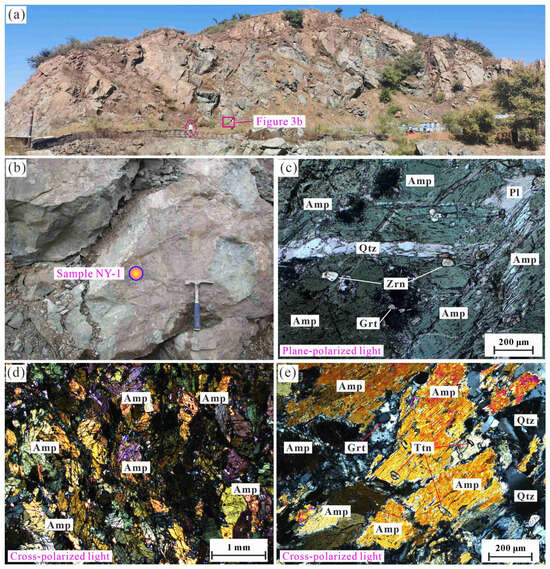
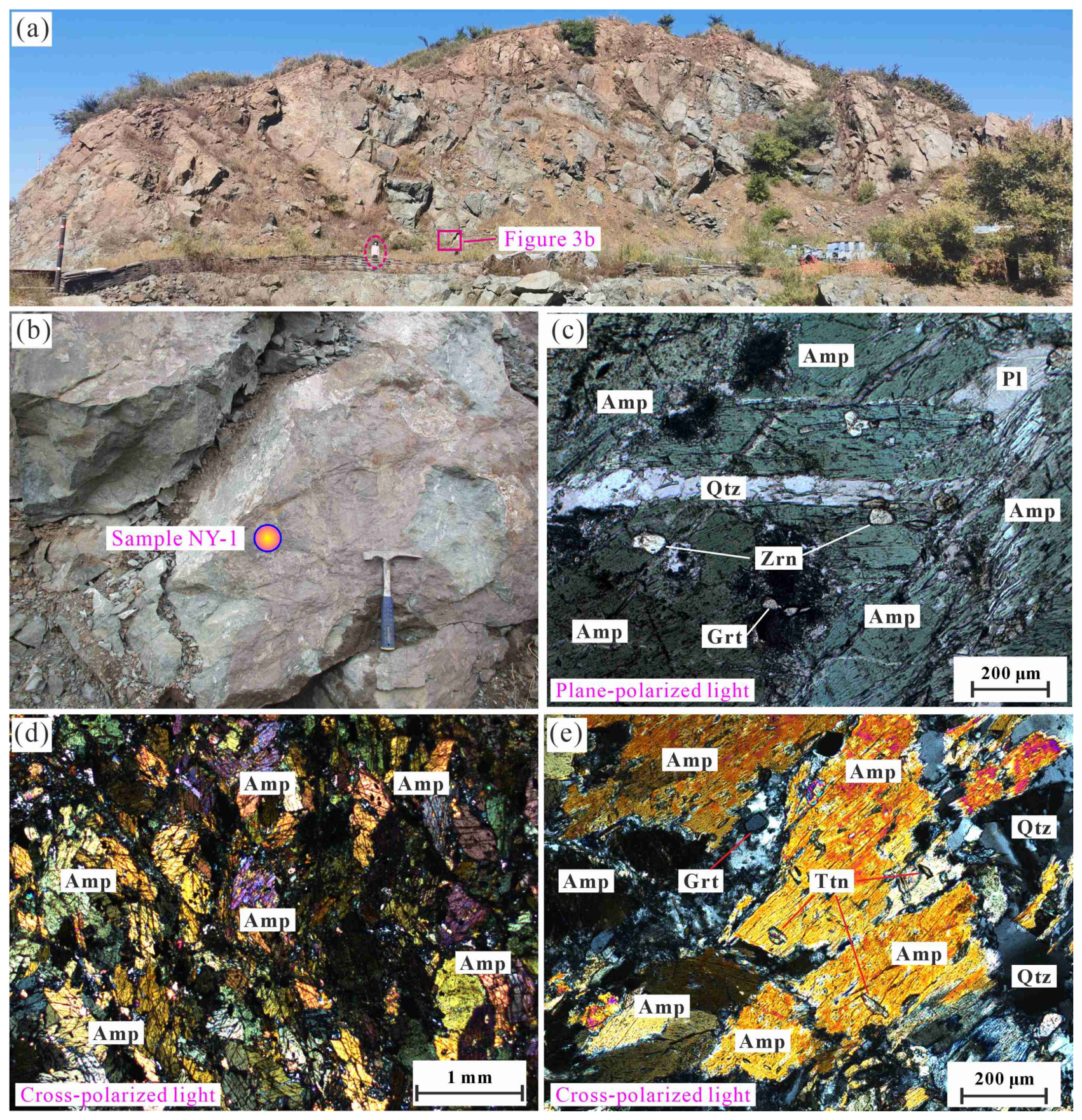
Amphibolite samples for this study were collected from the northwestern shore of the Shitoukoumen Reservoir (GPS: 43°57′24″ N, 125°43′40″ E). The weathered surface is brown, and the fresh surface is grayish-green (Figure 3a,b). The amphibolite has a massive structure and a medium- to fine-grained granoblastic to prismatoblastic texture. The major constituent minerals are amphibole (50–70 vol.%) and plagioclase (25–40 vol.%), with minor quartz (Figure 3c–e). Amphibole occurs mainly as subhedral to irregular prisms, 0.1 to 1.0 mm in size, and displays khaki to green pleochroism and one or two sets of cleavages. Plagioclase is unevenly distributed and occurs mostly as anhedral or irregular granular grains, 0.02 to 0.5 mm in size. Quartz occurs as anhedral grains or aggregates filling interstices between amphibole and plagioclase. Accessory minerals include zircon, titanite, apatite, and garnet.
Figure 3.
Field photographs (a,b) and photomicrograph (c–e) of the Shitoukoumen amphibolite. Mineral abbreviations: Amp—amphibole; Pl—plagioclase; Qtz—Quartz; Grt—garnet; Zrn—Zircon; Ttn—titanite. Abbreviations of mineral names are the same as in [62].
3. Analytical Methods
3.1. Zircon U-Pb Dating
Based on petrographic observations, we selected one fresh amphibolite sample (NY-1) for zircon separation and U-Pb dating. Zircon grains were separated using conventional magnetic and heavy liquid techniques at the Langfang Regional Geological Survey, Hebei Province, China. Approximately 200 grains were hand-picked under a binocular microscope and placed in an epoxy mount. The mount was then polished to approximately half the grain thickness to expose the interiors of the grains and cleaned in an ultrasonic cleaner prior to analysis. Cathodoluminescence (CL) images were obtained for all zircon grains using an FEI Quanta 400 FEG scanning electron microscope equipped with a Gatan MonoCL3+ spectrometer. U-Pb isotopic dating was performed by Laser Ablation Inductively Coupled Plasma Mass Spectrometer (LA-ICP-MS) at the State Key Laboratory of Continental Evolution and Early Life, Northwest University, Xi’an, China, following the procedures of Yuan et al. [63]. The analyses used an Agilent 7500a quadrupole ICP-MS coupled with a GeoLas 200M laser-ablation system. A laser spot size of 32 μm, a repetition rate of 6 Hz, and an ablation depth of 20–40 μm were employed during the analyses. To monitor reproducibility and accuracy, reference materials (NIST 610, GJ-1 and 91500) were analyzed together with the samples as QA/QC measures. Raw data were reduced offline using GLITTER 4.0, and U-Pb concordia diagrams and weighted mean age calculations were produced using the Microsoft Excel macro Isoplot 3.00.
3.2. Zircon Lu-Hf Isotopic Analyses
Zircon Lu-Hf isotopic analyses were conducted at Wuhan Sample Solution Analytical Technology Co., Ltd., Wuhan, China, using a Thermo Fisher Neptune Plus MC-ICP-MS coupled to a Geolas HD excimer ArF laser ablation system (Coherent, Göttingen, Germany). All analyses were performed on zircon grains in single spot ablation mode with a spot size of 44 μm and an energy density of ~7.0 J cm−2. Isobaric interferences of 176Lu and 176Yb were corrected using the interference-free isotopes 175Lu and 173Yb and the recommended ratios 176Lu/175Lu = 0.02656 and 176Yb/173Yb = 0.79639. Instrumental mass bias was corrected by normalizing Yb isotope ratios to 172Yb/173Yb = 1.35274 and Hf isotope ratios to 179Hf/177Hf = 0.7325 using an exponential mass fractionation law [64]. To assess data quality, three international zircon reference materials (Plešovice, 91500, and GJ-1) were analyzed together with the unknown samples. Plešovice served as the primary external standard for calibration, whereas 91500 and GJ-1 were used as secondary standards to monitor accuracy and reproducibility. In addition, the high-Yb/Hf zircon standard Temora 2 was analyzed to evaluate the accuracy of Hf isotope measurements for zircons with high Yb/Hf ratios. Repeated analyses yielded the following 176Hf/177Hf ratios: Plešovice = 0.282478 ± 0.000006 (1σ, n = 6); 91500 = 0.282295 ± 0.000011 (1σ, n = 4); GJ-1 = 0.282003 ± 0.000010 (1σ, n = 4). These results demonstrate the accuracy and external reproducibility of the Lu-Hf isotopic analyses.
3.3. Whole-Rock Major and Trace Element Analyses
Whole-rock major and trace element analyses were performed at Wuhan Sample Solution Analytical Technology Co., Ltd., Wuhan, China. Six fresh amphibolite samples were collected from different parts of the outcrop. Weathered surfaces were removed, and the samples were crushed and powdered to 200 mesh in an agate mortar. For major element analysis, the powdered samples were fused into glass disks. Major oxides were determined by wavelength-dispersive X-ray fluorescence (XRF) using a Rigaku ZSX Primus II spectrometer. Analytical quality was monitored by analyzing reference materials (GBW07103, GBW07105, GBW07111, and GBW07112) and duplicate samples along with the unknowns. Loss on ignition (LOI) was determined by ignition at 1000 °C. FeO concentrations were determined using the potassium dichromate volumetric method. For trace element analysis, approximately 50 mg of dried sample powder was digested in Teflon bombs using an HNO3 + HF mixture. Trace element concentrations were then measured using an Agilent 7700e ICP-MS. Standard reference materials of AGV-2, BCR-2, and RGM-2 were incorporated as QA/QC measures. Analytical precision was better than 5% for major elements and better than 10% for trace elements.
3.4. Whole-Rock Sr-Nd Isotopic Analyses
Sr and Nd isotopic analyses were performed at Wuhan Sample Solution Analytical Technology Co., Ltd., Wuhan, China. Sample powders were digested in Teflon bombs using a mixture of HNO3, HF, and HCl. Sr and Nd were then separated by conventional ion-exchange chromatography. Isotope ratios were measured using Thermo Fisher Neptune Plus multicollector inductively coupled plasma mass spectrometer (MC-ICP-MS). Mass fractionation was corrected using the exponential law and the reference ratios 86Sr/88Sr = 0.1194 and 146Nd/144Nd = 0.7219. During the analytical sessions, the measured isotope ratios of the monitoring standards were NIST 987 87Sr/86Sr of 0.710240 (2SD = 0.000010) and GSB 04-3258-2015 143Nd/144Nd of 0.512438 (2SD = 0.000008).
4. Analytical Results
4.1. Zircon U-Pb Geochronology
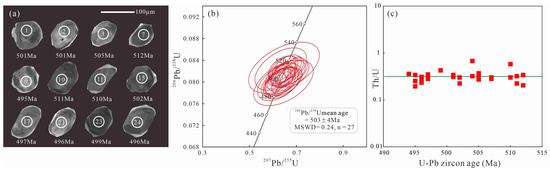
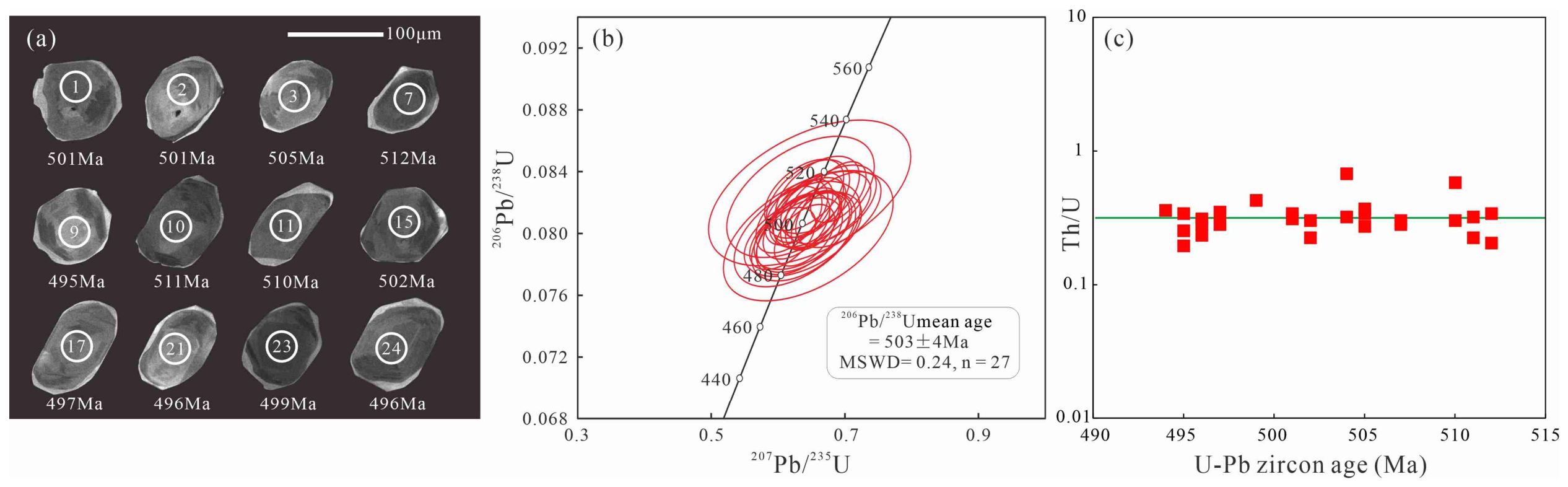
Zircons from amphibolite sample NY-1 are mostly subhedral to anhedral, predominantly short-prismatic to equant, and 50–120 μm in size. In CL images, they exhibit weakly zoned, unzoned, or fir-tree sector-zoned internal structures (Figure 4a), resembling zircons that formed or recrystallized during high-temperature metamorphism [50,65,66,67]. Some grains also display thin, bright white overgrowth rims.
Figure 4.
Representative CL images (a), zircon U-Pb concordia diagram (b) and Th/U versus U-Pb ages diagram (c) of the Shitoukoumen amphibolite. The green line indicates the empirical Th/U = 0.3 boundary between magmatic and metamorphic zircons [50]. The red squares represent the analytical spots of sample NY-1.
U-Pb dating was performed on 30 zircon grains from sample NY-1; the results are presented in Table 1. Three analyses (spots 16, 26, and 30) were excluded because they were discordant or had large uncertainties. The remaining 27 analyses plot on or near the concordia curve (Figure 4b). These zircons have relatively low Th and U concentrations of 2.32–32.39 ppm and 10.94–54.11 ppm, respectively, and Th/U ratios of 0.20–0.70. Most of the Th/U ratios are below or close to the empirical boundary of 0.3 between metamorphic and magmatic zircons (Figure 4c) [50]. Their 206Pb/238U ages range from 512 to 494 Ma, yielding a weighted mean of 503 ± 4 Ma (n = 27, MSWD = 0.24).
Table 1.
LA-ICP-MS zircon U-Pb data for the Shitoukoumen amphibolite.
4.2. Zircon Lu-Hf Isotopes
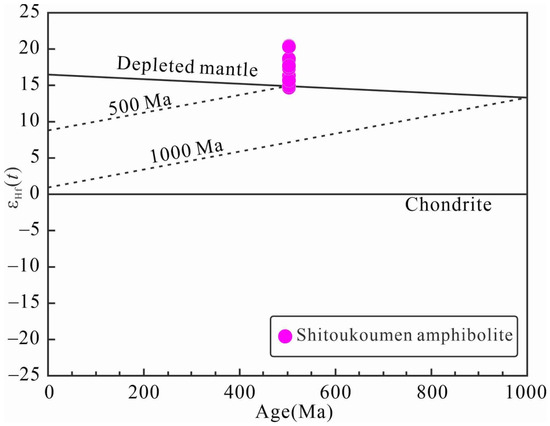
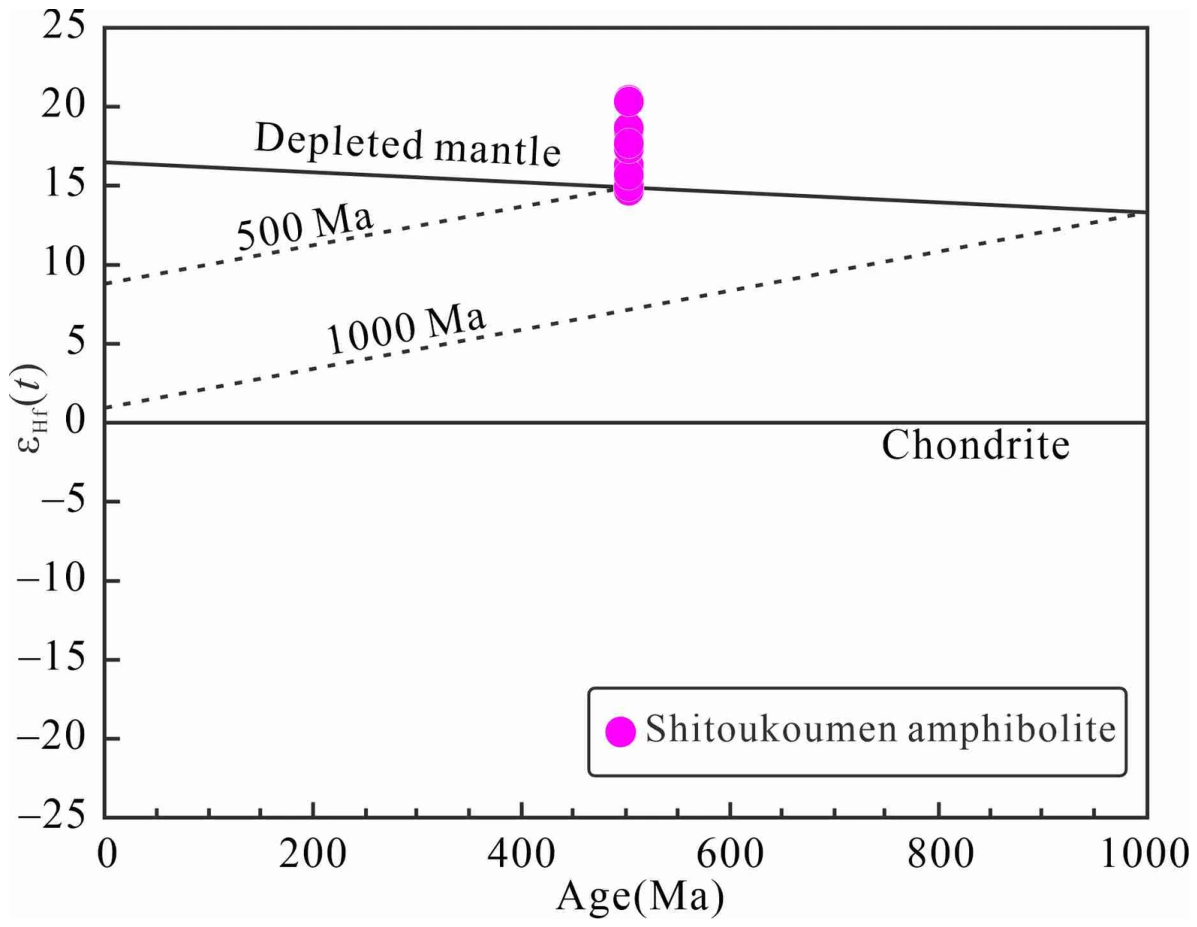
From the dated zircon population, fifteen grains with concordant U-Pb ages were selected for Lu-Hf isotopic analysis (Table 2). They have 176Lu/177Hf ratios of 0.00002–0.00054, 176Hf/177Hf ratios of 0.28288–0.28304, and fLu/Hf values from −0.98 to −1.00. Their εHf(t) values range from +14.9 to +20.4 and plot close to the depleted mantle evolution line in the εHf(t) versus U-Pb age diagram (Figure 5).
Table 2.
Zircon Lu-Hf isotope results for the Shitoukoumen amphibolite.
Figure 5.
Zircon εHf(t) versus U-Pb ages diagram of the Shitoukoumen amphibolite.
4.3. Major and Trace Element Geochemistry
A total of six amphibolite samples were selected for whole-rock geochemical analysis; the results are presented in Table 3. These samples have low SiO2 (48.46–52.22 wt.%), moderate TiO2 (1.17–2.25 wt.%), and relatively high MgO (4.48–6.31 wt.%), Fe2O3T (11.01–15.48 wt.%), and CaO (9.07–12.55 wt.%) contents, indicating a mafic composition. Their Na2O and K2O contents range from 3.35 to 3.84 wt.% and 0.07 to 0.17 wt.%, respectively, corresponding to Na2O/K2O ratios of 22.59–54.43 and reflecting strong Na enrichment and K depletion.
Table 3.
Whole-rock major (wt.%) and trace element (ppm) concentrations of the Shitoukoumen amphibolite.
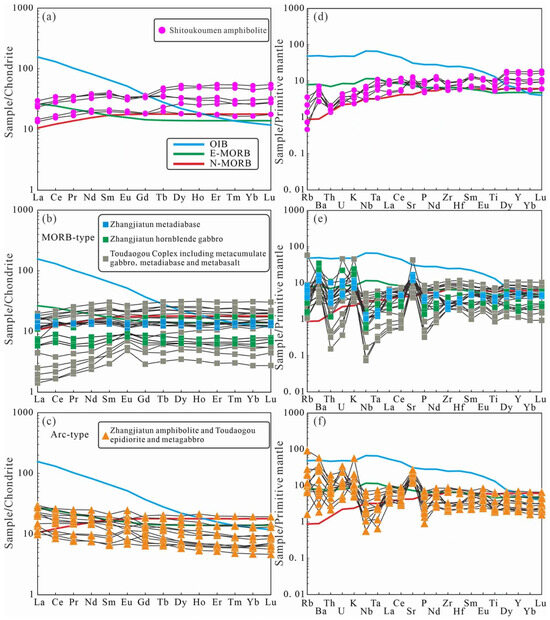
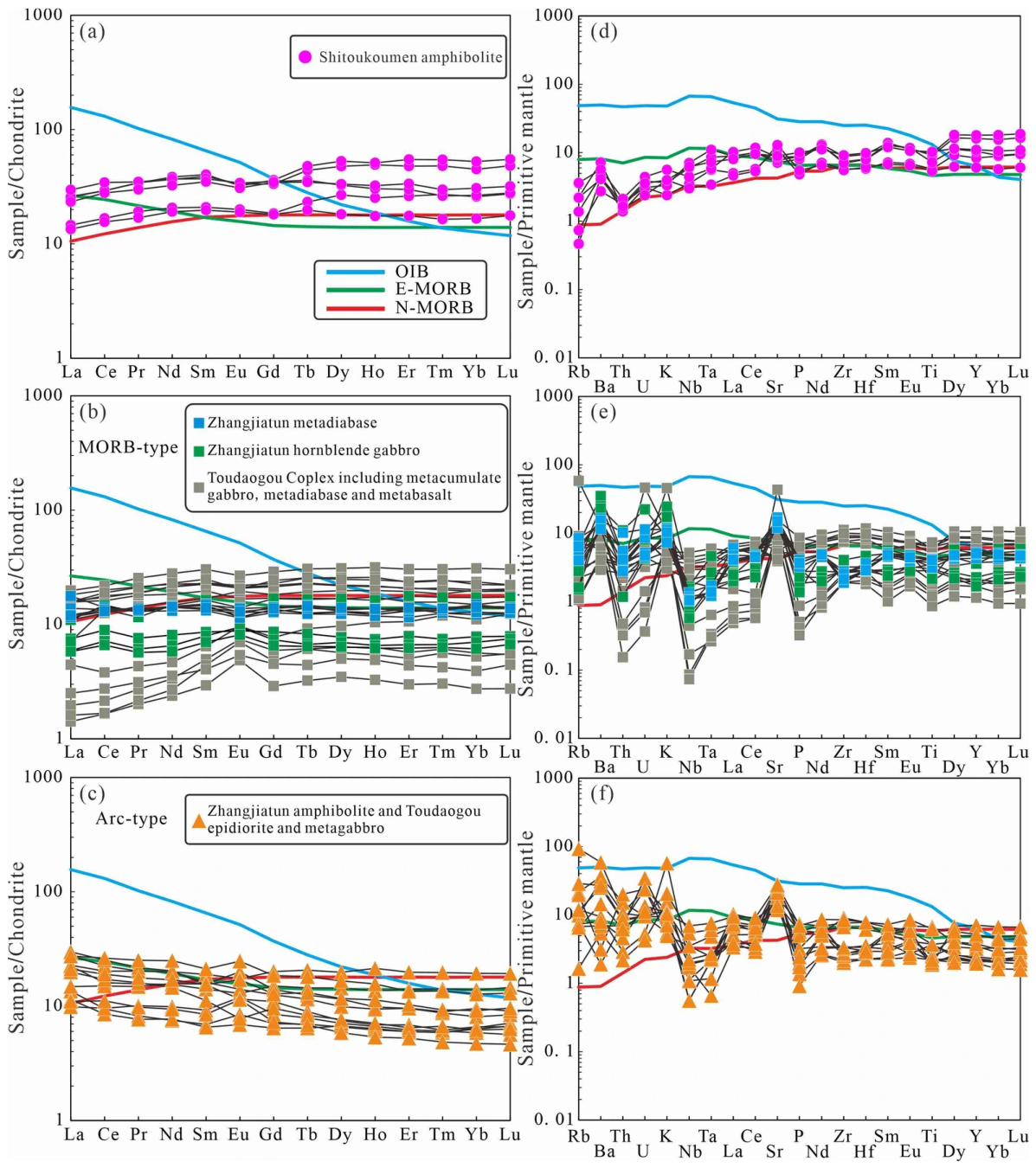
The amphibolites have relatively low total rare earth element (REE) abundances (ΣREE = 44.03–99.64 ppm), with light rare earth elements (LREEs) and heavy rare earth elements (HREEs) contents of 27.36–56.36 ppm and 16.67–46.38 ppm, respectively. Their LREE/HREE ratios range from 1.15 to 1.91. On the chondrite-normalized REE diagram, the samples exhibit relatively flat patterns (Figure 6a), with (La/Yb)N values of 0.49–1.12, indicating limited LREE-HREE fractionation. In the primitive mantle-normalized trace element diagram (Figure 6d), they display enrichment in Ba, slight depletion in Zr and Hf, and no significant negative Nb-Ta anomalies.
Figure 6.
Chondrite-normalized REE patterns (a–c) and primitive mantle-normalized multi-element diagram (d–f) for Cambrian–Ordovician (meta-) basites of central Jilin Province. Reference data are from [24,26,30]. Reference data for the Zhangjiatun and Toudaogou complexes are from [24,26,30]. Chondrite- and primitive mantle-normalized values, as well as those for OIB, N-MORB, and E-MORB, are from [68]. OIB: Ocean Island Basalt, N-MORB: Normal Mid-Ocean Ridge Basalt, E-MORB: Enriched Mid-Ocean Ridge Basalt.
4.4. Whole-Rock Sr-Nd Isotopes
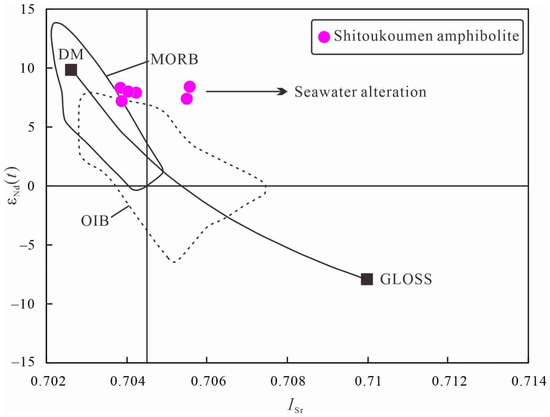
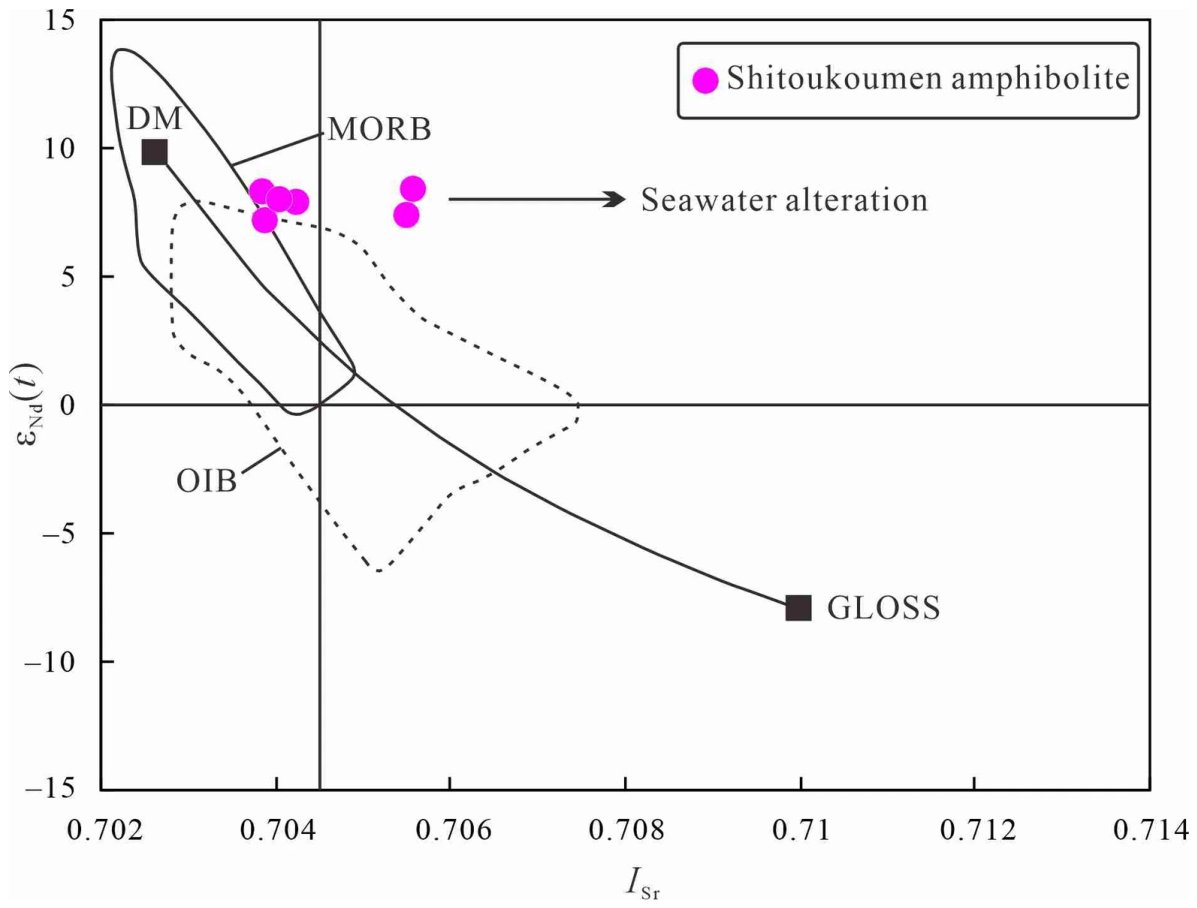
Whole-rock Sr-Nd isotopic results for the six amphibolite samples are presented in Table 4. Sr and Nd isotope ratios were back-calculated to 503 Ma, corresponding to the zircon U–Pb metamorphic age of the amphibolite. The initial 87Sr/86Sr ratios (ISr) range from 0.703830 to 0.705561, and the initial 143Nd/144Nd ratios (INd) range from 0.512359 to 0.512418. The corresponding εNd(t) values range from +7.2 to +8.4 and plot near the MORB field in the εNd(t) versus ISr diagram (Figure 7).
Table 4.
Whole-rock Sr-Nd isotopic compositions of the Shitoukoumen amphibolite.
Figure 7.
εNd(t) versus ISr diagram of the Shitoukoumen amphibolite. DM: Depleted Mantle, MORB: Mid-Ocean Ridge Basalt, GLOSS: Global Subducting Sediments. DM data are from reference [69]; MORB and OIB data are from reference [70]; GLOSS data are from reference [71].
5. Discussion
5.1. Protolith Reconstruction
Amphibolite protoliths can be either mafic igneous rocks (gabbro, basalt, or mafic tuff) or sedimentary rocks (graywacke, calcareous shale, or ferruginous dolomitic argillaceous limestone). Because primary textures and structures are rarely preserved in the Shitoukoumen amphibolite, we use whole-rock geochemistry to constrain its protolith.
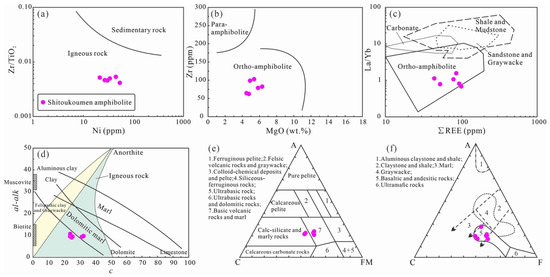
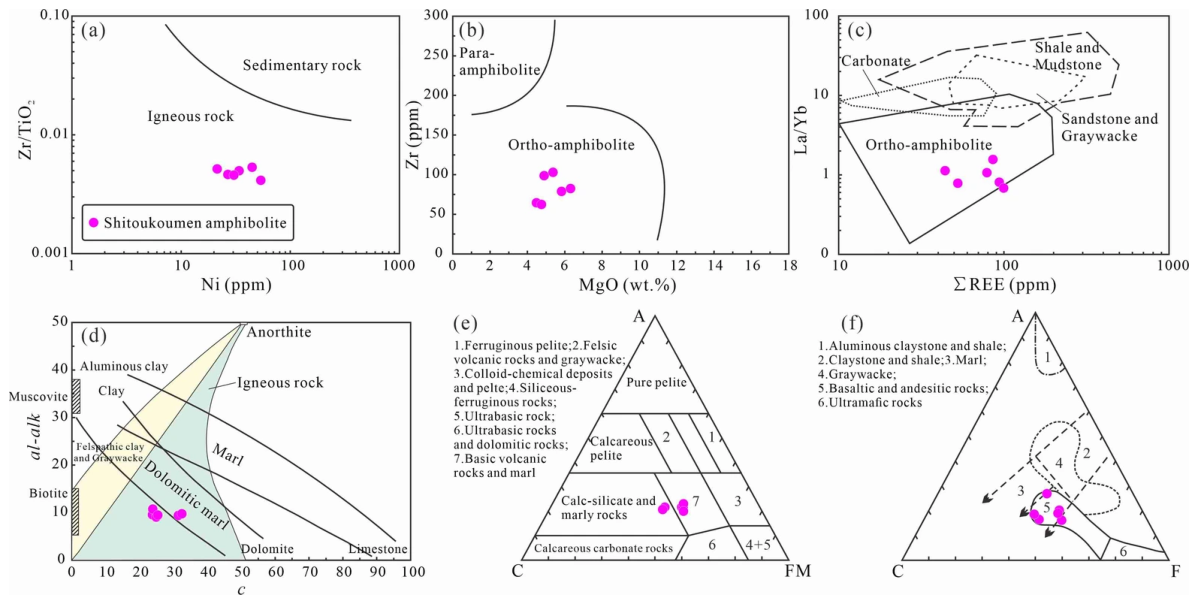
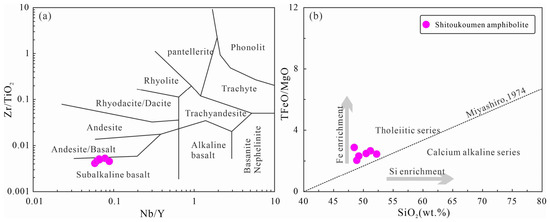
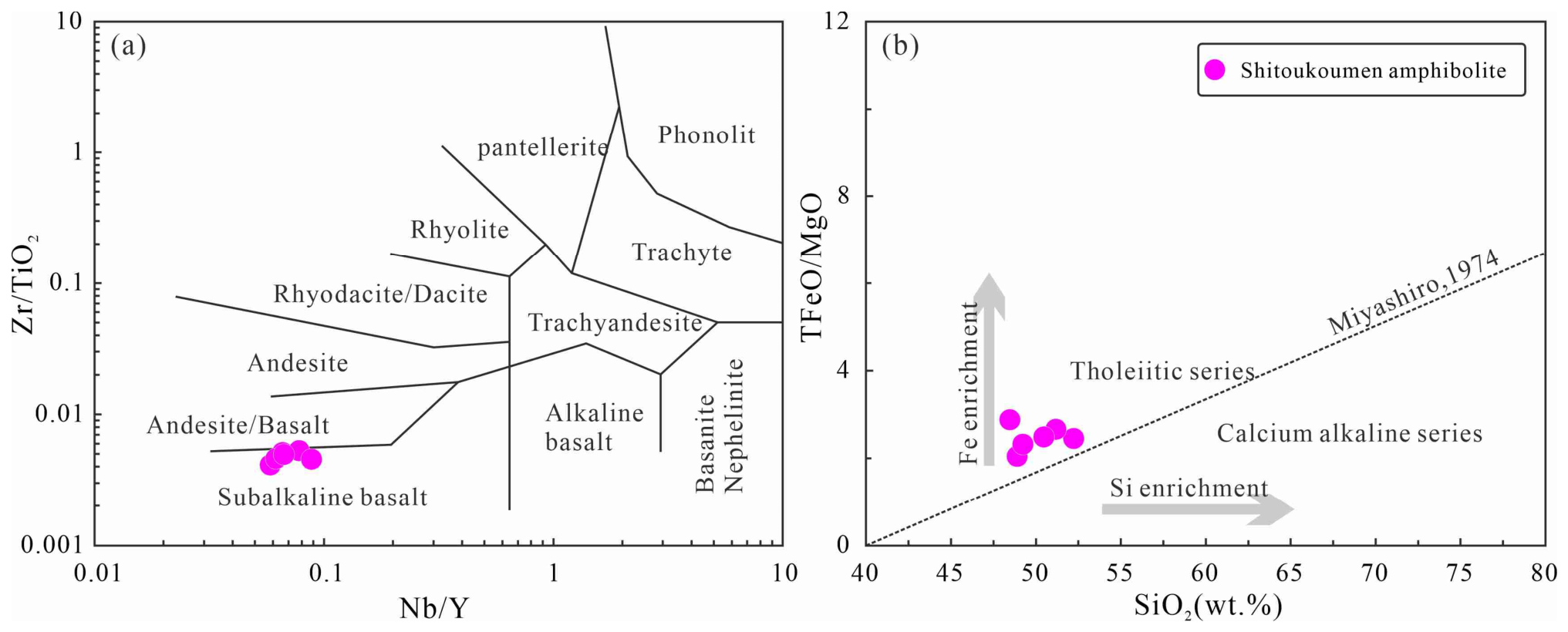
Several discrimination diagrams based on relatively immobile elements were applied. In the Zr/TiO2-Ni and Zr-MgO diagrams [72,73], the samples plot in the igneous rock field and the ortho-amphibolite field, respectively (Figure 8a,b). In the La/Yb-ΣREE diagram [74], their low La/Yb ratios place the samples in the ortho-amphibolite field (Figure 8c). In the (al-alk)-c, ACFM, and ACF diagrams [75,76], all samples also plot in igneous rock fields (Figure 8d–f). Collectively, these results indicate that the protolith of the Shitoukoumen amphibolite was mafic igneous rock. In the Zr/TiO2-Nb/Y diagram, all samples fall in the basalt field (Figure 9a), and in the TFeO/MgO versus SiO2 diagram, they plot in the tholeiitic series field (Figure 9b).
Figure 8.
Protolith reconstruction diagrams for the Shitoukoumen amphibolite. (a) Zr/TiO2 vs. Ni diagram [72]; (b) Zr vs. MgO diagram [73]; (c) La/Yb vs. ΣREE diagram [74]; (d) al-alk vs. C diagram [75]; (e) ACFM diagram [76]; (f) ACFM diagram [76].
Figure 9.
Discrimination diagram of rock types and rock series for the Shitoukoumen amphibolite. (a) Zr/TiO2 vs. Nb/Y diagram [77]; (b) TFeO/MgO vs. SiO2 diagram [78].
5.2. Effects of Alteration, Crustal Contamination and Fractional Crystallization
Prior to utilizing geochemical data for tracing petrogenesis and magma source characteristics, it is essential to assess the effects of metamorphism or alteration on element mobility. The Shitoukoumen amphibolite samples have low LOI values of 1.58–2.49 wt.%, with only one sample exceeding 2 wt.%, indicating weak alteration. Given the generally immobile behavior of Zr during secondary processes, element mobility can be assessed from correlations with Zr [79]. The amphibolites show positive correlations of REEs (e.g., La, Ce, Nd), high-field-strength elements (HFSEs, e.g., Nb, Ta), Hf, Sr, Ba, and TiO2 with Zr, whereas Rb and K2O show no such correlation. Therefore, the following discussion relies mainly on relatively immobile elements, including HFSEs, REEs, and some transition metals.
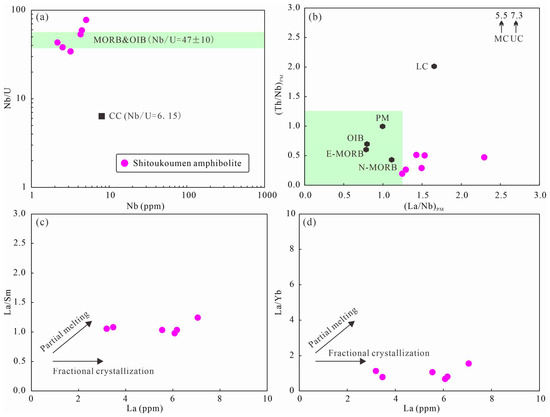
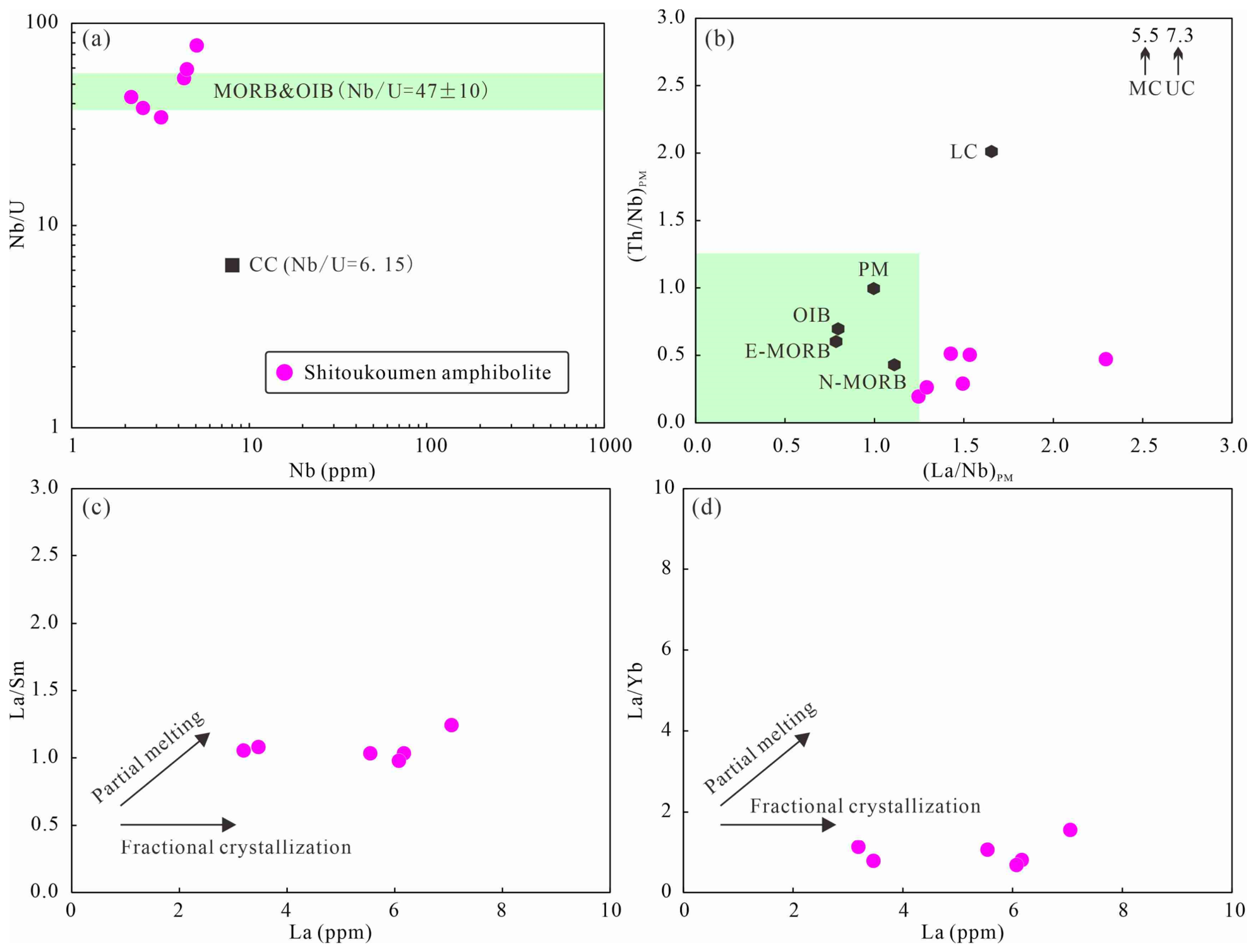
The geochemical results indicate that the protoliths of the Shitoukoumen amphibolites were mafic and likely derived from mantle melting. Mantle-derived magmas can assimilate crustal material during ascent, emplacement, or eruption [80,81]. However, several lines of evidence argue against significant crustal contamination: (1) Continental crust is typically depleted in Nb and Ta and enriched in Zr, Hf, and large ion lithophile elements (LILEs) [82]. The studied samples lack positive Th-U anomalies and negative Nb-Ta anomalies; instead, they show slight negative Zr-Hf anomalies, which is inconsistent with significant crustal involvement. (2) Crustal materials generally have low Nb/U ratios (~6.15) and elevated (La/Nb)PM and (Th/Nb)PM ratios [82,83,84], whereas the studied samples plot near MORB in the Nb/U-Nb and (Th/Nb)PM-(La/Nb)PM diagrams (Figure 10a,b). (3) The absence of inherited zircons further argues against crustal contamination.
Figure 10.
Discrimination diagrams for crustal contamination (a,b) and for fractional crystallization versus partial melting (c,d) for the protoliths of the Shitoukoumen amphibolites. (a) Nb/U vs. Nb diagram [83]; (b) (Th/Nb)PM vs. (La/Nb)PM diagram [84]; (c) La/Sm vs. La diagram; (d) La/Yb vs. La diagram. The data for continental crust (CC), upper crust (UC), middle crust (MC), and lower crust (LC) are from [82]. The subscript PM denotes primitive mantle normalization, and the normalization values, as well as the data for OIB, E-MORB and N-MORB, are from [68].
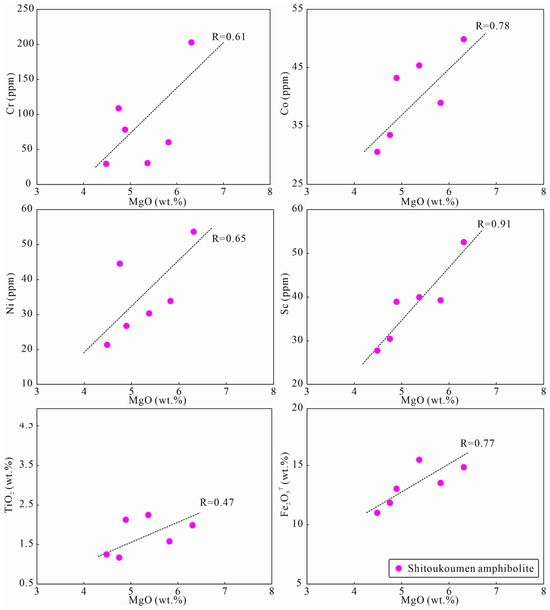
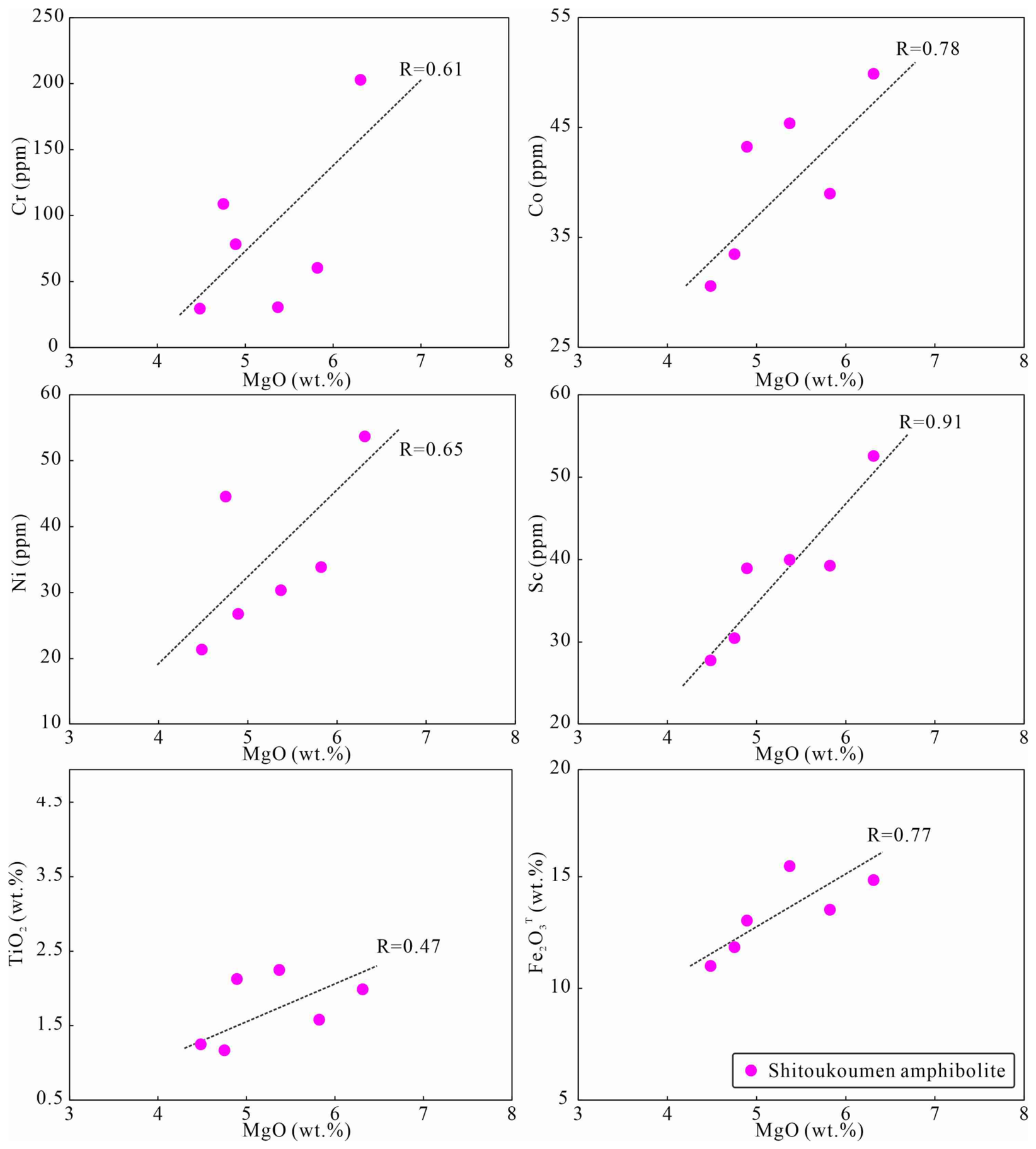
The samples have MgO contents of 4.48–6.31 wt.% and Cr and Ni concentrations of 30.0–203 ppm and 21.4–53.7 ppm (Table 3), respectively, which are lower than those of typical primary basaltic magmas (Cr = 300–500 ppm; Ni = 300–400 ppm) [85]. This is consistent with fractional crystallization of the parental magmas. During equilibrium melting, La/Sm and La/Yb ratios increase with La, whereas these ratios remain nearly constant during fractional crystallization. In the La/Sm-La and La/Yb-La diagrams, the samples follow fractional crystallization trends (Figure 10c,d). In Harker diagrams (Figure 11), Cr, Co, Ni, and Sc correlate positively with MgO, indicating fractionation of mafic minerals such as olivine and pyroxene. TiO2 and Fe2O3T also correlate positively with MgO, consistent with Fe-Ti oxide fractionation. However, the samples lack significant Eu anomalies, indicating that plagioclase fractionation was limited.
Figure 11.
Harker diagrams showing variations in selected major and trace elements versus MgO for the Shitoukoumen amphibolites.
5.3. Petrogenesis and Source Characteristics
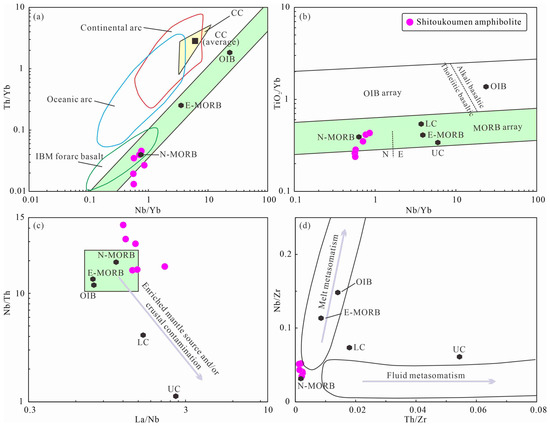
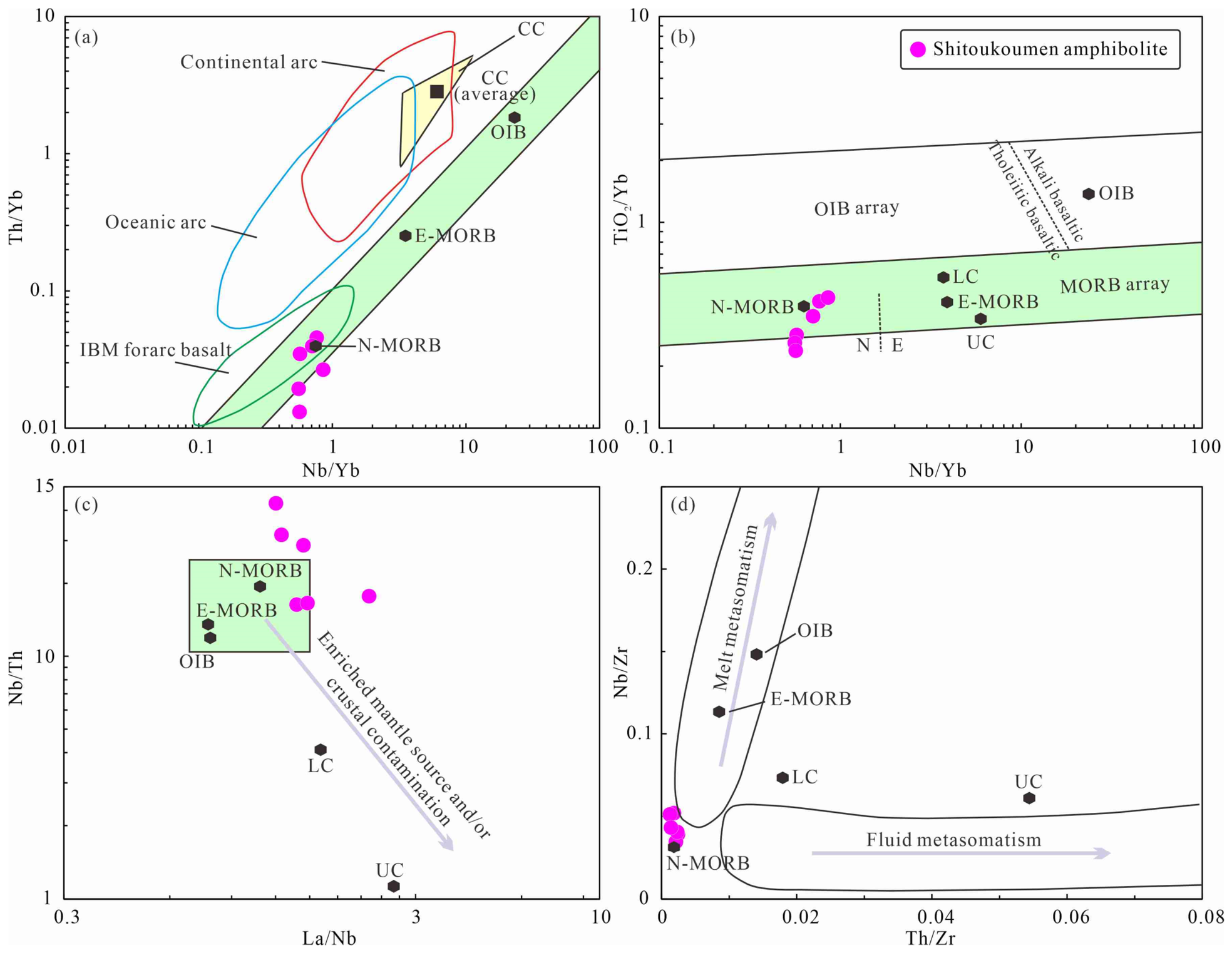
The protoliths of the Shitoukoumen amphibolites are tholeiitic mafic rocks, and their REE and trace element patterns display N-MORB affinity (Figure 6), suggesting derivation from an N-MORB-like mantle source. Although fractional crystallization may have modified the concentrations of some trace elements, radiogenic isotope ratios and ratios of highly incompatible elements (e.g., REEs and HFSEs) are largely insensitive to this process. Moreover, selected trace element ratios vary systematically among mantle reservoirs and can therefore trace the mantle source of mafic rocks [86,87,88]. The Shitoukoumen amphibolites have positive εHf(t) (+14.9 to +20.4) and εNd(t) (+7.2 to +8.4) values (Figure 5 and Figure 7), consistent with derivation from a depleted mantle source. Furthermore, their Th/Yb (0.013–0.046), Nb/Yb (0.56–0.85), La/Nb (1.20–2.21), Nb/Zr (0.039–0.052), and Th/Zr (0.001–0.002) ratios are close to those of N-MORB. In the Th/Yb-Nb/Yb, TiO2/Yb-Nb/Yb, Nb/Th-La/Nb, and Nb/Zr-Th/Zr diagrams, all samples plot near the N-MORB field (Figure 12), further supporting a depleted mantle source.
Figure 12.
Mantle source discrimination diagrams for the Shitoukoumen amphibolites. (a) Th/Yb vs. Nb/Yb diagram [89]; (b) TiO2/Yb vs. Nb/Yb diagram [90]; (c) Nb/Th vs. La/Nb diagram; (d) Nb/Zr vs. Th/Zr diagram [91].
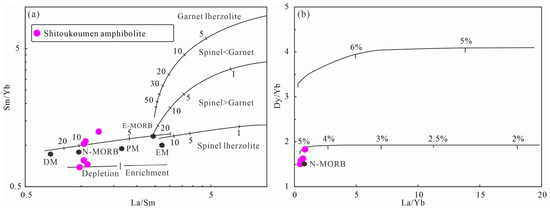
The trace element compositions of mafic magmas are sensitive to the depth of mantle melting since garnet- and spinel-facies residues have contrasting partition coefficients. Magmas derived from garnet-facies sources are typically HREE-depleted and have high Sm/Yb and Dy/Yb ratios, whereas those from spinel-facies sources generally have N-MORB-like, LREE-depleted patterns and low Sm/Yb and Dy/Yb ratios [87]. The Shitoukoumen amphibolites have low ΣREE abundances and LREE-depleted patterns subparallel to N-MORB (Figure 6a), as well as low Sm/Yb and Dy/Yb ratios. In the Sm/Yb-La/Sm and Dy/Yb-La/Yb diagrams, they plot close to the spinel-facies lherzolite melting trend (Figure 13). These features suggest that the parental magmas of the protoliths were generated by approximately 5–10% partial melting of spinel lherzolite.
Figure 13.
Sm/Yb vs. La/Sm (a) and Dy/Yb vs. La/Yb (b) diagrams for the Shitoukoumen amphibolites (modified after [87,92]).
In summary, we conclude that the parental magmas of the Shitoukoumen amphibolite protoliths were derived from depleted mantle and produced by partial melting of spinel lherzolite. During magma evolution, they experienced fractional crystallization of mafic minerals such as olivine and pyroxene, as well as Fe-Ti oxides.
5.4. Tectonic Affinity and Constraints on the Early Paleozoic Subduction Initiation of the PAOP
The Paleozoic tectonic evolution of the southeastern CAOB was governed by subduction, accretion, and collision during closure of the PAO. However, the Early Paleozoic geological record in this region is poorly preserved because of long-lived accretion, post-collisional extension, and complex Mesozoic overprinting by the Okhotsk and Paleo-Pacific tectonic regimes [1,2,3,4,5,6,7,8]. In recent years, an increasing number of Early Paleozoic geological bodies have been identified in the BAB, and detailed petrological, geochemical, and geochronological studies of these rocks have provided abundant data for reconstructing the Early Paleozoic tectonic evolution of the PAO [10,11,12,13,14,15,16,17,18,19,20,21,22,23,24,25,26,27,28,29,30,31,32,33,34,35,36,37,38,39,40].
The widespread recognition of Cambrian–Silurian arc magmatic rocks with subduction-related geochemical signatures and lithological associations in the BAB has led to broad acceptance that the region experienced Early Paleozoic subduction and accretion related to the evolution of the PAO [10,11,13,14,15,17,18,21,23,24,25,26,27,28,30,35,36,37,38,39,40]. However, the timing and mechanism of subduction initiation—a critical stage of the Wilson Cycle—remain a key unresolved issue in this tectonic evolution. Recent studies have yielded new constraints. The Tulinkai SSZ-type ophiolite, which is geochemically similar to the Troodos ophiolite, contains tonalite and metagabbro dated at 497–477 Ma, suggesting subduction initiation by ca. 500 Ma [38]; this interpretation has been widely adopted in subsequent studies [12,13,16,17,37,40]. Alternative views, however, place the initiation earlier. Early Cambrian dacite (518 ± 3 Ma) in the Baoerhantu Group has been interpreted as subduction-related lower-crustal melts and used to argue for subduction initiation at ca. 520 Ma [10]. Oceanic crustal fragments and forearc assemblages within the Ondor Sum subduction–accretion complex have been proposed to indicate initiation at ca. 510–501 Ma [25]. Inherited zircons (530–450 Ma) in Early Paleozoic diorite from the Damao Banner area have led to the inference that subduction may have begun as early as ca. 530 Ma [11].
Compared with the western BAB, evidence for Early Paleozoic subduction initiation in the central Jilin area of the eastern BAB is scarce and less well constrained. The earliest record, represented by Late Cambrian MORB-type metadiabase and serpentinite at Zhangjiatun and Xiaosuihe, resembles SSZ-type ophiolites and suggests subduction initiation before ca. 493 Ma [24]. These rocks have been further interpreted as an SSZ-type ophiolite formed in a forearc setting, with an initiation age broadly comparable to that in the Tulinkai area [30]. However, several arc magmatic rocks older than the SSZ ophiolites (e.g., ca. 518 Ma dacite, ca. 510 Ma mafic-rhyolite assemblage, and ca. 516 Ma tonalite) have also been recognized in the BAB [10,30]; therefore, the possibility of two Early Paleozoic subduction systems cannot be ruled out [13,26,30].
In summary, although existing studies provide a basis for understanding subduction initiation of the PAOP, the spatiotemporal relationships between the two proposed subduction systems and the dynamic mechanisms of intra-oceanic subduction initiation remain poorly constrained, largely owing to the scarcity of preserved records. The Shitoukoumen N-MORB-type amphibolite provides new constraints on this process. Geochemically, it is classified as low-K tholeiitic, with REE and trace element patterns resembling those of N-MORB, and all samples plot within or near the N-MORB field in discrimination diagrams (Figure 10, Figure 12 and Figure 13). Its positive εHf(t) (+14.9 to +20.4) and εNd(t) (+7.2 to +8.4) values indicate a depleted mantle source, whereas the relatively wide range of initial 87Sr/86Sr ratios (0.703830–0.705561) suggests some influence of seafloor alteration (Figure 7). Collectively, these features identify the amphibolite as a fragment of PAO crust.
Although the N-MORB affinity of the amphibolite could imply an ophiolitic origin, MORB-type rocks are not unique to mid-ocean ridges and also occur in oceanic plateaus and ocean islands [93,94,95]. Therefore, a direct link to the nearby ZTX SSZ ophiolite requires evaluation. Both the Shitoukoumen amphibolite and the mafic rocks of that ophiolite have low (La/Yb)N ratios and are classified as MORB-type rather than arc-type [30,94]. However, the Zhangjiatun–Toudaogou rocks show weak Nb-Ta-Ti depletion and a subduction-related forearc affinity [24,26,30], whereas the Shitoukoumen amphibolite lacks such depletion and has N-MORB-like incompatible element ratios (Figure 10, Figure 12 and Figure 13). Furthermore, the formation age of the ZTX ophiolite (502–476 Ma) is slightly younger than the metamorphic age of the amphibolite (ca. 503 Ma). These differences suggest that the amphibolite and the exposed mafic rocks of the ZTX ophiolite may not have formed in identical magmatic environments.
Recent geochronological and geochemical studies have provided new insights into the tectonic affinity of the Shitoukoumen amphibolite [42,43,44]. Lithologically, the amphibolite and adjacent serpentinite lenses [42] occur together with Early Carboniferous OIB- and N-MORB-type oceanic basalts and Late Carboniferous neritic carbonate rocks as blocks within a Lower Permian volcanic-sedimentary succession [44]. The Permian sedimentary rocks, characterized by deep-water gravity-flow deposits [42,43], together with these pre-Permian blocks, form a “blocks-in-matrix” assemblage. This assemblage is comparable to Permian olistostromal and block-in-matrix deposits documented in extensional basins elsewhere in the CAOB [95,96]. Together with the ZTX SSZ ophiolite and other ophiolitic fragments in central-eastern Jilin Province, these occurrences document the preservation of older oceanic and tectonic materials within the eastern BAB.
What, then, is the relationship between the Late Cambrian N-MORB-type amphibolite at Shitoukoumen and the onset of Early Paleozoic subduction of the PAO? Zircon morphology and U-Pb ages from the Shitoukoumen amphibolite provide further constraints. Zircons lack magmatic oscillatory zoning and instead display unzoned or fir-tree sector-zoned internal structures typical of high-temperature metamorphic zircons (Figure 4a) [50,65,66,67]. Although their Th/U ratios are variable (0.20–0.70), most values are at or close to the empirical boundary of 0.3 between metamorphic and magmatic zircons [65]. The ca. 503 Ma age therefore likely records metamorphism rather than magmatic crystallization. Although ca. 500 Ma metamorphism is widely documented in the Erguna, Xing’an, and Jiamusi–Khanka blocks of NE China and has been linked to a Late Pan-African event [97], the Shitoukoumen amphibolite lies far from these regions, arguing against such a correlation. Recent regional work reported a 502 ± 3 Ma gabbro from the Shitoukoumen area and a 502 ± 1 Ma SSZ-type metagabbro from the Qincaigou area, approximately 70 km to the southeast [98]. Although the field relationship between the Shitoukoumen gabbro and amphibolite is not well established, the close similarity in age raises the possibility that the gabbro represents the protolith of the amphibolite.
In recent years, metamorphic soles—high-temperature metamorphic suites formed during the initial stage of intra-oceanic subduction by heating and friction of the downgoing oceanic crust beneath the mantle wedge—have gained attention as key records of subduction initiation [99,100,101,102,103,104]. Metamorphic soles typically exhibit amphibolite- to granulite-facies metamorphism, occur directly beneath SSZ ophiolites, and show inverted metamorphic gradients [105,106]. Their metamorphic ages are generally close to those of the overlying SSZ ophiolites, as documented in Oman, Quebec, and Tibet [99,100,101,102,103,104]. The Shitoukoumen amphibolite shares several of these characteristics: it has N-MORB affinity, records amphibolite-facies metamorphism with metamorphic zircon textures and garnet, and is in direct contact with serpentinized peridotite. Its ca. 503 Ma metamorphic age is also closely comparable to the ca. 502 Ma age of the SSZ-type metagabbro in Shitoukoumen and Qincaigou areas [98]. Although a direct structural relationship between the amphibolite and the ZTX SSZ ophiolite has not yet been established, the close age relationship is compatible with a possible metamorphic-sole origin.
Current evidence broadly supports Late Cambrian intra-oceanic subduction initiation in the eastern PAO [10,11,13,23,24,26,30,38], although the geological record has been strongly overprinted by later tectonism. The Shitoukoumen amphibolite is spatially associated with the ZTX SSZ ophiolite (Figure 2a), and its metamorphic age is consistent with the Late Cambrian timing proposed for subduction initiation [24,26,30]. Taken together, its N-MORB affinity, high-temperature metamorphic characteristics, close spatial association with the ZTX SSZ ophiolite, and the close age relationship between the amphibolite metamorphism and nearby SSZ-type magmatism support a possible link to Late Cambrian intra-oceanic subduction initiation. We therefore interpret the amphibolite as a possible component of a metamorphic sole formed during Late Cambrian intra-oceanic subduction initiation of the PAO. This interpretation remains preliminary because quantitative P-T constraints, detailed structural relationships, and field evidence for an inverted metamorphic gradient are not yet available to independently test a metamorphic-sole origin. The amphibolite could alternatively represent an older oceanic crustal fragment associated with an intra-oceanic subduction event distinct from the one recorded by the ZTX ophiolite. The absence of a well-documented regional metamorphic event of this age in the BAB does not exclude the possibility of localized metamorphism related to an earlier intra-oceanic subduction system. Regardless of its precise relationship to the ZTX ophiolite, the Shitoukoumen amphibolite provides important evidence for Early Paleozoic oceanic and subduction-related processes in the eastern PAO. Further field, structural, petrochronological, and metamorphic investigations are needed to refine the early subduction history of the eastern PAO.
6. Conclusions
(1) Zircon U-Pb dating of the Shitoukoumen amphibolite yields a metamorphic age of 503 ± 4 Ma, recording Late Cambrian metamorphism.
(2) The amphibolite exhibits N-MORB-like geochemical and isotopic signatures, consistent with an oceanic crustal protolith derived from partial melting of a depleted spinel-facies mantle source. The positive εNd(t) and εHf(t) values further support a depleted, juvenile mantle source.
(3) The combination of N-MORB affinity, high-temperature metamorphic characteristics, spatial association with the ZTX SSZ ophiolite, and the close age relationship between the amphibolite metamorphism and nearby SSZ-type magmatism is consistent with a possible metamorphic-sole origin related to Late Cambrian intra-oceanic subduction initiation of the PAO.
Author Contributions
Conceptualization, Z.S. and Z.H.; methodology, Z.S.; validation, S.S. and Z.S.; formal analysis, S.S.; investigation, S.S. and Z.S.; data curation, S.S.; writing—original draft preparation, S.S.; writing—review and editing, Z.S. and Z.H.; visualization, S.S.; supervision, Z.S.; funding acquisition, Z.H. and Z.S. All authors have read and agreed to the published version of the manuscript.
Funding
This research was funded by the National Natural Science Foundation of China (Grant No. 42302244), the Natural Science Foundation of Shandong Province (Grant No. ZR2025MS549), the Open Research Fund of Shandong Key Laboratory of Mineralization Processes and Resources Utilization of Strategic Metal Minerals (Preparatory) and Key Laboratory of Gold Mineralization Processes and Resources Utilization, MNR (Grant No. KFKT202408), the Project Supported by the Doctor Foundation of Qingdao Binhai University (No. BRZB2025056), and the Qingdao Binhai University Research and Innovation Team Program (No. TDK202503).
Data Availability Statement
The data provided are in the tables presented in the document.
Acknowledgments
The authors sincerely thank the three anonymous reviewers for their careful and constructive comments, which have helped improve the manuscript considerably. We also thank Wenjian Zhong, Hui Liu, and Junlei Yan for their help with field geological investigations and sample collection.
Conflicts of Interest
The authors declare no conflicts of interest.
References
- Şengör, A.M.C.; Natal’In, B.A.; Burtman, V.S. Evolution of the Altaid tectonic collage and Palaeozoic crustal growth in Eurasia. Nature 1993, 364, 299–307. [Google Scholar] [CrossRef] [Scilit]
- Windley, B.F.; Alexeiev, D.; Xiao, W.J.; Kröner, A.; Badarch, G. Tectonic models for accretion of the Central Asian Orogenic Belt. J. Geol. Soc. 2007, 164, 31–47. [Google Scholar] [CrossRef] [Scilit]
- Xiao, W.J.; Windley, B.F.; Sun, S.; Li, J.L.; Huang, B.C.; Han, C.M.; Yuan, C.; Sun, M.; Chen, H.L. A tale of amalgamation of three Permo-Triassic collage systems in Central Asia: Oroclines, sutures, and terminal accretion. Annu. Rev. Earth Planet. Sci. 2015, 43, 477–507. [Google Scholar] [CrossRef] [Scilit]
- Liu, Y.J.; Li, W.M.; Ma, Y.F.; Feng, Z.Q.; Guan, Q.B.; Li, S.Z.; Chen, Z.X.; Liang, C.Y.; Wen, Q.B. An orocline in the eastern Central Asian Orogenic Belt. Earth-Sci. Rev. 2021, 221, 103808. [Google Scholar] [CrossRef] [Scilit]
- Song, Z.G.; Han, Z.Z.; Gao, L.H.; Geng, H.Y.; Li, X.P.; Meng, F.X.; Han, M.; Zhong, W.J.; Li, J.J.; Du, Q.X.; et al. Permo-Triassic evolution of the southern margin of the Central Asian Orogenic Belt revisited: Insights from Late Permian igneous suite in the Daheishan Horst, NE China. Gondwana Res. 2018, 56, 23–50. [Google Scholar] [CrossRef] [Scilit]
- Chang, Y.F.; Du, Q.X.; Gan, H.C.; Shen, X.L.; Han, Z.Z.; Hou, X.X.; Zhang, H.C. Early–Late Carboniferous tectonic evolution of the northern North China Craton (NE China): Constraints from zircon ages, geochemistry, and crustal thickness modeling. Geochem. Geophys. Geosyst. 2026, 27, e2026GC012960. [Google Scholar] [CrossRef] [Scilit]
- Sun, S.N.; Song, Z.G.; Han, Z.Z.; Ji, Z.G.; Zhou, J.G.; Qin, R.Y.; Li, J.J.; Zhong, W.J. Relict basin closure of the Paleo-Asian Ocean: New insights from geochronological and geochemical analysis of the Yangjiagou Formation, NE China. Lithos 2023, 442–443, 107074. [Google Scholar] [CrossRef] [Scilit]
- Zhou, W.X.; Zhao, X.C.; Fu, D.; Sun, J.J.; Li, Z.Q.; Huang, B.; Ge, M.C. Geochronology and geochemistry of the Carboniferous Ulann Tolgoi granite complex from northern Inner Mongolia, China: Petrogenesis and tectonic implications for the Uliastai continental margin. Geol. J. 2018, 53, 2690–2709. [Google Scholar] [CrossRef] [Scilit]
- Xiao, W.J.; Windley, B.F.; Hao, J.; Zhai, M.G. Accretion leading to collision and the Permian Solonker suture, Inner Mongolia, China: Termination of the Central Asian Orogenic Belt. Tectonics 2003, 22, 1069. [Google Scholar] [CrossRef] [Scilit]
- Zhang, S.H.; Zhao, Y.; Ye, H.; Liu, J.M.; Hu, Z.C. Origin and evolution of the Bainaimiao arc belt: Implications for crustal growth in the southern Central Asian orogenic belt. Geol. Soc. Am. Bull. 2014, 126, 1275–1300. [Google Scholar] [CrossRef] [Scilit]
- Zhou, H.; Zhao, G.C.; Han, Y.G.; Wang, B. Geochemistry and zircon U-Pb-Hf isotopes of Paleozoic intrusive rocks in the Damao area in Inner Mongolia, northern China: Implications for the tectonic evolution of the Bainaimiao arc. Lithos 2018, 314–315, 119–139. [Google Scholar] [CrossRef] [Scilit]
- Ma, S.X.; Wang, Z.Q.; Zhang, Y.L.; Sun, J.X. Bainaimiao Arc as an exotic terrane along the northern margin of the North China Craton: Evidences from petrography, zircon U-Pb dating, and geochemistry of the Early Devonian deposits. Tectonics 2019, 38, 2606–2624. [Google Scholar] [CrossRef] [Scilit]
- Chen, Y.; Zhang, Z.C.; Qian, X.Y.; Li, J.F.; Ji, Z.J.; Wu, T.R. Early to Mid-Paleozoic Magmatic and sedimentary records in the Bainaimiao Arc: An advancing subduction-induced terrane accretion along the northern margin of the North China Craton. Gondwana Res. 2020, 79, 263–282. [Google Scholar] [CrossRef] [Scilit]
- Liu, M.; Lai, S.C.; Zhang, D.; Zhu, R.Z.; Qin, J.F.; Qiong, G.Q.; Wang, H.R. Constructing the latest Neoproterozoic to Early Paleozoic multiple crust-mantle interactions in western Bainaimiao arc terrane, southeastern Central Asian Orogenic Belt. Geosci. Front. 2020, 11, 1727–1742. [Google Scholar] [CrossRef] [Scilit]
- Zhou, H.; Zhao, G.C.; Han, Y.G.; Wang, B.; Pei, X.Z. Tectonic origin of the Bainaimiao arc terrane in the southern Central Asian orogenic belt: Evidence from sedimentary and magmatic rocks in the Damao region. Geol. Soc. Am. Bull. 2021, 133, 802–818. [Google Scholar] [CrossRef] [Scilit]
- Ma, S.X.; Zhang, Y.L.; Wang, D.S.; Wang, Z.Q. Heavy mineral indicators of ridge subduction beneath the Bainaimiao arc in the southeastern Central Asian Orogenic Belt. Sediment. Geol. 2024, 461, 106562. [Google Scholar] [CrossRef] [Scilit]
- Shi, Y.; Wen, K.; Santosh, M.; Zhang, C.; Li, N.; Su, W.; Duan, X.Z. The role of intra-oceanic arc in the growth of continental crust: Evidence from the Early Paleozoic Bainaimiao arc. Gondwana Res. 2024, 131, 256–277. [Google Scholar] [CrossRef] [Scilit]
- Zhang, Q.Q.; Zhang, S.H.; Zhao, Y.; Hu, G.H. Compositionally variable basement and tectonic affinity of the Bainaimiao arc belt: Implications for crustal growth of the Central Asian Orogenic Belt. J. Asian Earth Sci. 2024, 263, 106009. [Google Scholar] [CrossRef] [Scilit]
- Gao, J.Y.; Wang, Y.X.; Qiu, Y.Z.; Zhang, Q. Islands-ocean structural evolution of mid-western continent in Inner Mongulia. Geotecton. Metallog. 2001, 25, 397–404. (In Chinese) [Google Scholar]
- Shang, H.S.; Tao, J.X.; Bao, Y.W.L.J.; Hao, X.Y. The arc-basin system and tectonic significance of Early Paleozoic in Baiyun’ebo area Inner Mongolia. Geol. Surv. Res. 2003, 26, 160–168. (In Chinese) [Google Scholar]
- Li, H.Y.; Zhou, Z.G.; Li, P.J.; Zhang, D.; Liu, C.F.; Zhao, X.Q.; Chen, L.Z.; Gu, C.N.; Lin, T.T.; Hu, M.M. Ordovician intrusive rocks from the eastern Central Asian Orogenic Belt in Northeast China: Chronology and implications for bidirectional subduction of the early Palaeozoic Palaeo-Asian Ocean. Int. Geol. Rev. 2016, 58, 1175–1195. [Google Scholar] [CrossRef] [Scilit]
- Li, C.H.; Liu, Z.H.; Dong, X.J.; Xu, Z.Y.; Wen, K.; Wang, S.J. Mesoproterozoic (~1.4 Ga) magmatism in the Liaoyuan Accretionary Belt, NE China: New implications for tectonic affinity and crustal evolution of microcontinents along the southern Central Asian Orogenic Belt. Precambrian Res. 2021, 365, 106389. [Google Scholar] [CrossRef] [Scilit]
- Zeng, H.; Song, D.F.; Xiao, W.J.; Li, P.Q. Accretion of an early Paleozoic Alaska-type arc onto northern North China: Implications for continental growth of the Central Asian orogenic belt. Geol. Soc. Am. Bull. 2023, 135, 2621–2647. [Google Scholar] [CrossRef] [Scilit]
- Pei, F.P.; Zhang, Y.; Wang, Z.W.; Cao, H.H.; Xu, W.L.; Wang, Z.J.; Wang, F.; Yang, C. Early–Middle Paleozoic subduction–collision history of the south-eastern Central Asian Orogenic Belt: Evidence from igneous and metasedimentary rocks of central Jilin Province, NE China. Lithos 2016, 261, 164–180. [Google Scholar] [CrossRef] [Scilit]
- Wu, C.; Liu, C.F.; Zhu, Y.; Zhou, Z.G.; Jiang, T.; Liu, W.C.; Li, H.Y.; Wu, C.; Ye, B.Y. Early Paleozoic magmatic history of central Inner Mongolia, China: Implications for the tectonic evolution of the Southeast Central Asian Orogenic Belt. Int. J. Earth Sci. 2016, 105, 1307–1327. [Google Scholar] [CrossRef] [Scilit]
- Ma, H.T.; Ma, X.; Chen, J.F.; Chen, B.; Li, C.; Zhou, L.M.; Yang, H.Z. The Zhangjiatun igneous complex in the southeastern margin of the Central Asian Orogenic Belt, NE China: Evidence for an Early Paleozoic intra-oceanic arc. J. Asian Earth Sci. 2020, 194, 104182. [Google Scholar] [CrossRef] [Scilit]
- Hou, L.Y.; Zhang, C.H.; Lin, Y.; Li, C.M.; Huang, Y.Z.; Dong, T. From oblique arc-continent collision to orthogonal plate subduction in the southeastern central Asia Orogenic Belt during Paleozoic: Evidence from superimposed folds at the northern margin of the north China Craton. J. Asian Earth Sci. 2020, 200, 104499. [Google Scholar] [CrossRef] [Scilit]
- Meng, Y.X.; Zhang, Z.C.; Tang, J.Z.; Zhang, H.H.; Wang, Q.; Ding, C. Late Ordovician fore-arc ophiolitic mélange in the southern margin of the Bainaimiao arc: Constraints from zircon U-Pb-Hf isotopes and geochemical analyses. Geol. Mag. 2021, 158, 2042–2062. [Google Scholar] [CrossRef] [Scilit]
- Zeng, H.; Song, D.F.; Xiao, W.J.; Li, P.Q. Field geology and provenance analyses of the Ganqimaodu accretionary complex (Inner Mongolia, China): Implications for early Paleozoic tectonic evolution of the southern Central Asian Orogenic Belt. Int. J. Earth Sci. 2022, 111, 2633–2656. [Google Scholar] [CrossRef] [Scilit]
- Ding, B.Q.; Pei, F.P.; Wei, J.Y.; Xu, W.L.; Wang, Z.W.; Sang, T.J. Supra-subduction zone ophiolite generated by the initial subduction of an Early Paleozoic island arc system abutting the northern North China Craton: Evidence from meta-igneous rocks. Gondwana Res. 2022, 110, 90–106. [Google Scholar] [CrossRef] [Scilit]
- Wang, Z.W.; Pei, F.P.; Xu, W.L.; Cao, H.H.; Wang, Z.J.; Zhang, Y. Tectonic evolution of the eastern Central Asian Orogenic Belt: Evidence from zircon U–Pb–Hf isotopes and geochemistry of early Paleozoic rocks in Yanbian region, NE China. Gondwana Res. 2016, 38, 334–350. [Google Scholar] [CrossRef] [Scilit]
- Han, Z.Z.; Liu, H.; Song, Z.G.; Zhong, W.J.; Han, C.; Han, M.; Du, Q.X.; Gao, L.H.; Li, J.J.; Yan, J.L. Geochronology, geochemistry, and tectonic implications of upper Silurian–lower Devonian meta-sedimentary rocks from the Jiangyu Group in eastern Jilin Province, Northeast China. Can. J. Earth Sci. 2018, 55, 490–504. [Google Scholar] [CrossRef] [Scilit]
- Zhou, H.; Pei, F.P.; Zhang, Y.; Zhou, Z.B.; Xu, W.L.; Wang, Z.W.; Cao, H.H.; Yang, C. Origin and tectonic evolution of early Paleozoic arc terranes abutting the northern margin of North China Craton. Int. J. Earth Sci. 2018, 107, 1911–1933. [Google Scholar] [CrossRef] [Scilit]
- Ma, H.T.; Chen, J.F.; Ma, X.; Meng, Y.X. Paleo-Mesoproterozoic magmatic-sedimentary events in eastern Bainaimiao micro-block: Implications for Precambrian tectonic evolution of a fragment from Columbia supercontinent. Precambrian Res. 2022, 377, 106698. [Google Scholar] [CrossRef] [Scilit]
- Han, Z.Z.; Song, Z.G.; Han, C.; Zhong, W.J.; Han, M.; Yan, J.L.; Liu, H.; Du, Q.X.; Gao, L.H.; Li, J.J. U–Pb ages and Hf isotopic composition of zircons and whole rock geochemistry of volcanic rocks from the Fangniugou area: Implications for Early–Middle Paleozoic tectonic evolution in Jilin Province, NE China. J. Mineral. Petrol. Sci. 2018, 113, 10–23. [Google Scholar] [CrossRef] [Scilit]
- Song, Z.G.; Han, C.; Liu, H.; Han, Z.Z.; Yan, J.L.; Zhong, W.J.; Gao, L.H.; Du, Q.X.; Han, M.; Li, J.J. Early-Middle Ordovician intermediate-mafic and ultramafic rocks in central Jilin Province, NE China: Geochronology, origin, and tectonic implications. Mineral. Petrol. 2019, 113, 393–415. [Google Scholar] [CrossRef] [Scilit]
- Shi, Y.; Shi, S.S.; Liu, Z.H.; Liu, J.; Ju, N.; You, H.X.; Zhang, Z.B.; Zhao, C.Q. Petrogenesis of the late Early Palaeozoic adakitic granitoids in the southern margin of the Songliao Basin, NE China: Implications for the subduction of the Palaeo-Asian Ocean. Geol. J. 2019, 54, 3821–3839. [Google Scholar] [CrossRef] [Scilit]
- Jian, P.; Liu, D.Y.; Kröner, A.; Windley, B.F.; Shi, Y.R.; Zhang, F.Q.; Shi, G.H.; Miao, L.C.; Zhang, W.; Zhang, Q.; et al. Time scale of an Early to Mid-Paleozoic orogenic cycle of the long-lived Central Asian Orogenic Belt, Inner Mongolia of China: Implications for continental growth. Lithos 2008, 101, 233–259. [Google Scholar] [CrossRef] [Scilit]
- Li, J.L.; Wu, C.; Cheng, L.; Yang, H.; Zhu, D.C.; Liu, J.G. Geodynamic controls on the Paleo-Asian oceanic plate evolution: Constraints from Paleozoic intrusive suites along the northern margin of the North China Block. Lithos 2023, 454–455, 107233. [Google Scholar] [CrossRef] [Scilit]
- Zhou, Z.H.; Mao, J.W.; Ma, X.H.; Che, H.W.; Ouyang, H.G.; Gao, X. Geochronological framework of the early Paleozoic Bainaimiao Cu-Mo-Au deposit, NE China, and its tectonic implications. J. Asian Earth Sci. 2017, 144, 323–338. [Google Scholar] [CrossRef] [Scilit]
- Shi, C.L.; Ding, X.Z.; Liu, Y.X.; Zhou, X.D.; Nie, L.J. Zircon U-Pb geochronology and petrogenesis of Early–Middle Permian arc-related volcanic rocks in central Jilin: Implications for the tectonic evolution of the eastern segment of Central Asian Orogenic Belt. Acta Geol. Sin.-Engl. Ed. 2020, 94, 1207–1222. [Google Scholar] [CrossRef] [Scilit]
- Song, C.; Pei, F.P.; Xu, W.L.; Wei, J.Y.; Ding, B.Q.; Sang, T.J.; Song, K.; Wang, Z.W.; Dong, H.C. Subduction history of the Paleo-Asian oceanic slab along the northern margin of the North China Craton: A case study of zircons and cherts from central Jilin Province, NE China. Geol. Soc. Am. Bull. 2024, 136, 4761–4774. [Google Scholar] [CrossRef] [Scilit]
- Song, Z.G.; Cong, W.S.; Zhang, T.Y.; Gao, L.H.; Ma, Q.H.; Han, Z.Z. Detrital zircon U-Pb ages from Early Permian sandstones in Shitoukoumen area, Jilin Province and their geological significance. J. Shandong Univ. Sci. Technol. (Nat. Sci.) 2024, 43, 41–52. (In Chinese) [Google Scholar]
- Jiao, J.; Pei, F.P.; Zhou, H.; Wei, J.Y.; Wang, Y.P.; Mu, R.T.; Wang, F.; Xu, W.L. Early Carboniferous seafloor spreading recorded by volcanic rocks in the western segment of the Changchun-Yanji Suture Belt, NE China. Geol. J. 2020, 55, 6376–6398. [Google Scholar] [CrossRef] [Scilit]
- Amelin, Y.; Lee, D.; Halliday, A.N. Early-middle Archaean crustal evolution deduced from Lu-Hf and U-Pb isotopic studies of single zircon grains. Geochim. Cosmochim. Acta 2000, 64, 4205–4225. [Google Scholar] [CrossRef] [Scilit]
- Blichert-Toft, J.; Albarède, F. The Lu-Hf isotope geochemistry of chondrites and the evolution of the mantle-crust system. Earth Planet. Sci. Lett. 1997, 148, 243–258. [Google Scholar] [CrossRef] [Scilit]
- Griffin, W.L.; Pearson, N.J.; Belousova, E.; Jackson, S.V.; Van Achterbergh, E.; O’Reilly, S.Y.; Shee, S.R. The Hf isotope composition of cratonic mantle: LAM-MC-ICPMS analysis of zircon megacrysts in kimberlites. Geochim. Cosmochim. Acta 2000, 64, 133–147. [Google Scholar] [CrossRef] [Scilit]
- Jacobsen, S.B.; Wasserburg, G.J. Sm-Nd isotopic evolution of chondrites. Earth Planet. Sci. Lett. 1980, 50, 139–155. [Google Scholar] [CrossRef] [Scilit]
- Zindler, A.; Hart, S. Chemical Geodynamics. Annu. Rev. Earth Planet. Sci. 1986, 14, 493–571. [Google Scholar] [CrossRef] [Scilit]
- Sanità, E.; Di Rosa, M.; Della Porta, G.; Catanzariti, R.; Pandolfi, L.; Marroni, M. Trench sediment heterogeneity controls accretion mechanisms in subduction zone. Sci. Rep. 2025, 15, 34793. [Google Scholar] [CrossRef] [Scilit]
- Eizenhöfer, P.R.; Zhao, G.; Zhang, J.; Sun, M. Final closure of the Paleo-Asian Ocean along the Solonker Suture Zone: Constraints from geochronological and geochemical data of Permian volcanic and sedimentary rocks. Tectonics 2014, 33, 441–463. [Google Scholar] [CrossRef] [Scilit]
- Li, M.R.; Gao, R.; Zhou, J.B.; Wilde, S.A.; Hou, H.S.; Deng, X.F. Eastward extension of the Solonker Suture beneath the central Songliao Basin, NE China: Evidence from a deep seismic reflection profile. Gondwana Res. 2023, 119, 164–171. [Google Scholar] [CrossRef] [Scilit]
- Fu, D.; Huang, B.; Kusky, T.M.; Li, G.; Wilde, S.A.; Zhou, W.; Yu, Y. A Middle Permian ophiolitic mélange belt in the Solonker Suture Zone, western Inner Mongolia, China: Implications for the evolution of the Paleo-Asian Ocean. Tectonics 2018, 37, 1292–1320. [Google Scholar] [CrossRef] [Scilit]
- Chen, Z.; Zhou, J.B.; Li, G.Y.; Wilde, S.A. The nature and spatial–temporal evolution of suture zones in Northeast China. Earth-Sci. Rev. 2023, 241, 104437. [Google Scholar] [CrossRef] [Scilit]
- Wang, S.J.; Li, S.C.; Li, W.J.; Xu, Z.Y.; Zhang, J.F.; Li, C.H.; Shi, Q.; Liu, Y.; Wang, W.L.; Guan, Q.B. Tectonic evolution of southeast Central Asian Orogenic Belt: Evidence from geochronological data and paleontology of the Early Paleozoic deposits in Inner Mongolia. J. Earth Sci. 2020, 31, 743–756. [Google Scholar] [CrossRef] [Scilit]
- Domeier, M. Early Paleozoic tectonics of Asia: Towards a full-plate model. Geosci. Front. 2018, 9, 789–862. [Google Scholar] [CrossRef] [Scilit]
- Cheng, Q.; Lu, L.; Wang, Y.; Fu, J.Y.; Guo, R.R.; Zhong, H.; Yang, X.P.; Du, J.Y. Geochronology of a Paleoproterozoic metamorphic complex in the Shuangsheng area of Inner Mongolia: Constraints on crustal evolution. Int. Geol. Rev. 2023, 65, 1622–1643. [Google Scholar] [CrossRef] [Scilit]
- Zhang, Q.Q.; Zhang, S.H.; Zhao, Y.; Hu, G.H. Geochronology, geochemistry and petrogenesis of the Neoarchean magmatism in the Jiefangyingzi area, northern North China Craton: Implications for crustal growth and tectonic affinity. Precambrian Res. 2021, 357, 106144. [Google Scholar] [CrossRef] [Scilit]
- Wen, K.; Sun, G.S.; Liu, Z.H.; Xu, Z.Y.; Li, P.C. Discovery of a ~1.37 Ga granite in the eastern part of the northern margin of the North China Craton and its geological significance. Acta Geol. Sin.-Engl. Ed. 2020, 94, 563–564. [Google Scholar] [CrossRef] [Scilit]
- Gu, C.C.; Zhu, G.; Zhai, M.J.; Lin, S.Z.; Song, L.H.; Liu, B. Features and origin time of Mesozoic strike-slip structures in the Yilan-Yitong Fault Zone. Sci. China Earth Sci. 2016, 59, 2389–2410. [Google Scholar] [CrossRef] [Scilit]
- Liu, C.; Zhu, G.; Zhang, S.; Gu, C.; Li, Y.; Su, N.; Xiao, S. Mesozoic strike-slip movement of the Dunhua–Mishan Fault Zone in NE China: A response to oceanic plate subduction. Tectonophysics 2018, 723, 201–222. [Google Scholar] [CrossRef] [Scilit]
- Whitney, D.L.; Evans, B.W. Abbreviations for names of rock-forming minerals. Am. Mineral. 2010, 95, 185–187. [Google Scholar] [CrossRef] [Scilit]
- Yuan, H.L.; Gao, S.; Liu, X.M.; Li, H.M.; Günther, D.; Wu, F.Y. Accurate U-Pb age and trace element determinations of zircon by laser ablation-inductively coupled plasma-mass spectrometry. Geostand. Geoanal. Res. 2004, 28, 353–370. [Google Scholar] [CrossRef] [Scilit]
- Fisher, C.M.; Vervoort, J.D.; Hanchar, J.M. Guidelines for reporting zircon Hf isotopic data by LA-MC-ICPMS and potential pitfalls in the interpretation of these data. Chem. Geol. 2014, 363, 125–133. [Google Scholar] [CrossRef] [Scilit]
- Di Rosa, M.; Farina, F.; Marroni, M.; Jeon, H.; Pandolfi, L. U–Pb ages from felsic rocks of the External Ligurian sedimentary mélange (Northern Apennine, Italy): Tracing the pre-Jurassic history of the hyperextended Adria continental margin. J. Geol. Soc. 2024, 181, jgs2023-121. [Google Scholar] [CrossRef] [Scilit]
- Hoskin, P.W.O.; Black, L.P. Metamorphic zircon formation by solid-state recrystallization of protolith igneous zircon. J. Metamorph. Geol. 2000, 18, 423–439. [Google Scholar] [CrossRef] [Scilit]
- Wang, S.J.; Brown, M.; Wang, L.; Johnson, T.E.; Olierook, H.K.H.; Kirkland, C.L.; Kylander-Clark, A.; Evans, N.J.; McDonald, B.J. Two-stage exhumation of deeply subducted continental crust: Insight from zircon, titanite, and apatite petrochronology, Sulu belt of eastern China. Geol. Soc. Am. Bull. 2023, 135, 48–66. [Google Scholar] [CrossRef] [Scilit]
- Sun, S.S.; McDonough, W.F. Chemical and isotopic systematics of oceanic basalts: Implications for mantle composition and processes. J. Geol. Soc. 1989, 42, 313–345. [Google Scholar] [CrossRef] [Scilit]
- Iwamori, H.; Nakamura, H. Isotopic heterogeneity of oceanic, arc and continental basalts and its implications for mantle dynamics. Gondwana Res. 2015, 27, 1131–1152. [Google Scholar] [CrossRef] [Scilit]
- Stracke, A.; Bizimis, M.; Salters, V.J.M. Recycling oceanic crust: Quantitative constraints. Geochem. Geophys. Geosyst. 2003, 4, 8003. [Google Scholar] [CrossRef] [Scilit]
- Plank, T. The chemical composition of subducting sediments. In Treatise on Geochemistry, 2nd ed.; Holland, H.D., Turekian, K.K., Eds.; Elsevier: Amsterdam, The Netherlands, 2014; pp. 607–629. [Google Scholar]
- Winchester, J.A.; Park, R.G.; Holland, J.G. The geochemistry of Lewisian semipelitic schists from the Gairloch District, Wester Ross. Scott. J. Geol. 1980, 16, 165–179. [Google Scholar] [CrossRef] [Scilit]
- Geringer, G.J. The origin and tectonic setting of amphibolites in part of the Namaqua Metamorphic Belt, South Africa. S. Afr. J. Geol. 1979, 82, 287–303. [Google Scholar]
- Sun, S.N.; Han, Z.Z.; Song, Z.G. Age, provenance and geological significance of (meta)–sedimentary rocks in the Yitong–Gongzhuling area, NE China: Constraints from zircon U–Pb geochronology. J. Miner. Petrol. Sci. 2022, 117, 005. [Google Scholar] [CrossRef] [Scilit]
- Leake, B.E. The discrimination of ortho and paracharnockitic rocks, anorthosites and amphibolite. Indian Miner. 1969, 10, 89–104. [Google Scholar]
- Winkler, H.G.F. Petrogenesis of Metamorphic Rocks, 4th ed.; Springer: New York, NY, USA, 1976; pp. 31–54. [Google Scholar]
- Winchester, J.A.; Floyd, P.A. Geochemical discrimination of different magma series and their differentiation products using immobile elements. Chem. Geol. 1977, 20, 325–343. [Google Scholar] [CrossRef] [Scilit]
- Miyashiro, A. Volcanic series in island arc and active continental margins. Am. J. Sci. 1974, 274, 321–355. [Google Scholar] [CrossRef] [Scilit]
- Polat, A.; Hofmann, A.W.; Rosing, M.T. Boninite-like volcanic rocks in the 3.7–3.8 Ga Isua greenstone belt, West Greenland: Geochemical evidence for intra-oceanic subduction zone processes in the early Earth. Chem. Geol. 2002, 184, 231–254. [Google Scholar] [CrossRef] [Scilit]
- Wang, S.J.; Brown, M. Making andesite through shallow hybridization of magmas derived from variably enriched lithospheric mantle. J. Geophys. Res. Solid Earth 2023, 128, e2023JB026402. [Google Scholar] [CrossRef] [Scilit]
- Sun, S.N.; Song, Z.G.; Han, Z.Z.; Ren, X.; Wei, P.F. Petrogenesis of Early Cretaceous volcanic rocks in the southeastern margin of the Songliao Basin, NE China: Implications for the geodynamic evolution of Paleo-Pacific Ocean. Int. J. Earth Sci. 2024, 113, 687–712. [Google Scholar] [CrossRef] [Scilit]
- Rudnick, R.L.; Gao, S. Composition of the continental crust. In Treatise on Geochemistry; Holland, H.D., Turekian, K.K., Eds.; Elsevier: Amsterdam, The Netherlands, 2003; pp. 1–64. [Google Scholar]
- Hofmann, A.W.; Jochum, K.P.; Seufert, M.; White, W.M. Nb and Pb in oceanic basalts: New constraints on mantle evolution. Earth Planet. Sci. Lett. 1986, 79, 33–45. [Google Scholar] [CrossRef] [Scilit]
- Dai, J.G.; Wang, C.S.; Hébert, R.; Li, Y.L.; Zhong, H.T.; Guillaume, R.; Bezard, R.; Wei, Y.S. Late Devonian OIB alkaline gabbro in the Yarlung Zangbo Suture Zone: Remnants of the Paleo-Tethys? Gondwana Res. 2011, 19, 232–243. [Google Scholar] [CrossRef] [Scilit]
- Frey, F.A.; Green, D.H.; Roy, S.D. Integrated models of basalt petrogenesis: A study of quartz tholeiites to olivine melilitites from south eastern Australia utilizing geochemical and experimental petrological data. J. Petrol. 1978, 19, 463–513. [Google Scholar] [CrossRef] [Scilit]
- Hofmann, A.W. Mantle geochemistry: The message from oceanic volcanism. Nature 1997, 385, 219–229. [Google Scholar] [CrossRef] [Scilit]
- Aldanmaz, E.; Pearce, J.A.; Thirlwall, M.F.; Mitchell, J.G. Petrogenetic evolution of late Cenozoic, post-collision volcanism in western Anatolia, Turkey. J. Volcanol. Geotherm. Res. 2000, 102, 67–95. [Google Scholar] [CrossRef] [Scilit]
- Willbold, M.; Stracke, A. Trace element composition of mantle end-members: Implications for recycling of oceanic and upper and lower continental crust. Geochem. Geophys. Geosyst. 2006, 7, Q04004. [Google Scholar] [CrossRef] [Scilit]
- Pearce, J.A.; Norry, M.J. Petrogenetic implications of Ti, Zr, Y, and Nb variations in volcanic rocks. Contrib. Mineral. Petrol. 1979, 69, 33–47. [Google Scholar] [CrossRef] [Scilit]
- Pearce, J.A. Immobile element fingerprinting of ophiolites. Elements 2014, 10, 101–108. [Google Scholar] [CrossRef] [Scilit]
- Kepezhinskas, P.; McDermott, F.; Defant, M.; Hochstaedter, A.; Drummond, M.S.; Hawkesworth, C.J.; Koloskov, A.; Maury, R.C.; Bellon, H. Trace element and Sr-Nd-Pb isotopic constraints on a three-component model of Kamchatka Arc petrogenesis. Geochim. Cosmochim. Acta 1997, 61, 577–600. [Google Scholar] [CrossRef] [Scilit]
- Xu, Y.G.; Ma, J.L.; Frey, F.A.; Feigenson, M.D.; Liu, J.F. Role of lithosphere-asthenosphere interaction in the genesis of Quaternary alkali and tholeiitic basalts from Datong, Western North China Craton. Chem. Geol. 2005, 224, 247–271. [Google Scholar] [CrossRef] [Scilit]
- Dürkefälden, A.; Hoernle, K.; Hauff, F.; Werner, R.; Garbe-Schönberg, D. Second-stage Caribbean Large Igneous Province volcanism: The depleted Icing on the enriched Cake. Chem. Geol. 2019, 509, 45–63. [Google Scholar] [CrossRef] [Scilit]
- Kelemen, P.B.; Hanghøj, K.; Greene, A.R. One view of the geochemistry of subduction-related magmatic arcs, with an emphasis on primitive andesite and lower crust. In Treatise on Geochemistry, 2nd ed.; Holland, H.D., Turekian, K.K., Eds.; Elsevier: Amsterdam, The Netherlands, 2014; pp. 749–806. [Google Scholar]
- Shu, L.S.; Wang, B.; Zhu, W.B.; Guo, Z.J.; Charvet, J.; Zhang, Y. Timing of initiation of extension in the Tianshan, based on structural, geochemical and geochronological analyses of bimodal volcanism and olistostrome in the Bogda Shan (NW China). Int. J. Earth Sci. 2011, 100, 1647–1663. [Google Scholar] [CrossRef] [Scilit]
- Zhang, H.; Xu, B.; Song, S.; Yin, L.; Zhang, L.; Shi, J. Late Paleozoic sedimentary and tectonic evolution of the Linxi basin in the eastern Inner Mongolia, eastern Central Asian Orogenic Belt. Gondwana Res. 2024, 126, 112–128. [Google Scholar] [CrossRef] [Scilit]
- Zhou, J.B.; Wilde, S.A.; Zhang, X.Z.; Zhao, G.C.; Liu, F.L.; Qiao, D.W.; Ren, S.M.; Liu, J.H. A > 1300 km late Pan-African metamorphic belt in NE China: New evidence from the Xing’an block and its tectonic implications. Tectonophysics 2011, 509, 280–292. [Google Scholar]
- Ding, B. Early Paleozoic Initial Subduction and Island Arc Evolution Abutting the Northern North China Craton: Evidence from Ophiolites and Arc-Related Magmatic Rocks. Ph.D. Thesis, Jilin University, Changchun, China, 2025. [Google Scholar]
- Guilmette, C.; Hébert, R.; Wang, C.S.; Villeneuve, M. Geochemistry and geochronology of the metamorphic sole underlying the Xigaze Ophiolite, Yarlung Zangbo Suture Zone, South Tibet. Lithos 2009, 112, 149–162. [Google Scholar] [CrossRef] [Scilit]
- Guilmette, C.; Smit, M.A.; van Hinsbergen, D.J.; Gürer, D.; Corfu, F.; Charette, B.; Maffione, M.; Rabeau, O.; Savard, D. Forced subduction initiation recorded in the sole and crust of the Semail ophiolite of Oman. Nat. Geosci. 2018, 11, 688–695. [Google Scholar] [CrossRef] [Scilit]
- Dubacq, B.; Soret, M.; Jewison, E.; Agard, P. Early subduction dynamics recorded by the metamorphic sole of the Mt. Albert ophiolitic complex (Gaspé, Quebec). Lithos 2019, 334–335, 161–179. [Google Scholar] [CrossRef] [Scilit]
- Keenan, T.E.; Encarnación, J.; Buchwaldt, R.; Fernandez, D.; Mattinson, J.; Rasoazanamparany, C.; Luetkemeyer, P.B. Rapid conversion of an oceanic spreading center to a subduction zone inferred from high-precision geochronology. Proc. Natl. Acad. Sci. USA 2016, 113, E7359–E7366. [Google Scholar] [CrossRef] [Scilit]
- Kim, S.; Jang, Y.; Kwon, S.; Samuel, V.O.; Kim, S.W.; Park, S.I.; Santosh, M.; Kokkalas, S. Petro-tectonic evolution of metamorphic sole of the Semail ophiolite, UAE. Gondwana Res. 2020, 86, 203–221. [Google Scholar] [CrossRef] [Scilit]
- Xin, G.Y.; Chu, Y.; Su, B.X.; Lin, W.; Uysal, I.; Feng, Z.T. Rapid transition from MORB-type to SSZ-type oceanic crust generation following subduction initiation: Insights from the mafic dikes and metamorphic soles in the Pozantı-Karsantı ophiolite, SE Turkey. Contrib. Mineral. Petrol. 2021, 176, 64. [Google Scholar] [CrossRef] [Scilit]
- Agard, P.; Prigent, C.; Soret, M.; Dubacq, B.; Guillot, S.; Deldicque, D. Slabitization: Mechanisms controlling subduction development and viscous coupling. Earth-Sci. Rev. 2020, 208, 103259. [Google Scholar] [CrossRef] [Scilit]
- Soret, M.; Agard, P.; Dubacq, B.; Plunder, A.; Yamato, P. Petrological evidence for stepwise accretion of metamorphic soles during subduction infancy (Semail ophiolite, Oman and UAE). J. Metamorph. Geol. 2017, 35, 1051–1080. [Google Scholar] [CrossRef] [Scilit]

Disclaimer/Publisher’s Note: The statements, opinions and data contained in all publications are solely those of the individual author(s) and contributor(s) and not of MDPI and/or the editor(s). MDPI and/or the editor(s) disclaim responsibility for any injury to people or property resulting from any ideas, methods, instructions or products referred to in the content. |
© 2026 by the authors. Licensee MDPI, Basel, Switzerland. This article is an open access article distributed under the terms and conditions of the Creative Commons Attribution (CC BY) license.