


Abstract
A combination of fault and fracture analyses, paleostress reconstructions from calcite twins, and U-Pb dating of syn-kinematic calcite mineralization provides new insights into the Cretaceous–Tertiary tectonic evolution of the Provence fold-and-thrust belt. This approach helped unravel 90 million years of polyphase deformation in this belt, which represents the eastward continuation of the northern Pyrenees. Focusing on three main targets along an NNE-SSW transect oriented roughly parallel to the regional Pyrenean shortening (the southernmost Nerthe range, the Bimont Lake area, and the northern Rians syncline), we date a wide range of scales and natures of deformation structures such as stylolites, veins, mesoscale faults, and major thrust fault zones. The reconstructed long-lasting tectonic history includes (1) the Durancian uplift and related NNE-SSW extension (~110 to 90 Ma); (2) the ~N-S Pyrenean compression related to the convergence then collision between Eurasia and Iberia and the Corsica–Sardinia block (~80 to 34 Ma); the Oligocene E-W to WNW-ESE extension related to the West European Cenozoic Rift System (ECRIS) and the Oligo–Miocene NW-SE to NNW-SSE extension related to the Liguro-Provençal Rifting (LPR); and a middle-late (?) N-S to NW-SE Alpine compression. We show that the Pyrenean shortening in Provence occurred during two main phases, 81–69 Ma and 59–34 Ma, coeval with the inversion of the pre-Pyrenean rift and the main Pyrenean collision, separated by a tectonic quiescence as described in the Pyrenees. Together with the published literature, our U-Pb ages also support the overall northward (forelandward) in sequence propagation of Pyrenean shortening across Provence. Our U-Pb results further allow us to refine the interpretation of local and regional fracture sets and reveal unsuspected polyphase development of fractures sharing a common strike. Beyond regional implications, our study shows that sampling structures of various natures and scales for U-Pb geochronology is probably the most efficient strategy to encompass the entire time interval of deformation in fold-and-thrust belts.
1. Introduction
Dating deformation is key to constraining the timing and duration of structural development in the Earth’s crust. In orogenic settings, well-constrained ages of individual structures allow us to address large-scale processes and mechanisms, such as stress transmission in forelands, long-term/short-term rates of deformation, and mode of deformation propagation (in sequence vs. out-of-sequence, episodic vs. continuous), with implications for the mechanics of the orogenic wedge and even the reconstruction of plate motions through time (see [1] for a review).
In fold-and-thrust belts (FTBs hereinafter), the age and duration of thrust activity and fold growth are usually constrained either indirectly by bracketing between the age of the younger formation that is thrusted and/or folded and of the older formation sealing the thrust or the fold, or directly by dating syn-orogenic sedimentation, e.g., growth strata, where preserved. The absolute age of activity of thrusts and associated folds can alternatively (and complementarily) be constrained by direct dating of fault-generated materials such as fault gouge, breccia, and cataclasites; mineralized slip surfaces; pseudotachylytes and slickenfibers; and vein fillings (e.g., [2,3,4]). From this viewpoint, the recent developments in radiometric dating of brittle structures using K-Ar or Ar-Ar dating of syn-kinematic illite [5,6,7,8,9,10] or U-Pb dating of syn-kinematic carbonate mineralizations, especially calcite [11,12], constitute a major breakthrough.
Structural studies based on orientation and relative chronology of fractures have long established that the fracture network associated with, for instance, the formation of a fold consists of fracture sets that developed through successive steps (e.g., early-folding layer-parallel shortening, LPS; fold growth; late-stage fold tightening, LSFT) [13,14,15] encompassed within the recognized large-scale folding and thrusting event. The U-Pb calcite geochronology of syn-kinematic calcite mineralization associated with such diffuse fracture networks validates the first-order sequence [15,16] but also reveals that fracture development might be more complex and more continuous than what this classical view suggests at first glance [17]. A better appraisal of the local vs. regional tectonic significance of fracture networks seems to be in reach thanks to geochronology applied to syn-kinematic mineralization. With enough age data, fundamental concepts such as the onset of stress build-up associated with LPS or the spatial distribution and sequence of deformation at various scales (e.g., stylolites, fractures, mesoscale faults, and major fault zones) have been recently tackled in more detail [17,18,19,20,21,22,23,24]. To date, however, most studies have used radiogenic data to build a calendar of local tectonics, e.g., [18,25,26,27], and few have gathered enough age data on a given structure or in a given area to actually discuss the complexity of the fracture network and its relation to long-term deformation history and mechanisms [17].
The Provence FTB represents the eastward continuation of the northern Pyrenees. In the Pyrenees, sedimentological and low-temperature thermochronological studies, as well as U-Pb calcite dating, indicate that contractional deformation began around ~80 Ma and persisted until ~20–15 Ma [25,28,29,30,31,32]—see also [33] and references therein—in agreement with kinematic reconstructions of the motion of Iberia with respect to Eurasia [34,35,36,37]. This timing has been recently supported by U-Pb calcite dating of contractional structures associated with ~N-S shortening in the Pyrenean northern retrowedge [21,23] and southern prowedge [25,32,38]. In Provence, the overall tectonic history is also well documented [39,40,41,42,43], but the timing of the initiation of folds and thrusts and the duration of the tectonic activity remain to be precisely defined at many places in the absence of a syn-tectonic sedimentary record. Whether the Pyrenean contraction in Provence occurred as pulses like in the Pyrenees [30] or in a continuous way, and whether the Pyrenean deformation propagated in sequence northward (forelandward), are still debated questions since absolute time constraints based on U-Pb geochronology of syn-kinematic calcite mineralization associated with brittle structures remain very scarce [17,44,45].
These questions are addressed in the present study, which reports new absolute chronological constraints on contractional deformation in the Provence FTB along an NNE-SSW transect roughly parallel to the regional Pyrenean shortening with a threefold aim: (1) to constrain the paleostress evolution, kinematics and age of various contractional structures along a transect from a broad syncline (the Rians Basin) to the north, a system of thin-skinned folds and thrusts (Bimont Lake area) to the southernmost Provençal range (the Nerthe massif) displaying a complex structure made of several anticlines and thrusts, and a mixed thin-skinned–thick-skinned tectonic style of deformation, comparing these ages with the ages of growth strata where preserved; (2) to date a wide range of scales of deformation features, i.e., from millimeter- to centimeter-scale stylolites to decimeter- to meter-scale faults and fractures up to hectometric- to kilometric-scale thrusts, in order to evaluate whether the age of deformation features is scale-dependent in a given place, i.e., whether deformation is coeval at all scales or if the different scale structures (localized major thrusts vs. diffuse fracture and stylolite populations) have developed at different times; and (3) to constrain the sequence of the structural development of the Provence folds and thrusts and to test the forelandward propagation of Pyrenean deformation related to the collision of Eurasia with Iberia and the Corsica–Sardinia block [46]. The latter is achieved by comparing the age of initiation and the duration of deformation in the Nerthe massif (the southernmost Pyrenean range in western Provence) with folds and thrust structures located further north (Bimont Lake area and Rians Basin, this study; Mirabeau anticline, [17]) along with the published literature. Our results yield new time constraints on the long-lasting (>90 My) Cretaceous–Tertiary polyphase regional tectonic evolution made of alternating extensional and contractional tectonic phases, as well as new insights into the interpretation of the complex fracture patterns in the carbonate rocks of Provence. Our results also provide time constraints on the onset of Pyrenean contractional deformation and show that it developed during time-restrained paroxysmic periods and spatially propagated northward.
2. Geological Setting
The Provence FTB is located in SE France. It is bounded by the Nîmes fault to the west and by the Alps to the north and east. It consists of the eastern prolongation of the Pyrenean domain and displays mainly E-W-striking folds and thrusts, extensional basins, and NNE-SSW- to NE-SW-striking strike–slip faults (Figure 1A).
Figure 1.
(A) Simplified geological map of the southeastern part of France, modified from [17]. Red frames represent the extent of detailed maps presented in Figure 2 and Figure 3. Black lines represent cross-sections A−A’– B−B’ (C) and X–Y (Figure 2). Insert shows the map in the setting of the Pyrenees-Provence domain. (B) Crustal-scale cross-section highlighting the main studied structures and the different structural styles after [40]. (C) Regional stratigraphic column, not-to-scale, modified after [40,47]. The following numbers are the approximate time intervals of the reconstructed regional stress fields: (1) the Tethyan Rifting from [48], (2) the Durance uplift from [49,50], (3) the Pyrenean–Provençal compression from [51,52,53] (4) the Ligurian–Provençal rifting from [41,51], (5) the West European rifting from [51,52], (6) the Alpine compression from [51].
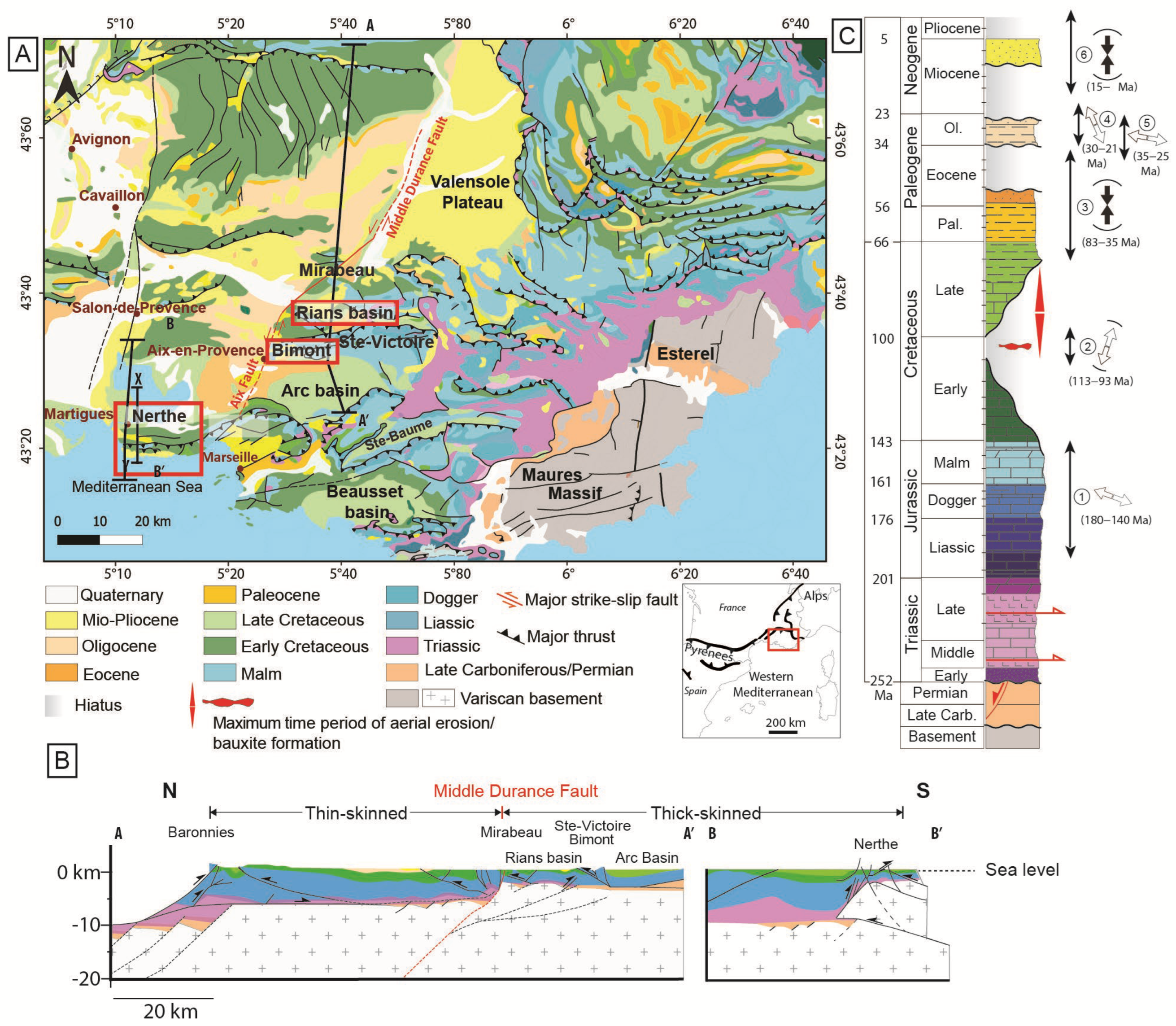
Figure 2.
(A) Detailed geological map (simplified) of the Nerthe range, extracted from the BRGM InfoTerre portal (https://infoterre.brgm.fr, accessed on 20 November 2025). The red line X−Y partially represents the cross-section presented in (B). Red dots represent the measurement and sampling sites. Crossed dot represents the La Folie well. (B) Balanced cross-section of the Nerthe range, where the sampling and measurement sites are projected along the topography. Basement-cover geometry is derived from [40].
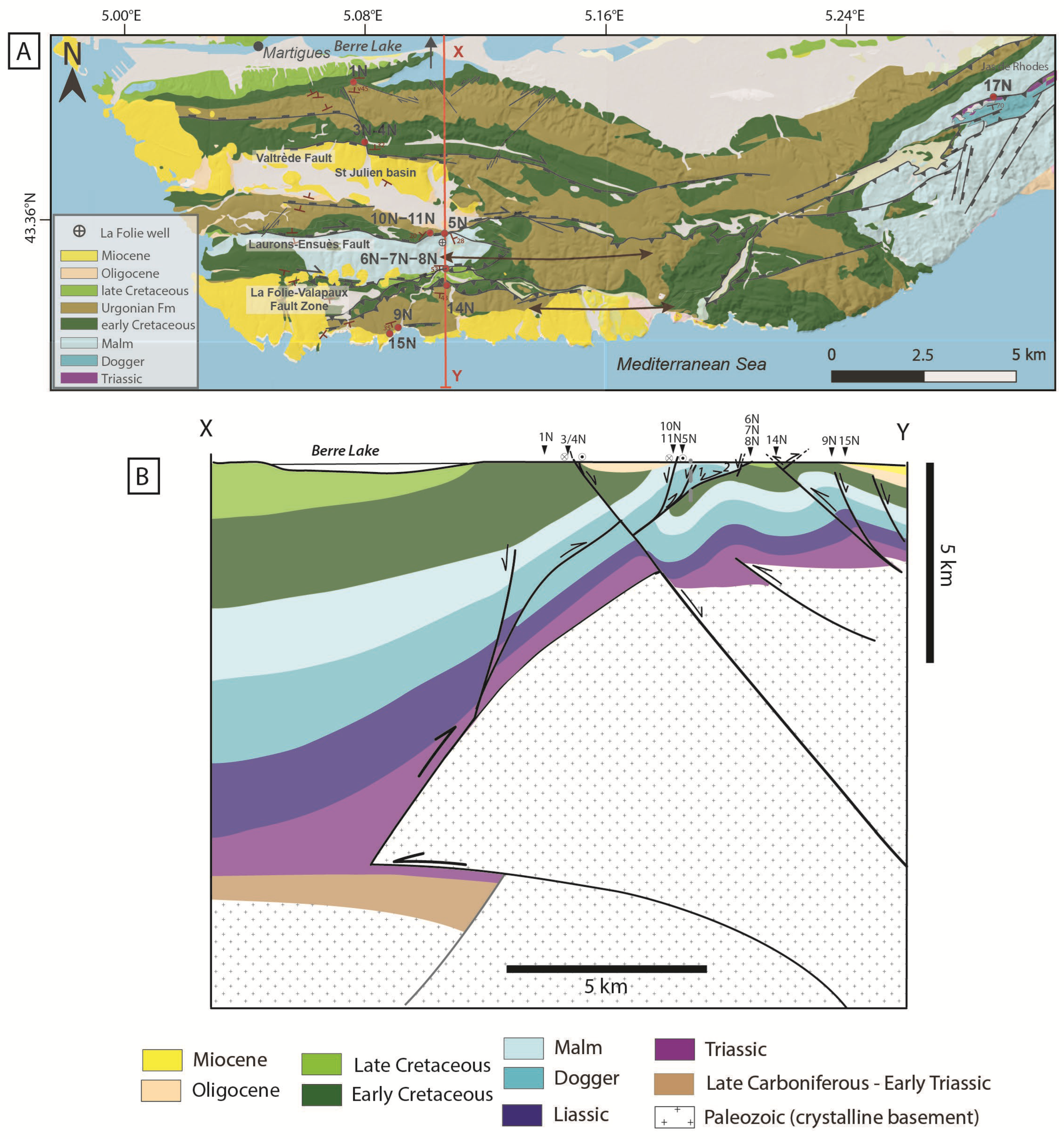
Figure 3.
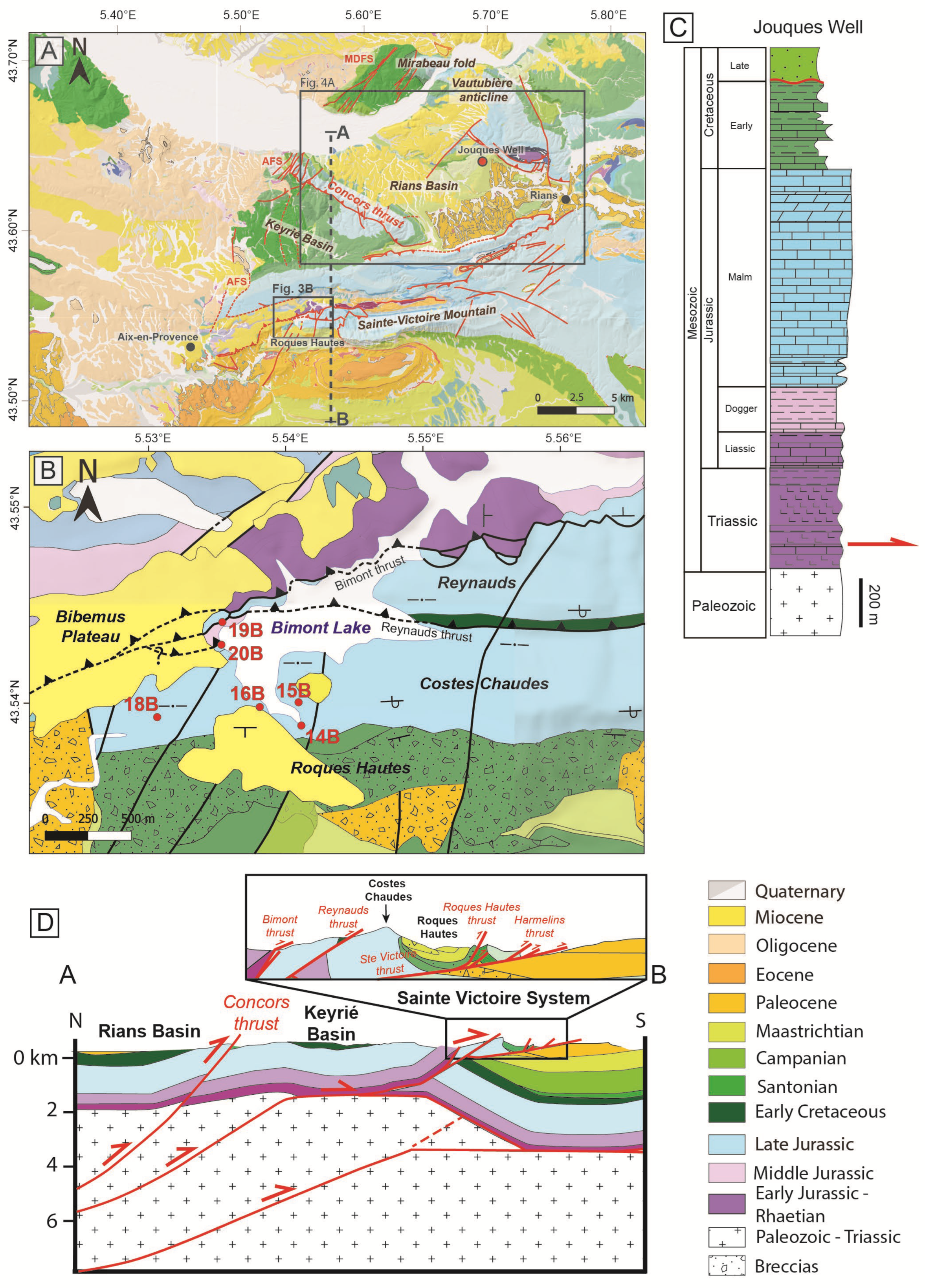
(A) Detailed geological map of the zone of interest, covering the Bimont Anticline to the Rians Basin. Compiled from the BRGM InfoTerre portal. Black frames represent the extent of detailed maps presented in (B) and in Figure 4A. Red dot represents the Jouques well. (B) Detailed map of the Bimont Lake area. Red-labeled dots represent the sampling and measurement sites. (C) Stratigraphic column reconstructed from the Jouques well logging reports. (D) Cross-section along A-B (located in (A)), with a zoom-in on the Sainte Victoire system that the Bimont anticline belongs to. Modified after [47].
2.1. Meso-Cenozoic Tectonic History of Provence
From the Triassic to the Early Cretaceous, Provence was part of the passive continental margin bordering the Tethys Ocean [48]. During the Albian–Cenomanian, the region experienced extensional crustal doming, triggered by diverging movements along the eastern edge of the Iberia–Eurasia plate boundary [54], a process described as the Durancian uplift [49,55]. This tectonic event led to the formation of roughly E-W-striking normal faults and related horsts and grabens [56], regional erosion, and surface exposure that favored karst processes and bauxite formation due to terrestrial weathering [57] and the development of a late Cretaceous regional unconformity.
Between the late Cretaceous and the late Eocene, NW-SE convergence of the African and Eurasian plates [58] resulted in the collision of the Iberian plate and the Corsica–Sardinia block with Eurasia [30,31,37,43,46,54,59,60,61,62,63,64,65]. The resulting stress regime was either compressional or strike–slip in type, with the principal maximum stress σ1 oriented approximately N-S on a regional scale [51,52,53], but with local orientations from NNE–SSW [39,42] to NNW–SSE [47,66]. This compression produced E-W-striking folds and thrusts, such as the Sainte-Victoire, Bimont, and Nerthe folds and the Etoile and Sainte-Baume thrusts [43,67,68,69], as well as left-lateral strike–slip faults striking NNE–SSW to NE–SW, including the Aix–Middle Durance Fault (AMDF) system, the Salon–Cavaillon Fault (SCF), and the Nîmes Fault (NF). Although the onset of the Pyrenean compression in Provence is broadly placed in the late Cretaceous [29,43,53,60,66,70], with a climax during the Eocene [43,46,71], the precise timing is still debated. Some authors have placed the initial compression around the Campanian [40,47,72], while others [31,39,73] have argued for a slightly earlier onset during the Late Santonian–Campanian. Bilau et al. [44] even proposed that the Pyrenean–Provençal compression started as early as 97–90 Ma, synchronously with the Durancian uplift. Further west, in the northern Pyrenean foreland, Parizot et al. [23] reported U-Pb ages of Pyrenean mesoscale contractional structures between 46.7 ± 2.9 Ma and 32.8 ± 2.0 Ma, while Jullien-Sicre et al. [21] reported U-Pb ages between ca. 48 Ma and 30 Ma.
During the latest Eocene (Priabonian) to Oligocene, an E-W-to-WNW-ESE extension associated with the West European Cenozoic Rift System (ECRIS) was recorded at different places in Provence [51,53], where it caused the formation of the Aix-en-Provence Basin [47,52], the Manosque basin [74], and the Marseille Basin [41]. The origin of this rifting is not unanimously agreed upon; one hypothesis connects it to the African–Eurasian convergence and a change in the African plate’s rotation pole [75], while another attributes it to the development of a thickened European lithospheric root beneath the Alps [76]. This phase was followed by the Liguro-Provençal rifting during the Oligocene–Aquitanian, resulting from the counterclockwise rotation of the Corsica–Sardinia block [77,78,79,80] and the subduction of the Apennine front [46,81]. The resulting NNW–SSE to NW–SE extension led to the formation of the Gulf of Lion passive margin and the opening of the Ligurian back-arc basin [41,82,83,84,85], temporarily overprinting the ECRIS-related extension during the Chattian.
African–Eurasian plate convergence persisted and produced Alpine compression during the Neogene, dated either to the Burdigalian–Langhian transition near the Salon-Cavaillon Fault [86] or to the late Tortonian in the eastern Lubéron Range [87]. In Provence, the Alpine compressional stress was directed NNE–SSW to ENE–WSW [39,51,52,88,89,90]. The main effect was the reactivation of major E–W trending folds formed in the earlier Pyrenean–Provençal orogenic phase, including the Lubéron, Alpilles, Trevaresse, and Ventoux structures [43,67,72,86,91,92], though overall Alpine shortening in Provence remained limited [40].
2.2. Tectonic Style of Deformation of Provence
In Provence, tectonic deformation exhibits contrasting styles across the AMDF [40,43,46,47,55,86,93]. Northwest of this fault system, where the sedimentary pile exceeds 7 km in thickness, the crust is deformed with a thin-skinned style, whereas to the southeast, thick-skinned deformation prevails, with the sedimentary cover commonly less than 4 km thick [40] (Figure 1B). During the Pyrenean shortening, the NNE-SSW-to-NE-SW-oriented AMDF, SCF, and NF functioned as left-lateral transfer zones, accommodating regional deformation [86]. The activation of these structures, particularly the AMDF inherited from the Variscan orogeny [94], has been repeatedly influenced by major tectonic episodes. During the Triassic to Jurassic, the extension linked with the formation of the Tethyan margin initiated normal faulting along the AMDF [95]. Notably, the westward-dipping AMDF led to pronounced differences in sediment accumulation across eastern and western domains [40,74]. The AMDF was subsequently reactivated as a reverse and strike–slip fault zone during the Pyrenean orogeny [91,96], focusing much of the shortening and accommodating differential deformation—restricted in the northwest thin-skinned domain but more pronounced in the southeast [40]. Later, the West European and Liguro-Provençal rifting phases produced a renewal of normal faulting, followed by further reverse fault activity during the Alpine orogeny [67,74,86,89,90,91,96].
Salt tectonics also played a significant role in shaping the geology of Provence. Initiating in the Early Jurassic and continuing until the late Cretaceous, halokinetic movement was mainly triggered by variations in sedimentary input on Middle Jurassic strata [73,97,98]. Chronological markers such as growth strata and unconformities within the Jurassic–Cretaceous formations constrain this activity [97,98,99,100]. A second major phase of salt mobilization, associated with Triassic detachment levels, was initiated by the Pyrenean–Provençal contraction from the late Cretaceous to late Eocene [97]. Renewed movement of salt diapirs subsequently coincided with the Oligocene extension and culminated during the Alpine compressional events [101,102].
2.3. Meso-Cenozoic Sedimentary Succession of Provence
In Provence, the sedimentary record is composed of a variety of rocks, including shales, carbonates, sandstones, marls, and evaporitic layers notably linked to Triassic Keuper facies. During the Jurassic and Early Cretaceous, the Tethyan margin subsided and enabled the accumulation of a carbonate platform about 400 m thick, featuring rudist-rich Urgonian facies from the Valanginian to Early Aptian [49,103,104]. The Durancian uplift fostered the widespread development of karst bauxite deposits, which are associated with periods of subaerial exposure and continental weathering [49,55,57,105,106] (Figure 1C). The sequence from the late Cretaceous through the Eocene is dominated by continental siliciclastic and carbonate strata, incorporating organic-rich black limestones of latest Santonian–early Campanian age and lacustrine/fluvial limestones, claystones, and sandstones from the Campanian to Maastrichtian, sometimes interbedded with levels of breccia. Conversely, southeasternmost Provence, nearly unaffected by the Durancian uplift, preserved marine environments and the deposition of rudist-bearing shallow marine limestones [107]. The Oligocene rifting phase resulted in the formation of extensional basins like those of Aix-en-Provence and Marseille, filled with lake- and river-derived conglomerates, limestones, and shales [41]. The Miocene record is marked by a marine transgression depositing marls and sands ([108] and references therein) unconformably atop the folded Cretaceous and Jurassic units of structures such as the Bimont fold and the Sainte-Victoire range. Finally, the Messinian salinity crisis led to intensified fluvial incision in Provence, particularly by the Durance River [109].
2.4. The Studied Structures
2.4.1. The Nerthe Range
The Nerthe range is an E-W-trending 25 km long, 8.5 km wide range located in SW Provence, bounded to the south by the Mediterranean Sea, to the north by the Etang de Berre, and to the east by the Marseille basin (Figure 1A and Figure 2A). The structure of the Nerthe range is divided into several tectonic compartments separated by major faults formed during a complex sequence of compressional and extensional deformation phases. The northern part of the range consists of a monocline structure dipping northward, made up largely of early Cretaceous limestones and marls, forming the southern limb of the Istres syncline. The central region features fault-bounded, small subsiding basins like the Saint Julien basin, which is filled with Oligocene and Lower Miocene (Burdigalian) lacustrine and continental deposits, including laminated limestones, marls, gypsum, and conglomerates. The southern sector of the massif is marked by overthrusting, where Barremian rudist-rich limestones are tectonically emplaced above younger Aptian and late Cretaceous units, forming a prominent thrust complex. Observations in the field combined with cross-sectional analysis indicate southward thrusting within the sedimentary cover along a shallowly north-dipping ramp, accompanied by minor north-verging thrusts [40,110,111]. The Nerthe range is positioned above a basement uplift characterized by relatively thin Mesozoic units; a major E-W-striking, north-dipping normal fault makes the transition to the Istres basin to the north, which displays a much thicker Mesozoic sequence [40,43,66]. Tempier [43] and Bestani et al. [40] proposed that this basement high and its associated preexisting normal fault were cut by a later south-dipping basement thrust located approximately at ~10 km depth during the Pyrenean–Provençal compressional event.
Most contractional deformation is considered to be Pyrenean (late Cretaceous–Eocene) in age but remains imprecisely dated; it was followed by the Oligocene extension. The early Burdigalian marine deposits seal and cover the deformed structures, indicating that major tectonic activity predated the Burdigalian.
The cross-section of Figure 2B illustrates the mixed thin-skinned and thick-skinned structural style of deformation, with the basement being involved in shortening at depth, while the sedimentary cover is decoupled above the Triassic evaporites and is affected by folds and shallow thrusts. The section also shows that the across-strike structure of the Nerthe range is characterized by two main E-W-trending anticline structures associated with north- and south-verging thrusts (e.g., the La Folie–Valapaux fault), later dissected by E-W-striking normal faults, such as the Valtrède fault and the Laurons-Ensuès Fault in the western and central part of the range [66,111,112,113,114,115,116,117,118]. We investigated a transect roughly parallel to the section shown as Figure 2B, along which we measured mesostructures of various orientations in 14 sites, numbered 1N to 17N.
2.4.2. The Bimont Lake Area
The Bimont Lake area is located within the western segment of the Sainte-Victoire System, northeast of the city of Aix-en-Provence (Figure 1A and Figure 3A,C). The sedimentary succession in this area begins with approximately 50 m of Rhaetian shales, representing the only known outcrop of this unit within the Sainte-Victoire System [47]. The Jurassic succession comprises roughly 300 m of Liassic breccias, limestones, and black shales, overlain by a similarly thick Dogger sequence composed of marine black shales and limestones. This is followed by the Malm series, which consists of more than 1300 m of marine limestones [47,119]. The Early Cretaceous series in the Bimont Lake area is characterized by massive marine limestones of Berriasian and Valanginian age. In the southern part of the Bimont Lake, breccia formations, namely the Campanian- to Maastrichtian-aged “Rognacian” breccias and the Danian-aged “Tholonet” breccias, unconformably overlie the sub-vertical late Jurassic strata [47]. These syn-tectonic breccia deposits are part of growth strata that developed in response to the formation of the Sainte-Victoire System [47]. Finally, the sedimentary succession is unconformably overlain by Miocene deposits.
The Bimont Lake area is structured by two ENE- to E–W-striking, N-dipping thrusts, known as the Bimont and the Reynauds thrust (Figure 3B,D). The northern Bimont thrust dips ~40° to the north and places Rhaetian units over the overturned, north-dipping late Jurassic to early Cretaceous strata of the Reynauds unit. The southern Reynauds thrust dips approximately 30° to the north and places the Reynauds unit over the overturned, north-dipping late Jurassic strata of Costes Chaudes [47].
2.4.3. The Rians Basin
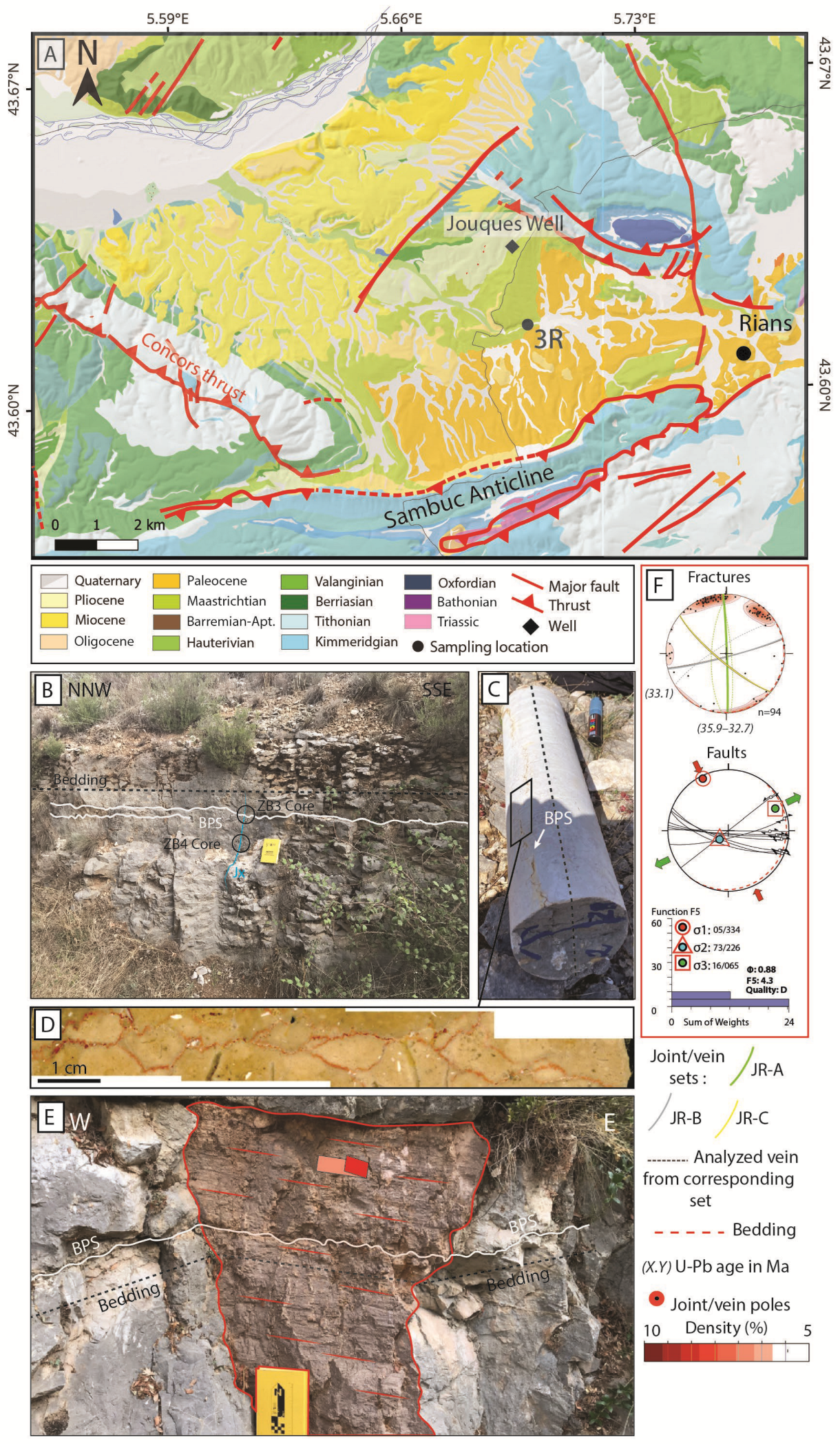
The Rians Basin is an NW-SE-trending syncline (Figure 3D and Figure 4A) bounded to the NE by the Vautubière anticline, in the west by the Concors thrust, and in the south by the Sambuc anticline. The sedimentary deposition in the Rians Basin is described in [47] from the Jouques well data (Figure 3C). The basin is filled by late Campanian (called “lower Rognacian”) siltstones with interbedded thick amalgamated sandstone beds covered by the Maastrichtian (called “upper Rognacian”) lacustrine limestones and red fluvial siltstones. The Cenozoic formations consist of Danian (so-called “Vitrollian”) lacustrine limestones and siltstones. This sedimentary sequence is the lateral equivalent of syntectonic breccias in the footwall of the Sainte-Victoire System [39,47,70,120,121,122].
Figure 4.
(A) Detailed geological map of the area of the Rians Basin compiled from the BRGM InfoTerre portal. Black diamond represents the Jouques Well presented in Figure 3C; small black dot represents the sampling site (3R) where core samples were drilled. (B) Location at the outcrop scale of the core samples. Bedding is represented by dotted line, and some bedding-parallel stylolites (BPSs) are highlighted in white. The yellow notebook for scale is 16 cm tall. (C) Extracted oriented core sample, where BPS is pointed, and initial bedding plane is represented by a black dotted line. (D) Zoom-in on a polished hand−sample showing the petrography and the occurrence of BPSs, veins, and jogs in the core. (E) Field photograph of left-lateral strike–slip fault. (F) Top: Fracture (mode I) data projected as poles on a lower-hemisphere stereonet; density contours are calculated from Fisher density and are represented in red. From the highest density values, an average fracture plane is represented, with color related to the fracture set described in the text (and presented below). Specific fractures that were successfully dated by U-Pb calcite geochronology are represented by dotted lines on the stereonet, and the age (without the uncertainty) is shown in brackets. Bottom: Fault–slip data in a lower-hemisphere stereonet, with the results of stress inversion using WinTensor software version 6.0.0 [123], reported as arrows and symbols.
3. Materials and Methods
3.1. Sampling Strategy and Material
Measurements and sampling sites encompass carbonate lithologies such as Hettangian dolomite and limestones of ages spanning the Bajocian to Miocene. Field data were collected across the Rians Basin, the Bimont Lake area, and the Nerthe range. By means of hand sampling and coring, we sampled syn-kinematic calcite mineralizations associated with fault rocks from the damage or core domains of major thrust zones, as well as with mesoscale deformation features such as minor striated faults and stylolites (Supplementary Material Figure S3). We also widely sampled small veins, keeping in mind that in the case of veins, opening and mineralization may not be perfectly coeval, and that full calcite precipitation may slightly postdate vein opening. There is coevality between calcite mineralization and deformation, hence, the syn-kinematic character of mineralization is obvious when calcite precipitates as fibers in opened veins [124]. Blocky calcite indicates free calcite precipitation from fluids in a void, due either to precipitation occurring after opening or at a slower rate than the rate of opening. However, even in the case of blocky calcite opening, mineralization can be coeval if calcite precipitation was directly triggered by the opening of the veins. In addition, even though calcite mineralization may be delayed with respect to opening at the scale of an individual vein, one can safely consider that, for a vein set, precipitation of blocky calcite is coeval with vein opening over the time span corresponding to the fracturing event forming the set, and is thus syn-kinematic in a broad sense [1].
Petrographic and microstructural analyses of the collected samples were carried out by means of X-ray diffraction (XRD) and cathodoluminescence (CL) with the aims of (1) confirming the calcite nature of the vein filling, fault coating, and matrix; (2) identifying a single or more generation(s) of calcite infill in a given vein or calcite step; (3) confirming the opening mode of veins, along with possible re-opening and/or shear reactivation and (4) constraining the relative chronology between mesostructures (e.g., vein–vein, stylolite–vein).
In total, 41 thin sections were studied using an optical microscope Zeiss AxioSkop 40 (Carl Zeiss Light Microscopy, Göttingen, Germany) with a Nikon D5100 SLR camera (Nikon Corporation, Tokyo, Japan) and using cathodoluminescence on an OPEA Cathodyne (OPEA, Laboratoire Optique Électronique Appliquée, Paris, France) equipped with a cold cathode. The latter were performed with replicable parameters, 50–60 mTorr vacuum, 15 kV voltage, and 200 μA electron beam. All these analyses were conducted at ISTeP (Institut des Sciences de la Terre de Paris), Sorbonne Université, France.
3.2. Analysis of Fractures and Stylolites
During fieldwork, we systematically measured (1) the orientation data for veins and joints, actively looking for evidence of opening modes, such as offsets of pre-existing fractures or stylolites; (2) the orientation of fault planes and the rake (pitch) of striations, with the sense of movement consistently inferred from kinematic indicators like calcite steps; and (3) the orientation of stylolite surfaces and the direction of their peaks, with particular care to distinguish stylolites from slickolites (see [125]). We paid close attention to the relative structural chronology among mesostructures, such as abutment and cross-cutting relationships, both at the outcrop scale and in thin sections.
Significant effort was devoted to identifying calcite jogs linked to bedding-parallel stylolites. These jogs refer to localized zones of calcite precipitation, typically found in gaps formed between the tips of two stylolites, generated to accommodate local displacement perpendicular to stylolite planes [126,127]. Stylolites develop through pressure solution and recrystallization, wherein insoluble phases (like clays and oxides) become concentrated along the stylolite seam [128,129], while soluble minerals, such as calcite, are dissolved and may locally reprecipitate. Because jogs form and are filled with calcite synchronously with the growth of the stylolite peaks [127], dating calcite in these jogs constrains the period of active pressure solution along the stylolite [17].
The orientations of mesostructures, together with the local orientation of bedding, were compiled for each site and then plotted on Schmidt stereonets (lower hemisphere) using the Stereonet software version 11 [130] for tensile (mode I) fracture and stylolite peak data and Win-Tensor [123] for fault–slip data. At each locality, fracture planes were organized into sets based on shared orientations (either in raw or restored bedding position), similar relative timing, and common deformation mode (e.g., [131,132,133]). For each group of mode I fractures or stylolites, the predominant orientation was defined using Fisher-based density plots, allowing for a statistically robust determination of dominant fracture directions at the site scale, even with datasets as small as 20 measurements. We additionally assumed that mode I fractures formed perpendicular to the minimum principal stress (σ3) [134] and that stylolite peak trends correspond to the orientation of the maximum principal stress σ1 during pressure solution along the stylolite [135].
3.3. Inversion of Fault–Slip Data for Tectonic Paleostress
Inversion of fault–slip data for paleostress involves finding the stress tensor that accounts for the best fit between the observed directions and senses of slip on a large number of faults displaying a wide distribution of orientations and the theoretical shear stress induced on these fault planes by this tensor [136,137,138]. The reconstructed stress parameters are the orientation of the three principal stress axes, σ1, σ2, and σ3, and the stress ellipsoid shape ratio, Φ = (σ2 – σ3)/(σ1 – σ3), with 0 ≤ Φ ≤ 1 and σ1 ≥ σ2 ≥ σ3, and pressure considered positive. In this work, inversion was carried out using the Win-Tensor program [123].
3.4. Inversion of Calcite Twin Data for Tectonic Paleostress
E-twins are common microscopic features in calcite deformed at low-pressure and -temperature conditions [139,140,141] and have long been used as indicators of paleostress orientations and magnitudes in various tectonic settings [140,142,143,144,145,146,147,148,149,150]. Twinning can be approximated to simple shear in a particular direction and sensed along crystallographic e-planes. Twinning occurs if and only if the resolved shear stress (RSS), , exceeds or equals the critical resolved shear stress (CRSS), , i.e., [151,152]. The CRSS depends on grain size and twinning strain but is poorly dependent on temperature (see discussion in [141]). For each sample, the orientations of twinned and untwinned planes are collected from three mutually perpendicular thin sections using a U-stage, following the procedure of [149]. For each sample, the mean grain size and the twinning strain are estimated to constrain the CRSS value to be adopted for the inversion process. The inversion involves finding the deviatoric stress tensor—i.e., the orientation of the three principal stress axes; the stress ellipsoid shape ratio, Φ; and the magnitude of the differential stress (σ1 − σ3)—which satisfies the above inequalities between τs and τa for a set of measured twinned planes and the whole set of non-twinned planes. In this work, we used the Calcite Stress Inversion Technique (CSIT-2) [153], which allows for the simultaneous identification and separation of superimposed deviatoric stress tensors, each of them accounting for part of the twin data within polyphase samples [154].
3.5. U-Pb Calcite Geochronology
We performed 76 U-Pb calcite geochronology analyses on 45 samples, geographically distributed as follows: 29 samples from the Nerthe fold, 12 samples from the Bimont Lake area, and 4 samples from the Rians Basin. Our dated samples can be separated into two categories. The first type of sample corresponds to syn-kinematic calcite mineralizations: 27 contain calcite-filled veins, 11 contain calcite samples from thrust fault zone rocks (hereafter “tectonic contacts”), 3 contain slickenfibers from mesoscale faults, and 4 contain calcite jogs related to bedding-parallel stylolites. The second type of samples corresponds to host rock secondary mineralizations (e.g., calcite cements) related to diagenetic processes (5 samples).
Absolute dating of our samples was conducted through two analytical sessions: a first session was performed at the Centre de Recherche et d’Enseignement des Géosciences de l’Environnement (CEREGE), Aix-en-Provence, France, with analyzed field samples from the Nerthe range and Bimont Lake area, and a second session at the Institut des Sciences Analytiques et de Physico-Chimie pour l’Environnement et les Matériaux (IPREM) laboratory in Pau, France, including additional samples or replicates of formerly analyzed mineralizations, as well as calcite jog samples.
At CEREGE, 37 analyses were carried out on polished 100 μm thick sections or 1-inch-diameter resin plugs using an ESI 193 nm excimer laser ablation system coupled to an Element XR SF-ICP-MS (detailed methodology and the U-Pb dataset can be found in the Supplementary Material). Samples were first scanned with a resolution of 3200 dpi to pre-select the areas of interest in terms of mineralogy, i.e., consisting of calcite vein from the same diagenetic phase or calcite steps from fault planes (Figure 4C,D). Then, samples were screened to identify locations with the highest U-Pb ratio variability and to thus target the best spots to perform the analyses [155]. After data acquisition and processing, ages for each selected calcitic component were derived from Tera–Wasserburg diagrams obtained using the IsoplotR software [156]. WC1 was used as a primary standard to correct 238U/206Pb fractionation [12] and AUG-B6 as a secondary standard [157] to check for reproducibility. Ages are quoted at a 95% confidence interval, including the propagation of systematic uncertainty by quadratic addition of 2.5% on WC1 age and an extra 3.5% to account for the long-term excess variance in AUG-B6, which is still under evaluation through an inter-laboratory comparison. Overall, this procedure offers great robustness in terms of sample throughput and data accuracy.
At IPREM, 40 analyses were carried out using a 257 nm femtosecond laser ablation system (Lambda3, Nexeya, Bordeaux, France), operating at 500 Hz and a spot size of 15 µm. The ablation was performed in a specific atmosphere composed of helium (600 mL/min) and nitrogen (10 mL/min) before being mixed with argon in the ICPMS. The ablation system is coupled to an Element XR SF-ICP-MS equipped with a jet interface. Similar to CEREGE, samples were first screened to identify locations most amenable to dating. However, the ablation strategy used at IPREM for obtaining ages is based on isotopic mapping of U, Pb, and Th elements obtained through a continuous ablation pattern [155,158]. Ages were calculated from the isotopic maps using a virtual spots approach [159,160]. WC1 was used as a primary standard to correct 238U/206Pb fractionation [12], and Duff Brown Tank [161] and AUG-B6 [157] as secondary standards. Ages calculated in the Tera–Wasserburg space using IsoplotR version 6.8 are quoted at the 95% confidence interval. Following [159], they include the decay constant uncertainty of 238U (0.1%), the 238U/206Pb ratio uncertainty of WC-1 (2.7%) [12], and the long-term excess variance in the NIST 614 standard (about 2.0%). Uncertainties are propagated following the recommendations of [162]. A complete description of the analytical acquisition, along with the raw data, is provided as Supplementary Material (Tables S1–S3).
4. Results
4.1. Orientations of Fractures, Stylolites, and Faults
4.1.1. The Nerthe Range
Site 1N is located at the northernmost part of the Nerthe massif (Figure 2A) and corresponds to an abandoned quarry, which provides a good exposure of the Urgonian rudist-bearing limestones. The bedding strikes E–W and dips 45° to the north. Mesostructures consist of two sets of sub-vertical fractures oriented N–S and E–W in a raw position, bedding-parallel stylolites, and tectonic stylolites with NE–SW-oriented peaks. Sites 3N and 4N are in Valanginian limestone and are located along a dextral strike–slip fault segment that acts as a relay between two sections of the Valtrède fault (Figure 2A). Deformation at site 3N is characterized by two sets of sub-vertical veins oriented NE–SW and NW–SE to NNW-SSE in a raw position (Figure 5). Site 4N displays a set oriented NE–SW, with the occurrence of NNW-SSE veins that, given the spatial proximity between sites 3N and 4N (separated by only a few meters), can be related to the NW-SE set of site 3N.
The Laurons–Ensuès Fault is an E-W-striking and north-dipping normal fault that is located 2 km south of the Valtrède fault, with Valanginian limestones in the hanging wall and Tithonian limestones in the footwall (Figure 2A). Sites 10N and 11N, located in the hanging wall, both exhibit sub-vertical NNE–SSW- to NE–SW-oriented vein sets (Figure 5). Sub-vertical ENE–WSW- and NW–SE-oriented vein sets were identified exclusively at site 11N (Figure 5). Site 5N, located in the footwall, displays NE-SW- and E-W-striking sub-vertical vein sets (Figure 5). Abutment and cross-cutting relationships unambiguously indicate that the E-W veins predate the NE-SW veins (Figure 6B).
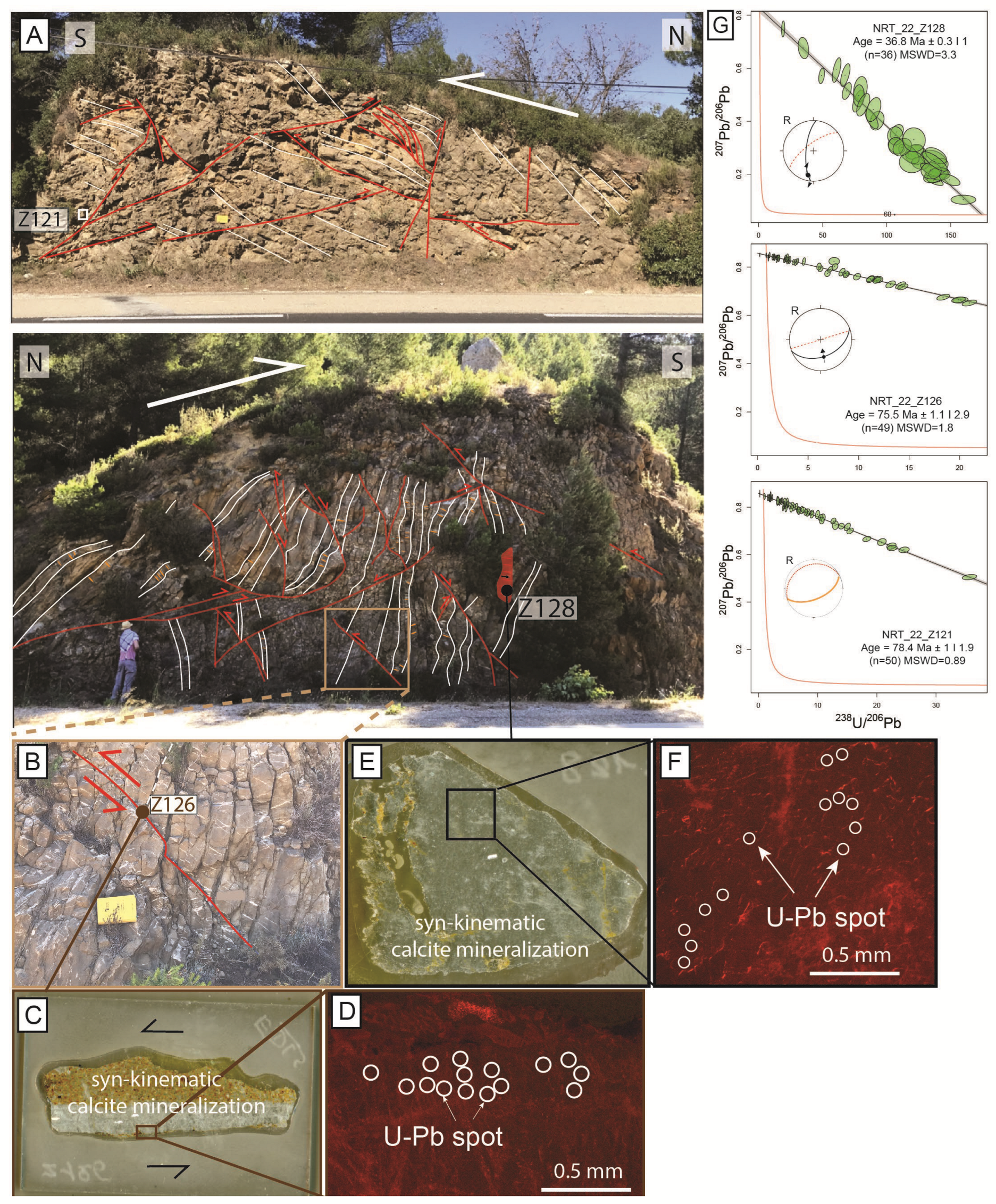
In the northern section of the La Folie–Valapaux Fault Zone, the Tithonian limestones are thrust southward onto late Cretaceous (Turonian to Santonian) limestones (Figure 7A). Site 8N, located in the hanging wall of the thrust, exhibits N-S-, NNE-SSW-, and E-W-striking veins. A few meters south, site 7N is located within the damage zone of the thrust (Figure 7A), showing darker, highly fractured, and anastomosed carbonate layers, locally containing NE-SW calcite veins, the dip of which is perpendicular to bedding (Figure 5). Approaching the fault core, deformation intensifies, giving way to a lighter-colored, cataclastic zone where the rock is more finely crushed, although isolated centimetric clasts are still preserved. The sharp transition between these two domains is clearly visible in Figure 7A. Samples Z132 and Z133 were collected from the cataclasites. In contrast, darker zones under natural light with very weak luminescence, typically occurring as blocks, were identified as the deformed carbonated host rock. At site 6N, located in the footwall of the thrust, two facing outcrops show the deformation of the late Cretaceous carbonates (Figure 8A). The carbonate strata are intensely folded and faulted; they exhibit reverse, strike–slip, and normal faults in the current attitude of bedding, as well as bedding-perpendicular fractures consistently oriented NNE-SSW to NE–SW after unfolding (Figure 5 and Figure 8).
Figure 5.
Fracture (mode I), stylolite, and striated fault data projected as poles (mode I and stylolites) and planes with rake (faults) on a lower-hemisphere stereonet for each site in the Nerthe range. For mode I fractures and stylolites, density contours are calculated from Fisher density and are represented in red for mode I fractures and in blue for stylolites. From the highest density values, an average fracture plane is represented, with color related to the fracture set described in the text (and presented below). Specific fractures that were successfully dated using U-Pb calcite geochronology are represented by dotted lines on the stereonet, and the age (without the uncertainty) is shown in brackets. “n” stands for the number of measured data per stereonet. For each site and when relevant, the results of the inversion of calcite twins for stress are presented as the orientations of σ1 (red), σ2 (blue), and σ3 (green) axes with corresponding arrows representing horizontal compression (red) or extension (green). The site’s bedding is represented as a dashed line, and the veins from which calcite twin measurements were taken are represented by a star. Stress ratio Φ values are reported below the stereonets. All data are presented in the current strata attitude (noted as R), where bedding is represented by a red dashed line and in an unfolded strata attitude (noted as U). Fault-slip data from site 9N are from [82]; for computed paleostress orientations please refer to the key of Figure 4.
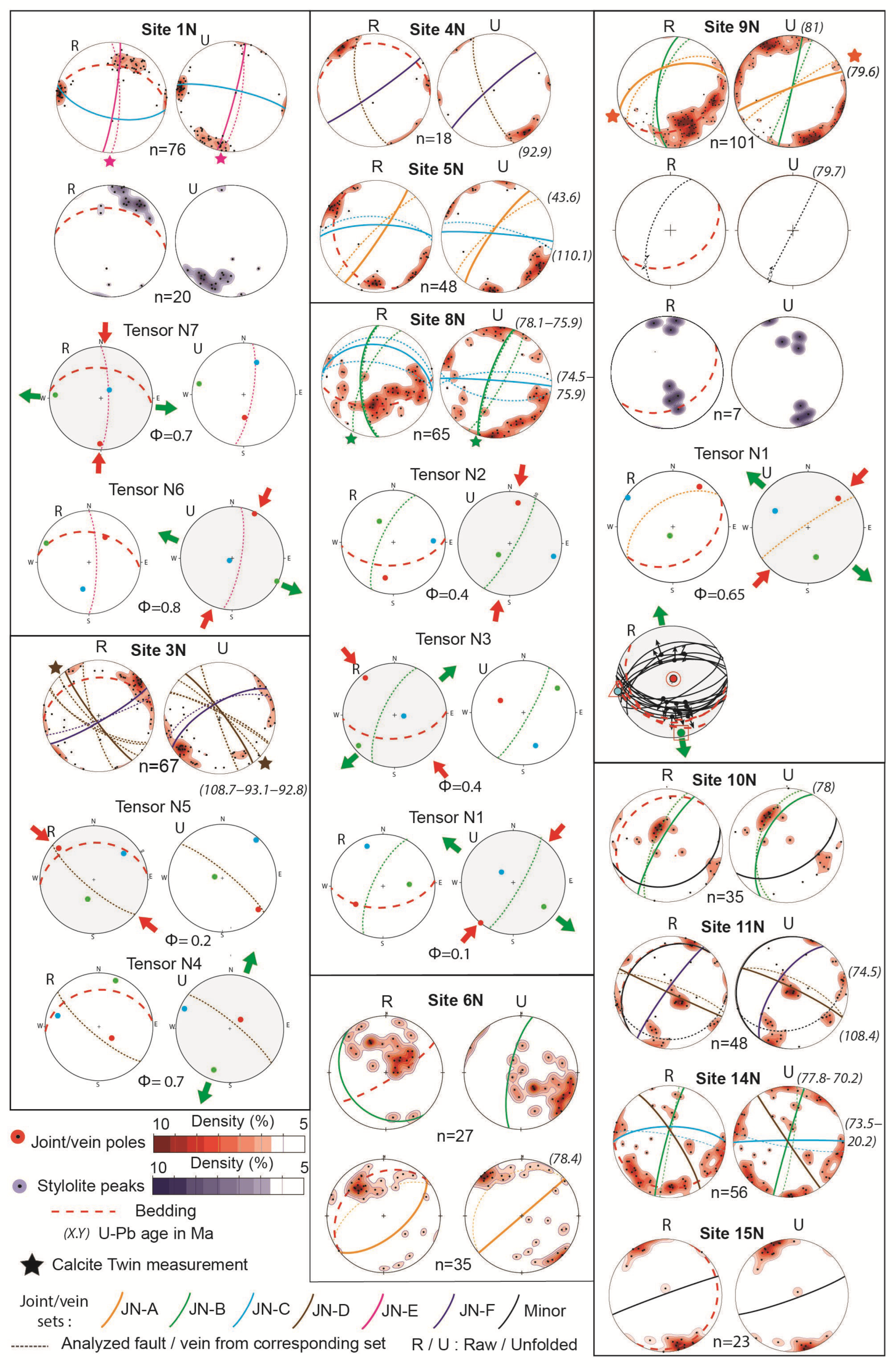
Figure 6.
(A,B) Interpreted field photographs of vein network as observed in the field, where relative chronological relationships are reported as 1 (oldest) and 2 (youngest). For each studied site ((A) 8N, (B) 5N), the corresponding stereonet is reported from Figure 5 in an unfolded strata attitude. (C–G) Photomicrographs in microscopy (natural light) and under cathodoluminescence of representative mode I veins (C,D) and pore-filling calcite cement (E–G). The blue frames represent the approximate position of the laser ablation that was conducted in order to date the calcite. (H) Tera–Wasserburg concordia diagrams of calcite mineralizations corresponding to (C–G), where the vein set is shown in a stereonet of the current strata attitude. The color of the fracture relates to the vein sets presented in Figure 5.
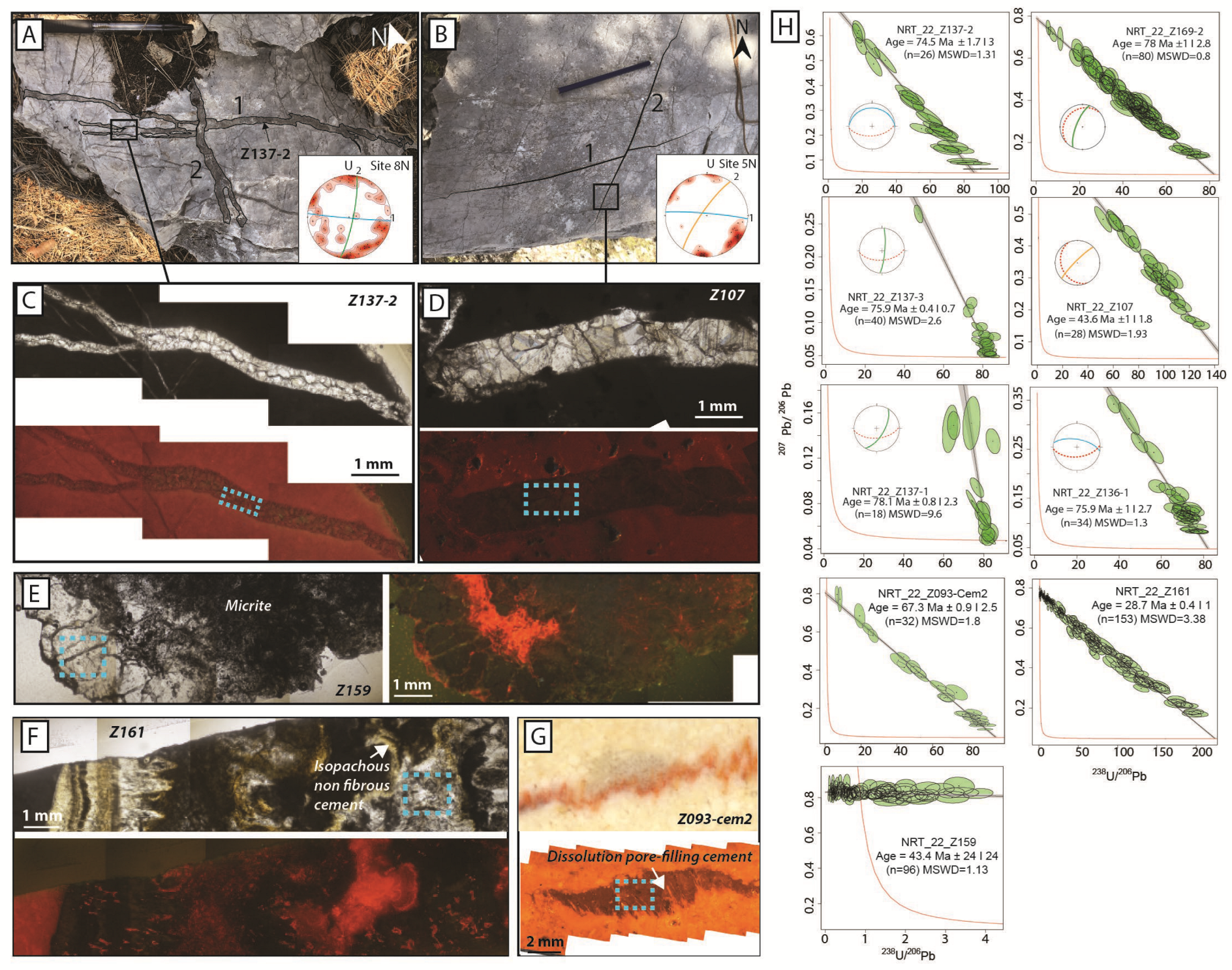
Figure 7.
(A) Field photograph of the La Folie–Valapaux Fault Zone damage zone (top) and its interpretation (bottom) at site 7B, highlighting the tectonic contact between the Tithonian formation to the north and the Turonian–Santonian formation to the south. (B) Microphotographs of a clast (sample Z133) from the cataclasite zone, shown in cross-polarized light (top) and under cathodoluminescence (bottom). (C) Close-up view of the outcrop within the Turonian–Santonian formation, with microphotographs of a clast (sample Z132) in cross-polarized light (top) and under cathodoluminescence (bottom). White circles represent the laser ablation spots used for U-Pb absolute dating. (D) Tera–Wasserburg concordia diagrams for samples Z133 and Z132. Sample Z133 yields two distinct age populations, here referred to as Z133a and Z133b.
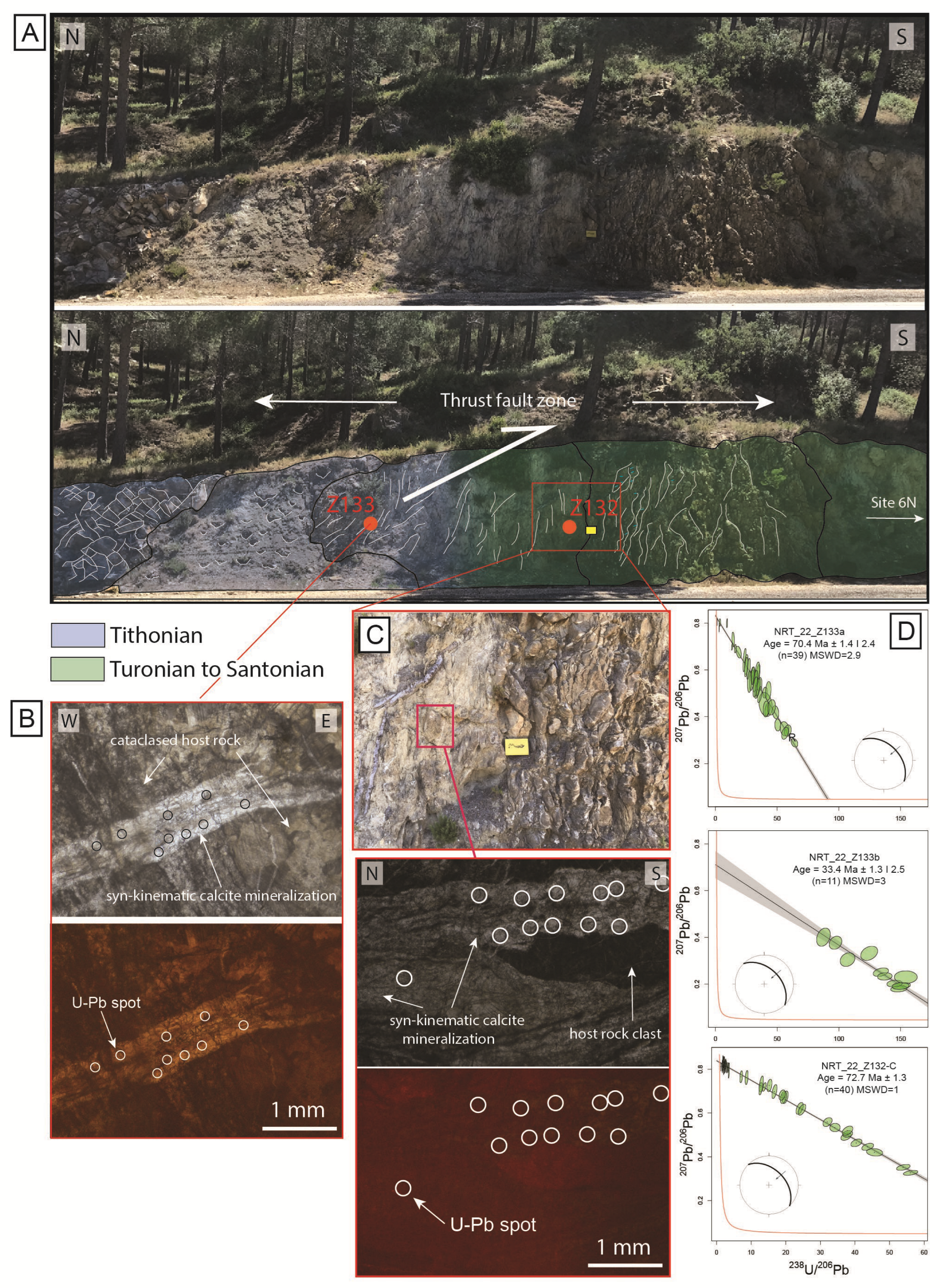
Figure 8.
(A) Interpreted field photograph of highly deformed Turonian–Coniacian–Santonian series from two facing outcrops, the eastern outcrop (top) and the western outcrop (bottom). These photographs exhibit the sampling location of samples Z121, Z126, and Z128. (B) Close-up of the sampling location of a slickenfiber sample (Z126) associated with an ENE-WSW-striking reverse fault. (C) Scan of sample Z126 thin section and (D) microphotograph under cathodoluminescence with white circles representing laser ablation spots for U-radiochronology. (E) Scan of a thin section of slickenfiber sample (Z128) from an N-S-oriented strike–slip fault (dextral) and (F) microphotograph under cathodoluminescence with white circles representing laser ablation spots for U-radiochronology. (G) Tera–Wasserburg concordia diagrams for samples Z128, Z126, and Z121.
Further south, site 14N exposes the southern section of the La Folie–Valapaux Fault Zone, an E–W-striking, north-dipping thrust with Hauterivian limestone in the hanging wall and Barremian limestones (so-called Urgonian facies) in the footwall (Supplementary Material Figure S2). At the outcrop scale, the fault zone consists of a several-meter-thick cataclasites. N–S-, E–W-, and NW–SE-oriented sub-vertical vein sets were also measured at this site (Figure 5).
Site 9N is an abandoned quarry exposing south-dipping Urgonian rudist-bearing limestone strata (strike N060, dip 38°, Figure 5 and Figure 9). There, two sets of sub-vertical veins oriented NNE–SSW and NE–SW can be observed, as well as NNE-SSW-striking right-lateral strike–slip faults and bedding-parallel faults. In addition to widespread bedding-parallel sedimentary stylolites, site 9N also displays bed-perpendicular tectonic stylolites with sub-horizontal peaks oriented NNW-SSE in an unfolded position. Going southward, we observed an angular unconformity between the folded Urgonian limestones and the sub-horizontal Miocene strata (site 15N), in which a sub-vertical vein set oriented ENE–WSW was recognized.
About 10 km east lies the locality of Jas de Rhodes, where sample site 17N is located, providing a lateral checkpoint for the transect we focused on. This area is characterized by numerous normal and reverse faults oriented ENE–WSW to NNE–SSW (Figure 2A). The thrust fault zone displays Kimmeridgian dolomite in the footwall and Bajocian–Bathonian marly limestones in the hanging wall. At site 17N, we sampled an ENE–WSW-striking and south-dipping thrust fault zone in the Kimmeridgian dolomite formation (Supplementary Material Figure S1).
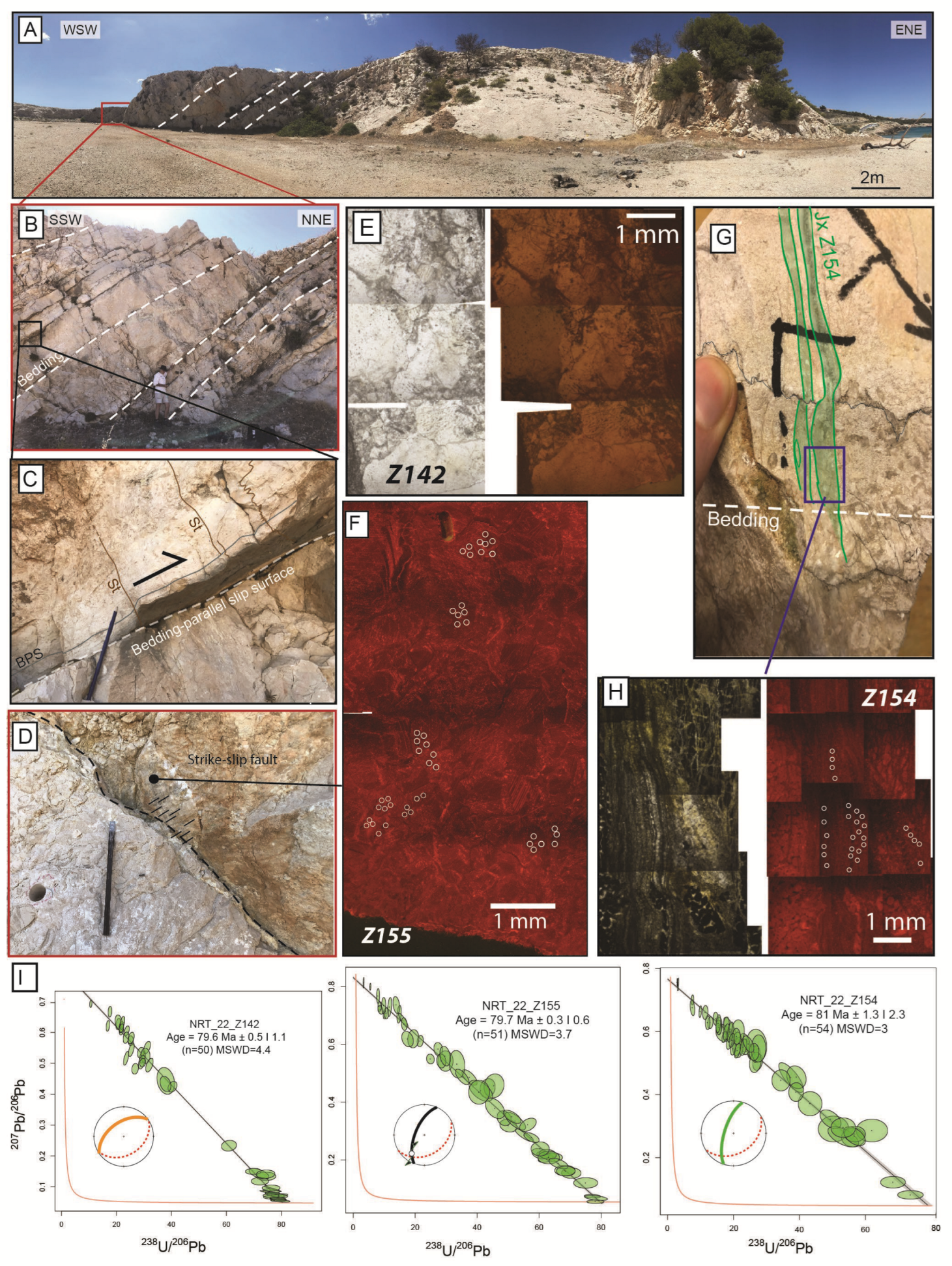
To sum up, we identified six main vein sets that can be found at the scale of the Nerthe massif (Figure 5), given by their occurrence and with respect to their current attitude: set JN-A comprises bed-perpendicular joints and veins striking N040 (read N040°E) to N060 (sites 9N, 5N, and 6N); set JN-B comprises bed perpendicular joints and veins striking N020 (sites 8N, 9N, 10N, 6N, and 14N); Set JN-C comprises bed perpendicular joints and veins striking N090 (sites 1N, 14N, 8N, and 5N); set JN-D comprises vertical joints and veins striking N135 and perpendicular to the strike of the strata (sites 3N, 11N); set JN-E comprises vertical joints and veins striking ~N-S and perpendicular to the strike of the strata (sites 1N); and set JN-F comprises vertical joints and veins striking ~N045, oblique to the strike of the strata (Sites 3N, 4N, and 11N). Other minor sets are encountered in some parts of the massif only, including bed parallel veins (site 11N), and veins oriented N070-40°S, oblique to bedding (site 10N). This fracture network is completed by sets of tectonic stylolites, of which peaks strike N020±20°, roughly parallel to the bedding (sites 1N and 9N), and N000-00° in the current strata attitude (site 9N). A limited population of striated faults (sites 6N and 9N) includes sub-vertical dextral strike–slip faults striking N020 and south-dipping reverse and normal faults striking N060.
Figure 9.
(A) Panoramic view of the Boumandariel carry (site 9N). The white lines show the bedding. (B) Interpreted photograph showing a close-up of the outcrop and the location of the Figure 8C image. (C) Interpreted photograph of the bedding (white lines), bedding-parallel stylolites (BPS), and tectonic stylolites (St) highlighted by brown thin lines. (D) Interpreted photograph of an NNE-SSW-oriented strike–slip fault. The black dot corresponds to the sampling location of slickenfiber sample Z155. (E) Microphotograph of NE-SW-oriented vein sample Z142 (JN-A) in natural light (left) and under cathodoluminescence. (F) Microphotograph under cathodoluminescence of sample Z155. (G) Interpreted photograph of a vein (in green) in relation to a BPS. (H) Microphotograph of vein sample Z154 in natural light (left) and under cathodoluminescence (right). (I) Tera–Wasserburg diagrams of samples Z142, Z155, and Z154.
4.1.2. The Bimont Lake Area
Several sampling and measurement sites are located along the shores of Bimont Lake. Sites 14B, 15B, and 16B are situated to the south of the lake, with site 14B located within the Tithonian limestones and sites 15B and 16B within the Kimmeridgian limestones (Figure 3B). At sites 14B and 15B, two distinct fracture sets were identified within sub-vertical, E–W-striking strata: (1) sub-vertical, N–S-striking fractures at both locations (set JB-A), and (2) a set of E–W-striking fractures dipping 50° to 70° toward the south (set JB-B) (Figure 10). Along the Imoucha trail at site 16B, structural observations were made possible through the analysis of drill cores from E-W-striking vertical limestone strata. The same two vein sets and two stylolite populations were identified within the cores (Figure 10 and Figure 11). Stylolites were classified into two populations according to their orientation: (1) sub-vertical bedding-parallel stylolites and (2) sub-vertical N–S-oriented tectonic stylolites with E-W peaks. Cross-cutting relationships between vein sets and stylolite populations are illustrated in Figure 11. These observations reveal that E-W-striking veins (set JB-B) are cut by N-S-striking veins (set JB-A). Figure 11 also shows that BPSs affect both vein sets (JB-A and JB-B). Specifically, one BPS dissolves a portion of the E-W vein on the left side of Figure 11C and offsets another E-W vein toward the center, and this same BPS cuts across the N-S vein on the right side of the image. Calcite jogs can also be observed in association with BPSs (Figure 11C). Finally, field observations indicate that N-S veins and BPSs are affected by N-S-striking stylolites with E-W-trending peaks (Figure 11B).
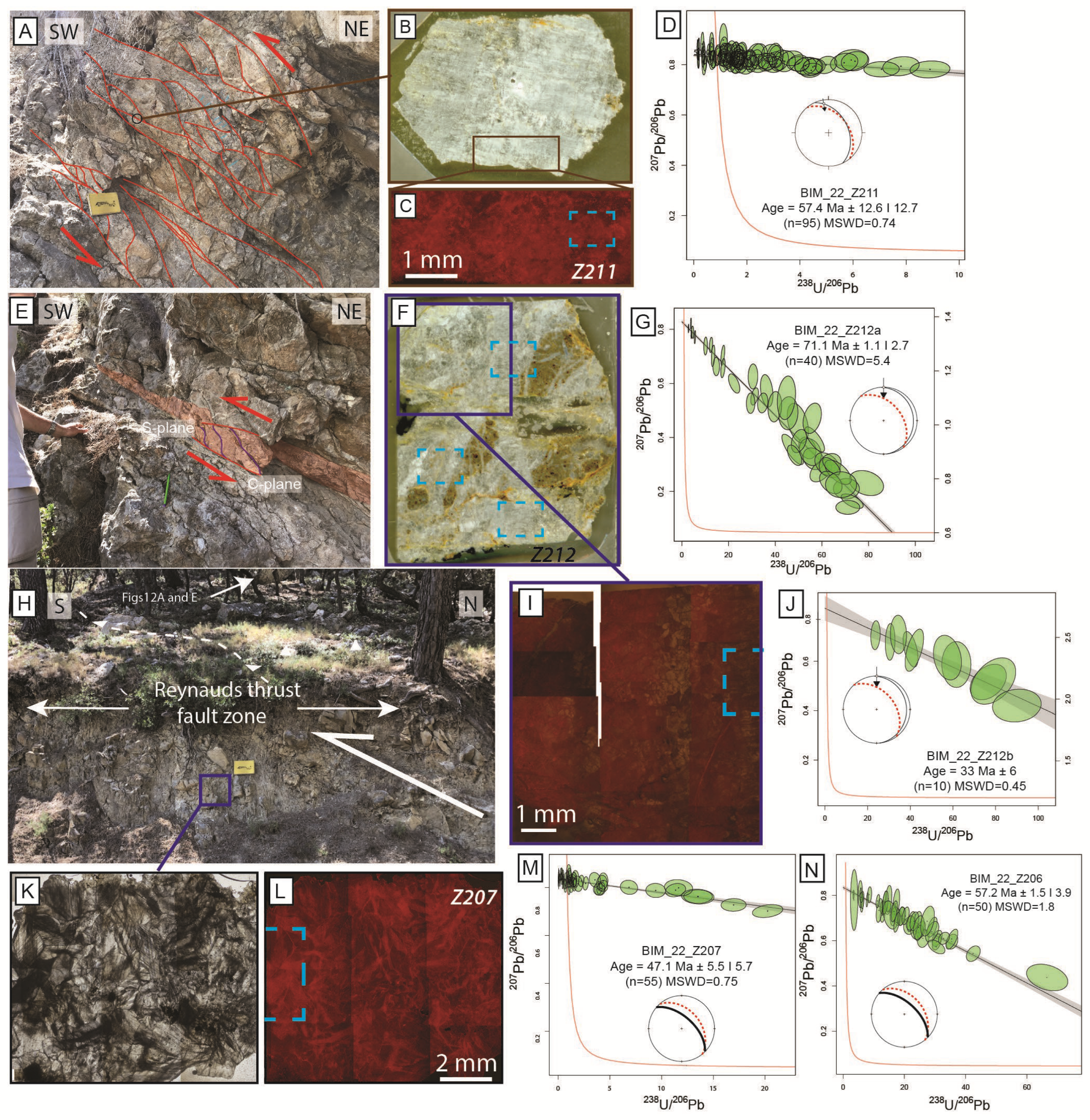
Site 18B is located within Kimmeridgian limestones and corresponds to a place where Lacombe et al. [53] reported highly dipping, N–S-oriented normal faults affecting sub-vertical, E–W-striking bedding (Figure 10). Site 19B is located on the western shore of Bimont Lake and is subdivided into two distinct zones. The first zone, referred to as 19B-Contact, corresponds to the Reynauds thrust fault zone between the Bathonian and Toarcian formations (Figure 12). Deformation at site 19B-Contact is characterized by the presence of centimeter-scale rock clasts embedded within a finely crushed matrix (Figure 12H). The samples collected from this area include both veins preserved within the intact rock clasts and powder samples extracted from the finely crushed matrix. The second zone, referred to as 19B-Cave, is a cave within the Toarcian marly limestones situated a few meters above the first zone (Figure 12). Brittle structures there consist of NW–SE-striking reverse faults, with average dips of ~45°N in a raw position, and a network of anastomosed brittle shear zones with well-developed C-S structures (Figure 10 and Figure 12A,E).
Site 20B is located at the tectonic contact between the Bathonian–Bajocian marly limestone and Kimmeridgian limestone, along the Reynauds thrust, in which we measured S-C planes (Figure 10) and sampled associated calcite mineralizations.
Figure 10.
Fracture (mode I), stylolite, and striated fault data projected as poles (mode I and stylolites) and planes with rakes (faults) on a lower-hemisphere stereonet for each site in the Bimont anticline. For mode I fractures and stylolites, density contours are calculated from Fisher density and are represented in red for mode I fractures and in blue for stylolites. From the highest density values, an average fracture plane is represented, with color related to the fracture set described in the text (and presented below). Specific fractures that were successfully dated using U-Pb calcite geochronology are reported in dotted lines on the stereonet, and the age (without the uncertainty) is shown in brackets. “n” stands for the number of measured data per stereonet. For each site and when relevant, the results of the inversion of calcite twins for stress are presented as the orientations of σ1 (red), σ2 (blue) and σ3 (green) axes with corresponding arrows representing horizontal compression (red) or extension (green). The site’s bedding is represented by a dashed line, and the veins from which calcite twin measurements were taken are represented by a star. Stress ratio Φ values are reported below the stereonets. All data are presented in the current strata attitude (noted as R), where bedding is reported as a red dashed line and in an unfolded strata attitude (noted as U). Labels a and b corresponds to the results of the inversion of fault-slip data for stress (stereodiagrams and characteristics of stress tensors), a: site19B−Cave, b: site 18B (data from [53]). For computed paleostress orientations please refer to the key of Figure 4.
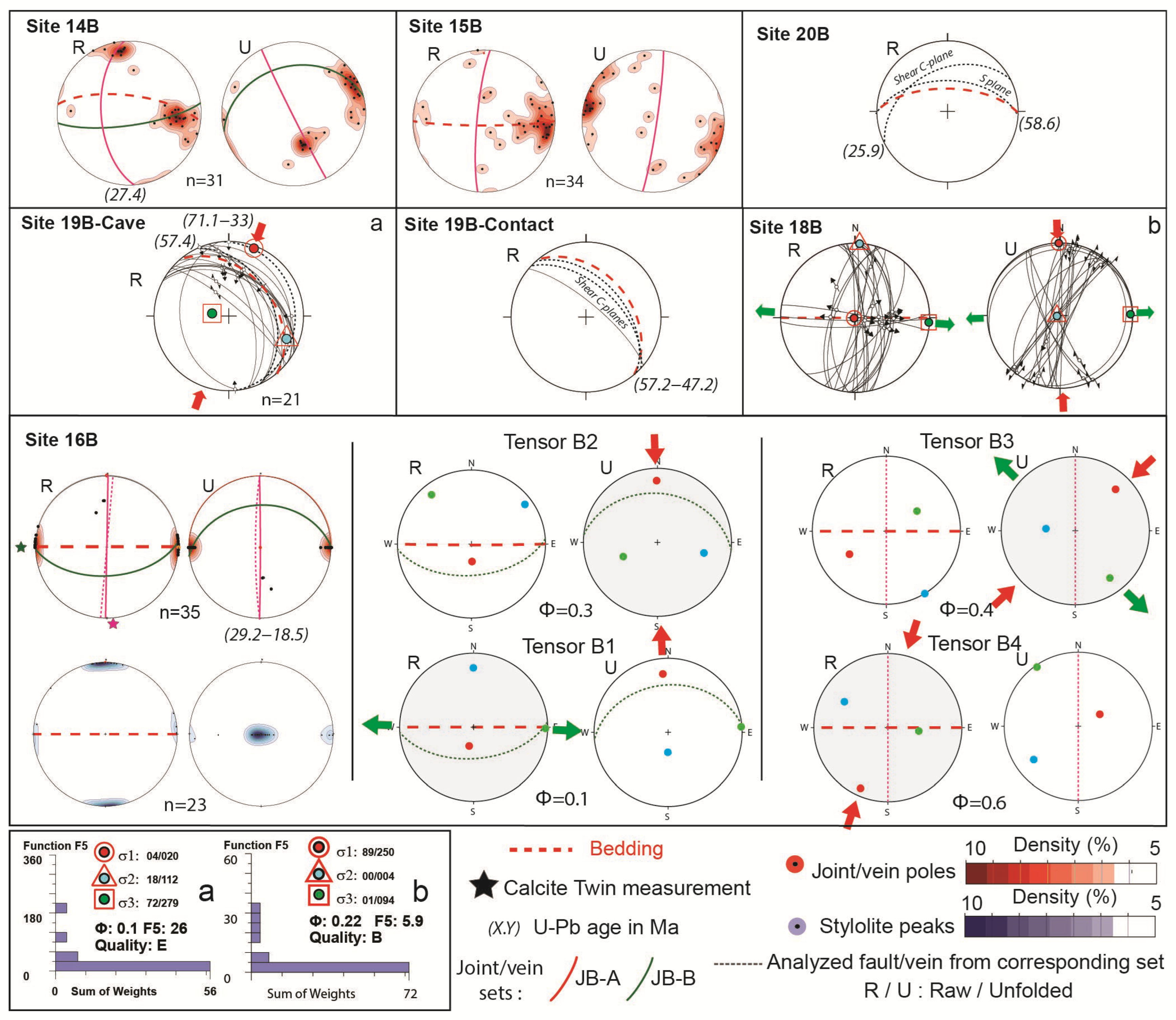
Figure 11.
(A) Unconformable attitude of the Miocene formation on the vertical late Jurassic limestone strata as observed in the Bimont anticline, notebook used for scale. (B) Close view of the fracture-stylolite network in the vertical late Jurassic strata. (C) High-resolution photograph of a slice of the core sample C8, where the fields of view for the (D–F) microphotographs are represented by frames on the left-hand side. On the right-hand side, the photograph is interpreted with relative chronology and absolute age obtained from U-Pb calcite geochronology. (D–F) Microphotographs of jog structures (D,F) or veins (E) that were analyzed by LA-ICP-MS for calcite geochronology (blue frames represent the laser ablation extent). For the jogs, U/Pb ratio maps were produced following the approach described in [159] and are presented as figures (G–I). (J) Corresponding Tera–Wasserburg concordia diagrams obtained from core sample C8.
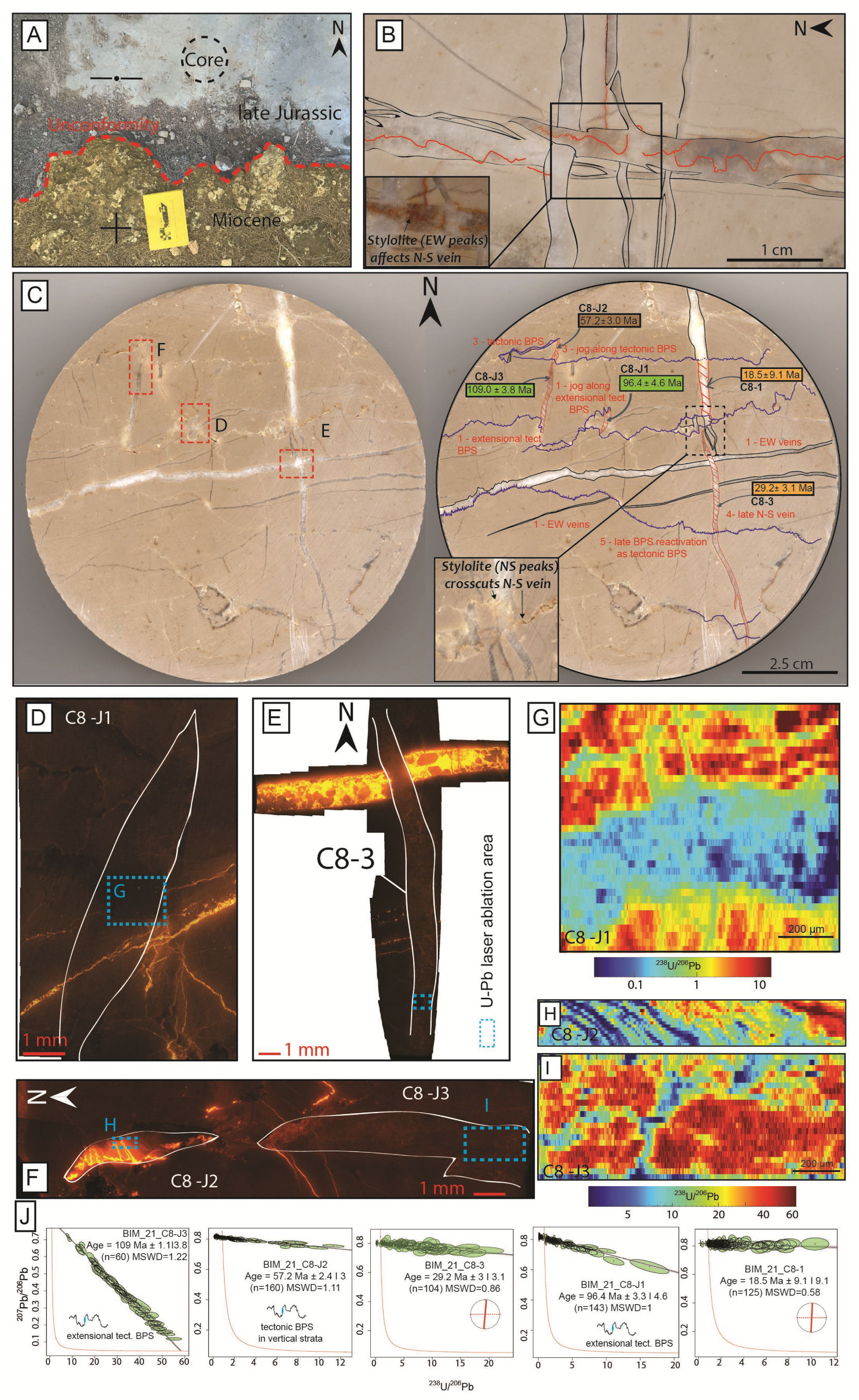
Figure 12.
(A,E,H) Detailed photographs of the Reynauds thrust fault zone in the Bimont Lake area (Site 19B). (B,C) Two-dimensional scan and microphotograph under cathodoluminescence of sample Z211 (B,C), sample Z212 (F–I), and sample Z207 (K,L); blue frames represent the extents of the laser ablation used for U-Pb calcite geochronology, of which results are presented as Tera–Wasserburg concordia diagrams (D,G,J,M,N).
4.1.3. The Rians Basin
In the Maastrichtian (so-called “Rognacian”) limestones of the Rians Basin, three distinct fracture sets were measured, striking N-S (set JR-A), ENE-WSW (set JR-B), and NW–SE (set JR-C) in a raw position, all being sub-vertical in flat-laying strata (site 3R, Figure 4). Strike–slip faulting is also documented with WNW–ESE-oriented right-lateral strike–slip faults and an NE–SW-oriented left-lateral strike–slip faults (Figure 4F). Horizontal drill cores were collected from the Rians outcrop within sub-horizontal layers. These cores enabled sampling of N-S-striking sub-vertical veins in a raw position, as well as BPSs.
4.2. Petrographic Observations
Most vein samples exhibit mode I openings, supported by observations of structural offsets on either side of the veins, as illustrated in Figure 6 and Figure 7. With some exceptions, most vein fillings consist of a single generation of blocky calcite, which shows light-colored zones under natural light and light orange areas under cathodoluminescence.
In some instances, host rocks include cement that seems to be related to the subaerial continental environment (Figure 6), showing nonfibrous crystals, either being isopachous (Z161), of extincted luminescence (Z159), or related to carbonate dissolution along stylolite (Z093) or to karstification parallel to the local thrust zone (Z190b). In all cases, these cements likely witness freshwater-dominated subaerial environments, and they were analyzed and dated in order to better constrain the emersion of the strata during the tectonic history of the Nerthe range.
4.3. Paleostress Orientations from Calcite Twin Inversion
In the Nerthe massif and Bimont Lake area, the calcite grains from the analyzed veins present thin (<1 μm) and straight twins [139]. Twinning strain was roughly estimated to be ~2% based on thin section observations. Several samples reveal two or three superimposed stress tensors, with each of them explaining part of the twinned planes and most of the untwinned planes. The complete results are shown in Table 1. Hereinafter, the stress tensor axes are described in their current orientation.
In the Nerthe massif (Figure 5), calcite twin inversion from the set JN-A vein (sample Z142, site 9N) revealed a compressional stress tensor with an NE-SW-oriented σ1 (tensor N1). Calcite twin inversion of the set JN-B vein (sample Z135, site 8N) revealed (1) a compressional-strike–slip stress tensor with an NE-SW-oriented σ1 (tensor N1), (2) a compressional stress tensor with an N-S-oriented σ1 (tensor N2), and (3) a strike–slip stress tensor with an NW-SE-oriented σ1 (tensor N3, Figure 5). Calcite twin inversion from the set JN-D vein (sample Z101, site 3N) revealed an extensional stress tensor with an NNE-SSW-oriented σ3 (tensor N4) and a compressional stress tensor with an NW-SE-oriented σ1 axis (tensor N5). Calcite twin inversion of a set JN-E vein (sample Z088, site 1N) revealed a strike–slip stress tensor with an NNE-SSW-oriented σ1 (tensor N6) and a strike–slip stress tensor with an N-S-oriented σ1 (tensor N7).
In the Bimont Lake area (Figure 10), calcite twin inversion from set JB-B (sample Z075-2, site 16B) revealed an extensional stress tensor with an E-W-oriented σ3 (tensor B1) and a compressional stress tensor with an N-S-oriented σ1 (tensor B2). Calcite twin inversion from set N-S (JB-A, sample Z079-2, site 16B) yielded a strike–slip stress tensor with an NE-SW-oriented σ1 (tensor B3) and a compressional stress tensor with an NNE-SSW-oriented σ1 (tensor B4).
Table 1.
Results of calcite twin inversion using CSIT-2. TP/UTP stands for twinned planes/untwinned planes. Penalization function, Min RSS: see details in [153]. Stress axes: Trend (Tr) and plunge (Pl) in degrees. Italics: Unfolded stress axes. Bold: Stress axes used for interpretations. Grain size in μm.
4.4. U-Pb Ages of Deformation
The success rate of absolute U-Pb dating varies significantly across the three studied localities. In the Nerthe range, 34 analyses out of 50 yielded reliable ages, corresponding to a success rate of 68%. The Bimont Lake area shows the highest success rate with 13 successful analyses out of 16 (81%), whereas the Rians Basin presents 4 calcite mineralizations successfully dated out of 10 (40%). Overall, across all three localities, 51 analyses out of 76 provided reliable U-Pb ages, representing a mean success rate of 67%. The complete results are shown in Table 2 and in the Supplementary Material (Figures S4 and S5). Most of the presented ages can be considered robust. Specifically, the technique based on isotopic mapping of U, Pb, and Th elements used at IPREM deals with images corresponding to very small rock surface areas, so multi-generation or mixed signals are unlikely, and if they do occur, the mixed ages can be separated and refined [159]. In addition, very few samples display low U/Pb ratios and, therefore, high uncertainties (e.g., samples NRT_22_Z159, BIM_22_Z211, and BIM_22_C8-1); these uncertainties were considered in the interpretations (see also discussion in [17]).
Table 2.
U-Pb calcite geochronology results.
4.4.1. The Nerthe Range
U–Pb dating of a vein from the JN-D set from site 3N, located along the relay between the two segments of the Valtrède fault (Figure 2A), yielded three ages, 92.8 ± 3.5 Ma, 93.1 ± 3.3 Ma, and 108.7 ± 1.6 Ma, corresponding to samples NRT_22_Z096-1, Z096-2, and Z103-1, respectively (Figure 5, Table 2). U–Pb dating of a vein from the JN-F set at site 4N did not yield interpretable ages, whereas sample Z105 from a vein from the JN-E set returned an age of 92.9 ± 3.3 Ma (Figure 5, Table 2).
In the hanging wall of the Laurons–Ensuès Fault, an NE-SW-oriented vein from the JN-B set from site 10N (sample Z169-2) yielded an age of 78 ± 2.8 Ma (Figure 5). Additionally, a sub-horizontal vein at site 11N provided an age of 74.5 ± 1.0 Ma (sample Z181, Figure 5). In the footwall, samples Z118b and Z107 from site 5N—from a vein from the JN-C set and a vein from the JN-B set, respectively—yield ages of 110.1 ± 0.5 Ma and 43.6 ± 1.8 Ma (Figure 6). In site 8N, among the two vein sets measured, set JN-B veins exhibit ages of 78.1 ± 2.3 Ma (Z137-1) and 75.9 ± 0.7 Ma (Z137-3), and set JN-C veins exhibit ages of 75.9 ± 2.7 Ma (Z136-1) and 74.5 ± 3 Ma (Z137-2) (Figure 5 and Figure 6, Table 2).
In site 7N, samples Z133 and Z132C were extracted from the La Folie–Valapaux fault zone (Figure 7). Sample Z133 exhibits distinct domains from which different ages were obtained: 70.4 ± 2.4 Ma (Z133a) and 33.4 ± 2.5 Ma (Z133b). Sample 132C yields an age of 72.7 ± 1.3 Ma. Located a few tens of meters further south, site 6N provided three dated samples: a vein from JN-A set (Z121), a syn-thrusting NE-SW-striking reverse fault (Z126), and a late N-S-striking vertical right-lateral strike–slip fault (Z128) (Figure 8). These samples yield ages of 78.4 ± 1.9 Ma, 75.5 ± 2.9 Ma, and 36.8 ± 1 Ma, respectively.
In site 14N, a vein from JN-C set (Z189-2) yielded two distinct ages: Z189-2a is dated at 73.5 ± 1.8 Ma, and Z189-2b is dated at 20.2 ± 5.2 Ma (Figure 5 and Table 2). In a vein from the JN-B set (Z189-1), the outer cement along the walls is dated at 77.8 ± 2.8 Ma, whereas the inner cement at the center of the vein is dated at 70.2 ± 2.6 Ma (Figure 5). In the same site, a microbreccia from the thrust fault zone yields an age of 71.7 ± 0.73 Ma (Z190a). In site 9N, the two vein sets have been dated at 79.6 ± 1.1 Ma for the JN-A set (Z142) and 81 ± 2.3 Ma for the JN-B set (Z154) (Figure 9). Additionally, sample Z155, from an NNE-SSW-striking right-lateral strike–slip fault, gives an age of 79.7 ± 0.6 Ma (Figure 5 and Figure 9). Finally, in site 17N (Jas de Rhodes), the E-W-striking thrust zone between the Kimmeridgian and the Bajocian–Bathonian formations (sample Z203), yields an age of 55.2 ± 9.3 Ma (Table 2).
Summarizing, in the Nerthe massif, the U-Pb ages of thrust fault zones and mesoscale structures (veins and minor striated faults) can be grouped into four distinct periods: (1) 6 ages obtained from veins consistent with an NNE-SSW extension fall between 108.7 ± 1.6 Ma and 92.8 ± 3.5 Ma, i.e., Albian–Cenomanian; (2) 17 ages obtained from structures consistent with N-S- to NE-SW-directed compression fall between 81 ± 2.3 Ma and 70.2 ± 2.6 Ma, i.e., Campanian–Maastrichtian; (3) 4 ages obtained from structures also consistent with N-S- to NE-SW-directed compression fall between 55.2 ± 9.3 Ma and 33.4 ± 2.5, i.e., Paleocene–latest Eocene; and (4) 1 age from a vein consistent with NNW-SSE extension at 20.2 ± 5.2 Ma, i.e., Oligo–Miocene. Interestingly, the ages obtained from set JN-C (~E-W-oriented veins) are highly contrasted and fall within three groups: early Cretaceous (~110 Ma, period 1), late Cretaceous (~74 Ma, period 2), and even Miocene (~20 Ma, period 4).
Some of the calcite cements that fill the porosity at various stages of the diagenetic history of the strata were successfully dated as well (Figure 6 and Table 2). These cements, likely related to subaerial environments, were dated to 43.4 ± 24 Ma (Z159), 28.7 ± 1.0 Ma (Z161), 67.3 ± 1.5 Ma (Z093-cem 2), 71.7 ± 4.3 Ma (Z093-cem1), and 18.6 ± 9.6 Ma (Z190b).
4.4.2. The Bimont Lake Area
In the Bimont Lake area, N-S-oriented JB-A veins yield ages of 27.4 ± 1.3 Ma (Z071-2, site 14B, Figure 10), 18.5 ± 9.1 Ma (C8-1, site 16B), and 29.2 ± 3.1 Ma (C8-3, site 16B) (Figure 11). Calcite jogs associated with bedding-parallel stylolites in the E-W-striking vertical Tithonian strata yielded ages of 109.0 ± 3.8 Ma (C8-J3, site 16B), 96.4 ± 4.6 Ma (C8-J1, site 16B), and 57.2 ± 3.0 Ma (C8-J2, site 16B; Figure 10 and Figure 11).
Slickenfibers from NW–SE-oriented, north-dipping reverse faults in site 19B-Cave yielded ages of 71.1 ± 2.7 Ma (Z212a), 57.4 ± 12.7 Ma (Z211), and 33 ± 6 Ma (Z212b) (Figure 12). At site 19B-Contact, in the thrust fault zone between the Bathonian and Toarcian formations, the finely crushed thrust fault zone material yielded ages of 57.2 ± 3.9 Ma and 47.1 ± 5.7 Ma (samples Z206 and Z207, respectively; Figure 12). At site 20B, at the tectonic contact between the Bathonian–Bajocian and Kimmeridgian formations, sample Z215 (S-plane) was dated at 58.6 ± 4.5 Ma, while sample Z216 (C-plane) yielded an age of 25.9 ± 1.3 Ma (Figure 10 and Table 2).
4.4.3. The Rians Basin
Absolute dating of vein samples from site 3R in the Rians Basin successfully constrained the ages of two out of three vein sets measured and identified within the Maastrichtian strata (Figure 4). A NE-SW-striking vein (sample Z002) from set JR-B yields an age of 33.1 ± 1.6 Ma, while N-S-striking veins (samples ZB3-1 and ZB4-1) from set JR-A, collected from drill cores, yield ages of 35.9 ± 1.7 Ma and 32.7 ± 1.3 Ma, respectively. The vein set JR-C provided no reliable age. Additionally, a calcite jog sample (ZB2-J1) associated with BPS development yielded an age of 45.4 ± 2.0 Ma, representing the oldest age recorded at this site (Figure 4).
5. Interpretation of Results: Timing of Deformation and Paleostress Evolution
5.1. Sequence of Deformation in the Nerthe Range
Considering the whole dataset of structures (stylolites, joints and veins, mesoscale faults, and major thrusts), stress tensors computed from the inversion of calcite twins, and striated faults and absolute U-Pb ages of syn-kinematic calcite and calcite cements, we can reconstruct a rather continuous history of deformation that affected the Nerthe range from the Albian until at least the Burdigalian. The integration of these independent data helped refine the fracture sequence, which sets were previously defined based on their orientation and attitude with respect to host strata only.
5.1.1. Pre-Pyrenean Extension (Albian-Cenomanian, 110–93 Ma)
The pre-contractional fracture development history of the Nerthe range is marked by a complex fracture pattern that gathered ~N-S (set JN-E), E-W (set JN-C), and N135 (set JN-D) veins. U-Pb dating indicates that the ages of these veins fall roughly at ~110 Ma and ~93 Ma, suggesting that they developed roughly coevally. Calcite twin inversion from the set JN-D vein in site 3N revealed a pre-folding extensional stress tensor with an N020-oriented σ3, consistent with the opening of the set JN-D and JN-C veins. We propose that this pattern relates to the regional uplift known as the Durancian uplift and associated NNE-SSW extension [49,54,55]. This interpretation is in good agreement with the work of [45], who provided a U-Pb age of ~90 Ma for the N070°-striking Castellas normal fault ~15 km north of the Nerthe range.
5.1.2. Pyrenean Compression (81–67 and 59–34 Ma)
The onset of the Pyrenean contractional event is characterized by the development of bed-perpendicular vein sets JN-A, JN-B, and JN-E, oriented N-S to NE-SW. They are interpreted as the result of a strike–slip stress and/or a compressional stress regime associated with a σ1 oriented ~N–S (stress tensors N2, N6, and N7) to NE–SW (stress tensor N1). This interpretation is supported by the occurrence of pre-tilting tectonic stylolites with ~N-S peaks. The wide distribution and the consistent pre-folding orientation and dip of these vein sets across the massif support their interpretation as being overall related to N-S- to NE-SW-oriented layer-parallel shortening (LPS). In more detail, at site 9N, calcite twin analysis from a vein from the JN-A set reveals a strike–slip stress tensor characterized by an NE-SW-trending σ1 (tensor N1), consistent with the opening of the vein. Since U-Pb ages indicate that set JN-B vein developed around 81 ± 2.3 Ma under a strike–slip stress regime with σ1-oriented N–S to NNE–SSW slightly predating set JN-A vein (79.6 ± 1.1 Ma), we conclude that σ1 evolved from an ~N-S to an NE–SW trend, causing not only the opening of set JN-A veins but also the development of NNE–SSW-striking, right-lateral strike–slip faults dated at 79.7 ± 0.6 Ma. Interestingly, these two sets, JN-A and JN-B, have been interpreted previously by [72] in site 15N (Boumandariel) as being formed in response to burial based on their mutual cross-cutting relationships with sedimentary, bedding-parallel stylolites. However, the record by a vein of the JN-A set of a stress tensor with a horizontal σ1 parallel to the vein supports its tectonic origin, which is further confirmed by the age of the calcite filling the vein. As a result, one can propose that parts of veins from sets JN-A and JN-B possibly formed during burial prior to the Pyrenean contraction but that some with the same orientations also formed during LPS. This allows us to very accurately constrain the timing of the onset of LPS at ~81 Ma, with the development of the related JN-B tectonic veins occurring at the maximum burial depth before the host strata were progressively exhumed by folding and thrusting.
The samples from the La Folie–Valapaux fault zone (site 7N) yield three ages, 72.7 ± 1.3 Ma, 70.4 ± 2.4 Ma, and 33.4 ± 2.5 Ma, indicating two distinct periods of thrust activity around ~72–70 Ma and ~33 Ma. These two deformation phases are further supported by the U-Pb age of slickenfibers from a syn-thrusting NE–SW-oriented mesoscale reverse fault (Z126, site 6N) that yielded an age of 75.5 ± 2.9 Ma. In the same site, a vertical, N–S-oriented right-lateral strike–slip fault, which geometry supports a post-folding development, is dated at 36.8 ± 0.5 Ma (Z128). The thrust bounding the pop-up structure to the north, which developed at the south of the La Folie–Valapaux fault zone (site 14N), shows evidence of activity at around ~72 Ma, in line with the first phase of activity of the La Folie–Valapaux Fault Zone.
In the central, southern part of the range, some N090-striking fractures, dipping perpendicular to the local bedding (set JN-C), also yield ages of 73.5 ± 1.8 Ma, 74.5 ± 3.0 Ma and 75.9 ± 2.7 Ma, suggesting a local bed-parallel extension perpendicular to fold axis as a response to strata curvature during folding (e.g., sites 14N and 8N). Finally, post-tilting contractional stress tensors with σ1 oriented N-S revealed by calcite twins (Site 1N, site 8N), along with the occurrence of N040-striking, sub-vertical fractures (set JN-F), and the occurrence of post-tilting tectonic stylolites with horizontal peaks striking ~N-S, can be interpreted as being the expression of the continuing NNE-SSW Pyrenean shortening after strata tilting (late-stage fold tightening, LSFT) by the latest Eocene.
Summarizing, all of the above-mentioned structures can be interpreted as related to alternating strike–slip or compressional stress regimes with σ1 roughly oriented NNE-SSW (in more detail, likely oscillating between N-S and NE-SW through time). These structures, whatever their scale, developed in two time periods, during the late Cretaceous (~81–67 Ma) and during the Eocene (~59–34 Ma). However, since most ages are related to the first period, we propose that Pyrenean shortening in the Nerthe massif mainly occurred during the latest Cretaceous, causing exhumation of folded strata and favoring fluid flow. Indeed, from the time thrusts were active in the Nerthe range, there are clear markers of subaerial environments (71.7 Ma) that persisted until the Miocene (9.6 Ma), suggesting that the range was close to emersion as soon as its structure was developing. The second period likely corresponds to a late, minor component of renewed Pyrenean contraction and reactivation of earlier structures. This is in line with the results of [45], who reported that the E-W-striking Castellas normal fault was reactivated as a left-lateral strike–slip fault at ~50–35 Ma.
5.1.3. Post-Pyrenean Extension (Oligo–Miocene, 33–20 Ma)
Few post-Eocene ages related to the development of tectonic structures were obtained. In the southern Nerthe range, at site 14N, one vein from set JN-C (E-W-striking) exhibits two generations of syn-kinematic calcite with distinct ages. While the first calcite generation reveals a vein opening at 75.9 Ma (Z189-2a) during the Pyrenean shortening, the second calcite generation, dated at 20 Ma, supports reopening of the vein during the Oligo–Miocene NNW-SSE extension. This Oligo–Miocene extensional reactivation is further supported by the occurrence of ENE-WSW-striking fractures affecting Burdigalian strata at site 15N and is consistent with the normal faults that dissected the Nerthe range (see also Figure 5 [82]), including the Valtrède fault and the Laurons–Ensuès fault, which bound the Saint Julien extensional basin.
5.1.4. Post-Pyrenean (Miocene?) Compression
Calcite twin analysis from veins from sets JN-B and JN-D revealed post-folding compressional (stress tensor N5) or strike–slip (stress tensor N3) with an NW-SE-trending σ1 (Figure 5). This late stress state is compatible with the right-lateral strike–slip reactivation of the major normal faults, such as those bounding the Saint Julien basin, and the Folie–Valapaux fault zone. In the absence of any time constraints, we tentatively propose that this NW-SE compression is related to Alpine compression, which would be associated with a negligible amount of shortening.
This sequence of deformation at the scale of the Nerthe massif is summarized in the Figure 13, where we present a step-by-step restoration of the cross-section of Figure 2B at four key periods: (1) end Miocene-present, representing the end of the Oligo–Miocene extension related to the Liguro–Provençal rifting; (2) end-Eocene, representing the end of the second (presumably very minor) stage of the Pyrenean shortening; (3) end-Maastrichtian, representing the end of the presumably first and main stage of the Pyrenean shortening in the Nerthe massif as supported by the pool of late Cretaceous U-Pb ages from various tectonic structures (from veins to thrust fault zones; see discussion in Section 6.2); and (4) the Santonian, representing the pre-contractional stage. It is interesting to notice that our U-Pb ages, therefore, help refine the timing of the restoration of the previously proposed Nerthe cross-section [40,82]. Also, in line with the conclusions of [40], our restoration reveals that both the Pyrenean shortening and Liguro–Provençal rifting have significantly reactivated Mesozoic (and Paleozoic?) extensional structures, which reflect the importance of Mesozoic (and Paleozoic?) structural inheritance and weaknesses during the subsequent Cenozoic contractional and extensional tectonic events.
Figure 13.
Sequential restoration of the cross-section across the Nerthe range (located in Figure 1A as X–Y) at 3 key periods starting from end-Miocene - present day (A): at the end of the Eocene (i.e., at the end of the second minor pulse of Pyrenean shortening) (B), at the end of the Maastrichtian (i.e., at the end of the first major pulse of Pyrenean shortening) (C) and in the Santonian (i.e., before the onset of the Pyrenean shortening (D). For each section, the active faults are highlighted in red, and the future faults appear as dashed lines. The complete shortening estimated from the restoration during the Pyrenean shortening (ca. 6.3 km) is reported along with the estimated Oligo–Miocene extension (ca. 0.2 km). The pin represents the stable line used for these estimates.
5.2. Sequence of Deformation in the Bimont Lake Area
Like for the Nerthe range, we propose a sequence of deformation based on the integration of structural observations and U-Pb ages of syn-kinematic calcite mineralizations. The reconstructed tectonic evolution is summarized in Figure 14.
Figure 14.
Evolutionary diagrams of the southern flank of the Bimont anticline, where the stratigraphic and structural evolution is reported with time. The mode I fracture colors are related to the sets described in Figure 10. At each step of the evolution, the reconstructed stress tensor is reported. The different steps of the tectonic history are associated with the various deformation stages.
5.2.1. Pre-Pyrenean Extension (Albian–Cenomanian, 110–93 Ma)
In the Bimont Lake area, dated tectonic structures did not yield any age consistent with the Durancian uplift and associated ~NNE-SSW extension as recognized in the Nerthe range. However, the occurrence of a regional uplift in an extensional setting by Albian–Cenomanian time and subsequent aerial exposure in northern Provence is supported by the erosion of pre-Campanian strata, with the oldest Campanian breccia resting unconformably on early Cretaceous and even late Jurassic strata in the Bimont area (Figure 3B). This is in line with the work by [163] who reported calcite cement ages of 96.7 and 90.5 Ma in Barremian limestones, associated with a phase of late cementation resulting from meteoric fluid circulation during subaerial exposure related to the Durancian uplift.
The calcite jogs dated at ~110 and ~96 Ma indicate active pressure solution along BPS under a vertical principal stress σ1 at that time. Because regional uplifting and erosion of strata are poorly consistent with coeval burial-related pressure solution along sedimentary BPSs, we alternatively propose that the BPSs associated with these jogs likely developed as tectonic stylolites under a vertical σ1 related to Albo-Cenomanian extension, hereinafter referred to as extensional tectonic BPSs to distinguish them from the classical view of tectonic stylolites related to horizontal shortening.
5.2.2. Pyrenean Compression (71–33 Ma)
In sites 14B, 15B, and 16B, vertical to slightly overturned E-W-striking Kimmeridgian strata show widespread bedding-parallel stylolites and two sets of veins (Figure 10 and Figure 11). The first vein set consists of E–W-striking veins with variable dips in a raw position in sites 14B and 16B (Figure 10) but have consistent dips of approximately 40°N after unfolding (JB-B set). The second set corresponds to N–S-striking vertical veins (JB-A set, Figure 10). Cross-cutting and abutment relationships indicate that JB-B veins predate JB-A veins. Because the attitude of the JB-A veins is not affected by unfolding, they might have developed when strata were horizontal (LPS), at any time of tilting or after tilting (LSFT). Calcite twin inversion reveals that JB-A veins recorded a pre-tilting and post-tilting NE-SW- and NNE-SSW-oriented σ1 (tensors B3 and B4, respectively), which indicate that they developed under a compressional strike–slip stress regime likely related to the Pyrenean shortening. A pre-folding N-S compression is also recorded in the JB-B veins (tensor B2), which confirms (1) the chronology between the E-W and N-S veins and (2) that both the JB-A and JB-B veins developed in response to an N-S to NNE-SSW compression.
After unfolding, BPSs are horizontal with vertical peaks; such stylolites are usually interpreted as forming under a vertical σ1, either related to burial (sedimentary stylolites) or to an extensional state of stress (extensional tectonic BPS). However, the relative chronology between the BPS and the vertical N-S-oriented veins remains ambiguous, with mutual cross-cutting relationships. Since N-S veins have a tectonic origin and are likely related to the Pyrenean compression, this means that some BPSs which are vertical in their current attitude and bear horizontal, N-S trending peaks may be of tectonic origin and may have formed within vertical strata in response to continuing N-S compression. The likely occurrence of at least two generations of BPSs—the first one developing under a vertical σ1 when strata were still horizontal and the second developing under a horizontal ~N-S-trending σ1 after the strata were folded into their current vertical attitude—is confirmed by the two highly contrasting ages yielded by the associated calcite jogs: 109.0 ± 3.8 Ma and 96.4 ± 4.6 Ma on the one hand and 57.2 ± 3.0 Ma on the other hand. While the first age reveals a pre-folding origin (see Section 5.2.1), the second age indicates tectonic BPS development in response to LSFT. This indicates that folding was over at ~57–55 Ma but that the N-S compression was still prevalent. The kinematic scenario of Figure 14 suggests that Pyrenean LPS initiated under a compressional stress regime (formation of JB-B veins), subsequently evolving into a strike–slip stress regime (formation of JB-A-veins and possibly conjugate strike–slip faults [53]), with σ1 oriented N-S to NNE-SSW. During folding, the former structures were progressively tilted until the strata became vertical. After strata tilting, the Pyrenean compression still prevailed and caused the development of bedding-parallel tectonic stylolites during the LSFT. Folding at Bimont was therefore over at ~57–55 Ma, which is in good agreement with the growth strata comprising syn-tectonic breccias that support folding occurred roughly between ~80 Ma (base of the oldest Campanian—so-called “Begudian”—breccias) and ~55 Ma (top of the youngest Dano-Montian—so-called “Tholonet”—breccias) [47].
West of the Bimont Lake, U-Pb ages of the fault zone rocks at site 19B-Contact indicate that the Reynauds thrust was active at 57.2 ± 4 Ma and at 47.1 ± 5.7 Ma (Figure 12). Slickenfibers along NW–SE-striking, shallowly N-dipping reverse faults from the anastomosed shear zones of site 19B-Cave located in the Kimmeridgian formation yielded ages of 71.1 ± 2.7 Ma (Z212a), 57.4 ± 12.7 Ma (Z211), and 33 ± 6 Ma (Z212b). This means that the northern branch of the Reynauds thrust zone was active during the late Cretaceous, mainly during the Paleocene–early Eocene and at the Priabonian–Rupelian transition, i.e., during the latest Eocene considering uncertainties. The Paleocene–early Eocene period of the Reynauds thrust activity is confirmed by the 58.6 ± 4.5 Ma age of the fault rocks at site 20B, located on its likely southern splay.
Combining all the data from the Bimont Lake area, we propose that Pyrenean deformation there started by the Campanian (~71 Ma) and was mainly active by the late Paleocene (59–56 Ma), giving birth to the Reynauds thrust and the Bimont fold. While folding at Bimont was likely achieved by ~57-55 Ma, thrusting was still active—but probably in a minor way—by the middle Eocene (~47 Ma, Ypresian–Lutetian) and latest Eocene (~33 Ma, Priabonian–Rupelian transition), before the stress regime evolved from N-S compression to E-W extension. Again, the timing of deformation revealed by U-Pb geochronology on syn-kinematic calcite is well in line with the timing formerly established from the sedimentary record, with the development of the nearby Sainte-Victoire range occurring between 83 Ma and ~43 Ma [47].
5.2.3. Post-Pyrenean Extension (Oligocene, 33–23 Ma)
U-Pb ages obtained from JB-A veins are 29.2 ± 3.1 Ma, 27.4 ± 1.3 Ma, and 18.5 ± 9.1 Ma (Figure 10 and Figure 11). These mostly Oligocene ages (considering uncertainties) are much younger than expected for the N-S veins that started to develop during Pyrenean LPS (Section 5.2.2). As a result, we can propose that these veins formed in response to Oligocene E-W to WNW-ESE extension, which implies two distinct generations of N-S veins sharing the same current attitude (Figure 4F). This E-W extension is supported by (1) the record of a post-folding stress tensor with vertical σ1 and horizontal σ3 trending E-W (tensor B1) by the pre-folding E-W veins (Figure 10), (2) the nearby Aix-en-Provence fault (part of the AMDF) bounding the Oligocene Aix-en-Provence basin to the east (Figure 3A,B), and (3) by the normal faults described in the Sainte-Victoire range just to the east [47,53]. The similar recent age at 25.9 ± 1.3 Ma obtained from the nearby southern splay of the Reynauds thrust could indicate either a late Oligocene thrust activity (which would be at odds with the extensional stress regime prevailing regionally at that time) or, more probably, some fluid flow across the fault zone during the Oligocene extension leading to new calcite precipitation.
5.2.4. Post-Pyrenean Alpine Compression (Miocene, 15?—? Ma)
The observation on the Bimont core (Figure 11) that E-W-striking BPSs cut across Oligocene N-S veins supports that pressure solution along the earlier formed BPSs likely resumed during the Miocene under late ~N-S compression. Also, the N-S-striking tectonic stylolites with E-W-oriented peaks may have developed when the strata were still horizontal, during or after folding, since their attitude is not affected by unfolding. However, they affect N-S veins, which supports a post-Pyrenean/post-Oligocene stress regime dominated by ~E-W-oriented horizontal σ1. As a result, our data document two likely Miocene minor compressions, oriented ~N-S and ~E-W, but the exact timing of which, unfortunately, cannot be constrained.
5.3. Sequence of Deformation in the Rians Basin
The absolute dating of the jog associated with the sedimentary BPS (ZB2-J1) at 45.4 ± 2 Ma in the sub-horizontal strata of the Rians Basin (site 3R) demonstrates that pressure solution along the BPS was still active at that time under a vertical σ1. Consequently, we infer that the Rians Basin was still experiencing ongoing burial until at least the middle Eocene and that the Pyrenean shortening did not start before this date. This is consistent with the oldest age (35.9 ± 1.7 Ma) obtained from an N-S vein of set JR-A, consistent with N-S compression, which suggests that the Pyrenean shortening likely occurred between ~45 Ma (at the earliest) and 36 Ma and weakly affected the Rians Basin. The younger age obtained from the JR-A vein (32.7 ± 1.3 Ma) and the age of the JR-B vein (33.1 ± 1.6 Ma) support that these veins were (re?)opened or newly formed during the Oligocene E-W to WNW-ESE extension. Interestingly, the U-Pb ages support that, as in Bimont, N-S-striking vertical veins may have formed both during the N-S Pyrenean compression and during the subsequent Oligocene extension. Finally, the occurrence of strike–slip faults and JR-C veins consistent with an NW-SE compression (Figure 4F) is interpreted as a late Alpine tectonic imprint.
6. Discussion
6.1. Unlocking > 90 My of Complex Compressional and Extensional Deformation in Provence
The U-Pb ages of calcite mineralizations collected from tectonic structures of various scales (from a few millimeters—jogs associated with stylolites—to kilometer-scale thrust fault zones) span ~110 to ~20 Ma, thus unraveling at least 90 Ma of tectonic activity in Provence. Combined with paleostress reconstructions, these U-Pb ages show that the Cretaceous–Tertiary tectonic evolution of Provence is related to successive regional compressional and extensional deformation events: the Albian–Cenomanian Durancian uplift and associated NNE-SSW extension, the late Cretaceous–Eocene ~N-S Pyrenean contraction, the E-W to WNW-ESE Oligocene extension related to ECRIS, the NW-SE to NNW-SSE Oligo–Miocene extension related to LPR, and possibly N-S to NW-SE Alpine shortening (even though no supportive ages were obtained for the latter). Our study, therefore, reveals the potential of the combination of structural and geochronological approaches on multi-scale tectonic structures precisely placed into the broader structural setting to unravel a long-lasting, polyphase regional tectonic evolution.
In more detail, the reconstructed tectonic history starts with the regional Durancian uplift and related NNE-SSW extension. The synthetic chart of Figure 15, together with data from the literature, indicates that this event occurred everywhere by Albian–Cenomanian times. The Durancian uplift was followed by a Pyrenean ~N-S shortening event between ~81 Ma and ~34 Ma (~45 My) related to the convergence followed by collision of Eurasia with Iberia and the Corsica–Sardinia block. This Pyrenean contraction is responsible for most of the E-W-striking folds and thrusts in Provence, such as the Bimont and Nerthe folds and the Etoile, Sainte-Baume, and Ventoux thrusts [40,43,47,67,68,69]. While the Pyrenean contraction may have lasted until ~20–15 Ma in the Pyrenees [25,30,32], the onset of the Oligocene extension at ~34 Ma marks roughly the end of the Pyrenean shortening in Provence. This extension related to ECRIS affected the northern Provence, where it is responsible for the renewed development of N-S-striking veins in the Bimont Lake area and Rians Basin, for normal faulting described in the Sainte-Victoire range just to the east [47,53], and at a larger scale, for the normal kinematics of the NNE-SSW-striking AMDF [55] and the related development of the Oligocene Manosque and Aix-en-Provence basins. In contrast, in the Nerthe range, the U-Pb ages from ~E-W-striking veins (Figure 15), as well as the development of newly formed ENE-WSW-striking veins in the Burdigalian formation close to the Mediterranean coast (Figure 2A and Figure 5), document an Oligo–Miocene NNW-SSE extension expressed at a larger scale by the development of E-W-striking normal faults that dissect the Pyrenean folds and thrusts in the Nerthe range (Figure 2B; see also Figure 5, data from [82]). This extensional event attributed to the LPR [41,85] appears to have affected mainly the southern part of Provence, like the Nerthe range or the Marseille Basin [41].
Figure 15.
Spatialized time chart that reports the absolute U-Pb age of calcite (along with uncertainty, sample name, and site name) obtained in this study, whether it is syn-kinematic or related to diagenesis, compared to the U-Pb ages available for the Mirabeau fold [17]. For each tectonic data, the analyzed fracture set is reported on a lower hemisphere stereonet in the current attitude of the strata and in colors respecting the ones presented in Figure 4, Figure 5, and Figure 10. Symbols represent the nature of the studied microstructure. On the left-hand side, the main regional tectonic events and related stress field are reported; see Figure 1 for the references. The pink, blue, purple and yellow colors highlight the main periods of regional tectonic activity/diagenetic evolution.
In the Nerthe range, calcite twin inversion revealed a post-folding NW-SE compression, which would explain the right-lateral reactivation of the Oligocene–early Miocene E-W normal faults dissecting the Nerthe massif. A similar NW-SE compressional trend was formerly reported there by [66]. A few kilometers to the north, in the Rians Basin, we also document a strike–slip stress regime with an NW-SE-oriented σ1. In the Mirabeau fold, Zeboudj et al. [17] reported a post-Pyrenean compressional stress regime with a WNW-ESE-oriented σ1. In the Bimont Lake area, our observations support the occurrence of two post-Oligocene compressional trends, ~N-S and ~E-W. Although the exact timing of these compressions could not be precisely constrained by U-Pb geochronology, we propose that the NW-SE to N-S compressional trends reflect deviations of the regional NNE-SSW to ENE-WSW middle–late Miocene Alpine compression [39,51,89,90,164] in the vicinity of major faults (e.g., the AMDF). In contrast, the ~E-W compression at the Bimont Lake area, together with the ENE-WSW to WNW-ESE compression recognized from calcite twins south of the nearby Sainte-Victoire range [53], would be of very local significance only. The precise characterization of the trend of the Alpine compression in Provence would require more extensive field and geochronological works; however, it must be noted that this late compression is associated with little shortening [40].
6.2. Timing and Evolution of the Pyrenean–Provençal Shortening
The ages obtained for the various structures related to N-S (NNE to NNW) Pyrenean shortening range from 81 ± 2.3 Ma to 33 ± 6 Ma (Figure 15). The oldest age matches very well with the generally accepted onset of the Pyrenean compression in Provence, as well as with the onset of Iberia–Eurasia convergence and inversion of pre-Pyrenean extensional basins, estimated to be late Cretaceous [25,28,29,30,31,37,39,40,47,53,70,73]. This contrasts with recently obtained ages as old as 97–90 Ma in the subalpine FTBs that were tentatively related to a very early onset of Pyrenean contraction—coeval with the Durancian uplift and related extension [44]—but are best explained by other causes, such as gravitational sliding of the cover as in the Devoluy subalpine belt [165] or, more probably, by salt tectonics (see discussion in [17]).
In detail, in the Nerthe range, our study highlights moments within the 81–34 Ma time interval for which the density of age data for syn-kinematic (and diagenetic) calcite mineralizations is higher than others (Figure 15), corresponding to two particular periods, 81–67 Ma and 59–34 Ma (Figure 15). The first period gathers 19 ages, i.e., 80% of the U-Pb ages obtained from Pyrenean structures, whereas the second period gathers 5 ages, i.e., 20% of the U-Pb ages. This gathering of U-Pb ages could be interpreted in three different ways. The first way is a bias of sampling and dating of Paleocene structures within a continuous Pyrenean compression from 81 to 34 Ma. The second way is to consider that more fluids flowed and precipitated calcite at these particular times and that the physicochemical conditions (e.g., fluid composition) were more prone to incorporating uranium into the calcite lattice then. In this case, U–Pb dating of deformation structures would only document parts of the continuous deformation history. As the governing factors allowing a calcite to be successfully dated remain debated [155,166], it would be interesting to obtain a more statistical approach to U-Pb dating for tectonic structures, as it might help us know whether U-Pb age data density might be used as a proxy for either deformation intensity or fluid system reconstructions, or both. The third way is that the two specific periods represent time intervals when rock damage was maximal, favoring coeval fluid circulation and calcite mineralization. In this case, the age distribution would suggest that the Pyrenean shortening occurred in two distinct phases: a paroxysmal phase of damage during the late Cretaceous (81–67 Ma) and a less intense phase during the late Paleocene–Eocene (59–34 Ma), separated by a phase of tectonic quiescence between 67 and 59 Ma. In this case, U–Pb geochronology would have captured the full range of deformation ages related to Pyrenean compression, and the absence of U-Pb ages would simply reflect the decrease or the absence of deformation during this interval. In the Bimont Lake area, among the 7 ages obtained within the 81–34 time interval, a single one, i.e., 15% of the U-Pb ages, is late Cretaceous (first phase), while the other 6 ages, i.e., 85% of the U-Pb ages, are late Paleocene and middle–late Eocene, hence belonging to the second phase defined in the Nerthe range. Finally, a single late Eocene age (second phase) has been obtained from the Rians Basin (Figure 15).
It is striking that the inferred two shortening phases recognized in Provence in the third scenario fit well with two phases of Pyrenean deformation recognized by [30] in the Pyrenees, which were ascribed to the inversion of the pre-Pyrenean rift (84–66 Ma) and to the main Pyrenean collision (59–34 Ma), separated by a period of tectonic quiescence during the Paleocene (66–59 Ma [21,34]). The Paleocene quiescent period could be explained either by the low convergence rate between the Eurasian and Iberian plates at that time [35,64], by the redistribution of shortening within the surrounding plates (e.g., [33]), or even by a change in the deep structure of the orogen as it evolved into full collision. Interestingly, the coevality between the periods of clustered U-Pb ages in Provence and the shortening phases recognized in the Pyrenees from independent geological observations [30] support that there may be some causal link between periods of intense tectonic rock damage and more abundant fluid circulation and, hence, calcite mineralization. However, we acknowledge that there is no systematic direct link between the number of U-Pb ages obtained for a tectonic episode and the related amount of shortening/rock damage since the dating ability of calcite depends primarily on its chemical composition and, therefore, on the fluid composition so that not all calcites are suitable for dating and that assuming that the chemical conditions behind calcite crystallization would be constant over time is obviously wrong.
Our dataset also suggests that the late Cretaceous deformation phase was likely paroxysmal in the Nerthe range and that deformation intensity decreased with time there, the second phase being associated with very minor shortening (Figure 13); ~15 km north of the Nerthe range, along the E-W-striking Castellas fault (formed at 90 Ma during the Durancian uplift), a single event of (wrench) reactivation at 50–40 Ma was documented [45]. In the northernmost folds (Bimont and Mirabeau) and basins (Rians), very few deformations appear to be dated to the late Cretaceous, suggesting that the local paroxysmal damage there was shifted toward younger times. Our dataset, therefore, supports an overall younger age of the onset of the main phase of shortening going northward, accompanied by a likely northward decrease in deformation intensity in the sedimentary cover. The ages of the onset of the main phase of Pyrenean-Provençal shortening at ~81 Ma in the Nerthe range, ~71 Ma and mainly ~59 Ma in the Bimont Lake area, ~50 Ma in the Mirabeau fold [17], and between 46 Ma (the age of the dated sedimentary BPS) and ~36 Ma in the Rians syncline, combined with age data from the literature, support that the Pyrenean deformation likely propagated northward (forelandward) across the Provence FTB (Figure 16) as already suggested by [17,39].
In contrast, most of the U-Pb ages in the northern Pyrenean belt produced by [21], as well as those reviewed by the same authors for the stable northern Pyrenean foreland cluster between 55 and 30 Ma. This led Jullien-Sicre et al. [21] to propose that the Pyrenean orogen, as well as the entire intraplate domain, deformed synchronously between 55 and 30 Ma, i.e., during the second phase of Pyrenean tectonic activity. It is, however, surprising that the age dataset produced by [21] from the North Pyrenean zone and the sub-Pyrenean zone, i.e., the northern Pyrenean belt, a setting very similar to Provence, lacks the widely expected late Cretaceous ages corresponding to the first period. The discrepancy with our results could be explained by the fact that [21] used only calcite slickenfibers along mesoscale faults for U-Pb dating. Our results show instead that the first deformation phase (80–67 Ma) is widely recorded by veins and thrust fault rocks, which emphasizes that sampling structures of various natures and scales (stylolites, veins, mesoscale faults, and major thrust fault zones) is probably a more efficient strategy to encompass the entire time interval of deformation.
Figure 16.
Map view summarizing the ages of the onset of the main phase of shortening in the Provençal FTB (modified after [17]). Reported data derive from U-Pb absolute dating (stars) and from relative dating of syn-kinematic breccias or growth strata, associated with the Durance uplift (purple) and Pyrenean–Provençal shortening (red). 1: [43,100,167]; 2: [97,168], 3: [39], 4: [168], 5: [47], 6: [39], 7: [169], 8,b: [17], 9, c: [45],10: [170], 11: [44], a: [163]. Spots 12 and d12 correspond to this study.
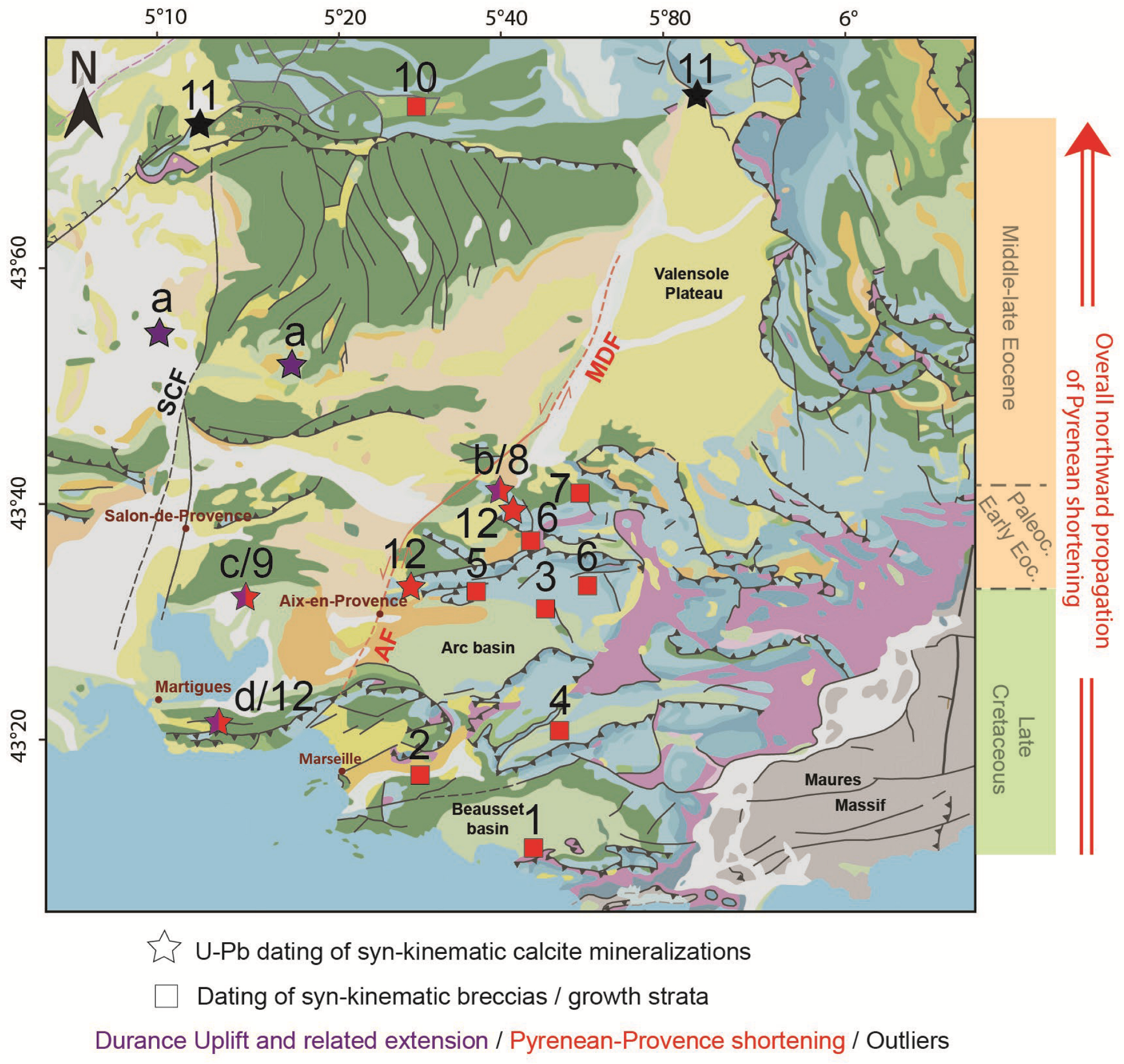
6.3. Lessons from Applying U-Pb Calcite Geochronology at Multiple Structural Scales
Numerous studies have refined the tectonic history of an area by using the geochronology of syn-kinematic calcite mineralizations at a given structural scale, whether it is at the scale of the diffuse fracture network [15,16,17,171] or seismic-scale faults [11,32,172,173]. Few, however, discuss the consistency of absolute ages between diffuse fractures and localized, larger-scale structures. Lacombe and Beaudoin [1] build on previously published studies and suggest that studying seismic scale thrust zones grants only partial access to the deformation history, primarily restricted to the seismic activity of the studied faults, which can evolve laterally (e.g., [5,174,175]. The contractional deformation in the Provence FTB is marked, on the one hand, by large-scale (hectometric to kilometric) tectonic structures and, on the other hand, by mesoscale (centimetric to metric) structures that reflect the distribution of (brittle) strain between, or close to, the major faults. Our study shows that the tectonic analysis and U-Pb dating of both major fault zones and mesoscale faults and veins, and even of sedimentary and tectonic stylolites, allow us to capture, with confidence, the entire deformation history, whether continuous or made of tectonic pulses [1].
Indeed, studying the mineralization filling diffuse fracture networks usually returns a large range of ages, more regularly populated, suggesting that this approach could grant access to a more continuous history of deformation than the dating of major faults only. The current study of the Nerthe range and Bimont Lake area reports a comprehensive and multi-scale record of the timing of mineralizations assumed to be syn-kinematic. In that case, the consistency of ages in a given deformation stage between mode I fracture, sub-seismic scale faults, and major thrusts is striking. For instance, the pre-tilting multi-scale expression of the ~N-S compression in the central part of the Nerthe range returns consistent ages clustering around 75 Ma (within uncertainty) from veins (sample Z137–3), reverse mesoscale faults (sample Z126), and large-scale thrusts (sample Z132-C). This consistency between the different scales of tectonic structures suggests that deformation occurred either at the same time across scales within a given fold/range or in a sequence spanning too short a time to distinguish them using U-Pb dating. Also, the consistency we observe between veins, mesoscale faults, and large thrust faults here validates that the calcite filling the veins, even of the blocky type, is in a vast majority of cases syn-kinematic, indeed, at least at the scale of the deformation event. Obviously, some calcite fillings may be younger than others despite being found in the same fracture set; thus, a reopening, filling, or dissolution/precipitation process needs to be investigated by an in-depth petrographic study before any conclusion can be made on the tectonic history of the studied fracture sets. In any case, the fact that most calcite precipitated coevally with the opening of the veins, even without showing the diagnostic stretched texture [124], supports that blocky calcite is likely to relate to the time of vein development, within the uncertainty of the radiochronology method. In other words, the time gap between vein development and subsequent filling is less than the accuracy of the radiogenic methods.
The use of geochronology may either simplify or sometimes increase the apparent complexity of the fracture network reconstruction. As defined in [134], a fracture set is defined as encompassing fractures that share a similar orientation, mode of deformation, and relative chronology with respect to other fracture sets. In the present study, U-Pb dating validates the first order of the classically established fracture sequence, similar to other studies [15,16,17]. However, the close range of U-Pb ages obtained on some fracture sets strongly suggests that this sequence is, in fact, simpler. For instance, the classical, statistical approach led to defining sets JN-A and JN-B in the Nerthe range, JN-B striking closer to N020, and JN-A striking closer to N45. The fact that calcite fillings belonging to these sets returned nearly the same ages rather supports that both sets developed nearly at the same time, or in a time range lower than a few My. This should question the range of directions that we allow a fracture population to have in order to define a set. In this case, we propose an interpretation with sets JN-A and JN-B developing in the same deformation step under a slightly evolving σ1 trend. Such a grouping means that a fracture set striking N045, itself an average that includes fractures striking up to N060, is “similar” to a fracture set striking N020, averaging fracture strikes that go as low as N000. If it would be wrong to suggest that N-S- and N060-striking mode I fractures can develop under the same stress conditions, we argue that the timing coevality of fractures with large directional variability could either result from a combination of local stress variation at the scale of the strata and at the larger scale, i.e., next to a major fault [176], or question the perfect stability of the direction of the maximum principal stress.
In contrast, absolute dating can, in some cases, complicate the interpretation of the deformation history, particularly when multiple distinct ages are obtained from fractures belonging to the same set. This is exemplified by the JN-C vein set (E-W-striking veins), which yields three distinct age clusters: 110 Ma, 73.5–75.9 Ma, and 20 Ma. It is important to note that several fractures matching the geometric criteria of specific sets, such as the E-W veins (JN-C in the Nerthe range) or the N-S veins (JN-B in the Nerthe range, JB-A in the Bimont Lake area), exhibit petrographic and microstructural evidence of at least two distinct phases of fluid flow and mineral precipitation (e.g., samples Z189-1 and Z189-2). This suggests that these structures were either partially reactivated during later deformation events or that the fracture network was locally densified through the formation of new, parallel fractures. One possible interpretation of the observed age data is that in the Nerthe range, the JN-C set initially formed around 110 Ma during the Durancian uplift and subsequently experienced reactivation or densification during Campanian folding (ca. 73–76 Ma). Veins from this set also may have been reactivated or newly formed under the NNW-SSE Oligo–Miocene extension (~20 Ma).
Another example of interpretative complexity in fracture sequence analysis is illustrated by the JB-A set (N-S-striking veins) located in the Bimont Lake area. Based on structural criteria and relative chronology, we can constrain the development of set JB-A as postdating set JB-B (E-W-striking veins), while calcite twin analysis indicates that veins from set JB-B recorded a pre-tilting Pyrenean compressional stress tensor B2 and that veins from set JB-A recorded a pre-tilting Pyrenean strike-slip stress tensor B3 and a post-tilting Pyrenean compressional stress tensor B4. Thus, since the orientation of set JB-A veins was not affected by bedding rotation, an interpretation of these fractures as pre-tilting appears to satisfy all the criteria presented above. However, absolute dating of three veins from this set reveals ages ranging between 29.5 and 18.5 Ma. It is important to note that the vein used for calcite twin inversion yielded no absolute age. The interpretation of pre-folding fracture opening, followed by later calcite infilling, would be incompatible with the record of tensor B4 within the already-filled vein. As a result, our dataset demonstrates that the veins from the JB-A set developed in response to both the Pyrenean-Provençal N-S compression and the subsequent Oligocene E-W extension. The U-Pb vein ages further constrain the age of some BPSs and of the N-S striking stylolites as post-Oligocene. These results demonstrate that multiple phases of development of parallel veins occurred through time, which would not have been undoubtedly recognized without the U-Pb dating approach.
7. Conclusions
In order to discuss the long-lasting complex tectonic evolution of the Provence FTB, this study focuses on the Nerthe range, extending north to the Bimont Lake area and the Rians Basin. It presents an integration of structural and microstructural data, together with stress inversion from calcite twins and striated faults, and absolute U-Pb dating of syn-kinematic calcite mineralizations conducted on a range of structures. The results highlight a >90 My polyphase history of deformation throughout the Provence FTB. In the Nerthe range, the strata were deformed during the Durancien uplift and related extension (112–92 Ma); during the Pyrenean compression, which affected the strata as soon as 81 Ma up to 34 Ma; and during the Oligo–Miocene extension related to LPR and possibly during a late Alpine Miocene compression. Further north, in the Bimont Lake area, most of the deformation related to the Pyrenean compression occurred between 59 and 33 Ma before seeing the effect of the Oligocene extension. In the Rians Basin, some contraction-related fractures suggested that the Pyrenean contraction affected the area during the late Eocene (~36 Ma, possibly between 46 and 36 Ma), before the onset of the Oligocene extension. Beyond this regional canvas of deformation, our study sheds light on how U-Pb calcite geochronology can help refine tectonic reconstructions. This is the first study where U-Pb calcite geochronology was applied to such a wide range of deformational features, from the stylolite jog to the crustal-scale thrust. All scales returned consistent ages, suggesting that, within methodological uncertainties, most deformation occurs coevally at these different scales, yet a more complex and detailed deformation history arises as more various structures are analyzed. On top of that, our study supports that the Pyrenean contractional deformation in Provence developed during time-restrained paroxysmic periods and spatially propagated (continuously?) in sequence forelandward, questioning the way orogenic stress is transmitted into the foreland.
Supplementary Materials
The following supporting information can be downloaded at https://www.mdpi.com/article/10.3390/geosciences15120463/s1. The supplementary material of this contribution comprises five figures and two tables: Figure S1: Site 17N, located est from the main cross-section and shown in Figure 2. (A) General view of the footwall of the thrust; (B) photograph of the Liassic formation, in the hanging wall of the thrust; (C) photograph of the damage zone of the fault, where calcite samples were collected for petrography; (D) and radiochronology. Figure S2: Various photographs of sites not presented in the main text. (A) Site 20B, Bimont Lake area: Reynauds southern thrust fault zone. (B) Thrust damage zone in site 14N (Nerthe range). (C) Panoramic view of the right lateral strike–slip fault zone in site 1N (Nerthe range). Figure S3: Photomicrographs of samples on which U-Pb radiochronology has been successfully conducted, with the blue dashed frames indicating the extent of the laser ablation. (A) Z133, (B) Z212Z, (C) Z189-1, (D) Z189-2, (E) Z190, (F) Z133. Figure S4: Tera–Wasserburg concordia plots obtained for samples collected from the Nerthe range. When relevant, the orientation of the studied microstructure is reported in lower-hemisphere stereonets represented in the TW, with color relative to the key used in Figure 5. Figure S5: Tera–Wasserburg concordia plots obtained for samples collected in the Bimont anticline and Rians Basin. When relevant, the orientation of the studied microstructure is reported in lower hemisphere stereonets represented in the TW, with color relative to the key used in Figure 4 and Figure 10. Table S1: Parameters of acquisition and U, Pb isotopic raw data obtained from spot-laser ablation (CEREGE) ([12,156,157,177,178]). Table S2: U, Pb isotopic raw data obtained from map-laser ablation (UPPA). Table S3: Parameters of acquisition from map-laser ablation (UPPA) ([12,156,157,159,161,177,178,179,180,181,182]).
Author Contributions
Conceptualization, A.Z., O.L., N.E.B. and J.L.; Methodology, A.Z., O.L., A.G., G.H., G.B., C.P. and P.D.; Software, A.Z. and N.E.B.; Validation, O.L. and N.E.B.; Formal Analysis, A.Z.; Investigation, A.Z., O.L., N.E.B. and J.L.; Resources, O.L. and J.L.; Data Curation, A.Z., O.L., N.E.B., J.-P.C., A.G., G.H., G.B. and C.P.; Writing—Original Draft Preparation, A.Z., O.L. and N.E.B.; Writing—Review and Editing, O.L., N.E.B., J.-P.C., G.H., A.G. and P.D.; Project Administration, O.L. and J.L.; Funding Acquisition, O.L. All authors have read and agreed to the published version of the manuscript.
Funding
This research received no external funding.
Data Availability Statement
All remaining data that are not available in the Supplementary Files will be made available upon request to the corresponding author of the paper.
Acknowledgments
We would like to dedicate this work to our colleague and friend, Juliette Lamarche, who sadly passed away in 2024 during its course. The authors thank E. Delairis for his handling of the thin section preparation and L. Le Callonnec for her support with the cathodoluminescence. U-Pb analyses performed at CEREGE were conducted with instruments acquired with the support of the Initiative d’Excellence of Aix-Marseille University—A*Midex, DatCarb project. The three anonymous reviewers are thanked for their comments, which helped improve the quality of the manuscript.
Conflicts of Interest
The authors declare no conflicts of interest.
References
- Lacombe, O.; Beaudoin, N.E. Timing, Sequence, Duration and Rate of Deformation in Fold-and-Thrust Belts: A Review of Traditional Approaches and Recent Advances from Absolute Dating (K–Ar Illite/U–Pb Calcite) of Brittle Structures. Comptes Rendus Géosci. 2024, 356, 467–494. [Google Scholar] [CrossRef] [Scilit]
- Nuriel, P.; Rosenbaum, G.; Zhao, J.-X.; Feng, Y.; Golding, S.D.; Villemant, B.; Weinberger, R. U-Th Dating of Striated Fault Planes. Geology 2012, 40, 647–650. [Google Scholar] [CrossRef] [Scilit]
- Nuriel, P.; Weinberger, R.; Kylander, A. Dating Terrestrial Sediments by in Situ U-Pb Dating of Carbonates. In Proceedings of the Twenty-Ninth Annual Goldschmidt Conference, Barcelona, Spain, 18–23 August 2019; p. 2474. [Google Scholar]
- Tillberg, M.; Drake, H.; Zack, T.; Kooijman, E.; Whitehouse, M.J.; Åström, M.E. In Situ Rb-Sr Dating of Slickenfibres in Deep Crystalline Basement Faults. Sci. Rep. 2020, 10, 562. [Google Scholar] [CrossRef] [Scilit] [PubMed]
- Van Der Pluijm, B.A.; Hall, C.M.; Vrolijk, P.J.; Pevear, D.R.; Covey, M.C. The Dating of Shallow Faults in the Earth’s Crust. Nature 2001, 412, 172–175. [Google Scholar] [CrossRef] [Scilit] [PubMed]
- Zwingmann, H.; Mancktelow, N. Timing of Alpine Fault Gouges. Earth Planet. Sci. Lett. 2004, 223, 415–425. [Google Scholar] [CrossRef] [Scilit]
- Haines, S.H.; Van Der Pluijm, B.A. Clay Quantification and Ar–Ar Dating of Synthetic and Natural Gouge: Application to the Miocene Sierra Mazatán Detachment Fault, Sonora, Mexico. J. Struct. Geol. 2008, 30, 525–538. [Google Scholar] [CrossRef] [Scilit]
- Duvall, A.R.; Clark, M.K.; Van Der Pluijm, B.A.; Li, C. Direct Dating of Eocene Reverse Faulting in Northeastern Tibet Using Ar-Dating of Fault Clays and Low-Temperature Thermochronometry. Earth Planet. Sci. Lett. 2011, 304, 520–526. [Google Scholar] [CrossRef] [Scilit]
- Viola, G.; Torgersen, E.; Mazzarini, F.; Musumeci, G.; van der Lelij, R.; Schönenberger, J.; Garofalo, P.S. New Constraints on the Evolution of the Inner Northern Apennines by K-Ar Dating of Late Miocene-Early Pliocene Compression on the Island of Elba, Italy. Tectonics 2018, 37, 3229–3243. [Google Scholar] [CrossRef] [Scilit]
- Vrolijk, P.; Pevear, D.; Covey, M.; LaRiviere, A. Fault Gouge Dating: History and Evolution. Clay Miner. 2018, 53, 305–324. [Google Scholar] [CrossRef] [Scilit]
- Roberts, N.M.W.; Walker, R.J. U-Pb Geochronology of Calcite-Mineralized Faults: Absolute Timing of Rift-Related Fault Events on the Northeast Atlantic Margin. Geology 2016, 44, 531–534. [Google Scholar] [CrossRef] [Scilit]
- Roberts, N.M.W.; Rasbury, E.T.; Parrish, R.R.; Smith, C.J.; Horstwood, M.S.A.; Condon, D.J. A Calcite Reference Material for LA-ICP-MS U-Pb Geochronology. Geochem. Geophys. Geosystems 2017, 18, 2807–2814. [Google Scholar] [CrossRef] [Scilit]
- Bergbauer, S.; Pollard, D.D. A New Conceptual Fold-Fracture Model Including Prefolding Joints, Based on the Emigrant Gap Anticline, Wyoming. Geo. Soc. Am. Bull. 2004, 116, 294. [Google Scholar] [CrossRef] [Scilit]
- Tavani, S.; Storti, F.; Lacombe, O.; Corradetti, A.; Muñoz, J.A.; Mazzoli, S. A Review of Deformation Pattern Templates in Foreland Basin Systems and Fold-and-Thrust Belts: Implications for the State of Stress in the Frontal Regions of Thrust Wedges. Earth-Sci. Rev. 2015, 141, 82–104. [Google Scholar] [CrossRef] [Scilit]
- Lacombe, O.; Beaudoin, N.E.; Hoareau, G.; Labeur, A.; Pecheyran, C.; Callot, J.-P. Dating Folding beyond Folding, from Layer-Parallel Shortening to Fold Tightening, Using Mesostructures: Lessons from the Apennines, Pyrenees, and Rocky Mountains. Solid Earth 2021, 12, 2145–2157. [Google Scholar] [CrossRef] [Scilit]
- Beaudoin, N.; Lacombe, O.; Roberts, N.M.W.; Koehn, D. U-Pb Dating of Calcite Veins Reveals Complex Stress Evolution and Thrust Sequence in the Bighorn Basin, Wyoming, USA. Geology 2018, 46, 1015–1018. [Google Scholar] [CrossRef] [Scilit]
- Zeboudj, A.; Lacombe, O.; Beaudoin, N.E.; Callot, J.-P.; Lamarche, J.; Guihou, A.; Hoareau, G. Sequence, Duration, Rate of Deformation and Paleostress Evolution during Fold Development: Insights from Fractures, Calcite Twins and U-Pb Calcite Geochronology in the Mirabeau Anticline (SE France). J. Struct. Geol. 2025, 199, 105460. [Google Scholar] [CrossRef] [Scilit]
- Beaudoin, N.E.; Labeur, A.; Lacombe, O.; Koehn, D.; Billi, A.; Hoareau, G.; Boyce, A.; John, C.M.; Marchegiano, M.; Roberts, N.M.; et al. Regional-Scale Paleofluid System across the Tuscan Nappe–Umbria–Marche Apennine Ridge (Northern Apennines) as Revealed by Mesostructural and Isotopic Analyses of Stylolite–Vein Networks. Solid Earth 2020, 11, 1617–1641. [Google Scholar] [CrossRef] [Scilit]
- Goodfellow, B.W.; Viola, G.; Bingen, B.; Nuriel, P.; Kylander-Clark, A.R.C. Palaeocene Faulting in SE Sweden from U–Pb Dating of Slickenfibre Calcite. Terra Nova 2017, 29, 321–328. [Google Scholar] [CrossRef] [Scilit]
- Hansman, R.J.; Albert, R.; Gerdes, A.; Ring, U. Absolute Ages of Multiple Generations of Brittle Structures by U-Pb Dating of Calcite. Geology 2018, 46, 207–210. [Google Scholar] [CrossRef] [Scilit]
- Jullien-Sicre, A.; Missenard, Y.; Blaise, T.; Augier, R.; Parizot, O.; Haurine, F. Timing of Contractional Stress Propagation, From the Pyrenean Orogen to the Intraplate Domain, Evidenced by U-Pb Dating of Syn-Kinematic Calcite. Tectonics 2025, 44, e2024TC008634. [Google Scholar] [CrossRef] [Scilit]
- Parizot, O.; Missenard, Y.; Vergely, P.; Haurine, F.; Noret, A.; Delpech, G.; Barbarand, J.; Sarda, P. Tectonic Record of Deformation in Intraplate Domains: Case Study of Far-Field Deformation in the Grands Causses Area, France. Geofluids 2020, 2020, 7598137. [Google Scholar] [CrossRef] [Scilit]
- Parizot, O.; Missenard, Y.; Haurine, F.; Blaise, T.; Barbarand, J.; Benedicto, A.; Sarda, P. When Did the Pyrenean Shortening End? Insight from U–Pb Geochronology of Syn-Faulting Calcite (Corbières Area, France). Terra Nova 2021, 33, 551–559. [Google Scholar] [CrossRef] [Scilit]
- Parrish, R.R.; Parrish, C.M.; Lasalle, S. Vein Calcite Dating Reveals Pyrenean Orogen as Cause of Paleogene Deformation in Southern England. J. Geol. Soc. 2018, 175, 425–442. [Google Scholar] [CrossRef] [Scilit]
- Cruset, D.; Vergés, J.; Albert, R.; Gerdes, A.; Benedicto, A.; Cantarero, I.; Travé, A. Quantifying Deformation Processes in the SE Pyrenees Using U–Pb Dating of Fracture-Filling Calcites. J. Geol. Soc. 2020, 177, 1186–1196. [Google Scholar] [CrossRef] [Scilit]
- Jin, X.-Y.; Zhao, J.-X.; Feng, Y.-X.; Hofstra, A.H.; Deng, X.-D.; Zhao, X.-F.; Li, J.-W. Calcite U-Pb Dating Unravels the Age and Hydrothermal History of the Giant Shuiyindong Carlin-type Gold Deposit in the Golden Triangle, South China. Econ. Geol. 2021, 116, 1253–1265. [Google Scholar] [CrossRef] [Scilit]
- Rocca, M.; Zanchetta, S.; Gasparrini, M.; Mangenot, X.; Berra, F.; Deschamps, P.; Guihou, A.; Zanchi, A. U-Pb Carbonate Dating Reveals Long-Lived Activity of Proximal Margin Extensional Faults during the Alpine Tethys Rifting. Terra Nova 2024, 36, 347–357. [Google Scholar] [CrossRef] [Scilit]
- Puigdefàbregas, C.; Souquet, P. Tecto-Sedimentary Cycles and Depositional Sequences of the Mesozoic and Tertiary from the Pyrenees. Tectonophysics 1986, 129, 173–203. [Google Scholar] [CrossRef] [Scilit]
- Séranne, M.; Benedicto, A.; Labaum, P.; Truffert, C.; Pascal, G. Structural Style and Evolution of the Gulf of Lion Oligo-Miocene Rifting: Role of the Pyrenean Orogeny. Mar. Pet. Geol. 1995, 12, 809–820. [Google Scholar] [CrossRef] [Scilit]
- Grool, A.R.; Ford, M.; Vergés, J.; Huismans, R.S.; Christophoul, F.; Dielforder, A. Insights Into the Crustal-Scale Dynamics of a Doubly Vergent Orogen From a Quantitative Analysis of Its Forelands: A Case Study of the Eastern Pyrenees. Tectonics 2018, 37, 450–476. [Google Scholar] [CrossRef] [Scilit]
- Andrieu, S.; Saspiturry, N.; Lartigau, M.; Issautier, B.; Angrand, P.; Lasseur, E. Large-Scale Vertical Movements in Cenomanian to Santonian Carbonate Platform in Iberia: Indicators of a Coniacian Pre-Orogenic Compressive Stress. Bull. De La Société Géologique De Fr. 2021, 192, 19. [Google Scholar] [CrossRef] [Scilit]
- Hoareau, G.; Crognier, N.; Lacroix, B.; Aubourg, C.; Roberts, N.M.W.; Niemi, N.; Branellec, M.; Beaudoin, N.; Suárez Ruiz, I. Combination of Δ47 and U-Pb Dating in Tectonic Calcite Veins Unravel the Last Pulses Related to the Pyrenean Shortening (Spain). Earth Planet. Sci. Lett. 2021, 553, 116636. [Google Scholar] [CrossRef] [Scilit]
- Mouthereau, F.; Filleaudeau, P.-Y.; Vacherat, A.; Pik, R.; Lacombe, O.; Fellin, M.G.; Castelltort, S.; Christophoul, F.; Masini, E. Placing Limits to Shortening Evolution in the Pyrenees: Role of Margin Architecture and Implications for the Iberia/Europe Convergence. Tectonics 2014, 33, 2283–2314. [Google Scholar] [CrossRef] [Scilit]
- Macchiavelli, C.; Vergés, J.; Schettino, A.; Fernàndez, M.; Turco, E.; Casciello, E.; Torne, M.; Pierantoni, P.P.; Tunini, L. A New Southern North Atlantic Isochron Map: Insights Into the Drift of the Iberian Plate Since the Late Cretaceous. J. Geophys. Res. Solid Earth 2017, 122, 9603–9626. [Google Scholar] [CrossRef] [Scilit]
- Dielforder, A.; Frasca, G.; Brune, S.; Ford, M. Formation of the Iberian-European Convergent Plate Boundary Fault and Its Effect on Intraplate Deformation in Central Europe. Geochem. Geophys. Geosystems 2019, 20, 2395–2417. [Google Scholar] [CrossRef] [Scilit]
- Ford, M.; Masini, E.; Vergés, J.; Pik, R.; Ternois, S.; Léger, J.; Dielforder, A.; Frasca, G.; Grool, A.; Vinciguerra, C.; et al. Evolution of a Low Convergence Collisional Orogen: A Review of Pyrenean Orogenesis. BSGF-Earth Sci. Bull. 2022, 193, 19. [Google Scholar] [CrossRef] [Scilit]
- Angrand, P.; Mouthereau, F. Evolution of the Alpine Orogenic Belts in the Western Mediterranean Region as Resolved by the Kinematics of the Europe-Africa Diffuse Plate Boundary. BSGF-Earth Sci. Bull. 2021, 192, 42. [Google Scholar] [CrossRef] [Scilit]
- Muñoz-López, D.; Cruset, D.; Vergés, J.; Cantarero, I.; Benedicto, A.; Mangenot, X.; Albert, R.; Gerdes, A.; Beranoaguirre, A.; Travé, A. Spatio-Temporal Variation of Fluid Flow Behavior along a Fold: The Bóixols-Sant Corneli Anticline (Southern Pyrenees) from U–Pb Dating and Structural, Petrographic and Geochemical Constraints. Mar. Pet. Geol. 2022, 143, 105788. [Google Scholar] [CrossRef] [Scilit]
- Balansa, J.; Espurt, N.; Hippolyte, J.-C.; Philip, J.; Caritg, S. Structural Evolution of the Superimposed Provençal and Subalpine Fold-Thrust Belts (SE France). Earth-Sci. Rev. 2022, 227, 103972. [Google Scholar] [CrossRef] [Scilit]
- Bestani, L.; Espurt, N.; Lamarche, J.; Bellier, O.; Hollender, F. Reconstruction of the Provence Chain Evolution, Southeastern France. Tectonics 2016, 35, 1506–1525. [Google Scholar] [CrossRef] [Scilit]
- Hippolyte, J.-C.; Angelier, J.; Bergerat, F.; Nury, D.; Guieu, G. Tectonic-Stratigraphic Record of Paleostress Time Changes in the Oligocene Basins of the Provence, Southern France. Tectonophysics 1993, 226, 15–35. [Google Scholar] [CrossRef] [Scilit]
- Molliex, S. Caractérisation de la Déformation Tectonique Récente en Provence (SE France). Ph.D. Thesis, Université Paul Cézanne-Aix-Marseille III, Marseille, France, 2009. [Google Scholar]
- Tempier, C. Modèle Nouveau de Mise en Place des Structures Provencales. Bull. De La Société Géologique De Fr. 1987, III, 533–540. [Google Scholar] [CrossRef] [Scilit]
- Bilau, A.; Rolland, Y.; Dumont, T.; Schwartz, S.; Godeau, N.; Guihou, A.; Deschamps, P. Early Onset of Pyrenean Collision (97–90 Ma) Evidenced by U–Pb Dating on Calcite (Provence, SE France). Terra Nova 2023, 35, 413–423. [Google Scholar] [CrossRef] [Scilit]
- Corrêa, R.S.M.; Ukar, E.; Laubach, S.E.; Aubert, I.; Lamarche, J.; Wang, Q.; Stockli, D.F.; Stockli, L.D.; Larson, T.E. Episodic Reactivation of Carbonate Fault Zones with Implications for Permeability—An Example from Provence, Southeast France. Mar. Pet. Geol. 2022, 145, 105905. [Google Scholar] [CrossRef] [Scilit]
- Lacombe, O.; Jolivet, L. Structural and Kinematic Relationships between Corsica and the Pyrenees-Provence Domain at the Time of the Pyrenean Orogeny. Tectonics 2005, 24, TC1003. [Google Scholar] [CrossRef] [Scilit]
- Espurt, N.; Hippolyte, J.-C.; Saillard, M.; Bellier, O. Geometry and Kinematic Evolution of a Long-Living Foreland Structure Inferred from Field Data and Cross Section Balancing, the Sainte-Victoire System, Provence, France. Tectonics 2012, 31. [Google Scholar] [CrossRef] [Scilit]
- Dercourt, J.; Gaetani, M.; Vrielynck, B. Atlas Peri-Tethys Palaeogeographical Maps; CCGM: Paris, France, 2000. [Google Scholar]
- Masse, J.; Philip, J. Paléogéographie et Tectonique du Crétacé Moyen en Provence: Révision du Concept d’isthme Durancien. Rev. De Géographie Phys. Et De Géologie Dyn. 1976, 18, 49–66. [Google Scholar]
- Guyonnet-Benaize, C.; Lamarche, J.; Masse, J.-P.; Villeneuve, M.; Viseur, S. 3D Structural Modelling of Small-Deformations in Poly-Phase Faults Pattern. Application to the Mid-Cretaceous Durance Uplift, Provence (SE France). J. Geodyn. 2010, 50, 81–93. [Google Scholar] [CrossRef] [Scilit]
- Bergerat, F. Stress Fields in the European Platform at the Time of Africa-Eurasia Collision. Tectonics 1987, 6, 99–132. [Google Scholar] [CrossRef] [Scilit]
- Gaviglio, P.; Gonzales, J.F. Fracturation et Histoire Tectonique Du Bassin de Gardanne (Bouches-Du-Rhone). Bull. De La Société Géologique De Fr. 1987, III, 675–682. [Google Scholar] [CrossRef] [Scilit]
- Lacombe, O.; Angelier, J.; Laurent, P. Determining Paleostress Orientations from Faults and Calcite Twins: A Case Study near the Sainte-Victoire Range (Southern France). Tectonophysics 1992, 201, 141–156. [Google Scholar] [CrossRef] [Scilit]
- Tavani, S.; Bertok, C.; Granado, P.; Piana, F.; Salas, R.; Vigna, B.; Muñoz, J.A. The Iberia-Eurasia Plate Boundary East of the Pyrenees. Earth-Sci. Rev. 2018, 187, 314–337. [Google Scholar] [CrossRef] [Scilit]
- Guyonnet-Benaize, C. Modélisation 3D Multi-Échelle des Structures Géologiques de la Région de la Faille de la Moyenne Durance (SE France). Ph.D. Thesis, Université Aix-Marseille, Marseille, France, 2011. [Google Scholar]
- Aubert, I.; Léonide, P.; Lamarche, J.; Salardon, R. Diagenetic Evolution of Fault Zones in Urgonian Microporous Carbonates, Impact on Reservoir Properties (Provence—Southeast France). Solid Earth 2020, 11, 1163–1186. [Google Scholar] [CrossRef] [Scilit]
- Mondillo, N.; Chelle-Michou, C.; Putzolu, F.; Balassone, G.; Mormone, A.; Santoro, L.; Cretella, S.; Scognamiglio, G.; Tarallo, M.; Tavani, S. The Mid-Cretaceous Bauxites of SE France: Geochemistry, U-Pb Zircon Dating and Their Implications for the Paleogeography at the Junction between Alpine Tethys and Pyrenean Rift. Gondwana Res. 2025, 137, 145–170. [Google Scholar] [CrossRef] [Scilit]
- Dercourt, J.; Zonenshain, L.P.; Ricou, L.-E.; Kazmin, V.G.; Le Pichon, X.; Knipper, A.L.; Grandjacquet, C.; Sbortshikov, I.M.; Geyssant, J.; Lepvrier, C.; et al. Geological Evolution of the Tethys Belt from the Atlantic to the Pamirs since the LIAS. Tectonophysics 1986, 123, 241–315. [Google Scholar] [CrossRef] [Scilit]
- Advokaat, E.L.; van Hinsbergen, D.J.J.; Maffione, M.; Langereis, C.G.; Vissers, R.L.M.; Cherchi, A.; Schroeder, R.; Madani, H.; Columbu, S. Eocene Rotation of Sardinia, and the Paleogeography of the Western Mediterranean Region. Earth Planet. Sci. Lett. 2014, 401, 183–195. [Google Scholar] [CrossRef] [Scilit]
- Arthaud, F.; Seguret, M. Les Structures Pyrénéennes du Languedoc et du Golfe du Lion (Sud de La France). Bull. De La Société Géologique De Fr. 1981, S7-XXIII, 51–63. [Google Scholar] [CrossRef] [Scilit]
- van Hinsbergen, D.J.J.; Torsvik, T.H.; Schmid, S.M.; Maţenco, L.C.; Maffione, M.; Vissers, R.L.M.; Gürer, D.; Spakman, W. Orogenic Architecture of the Mediterranean Region and Kinematic Reconstruction of Its Tectonic Evolution since the Triassic. Gondwana Res. 2020, 81, 79–229. [Google Scholar] [CrossRef] [Scilit]
- Olivet, J.-L. La Cinématique de la Plaque Ibérique. Bull. Des Cent. De Rech. Explor.-Prod. Elf-Aquitaine 1996, 20, 131–195. [Google Scholar]
- Rosenbaum, G.; Lister, G.; Duboz, C. Reconstruction of the Tectonic Evolution of the Western Mediterranean since the Oligocene. J. Virtual Explor. 2002, 8, 107–130. [Google Scholar] [CrossRef] [Scilit]
- Schettino, A.; Turco, E. Tectonic History of the Western Tethys since the Late Triassic. GSA Bull. 2011, 123, 89–105. [Google Scholar] [CrossRef] [Scilit]
- Vergés, J.; Marzo, M.; Muñoz, J.A. Growth Strata in Foreland Settings. Sediment. Geol. 2002, 146, 1–9. [Google Scholar] [CrossRef] [Scilit]
- Andreani, L.; Loget, N.; Rangin, C.; Le Pichon, X. New Structural Constraints on the Southern Provence Thrust Belt (France): Evidences for an Eocene Shortening Event Linked to the Corsica-Sardinia Subduction. Bull. De La Société Géologique De Fr. 2010, 181, 547–563. [Google Scholar] [CrossRef] [Scilit]
- Champion, C.; Choukroune, P.; Clauzon, G. La Déformation Post-Miocène en Provence Occidentale. Geodin. Acta 2000, 13, 67–85. [Google Scholar] [CrossRef] [Scilit]
- Corroy, G. La Montagne Sainte-Victoire. Bull. Du Serv. De La Cart. Géologique De Fr. 1957, 55, 1–46. [Google Scholar]
- Guieu, G. Un Exemple de Tectonique Tangentielle; l’évolution du Cadre Montagneux de Marseille. Bull. De La Société Géologique De Fr. 1967, S7-IX, 610–630. [Google Scholar] [CrossRef] [Scilit]
- Tempier, C.; Durand, J. Importance de l’épisode Tectonique d’âge Crétacé Supérieur dans la Structure du Versant Méridional de la Montagne Sainte-Victoire (Provence). C.R. Acad. Sci. 1981, 293, 629–632. [Google Scholar]
- Fitzgerald, P.G.; Muñoz, J.A.; Coney, P.J.; Baldwin, S.L. Asymmetric Exhumation across the Pyrenean Orogen: Implications for the Tectonic Evolution of a Collisional Orogen. Earth Planet. Sci. Lett. 1999, 173, 157–170. [Google Scholar] [CrossRef] [Scilit]
- Lavenu, A.P.C.; Lamarche, J.; Gallois, A.; Gauthier, B.D.M. Tectonic versus Diagenetic Origin of Fractures in a Naturally Fractured Carbonate Reservoir Analog (Nerthe Anticline, Southeastern France). AAPG Bull. 2013, 97, 2207–2232. [Google Scholar] [CrossRef] [Scilit]
- Wicker, V.; Ford, M. Assessment of the Tectonic Role of the Triassic Evaporites in the North Toulon Fold-Thrust Belt. BSGF-Earth Sci. Bull. 2021, 192, 51. [Google Scholar] [CrossRef] [Scilit]
- Roure, F.; Colletta, B. Cenozoic Inversion Structures in the Foreland of the Pyrenees and Alps. Mémoires Du Muséum Natl. D’histoire Nat. 1996, 170, 173–209. [Google Scholar]
- Le Pichon, X.; Bergerat, F.; Roulet, M.-J. Plate Kinematics and Tectonics Leading to the Alpine Belt Formation; A New Analysis. In Processes in Continental Lithospheric Deformation; Clark, S.P., Jr., Burchfiel, B.C., Suppe, J., Eds.; Geological Society of America: Boulder, CO, USA, 1988; pp. 111–131. ISBN 978-0-8137-2218-4. [Google Scholar]
- Merle, O.; Michon, L. The Formation of the West European Rift; a New Model as Exemplified by the Massif Central Area. Bull. De La Société Géologique De Fr. 2001, 172, 213–221. [Google Scholar] [CrossRef] [Scilit]
- Cherchi, A.; Mancin, N.; Montadert, L.; Murru, M.; Putzu, M.T.; Schiavinotto, F.; Verrubbi, V. The Stratigraphic Response to the Oligo-Miocene Extension in the Western Mediterranean from Observations on the Sardinia Graben System (Italy). Bull. De La Société Géologique De Fr. 2008, 179, 267–287. [Google Scholar] [CrossRef] [Scilit]
- Faccenna, C.; Mattei, M.; Funiciello, R.; Jolivet, L. Styles of Back-Arc Extension in the Central Mediterranean. Terra Nova 1997, 9, 126–130. [Google Scholar] [CrossRef] [Scilit]
- Gattacceca, J.; Deino, A.; Rizzo, R.; Jones, D.S.; Henry, B.; Beaudoin, B.; Vadeboin, F. Miocene Rotation of Sardinia: New Paleomagnetic and Geochronological Constraints and Geodynamic Implications. Earth Planet. Sci. Lett. 2007, 258, 359–377. [Google Scholar] [CrossRef] [Scilit]
- Gueguen, E.; Doglioni, C.; Fernandez, M. On the Post-25 Ma Geodynamic Evolution of the Western Mediterranean. Tectonophysics 1998, 298, 259–269. [Google Scholar] [CrossRef] [Scilit]
- Faccenna, C.; Jolivet, L.; Piromallo, C.; Morelli, A. Subduction and the Depth of Convection in the Mediterranean Mantle. J. Geophys. Res. Solid Earth 2003, 108. [Google Scholar] [CrossRef] [Scilit]
- Bestani, L. Géométrie et Cinématique de l’Avant-Pays Provençal: Modélisation par Coupes Équilibrées dans une Zone à Tectonique Polyphasée. Ph.D. Thesis, Université Aix-Marseille, Marseille, France, 2015. [Google Scholar]
- Hemelsdaël, R.; Séranne, M.; Husson, E.; Ballas, G. Structural Style of the Languedoc Pyrenean Thrust Belt in Relation with the Inherited Mesozoic Structures and with the Rifting of the Gulf of Lion Margin, Southern France. Bull. De La Société Géologique De Fr. 2021, 192, 46. [Google Scholar] [CrossRef] [Scilit]
- Séranne, M. The Gulf of Lion Continental Margin (NW Mediterranean) Revisited by IBS: An Overview. Geol. Soc. Lond. Spec. Publ. 1999, 156, 15–36. [Google Scholar] [CrossRef] [Scilit]
- Séranne, M.; Couëffé, R.; Husson, E.; Baral, C.; Villard, J. The Transition from Pyrenean Shortening to Gulf of Lion Rifting in Languedoc (South France) – A Tectonic-Sedimentation Analysis. Bull. De La Société Géologique De Fr. 2021, 192, 27. [Google Scholar] [CrossRef] [Scilit]
- Molliex, S.; Bellier, O.; Terrier, M.; Lamarche, J.; Martelet, G.; Espurt, N. Tectonic and Sedimentary Inheritance on the Structural Framework of Provence (SE France): Importance of the Salon-Cavaillon Fault. Tectonophysics 2011, 501, 1–16. [Google Scholar] [CrossRef] [Scilit]
- Clauzon, G.; Fleury, T.-J.; Bellier, O.; Molliex, S.; Mocochain, L.; Aguilar, J.-P. Morphostructural Evolution of the Luberon since the Miocene (SE France). Bull. De La Société Géologique De Fr. 2011, 182, 95–110. [Google Scholar] [CrossRef] [Scilit]
- Baroux, E. Tectonique Active en Région à Sismicité Modérée: Le Cas de la Provence (France): Apport d’une Approche Pluridisciplinaire. Ph.D. Thesis, Université Paris, Paris, France, 2000. [Google Scholar]
- Combes, P. La tectonique récente de la Provence Occidentale Microtectonique, Caractéristiques Dynamiques et Cinématiques: Méthodologie de Zonation Tectonique et Relations Avec la Séismicité. Ph.D. Thesis, Université de Strasbourg, Strasbourg, France, 1984. [Google Scholar]
- Guignard, P.; Bellier, O.; Chardon, D. Géométrie et cinématique post-oligocène des failles d’Aix et de la moyenne Durance (Provence, France). Comptes Rendus Geosci. 2005, 337, 375–384. [Google Scholar] [CrossRef] [Scilit]
- Guyonnet-Benaize, C.; Lamarche, J.; Hollender, F.; Viseur, S.; Münch, P.; Borgomano, J. Three-Dimensional Structural Modeling of an Active Fault Zone Based on Complex Outcrop and Subsurface Data: The Middle Durance Fault Zone Inherited from Polyphase Meso-Cenozoic Tectonics (Southeastern France). Tectonics 2015, 34, 265–289. [Google Scholar] [CrossRef] [Scilit]
- Lamarche, J.; Lavenu, A.P.C.; Gauthier, B.D.M. How Far Facies and Diagenesis Control Fractures in Carbonates. In Second EAGE Workshop on Naturally Fractured Reservoirs; European Association of Geoscientists & Engineers (EAGE): Houten, The Netherlands, 2013. [Google Scholar]
- Lacombe, O.; Mouthereau, F. Basement-Involved Shortening and Deep Detachment Tectonics in Forelands of Orogens: Insights from Recent Collision Belts (Taiwan, Western Alps, Pyrenees). Tectonics 2002, 21, 12-1–12-22. [Google Scholar] [CrossRef] [Scilit]
- Arthaud, F.; Matte, P. Les Décrochements Tardi-Hercyniens du Sud-Ouest de l’Europe. Géométrie et Essai de Reconstitution des Conditions de la Déformation. Tectonophysics 1975, 25, 139–171. [Google Scholar] [CrossRef] [Scilit]
- Arthaud, F.; Matte, P. Détermination de la Position Initiale de la Corse et de la Sardaigne à la Fin de l’orogénèse Hercynienne grâce aux Marqueurs Géologiques Anté-Mesozoiques. Bull. De La Société Géologique De Fr. 1977, S7-XIX, 833–840. [Google Scholar] [CrossRef] [Scilit]
- Cushing, E.M.; Bellier, O.; Nechtschein, S.; Sébrier, M.; Lomax, A.; Volant, P.; Dervin, P.; Guignard, P.; Bove, L. A Multidisciplinary Study of a Slow-Slipping Fault for Seismic Hazard Assessment: The Example of the Middle Durance Fault (SE France). Geophys. J. Int. 2008, 172, 1163–1178. [Google Scholar] [CrossRef] [Scilit]
- Bestani, L.; Espurt, N.; Lamarche, J.; Floquet, M.; Philip, J.; Bellier, O.; Hollender, F. Structural Style and Evolution of the Pyrenean-Provence Thrust Belt, SE France. Bull. De La Société Géologique De Fr. 2015, 186, 223–241. [Google Scholar] [CrossRef] [Scilit]
- Espurt, N.; Wattellier, F.; Philip, J.; Hippolyte, J.-C.; Bellier, O.; Bestani, L. Mesozoic Halokinesis and Basement Inheritance in the Eastern Provence Fold-Thrust Belt, SE France. Tectonophysics 2019, 766, 60–80. [Google Scholar] [CrossRef] [Scilit]
- Mennessier, G. Étude Tectonique du Massif de Bras (Var) et Description Détaillée des Synclinaux Bauxitifères à Partir des Travaux Miniers (Feuilles de Draguignan et de Brignoles à 1:50000); BRGM: Orléans, France, 1975. [Google Scholar]
- Philip, J.; Masse, J.L.; Machhour, L. L’Evolution Paleogeographique et Structurale du Front de Chevauchement Nord-Toulonnais (Basse-Provence Occidentale, France). Bull. De La Société Géologique De Fr. 1987, III, 541–550. [Google Scholar] [CrossRef] [Scilit]
- Angelier, J.; Aubouin, J. Contribution à l’Etude Géologique des Bandes Triasiques Provençales de Barjols (Var) Au Bas Verdon. Bull. du BRGM 1976, 3, 187–217. [Google Scholar]
- Célini, N.; Callot, J.-P.; Ringenbach, J.-C.; Graham, R. Jurassic Salt Tectonics in the SW Sub-Alpine Fold-and-Thrust Belt. Tectonics 2020, 39, e2020TC006107. [Google Scholar] [CrossRef] [Scilit]
- Léonide, P.; Floquet, M.; Villier, L. Interaction of Tectonics, Eustasy, Climate and Carbonate Production on the Sedimentary Evolution of an Early/Middle Jurassic Extensional Basin (Southern Provence Sub-Basin, SE France). Basin Res. 2007, 19, 125–152. [Google Scholar] [CrossRef] [Scilit]
- Masse, J.-P.; Villeneuve, M.; Leonforte, E.; Nizou, J. Block Tilting of the North Provence Early Cretaceous Carbonate Margin: Stratigraphic, Sedimentologic and Tectonic Data. Bull. De La Société Géologique De Fr. 2009, 180, 105–115. [Google Scholar] [CrossRef] [Scilit]
- Combes, P.-J. Typologie, Cadre Géodynamique et Genèse des Bauxites Françaises. Geodin. Acta 1990, 4, 91–109. [Google Scholar] [CrossRef] [Scilit]
- Chorowicz, J.; Mekarnia, A. Mise en Evidence d’une Extension Albo-Aptienne Orientée NW-SE en Provence (Sud-Est de La France). C.R. Acad. Sci. 1992, 315, 861–866. [Google Scholar]
- Philip, J. Palaeoécologie des Formations à Rudistes du Crétacé Supérieur—l’exemple du Sud-Est de la France. Palaeogeogr. Palaeoclimatol. Palaeoecol. 1972, 12, 205–222. [Google Scholar] [CrossRef] [Scilit]
- Besson, D. Architecture du Bassin Rhodano-Provençal Miocène (Alpes, SE France): Relations Entre Déformation, Physiographie et Sédimentation Dans un Bassin Molassique d’Avant-Pays. Ph.D. Thesis, École Nationale Supérieure des Mines de Paris, Paris, France, 2005. [Google Scholar]
- Clauzon, G. Sequence boundaries and geodynamic evolution. Géomorphologie Relief Process. Environ. 1996, 2, 3–21. [Google Scholar] [CrossRef] [Scilit]
- Dufaure, P.; Ferrat, J.; Laumondais, A.; Mille, M. Description Sommaire d’un Sondage dans la Chaine de Martigues (Bouches-du-Rhône). Bull. De La Société Géologique De Fr. 1969, S7-XI, 670–675. [Google Scholar] [CrossRef] [Scilit]
- Guieu, G. L’évolution Tectonique de la Chaine de la Nerthe au Nord-Ouest de Marseille. Comptes Rendus De L’Académie Des Sci. 1973, 276, 13–16. [Google Scholar]
- Denizot, G. Observations sur le Quaternaire Moyen de la Méditerranée Occidentale et sur la Signification du Terme de Monastirien. Bull. De La Société Geol. De Fr. 1935, 7, 559–571. [Google Scholar]
- Denizot, G. Feuille de Martigues et Extension Au 50.000ème. Bull. Du Serv. De La Cart. Géologique De Fr. 1962, 59, 247–250. [Google Scholar]
- Froget, C.; Guieu, G.; Roux, M.R. Etude Tectonique de La Region Sud de La Nerthe. Bull. De La Société Géologique De Fr. 1966, 7–VII, 712–726. [Google Scholar] [CrossRef] [Scilit]
- Guieu, G. Etude Tectonique de La Région de Marseille. Ph.D. Thesis, Aix Marseille, Marseille, France, 1968. [Google Scholar]
- Guieu, G.; Froget, C.; Roux, M.R. Observations Nouvelles Sur La Structure de La Partie Sud-Ouest de La Chaîne de La Nerthe, à l’ouest de Marseille (BdR). Comptes Rendus De L’Académie Des Sci. 1964, 258, 2360–2362. [Google Scholar]
- Repelin, J. Nouvelles Observations sur sa Tectonique de la Chaine de la Nerthe. Bull. De La Société Géologique De Fr. 1900, 28, 236–263. [Google Scholar]
- Repelin, J. Observations au Sujet de la Tectonique de la Partie Occidentale de la Chaîne de la Nerthe. Comptes Rendus De L’académie Des Sci. 1933, 196, 197–198. [Google Scholar]
- Tempier, C. Les Facies Calcaires du Jurassique Provençal. Ph.D. Thesis, Université Marseille, Marseille, France, 1972. [Google Scholar]
- Chorowicz, J.; Ruiz, R. La Sainte Victoire (Provence): Observations et Interprétations Nouvelles. Géologie De La Fr. 1984, 4, 41–55. [Google Scholar]
- Durand, J.P.; Tempier, C. Etude Tectonique de la Zone des Brèches du Massif de Sainte-Victoire dans la Région du Tholonet (Bouches-du-Rhône). Bull. De La Société Géologique De Fr. 1962, S7-IV, 97–101. [Google Scholar] [CrossRef] [Scilit]
- Guieu, G.; Philip, J.; Durand, J.-P.; Nury, D.; Redondo, C. Le détritisme provençal du Crétacé moyen à l’Oligocène dans son cadre paléogéographique, structural et géodynamique. Géologie Alp. Mémoire H.S. 1987, 13, 247. [Google Scholar]
- Delvaux, D.; Sperner, B. New Aspects of Tectonic Stress Inversion with Reference to the TENSOR Program. Geol. Soc. Lond. Spec. Publ. 2003, 212, 75–100. [Google Scholar] [CrossRef] [Scilit]
- Bons, P.D.; Elburg, M.A.; Gomez-Rivas, E. A Review of the Formation of Tectonic Veins and Their Microstructures. J. Struct. Geol. 2012, 43, 33–62. [Google Scholar] [CrossRef] [Scilit]
- Petracchini, L.; Antonellini, M.; Billi, A.; Scrocca, D. Fault Development through Fractured Pelagic Carbonates of the Cingoli Anticline, Italy: Possible Analog for Subsurface Fluid-Conductive Fractures. J. Struct. Geol. 2012, 45, 21–37. [Google Scholar] [CrossRef] [Scilit]
- Aharonov, E.; Karcz, Z. How Stylolite Tips Crack Rocks. J. Struct. Geol. 2019, 118, 299–307. [Google Scholar] [CrossRef] [Scilit]
- Beaudoin, N.E.; Koehn, D.; Aharonov, E.; Billi, A.; Daeron, M.; Boyce, A. Reconstruction of the Temperature Conditions of Burial-Related Pressure Solution by Clumped Isotopes Validates the Analysis of Sedimentary Stylolites Roughness as a Reliable Depth Gauge. Minerals 2025, 15, 73. [Google Scholar] [CrossRef] [Scilit]
- Harris, N.B. Low-Porosity Haloes at Stylolites in the Feldspathic Upper Jurassic Ula Sandstone, Norwegian North Sea: An Integrated Petrographic and Chemical Mass-Balance Approach. J. Sediment. Res. 2006, 76, 444–459. [Google Scholar] [CrossRef] [Scilit]
- Heald, M.T. Stylolites in Sandstones. J. Geol. 1955, 63, 101–114. [Google Scholar] [CrossRef] [Scilit]
- Allmendinger, R.W.; Cardozo, N.; Fisher, M. Structural Geology Algorithms: Vectors and Tensors; Cambridge University Press: Cambridge, UK, 2011. [Google Scholar]
- Ahmadhadi, F.; Daniel, J.-M.; Azzizadeh, M.; Lacombe, O. Evidence for Pre-Folding Vein Development in the Oligo-Miocene Asmari Formation in the Central Zagros Fold Belt, Iran. Tectonics 2008, 27. [Google Scholar] [CrossRef] [Scilit]
- Lacombe, O.; Bellahsen, N.; Mouthereau, F. Fracture Patterns in the Zagros Simply Folded Belt (Fars, Iran): Constraints on Early Collisional Tectonic History and Role of Basement Faults. Geol. Mag. 2011, 148, 940–963. [Google Scholar] [CrossRef] [Scilit]
- Sanderson, D.J.; Peacock, D.C.P.; Nixon, C.W. Fracture Sets and Sequencing. Earth-Sci. Rev. 2024, 257, 104888. [Google Scholar] [CrossRef] [Scilit]
- Pollard, D.D.; Aydin, A. Progress in Understanding Jointing over the Past Century. GSA Bull. 1988, 100, 1181–1204. [Google Scholar] [CrossRef] [Scilit]
- Koehn, D.; Renard, F.; Toussaint, R.; Passchier, C. Growth of Stylolite Teeth Patterns Depending on Normal Stress and Finite Compaction. Earth Planet. Sci. Lett. 2007, 257, 582–595. [Google Scholar] [CrossRef] [Scilit]
- Angelier, J. Tectonic Analysis of Fault Slip Data Sets. J. Geophys. Res. 1984, 89, 5835–5848. [Google Scholar] [CrossRef] [Scilit]
- Lacombe, O. Do Fault Slip Data Inversions Actually Yield “Paleostresses” That Can Be Compared with Contemporary Stresses? A Critical Discussion. Comptes Rendus Geosci. 2012, 344, 159–173. [Google Scholar] [CrossRef] [Scilit]
- Pascal, C. Paleostress Inversion Techniques: Methods and Applications for Tectonics; Elsevier: Amsterdam, The Netherlands, 2021; ISBN 978-0-12-811947-1. [Google Scholar]
- Burkhard, M. Calcite Twins, Their Geometry, Appearance and Significance as Stress-Strain Markers and Indicators of Tectonic Regime: A Review. J. Struct. Geol. 1993, 15, 351–368. [Google Scholar] [CrossRef] [Scilit]
- Lacombe, O. Paleostress Magnitudes Associated with Development of Mountain Belts: Insights from Tectonic Analyses of Calcite Twins in the Taiwan Foothills. Tectonics 2001, 20, 834–849. [Google Scholar] [CrossRef] [Scilit]
- Lacombe, O.; Parlangeau, C.; Beaudoin, N.E.; Amrouch, K. Calcite Twin Formation, Measurement and Use as Stress–Strain Indicators: A Review of Progress over the Last Decade. Geosciences 2021, 11, 445. [Google Scholar] [CrossRef] [Scilit]
- Amrouch, K.; Lacombe, O.; Bellahsen, N.; Daniel, J.-M.; Callot, J.-P. Stress and Strain Patterns, Kinematics and Deformation Mechanisms in a Basement-Cored Anticline: Sheep Mountain Anticline, Wyoming. Tectonics 2010, 29, TC1005. [Google Scholar] [CrossRef] [Scilit]
- Amrouch, K.; Beaudoin, N.; Lacombe, O.; Bellahsen, N.; Daniel, J.-M. Paleostress Magnitudes in Folded Sedimentary Rocks. Geophys. Res. Lett. 2011, 38, L17301. [Google Scholar] [CrossRef] [Scilit]
- Beaudoin, N.; Leprêtre, R.; Bellahsen, N.; Lacombe, O.; Amrouch, K.; Callot, J.-P.; Emmanuel, L.; Daniel, J.-M. Structural and Microstructural Evolution of the Rattlesnake Mountain Anticline (Wyoming, USA): New Insights into the Sevier and Laramide Orogenic Stress Build-up in the Bighorn Basin. Tectonophysics 2012, 576–577, 20–45. [Google Scholar] [CrossRef] [Scilit]
- Beaudoin, N.; Koehn, D.; Lacombe, O.; Lecouty, A.; Billi, A.; Aharonov, E.; Parlangeau, C. Fingerprinting Stress: Stylolite and Calcite Twinning Paleopiezometry Revealing the Complexity of Progressive Stress Patterns during Folding—The Case of the Monte Nero Anticline in the Apennines, Italy. Tectonics 2016, 35, 1687–1712. [Google Scholar] [CrossRef] [Scilit]
- Lacombe, O.; Angelier, J.; Laurent, P.; Bergerat, F.; Tourneret, C. Joint Analyses of Calcite Twins and Fault Slips as a Key for Deciphering Polyphase Tectonics: Burgundy as a Case Study. Tectonophysics 1990, 182, 279–300. [Google Scholar] [CrossRef] [Scilit]
- Lacombe, O.; Amrouch, K.; Mouthereau, F.; Dissez, L. Calcite Twinning Constraints on Late Neogene Stress Patterns and Deformation Mechanisms in the Active Zagros Collision Belt. Geology 2007, 35, 263–266. [Google Scholar] [CrossRef]
- Lacombe, O.; Malandain, J.; Vilasi, N.; Amrouch, K.; Roure, F. From Paleostresses to Paleoburial in Fold–Thrust Belts: Preliminary Results from Calcite Twin Analysis in the Outer Albanides. Tectonophysics 2009, 475, 128–141. [Google Scholar] [CrossRef] [Scilit]
- Tourneret, C.; Laurent, P. A New Computer Method for Rapid and Precise Determination of Calcite Crystallographic Orientation from U-Stage Measurements. Comput. Geosci. 1991, 17, 251–269. [Google Scholar] [CrossRef] [Scilit]
- Zeboudj, A.; Bah, B.; Lacombe, O.; Beaudoin, N.E.; Gout, C.; Godeau, N.; Girard, J.-P.; Deschamps, P. Depicting Past Stress History at Passive Margins: A Combination of Calcite Twinning and Stylolite Roughness Paleopiezometry in Supra-Salt Sendji Deep Carbonates, Lower Congo Basin, West Africa. Mar. Pet. Geol. 2023, 152, 106219. [Google Scholar] [CrossRef] [Scilit]
- Lacombe, O.; Laurent, P. Determination of Deviatoric Stress Tensors Based on Inversion of Calcite Twin Data from Experimentally Deformed Monophase Samples: Preliminary Results. Tectonophysics 1996, 255, 189–202. [Google Scholar] [CrossRef] [Scilit]
- Laurent, P.; Kern, H.; Lacombe, O. Determination of Deviatoric Stress Tensors Based on Inversion of Calcite Twin Data from Experimentally Deformed Monophase Samples. Part II. Axial and Triaxial Stress Experiments. Tectonophysics 2000, 327, 131–148. [Google Scholar] [CrossRef] [Scilit]
- Parlangeau, C.; Lacombe, O.; Schueller, S.; Daniel, J.-M. Inversion of Calcite Twin Data for Paleostress Orientations and Magnitudes: A New Technique Tested and Calibrated on Numerically-Generated and Natural Data. Tectonophysics 2018, 722, 462–485. [Google Scholar] [CrossRef] [Scilit]
- Bah, B.; Lacombe, O.; Beaudoin, N.E.; Zeboudj, A.; Gout, C.; Girard, J.-P.; Teboul, P.-A. Paleostress Evolution of the West Africa Passive Margin: New Insights from Calcite Twinning Paleopiezometry in the Deeply Buried Syn-Rift TOCA Formation (Lower Congo Basin). Tectonophysics 2023, 863, 229997. [Google Scholar] [CrossRef] [Scilit]
- Roberts, N.M.W.; Drost, K.; Horstwood, M.S.A.; Condon, D.J.; Chew, D.; Drake, H.; Milodowski, A.E.; McLean, N.M.; Smye, A.J.; Walker, R.J.; et al. Laser Ablation Inductively Coupled Plasma Mass Spectrometry (LA-ICP-MS) U–Pb Carbonate Geochronology: Strategies, Progress, and Limitations. Geochronology 2020, 2, 33–61. [Google Scholar] [CrossRef] [Scilit]
- Vermeesch, P. IsoplotR: A Free and Open Toolbox for Geochronology. Geosci. Front. 2018, 9, 1479–1493. [Google Scholar] [CrossRef] [Scilit]
- Pagel, M.; Bonifacie, M.; Schneider, D.A.; Gautheron, C.; Brigaud, B.; Calmels, D.; Cros, A.; Saint-Bezar, B.; Landrein, P.; Sutcliffe, C.; et al. Improving Paleohydrological and Diagenetic Reconstructions in Calcite Veins and Breccia of a Sedimentary Basin by Combining Δ47 Temperature, δ18Owater and U-Pb Age. Chem. Geol. 2018, 481, 1–17. [Google Scholar] [CrossRef] [Scilit]
- Drost, K.; Chew, D.; Petrus, J.A.; Scholze, F.; Woodhead, J.D.; Schneider, J.W.; Harper, D.A.T. An Image Mapping Approach to U-Pb LA-ICP-MS Carbonate Dating and Applications to Direct Dating of Carbonate Sedimentation. Geochem. Geophys. Geosystems 2018, 19, 4631–4648. [Google Scholar] [CrossRef] [Scilit]
- Hoareau, G.; Claverie, F.; Pecheyran, C.; Barbotin, G.; Perk, M.; Beaudoin, N.E.; Lacroix, B.; Rasbury, E.T. The Virtual-Spot Approach: A Simple Method for Image U–Pb Carbonate Geochronology by High-Repetition-Rate LA-ICP-MS. Geochronology 2025, 7, 387–407. [Google Scholar] [CrossRef] [Scilit]
- Hoareau, G.; Claverie, F.; Pecheyran, C.; Paroissin, C.; Grignard, P.-A.; Motte, G.; Chailan, O.; Girard, J.-P. Direct U–Pb Dating of Carbonates from Micron-Scale Femtosecond Laser Ablation Inductively Coupled Plasma Mass Spectrometry Images Using Robust Regression. Geochronology 2021, 3, 67–87. [Google Scholar] [CrossRef] [Scilit]
- Hill, C.A.; Polyak, V.J.; Asmerom, Y.; Provencio, P.P. Constraints on a Late Cretaceous Uplift, Denudation, and Incision of the Grand Canyon Region, Southwestern Colorado Plateau, USA, from U-Pb Dating of Lacustrine Limestone. Tectonics 2016, 35, 896–906. [Google Scholar] [CrossRef] [Scilit]
- Horstwood, M.S.A.; Košler, J.; Gehrels, G.; Jackson, S.E.; McLean, N.M.; Paton, C.; Pearson, N.J.; Sircombe, K.; Sylvester, P.; Vermeesch, P.; et al. Community-Derived Standards for LA-ICP-MS U-(Th-)Pb Geochronology—Uncertainty Propagation, Age Interpretation and Data Reporting. Geostand. Geoanalytical Res. 2016, 40, 311–332. [Google Scholar] [CrossRef] [Scilit]
- Godeau, N.; Deschamps, P.; Guihou, A.; Leonide, P.; Tendil, A.; Gerdes, A.; Hamelin, B.; Girard, J.-P. U-Pb Dating of Calcite Cement and Diagenetic History in Microporous Carbonate Reservoirs: Case of the Urgonian Limestone, France. Geology 2018, 46, 247–250. [Google Scholar] [CrossRef] [Scilit]
- Baroux, E.; Béthoux, N.; Bellier, O. Analyses of the Stress Field in Southeastern France from Earthquake Focal Mechanisms. Geophys. J. Int. 2001, 145, 336–348. [Google Scholar] [CrossRef] [Scilit]
- Michard, A.; Dumont, T.; Andreani, L.; Loget, N. Cretaceous Folding in the Dévoluy Mountains (Subalpine Chains, France): Gravity-Driven Detachment at the European Paleomargin versus Compressional Event. Bull. De La Société Géologique De Fr. 2010, 181, 565–581. [Google Scholar] [CrossRef] [Scilit]
- Mottram, C.; Coutand, I.; Grujic, D.; Kellett, D. Directly Dating Deformation with Calcite U-Pb; the Good, the Bad and the Ugly! Geophys. Res. Abstr. 2019, 21, 1. [Google Scholar]
- Philip, J. Les Formations Calcaires à Rudistes du Crétacé Supérieur Provençal et Rhodanien. Ph.D. Thesis, Université Marseille, Marseille, France, 1970. [Google Scholar]
- Philip, J. La Bande Triasique de l’Huveaune. In Villeneuve et al. Mémoire Explicatif, Carte géol. France (1/50 000), Feuille Aubagne-Marseille, 3ième Edition (1044); BRGM: Orléans, France, 2018; pp. 148–156. [Google Scholar]
- Philip, J.; Vianey-Liaud, M.; Martin-Closas, C.; Tabuce, R.; Léonide, P.; Margerel, J.-P.; Noël, J. Stratigraphy of the Haut Var Paleogene Continental Series (Northeastern Provence, France): New Insight on the Age of the ‘Sables Bleutés du Haut Var’ Formation. Geobios 2017, 50, 319–339. [Google Scholar] [CrossRef] [Scilit]
- Montenat, C.; Barrier, P.; Hibsch, C. Enregistrement des événements pyrénéo-provençaux dans les chaînes subalpines méridionales (Baronnies, France). Sédimentation continentale et tectonique éocènes. Géologie Fr. 2005, 1, 23–73. [Google Scholar]
- Ferrill, D.A.; Cawood, A.J.; Smart, K.J.; Lehrmann, D.J.; Evans, M.A.; Stockli, L.D.; Stockli, D.F. Fault Zone Deformation and Fracture Intensity in Chalk-Dominated Carbonates. J. Struct. Geol. 2025, 199, 105469. [Google Scholar] [CrossRef] [Scilit]
- Aykut, T.; Yıldırım, C.; Uysal, I.T.; Ring, U.; Zhao, J. Coeval Upper Crustal Extension and Surface Uplift in the Central Taurides (Türkiye) above the Cyprus Subduction Zone. Nat. Commun. 2025, 16, 3921. [Google Scholar] [CrossRef] [Scilit] [PubMed]
- Connolly, J.; Anderson, M.; Mottram, C.; Price, G.D.; Parrish, R.; Sanderson, D. Using U–Pb Carbonate Dating to Constrain the Timing of Extension and Fault Reactivation within the Bristol Channel Basin, SW England. J. Geol. Soc. 2024, 181, jgs2024–jgs2021. [Google Scholar] [CrossRef] [Scilit]
- Pană, D.I.; van der Pluijm, B.A. Orogenic Pulses in the Alberta Rocky Mountains: Radiometric Dating of Major Faults and Comparison with the Regional Tectono-Stratigraphic Record. GSA Bull. 2015, 127, 480–502. [Google Scholar] [CrossRef] [Scilit]
- van der Pluijm, B.A.; Vrolijk, P.J.; Pevear, D.R.; Hall, C.M.; Solum, J. Fault Dating in the Canadian Rocky Mountains: Evidence for Late Cretaceous and Early Eocene Orogenic Pulses. Geology 2006, 34, 837–840. [Google Scholar] [CrossRef] [Scilit]
- Homberg, C.; Hu, J.C.; Angelier, J.; Bergerat, F.; Lacombe, O. Characterization of Stress Perturbations near Major Fault Zones: Insights from 2-D Distinct-Element Numerical Modelling and Field Studies (Jura Mountains). J. Struct. Geol. 1997, 19, 703–718. [Google Scholar] [CrossRef] [Scilit]
- Paton, C.; Hellstrom, J.; Paul, B.; Woodhead, J.; Hergt, J. Iolite: Freeware for the visualisation and processing of mass spectrometric data. J. Anal. At. Spectrom. 2011, 26, 2508. [Google Scholar] [CrossRef] [Scilit]
- Woodhead, J.D.; Hergt, J.M. Strontium, neodymium and lead isotope analyses of NIST glass certified reference materials: SRM 610, 612, 614. Geostand. Newslett. 2001, 25, 261–266. [Google Scholar] [CrossRef] [Scilit]
- Chew, D.M.; Petrus, J.A.; Kamber, B.S. U–Pb LA–ICPMS dating using accessory mineral standards with variable common Pb. Chem. Geol. 2014, 363, 185–199. [Google Scholar] [CrossRef] [Scilit]
- Howell, D.; Griffin, W.L.; Pearson, N.J.; Powell, W.; Wieland, P.; O’Reilly, S.Y. Trace element partitioning in mixed-habit diamonds. Chem. Geol. 2013, 355, 134–143. [Google Scholar] [CrossRef] [Scilit]
- Picazo, S.M.; Ewing, T.A.; Müntener, O. Paleocene metamorphism along the Pennine–Austroalpine suture constrained by U–Pb dating of titanite and rutile (Malenco, Alps). Swiss J Geosci 2019, 112, 517–542. [Google Scholar] [CrossRef] [Scilit]
- Blaise, T.; Augier, R.; Bosch, D.; Bruguier, O.; Cogne, N.; Deschamps, P.; Guihou, A.; Haurine, F.; Hoareau, G.; Nouet, J. Characterisation and interlaboratory comparison of a new calcite reference material for U-Pb geochronology—The “AUG-B6” calcite-cemented hydraulic breccia. In Proceedings of the 2023 Goldschmidt Conference, Lyon, France, 9–14 July 2023. [Google Scholar]
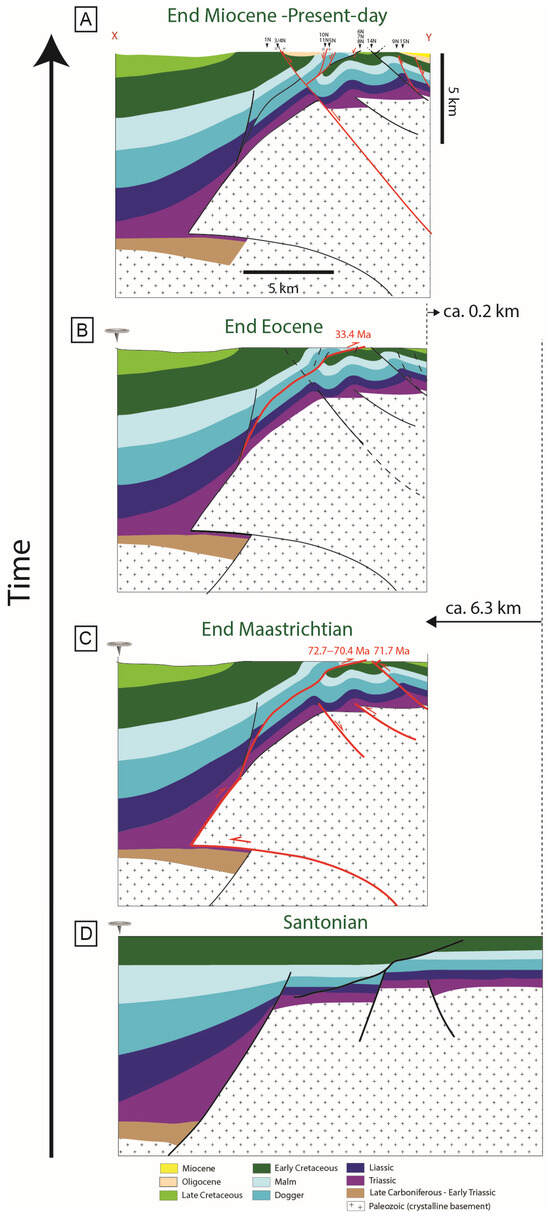
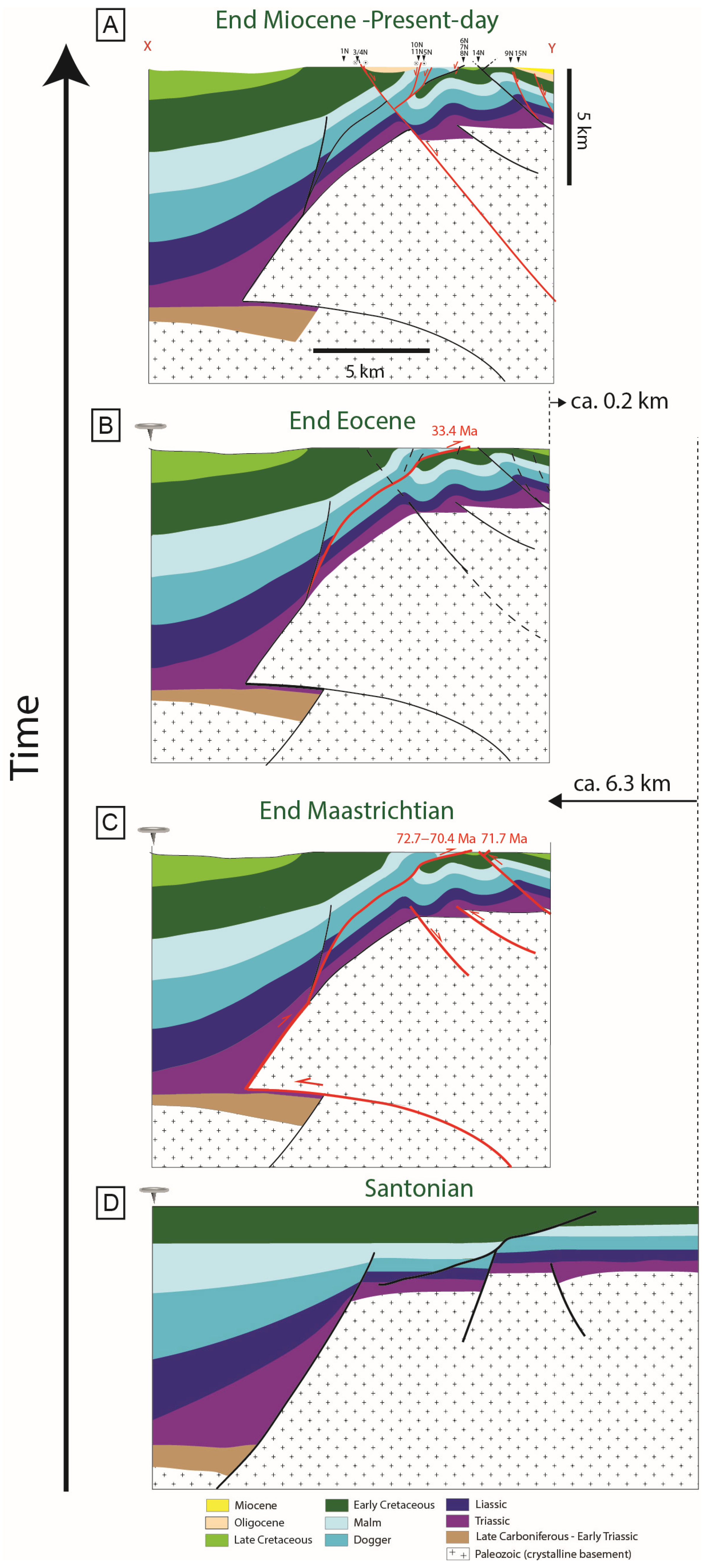
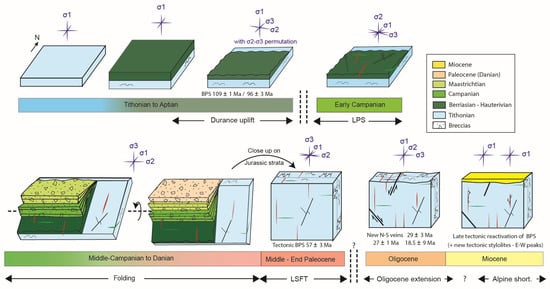
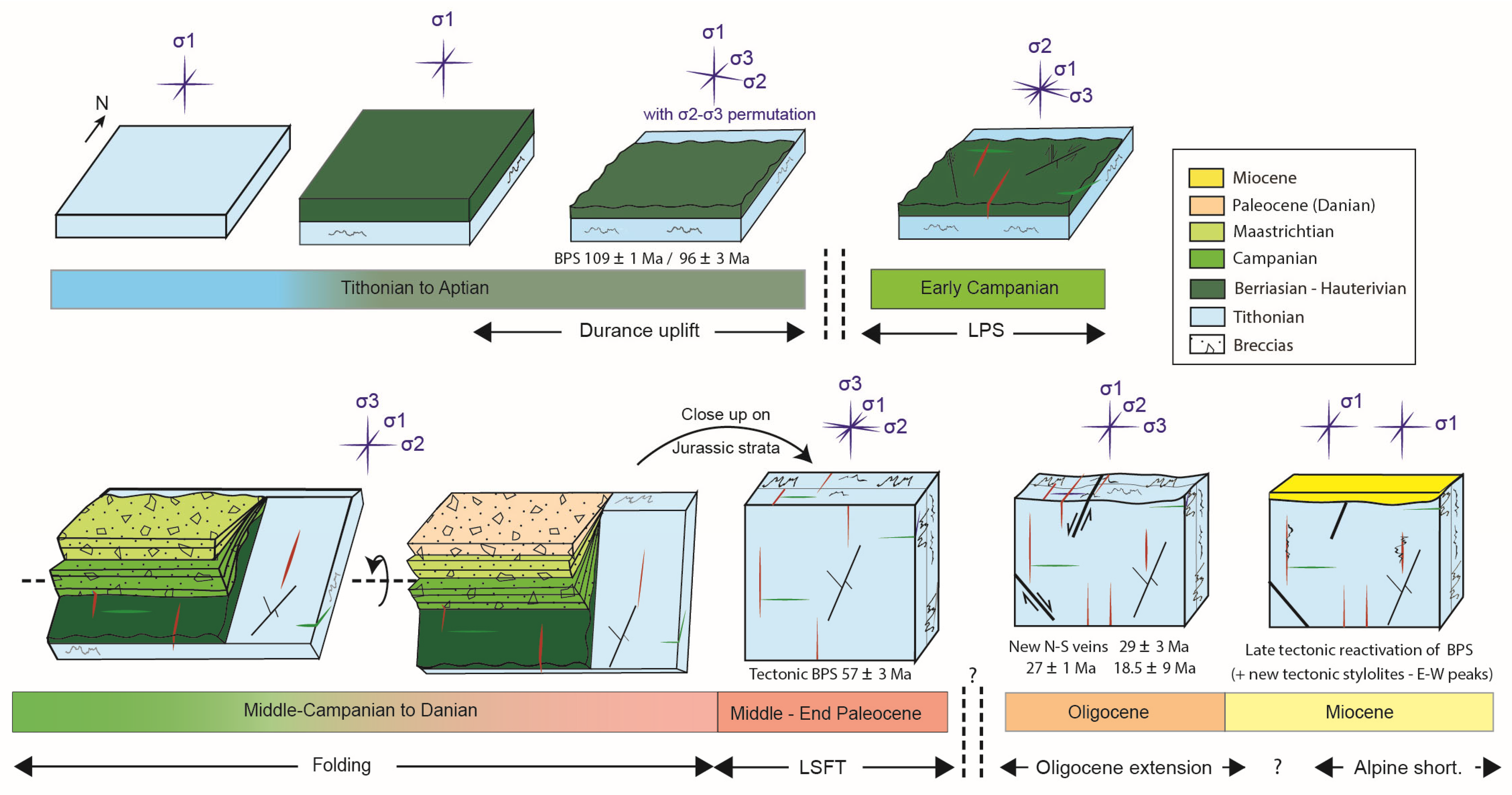
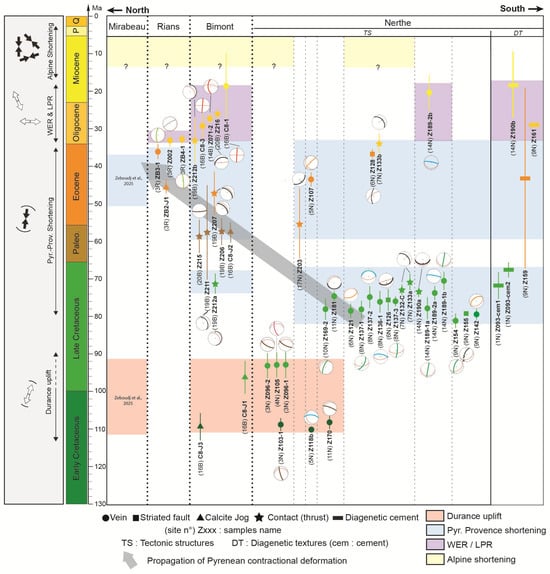
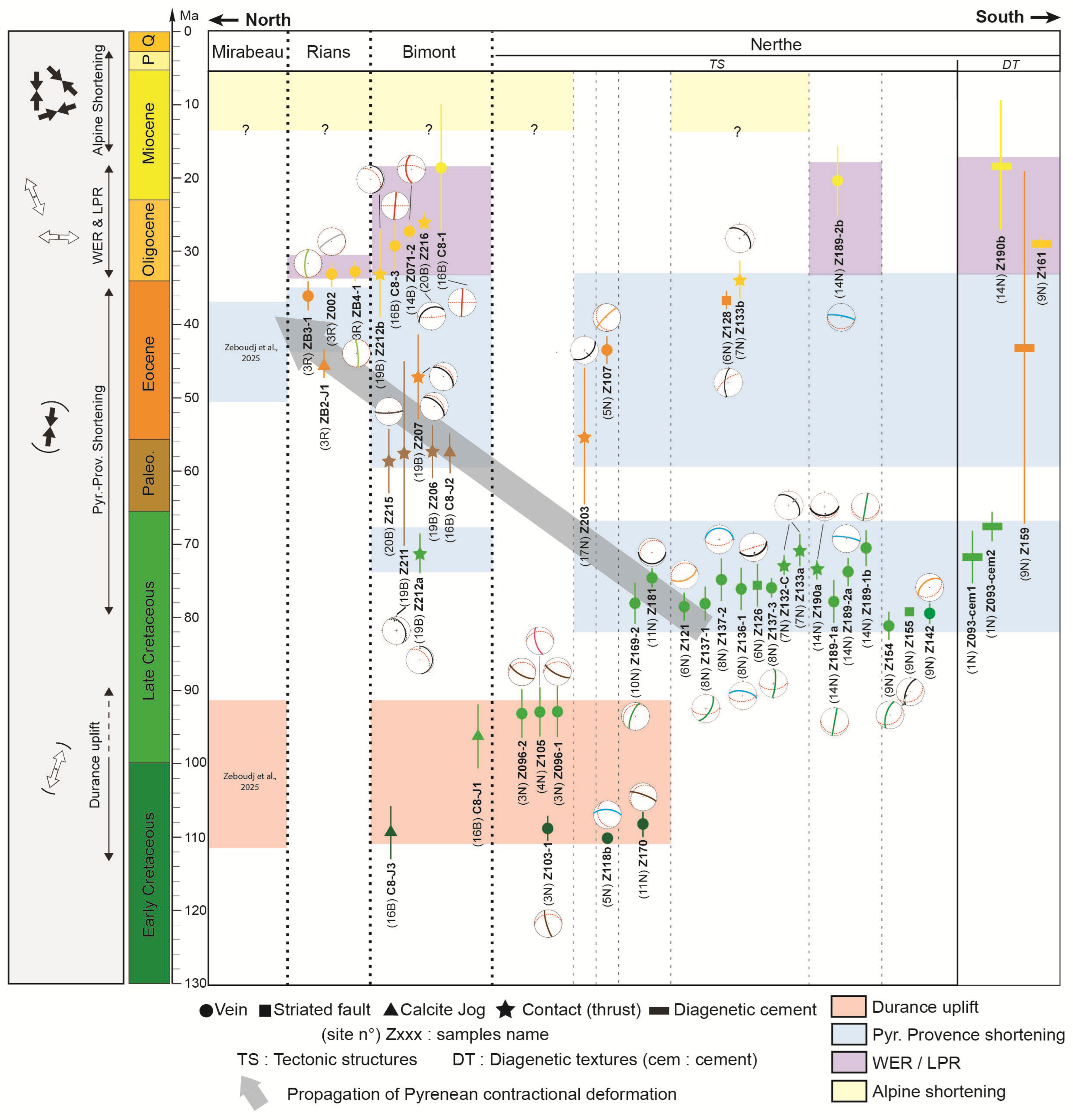

Disclaimer/Publisher’s Note: The statements, opinions and data contained in all publications are solely those of the individual author(s) and contributor(s) and not of MDPI and/or the editor(s). MDPI and/or the editor(s) disclaim responsibility for any injury to people or property resulting from any ideas, methods, instructions or products referred to in the content. |
© 2025 by the authors. Licensee MDPI, Basel, Switzerland. This article is an open access article distributed under the terms and conditions of the Creative Commons Attribution (CC BY) license (https://creativecommons.org/licenses/by/4.0/).