Article

Elemental Geochemical Analysis for the Gold–Antimony Segregation in the Gutaishan Deposit: Insights from Stibnite and Pyrite

1
Key Laboratory of Metallogenic Prediction of Nonferrous Metals and Geological Environment Monitoring, Ministry of Education, Changsha 410083, China
2
School of Geosciences and Info-Physics, Central South University, Changsha 410083, China
3
Hunan Provincial Natural Resources Survey Institute, Loudi 417000, China
*
Authors to whom correspondence should be addressed.
Geosciences 2025, 15(12), 462; https://doi.org/10.3390/geosciences15120462
Submission received: 11 August 2025 / Revised: 18 November 2025 / Accepted: 20 November 2025 / Published: 4 December 2025

Abstract

In many gold–antimony deposits throughout the world, the sequence of Au and Sb precipitation varies significantly. In high-temperature systems such as hydrothermal Au deposits, gold typically precipitates prior to antimony, whereas in lower-temperature systems (e.g., Carlin-type deposits), no consistent depositional sequence is observed. The Gutaishan Au-Sb deposit, located in the Xiangzhong Basin of the Jiangnan Orogenic Belt, South China, exhibits a distinct spatial segregation within a continuously evolving system of gold and antimony mineralization—a pattern commonly observed in many Au-Sb deposits throughout the region. To elucidate the mechanisms controlling Au-Sb co-occurrence and segregation, we conducted electron probe microanalysis (EPMA) and laser ablation inductively coupled plasma mass spectrometry (LA–ICP–MS) major and trace element analyses of stibnite and pyrite from quartz veins across different ore zones within the Gutaishan deposit. Trace element signatures—such as Cu-Pb correlations and Hg/(Cu + Pb) ratios which classify stibnite into Woxi-type and Xikuangshan-type, and Co/Ni ratios classifies pyrite into magmatic–hydrothermal and sedimentary types—suggest that the ore-forming fluids were predominantly magmatic–hydrothermal in origin, with minor contributions from metamorphic basement fluids. The occurrence of low-temperature trace element signatures in the Au-Sb deposit indicates that temperature is the primary control on Au-Sb segregation. The thermodynamic model further confirms that high-temperature fluids favored the precipitation of Au veins, while lower-temperature fluids facilitated the co-precipitation of stibnite and gold in Sb-Au veins. Therefore, we propose a metallogenic model for the Gutaishan deposit that highlights temperature-driven Au-Sb segregation, resulting from the progressive cooling of the ore-forming fluids.

1. Introduction

The co-occurrence of gold and antimony in the same ore deposit is a common phenomenon [1,2], but the mechanism governing their coexistence and segregation remains poorly understood. In Au-Sb deposits, gold occurs primarily as native gold and “invisible” gold, which is in the structure of common sulfide minerals or as discrete inclusions smaller than 100 nanometers [3], while antimony primarily exists as sulfides represented by stibnite, and can also be present in a variety of sulfides, such as entering the arsenopyrite crystal lattice through isomorphous substitution [4]. Current research suggests that gold–antimony segregation in hydrothermal systems is primarily controlled by the following factors: (1) variations in the source of the ore-forming fluid, as observed in the Woxi deposit of the Jiangnan Orogenic Belt (JOB) [5], (2) changes in the physical and chemical properties of the fluids, exemplified by the Baogutu deposit in the West Junggar Region [1], (3) structural controls that influence element migration and precipitation, such as in the Longwangjiang-Jiangdongwan Sb-Au mineralized area in the JOB [6]. A distinguishing characteristic of such deposits is the earlier formation of native gold relative to stibnite [7]. This sequence is also evident in other hydrothermal Au deposits, including orogenic systems such as those in the southern Tibetan Plateau of the Himalayan orogenic zone [8]. In contrast, Carlin-type and Carlin-like deposits do not exhibit a fixed sequence of gold and antimony mineralization, as demonstrated by the Qinglong and Yata deposits in the Youjiang Basin [9,10]. Some hydrothermal Au deposits with distinct physicochemical conditions (e.g., high sulfur fugacity or the prior enrichment and saturation of antimony) will also exhibit the precipitation sequence of antimony followed by gold [11,12].
The JOB in southern China is a major metallogenic region, particularly enriched in Au and Sb deposits [13]. The Gutaishan deposit, located in the southwestern region of the JOB, hosts 9 tons of gold reserves with an average gold grade of 13 g/ton [14]. Unlike epithermal Au deposits or orogenic Au deposits, Gutaishan is generally associated with intrusive granite and received metallic inputs (e.g., Ni) from sedimentary sources [15,16]. The deposit features two distinct vein systems: north–south-trending gold-only veins and northwest–southeast-trending Au-Sb veins. These vein systems probably formed in the late Indosinian period (muscovite 40Ar/39Ar dating yielded an age of 223.6 ± 5.3 Ma) [14] and the Yanshanian period (tectonic–magmatic processes suggested a late Jurassic age.) [17,18], respectively. Recent research on the Gutaishan deposit has primarily focused on the following: (1) the relationship between alteration and gold mineralization [19], (2) fluid inclusion studies [20], (3) sulfide textures and trace element analysis [14], (4) quartz trace elements and sulfur isotopes in stibnite [21], and (5) the overall mineralization mechanisms [15,16]. However, research specifically addressing the NW-trending Au-Sb veins is limited, and the process controlling the Au-Sb segregation remains poorly understood [17,18,21,22]. Therefore, this study aims to elucidate this segregation by analyzing the trace element characteristics of stibnite and pyrite.
Stibnite and pyrite are the minerals most closely associated with gold, and are recognized as important hosts of gold in hydrothermal deposits [3,7]. Stibnite is a common sulfide in such systems and plays a key role in understanding ore genesis, fluid sources, mineralization processes, and metal precipitation mechanisms [23,24,25,26,27]. Stibnite’s mineralogical characteristics make it a valuable target for deciphering the conditions of gold ore formation. Pyrite, the most abundant sulfide, serves as a robust recorder of geological processes in both igneous and fluid systems. Pyrite trace element compositions provide critical insights into fluid evolution and gold enrichment mechanisms [28,29,30]. Therefore, the analysis of trace elements in both stibnite and pyrite, particularly within different geological settings, has proven an effective tool in revealing ore-forming processes [31].
This study integrates electron probe microanalysis (EPMA) and laser ablation inductively coupled plasma mass spectrometry (LA–ICP–MS) data to investigate the major and trace element compositions of stibnite and pyrite from different ore zones in the Gutaishan deposit. The analytical results were further validated through thermodynamic modeling to assess the key factors controlling gold–antimony segregation. Based on this collective evidence, the trace element migration processes associated with Au-Sb segregation are reconstructed, aiming to develop a genetic model for their coexistence and spatial segregation.

2. Geological Background

2.1. Regional Geology

The South China Block consists of the Precambrian tectonic units of the Yangtze and Cathaysia Blocks (Figure 1a) [32]. The collision of the Yangtze and Cathaysia Blocks during the Middle and Late Proterozoic periods resulted in the formation and uplift of the JOB [33,34,35]. The JOB, situated along the southern periphery of the Yangtze Block (Figure 1a), comprises late Mesoproterozoic to early Neoproterozoic low-grade metamorphic basement rocks. This geological formation exhibits a width ranging from 80 to 120 km and a length exceeding 1000 km [36,37]. The region contains S-type granite intrusions that emerged during the Neoproterozoic era [38]. The JOB underwent a series of tectonic movements following its formation. The tectonic setting underwent a transition from subduction during the Early Paleozoic to the Middle–Late Jurassic periods, to extension during the Late Jurassic–Cretaceous [39]. These tectonic movements resulted in the formation of numerous NE–NNE-trending uplifting structures, such as Xuefeng Mountain, and deep faults, including the Woxi Deep Fault (Figure 1b) [40]. The South China Block has three primary episodes of mineralization, including the ~430–380 Ma and 230–200 Ma episodes of antimony–gold–tungsten mineralization in the Xuefengshan Uplift Belt, and the 160–130 Ma episode of Sb mineralization in the Xiangzhong Basin and of granite-related tungsten–tin mineralization to the southeast of the basin [41,42,43,44].
The Xiangzhong Basin, situated in the southwestern region of the JOB, is predominantly composed of Late Paleozoic carbonates, with sporadic occurrences of Sinian, Cambrian, Ordovician, and Cretaceous strata [45]. Granitic intrusions from the Paleozoic (410–400 Ma) and early Mesozoic (230–200 Ma) eras are exposed along the margin of the Xiangzhong Basin. The occurrence of younger Mesozoic intrusions is characterized by their tendency to penetrate the terrain between Paleozoic granitic intrusions [46,47,48,49]. Furthermore, the presence of Triassic granite intrusions [50,51,52,53] and substantial gravity anomalies [54,55] within the Xiangzhong Basin suggests the potential for buried Yanshanian granitic bodies to have developed in the region’s deeper layers. The Xiangzhong Basin and the adjacent Xuefeng Mountain uplift zone have identified over 100 independent antimony ore deposits, varying in grade and scale (Figure 1b) [56,57]. Notable representative deposits include the Gutaishan, Woxi, and Banxi antimony (Au-W) polymetallic ore deposits, as well as the Xikuangshan antimony ore deposit (Figure 1b). Among these deposits, the Gutaishan represents an ideal case study for understanding the controls on Au-Sb segregation.

2.2. Ore Deposit Geology

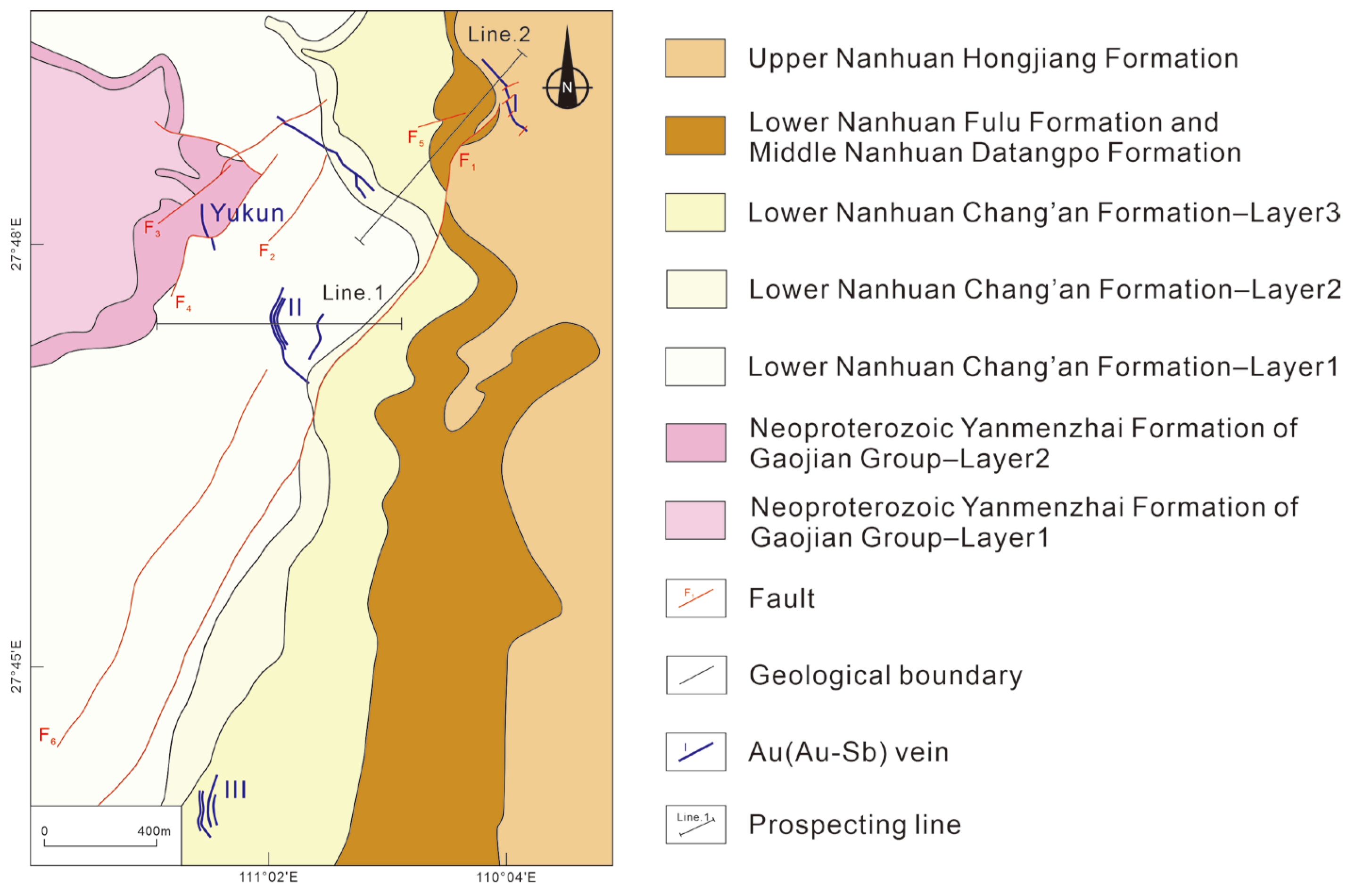
The Gutaishan Au-Sb deposit exposed strata mainly include the Upper–Lower Proterozoic Banxi Group, Cambrian, Ordovician, and Quaternary (Figure 1b and Figure 2). The Banxi Group, with slate and sandstone outcrops due to fracture development, hosts gold-mineralized quartz veins filling the fractures, serving as one of the primary ore-bearing strata, and ore veins are localized within interlayer fractures, making them strictly strata bound. The Paleozoic strata in the western and central parts are dominated by conglomerate shale, sandstone, carbonate, mudstone, and siliceous rock, while the Cambrian in the east–central area consists of siliceous rock, mudstone, and limestone, and the Lower Ordovician along the eastern periphery is mainly mudstone and sandstone. The strike of the strata varies from approximately E–W to N–NE from north to south. The dominant foliation is a slaty cleavage formed by regional metamorphism, exhibiting a general NNE–SSW strike (358–12°) with an easterly dip. The attitude of this foliation varies slightly among different ore-hosting horizons and demonstrates a consistent geometric relationship with the veins, which are either parallel to the bedding or indirectly constrained by this structural fabric. The area features a N–S trending monocline without significant folds, with faults categorized into NE, NW, N–S, and E–W groups showing multi-stage activities, and the N–S and NW faults in the west act as ore-hosting structures. The Baimashan granite complex, located approximately 2 km to the west (Figure 1b), was primarily emplaced during the Caledonian period (422.0–411.8 Ma) [58], with subsequent intrusions during the Indosinian (233–204.5 Ma) [51,59] and Yanshanian (176.0 ± 4.4 Ma) [52] periods. It consists mainly of biotite dioritic granite and granodiorite, featuring relatively undeveloped central veins but exhibiting a complete range of vein types. Wall rock adjacent to the veins exhibit prominent alterations, divided into inner zones (arsenopyrite, stibnite, pyrite, silicification, closely related to mineralization) and outer zones (silicification, sericitization, carbonate, chlorite, with no obvious mineralization association), with stibnite closely linked to gold in single gold-bearing quartz veins.

2.3. Ore Body Features

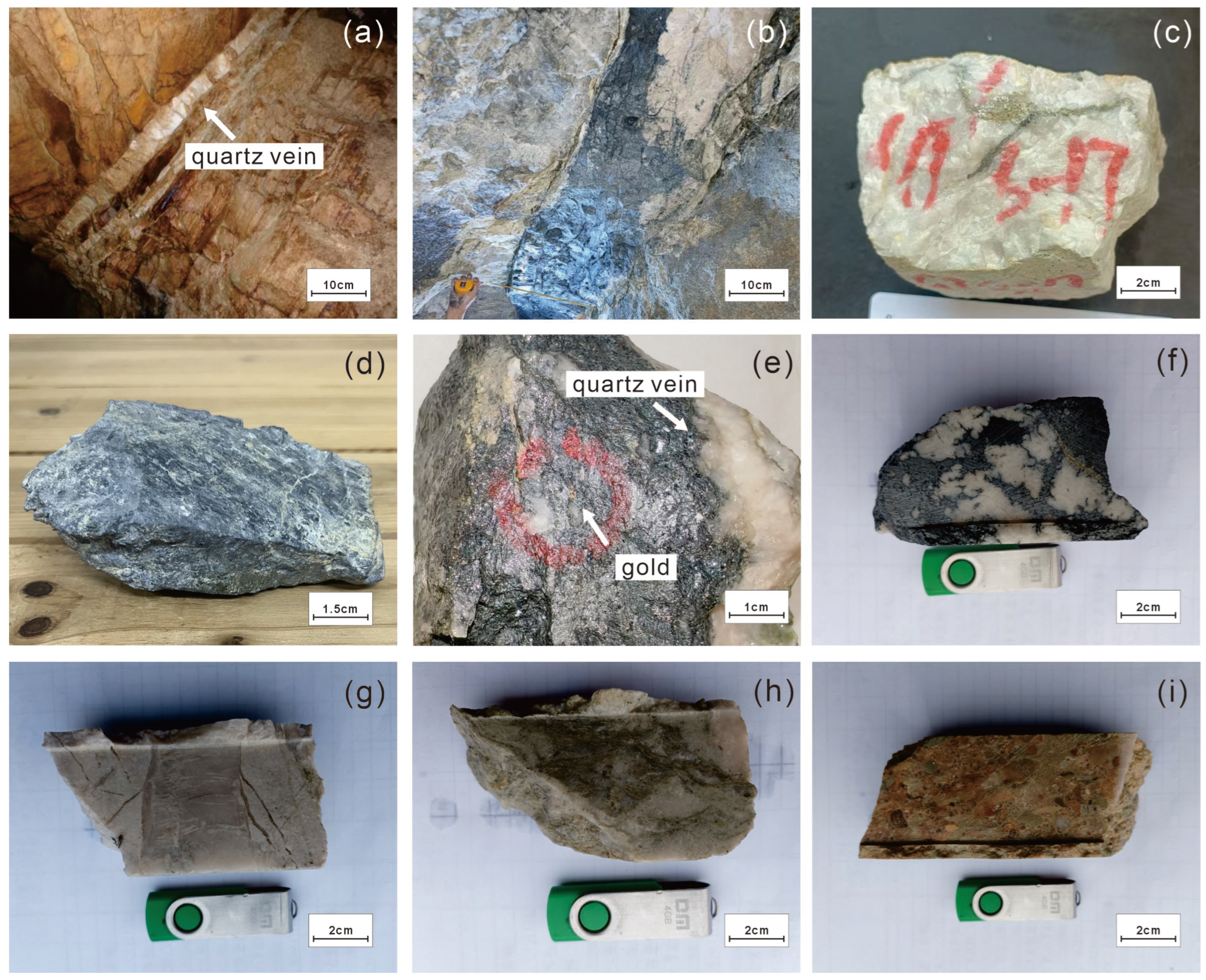
The mineralogy is relatively simple, comprising native gold; sulfides include stibnite and pyrite as the main sulfides, with occasional occurrences of chalcopyrite; gangue minerals are primarily quartz, followed by chalcedony, feldspar, calcite, sericite, and chlorite, among others. The ore’s mineral composition and associated mineral associations serve as the foundation for its classification into two distinct types: single-gold-type (Figure 3a) and antimony–gold-type (Figure 3b). Genetically, it is divided into quartz vein-type (gold) and fracture-controlled-type (antimony), both associated with magmatic activity, as indicated by ore-forming fluids, material sources, and mineralization age.
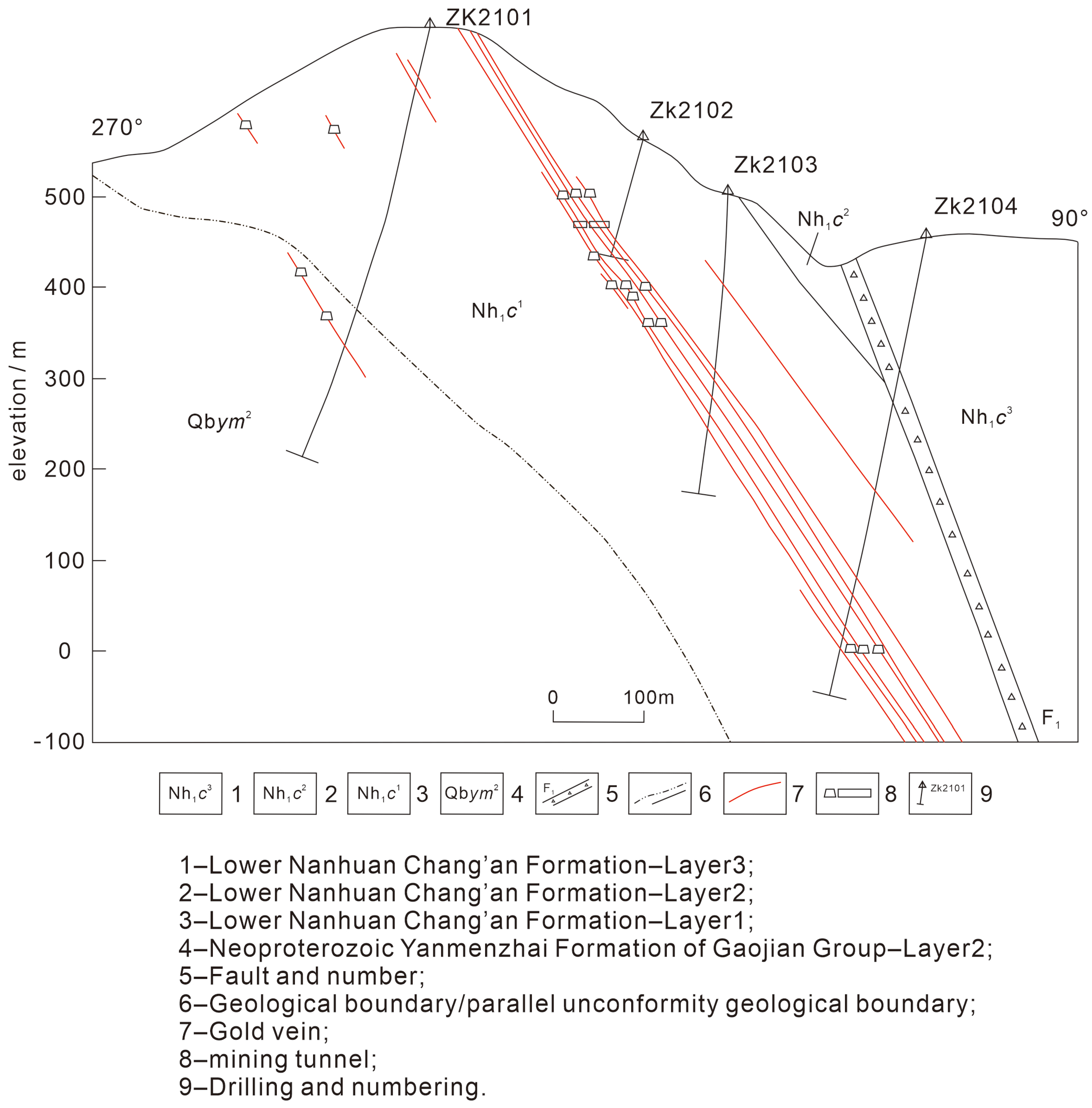
Single-gold-type ores (Figure 3a,c) are the primary mineral type in this mining area. This mineralogical formation consists of quartz veins and near-vein altered wall rocks. Between the quartz veins, V-shaped echelon structures or simple echelon structures are observable. The mineral veins are oriented in a direction that is nearly N–S, with a dip toward the east and a dip angle ranging from 48° to 62°. The quartz veins are characterized by their parallel alignment (Figure 4). Ore bodies within the deposit range in strike length from tens of meters to 200 m, with a dip extension that extends between 200 and 700 m. The primary ore minerals present in the ore are pyrite, followed by arsenopyrite, stibnite, sphalerite, galena, chalcopyrite, and native gold. The main gangue minerals are sericite and quartz, followed by chlorite, feldspar, and a small amount of calcite. In the single-gold-type deposit, pyrite manifests in two distinct forms. The first form is bright metallic, exhibiting a euhedral or subhedral morphology, with grain sizes ranging from 0.2 to 1.5 mm. This form is sporadically distributed within quartz veins and the surrounding wall rock. The second form is characterized by a smoky gray hue, manifesting as disseminated or irregularly shaped aggregates within quartz veins or in close proximity to the veins. Notably, the latter form exhibits a close association with native gold. Stibnite is predominantly found as granular aggregates between quartz grains or in fractures, arranged in banded or fine vein-like patterns.
Antimony–gold-type ores (Figure 3b,d–i) are predominantly found in mineralized fracture zones. The alteration and fractured zone-type Sb (Au) veins are characteristic of this type. This type of ore bodies is primarily composed of multiple-stage quartz, blocky and disseminated stibnite, fault breccia fragment, and fault gouge. The vein trend exhibits a gradual shift from a W–E direction to a NW–SE direction, with a concomitant decrease in dip angle from west to east. The intersection relationships between antimony veins and quartz veins, in conjunction with the characteristics of quartz, indicate that this fault has undergone at least three tectonic episodes. The average antimony grade is 5.94%, and the average gold grade is 15.13 g/t. The Au-Sb grade demonstrates a positive correlation with depth. The predominant metallic minerals are stibnite, followed by pyrite, galena, sphalerite, arsenopyrite, wolframite, and native gold. The predominant gangue minerals are sericite and quartz, feldspar, and calcite, with trace amounts of muscovite, dolomite, and barite. Pyrite and stibnite are distributed unevenly along the margins of the veins and in the wall rock. Their abundance decreases from the vein core toward the margins. Beyond approximately 10 cm from the vein, the distribution becomes sparse, exhibiting a relative symmetry on both sides of the vein. The ore structure is predominantly crystalline, coarse-grained to fine-grained, fractured, and consists of disseminated, nodular, and compact blocky textures.

3. Sampling and Methods

3.1. Sampling

Eight samples were collected from well-mineralized ore bodies at various depths in the No. II and Yukun veins of the Gutaishan Au-Sb deposit to analyze the chemical compositions of associated pyrite and stibnite from gold-bearing quartz veins and fracture zone-type stibnite veins, respectively (Figure 2).
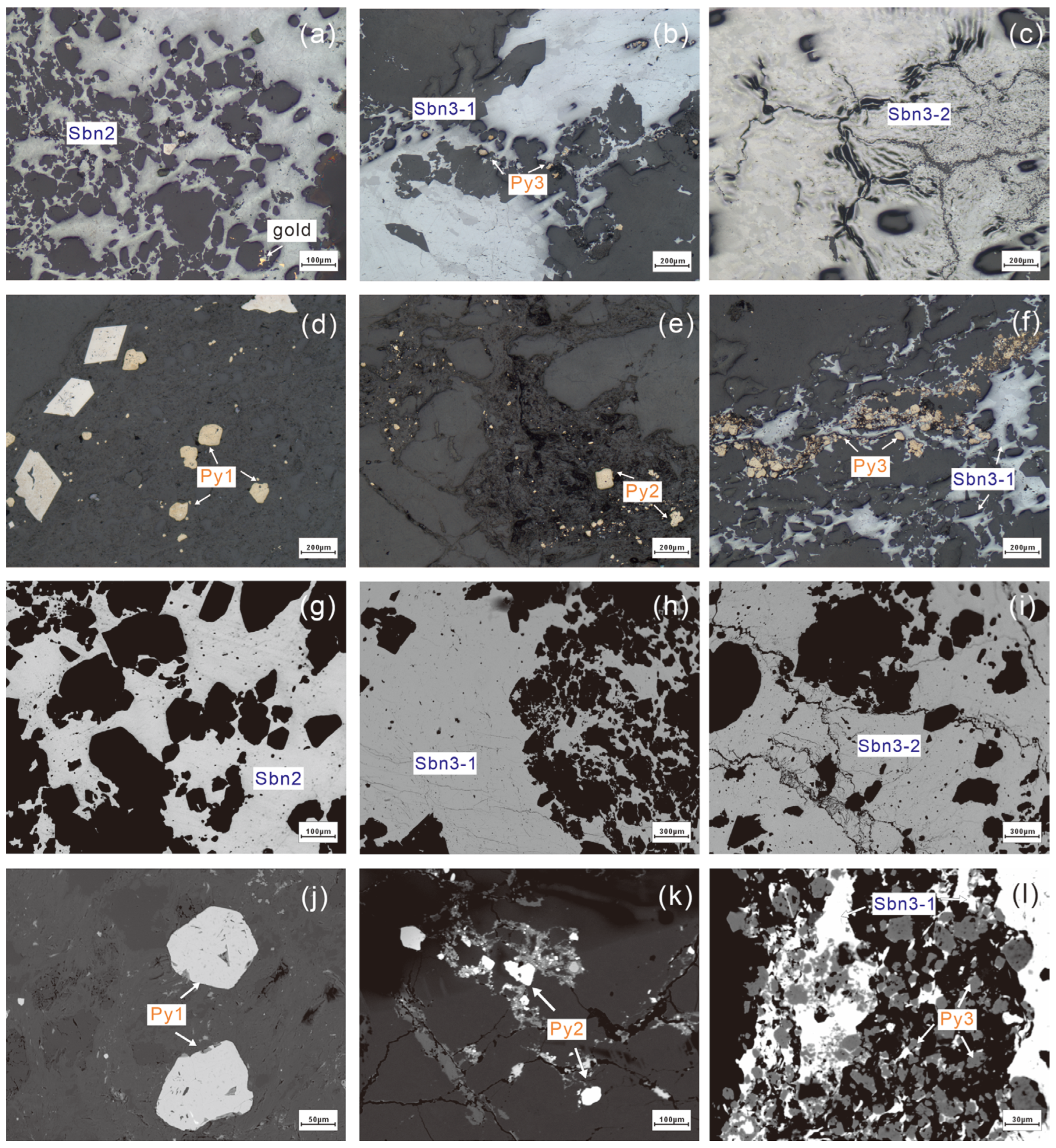
Based on the sampling locations of the samples and the structural characteristics of the stibnite ores, stibnite was classified into the following categories: Sbn2: Massive or disseminated stibnite occurring in stibnite veins (Figure 5a); Sbn3-1: Massive or disseminated stibnite occurring in stibnite veins in association with vein-like pyrite (Figure 5b); Sbn3-2: Massive or disseminated stibnite occurring in stibnite veins and two types of stibnite replacement textures can be seen (Figure 5c). Sbn3-1 and Sbn3-2 are sourced from the same sampling locations. As all stibnite samples were collected from antimony–gold-type veins, they exhibit limited variation in their petrographic characteristics.
Based on the sampling locations of the samples and the microscopic observations of the pyrite structure, the pyrites were classified into the following categories: Py1: Single-grain euhedral to subhedral pyrite from Au veins (Figure 5d); Py2: Single-grain euhedral to subhedral pyrite from stibnite veins (Figure 5e); the Py2 and Sbn2 samples are from the same source. Py3: Vein-like euhedral to subhedral pyrite from stibnite veins (Figure 5f). The Py3, Sbn3-1, and Sbn3-2 samples are all from the same locations. The burial depth becomes progressively shallower from the sampling locations of Py1 to Py3.

3.2. EPMA

Major and trace element components of sulfides were analyzed using a JXA-8100 electron microprobe (EMPA) (JEOL, Tokyo, Japan) with a voltage of 20 kV, a beam current of 20 nA, a spot size of 1 μm, and 10–30 s peak counting time. The natural minerals and synthetic oxides that were used as calibration are as follows: pure As (As), CuFeS2 (Fe, S and Cu), pure Co (Co), galena (Pb), pure Ni (Ni), pure Bi (Bi), Ag2Te (Te), and InSb (Sb). The spectral lines adopted of each element are As (105.07), Fe (134.928), S (172.099), Co (124.665), Pb (169.299), Ni (115.486), Bi (163.951), Cu (107.234), Sb (110.784), and Te (106.068), respectively. A program based on the ZAF procedure is used for data correction. The full major element data suite of analyzed stibnite and pyrite data can be found in Supplementary Tables S1 and S2, respectively.

3.3. LA–ICP–MS

In situ trace element compositions of individual stibnite and pyrite were measured by a Teledyne Photon Machines Analyte He Excimer 193 nm laser ablation system (Thousand Oaks, CA, USA), coupled to an Analytik Jena Plasma Quant MS Ellite (Jena, Germany) at the Key Laboratory of Metallogenic Prediction of Nonferrous Metals and Geological Environment Monitor of Ministry of Education, at the Central South University, Changsha, Hunan Province. The selected thin sections were cleaned and placed into the HelEx II chamfer cell of laser (Teledyne, Thousand Oaks, CA, USA). The samples were placed in a sealed ablation cell that was constantly flushed with a mixture of high purity Ar (13.5 L/min) and He gases (1.1 L/min). Spot sizes are 35 μm. The laser repetition rate was typically 5 Hz and laser beam energy at the sample was maintained around 1.5–2.5 J/cm2. The analyzing time for each spot was 70 s, comprising a 20 s measurement of background (laser off) and a 30 s analyzes signal and 20 s washout time. The instrument tuning conditions are as follows: energy density 3.5 J/cm2, beam spot diameter 35 μm, laser frequency 5 Hz to analyze NIST SRM610 [60]; ensure that for 238U of 1 microgram/gram the count is more than 7000 per second. The measured elements include the following: 23Na, 25Mg, 27Al, 29Si, 31P, 33S, 35Cl, 39K, 43Ca, 45Sc, 47Ti, 51V, 53Cr, 55Mn, 57Fe, 59Co, 60Ni, 65Cu, 66Zn, 71Ga, 72Ge, 75As, 78Se, 98Mo, 107Ag, 113Cd, 115In, 118Sn, 121Sb, 125Te, 197Au, 202Hg, 205Tl, 208Pb, 209Bi, 232Th, and 238U. We used USGS geochemical reference materials MASS-1 [61], GSD-1G [62], and GSE-1G [63] as external standards for pyrite analyses, and iron as internal standard. In addition, NIST SRM610 was used as the system monitoring sample. USGS geochemical reference materials BCR-2 [64], BHVO-2 [65], AVG-2 [66], and RGM-2 [67] were used for quality control, the internal standard elements were Sb and Fe for stibnite and pyrite. Data reductions use GLITTER 4.4.4 developed by GEMOC according to the standard method [68]. All results for all measured trace elements are in good agreement with published standard material. The full trace element data suite of analyzed stibnite and pyrite data can be found in Supplementary Tables S3 and S4, respectively.

4. Major and Trace Elements of Stibnite and Pyrite

4.1. Major Elements

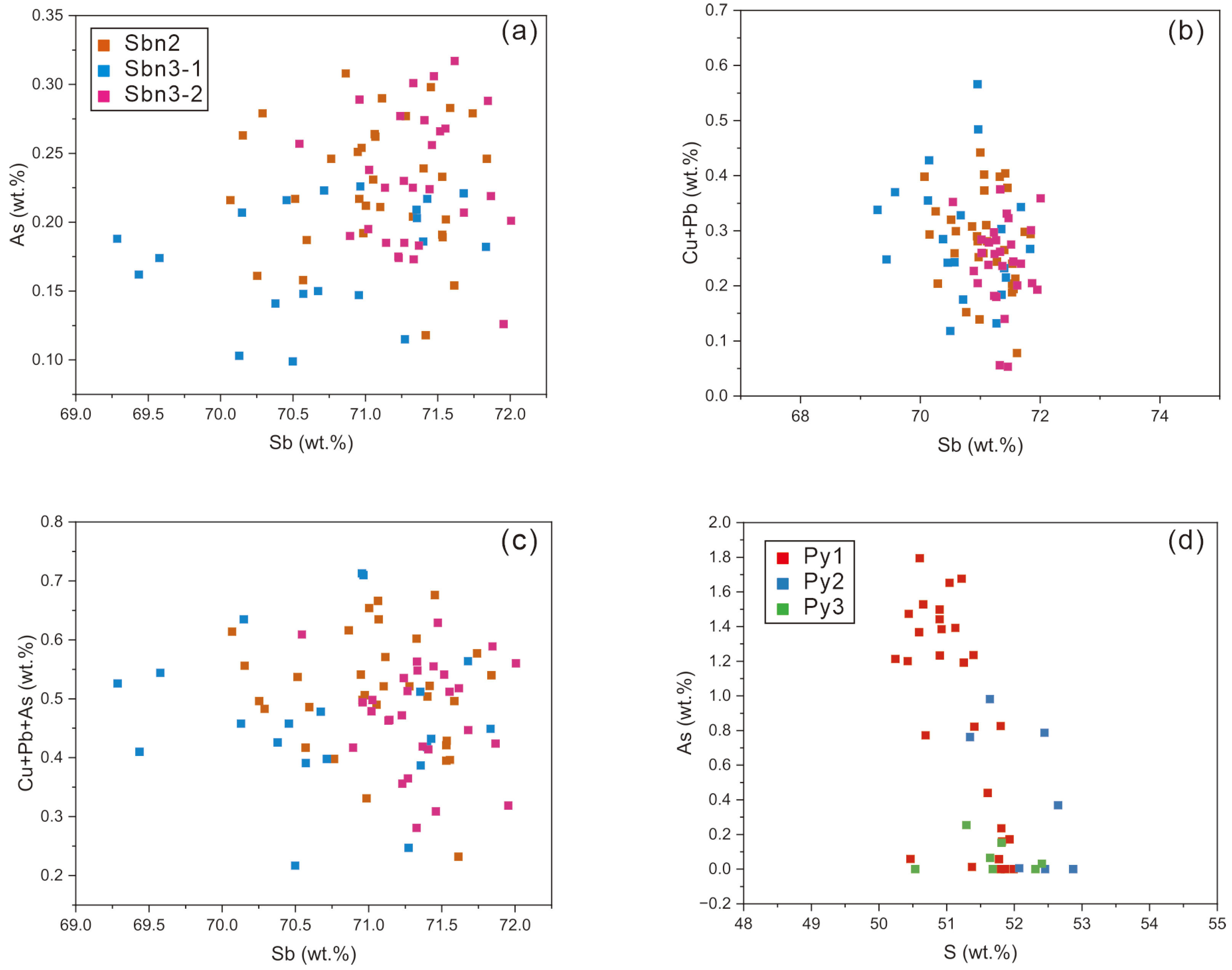
The EPMA results of stibnite from the Gutaishan Au-Sb deposit indicate that the three types of stibnite are relatively homogeneous in composition (Figure 6a–c). Antimony and sulfur contents range from 69.29 to 72.01 wt.% (mean 71.08 wt.%) and 27.27 to 28.95 wt.% (mean 28.11 wt.%), respectively, closely approaching the theoretical values of stibnite (Sb = 71.38 wt.%, S = 28.62 wt.%) [69]. Besides these two major elements, arsenic and lead are present in relatively higher amounts, ranging from 0.10 to 0.32 wt.% (mean 0.22 wt.%) and 0.05 to 0.52 wt.% (mean 0.27 wt.%), respectively. In contrast, copper contents are generally low, mostly near or below the EPMA detection limit, with a maximum value of 0.05 wt.%.
The EPMA results of pyrite indicate that, with the exception of anomalous points, the Fe and S contents generally range from 44.05 to 47.13 wt.% and 50.24 to 52.87 wt.%, respectively. From Py1 to Py3, the As content shows a clear decreasing trend (Figure 6d), averaging 0.89 wt.% in Py1, 0.42 wt.% in Py2, and only 0.07 wt.% in Py3. An anomalous spot was identified in Py3, characterized by significantly low Fe and S contents of 29.18 wt.% and 41.18 wt.%, respectively, with a total elemental sum of 72.03 wt.%. Furthermore, Sb was exclusively detected in Py3 among all the pyrite types analyzed.

4.2. Trace Elements

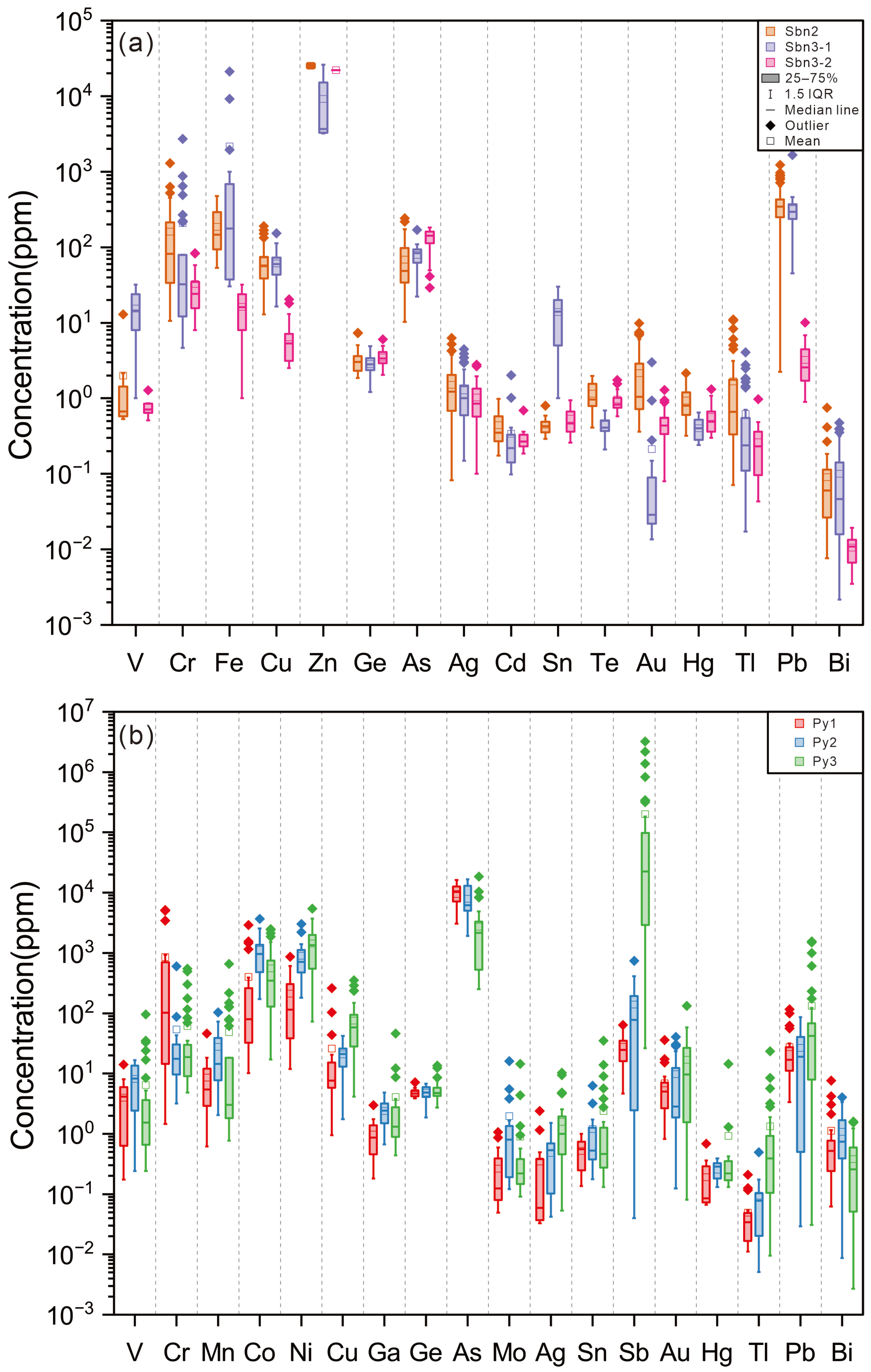
In the Gutaishan antimony mine (Figure 7a), the most frequently detected trace elements in stibnite are Cr, As, Ag, Au, Tl, and Pb. Their concentrations are usually higher than the detection limit. In Sbn2 and Sbn3-1, Pb, Cu, As, and Cr have relatively high average concentrations (>50 ppm). In Sbn3-2, only As has an average concentration (mean 126.7, range 182.5–29.1 ppm) that is higher than 50 ppm. Additionally, the average concentrations of Au in different stibnite types are as follows: 2.2 (range 9.8–0.4 ppm), 0.2 (range 3.0–0.0 ppm), and 0.5 (range 1.3–0.1 ppm).
In Py1-3, the concentrations of V, Cr, Mn, Co, Ni, Cu, Ga, Ge, As, Ag, Sb, Au, Tl, Pb, and Bi were generally higher than the detection limits (Figure 7b). The concentrations of Zn, Se, Mo, Cd, In, Sn, Te, and Hg were partially or entirely below the detection limits. Among these, elements with relatively high average concentrations (>100 ppm) include the following: Cr, Co, Ni, and As in Py1; Co, Ni, As, and Sb in Py2; and Co, Ni, As, and Sb in Py3. Elements with moderate concentrations (10–100 ppm) include the following: Cu, Sb, and Pb in Py1; Cr, Mn, and Cu in Py2; and Cr, Mn, Cu, and Au in Py3. The average concentrations of Au in the three pyrite types were 6.9 (range 7.8–0.8 ppm), 9.7 (range 12.2–0.1 ppm), and 16.9 (range 22.2–0.1 ppm), respectively. The abnormally high concentration of Sb in Py3 (range 570,189.4–26.5 ppm, mean 199,943.0 ppm) may be due to its simultaneous formation with stibnite, resulting in the presence of a significant amount of stibnite inclusions.

5. Discussion

5.1. Occurrence of Trace Elements

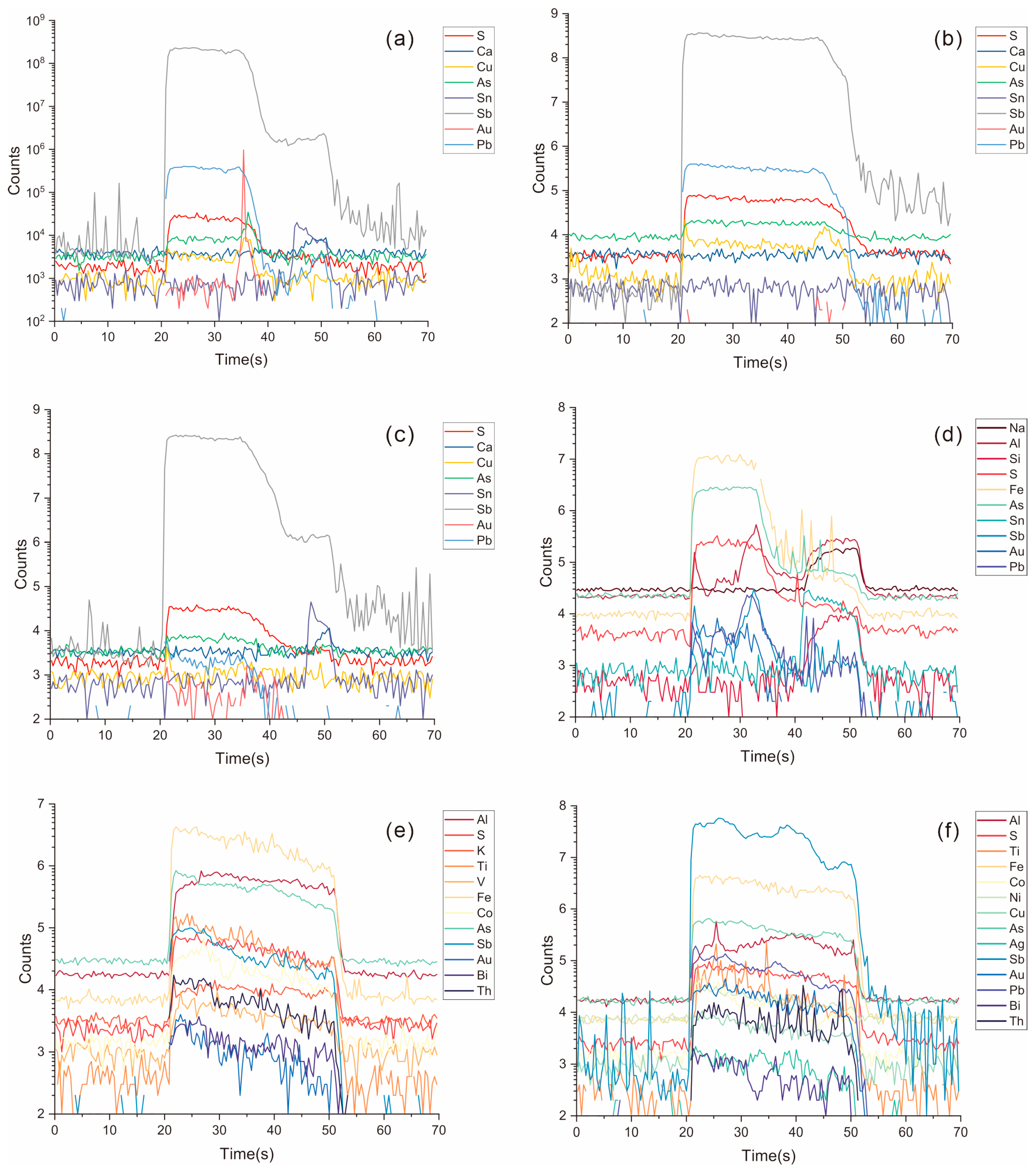
Previous studies have shown that trace elements in sulfide minerals (e.g., pyrite, stibnite, sphalerite, and galena) typically occur in one of three forms: (1) solid solutions or nanoparticles within the crystal lattice, (2) micro-/nano-inclusions, or (3) visible fluid or mineral inclusions [70,71,72,73,74]. For LA–ICP–MS time-resolved profiles, (1) relatively smooth profiles indicate that the relevant trace elements exist in solid solution or are incorporated into mineral structures in the form of nanoparticles, (2) profiles with element peaks typically indicate the presence of micro-scale inclusions of relevant elements [70,75,76]. When mineral inclusion particles exhibit dimensions greater than 100 nm, the LA–ICP–MS data ablation signal curves can distinctly differentiate these mineral particles, otherwise the presence of nano-inclusions would also result in smooth time-resolved profiles [77,78].
In the stibnite ore of the Gutaishan deposit, the LA–ICP–MS time-resolved profiles of Cu and Pb in Sbn2 and Sbn3-1 are relatively smooth or consist of a series of comparable peaks of different amplitudes. This finding indicates that these elements may exist mainly in the form of solid solutions in the crystal lattice, or at least as nanoparticles that are invisible in stibnite. The presence of Au was indicated by isolated peaks (Figure 8a) in a considerable number of LA–ICP–MS time-resolved profiles, suggesting the existence of micrometer-sized Au inclusions or nanoparticles within the stibnite of the Gutaishan deposit. In addition, the presence of small-scale peaks of As, Sn, Cr, Al, Mn, and Ti were observed, while only Sbn3-1 exhibited small-scale peaks of Fe, Co, and Ni.
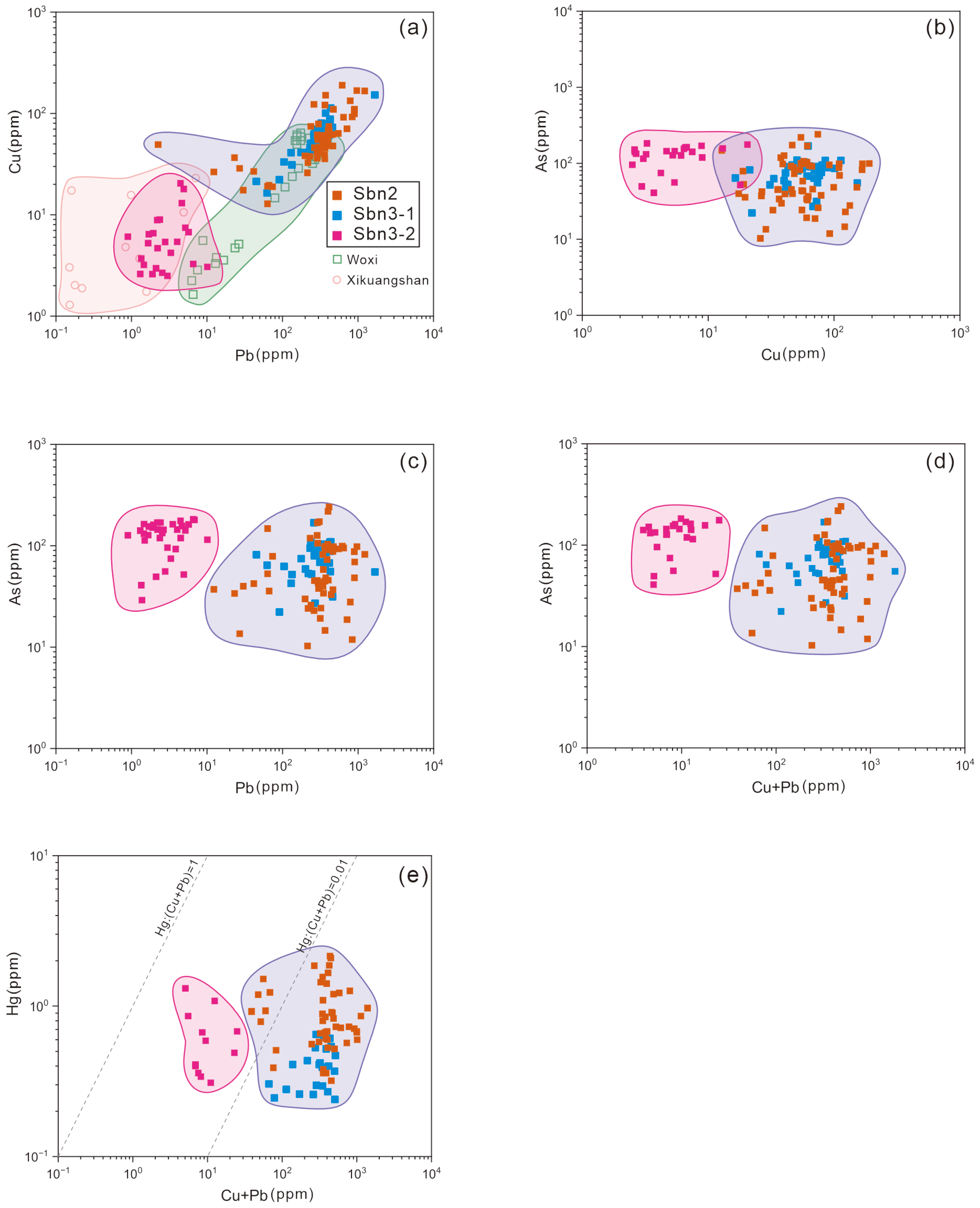
In the Gutaishan deposit, a significant positive correlation was observed between Cu and Pb (R = 0.75, R = 0.82) in Sbn2 and Sbn3-1, while weak correlation was detected between Cu and Pb (R = 0.20) in Sbn3-2 (Figure 9a). The prevailing studies generally suggest that Cu and Pb can enter the stibnite lattice through coupled replacement of Cu+ and Pb2+ with Sb3+, and that the concentrations of Cu and Pb in stibnite should be correlated and similar [76]. In this study, the higher Pb concentration compared to Cu in Sbn2 and Sbn3-1 indicates that the coupled substitution of Cu+ and Pb2+ may not be the sole mechanism for their incorporation (Figure 9a). The smooth LA–ICP–MS time-resolved profiles (Figure 8a–c) and the absence of inclusions in BSE images (Figure 5g–i) suggest that Pb may be in solid solution, or as nanoparticles/nano-scale inclusions.
Arsenic is also relatively abundant in stibnite in Gutaishan, which may be due to the similarity in the ionic radii and chemical properties of arsenic and antimony [80]. According to previous studies, the presence of As within the crystal lattice of stibnite can be explained by two possible mechanisms: (1) Sb3+ ↔ As3+ [76] or (2) 2Sb3+ ↔ Cu+ + Pb2+ + As3+ [76,81]. Based on the analysis of the correlations between Cu, Pb, and As (Figure 9b–d), we found that As was not correlated with Cu, Pb, or (Cu + Pb) (|R| < 0.2, Figure 9b–d), indicating that the main way As enters stibnite is likely Sb3+ ↔ As3+ substitution.
In the pyrite of the Gutaishan deposit, the majority of elements (e.g., V, Cr, Cu, Ga, Ge, As, Ag, Tl, and Bi) exhibit smooth LA–ICP–MS time-resolved profiles or comprise a series of comparable peaks of varying amplitudes. This observation suggests that these elements predominantly exist in the crystal lattice in the form of solid solutions or at least in the form of nanoparticles invisible in pyrite. No significant inclusion peaks were observed in Py1. Small-scale peaks of Sb, Pb, and Ti were observed in Py2. In Py3, wide and high Sb peaks indicate the presence of large amounts of stibnite inclusions in pyrite, and small-scale peaks of Pb, Al, and Au were also observed.
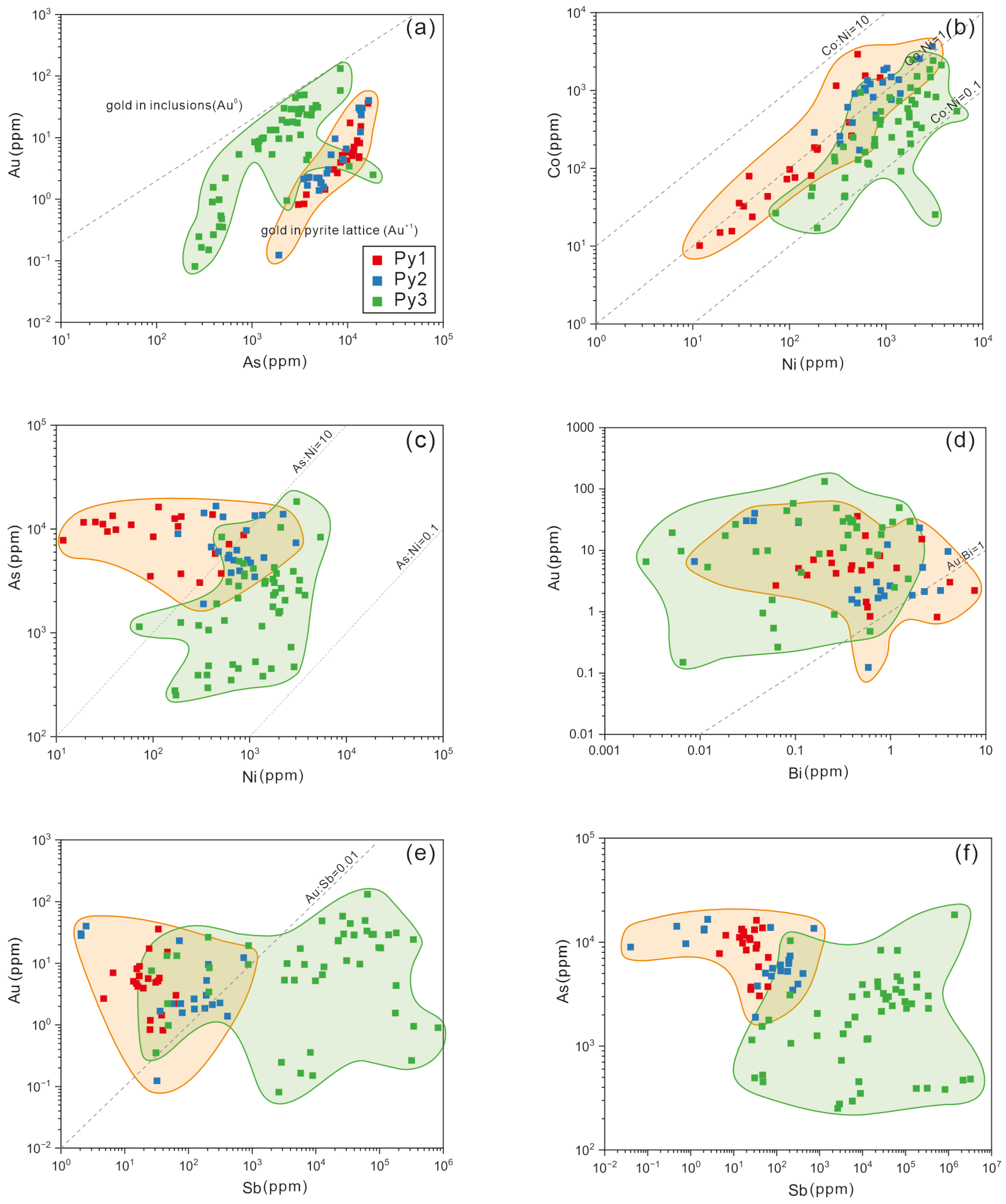
Gold occurrence in pyrite is complex and can exist in multiple forms: as structurally bound Au in positive (Au+, substituting for Fe) or negative (Au, substituting for S) valence states within the crystal lattice, and as native gold nanoparticles (Au0) [82,83,84]. The empirical solubility of gold in pyrite is as follows: it can be demonstrated that CAu = 0.02 × CAs + 4 × 10⁻⁵ (Figure 10a) [85]. The data for Py1-3 are all completely below the solubility curve, indicating that gold exists in Gutaishan pyrite in the form of structurally bound Au+1.
Arsenic, the most abundant element in Gutaishan pyrites, can enter the pyrite lattice through isomorphous substitution [86]. In Py1 and Py2, arsenopyrite inclusions are observed in BSE images (Figure 5j,k), EPMA data reveal a negative correlation between As and S (Figure 6d), and LA–ICP–MS time-resolved profiles for As are generally smooth with occasional sharp, isolated peaks (Figure 8d–f). These features indicate that arsenic incorporation occurred primarily through As-S substitution, with minor arsenopyrite inclusions. In contrast, Py3 contains relatively less As but extremely high Sb, as shown by LA–ICP–MS results with smooth time-resolved profiles (Figure 8f). While BSE images reveal minor stibnite inclusions (Figure 5l), EPMA-measured Sb contents are predominantly below the detection limit. This evidence suggests that Sb in Py3 is predominantly hosted as nano-inclusions, reflecting an Sb-rich and relatively As-poor fluid signature for the Py3-forming stage.

5.2. Implications for Ore-Forming Fluids

Many studies have examined the trace elements in stibnite in southern China, and the results summarize two stages of mineralization in the Xiangzhong Basin: the orogenic stage and magmatic stage. Both stages are represented by the so-called Woxi and Xikuangshan types, respectively [79,87].
The Woxi-type Sb deposit is characterized by comparatively high base metal (Cu and Pb) concentrations and strong positive correlations between Cu and Pb [79]. It contains native gold, and δ34S suggests that the antimony mineralization is genetically related to magmatic source, associated with Caledonian and Indosinian orogenic events, and coeval magmatic activity [79].
The Xikuangshan Sb deposit has low base metal concentrations [79], and a lack of correlation between Cu and Pb, with no native gold identified. During the Proterozoic, δ34S suggests that circulated fluids leached Sb and related metals from the metamorphic basement forming the deposit under the influence of the Yanshanian orogeny [79,88].
In the Gutaishan Au-Sb deposit, Sbn2 and Sbn3-1 have been found to contain elevated concentrations of base metals, exhibiting a discernible positive correlation between Cu and Pb [79]. The base metal concentration in Sbn3-2 is comparatively low [79], and the correlation between Cu and Pb is weak (Figure 9a). The presence of gold particles was detected in all these groups. Previous studies have suggested that the Gutaishan Au-Sb deposit is related to granite intrusions [14]. Furthermore, the Gutaishan deposit is believed to be situated between the Woxi deposit and the Xikuangshan deposit (Figure 1b). The mineralization time during the Indosinian period (223.6 ± 5.3 Ma) [14] and the Yanshanian period (Late Jurassic age) [17] is also between the orogenic and magmatic periods [39] of the Xiangzhong Basin. Evidence from sulfur isotopes [21], hydrogen and oxygen isotopes [89], and quartz fluid inclusions [90] also suggests that the ore-forming fluids in the Gutaishan deposit are magmatic-related, with a contribution from the metamorphic strata. However, the Hg/(Cu + Pb) ratio of antimony deposits in Xikuangshan is usually greater than 1 (Figure 9e), while the Hg/(Cu + Pb) ratio of Woxi deposits is often much lower than 1 [76]. The Hg/(Cu + Pb) value in the Gutaishan antimony deposit was less than 0.01 for most sampling points in Sbn2 and Sbn3-1, and still less than 1 for Sbn3-2 (Figure 9e). This finding indicates that the Xikuangshan-type deposit had a limited impact on the Gutaishan deposit, which was mainly influenced by the Woxi-type mineralization.
The Co/Ni ratio in pyrite is widely used as an indicator of ore genesis and fluid source [91,92,93,94]. Sedimentary pyrite typically exhibits higher Ni concentration [95,96], while magmatic–hydrothermal and volcanic pyrite is enriched in Co [97,98]. Consequently, pyrite with a Co/Ni ratio less than 1 originates from sedimentary rocks, while pyrite associated with hydrothermal activity has a Co/Ni ratio far greater than 1 [91,92,99,100,101,102,103,104]. In the Gutaishan Au-Sb deposit, Py1 is predominantly present in the transitional zone between the hydrothermal and sedimentary environments, while Py2 is distributed across the hydrothermal–magmatic–sedimentary overlap zone (Figure 10b) [105]. It is noteworthy that Py1 and Py2 may exhibit a strong geochemical affinity to magmatic–hydrothermal pyrite. Py3 pyrite is predominantly found in the sedimentary zone (Figure 10b), suggesting a potential correlation with the local sedimentary source. Trace element patterns in Py3 further support this, with characteristic ratios of 0.1 < As/Ni < 10, Bi/Au > 1, and Sb/Au > 100 (Figure 10c–e) [96].
The distribution pattern of Ni also provides insights into the ore-forming fluid of pyrite [106]. Ni preferentially incorporates into pyrite over Co under lower-temperature conditions [107,108]. Pyrite associated with granitic rocks typically contains less Ni than that in sedimentary or mafic–ultramafic rocks [95,96,106]. In the Gutaishan deposit, the Py3 shows higher Ni concentration than Py1 and Py2 (Figure 10b), suggesting formation from cooler and more alkaline fluid. Under acidic and reducing conditions, As and Sb exist in the form of hydroxide complexes, As(OH)3 and Sb(OH)3, respectively, with As exhibiting greater mobility due to its higher solubility [109,110]. The elevated As/Sb ratios in Py1 and Py2 further support their formation in more acidic fluids, contrasting with the lower As/Sb ratio in Py3, which points to more alkaline conditions (Figure 10f). A recent study on trace elements in quartz also indicates that the ore-forming fluids for the Au-Sb veins formed in lower temperature and became more alkaline [21]. Anomalously high Cr concentrations that have been identified in both stibnite and pyrite (Figure 7a,b) are noteworthy. This geochemical signature may be attributed to the incorporation of Cr from adjacent mafic-related host rocks, such as the Neoproterozoic Nanhuan Chang’an Formation (Figure 2 and Figure 4) [111]. Consequently, this evidence suggests that the magmatic–hydrothermal fluids associated with the Gutaishan deposit were not solely restricted to granite but was also influenced by mafic rocks.
The significant similarity in trace element concentrations between pyrite Py1 (single-gold-type veins) and Py2 (antimony–gold-type veins) indicates a potential genetic link (Figure 10a–f). This interpretation is further supported by their analogous sulfur isotope compositions, which collectively point to a shared origin and evolution from the same ore-forming system [14,21]. Together, these geochemical characteristics indicate that Py1 and Py2 are formed from magmatic–hydrothermal fluids, while Py3 likely originated from fluids derived from the underlying basement or its leached surrounding rocks. This interpretation aligns with trace element data from stibnite: co-located Sbn2 (with Py2) exhibits a Woxi-type signature, indicative of magmatic–hydrothermal fluids, whereas co-located Sbn3-2 (with Py3) shows a Xikuangshan-type signature, suggestive of a metamorphic basement fluid source.
We therefore propose that the stibnite mineralization in the Gutaishan deposit is of the Woxi type, modified by Xikuangshan-type fluid influence, and formed through the interaction of multiple fluid phases.

5.3. Gold–Antimony Segregation Models

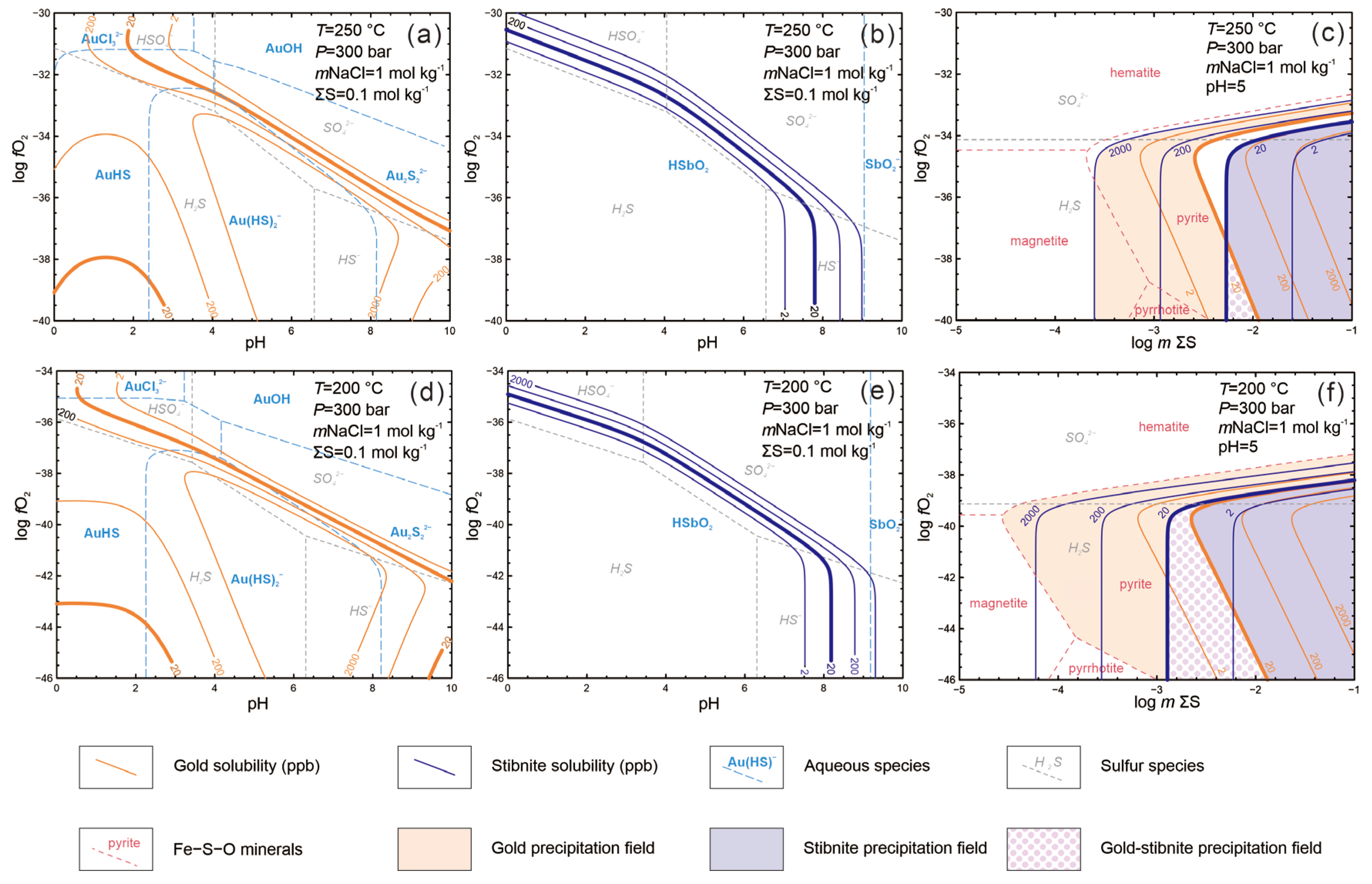
The geochemical differences between the various types of stibnite and pyrite in the Gutaishan deposit indicate a progressive cooling of the ore-forming fluid. To model the hydrothermal conditions conducive to the precipitation of either gold by itself or gold and stibnite together, we created log fO2–pH and log fO2–ΣS diagrams at two temperatures of 250 (Figure 11a–c) and 200 °C (Figure 11d–f). The diagrams were made using the CHNOSZ package [112] with thermodynamic data for gold [113], stibnite [114], aqueous Au species [115,116], and aqueous Sb species [117].
The logfO2–pH diagrams, constructed for a constant total aqueous sulfur concentration (ΣS), show that gold precipitation is favored in sulfate-dominated fluids, while stibnite precipitation is favored in sulfide-dominated fluids (Figure 11a,b,d,e). The 20 ppb solubility contours for Au and Sb are highlighted as a point of reference for a low solubility that favors mineral precipitation rather than metal transport in the fluid. The contour for stibnite moves further into the SO42− field at 200 (Figure 11e) compared to 250 °C (Figure 11b), potentially leading to similar precipitation conditions for both gold and stibnite.
Overlapping precipitation regions for gold and stibnite are more apparent on log fO2–ΣS diagrams with a constant pH (Figure 11c,f). These diagrams are relevant to the ore formation environment because fluid interactions with minerals such as pyrite can affect the total sulfur concentration. Precipitation conditions for gold and stibnite are largely non-overlapping at 250 °C (Figure 11c), as indicated by the leftward location of the 20 ppb contour for gold compared to that for stibnite on the log fO2–ΣS diagram. Conversely, at 200 °C the 20 ppb line for stibnite moves to the left of that for gold (Figure 11f), indicating a set of fluid conditions where the solubilities of both minerals are <20 ppb (Au or Sb) and are therefore favored to precipitate simultaneously. These conditions lie within the pyrite stability field in the Fe-S-O system, which is consistent with the observed presence of pyrite.
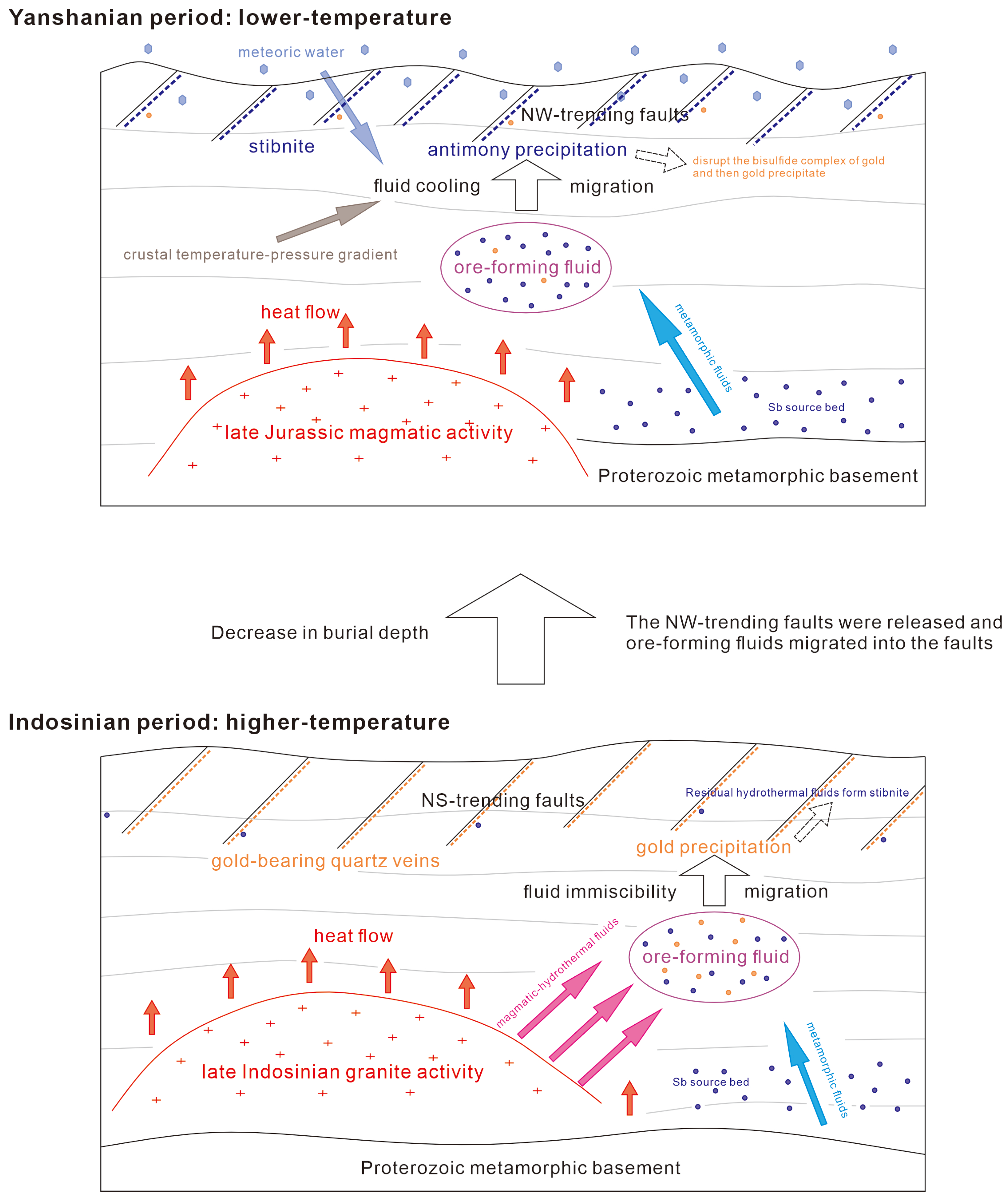
We therefore conclude that cooling of the ore-forming fluids was the key factor controlling gold–antimony segregation in the Gutaishan deposit. This is manifested in a distinct spatial zoning pattern, transitioning from deep gold mineralization to intermediate gold–antimony, and finally to near-surface antimony enrichment (Figure 12) [17,118].
Late Indosinian granite activity (Late Triassic) provided heat and fluids [14,17], driving the upward migration of gold-bearing magmatic–metamorphic fluids into the N–S extensional fault in this area [18,119]. As these fluids ascended, decompression of the ore-forming fluid triggered fluid immiscibility, which reduced the contents of CO2 and H2S and consequently altered critical physicochemical parameters (e.g., pH, sulfur, and oxygen fugacity) [15,20,119]. These changes destabilized Au complexes, causing gold to precipitate with sulfides and quartz, forming high-grade gold-bearing quartz veins [18,20,119]. Based on the arsenopyrite geothermometer and the homogenization temperatures of fluid inclusions in quartz from this stage, a gold precipitation temperature is suggested ranging from 200 to 320 °C, averaging 255 °C [20,118], slightly above the stability window of stibnite [25], thus limiting early stibnite mineralization. Residual hydrothermal fluids in the late stage may have precipitated minor stibnite within quartz vein cavities.
During the Yanshanian period (Late Jurassic) [17,18], NWW-trending extensional stresses reactivated NW–NNW-trending faults that had been sealed during the Indosinian. Magmatic activity in the Late Jurassic introduced ore-forming fluids into these faults. These fluids were a mixture of Cu-Pb-rich magmatic–hydrothermal fluids and Cu-Pb-depleted Proterozoic metamorphic basement fluids. Episodic influxes of metamorphic fluids continued during this period, moderately but notably influencing the evolution and composition of the hydrothermal system [18]. Existing research suggests that temperature is the dominant factor controlling stibnite precipitation [24,120,121,122]. In the Gutaishan deposit, the cooling of ore-forming fluids may have been influenced by meteoric water [45,90] or regions with high temperature–pressure gradients [121,123,124]. This cooling reduced both temperature and fS2, leading to the supersaturation and precipitation of stibnite. Concurrently, the precipitation of stibnite destabilized Au-bisulfide complexes, thereby promoting Au deposition [118]. These processes collectively resulted in the formation of gold-bearing stibnite veins.
Overall, temperature is regarded as the key factor governing Au-Sb coexistence. In typical hydrothermal and orogenic Au deposits, higher temperatures favor early gold precipitation followed by antimony. In contrast, Carlin-type and Carlin-style Au deposits form under lower temperatures, where the precipitation sequence of Au and Sb is less distinct.

6. Conclusions

  • The ore-forming fluids of the Gutaishan deposit are mainly magmatic–hydrothermal in origin, with minor contributions from the metamorphic basement, and were active during the Indosinian and Yanshanian periods.
  • The stibnite in the Gutaishan deposit is predominantly of the Woxi type (magmatic–hydrothermal fluids), with minor input from the Xikuangshan type (metamorphic basement fluids).
  • Temperature decrease is the dominant factor controlling gold–antimony segregation: gold precipitated first at a high temperature, while the co-precipitation of gold and stibnite deposited at a lower temperature.

Supplementary Materials

The following supporting information can be downloaded at: https://www.mdpi.com/article/10.3390/geosciences15120462/s1, Table S1: Stibnite major element geochemistry; Table S2: Pyrite major element geochemistry; Table S3: Stibnite trace element geochemistry; Table S4: Pyrite trace element geochemistry.

Author Contributions

Conceptualization, S.L. and M.Y.; Methodology, S.L. and M.Y.; Validation, M.Y.; Formal analysis, S.L. and M.Y.; Investigation, S.L., Y.N., L.X., K.H., S.C., X.Z., H.H. and M.Y.; Resources, S.L., Y.N., L.X., K.H., S.C., X.Z., H.H. and M.Y.; Data curation, K.H., X.Z., H.H. and M.Y.; Writing—original draft, S.L.; Writing—review and editing, S.L., X.Z. and M.Y.; Visualization, S.L.; Supervision, K.H., H.H. and M.Y.; Project administration, S.L., Y.N., L.X., K.H., S.C., X.Z., H.H. and M.Y.; Funding acquisition, S.L., Y.N., L.X. and M.Y. All authors have read and agreed to the published version of the manuscript.

Funding

This research is supported by Central South University, Innovation and Entrepreneurship Training Program, Project Number: CXPY2024673, the Mineralization and Prospecting Prediction in the Antimony Metallogenic Province, Central Hunan, Project Number: HNGSTP202305, and the Youth Program of the Hunan Provincial Natural Science Foundation of China, Project Number: 2023JJ40717.

Data Availability Statement

Data are available upon request.

Acknowledgments

The authors gratefully acknowledge Jeffrey M. Dick from Central South University for his outstanding contributions to the thermodynamic modeling presented in this study. We also extend our sincere thanks to Baowu Xie of the Hunan Provincial Natural Resources Survey Institute for providing us with valuable deposit and mineral photographs of the Gutaishan deposit.

Conflicts of Interest

The authors declare no conflicts of interest.

References

  1. An, F.; Zhu, Y. Native antimony in the Baogutu gold deposit (west Junggar, NW China): Its occurrence and origin. Ore Geol. Rev. 2010, 37, 214–223. [Google Scholar] [CrossRef]
  2. Bellot, J.-P.; Lerouge, C.; Bailly, L.; Bouchot, V. The Biards Sb-Au–bearing shear zone (Massif Central, France): An indicator of crustal-scale transcurrent tectonics guiding late Variscan collapse. Econ. Geol. 2003, 98, 1427–1447. [Google Scholar] [CrossRef]
  3. Cook, N.J.; Chryssoulis, S.L. Concentrations of invisible gold in the common sulfides. Can. Mineral. 1990, 28, 1–16. [Google Scholar]
  4. Silyanov, S.A.; Sazonov, A.M.; Naumov, E.A.; Lobastov, B.M.; Zvyagina, Y.A.; Artemyev, D.A.; Nekrasova, N.A.; Pirajno, F. Mineral Paragenesis, formation stages and trace elements in sulfides of the Olympiada gold deposit (Yenisei Ridge, Russia). Ore Geol. Rev. 2022, 143, 104750. [Google Scholar] [CrossRef]
  5. Li, H.; Zhu, D.-P.; Shen, L.-W.; Algeo, T.J.; Elatikpo, S.M. A general ore formation model for metasediment-hosted Sb-(Au-W) mineralization of the Woxi and Banxi deposits in South China. Chem. Geol. 2022, 607, 121020. [Google Scholar] [CrossRef]
  6. Zheng, Y.; Zhang, G.; Wu, Y.; Yu, P.; Chen, X.; Hu, Z.; Long, L. Triassic multistage antimony-gold mineralization in the Precambrian sedimentary rocks of South China: Insights from structural analysis, paragenesis, 40Ar/39Ar age, in-situ S-Pb isotope and trace elements of the Longwangjiang-Jiangdongwan orefield, Xuefengshan Mountain. Ore Geol. Rev. 2022, 148, 105030. [Google Scholar]
  7. Krinov, L. A Review on the mineralogy of stibnite in hydrothermal gold deposits. Acad. J. Earth Sci. 2024, 2, 16–20. [Google Scholar] [CrossRef]
  8. Zhai, W.; Sun, X.; Yi, J.; Zhang, X.; Mo, R.; Zhou, F.; Wei, H.; Zeng, Q. Geology, geochemistry, and genesis of orogenic gold–antimony mineralization in the Himalayan Orogen, South Tibet, China. Ore Geol. Rev. 2014, 58, 68–90. [Google Scholar] [CrossRef]
  9. Li, J.; Hu, R.; Xiao, J.; Zhuo, Y.; Yan, J.; Oyebamiji, A. Genesis of gold and antimony deposits in the Youjiang metallogenic province, SW China: Evidence from in situ oxygen isotopic and trace element compositions of quartz. Ore Geol. Rev. 2020, 116, 103257. [Google Scholar] [CrossRef]
  10. Chen, J.; Huang, Z.-L.; Yang, R.-D.; Du, L.-J.; Liao, M.-Y. Gold and antimony metallogenic relations and ore-forming process of Qinglong Sb (Au) deposit in Youjiang basin, SW China: Sulfide trace elements and sulfur isotopes. Geosci. Front. 2021, 12, 605–623. [Google Scholar] [CrossRef]
  11. Neiva, A.; Andráš, P.; Ramos, J. Antimony quartz and antimony–gold quartz veins from northern Portugal. Ore Geol. Rev. 2008, 34, 533–546. [Google Scholar] [CrossRef]
  12. Goryachev, N.; Yurgenson, G.; Nikanyuk, T. Ore mineralization of the Aliya ore field (Transbaikalian sector of the Mongol–Okhotsk Orogenic Belt): Structural relationships, mineralogy, geochemistry, and zoning. Russ. Geol. Geophys. 2025, 66, 794–805. [Google Scholar] [CrossRef]
  13. Zhang, L.; Yang, L.-Q.; Groves, D.I.; Sun, S.-C.; Liu, Y.; Wang, J.-Y.; Li, R.-H.; Wu, S.-G.; Gao, L.; Guo, J.-L. An overview of timing and structural geometry of gold, gold-antimony and antimony mineralization in the Jiangnan Orogen, southern China. Ore Geol. Rev. 2019, 115, 103173. [Google Scholar] [CrossRef]
  14. Li, W.; Xie, G.-Q.; Mao, J.-W.; Zhang, Z.-Y.; Fu, B.; Lu, S. Muscovite 40Ar/39Ar and in situ sulfur isotope analyses of the slate-hosted Gutaishan Au–Sb deposit, South China: Implications for possible Late Triassic magmatic-hydrothermal mineralization. Ore Geol. Rev. 2018, 101, 839–853. [Google Scholar] [CrossRef]
  15. Feng, Y.; Zhang, Y.; Xie, Y.; Shao, Y.; Tan, H.; Li, H.; Lai, C. Ore-forming mechanism and physicochemical evolution of Gutaishan Au deposit, South China: Perspective from quartz geochemistry and fluid inclusions. Ore Geol. Rev. 2020, 119, 103382. [Google Scholar] [CrossRef]
  16. Feng, Y.; Zhang, Y.; Xie, Y.; Shao, Y.; Lai, C. Pyrite geochemistry and metallogenic implications of Gutaishan Au deposit in Jiangnan Orogen, South China. Ore Geol. Rev. 2020, 117, 103298. [Google Scholar] [CrossRef]
  17. Bai, D.; Li, B.; Jiang, C. Deformation sequences, metallogenic events and ore-controlling structures at Gutaishan Au-Sb deposit in central Hunan province. Miner. Depos. 2023, 42, 229–252. [Google Scholar]
  18. Ning, Y. Geological characteristics and genesis of Gutaishan gold (antimony) deposit in central Hunan. Miner. Resour. Geol. 2024, 38, 847–861. [Google Scholar]
  19. Jianguo, Y. Alteration features and its direction of looking for the deposit in Gutaishan Au-Sb deposit, Xinhua. Hunan Geol. 1998, 17, 155–159. [Google Scholar]
  20. Li, W.; Xie, G.; Zhang, Z.; Zhang, X. Constraint on the genesis of Gutaishan gold deposit in central Hunan Province: Evidence from fluid inclusion and CHO isotopes. Acta Petrol. Sin. 2016, 32, 3489–3506. [Google Scholar]
  21. Feng, J.; Kang, L.; Li, B.; Kang, P. Geochemical Constraints on Antimony Mineralization in the Gutaishan Au–Sb Deposit, China: Insights from Trace Elements in Quartz and Sulfur Isotopes in Stibnite. Minerals 2025, 15, 953. [Google Scholar] [CrossRef]
  22. Jiang, C.; Xie, B.W.; Duan, A.J.; Huang, X.J.; Ai, G.; Liu, W. Study on Geological Characteristics and Prospecting Direction of No. 3 Vein in Gutaishan Gold-antimony Deposit,Hunan Province. Mod. Min. 2024, 40, 49–53+61. [Google Scholar]
  23. Zhai, D.; Mathur, R.; Liu, S.-A.; Liu, J.; Godfrey, L.; Wang, K.; Xu, J.; Vervoort, J. Antimony isotope fractionation in hydrothermal systems. Geochim. Cosmochim. Acta 2021, 306, 84–97. [Google Scholar] [CrossRef]
  24. Krupp, R.E. Solubility of stibnite in hydrogen sulfide solutions, speciation, and equilibrium constants, from 25 to 350 °C. Geochim. Cosmochim. Acta 1988, 52, 3005–3015. [Google Scholar] [CrossRef]
  25. Williams-Jones, A.E.; Norman, C. Controls of mineral parageneses in the system Fe-Sb-SO. Econ. Geol. 1997, 92, 308–324. [Google Scholar] [CrossRef]
  26. Guodong, A.; Dai Tagen, C.M. Pyrite-arsenite-antimony type and the occurrence status of gold in gold deposits-taking gold deposits in Hunan Province as an example. Geol. Resour. 2010, 19, 157–163. [Google Scholar]
  27. Bao, Z.X. A preliminary study on gold-bearing property of stibnite in tungsten-antimony-arsenic-gold deposits in central and western Hunan. Precious Metals Geology 1992, 1, 223–227. [Google Scholar]
  28. Large, R.R.; Meffre, S.; Burnett, R.; Guy, B.; Bull, S.; Gilbert, S.; Goemann, K.; Danyushevsky, L. Evidence for an intrabasinal source and multiple concentration processes in the formation of the Carbon Leader Reef, Witwatersrand Supergroup, South Africa. Econ. Geol. 2013, 108, 1215–1241. [Google Scholar] [CrossRef]
  29. Keith, M.; Smith, D.J.; Doyle, K.; Holwell, D.A.; Jenkin, G.R.; Barry, T.L.; Becker, J.; Rampe, J. Pyrite chemistry: A new window into Au-Te ore-forming processes in alkaline epithermal districts, Cripple Creek, Colorado. Geochim. Cosmochim. Acta 2020, 274, 172–191. [Google Scholar] [CrossRef]
  30. Gregory, D.D.; Large, R.R.; Bath, A.B.; Steadman, J.A.; Wu, S.; Danyushevsky, L.; Bull, S.W.; Holden, P.; Ireland, T.R. Trace element content of pyrite from the kapai slate, St. Ives Gold District, Western Australia. Econ. Geol. 2016, 111, 1297–1320. [Google Scholar] [CrossRef]
  31. Cook, N.; Ciobanu, C.L.; George, L.; Zhu, Z.-Y.; Wade, B.; Ehrig, K. Trace element analysis of minerals in magmatic-hydrothermal ores by laser ablation inductively-coupled plasma mass spectrometry: Approaches and opportunities. Minerals 2016, 6, 111. [Google Scholar] [CrossRef]
  32. Li, W.; Xie, G.-Q.; Mao, J.-W.; Cook, N.J.; Wei, H.-T.; Ji, Y.-H.; Fu, B. Precise age constraints for the Woxi Au-Sb-W deposit, south China. Econ. Geol. 2023, 118, 509–518. [Google Scholar] [CrossRef]
  33. Li, Z.-X.; Zhang, L.; Powell, C.M. South China in Rodinia: Part of the missing link between Australia–East Antarctica and Laurentia? Geology 1995, 23, 407–410. [Google Scholar] [CrossRef]
  34. Chen, J.; Jahn, B.-m. Crustal evolution of southeastern China: Nd and Sr isotopic evidence. Tectonophysics 1998, 284, 101–133. [Google Scholar] [CrossRef]
  35. Gu, X.; Liu, J.; Zheng, M.; Tang, J.; Qi, L. Provenance and tectonic setting of the Proterozoic turbidites in Hunan, South China: Geochemical evidence. J. Sediment. Res. 2002, 72, 393–407. [Google Scholar] [CrossRef]
  36. Greentree, M.R.; Li, Z.-X.; Li, X.-H.; Wu, H. Late Mesoproterozoic to earliest Neoproterozoic basin record of the Sibao orogenesis in western South China and relationship to the assembly of Rodinia. Precambrian Res. 2006, 151, 79–100. [Google Scholar] [CrossRef]
  37. Li, S.; Suo, Y.; Li, X.; Zhou, J.; Santosh, M.; Wang, P.; Wang, G.; Guo, L.; Yu, S.; Lan, H. Mesozoic tectono-magmatic response in the East Asian ocean-continent connection zone to subduction of the Paleo-Pacific Plate. Earth-Sci. Rev. 2019, 192, 91–137. [Google Scholar] [CrossRef]
  38. Zheng, Y.-F.; Wu, R.-X.; Wu, Y.-B.; Zhang, S.-B.; Yuan, H.; Wu, F.-Y. Rift melting of juvenile arc-derived crust: Geochemical evidence from Neoproterozoic volcanic and granitic rocks in the Jiangnan Orogen, South China. Precambrian Res. 2008, 163, 351–383. [Google Scholar] [CrossRef]
  39. Xu, D.; Deng, T.; Chi, G.; Wang, Z.; Zou, F.; Zhang, J.; Zou, S. Gold mineralization in the Jiangnan Orogenic Belt of South China: Geological, geochemical and geochronological characteristics, ore deposit-type and geodynamic setting. Ore Geol. Rev. 2017, 88, 565–618. [Google Scholar] [CrossRef]
  40. Zhou, Z.; Yonezu, K.; Imai, A.; Tindell, T.; Li, H.; Gabo-Ratio, J.A. Trace elements mineral chemistry of sulfides from the Woxi Au-Sb-W deposit, southern China. Resour. Geol. 2022, 72, e12279. [Google Scholar] [CrossRef]
  41. Hu, R.-Z.; Zhou, M.-F. Multiple Mesozoic mineralization events in South China—An introduction to the thematic issue. Miner. Depos. 2012, 47, 579–588. [Google Scholar] [CrossRef]
  42. Ruizhong, H.; Shanling, F.; Jiafei, X. Major scientific problems on low-temperature metallogenesis in South China. Acta Petrol. Sin. 2016, 32, 3239–3251. [Google Scholar]
  43. Hu, R.; Fu, S.; Huang, Y.; Zhou, M.-F.; Fu, S.; Zhao, C.; Wang, Y.; Bi, X.; Xiao, J. The giant South China Mesozoic low-temperature metallogenic domain: Reviews and a new geodynamic model. J. Asian Earth Sci. 2017, 137, 9–34. [Google Scholar] [CrossRef]
  44. Hu, R.-Z.; Chen, W.T.; Xu, D.-R.; Zhou, M.-F. Reviews and new metallogenic models of mineral deposits in South China: An introduction. J. Asian Earth Sci. 2017, 137, 1–8. [Google Scholar] [CrossRef]
  45. A’xiang, H.; Jiantang, P. Fluid inclusions and ore precipitation mechanism in the giant Xikuangshan mesothermal antimony deposit, South China: Conventional and infrared microthermometric constraints. Ore Geol. Rev. 2018, 95, 49–64. [Google Scholar] [CrossRef]
  46. Wang, Y.; Fan, W.; Sun, M.; Liang, X.; Zhang, Y.; Peng, T. Geochronological, geochemical and geothermal constraints on petrogenesis of the Indosinian peraluminous granites in the South China Block: A case study in the Hunan Province. Lithos 2007, 96, 475–502. [Google Scholar] [CrossRef]
  47. Fu, S.; Hu, R.; Bi, X.; Chen, Y.; Yang, J.; Huang, Y. Origin of Triassic granites in central Hunan Province, South China: Constraints from zircon U–Pb ages and Hf and O isotopes. Int. Geol. Rev. 2015, 57, 97–111. [Google Scholar] [CrossRef]
  48. Xie, G.; Mao, J.; Li, W.; Fu, B.; Zhang, Z. Granite-related Yangjiashan tungsten deposit, southern China. Miner. Depos. 2019, 54, 67–80. [Google Scholar] [CrossRef]
  49. Long, Z.-Y.; Qiu, K.-F.; Santosh, M.; Yu, H.-C.; Jiang, X.-Y.; Zou, L.-Q.; Tang, D.-W. Fingerprinting the metal source and cycling of the world’s largest antimony deposit in Xikuangshan, China. Bulletin 2023, 135, 286–294. [Google Scholar] [CrossRef]
  50. Ding, X.; Chen, P.; Chen, W.; Huang, H.; Zhou, X. Single zircon LA-ICPMS U-Pb dating of Weishan granite (Hunan, South China) and its petrogenetic significance. Sci. China Ser. D Earth Sci. 2006, 49, 816–827. [Google Scholar] [CrossRef]
  51. Chen, W.; Chen, P.; Huang, H.; Ding, X.; Sun, T. Chronological and geochemical studies of granite and enclave in Baimashan pluton, Hunan, South China. Sci. China Ser. D Earth Sci. 2007, 50, 1606–1627. [Google Scholar] [CrossRef]
  52. Liu, J.; Xie, Y.; Zhao, Z.; Lin, J.; Feng, W.; Huang, X. The geochronologic characteristics of Baimashan granite in western Hunan Province and its geotectonic significance. Earth Sci. Front. 2013, 20, 25–35. [Google Scholar]
  53. Hu, R. Large Scale Low-Temperature Metallogenesis in South China; Science Press: Beijing, China, 2021; pp. 1–469. [Google Scholar]
  54. Rao, J. The mantle-crustal tectonic metallogenic model and ore-prospecting in the Xikuangshan antimony orefield. Geophys. Geochem. Explor. 1999, 23, 241–249. [Google Scholar]
  55. Zhu, Z. Research on the Finite Element Numerical Simulation of the Geodynamic Evolution Features and Characteristics of Metallogenic in Hunan Region since Mesozoic; Central South University: Changsha, China, 2004. [Google Scholar]
  56. MA, D.-s. Ore source of Sb (Au) deposits in central Hunan: I. Evidences of trace elements and experimental geochemistry. Miner. Depos. 2002, 21, 367–376. [Google Scholar]
  57. Shanling, F.; Ruizhong, H.; Youwei, C.; Jincheng, L. Chronology of the Longshan Au-Sb deposit in central Hunan Province: Constraints from pyrite Re-Os and zircon U-Th/He isotopic dating. Acta Petrol. Sin. 2016, 32, 3507–3517. [Google Scholar]
  58. Gao, W. Geological-Geochemical Characteristics of Caledonian Granitoids and its Geological Significance, Hunan Province-Taking Baimashan, Xuehuading, Hongxiaoqiao Plutons as Examples; Central South University: Changsha, China, 2013; pp. 10–70. [Google Scholar]
  59. Luo, Z.; Wang, Y.; Zhang, F.; Zhang, A.; Zhang, Y. LA-ICPMS zircon U–Pb dating for Baimashan and Jintan Indosinian granitic plutons and its petrogenetic implications. Geotecton. Metallog. 2010, 34, 282–290. [Google Scholar]
  60. SRM 610; Trace Elements in Glass. National Institute of Standards and Technology (NIST): Gaithersburg, MD, USA, 2012.
  61. Wilson, S.; Ridley, W.; Koenig, A. Development of sulfide calibration standards for the laser ablation inductively-coupled plasma mass spectrometry technique. Journal of Analytical Atomic Spectrometry 2002, 17, 406–409. [Google Scholar] [CrossRef]
  62. Jochum, K.P.; Wilson, S.A.; Abouchami, W.; Amini, M.; Chmeleff, J.; Eisenhauer, A.; Hegner, E.; Iaccheri, L.M.; Kieffer, B.; Krause, J. GSD-1G and MPI-DING reference glasses for in situ and bulk isotopic determination. Geostandards and Geoanalytical Research 2011, 35, 193–226. [Google Scholar] [CrossRef]
  63. Guillong, M.; Hametner, K.; Reusser, E.; Wilson, S.A.; Günther, D. Preliminary characterisation of new glass reference materials (GSA-1G, GSC-1G, GSD-1G and GSE-1G) by laser ablation-inductively coupled plasma-mass spectrometry using 193 nm, 213 nm and 266 nm wavelengths. Geostandards and Geoanalytical Research 2005, 29, 315–331. [Google Scholar] [CrossRef]
  64. BCR-2; Columbia River Basalt. United States Geological Survey (USGS): Denver, CO, USA, 2022.
  65. BHVO-2; Hawaiian Volcano Observatory Basalt. United States Geological Survey (USGS): Denver, CO, USA, 2022.
  66. AGV-2; Guano Valley Andesite. United States Geological Survey (USGS): Denver, CO, USA, 2022.
  67. RGM-2*-NP; Rhyolite. myStandards GmbH: Kiel, Germany, 2024.
  68. Powell, W.; Pearson, N.; O’Reilly, S. GLITTER: Data reduction software for laser ablation ICP-MS/Ed. PJ Sylvester. Laser Ablation ICP-MS Earth Sci. 2008, 40, 308–311. [Google Scholar]
  69. Pan, P.; Wang, X.; Li, B.; Tang, G.; Xiang, Z. Trace element compositions of pyrite and stibnite: Implications for the genesis of antimony mineralization in the Yangla Cu skarn deposit, Northwestern Yunnan, China. Acta Geochim. 2024, 43, 535–554. [Google Scholar] [CrossRef]
  70. Cook, N.J.; Ciobanu, C.L.; Pring, A.; Skinner, W.; Shimizu, M.; Danyushevsky, L.; Saini-Eidukat, B.; Melcher, F. Trace and minor elements in sphalerite: A LA-ICPMS study. Geochim. Cosmochim. Acta 2009, 73, 4761–4791. [Google Scholar] [CrossRef]
  71. Deditius, A.P.; Utsunomiya, S.; Reich, M.; Kesler, S.E.; Ewing, R.C.; Hough, R.; Walshe, J. Trace metal nanoparticles in pyrite. Ore Geol. Rev. 2011, 42, 32–46. [Google Scholar] [CrossRef]
  72. Ciobanu, C.; Cook, N.; Kelson, C.; Guerin, R.; Kalleske, N.; Danyushevsky, L. Trace element heterogeneity in molybdenite fingerprints stages of mineralization. Chem. Geol. 2013, 347, 175–189. [Google Scholar] [CrossRef]
  73. Zhang, J.; Li, L.; Gilbert, S.; Liu, J.J.; Shi, W.S. LA–ICP–MS and EPMA studies on the Fe–S–As minerals from the Jinlongshan gold deposit, Qinling Orogen, China: Implications for ore-forming processes. Geol. J. 2014, 49, 482–500. [Google Scholar] [CrossRef]
  74. George, L.; Cook, N.J.; Wade, B.P. Trace and minor elements in galena: A reconnaissance LA-ICP-MS study. Am. Mineral. 2015, 100, 548–569. [Google Scholar] [CrossRef]
  75. Longerich, H.P.; Jackson, S.E.; Günther, D. Inter-laboratory note. Laser ablation inductively coupled plasma mass spectrometric transient signal data acquisition and analyte concentration calculation. J. Anal. At. Spectrom. 1996, 11, 899–904. [Google Scholar] [CrossRef]
  76. Fu, S.; Hu, R.; Bi, X.; Sullivan, N.A.; Yan, J. Trace element composition of stibnite: Substitution mechanism and implications for the genesis of Sb deposits in southern China. Appl. Geochem. 2020, 118, 104637. [Google Scholar] [CrossRef]
  77. Belousov, I.; Large, R.; Meffre, S.; Danyushevsky, L.; Steadman, J.; Beardsmore, T. Pyrite compositions from VHMS and orogenic Au deposits in the Yilgarn Craton, Western Australia: Implications for gold and copper exploration. Ore Geol. Rev. 2016, 79, 474–499. [Google Scholar] [CrossRef]
  78. Cao, G.; Zhang, Y.; Chen, H. Trace elements in pyrite from orogenic gold deposits: Implications for metallogenic mechanism. Acta Petrol. Sin. 2023, 39, 2330–2346. [Google Scholar] [CrossRef]
  79. Wilson, S.C.; Lockwood, P.V.; Ashley, P.M.; Tighe, M. The chemistry and behaviour of antimony in the soil environment with comparisons to arsenic: A critical review. Environ. Pollut. 2010, 158, 1169–1181. [Google Scholar] [CrossRef]
  80. Stergiou, C.L.; Melfos, V.; Voudouris, P.; Papadopoulou, L.; Spry, P.G.; Peytcheva, I.; Dimitrova, D.; Stefanova, E. A fluid inclusion and critical/rare metal study of epithermal quartz-stibnite veins associated with the Gerakario Porphyry Deposit, Northern Greece. Appl. Sci. 2022, 12, 909. [Google Scholar] [CrossRef]
  81. Zhou, Z.; Li, H.; Yonezu, K.; Imai, A.; Tindell, T. In-situ trace elements and sulfur isotopic analyses of stibnite: Constraints on the genesis of Sb/Sb-polymetallic deposits in southern China. J. Geochem. Explor. 2023, 247, 107177. [Google Scholar] [CrossRef]
  82. Wei, D.-T.; Xia, Y.; Gregory, D.D.; Steadman, J.A.; Tan, Q.-P.; Xie, Z.-J.; Liu, X.-J. Multistage pyrites in the Nibao disseminated gold deposit, southwestern Guizhou Province, China: Insights into the origin of Au from textures, in situ trace elements, and sulfur isotope analyses. Ore Geol. Rev. 2020, 122, 103446. [Google Scholar] [CrossRef]
  83. He, H.; Xian, H.; Zhu, J.; Tan, W.; Wu, X.; Yang, Y.; Li, S.; Qiu, K.; Zhu, R.; Henry Teng, H. Evaluating the physicochemical conditions for gold occurrences in pyrite. Am. Mineral. 2023, 108, 211–216. [Google Scholar] [CrossRef]
  84. Marion, P.; Holliger, P.; Boiron, M.; Cathelineau, M.; Wagner, F. New Improvements in the Characterization of Refractory Gold in Pyrites: An Electron Microprobe, Mössbauer Spectrometry and ion Microprobe Study; Instituto Brasileiro de Mineracao (IBRAM): Belo Horizonte, Brazil, 1991. [Google Scholar]
  85. Reich, M.; Kesler, S.E.; Utsunomiya, S.; Palenik, C.S.; Chryssoulis, S.L.; Ewing, R.C. Solubility of gold in arsenian pyrite. Geochim. Cosmochim. Acta 2005, 69, 2781–2796. [Google Scholar] [CrossRef]
  86. Chen, M.; Shao, Y.; Li, Y.; Liu, Z.; Chen, K.; He, M.; Chen, Z. Ore-forming process and ore genesis of the Wangu gold deposit in the Jiangnan orogenic Belt, South China: Constraints from pyrite textures, trace elements and in-situ sulfur isotopes composition. Ore Geol. Rev. 2025, 178, 106485. [Google Scholar] [CrossRef]
  87. Li, H.; Wu, Q.-H.; Evans, N.J.; Zhou, Z.-K.; Kong, H.; Xi, X.-S.; Lin, Z.-W. Geochemistry and geochronology of the Banxi Sb deposit: Implications for fluid origin and the evolution of Sb mineralization in central-western Hunan, South China. Gondwana Res. 2018, 55, 112–134. [Google Scholar] [CrossRef]
  88. Song, X.; Lai, J.; Xu, J.; Liu, X.; Li, B.; He, H.; Wang, Y.; Shi, J.; Wang, C.; Wen, C. Material Source and Genesis of the Daocaowan Sb Deposit in the Xikuangshan Ore Field: LA-ICP-MS Trace Elements and Sulfur Isotope Evidence from Stibnite. Minerals 2022, 12, 1407. [Google Scholar] [CrossRef]
  89. Zhang, Z.; Xie, G.; Yuan, L. Discussion of the genetic relations between W and Sb-Au mineralization of Xiangzhong ore district: Constraints from Sr-Nd-HO isotopic compositions of the Caojiaba W and Longshan Sb-Au deposits. Acta Petrol. Sin. 2023, 39, 1847–1860. [Google Scholar] [CrossRef]
  90. Sun, J.; Zhou, C.; Lu, W.; Guo, A.; Xiao, R.; Wei, H.; Tan, S.; Jia, P. He–Ar–Sr isotope geochemistry of ore–forming fluids in the gutaishan Au–Sb deposit in hunan province and its significance for deep prospecting. Acta Geosci. Sin. 2020, 41, 267–279. [Google Scholar]
  91. Bralia, A.; Sabatini, G.; Troja, F. A revaluation of the Co/Ni ratio in pyrite as geochemical tool in ore genesis problems: Evidences from southern Tuscany pyritic deposits. Miner. Depos. 1979, 14, 353–374. [Google Scholar] [CrossRef]
  92. Raymond, O.L. Pyrite composition and ore genesis in the Prince Lyell copper deposit, Mt Lyell mineral field, western Tasmania, Australia. Ore Geol. Rev. 1996, 10, 231–250. [Google Scholar] [CrossRef]
  93. Craig, J.; Vokes, F.; Solberg, T. Pyrite: Physical and chemical textures. Miner. Depos. 1998, 34, 82–101. [Google Scholar] [CrossRef]
  94. Clark, C.; Grguric, B.; Mumm, A.S. Genetic implications of pyrite chemistry from the Palaeoproterozoic Olary Domain and overlying Neoproterozoic Adelaidean sequences, northeastern South Australia. Ore Geol. Rev. 2004, 25, 237–257. [Google Scholar] [CrossRef]
  95. Large, R.R.; Danyushevsky, L.; Hollit, C.; Maslennikov, V.; Meffre, S.; Gilbert, S.; Bull, S.; Scott, R.; Emsbo, P.; Thomas, H. Gold and trace element zonation in pyrite using a laser imaging technique: Implications for the timing of gold in orogenic and Carlin-style sediment-hosted deposits. Econ. Geol. 2009, 104, 635–668. [Google Scholar] [CrossRef]
  96. Gregory, D.D.; Large, R.R.; Halpin, J.A.; Baturina, E.L.; Lyons, T.W.; Wu, S.; Danyushevsky, L.; Sack, P.J.; Chappaz, A.; Maslennikov, V.V. Trace element content of sedimentary pyrite in black shales. Econ. Geol. 2015, 110, 1389–1410. [Google Scholar] [CrossRef]
  97. Cafagna, F.; Jugo, P.J. An experimental study on the geochemical behavior of highly siderophile elements (HSE) and metalloids (As, Se, Sb, Te, Bi) in a mss-iss-pyrite system at 650 °C: A possible magmatic origin for Co-HSE-bearing pyrite and the role of metalloid-rich phases in the fractionation of HSE. Geochim. Cosmochim. Acta 2016, 178, 233–258. [Google Scholar]
  98. Shao, Y.-J.; Wang, W.-S.; Liu, Q.-Q.; Zhang, Y. Trace element analysis of pyrite from the Zhengchong gold deposit, Northeast Hunan Province, China: Implications for the ore-forming process. Minerals 2018, 8, 262. [Google Scholar] [CrossRef]
  99. Koglin, N.; Frimmel, H.E.; Lawrie Minter, W.; Brätz, H. Trace-element characteristics of different pyrite types in Mesoarchaean to Palaeoproterozoic placer deposits. Miner. Depos. 2010, 45, 259–280. [Google Scholar] [CrossRef]
  100. Thomas, H.V.; Large, R.R.; Bull, S.W.; Maslennikov, V.; Berry, R.F.; Fraser, R.; Froud, S.; Moye, R. Pyrite and pyrrhotite textures and composition in sediments, laminated quartz veins, and reefs at Bendigo gold mine, Australia: Insights for ore genesis. Econ. Geol. 2011, 106, 1–31. [Google Scholar] [CrossRef]
  101. Deol, S.; Deb, M.; Large, R.R.; Gilbert, S. LA-ICPMS and EPMA studies of pyrite, arsenopyrite and loellingite from the Bhukia-Jagpura gold prospect, southern Rajasthan, India: Implications for ore genesis and gold remobilization. Chem. Geol. 2012, 326, 72–87. [Google Scholar] [CrossRef]
  102. Zhang, J.; Deng, J.; Chen, H.-y.; Yang, L.-q.; Cooke, D.; Danyushevsky, L.; Gong, Q.-j. LA-ICP-MS trace element analysis of pyrite from the Chang’an gold deposit, Sanjiang region, China: Implication for ore-forming process. Gondwana Res. 2014, 26, 557–575. [Google Scholar] [CrossRef]
  103. Meng, Y.-M.; Hu, R.-Z.; Huang, X.-W.; Gao, J.-F.; Sasseville, C. The origin of the carbonate-hosted Huize Zn–Pb–Ag deposit, Yunnan province, SW China: Constraints from the trace element and sulfur isotopic compositions of pyrite. Mineral. Petrol. 2019, 113, 369–391. [Google Scholar] [CrossRef]
  104. Mukherjee, I.; Large, R.R.; Bull, S.; Gregory, D.G.; Stepanov, A.S.; Ávila, J.; Ireland, T.R.; Corkrey, R. Pyrite trace-element and sulfur isotope geochemistry of paleo-mesoproterozoic McArthur Basin: Proxy for oxidative weathering. Am. Mineral. 2019, 104, 1256–1272. [Google Scholar] [CrossRef]
  105. Brill, B.A. Trace-element contents and partitioning of elements in ore minerals from the CSA Cu-Pb-Zn deposit, Australia, and implications for ore genesis. Can. Mineral. 1989, 27, 263–274. [Google Scholar]
  106. Zhao, H.-X.; Frimmel, H.E.; Jiang, S.-Y.; Dai, B.-Z. LA-ICP-MS trace element analysis of pyrite from the Xiaoqinling gold district, China: Implications for ore genesis. Ore Geol. Rev. 2011, 43, 142–153. [Google Scholar] [CrossRef]
  107. Maslennikov, V.; Maslennikova, S.; Large, R.; Danyushevsky, L. Study of trace element zonation in vent chimneys from the Silurian Yaman-Kasy volcanic-hosted massive sulfide deposit (Southern Urals, Russia) using laser ablation-inductively coupled plasma mass spectrometry (LA-ICPMS). Econ. Geol. 2009, 104, 1111–1141. [Google Scholar] [CrossRef]
  108. Zhen, S.; Wang, D.; Yu, X.; Wang, Q.; Li, Y.; Zha, Z.; Wang, J. Trace elements and sulfur isotopes of sulfides in the Zhangquanzhuang gold deposit, Hebei Province, China: Implications for physicochemical conditions and mineral deposition mechanisms. Minerals 2020, 10, 1089. [Google Scholar] [CrossRef]
  109. Leuz, A.-K.; Mönch, H.; Johnson, C.A. Sorption of Sb (III) and Sb (V) to goethite: Influence on Sb (III) oxidation and mobilization. Environ. Sci. Technol. 2006, 40, 7277–7282. [Google Scholar] [CrossRef]
  110. Hockmann, K.; Schulin, R. Leaching of antimony from contaminated soils. In Competitive Sorption and Transport of Heavy Metals in Soils; CRC Press: Boca Raton, FL, USA, 2012; Volume 119. [Google Scholar]
  111. Zhou, J.; Li, X.-H.; Ge, W.; Li, Z.-X. Age and origin of middle Neoproterozoic mafic magmatism in southern Yangtze Block and relevance to the break-up of Rodinia. Gondwana Res. 2007, 12, 184–197. [Google Scholar] [CrossRef]
  112. Dick, J.M. CHNOSZ: Thermodynamic calculations and diagrams for geochemistry. Front. Earth Sci. 2019, 7, 180. [Google Scholar] [CrossRef]
  113. Helgeson, H.C. Summary and critique of the thermodynamic properties of rock-forming minerals. Am. J. Sci. A 1978, 278, 1–229. [Google Scholar]
  114. Robie, R.A.; Hemingway, B.S. Thermodynamic Properties of Minerals and Related Substances at 298.15 K and 1 bar (105 Pascals) Pressure and at Higher Temperatures; US Government Printing Office: Washington, DC, USA, 1995; Volume 2131. [Google Scholar]
  115. Tagirov, B.; Akinfiev, N.; Zotov, A. Gold (I) complexation in chloride hydrothermal fluids. Geol. Ore Depos. 2024, 66, 581–597. [Google Scholar] [CrossRef]
  116. Tagirov, B.R.; Akinfiev, N.N.; Tarnopolskaia, M.E.; Nikolaeva, I.Y.; Zlivko, I.Y.; Volchenkova, V.A.; Koroleva, L.A.; Zotov, A.V. Gold in sulfide fluids revisited. Geochim. Cosmochim. Acta 2024, 406, 285–304. [Google Scholar] [CrossRef]
  117. Shock, E.L.; Sassani, D.C.; Willis, M.; Sverjensky, D.A. Inorganic species in geologic fluids: Correlations among standard molal thermodynamic properties of aqueous ions and hydroxide complexes. Geochim. Cosmochim. Acta 1997, 61, 907–950. [Google Scholar] [CrossRef]
  118. Li, W.; Cook, N.J.; Xie, G.-Q.; Mao, J.-W.; Ciobanu, C.L.; Li, J.-W.; Zhang, Z.-Y. Textures and trace element signatures of pyrite and arsenopyrite from the Gutaishan Au–Sb deposit, South China. Miner. Depos. 2019, 54, 591–610. [Google Scholar] [CrossRef]
  119. Chao, Z.; Ji, S.; Aimin, G.; Pengyuan, J.; Wen, L.; Hantao, W.; Ding, G.; Yi, C. A comparative study of the ore-forming fluids of the typical gold-antimony deposits along Middle Xuefeng arc structure belt. Geol. China 2020, 47, 1241–1259. [Google Scholar]
  120. Munoz, M.; Courjault-Radé, P.; Tollon, F. The massive stibnite veins of the French Palaeozoic basement: A metallogenic marker of Late Variscan brittle extension. Terra Nova 1992, 4, 171–177. [Google Scholar] [CrossRef]
  121. Hagemann, S.G.; Lüders, V. PTX conditions of hydrothermal fluids and precipitation mechanism of stibnite-gold mineralization at the Wiluna lode-gold deposits, Western Australia: Conventional and infrared microthermometric constraints. Miner. Depos. 2003, 38, 936–952. [Google Scholar] [CrossRef]
  122. Zotov, A.; Shikina, N.; Akinfiev, N. Thermodynamic properties of the Sb (III) hydroxide complex Sb (OH)3(aq) at hydrothermal conditions. Geochim. Cosmochim. Acta 2003, 67, 1821–1836. [Google Scholar] [CrossRef]
  123. Ashley, P.; Creagh, C.; Ryan, C. Invisible gold in ore and mineral concentrates from the Hillgrove gold-antimony deposits, NSW, Australia. Miner. Depos. 2000, 35, 285–301. [Google Scholar] [CrossRef]
  124. Wagner, T.; Cook, N. Late-Variscan antimony mineralisation in the Rheinisches Schiefergebirge, NW Germany: Evidence for stibnite precipitation by drastic cooling of high-temperature fluid systems. Miner. Depos. 2000, 35, 206–222. [Google Scholar] [CrossRef]
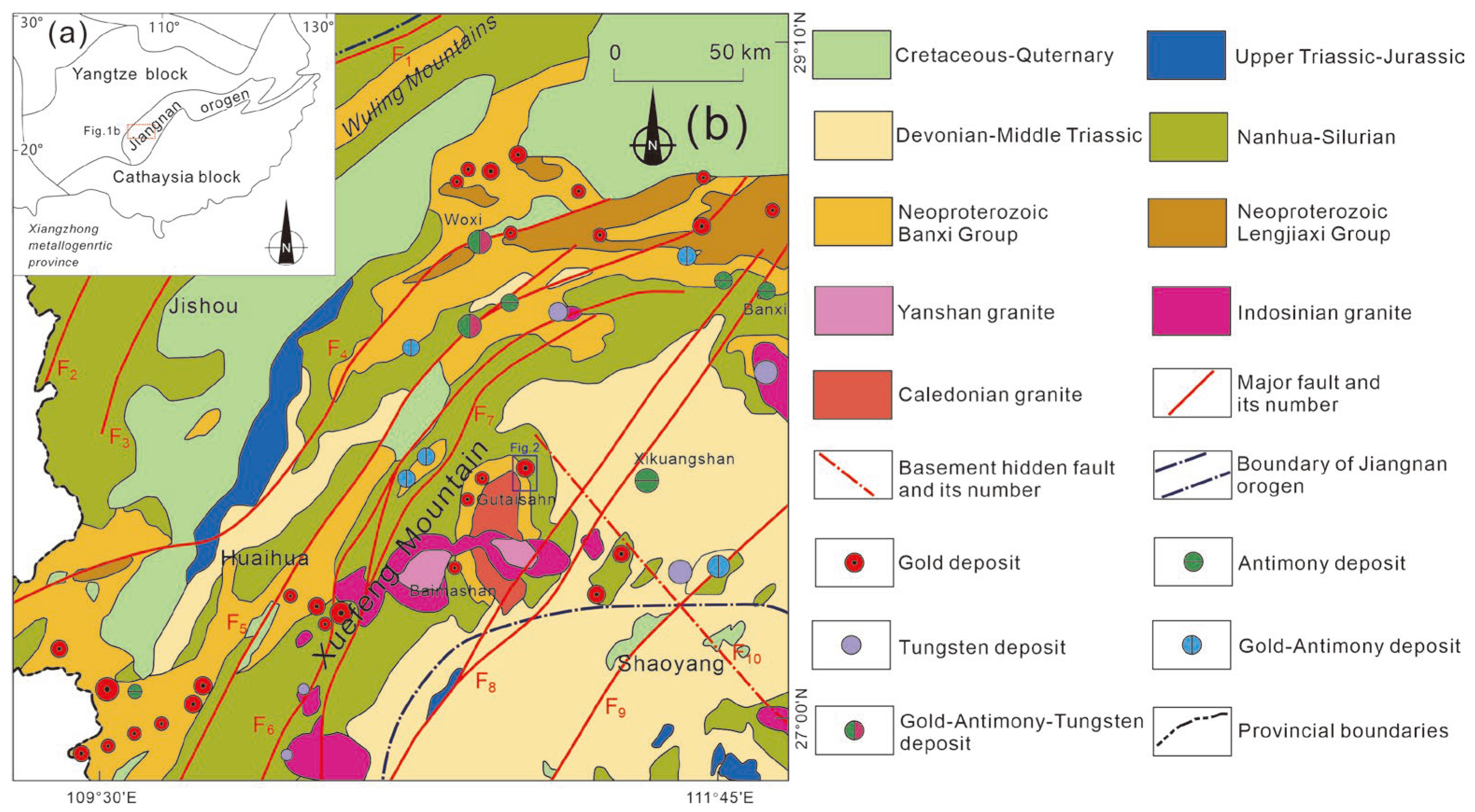
Figure 1. (a) Location of southwestern Jiangnan Orogenic Belt (Xiangzhong Basin) [20]; (b) Regional geological map and distribution of Sb-W-Au deposits in central–west Hunan [18].
Geosciences 15 00462 g001
Figure 2. Geological diagram of the Gutaishan Au-Sb deposit [18].
Geosciences 15 00462 g002
Figure 3. Photographs of ore veins and hand specimens from the Gutaishan deposit: In situ photography from the (a) single-gold-type veins; (b) antimony–gold-type veins in Gutaishan; (c) single-gold-type ores; (d) antimony–gold-type ores; (e) Au-bearing stibnite; (f) stibnite infilling within early-stage quartz veins; (g) cross-cutting relationship between two generations of quartz veins; (h) tectonic breccia within an antimony–gold-type vein and the adjacent shattered slate; (i) tectonic breccia in an antimony–gold-type vein.
Geosciences 15 00462 g003
Figure 4. Profile of prospecting line 1 in II ore belt of the Gutaishan Au-Sb mining area [18].
Geosciences 15 00462 g004
Figure 5. Microscopic microphotographs (af) and back-scattered electron (BSE) images (gl) of minerals in ores from Gutaishan deposit. (a) Sbn2 and gold occurring in Au-Sb veins; (b) Sbn3-1 occurring in Au-Sb veins in association with vein-like pyrite; (c) Sbn3-2 occurring in Au-Sb veins and two types of stibnite replacement textures can be seen; (d) Py1 from Au veins; (e) Py2 from Au-Sb veins; (f) Vein-like Py3 from Au-Sb veins; BSE images of different categories of stibnite: (g) Sbn2; (h) Sbn3-1; (i) Sbn3-2; and pyrite: (j) Py1; (k) Py2; (l) Py3.
Geosciences 15 00462 g005
Figure 6. Plots of: stibnite (a) As vs. Sb; (b) (Cu + Pb) vs. Sb; (c) Au vs. Fe and pyrite (d) As vs. S contents obtained from EPMA analysis of Gutaishan deposit.
Geosciences 15 00462 g006
Figure 7. Box plot showing trace element concentrations of Gutaishan (a) stibnite and (b) pyrite.
Geosciences 15 00462 g007
Figure 8. LA–ICP–MS time-resolved signal for Gutaishan stibnite and pyrite. (a) Sbn2; (b) Sbn3-1; (c) Sbn3-2; (d) Py1; (e) Py2; (f) Py3.
Geosciences 15 00462 g008
Figure 9. Correlation diagrams of trace elements in the Gutaishan stibnite. (a) Pb vs. Cu; data of stibnite obtained from Woxi and Xikuangshan deposits are shown for comparison [79]. (b) As vs. Cu; (c) As vs. Pb; (d) As vs. (Cu + Pb); (e) Hg vs. (Cu + Pb).
Geosciences 15 00462 g009
Figure 10. Correlation diagrams of trace elements in the Gutaishan pyrite. (a) Au vs. As; (b) Co vs. Ni; (c) As vs. Ni; (d) Au vs. Bi; (e) Au vs. Sb; (f) As vs. Sb.
Geosciences 15 00462 g010
Figure 11. Thermodynamic phase diagrams of the gold–stibnite system at 250 °C (ac) and 200 °C (df), the solubility limit for precipitation was set at <20 ppb. Diagrams of log fO2–pH showing solubility and aqueous species of (a) gold and (b) stibnite; (c) log fO2–log m∑S diagram illustrating gold–stibnite solubility in relation to Fe–S–O mineral stability fields at 250 °C; corresponding log fO2–pH diagrams at 200 °C for (d) gold and (e) stibnite; (f) log fO2–log m∑S diagram showing gold–stibnite solubility and Fe–S–O mineral stabilities at 200 °C.
Geosciences 15 00462 g011
Figure 12. Geological model diagram for Au-Sb mineralization segregation in the Gutaishan deposit.
Geosciences 15 00462 g012
Disclaimer/Publisher’s Note: The statements, opinions and data contained in all publications are solely those of the individual author(s) and contributor(s) and not of MDPI and/or the editor(s). MDPI and/or the editor(s) disclaim responsibility for any injury to people or property resulting from any ideas, methods, instructions or products referred to in the content.