


Abstract
We present ID-TIMS U-Pb single zircon ages and major and trace element data for granitoid plutons from the Imorona–Itsindro and Kiangara suites in central Madagascar, in order to constrain the timing of igneous emplacement and investigate the petrogenesis and tectonic settings of these Neoproterozoic plutons. A U-Pb crystallization age of 779 ± 7 Ma was determined from an Imorona–Itsindro intrusion, while a Kiangara intrusion yields 777 ± 4 Ma, older than previously reported. The identical U-Pb ages suggest contemporaneous emplacement of some Kiangara and Imorona–Itsindro intrusions. Elemental data indicate that the two suites display trace element patterns similar to those of arc-type magmas. Some distinct geochemical features are apparent between these two suites. The Imorona–Itsindro sample displays I-type affinity with low REE abundances, whereas the Kiangara samples exhibit A-type signatures with higher REE contents. We suggest that the elemental differences between A-type and I-type reflect the contamination of mantle-derived magma by lower and upper crustal rocks, respectively. We suggest that the coeval A-type and I-type granitoids in central Madagascar were generated in a subduction system associated with slab rollback and back-arc extension like extension. The compositional diversity in these Neoproterozoic plutons reflects the evolution of the tectonic regime within a single geodynamic environment, similar to that proposed for plutons in other Precambrian and younger terranes.
1. Introduction
Granitoid magmas can provide valuable information regarding the timing and the processes involved in the differentiation and evolution of Earth’s continental crust. They are important keys to unraveling the tectonic evolution of a given area and for developing plate reconstructions [1,2]. Several isotopic systems and techniques have been used to determine the crystallization and emplacement ages of granitoid magmas. Very often, high precision U-Pb zircon geochronology is used in studies of felsic system and their associated metamorphism, as zircon contains relatively high contents of U, Th, and Pb, which are critical for robust age determination and are essentially unaffected by subsequent alteration events. Nevertheless, the petrogenesis and the sources of granitoid magmas remain controversial. In general, the composition of granitoid magmas has been attributed to either partial melting of pre-existing crustal rocks [3,4,5] or to fractional crystallization of primary mantle-derived basaltic melts [6]. Recent studies invoke that both processes must contribute to a variable degree to the formation of granitic melts [7,8]. Another related issue is the question of whether crustal assimilation or possible mixing processes produce the compositional diversity of granitic magma [9]. To complicate the matter further, it is unclear to what extent tectonic setting controls the composition of granitic magmas. In order to address this question, several tectonic discrimination schemes were developed since 1980 [10,11]. Accordingly, there is a general consensus that alkaline/peralkaline A-type magmatism, for instance, is attributed to an intracontinental rifting, peraluminous S-type granites reflect continental collision, and subduction zones are dominated by M- and I-type granitic magmas [12,13,14]. However, recent studies argued that the tectonic discrimination diagrams are inappropriate for some granitic magmas, and thus placing the granitic magmas in the wrong geodynamic settings [15].
The Imorona–Itsindro and Kiangara granitoids provide an opportunity to document the timing of magmatism and the tectonic origins of granitoid magmas during Neoproterozoic in central Madagascar. Previous studies argued that the chemical and isotopic signatures of the Imorona–Itsindro and the Kiangara granitoids can be explained by typical continental arc processes [16,17,18,19]. On the other hand, others argued that the alkaline nature of the granitoids is more compatible with a continental rift setting [20,21,22]. Furthermore, some workers suggested that the Imorona–Itsindro and the Kiangara suites consist of two distinct magmatic events during the middle to late Neoproterozoic [23]. In contrast, others argued that the Kiangara suite should be considered part of the Imorona–Itsindro suite on the basis of their U-Pb ages and geochemical compositions [20] and that granitic plutons in central Madagascar represent a continuous magmatic sequence rather than intermittent pulses of magmatism. Thus, fundamental questions remain about the timing, sources and tectonic origins of these scattered but voluminous granitoid magmas that occur mostly across the Antananarivo domain and are less represented in the other domains. Additionally, Madagascar has long been regarded as a key location to understanding the development of the East African Orogen and the timing of Gondwana’s amalgamation, as it was once situated between East (India-Antarctica-Australia-Sri-Lanka) and West (South America-Africa) Gondwana lands [16,24,25,26]. Therefore, detailed studies of the basement are critical for developing Proterozoic plate reconstructions [16,27,28,29,30,31,32,33,34,35,36,37,38,39]. As indicated by previous studies [40,41,42,43,44], the Precambrian basement is characterized by a complex structure, which could influence the geometrical reconstruction. Thus, additional precise geochronological data are needed to clarify and to support any tentative reorganization of Gondwana.
This contribution reports (1) high precision U-Pb zircon age using isotope dilution—thermal ionization mass spectrometry (ID-TIMS) for granitoid intrusions from the Kiangara and Imorona–Itsindro suites within the Antananarivo block to further constrain the timing of igneous emplacement in central Madagascar, and (2) major and trace element data for few selected samples to investigate their tectonic origins. This study will contribute to a better understanding of the tectonic evolution of central Madagascar and the greater Gondwana supercontinent.
2. Geological Setting
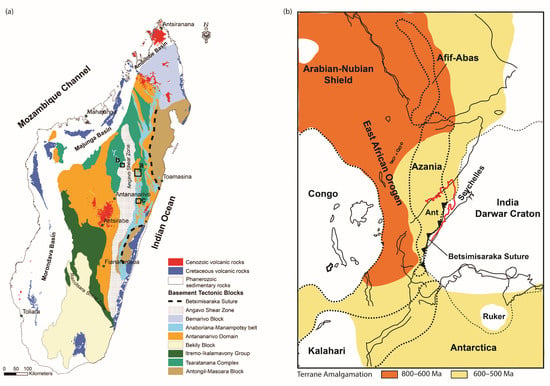
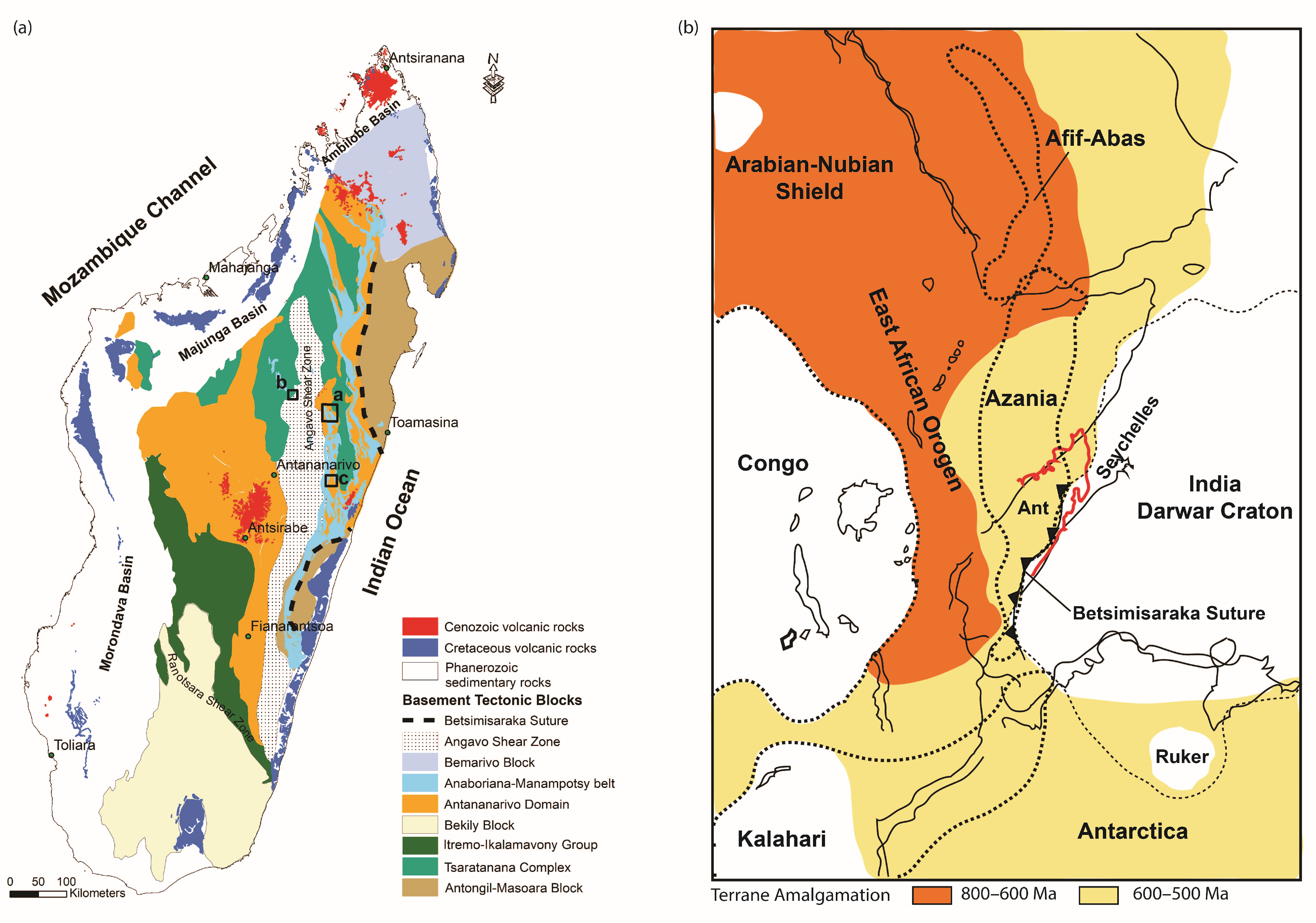
Madagascar has a prolonged and complex tectonic history. Its basement rocks record high-grade metamorphism, magmatism, and contractional and extensional structures associated with the collision of the eastern and western Gondwana supercontinent and its progressive breakup. The eastern two-thirds of the island are underlain by Precambrian to Paleozoic rocks, and Phanerozoic sediment underlies the western third of the island with minor volcanic rocks. The Precambrian shield of Madagascar hosted several domains (Figure 1a), each of which has a unique tectonic history and is defined by distinctive suites of lithological units (e.g., [22,45]). The domains include the following: Bemarivo in the northern part, Antananarivo (including the Tsaratanana complex and Itremo) in the central part, Antongil-Masora along the eastern coast, Ikalamavony in west central, and Vohibory and Anosyen-Androyen in the southern part. The Antananarivo Domain represents the largest tectonic block and occupies much of central Madagascar. It is tectonically separated from the Bemarivo and Antongil-Masora Domain by the sheared rocks of the Betsimisaraka Suture Zone, recently re-named as the Anaboriana-Manampotsy group (e.g., [45]).
Figure 1.
(a) Tectonic map of Gondwana showing the locations of the microcontinent of Azania (AZ), the Dharwar Craton of India and the Betsimisaraka Suture. Modified after [34]. (b) Map of the Precambrian Shield of Madagascar showing the major tectonic domains (modified after [22]). Study areas are also shown in open rectangles (a,b). Dashed lines represent the outline of pre-Neoproterozoic continental crust, and the red line outlines the island of Madagascar.
The Antananarivo domain hosts Neoarchaean orthogneisses of the Betsiboka Suite, numerous granitic intrusions, rare mafic and ultramafic intrusions, paragneisses, and other metasedimentary rocks. In addition, the domain hosts several Pan-African shear zones, including the Angavo-Ifanadiana shear zone [43]. Several workers suggested that central Madagascar, including the Antananarivo domain, consists of a microcontinent, referred to as Azania (e.g., [16,46,47]). Collins and Windley [46], proposed that a west-facing subduction of Mozambique lithosphere beneath the Azania microcontinent led to the amalgamation of Dharwar craton with Azania (Figure 1b). This subduction is believed to be associated with voluminous Neoproterozoic arc magmatism throughout central Madagascar including the Imorona–Itsindro suite, and the subsequent collision led to the development of the Betsimisaraka Suture (e.g., [46]). On the other hand, others argued that the alkaline nature of some of the granitoids is more compatible with a continental rift setting (e.g., [20,21,22]). Compilation of existing radiometric ages obtained from a wide range of minerals and techniques revealed at least three major magmatic events during the middle to late Neoproterozoic, including the Imorona–Itsindro suite (850–720 Ma), the Kiangara suite (633 to 570 Ma), and the Ambalavao suite (570 to 530 Ma) (e.g., [45]). The Imorona–Itsindro suite is the most voluminous and widespread plutonic sequence in central Madagascar. The suite is believed to form a more than 500 km long plutonic belt which stretches from Maevatanana to Ambalavao areas. The suite consists of nested plutons, dikes and sills of gabbro, syenite, and granite (e.g., [45]). On the other hand, the Kiangara suite, also known as the stratoid granites [48], represents sheet-like intrusions that have been emplaced along the foliation of the country rocks [48,49]. Nédélec et al. [49] indicated that the stratoid granites and their host gneisses and migmatites display major ENE-WSW trending lineations. Additionally, they argued that their stratoid forms could be attributed to an emplacement within an extensional ductile shear zone. In fact, Nédélec et al. [50] suggested that the stratoid granites are contemporaneous with post-collisional ENE-WSW extension associated with the Pan-African orogen. Recently, Nédélec et al. [20] argued that the Kiangara suite should be considered part of the Imorona–Itsindro suite on the basis of their U-Pb ages and geochemical compositions. It is thus clear that the timing, sources, and tectonic origin of these scattered but voluminous granitoid magmas remain inconclusive.
3. Materials and Methods
3.1. Sampling
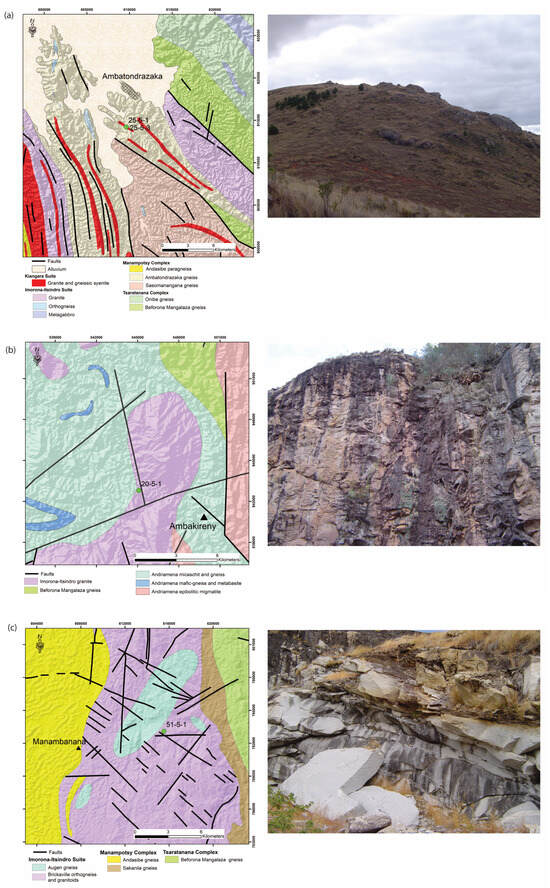
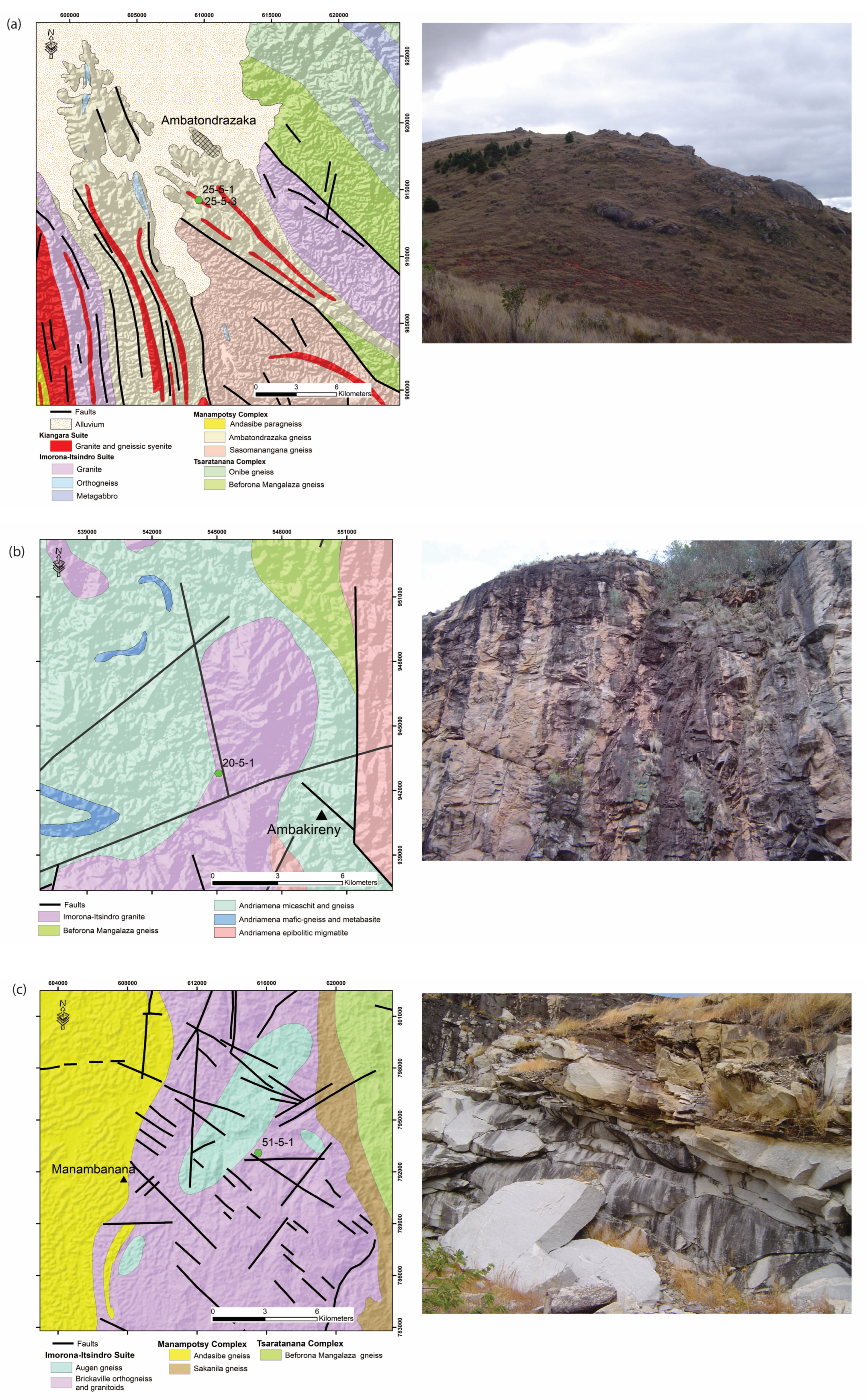
All samples are characterized by the principal mineral assemblages of quartz, K-feldspar, and plagioclase, which are predominant phases in most granitoids. Sample 20-5-1 is a granitoid collected from the western edge of the Angavo belt, in the Ambohidronono area (Figure 2b). It has uniform texture of thick leucocratic bands (>5 cm) composed mainly of quartz, K-feldspar, plagioclase, and muscovite. It is mapped as part of the Imorona–Itsindro suite (Figure 2b). Samples 25-5-1 and 25-5-3 were both collected from quarries located near the Ankazotsaravolo village, southeast of the Lake Alaotra. The new geologic map (Figure 2a) shows that the outcrop is part of the Kiangara suite. Sample 25-5-1 is a leucocratic granite characterized by a mineral assemblage of quartz, plagioclase, and microcline. It forms up to 30 m thick layers of granitoid within the interlayered host rock, which is muscovite-biotite-bearing pink weakly foliated gneiss. Another Imorona–Itsindro sample, 51-5-1, is a granitoid emplaced within migmatites (Figure 2c). It is collected from the eastern side of the Angavo belt, in the Ankevoka area. In the field, the granitoid is heterogeneous with numerous discontinuous patches of migmatite. It consists of K-feldspar, microcline, quartz, pyroxene, plagioclase, and very few mafic minerals.
Figure 2.
Simplified geologic maps of the study areas. Green dots indicate the locations for the Kiangara and Imorona–Itsindro samples. (a) Map of Ambatondrazaka showing the location and extent of the Kiangara and Imorona–Itsindro suites in the area (modified after [51,52,53]). The right panel shows field photograph of the Ankazotsaravolo intrusion geologically mapped as part of the Kiangara suite. (b) Map of Ambakireny–Ampandrana showing the extent of Imorona–Itsindro suite in these areas (modified after [54]). Field photograph of the Ambohidronono granitoid mapped as part of the Imorona–Itsindro suite is shown on the right panel. (c) Map of Perinet showing the extent of Imorona–Itsindro suite in the area (modified after [55]). The right panel shows field photograph of the Anevoka granitoid, mapped as part of the Imorona–Itsindro suite.
3.2. Analytical Techniques
Whole-rock major element (SiO2, TiO2, Al2O3, FeO, MnO, MgO, CaO, Na2O, K2O, and P2O5) abundances were determined for the studied samples by X-ray fluorescence (XRF) at Activation Laboratory Ltd. (Ancaster, ON, Canada), and abundances of trace elements including rare earth elements (REE) were determined by inductively coupled plasma mass spectrometry (ICP-MS), also at Activation Laboratory Ltd., Ancaster, ON, Canada. Details of the sample preparation and analytical procedures are provided on the Activation Laboratory Ltd. website. Long-term reproducibility and precision are better than 5% for REE measurements and 10% for the remaining trace elements. U and Pb isotopic compositions and concentrations were determined by isotope dilution on single zircon minerals. U-Pb chemical separation and isotopic measurements were performed by thermal ionization mass spectrometer (TIMS) on a VG Sector with a 54° sector magnet and three Faraday cups at the University of North Carolina, Chapel Hill.
Zircon minerals were separated from their host granites by crushing approximately 2 kg of whole rock using standard jaw-crusher and disk mill. Gravity separations were carried out using a Wilfley water table followed by heavy liquids (bromoform and methylene iodide). Samples were then passed through a hand magnet and a Frantz isodynamic separator [56]. Zircon grains were then handpicked under a binocular microscope based on quality (e.g., clear, colorless, non-magnetic, and free of cracks and inclusions) and morphology (e.g., long and prismatic crystals). The mineral separates were cleaned three times in an ultrasonic bath with 18.2 MΩ H2O and were treated with both physical abrasion [57] and chemical [58,59] leaching techniques to minimize the effects of Pb loss and inheritance. Zircon grains were thermally annealed at 900 °C for 48 h prior to chemical abrasion using a mixture of HF and HNO3 in a Teflon bomb for a period of 16 h at 220 °C. Then, the crystals were repeatedly cleaned in an ultrasonic bath in a mixture of HCl and HNO3. Selected zircons were washed and leached repeatedly with HNO3 on a hotplate, and then each fraction (single grain) was transferred into microcap. The samples were spiked using a 205Pb/235U/233U mixed spike [60,61] and dissolved at 220 °C in Teflon dissolution bombs containing HF and HNO3 for 5 days. The samples were dried down on hot plate and then re-dissolved in HF-HNO3 for 5–7 days at a temperature of 220 °C to ensure complete digestion. Separation of U and Pb was performed by ion exchange chromatography. A mixture of the Uranium sample, phosphoric acid, and graphite was then loaded onto a Re filament to be analyzed in static multi-collector mode. Lead was loaded on a single Re filament with silica gel and phosphoric acid and analyzed using peak-hopping on a single-Daly detector. Data from the mass spectrometry was reduced using Tripoli 4.5 software [62]. Both PBDAT [63] and ISOPLOT-Ex v. 3 [64] software were used for data reduction, data plotting, and age calculation (Table 1). All isotope dilution results are quoted at 95% confidence (2-sigma) level.
Table 1.
ID-TIMS U-Pb zircon isotopic data.
4. Results
4.1. U-Pb Ages
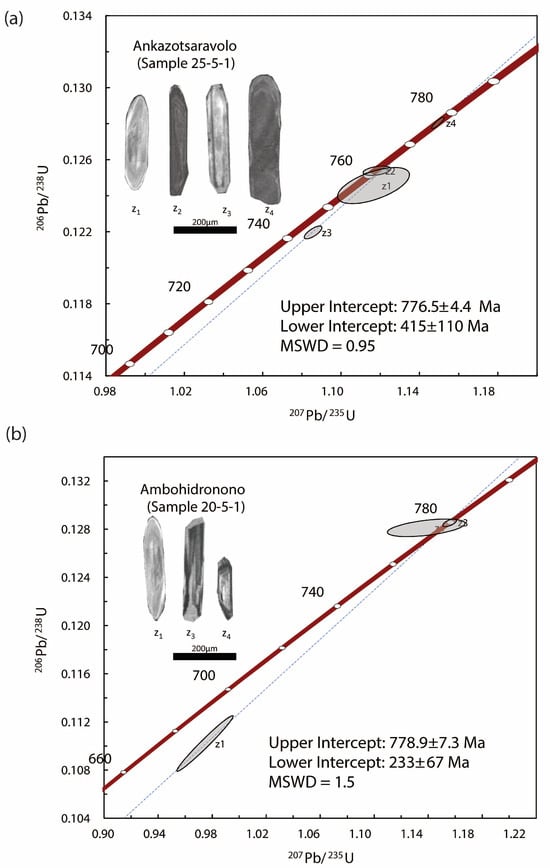
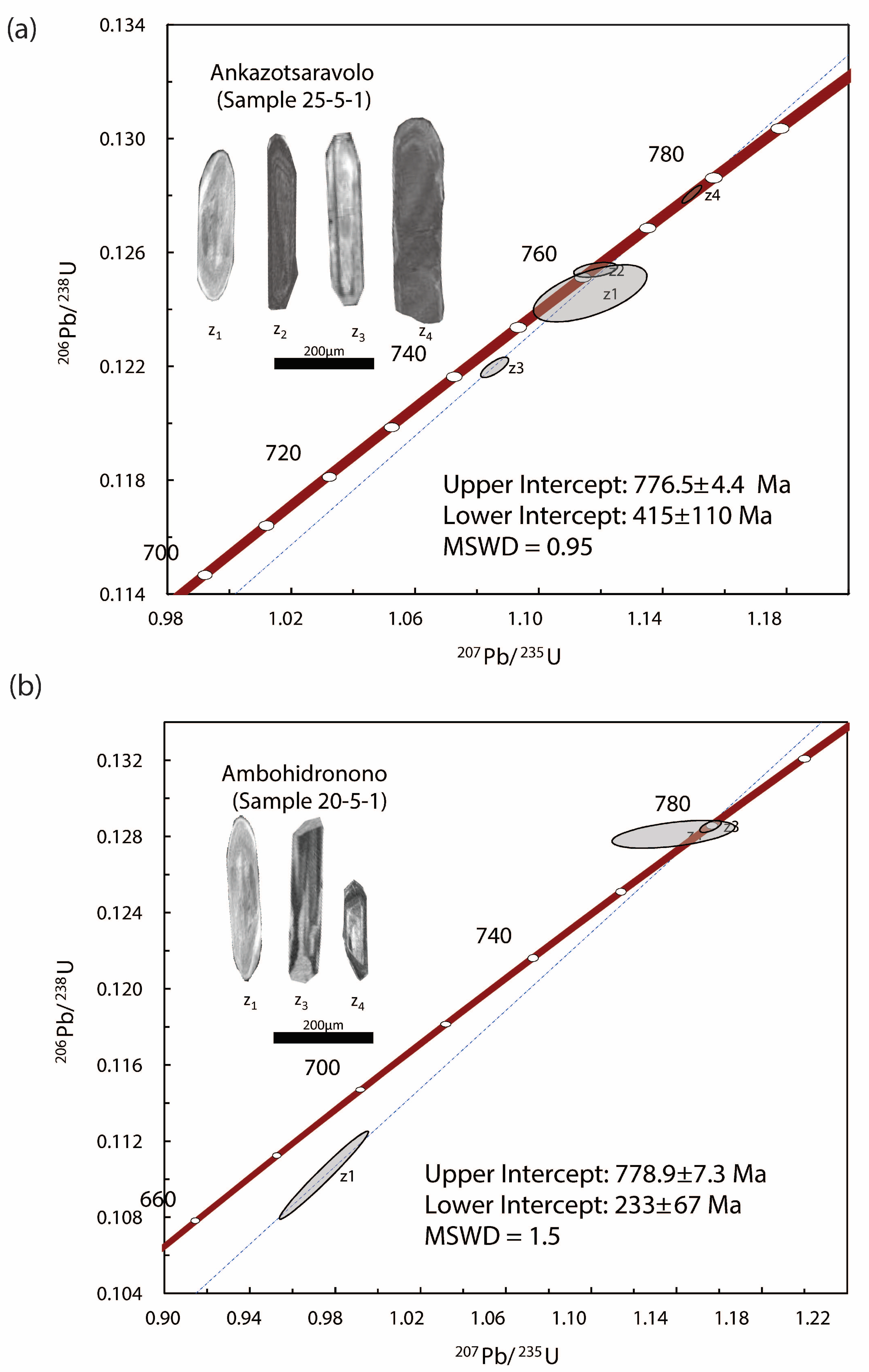
U-Pb ID-TIMS data for the Ankazotsaravolo and for the Ambohidronono samples previously mapped as part of the Kiangara and Imorona–Itsindro suites, respectively, are presented in Table 1. For the Ankazotsaravolo granitoid (25-5-1), four separated (single) zircon grains were analyzed. Zircon crystals are colorless, clear, non-magnetic, and long (width/length ratios ~1:4 to 1:5). Scanning electron microscopy cathodoluminescence (SEM-CL) images show euhedral growth zones, free of inclusions, an absence of cracks, and planar faces (Figure 3), all characteristics of igneous zircons. Zircon grains have Th/U ratios higher than 0.1 (~0.638 to 0.844, Table 1), which supports an igneous origin. As illustrated in Figure 3a, data for one of the grains (z4) is concordant and yields a concordia age of 776 Ma. U-Pb data for the remaining zircon grains are slightly to moderately discordant. The four zircon grains form a discordia line (Figure 3a) with an upper intercept at 776.5 ± 4.4 Ma (2σ) (MSWD = 0.95) which, as discussed below, is interpreted as the age of crystallization of the granite (Figure 3a), and a lower intercept at 415 ± 110 Ma, which is attributed to the timing of Pb loss.
Figure 3.
206Pb/238U vs. 207Pb/235U concordia diagrams for the analyzed zircons from the (a) Kiangara granitoid in the Ankazotsaravolo area, and (b) Imorona–Itsindro granitoid in the Ambohidronono area. Cathodoluminescence (CL) images are also shown.
For the Ambohidronono sample (20-5-1), four single fractions of clear, prismatic, and colorless zircon grains were prepared for the isotopic analyses; however, only three survived the pre-treatment. The grains are free of inclusions and with width/length ratios up to 1/5, typical features of igneous origin. Data for one grain (z3) is concordant at 779 Ma, while the remaining grains are slightly discordant (Figure 3b). All three grains have a high Th/U ratio (>0.1), which supports an igneous origin (Table 1), and the U and radiogenic-Pb contents ranged from 84 to 138 ppm and 16 to 22 ppm, respectively. Two fractions (z3 and z4) overlap on the concordia curve and yield an age at approximately 778 Ma (Figure 3b). The three separated grains yield an upper intercept age of 778.9 ± 7.3 Ma (2σ) (MSWD = 1.5) and a lower intercept of 230 ± 70 Ma (Figure 3b).
4.2. Major and Trace Element Data
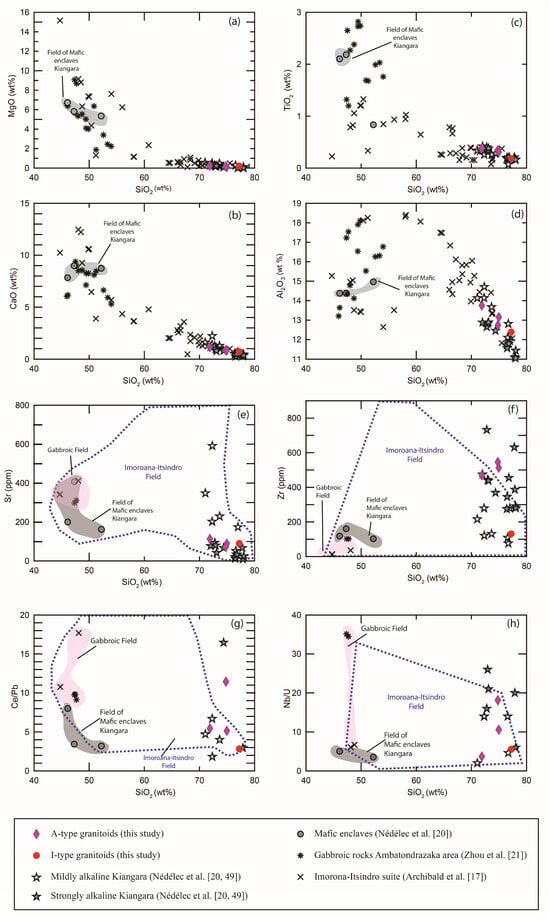
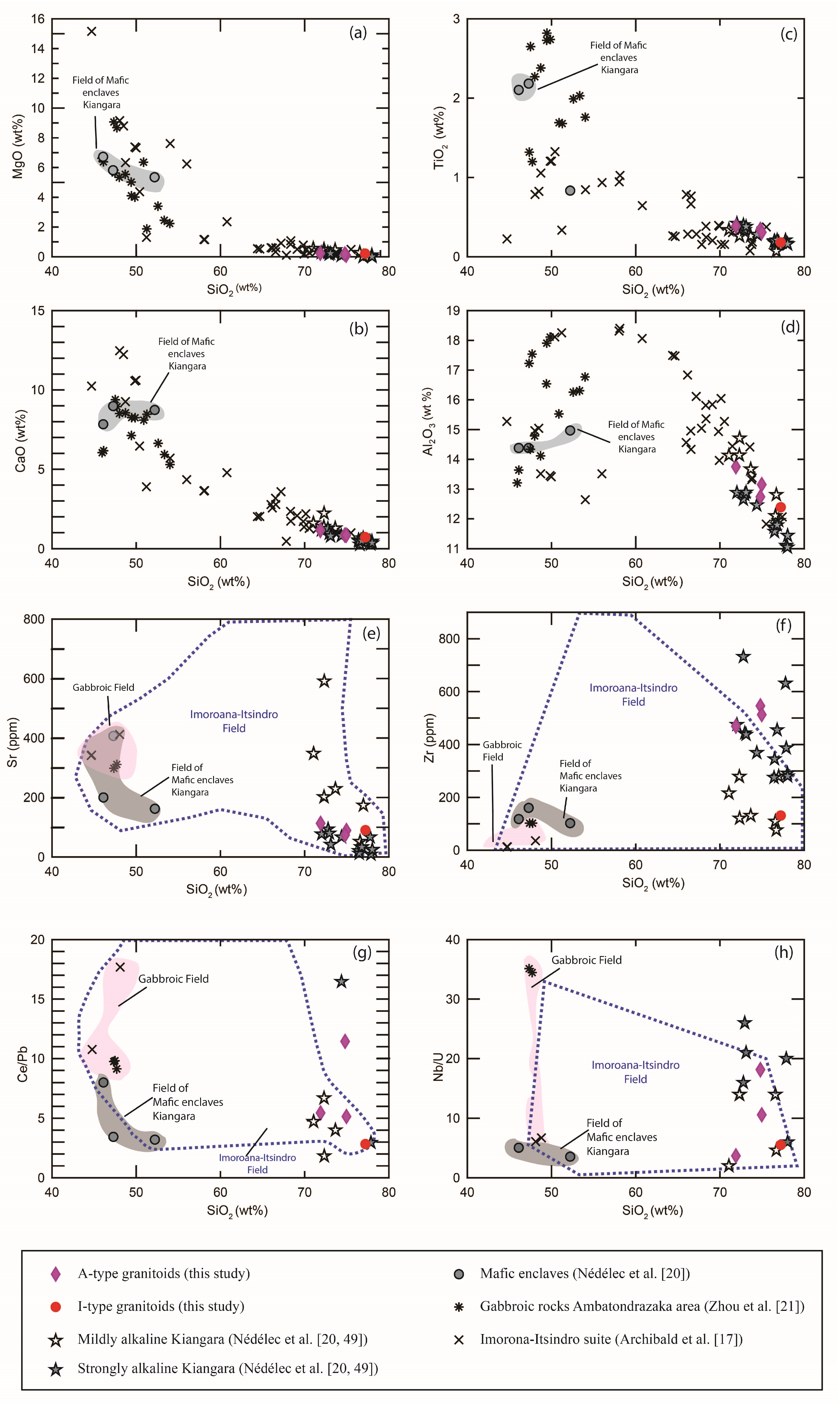
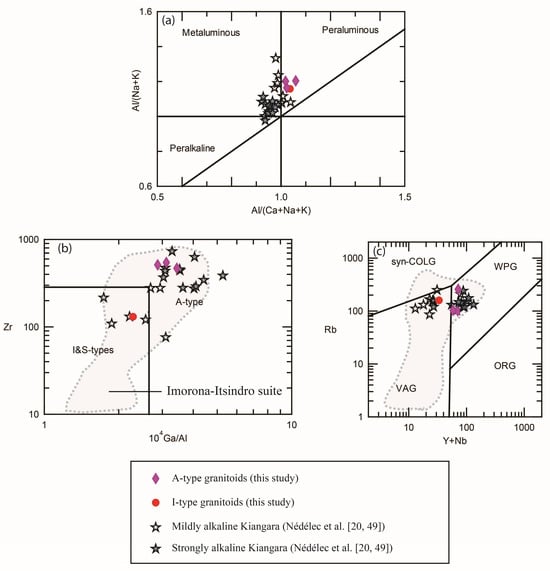
Whole-rock major and trace element data for the dated samples and additional granitoid samples are provided in Table 2. The new major and trace element data in this study fall very well within the compositional range observed previously in the Neoproterozoic granitic magmas in central Madagascar [20,45]. As shown in Figure 4, all of the samples have high silica (SiO2 > 70 wt%) and total alkali (Na2O + K2O > 8 wt%) contents. Their A/CNK ratios range between 1 and 1.1 and fall within the peraluminous field (Figure 5a). However, in several discrimination diagrams, the samples fall into two compositionally distinct fields where the sample from the Ambohidronono, part of the Imorona–Itsindro suite, plots in the I-type, whereas the samples from the Ankazotsaravolo, part of the Kiangara suite, fall in the A-type (Figure 5b). Additional Imorona–Itsindro sample from the Ankevoka area plots in the A-type field. Variation diagrams for the samples from this study, together with previously published data for the Kiangara and Imorona–Itsindro suites are shown in Figure 4. As a whole, the mafic and felsic intrusions in central Madagascar display coherent correlation between most major oxides and SiO2 (Figure 4a–d). We note that the A-type Kiangara samples in this study are very similar to the strongly alkaline A-type granites reported in previous studies (e.g., [20,49]). Nonetheless, the A-type in this study exhibits slightly higher Zr (Figure 4f) and Eu but lower Sr (Figure 4e), Y, and Nb contents at a given SiO2 relative to those identified by Nédélec et al. [20,49]. Compared with the I-type, the A-type samples have lower SiO2 contents (~74 wt% vs. 77 wt%) but slightly higher TiO2, Al2O3, and Fe2O3t. Nonetheless, they have comparable alkali contents, MgO, CaO, MnO, and P2O5 contents. Among the samples from this study, as well as those from the Kiangara and Imorona–Itsindro granitic suites as a whole, incompatible trace elements generally lack systematic variations with SiO2 (Figure 4e,f), except Ba and Eu. Moreover, on incompatible trace element variations diagrams, the A-type samples can be clearly distinguished from the I-type samples, with the former displaying higher abundances of the high field strength elements (HFSE) Zr, Hf, and to some extent HREE and Y (Figure 6c). In addition, the A-type exhibits higher Ga and Ba contents but lower Rb, Th, and U. Both A- and I-type samples exhibit variable and low ratios of Ce/Pb, Nb/U, and Sr/Nd, much lower than those observed in mid-ocean ridge basalts (MORB) and OIB, for which Ce/Pb = 25 and Nb/U = 47 ± 10 [65] (Figure 4g,h).
Table 2.
Major and trace element data for the granitoid magmas from Kiangara and Imorona–Itsindro suites.
Figure 4.
Selected major and trace element variation diagrams for the studied granitoids. Previous data for plutonic rocks from Kiangara and Imorona–Itsindro suites are also shown for comparison. Data for the Kiangara granitoids and mafic enclaves are from Nédélec et al. [20,49]; data for the Imorona–Itsindro suite are from Archibald et al. [17] and Zhou et al. [21]. Dotted field represents the composition of the mafic to felsic rocks of the Imorona–Itsindro suite. Pink field represents the composition of the most mafic rocks within the Imorona–Itsindro suite, whereas dark field represents the composition of the mafic enclaves from the Kiangara suite. Dashed purple lines outline the composition of the whole Imorona–Itsindro suite.
Figure 5.
(a) A/NK vs. A/CNK, (b) Zr vs. Ga/Al, and (c) Rb vs. Y + Nb. Previous data for plutonic rocks from Kiangara and Imorona–Itsindro suites are also shown for comparison. Data for the Kiangara granitoids are from Nédélec et al. [20,49]; data for the Imorona–Itsindro suite are from Archibad et al. [17] and Zhou et al. [21]. Dotted field represents the composition of the mafic to felsic rocks of the Imorona–Itsindro suite.
Figure 6.
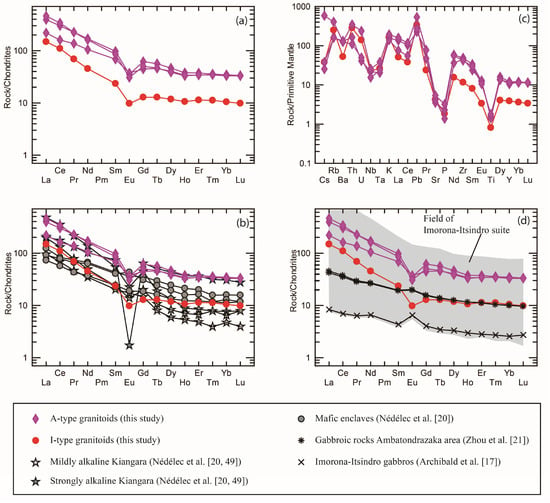
(a) Chondrite- and (b) primitive mantle-normalized trace element patterns for granitoids from Kiangara and Imorona–Itsindro suites in this study. Normalizing values are from [66]. Comparison of the trace element patterns for the studied samples with those of (c) mafic enclaves and strongly alkaline and mildly alkaline granitoids from Kiangara suite [20] and (d) mafic to felsic rocks from Imorona–Itsindro suite [17] (gray field). The most primitive (i.e., high Ni contents) grabbroic rocks from the Ambatondrazaka area [21] and from the Imorona–Itsindro as a whole [17] are also shown.
On a primitive mantle-normalized multi-element diagram (Figure 6c), all samples are characterized by enrichment of Cs, K, and Pb but strong depletion in Nb, Ta, Sr, and Ti trace element patterns are very similar to those Andean-type arcs. The granites also display similar REE patterns on chondrite-normalized REE diagram (Figure 6a,b,d). They all show relative enrichment of LREE to HREE with La/Yb ranging from 10 to 20 and display a subtle Eu negative anomaly. However, the I-type granite shows low REE abundances relative to the A-type granite (Figure 6a). We note that the alkaline hypersolvus granite from Kiangara suite (M14 [20]) shares similar patterns to those of the A-type granites in this study but shows strong depletion in Ba, Sr, P, and Eu. On various tectonic discrimination diagrams, the peraluminous A-type samples plot in the within plate (WPG) field, whereas the peraluminous I-type falls within the volcanic arc (VAG) field (Figure 5c). We note that, although some trace element patterns correlate empirically with tectonic settings, they more accurately reflect distinct chemical source reservoirs than tectonic settings.
5. Discussion
5.1. Crystallization Ages of the Kiangara and Imorona–Itsindro Samples
The new U-Pb single zircon ages and the geochemical signatures of the granitoid intrusions in this study can be used to further constrain the petrogenesis and the timing of granitic magmatism that was emplaced within the Antananarivo Domain. As indicated above, the Ankazotsaravolo intrusion is geologically mapped as part of the Kiangara suite also known as the stratoid granites, whereas the Ambohidronono granitoid is mapped as part of the Imorona–Itsindro suite which is believed to consist of nested plutons, dikes, and sills. Previous studies suggested that the Imorona–Itsindro suite comprises all magmatic rocks emplaced in between ~850 and 720 Ma, whereas the Kiangara magmatic rocks which comprise the sheet-like granitoid intrusions were mostly emplaced between 633 and 570 Ma (e.g., [20,22]). Our new ID-TIMS U-Pb age determinations for the Ambohidronono intrusion indicate that its crystallization and emplacement have occurred at 779 ± 7 Ma (Figure 3a), and thus falls well within the magmatic activity associated with Imorona–Itsindro suite (e.g., [22]). In contrast, the Ankazotsaravolo granitoid intrusion, which is mapped as part of the Kiangara suite, yields a U-Pb zircon crystallization age of 777 ± 4 Ma (Figure 3b), distinctly older than those reported for the Kiangara suite (e.g., [22]). Recently, Nédélec et al. [20] reported a U-Pb age of 789 Ma from a quartz-syenite of the Kiangara suite, and 780 Ma for the emplacement of the Midongy granite within the Imorona–Itsindro suite. Thus, the U-Pb zircon age from the Ankazotsaravolo intrusion strongly confirms that the emplacement of the Kiangara suite occurred as early as 780 Ma rather than 633 Ma. Additionally, the U-Pb age of 779 ± 7 Ma from the Ambohidronono intrusion is identical within analytical error to the 777 ± 4 Ma date from the Ankazotsaravolo intrusion, suggesting that the emplacement of the Kiangara and Imorona–Itsindro granitic intrusions were indeed contemporaneous. Nédélec et al. [20] argued that the 630 Ma obtained from a quartz-syenite of the Kiangara suite (e.g., [49]) do not have any geologic significance; instead, they suggested that the Kiangara suite should be re-assigned to the Imorona–Itsindro suite based on their U-Pb ages and geochemical compositions. Nonetheless, it is worth mentioning that BGS-USGS-GLW [45] have reported several ages between 633 and 570 Ma from these sheet-like granites throughout the Antananarivo domain. The available geochronological data therefore indicate that the Kiangara magmatism occurred between 790 (e.g., [20]) and 570 Ma (e.g., [45]); however, it is not clear whether it represents a continuous magmatism or intermittent pulses within this time range.
5.2. Are the I- and A-Type Granitoids in Central Madagascar Genetically Related?
As illustrated in Figure 5a, the samples from the Kiangara and the Imorona–Itsindro suites analyzed in this study are exclusively peraluminous. They display similar trace element patterns with significant enrichments in LILE (e.g., Ba, Rb, Cs and K) and depletions in HFSE (e.g., Nb and Ta), characteristics very similar to those of arc-type magmas (e.g., [67,68]). Nonetheless, some subtle but distinct geochemical features are apparent among the two suites; most notably, the Ambohidronono granitoid from the Imorona–Itsindro group displays I-type affinity with low REE abundances, whereas the Ankazotsaravolo granitoid from the Kiangara suite and Anevoka samples exhibit A-type signatures with higher REE contents (Figure 4 and Figure 6). Whether the A-type granites are genetically related to the I-type remains a matter of debate, but some studies argued that the A-type magma is likely a subtype of the I-type granite (e.g., [69]). If this is the case, the REE patterns of the Kiangara and Imorona–Itsindro samples in this study could have been simply derived from different degrees of partial melting of a similar source, in which the A-type samples are generated from smaller degrees of melting than the I-type sample, or the A-type granites were formed by extensive fractionation of I-type melt. In addition, the U-Pb zircon age of the A-type granite (777 ± 4 Ma) is indistinguishable from the age of the I-type pluton (779 ± 7 Ma) within analytical error, meaning that the A-type is contemporaneous with the I-type magma. The compositional signatures, together with the similar ages, therefore, seem to suggest that the two groups could be genetically related.
Previous studies have shown that trace element pairs such as Sr-Nd and Ce-Pb behave very similarly during partial melting and therefore cannot be fractionated by variable degrees of melting (e.g., [65]). As illustrated in Figure 4g,h, the studied samples display variable trace element ratios (e.g., Sr/Nd, Nb/U, and Ce/Pb), thus arguing against the difference in degree of partial melting being the sole cause of the compositional distinctions. Major element data are also inconsistent with the generation of the A-type granites from I-type as the latter is more felsic (SiO2 ~76 wt%) than the A-type (SiO2 ~74 wt%). Thus, we suggest that the generation of the A-type magmas from the I-type can be dismissed, and the subtle but distinct compositional features suggest that the I- and A-type granitoids of the Imorona–Itsindro and Kiangara, respectively, come from compositionally distinct sources or they reflect a variable degree of crustal contamination of a mantle-derived magma. Below, we further explore the possible magmatic processes involved in the genesis of the A- and I-type granitoids.
5.3. Petrogenesis of the Peraluminous A-Type Granitoid in Kiangara
5.3.1. Role of Simple Fractional Crystallization
Previous studies have shown that the compositional signatures of A-type granitoids can be explained by extensive fractional crystallization of alkaline mafic magmas (e.g., [70,71,72]), or by crustal contamination of a mantle-derived melt, or by crustal anatexis.
As illustrated on Figure 4 and Figure 5, the A-type granites from this study fall very well within the compositional range of the high-alkaline granitic rocks of Kiangara and Imorona–Itsindro suites from previous studies (e.g., [20,49]). Nédélec et al. [20,49] suggested that the mafic enclaves found in these hypersolvus granites could represent the parental magma for the syenite and alkaline granites within the Kiangara suite. Collectively, the mafic enclaves, the A-type samples in this study, and those from Nédélec et al. [20,49] form a coherent trend on all major oxides versus SiO2 (Figure 4a–d), consistent with their derivation from the mafic enclaves via fractional crystallization paths. However, similar trace element ratios such as Ce/Pb and Nb/U would be expected if these A-type granites were genetically related to the mafic enclaves by a simple fractional crystallization, which is not observed (Figure 4g,h). Rather, the A-type granitoids in this study extend to higher Nb/U (up to 20) and Ce/Pb (up to 12) than the mafic enclaves which are characterized by lower Nb/U (<5) and Ce/Pb (<8) (Figure 4g,h). An alternative possibility is that the parental magmas have elemental composition very similar to that of gabbroic rocks in the Imorona–Itsindro suite with relatively high Nb/U and Ce/Pb ratios (e.g., [21,73]). However, the scatter but negative correlation between Nb/U and SiO2 precludes a simple fractionation mechanism and rather suggests a crustal contamination process (Figure 4h). Furthermore, the A-type granites in this study are characterized by peraluminous signatures (Figure 4a), and thus it is unlikely that they are produced by extensive fractional crystallization from a mantle-derived alkaline magma, as such processes would generally produce magma with peralkaline compositions (e.g., [74,75,76]).
In summary, we suggest that the geochemical signatures of the A-type magmas in this study cannot be ascribed to protracted fractional crystallization of a primary melt compositionally similar to the mafic enclaves found in the hypersolvus granites of the Kiangara suite or the gabbroic rocks in Imorona–Itsindro suite. Instead, the low HFSE, Nb/U, and Ce/Pb require crustal involvement in their petrogenesis [77], whether by crustal contamination of a mantle-derived melt or by crustal anatexis.
5.3.2. Role of Crustal Anatexis vs. Crustal Assimilation
Alternatively, the peraluminous A-type granitoids in this study could be derived solely by partial melting of the Precambrian basement. In fact, the negative ɛNd isotopic signatures (−15) in the less alkaline A-type magmas of the Kiangara suite are interpreted to reflect melting of the late-Archean gneiss that primarily constitute the Antananarivo domain (e.g., [20]). The relatively low MgO, Ni, Cr, Ce/Pb, and Nb/U would all be consistent with the A-type samples being exclusively produced by crustal anatexis. However, some studies argued that A-type magmas cannot be simply derived from crustal sources (e.g., [78]), as experimental studies using various types of rocks under various crustal conditions failed to reproduce the geochemical signatures of A-type magmas (e.g., [79]). Additionally, some experimental studies have shown that partial melting of basaltic composition at lower crust to mantle depths can produce highly siliceous granitic to trondhjemitic melts with residual plagioclase in the source (e.g., [80]). The lack of a strong Eu anomaly in the A-type samples in this study seems to suggest the absence of residual plagioclase in the source. Similarly, Eby et al. [81] indicated that A-type magmas require high temperatures in the source regions; however, such high temperatures cannot be achieved in the crust, and the involvement of mantle-derived melts is required in their petrogenesis. It is argued that A-type magmas are generated from mantle-derived transitional to alkaline mafic and intermediate magmas that are variably contaminated by continental crust (e.g., [78]).
As noted earlier, major and trace element signatures of A-type Kiangara samples in this study are very similar to those of strongly alkaline A-type granites reported in previous studies (e.g., [20,49]). For the strongly alkaline syenite and granites from the Kiangara suite and the Midongy granites, Nédélec et al. [20,49] argued that their ɛNd isotopic signatures reflect contribution from both sub-continental lithospheric mantle (SCLM) and Archean crust. As illustrated in Figure 4h, the A-type granitoids from the Kiangara suite, the gabbroic rocks in the Ambatondrazaka area, and the Imorona–Itsindro suite as a whole display an inverse correlation between Nb/U and indices of differentiation such as SiO2 (Figure 4h), suggesting that crustal assimilation is indeed an important process in their petrogenesis. It is thus possible that the geochemical signatures of the A-type magmas in this study stem from significant crustal contamination of a mantle-derived magma. Nonetheless, the arc-like trace element characteristics including LILE enrichments and HFSE depletions (Figure 6c) can be primarily attributed to the derivation of the parental melts from a mantle that has been metasomatised by slab-derived hydrous fluids. This is in accord with the conclusion reached by previous workers (e.g., [73]) and is consistent with A-type granites elsewhere such as the peraluminous A-type granitoids from the Sierras Pampeanas, Argentina, which clearly show the involvement of both metasomatized mantle and crustal material to varying degrees in their petrogenesis (e.g., [82]).
5.4. Petrogenesis of the Peraluminous I-Type Magmas of Imorona-Itsindro
As with the A-type granitic magmas, various petrogenetic models have been proposed to explain the compositional signatures of I-type magmas, including partial melting of crustal materials [83,84,85,86] and fractional crystallization from mantle-derived mafic or intermediate magmas [87,88,89]. Some studies have questioned the simple fractionation process as it is difficult to generate peraluminous melt by the removal of subaluminous phases such as hornblende and pyroxene from mafic to intermediate melts. Instead, the peraluminous characters of granitoids are attributed to dehydration melting of basaltic to andesitic compositions at crustal conditions (e.g., [86]). Although the mafic crustal rocks from the Suite de Betsiboka within the Antananarivo Domain could be potential sources, the I and A-type samples display a lack of strong Eu anomaly, which is the opposite of what is expected for melts produced at lower crust depth with residual plagioclase in the source.
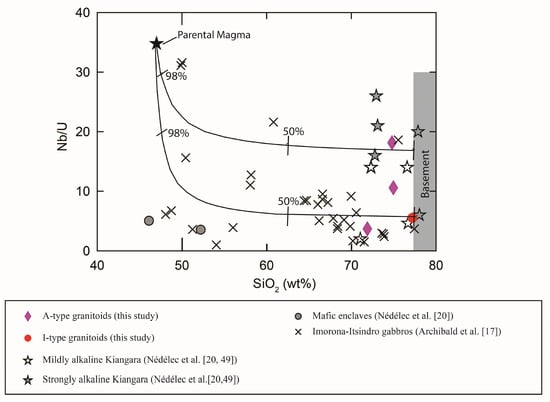
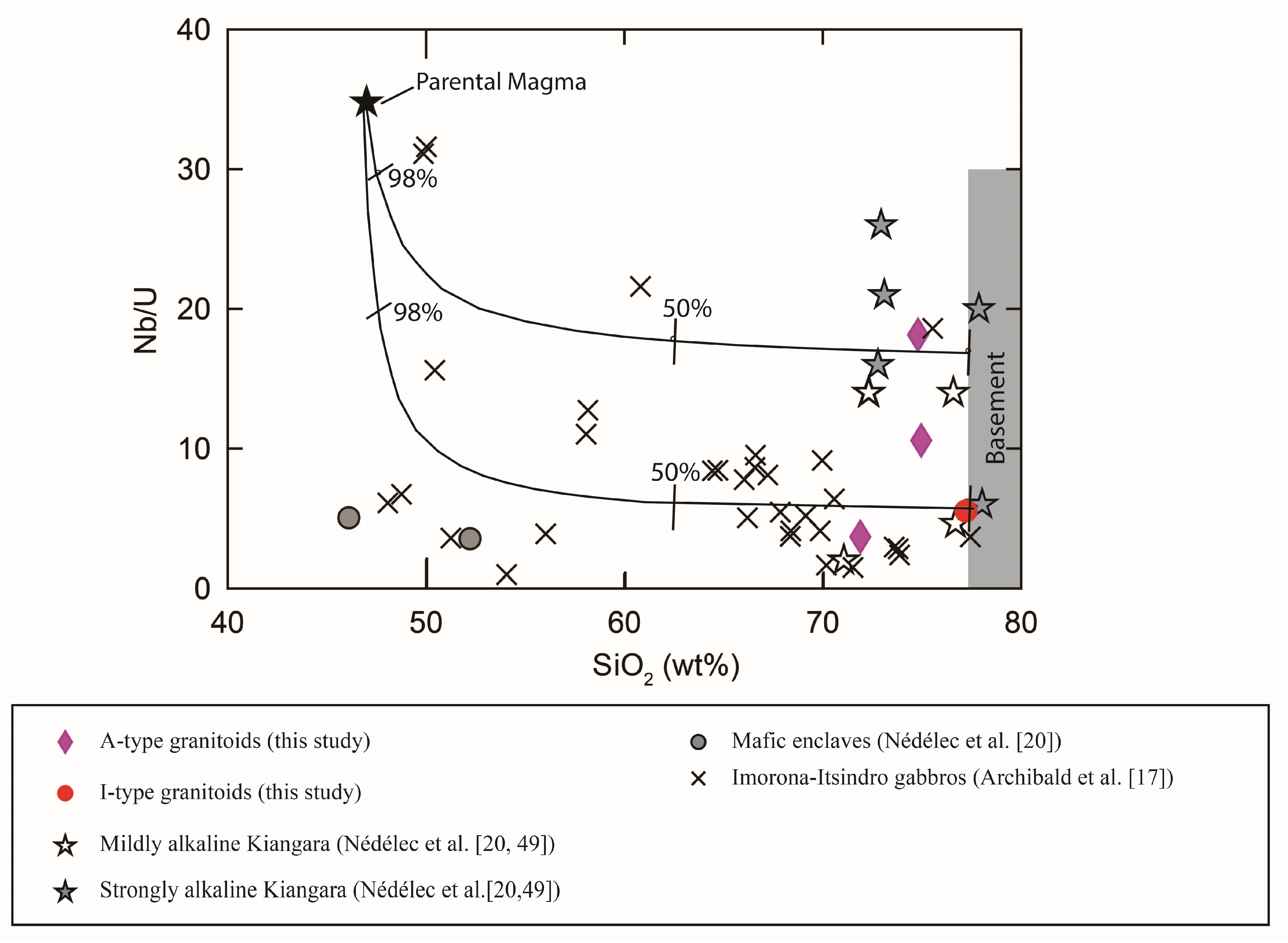
As indicated previously, the A- and I-type magmas in this study show broad geochemical similarities (e.g., peraluminous and arc-like signatures), suggesting that they share common components in their sources. Together with the gabbroic rocks in the Imorona–Itsindro suite, they display broad negative correlation in Nb/U vs. indices of differentiation (e.g., SiO2, Figure 7), with the I-type forming an array with a steeper slope than the A-type magmas. The two trends strongly suggest crustal assimilation by mantle-derived melt along with extensive fractionation. As illustrated in Figure 6, the A-type can be explained by the involvement of crustal component characterized by higher Nb/U, whereas the I-type requires crustal component with lower Nb/U. Indeed, the Precambrian basement rocks in central Madagascar are extremely heterogeneous and can cause the variability in chemical and isotopic compositions observed in the granitoid intrusions. Although this study focuses on restricted data, Archibald et al. [73] have incorporated whole-rock geochemical data from the entire Imorona–Itsindro suite in their study and concluded that the compositional diversity of the Tonian magmatic rocks in central Madagascar is more compatible with mantle-derived melts mixed with crustal melts or through assimilation of crustal materials, consistent with the trace element model in this study. As with the A-type granitoids, we argue that the arc-like trace element characteristics including LILE enrichments and HFSE depletions observed in the I-type magmas in this study stem from partial melting of mantle sources that have been metasomatised by slab-derived hydrous fluids. Assimilation fractional crystallization process further causes the variable and low Ce/Pb and Nb/U and influences the isotopic signatures of the Imorona–Itsindro and Kiangara suites in general. Further isotopic studies are needed to better constrain the role of source heterogeneity in the generation of these Neoproterozoic magmas.
Figure 7.
Nb/U vs. SiO2 diagram showing assimilation–fractional crystallization (AFC) trends between a potential parental magma (mafic rocks of Imorona-Itsindro) and the Precambrian basement. For AFC calculations, DNb and DU of 0.01 were assumed and an r value (rate of assimilation to rate of crystallization) less than 0.9 was used. Tick marks represent the fraction of remaining liquid.
5.5. Re-Evaluation of the Tectonic Significance of the Neoproterozoic Magmatism in Central Madagascar
The Neoproterozoic granitoids in central Madagascar have been the subject of extensive studies; however, their origins and the tectonic settings remain inconclusive. As we noted earlier, understanding their tectonic origins is crucial for developing the reconstruction of Gondwana during the Neoproterozoic. Some studies argued that the structures and the chemical and isotopic signatures of these Neoproterozoic magmatic rocks, including the Imorona–Itsindro and Kiangara suites, can be attributed to melting of the subcontinental lithospheric mantle (SCLM) during crustal thinning in an extensional setting. For instance, on the basis of field and anisotropy magnetic susceptibility (AMS) data, Nédélec et al. [20] argued that the Imorona–Itsindro plutons were emplaced within core complexes during the deformational D1 event that affected the Antananarivo, Itremo, and Ikalamavony domains. They argued that both structural and isotopic data are consistent with this extensional regime (D1) which took place during the breakup of Rodinia around 790–780 Ma, and probably due to the rifting of Madagascar from North China craton. In their model, decompression melting of the SCLM is generally linked with an upwelling-induced extension, and the underplating of mafic magmas is regarded as the heat source for crustal anatexis and high-grade metamorphism. Similarly, Tucker et al. [22] proposed that the Imorona–Itsindro magmatism and the elongated basins filled with Neoproterozoic sediments of the Manampotsy group are coeval and are associated with continental extension in Cryogenian time. This is largely based on the similarities in detrital zircon age from the Manampotsy group and the ages of the Imorona–Itsindro suite. Additionally, they argued that the bi-modal nature of the suite, the nested geometry of the complexes, and their spatial and temporal relationship with the elongated basins suggested emplacement within pre-existing structures. They suggested that mantle melting is induced by crustal delamination and asthenospheric upwelling. Zhou et al. [21] also suggested an intraplate extensional setting for the Imorona–Itsindro suite, including the granite, syenite, and the gabbros from the Ambatondrazaka area. They also suggested that the Imorona–Itsindro suite forms a bi-modal magmatism, and that the felsic end member can be explained by melting of pre-existing crustal basement, whereas the mafic end member was derived from an EM1-like SCLM.
Alternatively, other studies suggested an emplacement of the Neoproterozoic magmatic rocks above a subduction setting (e.g., [19,46,73]). Several studies advocated that the central Madagascar, including the Antananarivo Domain, formed a microcontinent referred to as “Azania,” and that the microcontinent was separated from the Dharwar craton by the Mozambique oceanic lithosphere (e.g., [16]). Collins and Windley [46] proposed that a west-facing subduction of Mozambique lithosphere beneath the Azania was associated with voluminous Neoproterozoic arc magmatism throughout central Madagascar, including the Imorona–Itsindro suite. Handke et al. [18] suggested an eastward subduction of Mozambique lithosphere, and the magmatic suites within central Madagascar are interpreted as the roots of the Neoproterozoic continental arc. Similarly, platinum group element (PGE) and trace element data for the ultramafic-mafic complexes in the Andriamena region are attributed to typical Andean-type arc. Furthermore, Boger et al. [19] argued that all Tonian magmatic rocks in Madagascar are better explained by subduction zone processes rather than a plume origin. They proposed that the arc magmatism was associated with an east-dipping subduction of an oceanic lithosphere (west of Androyen domain) beneath the Greater Dharwar Craton, which comprises central Madagascar and India.
Recently, Archibald et al. [73] conducted petrography, elemental, and isotopic studies of the felsic and mafic rocks that encompass the full compositional range of the Imorona–Itsindro suite and confirmed that the magmatic rocks were emplaced above an east-facing supra-subduction zone. Archibal et al. [73] argued that the Imorona–Itsindro suite forms a continuum of compositions from mafic to felsic without compositional gaps (e.g., [73]), which is inconsistent with a bimodal magmatism which is mostly found within an extensional environment. Furthermore, when comparing the Imorona–Itsindro suite to granitoids from East African Rift system and Andean-type arc-magmas, Archibal et al. [73] demonstrated that the vast majority of the plutonic rocks in central Madagascar exhibit geochemical signatures that are more closely aligned with those of Andean rocks (e.g., [73]). In this study, we suggest that the geochemical data from the granitoid samples are more compatible with subduction zone processes. Although our current data are unable to distinguish between west- and east-dipping subduction, the lack of the Imorona–Itsindro magmatic rocks in the Antongil domain (present-day east of the Betsimisaraka suture) supports the previous model invoking westward-directed subduction.
5.6. Origin and Evolution of the Tonian-Aged Plutons in Central Madagascar
Zhou et al. [21] have argued that the elemental and isotopic signatures of the gabbroic rocks from the Imorona–Itsindro suite indicate derivation from an EM1-type mantle source. The most primitive gabbroic rocks from their data set display Nb-Ta negative anomalies and low trace element ratios (e.g., Nb/U < 47 for the most primitive samples), which is the opposite of what is expected for an enriched plume source but might be attributed to the contribution of hydrous fluid from a subducted slab (e.g., [65,67,68]). We suggest that the Neoproterozoic subduction of the Mozambique oceanic lithosphere beneath central Madagascar preferentially enriched the mantle wedge in highly fluid-mobile elements (e.g., Sr, Pb and Ba) relative to the hydrous fluid immobile elements (e.g., Nb and Ta) and produced the mantle source of the mafic rocks such as the gabbroic rocks within the Imorona–Itsindro including those from Ambatondrazaka area (e.g., [21]). During partial melting of the enriched sources, the mantle-derived magmas rose from depth and stalled at different crustal levels where some of them underwent extensive fractionation and crustal assimilation. As indicated previously, the geochemical signatures of the A- and I-type magmas in this study cannot be attributed to simple fractional crystallization from a primary melt compositionally similar to the mafic enclaves in the Kiangara suite or the gabbroic rocks in Imorona–Itsindro suite. Instead, the scatter but negative correlation between trace element ratios such as Nb/U and indices of differentiation suggests that assimilation of the crustal rocks plays an important role in controlling their elemental and isotopic signatures. The peraluminous A-type magmas require assimilation of crustal materials characterized by high Nb/U, such as lower to mid-crust, whereas the I-type magma requires contamination by crustal rocks with low Nb/U, such as the upper crust.
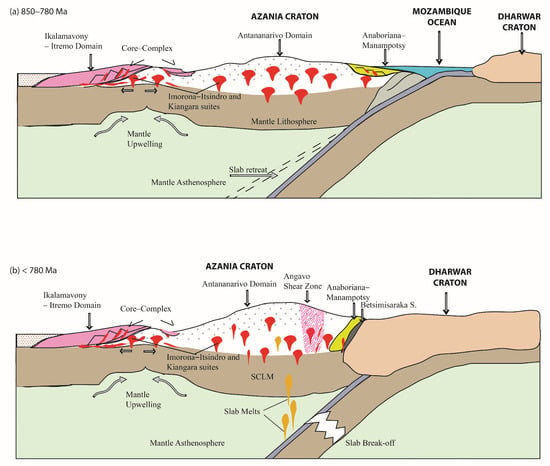
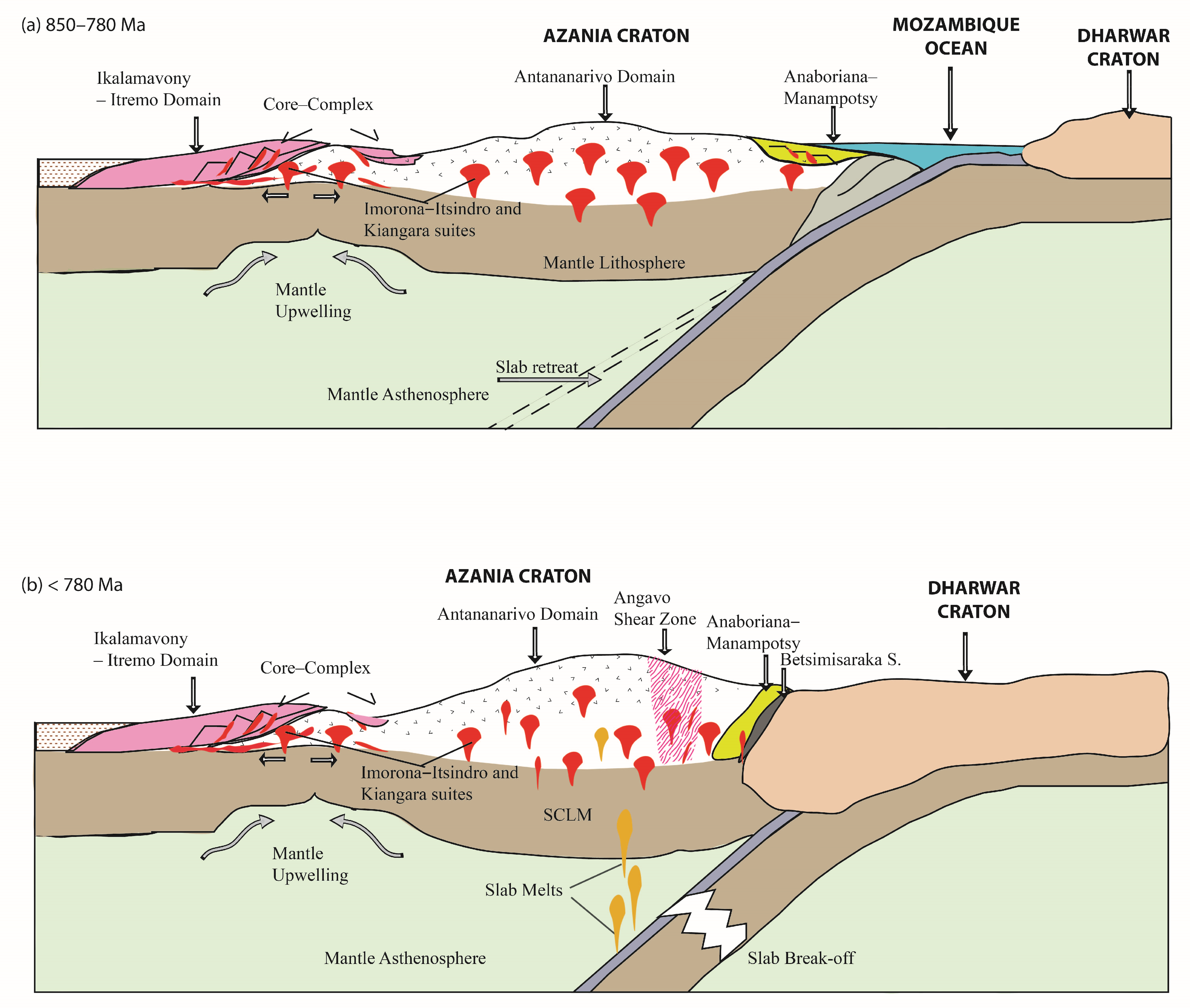
In Figure 8, we propose an alternative model for the origins of Neoproterozoic magmatism in central Madagascar. On the basis of geochronological data, the intrusion of the Imorona–Itsindro and Kiangara suites, consisting mainly of granitoids and gabbro throughout central Madagascar, occurred between ca. 850 and 570 Ma (e.g., [17,20]). We infer that these plutonic rocks were emplaced in central Madagascar as the result of the westward-directed subduction of the Mozambique lithosphere that lay to the west and north of central Madagascar beneath the Antananarivo Craton (Figure 8). In this model, the Anaboriana-Manampotsy belt is interpreted as the forearc basin that formed in response to this subduction, as suggested by Armistead et al. [90], rather than the elongated basin that formed during intracratonic rift (e.g., [22]). Moreover, the Anaboriana-Manampotsy belt, as noted by Armstead et al. [90], is also near the location of the Betsimisaraka Suture zone, which has been interpreted as the site of amalgamation and suturing of the Antananarivo craton with the Dharwar craton during the Ediacaran to early Cambrian (e.g., [34,40,41]). Nédélec et al. [20] indicated that some Imorona–Itsindro plutons in the Itremo regions were emplaced within core complexes. This raises the question about the interplay between the Imorona–Itsindro granitoids and contemporaneous detachments. Several studies have shown that a retreating subduction zone with a back-arc-like extension in the overriding plate could be associated with the development of multiple sets of extensional detachments (e.g., [91]). This model could therefore account for the intrusion of Imorona–Itsindro suite in the Itremo metasediment and their emplacement within core complexes (Figure 8). Nonetheless, we acknowledged that some of the Kiangara plutons are peralkaline and fit the genuine within-plate setting. Kusky et al. [92] proposed that slab rollback induces extension of the overriding plate and is responsible for asthenospheric mantle upwelling and melting that cause thermal erosion and large-scale destruction of SCLM beneath Archean cratons. Melting of an asthenospheric mantle source polluted by these foundered SCLM can produce mafic alkaline magmas (e.g., [93]), which can serve as parental for the peralkaline granitoids. Therefore, we propose that the slab rollback model can explain how some of the peralkaline granitic magmas in the Imorona–Itsindro and Kiangara suites were generated and emplaced in an extension-like setting. Upwelling of asthenospheric mantle due to thermal erosion or mechanical delamination of the lithospheric mantle, or a combination of both processes, can heat and partially melt the mafic lower crust.
Figure 8.
Schematic diagram (not to scale) showing the tectonic origins of Neoproterozoic granitoid magmas in central Madagascar. (a) West-facing subduction of Mozambique lithosphere beneath the Azania microcontinent and associated Neoproterozoic arc magmatism throughout the Antananarivo Domain, including the Imorona–Itsindro and Kiangara suites. In this model, the Anaboriana-Manampotsy belt, situated east of the Angavo shear zone in the present day, is interpreted to represent a forearc basin associated with this subduction. The intrusion of Imorona–Itsindro suite in the Itremo metasediment, and their emplacement within core complexes are also shown. (b) Collision of Azania and Dharwar cratons which led to the closure of the Mozambique Ocean. Slab failure due to continent–continent collision is also shown.
Another related question is whether Neoproterozoic magmatism in central Madagascar represents a mixture of arc and slab failure magmatism. As pointed out by Whalen and Hildebrand [94], not all plutons above subduction zones are the products of arc magmatism as commonly believed but instead some plutons are generated from the mantle as a consequence of slab failure during an arc-continent collision. Whalen and Hildebrand [94] noted that these slab failure magmas are compositionally similar to old tonalite–trondhjemite–granodiorite (TTG) suites. During arc-collision, tearing of the subducting slab occurs as the continents are too buoyant to subduct. Consequently, the slab breakoff leads to asthenospheric mantle uprising that causes partial melting of the subducted slab at mantle depths (e.g., [94,95]). Melts generated from this mechanism rise and interact with the overlying SCLM and produce distinct compositional signatures, such as those observed in the Peninsular Ranges Batholith and the Sierra Nevada Batholith (e.g., [90]). Evaluating the relative importance of the slab failure process in the origins of some of the late Neoproterozoic magmatism in central Madagascar could be an outstanding area of future research. Late Neoproterozoic plutons that exhibit slab failure signatures may be linked to the collision and suturing of Azania with the Dharwar craton.
Overall, syn- to post-tectonic plutonic suites were emplaced within the Antananarivo Block throughout the Neoproterozoic. In this study, we propose that the Tonian-aged plutons, which include the gabbroic rocks as well as A-type and I-type granitoids in central Madagascar, were generated in a subduction system associated with slab rollback and back-arc-like extension in the overriding plate, a geodynamic scenario very similar to those proposed for plutonic rocks in other terranes, such as the Lachlan Orogen and Arabian–Nubian Shield. The younger plutons (575 to 522 Ma) are attributed to post-tectonic or may have formed during a separate tectonic event (e.g., Tucker et al. [22]). The Imorona–Itsindro and Kiangara suites associated with the arc magmatism began as early as 850 Ma and the continent–continent collision must have been accomplished by ~575 Ma. In this context, the new U-Pb ages (779 and 777 Ma) obtained in this study represent the middle episode of arc magmatism. In central Madagascar, alkaline granites (A-type) are temporally and spatially associated with calc-alkaline (I-type) granites, similar to those found in the Lachlan Orogen. Lachlan A-type granitoids are interpreted as post-collisional and were emplaced later than felsic I-types, whereas in central Madagascar, A- and I-types are contemporaneous and are interpreted as syn-tectonic. Anatexis of tonalitic sources is thought to have generated both alkaline and calc-alkaline granites in the Lachlan Orogen [96]. Nonetheless, I-types are also interpreted as mixtures of crustal and mantle components or as products of melting of young mafic rocks [8]. In central Madagascar, some granitoids are characterized by enriched isotopic compositions, indicating a crustal origin. In this study, we also propose that the elemental differences between A-type and I-type may reflect the contamination of mantle-derived magma by lower and upper crustal rocks, respectively. We note that the coexistence of both alkaline and calc-alkaline compositions is also common in modern arc systems, such as in the Trans-Mexican volcanic belt. Based on the existing data, the compositional diversity in the Neoproterozoic magmas in central Madagascar reflects tectonic evolution within the same geodynamic environment.
6. Conclusions
The new U-Pb zircon age determined in this study further confirms that the emplacement of the alkaline granitoids of the Kiangara suite ca. 780 Ma can be much older than the 633 Ma previously reported. Although some studies argued that the 630 Ma do not have any geologic significances (e.g., [20]), emplacement of these sheet-like granites throughout the Antananarivo domain has been reported between 633 and 570 Ma (e.g., [45]). Furthermore, this study demonstrates that some of the sheet-like granites of the Kiangara suite were coeval with the plutons of the Imorona–Itsindro suite, and that they show similar geochemical signatures, suggesting that they share common component in their sources and were formed within a single but complex geodynamic setting. Overall, the existing geochemical data do not show clear evidence of a plume source; rather, they are more consistent with a subduction zone process. A satisfactory petrogenetic model to explain the elemental data (and existing isotopic data) for the Kiangara and Imorona–Itsindro suites involves partial melting of a mantle metasomatized by slab-derived hydrous fluid, followed by significant crustal assimilation and extensive fractionation. Indeed, the Kiangara and Imorona–Itsindro suites can be related to the gabbroic rocks in Ambatondrazaka area by assimilation–fractional crystallization processes. Partial melting of mafic crustal materials is not ruled out; however, thermal erosion or mechanical delamination of lithospheric mantle (or combination of both processes) would be required to supply enough heat to melt the crust. This study invokes a subduction system associated with slab rollback and extension in the same geodynamic environment to explain the gabbroic rocks, A-type, and I-type granitoids in central Madagascar. Thus, the compositional diversity in the Neoproterozoic plutons in central Madagascar reflects the evolution of the tectonic setting within a single geodynamic environment.
Author Contributions
Conceptualization, T.R. and C.R.; methodology, T.R.; software, C.R.; validation, T.R., C.R., and T.M.K.; formal analysis, T.R.; investigation, T.R.; resources, T.R.; data curation, C.R.; writing—original draft preparation, T.R.; writing—review and editing, T.R., C.R., and T.M.K.; visualization, T.R.; supervision, T.R.; project administration, T.R.; funding acquisition, T.R. All authors have read and agreed to the published version of the manuscript.
Funding
This research was partially funded by the University of Regina, Faculty Research Fund [253142] awarded to Raharimahefa.
Data Availability Statement
The original contributions presented in this study are included in the article. Further inquiries can be directed to the corresponding author(s).
Acknowledgments
We sincerely thank Drew Coleman at University of North Carolina, Chapel Hill for allowing Raharimahefa to use his laboratory. Also, we thank the field crew for helping our team during the fieldwork. Furthermore, we acknowledge the editor for handling this manuscript. We thank the anonymous reviewers for their insights and input.
Conflicts of Interest
The authors declare no conflicts of interest.
References
- Liégeois, J.P.; Black, R. Alkaline Magmatism Subsequent to Collision in the Pan-African Belt of the Adrar des Iforas (Mali); Fitton, J.G., Upton, B.G.J., Eds.; Alkaline Igneous Rocks; Lyell Collection: Edinburgh, UK, 1987; Volume 30, pp. 381–401. [Google Scholar]
- Pearce, J.A. Sources and settings of granitic rocks. Episodes 1996, 19, 120–125. [Google Scholar] [CrossRef] [Scilit]
- Chappell, B.W.; White, A.J.R. Two Contrasting Granite Types. Pac. Geol. 1974, 8, 173–174. [Google Scholar]
- Chappell, B.W.; White, A.J.R. Two Contrasting Granite Types. 25 Years Later. Aust. J. Earth Sci. 2001, 48, 489–499. [Google Scholar] [CrossRef] [Scilit]
- King, P.L.; Chappell, B.W.; Allen, C.M.; White, A.J.R. Are A-type granites the high-temperature felsic granites? Evidence from fractionated granites of the Wangrah suite. Aust. J. Earth Sci. 2001, 48, 501–514. [Google Scholar] [CrossRef] [Scilit]
- Frost, C.D.; Frost, B.R. Reduced rapakivitype granites: The tholeiite connection. Geology 1997, 25, 647–650. [Google Scholar] [CrossRef] [Scilit]
- Fu, D.; Kusky, T.M.; Wilde, S.A.; Polat, A.; Huang, B.; Zhou, Z.P. Early Paleozoic collisional-related magmatism in the eastern North Qilian orogen, northeastern Tibet: A linkage between accretionary and collisional orogenesis. Geol. Soc. Am. Bull. 2018, 131, 1031–1056. [Google Scholar] [CrossRef] [Scilit]
- Jacob, J.B.; Moyen, J.F.; Fiannacca, P.; Laurent, O.; Bachmann, O.; Janousek, V.; Farina, F.; Villaros, A. Crustal melting vs fractionation of basaltic magmas: Part 2, attempting to quantify mantle and crustal contributions in granitoids. Lithos 2021, 402, 106292. [Google Scholar] [CrossRef] [Scilit]
- Chappell, B.W. Magma mixing and the production of compositional variation within granite suites: Evidence from the granites of southeastern Australia. J. Petrol. 1996, 37, 449–470. [Google Scholar] [CrossRef] [Scilit]
- Pearce, J.A.; Harris, N.B.W.; Tindle, A.G. Trace element discrimination diagrams for the tectonic interpretation of granitic rocks. J. Petrol. 1984, 25, 956–983. [Google Scholar] [CrossRef] [Scilit]
- Frost, R.B.; Arculus, R.J.; Barnes, C.G.; Collins, W.J.; Ellis, D.J.; Frost, C.D. Geochemical classification for granitic rock suites. J. Petrol. 2001, 42, 2033–2048. [Google Scholar] [CrossRef] [Scilit]
- Whalen, J.B.; Currie, K.L.; Chappell, B.W. A-type granites: Geochemical characteristics, discrimination and petrogenesis. Contrib. Mineral. Petrol. 1987, 95, 407–419. [Google Scholar] [CrossRef] [Scilit]
- Barbarin, B. Granitoids: Main petrogenetic classifications in relation to origin and tectonic setting. Geol. J. 1990, 25, 227–238. [Google Scholar] [CrossRef] [Scilit]
- Barbarin, B. A review of the relationships between granitoid types, their origins and their geodynamic environments. Lithos 1999, 46, 605–626. [Google Scholar] [CrossRef] [Scilit]
- Collins, W.J.; Huang, H.Q.; Bowden, P.; Kemp, A.I.S. Repeated S–I–A-Type Granite Trilogy in the Lachlan Orogen and Geochemical Contrasts with A-Type Granites in Nigeria: Implications for Petrogenesis and Tectonic Discrimination; Janouˇsek, V., Bonin, B., Collins, W.J., Farina, F., Bowden, P., Eds.; Post-Archean Granitic Rocks: Contrasting Petrogenetic Processes and Tectonic Environments; Lyell Collection: Edinburgh, UK, 2020; Volume 491, pp. 53–76. [Google Scholar]
- Collins, A.S.; Pisarevsky, S.A. Amalgamating eastern Gondwana: The evolution of the Circum-Indian Orogens. Earth-Sci. Rev. 2005, 71, 229–270. [Google Scholar] [CrossRef] [Scilit]
- Archibald, D.B.; Collins, A.S.; Foden, J.D.; Payne, J.L.; Holden, P.; Razakamanana, T.; DeWaele, B.; Thomas, R.J.; Pitfield, P.E.J. Genesis of the Tonian Imorona-Itsindro magmatic suite in central Madagascar: Insights from U-Pb, oxygen and hafnium isotopes in zircon. Precambr. Res. 2016, 281, 312–337. [Google Scholar] [CrossRef] [Scilit]
- Handke, M.J.; Tucker, R.D.; Ashwal, L.D. Neoproterozoic continental arc magmatism in westcentral Madagascar. Geology 1999, 27, 351–354. [Google Scholar] [CrossRef] [Scilit]
- Boger, S.D.; Hirdes, W.; Ferreira, C.A.M.; Schulte, B.; Jenett, T.; Fanning, C.M. From passive margin to volcano-sedimentary forearc: The Tonian to Cryogenian evolution of the Anosyen Domain of southeastern Madagascar. Precambr. Res. 2014, 247, 159–186. [Google Scholar] [CrossRef] [Scilit]
- Nédélec, A.; Paquette, J.L.; Antonio, P.; Paris, G.; Bouchez, J.L. A-type stratoid granites of Madagascar revisited: Age, source and links with the breakup of Rodinia. Precambr. Res. 2016, 280, 231–248. [Google Scholar] [CrossRef] [Scilit]
- Zhou, J.-L.; Shao, S.; Luo, Z.-H.; Shao, J.-B.; Wu, D.-T.; Rasoamalala, V. Geochronology and geochemistry of Cryogenian gabbros from the Ambatondrazaka area, east central Madagascar: Implications for Madagascar-India correlation and Rodinia paleogeography. Precambr. Res. 2015, 256, 256–270. [Google Scholar] [CrossRef] [Scilit]
- Tucker, R.D.; Roig, J.-Y.; Moine, B.; Delor, C.; Peters, S.G. A geological synthesis of the Precambrian shield in Madagascar. J. Afr. Earth Sci. 2014, 94, 9–30. [Google Scholar] [CrossRef] [Scilit]
- Tucker, R.D.; Roig, J.-Y.; Macey, P.H.; Delor, C.; Amelin, Y.; Armstrong, R.A.; Rabarimanana, M.H.; Ralison, A.V. A new geological framework for south-central Madagascar, and its relevance to the “out-of-Africa” hypothesis. Precambr. Res. 2011, 185, 109–130. [Google Scholar] [CrossRef] [Scilit]
- Stern, R.J. Arc assembly and continental collision in the Neoproterozoic East African orogeny: Implications for the consolidation of Gondwana. Annu. Rev. Earth Planet. Sci. 1994, 22, 319–351. [Google Scholar] [CrossRef]
- Kröner, A.; Hegner, E.; Collins, A.S.; Windley, B.F.; Brewer, T.S.; Razakamanana, T.; Pidgeon, R.T. Age and magmatic history of the Antananarivo Block, central Madagascar, as derived from zircon geochronology and Nd isotopic systematics. Am. J. Sci. 2000, 300, 251–288. [Google Scholar] [CrossRef] [Scilit]
- Kusky, T.M.; Matsah, M. Neoproterozoic Dextral Faulting on the Najd Fault System, Saudi Arabia, Preceded Sinistral Faulting and Escape Tectonics Related to Closure of the Mozambique Ocean; Lyell Collection: Edinburgh, UK, 2003; Volume 206, pp. 327–361. [Google Scholar]
- Windley, B.F.; Razafinimparany, A.; Razakamanana, T.; Ackermand, D. The tectonic framework of the Precambrian of Madagascar and its Gondwana connections: A review and reappraisal. Geol. Rundsch. 1994, 83, 642–659. [Google Scholar] [CrossRef] [Scilit]
- Paquette, J.L.; Nédélec, A. A new insight into Pan-African tectonics in the east west Gondwana collision zone by U –Pb zircon dating of granites from central Madagascar. Earth Planet. Sci. Lett. 1998, 155, 45–56. [Google Scholar] [CrossRef] [Scilit]
- Kröner, A.; Windley, B.F.; Jaeckel, P.; Brewer, T.S.; Nemchin, A.; Razakamanana, T. New zircon ages and regional significance for the evolution of the PanAfrican-orogen in Madagascar. J. Geol. Soc. 1999, 156, 1125–1135. [Google Scholar] [CrossRef] [Scilit]
- Martelat, J.E.; Lardeaux, J.M.; Nicollet, C.; Rakotondrazafy, R. Strain pattern and late Precambrian deformation history in Southern Madagascar. Precambr. Res. 2000, 102, 1–20. [Google Scholar] [CrossRef] [Scilit]
- de Wit, M.J. Madagascar: Heads It`s a continent, Tails It`s an Island. Annu. Rev. Earth Planet. Sci. 2003, 31, 213–248. [Google Scholar] [CrossRef] [Scilit]
- Collins, A.S.; Razakamanana, T.; Windley, B.F. Neoproterozoic crustal-scale extensional detachment in Central Madagascar: Implications for extensional collapse of the East African Orogen. Geol. Mag. 2000, 137, 39–51. [Google Scholar] [CrossRef] [Scilit]
- Collins, A.S.; Fitzsimons, I.C.W.; Kinny, P.D.; Brewer, T.S.; Windley, B.F.; Kröner, A.; Razakamanana, T. The Archaean rocks of Central Madagascar: Their Place in Gondwana. In Proceedings of the 4th International Archaean Symposium, Extended Abstracts, Australian Geological Survey Organisation-Geosciences Australia, Perth, Australia, 24–28 September 2001; Cassidy, K.F., Dunphy, J.M., Van Kranendonk, M.J., Eds.; AGSO-Geoscience Australia: Canberra, Australia, 2001; Volume 37, pp. 294–296. [Google Scholar]
- Collins, A.S. Madagascar and the amalgamation of Central Gondwana. Gondwana Res. 2006, 9, 3–16. [Google Scholar] [CrossRef] [Scilit]
- Meert, J.G.; Nédélec, A.; Hall, C.; Wingate, M.; Rakotondrazafy, M. Paleomagnetism, geochronology and tectonic implications of the Carion granite, central Madagascar. Tectonophysics 2001, 340, 1–21. [Google Scholar] [CrossRef] [Scilit]
- Meert, J.G. A synopsis of events related to the assembly of eastern Gondwana. Tectonophysics 2003, 362, 1–40. [Google Scholar] [CrossRef] [Scilit]
- Rambeloson, R.A.; Yoshida, M.; Ramasiarinoro, V.; Le Duc, L.; Ralison, B. The Central granites–gneiss–migmatite belt (CGGMB) of Madagascar: The eastern Neoproterozoic suture of the East African Orogen. Gondwana Res. 2003, 6, 641–651. [Google Scholar] [CrossRef] [Scilit]
- Seward, D.; Grujic, D.; Scheurs, G. An insight into the break-up of Gondwana: Identifying events through low-temperature thermochronology from the basement rocks of Madagascar. Tectonics 2004, 23, TC3007. [Google Scholar] [CrossRef] [Scilit]
- Tucker, R.D.; Ashwal, L.D.; Handke, M.J.; Hamilton, M.A.; Le-Grange, M.; Rambeloson, R.A. U–Pb geochronology and isotope geochemistry of Archean and Proterozoic rocks of north-central Madagascar. J. Geol. 1999, 107, 135–145. [Google Scholar] [CrossRef] [Scilit]
- Raharimahefa, T.; Kusky, M.T.M. Structural and remote sensing studies of the Southern Betsimisaraka suture, Madagascar. Gondwana Res. 2006, 10, 186–197. [Google Scholar] [CrossRef] [Scilit]
- Raharimahefa, T.; Kusky, T.M. Structural and remote sensing analysis of the Betsimisaraka suture in Northeastern Madagascar. Gondwana Res. 2009, 15, 14–27. [Google Scholar] [CrossRef] [Scilit]
- Raharimahefa, T.; Kusky, T.M. Temporal evolution of the Angavo and related shear zone in Gondwana: Constraints from LA–MC–ICP–MS U–Pb zircon ages of granitoids and gneiss from central Madagascar. Precambr. Res. 2010, 182, 30–42. [Google Scholar] [CrossRef] [Scilit]
- Raharimahefa, T.; Kusky, T.M.; Toraman, E.; Rasoazanamparany, C.; Rasaonina, I. Geometry and kinematics of the late Proterozoic Angavo Shear Zone, Central Madagascar: Implications for Gondwana Assembly. Tectonophysics 2013, 592, 113–129. [Google Scholar] [CrossRef] [Scilit]
- Key, R.M.; Pitfield, P.E.J.; Thomas, R.J.; Goodenough, K.M.; De Waele, B.; Schofield, D.I.; Bauer, W.; Horstwood, M.S.A.; Styles, M.T.; Conrad, J.; et al. Polyphase Neoproterozoic Orogenesis Within the East Africa–Antarctica Orogenic Belt in Central and Northern Madagascar; van Hinsbergen, D.J.J., Buiter, S.J.H., Torsvik, T.H., Gaina, C., Webb, S.J., Eds.; The formation and evolution of Africa: A synopsis of 3.8 Ga of Earth history; Lyell Collection: Edinburgh, UK, 2011; Volume 357, pp. 49–68. [Google Scholar]
- BGS-USGS-GLW (British Geological Survey, US Geological Survey, GLW Conseil). Revision de la Cartographie Géologique Etminière des Zones Nord, Centre, et Centre Est de Madagascar; BGS Rep. CR/08/078.; British Geological Survey: Keyworth, UK, 2008. [Google Scholar]
- Collins, A.S.; Windley, B.F. The tectonic evolution of central and northern Madagascar and its place in the final assembly of Gondwana. J. Geol. 2002, 110, 325–340. [Google Scholar] [CrossRef] [Scilit]
- Cox, R.; Coleman, D.S.; Chokel, C.B.; De Oreo, S.B.; Wooden, J.L.; Collins, A.S.; De Waele, B.; Kröner, A. Proterozoic tectonostratigraphy and paleogeography of central Madagascar derived from detrital zircon U-Pb age populations. J. Geol. 2004, 112, 379–400. [Google Scholar] [CrossRef] [Scilit]
- Guyonnaud, G. Étude géologique de la feuille Maevatanana. Tananarivo, Haut Commissarat de Madagascar et Dépendances. Trav. Bur. Géologique Madag. 1951, 24. [Google Scholar]
- Nédélec, A.; Stephens, W.E.; Fallick, A.E. The Panafrican stratoid granites of Madagascar: Alkaline magmatism in a post-collisional extensional setting. J. Petrol. 1995, 36, 1367–1391. [Google Scholar] [CrossRef] [Scilit]
- Nédélec, A.; Paquette, J.-L.; Bouchez, J.-L.; Olivier, P.; Ralison, B. Stratoid granites of Madagascar: Structure and position in the Panafrican orogeny. Geodin. Acta 1994, 7, 48–56. [Google Scholar] [CrossRef] [Scilit]
- Key, R.M.; Bauer, W.; Smith, R.A.; Tucker, R.D.; Randriamananjara, T. Feuille d’Ambatondrazaka S44 Carte géologique 1:100 000. 2008.
- Rantoanina, M. Feuille d` Ambatondrazaka S44, Carte géologique 1/100 000em, 1960–1961.
- Laplain, L. Razafintsalama. Feuille d` Ambatondrazaka S44, Carte géologique 1/100 000em 1950.
- Rantoanina, M.; Ramarokoto, A.; Rabe, M. Feuille d` Ambakireny Q44, Carte géologique 1/100 000em 1967.
- Key, R.M.; Bauer, W.; Smith, R.A.; Tucker, R.D.; Randriamananjara, T. Feuille de Perinet S47, Carte géologique 1/100 000em.
- Krogh, T.E. Improved accuracy of U-Pb dating by selection of concordant fractions using a high gradient magnetic separation technique. Geochim. Cosmochim. Acta 1982, 46, 631–636. [Google Scholar] [CrossRef] [Scilit]
- Krogh, T.E. Improved accuracy of U-Pb zircon ages by the creation of more concordant systems using an air abrasion technique. Geochim. Cosmochim. Acta 1982, 46, 637–649. [Google Scholar] [CrossRef] [Scilit]
- Mundil, R.; Ludwig, K.R.; Metcalfe, I.; Renne, P.R. Age and timing of the Permian mass extinctions: U/Pb dating of closed-system zircons. Science 2004, 305, 1760–1763. [Google Scholar] [CrossRef] [Scilit] [PubMed]
- Mattinson, J.M. Zircon U-Pb chemical abrasion (“CA-TIMS”) method: Combined annealing and multi-step partial dissolution analysis for improved precision and accuracy of zircon ages. Chem. Geol. 2005, 220, 47–66. [Google Scholar] [CrossRef] [Scilit]
- Krogh, T.E.; Davis, G.L. The Production and Preparation of 205Pb for the Use as A Tracer for Isotopic Dilution Analysis; Yearbook—Carnegie Institute of Washington: Washington, DC, USA, 1975; Volume 74, pp. 619–623. [Google Scholar]
- Parrish, R.R.; Krogh, T.E. Synthesis and purification of 205Pb for U-Pb geochronology. Chem. Geol. 1987, 66, 103–110. [Google Scholar] [CrossRef] [Scilit]
- Bowring, J.F. Engineering cyber infrastructure for U-Pb geochronology: Tripoli and U-Pb_Redux. Geochem. Geophys. Geosystems 2011, 12. [Google Scholar] [CrossRef] [Scilit]
- Ludwig, K.R. PBDAT A Computer Programa for Processing Pb–U–Th Isotope Data; USGS: Berkeley, CA, USA, 1993.
- Ludwig, K.R. User’s Manual for Isoplot 3.0; Geochronology Center: Berkeley, CA, USA, 2003; 70p. [Google Scholar]
- Hofmann, A.W.; Jochum, K.P.; Seufert, M.; White, W.M. Nb and Pb in oceanic basalts: New constraints on mantle evolution. Earth Planet. Sci. Lett. 1986, 79, 33–45. [Google Scholar] [CrossRef] [Scilit]
- Sun, S.S.; McDonough, W.F. Chemical and Isotopic Systematics of Ocean Basalts: Implications for Mantle Composition and Processes. In Magmatism and the Ocean Basins; Saunders, A.D., Norry, M.J., Eds.; Lyell Collection: Edinburgh, UK, 1989; Volume 42, pp. 313–345. [Google Scholar]
- Tatsumi, Y.; Kogiso, T. Trace element transport during dehydration processes in the subducted oceanic crust: 2. Origin of chemical and physical characteristics in arc magmatism. Earth Planet. Sci. Lett. 1997, 148, 207–221. [Google Scholar] [CrossRef] [Scilit]
- Rasoazanamparany, C.; Widom, E.; Siebe, C.; Guilbaud, M.N.; Spicuzza, M.J.; Valley, J.W.; Valdez, G.; Salinas, S. Temporal and compositional evolution of Jorullo volcano, Mexico: Implications for magmatic processes associated with a monogenetic eruption. Chem. Geol. 2016, 434, 62–80. [Google Scholar] [CrossRef] [Scilit]
- Creaser, R.A.; Price, R.C.; Wormald, R.J. A-type granites revisited: Assessment of a residual-source model. Geology 1991, 19, 163–166. [Google Scholar] [CrossRef] [Scilit]
- Eby, G.N. Chemical subdivision of the A-type granitoids: Petrogenetic and tectonic implications. Geology 1992, 20, 641–644. [Google Scholar] [CrossRef] [Scilit]
- Turner, S.P.; Foden, J.D.; Morrison, R.S. Derivation of some A-type magmas by fractionation of basaltic magma: An example from the Pathaway Ridge, South Australia. Lithos 1992, 28, 151–179. [Google Scholar] [CrossRef] [Scilit]
- Shellnutt, G.; Zhou, M.-F. Permian peralkaline, peraluminous and metaluminous A-type granites in the Panxi district, SW China: Their relationship to the Emeishan mantle plume. Chem. Geol. 2007, 243, 286–316. [Google Scholar] [CrossRef] [Scilit]
- Archibald, D.B.; Collins, A.S.; Foden, J.D.; Razakamanana, T. Tonian arc magmatism in central Madagascar: The petrogenesis of the Imorona-Itsindro Suite. J. Geol. 2017, 125, 271–297. [Google Scholar] [CrossRef] [Scilit]
- King, P.L.; White, A.J.R.; Chappell, B.W. Characterization and origin of aluminous A type granites of the Lachlan Fold Belt, southeastern Australia. J. Petrol. 1997, 36, 371–391. [Google Scholar] [CrossRef]
- Patiño Douce, A.E. Generation of metaluminous A-type granitoids by low-pressure melting of calc-alkaline granitoids. Geology 1997, 25, 743–746. [Google Scholar] [CrossRef] [Scilit]
- Wu, F.Y.; Sun, D.Y.; Li, H.M.; Jahn, B.M.; Wilde, S.A. A-type granites in Northeastern China: Age and geochemical constraints on their petrogenesis. Chem. Geol. 2002, 187, 143–173. [Google Scholar] [CrossRef] [Scilit]
- Hofmann, A.M. Mantle geochemistry: The message from oceanic volcanism. Nature 1997, 385, 219–229. [Google Scholar] [CrossRef] [Scilit]
- Bonin, B. A-type granites and related rocks: Evolution of a concept, problems and prospects. Lithos 2007, 97, 1–29. [Google Scholar] [CrossRef] [Scilit]
- Beard, J.S.; Lofgren, G.E.; Sinha, A.K.; Tollo, R.P. Partial melting of apatite-bearing charnockite, granulite, and diorite: Melt compositions, restite mineralogy, and petrologic implications. J. Geophys. Res. 1994, 99, 21591–21603. [Google Scholar] [CrossRef] [Scilit]
- Rapp, R.P.; Watson, E.B. Dehydration melting of metabasalt at 8–32 kbar: Implications for continental growth and crust-mantle recycling. J. Petrol. 1995, 36, 891–931. [Google Scholar] [CrossRef] [Scilit]
- Eby, G.N. A-type granites: Magma sources and their contribution to the growth of the continental crust. In Proceedings of the Seventh Hutton Symposium on Granites and Related Rocks 2011, Avila, Spain, 4–9 July 2011; pp. 50–51. [Google Scholar]
- Dahlquist, J.A.; Alasino, P.H.; Eby, G.N.; Galindo, C.; Casquet, C. Fault controlled Carboniferous A-type magmatism in the proto-Andean foreland (Sierras Pampeanas, Argentina): Geochemical constraints and petrogenesis. Lithos 2010, 115, 65–81. [Google Scholar] [CrossRef] [Scilit]
- Turpin, L.; Cuney, M.; Friedrich, M.; Bouchez, J.L.; Aubertin, M. Meta-igneous origin of Hercynian peraluminous granites in N.W. French Massif Central: Implications for crustal history reconstruction. Contrib. Mineral. Petrol. 1990, 104, 163–172. [Google Scholar] [CrossRef] [Scilit]
- Barbarin, B. Genesis of the two main types of peraluminous granitoids. Geology 1996, 24, 295–298. [Google Scholar] [CrossRef] [Scilit]
- Champion, D.C.; Chappell, B.W. Petrogenesis of felsic I-type granites: An example from northern Queensland. Earth Environ. Sci. Trans. R. Soc. Edinb. 1992, 83, 115–126. [Google Scholar] [CrossRef] [Scilit]
- Chappell, B.W.; Bryant, C.J.; Wyborn, D. Peraluminous I-type granites. Lithos 2012, 153, 142–153. [Google Scholar] [CrossRef] [Scilit]
- Cawthorn, R.G.; Brown, P.A. A Model for the Formation and Crystallization of Corundum-Normative Calc-Alkaline Magmas through Amphibole Fractionation. J. Geol. 1976, 84, 467–476. [Google Scholar] [CrossRef] [Scilit]
- Wyborn, D.; Turner, B.S.; Chappell, B.W. The Boggy Plain Supersuite: A distinctive belt of I-type igneous rocks of potential economic significance in the Lachlan Fold Belt. Aust. J. Earth Sci. 1987, 34, 21–43. [Google Scholar] [CrossRef] [Scilit]
- Wyborn, D.; Chappell, B.W.; James, M. Examples of convective fractionation in high-temperature granites from the Lachlan Fold Belt. Aust. J. Earth Sci. 2001, 48, 531–541. [Google Scholar] [CrossRef] [Scilit]
- Armistead, S.E.; Collins, A.S.; Merdith, A.S.; Payne, J.L.; Cox, G.M.; Foden, J.D.; Razakamanana, T.; Waele, B.D. Evolving Marginal Terranes During Neoproterozoic Supercontinent Reorganization: Constraints from the Bemarivo Domain in Northern Madagascar. Tectonics 2019, 38, 2019–2035. [Google Scholar] [CrossRef] [Scilit]
- Rabillard, A.; Jolivet, L.; Arbaret, L.; Bessiere, E.; Laurent, V.; Menant, A.; Augier, R.; Beaudoin, A. Syn-extensional granitoids and detachment systems within cycladic metamorphic core complexes (Aegean Sea, Greece): Toward a regional tectono-magmatic model. Tectonics 2018, 37, 2328–2362. [Google Scholar] [CrossRef] [Scilit]
- Kusky, T.M.; Windley, B.F.; Wang, L.; Wang, Z.S.; Li, X.Y.; Zhu, P.M. Flat slab subduction, trench suction, and craton destruction: Comparison of the North China, Wyoming, and Brazilian cratons. Tectonophysics 2014, 630, 208–221. [Google Scholar] [CrossRef] [Scilit]
- Rasoazanamparany, C.; Widom, E.; Kuentz, D.; Raharimahefa, T.; Rakotondrazafy, A.M.F.; Rakotondravelo, K.M. Origin and sources of recent continental alkaline volcanism in the Southwest Ankaratra volcanic field, Central Madagascar: Insights from major and trace element and Sr, Nd, Pd, Hf, Os isotopes. Chem. Geol. 2022, 606, 120949. [Google Scholar] [CrossRef] [Scilit]
- Whalen, J.D.; Hildebrand, R.S. Trace element discrimination of arc, slab failure, and A type granitic rocks. Lithos 2019, 348, 105179. [Google Scholar] [CrossRef] [Scilit]
- Hildebrand, R.S.; Whalen, J.B.; Bowring, S.A. Resolving the crustal composition paradox by 3.8 billion years of slab failure magmatism and collisional recycling of continental crust. Tectonophysics 2019, 734, 63–88. [Google Scholar] [CrossRef] [Scilit]
- Sylvester, P.J. Post–Collisional Alkaline Granites. J. Geol. 1988, 97, 261–280. [Google Scholar] [CrossRef] [Scilit]

Disclaimer/Publisher’s Note: The statements, opinions and data contained in all publications are solely those of the individual author(s) and contributor(s) and not of MDPI and/or the editor(s). MDPI and/or the editor(s) disclaim responsibility for any injury to people or property resulting from any ideas, methods, instructions or products referred to in the content. |
© 2025 by the authors. Licensee MDPI, Basel, Switzerland. This article is an open access article distributed under the terms and conditions of the Creative Commons Attribution (CC BY) license (https://creativecommons.org/licenses/by/4.0/).