Ecological Analysis of the Helminth Community and Its Relationship with the Physiological State in the Montane Water Vole, Arvicola scherman (Shaw, 1801), in NW Spain
 , , , , and
Simple Summary
Abstract
1. Introduction
2. Materials and Methods
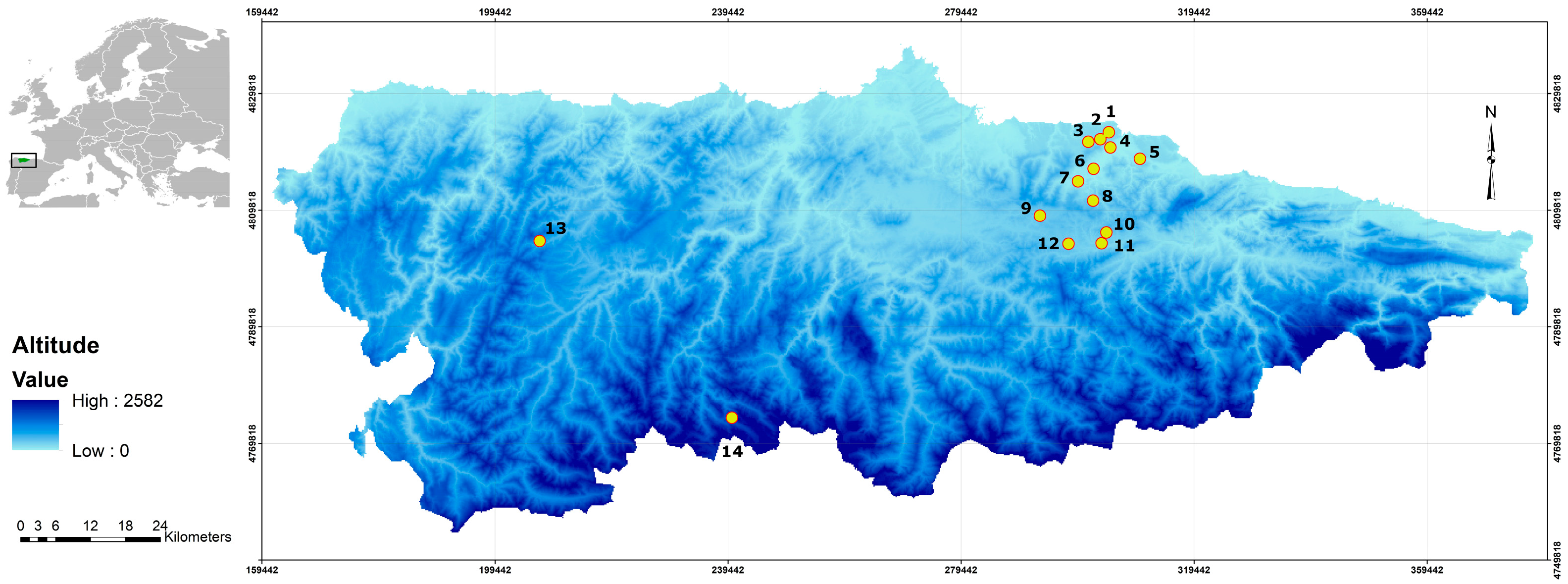
2.1. Study Area
2.2. Zoological and Helminthological Procedures
2.3. Helminth Community Analysis
2.4. Association Between Body Condition and Parasite Burden
3. Results
3.1. Helminth Community Composition and Structure
3.1.1. Hydatigera taeniaeformis s.l. (Batsch, 1786) Larvae (Figure 3)

3.1.2. Aonchotheca wioletti (Rukhlyadeva, 1950)
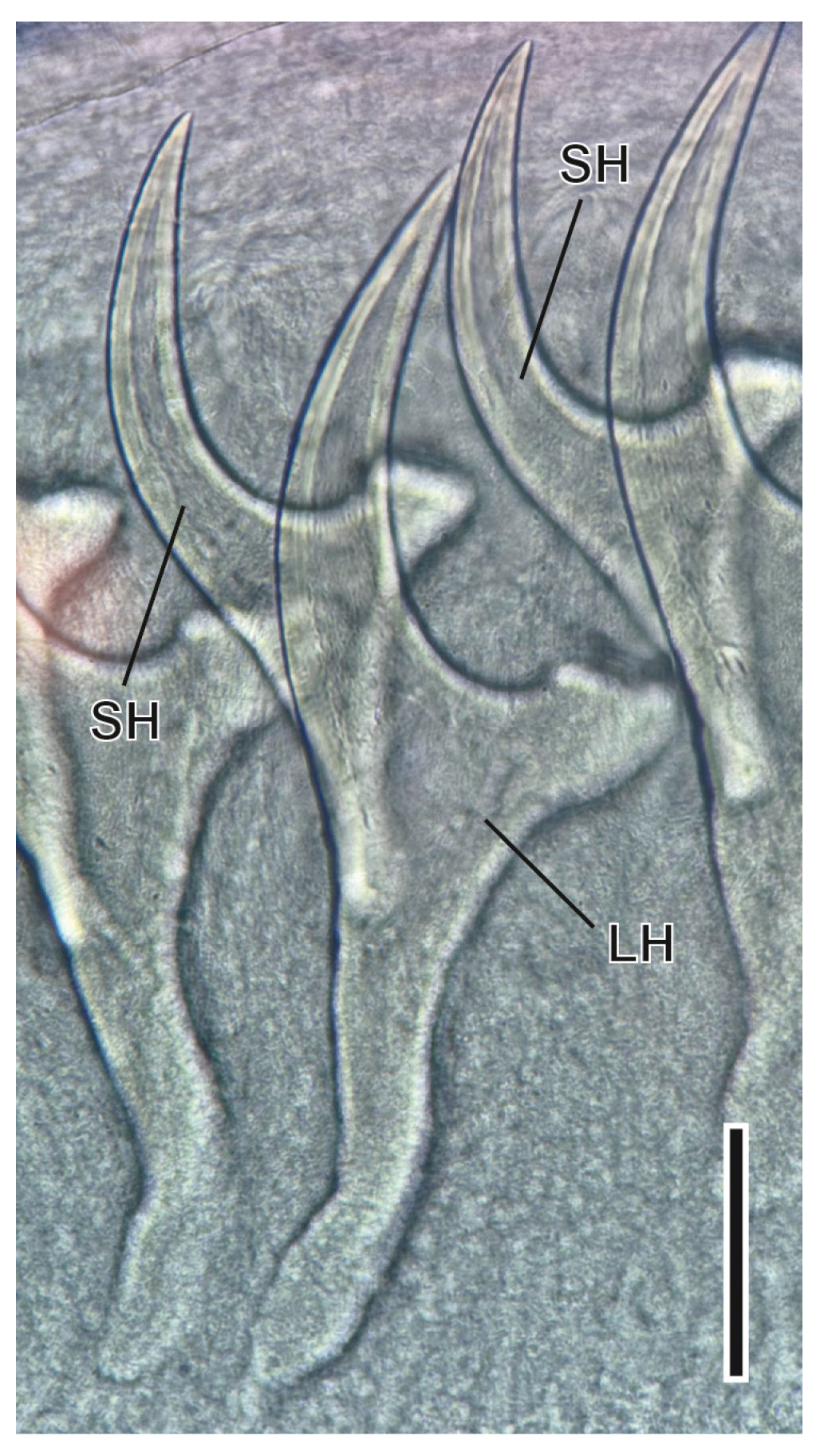
3.1.3. Eucoleus bacillatus (Eberth, 1863) (Figure 4)
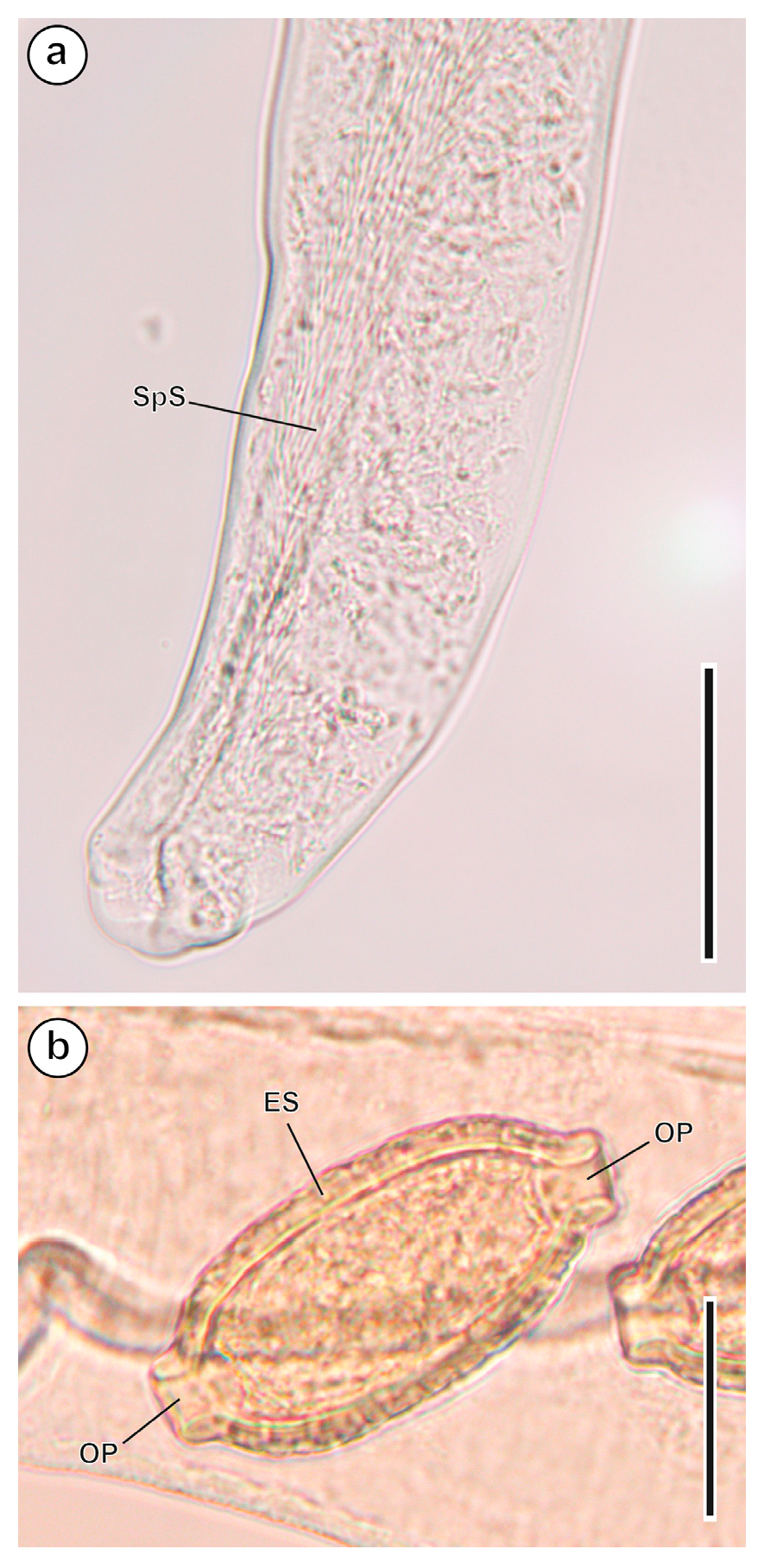
3.1.4. Trichuris arvicolae Feliu et al., 2000 (Figure 5)
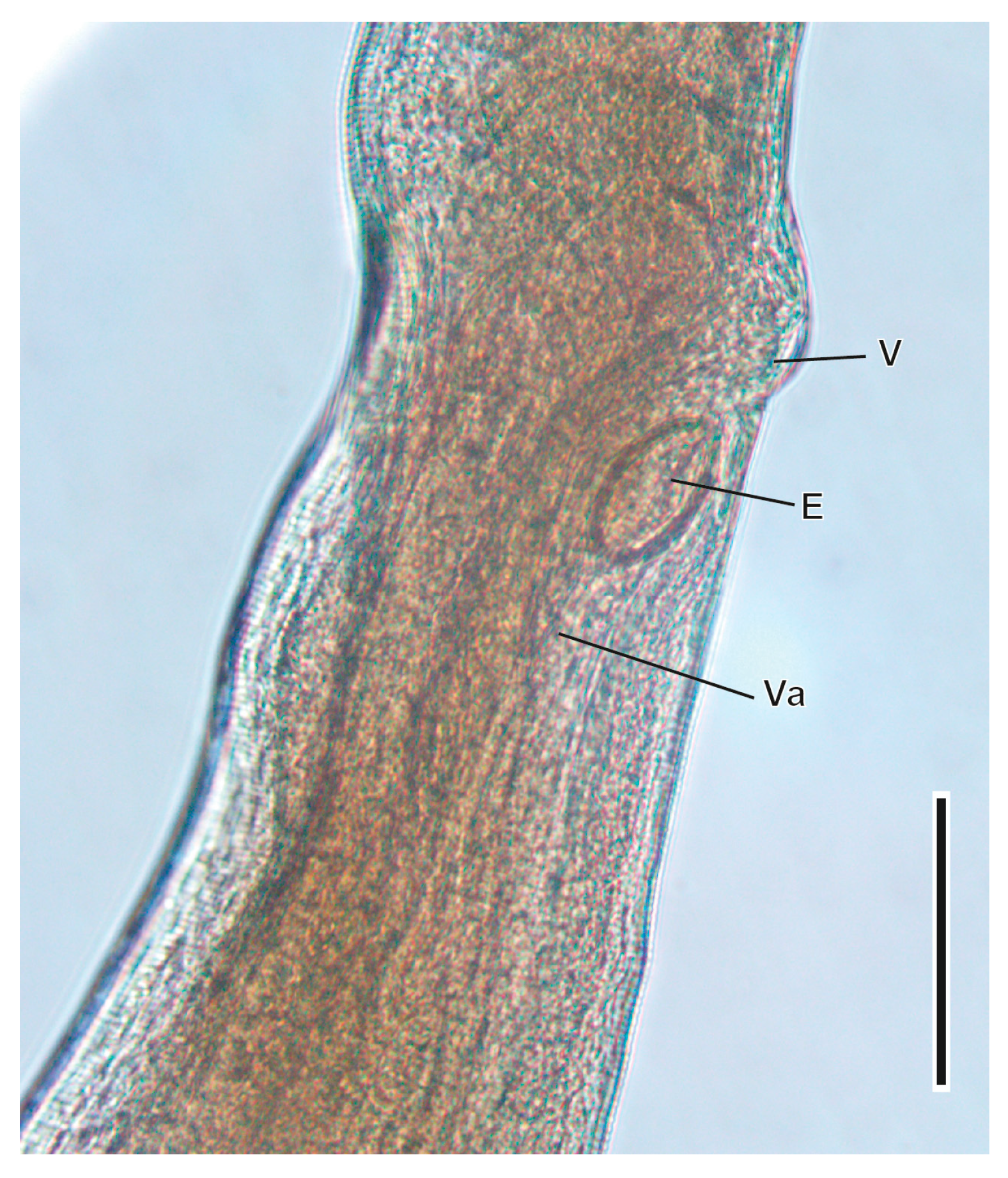
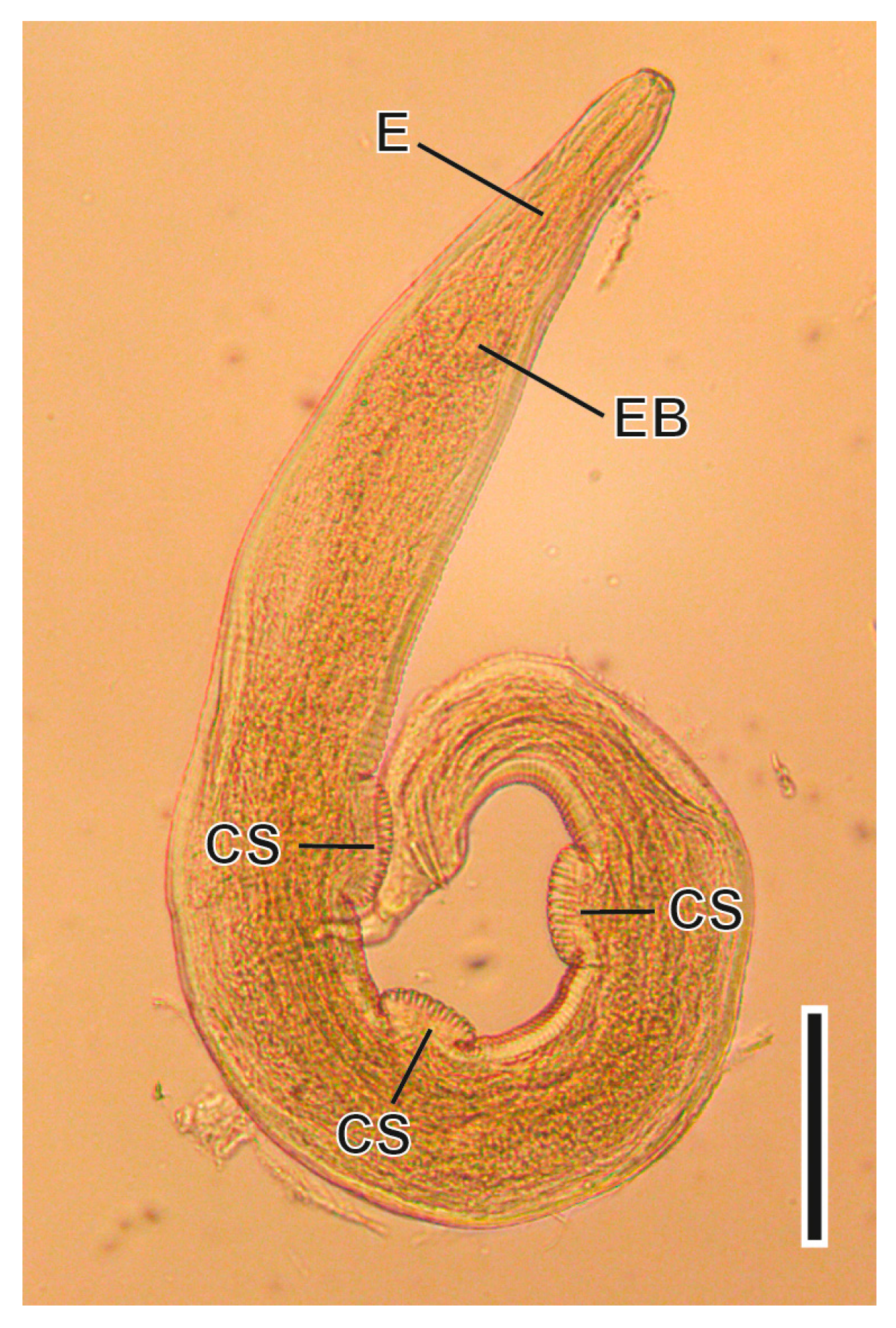
3.1.5. Carolinensis minutus (Dujardin, 1845) (Figure 6)
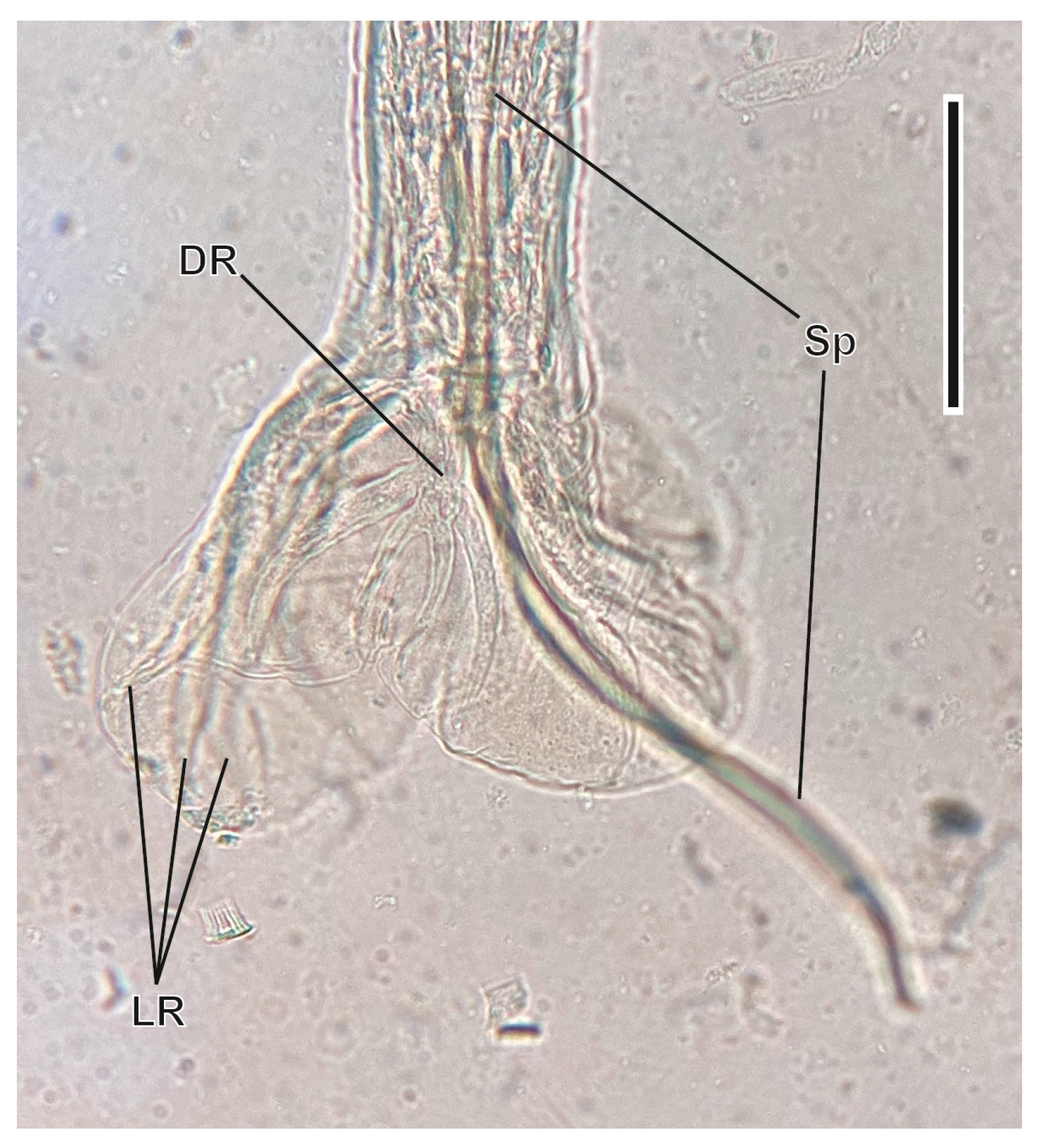
3.1.6. Syphacia nigeriana Baylis, 1928 (Figure 7)
3.2. Helminth Community Analysis
3.2.1. Helminth Community Components
3.2.2. Helminth Community Diversity
3.2.3. Helminth Infracommunity Diversity
3.2.4. Effects of Host Age and Sex, and Season and Year of Capture on Helminth Infection Parameters
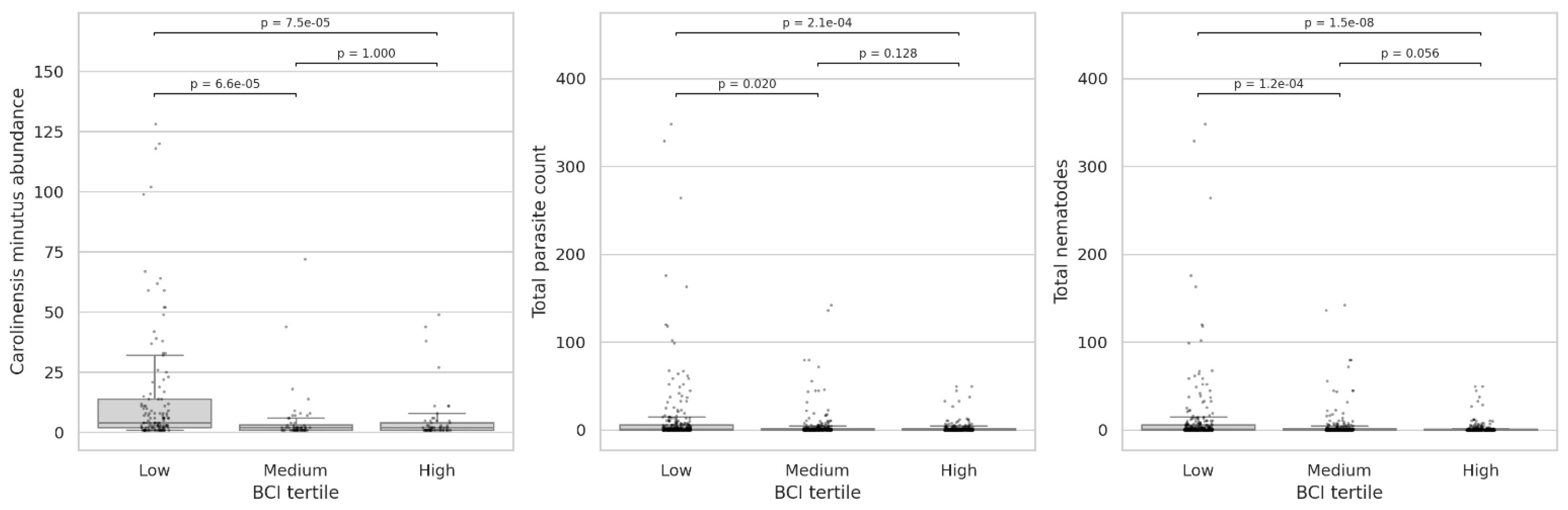
3.3. Association Between Body Condition and Parasite Burden
4. Discussion
4.1. Helminth Community Analysis
4.1.1. Helminth Community Components
4.1.2. Effects of Host Age and Sex, and Season and Year of Capture on Helminth Infection Parameters
4.2. Association Between Body Condition and Parasite Burden
4.3. The Use of the Helminths of Arvicola scherman in Pest Control
5. Conclusions
Author Contributions
Funding
Institutional Review Board Statement
Informed Consent Statement
Data Availability Statement
Conflicts of Interest
References
- Robovský, J.; Řičánková, V.; Zrzavý, J. Phylogeny of Arvicolinae (Mammalia, Cricetidae): Utility of morphological and molecular data sets in a recently radiating clade. Zool. Scr. 2008, 37, 571–590. [Google Scholar] [CrossRef] [Scilit]
- Musser, G.G.; Carleton, M.C. Rodentia: Myomporpha: Muroidea: Cricetidae: Arvicolinae. In Mammal Species of the World. A Taxonomic and Geographic Reference, 3rd ed.; Wilson, D.E., Reeder, D.M., Eds.; Johns Hopkins University Press: Baltimore, MD, USA, 2005; pp. 956–1039. [Google Scholar]
- Kryštufek, B.; Koren, T.; Engelberger, S.; Horváth, G.F.; Purger, J.J.; Arslan, A.; Chişamera, G.; Murariu, D. Fossorial morphotype does not make a species in water voles. Mammalia 2015, 79, 293–303. [Google Scholar] [CrossRef] [Scilit]
- Chevret, P.; Renaud, S.; Helvaci, Z.; Ulrich, R.G.; Quéré, J.P.; Michaux, J.R. Genetic structure, ecological versatility, and skull shape differentiation in Arvicola water voles (Rodentia, Cricetidae). J. Zoolog. Syst. Evol. Res. 2020, 58, 1323–1334. [Google Scholar] [CrossRef] [Scilit]
- Mahmoudi, A.; Maul, L.C.; Khoshyar, M.; Darvish, J.; Aliabadian, M.; Kryštufek, B. Evolutionary history of water voles revisited: Confronting a new phylogenetic model from molecular data with the fossil record. Mammalia 2020, 84, 171–184. [Google Scholar] [CrossRef] [Scilit]
- Balmori-de la Puente, A.; Ventura, J.; Miñarro, M.; Somoano, A.; Hey, J.; Castresana, J. Divergence time estimation using ddRAD data and an isolation-with-migration model applied to water vole populations of Arvicola. Sci. Rep. 2022, 12, 4065. [Google Scholar] [CrossRef] [Scilit]
- Balmori-de la Puente, A.; Fernández-González, Á.; Castresana, J. Assessment of predation on small semi-aquatic mammals by the Eurasian otter through genetic analysis of spraints. Mamm. Biol. 2025, 105, 167–175. [Google Scholar] [CrossRef] [Scilit]
- Ventura, J.; Gosálbez, J. Taxonomic review of Arvicola terrestris (Linnaeus, 1758) (Rodentia, Arvicolidae) in the Iberian Peninsula. Bonn. Zool. Beitr. 1989, 40, 227–242. [Google Scholar]
- Kopp, R. Étude de L‘Impact de la Forme Fouisseuse du Campagnol Terrestre, Arvicola terrestris scherman (Shaw), sur la Végétation D‘Une Prairie. Ph.D. Thesis, Université de Lausanne, Lausanne, Switzerland, 1993. [Google Scholar]
- Somoano, A.; Miñarro, M.; Ventura, J. Reproductive potential of a vole pest (Arvicola scherman) in Spanish apple orchards. Span. J. Agric. Res. 2016, 14, e1008. [Google Scholar] [CrossRef] [Scilit]
- Giraudoux, P.; Delattre, P.; Habert, M.; Quere, J.P.; Deblay, S.; Defaut, R.; Duhamel, R.; Moissenet, M.F.; Salvi, D.; Truchetet, D. Population dynamics of fossorial water vole (Arvicola terrestris scherman): A land use and landscape perspective. Agric. Ecosyst. Environ. 1997, 66, 47–60. [Google Scholar] [CrossRef] [Scilit]
- Giraudoux, P.; Levret, A.; Afonso, E.; Coeurdassier, M.; Couval, G. Numerical response of predators to large variations of grassland vole abundance and long-term community changes. Ecol. Evol. 2020, 10, 14221–14246. [Google Scholar] [CrossRef] [Scilit] [PubMed]
- Somoano, A.; Varona, L.; Rubio, A.; Tarragona, C.; del Cerro, A. Large-scale remote sensing model enables an integrated monitoring approach for high-resolution tracking pest vole populations. Sci. Rep. 2025, 15, 41201. [Google Scholar] [CrossRef] [Scilit]
- BOE. Royal decree 409/2008, of 28 March, that established national program for controlling pests of field voles. Boletín Of. Estado 2008, 86, 19217–19219. (In Spanish) [Google Scholar]
- Somoano, A. Update on the distribution of the fossorial water vole, Arvicola scherman, in Asturias and León, NW Spain. Galemys 2004, 36, 76–80. [Google Scholar] [CrossRef] [Scilit]
- Tompkins, D.M.; Dunn, A.M.; Smith, M.J.; Telfer, S. Wildlife diseases: From individuals to ecosystems. J. Anim. Ecol. 2011, 80, 19–38. [Google Scholar] [CrossRef] [Scilit]
- Anderson, R.M.; May, R.M. Regulation and stability of host-parasite population interactions. I. Regulatory processes. J. Anim. Ecol. 1978, 47, 219–247. [Google Scholar] [CrossRef] [Scilit]
- Hudson, P.J.; Rizzoli, A.; Grenfell, B.T.; Heesterbeek, H.; Dobson, A.P. The Ecology of Wildlife Diseases; Oxford University Press: Oxford, UK, 2002. [Google Scholar]
- Haukisalmi, V.; Henttonen, H. Coexistence of helminths in the bank vole Clethrionomys glareolus. I. Patterns of co-occurrence. J. Anim. Ecol. 1993, 62, 221–229. [Google Scholar] [CrossRef] [Scilit]
- Bordes, F.; Morand, S.; Pilosof, S.; Claude, J.; Krasnov, B.R.; Cosson, J.F.; Chaval, Y.; Ribas, A.; Chaisiri, K.; Blasdell, K.; et al. Habitat fragmentation alters the properties of a host-parasite network: Rodents and their helminths in South-East Asia. J. Anim. Ecol. 2015, 84, 1253–1263. [Google Scholar] [CrossRef] [Scilit]
- Blasco, S. Sobre las Helmintofaunas de Erinaceus europaeus Linnaeus, 1758 (Insectivoraerinaceidae) Arvicola terrestris (Linnaeus, 1758) (Rodentia:Arvicolidae). Ph.D. Thesis, Universitat de Barcelona, Barcelona, Spain, 1997. [Google Scholar]
- Feliu, C.; Renaud, F.; Catzeflis, F.; Hugot, J.P.; Durand, P.; Morand, S. A comparative analysis of parasite species richness of Iberian rodents. Parasitology 1997, 115, 453–466. [Google Scholar] [CrossRef] [Scilit] [PubMed]
- McSorley, H.J.; Maizels, R.M. Helminth infections and host immune regulation. Clin. Microbiol. Rev. 2012, 25, 585–608. [Google Scholar] [CrossRef] [Scilit]
- Gazzinelli-Guimaraes, P.H.; Nutman, T.B. Helminth parasites and immune regulation. F1000Research 2018, 7, 1685. [Google Scholar] [CrossRef] [Scilit]
- Brealey, J.C.; Ytrehus, B.; Solberg, E.J.; Davidson, R.K.; Rolandsen, C.M. Higher parasite burdens are associated with lower body condition in a Norwegian moose population. Eur. J. Wildl. Res. 2025, 71, 144. [Google Scholar] [CrossRef] [Scilit]
- Adalid, R.; Feliu, C.; Somoano, A.; Miñarro, M.; Ventura, J.; Torres, J.; Miquel, J.; Fuentes, M.V. Ecological analysis of the helminth community of Microtus lusitanicus (Gerbe, 1879) in Asturias, NW Spain. Animals 2021, 11, 3055. [Google Scholar] [CrossRef] [Scilit]
- Froeschke, G.; Matthee, S. Landscape characteristics influence helminth infestations in a peri-domestic rodent-implications for possible zoonotic disease. Parasit. Vectors 2014, 7, 393. [Google Scholar] [CrossRef] [Scilit]
- Alvárez-Santacoloma, A.; Ferreiro-Lera, G.B.; González-Pérez, A.; Penas Merino, Á.; del Río González, S. Caracterización bioclimàtica del principado de Asturias. In Retos del Cambio Climático: Impactos, Mitigación y Adaptación; Martí Ezpeleta, A., Lorenzo González, N., Royé, D., Díaz Paso, A., Eds.; Asociación Española de Climatología, Agencia Española de Metereología: Madrid, Spain, 2022; pp. 551–561. [Google Scholar]
- Somoano, A.; Bastos-Silveira, C.; Ventura, J.; Miñarro, M.; Heckel, G. A bocage landscape restricts the gene flow of pest vole populations. Life 2022, 27, 800. [Google Scholar] [CrossRef] [Scilit]
- Díaz-González, T.E.; Fernández-Prieto, J.A. Prados y pastos cantábricos: Origen y diversidad. In Producciones Agroganaderas: Gestión Eficiente y Conservación del Medio Natural; XLV Reunión Científica de la SEEP; De la Roza, B., Martínez, A., Carballal, A., Eds.; SERIDA: Gijón, Spain, 2005; Volume 2, pp. 699–730. [Google Scholar]
- Miñarro, M.; Montiel, C.; Dapena, E. Vole pests in apple orchards: Use of presences signs to estimate the abundance of Arvicola terrestris cantabriae and Microtus lusitanicus. J. Pest Sci. 2012, 85, 477–488. [Google Scholar] [CrossRef] [Scilit]
- Somoano, A.; Ventura, J.; Miñarro, M. Continuous breeding of fossorial water voles in northwestern Spain: Potential impact on apple orchards. Folia Zool. 2017, 66, 37–49. [Google Scholar] [CrossRef] [Scilit]
- EU Directive. 2010/63/EU horizontal legislation on the protection of animal used for scientific Purposes. OJEU 2010, 276, 33–79. [Google Scholar]
- Ventura, J. Crecimiento relativo de Arvicola terrestris monticola (Rodentia, Arvicolidae). Misc. Zool. 1993, 17, 237–248. [Google Scholar]
- Bush, A.O.; Lafferty, K.D.; Lotz, J.M.; Shostak, A.W. Parasitology meets ecology on its own terms: Margolis et al. revisited. J. Parasitol. 1997, 83, 575–583. [Google Scholar] [CrossRef] [Scilit]
- Bush, A.O. An Ecological Analysis of the Helminth Parasites of the White Ibis in Florida. Master’s Thesis, University of Florida, Gainesville, FL, USA, 1973. [Google Scholar]
- Pence, D.B.; Eason, S. Comparison of the helminth faunas of two sympatric top carnivores from the Rolling Plains of Texas. J. Parasitol. 1980, 66, 115–120. [Google Scholar] [CrossRef] [Scilit]
- Lefkovitch, L.P. An index of spatial distribution. Res. Popul. Ecol. 1966, 8, 89–92. [Google Scholar] [CrossRef] [Scilit]
- Pielou, E.C. Ecological Diversity; John Wiley & Sons: New York, NY, USA, 1975. [Google Scholar]
- Magurran, A.E. Ecological Diversity and Its Measurement; Croom Helm: London, UK, 1998. [Google Scholar]
- Simpson, E.H. Measurement of diversity. Nature 1949, 163, 688. [Google Scholar] [CrossRef] [Scilit]
- Berger, W.H.; Parker, F.L. Diverstity of planktonic Foraminifera in deep sea sediments. Science 1970, 168, 1345–1347. [Google Scholar] [CrossRef] [Scilit]
- May, R.M. Patterns of species abundance and diversity. In Ecology and Evolution Communities; Cody, M.L., Diamond, J.M., Eds.; Harvard University Press: Cambridge, MA, USA, 1975; pp. 81–120. [Google Scholar]
- Pielou, E.C. An Introduction to Mathematical Ecology; John Wiley & Sons: New York, NY, USA, 1969. [Google Scholar]
- Peig, J.; Green, A.J. New perspectives for estimating body condition from mass/length data: The scaled mass index as an alternative method. Oikos 2009, 118, 1883–1891. [Google Scholar] [CrossRef] [Scilit]
- Tête, N.; Fritsch, C.; Afonso, E.; Coeurdassier, M.; Lambert, J.-C.; Giraudoux, P.; Scheifler, R. Can body condition and somatic indices assess metal-induced stress in small mammals? PLoS ONE 2013, 8, e66399. [Google Scholar] [CrossRef] [Scilit]
- Murai, É. Taeniid species in Hungary (Cestoda: Taeniidae). II. Larval stages of taeniids parasitizing rodents and lagomorphs. Misc. Zool. Hung. 1982, 1, 27–44. [Google Scholar]
- Rukhlyadeva, M.N. A new Capillaria from the stomach of a water rat. Tr. Gel’Mintol. Lab. Akad. Nauk. SSSR 1950, 4, 136–138. [Google Scholar]
- Feliu, C. Contribución al Conocimiento de la Helmintofauna de Micromamíferos Ibéricos: Helmintos de Gliridae y Muridae: Rodentia. Ph.D. Thesis, Universitat de Barcelona, Barcelona, Spain, 1980. [Google Scholar]
- Feliu, C.; Spakulová, M.; Casanova, J.C.; Renaud, F.; Morand, S.; Hugot, J.P.; Santalla, F.; Durand, P. Genetic and morphological heterogeneity in small rodent whipworms in southwestern Europe: Characterization of Trichuris muris and description of Trichuris arvicolae n. sp. (Nematoda: Trichuridae). J. Parasitol. 2000, 86, 442–449. [Google Scholar] [CrossRef] [Scilit]
- Mészáros, F. Parasitic Nematodes of Microtus arvalis (Rodentia) in Hungary. Parasitol. Hung. 1977, 10, 67–83. [Google Scholar]
- Feliu, C.; Torres, J.; Casanova, J.C.; Miquel, J. Consideraciones sobre el binomio helmintofauna-modo de vida de los roedores ibéricos. In In Memoriam al Profesor Doctor D.F. de Martínez Gómez; Hernández Rodríguez, S., Ed.; Universidad de Córdoba: Córdoba, Spain, 1992; pp. 351–366. [Google Scholar]
- Palomo, L.J.; Gisbert, J.; Blanco, J.C. Atlas y Libro Rojo de los Mamíferos Terrestres de España; Dirección General para la Biodiversidad-SECEM-SECEMU: Madrid, Spain, 2007. [Google Scholar]
- King, K.C.; Mclaughlin, J.D.; Boily, M.; Marcogliese, D.J. Effects of agricultural landscape and pesticides on parasitism in native bullfrogs. Bioll. Conserv. 2010, 143, 302–310. [Google Scholar] [CrossRef] [Scilit]
- Dobson, A.P. The population biology of parasite induced changes in host behaviour. Q. Rev. Biol. 1988, 63, 139–165. [Google Scholar] [CrossRef] [Scilit] [PubMed]
- Dobson, A.P.; Hudson, P.J. Regulation and stability of a free-living host-parasite system: Trychostrongylus tenuis in red grouse. II. Population models. J. Anim. Ecol. 1992, 61, 487–498. [Google Scholar] [CrossRef] [Scilit]
- Shaw, D.J.; Dobson, A.P. Patterns of microparasite abundance and aggregation in wildlife populations: A quantitative review. Parasitology 1995, 111, S111–S133. [Google Scholar] [CrossRef] [Scilit] [PubMed]
- Wilson, K.; Bjørnstad, O.N.; Dobson, A.P.; Merler, S.; Poglayen, G.; Randolph, S.E.; Read, A.F.; Skorping, A. Heterogeneities in macroparasite infections: Patterns and processes. In The Ecology of Wildlife Diseases; Hudson, P.J., Rizzoli, A., Grenfell, B.T., Heesterbeek, H., Dobson, A.P., Eds.; Oxford University Press: Oxford, UK, 2001; pp. 6–44. [Google Scholar]
- Morand, S.; Krasnov, B. Why apply ecological laws to epidemiology? Trends Parasitol. 2008, 24, 304–309. [Google Scholar] [CrossRef] [Scilit]
- Burlet, P.; Deplazes, P.; Hegglin, D. Age, season and spatio-temporal factors affecting the prevalence of Echinococcus multilocularis and Taenia taeniaeformis in Arvicola terrestris. Parasit. Vectors 2011, 4, 6. [Google Scholar] [CrossRef] [Scilit] [PubMed]
- Fuehrer, H.P.; Siehs, C.; Schneider, R.; Auer, H. Morphometrical analysis of Taenia taeniaeformis and Taenia crassiceps in the common vole (Microtus arvalis) and the water vole (Arvicola terrestris) in Vorarlberg, Austria. Helminthologia 2012, 49, 169–173. [Google Scholar] [CrossRef] [Scilit]
- Elton, C.; Ford, E.B.; Baker, J.R.; Gardiner, A.D. The health and parasites of a wild mouse population. Proc. Zool. Soc. Lond. 1931, 101, 657–721. [Google Scholar] [CrossRef] [Scilit]
- Kisielewska, K. Intestinal helminths as indicatory of the age structure of Microtus arvalis Pallas, 1778 population. Bull. Acad. Polon. Sci. Ser. Sci. Biol. 1971, 19, 275–282. [Google Scholar]
- Montgomery, S.S.J.; Montgomery, W.I. Spatial and temporal variation in the infracommunity structure of helminths of Apodemus sylvaticus (Rodentia: Muridae). Parasitology 1989, 98, 145–150. [Google Scholar] [CrossRef] [Scilit]
- Gregory, R.D. On the interpretation of host-parasite ecology: Heligmosomum polygyrus (Nematoda) in the wood mouse (Apodemus sylvaticus) populations. J. Zool. 1992, 226, 109–121. [Google Scholar] [CrossRef] [Scilit]
- Gregory, R.D.; Montgomery, S.S.J.; Montgomery, W.I. Population biolgy of Heligmosomum polygyrus (Nematoda) in the wood mouse. J. Anim. Ecol. 1992, 61, 749–757. [Google Scholar] [CrossRef] [Scilit]
- Behnke, J.M.; Lewis, J.W.; Mohd Zain, S.N.; Gibert, F.S. Helminth infections in Apodemus sylvaticus in Southern England: Interactive effects of host age, sex and year on the prevalence and abundance of infections. J. Helminthol. 1999, 22, 861–907. [Google Scholar] [CrossRef] [Scilit]
- Behnke, J.M.; Rogan, M.T.; Craig, P.S.; Jackson, J.A.; Hide, G. Long-term trends in helminth infections of wood mice (Apodemus sylvaticus) from the vicinity of Malhalm Tarn in North Yorkshire, England. Parasitology 2021, 148, 451–463. [Google Scholar] [CrossRef] [Scilit]
- Fuentes, M.V.; Sáez, S.; Trelis, M.; Galán-Puchades, M.T.; Esteban, J.G. The helminth community of the wood mouse, Apodemus sylvaticus, in the Sierra Espuña, Murcia, Spain. J. Helminthol. 2004, 78, 219–223. [Google Scholar] [CrossRef] [Scilit]
- Fuentes, M.V.; Sainz-Elipe, S.; Galán-Puchades, M.T. Ecological study of the wood mouse helminth community in a burned Mediterranean ecosystem in regeneration five years after a wildfire. Acta Parasitol. 2007, 52, 403–413. [Google Scholar] [CrossRef] [Scilit]
- Fuentes, M.V.; Sainz-Elipe, S.; Sáez-Durán, S.; Galán-Puchades, M.T. The helminth community of the wood mouse Apodemus sylvaticus in a Mediterranean ecosystem in regeneration ten years after a wildfire. J. Helminthol. 2010, 84, 39–48. [Google Scholar] [CrossRef] [Scilit]
- Eira, C.; Torres, J.; Vingada, J.; Miquel, J. Ecological aspects influencing the helminth community of the wood mouse Apodemus sylvaticus in Dunas de Mira, Portugal. Acta Parasitol. 2006, 51, 300–308. [Google Scholar] [CrossRef] [Scilit]
- Feliu, C.; Ventura, J.; Segovia, J.M.; Jiménez, L.; Ribas, A.; Gisbert, J. Helminths of Microtus lusitanicus (Gerbe, 1879) (Rodentia: Cricetidae) in the Iberian Peninsula: Faunistic and ecological considerations. Rev. Ibero-Latinoam. Parasitol. 2009, 68, 159–166. [Google Scholar]
- Jackson, J.A.; Friberg, I.M.; Bolch, I.; Lowe, A.; Ralli, C.; Harris, P.D.; Behnke, J.M.; Bradley, J.E. Immunomodultory parasites and toll-like receptormediated tumour necrosis factor alpha responsiveness in wild mammals. BMC Biol. 2009, 7, 16. [Google Scholar] [CrossRef] [Scilit]
- Jackson, J.A.; Hall, A.J.; Friberg, I.M.; Ralli, C.; Lowe, A.; Zawadzka, M.; Turner, A.K.; Stewart, A.; Birtles, R.J.; Paterson, S.; et al. An immunological marker of tolerance to infection in wild rodents. PLoS Biol. 2014, 12, e1001901. [Google Scholar] [CrossRef] [Scilit]
- Friberg, I.M.; Little, S.; Ralli, C.; Lowe, A.; Hall, A.; Jackson, J.A.; Bradley, P.J. Macroparasites at peripheral sites of infection are major and dynamic modifiers of systematic antimicrobial patterns recognition responses. Mol. Ecol. 2013, 22, 2810–2826. [Google Scholar] [CrossRef] [Scilit]
- Sáez-Durán, S.; Debenedetti, A.L.; Sainz-Elipe, S.; Galán-Puchades, M.T.; Fuentes, M.V. The helminth community component species of the wood mouse as biological indicator tags of a ten post-fire-year regeneration process in a Mediterranean ecosystem. Parasitol. Res. 2018, 117, 2217–2231. [Google Scholar] [CrossRef] [Scilit]
- Theis, J.H.; Schwab, R.G. Seasonal prevalence of Taenia taeniaeformis: Relationship to age, sex, reproduction and abundance of an intermediate host (Peromyscus maniculatus). J. Wildlife Dis. 1992, 28, 42–50. [Google Scholar] [CrossRef] [Scilit]
- Hudson, P.J.; Cattadori, I.M.; Boag, B.; Dobson, A.B. Climate disruption and parasite-host dynamics: Patterns and processes associated with warming and the frequency of extreme climatic events. J. Helminthol. 2006, 80, 175–182. [Google Scholar] [CrossRef] [Scilit]
- Deter, J.; Chaval, Y.; Galán, M.; Berthier, K.; Salvador, A.R.; Casanova Garcia, J.C.; Morand, S.; Cosson, J.F.; Charbonnel, N. Linking demography and host dispersal to Trichuris arvicolae distribution in a cyclic vole species. Int. J. Parasitol. 2007, 37, 813–824. [Google Scholar] [CrossRef] [Scilit]
- Mair, I.; Else, K.J.; Forman, R. Trichuris muris as a tool for holistic discovery research: From translational research to environmental bio-tagging. Parasitology 2021, 148, 1722–1734. [Google Scholar] [CrossRef] [Scilit]
- Gubányi, A.; Mészáros, F.; Murai, É.; Soltész, A. Studies on helminth parasites of the small field mouse (Apodemus microps) and the common vole (Microtus arvalis) from a pine forest in Hungary. Parasitol. Hung. 1992, 25, 37–51. [Google Scholar]
- Bajer, A.; Behnke, J.M.; Pawelczyk, A.; Kuliś, K.; Sereda, M.J.; Siński, E. Medium-term temporal stability of the helminth component community in bank voles (Clethrionomys glareolus) from the Mazury Lake District region of Poland. Parasitology 2005, 130, 213–228. [Google Scholar] [CrossRef] [Scilit]
- Cerqueira, D.; Delattre, P.; de Sousa, B.; Gabrion, C.; Morand, S.; Quéré, J.P. Numerical response of a helminth community in the course of a multi-annual abundance cycle of the water vole (Arvicola terrestris). Parasitology 2007, 134, 705–711. [Google Scholar] [CrossRef] [Scilit]
- Milazzo, C.; Di Bella, C.; Casanova, J.C.; Ribas, A.; Cagnin, M. Helminth communities of wood mouse (Apodemus sylvaticus) on the river Avena (Calabria, southern Italy). Hystrix 2010, 21, 171–176. [Google Scholar] [CrossRef] [Scilit]
- Grzybek, M.; Bajer, A.; Bednarska, M.; Al-Sarraf, M.; Behnke-Borowczyk, J.; Harris, P.D.; Price, S.J.; Brown, G.S.; Osborne, S.J.; Siński, E.; et al. Long-term spatiotemporal stability and Dynamic changes in helminth infracommunities of bank voles (Myodes glareolus) in NE Poland. Parasitology 2015, 142, 1722–1743. [Google Scholar] [CrossRef] [Scilit]
- Klein, S.L. Hormonal and immunological mechanisms mediating sex differences in parasite infection. Parasite Immunol. 2004, 26, 247–264. [Google Scholar] [CrossRef] [Scilit]
- Krasnov, B.R.; Morand, S.; Hawlena, H.; Khokhlova, I.S.; Shenbrot, G.I. Sexbiased parasitism, seasonality and sexual size dimorphism in desert rodents. Oecologia 2005, 146, 209–217. [Google Scholar] [CrossRef] [Scilit]
- Krasnov, B.R.; Bordes, F.; Khokhlova, I.S.; Morand, S. Gender-biasedparasitism in small mammals: Patterns, mechanisms, consequences. Mammalia 2012, 76, 1–13. [Google Scholar] [CrossRef] [Scilit]
- Bordes, F.; Ponlet, N.; Göuy de Bellocq, J.; Ribas, A.; Krasnov, B.R.; Morand, S. Is there sex-biased resistance and tolerance in Mediterranean wood mouse (Apodemus sylvaticus) populations facing multiple helminth infections? Oecologia 2012, 170, 123–135. [Google Scholar] [CrossRef] [Scilit]
- Abu-Madi, M.A.; Behnke, J.M.; Lewis, J.W.; Gilbert, F.S. Seasonal and site variation community structure of intestinal helminths in Apodemus sylvaticus from three contrasting habitats in south-east England. J. Helminthol. 2000, 74, 7–15. [Google Scholar] [CrossRef] [Scilit]
- Meylan, A.; Airoldi, J.P. Reproduction hivernale chez Arvicola terrestris scherman Shaw (Mammalia, Rodentia). Rev. Suisse Zool. 1975, 82, 689–694. [Google Scholar]
- Arneberg, P.; Shorping, A.; Grenfell, B.; Read, A.F. Host-densities as determinants of abundance in parasite communities. Proc. R. Soc. Lond. B 1998, 265, 1283–1289. [Google Scholar] [CrossRef] [Scilit]
- Behnke, J.M.; Bajer, A.; Harris, P.D.; Newington, L.; Pidgeon, E.; Rowlands, G.; Sheriff, C.; Kuliś-Malkowska, K.; Siński, E.; Gilbert, F.S.; et al. Temporal and between-side variation in helminth communities of bank voles (Myodes glareolus) from N.E. Poland. 1. Regional fauna and component community levels. Parasitology 2008, 135, 985–997. [Google Scholar] [CrossRef] [Scilit]
- Behnke, J.M.; Stewart, A.; Smales, L.; Cooper, G.; Lowe, A.; Kinsella, J.M.; Bajer, A.; Dwużnik-Szarek, D.; Herman, J.; Fenn, J.; et al. Parasitic nematodes of the genus Syphacia Seurat, 1916 infecting Cricetidae in the British Isles: The enigmatic status of Syphacia nigeriana. Parasitology 2022, 149, 76–94. [Google Scholar] [CrossRef] [Scilit]
- Gulland, F.M.D. The impact of infectious diseases on wild animal populations: A review. In Ecology of Infectious Diseases in Natural Populations; Grenfell, B.T., Dobson, A.P., Eds.; Cambridge University Press: Cambridge, UK, 1995; pp. 20–51. [Google Scholar]
- Albon, S.D.; Stein, A.; Irvine, R.J.; Langvatn, R.; Ropstad, E.; Halvorsen, O. The role of parasites in the dynamics of a reindeer population. Proc. R. Soc. Lond. B 2002, 269, 1625–1632. [Google Scholar] [CrossRef] [Scilit]
- Stien, A.; Irvine, R.J.; Langvatn, R.; Ropstad, E.; Halvorsen, O.; Albon, S.D. The impact of gastrointestinal nematodes on wild reindeer: Experimental and cross-sectional studies. J. Anim. Ecol. 2002, 71, 937–945. [Google Scholar] [CrossRef] [Scilit]
- Newey, S.; Thirgood, S.J. Parasite-mediated reduction in fecundity of mountain hares. Proc. R. Soc. Lond. B 2004, 271, S413–S415. [Google Scholar] [CrossRef] [Scilit]
- Grenfell, B.; Wilson, K.; Finkenstädt, B.F.; Coulson, T.N.; Murray, S.; Albon, S.D.; Pemberton, J.M.; Clutton-Brock, T.H.; Crawley, M.J. Noise and determinism in synchronised sheep dynamics. Nature 1998, 394, 674–677. [Google Scholar] [CrossRef] [Scilit]
- Redpath, S.M.; Mougeot, F.; Leckie, F.L.; Elston, D.A.; Hudson, P.J. Testing the role of parasites in driving the cyclic population dynamics of a gamebird. Ecol. Lett. 2006, 9, 410–418. [Google Scholar] [CrossRef] [Scilit]
- Lin, Y.C.; Rikihisa, Y.; Kono, H.; Gu, Y. Effects of larval tapeworm (Taenia taeniaeformis) infection on reproductive functions in male and female host rats. Exp. Parasitol. 1990, 70, 344–352. [Google Scholar] [CrossRef] [Scilit]
- Dvoráková, L.; Prokopic, J. Hydatigera taeniaeformis (Batsch, 1786) as the cause of mass deaths of muskrats. Folia Parasitol. 1984, 31, 127–131. [Google Scholar]
- Deter, J.; Berthier, K.; Chaval, Y.; Cosson, J.F.; Morand, S.; Charbonnel, N. Influence of geographical scale on the detection of density dependence in the host-parasite system, Arvicola terrestris and Taenia taeniaeformis. Parasitology 2006, 132, 595–605. [Google Scholar] [CrossRef] [Scilit] [PubMed]
- Deter, J.; Cosson, J.F.; Chaval, Y.; Charbonnel, N.; Morand, S. The intestinal nematode Trichuris arvicolae affects the fecundity of its host, the common vole Microtus arvalis. Parasitol. Res. 2007, 101, 1161–1164. [Google Scholar] [CrossRef] [Scilit]
- Deter, J.; Charbonnel, N.; Cosson, J.F.; Morand, S. Regulation of vole populations by the nematode Trichuris arvicolae: Insights from modelling. Eur. J. Wildl. Res. 2008, 54, 60–70. [Google Scholar] [CrossRef] [Scilit]


| Host Sex | Season | Host Age | |||
|---|---|---|---|---|---|
| Juveniles | Preadults | Adults | Total | ||
| Males | Winter | 8 | 20 | 58 | 86 |
| Spring | 16 | 23 | 77 | 116 | |
| Summer | 8 | 25 | 64 | 97 | |
| Autumn | 13 | 26 | 63 | 102 | |
| Total | 45 | 94 | 262 | 401 | |
| Females | Winter | 5 | 20 | 58 | 83 |
| Spring | 14 | 24 | 73 | 111 | |
| Summer | 17 | 16 | 67 | 100 | |
| Autumn | 12 | 31 | 77 | 120 | |
| Total | 48 | 91 | 275 | 414 | |
| Year | Season | ||||
|---|---|---|---|---|---|
| Winter | Spring | Summer | Autumn | Total | |
| 2011 | 67 | 124 | 109 | 127 | 427 |
| 2012 | 102 | 103 | 88 | 79 | 372 |
| 2013 | 16 | 0 | 0 | 0 | 16 |
| Total | 185 | 227 | 197 | 206 | 815 |
| n | Mean Temperature (°C) | Mean Rainfall (mm) | Cumulative Rainfall (mm) | |
|---|---|---|---|---|
| Winter 2011 | 25 | 10.1 | 3.0 | 269.0 |
| Spring 2011 | 92 | 15.0 | 4.0 | 338.4 |
| Summer 2011 | 110 | 19.9 | 0.7 | 65.9 |
| Autumn 2011 | 116 | 12.6 | 5.5 | 503.4 |
| Winter 2012 | 101 | 11.1 | 2.9 | 246.0 |
| Spring 2012 | 95 | 16.2 | 1.0 | 88.5 |
| Summer 2012 | 86 | 19.7 | 1.3 | 116.2 |
| Autumn 2012 | 72 | 14.6 | 2.2 | 199.0 |
| Winter 2013 | 13 | 10.2 | 1.4 | 125.1 |
| Helminth Species | Site | Life Cycle | n | Prevalence (95% CI) | Mean Abundance (SE) | Mean Intensity (Range) |
|---|---|---|---|---|---|---|
| CESTODA | ||||||
| H. taeniaeformis s.l. larvae | L | DH | 155 | 19 (16–22) | 0.25 (0.02) | 1 (1–13) |
| NEMATODA | ||||||
| A. wioletti | S | DH | 1 | 0.1 (0.0–0.5) | <0.00 (<0.00) | 2 (2) |
| E. bacillatus | S | M-P | 3 | 0.4 (0.0–0.5) | 0.01 (<0.00) | 1 (1–3) |
| T. arvicolae | C | M-P | 57 | 7 (5–9) | 0.12 (0.02) | 1 (1–8) |
| C. minutus | I | M-G | 246 | 30 (27–37) | 3.12 (0.42) | 3 (1–128) |
| S. nigeriana | C | M-A | 94 | 12 (10–14) | 3.11 (0.79) | 5 (1–348) |
| Species | ||||||
|---|---|---|---|---|---|---|
| H. taeniaeformis s.l. Larvae | T. arvicolae | C. minutus | S. nigeriana | |||
| Sex | Males | Prevalence (CI 95%) | 21 (17–25) | 6 (4–9) | 31 (27–36) | 11 (8–14) |
| Mean abundance (SE) | 0.27 (0.04) | 0.11 (0.03) | 2.97 (0.55) | 2.39 (0.63) | ||
| Mean intensity (range) | 1 (1–13) | 1 (1–8) | 3 (1–128) | 6 (1–264) | ||
| Females | Prevalence (CI 95%) | 17 (14–21) | 8 (6–11) | 29 (25–34) | 12 (9–15) | |
| Mean abundance (SE) | 0.22 (0.03) | 0.12 (0.03) | 3.27 (0.55) | 3.82 (0.83) | ||
| Mean intensity (range) | 1 (1–4) | 1 (1–6) | 3 (1–120) | 5 (1–348) | ||
| Age | Juveniles | Prevalence (CI 95%) | - | - | 54 (44–84) | 4 (1–10) |
| Mean abundance (SE) | - | - | 12.18 (2.86) | 1.49 (0.87) | ||
| Mean intensity (range) | - | - | 6 (1–128) | 36 (3–64) | ||
| Preadults | Prevalence (CI 95%) | 8 (5–13) | 6 (3–10) | 44 (37–51) | 10 (6–15) | |
| Mean abundance (SE) | 0.16 (0.08) | 0.10 (0.03) | 4.24 (0.81) | 6.74 (3.11) | ||
| Mean intensity (range) | 1 (1–13) | 1 (1–3) | 3 (1–67) | 2 (1–348) | ||
| Adults | Prevalence (CI 95%) | 26 (13–25) | 8 (6–11) | 21 (18–25) | 13 (10–16) | |
| Mean abundance (SE) | 0.32 (0.03) | 0.14 (0.03) | 1.16 (0.23) | 2.15 (0.51) | ||
| Mean intensity (range) | 1 (1–4) | 1 (1–8) | 2 (1–72) | 6 (1–142) | ||
| Season | Winter | Prevalence (CI 95%) | 18 (13–25) | 7 (4–12) | 25 (19–32) | 9 (5–14) |
| Mean abundance (SE) | 0.20 (0.04) | 0.13 (0.04) | 1.89 (0.56) | 3.19 (2.02) | ||
| Mean intensity (range) | 1 (1–4) | 1 (1–6) | 2 (1–64) | 7 (1–348) | ||
| Spring | Prevalence (CI 95%) | 21 (1–4) | 10 (6–15) | 48 (41–55) | 8 (5–12) | |
| Mean abundance (SE) | 0.26 (0.03) | 0.09 (0.05) | 5.91 (1.05) | 3.39 (1.88) | ||
| Mean intensity (range) | 1 (1–3) | 1 (1–8) | 3 (1–118) | 6 (1–329) | ||
| Summer | Prevalence (CI 95%) | 21 (16–27) | 5 (2–9) | 29 (23–36) | 13 (16–27) | |
| Mean abundance (SE) | 0.26 (0.08) | 0.09 (0.03) | 3.41 (1.08) | 2.91 (1.01) | ||
| Mean intensity (range) | 1 (1–13) | 2 (1–3) | 3 (1–128) | 7 (1–142) | ||
| Autumn | Prevalence (CI 95%) | 16 (12–21) | 6 (3–10) | 16 (12–21) | 16 (12–21) | |
| Mean abundance (SE) | 0.02 (0.04) | 0.07 (0.02) | 0.87 (0.26) | 2.94 (1.12) | ||
| Mean intensity (range) | 1 (1–3) | 1 (1–2) | 3 (1–38) | 3 (1–176) | ||
| Year | 2011 | Prevalence (CI 95%) | 18 (15–22) | 6 (4–9) | 28 (24–32) | 7 (5–10) |
| Mean abundance (SE) | 0.22 (0.03) | 0.11 (0.03) | 3.21 (0.68) | 1.29 (0.35) | ||
| Mean intensity (range) | 1 (1–3) | 1 (1–8) | 3 (1–128) | 10 (1–80) | ||
| 2012–2013 | Prevalence (CI 95%) | 20 (16–24) | 9 (6–12) | 32 (28–37) | 17 (14–21) | |
| Mean abundance (SE) | 0.27 (0.04) | 0.13 (0.02) | 3.02 (0.45) | 5.12 (1.61) | ||
| Mean intensity (range) | 1 (1–13) | 1 (1–4) | 3 (1–72) | 3 (1–348) | ||
| Shannon Index | Simpson Index | Berger–Parker Index | Shannon Evenness Index | ||
|---|---|---|---|---|---|
| Sex | Males | 0.93 | 0.56 | 0.48 | 0.58 |
| Females | 0.89 | 0.54 | 0.49 | 0.49 | |
| Age | Juveniles | 0.35 | 0.19 | 0.11 | 0.31 |
| Preadults | 0.78 | 0.50 | 0.40 | 0.49 | |
| Adults | 1.03 | 0.57 | 0.43 | 0.58 | |
| Season | Winter | 0.90 | 0.53 | 0.41 | 0.56 |
| Spring | 0.85 | 0.51 | 0.39 | 0.48 | |
| Summer | 0.91 | 0.55 | 0.49 | 0.66 | |
| Autumn | 0.78 | 0.43 | 0.28 | 0.57 | |
| Year | 2011 | 0.85 | 0.48 | 0.34 | 0.64 |
| 2012–2013 | 0.86 | 0.52 | 0.40 | 0.48 | |
| Total | 0.91 | 0.55 | 0.55 | 0.51 |
| Mean Species Richness X/S.E. | Brillouin Index (B.I.) X/S.E./Max. | B.I. of Infected A. scherman Only X/S.E. | % of A. scherman Infected | ||
|---|---|---|---|---|---|
| Sex | Males | 0.69/0.04 | 0.04/0.01/0.72 | 0.07/0.01 | 56.86 |
| Females | 0.67/0.03 | 0.03/0.01/0.68 | 0.06/0.01 | 57.00 | |
| Age | Juveniles | 0.58/0.03 | 0.01/0.01/0.50 | 0.02/0.01 | 54.83 |
| Preadults | 0.69/0.05 | 0.03/0.01/0.58 | 0.04/0.01 | 61.08 | |
| Adults | 0.70/0.03 | 0.04/0.01/0.72 | 0.08/0.01 | 55.87 | |
| Season | Winter | 0.59/0.05 | 0.02/0.01/0.43 | 0.05/0.01 | 51.89 |
| Spring | 0.89/0.05 | 0.06/0.01/0.72 | 0.08/0.01 | 70.04 | |
| Summer | 0.69/0.05 | 0.04/0.01/0.58 | 0.07/0.01 | 56.85 | |
| Autumn | 0.53/0.04 | 0.02/0.01/0.45 | 0.04/0.01 | 47.09 | |
| Year | 2011 | 0.59/0.03 | 0.03/<0.00/0.67 | 0.05/0.01 | 51.76 |
| 2012–2013 | 0.78/0.04 | 0.05/0.01/0.72 | 0.08/0.01 | 62.63 | |
| Total | 0.68/0.02 | 0.04/<0.00/0.72 | 0,06/0.01 | 56.93 |
| Helminth Species/Independent Variables Included in the Model | df | ꭓ2 | p |
|---|---|---|---|
| Global A. scherman parasitation | |||
| Climatology | 8 | 77.778 | <0.0001 |
| H. taeniaeformis s.l. larvae | |||
| Host age | 2 | 72.969 | <0.0001 |
| T. arvicolae | |||
| Meteorological station | 1 | 37.498 | <0.0001 |
| Meteorological station and host age | 3 | 51.024 | <0.0001 |
| C. minutus | |||
| Host age | 2 | 57.926 | <0.0001 |
| Host age and season of capture | 5 | 125.393 | <0.0001 |
| S. nigeriana | |||
| Climatology | 8 | 33.883 | <0.0001 |
| Climatology and meteorological station | 9 | 40.268 | <0.0001 |
| Helminth Species/Independent Variables Included in the Model | df | U/H | p |
|---|---|---|---|
| H. taeniaeformis s.l. larvae | |||
| Host age | 2 | 52.731 | <0.0001 |
| T. arvicolae | |||
| Host age | 2 | 8.602 | 0.014 |
| C. minutus | |||
| Host age | 2 | 74.672 | <0.0001 |
| S. nigeriana | |||
| Host age | 2 | 6.307 | 0.043 |
| Year of capture | 1 | 75,204 | <0.0001 |
| Season of capture | 3 | 8.049 | 0.045 |
Disclaimer/Publisher’s Note: The statements, opinions and data contained in all publications are solely those of the individual author(s) and contributor(s) and not of MDPI and/or the editor(s). MDPI and/or the editor(s) disclaim responsibility for any injury to people or property resulting from any ideas, methods, instructions or products referred to in the content. |
© 2026 by the authors. Licensee MDPI, Basel, Switzerland. This article is an open access article distributed under the terms and conditions of the Creative Commons Attribution (CC BY) license.
Share and Cite
Adalid, R.; Feliu, C.; Somoano, A.; Miñarro, M.; Ventura, J.; Miquel, J.; Fuentes, M.V. Ecological Analysis of the Helminth Community and Its Relationship with the Physiological State in the Montane Water Vole, Arvicola scherman (Shaw, 1801), in NW Spain. Animals 2026, 16, 1162. https://doi.org/10.3390/ani16081162
Adalid R, Feliu C, Somoano A, Miñarro M, Ventura J, Miquel J, Fuentes MV. Ecological Analysis of the Helminth Community and Its Relationship with the Physiological State in the Montane Water Vole, Arvicola scherman (Shaw, 1801), in NW Spain. Animals. 2026; 16(8):1162. https://doi.org/10.3390/ani16081162
Chicago/Turabian StyleAdalid, Roser, Carles Feliu, Aitor Somoano, Marcos Miñarro, Jacint Ventura, Jordi Miquel, and Màrius Vicent Fuentes. 2026. "Ecological Analysis of the Helminth Community and Its Relationship with the Physiological State in the Montane Water Vole, Arvicola scherman (Shaw, 1801), in NW Spain" Animals 16, no. 8: 1162. https://doi.org/10.3390/ani16081162
APA StyleAdalid, R., Feliu, C., Somoano, A., Miñarro, M., Ventura, J., Miquel, J., & Fuentes, M. V. (2026). Ecological Analysis of the Helminth Community and Its Relationship with the Physiological State in the Montane Water Vole, Arvicola scherman (Shaw, 1801), in NW Spain. Animals, 16(8), 1162. https://doi.org/10.3390/ani16081162