

You are currently viewing a new version of our website. To view the old version click .

Microorganisms, Volume 10, Issue 6

June 2022 - 181 articles

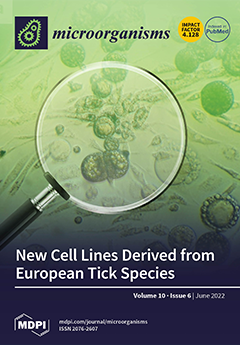
Cover Story: Tick cell lines are important tools for research on ticks and the pathogens they transmit, facilitating laboratory-based isolation, propagation, and study of disease-causing agents, as well as aspects of tick biology. This study reports ten new cell lines derived from embryos of five genera of European ticks. Each cell line was generated from a primary culture comprising a wide variety of cell phenotypes, of which only some started to grow continuously. Molecular analysis confirmed the species origin of each cell line and revealed genetic differences between cell lines derived from ticks collected in the same or nearby geographic locations. Collectively, these new cell lines will support research into a wide range of viral, bacterial, and protozoal tick-borne diseases prevalent in Europe. View this paper
  • Issues are regarded as officially published after their release is announced to the table of contents alert mailing list .
  • You may sign up for email alerts to receive table of contents of newly released issues.
  • PDF is the official format for papers published in both, html and pdf forms. To view the papers in pdf format, click on the "PDF Full-text" link, and use the free Adobe Reader to open them.

Articles (181)

  • Article
  • Open Access
26 Citations
10,936 Views
25 Pages

The gut microbiota is implicated in diverse interactions affecting human health. The present study reports a randomized, double-blind, placebo-controlled clinical study conducted by administering a new synbiotic formulation composed of two Lactobacil...

  • Article
  • Open Access
2 Citations
3,159 Views
16 Pages

For five decades it has been known that the pentamer of B subunits (choleragenoid) of the cholera toxin (CT) of Vibrio cholerae binds with high preference to the ganglioside GM1 (II3Neu5Ac-Gg4Cer). However, the exact structures of CT-binding GM1 lipo...

  • Communication
  • Open Access
17 Citations
7,507 Views
9 Pages

Comparison of DNA Extraction and Amplification Techniques for Use with Engorged Hard-Bodied Ticks

  • Gretchen C. Reifenberger,
  • Bryce A. Thomas and
  • DeLacy V. L. Rhodes

Tick-borne infections are a serious threat to humans, livestock, and companion animals in many parts of the world, often leading to high morbidity and mortality rates, along with decreased production values and/or costly treatments. The prevalence of...

  • Article
  • Open Access
13 Citations
4,105 Views
18 Pages

Enhancing Red Yeast Biomass Yield and Lipid Biosynthesis by Using Waste Nitrogen Source by Glucose Fed-Batch at Low Temperature

  • Iwona Gientka,
  • Magdalena Wirkowska-Wojdyła,
  • Ewa Ostrowska-Ligęza,
  • Monika Janowicz,
  • Lidia Reczek,
  • Alicja Synowiec and
  • Stanisław Błażejak

This work reports the effect of simple feeding strategies and temperature to obtain high-cell-density cultures of Rhodotorula glutinis var. rubescens LOCKR13 maximizing the de novo lipid productivity using deproteinated potato wastewater (DPW) as a b...

  • Article
  • Open Access
8 Citations
2,847 Views
15 Pages

How microbial communities respond to extreme conditions in the stratosphere remains unclear. To test this effect, cyanobacterial crusts collected from Tengger Desert were mounted to high balloons and briefly exposed (140 min) to high UV irradiation a...

  • Article
  • Open Access
5 Citations
3,881 Views
10 Pages

Mating Interactions between Schistosoma bovis and S. mansoni and Compatibility of Their F1 Progeny with Biomphalaria glabrata and Bulinus truncatus

  • Amos Mathias Onyekwere,
  • Alejandra De Elias-Escribano,
  • Julien Kincaid-Smith,
  • Sarah Dametto,
  • Jean-François Allienne,
  • Anne Rognon,
  • Maria Dolores Bargues and
  • Jérôme Boissier

Contrary to the majority of other Trematoda, Schistosoma species are gonochoric. Consequently, in endemic areas where several schistosome species overlap and can co-infect the same definitive host, there may be frequent opportunities for interspecifi...

  • Article
  • Open Access
3 Citations
2,753 Views
11 Pages

mRNA BNT162b Vaccine Elicited Higher Antibody and CD4+ T-Cell Responses than Patients with Mild COVID-19

  • Federica Zavaglio,
  • Irene Cassaniti,
  • Josè Camilla Sammartino,
  • Stelvio Tonello,
  • Pier Paolo Sainaghi,
  • Viola Novelli,
  • Federica Meloni,
  • Daniele Lilleri and
  • Fausto Baldanti

We compared the development and persistence of antibody and T-cell responses elicited by the mRNA BNT162b2 vaccine or SARS-CoV-2 infection. We analysed 37 post-COVID-19 patients (15 with pneumonia and 22 with mild symptoms) and 20 vaccinated subjects...

  • Article
  • Open Access
9 Citations
3,930 Views
21 Pages

Characterization of Microbial Diversity in Decayed Wood from a Spanish Forest: An Environmental Source of Industrially Relevant Microorganisms

  • Óscar Velasco-Rodríguez,
  • Mariana Fil,
  • Tonje M. B. Heggeset,
  • Kristin F. Degnes,
  • David Becerro-Recio,
  • Katarina Kolsaková,
  • Tone Haugen,
  • Malene Jønsson,
  • Macarena Toral-Martínez and
  • Carlos García-Estrada
  • + 4 authors

Rotting wood is inhabited by a large diversity of bacteria, fungi, and insects with complex environmental relationships. The aim of this work was to study the composition of the microbiota (bacteria and fungi) in decaying wood from a northwest Spanis...

  • Article
  • Open Access
1 Citations
2,716 Views
12 Pages

Endosymbiosis between heterotrophic host and microalga often breaks down because of environmental conditions, such as temperature change and exposure to toxic substances. By the time of the apparent breakdown of endosymbiosis, it is often too late fo...

  • Review
  • Open Access
32 Citations
5,183 Views
30 Pages

Bacteria use a cell-cell communication process called quorum sensing (QS) to orchestrate collective behaviors. QS relies on the group-wide detection of extracellular signal molecules called autoinducers (AI). Quorum sensing is required for virulence...

of 19

Get Alerted

Add your email address to receive forthcoming issues of this journal.

XFacebookLinkedIn
Microorganisms - ISSN 2076-2607