You are currently viewing a new version of our website. To view the old version click .

Pathogens, Volume 14, Issue 3

March 2025 - 95 articles

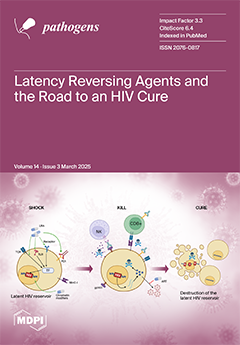
Cover Story: HIV infection cannot be cured due to latently infected cells carrying intact but inactive HIV DNA, making them indistinguishable from uninfected cells. Several strategies have been developed to cure HIV infection, including the reactivation of HIV in latently infected cells, resulting in recognition and death—the “shock and kill” approach. Various latency-reversing agents (LRAs) have been tested in clinical trials. Some were successful in reactivating HIV in vivo and induced detectable changes in the reservoir. Though the technique is not yet curative, these trials prove that latently infected cells can be targeted. In combination with the latest immunomodulatory drugs that aid in killing cells that replicate HIV, new strategies and novel LRAs may be developed in the near future to cure HIV infection. View this paper
  • Issues are regarded as officially published after their release is announced to the table of contents alert mailing list .
  • You may sign up for email alerts to receive table of contents of newly released issues.
  • PDF is the official format for papers published in both, html and pdf forms. To view the papers in pdf format, click on the "PDF Full-text" link, and use the free Adobe Reader to open them.

Articles (95)

  • Communication
  • Open Access
1,303 Views
8 Pages

Molecular Characterization of Presumptive Klebsiella pneumoniae Isolates from Companion and Farm Animals in Germany Reveals Novel Sequence Types

  • Marwa Bassiouny,
  • Peter A. Kopp,
  • Ivonne Stamm,
  • Hanka Brangsch,
  • Heinrich Neubauer and
  • Lisa D. Sprague

Klebsiella (K.) pneumoniae is a One Health pathogen that has been isolated from humans, animals, and environmental sources and is responsible for a diverse range of potentially life-threatening infections. In the present study, we analyzed the genome...

  • Article
  • Open Access
2,733 Views
21 Pages

Development of Low-Cost In-House Assays for Quantitative Detection of HBsAg, HBeAg, and HBV DNA to Enhance Hepatitis B Virus Diagnostics and Antiviral Screening in Resource-Limited Settings

  • Simmone D’souza,
  • Layla Al-Yasiri,
  • Annie Chen,
  • Dan T. Boghici,
  • Guido van Marle,
  • Jennifer A. Corcoran,
  • Trushar R. Patel and
  • Carla S. Coffin

Globally, an estimated 254 million people are living with chronic hepatitis B virus (HBV) infection, yet only 10.5% have been diagnosed, underscoring the urgent need to expand testing to meet the World Health Organization’s HBV elimination targ...

  • Article
  • Open Access
3 Citations
2,374 Views
19 Pages

Aeromonas salmonicida is a predominant pathogen that infects fish. The pathogen A. salmonicida subsp. masoucida (ASM) was isolated for the first time from diseased starry flounders (Platichthys stellatus). Our study aimed to isolate, characterize, an...

  • Article
  • Open Access
1 Citations
1,174 Views
13 Pages

Long non-coding RNAs (lncRNAs) represent a class of non-coding RNAs. In the study of Pseudomonas putida Sneb821-induced tomato resistance to Meloidogyne incognita, reverse transcription polymerase chain reaction (RT-PCR) was employed to validate 12 l...

  • Article
  • Open Access
1,811 Views
20 Pages

Venomous Cargo: Diverse Toxin-Related Proteins Are Associated with Extracellular Vesicles in Parasitoid Wasp Venom

  • Jennifer Chou,
  • Michael Z. Li,
  • Brian Wey,
  • Mubasshir Mumtaz,
  • Johnny R. Ramroop,
  • Shaneen Singh and
  • Shubha Govind

Unusual membrane-bound particles are present in the venom of the parasitoid wasps that parasitize Drosophila melanogaster. These venom particles harbor about 400 proteins and suppress the encapsulation of a wasp egg. Whereas the proteins in the...

  • Article
  • Open Access
1 Citations
2,444 Views
13 Pages

Urine of Cats with Severe Fever with Thrombocytopenia Syndrome: A Potential Source of Infection Transmission

  • Hirohisa Mekata,
  • Mari Yamamoto,
  • Yasuyuki Kaneko,
  • Kentaro Yamada,
  • Tamaki Okabayashi and
  • Akatsuki Saito

Severe fever with thrombocytopenia syndrome (SFTS), caused by infection with the SFTS virus, is an emerging fatal tick-borne zoonosis endemic to East Asia. Although SFTS is a tick-borne disease, the virus can be transmitted from animals with SFTS wit...

  • Article
  • Open Access
1,385 Views
16 Pages

In recent years, resistance of Klebsiella pneumoniae to the clinical last-resort drugs carbapenem and tigecycline has intensified, including Metallo-β-Lactamase-producing K. pneumoniae (MBL-KP), which demonstrated resistance to ceftazidime-aviba...

  • Communication
  • Open Access
1,023 Views
9 Pages

First Insights from On-Board Fish Gutting into the Zoonotic Nematode Burden of Pouting (Trisopterus luscus) at the Point of Sale to the Consumer

  • Francisco Javier Arrebola-Casañas,
  • Mario Garrido,
  • Francisco Javier Adroher,
  • Rocío Benítez and
  • Manuel Morales-Yuste

A survey was conducted to assess the impact of on-board gutting in the pouting fishery, Trisopterus luscus (L.), from the Bay of Biscay (area FAO 27.VIII) on the parasite burden of macroscopic ascaridoid nematodes, including anisakids (causing anisak...

  • Review
  • Open Access
2 Citations
2,362 Views
18 Pages

Overview of North American Isolates of Chronic Wasting Disease Used for Strain Research

  • W. David Walter,
  • Allen Herbst,
  • Chia-Hua Lue,
  • Jason C. Bartz and
  • M. Camille Hopkins

Chronic Wasting Disease (CWD) is a prion disease that affects Cervidae species, and is the only known prion disease transmitted among wildlife species. The key pathological feature is the conversion of the normal prion protein (PrPC) misfolding into...

  • Brief Report
  • Open Access
1,479 Views
13 Pages

Staphylococcus aureus is a versatile zoonotic pathogen capable of causing a wide range of infections. Due to the organism’s ability to persist, recalcitrant and recurring infections are a major concern for public and animal health. This study i...

of 10

Get Alerted

Add your email address to receive forthcoming issues of this journal.

XFacebookLinkedIn
Pathogens - ISSN 2076-0817