


Abstract
Background: Placental infections caused by Schistosoma spp. and sexually transmitted microorganisms can adversely impact pregnancy outcomes. However, the association between molecular detection of these pathogens in placental tissue and corresponding histopathological inflammation remains unclear, particularly in sub-Saharan African populations. Methods: In this cross-sectional study, placental parenchyma specimens with limited membrane sampling were collected from 103 Ivorian and Ghanaian mothers without known pregnancy or birth complications. Tissue pieces adjacent to PCR-tested samples were analyzed by real-time PCR targeting Chlamydia trachomatis, Mycoplasma hominis, Neisseria gonorrhoeae, Schistosoma spp., Streptococcus agalactiae, Trichomonas vaginalis, Ureaplasma parvum and Ureaplasma urealyticum. Corresponding adjacent tissues were examined by routine histopathology, supplemented with immunohistochemistry when higher pathogen DNA quantities were detected, to assess inflammatory changes. Results: Real-time PCR detected U. urealyticum in 15 out of 103 cases (14.6%, ±0.7%), U. parvum in 13 (12.6%, ±0.6%), S. agalactiae in 11 (10.7%, ±0.5%), the S. haematobium complex in four (3.9%, ±0.2%), M. hominis in four (3.9%, ±0.2%), confirmed N. gonorrhoeae in two (1.9%, ±0.1%) and non-confirmed N. gonorrhoeae in one (1.0%, ±0.1%), T. vaginalis in two (1.9%, ±0.1%), and C. trachomatis (non-lymphogranuloma venereum serovar) in one (1.0%, ±0.1%). Overall, pathogen DNA levels were low, with only four positive PCR results yielding cycle threshold (Ct) values below 30 and none below 25. Histopathological examination revealed no relevant inflammatory changes in any samples. Conclusions: Placental parenchyma tissues with limited membrane sampling testing positive for Schistosoma spp. or sexually transmitted pathogens by molecular methods demonstrated no corresponding histopathological inflammation. These findings warrant confirmatory studies to better characterize potential region-specific placental infection phenotypes and their clinical significance.
1. Introduction
Placental infections constitute a significant health and survival risk for fetuses in West Africa [1,2]. Several sexually and non-sexually transmitted microorganisms have been associated with adverse pregnancy outcomes.
Among regionally prevalent non-sexually transmitted infectious agents, Schistosoma spp. warrant particular attention in West Africa. Increased rates of low birth weight, prematurity, and stillbirth have been observed in cases of maternal schistosomiasis, and proinflammatory responses in maternal, placental, and fetal compartments have been linked to these outcomes [3,4,5]. In particular, soluble egg antigens of Schistosoma spp. have been shown to activate proinflammatory molecular pathways in placental trophoblasts [6]. However, the sensitivity of histological examinations for diagnosing genital schistosomiasis in placental tissue is limited by the low density and uneven distribution of helminth eggs [3,7]. Notably, even adult worms have occasionally been detected histologically within the intervillous space and decidual vessels adjacent to eggs in severe cases [5]. Although tissue maceration techniques have been proposed to improve diagnostic sensitivity, they remain laborious and unsuitable for routine diagnostics [3]. Importantly, no evidence of fetal infection has been reported even in severe cases of placental schistosomiasis [5].
Associations between sexually transmitted microorganisms and pregnancy complications are well established, with substantial data available for Mycoplasma spp. and Ureaplasma spp. More than four decades ago, transcervical migration of these organisms from the lower genital tract to the placenta was described and associated with polymorphonuclear infiltration of the placental membranes, fetal surface, and umbilical cord [8,9]. Detection of Mycoplasma and Ureaplasma species in placental tissue, whether indicative of colonization or infection, has been associated with preterm delivery, chorioamnionitis, fetal infection, and stillbirth [10,11,12]. In particular, Ureaplasma parvum has been implicated in placental infection [13], while a study in a low-risk Latvian population reported increased risk of intrauterine infection with U. parvum only in the presence of co-infections [14]. In neonates, detection of Mycoplasma spp. has been associated with increased risk of bronchopulmonary dysplasia [10].
With regard to the localization of placental inflammation, Mycoplasma spp.-associated infection tends to involve the membranes [10], although findings on chorionic plate involvement of Mycoplasma spp. and Ureaplasma urealyticum remain conflicting [10,15]. Ureaplasma spp. colonization has been linked to infertility, stillbirth, and histologic chorioamnionitis in mothers, as well as congenital pneumonia, bronchopulmonary dysplasia, meningitis, and perinatal death in neonates [16,17,18,19,20,21,22]. In preterm infants, colonization of the respiratory tract with Ureaplasma spp. has been associated with necrotizing enterocolitis [23]. Recently, U. urealyticum and Gardnerella vaginalis were detected in amniotic fluid and associated with intra-amniotic inflammation in patients with clinical chorioamnionitis at term [24], contrasting with earlier reports suggesting that chorioamnionitis at term is primarily non-infectious [25]. In smaller studies from Mexico and China, U. urealyticum was the most frequently detected microorganism associated with intrauterine infection [26,27]. Experimental evidence suggests that the severity of U. parvum-associated intrauterine infection may depend on host genetic predisposition [28]. Although both organisms are considered to have low virulence, the strength of their associations with pregnancy complications remains debated [10]. Quantitative rather than qualitative differences in microbial abundance—also observed in healthy uterine and chorionic tissues —have been associated with preterm delivery and gestational age [29,30]. Mycoplasma and Ureaplasma species are detected more frequently in placental samples from the second trimester rather than the first, whereas such differences are not observed for viral agents such as herpes simplex virus and cytomegalovirus [31]. In late pregnancy, U. urealyticum and U. parvum show low transmission rates to the placenta and fetus, although U. parvum has been linked to postpartum endometritis [32].
Streptococcus agalactiae has been associated with an increased risk of spontaneous mid-gestation abortion [33,34]. Experimental studies have demonstrated that this bacterium can induce chorioamnionitis with marked polymorphonuclear infiltration [35] and that S. agalactiae-induced choriodeciduitis can progress to intra-amniotic infection associated with preterm labor [36]. In contrast, histologic evidence of fetoplacental inflammation has been a poor predictor of perinatal S. agalactiae infection [37].
Historical investigations have suggested no association between Chlamydia trachomatis and stillbirth or abortion [38,39], and significant colonization of amniotic membranes with C. trachomatis has not been observed [40]. Similarly, Neisseria species are rarely detected in placental inflammatory lesions [41]. Trichomonas vaginalis has been associated with vaginal dysbiosis during pregnancy [42] and may facilitate ascending bacterial infections leading to complications [43]. Although these three microorganisms have occasionally been isolated from the amniotic cavity following preterm delivery, their etiological relevance remains uncertain [44].
Beyond sexually transmitted pathogens, vaginal dysbiosis-associated G. vaginalis, anerobic bacteria such as Bacteroides spp., and enteropharyngeal organisms including members of the order Enterobacterales, as well as Haemophilus influenzae and Staphylococcus aureus, have been linked to pregnancy complications and preterm labor [45]. Nevertheless, estimates of intra-amniotic infection based on placental culture and histopathology remain uncertain [46]: the accuracy of placental culture in predicting amniotic fluid infection ranges from 44% to 57%, and placental histopathology identifies intra-amniotic inflammation in only 58% of cases [46]. Notably, male preterm infants are more likely to exhibit positive placental membrane cultures and increased decidual lymphoplasmacytic infiltration, suggesting more pronounced maternal immune activation [47]. Overall, the association between infectious chorioamnionitis and preterm birth appears moderate in magnitude [48]. Regarding fetal death, maternal inflammation seems to play a more determinative role than fetal inflammatory responses [49].
This study aims to contribute to existing knowledge on the associations between pathogen detection and placental inflammatory alterations by assessing spatial correlations between molecular pathogen detection and histopathological evidence of placental inflammation for selected sexually transmitted microorganisms and Schistosoma spp. Adjacent placental tissue samples were analyzed using real-time PCR and traditional histopathological staining. The samples were obtained from a cohort of West African mothers without known pregnancy or delivery complications.
2. Materials and Methods
2.1. Study Type and Population as Well as Inclusion and Exclusion Criteria
This study was conducted as a comparative analysis using fully anonymized human sample material. Placental tissue samples were collected immediately after delivery from Ivorian and Ghanaian mothers participating in the Child Development Study (CDS), which investigates the effects of communicable and non-communicable diseases on infant development in sub-Saharan Africa, as described in detail elsewhere [50,51]. In Côte d’Ivoire, samples were collected at Abobo Community Hospital in Abidjan, and in Ghana at Komfo Anokye Teaching Hospital in Kumasi. The inclusion criteria for this analysis were a placental tissue weight exceeding 200 mg and the absence of amplification inhibition in real-time PCR. Exclusion criteria comprised maternal risk factors or pregnancy complications. Specifically, volunteers were excluded in cases of maternal age below 18 years, multiple pregnancy, diabetes, hypertension, hemorrhage, preeclampsia, preterm delivery, stillbirth, or low birth weight.
2.2. Sampling
Placental samples were collected immediately after delivery from randomly selected areas of the tissue. Specimens were fixed in 100% ethanol and stored at −80 °C. At the assessment sites in Germany, samples were divided into two parts: approximately 200 mg of tissue was used for molecular analysis, and the directly adjacent portion was processed for histopathological examination.
2.3. Molecular Diagnostics and Associated Case Definitions
The EZ1&2 DNA tissue kit protocol (Qiagen, Hilden, Germany) was applied on EZ1 automatic nucleic acid extractors (Qiagen, Hilden, Germany) according to the manufacturer’s instructions for DNA extraction from the respective 200 mg tissue volumes. Before starting the protocol, bead-beating-based tissue lysis was performed using 3.5 mm steel beads in liquid-nitrogen frozen tubes for 5 min at 30/s using a TissueLyser LT device (Qiagen, Hilden, Germany). After nucleic acid extraction, DNA (desoxyribonucleic acid) in the eluates was quantified using a Pico 100 Picodrop microliter spectrophotometer (Picodrop Ltd., Hinxton, UK) according to the manufacturer’s instructions, yielding a mean ± standard deviation (SD) of 237.7 ng/µL ± 84.4 ng/µL. Eluates were deep-frozen at −80 °C prior to PCR analyses.
Real-time PCR protocols obtained from the literature [52,53,54,55,56,57,58,59,60,61] were applied to screen for DNA of C. trachomatis, M. hominis, Neisseria gonorrhoeae, S. agalactiae, Schistosoma spp., T. vaginalis, U. parvum, and U. urealyticum. Details on target sequences, diagnostic accuracy estimates from the literature [52,53,54,55,56,57,58,59,60,61], and technical detection limits as determined with 10-fold dilution series of positive control plasmids containing the assay target sequences are provided in Table 1.
Table 1.
Characteristics of the applied microbial target-specific real-time PCRs assays. Diagnostic accuracy estimates were derived from published evaluation studies. Technical detection limits were determined using 10-fold serial dilution of positive control plasmids containing the target sequences.
The assays were run on RotorGene Q cyclers (Qiagen, Hilden, Germany), each run contained a plasmid-based positive control and a PCR grade water-based negative control. Typical sigmoid-shaped amplification curves were accepted as most likely target-specific, and no cut-off was applied with regard to measured cycle threshold (Ct) values. Semi-quantification based on Ct values was performed using the categories “high pathogen density” for Ct values < 20, “intermediate pathogen density” for Ct values ≥ 20 but <30, and “low pathogen density” for Ct values ≥ 30.
Because low pathogen densities close to the technical detection limits of the PCRs were considered as likely, at least two different real-time PCRs per target microorganism were applied. For diagnostic case definitions, each typically shaped real-time PCR signal was considered a true positive. In line with previous recommendations [53], both N. gonorrhoeae PCRs had to be positive to define a confirmed case, whereas a non-confirmed case was defined as a situation with only one out of two real-time PCR assays testing positive. The two applied PCRs for C. trachomatis targeted a C. trachomatis cryptic plasmid sequence for species-specific screening and the pmpH gene for discrimination of serovars A–K from serovars L1–L3 [54]. More specifically, the pmpH-based serovar discrimination used a pan-serovar-specific hybridization probe and a serovar A–K-specific probe. Accordingly, an L1–L3 serovar was diagnosed if the pan-serovar-specific hybridization probe, but not the A–K-specific probe, showed a positive fluorescence signal [54]. Finally, the two Schistosoma spp.-specific PCRs allowed discrimination of the S. mansoni complex, indicated by a positive result of the Sm1-7 sequence-specific PCR, and the S. haematobium complex, indicated by a positive Dra1-specific PCR [52]. A phocid herpesvirus DNA-specific real-time PCR was performed with each sample to exclude sample inhibition [62]. In line with the standards of the diagnostic laboratory, a plasmid containing the phocid herpesvirus target sequence [62] was spiked into each sample prior to nucleic acid extraction at a quantity resulting in a Ct-value range between 25 and 30. To control the risk of sample contamination during laboratory procedures, strict adherence to three-room-separation of nucleic acid extraction, master mix preparation, and nucleic acid amplification was ensured. In addition, sample series were monitored for suspicious patterns of neighboring samples showing positive real-time PCR results with increasing Ct values as potential indicators of contamination transferred between adjacent specimens.
2.4. Histopathological Workup and Comparison with the Molecular Diagnostic Results
Randomized tissue samples were thawed at room temperature in a bath of 100% ethanol and transferred to capsules. Fixation was performed in 6% formaldehyde for at least 5 days. Subsequent processing was completed within one week, resulting in formaldehyde exposure for five-twelve days. All tissue specimens were paraffin-embedded, sectioned at approximately 5 µm thickness, and stained with hematoxylin and eosin (H&E; Morphisto, Offenbach am Main, Germany).
Histopathological evaluation focused on inflammatory changes and, where applicable, followed the Amsterdam Placental Workshop Group Consensus Statement criteria [63]. Assessment was performed independently and in a blinded fashion by two pathologists experienced in placental pathology. After the initial evaluation and subsequent unblinding, a histopathological re-evaluation was conducted. Additionally, samples with a real-time PCR Ct value below 30 were recut and subjected to immunohistochemical staining to detect macrophages and neutrophilic granulocytes using anti-CD15 (clone Carb3) and anti-CD68 (clone KP1) antibodies (Agilent, Santa Clara, CA, USA). Representative images were captured using an Axio Imager. Z2 microscope (Zeiss, Jena, Germany) equipped with an Axiocam 305 color camera (Zeiss, Jena, Germany).
2.5. Statistics
Given the moderate sample size and low frequency of pathogen detections, study results were presented descriptively as part of this hypothesis-generating, exploratory analysis. Because no prior assumptions were made regarding expected findings or effect sizes, no sample size calculation was performed; instead, all available specimens were included in the analysis.
2.6. Ethics
All study procedures complied with the Declaration of Helsinki and its subsequent amendments. Ethical approval for the Child Development Study (CDS) was obtained from the National Ethics Committee of Côte d’Ivoire (Ref: 4169/MHSP), the Ethics Committee of the Kwame Nkrumah University of Science and Technology in Kumasi, Ghana (Ref: CHRPE/KNUST/KATH/01_06_08), and the Ethics Committee of the Hamburg Chamber of Physicians, Germany (Ref: PV3020). Written informed consent for participation was obtained from all CDS participants.
3. Results
3.1. Characterization of the Study Population
As summarized in Table 2, the study population consisted predominantly of Ivorian mothers, with only a small proportion from Ghana. The mean maternal age was slightly below 30 years, and on average, placental samples were obtained from the third delivery. Most births occurred via the vaginal route. Consistent with the exclusion of complications during pregnancy and delivery, the mean APGAR score at one minute exceeded 8 and was close to 9 at five minutes. The majority of participating mothers had limited formal education, were employed in occupations not requiring specialized training, and lived under modest socioeconomic conditions. Household amenities such as flush toilets or freezers were uncommon and considered luxuries rather than standard equipment.
Table 2.
Characterization of the study population (n = 103).
3.2. Molecular Proof of Microorganisms in the Placental Samples
As detailed in Appendix A Table A1, the molecular diagnostic assays demonstrated 15/103 (14.6%, ±0.7%) detections of U. urealyticum, 13 (12.6%, ±0.6%) detections of U. parvum, 11 (10.7%, ±0.5%) detections of S. agalactiae, four (3.9%, ±0.2%) detections of S. haematobium complex, four (3.9%, ±0.2%) detections of M. hominis, two (1.9%, ±0.1%) confirmed detections and one (1.0%, ±0.1%) non-confirmed detection of N. gonorrhoeae, two (1.9%, ±0.1%) detections of T. vaginalis, and one (1.0%, ±0.7%) detection of a C. trachomatis serovar not associated with lymphogranuloma venereum, in declining order of frequency (Table 3). In nine of 103 (8.7%, ±0.4%) placental samples, more than one microorganism was detected, including five cases of co- detection of U. parvum and U. urealyticum, one case of U. parvum and M. hominis, one case of S. agalactiae with non-confirmed N. gonorrhea, one case with U. parvum, M. hominis and U. urealyticum, and one case with U. parvum, U. urealyticum and S. agalactiae. As also shown in Appendix A, Table A1, and summarized in Table 3, low quantities of microbial DNA with cycle threshold values ≥ 30 were observed, with four exceptions: two detections of the cfb gene of S. agalactiae, one detection of the 67-base pair region within a multicopy sequence in the T. vaginalis genome, and one detection of the Dra1 sequence of S. haematobium complex. Even in these four instances, Ct values were >25. In a total of 11 cases, both applied target-specific PCRs were positive, thereby confirming the diagnosis. These comprised six infections with S. agalactiae, two with N. gonorrhoeae, and one each with C. trachomatis non-L1-3, M. hominis, and U. parvum (Table 3). Of note, the two S. agalactiae infections with Ct values < 30 for the cfb gene were among these 11 confirmed cases.
3.3. Histopathological Assessment
All 103 tissue samples were suitable for histological evaluation after refixation in formaldehyde. The majority of samples consisted predominantly of placental parenchyma with portions of decidua (n = 62/103; 60.2%, ±3.0%); in many samples, only placental parenchyma was present (n = 33/103; 32.0%, ±1.6%), whereas amnion was detectable in only a minority of samples (n = 8/103; 7.8%, ±0.4%). While 60–100% of DNA detections per assessed microbial species were associated with the presence of decidua tissue, only a single detection of S. agalactiae DNA occurred in a sample containing amnion tissue (Table 3). No tissue sample contained both decidua and amnion. In all cases, placental maturity corresponded to the third trimester. No signs of inflammation, helminth tissue, or helminth eggs were identified in any specimen. After re-evaluation and immunohistochemical staining, no additional pathology was detected. Because inflammatory changes were entirely absent, staging and grading according to the Amsterdam scheme were not performed. Representative findings are shown in Figure 1.
Figure 1.
Representative histological findings within the assessed placental tissues. (A–D) Representative images of mature placental parenchyma of the third trimester, showing numerous terminal villi, some intermediate villi, and a few stem villi. Minor fibrin depositions were observed in the basal decidua (B) along with sparse calcifications (C), both considered normal signs of minor regression. Hematoxylin and eosin (H&E) staining. (E,F) Representative immunohistochemical staining of sample 19: CD15-specific antibodies highlight loosely distributed immature endothelial cells and nonspecific autolytic cell debris without evidence of neutrophil granulocytes (E). CD68-specific antibodies show no accumulation of macrophages or histiocytes (F). Magnifications are 50× in (F), 100× in (A–C,E), and 200× in (D). Scale bars represent 50 µm, 100 µm, and 200 µm.
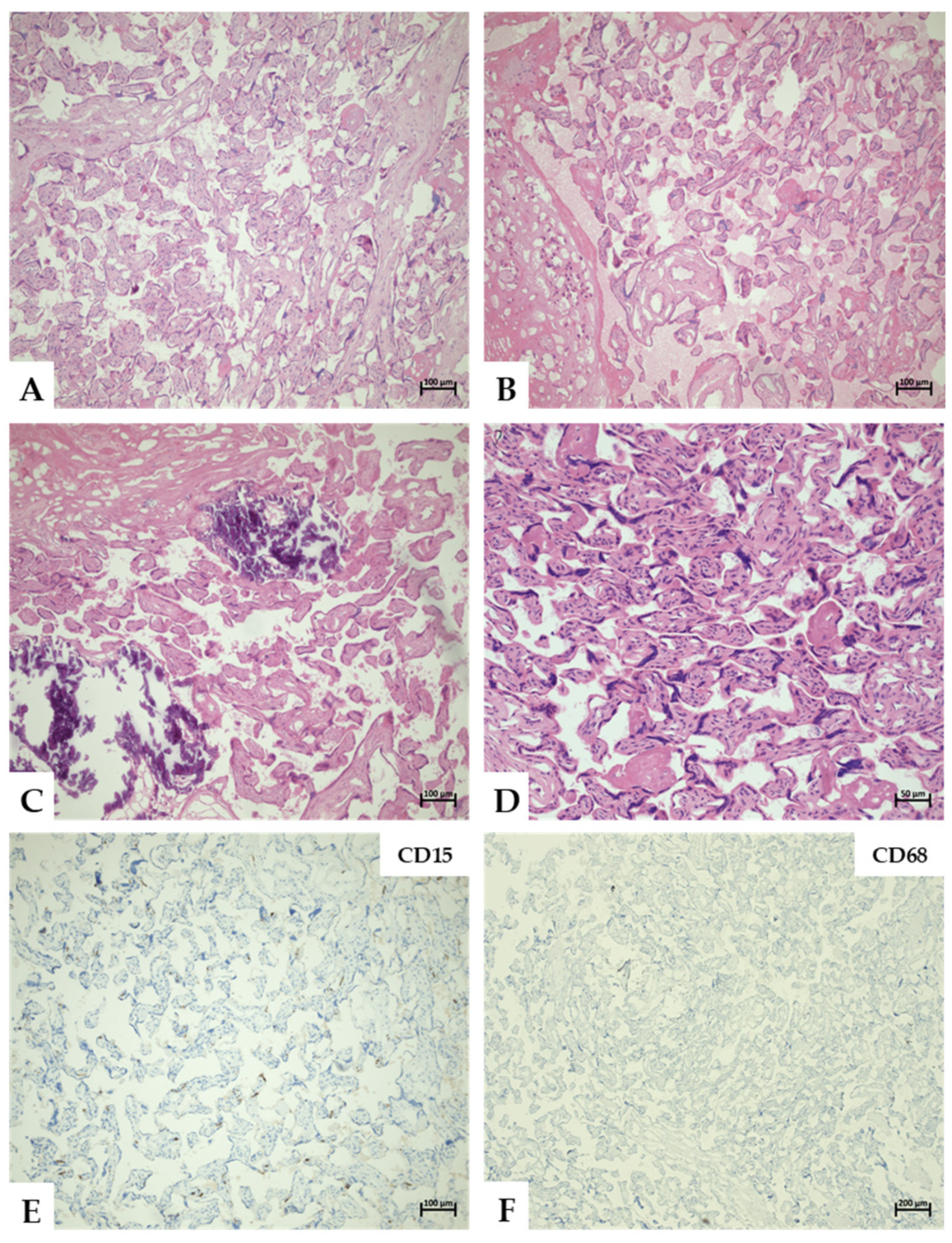
Table 3.
Comparison of molecular pathogen detection and histology proof of membranes in adjacent tissue.
4. Discussion
This study aimed to assess histopathological signs of inflammation in placental tissue adjacent to samples used for DNA detection of Schistosoma spp. and sexually transmitted microbial agents. Notably, no relevant inflammatory changes were observed, which holds several implications.
Regarding placental schistosomiasis, low helminth egg density is a recognized challenge that limits the diagnostic sensitivity of conventional histopathology [3,7]. To address this, the study analyzed tissue adjacent to PCR-positive samples, hypothesizing that soluble egg antigens released from deposited Schistosoma eggs might induce detectable inflammation [6]. Two hypotheses may explain the absence of inflammation: first, PCR positivity might reflect single, sparsely distributed eggs causing minimal local inflammation undetectable even in nearby sections. This is plausible given the high sensitivity of the Dra1 assay [52]. Second, PCR might detect circulating cell-free Schistosoma DNA within placental blood vessels, consistent with the assay’s diagnostic design. Both interpretations affirm the high sensitivity of Dra1-based real-time PCR in detecting schistosomiasis with few or absent tissue eggs, supported by elevated Ct values.
The absence of inflammation despite molecular detection of Mycoplasma spp. and Ureaplasma spp.—traditionally linked to placental inflammation [8,9]—is consistent with all detections showing high Ct values (>30), indicating to low pathogen density. Earlier studies report that inflammation when caused by these species depends on pathogen load and that these organisms can also be harmless colonizers [29]. These findings align with prior reports from uncomplicated pregnancies in West African populations [29].
Similarly, S. agalactiae and T. vaginalis, detections at intermediate pathogen densities (Ct 20–30) showed no histological inflammation. Low detection rates of N. gonorrhoeae and C. trachomatis reflect their rarity in placental tissue [40,41]. Given the overall low microbial DNA loads, the possibility of secondary contamination during vaginal delivery cannot be excluded, especially since only one confirmed cesarean section was part of the study and pathogen DNA was not detected in that sample (data not shown).
Notably, Ct value-based semi-quantification as performed in our study requires careful interpretation; therefore, only approximations over Ct value ranges were provided. As reported elsewhere [64], measured inhibition control Ct values obtained with fixed placental tissues showed a standard deviation range corresponding to approximately two orders of magnitude of target DNA concentration. This partial sample inhibition, combined with probable effects of sample storage and transfer from the African study sites, prevented attempts at absolute quantification. Furthermore, although some PCR targets occurred in multiple copies per pathogen genome, as described for Schistosoma spp.-specific assays [52], the actual sensitivity gain achievable with these assays is substantially less than expected due to the multicopy nature of the target sequences [65]. As elaborated elsewhere [65], unpredictable sequence variations within those repeat regions are responsible for this phenomenon. Focusing on target sequence quantity per sample, rough estimations of sequence numbers based on diagnostic threshold values assessed with dilution series of positive control plasmids (data not shown) suggest that “high pathogen density”, defined as Ct values < 20, corresponds to target DNA copy numbers exceeding 10 million; “intermediate pathogen density”, defined as Ct values ≥ 20 but <30, corresponds to a range between 10 thousand and 10 million; and “low pathogen density”, defined as Ct values ≥ 30, corresponds to fewer than 10 thousand copies.
This study has several limitations. First, by design, there was no control group of mothers with pregnancy or delivery complications [50,51]. Consequently, while the current analysis demonstrates microbial DNA detection without histopathologic inflammation in uncomplicated pregnancies, conclusions regarding pathological pregnancies cannot be drawn. Second, the PCR protocols employed were not optimized specifically for placental tissue, raising uncertainty about whether the diagnostic accuracy reported for other sample types applies here. Particularly given the low measured Ct values and the low inter-assay concordance of positive real-time PCR results, confirmatory testing strategies beyond use of alternative assays for the same parameters would have been advisable. Because such additional approaches were not implemented, only 11 positive PCR results could be confirmed by two independent methods, whereas the remainder must be considered unconfirmed by an independent assay. Third, distinction among microbial colonization, true infection, and contamination during vaginal delivery was not feasible. Contamination with DNA of sexually transmitted microorganisms during vaginal delivery likely accounts for the absence of inflammation in at least some cases, especially given the low amounts of detected target DNA. Fourth, placental specimens were collected randomly without systematic sampling of defined regions; as a result, amnion tissue was often absent, precluding the histopathological identification of chorioamnionitis. Fifth, limited tissue availability restricted the number of comparative assessments in this exploratory analysis, therefore minor effects may have gone undetected. Sixth, the sample origin was unevenly distributed between the Ghanaian and Ivorian sites, preventing conclusions on regional epidemiology. Finally, available epidemiological information on participants lacked data on maternal antibiotic exposure near delivery and maternal comorbidities that could suppress inflammation. These factors might have influenced the findings, and the absence of such data should be regarded as a potential source of bias.
5. Conclusions
Despite these limitations, this exploratory hypothesis-generating study demonstrated absent or minimal inflammatory reactions in placental parenchyma tissue, with only limited membrane sampling, from uncomplicated pregnancies adjacent to samples testing positive for Schistosoma spp. and sexually transmitted microorganisms by molecular methods at low target DNA quantities. Future confirmatory assessments are necessary to substantiate or refute specific regional phenotypes. Such studies should include robust sample size calculations, adequate control groups, systematic membrane sampling, and application of multi-level, quality-controlled molecular diagnostic approaches to comprehensively characterize placental infection and inflammatory profiles in endemic settings.
Author Contributions
Conceptualization, J.T.S., H.F. and K.A.E.; methodology, H.F. and J.T.S.; software, H.F. and J.T.S.; validation, H.F. and J.T.S.; formal analysis, H.F. and J.T.S.; investigation, H.F. and J.T.S.; resources, S.S., S.E., G.M., T.F., D.B., H.F., K.A.E., J.B., S.B.N., M.K., H.T., L.C. and C.B.; data curation, H.F. and J.T.S.; writing—original draft preparation, H.F. and J.T.S.; writing—review and editing, J.T.S., G.M., S.S., S.E., T.F., D.B., H.F., K.A.E., J.B., S.B.N., M.K., H.T., L.C., C.B., R.H. and J.B.; visualization, J.T.S.; supervision, H.F., G.M. and K.A.E.; project administration, H.F.; funding acquisition, K.A.E. All authors have read and agreed to the published version of the manuscript.
Funding
The assessment of microorganisms and signs of inflammation did not receive any funding. Placenta sampling and socioeconomic data collection were supported by an academic grant from the German Research Council (Deutsche Forschungsgemeinschaft; DFG; project number 68748488; https://gepris.dfg.de/gepris/projekt/68748488 (accessed on 6 July 2023)). The funders had no role in study design, data collection and analysis, decision to publish, or preparation of the manuscript.
Institutional Review Board Statement
Compliance with the Helsinki Declaration and all its amendments was ensured. Ethical approval for the Child Development Study (CDS) was granted by the national ethics committee in Ivory Coast (Ref: 4169/MHSP, 19 September 2008) as well as by the local ethics committees of the Kwame Nkrumah University of Science and Technology in Kumasi, Ghana (Ref: CHRPE/KNUST/KATH/01_06_08, 7 July 2008) and the chamber of physicians (“Ärztekammer”) in Hamburg, Germany (Ref: PV3020, 2 October 2008).
Informed Consent Statement
CDS participants provided written informed consent for study participation.
Data Availability Statement
All relevant data are provided either in the manuscript or Appendix A.
Acknowledgments
We sincerely thank Kais Hussein for assisting with the histologic evaluation and for advising on the project. Simone Priesnitz and Annett Michel are gratefully acknowledged for excellent technical assistance.
Conflicts of Interest
The authors declare no conflicts of interest. The funders had no role in the design of the study; in the collection, analyses, or interpretation of data; in the writing of the manuscript; or in the decision to publish the results.
Abbreviations
The following abbreviations are used in this manuscript:
| C.t. | Chlamydia trachomatis |
| C.t. non-L1-L3 | Chlamydia trachomatis without the serovars L1-L3 |
| CDS | Child Development Study |
| Ct | cycle threshold |
| DNA | desoxyribonucleic acid |
| ID | anonymized sample number |
| M.h. | Mycoplasma hominis |
| µL | Microliter |
| n | Number |
| n.a. | Not applicable |
| N.g. | Neisseria gonorrhoeae |
| PCR | polymerase chain reaction |
| SD | standard deviation |
| S.a. | Streptococcus agalactiae |
| S.h.c. | Schistosoma haematobium complex |
| S.m.c. | Schistosoma mansoni complex |
| spp. | species (plural) |
| T.v. | Trichomonas vaginalis |
| U.p. | Ureaplasma parvum |
| U.u. | Ureaplasma urealyticum |
Appendix A
Table A1.
Distribution of the recorded real-time PCR signals over the assessed placenta samples. The headers of the table indicate the target microorganisms and the target sequences are in the row below. Negative PCR signals are indicated in white and positive ones in gray, including the measured cycle threshold (Ct) values shown as plain numbers. The samples are fully anonymized and denoted with plain numbers only.
References
- Tettey, Y.; Wiredu, E.K. Autopsy studies on still births in Korle Bu Teaching Hospital: Pathological findings in still births and their placentae. West. Afr. J. Med. 1997, 16, 12–19. [Google Scholar] [PubMed]
- Wiredu, E.K.; Tettey, Y. Autopsy studies on still births in Korle Bu Teaching Hospital. II: Causes of death in 93 still births. West. Afr. J. Med. 1998, 17, 148–152. [Google Scholar]
- Kurtis, J.D.; Higashi, A.; Wu, H.W.; Gundogan, F.; McDonald, E.A.; Sharma, S.; PondTor, S.; Jarilla, B.; Sagliba, M.J.; Gonzal, A.; et al. Maternal Schistosomiasis japonica is associated with maternal, placental, and fetal inflammation. Infect. Immun. 2011, 79, 1254–1261. [Google Scholar] [CrossRef] [Scilit]
- Holtfreter, M.C.; Neubauer, H.; Groten, T.; El-Adawy, H.; Pastuschek, J.; Richter, J.; Häussinger, D.; Pletz, M.W.; Schleenvoigt, B.T. Improvement of a tissue maceration technique for the determination of placental involvement in schistosomiasis. PLoS Negl. Trop. Dis. 2017, 11, e0005551. [Google Scholar] [CrossRef] [Scilit]
- Bittencourt, A.L.; Cardoso de Almeida, M.A.; Iunes, M.A.; Casulari da Motta, L.D. Placental involvement in schistosomiasis mansoni. Report of four cases. Am. J. Trop. Med. Hyg. 1980, 29, 571–575. [Google Scholar] [CrossRef] [Scilit]
- McDonald, E.A.; Kurtis, J.D.; Acosta, L.; Gundogan, F.; Sharma, S.; Pond-Tor, S.; Wu, H.W.; Friedman, J.F. Schistosome egg antigens elicit a proinflammatory response by trophoblast cells of the human placenta. Infect. Immun. 2013, 81, 704–712. [Google Scholar] [CrossRef] [Scilit]
- Gerstenberg, J.; Mishra, S.; Holtfreter, M.; Richter, J.; Davi, S.D.; Okwu, D.G.; Ramharter, M.; Mischlinger, J.; Schleenvoigt, B.T., on behalf of the TropNet. Human Placental Schistosomiasis-A Systematic Review of the Literature. Pathogens 2024, 13, 470. [Google Scholar] [CrossRef] [Scilit]
- Kundsin, R.B.; Driscoll, S.G.; Monson, R.R.; Yeh, C.; Biano, S.A.; Cochran, W.D. Association of Ureaplasma urealyticum in the placenta with perinatal morbidity and mortality. N. Engl. J. Med. 1984, 310, 941–945. [Google Scholar] [CrossRef] [Scilit] [PubMed]
- Embree, J.E.; Krause, V.W.; Embil, J.A.; MacDonald, S. Placental infection with Mycoplasma homonis and Ureaplasma urealyticum: Clinical correlation. Obstet. Gynecol. 1980, 56, 475–481. [Google Scholar] [PubMed]
- Stirling, K.M.; Hussain, N.; Sanders, M.M.; Campbell, W. Association between maternal genital mycoplasma colonization and histologic chorioamnionitis in preterm births. J. Neonatal Perinatal Med. 2016, 9, 201–209. [Google Scholar] [CrossRef] [Scilit]
- Chu, A.; de St Maurice, A.; Sim, M.S.; Kallapur, S.G. Neonatal Mycoplasma and Ureaplasma Infections. Pediatr. Ann. 2020, 49, e305–e312. [Google Scholar] [CrossRef] [Scilit] [PubMed]
- Dische, M.R.; Quinn, P.A.; Czegledy-Nagy, E.; Sturgess, J.M. Genital mycoplasma infection. Intrauterine infection: Pathologic study of the fetus and placenta. Am. J. Clin. Pathol. 1979, 72, 167–174. [Google Scholar] [CrossRef] [Scilit]
- Cox, C.; Saxena, N.; Watt, A.P.; Gannon, C.; McKenna, J.P.; Fairley, D.J.; Sweet, D.; Shields, M.D.L.; Cosby, S.; Coyle, P.V. The common vaginal commensal bacterium Ureaplasma parvum is associated with chorioamnionitis in extreme preterm labor. J. Matern. Fetal Neonatal Med. 2016, 29, 3646–3651. [Google Scholar] [CrossRef] [Scilit]
- Rezeberga, D.; Lazdane, G.; Kroica, J.; Sokolova, L.; Donders, G.G. Placental histological inflammation and reproductive tract infections in a low risk pregnant population in Latvia. Acta Obstet. Gynecol. Scand. 2008, 87, 360–365. [Google Scholar] [CrossRef] [Scilit]
- Hecht, J.L.; Onderdonk, A.; Delaney, M.; Allred, E.N.; Kliman, H.J.; Zambrano, E.; Pflueger, S.M.; Livasy, C.A.; Bhan, I.; Leviton, A.; et al. Characterization of chorioamnionitis in 2nd-trimester C-section placentas and correlation with microorganism recovery from subamniotic tissues. Pediatr. Dev. Pathol. 2008, 11, 15–22. [Google Scholar] [CrossRef] [Scilit]
- Sprong, K.E.; Mabenge, M.; Wright, C.A.; Govender, S. Ureaplasma species and preterm birth: Current perspectives. Crit. Rev. Microbiol. 2020, 46, 169–181. [Google Scholar] [CrossRef] [Scilit]
- Joste, N.E.; Kundsin, R.B.; Genest, D.R. Histology and Ureaplasma urealyticum culture in 63 cases of first trimester abortion. Am. J. Clin. Pathol. 1994, 102, 729–732. [Google Scholar] [CrossRef] [Scilit]
- Sun, H. Ureaplasma urealyticum and intrauterine infection of fetus. Zhonghua Liu Xing Bing Xue Za Zhi 1993, 14, 81–83. [Google Scholar]
- Hillier, S.L.; Krohn, M.A.; Kiviat, N.B.; Watts, D.H.; Eschenbach, D.A. Microbiologic causes and neonatal outcomes associated with chorioamnion infection. Am. J. Obstet. Gynecol. 1991, 165 Pt 1, 955–961. [Google Scholar] [CrossRef] [Scilit]
- Hillier, S.L.; Martius, J.; Krohn, M.; Kiviat, N.; Holmes, K.K.; Eschenbach, D.A. A case-control study of chorioamnionic infection and histologic chorioamnionitis in prematurity. N. Engl. J. Med. 1988, 319, 972–978. [Google Scholar] [CrossRef] [Scilit]
- Cassell, G.H.; Waites, K.B.; Gibbs, R.S.; Davis, J.K. Role of Ureaplasma urealyticum in amnionitis. Pediatr. Infect. Dis. 1986, 5 (Suppl. S6), S247–S252. [Google Scholar] [CrossRef] [Scilit] [PubMed]
- Shurin, P.A.; Alpert, S.; Bernard Rosner, B.A.; Driscoll, S.G.; Lee, Y.H. Chorioamnionitis and colonization of the newborn infant with genital mycoplasmas. N. Engl. J. Med. 1975, 293, 5–8. [Google Scholar] [CrossRef] [Scilit]
- Okogbule-Wonodi, A.C.; Gross, G.W.; Sun, C.C.; Agthe, A.G.; Xiao, L.; Waites, K.B.; Viscardi, R.M. Necrotizing enterocolitis is associated with ureaplasma colonization in preterm infants. Pediatr. Res. 2011, 69 Pt 1, 442–447. [Google Scholar] [CrossRef] [Scilit] [PubMed]
- Romero, R.; Miranda, J.; Kusanovic, J.P.; Chaiworapongsa, T.; Chaemsaithong, P.; Martinez, A.; Gotsch, F.; Dong, Z.; Ahmed, A.I.; Shaman, M.; et al. Clinical chorioamnionitis at term I: Microbiology of the amniotic cavity using cultivation and molecular techniques. J. Perinat. Med. 2015, 43, 19–36. [Google Scholar] [CrossRef] [Scilit]
- Roberts, D.J.; Celi, A.C.; Riley, L.E.; Onderdonk, A.B.; Boyd, T.K.; Johnson, L.C.; Lieberman, E. Acute histologic chorioamnionitis at term: Nearly always noninfectious. PLoS ONE 2012, 7, e31819. [Google Scholar] [CrossRef] [Scilit] [PubMed]
- Castro-Leyva, V.; Espejel-Nuñez, A.; Barroso, G.; Zaga-Clavellina, V.; Flores-Pliego, A.; Morales-Mendez, I.; Giono-Cerezo, S.; Walsh, S.W.; Estrada-Gutierrez, G. Preserved ex vivo inflammatory status in decidual cells from women with preterm labor and subclinical intrauterine infection. PLoS ONE 2012, 7, e43605. [Google Scholar] [CrossRef] [Scilit]
- Li, J.; Hou, Y.; Zhao, Y.; Zhang, Z.M.; Mao, J. Value of microbial gene 16SrRNA in the identification of antenatal infection. Zhongguo Dang Dai Er Ke Za Zhi 2010, 12, 726–729. [Google Scholar]
- von Chamier, M.; Allam, A.; Brown, M.B.; Reinhard, M.K.; Reyes, L. Host genetic background impacts disease outcome during intrauterine infection with Ureaplasma parvum. PLoS ONE 2012, 7, e44047. [Google Scholar] [CrossRef] [Scilit]
- Onderdonk, A.B.; Hecht, J.L.; McElrath, T.F.; Delaney, M.L.; Allred, E.N.; Leviton, A.; ELGAN Study Investigators. Colonization of second-trimester placenta parenchyma. Am. J. Obstet. Gynecol. 2008, 199, 52.e1–52.e10. [Google Scholar] [CrossRef] [Scilit] [PubMed]
- Onderdonk, A.B.; Delaney, M.L.; DuBois, A.M.; Allred, E.N.; Leviton, A.; Extremely Low Gestational Age Newborns (ELGAN) Study Investigators. Detection of bacteria in placental tissues obtained from extremely low gestational age neonates. Am. J. Obstet. Gynecol. 2008, 198, 110.e1–110.e7. [Google Scholar] [CrossRef] [Scilit]
- McDonagh, S.; Maidji, E.; Ma, W.; Chang, H.T.; Fisher, S.; Pereira, L. Viral and bacterial pathogens at the maternal-fetal interface. J. Infect. Dis. 2004, 190, 826–834. [Google Scholar] [CrossRef] [Scilit]
- Jacqui, P.; Sedallian, A. Rôle des mycoplasmes dans la pathologie du dernier mois de gestation et du post-partum. Etude prospective de 577 grossesses [Role of mycoplasmas in the last month of pregnancy and postpartum pathology. Prospective study of 577 pregnancies]. Rev. Fr. Gynecol. Obstet. 1992, 87, 135–144. [Google Scholar]
- McDonald, H.M.; Chambers, H.M. Intrauterine infection and spontaneous midgestation abortion: Is the spectrum of microorganisms similar to that in preterm labor? Infect. Dis. Obstet. Gynecol. 2000, 8, 220–227. [Google Scholar] [CrossRef] [PubMed]
- Singer, D.B.; Campognone, P. Perinatal group B streptococcal infection in midgestation. Pediatr. Pathol. 1986, 5, 271–276. [Google Scholar] [CrossRef] [Scilit]
- Allard, M.J.; Brochu, M.E.; Bergeron, J.D.; Segura, M.; Sébire, G. Causal role of group B Streptococcus-induced acute chorioamnionitis in intrauterine growth retardation and cerebral palsy-like impairments. J. Dev. Orig. Health Dis. 2019, 10, 595–602. [Google Scholar] [CrossRef] [Scilit] [PubMed]
- Grigsby, P.L.; Novy, M.J.; Adams Waldorf, K.M.; Sadowsky, D.W.; Gravett, M.G. Choriodecidual inflammation: A harbinger of the preterm labor syndrome. Reprod. Sci. 2010, 17, 85–94. [Google Scholar] [CrossRef] [Scilit]
- De Paepe, M.E.; Friedman, R.M.; Gundogan, F.; Pinar, H.; Oyer, C.E. The histologic fetoplacental inflammatory response in fatal perinatal group B-streptococcus infection. J. Perinatol. 2004, 24, 441–445. [Google Scholar] [CrossRef] [Scilit]
- Madan, E.; Meyer, M.P.; Amortegui, A.J. Isolation of genital mycoplasmas and Chlamydia trachomatis in stillborn and neonatal autopsy material. Arch. Pathol. Lab. Med. 1988, 112, 749–751. [Google Scholar]
- Feist, A.; Sydler, T.; Gebbers, J.J.; Pospischil, A.; Guscetti, F. No association of Chlamydia with abortion. J. R. Soc. Med. 1999, 92, 237–238. [Google Scholar] [CrossRef] [Scilit]
- Dong, Y.; St Clair, P.J.; Ramzy, I.; Kagan-Hallet, K.S.; Gibbs, R.S. A microbiologic and clinical study of placental inflammation at term. Obstet. Gynecol. 1987, 70, 175–182. [Google Scholar] [CrossRef] [Scilit] [PubMed]
- Schuetz, A.N.; Guarner, J.; Packard, M.M.; Zaki, S.R.; Shehata, B.M.; Opreas-Ilies, G. Infectious disease immunohistochemistry in placentas from HIV-positive and HIV-negative patients. Pediatr. Dev. Pathol. 2011, 14, 180–188. [Google Scholar] [CrossRef] [Scilit] [PubMed]
- Bagga, R.; Arora, P. Genital Micro-Organisms in Pregnancy. Front. Public Health 2020, 8, 225. [Google Scholar] [CrossRef] [Scilit]
- Ross, S.M.; Naeye, R.L.; Du Plessis, J.P.; Visagie, M.E. The genesis of amniotic fluid infections. Ciba Found. Symp. 1979, 77, 39–53. [Google Scholar]
- Pararas, M.V.; Skevaki, C.L.; Kafetzis, D.A. Preterm birth due to maternal infection: Causative pathogens and modes of prevention. Eur. J. Clin. Microbiol. Infect. Dis. 2006, 25, 562–569. [Google Scholar] [CrossRef] [Scilit]
- McDonald, H.M.; O’Loughlin, J.A.; Jolley, P.; Vigneswaran, R.; McDonald, P.J. Vaginal infection and preterm labour. Br. J. Obstet. Gynaecol. 1991, 98, 427–435. [Google Scholar] [CrossRef] [Scilit]
- Pettker, C.M.; Buhimschi, I.A.; Magloire, L.K.; Sfakianaki, A.K.; Hamar, B.D.; Buhimschi, C.S. Value of placental microbial evaluation in diagnosing intra-amniotic infection. Obstet. Gynecol. 2007, 109, 739–749. [Google Scholar] [CrossRef] [Scilit]
- Goldenberg, R.L.; Andrews, W.W.; Faye-Petersen, O.M.; Goepfert, A.R.; Cliver, S.P.; Hauth, J.C. The Alabama Preterm Birth Study: Intrauterine infection and placental histologic findings in preterm births of males and females less than 32 weeks. Am. J. Obstet. Gynecol. 2006, 195, 1533–1537. [Google Scholar] [CrossRef] [Scilit]
- Paul, V.K.; Dawar, R.; Gupta, S.D.; Singh, M.; Buckshee, K.; Gupta, U.; Bhan, M.K.; Bhargava, V.L.; Takkar, D.; Deorari, A.K. Histologic chorioamnionitis & its association with prematurity in a hospital-based study. Indian J. Med. Res. 1998, 108, 272–278. [Google Scholar]
- Blackwell, S.; Romero, R.; Chaiworapongsa, T.; Kim, Y.M.; Bujold, E.; Espinoza, J.; Camacho, N.; Hassan, S.; Yoon, B.H.; Refuerzo, J.S. Maternal and fetal inflammatory responses in unexplained fetal death. J. Matern. Fetal Neonatal Med. 2003, 14, 151–157. [Google Scholar] [CrossRef] [PubMed]
- Bindt, C.; Appiah-Poku, J.; Te Bonle, M.; Schoppen, S.; Feldt, T.; Barkmann, C.; Koffi, M.; Baum, J.; Nguah, S.B.; Tagbor, H.; et al. Antepartum depression and anxiety associated with disability in African women: Cross-sectional results from the CDS study in Ghana and Côte d’Ivoire. PLoS ONE 2012, 7, e48396. [Google Scholar] [CrossRef] [Scilit] [PubMed]
- Bindt, C.; Guo, N.; Bonle, M.T.; Appiah-Poku, J.; Hinz, R.; Barthel, D.; Schoppen, S.; Feldt, T.; Barkmann, C.; Koffi, M.; et al. No association between antenatal common mental disorders in low-obstetric risk women and adverse birth outcomes in their offspring: Results from the CDS study in Ghana and Côte D’Ivoire. PLoS ONE 2013, 8, e80711. [Google Scholar] [CrossRef] [Scilit]
- Frickmann, H.; Lunardon, L.M.; Hahn, A.; Loderstädt, U.; Lindner, A.K.; Becker, S.L.; Mockenhaupt, F.P.; Weber, C.; Tannich, E. Evaluation of a duplex real-time PCR in human serum for simultaneous detection and differentiation of Schistosoma mansoni and Schistosoma haematobium infections—Cross-sectional study. Travel Med. Infect. Dis. 2021, 41, 102035. [Google Scholar] [CrossRef] [Scilit]
- Goire, N.; Nissen, M.D.; LeCornec, G.M.; Sloots, T.P.; Whiley, D.M. A duplex Neisseria gonorrhoeae real-time polymerase chain reaction assay targeting the gonococcal porA pseudogene and multicopy opa genes. Diagn. Microbiol. Infect. Dis. 2008, 61, 6–12. [Google Scholar] [CrossRef] [Scilit]
- Chen, C.Y.; Chi, K.H.; Alexander, S.; Ison, C.A.; Ballard, R.C. A real-time quadriplex PCR assay for the diagnosis of rectal lymphogranuloma venereum and non-lymphogranuloma venereum Chlamydia trachomatis infections. Sex. Transm. Infect. 2008, 84, 273–276. [Google Scholar] [CrossRef] [Scilit] [PubMed]
- Vancutsem, E.; Soetens, O.; Breugelmans, M.; Foulon, W.; Naessens, A. Modified real-time PCR for detecting, differentiating, and quantifying Ureaplasma urealyticum and Ureaplasma parvum. J. Mol. Diagn. 2011, 13, 206–212. [Google Scholar] [CrossRef] [Scilit]
- Chan, J.L.; Cerón, S.; Horiuchi, S.M.; Yap, J.P.; Chihuahua, E.G.; Tsan, A.T.; Kamau, E.; Yang, S. Development of a Rapid and High-Throughput Multiplex Real-Time PCR Assay for Mycoplasma hominis and Ureaplasma Species. J. Mol. Diagn. 2023, 25, 838–848. [Google Scholar] [CrossRef] [Scilit]
- Férandon, C.; Peuchant, O.; Janis, C.; Benard, A.; Renaudin, H.; Pereyre, S.; Bébéar, C. Development of a real-time PCR targeting the yidC gene for the detection of Mycoplasma hominis and comparison with quantitative culture. Clin. Microbiol. Infect. 2011, 17, 155–159. [Google Scholar] [CrossRef] [Scilit] [PubMed]
- Diaz, M.H.; Waller, J.L.; Napoliello, R.A.; Islam, M.S.; Wolff, B.J.; Burken, D.J.; Holden, R.L.; Srinivasan, V.; Arvay, M.; McGee, L.; et al. Optimization of Multiple Pathogen Detection Using the TaqMan Array Card: Application for a Population-Based Study of Neonatal Infection. PLoS ONE 2013, 8, e66183. [Google Scholar] [CrossRef] [Scilit]
- Bergseng, H.; Bevanger, L.; Rygg, M.; Bergh, K. Real-time PCR targeting the sip gene for detection of group B Streptococcus colonization in pregnant women at delivery. J. Med. Microbiol. 2007, 56 Pt 2, 223–228. [Google Scholar] [CrossRef] [Scilit] [PubMed]
- Caliendo, A.M.; Jordan, J.A.; Green, A.M.; Ingersoll, J.; Diclemente, R.J.; Wingood, G.M. Real-time PCR improves detection of Trichomonas vaginalis infection compared with culture using self-collected vaginal swabs. Infect. Dis. Obstet. Gynecol. 2005, 13, 145–150. [Google Scholar] [CrossRef] [Scilit]
- Schirm, J.; Bos, P.A.; Roozeboom-Roelfsema, I.K.; Luijt, D.S.; Möller, L.V. Trichomonas vaginalis detection using real-time TaqMan PCR. J. Microbiol. Methods 2007, 68, 243–247. [Google Scholar] [CrossRef] [Scilit] [PubMed]
- Niesters, H.G. Quantitation of viral load using real-time amplification techniques. Methods 2001, 25, 419–429. [Google Scholar] [CrossRef] [Scilit] [PubMed]
- Khong, T.Y.; Mooney, E.E.; Ariel, I.; Balmus, N.C.; Boyd, T.K.; Brundler, M.A.; Derricott, H.; Evans, M.J.; Faye-Petersen, O.M.; Gillan, J.E.; et al. Sampling and Definitions of Placental Lesions: Amsterdam Placental Workshop Group Consensus Statement. Arch. Pathol. Lab. Med. 2016, 140, 698–713. [Google Scholar] [CrossRef] [Scilit] [PubMed]
- Franz, R.; Hahn, A.; Hagen, R.M.; Rohde, H.; Eberhardt, K.A.; Ehrhardt, S.; Baum, J.; Claussen, L.; Feldt, T.; Hinz, R.; et al. Screening for Resistant Bacteria, Antimicrobial Resistance Genes, Sexually Transmitted Infections and Schistosoma spp. in Tissue Samples from Predominantly Vaginally Delivered Placentae in Ivory Coast and Ghana. Pathogens 2023, 12, 999. [Google Scholar] [CrossRef] [Scilit]
- Hoffmann, T.; Carsjens, I.; Rakotozandrindrainy, R.; Girmann, M.; Randriamampionona, N.; Maïga-Ascofaré, O.; Podbielski, A.; Hahn, A.; Frickmann, H.; Schwarz, N.G. Serology-and Blood-PCR-Based Screening for Schistosomiasis in Pregnant Women in Madagascar-A Cross-Sectional Study and Test Comparison Approach. Pathogens 2021, 10, 722. [Google Scholar] [CrossRef] [Scilit]

Disclaimer/Publisher’s Note: The statements, opinions and data contained in all publications are solely those of the individual author(s) and contributor(s) and not of MDPI and/or the editor(s). MDPI and/or the editor(s) disclaim responsibility for any injury to people or property resulting from any ideas, methods, instructions or products referred to in the content. |
© 2025 by the authors. Licensee MDPI, Basel, Switzerland. This article is an open access article distributed under the terms and conditions of the Creative Commons Attribution (CC BY) license (https://creativecommons.org/licenses/by/4.0/).