No Histopathological Evidence of Inflammation Despite Molecular Detection of Schistosoma spp. and Sexually Transmitted Pathogens in Placental Parenchyma Specimens with Limited Membrane Sampling from West African Women with Uncomplicated Pregnancies

 , , , ,
  , , and
Abstract
1. Introduction
2. Materials and Methods
2.1. Study Type and Population as Well as Inclusion and Exclusion Criteria
2.2. Sampling
2.3. Molecular Diagnostics and Associated Case Definitions
2.4. Histopathological Workup and Comparison with the Molecular Diagnostic Results
2.5. Statistics
2.6. Ethics
3. Results
3.1. Characterization of the Study Population
3.2. Molecular Proof of Microorganisms in the Placental Samples
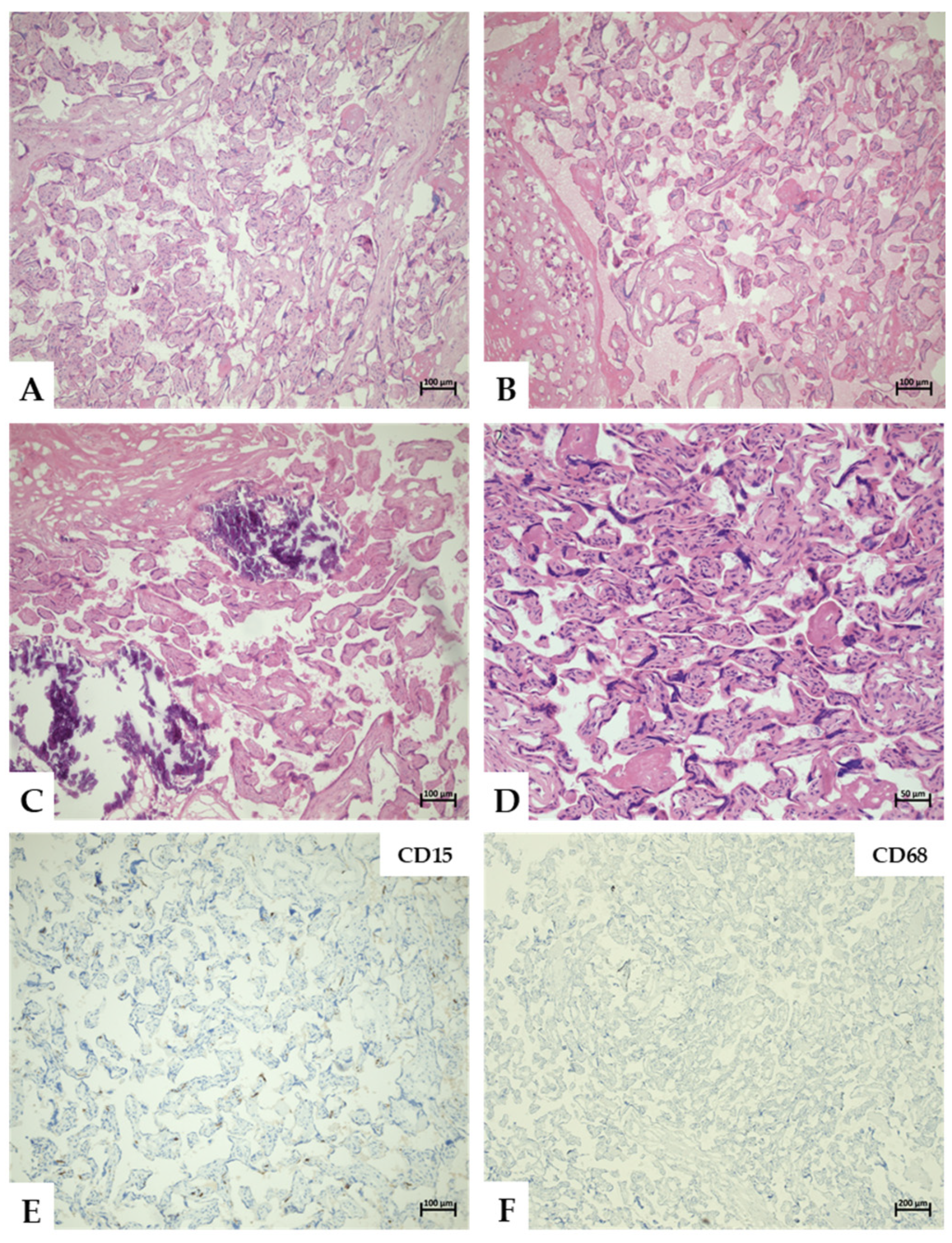
3.3. Histopathological Assessment


| Detected Microorganism | Proportion of Positive Samples (n/n, Percentage, 95% Confidence Interval) | Number of Positive Results Confirmed by Another Assay | Number of Positive Samples Indicating “Intermediate Pathogen Density” Defined as Ct Value ≥ 20 but <30 with at Least One Assay | Number of Positive Samples Indicating “Low Pathogen Density” Defined as Ct Value ≥ 30 with Any Target-Specific Assay | Number of PCR-Positive Samples Showing Amnion in Histology | Number of PCR-Positive Samples Showing Decidua in Histology |
|---|---|---|---|---|---|---|
| Chlamydia trachomatis | 1/103 (1.0%, ±0.7%) | 1 | 0 | 1 | 0 | 1 |
| Mycoplasma hominis | 4/103 (3.9%, ±0.2%) | 1 | 0 | 4 | 0 | 3 |
| Neisseria gonorrhoeae | 3/103 (1.9%, ±0.1%) | 2 | 0 | 3 | 0 | 2 |
| Ureaplasma parvum | 13/103 (12.6%, ±0.6%) | 1 | 0 | 13 | 0 | 9 |
| Ureaplasma urealyticum | 15/103 (14.6%, ±0.7%) | 0 | 0 | 15 | 0 | 9 |
| Schistosoma haematobium | 4/103 (3.9%, ±0.2%) | n.a. | 1 | 3 | 0 | 3 |
| Streptococcus agalactiae | 11/103 (10.7%, ±0.5%) | 6 | 2 | 9 | 1 | 8 |
| Trichomonas vaginalis | 2/103 (1.9%, ±0.1%) | 0 | 1 | 1 | 0 | 2 |
4. Discussion
5. Conclusions
Author Contributions
Funding
Institutional Review Board Statement
Informed Consent Statement
Data Availability Statement
Acknowledgments
Conflicts of Interest
Abbreviations
| C.t. | Chlamydia trachomatis |
| C.t. non-L1-L3 | Chlamydia trachomatis without the serovars L1-L3 |
| CDS | Child Development Study |
| Ct | cycle threshold |
| DNA | desoxyribonucleic acid |
| ID | anonymized sample number |
| M.h. | Mycoplasma hominis |
| µL | Microliter |
| n | Number |
| n.a. | Not applicable |
| N.g. | Neisseria gonorrhoeae |
| PCR | polymerase chain reaction |
| SD | standard deviation |
| S.a. | Streptococcus agalactiae |
| S.h.c. | Schistosoma haematobium complex |
| S.m.c. | Schistosoma mansoni complex |
| spp. | species (plural) |
| T.v. | Trichomonas vaginalis |
| U.p. | Ureaplasma parvum |
| U.u. | Ureaplasma urealyticum |
Appendix A
| ID | S.m.c. | S.h.c. | C.t. Non-L1-L3 | C.t. | N.g. | N.g. | T.v. | T.v. | U.p. | U.p. | S.a. | S.a. | M.h. | M.h. | U.u. | U.u. |
|---|---|---|---|---|---|---|---|---|---|---|---|---|---|---|---|---|
| Sm1-7 | Dra1 | pmpH | Chlamydia trachomatis cryptic plasmid sequence | Opa | porA | 67-base pair region within a multi-copy sequence in the T. vaginalis genome | sequence of the beta-tubulin protein | ureD | clpB | cfb | sip | tuf | yidC | ABC transporter permease gene | ureD | |
| 1 | ||||||||||||||||
| 2 | ||||||||||||||||
| 3 | ||||||||||||||||
| 4 | ||||||||||||||||
| 5 | ||||||||||||||||
| 6 | 34 | 35 | ||||||||||||||
| 7 | ||||||||||||||||
| 8 | 35 | |||||||||||||||
| 9 | 37 | |||||||||||||||
| 10 | ||||||||||||||||
| 11 | ||||||||||||||||
| 12 | ||||||||||||||||
| 13 | ||||||||||||||||
| 14 | ||||||||||||||||
| 15 | ||||||||||||||||
| 16 | 38 | |||||||||||||||
| 17 | 31 | 34 | ||||||||||||||
| 18 | 35 | |||||||||||||||
| 19 | 29 | |||||||||||||||
| 20 | ||||||||||||||||
| 21 | 34 | 36 | 34 | 37 | 37 | |||||||||||
| 22 | 35 | |||||||||||||||
| 23 | ||||||||||||||||
| 24 | 31 | 34 | ||||||||||||||
| 25 | 33 | |||||||||||||||
| 26 | ||||||||||||||||
| 27 | ||||||||||||||||
| 28 | 32 | 39 | ||||||||||||||
| 29 | ||||||||||||||||
| 30 | 32 | 30 | ||||||||||||||
| 31 | ||||||||||||||||
| 32 | 35 | 36 | ||||||||||||||
| 33 | ||||||||||||||||
| 34 | ||||||||||||||||
| 35 | 38 | |||||||||||||||
| 36 | ||||||||||||||||
| 37 | ||||||||||||||||
| 38 | 37 | |||||||||||||||
| 39 | ||||||||||||||||
| 40 | 33 | 37 | ||||||||||||||
| 41 | ||||||||||||||||
| 42 | ||||||||||||||||
| 43 | ||||||||||||||||
| 44 | ||||||||||||||||
| 45 | ||||||||||||||||
| 46 | ||||||||||||||||
| 47 | ||||||||||||||||
| 48 | 33 | 39 | ||||||||||||||
| 49 | 37 | |||||||||||||||
| 50 | ||||||||||||||||
| 51 | 39 | |||||||||||||||
| 52 | ||||||||||||||||
| 53 | 32 | 34 | ||||||||||||||
| 54 | ||||||||||||||||
| 55 | ||||||||||||||||
| 56 | 28 | 31 | ||||||||||||||
| 57 | ||||||||||||||||
| 58 | 37 | |||||||||||||||
| 59 | 31 | 37 | 32 | |||||||||||||
| 60 | ||||||||||||||||
| 61 | ||||||||||||||||
| 62 | ||||||||||||||||
| 63 | ||||||||||||||||
| 64 | ||||||||||||||||
| 65 | ||||||||||||||||
| 66 | ||||||||||||||||
| 67 | 36 | |||||||||||||||
| 68 | ||||||||||||||||
| 69 | ||||||||||||||||
| 70 | ||||||||||||||||
| 71 | 38 | |||||||||||||||
| 72 | 33 | 32 | ||||||||||||||
| 73 | ||||||||||||||||
| 74 | 38 | |||||||||||||||
| 75 | ||||||||||||||||
| 76 | ||||||||||||||||
| 77 | ||||||||||||||||
| 78 | ||||||||||||||||
| 79 | 37 | |||||||||||||||
| 80 | 37 | |||||||||||||||
| 81 | ||||||||||||||||
| 82 | 33 | 33 | ||||||||||||||
| 83 | ||||||||||||||||
| 84 | ||||||||||||||||
| 85 | ||||||||||||||||
| 86 | ||||||||||||||||
| 87 | ||||||||||||||||
| 88 | 26 | 30 | ||||||||||||||
| 89 | ||||||||||||||||
| 90 | ||||||||||||||||
| 91 | 34 | 36 | ||||||||||||||
| 92 | 37 | |||||||||||||||
| 93 | 37 | |||||||||||||||
| 94 | 35 | 38 | ||||||||||||||
| 95 | ||||||||||||||||
| 96 | 35 | |||||||||||||||
| 97 | ||||||||||||||||
| 98 | 29 | |||||||||||||||
| 99 | 32 | |||||||||||||||
| 100 | 32 | |||||||||||||||
| 101 | 34 | |||||||||||||||
| 102 | ||||||||||||||||
| 103 | 33 | 31 |
References
- Tettey, Y.; Wiredu, E.K. Autopsy studies on still births in Korle Bu Teaching Hospital: Pathological findings in still births and their placentae. West. Afr. J. Med. 1997, 16, 12–19. [Google Scholar] [PubMed]
- Wiredu, E.K.; Tettey, Y. Autopsy studies on still births in Korle Bu Teaching Hospital. II: Causes of death in 93 still births. West. Afr. J. Med. 1998, 17, 148–152. [Google Scholar]
- Kurtis, J.D.; Higashi, A.; Wu, H.W.; Gundogan, F.; McDonald, E.A.; Sharma, S.; PondTor, S.; Jarilla, B.; Sagliba, M.J.; Gonzal, A.; et al. Maternal Schistosomiasis japonica is associated with maternal, placental, and fetal inflammation. Infect. Immun. 2011, 79, 1254–1261. [Google Scholar] [CrossRef] [Scilit]
- Holtfreter, M.C.; Neubauer, H.; Groten, T.; El-Adawy, H.; Pastuschek, J.; Richter, J.; Häussinger, D.; Pletz, M.W.; Schleenvoigt, B.T. Improvement of a tissue maceration technique for the determination of placental involvement in schistosomiasis. PLoS Negl. Trop. Dis. 2017, 11, e0005551. [Google Scholar] [CrossRef] [Scilit]
- Bittencourt, A.L.; Cardoso de Almeida, M.A.; Iunes, M.A.; Casulari da Motta, L.D. Placental involvement in schistosomiasis mansoni. Report of four cases. Am. J. Trop. Med. Hyg. 1980, 29, 571–575. [Google Scholar] [CrossRef] [Scilit]
- McDonald, E.A.; Kurtis, J.D.; Acosta, L.; Gundogan, F.; Sharma, S.; Pond-Tor, S.; Wu, H.W.; Friedman, J.F. Schistosome egg antigens elicit a proinflammatory response by trophoblast cells of the human placenta. Infect. Immun. 2013, 81, 704–712. [Google Scholar] [CrossRef] [Scilit]
- Gerstenberg, J.; Mishra, S.; Holtfreter, M.; Richter, J.; Davi, S.D.; Okwu, D.G.; Ramharter, M.; Mischlinger, J.; Schleenvoigt, B.T., on behalf of the TropNet. Human Placental Schistosomiasis-A Systematic Review of the Literature. Pathogens 2024, 13, 470. [Google Scholar] [CrossRef] [Scilit]
- Kundsin, R.B.; Driscoll, S.G.; Monson, R.R.; Yeh, C.; Biano, S.A.; Cochran, W.D. Association of Ureaplasma urealyticum in the placenta with perinatal morbidity and mortality. N. Engl. J. Med. 1984, 310, 941–945. [Google Scholar] [CrossRef] [Scilit] [PubMed]
- Embree, J.E.; Krause, V.W.; Embil, J.A.; MacDonald, S. Placental infection with Mycoplasma homonis and Ureaplasma urealyticum: Clinical correlation. Obstet. Gynecol. 1980, 56, 475–481. [Google Scholar] [PubMed]
- Stirling, K.M.; Hussain, N.; Sanders, M.M.; Campbell, W. Association between maternal genital mycoplasma colonization and histologic chorioamnionitis in preterm births. J. Neonatal Perinatal Med. 2016, 9, 201–209. [Google Scholar] [CrossRef] [Scilit]
- Chu, A.; de St Maurice, A.; Sim, M.S.; Kallapur, S.G. Neonatal Mycoplasma and Ureaplasma Infections. Pediatr. Ann. 2020, 49, e305–e312. [Google Scholar] [CrossRef] [Scilit] [PubMed]
- Dische, M.R.; Quinn, P.A.; Czegledy-Nagy, E.; Sturgess, J.M. Genital mycoplasma infection. Intrauterine infection: Pathologic study of the fetus and placenta. Am. J. Clin. Pathol. 1979, 72, 167–174. [Google Scholar] [CrossRef] [Scilit]
- Cox, C.; Saxena, N.; Watt, A.P.; Gannon, C.; McKenna, J.P.; Fairley, D.J.; Sweet, D.; Shields, M.D.L.; Cosby, S.; Coyle, P.V. The common vaginal commensal bacterium Ureaplasma parvum is associated with chorioamnionitis in extreme preterm labor. J. Matern. Fetal Neonatal Med. 2016, 29, 3646–3651. [Google Scholar] [CrossRef] [Scilit]
- Rezeberga, D.; Lazdane, G.; Kroica, J.; Sokolova, L.; Donders, G.G. Placental histological inflammation and reproductive tract infections in a low risk pregnant population in Latvia. Acta Obstet. Gynecol. Scand. 2008, 87, 360–365. [Google Scholar] [CrossRef] [Scilit]
- Hecht, J.L.; Onderdonk, A.; Delaney, M.; Allred, E.N.; Kliman, H.J.; Zambrano, E.; Pflueger, S.M.; Livasy, C.A.; Bhan, I.; Leviton, A.; et al. Characterization of chorioamnionitis in 2nd-trimester C-section placentas and correlation with microorganism recovery from subamniotic tissues. Pediatr. Dev. Pathol. 2008, 11, 15–22. [Google Scholar] [CrossRef] [Scilit]
- Sprong, K.E.; Mabenge, M.; Wright, C.A.; Govender, S. Ureaplasma species and preterm birth: Current perspectives. Crit. Rev. Microbiol. 2020, 46, 169–181. [Google Scholar] [CrossRef] [Scilit]
- Joste, N.E.; Kundsin, R.B.; Genest, D.R. Histology and Ureaplasma urealyticum culture in 63 cases of first trimester abortion. Am. J. Clin. Pathol. 1994, 102, 729–732. [Google Scholar] [CrossRef] [Scilit]
- Sun, H. Ureaplasma urealyticum and intrauterine infection of fetus. Zhonghua Liu Xing Bing Xue Za Zhi 1993, 14, 81–83. [Google Scholar]
- Hillier, S.L.; Krohn, M.A.; Kiviat, N.B.; Watts, D.H.; Eschenbach, D.A. Microbiologic causes and neonatal outcomes associated with chorioamnion infection. Am. J. Obstet. Gynecol. 1991, 165 Pt 1, 955–961. [Google Scholar] [CrossRef] [Scilit]
- Hillier, S.L.; Martius, J.; Krohn, M.; Kiviat, N.; Holmes, K.K.; Eschenbach, D.A. A case-control study of chorioamnionic infection and histologic chorioamnionitis in prematurity. N. Engl. J. Med. 1988, 319, 972–978. [Google Scholar] [CrossRef] [Scilit]
- Cassell, G.H.; Waites, K.B.; Gibbs, R.S.; Davis, J.K. Role of Ureaplasma urealyticum in amnionitis. Pediatr. Infect. Dis. 1986, 5 (Suppl. S6), S247–S252. [Google Scholar] [CrossRef] [Scilit] [PubMed]
- Shurin, P.A.; Alpert, S.; Bernard Rosner, B.A.; Driscoll, S.G.; Lee, Y.H. Chorioamnionitis and colonization of the newborn infant with genital mycoplasmas. N. Engl. J. Med. 1975, 293, 5–8. [Google Scholar] [CrossRef] [Scilit]
- Okogbule-Wonodi, A.C.; Gross, G.W.; Sun, C.C.; Agthe, A.G.; Xiao, L.; Waites, K.B.; Viscardi, R.M. Necrotizing enterocolitis is associated with ureaplasma colonization in preterm infants. Pediatr. Res. 2011, 69 Pt 1, 442–447. [Google Scholar] [CrossRef] [Scilit] [PubMed]
- Romero, R.; Miranda, J.; Kusanovic, J.P.; Chaiworapongsa, T.; Chaemsaithong, P.; Martinez, A.; Gotsch, F.; Dong, Z.; Ahmed, A.I.; Shaman, M.; et al. Clinical chorioamnionitis at term I: Microbiology of the amniotic cavity using cultivation and molecular techniques. J. Perinat. Med. 2015, 43, 19–36. [Google Scholar] [CrossRef] [Scilit]
- Roberts, D.J.; Celi, A.C.; Riley, L.E.; Onderdonk, A.B.; Boyd, T.K.; Johnson, L.C.; Lieberman, E. Acute histologic chorioamnionitis at term: Nearly always noninfectious. PLoS ONE 2012, 7, e31819. [Google Scholar] [CrossRef] [Scilit] [PubMed]
- Castro-Leyva, V.; Espejel-Nuñez, A.; Barroso, G.; Zaga-Clavellina, V.; Flores-Pliego, A.; Morales-Mendez, I.; Giono-Cerezo, S.; Walsh, S.W.; Estrada-Gutierrez, G. Preserved ex vivo inflammatory status in decidual cells from women with preterm labor and subclinical intrauterine infection. PLoS ONE 2012, 7, e43605. [Google Scholar] [CrossRef] [Scilit]
- Li, J.; Hou, Y.; Zhao, Y.; Zhang, Z.M.; Mao, J. Value of microbial gene 16SrRNA in the identification of antenatal infection. Zhongguo Dang Dai Er Ke Za Zhi 2010, 12, 726–729. [Google Scholar]
- von Chamier, M.; Allam, A.; Brown, M.B.; Reinhard, M.K.; Reyes, L. Host genetic background impacts disease outcome during intrauterine infection with Ureaplasma parvum. PLoS ONE 2012, 7, e44047. [Google Scholar] [CrossRef] [Scilit]
- Onderdonk, A.B.; Hecht, J.L.; McElrath, T.F.; Delaney, M.L.; Allred, E.N.; Leviton, A.; ELGAN Study Investigators. Colonization of second-trimester placenta parenchyma. Am. J. Obstet. Gynecol. 2008, 199, 52.e1–52.e10. [Google Scholar] [CrossRef] [Scilit] [PubMed]
- Onderdonk, A.B.; Delaney, M.L.; DuBois, A.M.; Allred, E.N.; Leviton, A.; Extremely Low Gestational Age Newborns (ELGAN) Study Investigators. Detection of bacteria in placental tissues obtained from extremely low gestational age neonates. Am. J. Obstet. Gynecol. 2008, 198, 110.e1–110.e7. [Google Scholar] [CrossRef] [Scilit]
- McDonagh, S.; Maidji, E.; Ma, W.; Chang, H.T.; Fisher, S.; Pereira, L. Viral and bacterial pathogens at the maternal-fetal interface. J. Infect. Dis. 2004, 190, 826–834. [Google Scholar] [CrossRef] [Scilit]
- Jacqui, P.; Sedallian, A. Rôle des mycoplasmes dans la pathologie du dernier mois de gestation et du post-partum. Etude prospective de 577 grossesses [Role of mycoplasmas in the last month of pregnancy and postpartum pathology. Prospective study of 577 pregnancies]. Rev. Fr. Gynecol. Obstet. 1992, 87, 135–144. [Google Scholar]
- McDonald, H.M.; Chambers, H.M. Intrauterine infection and spontaneous midgestation abortion: Is the spectrum of microorganisms similar to that in preterm labor? Infect. Dis. Obstet. Gynecol. 2000, 8, 220–227. [Google Scholar] [CrossRef] [PubMed]
- Singer, D.B.; Campognone, P. Perinatal group B streptococcal infection in midgestation. Pediatr. Pathol. 1986, 5, 271–276. [Google Scholar] [CrossRef] [Scilit]
- Allard, M.J.; Brochu, M.E.; Bergeron, J.D.; Segura, M.; Sébire, G. Causal role of group B Streptococcus-induced acute chorioamnionitis in intrauterine growth retardation and cerebral palsy-like impairments. J. Dev. Orig. Health Dis. 2019, 10, 595–602. [Google Scholar] [CrossRef] [Scilit] [PubMed]
- Grigsby, P.L.; Novy, M.J.; Adams Waldorf, K.M.; Sadowsky, D.W.; Gravett, M.G. Choriodecidual inflammation: A harbinger of the preterm labor syndrome. Reprod. Sci. 2010, 17, 85–94. [Google Scholar] [CrossRef] [Scilit]
- De Paepe, M.E.; Friedman, R.M.; Gundogan, F.; Pinar, H.; Oyer, C.E. The histologic fetoplacental inflammatory response in fatal perinatal group B-streptococcus infection. J. Perinatol. 2004, 24, 441–445. [Google Scholar] [CrossRef] [Scilit]
- Madan, E.; Meyer, M.P.; Amortegui, A.J. Isolation of genital mycoplasmas and Chlamydia trachomatis in stillborn and neonatal autopsy material. Arch. Pathol. Lab. Med. 1988, 112, 749–751. [Google Scholar]
- Feist, A.; Sydler, T.; Gebbers, J.J.; Pospischil, A.; Guscetti, F. No association of Chlamydia with abortion. J. R. Soc. Med. 1999, 92, 237–238. [Google Scholar] [CrossRef] [Scilit]
- Dong, Y.; St Clair, P.J.; Ramzy, I.; Kagan-Hallet, K.S.; Gibbs, R.S. A microbiologic and clinical study of placental inflammation at term. Obstet. Gynecol. 1987, 70, 175–182. [Google Scholar] [CrossRef] [Scilit] [PubMed]
- Schuetz, A.N.; Guarner, J.; Packard, M.M.; Zaki, S.R.; Shehata, B.M.; Opreas-Ilies, G. Infectious disease immunohistochemistry in placentas from HIV-positive and HIV-negative patients. Pediatr. Dev. Pathol. 2011, 14, 180–188. [Google Scholar] [CrossRef] [Scilit] [PubMed]
- Bagga, R.; Arora, P. Genital Micro-Organisms in Pregnancy. Front. Public Health 2020, 8, 225. [Google Scholar] [CrossRef] [Scilit]
- Ross, S.M.; Naeye, R.L.; Du Plessis, J.P.; Visagie, M.E. The genesis of amniotic fluid infections. Ciba Found. Symp. 1979, 77, 39–53. [Google Scholar]
- Pararas, M.V.; Skevaki, C.L.; Kafetzis, D.A. Preterm birth due to maternal infection: Causative pathogens and modes of prevention. Eur. J. Clin. Microbiol. Infect. Dis. 2006, 25, 562–569. [Google Scholar] [CrossRef] [Scilit]
- McDonald, H.M.; O’Loughlin, J.A.; Jolley, P.; Vigneswaran, R.; McDonald, P.J. Vaginal infection and preterm labour. Br. J. Obstet. Gynaecol. 1991, 98, 427–435. [Google Scholar] [CrossRef] [Scilit]
- Pettker, C.M.; Buhimschi, I.A.; Magloire, L.K.; Sfakianaki, A.K.; Hamar, B.D.; Buhimschi, C.S. Value of placental microbial evaluation in diagnosing intra-amniotic infection. Obstet. Gynecol. 2007, 109, 739–749. [Google Scholar] [CrossRef] [Scilit]
- Goldenberg, R.L.; Andrews, W.W.; Faye-Petersen, O.M.; Goepfert, A.R.; Cliver, S.P.; Hauth, J.C. The Alabama Preterm Birth Study: Intrauterine infection and placental histologic findings in preterm births of males and females less than 32 weeks. Am. J. Obstet. Gynecol. 2006, 195, 1533–1537. [Google Scholar] [CrossRef] [Scilit]
- Paul, V.K.; Dawar, R.; Gupta, S.D.; Singh, M.; Buckshee, K.; Gupta, U.; Bhan, M.K.; Bhargava, V.L.; Takkar, D.; Deorari, A.K. Histologic chorioamnionitis & its association with prematurity in a hospital-based study. Indian J. Med. Res. 1998, 108, 272–278. [Google Scholar]
- Blackwell, S.; Romero, R.; Chaiworapongsa, T.; Kim, Y.M.; Bujold, E.; Espinoza, J.; Camacho, N.; Hassan, S.; Yoon, B.H.; Refuerzo, J.S. Maternal and fetal inflammatory responses in unexplained fetal death. J. Matern. Fetal Neonatal Med. 2003, 14, 151–157. [Google Scholar] [CrossRef] [PubMed]
- Bindt, C.; Appiah-Poku, J.; Te Bonle, M.; Schoppen, S.; Feldt, T.; Barkmann, C.; Koffi, M.; Baum, J.; Nguah, S.B.; Tagbor, H.; et al. Antepartum depression and anxiety associated with disability in African women: Cross-sectional results from the CDS study in Ghana and Côte d’Ivoire. PLoS ONE 2012, 7, e48396. [Google Scholar] [CrossRef] [Scilit] [PubMed]
- Bindt, C.; Guo, N.; Bonle, M.T.; Appiah-Poku, J.; Hinz, R.; Barthel, D.; Schoppen, S.; Feldt, T.; Barkmann, C.; Koffi, M.; et al. No association between antenatal common mental disorders in low-obstetric risk women and adverse birth outcomes in their offspring: Results from the CDS study in Ghana and Côte D’Ivoire. PLoS ONE 2013, 8, e80711. [Google Scholar] [CrossRef] [Scilit]
- Frickmann, H.; Lunardon, L.M.; Hahn, A.; Loderstädt, U.; Lindner, A.K.; Becker, S.L.; Mockenhaupt, F.P.; Weber, C.; Tannich, E. Evaluation of a duplex real-time PCR in human serum for simultaneous detection and differentiation of Schistosoma mansoni and Schistosoma haematobium infections—Cross-sectional study. Travel Med. Infect. Dis. 2021, 41, 102035. [Google Scholar] [CrossRef] [Scilit]
- Goire, N.; Nissen, M.D.; LeCornec, G.M.; Sloots, T.P.; Whiley, D.M. A duplex Neisseria gonorrhoeae real-time polymerase chain reaction assay targeting the gonococcal porA pseudogene and multicopy opa genes. Diagn. Microbiol. Infect. Dis. 2008, 61, 6–12. [Google Scholar] [CrossRef] [Scilit]
- Chen, C.Y.; Chi, K.H.; Alexander, S.; Ison, C.A.; Ballard, R.C. A real-time quadriplex PCR assay for the diagnosis of rectal lymphogranuloma venereum and non-lymphogranuloma venereum Chlamydia trachomatis infections. Sex. Transm. Infect. 2008, 84, 273–276. [Google Scholar] [CrossRef] [Scilit] [PubMed]
- Vancutsem, E.; Soetens, O.; Breugelmans, M.; Foulon, W.; Naessens, A. Modified real-time PCR for detecting, differentiating, and quantifying Ureaplasma urealyticum and Ureaplasma parvum. J. Mol. Diagn. 2011, 13, 206–212. [Google Scholar] [CrossRef] [Scilit]
- Chan, J.L.; Cerón, S.; Horiuchi, S.M.; Yap, J.P.; Chihuahua, E.G.; Tsan, A.T.; Kamau, E.; Yang, S. Development of a Rapid and High-Throughput Multiplex Real-Time PCR Assay for Mycoplasma hominis and Ureaplasma Species. J. Mol. Diagn. 2023, 25, 838–848. [Google Scholar] [CrossRef] [Scilit]
- Férandon, C.; Peuchant, O.; Janis, C.; Benard, A.; Renaudin, H.; Pereyre, S.; Bébéar, C. Development of a real-time PCR targeting the yidC gene for the detection of Mycoplasma hominis and comparison with quantitative culture. Clin. Microbiol. Infect. 2011, 17, 155–159. [Google Scholar] [CrossRef] [Scilit] [PubMed]
- Diaz, M.H.; Waller, J.L.; Napoliello, R.A.; Islam, M.S.; Wolff, B.J.; Burken, D.J.; Holden, R.L.; Srinivasan, V.; Arvay, M.; McGee, L.; et al. Optimization of Multiple Pathogen Detection Using the TaqMan Array Card: Application for a Population-Based Study of Neonatal Infection. PLoS ONE 2013, 8, e66183. [Google Scholar] [CrossRef] [Scilit]
- Bergseng, H.; Bevanger, L.; Rygg, M.; Bergh, K. Real-time PCR targeting the sip gene for detection of group B Streptococcus colonization in pregnant women at delivery. J. Med. Microbiol. 2007, 56 Pt 2, 223–228. [Google Scholar] [CrossRef] [Scilit] [PubMed]
- Caliendo, A.M.; Jordan, J.A.; Green, A.M.; Ingersoll, J.; Diclemente, R.J.; Wingood, G.M. Real-time PCR improves detection of Trichomonas vaginalis infection compared with culture using self-collected vaginal swabs. Infect. Dis. Obstet. Gynecol. 2005, 13, 145–150. [Google Scholar] [CrossRef] [Scilit]
- Schirm, J.; Bos, P.A.; Roozeboom-Roelfsema, I.K.; Luijt, D.S.; Möller, L.V. Trichomonas vaginalis detection using real-time TaqMan PCR. J. Microbiol. Methods 2007, 68, 243–247. [Google Scholar] [CrossRef] [Scilit] [PubMed]
- Niesters, H.G. Quantitation of viral load using real-time amplification techniques. Methods 2001, 25, 419–429. [Google Scholar] [CrossRef] [Scilit] [PubMed]
- Khong, T.Y.; Mooney, E.E.; Ariel, I.; Balmus, N.C.; Boyd, T.K.; Brundler, M.A.; Derricott, H.; Evans, M.J.; Faye-Petersen, O.M.; Gillan, J.E.; et al. Sampling and Definitions of Placental Lesions: Amsterdam Placental Workshop Group Consensus Statement. Arch. Pathol. Lab. Med. 2016, 140, 698–713. [Google Scholar] [CrossRef] [Scilit] [PubMed]
- Franz, R.; Hahn, A.; Hagen, R.M.; Rohde, H.; Eberhardt, K.A.; Ehrhardt, S.; Baum, J.; Claussen, L.; Feldt, T.; Hinz, R.; et al. Screening for Resistant Bacteria, Antimicrobial Resistance Genes, Sexually Transmitted Infections and Schistosoma spp. in Tissue Samples from Predominantly Vaginally Delivered Placentae in Ivory Coast and Ghana. Pathogens 2023, 12, 999. [Google Scholar] [CrossRef] [Scilit]
- Hoffmann, T.; Carsjens, I.; Rakotozandrindrainy, R.; Girmann, M.; Randriamampionona, N.; Maïga-Ascofaré, O.; Podbielski, A.; Hahn, A.; Frickmann, H.; Schwarz, N.G. Serology-and Blood-PCR-Based Screening for Schistosomiasis in Pregnant Women in Madagascar-A Cross-Sectional Study and Test Comparison Approach. Pathogens 2021, 10, 722. [Google Scholar] [CrossRef] [Scilit]
| Microbial Target | Target Sequence of Real-Time PCR 1; Sensitivity in %, Specificity in %, Technical Detection Limit in Copies/µL | Target Sequence of Real-Time PCR 2; Sensitivity in %, Specificity in %, Technical Detection Limit in Copies/µL | References |
|---|---|---|---|
| Chlamydia trachomatis | pmpH; copy-number depending sensitivity close to 100% in combination with PCR 2 c, 100% specificity in combination with PCR 2 c, <102 copies/µL | C. trachomatis cryptic plasmid sequence; copy-number depending sensitivity close to 100% in combination with PCR 1 c, 100% specificity in combination with PCR 1 c, <102 copies/µL | [54] |
| Mycoplasma hominis | tuf gene; 97.0% sensitivity f, 99.5% specificity e, <101 copies/µL | yidC gene; 100% sensitivity g, 100% specificity g, <102 copies/µL | [53] |
| Neisseria gonorrhoeae | opa gene; 100% sensitivity (in combined use with porA gene assessment) b, 99.3% specificity (in combined use with porA gene assessment) b, <102 copies/µL | porA gene; 100% sensitivity (in combined use with opa gene assessment) b, 99.3% specificity (in combined use with opa gene assessment) b, <102 copies/µL | [56,57] |
| Schistosoma spp. | Sm1-7 (multicopy target occurring in about 60,000 copies per S. mansoni complex genome); 93.3% sensitivity a, 100% specificity a, <103 copies/µL | Dra1 (multicopy target occurring in about 20,000 copies per S. haematobium complex genome); 95.9% sensitivity a, 97.3% specificity a, <103 copies/µL | [52] |
| Streptococcus agalactiae | cfb gene; 100% sensitivity h, 100% specificity e, <102 copies/µL | sip gene; 97.0% sensitivity i, 99.0% specificity i, <102 copies/µL | [58,59] |
| Trichomonas vaginalis | 67-base pair region within a multi-copy sequence in the T. vaginalis genome; 100% sensitivity d, 99.6% specificity d, <101 copies/µL | sequence of the beta-tubulin protein; 100% sensitivity d, 99.9% specificity d, <101 copies/µL | [60,61] |
| Ureaplasma parvum | ureD gene; 100% sensitivity d, 100% specificity e, <101 copies/µL | clpB gene; 97.0% sensitivity f, 99.5% specificity e, <101 copies/µL | [55,56] |
| Ureaplasma urealyticum | ABC transporter permease gene; 95.6% senstitivity f, 96.9% specificity e, <101 copies/µL | ureD gene; 100% sensitivity d, 100% specificity e, <101 copies/µL | [55,56] |
| Age and Country of Origin of the Pregnant Women | |
|---|---|
| Mean age ± standard deviation (SD) | 28.4 (±5.8) |
| Country of origin: number (percentage) | Ivory Coast: n = 100 (97.1%, ±4.9%) Ghana: n = 3 (2.9%, ±0.1%) |
| Pregnancy- and birth-related information | |
| Mean number of pregnancies ± standard deviation (SD) 1 | 3.4 (±2.0) |
| Type of delivery: number (percentage) | Vaginal delivery: n = 100 (97.1%, ±4.9%) Section: n = 1 (1.0%, ±0.1%) Missing datasets: n = 2 (1.9%, ±0.1%) |
| Mean APGAR 1 value ± standard deviation (SD) 2 | 8.1 (±0.8) |
| Mean APGAR 2 value ± standard deviation (SD) 2 | 8.8 (±0.6) |
| Socio-economic characterization | |
| Education level: number (percentage) | None: n = 42 (40.8%, ±2.0%) Basic: n = 37 (35.9%, ±1.8%) Secondary: n = 20 (19.4%, ±1.0%) Tertiary: n = 4 (3.9%, ±0.2%) |
| Kind of occupation: number (percentage) | Housewife: n = 27 (26.2%, ±1.3%) Farmer: n = 1 (1.0%, ±0.1%) Trader: n = 26 (25.2%, ±1.3%) Salery worker: n = 9 (8.7%, ±0.4%) Other: n = 40 (38.8%, ±1.9%) |
| Source of water: number (percentage) | Piped water: n = 103 (100%, ±5.0%) |
| Kind of toilet: number (percentage) | Pit latrine: n = 70 (68.0%, ±3.4%) Improved pit latrine: n = 25 (24.3%, ±1.2%) Flush toilet: n = 8 (7.8%, ±0.4%) |
| Kind of floor in the household: number (percentage) | Earth/sand: n = 4 (3.9%, ±0.2%) Vinyl/tiles: n = 12 (11.7%, ±0.6%) Cement: n = 87 (84.5%, ±4.2%) |
| Electricity in the household: number (percentage) | No: n = 3 (2.9%, ±0.1%) Yes: n = 100 (97.1%, ±4.9%) |
| Freezer in the household: number (percentage) | No: n = 78 (75.7%, ±3.8%) Yes: n = 25 (24.3%, ±1.2%) |
| Farming of poultry close to the household: number (percentage) | No: n = 85 (81.6%, ±4.1%) Yes: n = 18 (17.5%, ±0.9%) |
Disclaimer/Publisher’s Note: The statements, opinions and data contained in all publications are solely those of the individual author(s) and contributor(s) and not of MDPI and/or the editor(s). MDPI and/or the editor(s) disclaim responsibility for any injury to people or property resulting from any ideas, methods, instructions or products referred to in the content. |
© 2025 by the authors. Licensee MDPI, Basel, Switzerland. This article is an open access article distributed under the terms and conditions of the Creative Commons Attribution (CC BY) license (https://creativecommons.org/licenses/by/4.0/).
Share and Cite
Suhren, J.T.; Müller, G.; Feldt, T.; Koffi, M.; Nguah, S.B.; Bindt, C.; Ehrhardt, S.; Barthel, D.; Hinz, R.; Baum, J.; et al. No Histopathological Evidence of Inflammation Despite Molecular Detection of Schistosoma spp. and Sexually Transmitted Pathogens in Placental Parenchyma Specimens with Limited Membrane Sampling from West African Women with Uncomplicated Pregnancies. Pathogens 2025, 14, 1223. https://doi.org/10.3390/pathogens14121223
Suhren JT, Müller G, Feldt T, Koffi M, Nguah SB, Bindt C, Ehrhardt S, Barthel D, Hinz R, Baum J, et al. No Histopathological Evidence of Inflammation Despite Molecular Detection of Schistosoma spp. and Sexually Transmitted Pathogens in Placental Parenchyma Specimens with Limited Membrane Sampling from West African Women with Uncomplicated Pregnancies. Pathogens. 2025; 14(12):1223. https://doi.org/10.3390/pathogens14121223
Chicago/Turabian StyleSuhren, Jan Theile, Gunnar Müller, Torsten Feldt, Mathurin Koffi, Samuel Blay Nguah, Carola Bindt, Stephan Ehrhardt, Dana Barthel, Rebecca Hinz, Jana Baum, and et al. 2025. "No Histopathological Evidence of Inflammation Despite Molecular Detection of Schistosoma spp. and Sexually Transmitted Pathogens in Placental Parenchyma Specimens with Limited Membrane Sampling from West African Women with Uncomplicated Pregnancies" Pathogens 14, no. 12: 1223. https://doi.org/10.3390/pathogens14121223
APA StyleSuhren, J. T., Müller, G., Feldt, T., Koffi, M., Nguah, S. B., Bindt, C., Ehrhardt, S., Barthel, D., Hinz, R., Baum, J., Claussen, L., Tagbor, H., Schoppen, S., Frickmann, H., & Eberhardt, K. A. (2025). No Histopathological Evidence of Inflammation Despite Molecular Detection of Schistosoma spp. and Sexually Transmitted Pathogens in Placental Parenchyma Specimens with Limited Membrane Sampling from West African Women with Uncomplicated Pregnancies. Pathogens, 14(12), 1223. https://doi.org/10.3390/pathogens14121223