You are currently viewing a new version of our website. To view the old version click .

Pathogens, Volume 10, Issue 7

July 2021 - 133 articles

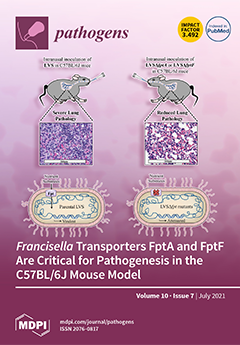
Cover Story: Francisella tularensis (Ft) is a Tier 1 Select Agent of concern for biodefense for which there is no licensed vaccine. Herein, the Ft transporters, FptA and FptF, are evaluated as targets for attenuating mutations in Ft LVS. ΔfptA and ΔfptF mutant strains are attenuated and confer protection against lethal challenge in the mouse model. Furthermore, the data support roles for both transporters in modulating the host immune response to promote Ft’s full virulence. The results support a fundamental requirement for FptA and FptF in the pathogenesis of Ft and their potential as targets in Ft vaccine development. View this paper.
  • Issues are regarded as officially published after their release is announced to the table of contents alert mailing list .
  • You may sign up for email alerts to receive table of contents of newly released issues.
  • PDF is the official format for papers published in both, html and pdf forms. To view the papers in pdf format, click on the "PDF Full-text" link, and use the free Adobe Reader to open them.

Articles (133)

  • Article
  • Open Access
25 Citations
4,642 Views
11 Pages

Biological Control of Take-All and Growth Promotion in Wheat by Pseudomonas chlororaphis YB-10

  • Wen Xu,
  • Lingling Xu,
  • Xiaoxu Deng,
  • Paul H. Goodwin,
  • Mingcong Xia,
  • Jie Zhang,
  • Qi Wang,
  • Runhong Sun,
  • Yamei Pan and
  • Chao Wu
  • + 1 author

Wheat is a worldwide staple food crop, and take-all caused by Gaeumannomyces graminis var. tritici can lead to a tremendous decrease in wheat yield and quality. In this study, strain YB-10 was isolated from wheat rhizospheric soil and identified as P...

  • Article
  • Open Access
32 Citations
7,211 Views
15 Pages

Characterization of Oral Microbiota in Cats: Novel Insights on the Potential Role of Fungi in Feline Chronic Gingivostomatitis

  • Janina A. Krumbeck,
  • Alexander M. Reiter,
  • James C. Pohl,
  • Shuiquan Tang,
  • Young J. Kim,
  • Annika Linde,
  • Aishani Prem and
  • Tonatiuh Melgarejo

Previous studies have suggested the involvement of viral and bacterial components in the initiation and progression of feline chronic gingivostomatitis (FCGS), but the role of fungi remains entirely unknown. This pilot study aimed to investigate the...

  • Article
  • Open Access
3 Citations
2,774 Views
16 Pages

Selection for Plastic, Pathogen-Inducible Recombination in a Red Queen Model with Diploid Antagonists

  • Sviatoslav Rybnikov,
  • Zeev Frenkel,
  • Abraham B. Korol and
  • Tzion Fahima

Antagonistic interactions and co-evolution between a host and its parasite are known to cause oscillations in the population genetic structure of both species (Red Queen dynamics). Potentially, such oscillations may select for increased sex and recom...

  • Article
  • Open Access
23 Citations
7,939 Views
14 Pages

West Nile Virus in Brazil

  • Érica Azevedo Costa,
  • Marta Giovanetti,
  • Lilian Silva Catenacci,
  • Vagner Fonseca,
  • Flávia Figueira Aburjaile,
  • Flávia L. L. Chalhoub,
  • Joilson Xavier,
  • Felipe Campos de Melo Iani,
  • Marcelo Adriano da Cunha e Silva Vieira and
  • Danielle Freitas Henriques
  • + 21 authors

Background: West Nile virus (WNV) was first sequenced in Brazil in 2019, when it was isolated from a horse in the Espírito Santo state. Despite multiple studies reporting serological evidence suggestive of past circulation since 2004, WNV remains a l...

  • Article
  • Open Access
1 Citations
3,564 Views
13 Pages

Variations in the Abortive HIV-1 RNA Hairpin Do Not Impede Viral Sensing and Innate Immune Responses

  • Melissa Stunnenberg,
  • John L. van Hamme,
  • Atze T. Das,
  • Ben Berkhout and
  • Teunis B. H. Geijtenbeek

The highly conserved trans-acting response element (TAR) present in the RNA genome of human immunodeficiency virus 1 (HIV-1) is a stably folded hairpin structure involved in viral replication. However, TAR is also sensed by viral sensors, leading to...

  • Article
  • Open Access
15 Citations
7,556 Views
13 Pages

Microbiological Quality of Nuts, Dried and Candied Fruits, Including the Prevalence of Cronobacter spp.

  • Anna Berthold-Pluta,
  • Monika Garbowska,
  • Ilona Stefańska,
  • Lidia Stasiak-Różańska,
  • Tamara Aleksandrzak-Piekarczyk and
  • Antoni Pluta

Cronobacter genus bacteria are food-borne pathogens. Foods contaminated with Cronobacter spp. may pose a risk to infants or immunocompromised adults. The aim of this study was to determine the microbiological quality of nuts, seeds and dried fruits w...

  • Review
  • Open Access
6 Citations
5,574 Views
15 Pages

West Nile virus (WNV) is an emerging and re-emerging zoonotic flavivirus first identified in and endemic to Africa. The virus is transmitted between birds by biting mosquitoes, with equids and humans being incidental hosts. The majority of infected i...

  • Article
  • Open Access
7 Citations
3,287 Views
9 Pages

Tick-borne pathogens are an important medical and veterinary issue worldwide. Environmental monitoring in relation to not only climate change but also globalization is currently essential. The present study aimed to detect tick-borne pathogens of the...

  • Article
  • Open Access
14 Citations
3,773 Views
12 Pages

The aim of this study was to compare the virulence of porcine circovirus type 2 (PCV2) genotypes in dually inoculated pigs with both three genotypes (a, b, and d) of PCV2 and porcine reproductive and respiratory syndrome virus-2 (PRRSV-2) versus pigs...

  • Article
  • Open Access
16 Citations
4,083 Views
13 Pages

Tularemia Outbreaks in Spain from 2007 to 2020 in Humans and Domestic and Wild Animals

  • Olga Mínguez-González,
  • César-Bernardo Gutiérrez-Martín,
  • María del Carmen Martínez-Nistal,
  • María del Rosario Esquivel-García,
  • José-Ignacio Gómez-Campillo,
  • Jesús-Ángel Collazos-Martínez,
  • Luis-Miguel Fernández-Calle,
  • Cristina Ruiz-Sopeña,
  • Sonia Tamames-Gómez and
  • Sonia Martínez-Martínez
  • + 4 authors

In this study, tularemia outbreaks associated with humans and several domestic and wild animals (Iberian hares, wild rabbits, voles, mice, grey shrews, sheep, dogs, foxes, wolves, ticks, and river crayfish) are reported in Spain from 2007 to 2020. Sp...

of 14

Get Alerted

Add your email address to receive forthcoming issues of this journal.

XFacebookLinkedIn
Pathogens - ISSN 2076-0817