


Abstract
This article examines how the discourse of “for your own good” functions as a moral framework through which parental violence is reinterpreted as care in Sinophone family cinema. Focusing on family-centered films as a key site of representation, we analyze how reconciliation is constructed not merely as a narrative resolution but as an ethical expectation. Drawing on theoretical perspectives from Michel Foucault and Louis Althusser, we develop the concept of “moralized parental violence” to describe how authority, discipline, and emotional control are legitimized through moral discourse. Through a typological analysis, identify three recurring models of reconciliation: deathbed reconciliation, retrospective understanding, and silent reconciliation. The study further explores works that resist reconciliation, arguing that such narratives suspend ethical closure and challenge normative expectations of forgiveness. By examining narrative structure, visual emphasis, and affective strategies, we demonstrate how cultural texts guide audience responses and shape moral interpretation. Rather than rejecting family values, this study reconsiders how ethics, power, and care are intertwined in cultural narratives and how the refusal of reconciliation opens a critical space for rethinking the limits of moral obligation.
1. Introduction
Within the Sinophone cultural context, few expressions carry as much moral weight as the phrase “for your own good.” Whether articulated by parents, teachers, superiors, or other authority figures, this seemingly benevolent declaration functions as a rhetorical tool that translates control, discipline, and even violence into the language of care. Physical, psychological, and structural forms of violence are all legitimized and sanitized under the rhetoric of “sacrifice”: adults endure suffering and exercise restraint for the sake of children, thereby acquiring a moral entitlement to control them. This moral economy of “for your own good” gives rise to what this article terms “moralized parental violence”, a specific form of violence that is not only tolerated but often rendered ethically necessary through its entanglement with love, responsibility, and sacrifice.
Existing film studies scholarship has consistently emphasized that family melodrama is structured around intra-familial conflict and its narrative resolution, often articulated through cycles of tension and reconciliation (Bitney 2022). Such narratives are driven not just by linear causality but also by the intensification of affect through highly codified emotional scenes, such as confrontation, suffering, and deathbed encounters, where moral authority is reasserted and the primacy of familial duty over individual desire is reinforced (Jayamanne 1992). Within Sinophone film studies, scholars have further examined how domestic narratives construct familial bonds, circulate moral values, and organize audience identification through patterns of affect and narrative closure (e.g., Berry 2009; Lu 1997; Teo 2013). Taken together, these perspectives suggest that reconciliation in family melodrama should be understood not merely as emotional closure but as a structurally and affectively organized process embedded within specific cultural and ethical frameworks. Building on this foundation, this study shifts the analytical focus toward the moralization of parental violence, examining how such violence is rendered ethically legible and narratively necessary within Sinophone family cinema.
Sinophone cinema has long served not merely as a site for the representation of the moral economy but as a field for its active reproduction (Berry 2009; Lu 1997). Films centered on familial conflict frequently culminate in moments of reconciliation, such as forgiveness at the brink of death, belated recognition of parental sacrifice, or a silent acknowledgment that restores familial order (Teo 2013). These reconciliations are narratively constructed as ethical inevitabilities, as if the only legitimate resolution to stories of familial harm is forgiveness and repair. Yet this compulsion toward reconciliation constitutes a fallacy in itself. If the reconciliations presented in mainstream cinema do not in fact resolve conflict but rather operate as an ideological mechanism, one that seals off structural violence, restores the legitimacy of parental authority, and compels audiences to participate in a moral closure they may not willingly grant, how should such narratives be evaluated?
Drawing on a corpus of Sinophone films dealing with family themes, we classify reconciliation into three types, terminal illness or deathbed reconciliation, success-driven retrospective understanding, and silent acknowledgment of fault, alongside heterogeneous pathways that refuse reconciliation altogether. Following an analysis of narrative structure, cinematography, and characterization, we pose three interrelated questions: First, how does each film represent violence, and how is such violence situated within the moral economy of “for your own good”? Second, how is reconciliation, or its refusal, constructed at the narrative level, and what formal devices shape the audience’s ethical orientation toward these resolutions? Third, what critical insights can be gained by identifying “reconciliation” itself as a narrative device that may perform ideological functions, such as restoring parental or familial authority while foreclosing structural critique?
This study employs a qualitative, interpretive methodology grounded in close textual and narrative analysis. Rather than aiming for a comprehensive survey of Sinophone cinema, a theoretically driven analysis is based on a selective corpus of films that foreground parent–child conflict and its narrative resolution.
The selection of case studies followed three primary criteria. First, the films must centrally depict parent–child relationships in which forms of violence, whether physical, emotional, or structural, are framed, justified, or mediated through moral discourse, particularly through variations in the rhetoric “for your own good.” Second, the films must contain explicit or structurally significant moments of reconciliation, or, alternatively, a marked refusal of reconciliation, allowing for a comparative examination of different narrative resolutions. Third, the films originate from Sinophone contexts. In this study, it is understood that the selected films are not a comprehensive representation of “Sinophone cinema,” but a culturally and linguistically interconnected field in which Confucian-inflected familial ethics and contemporary socio-economic pressures intersect in distinct ways.
The corpus is not intended to be statistically representative but analytically generative. The films discussed were selected for their capacity to exemplify recurring narrative patterns, including deathbed reconciliation, retrospective understanding through success, and silent acknowledgment of fault, as well as their potential to illuminate deviations from these patterns. In this sense, this study operates through a form of theoretical sampling in which individual cases are mobilized to clarify broader ideological and esthetic mechanisms rather than to establish empirical generalizations.
Finally, the analysis incorporates a narrative aspect with attention to formal elements, including visual framing, affective orchestration, and narrative closure. This approach facilitates the study of not only what is represented but also how cinematic form participates in shaping ethical interpretation and spectatorship.
The article is structured in four parts. It begins by outlining the theoretical framework of moralized parental violence and reconciliation as a narrative device. Then, the threefold typology of reconciliation narratives is examined. In the third section, a case of radically refused reconciliation is analyzed. Finally, through a comparative analysis, we argue that the distinction between reconciliation and its refusal reveals the ideological work performed by reconciliation narratives, opening up a critical space for films that resist the imperative to forgive.
2. Theoretical Framework: Moralized Parental Violence and Reconciliation as a Narrative Device
While this study primarily engages with Foucauldian and Althusserian frameworks, it is important to situate these mechanisms within the broader context of Confucian relational ethics, particularly the hierarchical structure of parent–child relations and the moralization of authority through filial piety.
Before turning to the detailed textual analysis, it is necessary to clarify the two core concepts employed in this study: moralized parental violence and reconciliation as a narrative device. These concepts are the primary analytical tools in this research, enabling us to problematize what appear to be naturalized moral choices within film narratives and to expose the ideological mechanisms underlying them (Hall 1985; Althusser 1971).
2.1. Moralized Parental Violence
The power of the phrase “for your own good” lies in its capacity to translate power relations into expressions of love. When parents or elders invoke this phrase, they simultaneously perform three rhetorical operations. First, they define their actions as being “in the interest of the other,” thereby effacing any potential self-interest. Second, they frame resistance as a failure to recognize goodwill, thus stripping it of legitimacy. Third, they redefine potential forms of violence, whether verbal humiliation, physical punishment, or emotional manipulation, as “necessary means,” thereby granting them moral legitimacy.
From the perspective of disciplinary theory, the efficacy of this discourse lies not only in legitimizing violence but also in producing compliant subjects. As Michel Foucault argues in Discipline and Punish, modern power has shifted from repression to discipline: through continuous surveillance, normalizing judgment, and the operation of technologies of the self, individuals are guided to internalize power relations and to transform them into modes of self-governance (Foucault 1977). In this sense, “for your own good” functions as a disciplinary operation. It rearticulates parental violence as “education,” “cultivation,” or “love,” such that children, in accepting this discourse, actively participate in their own domestication and submission. Rather than being suppressed through resistance, they learn self-discipline through the process of “understanding their parents’ good intentions.” This suggests the deeper mechanism of such violence (Foucault 1982).
This article terms this phenomenon moralized parental violence, emphasizing that such violence is not perceived or accepted as violence per se but is instead translated through a moral rhetoric into responsibility, care, and sacrifice (Kleinman 1995; Illouz 2007). Its operation relies on three interrelated mechanisms:
First is the narrative of sacrifice, in which violence is embedded within the framework of “how much I have sacrificed for you.” Parental suffering, physical exhaustion, economic pressure, and the abandonment of personal aspirations become the very justification for violence. Within this logic, violence is no longer construed as harm inflicted upon the child but as an expression of parental necessity (Illouz 2007). A recurrent cinematic motif in which parents reveal fatigue and vulnerability after committing acts of violence serves as a visual articulation of this sacrificial narrative.
Second is the modern translation of filial piety discourse. While traditional Confucian filial piety emphasizes absolute obedience to parents, in modern contexts it is reframed as an affective demand to “understand” and “empathize with” one’s parents (Kipnis 2011). The imperative is no longer “you must be filial,” but rather “you should recognize how difficult it has been for your parents.” This translation blurs the boundary between control and emotion, rendering power relations more opaque. Instead of enforcing compliance through external norms, it mobilizes affect to elicit voluntary identification (Yan 2010). Cinematic reconciliation scenes are often structured upon this logic: children ultimately “come to understand” their parents, and this understanding itself is presented as a marker of ethical maturity.
Third is the isomorphism between state and family. In the modern formation of Chinese nation-states, the family has frequently functioned as a foundational model of social order. The stability of the family is equated with the stability of society, and the legitimacy of parental authority is metaphorically aligned with that of state power (Dirlik 1997). Within this structure, challenging parental authority is not merely framed as familial rebellion but implicitly associated with a threat to social order. Consequently, cinematic resolutions of family conflict often assume a symbolic function of social restoration (Berry 2009).
The purpose of employing this concept is not to pathologize all forms of parenting but to expose a specific discursive mechanism. Within this mechanism, violence is moralized, power is naturalized, and critique is preemptively framed as “unfilial” or “lacking understanding” (Foucault 1977; Althusser 1971). The analysis of film, therefore, seeks not to simply condemn this mechanism but to identify and interrogate its modes of operation.
2.2. Reconciliation as a Narrative Device
If moralized parental violence constitutes the recurrent social reality represented in Sinophone family films, then reconciliation operates as the narrative device through which such violence is legitimized and sealed off. Here, the term “device” is used to emphasize that reconciliation is not a natural narrative development but a carefully constructed narrative operation that serves specific ideological functions.
Louis Althusser’s theory of ideological state apparatuses provides a crucial framework for understanding the ideological function of reconciliation. In Ideology and Ideological State Apparatuses, Althusser argues that the reproduction of state power relies not only on repressive state apparatuses (such as the government, military, and police) but also on ideological state apparatuses, including the family, education, religion, and the media (Althusser 1971). Through ideology, individuals are “interpellated” as subjects. Within Althusser’s framework, the family occupies a central position; rather than a pre-political private sphere, it is a key site for the reproduction of state power, where individuals are drawn into specific social positions through everyday discourse, ritual practices, and affective bonds, leading them to identify with the existing order (Althusser 1971).
Reconciliation narratives constitute a paradigmatic site for such interpellative mechanisms. When, at the conclusion of a film, children articulate statements such as “I understand now” or enact gestures of forgiveness, they not only achieve narrative closure but are also ideologically interpellated as “children who understand their parents” (Althusser 1971). The efficacy of this interpellation lies in its presentation as a voluntary act, as if reconciliation were an internally motivated, mature choice rather than the product of both narrative structuring and ideological pressure.
Based on an analysis of a wide range of Sinophone family films, three dominant patterns of reconciliation can be identified, each exemplifying Althusserian interpellation:
The first is deathbed reconciliation, the most canonical form. Parents (or one parent) reconcile with their children at the brink of death, and it is precisely at this moment of imminent loss that the children finally “come to understand” parental intentions. The ideological force of this pattern lies in the fact that death forecloses further questioning: any critique of parental behavior appears untimely or even cruel (Kleinman 1995). This suggests an extreme moment of interpellation, in which children are hailed as “filial subjects,” while the audience is affectively compelled to accept the closure (Althusser 1971).
The second is retrospective understanding through success. In this pattern, children only “truly understand” their parents after experiencing analogous life conditions, such as becoming parents themselves or facing comparable professional pressures. The central rhetoric here is, “you will understand when you reach my age.” This formulation presupposes the correctness of parental authority and frames children’s earlier incomprehension as a function of immaturity (Kipnis 2011). Intergenerational understanding is thus grounded in positional equivalence rather than in critical reflection on power relations. The children’s success, whether professional achievement or familial fulfillment, becomes the precondition for understanding, while understanding itself is framed as a marker of maturity. This represents a deferred interpellation, completed only when the child occupies a social position homologous to that of the parent (Yan 2010; Althusser 1971).
The third pattern is more covert: reconciliation through silent acknowledgment of fault. Here, parents do not explicitly apologize but instead signal remorse through their actions, such as quiet assistance or awkward expressions of care. Children, in turn, complete the reconciliation by accepting these gestures. The defining feature of this pattern is that the power structure remains fundamentally intact: parental authority is neither dismantled nor explicitly questioned. Reconciliation occurs without language, without apology, and without structural transformation. Conflict is thus “absorbed” rather than “resolved” (Hall 1985). From an Althusserian perspective, this is perhaps the most effective ideological operation, precisely because it requires no overt coercion; subjects “voluntarily” align themselves with the existing order (Althusser 1971; Žižek 1989).
What unites these three patterns is that they all construct reconciliation as an ethical inevitability. Within the narrative logic, the refusal of reconciliation is coded as “immaturity,” “unfiliality,” or an inability to let go (Kipnis 2011). Audiences are guided to anticipate reconciliation, to desire it, and ultimately to identify with it. This process of identification is precisely where ideology exerts its force.
2.3. Ethical Orientation of Spectatorship and the Possibility of “Refusing Reconciliation”
The outcomes of the foregoing analysis further raise the question, how do reconciliation narratives guide the ethical positioning of spectators? In this study, we identify three primary dimensions through which such guidance operates.
The first is visual dominance. In scenes of familial conflict, whose perspective is privileged by the camera? Whose face is granted emotional weight through close-ups? When the visual center of gravity is placed on parental fatigue and vulnerability, spectators are guided, through cinematic language, to empathize with the parents. Conversely, when emphasis is placed on the child’s suffering and resistance, spectators are encouraged to question parental authority. The visual strategies of reconciliation narratives tend to privilege the former: parents are framed as “equally wounded subjects,” thereby obscuring the asymmetry of power.
Second is affective orchestration. Film regulates spectators’ emotional responses through music, rhythm, and editing. Moments of reconciliation are frequently accompanied by emotive scoring, decelerated pacing, and close-ups of embraces and tears. These formal techniques generate an intensified affective charge, mobilizing the spectator’s emotions in ways that can suspend critical reflection in favor of emotional identification (Illouz 2007). Even when spectators retain intellectual reservations, they may nonetheless be affectively compelled to accept reconciliation.
Third, the pressure of narrative closure. Narrative cinema is structurally oriented toward closure: stories demand an ending, and reconciliation is among the most conventional forms of resolution. Within the Sinophone cultural context in particular, there is a strong preference for harmonious “happy ending” configurations. As a film approaches its conclusion, the spectators enter a psychological state of anticipating closure, making reconciliation scenes more readily acceptable. Endings that refuse reconciliation disrupt this expectation and are therefore narratively more challenging.
2.4. Theoretical Synthesis
In this study, disciplinary theory and ideological theory are not treated as mutually exclusive but as complementary frameworks. The analysis of Michel Foucault enables us to understand how the discourse of “for your own good” produces compliant subjects through micro-level disciplinary techniques, such as training, surveillance, and normalizing judgment (Foucault 1977). Children are not suppressed through overt resistance; rather, they learn self-discipline in the very process of “coming to understand” their parents’ intentions (Foucault 1982). The analysis of Louis Althusser, by contrast, allows us to grasp how reconciliation narratives function through ideological interpellation: at the moment of reconciliation, children are hailed into the social position of the “filial child” and come to identify with this position as if voluntarily (Althusser 1971).
Disciplinary power explains how violence is internalized, while ideology explains how reconciliation is accepted as necessary (Foucault 1977; Althusser 1971). Together, these two frameworks constitute an integrated analytical apparatus for examining both the operational logic of moralized parental violence and the ideological function of reconciliation narratives in Sinophone family cinema. Reconciliation, in this context, emerges precisely at the intersection of micro-level discipline and macro-level ideological reproduction.
In the following sections, we apply this analytical framework to a typological examination of reconciliation narratives in Sinophone family films while also investigating how films that refuse reconciliation disrupt this ideological configuration.
3. Three Modes of Reconciliation
In this section, the theoretical framework developed in the preceding sections is applied to a typological analysis of reconciliation narratives in Sinophone family cinema. Based on examining more than a dozen films, we identify three dominant modes of reconciliation: deathbed or illness-based reconciliation, retrospective understanding through success, and reconciliation through silent acknowledgment of fault. These categories are not mutually exclusive, as many films deploy multiple mechanisms in combination, but each exhibits a distinct narrative structure and ideological mode of operation.
The typological analysis follows a consistent analytical protocol. First, the basic narrative structure of each type is outlined. Second, a representative case is subjected to close reading, with particular attention to how violence is moralized, how reconciliation is constructed, and how spectators’ ethical orientations are guided. If it is necessary, one supplementary example is introduced to demonstrate the transregional articulation of the type.
3.1. Deathbed Reconciliation
Deathbed or illness-based reconciliation constitutes the most canonical mode of reconciliation in Sinophone family cinema (Elsaesser 2000; Williams 1998). Its basic narrative structure can be outlined as follows: familial conflict is suspended for an extended period until one or both parents face a terminal diagnosis or an unexpected life-threatening event. It is only in the face of imminent death that children are compelled to confront their relationship with their parents, ultimately arriving at understanding and forgiveness at the bedside (Brooks 1995).
The ideological operation of this mode relies on the dual function of death. First, death neutralizes critique: in the presence of someone about to die, any retrospective questioning appears untimely, cruel, or even inhumane (Ariès 1981). Second, death produces urgency: if reconciliation does not occur at this moment, the opportunity will be lost forever, and this “irreversible loss” is itself framed as an unbearable moral burden (Walter 1994). Under these dual conditions, reconciliation is constructed as the only ethically viable option.
From an Althusserian perspective, deathbed reconciliation functions as a form of coercive interpellation: the imminence of death forecloses the possibility of refusal, compelling the subject to occupy the position of the “filial child” (Althusser 1971). From a Foucauldian perspective, this type is often accompanied by a confessional mechanism, typically manifested in scenes where children are prompted to confess their misunderstanding or where they demand that their parents disclose the truth (Foucault 1978).
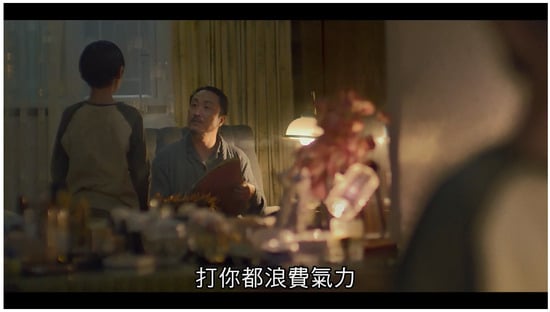
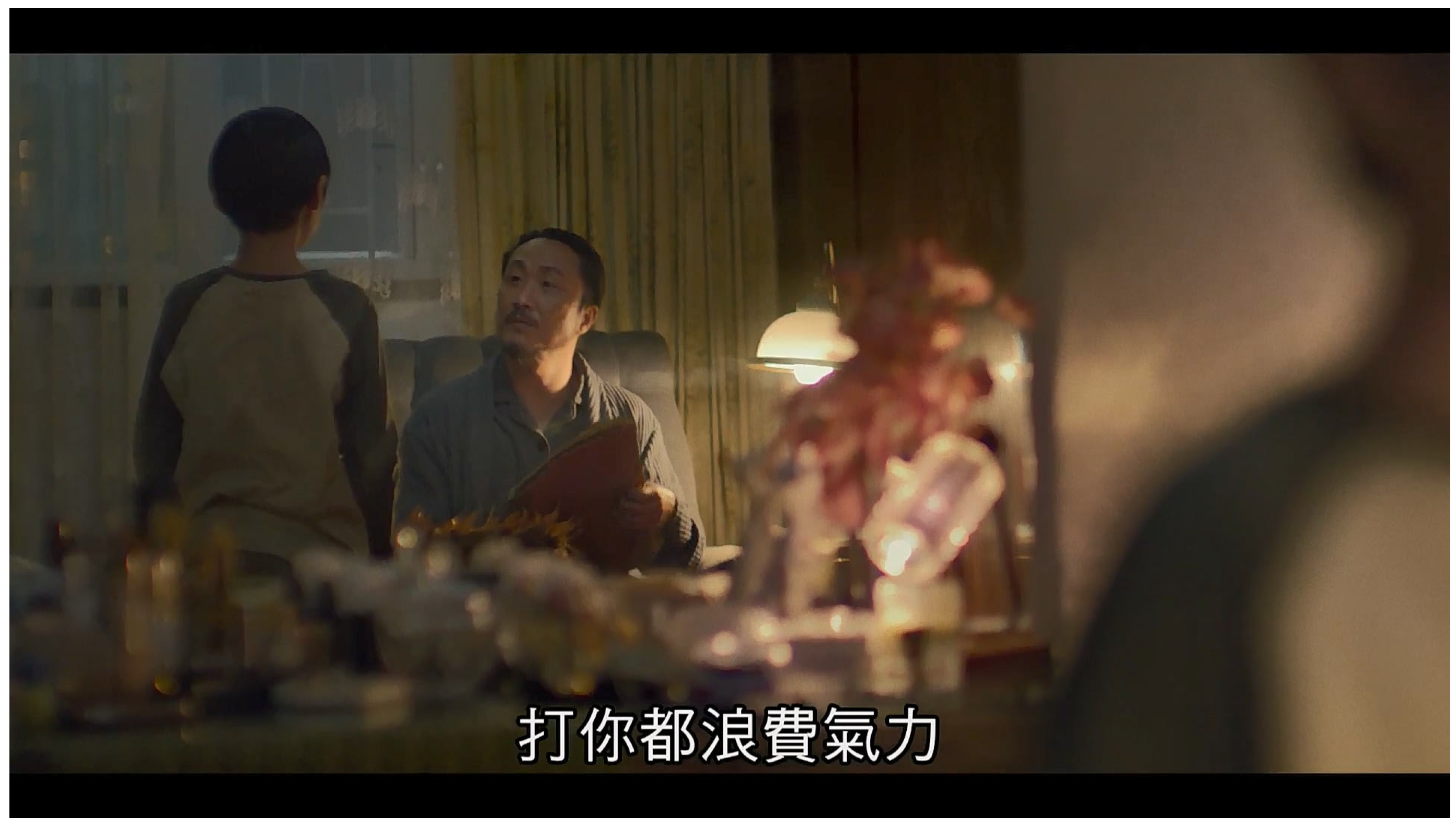
Nick Cheuk’s Time Still Turns the Pages serves as a quintessential representation of “terminal or illness-driven reconciliation.” Prior to the death of the eldest son, Eli (Sze-chit), the “elitist meritocracy” embodied by the father functioned as a rigorous, repressive apparatus. Eli, unable to answer the “summons to succeed,” eventually spiraled toward self-destruction. Moralized violence permeates the film: the father frequently brands Eli as “trash” (Cheuk 2023), declares him “not a talent” (Cheuk 2023), and even sneers “Hitting you is a waste of my energy” (Cheuk 2023) as shown in Figure 1. By explicitly stating that “achievement is forced out of people,” the father wraps his violence in a moral veneer, as if his physical abuse, sarcasm, and character assassination were inherently righteous.
Figure 1.
The father is saying “Hitting you is a waste of my energy” in Time Still Turns the Pages.
However, Eli’s suicide constitutes a different form of “finality.” Through the termination of his life, he forcibly thrusts his surviving younger brother, Cheng (the adult Mr. Cheng), into the position of both “mourner” and “culprit.” The urgency wrought by this death does not dissipate with time; instead, mediated by a yellowed childhood diary, it forces the adult Mr. Cheng to remain entrenched in a reflection on patriarchal violence and the shame of his own status as a “survivor.”
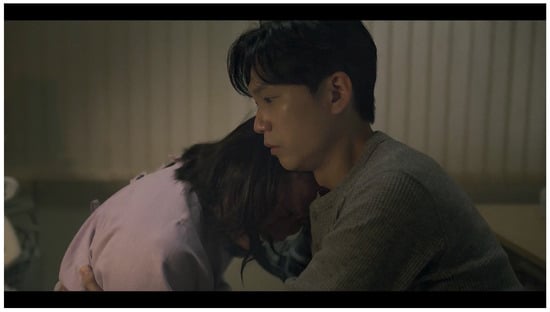
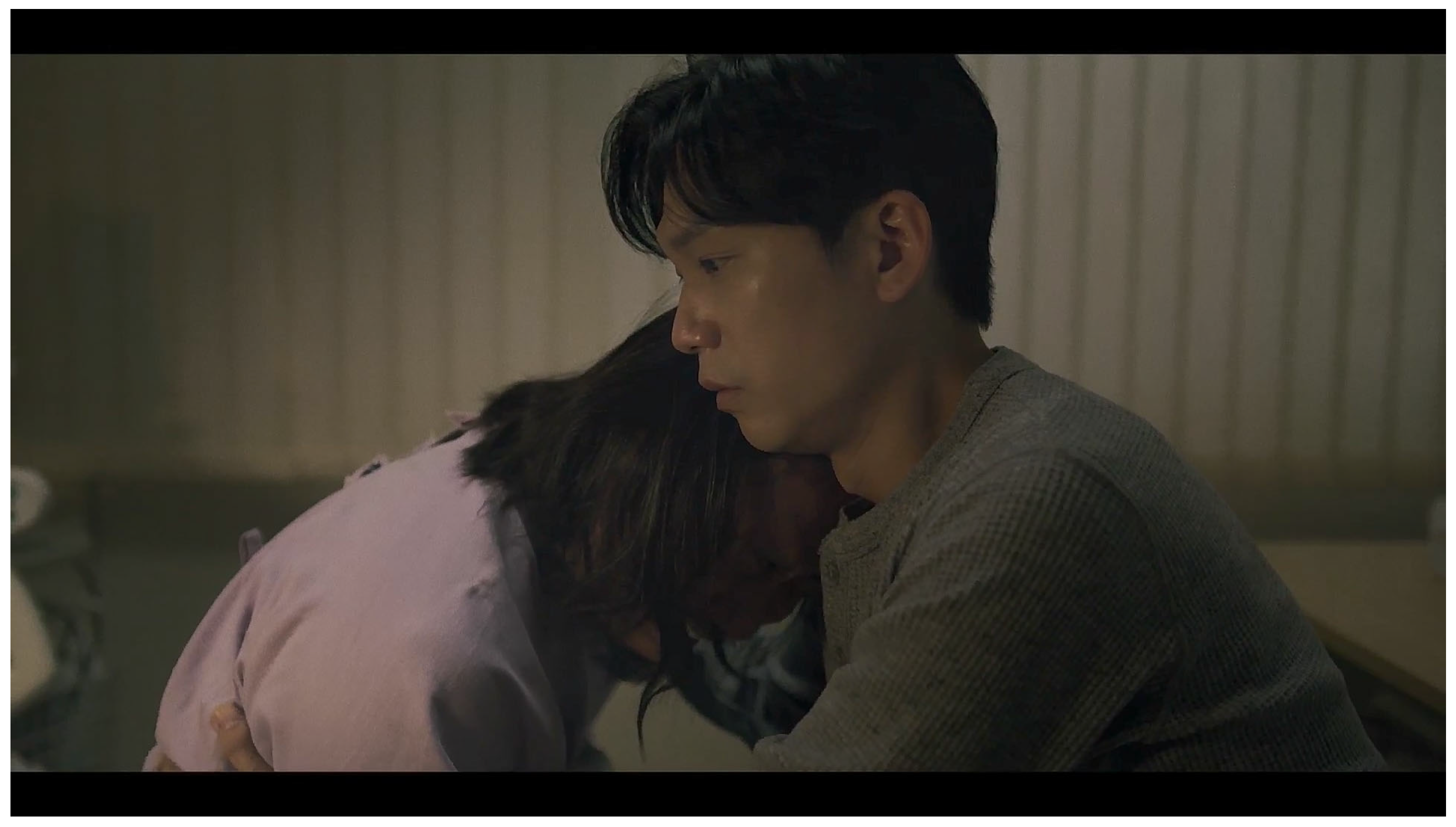
At the film’s conclusion, when the once-tyrannical father is transformed into a terminal patient, shriveled on a sickbed and entangled in medical tubes, the “dual function of death” is realized to its fullest extent. As shown in Figure 2.
Figure 2.
Mr. Cheng listens to his father’s tearful reminiscence and repentance for his late son in Time Still Turns the Pages.
First, it renders interrogation futile. Facing a father who has lost his capacity for speech and hangs by a thread, the adult son, Cheng, finds that even his most righteous indignation appears “untimely” and “cruel.” This physiological decay dissolves the father’s authority as an abuser, reducing him to a mere object demanding pity. Second, it initiates a transfer of the moral burden. As Mr. Cheng listens to his father’s tearful reminiscence and repentance for his late son, Eli, “forgiveness” is constructed as the only viable ethical exit. If some form of closure is not achieved in this moment, the living will be eternally imprisoned in the psychic black hole of an “unresolved reconciliation”.
From the perspective of Foucault’s theory of power, the diary becomes the material vessel for the “confessional” mechanism inherent in this genre. In traditional Chinese power narratives, children are systematically stripped of their agency and voice. Yet, through Eli’s suicide, this diary acquires a near-sacred “power of the last word.” On his deathbed, the father is effectively compelled to perform a “confession” regarding his own exploitative use of power.
3.2. Retrospective Understanding
The core narrative structure of reconciliation through retrospective understanding is as follows: children come to “truly understand” their parents only after undergoing experiences analogous to those their parents once faced. The canonical rhetoric of this model is that “you will understand when you reach my age.” Here, intergenerational understanding is grounded in positional equivalence rather than in critical reflection on power relations.
The ideological operation of this type relies on a form of deferred interpellation: only after entering a social position homologous to that of the parent, such as becoming a parent oneself or confronting comparable professional pressures, do children come to identify with parental authority (Althusser 1971). This identification is framed as “growth” and “maturity,” as if the failure to understand were merely a limitation of age rather than an effect of power relations.
From a Foucauldian perspective, this model represents one of the most efficient forms of disciplinary power: the subject does not submit under external coercion but rather “discovers” the correctness of parental authority through lived experience (Foucault 1977). This “discovery” is presented as autonomous and natural, thereby masking its ideological character.
Cao’s (2013) Einstein and Einstein offers a complex deconstruction of the “post-success understanding” myth. The film’s core narrative follows a systematic process of “socialization” in which the individuality of the protagonist, Li Wan, is dismantled by a series of moralized domestic violence.
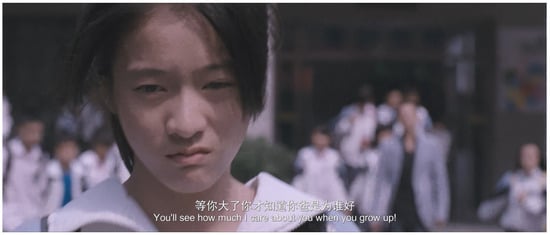
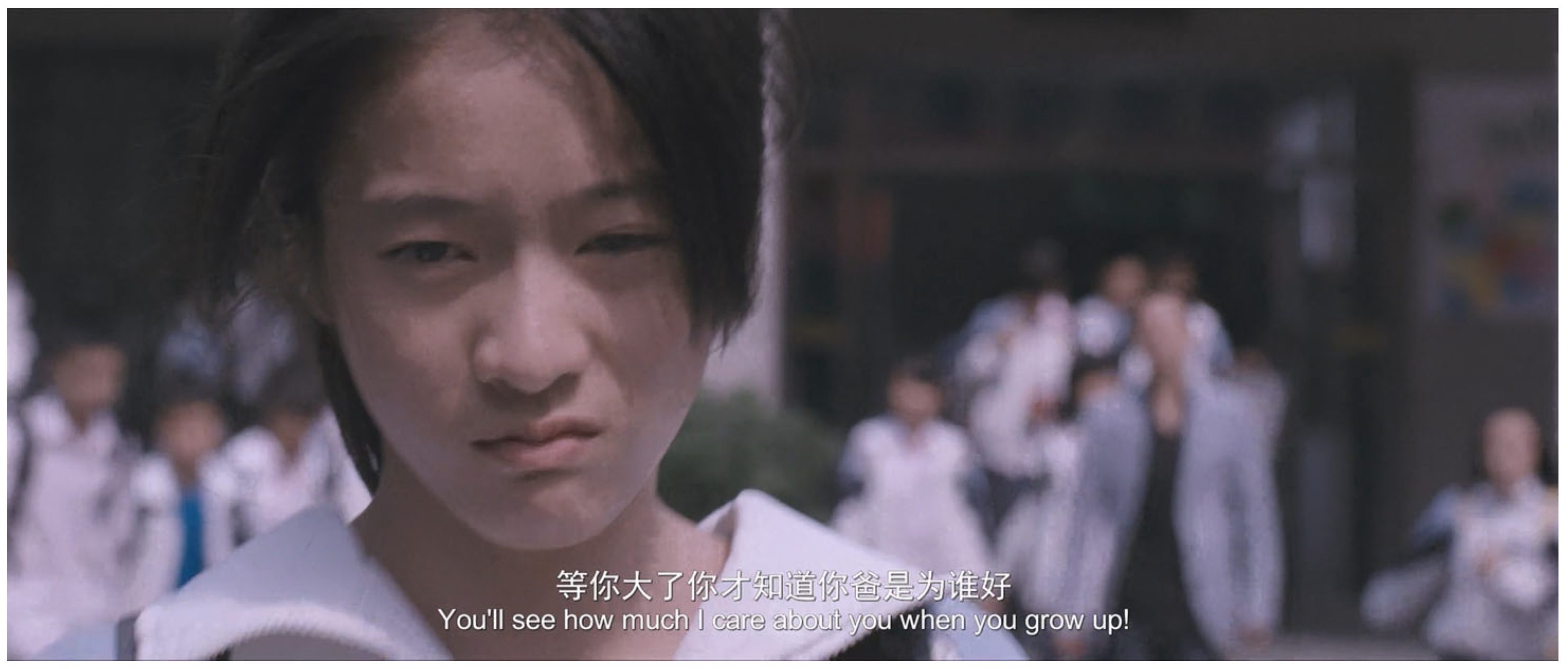
This process begins with the father, guided by a teacher, coercing Li Wan into joining an English study group, the very subject she dislikes and struggles with most. When she resists, the father impatiently pushes her aside and signs the consent form on her behalf. Chasing after her as she walks away in frustration, he exclaims: “I’ve been working all day and didn’t even get a chance to sleep, then had a long talk with your teacher for whole morning. I’m not living an easy life, am I? You’re still mad at me? You’ll see how much I care about you when you grow up” (Cao 2013) as shown in Figure 3. Similarly, the grandmother forces Li Wan to drink milk every morning, despite the girl’s physical intolerance and subsequent vomiting. To the grandmother, milk is “nutritious and good,” making the possibility of a biological rejection inconceivable.
Figure 3.
Li Wan’s father is exclaiming in Einstein and Einstein.
By the film’s conclusion, a “reconciliation” between Li Wan and her father (and the two “Einsteins”) is achieved following her success in a provincial physics competition. From a Foucaultian perspective, this “success” serves as the ultimate reward of disciplinary power. It is only when Li Wan reaches this socially recognized milestone, securing her place in an elite high school, that the father’s past brutality is retroactively “sanitized.” In the car, the father offers a tearful apology, framed by the rhetoric of “I’m doing this all for your own good,” which functions as a powerful act of ideological interpellation (Althusser 1971).
Li Wan is subsequently praised as a “sensible daughter”. Her silent endurance of her father’s grief, combined with her chillingly calm consumption of dog meat at the celebratory banquet, signals her total internalization of the patriarchal logic. This is a form of post-success understanding built upon the ruins of the self: she “understands” her father not through mutual empathy, but because she has been successfully assimilated into the very power structure that once oppressed her. The film’s final image of Li Wan’s pale, compliant smile reveals the most profound violence of moralized parenting: it transforms the victim into an accomplice of their own discipline, framing the loss of the soul as the arrival of “maturity”.
Mad World by Wong Chun presents a more ironic and critical variation in this model. The film centers on the conflict between Ah-Tung, a son diagnosed with bipolar disorder, and his father Wong Tai-hoi. After being discharged from a psychiatric institution, Ah-Tung returns to live with his father in a cramped public housing unit, where the two engage in a cycle of mutual harm. Here, the mechanism of “understanding through success” is inverted: the “success” in question is itself marked by failure. Ah-Tung eventually comes to understand his father’s impotence, an uneducated, socially marginalized man crushed by structural conditions, whose violence and emotional detachment appear less as malice than as incapacity. This understanding is framed as a form of maturity: Ah-Tung no longer demands an apology because he recognizes that his father lacks the capacity to apologize.
Yet the film’s critical force lies in the fact that this understanding produces no transformation. Ah-Tung remains trapped within the constraints of mental illness, and Wong Tai-hoi remains an inadequate father. Reconciliation here is rendered as a form of resigned acceptance rather than genuine repair.
3.3. Silent Acknowledgment
Reconciliation through silent acknowledgment constitutes the most covert form of reconciliation. Its defining feature is that parents do not offer explicit apologies; instead, they signal remorse or transformation through actions, such as quiet assistance, awkward gestures of care, or silent companionship. Children, in turn, complete the reconciliation by accepting these unspoken gestures.
The ideological efficiency of this type lies precisely in its minimalism: it requires no language, no confession, and no structural transformation. Conflict is “absorbed” without being articulated, accounted for, or resolved. Parents never explicitly acknowledge wrongdoing, and children never receive a genuine apology, yet reconciliation nonetheless “occurs.” It unfolds in the interstices of everyday life, grounded in a broader Chinese cultural presupposition that “everything is understood without being spoken”.
From a Foucauldian perspective, the confessional mechanism is entirely absent in this form of reconciliation (Foucault 1978). Neither parents nor children are compelled to verbalize the truth. As a result, the asymmetry of power remains fully intact: parents continue to occupy a position that requires no justification, while children remain in a position of acceptance. From an Althusserian perspective, this can be understood as the most “voluntary” form of interpellation: children appear to willingly accept parental gestures and to relinquish past grievances, thereby completing their identification with the existing order (Althusser 1971).
A Sun by Chung Mong-hong offers a complex articulation of this mode. The film portrays a family: the father, A-wen, a driving instructor, has two sons, A-hao, the exemplary elder son, and A-he, the rebellious younger one. After A-hao’s sudden suicide and A-he’s incarceration for a violent crime, the latter half of the film focuses on the attempted repair of the relationship between A-he and his father following A-he’s release.
Violence in the film operates on multiple levels. While the most visible form is A-he’s street violence, the central form is the father’s affective neglect, a form of emotional violence. A-wen recognizes only “one son” (A-hao), effectively erasing A-he’s existence. This affective violence is moralized through the discourse of paternal aspiration. A-wen’s recurring phrase, “Seize the day, decide your path” (Chung 2019), functions both as a driving school slogan and as a life principle imposed upon his sons. Its violence lies in its absolutization of A-wen’s personal standard as the “correct direction,” rendering A-he’s deviation as inherently erroneous. The film does not directly critique this discourse; instead, it reveals its destructive consequences through A-hao’s suicide. Overburdened by expectations of “universal illumination,” A-hao becomes the sacrificial subject of paternal desire.
Visually, the film constructs A-wen through a series of contradictions: he is frequently framed in shadow, from behind, or in silence, rendering him an opaque and unreadable figure. This visual strategy itself participates in the moralization of his violence, guiding spectators to ask, “why is he like this?” rather than “is he justified in acting this way?”
Reconciliation in A Sun occurs in the film’s final sequence, yet the father, A-wen, never utters an explicit “I’m sorry” to his son, A-he. His “acknowledgment of fault” is conveyed instead through two symbolic actions. First, after A-he was released from prison, he secretly guarded him while working. Second, standing under the midday sun, he confesses to A-he’s mother: “Because now, I really only have one [son]” (Chung 2019).
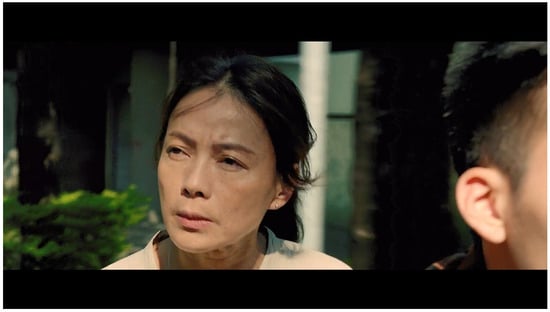
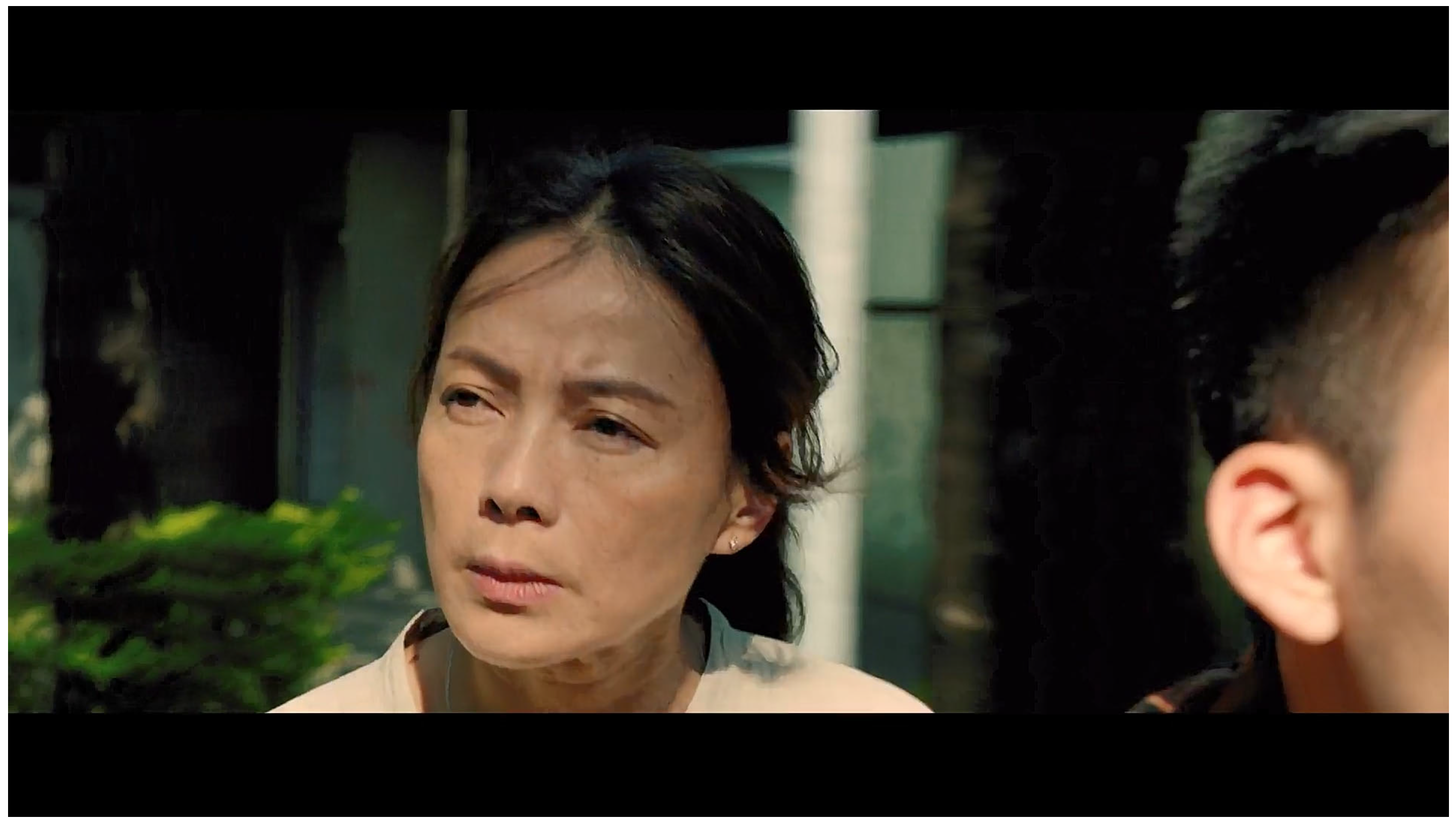
This second moment is the fulcrum of their reconciliation. A-wen’s admission, “I only have one son”, functions simultaneously as a belated recognition of A-he and a displaced mourning for the deceased A-hao. However, it is crucial to note that this “confession” contains neither a reflection on his past cruelty nor a guarantee of future change; it merely asserts a cold, biological fact: A-he is now his only remaining son. The film’s final sequence depicts the mother and son riding a bicycle together under the radiant sun; yet, the mother’s brow remains tightly furrowed, creating a scene where warmth and harshness coexist as shown in Figure 4. Reconciliation is achieved, yet it remains wordless, ambiguous, and fundamentally incomplete.
Figure 4.
The mother’s brow remains tightly furrowed on the back seat of the bike in A Sun.
The film guides spectators toward accepting this reconciliation through multiple mechanisms. First, visual redistribution: while A-wen is initially framed as cold and rigid, the latter half increasingly captures his vulnerability, aging, and impotence, inviting sympathy for a father “unable to express himself.” Second, affective suspension: the film withholds any clear moment of emotional release; there is no embrace, no overt weeping, and no melodramatic score with the scenario of father and son. This restrained, auteurist minimalism paradoxically enhances the perceived “authenticity” of reconciliation, making it appear less as a constructed device and more as an index of lived reality. Most importantly, the film redefines A-wen’s behavior as a form of paternal love, awkward, inarticulate, yet “sincere.” This redefinition constitutes the core ideological operation: affective violence is recoded as “inexpressive love,” and structural contradictions are displaced onto individual personality traits (Althusser 1971).
4. Heterogeneous Pathways of Refusal: Parental Violence and Familial Destruction in the Bold, the Corrupt, and the Beautiful
If the three modes of reconciliation analyzed in Section 3 constitute the dominant narrative tradition of Sinophone family cinema, this chapter turns to heterogeneous practices that refuse such a tradition. Rather than resolving conflict, these films sustain it in an open state; they refuse to provide spectators with moral certainty and reject the construction of reconciliation as an ethical necessity of narrative closure.
The refusal of reconciliation should not be understood as a simple endorsement of resentment or a negation of familial bonds. On the contrary, it functions as a critical practice: it exposes the ideological nature of reconciliation narratives (Althusser 1971), reveals the moral coercion embedded in the discourse of “for your own good,” and creates a conceptual space for the possibility of non-forgiveness. In doing so, it challenges the assumption that ethical maturity must culminate in understanding and reconciliation.
This chapter focuses on a key example of such refusal: The Bold, the Corrupt, and the Beautiful, a film that not only withholds reconciliation but also pushes familial relations toward disintegration. Through its portrayal of parental violence and the collapse of family structures, the film offers a radical counterpoint to the ideological operations identified in earlier chapters.
4.1. Narrative Cycles of Power
The Bold, the Corrupt, and the Beautiful by Yang Ya-che offers one of the most incisive critiques of moralized parental violence in Sinophone cinema. The film narrates the story of a politically entangled elite family. Madam Tang (played by Kara Wai) is the matriarch and ultimate authority, who manipulates her daughter Tang Ning (played by Wu Ke-xi) as an instrument in political and commercial transactions. Tang Ning’s daughter, Tang Chen (played by Vicky Chen), grows up within this environment and ultimately becomes the next Madam Tang.
The narrative structure unfolds as a cyclical configuration of power across three generations of women: Madam Tang controls Tang Ning; Tang Ning attempts but fails to escape; and Tang Chen, having witnessed this entire process, does not choose resistance but instead assumes the position of her grandmother. The horror of this cycle lies in the transformation of victims into perpetrators. Within this process, the discourse of “for your own good” becomes the mechanism through which all subjects are ultimately destroyed (Foucault 1977).
What distinguishes the film is its radical exposure of both the extremity and the collapse of the “for your own good (Yang 2017)” discourse. Madam Tang repeatedly invokes this phrase, yet the disjunction between her words and her actions is so stark that the phrase is stripped of any moral legitimacy, revealing itself as a naked lie. The film refuses any possibility of reconciliation: there is no deathbed forgiveness, no retrospective understanding, no gesture of absolution, only the complete disintegration of the family (Althusser 1971).
4.2. Moralized Violence and “For Your Own Good”
Madam Tang’s parental violence is systemic and destructive, yet it is consistently enveloped in the discourse of “protection” and “for your own good”. The film articulates the mechanisms of this moralized violence across three interrelated levels.
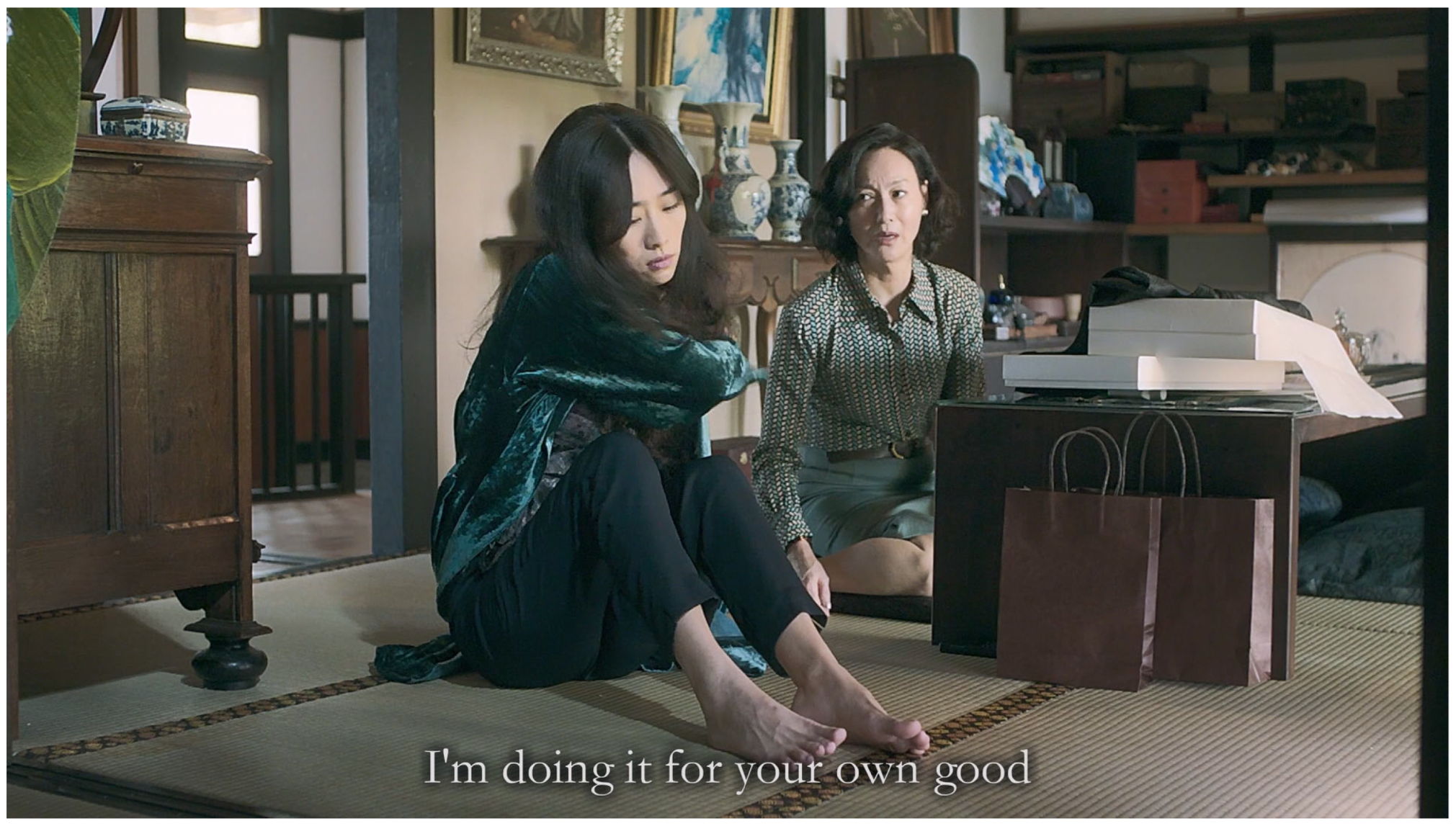
The first level is the instrumentalization of the daughter as a sexual commodity. Madam Tang arranges for Tang Ning to engage in sexual relationships with political and business elites in exchange for advantage. She tells her daughter, “I am doing it for your own good” and “we are doing this for the family” (Yang 2017). Through this discursive operation, Tang Ning’s body is transformed into a medium of exchange within familial capital, and this transformation is redefined as “sacrifice”, a moralized obligation. A key scene occurs when Madam Tang prepares Tang Ning for one such “assignment.” When Tang Ning resists, Madam Tang calmly responds: “Do you think I want this? I’m doing this for your own good” (Yang 2017) as shown in Figure 5. This exchange exemplifies the disciplinary function of the discourse: it does not persuade Tang Ning, but rather deprives her refusal of moral legitimacy. To resist is to become the “unfilial daughter” who fails to recognize maternal sacrifice.
Figure 5.
Madam Tang arranges for Tang Ning to engage in sexual relationships with political and business elites in exchange for advantage in The Bold, the Corrupt, and the Beautiful.
From a Foucauldian perspective, this scene demonstrates the operation of disciplinary power (Foucault 1977). Tang Ning is not coerced through overt force; instead, she is guided to internalize the necessity of “sacrifice.” Her resistance is morally coded as immaturity, while compliance is defined as maturity.
The second level is manipulating the granddaughter as a successor. Madam Tang cultivates Tang Chen to become her replica—cold, calculating, and ruthless. By bringing Tang Chen into the circles of the political and business elite, Madam Tang uses the ritual of “tea serving” as a pedagogical tool, allowing her granddaughter to observe and decipher the sophisticated linguistic maneuvers of adult power play. Furthermore, while teaching Tang Chen to paint, Madam Tang delivers a chilling instruction: “When you encounter something terrifying, the only way to stop seeing it is to face it head-on” (Yang 2017). The essence of this “protection” is not to shield Tang Chen from evil but to force her to internalize and master it, ensuring the seamless reproduction of the matriarchal power apparatus.
From an Althusserian perspective, this moment exemplifies ideological interpellation at its most fundamental level (Althusser 1971). Tang Chen is interpellated into the subject position of a “daughter of the Tang family,” yet this position is itself structurally destructive—it demands the relinquishment of affect, morality, and even humanity in order to become an operative within a system of power.
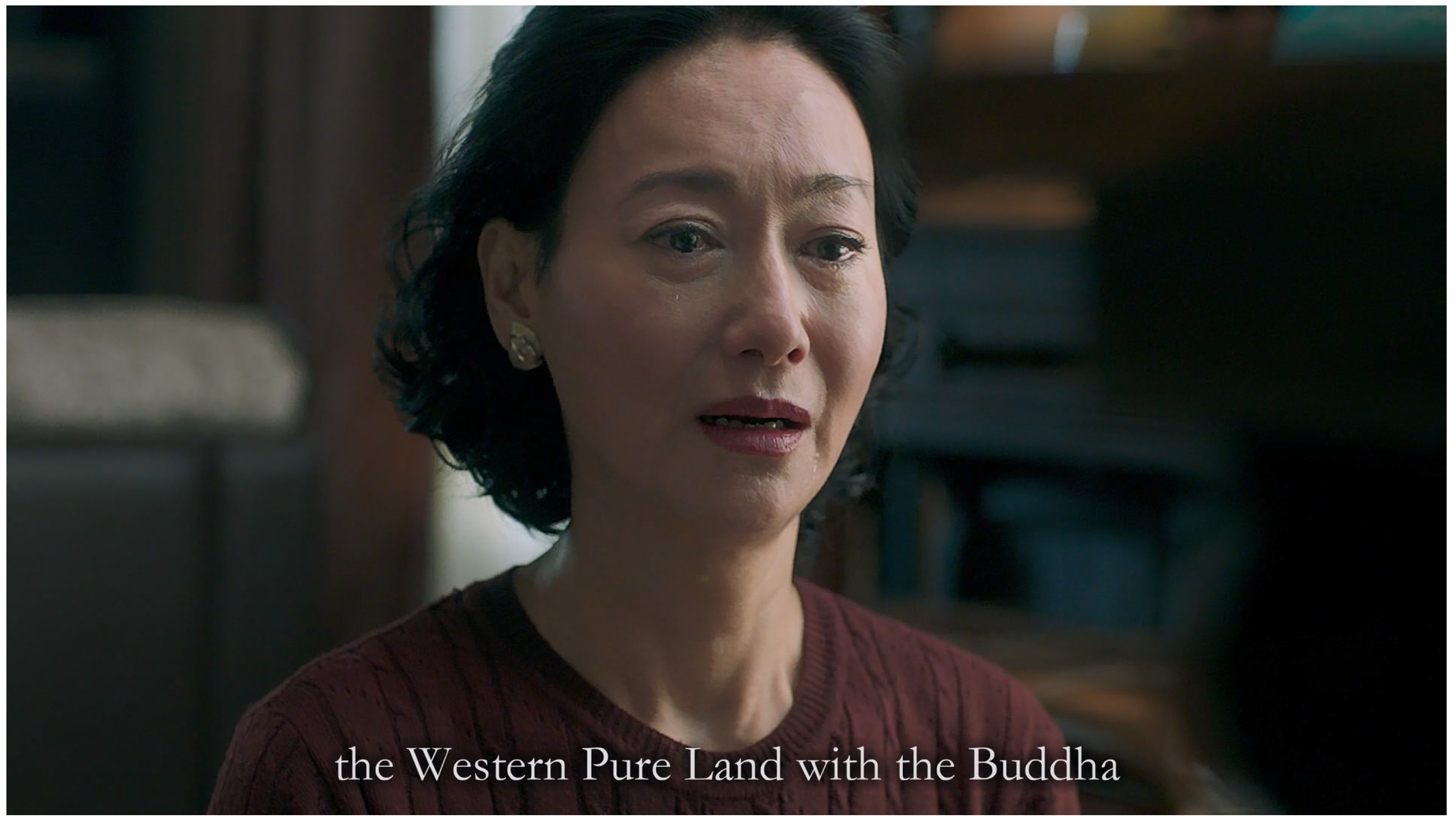
The third level is sacrificing the daughter for self-preservation. The film’s climax depicts Tang Ning’s desperate attempt to escape the family’s clutches. Although she intends to take Tang Chen with her, the girl refuses to follow, choosing instead to remain by Madam Tang’s side. To eliminate a potential liability, a fatal explosion is orchestrated to destroy the getaway boat at sea, with Tang Chen standing on the shore, a silent witness to her own mother’s annihilation. The scene then cuts to Madam Tang engaged in Buddhist chanting, starting with the Heart Sutra and transitioning into the Great Compassion Mantra as shown in Figure 6. In Buddhist tradition, the latter is often used to guide the souls of the deceased, a detail that heavily implies Madam Tang as the true architect of the explosion; she is the one who has killed her own daughter. The tears she sheds upon finishing the prayer serve as a “moral sugar-coating,” a sanctimonious attempt to cleanse and legitimize her own monstrous violence.
Figure 6.
Madam Tang engages in Buddhist chanting in The Bold, the Corrupt, and the Beautiful.
The film’s visual construction of Madam Tang reinforces this moralized violence. She is consistently presented as elegant, composed, and smiling; her violence is neither explosive nor chaotic but rational and calculated. The director frequently employs medium and long shots, restrained, distanced framings, to situate her within opulent interiors, dressed in refined clothes and with immaculate makeup. This visual contrast intensifies the exposure of the discourse’s hypocrisy: the agent of violence is not a pitiable figure “out of control,” but a composed strategist fully in command. This esthetic strategy disrupts the conventional sacrificial narrative. Madam Tang is never shown as exhausted or vulnerable; she offers no tearful confession, no visible fragility, only perpetual composure and control.
4.3. Radical Subversion of Reconciliation
The Bold, the Corrupt, and the Beautiful enacts a comprehensive and systematic refusal of reconciliation. It dismantles, one by one, the three dominant reconciliation models identified in Section 3.
First is the subversion of the “terminal reconciliation” model. The film presents two potential scenes of deathbed reconciliation, both of which are utterly dismantled.
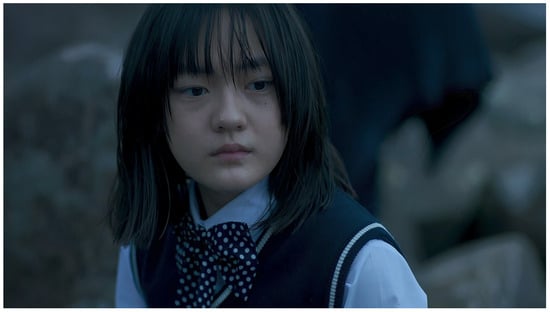
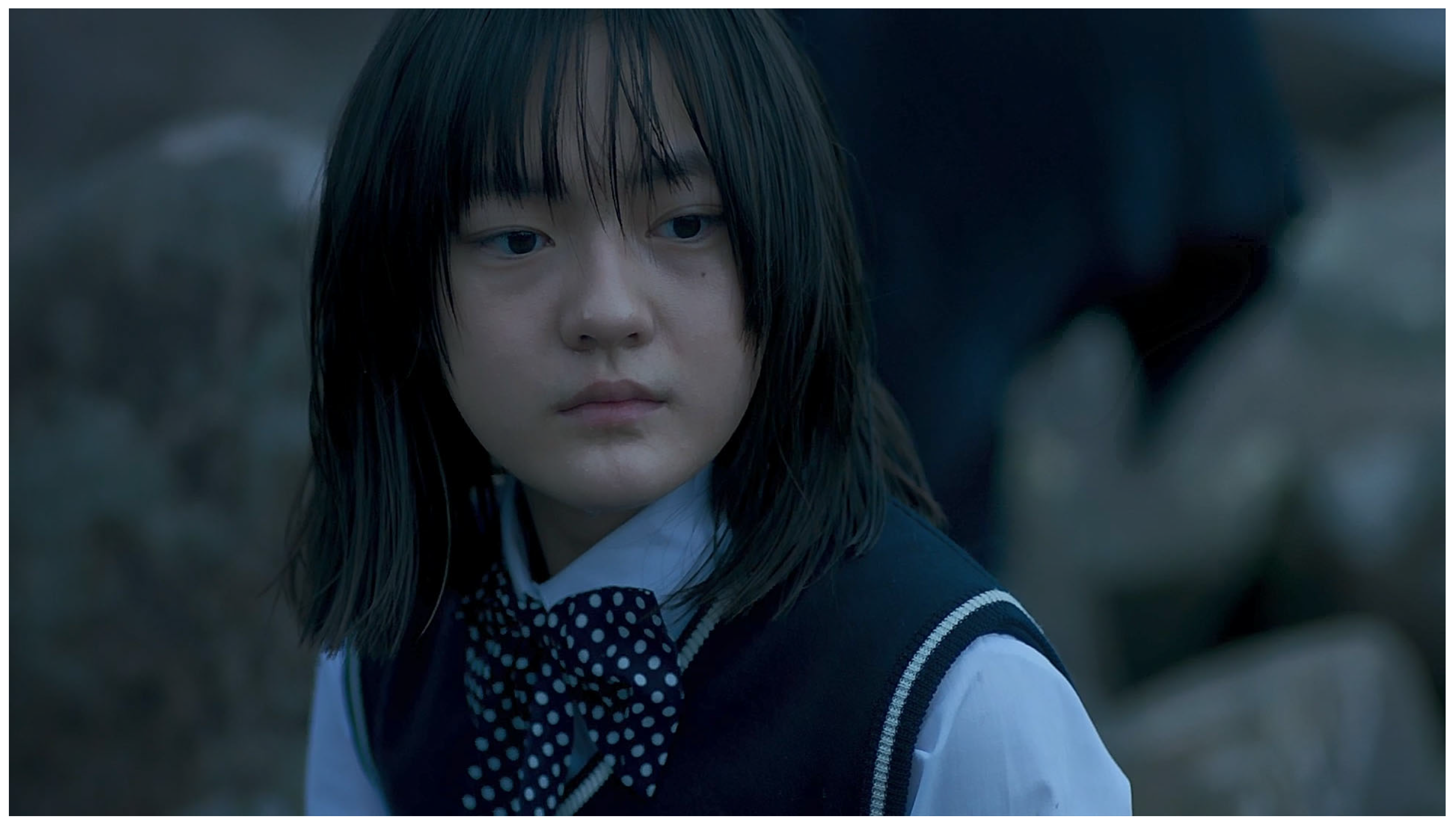
The first occurs when Tang Ning, attempting to flee with Tang Chen, tells her, “Mom loves you.” In conventional narratives, this would serve as the prelude to reconciliation, a moment where the daughter finally “understands” the mother as she faces departure or death. However, the film obliterates this expectation; Tang Chen offers no response as shown in Figure 7. Having been thoroughly molded by Madam Tang’s disciplinary regime, she is no longer capable of believing in the discourse of “love.” Furthermore, Tang Ning’s “love” remains fundamentally opaque: is it genuine affection or another layer of manipulation? The film refuses to provide an answer, denying this scene any status as a starting point for reconciliation.
Figure 7.
Tang Chen offers no response after Tang Ning said, “Mom loves you.” in The Bold, the Corrupt, and the Beautiful.
The second instance occurs at the film’s conclusion, with Madam Tang paralyzed in bed while Tang Chen watches her suffer. This is a radical inversion of the terminal reconciliation trope. In traditional storytelling, this is the quintessential moment for a “grand reconciliation,” where the daughter grants forgiveness to the dying matriarch. Instead, Tang Chen refuses to grant Madam Tang the “release” of death, withholding any form of absolution. She watches her mother (who is, in fact, her grandmother) struggle with cold detachment; there is no embrace, no forgiveness, and no closure.
The horror of this refusal lies not in its anger, but in its calculation. Tang Chen has become the mirror image of Madam Tang: cold, calculating, and ruthless. Her gaze is not fueled by hot-blooded hatred but by the stoic conclusion that “this is what you deserve.” This scene flips the terminal reconciliation model on its head: death is no longer a catalyst for harmony, but rather the site for the completion of revenge.
The second instance occurs at the film’s conclusion, when Madam Tang lies paralyzed, enduring a prolonged, painful existence, while Tang Chen observes her. In classical narrative terms, this would constitute the ultimate moment for reconciliation: the child, faced with the parent’s imminent death, finally offers forgiveness. Instead, Tang Chen refuses to grant release. She withholds both emotional and ethical closure: no embrace, no absolution, and no reconciliation. The force of this refusal lies in its affective register: it is not driven by anger but by cold calculation. Tang Chen has become another Madam Tang, composed, strategic, and devoid of sentimentality. Her gaze upon Madam Tang’s suffering is not one of hatred, but of judgment: “this is what you deserve.” In this inversion, death ceases to function as a catalyst for reconciliation and instead becomes the site at which retribution is completed.
Second, the film subverts the model of retrospective understanding through success. It systematically denies the spectator any access to understanding Madam Tang. She is not provided with a backstory that might render her legible: no childhood trauma, no structural oppression, and no narrative of reluctant sacrifice. She appears as an opaque figure of power, irreducible to explanatory causality. This refusal carries significant critical implications. In the “retrospective understanding” model, children come to understand their parents by occupying analogous positions. Tang Chen does, in fact, become the next Madam Tang; however, this transformation does not produce understanding. Instead, it produces replication. The film thereby exposes the fundamental illusion of this model: generational repetition does not necessarily yield comprehension; it may simply reproduce violence. Tang Chen’s “success,” marked by her acquisition of power, does not culminate in reconciliation but in the continuation of domination. The cycle is not a pathway to ethical resolution but a mechanism of violent perpetuation (Althusser 1971).
Finally, the film subverts the model of reconciliation through silent acknowledgment of fault. In conventional instances of this model, parents signal remorse through understated gestures, and children complete reconciliation by accepting them. In The Bold, the Corrupt, and the Beautiful, this structure is entirely dismantled. Madam Tang never offers gestures of goodwill, nor does she imply remorse. Her silence is not an index of guilt but an expression of sovereign arrogance. She does not apologize because she does not recognize herself as culpable. Correspondingly, Tang Chen never receives, nor accepts, any conciliatory gesture.
In the final scene, Madam Tang’s paralysis renders her silent and immobile, an extreme form of muteness. Yet this is not the silence of acknowledgment but the silence produced by the loss of power. Tang Chen confronts this silence without response. This moment constitutes the film’s most radical critique of silent reconciliation: when parents finally become “silent,” should this silence be accepted as reconciliation? The film’s answer is unequivocally negative. Silence does not equate to acknowledgment, and the incapacity of the parent does not retroactively confer innocence.
4.4. Ethical Suspension and the Breakdown of Sympathy
The Bold, the Corrupt, and the Beautiful poses a profound challenge to spectators’ ethical positioning by refusing to provide any form of moral consolation. The viewer is unable to fully sympathize with any character.
Madam Tang is unequivocally a perpetrator, yet her elegance and intelligence resist straightforward moral condemnation. She is not a conventionally “evil” antagonist, but rather a subject entirely subsumed by the logic of power (Foucault 1977). Her invocation of “for your own good” may not be wholly insincere; she may indeed believe that she is “protecting” Tang Chen and preserving the family. This entanglement of sincerity and deception renders moral judgment indeterminate.
Tang Ning, while clearly a victim, is also complicit. She exchanges her body for political and economic gain and participates, at least in part, “voluntarily” in the system that exploits her. Her love for Tang Chen appears genuine, yet this love is itself contaminated by the logic of power. Does she also instrumentalize her daughter as a means of escape? The film refuses to resolve this question.
Tang Chen, too, is a victim, yet by the film’s conclusion she becomes the next Madam Tang. She transforms from one who is harmed into one who harms, what might be described as the familiar paradox of “the slayer of dragons eventually becoming the dragon.” Her coldness is a response to violence, yet this response itself becomes a new form of violence.
This ethical complexity produces a state in which the spectator cannot arrive at any stable moral judgment. It is precisely this condition of ethical suspension that constitutes the film’s most radical refusal of reconciliation narratives. From an Althusserian perspective, the film stages the collapse of ideological interpellation (Althusser 1971). Tang Chen is indeed hailed into the position of “daughter of the Tang family,” yet the subject that emerges is distorted and destructive. Interpellation is completed, but at the cost of the subject’s humanity. From a Foucauldian perspective, the film exposes the ultimate paradox of disciplinary power: instead of producing compliant subjects, it produces destructive ones—not children who “understand their parents,” but children who become perpetrators (Foucault 1977).
4.5. The Collapse of the Family: Toward a Loveless Future
The film’s conclusion is unrelentingly bleak. Madam Tang remains alive but paralyzed, while Tang Chen inherits the family enterprise and becomes emotionally hardened. A voiceover states: “The most terrifying thing is not the punishment before us, but the loveless future” (Yang 2017). This ending rejects any possibility of redemption. There is no repair, no reconciliation, no hope. The family is entirely destroyed, and this destruction is not endowed with meaning.
It is not a tragedy, for tragedy presupposes a form of transcendence or moral elevation, nor is it a cautionary tale, which would imply the possibility of change. It is not even a warning, which would gesture toward alternative paths. It is destruction in its pure form.
The notion of a “loveless future” operates on multiple levels. First, it points to Tang Chen’s future: she will become the next Madam Tang, permanently embedded within the logic of power and incapable of genuine affective relations (Foucault 1977). Second, it signifies the future of the family itself: a structure so thoroughly destroyed that no restoration is conceivable. Third, it implicates the spectator’s position: the viewer is left within this “loveless future,” deprived of any moral reassurance.
This ending constitutes the most radical refusal of reconciliation. In mainstream cinema, even the darkest narratives often retain a residual gesture of hope, a final embrace, a word of forgiveness, or at least an implication of repair. The Bold, the Corrupt, and the Beautiful denies all such gestures. It insists that certain harms cannot be repaired, certain families cannot be reconciled, and certain forms of violence cannot be forgiven. By dismantling the narrative structures that typically smooth over conflict, the film compels the spectator to confront an unmitigated reality. To accept this reality is, in itself, the first step in refusing moral coercion (Althusser 1971).
5. Conclusions
This article has examined Sinophone family cinema to investigate how the moralized discourse of “for your own good” translates parental violence into the language of love and how reconciliation is narratively constructed as an ethical inevitability. Through a typological analysis of nearly ten Sinophone family films, the ideological mechanisms underpinning reconciliation narratives were identified. By further analyzing films that refuse reconciliation, this research opens a theoretical space for the possibility of “non-forgiveness.”
Sinophone family cinema has long been understood as an artistic expression of filial piety. This study, however, demonstrates that such films function simultaneously as sites of cultural reproduction and as arenas of critique. Through an ideological analysis of reconciliation narratives, this article shows how cinematic storytelling participates in the discursive operations of power (Foucault 1977), while films that refuse reconciliation disrupt these operations. Moreover, by examining visual dominance, affective orchestration, and the pressure of narrative closure, this research illustrates how formal strategies generate ethical effects and how spectators are guided, at the level of form, to accept reconciliation. This methodological approach may be extended to the analysis of other film genres.
The aim of this study was not to negate family values but rather to deconstruct the discourse of “for your own good,” revealing that behind this seemingly benevolent phrase, there is power that speaks (Foucault 1977) and that behind the apparent inevitability of reconciliation is an ideology that interpellates (Althusser 1971). The task of film studies is to identify these mechanisms, create space for voices suppressed by this discourse, and legitimize the possibility of refusing reconciliation as a critical position.
If cinema continues to translate control into love, it risks serving as a mechanism for the self-legitimation of power. If, however, cinema dares to refuse this translation, it may instead mark the beginning of critique.
Author Contributions
Conceptualization, H.G.; methodology, H.G.; formal analysis, H.G.; writing—original draft preparation, H.G.; writing—review and editing, S.C.; supervision, S.C. All authors have read and agreed to the published version of the manuscript.
Funding
This research received no external funding.
Data Availability Statement
No new data was created.
Acknowledgments
During the preparation of this work, the author(s) used ChatGPT 4.0, Gemini 3 and DeepSeek-V3.2 to obtain suggestions for selecting the most suitable theories to contribute the discussion, search for the relevant literature, and structure the initial draft of the theoretical framework, and to translate the draft from Chinese to English. The author(s) subsequently revised and critically analyzed the AI-generated output to ensure academic rigor and original interpretation.
Conflicts of Interest
The authors declare no conflicts of interest.
Abbreviation
The following abbreviation is used in this manuscript:
| TLA | Three-letter acronym |
References
- Althusser, Louis. 1971. Ideology and Ideological State Apparatuses (Notes towards an Investigation). In Lenin and Philosophy and Other Essays. Translated by Ben Brewster. New York: Monthly Review Press, pp. 127–86. [Google Scholar]
- Ariès, Philippe. 1981. The Hour of Our Death. New York: Knopf. [Google Scholar]
- Berry, Chris. 2009. Chinese Urban Cinema and the Cultural Economy of Globalization. Cinema Journal 49: 120–25. [Google Scholar]
- Bitney, Joseph. 2022. Rethinking the Family Melodrama: Thomas Elsaesser, Mildred Pierce, and the Business of Family. Screen 63: 327–45. [Google Scholar] [CrossRef] [Scilit]
- Brooks, Peter. 1995. The Melodramatic Imagination: Balzac, Henry James, Melodrama, and the Mode of Excess. New Haven: Yale University Press. [Google Scholar]
- Cao, Baoping. 2013. Einstein and Einstein. Beijing: Huayi Brothers Media. [Google Scholar]
- Cheuk, Nick. 2023. Time Still Turns the Pages. Hong Kong: MM2 Entertainment. [Google Scholar]
- Chung, Mong-hong. 2019. A Sun. Taipei: 3H Productions. [Google Scholar]
- Dirlik, Arif. 1997. The Postcolonial Aura: Third World Criticism in the Age of Global Capitalism. Boulder: Westview Press. [Google Scholar]
- Elsaesser, Thomas. 2000. Tales of Sound and Fury: Observations on the Family Melodrama. In Home Is Where the Heart Is: Studies in Melodrama and the Woman’s Film. Edited by Christine Gledhill. London: BFI. [Google Scholar]
- Foucault, Michel. 1977. Discipline and Punish: The Birth of the Prison. New York: Pantheon. [Google Scholar]
- Foucault, Michel. 1978. The History of Sexuality, Volume 1: An Introduction. New York: Pantheon Books. [Google Scholar]
- Foucault, Michel. 1982. The Subject and Power. Critical Inquiry 8: 777–95. [Google Scholar] [CrossRef] [Scilit]
- Hall, Stuart. 1985. Signification, Representation, Ideology: Althusser and the Post-Structuralist Debates. Critical Studies in Mass Communication 2: 91–114. [Google Scholar] [CrossRef] [Scilit]
- Illouz, Eva. 2007. Consuming the Romantic Utopia: Love and the Cultural Contradictions of Capitalism. Berkeley: University of California Press. [Google Scholar]
- Jayamanne, Laleen. 1992. Sri Lankan Family Melodrama: A Cinema of Primitive Attractions. Screen 33: 145–53. [Google Scholar] [CrossRef] [Scilit]
- Kipnis, Andrew B. 2011. Governing Educational Desire: Culture, Politics, and Schooling in China. Chicago: University of Chicago Press. [Google Scholar]
- Kleinman, Arthur. 1995. Writing at the Margin: Discourse Between Anthropology and Medicine. Berkeley: University of California Press. [Google Scholar]
- Lu, Sheldon Hsiao-peng. 1997. Transnational Chinese Cinemas: Identity, Nationhood, Gender. Honolulu: University of Hawai‘i Press. [Google Scholar]
- Teo, Stephen. 2013. Chinese Martial Arts Cinema: The Wuxia Tradition. Edinburgh: Edinburgh University Press. [Google Scholar]
- Walter, Tony. 1994. The Revival of Death. London: Routledge. [Google Scholar]
- Williams, Linda. 1998. Melodrama Revised. In Refiguring American Film Genres: Theory and History. Edited by Nick Browne. Berkeley: University of California Press. [Google Scholar]
- Yan, Yunxiang. 2010. The Individualization of Chinese Society. Oxford: Berg. [Google Scholar]
- Yang, Ya-che. 2017. The Bold, the Corrupt, and the Beautiful. Taipei: Atom Cinema. [Google Scholar]
- Žižek, Slavoj. 1989. The Sublime Object of Ideology. London: Verso. [Google Scholar]
Disclaimer/Publisher’s Note: The statements, opinions and data contained in all publications are solely those of the individual author(s) and contributor(s) and not of MDPI and/or the editor(s). MDPI and/or the editor(s) disclaim responsibility for any injury to people or property resulting from any ideas, methods, instructions or products referred to in the content. |
© 2026 by the authors. Licensee MDPI, Basel, Switzerland. This article is an open access article distributed under the terms and conditions of the Creative Commons Attribution (CC BY) license.