Skip to Content
HumanitiesHumanities
  • Article
  • Open Access

12 February 2026

Staging History: A Reading of Cecilie Løveid’s Maria Q (1994)


Faculty of Humanities, University of Amsterdam, 1000 BP Amsterdam, The Netherlands

Abstract

This article examines the reshaping of the period of the Second World War in Cecilie Løveid’s play Maria Q, a drama centered on the enigmatic historical figure of Mara Vasilyevna Pasetchnikova, better known as Maria Quisling, the second wife of Vidkun Quisling, who was Norway’s fascist prime minister during that war. Drawing on studies of historical fiction and intertextuality, this article aims to show how Cecilie Løveid employed the genre of historical drama but transformed it so that she could offer her reimagining of the war period in Norway to a present-day audience. I read Maria Q as an experimental historical drama in which Løveid not only used her freedom as a writer of dramatic fiction to combine fact with imagination but simultaneously incorporated various texts and genres as sources to further her own multifaceted reimagining of Maria Quisling as a complex character. As I will demonstrate, by foregrounding dialogism as her central dimension, Løveid rejected a unitary, monologic and authoritarian conception both of recent Norwegian history and of Maria Quisling’s role in it.

1. Introduction

Cecilie Løveid’s drama Maria Q (Løveid 1994) deals primarily with the historical Mara Vasilyevna Pasetchnikova, later Quisling. The work may be read as an interesting contribution to the reshaping of the war period in modern Norwegian culture and to the repositioning of her in Norwegian history. In Norwegian professional historiography, Maria Quisling is typically portrayed simply as Vidkun Quisling’s wife, but Løveid reclaimed her from marginality by placing her at the center of a historical drama, illustrating that history is no longer “the preserve of the male” (Cooper and Short 2012, p. 3).
The Ukrainian-born Mara Vasilyevna Pasetchnikova (1899 or 1900–1980) is best known as Maria Quisling, the second wife of Vidkun Quisling, whom she met in the early 1920s while working for a Russian relief organization in Kharkiv. Quisling was assisting Fridtjof Nansen with the League of Nations relief program for victims of the famine in the Soviet Union and was married to Alexandra Voronina; they moved later in the 1920s to Oslo, where all three of them lived together for a time before Alexandra moved to France. Vidkun Quisling went on to found the Norwegian National Socialist Party in 1933 and became its leader. However, after the liberation of Norway in May 1945, Quisling was arrested, tried for treason and, on conviction, was sentenced to death and executed in October 1945. Maria had shown support for her husband, so she was subsequently regarded as a traitor in Norwegian postwar cultural memory. However, from the late twentieth century, the dividing lines between those thought of as heroes and those considered traitors became less fine, and interest grew in individuals previously seen as traitors (Langås and Torjusen 2024). It was in that context, or that “now”, that Cecilie Løveid published her drama about Maria.
In this article, I hope to illustrate the significance and potential cultural impact of staging history by examining how Løveid adapted the established genre of historical drama in her attempt to offer a counter-narrative to the monologic view of near-contemporary Norwegian history and of Maria Quisling’s place in it.

2. Staging History: Genre, Ethics and Narrative Strategy

As Freddie Rokem argued in his seminal study Performing history: Theatrical representations of the past in contemporary theater (Rokem 2000), theatre is particularly effective in representing historical events and figures and in reflecting the complexity of national identity and power structures, which it can both challenge and affirm. Rokem suggested that one of the main reasons for that is that theatrical representation, unlike professional historiography, necessarily transposes historical events and figures into the “here” and “now”. According to Rokem, actors representing historical figures are both mediators between past and present and witnesses. They can reveal to the audience, as “observers of history”, various experiences that had previously remained hidden. As a result, the audience is shown those past events and figures in different ways, becoming therefore “secondary witnesses” better placed to form their own judgments about the past (Rokem 2000, p. 9).
Taking a closer look at the play, we see that Maria Q at first appears to affirm established understandings of Norwegian near-contemporary history and Maria Quisling’s role in it. The play’s opening seems to confirm the image of her that circulated in Norwegian collective memory; its motto is a quotation from Macbeth, which draws an explicit analogy between Maria and Lady Macbeth, the powerful and manipulative wife of a tragic hero. Moreover, the prologue (“intro”) informs the reader that the scene is staged on a “gigantic sun wheel”. Furthermore, the sound effects specified in the stage direction in the opening scene, the noise of tramping boots, Nazi songs and Wagner, anchor the scene in the Second World War, thus symbolically invoking the political context in which Maria’s enduring image was shaped. However, for the rest of the play, the political context is consistently downplayed, with even the fourth Act, actually set during the war, less concerned with politics than with personal relations and character. Act IV, in fact, centers on a garden party hosted by the Quislings and attended by the German Reichskommissar Terboven, who ends up in bed with Maria in scene 27, a scene which may be read as emblematic of Maria’s own sexual desire and her affective isolation within her marriage to Vidkun. It exemplifies Løveid’s reconstruction of Maria as a complex human subject, rather than a purely political or historical figure.
By rendering her experiences and thoughts, Løveid presents Maria as someone who can be manipulative and mendacious but who is also naïve, lonely, and fearful. She mourns the loss of her husband and is tormented by thoughts of the child she had abandoned when she chose to follow Quisling. Løveid’s Maria is thus no longer represented primarily as an “enemy of the people”, the stalwart wife who stood by and encouraged her husband, as in Erik Poppe’s film Quisling: The Final Days (Bache-Wiig et al. 2024). Interestingly, this film does revise the image of Vidkun Quisling and thereby challenges the more traditional image of the war in Norway, but it retains, and even strengthens, the image of Maria as a supporter of her husband.1 In Løveid’s hands she becomes a much more complex figure, her motives and vulnerabilities carefully explored.
Løveid’s project amounts to a difficult balancing act because little is known about Maria, whose early life is poorly documented and who was as reluctant to speak about her own past as she was about her feelings and thoughts. That scarcity of hard information intensified the creation of myths about who she really was, myths that, according to Øistein Parmann, who edited her diary, she “never refuted, and maybe even induced” (Parmann 1980, p. 23). It was as if she wished to obscure her “true” identity by donning different masks, as required. Cecilie Løveid even stated that Maria Quisling “identified herself with the mask” (Rossiné 1994), and it was that aura of mystery that initially sparked Løveid’s interest in her (Bugge 1994). Løveid chose to construct a fictionalized and highly intertextual biography for Maria that experiments with various discursive and generic models to grasp both an enigmatic character and the period of Norwegian history in which she figured.
In her attempt to recover Maria’s life, Løveid employed a form of “critical fabulation”, a practice that, according to Saidiya Hartman, makes use of, plays with, and re-arranges story elements and archival material in an attempt to reposition the dominant narrative and “to imagine what might have happened”. However, as Hartman argues, the method does require “narrative restraint”, by which she means that the narrative should stop short of suggesting closure and should never “fill in the gaps” (Hartman 2008, p. 11).2
Constructing an image of a real historical person through creative invention raises an obvious ethical dilemma. On the one hand one might see it as a moral imperative to give voice to a person whose story ought perhaps to “be re-examined from a different angle” (Boldrini 2022, p. 21). On the other hand, Løveid’s play appropriates both Maria’s voice and her story without Maria’s consent, as it does for its three other historical figures: Vidkun Quisling himself, his first wife Alexandra Voronina, and his mother Anna. However, as Lucia Boldrini points out in “Biofiction, heterobiography and the ethics of speaking, of, for and as another”, crucial here is the choice of subject. Boldrini distinguishes between subjects who could speak for themselves and those who never had the chance to do so, such as those at the center of Hartman’s study. One might, of course, complain that Maria Quisling never consented to Løveid’s use of her story—but after all, when Løveid started writing, Maria had been dead for more than ten years, as had her husband and his mother. However, Maria had not in fact been entirely silent. She had left personal notes and had allowed Bjørn Furuborg, who had interviewed her, to publish his account of their conversation after her death. Maria’s notes were published as her diary in 1980, and both they and Furuborg’s account were widely discussed in newspapers. Audiences could therefore compare those narratives and form their own judgment. By interesting contrast, Alexandra Voronina was still alive when Løveid wrote her play, and although she had given an interview in the 1970s about her life with Quisling to the Norwegian magazine Alle Kvinners Blad, it might well be that the ethical obligation to historical accuracy was felt considerably more strongly.
My reading of Maria Q draws, therefore, on Hartman’s idea of critical fabulation, which I combine with the concept of historical fiction as inherently intertextual. As Ann Rigney points out, historical fiction cannot be seen as “autonomous works of art […] as they also call upon prior knowledge, echoing and/or disputing other discourses about the past” (Rigney 2001, p. 19). According to Rigney, the connections between a story rendered as historical fiction and “the sources from which it is partly derived are not irrelevant” (Rigney 2001, p. 24). That is precisely because historical fiction not only activates an assumed prior knowledge of the past but simultaneously invites the reader to believe the story as presented. The sources for Løveid’s Maria Q are varied, as her historical play combines documents like letters, biographies, diaries, photographs, journalistic material and memoirs with myriad fictional sources, from the plays of Shakespeare and Ibsen, to Bible stories, legends, sagas, poems and rhymes, folk tales and folk songs. The miscellaneous nature of her sources, as well as her choice to incorporate her own experience and imagination with them, allowed Løveid to challenge traditional modes of historical writing. Indeed her approach can be seen as an illustration of Gallagher and Greenblatt’s suggestion that counter-history “opposes itself not only to dominant narratives, but also to prevailing modes of historical thought and methods of research” (Gallagher and Greenblatt 2000, p. 52).
Løveid’s use of intertextuality as a central narrative strategy resonates too with Julia Kristeva’s poststructuralist notion of intertextuality. Kristeva emphasized that all texts are in fact in a constant process of production, one in which the reader is encouraged to take part. Kristeva developed her theory from Mikhail Bakhtin’s reflections on “dialogism”, which he based on the idea that literary structures do not exist, but are produced in dialogue with other structures, which might include those of the author and the addressee, or a former or contemporary cultural context. According to Kristeva, dialogism can be defined as the space “where texts meet, contradict and relativize each other through extensive use of repetitions, illogical constructions and non-exclusive opposition” (Kristeva 1986, p. 34). A vision is thus advanced of writing, reading, and meaning that resists conventional thoughts of originality, autonomy, singularity—and of the (mono)logic (Graham 2021). All this is just as true of plot, stylistic and generic features and choice of vocabulary as it is of aspects of character. Naturally then, characters’ thoughts and words are not unique but the products of the cultures they find themselves in.
My analysis of Maria Q will show that in her reimagination, Løveid offers neither closure nor even any of her own understanding of a definitive, “real” Maria nor, for that matter, of Norwegian history. Quite the contrary in fact, for I will argue that Løveid’s characteristic intertextual narrative strategy in her critical fabulation not only helped her to construct her own version of Maria Quisling, but also provides a polyphonic framework which invites the play’s audience—whether readers of the text or actual theatergoers—to form their own judgments of Maria Quisling and her times. The play, therefore, allows reinterpretation and re-evaluation of historical and biographical narratives of Maria Quisling and her place in Norwegian history.

3. Historical Context

In the years before Maria Q was performed and published, the Norwegian public had been exposed to “new” information about Vidkun Quisling and about his two wives, Alexandra and Maria. The women’s magazine Alle Kvinners Blad had published a three-part interview with Vidkun Quisling’s first wife, Alexandra. Øistein Parmann commented in his introduction to Maria Quisling’s diary that the publication had indeed upset Maria, who claimed the information was not correct. Parmann had tried to convince Maria that the best way to counter the ‘lies’ was to tell her own story. Maria Quisling’s diary was eventually published in 1980, shortly after she had died, and although it revealed very little about Maria’s life, the book was discussed in the media and re-awakened the public memory of the Quislings. The same year, Bjørn Furuborg had published a lengthy and rather sensational article including a number of photographs in the magazine Vi menn based on his interviews with Maria Quisling in the 1970s (Furuborg 1980). And in 1988, Arve Juritzen had published a biography of Quisling and his two wives, Privatmennesket Quisling og hans to kvinner (Juritzen 1988).
It had been this “new” information that had sparked Løveid’s interest in Maria Quisling, who, as Løveid phrased it, had been “a no person”3 for Løveid as for many others. Reading about her, about the hatred Maria encountered even in extreme old age, made Løveid wish to “do something with her story, artistically” (Nilsen 1994).
Løveid’s decision to write a play about figures such as the Quislings, each among the most despised characters in Norwegian history, is particularly striking in light of the patriotic context of the play’s presentation: as part of the cultural program—alongside, amongst others, Henrik Ibsen’s The Master Builder—for Norway’s hosting of the 1994 Winter Olympics. Staging at a moment of national self-representation a play centered on a historical figure long regarded as a traitor suggests that something had changed, that Norway was now willing to reconsider dominant historical narratives.4 The choice also underscores the significance of the dramatic genre in Norway’s cultural identity.
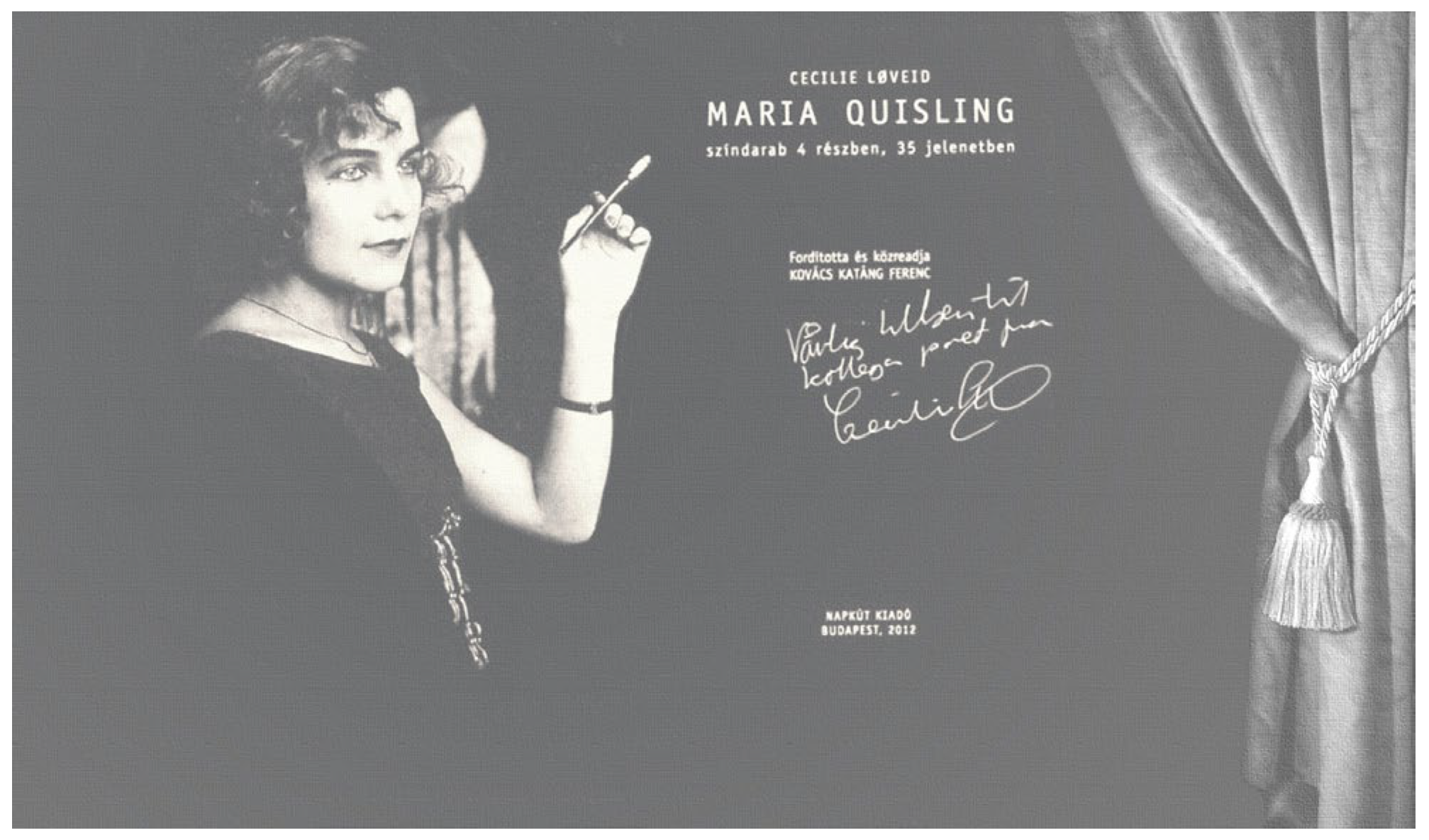
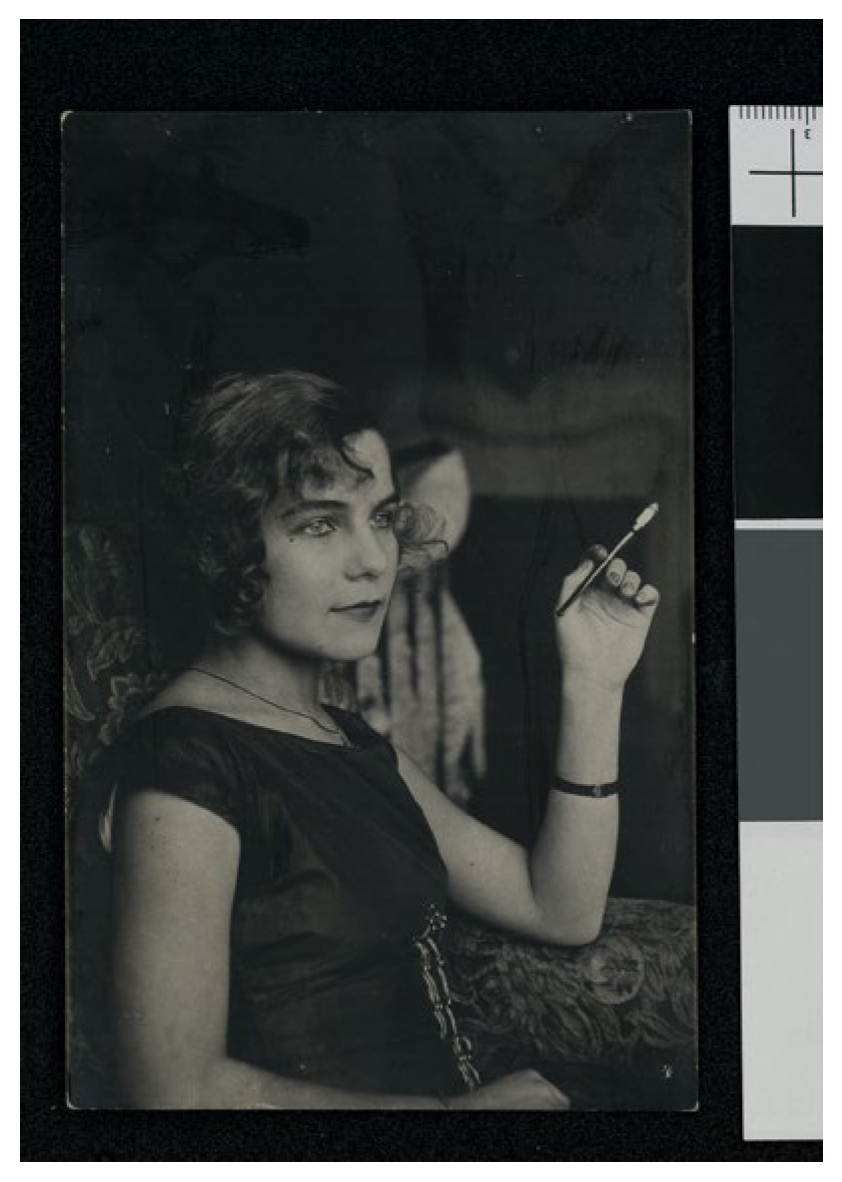
Maria Q was performed by Norway’s National Theater, an institution ‘owned’ by the Norwegian Ministry of Culture, directed by Kjetil Bang-Hansen. It ran thirty times in Lillehammer, where the Olympics were held, and in Oslo, thus reaching both international and national audiences. The Norwegian performance received considerable attention in the Norwegian press in 1994, not least because Maria was played by Ellen Horn, one of Norway’s leading actresses and manager of the National Theater.5 Maria Q was performed at least twice outside Norway: it was performed in the United States in 1997 (Seaver et al. 2007) and in 2012 in Hungary (Budapest). The Hungarian production used a historical photograph for the showbill, signed by Løveid with a personal note (Figure 1 Maria Q showbill). Yet, the photograph does not display Maria Quisling as the Norwegian audience would have known her: in fact, it shows Alexandra Voronina photographed in Paris in 1924 in a staged picture of her elegantly holding a cigarette, although she never smoked! (Figure 2 Alexandra Voronina).6
Figure 1. Maria Q showbill.
Figure 2. Alexandra Voronina.

4. Reception of the Play

Newspaper articles published in early 1994 indicate that Maria Q certainly provoked debate. Yet it was not so much the play’s perspective that elicited responses as the form Løveid imposed on the material in order to represent Maria Quisling’s past life in all its enigmatic complexity, which, according to Tanya Thresher, necessitated “an investigation of the relationship of fact and fiction” (Thresher 2005, p. 30). Despite the fact that the drama was presented not as a factual piece but as a literary text, the hybridized relationship between fact and fiction and Løveid’s idiosyncratic use of source material touched nerves.
In an interview with Alf van der Hagen, Løveid insisted that she had never intended her dramatic treatment of the historical Maria Quisling as a biography, nor had she aimed to “hide citations” (Hagen 1998). That becomes particularly clear at the opening of Maria Q, where the play’s motto from Macbeth is referenced explicitly, and Løveid’s stage directions repeatedly document her source texts, such as in scene 8 where Vidkun “cites from Helge Hundingsbane” (a medieval Norwegian rhyme) or scene 23 where Maria “sings an old Russian lullaby: “Lille vindens sang”” (p. 93). Løveid thus compiles her portraits of Maria Quisling and the other characters consciously and openly from existing material, which she freely combines with her own imaginings.
Stylistic use of sources ranges from showing aspects of character to verbatim or near -verbatim citations, sometimes restricted to a few words but in longer passages too. There are allusions and transformations also, that Løveid has enhanced or scaled down as she deemed fit, and at times “alleged something audacious” (Schjerven Mollerin 2022, p. 14), such as the explicitly erotic scene between Maria and Josef Terboven, the German Reichskommissar in Norway. Phantasms of that sort indicate that literary invention, or critical fabulation, is an important element both in Løveid’s construction of the narrative and in her portrayal of her historically based figures. Nevertheless, two of the main characters, Maria and Vidkun are deeply enigmatic (Why did Vidkun Quisling claim he had married Maria, whilst still being married to Alexandra Voronina? Why was Maria so reluctant to speak about her past?); so that use of the irrational and the questionable seem rather apt as a mechanism not only to indicate the blurred relationship between fact and fiction, but to characterize the main subjects too.
However, not all sources are acknowledged explicitly. Maria Quisling’s diary functions as one of the main sources in Acts I and IV, but that is not revealed, even though variously extensive extracts are reproduced verbatim or near-verbatim. The omission is significant, since in those Acts Løveid directly appropriates Maria Quisling’s own voice7 so that at those moments her fictional Maria and the real historical individual coincide. The extracts reproduce sequences from Maria’s diary which reveal personal information and articulate her feelings, such as the dream she had the night before Vidkun Quisling was executed; a childhood memory; her recollections of the day Quisling became prime minister.
Indeed the inadequacy of its referencing was one of the main points of criticism directed at the play. Arve Juritzen, who in 1988 had published Privatmennesket Quisling og hans to kvinner, criticized Løveid for using his work un-referenced, a work he called “the factual history”. May a writer steal freely from other people’s work? he wondered. That the Norwegian National Theatre had, in his view, marketed the play as a “documentary” only deepened Juritzen’s unease (Juritzen 1994).
Others worried about Løveid’s portrayal of living persons. Although Maria is the play’s main protagonist, Asja (Alexandra Voronina, Vidkun Quisling’s first wife) also has a central role, which raised ethical concerns because Alexandra Voronina was still alive when Løveid wrote her play.8 Kirsten Seaver, Alexandra’s biographer, was surprised that the author had seen fit to lay hands on a living person’s private life but had overlooked readily available information about her. Seaver went so far as to assert that Løveid’s Alexandra had nothing in common with the real Alexandra, and Juritzen too denounced Løveid’s transformation of her (Seaver 1994). According to Juritzen, Løveid had painted Alexandra as “a brainless prostitute” (Juritzen 1994), and George Yourieff, Alexandra’s third husband, felt Løveid had not only besmirched Alexandra’s good name but had made of her a public figure against her will (Yourieff 1994). Such criticism suggests that reviewers drew a sharper ethical line between living and dead historical figures. Although Løveid’s constructions of Vidkun and Maria are just as transformative as her construction of Alexandra, critics appear to have been less troubled by her portrayals of Vidkun and Maria, perhaps, of course because both were dead by then and anyway had already been negatively coded into (Norwegian) cultural memory. On the other hand, Løveid’s fictionalization of Alexandra was of someone living (at least at the time of writing of the play) and who had no negative reputation in cultural memory.
However, critics who read Maria Q as a work of fiction and saw its characters as fictional embraced Løveid’s work. Critics like Hans Fredrik Dahl—Quisling’s biographer—and Harriet Bjerrum Nielsen interpreted the play as a mirror held up to contemporary Norwegian society (Nielsen 1994). Dahl lauded the play’s textual display of poetic truth and admired its attempt to understand Maria Quisling (Dahl 1994). In his view, Løveid’s Maria is positioned as a “stranger” who enables the audience to see itself. Dahl’s reading resonates with Freddie Rokem’s account of the effectiveness of theatrical representations of the past and of their capacity not only to connect past and present but also to make “second witnesses” of the audience (Rokem 2000, p. 9). Bjerrum Nielsen, professor of women’s studies, for her part, focused on Løveid’s Alexandra, whom she saw as positive, consistently strong in her criticism of prevailing gender norms (Nielsen 1994). This was in contrast to Maria, whose self-esteem in the play is linked to Vidkun Quisling; Nielsen’s view was a similar contrast to Juritzen’s interpretation of Løveid’s imagination of Alexandra. Also noteworthy is the response of Ole Wilhelm Klüwer, a so-called “NS-barn”, that is, a child of parents who had joined the Norwegian National Socialist party, which Vidkun Quisling led from 1933 to its demise in 1945. From his early childhood, Klüwer had heard party members described as “scum”, or “pigs”, and for him, simply by depicting Maria as a human being, Maria Q marked a turning point in that historical narrative (Klüwer 1994). Although individual responses cannot, of course, be taken as indicative of a general reception, Klüwer’s reaction is nevertheless significant, given his active role as a spokesman for the “NS-children”.

5. Intertextual Strategies

Many critics have commented on Løveid’s extensive use of intertextual references throughout her oeuvre. Janneken Øverland, for example, once compared Løveid to a “pickpocket on a crowded bus” (Hagen 1998, p. 184), and Ivo de Figueiredo noted Løveid “steals from history, but also from literature and popular culture” (Figueiredo 2014, p. 387). More specifically, Ellen Mortensen and Bettina Baur addressed the use of intertext in Maria Q. Although because the main focus of Mortensen’s reading of it was on generic elements in the play, she mentioned only briefly the parallels between Maria Quisling and Lady Macbeth. Mortensen pointed out that both women are shown as complicit in their husbands’ wrongdoings and adduced the parallel between the two seemingly different heroines, one fictional and the other historical, to examine whether it is ever possible to represent life textually (Mortensen 1998). Bettina Baur (2002) analyzed a wider, though still limited, range of intertextual references. Her reading of Maria Q refers both to non-fiction, such as interviews with Mara and Vidkun Quisling, Maria Quislings dagbok og andre efterlatte papirer (1980), and Arve Juritzen’s biographical Privatmennesket Quisling og hans to kvinner (1988), and fiction such as Igor Stravinsky’s ballet Petrushka and Michael Ignatieff’s novel Asja (1991).9 However, Baur apparently overlooked biblical references and allusions to Russian and Ukrainian folk tales and songs, and it seems she missed the intertextual connections to Norwegian fiction, sources clearly crucial to Løveid’s imagination of Maria Quisling’s enigmatic character, and to which I will return in my own analysis of the play.

6. Maria Q

Maria Q is a drama in five Acts. It begins with a dreamlike sequence featuring Maria as she was in about 1970. She is sick, bedridden and full of angst, fearing vengeance and ultimately death. Løveid thus employs retrospection, a key formal feature of historical fiction, to structure a reimagining of Maria’s life (Boccardi 2009). The five Acts bear titles indicating a chronological order of events but even so, from its very opening the drama’s temporal layers converge as the dramatic narrative moves back and forth among Maria’s childhood memories of Ukraine in the early 1900s, her father’s assassination by revolutionaries, and her own encounter with the handsome Norwegian humanitarian relief worker Vidkun Quisling, for whom she would leave her home country and abandon her child. We see tension and jealousy in the developing triangular relationship between Quisling’s first wife, Alexandra, Quisling himself, and Maria. This occurs during the 1920s, the years when Maria and Quisling lived as man and wife in Oslo before and during the Second World War, and then we are shown her secluded and forlorn life as the widow of the detested traitor Quisling. In the final scene, Maria returns home to Ukraine, dressed in white like a fairytale princess; she carries a child under her gown as if none of the intervening years had passed, as if she had never left home and country. The closing scene is again dreamlike, just like the play’s opening. It emphasizes the centrality of the surreal in the play, suggesting, incidentally, the circular nature of life. Throughout the play dreams and other surreal elements, such as intertextual references to prophecies and folk tales, contribute to the construction of an image of Maria Quisling as a dreamer; they serve to reflect her elusiveness. Yet the intersection of folk-tale tropes and historical narrative can also be understood as creative freedom, as Løveid oversteps “the reality” of the documentary sources. Folk-tale tropes allow imagination of dimensions of Maria’s life that remained un-reflected in those sources: her desires, her anxiety, her feelings of guilt. They may be understood as a mode of critical fabulation that opens up different dimensions of Maria’s life and character, but their use of archetypes may also resonate with the audience as narrative elements they recognize, helping them to relate to Maria as a human being. And just as importantly, the tropes also function as a strategy to foreground the constructed nature of all historiography.

6.1. Maria Q and Fictional Sources

In the introduction to the play, Maria’s world is summarized as follows: “MARIA’S world; past and present, Russia and Norway, inside and outside” (Løveid 13). This is a world where borders, whether temporal, spatial, religious, national or cultural, are continuously transgressed or erased. Those transgressions and erasures are reflected in the selection of literary texts used as sources. It is not my intention to trace all such references, but instead, by highlighting certain of them, I aim to illustrate Maria Q’s broad intertextual spectrum. After a brief overview and characterization of the sources, I will then analyze how Løveid uses them in a critical reassessment of events and figures from Norwegian history.
Though opening with a motto taken from Act V of Shakespeare’s Macbeth, the first and last words spoken in Løveid’s play contain references to the Book of Revelation, taken respectively from its Chapters 12 and 6. In the meantime, Maria is compared to the Daughter of Babylon (Jeremiah 51) and alongside her biblical references Løveid incorporates texts taken from Russian, Ukrainian and Norwegian folk culture, from Norwegian and Icelandic medieval texts, and the plays of Shakespeare and Ibsen. (A more detailed overview is given in the endnotes.)10 The intertexts revolve around themes of sacrifice, revenge and loss, rivalry in both political and personal contexts, and questions of morality and identity.
In the cases of most of the intertexts, Løveid draws analogies between the main characters and the historical figures in the play (Maria, Vidkun and Alexandra),11 sometimes expressed explicitly as similes. As Løveid constructs her Maria in dialogue with figures drawn from very different texts and from different cultural contexts, the image of Maria that emerges is deeply ambiguous. She is compared to disparate “models such as the Holy Mother Maria, the innocent and loving young daughter of a merchant, the daughter of King Jaroslav, and the deceitful Sister Fox, but to the daughter of Babylon also, and to Hognes’ daughter, both of whom made great sacrifices.
Despite the indeterminate image that emerges from the various models to which Maria is compared, she is never ridiculed—and that is noteworthy. As Bettina Baur convincingly shows in her analysis of Maria Q, Løveid‘s depiction of Vidkun Quisling is, in fact, deeply ironic. Although he is compared to “great men” such as Jesus and Napoleon, which not only reflects his megalomaniacal character but also illustrates that he has lost any sense of reality, Vidkun is primarily framed within a medieval political and cultural context. He acts as if he were the new King Olaf, the Eternal King, and describes his defeat at the end of the war as his “Stiklestad”, the famous battle in which King Olaf was killed. These sections function as a play-within-a-play, a theatrical technique that foregrounds the contrast between fiction and reality, but which can be seen also as a means of connecting Norway’s glorious medieval past and Quisling’s time. The mechanism of narrative framing directly inserts the figure of Vidkun Quisling into a national cultural discourse. However, medieval kings like King Olaf and Håkon Håkonsson function as icons of Norwegian national cultural identity—as do authors like Ibsen and, to a lesser extent, Per Sivle, whose works are intertextually invoked in these sequences. One might well argue, therefore, that Løveid here holds up a sort of oblique mirror to her Norwegian audience, revealing to them that Quisling’s self-mythologization draws on exactly the same symbolic repertoire as that of many Norwegian narratives of national identity.
In contrast to Vidkun, Maria is compared not to historical figures but to other fictional characters, and in indirect or implicit ways. Many such figures are derived from biblical narratives and folk tales of the kind repeatedly appropriated and transformed by writers throughout the nineteenth and twentieth centuries (Bacchilega 2010). The same is true of bible stories, such as in Thomas Mann’s novel The Holy Sinner (1951). Such rewriting not only offers ready-made narrative frameworks, but also provides different images of womanhood. What distinguishes a novel like Mann’s from Løveid’s play, however, is that Løveid juxtaposes those intertextual and fictional narratives with a historical plot-line in which historical figures act directly with fictional ones. In Maria Q the biblical narratives and folk tales mobilize specific images of womanhood and of distinct stages in a woman’s life—child, mother, wife. The fictional sources thus enable Løveid to imagine Maria as a multidimensional character at distinct stages in life, beyond the image constructed for her by Norwegian historiography.
In Scene 1 Maria is introduced as an anxious and guilt-ridden mother who thinks of the child she has forsaken. Neither Maria nor her biographers ever mentioned that when she left Ukraine with Vidkun Quisling, she had abandoned a child there; that particular motif is introduced by Løveid. In fact, the abandoned child motif recurs throughout Løveid’s drama: Løveid herself has indicated in a number of interviews that she was abandoned as a child, an experience that has profoundly affected her life and writing (Larsen 2015; Schjerven Mollerin 2022). By positioning that autobiographical element at the beginning of her play, Løveid signals that her image of Maria Quisling is constructed not only in dialogue with existing fictional and non-fictional texts, but also with what Bakhtin describes as “the structures of the author”.
The autobiographical layer is then combined with an explicitly intertextual layer in the strikingly complex dreamlike sequence opening the play. The Child cries out that it is being carried off by an eagle, while Maria, lying in bed in a hall by a deadly beach, has no idea where she lives. The unusual clustering of the serpent, the eagle and the beach evokes the Book of Revelation12 and, by extension, the figure of the Holy Mother. By situating Maria within that apocalyptic imaginary, the play establishes an analogy between the biblical narrative of motherhood and Maria Q’s own life.13 That analogy leads to an allegorical exploration of the complex mother–child relationship that runs throughout the play, and in which roles are continuously doubled, thereby destabilizing rational coherence and the notion of a unified human subject.14
The role reversal is staged in the third scene, where the figures of Maria and the Child appear to converge. As in the first scene, the situation is marked by surrealism, in a passage invoking an intertextual reference to the Russian folk tale “The tale of the silver saucer and the transparent apple”,15 from which the Child speaks a number of lines, but rephrased. The Russian tale centers on a young girl of low birth who ultimately marries the Tsar, its female protagonist rendered in highly idealized terms: she is innocent but clever, beautiful but generous. By aligning Maria with this fictional figure, the text represents her distinctly positively, as an idealized figure, even. In other words, the intertextual reference functions here as a mode to characterize the young Maria, re-inscribing her within a more affirmative discursive framework.
However, her positive image is countered later in the play when the older Maria is portrayed during her marriage to Vidkun. Perhaps she still has her beauty and her intelligence, but she has now become mendacious. Her lies are articulated not only intradiegetically through Asja, who in the final act declares that she can never forgive Maria for all the lies that have ruined her life, but intertextually also, in the Ukrainian tale “Sister Fox and the Rolling Pin”, which is incorporated in Scene 27 of Act IV, set during the war. While the intertextual configuration there appears to reaffirm the dominant unfavorable image of Maria in Norwegian cultural memory, it simultaneously constructs an aspect of her that was previously unknown to the public: she emerges as a sexually active woman, an image that recurs throughout the play.
In fact the scene departs from Maria Quisling’s diary, which describes the encounter only briefly; the real Maria emphasized her dislike of Reichskommissar Terboven and her reluctance to meet him, noting that when she finally did so, she wore “a simple black dress with white embroidery and a collar of two large silver fox furs” (Parmann 1980, p. 133). The description of her clothing in Maria’s diary is reproduced verbatim in the stage directions of scene 27, but only as a point of departure, as Løveid radically deviates from what Maria Quisling actually said of the encounter. Yet as Øistein Parmann indicated, the true aim of Maria’s diary was to rehabilitate both her husband and herself; Løveid’s critical fabulation underscores the biased nature of this source material and demonstrates that her play is written both with and against those particular sources. In Løveid’s reworking, Maria, earlier described as lonely and longing for a man (“My kingdom for a man” Løveid 105, ironically “misquoting” a literary source as Løveid’s Maria frequently does), flirts with the German. She suggests they enact the tale of “Sister Fox and the Rolling Pin”; Maria’s “collar of two large silver fox furs” is an explicit reference to the analogy between Maria and Sister Fox, the manipulative, deceitful protagonist of the folk tale. Once again, therefore, Løveid employs the dramatic technique of the play-within-a-play. Here, the embedded play ends with the two protagonists in bed together, where Vidkun catches them “in the act”. Løveid indicated in a conversation with Hans Rossiné that she had made the scene up as she “needed to create a situation for Maria’s downfall” (Rossiné 1994). The tale thus provides a narrative framework by initiating Maria’s downfall while simultaneously reinforcing an image of her as manipulative and untrustworthy.

6.2. Maria Q and Maria Quisling’s Diary

Such fictional elements—many of them surreal—are placed alongside passages that depart from historical sources. However, none of the historical sources is made explicit, so that no distinction is made between fact and fiction. That lack of distinction may be explained by the circumstance that the factual sources themselves offer no objective truth, but all the same and apart from Maria Quisling’s diary and the letters she wrote, the account Bjørn Furuborg published three months after her death, is one of the few sources in which Maria’s own voice can be heard.16 In her interview with Furuborg, Maria told him she and Vidkun had had a child; that has never been verified but is rendered in scene 23 of Act III of Maria Q.17
In fact the same impossibility of verification applies to Maria’s diary also, and a short comment by Øistein Parmann in his introduction to the diary is telling in that regard. Contextualizing Maria’s relationship with Vidkun Quisling, Parmann wrote of Quisling’s first wife, Alexandra Voronina—a manuscript whose autobiography he had read—“The entire history [Alexandra’s] seems rather fantastic, but it is so well documented with correct data, amateur photographs and names that it is hard to doubt it” (Parmann 1980, p. 21). More interesting is what Parmann does not say: Maria’s story lacks such documentation.
Contrary to what one might expect, Maria’s diary reveals remarkably little about her own life, partly because of what motivated her to write down her memories. Parmann notes that the diary is essentially a rough draft, written by Maria in retrospect after her husband’s death for a putative ‘Great Book’ about Vidkun Quisling. Thus the main focus of all chapters is Vidkun Quisling, not Maria, for in that context her life story was of secondary relevance.
It is telling, therefore, that Maria’s diary opens with a description of her first encounter with Vidkun Quisling, at the time of the famine in Kharkiv. There follows a chapter in which Maria relates the period between the end of the war and 24 October 1945, the day of her husband’s execution, two pivotal events in her life, both dramatized in Act I of Maria Q, in the eighth and second scenes, respectively, scenes in which Løveid adheres closely to the diary.
The diary reveals next to nothing about Maria’s life in the Ukraine. This makes the rendering of two memories she does share even more interesting, also because both memories are incorporated into Løveid’s play. The first memory concerns a lost doll’s shoe, the second a description of her home in Kharkiv. It is precisely those memories that Kirsten Seaver mentioned in her introduction to Alexandra Voronina’s autobiography (Seaver et al. 2007). Seaver wrote that both those memories, presented by Maria as her own, belonged in fact to Alexandra, who claimed to have told Maria about the doll’s shoe during their stay in Paris in 1924. Then again, Maria’s description of her home next door to a church in the center of Kharkiv is exactly the same as Alexandra’s description of her home. In her own memoirs, Alexandra states that Maria lived with her mother in a place on the outskirts of Kharkiv.
The comments by Seaver in Alexandra’s autobiography raise the question of why Maria might choose to present Alexandra’s memories as hers, and why Løveid would retain them as Maria’s. One explanation is that it was a strategy intended to obscure Maria’s actual background: presenting herself as coming from a well-to-do family would certainly have bolstered the image of Maria as a suitable wife for Norway’s political leader.18 It may also be read as a more subtle instance of Maria’s duplicity, which Ellen Mortensen has argued is an effective rhetorical method of representing Maria while simultaneously foregrounding her diffuse gender identity and the multiple roles she assumes in Maria Q (Mortensen 1998). “Dressing” herself in Alexandra’s memories could thus be seen as part of such a strategy. Yet, on a metatextual level, a similar mechanism applies to Løveid’s text. Just as Maria in her diary misappropriates Alexandra’s memories, Løveid inscribes elements of her own experience into her story of Maria. The moral dilemma to which both examples point concerns the problem of who is entitled to narrate, appropriate, and authorize another person’s life in historical writing.

7. Conclusions

Cecilie Løveid’s experimental historical drama Maria Q effectively reclaims from marginality the figure of Mara Vasilyevna Pasetchnikova, enigmatic and long-despised second wife of Norway’s fascist prime minister Vidkun Quisling. While historical fiction, including historical drama, has often contributed to the idea that history is “the preserve of the male”, a domain in which women have been obscured or marginalized, Løveid employs and transforms the genre to imagine Mara Vasilyevna Pasetchnikova as a multidimensional human being. By displaying her anxieties and fears, her grief at having forsaken her child, her naivety, her dreams, her sexual desire, and her manipulative and mendacious behavior, the play manages to present Maria as neither heroine nor enemy of the Norwegian people.
Løveid’s use of intertextuality as a central narrative strategy openly acknowledges that historical fiction is not autonomous. Rather it is produced in dialogue with source texts from varied thematic, geographical and temporal contexts, including those belonging to the author and her readers. Maria Q functions as a space where elements from Løveid’s own life converse with fictional literary structures drawn from diverse religious and cultural traditions, as well as from documentary material. Løveid therefore has not only resisted a monologic understanding of history, but has signaled also her awareness that historical representation is always fictional to some extent. By linking Maria’s life narrative both to empirical facts such as the famine in Ukraine, and to fictional story elements such as folk tales or medieval rhymes—all with recognizable narrative structures—Løveid has overcome the limitations of the historical record of Maria. She has thereby invited the reader into her intertextual play in order to reimagine Maria and her life story, and, to a broader extent, Norwegian history and the way it is constructed.

Funding

This research received no external funding.

Data Availability Statement

No new data were created or analyzed in this study. Data sharing is not applicable to this article.

Conflicts of Interest

The author declares no conflict of interest.

Notes

1
The film is partly based on the notes of Peder Olsen, the pastor who assisted Quisling during his imprisonment in 1945, and on Maria Quisling’s diary. The latter source is used somewhat uncritically. Interestingly, the film’s depiction of Quisling also draws an analogy between him and one of Henrik Ibsen’s characters (Dr Stockmann from An Enemy of the People), as does Løveid, though she refers to another of Ibsen’s plays.
2
Saidiya Hartman employs the concept within the context of decolonial historiography, which, according to her, needs to balance between telling untold or impossible narratives, but not closing them.
3
“et ikke noe-menneske”.
4
The opening ceremony also offered a platform for the indigenous Sámi people, who long had long been marginalized by the Norwegian state, something that can be seen as an illustration of the rehabilitation of the Sámi in Norwegian political and cultural life and as an illustration of the willingness of Norwegian authorities to alter Norwegian self-representation.
5
Løveid had presented her ideas to Ellen Horn, who not only is one of Norway’s leading actresses but also functioned as manager of Norway’s National Theater (1992–2000). Norway’s Ministry of Culture appoints the theatre’s board of management.
6
Copyright permission given by Napút and Norway’s National Library.
7
However, it is important to note that Øistein Parmann edited Maria’s notes after her death and may have made some alterations.
8
Alexandra Voronina died in October 1993, shortly before Maria Q was published.
9
Baur sees a link between Løveid’s Maria and Ignatieff’s story about Asya, a Russian aristocrat (Asya Galitzine) who fled her country after the revolution and settled in France. Yet Baur appears to confuse Asja (Alexandra) and Maria, as it was not Maria but Asja who spent several years living in France.
10
Petrushka is a ballet by Igor Stravinskij based on a Russian folktale thematizes the triangular relationship between three dolls, Petrushka, the ballet girl and a Moor, a relation characterized by love and jealousy leading to the death of Petruska; Sister Fox and the Rolling Pin is a Russian folktale about a deceitful woman who manipulates and belies people who help her; Helge Hundingsbane tells of Hognes’ daughter who pays a high prize to be freed from her destiny; Henrik Ibsen’s Kongsemnerne is a historical drama reflecting the conflict between medieval king Håkon IV Håkonson and his father in law; Per Sivle’s “Tord Foleson” tells about the Battle at Stiklestad where King Olaf was killed; “Huttemetu, vesle Kari Ru” is a rime from Hallingdal (Norway); Finnsagnet contains a riddle: King Olaf is helped by a troll, on condition that he guesses the troll’s name; Völuspá part of the Edda describes the words of the seeress on the Norse cosmogony, the world of the Gods and Giants from its beginning to its end, the generic features in these sources can be regarded as instrumental to Løveid’s portrayal of the enigmatic character of Maria; Shakespeare’s Richard III, who loses the battle and his horse and famously exclaims: “my kingdom for a horse” ironically transformed by Løveid: “My kingdom for a man”.
11
Most often references are linked to Maria, but there are multiple intertextual references that highlight characteristics of Asja/Alexandra or Vidkun.
12
In Norwegian: Ormen, ørnen, stranden. The Revelation of St. John the Divine, chapter 12. “Barnet: Mamma, ørnen tar meg!/Maria: Denne salen ved dødsstranden/er av ørmesygger flettet […] Vet ikke hvor jeg skal hvile min blå kropp/Kaster meg på himmelørnen med høyre hand” (Løveid, 14). According to St. John the Holy Mother was given two wings of a great eagle after having given birth to a child which should rule all nations but who now was threatened by a serpent.
13
In Løveid’s intertextual rewriting, however, Maria is no longer a passive object of prophesy, but appears as narrating subject, who reflects on her responsibilities and the choices she has made.
14
The child introduced in the first scene can be seen as the child Maria Q had left behind in Ukraine, but also as Vidkun Quisling, who, later in the play, is metaphorically and repeatedly described as Christ and who calls Maria ‘mother’.
15
The tale of the silver saucer and the transparent apple tells the story of a little girl who asks her father to bring her what seems to be a rather humble gift: silver saucer and a transparent apple. Her sisters think she is stupid and laugh at her. Yet, by spinning the apple on the saucer, she is able to see the world, whereupon her sisters get envious and kill her whilst picking berries in the woods. What seems to be a tragic story ends well, as the little girl awakes when a cup of water from the Tsar’s wells is sprinkled over her body, and finally she even marries the Tsar.
16
Though, of course, her diary was edited by Parmann.
17
The 23rd scene introduces Maria, who, after having given birth to a tiny, dead infant, cites a Viking law that states that deformed infants should be left to die, followed by Maria’s exclaim that the child was not deformed at all. Directly after Maria sings a Russian lullaby, “The Little Wind’s song”, which narrates a story about the little wind that had come back home to his mother after three nights. The song is rendered verbatim, apart from the end where Maria sings about Nadesjda, the child Maria, as Løveid imagines, has left behind in Ukraine when she followed Vidkun Quisling. The short scene is exemplary for the intricate intertextual web Løveid spins, by letting different texts meet whilst combining logical and illogical or surreal constructions to envision Maria’s experiences. In this particular scene connecting the story Maria told Furuborg about the child Vidkun and she had lost with the story that Maria had left behind her child in her home country.
18
Seaver comments on a rumor circulated by one of Quisling’s acquaintances, the Danish lawyer Hermod Lanning, concerning Alexandra’s mother, whom he claimed had been sitting in the street hawking soup, an incident that never actually occurred. Lanning nonetheless used the rumor to explain why those in Quisling’s circle regarded his marriage to Alexandra as “a mismatch” (Seaver et al. 2007, p. 48).

References

  1. Bacchilega, Cristina. 2010. Postmodern Fairy Tales. Gender and Narrative Strategies. Philadelphia: University of Pennsylvania Press. [Google Scholar]
  2. Bache-Wiig, Anna, Siv Rajendram Eliassen, and Ravn Lanesskog. 2024. Quislings Siste Dager [Quisling: The Final Days]. Directed by Erik Poppe. Oslo: Paradox Film. [Google Scholar]
  3. Baur, Bettina. 2002. Melancholie und Karneval. Zur Dramatik Cecilie Løveids. Tübingen und Basel: A. Franke verlag. [Google Scholar]
  4. Boccardi, Mariadele. 2009. The Contemporary British Historical Novel. Representation, Nation, Empire. Basingstoke: Palgrave Macmillan. [Google Scholar]
  5. Boldrini, Lucia. 2022. Biofiction, Heterobiography and the ethics of Speaking of, for and as Another. Interdisciplinary of Literature 6: 18–37. [Google Scholar]
  6. Bugge, Erle Moestue. 1994. Til sengs med Maria Quisling. Aftenposten, January 9.
  7. Cooper, Katherine, and Emma Short. 2012. The Female Figure in Contemporary Historical Fiction. Basingstoke: Palgrave Macmillan. [Google Scholar]
  8. Dahl, Hans Fredrik. 1994. Maria Q og den poetiske sannhet. Dagbladet, January 19.
  9. Figueiredo, Ivo de. 2014. Ord/Kjøtt: Norsk scenedramatikk 1890–2000. Oslo: Cappelen/Damm. [Google Scholar]
  10. Furuborg, Bjørn. 1980. Maria Quislings eneste intervju—Og hennes private bilder. Vi Menn, March 28, nr. 14.
  11. Gallagher, Catherine, and Stephen Greenblatt. 2000. Practicing New Historicism. Chicago: University of Chicago Press. [Google Scholar]
  12. Graham, Allan. 2021. Intertextuality. London: Routledge. [Google Scholar]
  13. Hagen, Alf van der. 1998. Hun elsket to menn. Intervju med Cecilie Løveid. In Klangen av Knust Språk. Løveids Prosa Og Lyrikk. Edited by Benedicte Eyde. Oslo: Landslaget for norskundervisning (LNU) Cappelen Akademisk Forlag, pp. 169–95. [Google Scholar]
  14. Hartman, Saidiya. 2008. Venus in Two Acts. Small Axe 12: 1–14. [Google Scholar] [CrossRef]
  15. Juritzen, Arve. 1988. Privatmennesket Quisling og Hans to Kvinner. Oslo: Aventura Forlag. [Google Scholar]
  16. Juritzen, Arve. 1994. “Maria Q”—uten kilder og uten omtanke. Aftenposten, February 2.
  17. Klüwer, Ole Wilhelm. 1994. Maria Q forløsende på dypfryste sjeler. Aftenposten, February 8.
  18. Kristeva, Julia. 1986. Word, Dialogue and Novel. In The Kristeva Reader. Edited by Toril Moi. Oxford: Basil Blackwell, pp. 34–62. [Google Scholar]
  19. Langås, Unni, and Henrik Torjusen, eds. 2024. Krigsforbytere i dagens estetiske minnekultur. Oslo: Cappelen Damm Forskning. [Google Scholar]
  20. Larsen, Wenche. 2015. Dramatiske Forvandlinger. Bildet Som Teatralt Virkemiddel i Cecilie Løveids Skuespill. Balansedame, Fødsel er Musikk og Barock Friise Eller kjærligheten er en Større Labyrint. Doctoral Thesis, University of Oslo, Oslo, Norway. [Google Scholar]
  21. Løveid, Cecilie. 1994. Maria Q. Oslo: Gyldendal. [Google Scholar]
  22. Mortensen, Ellen. 1998. Drømmetekst eller myto-poetisk tragedie? En lesning av Maria Q. In Livsritualer. En bok om Cecilie Løveids Dramatikk. Edited by Merete Morken Andersen. Oslo: Gyldendal, pp. 142–56. [Google Scholar]
  23. Nielsen, Harriet Bjerrum. 1994. Praktfull Alexandra. Aftenposten, February 18.
  24. Nilsen, Åse. 1994. Maria Q i bok og på scene. Halden Arbeiderblad, January 11.
  25. Parmann, Øistein. 1980. Maria Quisling. In Dagbok og Andre Efterlatte Papirer. Oslo: Dreyer. [Google Scholar]
  26. Rigney, Ann. 2001. Imperfect Histories. In The Elusive Past and the Legacy of Romantic Historicism. Ithaca: Cornell Press. [Google Scholar]
  27. Rokem, Freddie. 2000. Performing History: Theatrical Representations of the Past. Iowa: University of Iowa Press. [Google Scholar]
  28. Rossiné, Hans. 1994. Maria Q skal provosere. Dagbladet, January 5.
  29. Schjerven Mollerin, Kaja. 2022. Kamerat livet. In En samtale med Cecilie Løveid. Oslo: Kolon forlag. [Google Scholar]
  30. Seaver, Kristin A. 1994. Nationaltheatrets Maria Q og Alexandra. Aftenposten, March 1.
  31. Seaver, Kristin A., Alexandra Yourieff, and Wladimir George Yourieff. 2007. In Quisling’s Shadow. The Memoirs of Vidkun Quisling’s First Wife, Alexandra. Stanford: Hoover Institution Press. [Google Scholar]
  32. Thresher, Tanya. 2005. Cecilie Løveid. Engendering a Dramatic Tradition. Laksevåg: Alvheim & Eide. [Google Scholar]
  33. Yourieff, George W. 1994. Smakløst opptrinn på Nationaltheatret. Aftenposten, February 8.
Disclaimer/Publisher’s Note: The statements, opinions and data contained in all publications are solely those of the individual author(s) and contributor(s) and not of MDPI and/or the editor(s). MDPI and/or the editor(s) disclaim responsibility for any injury to people or property resulting from any ideas, methods, instructions or products referred to in the content.

Article Metrics

Citations

Article Access Statistics

Multiple requests from the same IP address are counted as one view.