


Abstract
This study explores how various factors—including motivation, emotion, demographics, and institutional characteristics—interrelate to shape academic success among Greek university students. Based on Self-Determination Theory (SDT) and Tinto’s model of integration, it fills a gap in research by addressing the specific characteristics of the Greek higher education system. While prior research emphasizes the importance of motivation and integration, few studies have combined these with factors like program alignment, student type, and gender in a structural model. A sample of 284 students, aged 18–28, completed validated Greek versions of the AMS, PASS, and SACQ. Structural Equation Modeling (SEM) was used to assess both the direct and indirect effects on academic success. Key variables included gender, traditional vs. non-traditional student status, first-choice program enrollment, intrinsic and extrinsic motivation, academic and social integration, emotional adjustment, institutional attachment, and procrastination. Gender (female) was the strongest predictor of academic success (β = 0.819), affecting outcomes through intrinsic motivation, emotional adjustment, and procrastination. Academic integration (β = 0.424) and traditional student status (β = 0.300) also significantly predicted GPA. Social integration had an indirect effect through academic engagement. Procrastination (β = −0.228) and emotional maladjustment (β = −0.143) were major obstacles. While selecting a first-choice program affected institutional attachment, it did not directly impact academic performance. Conclusion: Academic success in Greek universities is influenced by a range of personal, motivational, and contextual factors. Improving integration, reducing procrastination, and fostering intrinsic motivation can boost academic outcomes. Interventions should consider gender and student pathways to be more effective.
1. Introduction
University academic performance is shaped by a complex combination of cognitive, emotional, motivational, and social factors (Gkintoni et al. 2025; Mulaudzi 2023). Exploring the processes that influence students’ academic achievement has been central in higher education research, particularly within the context of Self-Determination Theory (SDT; Ryan and Deci 2000) and Tinto’s student integration model (Tinto 1975). Although both frameworks have generated extensive empirical research, prior studies have typically examined motivational, integration, or demographic factors in isolation or through partial mediation models rather than within a unified structural framework (Mulaudzi 2023; Gebregergis et al. 2023); relatively few studies have explicitly modeled how student traits (e.g., gender, student type), psychological adjustment variables (e.g., emotional maladjustment, procrastination), and institutional alignment factors (e.g., first-choice enrollment, attachment) jointly operate to predict academic achievement. This fragmentation limits our understanding of how these domains interact simultaneously within real institutional contexts (Vlachopanou et al. 2025c).
The present study addresses this gap by specifying and empirically testing an integrated SEM that situates demographic characteristics as exogenous predictors and examines how motivational, emotional, behavioral, and institutional mechanisms operate concurrently to shape academic achievement. Rather than merely extending SDT and Tinto conceptually, this study clarifies whether and how these theoretical traditions can be statistically integrated within a single explanatory structure.
In this study, a single pre-specified SEM was tested in which gender and student type were modeled as exogenous variables. Academic integration had a direct path to academic achievement, while social integration influenced achievement indirectly through academic integration. Institutional attachment had a small direct path to achievement and was, in turn, predicted by first-choice enrollment. Finally, procrastination and personal–emotional maladjustment had direct negative paths to achievement. No direct path from intrinsic motivation to academic achievement was estimated in the final model.
Directional assumptions were grounded in SDT and student integration theory as process models but are interpreted as correlational given the cross-sectional design.
To truly understand what influences academic performance, it is important to examine not only psychological factors such as motivation and integration, but also the social characteristics that shape students’ academic experiences (Rožman et al. 2025). These include whether students enroll in their preferred academic program, their student status (traditional or non-traditional), and demographic dimensions such as gender (Brozina et al. 2024). These background variables often serve as indirect influences on achievement by affecting motivation, levels of institutional engagement, and behavioral adjustment (Brozina et al. 2024; Ribeiro et al. 2019).
However, the combined impact of these factors within a single framework has not been sufficiently explored, particularly in contexts such as Greece, where access to education and academic pathways are highly regulated.
The inclusion of student traits (gender, traditional vs. non-traditional status), psychological adjustment indicators (emotional maladjustment), and behavioral self-regulation factors (procrastination) is theoretically grounded in the assumption that motivation does not operate in a vacuum. SDT posits that motivational quality is embedded within broader psychosocial conditions, while Tinto’s model emphasizes the interaction between individual characteristics and institutional integration. Therefore, incorporating these variables is central—not peripheral—to testing whether motivational processes translate into achievement only when supported by emotional regulation, behavioral control, and institutional alignment.
At the core of the present model is the concept of motivation within SDT. Within the SDT framework, intrinsic motivation is treated as a proximal motivational disposition, recognizing that other SDT constructs also relate to achievement and merit longitudinal examination beyond the present model’s scope. According to SDT, intrinsic motivation arises when students engage in learning for its own sake, driven by curiosity or genuine interest. Meta-analytic work (Cerasoli et al. 2014) shows that intrinsic motivation predicts performance outcomes, particularly when tasks are complex.
Social and academic integration, as defined by Tinto (1975), play an important role in connecting personal characteristics and academic performance. Students who develop supportive peer networks and meaningful relationships with faculty are more likely to remain in their studies and perform well academically. Empirical evidence from both Greek and international studies supports this assertion (Katsarou and Chatzipanagiotou 2025; Gkintoni et al. 2025; Kori 2017). For instance, a study by Quilez-Robres et al. (2021) found that feelings of social belonging and academic integration significantly impacted performance in both primary and higher education students.
Building on prior research that identifies emotional adjustment as a correlate of engagement and performance, the present analysis examines its direct association with achievement within the tested SEM. The Greek literature confirms that emotional dysregulation is associated with increased dropout risk and reduced self-efficacy (Dimitropoulou et al. 2021).
Another significant factor is institutional attachment, referring to students’ emotional identification with their university. Students who feel valued and connected with their academic community tend to show greater resilience, stronger goal orientation, and a deeper commitment to their studies (Özer et al. 2021). Recent research (Kritikou and Giovazolias 2022; Huang and Kou 2025) indicates that a strong institutional connection not only enhances motivation but also helps buffer the negative impacts of stress and emotional struggles. In the present model, institutional attachment is conceptualized as being predicted by first-choice program enrollment and exerting a small direct effect on academic achievement, rather than serving as a mediator of motivation or emotional adjustment.
Academic procrastination, defined as a failure of self-regulation (Vlachopanou and Karagiannopoulou 2022a, 2022b), represents an inhibitory factor that directly undermines performance. It tends to flourish in contexts of amotivation or external regulation, where students fail to internalize the value of academic tasks (Vlachopanou et al. 2025a). In Greece, procrastination is a major challenge among university students, often linked to academic anxiety and time-management difficulties (Vlachopanou 2020).
Taken together, the literature emphasizes that academic performance and success are influenced by the dynamic combination of motivational, emotional, and contextual variables (Choi 2025). Factors such as gender, program–choice alignment, and student typology may indirectly influence performance by shaping students’ motivation, level of institutional integration, and self-regulatory factors (Vlachopanou et al. 2025c; Duru et al. 2024; Özer et al. 2021). Meanwhile, obstacles such as academic procrastination and emotional maladjustment can undermine progress, especially in environments that fail to support psychological needs for autonomy, competence, and relatedness (Vlachopanou et al. 2025a).
To ensure alignment, the hypotheses, model specification, and results are fully consistent; only paths estimated in the final SEM are hypothesized and interpreted.
Directional links are treated as theoretically informed associations rather than causal claims, given the cross-sectional nature of the data.
Within this context, the present study proposes a comprehensive conceptual model integrating key constructs from SDT and student integration theory. By examining how demographic, psychological, and institutional factors connect to shape academic outcomes, this research aims to clarify the processes that foster or hinder academic achievement in university settings. Grounded in international and Greek research, it provides a theoretically informed framework that aligns the hypothesized relationships, the tested SEM model, and the reported results.
1.1. The Rationale of the Study
Understanding the determinants of academic performance in higher education is an important priority for educators, policymakers, and psychologists. While previous research has strongly highlighted the importance of factors like motivation, emotional adjustment, and a sense of belonging to the institution, there is still a lack of integrated, empirically tested models—especially in European and specifically Greek university contexts (Daniilidou et al. 2025; Katsarou and Chatzipanagiotou 2025; Vlachopanou et al. 2025a, 2025c).
This study builds on Self-Determination Theory (SDT) (Ryan and Deci 2000) and Tinto’s (1975) model of student integration, taking a multidimensional approach to academic performance by considering both personal and contextual factors. While SDT has been well established in educational research, its interaction with factors like institutional attachment, emotional regulation, and behaviors such as procrastination has not been thoroughly explored in models that reflect the real-life complexity of university students’ experiences (Vlachopanou et al. 2025a, 2025c). Furthermore, existing models often overlook factors like initial academic alignment—such as enrolling in a first-choice program—and student type (traditional or non-traditional), both of which can significantly influence motivation and integration.
The Greek higher education system has unique socio-academic features, such as centralized university admissions, strict department divisions, and high dropout rates in some programs, which require more research tailored to this specific area (Vlachopanou 2020; Kalamaras et al. 2025a; Prokou et al. 2025). Despite the increasing attention to student well-being and engagement in the Greek academic literature, there is a lack of comprehensive models that statistically test how various factors interrelate to predict academic performance among Greek university students. This study addresses this gap by examining how demographic (gender, student type), cognitive, emotional (intrinsic motivation, emotional adjustment), and contextual (social and academic integration, institutional attachment) factors come together to predict academic outcomes, including GPA and course completion.
This study uses Structural Equation Modeling (SEM) to estimate both direct and indirect effects, providing deeper insights into how individual differences influence performance through mediating and moderating factors (Kalamaras et al. 2025b; Hair et al. 2021; Ullman and Bentler 2013). By including academic procrastination as a behavioral obstacle (Chatrakamollathas et al. 2022; Tabar et al. 2024) and first-choice program selection as a motivational enhancer (Falebita et al. 2025), it introduces underexplored yet practically significant dimensions. The use of latent constructs, validated through established scales, ensures both strong statistical accuracy and theoretical alignment (Hair et al. 2021).
This study is particularly timely. In the post-pandemic academic world, where emotional instability and decreased motivation are more common among students (Kritikou and Giovazolias 2022), it is crucial to identify which factors can be used to design more effective interventions. By understanding how certain student characteristics influence academic performance or challenges through motivational and emotional pathways, this model offers practical insights for faculties, advisors, and university leadership (Rožman et al. 2025).
In the end, this study adds to the academic field by confirming that SDT and integration theory can be applied in a different cultural context, emphasizing the importance of factors like program alignment and academic procrastination, and providing practical, data-based suggestions to improve student retention and performance by focusing on intrinsic motivation and social integration.
1.2. Empirical Synthesis of Proposed Associations
Before presenting the hypotheses, it is important to briefly synthesize the prior empirical findings supporting each proposed association in the model. Academic integration has consistently emerged as a direct predictor of academic achievement across institutional contexts (Clark et al. 2014; Kori 2017). Similarly, social integration has been shown to facilitate achievement indirectly by enhancing academic engagement and persistence (Dunbar et al. 2016). Procrastination demonstrates a robust negative association with GPA in both cross-sectional and longitudinal designs, functioning as a self-regulatory failure that undermines sustained academic effort (Steel 2007; van Eerde 2016). Emotional maladjustment has likewise been associated with poorer academic outcomes, primarily through reduced concentration, increased stress, and diminished academic self-efficacy (Dimitropoulou et al. 2021). Institutional attachment and sense of belonging have been linked to persistence and performance, although effect sizes tend to be modest when academic integration is simultaneously modeled (Hausmann et al. 2007; Özer et al. 2021). First-choice enrollment has been associated with stronger institutional commitment and motivational investment, though its direct effect on GPA is often indirect (Falebita et al. 2025). Gender and student type differences have been documented in relation to engagement patterns, emotional regulation, and academic performance, but these variables typically function as background predictors rather than moderators (Nasir et al. 2024; Ribeiro et al. 2019). Taken together, these findings support the specification of directional hypotheses grounded in prior empirical trends rather than purely model-driven assumptions.
Summarizing the theoretical foundations and empirical gaps identified above—particularly regarding the interplay of motivation, emotional adjustment, institutional factors, and behavioral tendencies in the Greek higher education context—the following hypotheses were formulated:
H1.
Academic integration will positively predict academic achievement.
H2.
Social integration will be positively associated with academic integration and will relate to academic achievement.
H3.
Procrastination will negatively predict academic achievement.
H4.
First-choice program enrollment will positively predict institutional attachment.
H5.
Institutional attachment will show a positive direct association with academic achievement.
H6.
Personal–emotional maladjustment will negatively predict academic achievement.
H7.
Student type (traditional vs. non-traditional) will function as an exogenous predictor of academic integration, procrastination, and academic achievement.
H8.
Gender will function as an exogenous predictor of the model variables and academic achievement.
No direct path from intrinsic motivation to academic achievement is specified in the final model. Any associations were examined indirectly through the modeled mediators.
2. Materials and Methods
2.1. Participants
A power analysis estimation was performed using Soper’s SEM Sample Size Calculator with anticipated effect size equal to 0.05, desired statistical power level equal to 0.8, number of latent variables equal to 1, number of observed variables equal to 7 and probability level equal to 0.05. The analysis suggested a 224 minimum sample size.
The sample ultimately collected in this study consists of 284 undergraduate students aged between 18 and 28 years (M = 21.2, SD = 1.7). Among them, 36.2% self-identified as male and 63.4% as female. Notably, most participants (53.9%) are not traditional students, in the sense that they attend university studies at the earliest possible opportunity, immediately or up to two years after graduating from high school. For 48.6% of respondents, the academic department in which they were enrolled represented their first choice during the admission process (see Table 1). The sample of 284 undergraduate students was recruited voluntarily via email invitations distributed by university administrations, which provided logistical support but no incentives. Participants came from diverse faculties and academic programs, and while gender and discipline distributions differ slightly from national averages, this reflects higher engagement from certain fields. The survey was conducted online using an anonymous form (MS Forms), with no personal data collected. The exact response rate is unknown, as non-participation did not require a reply.
Table 1.
Variable definitions and values. Descriptive statistics, construct reliability (N = 284).
2.2. Procedure
Data collection was carried out via an online survey administered through Microsoft Survey Forms. Participation was voluntary and anonymous and was facilitated by the academic administrations of universities located in Attica and other provincial areas. All procedures adhered to established ethical standards and data protection protocols in accordance with institutional and regulatory guidelines.
2.3. Measures
Academic Motivation Scale (AMS): Academic motivation was assessed using the Academic Motivation Scale (AMS, AMS-C-28; Vallerand et al. 1992), a 28-item self-report measure based on a Likert-type format. The Greek version, adapted by Tsorbatzoudis et al. (2001), encompasses seven subscales measuring three types of intrinsic motivation (to know, to accomplish, and to experience stimulation), three types of extrinsic motivation (external regulation, introjected regulation, and identified regulation), and amotivation. Items are rated on a 5-point scale ranging from 0 (does not correspond at all) to 7 (corresponds exactly), with higher subscale scores reflecting stronger motivational tendencies. Internal consistency estimates indicated Cronbach’s α = 0.89 for intrinsic motivation, α = 0.73 for extrinsic motivation, and α = 0.86 for amotivation (Fairchild et al. 2005).
The Academic Motivation Scale (AMS) was included because it operationalizes intrinsic, extrinsic, and non-motivational dimensions as defined by Self-Determination Theory (Ryan and Deci 2000). More specifically, in the present study the AMS was used to capture the motivational component of the conceptual model, with intrinsic motivation for knowledge and extrinsic motivation serving as indicators of students’ academic motivational orientation, which was expected to relate to their adjustment patterns and academic achievement. The scale has been widely used in higher education research and has demonstrated strong psychometric properties across cultural contexts, including previous applications in Greek university samples. This choice is also consistent with recent evidence from Greek higher education showing that students’ motivational profiles are meaningfully associated with academic outcomes and adjustment processes (Maska 2026, Vlachopanou et al. 2023; 2025b).
Accordingly, only two subscales, namely, intrinsic motivation (for knowledge) and extrinsic motivation, were retained, because these were the dimensions most directly aligned with the design and conceptual focus of the present research.
In the present analysis, two subscales of this questionnaire were used—namely, intrinsic motivation (for knowledge) and extrinsic motivation—as they were identified to be most aligned with the design and conceptual focus of the present research.
Procrastination Assessment Scale—Students (PASS): Academic procrastination behaviors were measured using the Procrastination Assessment Scale—Students (PASS; Solomon and Rothblum 1984), translated into Greek by Chatzidimou (1994). The scale evaluates students’ tendency to delay academic tasks across five domains: (1) writing term papers; (2) preparing for exams; (3) administrative academic duties; (4) attending lectures; and (5) general academic functioning. Responses are given on a 5-point Likert scale (1 = never procrastinate, 5 = always procrastinate). In line with recommendations by Vlachopanou et al. (2023), only the first item of each subscale was used for analysis. The scale demonstrated high internal consistency with Cronbach’s α = 0.88.
The Procrastination Assessment Scale for Students (PASS) was chosen because procrastination constitutes a central behavioral expression of self-regulation difficulties in academic settings (Steel 2007). In the present study, PASS was used to operationalize the procrastination construct in the conceptual model, that is, a maladaptive academic coping/self-regulation tendency expected to function as a direct negative predictor of academic achievement. By assessing the frequency of delay across core academic tasks, the instrument corresponds closely to the study’s focus on maladaptive academic functioning. The PASS has been extensively validated in university populations, and its use in Greek student samples has yielded coherent findings regarding the academic and psychological correlates of procrastination (Vlachopanou 2026; Vlachopanou and Karagiannopoulou 2022a, 2022b; Vlachopanou et al. 2023).
Student Adaptation to College Questionnaire (SACQ)
Adaptation to college life was assessed with the SACQ (Baker and Siryk 1984), adapted for Greek samples by Gkatona (2007). The SACQ was modeled as four distinct subscales—academic, institutional, social, and personal–emotional—each representing a separate latent construct. Reliability coefficients (Cronbach’s α) were calculated and reported for each subscale individually, rather than as a single composite score. Items were rated on a 9-point Likert scale (1 = completely disagree to 9 = completely agree).
The Student Adjustment Questionnaire (SACQ) was incorporated because it captures multidimensional aspects of students’ academic, social, personal–emotional and institutional adjustment to the environment of each academic institution. Its use is especially appropriate in the present study because its four subscales correspond directly to the main adjustment-related constructs examined in the model. Academic adjustment reflects academic integration, social adjustment reflects social integration, and personal–emotional adjustment reflects students’ sense of adjustment and belonging to the institution. The tool has been used internationally and has demonstrated strong psychometric performance in diverse cultural settings, including Greek higher education. This is particularly relevant in light of evidence that student persistence and achievement are shaped by academic and social integration as well as by institutional support and belonging (Tinto 1975, 2012; Kori 2017), and by recent findings from Greek university samples linking adjustment processes with academic functioning and well-being (Kritikou and Giovazolias 2022; Vlachopanou et al. 2023).
2.4. Statistical Analysis
Structural Equation Modeling (SEM) was used to examine the direct and indirect associations among the study variables. Analyses were performed using standard maximum-likelihood estimation.
The final SEM specified the following paths:
- Direct effect of academic integration on academic achievement
- Direct effect of institutional attachment on academic achievement
- Direct effect of procrastination on academic achievement
- Direct effect of personal–emotional maladjustment on academic achievement
- Direct effect of gender on academic achievement
Direct effect of student type on academic achievementSocial integration predicted academic integration.
First-choice enrollment predicted institutional attachment.Gender and student type were modeled as exogenous predictors with direct effects on downstream variables, rather than as moderators. No interaction terms were included.
No direct path from intrinsic motivation to academic achievement was estimated.
The dependent variable, academic achievement, was treated as a latent construct indicated by three observed variables: overall GPA, GPA of the previous semester, and number of pending courses. This specification allowed for measurement error to be modeled explicitly and improved construct validity.
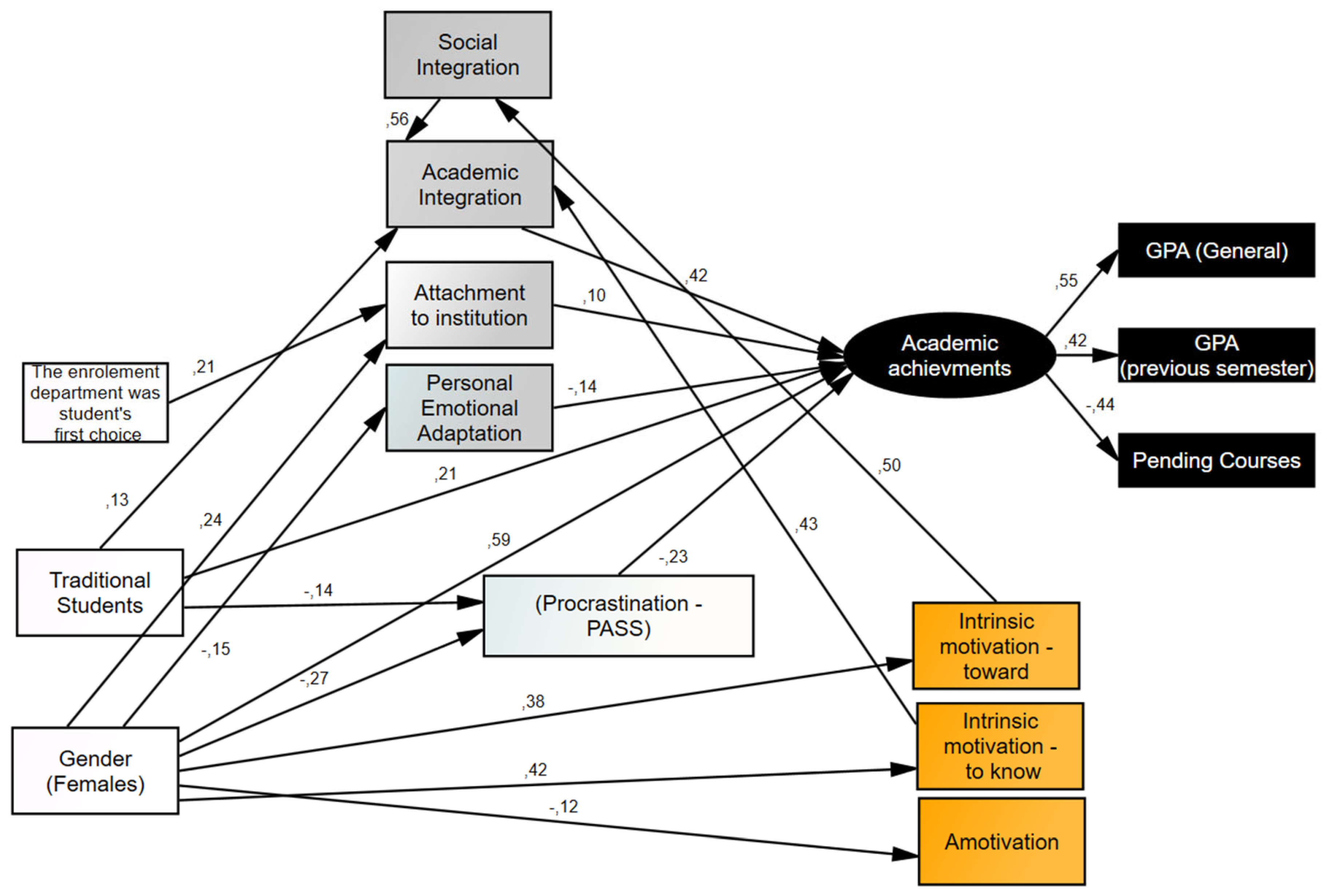
Model fit was evaluated using standard indices (χ2/df, CFI, TLI, RMSEA). All significance levels were set at p < 0.05. The tested model (Figure 1) included only the paths described above; any hypothesized but non-estimated relationships were omitted to maintain full coherence among the hypotheses, model, and results.
Figure 1.
The final SEM (direct and indirect effects). Note: χ2/df = 2.87, CFI = 0.84, TLI = 0.731, RMSEA = 0.034, p < 0.05.
The application of the path models provided enough evidence to validate the conceptual framework and provided empirical support for the hypotheses. The analysis not only elucidated the direct and indirect effects of students’ characteristics on GPA and academic adaptation, which served as the criterion variables in each model, but also highlighted the complex interplay between these characteristics and outcomes as mediated by students’ motivational status.
For reasons of brevity, the full description of the independent variables, as well as of those mentioned below, and their values are given in Table 1 together with the descriptive and factor analysis results.
As regards the dependent variable, there is a latent variable denoted by η, reflecting academic achievement. This construct was modeled as a latent factor indicated by three observed measures—overall GPA, GPA of the previous semester, and number of pending courses—each representing a concrete indicator of students’ academic progress and performance.
The three indicators were selected on the basis of conceptual relevance and practical availability rather than specific bibliographic precedence. Although GPA and semester GPA are correlated, they index different temporal scopes and were included to represent cumulative and recent academic performance, respectively.
The latent modeling allowed for measurement error to be accounted for, increasing the construct validity of the dependent variable. For the development of these latent constructs, three indicator variables were measured. These variables are denoted as Y_k, k = 1, …, 3 and they are also fully described along with the corresponding latent variable they measure in Table 1. In particular, Y1, Y2 and Y3 correspond to grade point average (GPA), grade point average (GPA) of the previous semester and number of courses pending for the current semester, respectively.
3. Results
A path analytic model using SEM was employed to investigate how key demographic, behavioral, and emotional constructs contribute to academic achievement among university students. Standardized effects are presented to assess both direct and mediated pathways (see Figure 1 and Table 2).
Table 2.
Standardized direct, indirect, and total effects on academic achievement.
The reported coefficients for the indicator variables “Gender,” “Traditional student,” and “Department was first choice” are standardized total effects from the SEM. Their magnitudes may appear large; however, this is expected given the model structure and the binary coding of these predictors (0/1), which can inflate standardized coefficients relative to continuous covariates.
Gender (female students) demonstrated the strongest total influence on academic achievement (β = 0.819). The direct effect (β = 0.590) was substantial, reflecting gender-based differences in learning behavior and adaptation. The indirect effect (β = 0.229) was mediated through several constructs: (a) intrinsic motivation toward integration (β = 0.383), (b) intrinsic motivation to know (β = 0.420), (c) personal–emotional adaptation (β = −0.152), (d) procrastination (β = −0.269), (e) amotivation (β = −0.119), and (f) institutional attachment (β = 0.237). The sum of these mediated paths yields the total indirect effect of β = 0.229, which indicates that gender impacts motivation, emotional resilience, and behavioral regulation, all of which contribute to academic performance.
Traditional student status exerted a total effect of β = 0.300 on academic achievement, composed of a direct effect (β = 0.214) and an indirect effect (β = 0.085). The indirect effect was mediated through academic integration (β = 0.126 × β = 0.563 = 0.071) and procrastination (β = −0.139 × β = −0.100 = 0.014), indicating that traditional students benefit from stronger academic engagement and lower behavioral avoidance. In other words, traditional students, possibly characterized by consistent enrollment patterns and fewer external obligations, are more likely to experience stable academic trajectories.
First-choice department selection had no direct effect on achievement but showed a modest indirect effect (β = 0.022), mediated through first choice → institutional attachment → achievement (β = 0.208 × β = 0.105 = 0.022). Although limited in magnitude, this suggests that students who enroll in their preferred department may feel more connected to the institution, supporting performance.
Social integration influenced academic achievement exclusively through an indirect path (β = 0.239), mediated by academic integration (β = 0.424 × β = 0.563 = 0.239). While no direct path to achievement was specified, the strength of this mediated route emphasizes that peer and community engagement facilitates deeper academic involvement, which in turn enhances performance.
Academic integration was among the most impactful direct predictors (β = 0.424). This construct encompasses the degree to which students engage with coursework, develop learning routines, and connect intellectually with their studies.
Institutional attachment showed a smaller but positive direct effect (β = 0.103), indicating that a sense of belonging can enhance persistence and focus, although its mediating role may be more influential in broader models.
Personal–emotional adaptation had a negative direct effect (β = −0.143), suggesting that students experiencing emotional distress or difficulty adapting may struggle academically, aligning with the existing literature on adjustment and academic functioning.
Finally, procrastination was strongly and negatively associated with achievement (β = −0.228), further supporting its role as a critical barrier to academic success. This aligns with cognitive-behavioral frameworks suggesting that delay and avoidance undermine performance outcomes.
These findings reinforce the importance of motivational, emotional, and institutional factors in shaping academic outcomes. Nonetheless, the cross-sectional nature of the data limits the ability to make causal inferences, and the observed associations should be viewed as correlational rather than causal. Variables such as gender and traditional student status exert significant influence, both directly and indirectly, while constructs like integration and procrastination highlight the behavioral dynamics underlying academic success.
4. Discussion
This study provides an empirically tested but moderately fitting model of academic achievement among university students by examining the interaction of demographic, motivational, behavioral, and institutional factors within Greek higher education. Although the SEM demonstrated acceptable RMSEA values, the incremental fit indices (CFI and TLI) were below conventional 0.90 thresholds, indicating that the model should be interpreted as a theoretically informed approximation rather than a comprehensive explanatory framework. The discussion focuses solely on relationships supported by the tested SEM. Statements about constructs not included in the model are interpreted as theoretical context rather than empirical findings.
The findings highlight that gender, particularly being female, was a significant predictor of academic success. However, these gender-related effects should be interpreted cautiously, as alternative explanations, such as academic discipline, institutional culture, or students’ prior academic achievement, may also contribute to the observed differences. Gender was modelled as an exogenous variable with direct effects on motivation, procrastination, emotional adjustment, and academic achievement, rather than as a moderator of the relationships among these constructs.
The study also showed that both social and academic integration play an important role in academic achievement, primarily through indirect pathways that support well established theories of student persistence and engagement. Specifically, social integration influenced achievement indirectly through academic integration—from social to academic achievement—while academic integration had a direct positive effect on achievement. Institutional attachment exhibited a smaller yet significant direct association with achievement and was predicted by first-choice program enrollment, indicating that students who study in their preferred department may develop stronger institutional connections that enhance academic outcomes.
Intrinsic motivation did not have a direct path to academic achievement in the final SEM. Its role appears indirectly through integration and emotional adjustment. Therefore, while motivation remains theoretically important within SDT, the present findings provide empirical support only for its indirect associations within this specific model configuration. Broader SDT mechanisms—such as basic psychological needs satisfaction or autonomous regulation—were not directly tested and should not be inferred from the current data.
Additionally, emotional maladjustment and procrastination were found to negatively affect academic outcomes, highlighting the importance of psychological resilience and behavioral self-regulation. These direct paths from emotional maladjustment to achievement (negative) and from procrastination to achievement (negative) were statistically significant, confirming their inhibitory role in students’ academic functioning.
4.1. Gender and Academic Performance
The strong influence of gender as a predictor aligns with a large body of research showing that female students often exhibit higher levels of self-discipline, emotional regulation, and academic persistence (Nasir et al. 2024; Vlachopanou et al. 2025c). These characteristics are consistent with SDT principles emphasizing autonomy, competence, and relatedness as culturally and psychologically shaped needs (Ryan and Deci 2000). However, the current cross-sectional evidence cannot determine whether gender causes these differences or reflects contextual factors such as discipline or prior performance. Future longitudinal studies should examine how these gender effects evolve across academic stages.
4.2. Integration and Institutional Belonging
Academic integration proved to be the strongest direct predictor of achievement, aligning with Tinto’s (1975) model, which highlights how active academic involvement drives persistence and performance.
Social integration was not directly related to achievement but contributed indirectly through academic integration, highlighting that peer and community engagement enhance academic engagement rather than achievement per se.
Institutional attachment also had a small yet positive direct effect on achievement and was predicted by first-choice enrollment. This pattern clarifies that students who are enrolled in their preferred programs tend to feel a stronger sense of belonging, which may indirectly support performance outcomes. These results refine earlier findings (Özer et al. 2021; Huang and Kou 2025) by showing that institutional attachment functions as a modest but distinct component within the broader integration framework.
Traditional students following a continuous educational trajectory showed higher academic achievement than non-traditional peers, largely due to stronger integration and lower procrastination. This observation is consistent with the findings of Montes (2024) and Burger (2023). However, student type acted as an exogenous predictor rather than a moderator, meaning that it directly influenced integration and achievement without altering other variable relationships.
4.3. Motivation and Self-Determination Theory
Contrary to the initial hypotheses, intrinsic motivation did not directly predict academic achievement in the tested SEM. This outcome suggests that motivation may operate indirectly by influencing integration and adjustment processes. Thus, any discussion of motivation as a causal driver of performance should be viewed as a correlational association. This finding aligns with recent evidence from Greek higher education indicating that academic motivation may influence performance indirectly through broader psychosocial mechanisms such as perceived employability and well-being, rather than functioning as a direct predictor of GPA (Maska 2026).
Statements about constructs not included in the model should be regarded as theoretical context rather than empirical findings. While SDT provides a valuable lens for interpreting students’ motivational profiles, the current data support only limited inferences about its causal mechanisms.
4.4. Emotional Adjustment and Procrastination
Emotional maladjustment had a direct negative path to achievement, confirming that students experiencing emotional distress or difficulty adapting academically may struggle to meet performance demands (Dimitropoulou et al. 2021).
Although moderate, this effect highlights the significance of emotional regulation as an aspect of students’ adjustment, rather than as a mediating factor of motivation.
Procrastination likewise showed a significant negative direct effect on achievement, indicating its role as a behavioral barrier to success. Unlike amotivation, which was not modeled as a predictor, procrastination directly undermines performance outcomes and represents a practical target for intervention.
Practical Implications for Higher Education Policy and Practice
Although the present findings are correlational, they offer several implications for institutional practice within higher education settings, particularly in structured systems such as the Greek context.
First, the strong direct effect of academic integration suggests that institutions should prioritize structured academic engagement mechanisms. Orientation programs, faculty–student mentoring schemes, structured first-year academic seminars, and systematic feedback processes may enhance academic integration, which in turn appears strongly associated with achievement (Tinto 2012; Clark et al. 2014). Given that social integration influenced achievement indirectly through academic integration, universities may benefit from designing social initiatives that are academically anchored rather than purely extracurricular.
Second, the significant negative effects of procrastination and emotional maladjustment highlight the importance of preventative academic support systems. Evidence-based interventions such as time-management workshops, self-regulation training, and embedded academic coaching may reduce behavioral avoidance patterns (Steel 2007; van Eerde 2016). Additionally, early-alert systems integrating academic and psychosocial indicators could allow institutions to identify at-risk students before performance deterioration becomes pronounced.
Third, the modest but significant role of institutional attachment suggests that alignment between students’ program choice and institutional identity may contribute to performance stability. Academic advising systems that support informed program selection and reinforce belonging through structured identity-building initiatives may indirectly enhance achievement outcomes (Hausmann et al. 2007).
Importantly, the findings indicate that intrinsic motivation alone may not directly predict performance when institutional and behavioral mechanisms are accounted for. Therefore, policy efforts focused exclusively on motivational enhancement may be insufficient unless accompanied by structural engagement and behavioral support mechanisms.
Taken together, these results suggest that academic success should be addressed through integrated institutional strategies that combine academic engagement, emotional support, and behavioral regulation rather than isolated interventions.
4.5. Limitations
While the proposed model is theoretically robust and empirically supported, several limitations should be acknowledged. First, all measures were based on self-report questionnaires, which may introduce biases such as social desirability, recall errors, or subjective interpretation of items. Second, in addition to the cross-sectional design, the incremental fit indices (CFI/TLI) suggest that alternative model specifications may provide improved explanatory power. Future research should compare competing SEM structures, include additional theoretically relevant constructs, and test longitudinal designs to strengthen model validity. Third, the sample consisted exclusively of students from Greek and Cypriot higher education institutions, limiting the generalizability of the findings to other cultural or institutional settings and excluding students from vocational or professional programs. Moreover, differences related to academic discipline, institutional culture, or financial background may further influence the observed associations and should be examined in future research. Longitudinal and multi-institutional studies are needed to test the directionality, stability, and potential mediating mechanisms of these relationships, as well as to incorporate broader constructs from Self-Determination Theory such as basic psychological needs and different forms of motivation. Future work could also explore the impact of digital engagement, post-pandemic learning conditions, and socioeconomic context on academic adjustment and success.
5. Conclusions
This study presents a well-rounded and empirically grounded model of academic achievement among Greek university students, integrating principles from Self-Determination Theory and Tinto’s integration framework. The findings indicate that academic success arises from a complex combination of motivational, emotional, institutional, and demographic factors rather than from any single determinant. Key predictors of achievement included being female, following a traditional educational trajectory, and demonstrating strong academic integration, whereas emotional maladjustment and procrastination were significant obstacles. These results highlight that academic performance is closely linked to students’ psychological resilience, behavioral self-regulation, and institutional engagement.
From a practical perspective, the findings highlight the need for higher education practitioners and policymakers to design comprehensive support systems that strengthen academic integration, reduce procrastination, and promote emotional well-being, particularly for non-traditional and male students who may experience greater challenges in adjustment and belonging. Institutions could also implement mentoring programs, time-management training, and early-warning mechanisms to identify and support students at risk of disengagement.
Nevertheless, these conclusions should be interpreted with caution. Because the study relies on self-reported, cross-sectional data, the observed associations cannot be taken as causal. Other factors—such as academic discipline, prior achievement, and institutional culture—may also shape the patterns identified. Accordingly, the results should be viewed as suggestive rather than definitive. Despite these limitations, the study advances a nuanced understanding of how personal, motivational, and institutional dimensions intersect to influence student success. It offers a coherent theoretical and empirical framework to inform evidence-based interventions and policy aimed at enhancing engagement, persistence, and academic achievement in higher education.
Author Contributions
Conceptualization, P.V. and L.M.; Methodology, P.V., L.M. and D.K.; Validation, P.V. and D.K.; Formal analysis, D.K.; Investigation, P.V.; Data curation, D.K.; Writing—original draft, P.V., L.M. and D.K.; Writing—review and editing, L.M.; Visualization, D.K.; Supervision, L.M.; Project administration, L.M. All authors have read and agreed to the published version of the manuscript.
Funding
This research received no external funding.
Institutional Review Board Statement
The study was conducted in accordance with the Declaration of Helsinki and the Aegean College/University of Essex ethical guidelines, and approved by the AOC Ethics, approval number PGR-AOC—202310o23, on 16 October 2023.
Informed Consent Statement
Written informed consent for publication was obtained from all participants whose data or images are included in this article.
Data Availability Statement
The datasets generated and/or analysed during the current study are not publicly available due to privacy and ethical considerations but are available from the corresponding author on reasonable request.
Acknowledgments
The authors would like to thank all the participants for their valuable contributions.
Conflicts of Interest
The authors declare no conflicts of interest.
Correction Statement
This article has been republished with a minor correction to the readability of Figure 1. This change does not affect the scientific content of the article.
References
- Baker, Robert W., and Bohdan Siryk. 1984. Student Adaptation to Collegequestionnaire [Database Record]. Washington, DC: APA PsycTests. [Google Scholar] [CrossRef] [Scilit]
- Brozina, Cory, Aditya Johri, and Alanis Chew. 2024. A systematic review of research on nontraditional students reveals inconsistent definitions and a need for clarity: Focus on U.S.-based studies. Frontiers in Education 9: 1434494. [Google Scholar] [CrossRef] [Scilit]
- Burger, Kaspar. 2023. Disentangling the interplay of the sense of belonging and institutional channels in individuals’ educational trajectories. Developmental Psychology 59: 30. [Google Scholar] [CrossRef] [Scilit]
- Cerasoli, Christopher P., Jessica M. Nicklin, and Michael T. Ford. 2014. Intrinsic motivation and extrinsic incentives jointly predict performance: A 40-year meta-analysis. Psychological Bulletin 140: 980–1008. [Google Scholar] [CrossRef] [Scilit]
- Chatrakamollathas, Sorrapakksorn, Kanu Priya Moha, and Oraphin Choochom. 2022. Academic procrastination behavior among college undergraduates: Structural equation modeling (SEM). Kasetsart Journal of Social Sciences 43: 223–30. [Google Scholar] [CrossRef] [Scilit]
- Chatzidimou, S. V. 1994. Procrastination in School and Academic Tasks Among Students and University Students. Master’s thesis, National and Kapodistrian University of Athens, Athens, Greece. [Google Scholar]
- Choi, Beomkyu. 2025. Exploring the Dynamics of Social-Emotional Competencies, Fear of Failure in Learning, and Engagement in Online Learning. American Journal of Distance Education 39: 456–72. [Google Scholar] [CrossRef] [Scilit]
- Clark, Margaret H., Steven C. Middleton, Daniel Nguyen, and Lauren K. Zwick. 2014. Mediating relationships between academic motivation, academic integration and academic performance. Learning and Individual Differences 33: 30–38. [Google Scholar] [CrossRef] [Scilit]
- Daniilidou, Athena, Katerina Nerantzaki, and Georgia Stavropoulou. 2025. Pathways to happiness and resilience among university students: Understanding the role of belongingness and academic engagement. International Journal of Applied Positive Psychology 10: 30. [Google Scholar] [CrossRef] [Scilit]
- Dimitropoulou, Panagiota, Diamanto Filippatou, Elisavet Chrysochoou, Petros Roussos, Asimina M. Ralli, Kleopatra Diakogiorgi, Athina Oikonomou, and Anthi Griva. 2021. Academic emotions and reading motivation: Preliminary evidence for their development and interrelations in childhood and preadolescence. Psychology: The Journal of the Hellenic Psychological Society 26: 73–87. [Google Scholar] [CrossRef] [Scilit]
- Dunbar, Robert L., Molly J. Dingel, Lorraine F. Dame, James Winchip, and Andrew M. Petzold. 2016. Student social self-efficacy, leadership status, and academic performance in collaborative learning environments. Studies in Higher Education 43: 1507–23. [Google Scholar] [CrossRef] [Scilit]
- Duru, Erdinç, Murat Balkis, and Sibel Duru. 2024. Fear of failure and academic satisfaction: The mediating role of emotion regulation difficulties and procrastination. European Journal of Psychology of Education 39: 2901–14. [Google Scholar] [CrossRef] [Scilit]
- Fairchild, Amanda J., S. Jeanne Horst, Sara J. Finney, and Kenneth E. Barron. 2005. Evaluating existing and new validity evidence for the Academic Motivation Scale. Contemporary Educational Psychology 30: 331–58. [Google Scholar] [CrossRef] [Scilit]
- Falebita, Oluwanife Segun, Akorede A. Asanre, and Admire Chibisa. 2025. A structural equation modeling of predictive factors of mathematics undergraduates’ academic achievement. Frontiers in Education 10: 1572840. [Google Scholar] [CrossRef] [Scilit]
- Gebregergis, Werede Tareke, Furtuna Beraki, Mulubrhan Michael, Munira Ahmedin, Nahom Debesay, Tsega Atoshm, Wizdan Tekleberhan, Karolina Eszter Kovács, and Csilla Csukonyi. 2023. Factors influencing academic achievement among college students: The influence of emotional intelligence, student engagement and demographics. European Journal of Psychology and Educational Research 6: 181–93. [Google Scholar] [CrossRef] [Scilit]
- Gkatona, G. 2007. The Contribution of Individual and Psychosocialfactors to the Adaptation of the Student Population to Theuniversity: An Ecosystemic Approach. Ph.D. dissertation, Aristotle University of Thessaloniki, Thessaloniki, Greece. [Google Scholar]
- Gkintoni, Evgenia, Ioannis Dimakos, and Georgios Nikolaou. 2025. Cognitive Insights from Emotional Intelligence: A Systematic Review of EI Models in Educational Achievement. Emerging Science Journal 8: 262–97. [Google Scholar] [CrossRef] [Scilit]
- Hair, Joseph F., G. Tomas M. Hult, Christian M. Ringle, Marko Sarstedt, Nicholas P. Danks, and Soumya Ray. 2021. An introduction to structural equation modeling. In Partial Least Squares Structural Equation Modeling (PLS-SEM) Using R. Cham: Springer, pp. 1–25. [Google Scholar] [CrossRef] [Scilit]
- Hausmann, Leslie R. M., Janet Ward Schofield, and Rochelle L. Woods. 2007. Sense of belonging as a predictor of intentions to persist among African American and White first-year college students. Research in Higher Education 48: 803–39. [Google Scholar] [CrossRef] [Scilit]
- Huang, He, and Heung Kou. 2025. Learning agility, self-efficacy, and resilience as pathways to mental health in higher education: Insights from a mixed-methods study. Frontiers in Psychology 16: 1528066. [Google Scholar] [CrossRef] [Scilit]
- Kalamaras, Dimitrios, Laura Maska, and Fani Nasika. 2025a. A Cox Proportional hazards model with latent covariates reflecting students’ preparation, motives, and expectations for the analysis of time to degree. Stats 8: 37. [Google Scholar] [CrossRef] [Scilit]
- Kalamaras, Dimitrios, Laura Maska, and Fani Nasika. 2025b. A proposed MIMIC structural equation model for assessing factors affecting time to degree—The case of the Greek tertiary system. Education Sciences 15: 187. [Google Scholar] [CrossRef] [Scilit]
- Katsarou, Eirene, and Paraskevi Chatzipanagiotou. 2025. Examining the Association of Personality Traits and Grit on Greek Students’ Well-being in Higher Education. Education Sciences 15: 57. [Google Scholar] [CrossRef] [Scilit]
- Kori, Külli. 2017. The Role of Academic, Social and Professional Integration in Predicting Student Retention in Higher Education Information Technology Studies. Doctoral dissertation, Tallinn University, Tallinn, Estonia. [Google Scholar]
- Kritikou, Marina, and Theodoros Giovazolias. 2022. Emotion regulation, academic buoyancy, and academic adjustment of university students within a self-determination theory framework: A systematic review. Frontiers in Psychology 13: 1057697. [Google Scholar] [CrossRef] [Scilit]
- Maska, Laura. 2026. Academic motivation, perceived employability, academic outcomes, and well-being in Greek higher education. Discover Psychology. [Google Scholar] [CrossRef] [Scilit]
- Montes, Alejandro. 2024. So close and yet so far: Comparing the experiences of university non-traditional students before and after the pandemic. European Educational Research Journal 24: 780–96. [Google Scholar] [CrossRef] [Scilit]
- Mulaudzi, Israel Creleanor. 2023. Factors affecting students’ academic performance: A case study of the university context. Journal of Social Science for Policy Implications 11: 18–26. [Google Scholar] [CrossRef] [Scilit]
- Nasir, Farheen, Athari Almuraikhi, Asma Alkusayer, Fatima Saeed, Abdulmohsen Alkushi, Areej S. Alowfi, Muhammad AlGhaihab, and Faizan Nasir. 2024. Assessing gender differences in the students’ academic performance, aptitude, emotional intelligence and grit. Middle East Journal of Medical Education 11: 7. [Google Scholar] [CrossRef] [Scilit]
- Özer, Mehmet, Alper Özer, and Akın Koçak. 2021. Identification and emotional attachment in higher education: Antecedents and consequences. Journal of Marketing for Higher Education 31: 1–25. [Google Scholar] [CrossRef] [Scilit]
- Prokou, Eleni, Christos Bagavos, Anastasia Charalampi, and Catherine Michalopoulou. 2025. Greek undergraduate students: ‘Stagnant’, ‘perpetual’ or simply dropouts? Academia, 28–47. [Google Scholar] [CrossRef]
- Quilez-Robres, Alberto, Alejandro González-Andrade, Zaira Ortega, and Sandra Santiago-Ramajo. 2021. Intelligence quotient, short-term memory, and study habits as academic achievement predictors of elementary school: A follow-up study. Studies in Educational Evaluation 70: 101020. [Google Scholar] [CrossRef] [Scilit]
- Ribeiro, Luísa, Pedro Rosário, José Carlos Núñez, Martha Gaeta, and Sonia Fuentes. 2019. First-year students’ background and academic achievement: The mediating role of student engagement. Frontiers in Psychology 10: 2669. [Google Scholar] [CrossRef] [Scilit]
- Rožman, Maja, Igor Vrečko, and Polona Tominc. 2025. Psychological Factors Impacting Academic Performance Among Business Studies’ Students. Education Sciences 15: 121. [Google Scholar] [CrossRef] [Scilit]
- Ryan, Richard M., and Edward L. Deci. 2000. Self-determination theory and the facilitation of intrinsic motivation, social development, and well-being. American Psychologist 55: 68–78. [Google Scholar] [CrossRef] [PubMed]
- Solomon, Laura J., and Esther D. Rothblum. 1984. Academic procrastina-tion: Frequency and cognitive-behavioral correlates. Journal of Counseling Psychology 31: 503–9. [Google Scholar] [CrossRef]
- Steel, Piers. 2007. The nature of procrastination: A meta-analytic and theoretical review of quintessential self-regulatory failure. Psychological Bulletin 133: 65–94. [Google Scholar] [CrossRef] [Scilit]
- Tabar, Ruhollah Salehi, Rahim Davari, and Hossein Ebrahimi Moghadam. 2024. Structural equation modeling of academic procrastination based on motivational beliefs with the mediating role of academic vitality. Journal of Educational Psychology Studies 25: 65–80. [Google Scholar] [CrossRef]
- Tinto, Vincent. 1975. Dropout from Higher Education: A Theoretical Synthesis of Recent Research. Review of Educational Research 45: 89–125. [Google Scholar] [CrossRef]
- Tinto, Vincent. 2012. Completing College: Rethinking Institutional Action. Chicago: University of Chicago Press. [Google Scholar]
- Tsorbatzoudis, Haralambos, Vassilis Barkoykis, and George Grouios. 2001. A preliminary study of the psychometric properties of the academic motivation scale. Psychology: The Journal of the Hellenic Psychological Society 8: 526–37. [Google Scholar]
- Ullman, Jodie B., and Peter M. Bentler. 2013. Structural equation modeling. In Handbook of Psychology: Vol. 2. Research Methods in Psychology, 2nd ed. Edited by Irving B. Weiner. New York: Wiley, pp. 661–90. [Google Scholar] [CrossRef] [Scilit]
- Vallerand, Robert J., Luc G. Pelletier, Marc R. Blais, Nathalie M. Briere, Caroline Senecal, and Evelyne F. Vallieres. 1992. The academic motivation scale: A measure of intrinsic, extrinsic, and amotivation in education. Educational and Psychological Measurement 52: 1003–17. [Google Scholar] [CrossRef] [Scilit]
- van Eerde, Wendelien. 2016. Procrastination and well-being at work. In Procrastination, Health, and Well-Being. Edited by Fuschia M. Sirois and Timothy A. Pychyl. San Diego: Elsevier Academic Press, pp. 233–53. [Google Scholar] [CrossRef] [Scilit]
- Vlachopanou, Patra. 2020. The Relationship Between Defense Mechanisms and Approaches to Learning: The Mediating Role of Academic Procrastination and Psychological Well-Being. Doctoral dissertation, University of Ioannina, Ioannina, Greece. Available online: http://hdl.handle.net/10442/hedi/48177 (accessed on 15 March 2026).
- Vlachopanou, Patra. 2026. Defensive pessimism influences approaches to learning psychological well-being and academic performance through academic procrastination. Discover Psychology. [Google Scholar] [CrossRef] [Scilit]
- Vlachopanou, Patra, and Evangelia Karagiannopoulou. 2022a. Defense Styles, Academic Procrastination, Psychological Wellbeing, and Approaches to Learning: A Person-Oriented Approach. The Journal of Nervous and Mental Disease 210: 186–93. [Google Scholar] [CrossRef] [Scilit] [PubMed]
- Vlachopanou, Patra, and Evangelia Karagiannopoulou. 2022b. Defense styles, approaches to learning and the mediating role of academic procrastination. Scientific Journal of Pure and Applied Sciences 10: 990–1000. [Google Scholar]
- Vlachopanou, Patra, Dimitrios Kalamaras, Fani Nasika, and Laura Maska. 2025a. The mediating role of academic procrastination in the link between academic motivation and academic adjustment among university students. European Journal of Psychology Open 84: 33–45. [Google Scholar] [CrossRef] [Scilit]
- Vlachopanou, Patra, Evangelia Karagiannopoulou, and Georgios Ntritsos. 2023. The Relationship Between Defenses and Learning: The Mediating Role of Procrastination and Well-Being Among Undergraduate Students. The Journal of Nervous and Mental Disease 211: 54–64. [Google Scholar] [CrossRef] [Scilit]
- Vlachopanou, Patra, Laura Maska, Dimitrios Kalamaras, and Fani Nasika. 2025b. Academic motivation, procrastination, and adjustment: Exploring their impact on student profiles and academic performance. PLoS ONE 20: E0335913. [Google Scholar] [CrossRef] [Scilit]
- Vlachopanou, Patra, Laura Maska, Dimitrios Kalamaras, and Fani Nasika. 2025c. Impact of Gender, Age, First University Choice, and Residence on Academic Adaptation and Performance Through Academic Motivation: A Path Analysis. European Journal of Psychology Open 84: 133–44. [Google Scholar] [CrossRef] [Scilit]

Disclaimer/Publisher’s Note: The statements, opinions and data contained in all publications are solely those of the individual author(s) and contributor(s) and not of MDPI and/or the editor(s). MDPI and/or the editor(s) disclaim responsibility for any injury to people or property resulting from any ideas, methods, instructions or products referred to in the content. |
© 2026 by the authors. Licensee MDPI, Basel, Switzerland. This article is an open access article distributed under the terms and conditions of the Creative Commons Attribution (CC BY) license.