


Abstract
The rapid transition to Industry 4.0/5.0 has widened the gap between graduates’ skill sets and labor market expectations; this study aimed to profile student competencies and align academic pathways with inclusive and adaptive AI-driven learning. A quantitative design was applied: an online survey of n = 126 students (engineering and economics, February–March 2025), expert evaluations from 5 faculty and 5 employers on a 5-point scale, framed by T-shaped competencies, 4C skills, and Bloom’s taxonomy. Analysis was performed in Python 3.11; future demand until 2035 was forecasted using ARIMA and Prophet models trained on publicly available labor market data (OECD, WEF, Eurostat 2015–2024); competency prioritization employed K-Means clustering and Random Forest models. Strengths included cooperation 4.2, critical thinking 3.9, communication 3.8, and creativity 3.6. Deficits were programming 2.8, project management 3.2, and solution development 3.2; employers rated programming at 2.5 (−0.7 compared to faculty). Forecast 2025–2035 showed growth in demand for programming +56% (3.2 → 5.0), data analytics +39% (3.6 → 5.0), project management +34% (3.2 → 4.3), digital literacy +30% (3.7 → 4.8), and critical thinking +15% (3.9 → 4.5). Clustering identified critical (programming, analytics, project management), supporting (creativity, communication, teamwork), and optional (narrow theoretical depth) competencies. Curriculum adjustment with practice-oriented modules, AI-enabled adaptive learning, and systematic university–employer feedback is essential; the proposed AI-supported profiling model is scalable and enhances inclusiveness.
1. Introduction
The rapid digitalization of economies and the rise of Industry 4.0 and 5.0 have significantly shifted the expectations placed on graduates, particularly in technical and interdisciplinary fields such as engineering and economics. Traditional models of education—largely linear, homogeneous, and teacher-centered—are increasingly unable to meet the demands of a labor market that values flexibility, autonomy, digital literacy, and collaboration. This transformation has fueled the global movement toward inclusive and adaptive learning, underpinned by the integration of AI-supported educational technologies (EdTech).
Inclusive learning aims to ensure equitable access to quality education for all learners, regardless of their socio-economic status, physical or cognitive abilities, or prior academic performance. According to the UNESCO framework on inclusive education, inclusive learning environments must actively recognize and accommodate learner diversity in terms of background, pace, style, and support needs (UNESCO 2017).
Adaptive learning, meanwhile, refers to pedagogical approaches and systems that adjust content, pacing, and assessment based on the learner’s individual progress, engagement, and preferences. Rooted in constructivist theories and cognitive psychology, adaptive learning emphasizes personalized trajectories rather than one-size-fits-all instruction (Du Plooy et al. 2024). The development of adaptive systems has been strongly linked to advances in artificial intelligence, which enable real-time data analysis, pattern recognition, and responsive interventions.
In recent years, AI-powered student modeling has emerged as a pivotal tool for supporting both adaptive and inclusive education. AI tools can collect and interpret massive datasets from learning management systems, quizzes, peer interactions, and self-reported metrics to build dynamic learner profiles (Khosravi et al. 2020). These profiles often go beyond academic performance to incorporate indicators of motivation, cognitive engagement, emotional state, and social collaboration, thereby enabling nuanced personalization.
Skill profiling, in particular, is enhanced by AI through its ability to analyze patterns across competency models. For instance, combining T-Shaped Skills (depth and breadth), Bloom’s Taxonomy (cognitive domains), and the 4C framework (21st-century skills: critical thinking, creativity, communication, cooperation) within an AI algorithm enables comprehensive mapping of student abilities and learning gaps (Chen et al. 2020).
Studies such as those by Zawacki-Richter et al. (2019) have underscored that AI not only facilitates differentiation in the delivery of content but also enhances inclusivity by identifying underperforming or at-risk students early and providing targeted support. Moreover, adaptive feedback loops enabled by machine learning support equity by preventing marginalization of students with divergent learning needs.
The potential of AI for equity enhancement in education has been noted in multiple international policy documents (OECD 2021; European Commission 2023). AI can democratize access to high-quality learning by:
- Providing real-time scaffolding and personalized hints to students who are falling behind (Holmes et al. 2019);
- Enabling content to be adapted linguistically, visually, or cognitively for students with disabilities or non-native language backgrounds (Al-Azawei et al. 2016);
- Supporting asynchronous and mobile access to education for remote or underserved learners.
One notable application is the use of natural language processing (NLP) to analyze open-text responses, discussion boards, and reflective journals, thus detecting when students are confused, disengaged, or require socio-emotional support—critical components of inclusive practice (Zhu and Wang 2020). However, scholars have also raised cautionary perspectives. If not carefully designed, AI systems may unintentionally reinforce biases (e.g., in predictive scoring or recommendation engines), thereby exacerbating inequality rather than alleviating it (Jang et al. 2017). Thus, AI-supported profiling must be coupled with transparent, ethical frameworks and human oversight. Several EdTech platforms now integrate AI to deliver adaptive learning experiences, including ALEKS, Smart Sparrow, DreamBox, and Knewton. These systems dynamically adjust content flow based on learner interactions, mastery levels, and confidence indicators. In higher education, platforms like Socrative, Coursera Labs, and edX Insights utilize data analytics to recommend personalized pathways and predict performance risk (Ifenthaler et al. 2019).
A growing number of studies have evaluated the impact of adaptive systems on student engagement, satisfaction, and outcomes. For example, Muñoz et al. (2022) found that adaptive modules increased STEM student retention by 18% in introductory courses, particularly among underrepresented student populations. Another study by Jian (2023) demonstrated that integrating AI-powered diagnostics into economics courses led to a 25% improvement in skill mastery rates. Nevertheless, successful integration of such systems requires institutional readiness, including digital infrastructure, faculty training, and curricular flexibility to allow non-linear progression.
The accelerating transformation of labor markets driven by Industry 4.0 and the emerging paradigm of Industry 5.0 places significant pressure on higher education institutions to adapt curricula to future skill demands. In this context, graduates from engineering and economic programs are increasingly expected to demonstrate not only deep domain-specific knowledge but also strong digital competencies, critical thinking, and the ability to operate in interdisciplinary and technology-intensive environments (OECD 2021; David and Kiplagat 2024). However, numerous studies reveal a persistent gap between the skills acquired by students during their university education and the evolving expectations of employers in the digital economy (Rhoney et al. 2024; Lizunkov et al. 2021).
Competency-based education has emerged as a key response to this challenge, emphasizing the integration of soft and hard skills within flexible, learner-centered models (Duche-Pérez et al. 2024). Frameworks such as T-Shaped Skills, the 4C model (critical thinking, creativity, communication, and cooperation), and Bloom’s Taxonomy are widely used to structure competency development across multiple learning dimensions (Politsinskaya et al. 2019; Timiras et al. 2024). At the same time, artificial intelligence (AI) and machine learning (ML) are becoming instrumental in identifying individual learning trajectories and forecasting labor market trends (Kowalska 2024; Joint Research Centre 2025; Kozlov et al. 2022; Eurydice 2024; WEF 2023).
This study addresses the urgent need to align university curricula with future-oriented skill profiles by proposing a machine learning-supported algorithm for student skill profiling. Using empirical data from student surveys and expert assessments, the research identifies core competency gaps and forecasts future skill demands using time series analysis and machine learning techniques. The study aims to provide evidence-based recommendations for creating inclusive, adaptive, and digitally enhanced educational programs that prepare students for a dynamic and data-driven labor market.
A forward-looking component of AI-supported profiling is the use of machine learning and time series forecasting (e.g., ARIMA, Prophet) to predict future skill demands based on labor market trends.
AI-supported student skills profiling, when combined with pedagogically sound frameworks and ethical oversight, enables higher education institutions to recognize and address individual learning needs at scale (Fatemeh and Bahram 2024; Furlan et al. 2021). This not only enhances academic outcomes but also promotes equity, personalization, and alignment with future labor demands. As the higher education sector continues to navigate complexity, AI-based approaches can serve as powerful tools to design systems that are both learner-centered and socially just. The remainder of the paper is organized as follows: Section 2 describes the materials and methods, including the survey design, data sources for time series forecasting, and machine learning procedures. Section 3 presents the results, covering student skill assessments, expert comparisons, demand forecasts, and competency classification. Section 4 provides a discussion of the findings in the context of existing literature and outlines the study’s limitations. Section 5 concludes the paper with recommendations and directions for future research.
2. Materials and Methods
2.1. Participants and Data Collection
This study employed a quantitative research design combining structured survey research with expert evaluation and data-driven modeling using AI-based analytical tools. The empirical component was conducted at Peter the Great St. Petersburg Polytechnic University (SPbPU) between 15 February and 14 March 2025. A total of 126 students from engineering (n = 68) and economic (n = 58) majors participated in a structured online questionnaire designed to assess their self-perceived skill levels across various competency domains. The questionnaire items were based on three widely accepted competency frameworks: T-Shaped Skills, the 4C model (critical thinking, creativity, communication, cooperation), and Bloom’s Taxonomy. All responses were anonymous, voluntary, and no personal data were collected. The sample size was sufficient for descriptive statistics and clustering analysis, though it represents a limitation for training complex supervised machine learning models.
2.2. Instruments
In parallel, expert assessments were collected from five university faculty members and five employers representing relevant industry sectors. These experts independently evaluated student competencies using the same competency frameworks and a five-point Likert scale. Although the expert panel was small (n = 10), it provided a valuable triangulation perspective alongside student self-assessments. It should be noted that the expert component was structured as a quantitative rating exercise rather than a qualitative study; therefore, the findings reflect numerical evaluations without in-depth qualitative data such as interview transcripts or content analysis. Mean values were calculated for each skill category and compared across the three respondent groups (students, faculty, employers).
2.3. Data Analyses
For forecasting trends in future skill demands, time series analysis techniques including ARIMA (AutoRegressive Integrated Moving Average) and Prophet (Taylor and Letham 2018) were applied. The forecasting models were trained on publicly available longitudinal labor market data from the OECD Skills Outlook reports (2015–2024), the World Economic Forum Future of Jobs surveys (2016–2023), and Eurostat digital skills indicators for the European labor market. Specifically, the following indicators were used: OECD skills demand indices, WEF employer survey ratings of skill importance, and Eurostat Digital Economy and Society Index (DESI) sub-indicators. Since these sources use different scales and metrics, all indicators were normalized to a common 1–5 scale using min–max normalization: X_norm = 1 + 4 × (X − X_min)/(X_max − X_min), where X_min and X_max represent the observed minimum and maximum values across the 2015–2024 period. A value of 5.0 thus corresponds to the maximum observed demand level rather than an absolute ceiling. These datasets provided annual or biennial observations (approximately 5–10 data points per skill domain), which represents a limitation: ARIMA and Prophet models perform best with longer time series, and results based on short series should be interpreted with caution. Model performance was evaluated using Mean Absolute Error (MAE) and Root Mean Squared Error (RMSE) on a hold-out validation set (2020–2024 data reserved for testing), with a naive last-value forecast used as a baseline for comparison. Forecast results are presented with 95% confidence intervals; for ARIMA, these were derived from the analytical forecast error variance, and for Prophet, from the posterior predictive distribution using default uncertainty parameters. The final reported intervals represent the Prophet model output, as Prophet showed lower MAE. For competency classification and prioritization, K-Means clustering (unsupervised) was applied to group skills by their current proficiency level and forecasted growth. Additionally, Random Forest classification (supervised) was used to predict skill priority categories (critical, supplementary, optional). The unit of analysis for the classification task was the student–skill pair (n = 126 students × 7 skill domains = 882 observations). The target variable for Random Forest was derived from a composite label assigned to each student–skill combination based on two criteria: (1) the gap between the student’s self-assessed proficiency and the forecasted 2035 demand for that skill, and (2) expert consensus on skill importance. Features included individual student self-assessment scores, mean expert ratings per skill, and forecasted demand values. Given the nested structure of the data, five-fold cross-validation was applied at the student level (to prevent data leakage); classification accuracy, precision, and recall are reported in Section 3. All data preprocessing, statistical analysis, and modeling were performed using Python (pandas, NumPy, scikit-learn, statsmodels, and Prophet libraries).
No human or animal interventions requiring ethical approval were part of this study. All student participants were informed of the research objectives and voluntarily agreed to participate. No personal data were collected throughout the research process.
All processed data and analytical code will be made available via an open access institutional repository upon acceptance of the article.
3. Results
This section presents the results of the empirical study, including student skill assessments, expert comparisons, forecasting analysis, and competency classification.
3.1. Student Skill Assessment and Expert Comparison
The survey conducted among 126 students revealed uneven development of key competencies (see Table 1). On average, students demonstrated strong scores in areas related to teamwork (cooperation: 4.2), critical thinking (3.9), and communication (3.8), indicating a solid foundation in soft skills and cognitive engagement. However, lower scores were observed in practical and technical domains such as programming (2.8), project management (3.2), and solution development (3.2), pointing to significant deficits in applied competencies. Notably, engineering students scored higher in programming (3.1 vs. 2.4 for economics students) and solution development (3.5 vs. 2.8), while economics students demonstrated stronger communication skills (4.0 vs. 3.6) and cooperation (4.4 vs. 4.0). These differences highlight the distinct competency profiles of the two disciplines and suggest that curriculum interventions should be tailored accordingly.
Table 1.
Comparison of student self-assessments and expert evaluations.
Expert evaluations provided by five faculty members and five industry professionals confirmed these trends. Educators rated students slightly higher in core academic knowledge areas, while employers emphasized the lack of real-world readiness. The most significant divergence was observed in programming and digital automation, where employers rated students at 2.5 on average—0.7 points below the students’ own assessments.
Analysis of Table 1 revealed significant discrepancies between student self-assessments and expert evaluations, particularly in technical competencies: the largest gap was observed in programming and automation, where employers rated students’ skills at 2.5 points versus 2.8 points in self-assessment and 3.2 points in faculty evaluation. Faculty systematically rated students higher across all skills, with the maximum divergence from employers reaching 0.7 points in programming, indicating differences in perception of graduates’ readiness for actual professional activities.
Students demonstrated the highest performance in soft skills—cooperation (4.2), critical thinking (3.9), and communication (3.8)—which was confirmed by relatively close assessments from all three respondent groups with minimal discrepancies of 0.1–0.2 points. Practical skills such as project management and solution development received identical student self-assessments (3.2 points), but employers rated them lower (3.0), indicating insufficient preparation for applying knowledge in real digital economy conditions. The overall pattern showed that students in engineering and economic disciplines had deficits in digital and managerial competencies (average score 2.8–3.2) while having relatively developed cognitive and communication skills (average score 3.6–4.2), requiring curriculum revision toward strengthening practice-oriented learning.
These gaps emphasized the need for curricular interventions, especially in programming-related disciplines and hands-on project execution.
The models were trained on normalized longitudinal labor market data from OECD, WEF, and Eurostat sources (2015–2024; approximately 5–10 annual/biennial observations per skill domain) and validated against held-out data from 2020 to 2024. Due to the short length of the time series, results should be interpreted as indicative trends rather than precise point forecasts. The ARIMA model achieved a Mean Absolute Error (MAE) of 0.18 and the Prophet model achieved a MAE of 0.15 on the validation set, both outperforming the naive last-value baseline (MAE = 0.31). Based on the Prophet model (which demonstrated lower error), by 2035 the demand for digital and analytical skills was projected to increase significantly (Table 2):
Table 2.
Forecast of skill demand growth (2025–2035), based on ARIMA and Prophet models. Growth percentages are rounded to whole numbers.
- Programming and automation skills were projected to rise by approximately 56%, becoming critical across industries;
- Data analytics was projected to grow by approximately 39%, reflecting the integration of big data and AI into decision-making;
- Project management demand was projected to increase by approximately 34%, driven by agile methodologies and cross-functional collaboration.
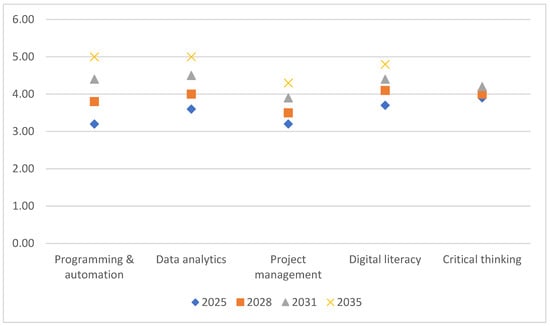
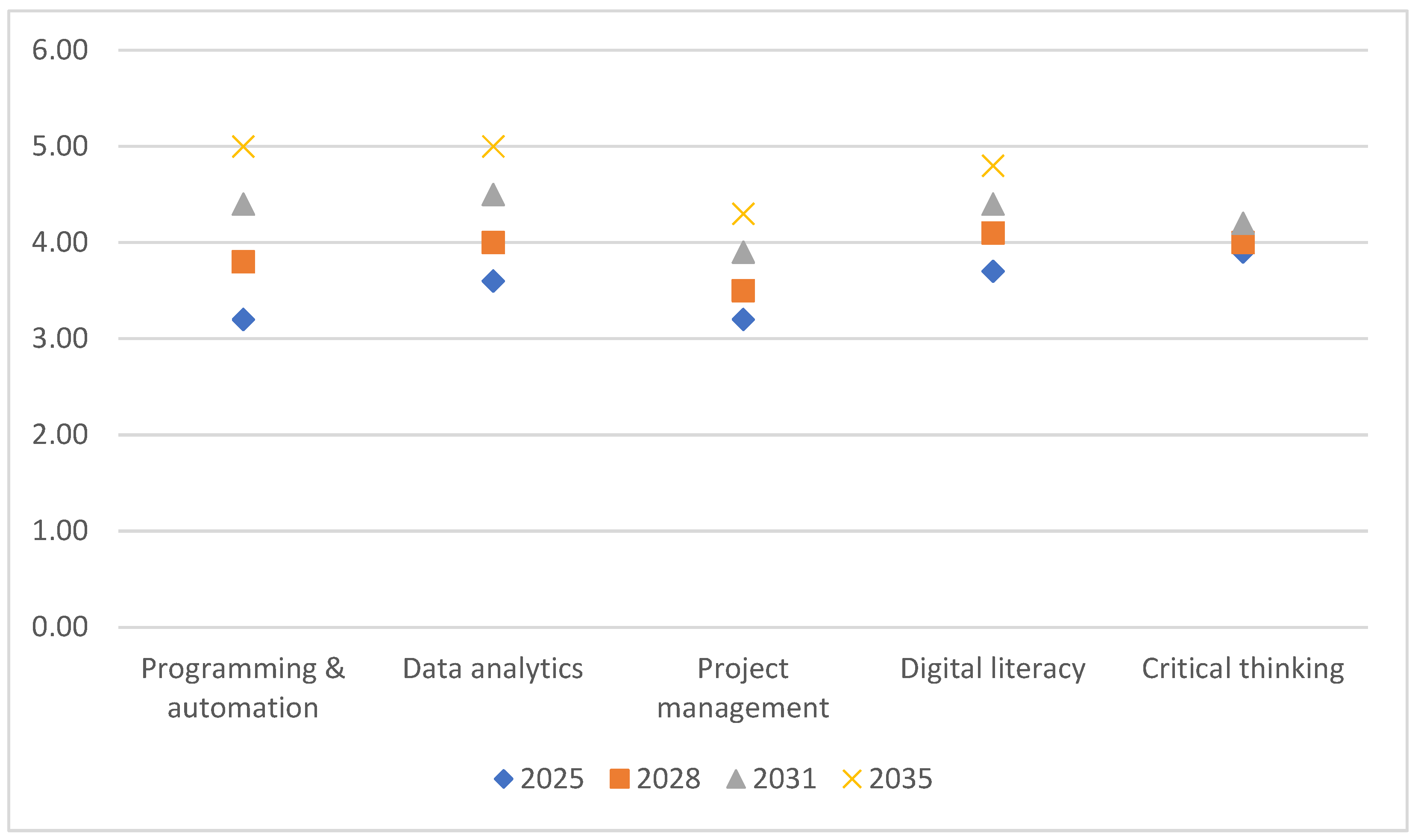
Figure 1 illustrates the projected increase in demand for key skills between 2025 and 2035.
Figure 1.
Projected growth in demand for key skills from 2025 to 2035 using ARIMA and Prophet models.
The forecast analysis using ARIMA and Prophet models demonstrated that programming and automation skills were projected to experience the most dramatic growth, rising from 3.2 in 2025 to 5.0 by 2035 (95% CI: 4.6–5.0), representing an approximately 56% increase that reflects the accelerating digital transformation under Industry 4.0 and 5.0 paradigms. Data analytics competencies were projected to grow by approximately 39% over the decade, advancing from 3.6 to 5.0 points (95% CI: 4.5–5.0), highlighting the critical role of big data and AI-driven decision-making in future labor markets. Project management skills were projected to see substantial growth of approximately 34%, increasing from 3.2 to 4.3 points (95% CI: 3.9–4.7) by 2035, driven by the adoption of agile methodologies and cross-functional collaboration requirements in technology-intensive environments.
Digital literacy showed steady progression with approximately 30% growth from 3.7 to 4.8 points (95% CI: 4.4–5.0), while critical thinking demonstrated the most modest increase of approximately 15% from 3.9 to 4.5 (95% CI: 4.2–4.8), suggesting that while cognitive skills remain important, technical competencies are becoming increasingly paramount. The convergence of programming, data analytics, and project management toward the maximum 5.0 rating by 2035 indicated these are likely to become mandatory baseline competencies for engineering and economics graduates, necessitating curriculum interventions to address the current skill gaps identified in student assessments. It should be noted that these projections carry inherent uncertainty, and actual demand trajectories may deviate depending on technological, economic, and policy developments.
These results suggested an urgent need for higher education institutions to integrate advanced digital content, especially in areas related to automation, data science, and agile project delivery.
3.2. Classification and Prioritization of Competencies
To assist curriculum developers in decision-making, student skills were grouped into three categories based on their current level and forecasted strategic importance using machine learning (K-Means clustering and Random Forest classification). K-Means clustering was first applied to identify natural groupings among competencies based on two features: mean student proficiency scores and forecasted 2035 demand values. Subsequently, Random Forest classification was trained on 882 student–skill observations (126 students × 7 skill domains), using composite priority labels as the target variable. Five-fold cross-validation at the student level yielded an average classification accuracy of 0.87, with precision and recall of 0.85 and 0.88, respectively (baseline majority-class accuracy: 0.43). Critical skills included programming, data analysis, and project management, where low proficiency and high demand growth converged. Supplementary skills such as communication, creativity, and teamwork were relatively strong but required ongoing support through collaborative and interdisciplinary projects. Optional skills—primarily deep theoretical knowledge in narrow domains—remained important for academic specialization but were less urgent from an industry readiness perspective. Table 3 summarizes the competency categories identified through machine learning classification.
Table 3.
Competency categories based on machine learning classification.
This classification can support universities in optimizing learning paths and allocating resources to develop high-impact skills in line with evolving labor market demands.
4. Discussion
The findings of this study underscored the critical need for restructuring university curricula in engineering and economics education to bridge the growing gap between students’ competencies and the demands of the digital labor market. The observed discrepancy between student self-assessment and expert evaluations—particularly in programming, project management, and solution development—validated prior research pointing to the misalignment between higher education outputs and employer expectations in the era of Industry 4.0 and 5.0 (Rhoney et al. 2024; Timiras et al. 2024).
The relatively strong performance in soft skills is consistent with existing studies that emphasize the effectiveness of collaborative learning and the cognitive depth achieved through project-based methods (Politsinskaya et al. 2019). However, the significantly lower evaluations in digital and managerial competencies suggest insufficient integration of practical, technology-oriented training in university programs. This aligns with the conclusions of Timiras et al. (2024), who highlighted the slow adaptation of higher education to the digital transformation and the resulting deficits in employability. The differences observed between engineering and economics students further suggest that a one-size-fits-all curriculum approach is inadequate; engineering students demonstrated stronger technical skills but weaker communication abilities compared to their economics counterparts, indicating that targeted interventions should account for disciplinary profiles.
The time series forecasts further contextualized these results by demonstrating an anticipated increase of over 50% in demand for programming and automation skills by 2035, followed by substantial growth in data analytics and project management. These projections confirmed the trend previously noted in European Commission guidelines (European Commission 2023) and DigComp 2.1, which identified digital literacy and analytical thinking as core competencies for the future workforce (Joint Research Centre 2025; Eurydice 2024). Consequently, it is essential that curricula not only include but prioritize these areas through mandatory coursework, practical labs, and AI-enabled simulation environments.
The classification of competencies into critical, supplementary, and optional clusters—based on K-Means and Random Forest modeling—provided actionable insights for curriculum designers. The prioritization of technical skills as “critical” echoes recent findings from the World Economic Forum and OECD regarding future-ready skills and lifelong learning frameworks (WEF 2023; OECD 2021). While supplementary skills like creativity and teamwork were adequately developed, their continued reinforcement through interdisciplinary challenges and capstone projects remains necessary.
From a pedagogical standpoint, the results support the wider implementation of adaptive learning environments that tailor educational content to individual student profiles, as proposed in the literature on competency-based and inclusive education (Holmes et al. 2019; Al-Azawei et al. 2016; Du Plooy et al. 2024). The gap identified between theoretical knowledge and its practical application (e.g., Bloom’s lower scores for solution development and process evaluation) further suggests the need for more case-based learning, agile project management modules, and integration of real-world digital tools (e.g., ERP systems, Python for data science, machine learning pipelines).
The study’s methodology, combining quantitative analysis, expert triangulation, and AI-based forecasting, provided a diagnostic tool for university skill profiling and contributed to the development of an AI-assisted framework for academic program redesign. However, several limitations must be acknowledged. First, the sample of 126 students was drawn from a single university (SPbPU), which limits the generalizability of the findings to other institutional or national contexts. Second, the expert panel comprised only 5 faculty members and 5 employers, which, while providing useful triangulation, is too small to be representative of broader labor market expectations. Third, student self-assessment is inherently subject to cognitive biases, including overestimation or underestimation of one’s own competencies, and no objective performance measures were used to validate these self-reports. Fourth, the forecasting models, although trained on multi-source longitudinal data, produce projections that are inherently uncertain over a 10-year horizon, and actual developments may diverge from the presented scenarios. Fifth, the study used a quantitative design only; future research could benefit from incorporating qualitative methods such as in-depth interviews and focus groups to provide richer contextual understanding of competency gaps. Finally, the time series used for forecasting contained only 5–10 data points per skill domain, which limits the statistical reliability of the ARIMA and Prophet models; future work should incorporate longer time series and additional data sources to improve forecast robustness.
Additionally, it would be valuable to investigate the role of institutional governance, faculty development, and digital infrastructure readiness in scaling such adaptive models. Finally, there is potential for extending the proposed algorithm to other domains beyond engineering and economics, such as healthcare, public administration, and environmental sciences, where interdisciplinary and digital competencies are also gaining strategic importance.
5. Conclusions
This study presented a comprehensive approach to profiling the skills of students in engineering and economic disciplines using competency-based models, expert assessments, and AI-powered forecasting techniques. The research highlighted a significant gap between the current level of students’ practical competencies and the projected demands of the labor market under Industry 4.0 and 5.0 conditions.
The analysis showed that students demonstrated strong performance in soft skills (cooperation—4.2; critical thinking—3.9; communication—3.8), but had deficits in digital and managerial competencies (programming—2.8; project management—3.2). Engineering students scored higher in technical skills, while economics students excelled in communication and cooperation. Experts confirmed this trend, with employers rating programming at 2.5 points—0.7 lower than the academic evaluation. The forecast to 2035 revealed an anticipated increase in demand for programming skills by approximately 56%, data analysis by approximately 39%, and project management by approximately 34%. These findings suggest that universities should strengthen practice-oriented disciplines and integrate adaptive digital technologies into the educational process to improve graduates’ readiness for labor market demands, while acknowledging the inherent limitations of the present study’s scope and sample size.
This research was funded by the Russian Science Foundation, project No. 25-28-01469 “Neural Network Solutions for Managing Social and Labor Relations in the Digital Economy of Megacities.” It should be noted that while the broader project employs neural network approaches, the present study specifically utilized K-Means clustering, Random Forest classification, and time series forecasting (ARIMA, Prophet) as its primary analytical methods. Future work will expand on these findings through longitudinal studies, international comparisons, and the incorporation of generative AI for continuous learning environment optimization.
Author Contributions
Conceptualization, O.E., G.M. and A.S.; methodology, O.E.; software, G.M.; validation, O.E., G.M. and A.S.; formal analysis, G.M.; investigation, O.E. and A.S.; resources, O.E.; data curation, A.S. and G.M.; writing—original draft preparation, O.E.; writing—review and editing, G.M. and O.E.; visualization, A.S. and G.M.; supervision, O.E.; project administration, O.E.; funding acquisition, O.E. All authors have read and agreed to the published version of the manuscript.
Funding
This research was funded by the Russian Science Foundation, project No. 25-28-01469 “Neural Network Solutions for Managing Social and Labor Relations in the Digital Economy of Megacities”.
Institutional Review Board Statement
Ethical review and approval were not required for this study, as it involved only anonymous voluntary online questionnaires with no collection of personal data and no human or animal interventions.
Informed Consent Statement
Informed consent was obtained from all participants through a notice at the beginning of the online questionnaire. No written signatures were required, as the survey was fully anonymous.
Data Availability Statement
Aggregated data and analytical code for AI-based modeling will be deposited in an open access institutional repository upon final acceptance of the article.
Acknowledgments
The authors wish to thank the teaching staff and technical teams at Peter the Great St. Petersburg Polytechnic University (SPbPU) for their support during data collection and analysis. During the preparation of this manuscript, the authors used ChatGPT-4 (OpenAI) for the purposes of language refinement, structure alignment, and formatting. The authors have reviewed and edited the output and take full responsibility for the content of this publication.
Conflicts of Interest
The authors declare no conflicts of interest. The funders had no role in the design of the study; in the collection, analyses, or interpretation of data; in the writing of the manuscript; or in the decision to publish the results.
Abbreviations
The following abbreviations are used in this manuscript:
| AI | Artificial Intelligence |
| EdTech | Educational Technology |
| NLP | Natural Language Processing |
| ARIMA | AutoRegressive Integrated Moving Average |
| OECD | Organisation for Economic Co-operation and Development |
| SPbPU | Peter the Great St. Petersburg Polytechnic University |
| ML | Machine Learning |
| 4C | Critical thinking, Creativity, Communication, Cooperation |
References
- Al-Azawei, Ammar, Francesco Serenelli, and Kristina Lundqvist. 2016. Universal Design for Learning (UDL): A Content Analysis of Peer-Reviewed Journal Papers from 2012 to 2015. Journal of Scholarship of Teaching and Learning 16: 39–56. [Google Scholar] [CrossRef] [Scilit]
- Chen, Lin, Pei Chen, and Zhiyong Lin. 2020. Artificial Intelligence in Education: A Review. IEEE Access 8: 75264–78. [Google Scholar] [CrossRef] [Scilit]
- David, Wambui, and Kiu Publication Extension. 2024. Competency-Based Education: Shifting Focus from Grades to Skills. Kiplagat: Kiu Publishing, vol. 3, pp. 13–18. [Google Scholar]
- Duche-Pérez, Ana, Andrea Plata, Raúl Grundy-López, and Valeria Flores. 2024. Research Competencies and Skills in Universities: A Systematic Literature Review. Revista de Gestão Social e Ambiental 18: e07747. [Google Scholar] [CrossRef] [Scilit]
- Du Plooy, Elna, Daniel Casteleijn, and Denise Franzsen. 2024. Personalized Adaptive Learning in Higher Education: A Scoping Review of Key Characteristics and Impact on Academic Performance and Engagement. Heliyon 10: e39630. [Google Scholar] [CrossRef] [Scilit] [PubMed]
- European Commission. 2023. Ethical Guidelines on the Use of Artificial Intelligence (AI) and Data in Teaching and Learning for Educators. Luxembourg: Publications Office of the European Union. Available online: https://op.europa.eu/en/publication-detail/-/publication/d81a0d54-5348-11ed-92ed-01aa75ed71a1 (accessed on 23 March 2025).
- Eurydice. 2024. The European Higher Education Area in 2024: Bologna Process Implementation Report. Available online: https://eurydice.eacea.ec.europa.eu/sites/default/files/2024-05/z_After_Chapters_1.pdf (accessed on 23 March 2025).
- Fatemeh, Zohreh, and Hamid Bahram. 2024. AST: A Self-Attention Based Method for Skill Translation in T-Shaped Expert Finding. Information Sciences 680: 121116. [Google Scholar] [CrossRef] [Scilit]
- Furlan, Riccardo, Marco Gatti, Roberto Mene, Davide Shiffer, Claudio Marchiori, Alberto G. Levra, Valentina Saturnino, Enrico Brunetta, Francesco Dipaola, and Francesca Shiffer. 2021. A Natural Language Processing-Based Virtual Patient Simulator and Intelligent Tutoring System for the Clinical Diagnostic Process: Simulator Development and Case Study. JMIR Medical Informatics 9: e24073. [Google Scholar] [CrossRef] [Scilit] [PubMed]
- Holmes, Wayne, Maya Bialik, and Charles Fadel. 2019. Artificial Intelligence in Education: Promises and Implications for Teaching and Learning. Boston: Center for Curriculum Redesign. [Google Scholar]
- Ifenthaler, Dirk, Dana-Kristin Mah, and Jane Yin-Kim Yau. 2019. Utilising Learning Analytics for Study Success: Reflections on Current Empirical Findings. In Utilising Learning Analytics to Support Study Success. Cham: Springer, pp. 19–38. [Google Scholar] [CrossRef] [Scilit]
- Jang, Eun-Young, Susanne P. Lajoie, Michael Wagner, Zhan Xu, Eric Poitras, and Laura Naismith. 2017. Person-Oriented Approaches to Profiling Learners in Technology-Rich Learning Environments for Ecological Learner Modeling. Journal of Educational Computing Research 55: 552–97. [Google Scholar] [CrossRef] [Scilit]
- Jian, Min. 2023. Personalized Learning through AI. Advances in Engineering Innovation 5: 16–19. [Google Scholar] [CrossRef] [Scilit]
- Joint Research Centre. 2025. Digital Competence Framework for Educators (DigCompEdu). Available online: https://joint-research-centre.ec.europa.eu/digcompedu_en (accessed on 23 March 2025).
- Khosravi, Hassan, Shazia Sadiq, and Dragan Gasevic. 2020. Development and Adoption of an Adaptive Learning System: Reflections and Lessons Learned. Paper presented at the 51st ACM Technical Symposium on Computer Science Education (SIGCSE 2020), Portland, OR, USA, March 11–14; New York: ACM, pp. 58–64. [Google Scholar] [CrossRef] [Scilit]
- Kowalska, Edyta. 2024. Competency Expectations Towards Managers of Medium-Sized Enterprises. Procedia Computer Science 246: 5469–77. [Google Scholar] [CrossRef] [Scilit]
- Kozlov, Alexey, Anna Kankovskaya, Alexander Teslya, and Artem Ivashchenko. 2022. Study of Labour Digital Potential Usage by Organizations of Ural Federal District. In Innovations in Digital Economy. SPBPU IDE 2021. Edited by Dmitry Rodionov, Tatyana Kudryavtseva, Alexander Skhvediani and Mohamed A. Berawi. Communications in Computer and Information Science. Cham: Springer, vol. 1619, pp. 237–47. [Google Scholar] [CrossRef] [Scilit]
- Lizunkov, Vladimir G., Elena V. Politsinskaya, and Olga T. Ergunova. 2021. Development of Team Competence among Graduates of Technical Universities Based on Collaborative Learning. Prospects of Science and Education 1: 92–112. [Google Scholar]
- Muñoz, José L. R., Fernando M. Ojeda, David L. A. Jurado, Patricia F. P. Peña, Carlos P. M. Carranza, Hugo Q. Berríos, Sandra U. Molina, Armando R. M. Farfan, José L. Arias-Gonzáles, and María J. Vasquez-Pauca. 2022. Systematic Review of Adaptive Learning Technology for Learning in Higher Education. European Journal of Educational Research 2022: 221–33. [Google Scholar]
- OECD. 2021. Skills Outlook 2021: Learning for Life. Paris: OECD Publishing. [Google Scholar] [CrossRef] [Scilit]
- Politsinskaya, Elena, Vladimir Lizunkov, and Olga Ergunova. 2019. Organization of Student Project-Based Activities through Individual Learning Routes. International Journal of Emerging Technologies in Learning 14: 186–93. [Google Scholar] [CrossRef] [Scilit]
- Rhoney, David H., Angela M. H. Chen, Michael D. Churchwell, Karen K. Daugherty, Jennifer B. Jarrett, Emily L. Kleppinger, John J. Nawarskas, Susan L. Sibicky, Cynthia D. Stowe, and Susan M. Meyer. 2024. The Need for Competency-Based Education. American Journal of Pharmaceutical Education 88: 100706. [Google Scholar] [CrossRef] [Scilit] [PubMed]
- Taylor, Sean J., and Benjamin Letham. 2018. Forecasting at Scale. The American Statistician 72: 37–45. [Google Scholar] [CrossRef] [Scilit]
- Timiras, Livia, Bianca Nichifor, Liviu Zaiț, Adrian Rotilă, and Oana A. Stângaciu. 2024. Key Professional Competencies for Graduates in the Job Market: An Analysis of Employer Expectations in 2024. Studies and Scientific Researches. Economics Edition 40. [Google Scholar] [CrossRef] [Scilit]
- UNESCO. 2017. A Guide for Ensuring Inclusion and Equity in Education. Paris: UNESCO. Available online: https://unesdoc.unesco.org/ark:/48223/pf0000248254 (accessed on 23 March 2025).
- World Economic Forum. 2023. The Future of Jobs Report 2023. Available online: https://www.weforum.org/publications/the-future-of-jobs-report-2023/ (accessed on 24 March 2025).
- Zawacki-Richter, Olaf, Victoria I. Marín, Martin Bond, and Franziska Gouverneur. 2019. Systematic Review of Research on Artificial Intelligence Applications in Higher Education. International Journal of Educational Technology in Higher Education 16: 39. [Google Scholar] [CrossRef] [Scilit]
- Zhu, Qing, and Minjuan Wang. 2020. Team-Based Mobile Learning Supported by an Intelligent System: Case Study of STEM Students. Interactive Learning Environments 28: 543–59. [Google Scholar] [CrossRef] [Scilit]

Disclaimer/Publisher’s Note: The statements, opinions and data contained in all publications are solely those of the individual author(s) and contributor(s) and not of MDPI and/or the editor(s). MDPI and/or the editor(s) disclaim responsibility for any injury to people or property resulting from any ideas, methods, instructions or products referred to in the content. |
© 2026 by the authors. Licensee MDPI, Basel, Switzerland. This article is an open access article distributed under the terms and conditions of the Creative Commons Attribution (CC BY) license.