1. Introduction
The origins of modern scholarship viewing the Mediterranean as a distinct geographical unit are in the works of nineteenth-century geography of the region. As an academic discourse, it has since evolved from something focused on by scholars of the ancient and medieval periods, to those interested in the history of the early modern period, and to those focused on modern anthropology, to name a few of its different flavors (
Seirinidou 2017). How useful is the Mediterranean as a frame of reference for analysis? The description of Palgrave’s Mediterranean Perspectives series argues that “Mediterranean Studies opens vistas onto histories of contact, circulation and exchange in all their complexity…” (
Cobaleda 2021, p. ii). And indeed, the instances of union and separation that a Mediterranean frame of reference reveals are at the heart of any answer to the question posed above in regard to many periods of study. Scholars of antiquity, for example, have found the idea of the Mediterranean as a unifying force to be useful (for example,
Schmidt et al. 2023). This is also true for the medieval period, where the economic sphere can be usefully examined under a Mediterranean lens even during periods of cultural and religious conflict (for example,
Goldberg 2012;
Jacoby 1997;
Unger 2015), and as the editors of a recent book arguing for such a connection state, “the varied shores, hinterlands and islands of the Mediterranean were linked by powerful cultural, economic and social bonds, even in the face of (and, to modern scholars, often invisible behind) those confessional and political divisions that formally separated them” (
Catlos and Kinoshita 2017, pp. vii–viii). Scholars of identity in the Premodern era have also found the Mediterranean a useful framework (
Watkins and Reyerson 2014). When so many find it to be beneficial, the usefulness of the Mediterranean as a frame of reference for analysis seems almost a given.
And yet, even within discussions advocating for a move in this direction, calling for the use of this frame of reference as a way to examine the unity of the region and the commonalities that arose within it, there is also a sense that it seems necessary for us to pay attention to the following complexity:
Moreover, in the Middle Ages it was a zone that was not under the domination of any single political entity. The Mediterranean was a zone of conflict and competition between rival dynasties, empires and caliphates, trading republics, and dynasties, cliques, and clans (both regional and local) who embodied a huge range of ethnic orientations and religious interpretations. Mediterranean diversity and competition were not merely a consequence of the meeting of these diverse “peoples” (such as Europeans, Africans, Asians, and Christians, Muslims, and Jews), but were an internal characteristic of these groups as well. None was monolithic, none was coherent, and none was unified; each was fraught internally with divisions at least as intractable and as viscerally contested as the differences between these larger groups.
As a result of these complexities, talking about a Mediterranean Art History for the medieval period presents a number of challenges, one of which is the extent to which the label of Mediterranean Art can be meaningful. To a certain extent, and perhaps as a general characterization, the answer must be “yes”, that such a label is indeed useful at conveying both meaning and information. However, this usefulness can only be taken so far before the general becomes problematized by the specific, the Mediterranean by the diversity and the incoherence that, as the quote above reveals, were a part of its internal characteristics.
A challenge of the label Mediterranean that I will not treat here is that of definition. The active debate involves where the outer limits lie, or what the Mediterranean consists of (for example, is it its own thing, or is it composed of other accepted entities like the Roman Empire or Europe, etc.). For the purposes of this essay, I will simply define the Mediterranean in its widest sense, which includes the sea and the lands around it.
2. The Study of Consumption
Consumption as a field of study and the related bibliography are both vast.
1 A non-exclusive list of the variety of topics explored would at first glance seem to have little in common with the study of medieval Mediterranean art and architecture. Topics include: the birth and/or history of consumer society, commercial trends, various means of production, monetary transactions, trade patterns and networks of exchange, capitalism, consumerism, commodities, standard of living, financialization, and the history of saving and spending. However, as will be explained below, many of the same challenges posed by the idea of the Mediterranean as a frame of reference for analysis or as an analytical lens are shared and addressed by certain aspects of the study of consumption.
What follows is a necessarily brief introduction and history of the field for the purpose of locating my own suggested use of consumption as a lens or framework more firmly within its development. As might be assumed, given the above list of themes, an investigation of the scholarly literature will show the close associations of consumption with the social sciences and, in particular, with the field of economics. Nonetheless, the historiography of consumption is broad and includes studies in anthropology, history, psychology, sociology, and political science. Like that of many other fields, its methodology and focus have changed (sometimes dramatically) over time. From its beginnings in the eighteenth century, the field was tied closely with production, as evidenced by Adam Smith’s linking of the two:
Consumption is the sole end and purpose of all production; and the interest of the producer ought to be attended to only so far as it may be necessary for promoting that of the consumer. The maxim is so perfectly self evident that it would be absurd to attempt to prove it. But in the mercantile system the interest of the consumer is almost constantly sacrificed to that of the producer; and it seems to consider production, and not consumption, as the ultimate end and object of all industry and commerce.
Eventually, scholarship moved from focusing on consumption as a handmaiden to production and viewing consumers as passive recipients of advertising demands, to seeing consumer society as having its own agency that could be used to join with or resist the cultural norms of everyday life. This transition from a focus on production to one on consumption occurred gradually during the 1990s, where authors writing early in the decade could still express the following sentiment: “in our supply-sided economic world, with its culture of consumerism, consumption is viewed from the side of the producer, not the consumer.” (
Goldthwaite 1993, p. 4). The evolving focus on the consumer during this decade led to an opening up of the economic-focused definition of consumption into one that acknowledged and included socio-cultural elements. This broader definition led, in turn, to the investigation of various elements of consumer behavior, such as the simple joy associated with consuming objects in the past and present. An appropriate example of the latter for modern academics is Paula Findlen’s discussion of Petrarch’s love of books, including his confession that “I perhaps own more of them than I ought;” and his subsequent explanation that “There is indeed something peculiar about books. Books please the core of one’s mind; they speak with us, advise us and unite us with a certain living and penetrating intimacy” (
Findlen 1998, p. 92).
Early attempts to develop a theory of consumption from a more anthropologically based approach in the 1980s revealed that there were “subtle and complicated reasons” that people want certain things. Arjun Appadurai’s edited collection,
The Social Life of Things, is often heralded as a key work in this regard in that it helped to broaden the definition of what might be examined under the lens of consumption and also helped to shift the focus from the processes of production and consumption to the objects themselves, how they circulated, and how they were given cultural value (
Appadurai 1986). The studies collected in this volume also demonstrated how a combination of approaches, including archaeology, cultural anthropology, and social history, could help to illuminate some of the issues surrounding why people want what they want. I will return to this idea below.
This broader definition led some scholars of material culture to view consumption as “a system, or process, communicating social meaning through which people convey symbolic messages to themselves as well as to others on matters such as class, social status, and identity” (
N. Ray 2006, p. 27; see also, for example,
Steel 2013). Meanwhile, the sometimes rigid focus on consumption alone eventually led some scholars to point out that production was unnecessarily being ignored and that it was instead the reciprocal system of production and consumption that required attention (for example,
Ratliff 2011).
In terms of how more historically oriented scholars have approached this broad landscape, Frank Trentmann has identified three approaches:
We can loosely identify three approaches that have been particularly influential. In one, consumption is about status, social hierarchy and inequality. In a second, it is about the production and manipulation of taste and lifestyle in capitalist society. In a third[,] it is about symbolic communication between individuals and groups.
Meanwhile, scholars interested in the Sociology of Consumption developed their own areas of focus involving “cultural consumption and its intersection with inequality and stratification, the organization of everyday life in Western societies and its consequences for sustainable consumption, and the politics of consumption” (
Warde 2015, p. 118). As part of this way of looking at consumption, scholars taking a Marxist approach focused on questions of how the objects being consumed were affected and effected by the sociohistorical conditions under which they were made and used, presented and received over the centuries, as well as how these conditions reflected the relationship between the economic base and ideological superstructure.
Alongside these developments, a number of scholars studied the history of consumption and sought to identify its beginnings as a phenomenon. Parallel to this approach were studies that debated whether or not a particular moment in time actually represented the origin of a consumer society. And although scholars have tended to focus on the period after WWII or the seventeenth and eighteenth centuries, some have attempted to locate consumption in the Renaissance and the Middle Ages (
Findlen 1998;
Goldthwaite 1989,
1993). Others have pushed the chronological boundaries of consumption even further back in time to ancient Greece and Rome (
Davidson 2012;
Harlow and Laurence 2024;
N. Ray 2006;
Larson 2016, with further examples). Archaeologists in particular have sought to apply the study of consumer behavior and consumption (with a range in the level of interaction with the larger field of consumption studies) to periods as remote as the Bronze Age (
Webb 1998;
Steel 2013).
It is noteworthy that the same variety of approaches can be seen in these studies of earlier periods as in those of chronologically later ones. For example, some studies of consumption in the ancient and medieval Mediterranean have focused on particular goods or commodities in ways that are more typical of scholarship set within later chronological periods (
Simmons 2021). Others have explored how the various objects that brought joy in their consumption, collection, or ownership changed over shorter and longer periods of time (
Findlen 1998;
Goldthwaite 1989). Still others, such as the work of Nick Ray, have focused on consumers in a particular time and place in the ancient world, in his case, Pompeii (
N. M. Ray 2016). Closer to the area of interest in this essay, Richard Goldthwaite has focused two studies on medieval Italy and its transition into the Renaissance (
Goldthwaite 1989,
1993).
Of importance to the discussion of the Mediterranean as a frame of reference are some of the more recent developments in the scholarship on consumption that focus on the consumer and issues of meaning. Particularly relevant are those studies that expose the intersection of a global marketplace with local consumption practices and the associated changes and negotiations that are a part of this intersection, whether that intersection is based on emulation or otherwise. And in fact, scholars using the Sahara as a similar frame of reference have put some of these consumption studies to use, providing some very interesting parallels for our discussion here (for example,
Berzock 2019).
What I am suggesting in proposing consumption as a lens for resolving some of the challenges inherent in the use of the Mediterranean as a frame of reference is not focused on looking at the relationship between producers and consumers per se. One could certainly do that, and indeed some of the studies that do so are helpful for our own discussion here. For example, Maxine Berg’s work on consumption in eighteenth-century Britain discusses both production and consumption as part of the same system, as she explores the relationship between Asian luxury goods that reached Britain as part of a network of global trade and the local British reaction, as seen in the production and consumption of these and similar goods. Berg uses this exploration to argue for the relationship between product development and technological change. Within this argument is a discussion of how, in certain cases, local contexts can drive imported objects to be embellished or made up, as she states, “to fit with [local] dress styles and drinking cultures”. In other cases, wholly new products could be made in response to imports, but with local tastes as the determining context. Thus, for example, an eighteenth-century imported Chinese teapot could be imitated by a model grounded within Britain’s interest and desire for Mediterranean antiques. Changes could also occur in production at the source to meet the tastes of a variety of export markets (
Berg 2004, pp. 106, 118, and 126–29). Other studies reveal that changes driven by local contexts could even occur during transport, as in the case of textiles being traded to certain parts of Africa (
Prestholdt 2012, p. 90).
Though eighteenth-century Britain and the medieval Mediterranean are far apart, Berg’s observations, as well as those arrived at in studies of the Sahara, are of use to us here not only because of the questions they invite us to consider, but also because they parallel those of the few studies that have looked at medieval art through a lens of consumption. In his study of Italian majolica, Richard Goldthwaite describes the initial importation of tin-glazed pottery in the eleventh and twelfth centuries as driving innovation among Italian potters. The result was their own experimentation with production in the medium to the extent that by the fourteenth century, the import trade of these wares had dried up (
Goldthwaite 1989, pp. 1–15). In conversation with Goldthwaite, but focusing on a different medium, Nina Rowe notes that the serial production of pocket devotional ivories not only provided a way for non-elite consumers to gain access to what was otherwise a much smaller marketplace for such objects, but also helped spread specific iconographies among them.
3. The Benefits and Challenges of a Mediterranean Outlook
In addition to the benefits of using the Mediterranean as a unifying concept, scholars have noted that the Mediterranean as an entity provides opportunities (often sustained) for interaction between various groups, whether that is in the form of trade, migration or conquest, and as such, it can provide a helpful way of thinking about a geographical area during the past, in the same way that “the North Atlantic world” can provide a way of thinking about the various connections between groups inhabiting that geographical area during the Middle Ages. Thus Brill’s
The Medieval Mediterranean series finds parallels in Brepols’
The North Atlantic World and Routledge’s
The Early Medieval North Atlantic series. This approach does not require one to believe that all of these interactions produce the same products; far from it. And I would also posit that it is exactly the differences between these products that present a challenge to the usefulness of thinking about medieval art and architecture via a unifying lens of some geographical entity, the Mediterranean or otherwise. Nonetheless, one way in which this lens can be helpful to examining medieval art and architecture has been explored by Cecily Hilsdale. She has suggested that, in thinking about how to use the idea of a geographical entity as a starting point, one can begin to carry out micro-regional studies that are very specific and then use these to expand outwards (
Catlos and Kinoshita 2017, p. 95). This approach is echoed by John Bintliff for the medieval archaeology of the region (
Bintliff 2024, p. 1079). A similar suggestion is also made by Judith Scheele and James McDougall in their introduction to a work on the Sahara, which serves as an instructive parallel to the Mediterranean in many ways (
McDougall and Scheele 2012, pp. 13–47).
As important as the local is for understanding Mediterranean objects or works of art, scholars have remarked that there is a recognizable regional culture in the medieval Mediterranean resulting from the flow of goods, ideas, and people across, around, and through it that would have affected their creation and reception. Those taking a globalization approach would describe this regional framework as a “common culture” often most clearly expressed among the upper levels of society. The benefits of such an approach come from its ready recognition of shared vocabularies (visual, but also aural, oral, and written, I would argue), leading to shared iconographies and other artistic expressions of power and status, such as a “shared culture of objects,” even among distinctly different groups (for example,
Georgopoulou 1999;
Grabar 1997). The paintings decorating the “throne room” of the bathhouse at Quṣayr ʿAmra are an early example of this (
Fowden 2004). The work done by Eva Hoffman on Islamic metalwork represents another wonderful example of the benefits of a global approach to the medieval Mediterranean (
Hoffman 2001). Lastly, a recent textbook on medieval art and architecture, taking a more global approach, presents an exciting new way to introduce students to the subject (
Caskey et al. 2022).
Thus, the benefits of a more global approach to medieval art and architecture make it seem ripe for application to the Mediterranean, especially in terms of foregrounding thinking about it as a whole entity as opposed to one made up of a number of disparate parts. A Mediterranean frame of analysis or lens not only allows for new questions to be asked and new insights to be gained, but helps us to re-envision our frame of reference as one in which connection, exchange, and multiculturalism and multilingualism are the norm, as opposed to unique results of isolated examples of influence. In fact, a similar approach has been used in the study of Islamic art and architecture as a way to examine it from the point of view of the
umma, or the global community of believers. This approach is labelled “universalism” by Sheila S. Blair and Jonathan M. Bloom in their 2003 article on the state of the field. The authors define it as an “approach to Islamic art sees all the arts produced by Muslims everywhere as reflecting the universal verities of Islam” (
Blair and Bloom 2003, p. 158).
Alicia Walker has described the benefits of a global approach to medieval art convincingly, highlighting its ability to allow for “the recognition of complex, and multidirectional networks that shaped the distribution of goods and movements of populations, and traffic in ideas and works of art” (
Walker 2012, p. 186). Similar benefits have been recognized in other fields, such as literature (
Kinoshita 2009). And thus, within the various forms that a global approach might take, including considering the local and even the regional in relationship to the wider interactions that they participated in, a larger regional or global approach has been shown to be useful.
Within medieval art history, globalism serves as a productive rubric under which a wide variety of concepts can be grouped, including: intercultural or cross-cultural relations, exchange, transmission, interchange, contacts, encounters, translation, and networks; syncretism; multiculturalism; transculturation; hybridity; appropriation; portability; exoticism; cosmopolitanism; and the transgression of both actual and conceptual borders and frontiers. These diverse concepts and methods share a common goal: to shift scholarly approaches away from a focus on origins and localities as the defining factors of history and toward the consideration of movement boundaries traditionally defined by language, religion, ethnicity, and geography.
Walker, however, also acknowledges the challenges:
Of course challenges exist for this model of scholarly practice. The most obvious is the expansive knowledge and skills required of individuals attempting to work simultaneously in multiple cultural traditions. Often this broadening of scholarly range is achieved at the loss of depth, requiring those who pursue a cross-cultural trajectory to rely on the focused, localized research of others.
These challenges have also been echoed in other fields of study, such as archaeology (
Bintliff 2024, p. 1079) and literature:
… the challenge is how to integrate texts composed in other medieval Mediterranean languages (including, limited to, Arabic, Byzantine Greek, Hebrew, and Turkish). If “the Mediterranean” is to function in an expansive way rather than a restrictive, self-limiting one, we must relinquish the requirement of field expertise and instead embrace collaborative inter- and cross-disciplinary work and develop principled ways of incorporating the unfamiliar (new regions, new languages, new disciplines) into our research and teaching.
And in fact, the examples used by Walker to illustrate the benefits of a global approach, the ivory plaques of the Darmstadt Casket, actually require knowledge of numerous local contexts and visual cultures in order to fully understand the intercultural aspects that a global approach allows us to see (
Walker 2012, pp. 187–92).
This reliance on the local context for the full understanding of an object or work of regional or global art echoes another challenge noted by Christopher Wood, who notes that although objects can travel across large distances, “It is much more difficult for the works to transport with them a whole set of premises and assumptions, which would make them truly articulate” (as part of the roundtable discussion in
Flood et al. 2010, p. 9). In fact, Wood goes further and notes that most of the artworks circulating in the medieval Mediterranean were not understood in terms of their original context and meanings, which he defines as their metadata (
Flood et al. 2010, p. 10). In a separate intervention, quoted below, Finbarr Flood calls for scholars to examine the history of spolia both in terms of its origin and its reuse as a way to avoid eliding differences that should instead be articulated and investigated as part of the exploration of such separate contexts and the meanings that they would impart (
Flood 2001). In the study cited above, Blair and Bloom also point out the lack of depth that is the cost of a macrolevel approach (
Blair and Bloom 2003, p. 158). This sentiment is expressed in another way by Grabar in an article that points out the problems of an ahistorical approach and who simply notes that “the artistic experience of the Muslim world in over 1400 years is too rich, too varied, and too complex to lend itself to a single message, a single voice, or a single explanation” (
Grabar 1983, p. 12).
Anthi Andronikou has argued for the treatment of specifics together with larger contexts in trying to overcome some of the difficulties just mentioned. In a recent article in this journal, she makes a clear and convincing case for examining the connections of Cypriot art with the art and aesthetics of the Republic of Venice in the fifteenth and sixteenth centuries, and as opposed to with Italy as a whole. In addition to the geographical specificity her work asks us to consider, there is a chronological specificity, a chronological context, that is just as important (
Andronikou 2023). Artistic production thrived on Cyprus while it was under Venetian rule, continuing the Byzantine tradition that formed the core of most works (
Stylianou and Stylianou 1997) but adding details derived from the flow of external artists, ideas, and works of art across the island during its long history. Thus, new artistic iconographies, styles, and traditions from around the Mediterranean could travel directly, carried by individual or groups of artists themselves, or indirectly via works of art (for example,
Andronikou 2022;
2023, pp. 2–3). Overall, her study shows that although local specificities are important for understanding works of art and architecture, these specificities were operating within a larger, regional context. Taking all of the benefits and critiques mentioned above together, we would seem to be stuck between the usefulness of the Mediterranean as a frame and the necessity of focusing on local contexts and specifics in order to avoid superficiality and over-generalization.
Once again, I propose that the lens or framework of consumption can be useful to us in this regard. Scholars researching a global scale of consumption or consumerism have identified and examined some of the same issues (for example,
Berg 2004, pp. 99–141). In this context, ‘glocalisation’ is the term employed by those looking to understand and explain “the process by which local communities respond differently to globalization” (
Ratliff 2011, p. 35). Although usually focused on the eighteenth century or later and thus a bit anachronistic, here too, what seems to be an emerging consensus displays an interesting and helpful parallel to the issues we are wrestling with here. This consensus acknowledges the benefits of recognizing the blending of local and global that occurs when these two spheres meet. Other scholars have explained this same idea by stressing the importance of examining both micro and macro systems (
Trentmann 2012c, p. 546). Among the various examples, the anthropologist Ulf Hannerz’s thoughts on how these two spheres interact provide a useful parallel to the issues of concern to us in terms of the medieval Mediterranean:
The world system, rather than creating massive cultural homogeneity on a global scale, is replacing one diversity with another; and the new diversity is based relatively more on interrelations and less on autonomy. Yet meanings and modes of expressing them can be born in the interrelations. We must be aware that openness to foreign cultural influences need not involve only an impoverishment of local and national culture.
Originally, Hannerz was making an argument for the usefulness of a creolist point of view in the study of macro-anthropology or world system studies, but what is of interest is the attempt to examine how larger systems (the Mediterranean in our case) and smaller systems (the more local) might interact. And indeed the parallels here to approaches discussed in studies of the Sahara or even of the Mediterranean itself argue for the benefits of incorporating such a point of view into our attempts to understand certain material representations of medieval Mediterranean culture in the form of works of art (for example,
Berzock 2019). David Abulafia has argued for a similar connection of ideas, noting that although the Mediterranean “remains an ill-defined field of study, … the concepts of decentered history and the global in the local will help us give a sharper definition to the history of the Mediterranean and of other Mediterraneans” (
Abulafia 2011, p. 220).
In the terms of the interaction of the local and the global, scholars focusing on other periods and places also acknowledge the importance of looking at this interplay and examining both the smaller/microlevel/more local and the larger/macrolevel/more regional or global spheres when trying to understand how people do things such as “create, maintain, recreate, and even reinforce group identities and social groupings” in the face of larger scale homogenizing processes (
Carroll 1999, p. 132). One of the benefits of seeing the local and the more regional or global spheres as intertwined is that it invites us to investigate how human agency and decision-making played a role in the consumption of different works of art and material culture, as opposed to simply seeing the local sphere as a passive recipient of a broader Mediterranean style. Omar Lizardo discusses this decision-making process in the context of how “local cultural practices” can be connected to “global cultural flows” (
Lizardo 2008). In another work on the Sahara that offers an instructive parallel, Judith Scheele explores the relationship between local production, local consumption, and regional trade networks (
Scheele 2010). Regarding local agency and the role it played in determining the reasons people want the things they want in this general area during the broader medieval period, J. Cameron Monroe has shown that local agency played a large role in the decisions made during the urbanization of sub-Saharan Africa. In particular, and of relevance to our interest in what a consumption-informed lens can help us to see, is the way in which the entanglements of the local, the interregional, and the global led elites to make locally based decisions on what external goods could be used to help reinforce their authority (
Monroe 2018).
Recognizing the role of human agency and decision making is important because as certain consumption studies remind us, the relationship between the local and the global is not one of simple acceptance along the lines of older studies of assimilation and acculturation, but one in which decisions are made within the context of local systems of meanings and their expression (for example,
Prestholdt 2012, p. 98). And in this way, if we are not already doing so, this lens invites us to also examine the contexts in which these decisions were made. Thus, the local context emerges as an important driver of what is deemed relevant and therefore accepted and integrated, and what is not. The same is true, for example, regarding which goods are afforded luxury status (
Berg 2012, p. 176).
4. Time, Context, and Agency
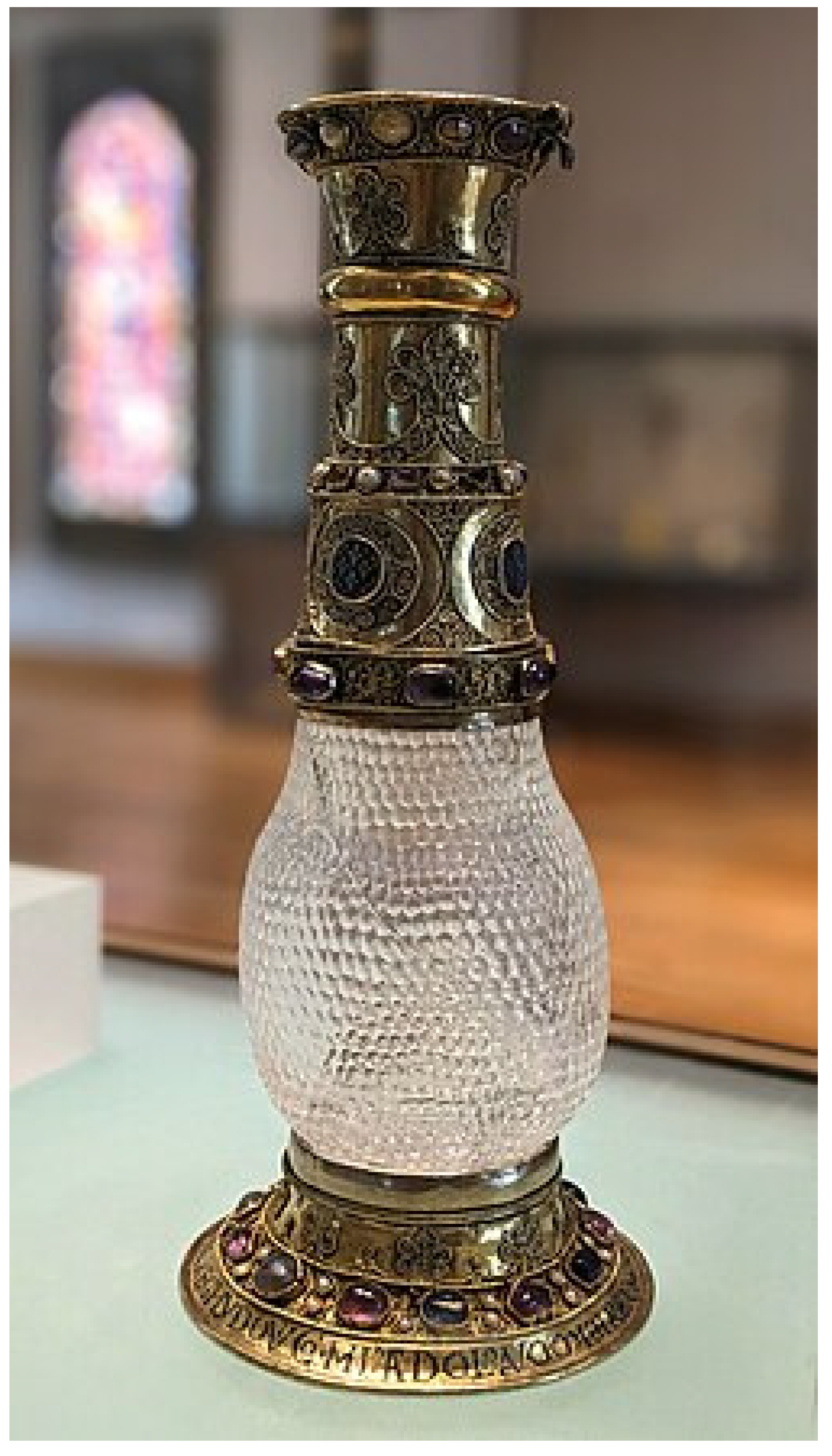
A number of inherent complexities at work in the production and consumption of medieval Mediterranean art and architecture show the usefulness of a framework that sees the local and the global (or the regional) as intertwined. For example, the issue of time is important to keep in mind when considering many works of art and other objects created in the medieval Mediterranean. One way in which this is illustrated is via objects such as the Eleanor Vase (
Figure 1), whose physical appearance and meaning underwent changes as time passed (
Beech 1992,
1993). For example, this piece went from starting out as a rock crystal vase, to becoming a wedding gift, to becoming a religious donation. Along the way, it gained both a metal framework and a biographical inscription (
T. Martin 2012, p. 8).
Another way in which the importance of time is illustrated is via objects that were contemporary in their original setting, but once moved, were seen as older or even antique in their new setting. Alexander Nagel has pointed this out in reference to Byzantine and Islamic objects entering the West, as well as to objects depicted in other forms of art, for example, as furnishings in scenes of the birth of Christ (as part of the roundtable discussion in
Flood et al. 2010, pp. 7–8). Flood has made a particularly convincing argument for considering time in regard to Christian objects entering Islamic contexts, focusing on the “need to be alive to shifts in meaning through time”:
The interests of those researching the history of visual culture are often period- and culture-specific, bound by parameters to which the objects of their study rarely conform. Artifacts, buildings, and cities endure in their entirety or in part, where rulers, dynasties and cultures do not, or change hands as the result of commerce, diplomacy, and war, and in the process are remodeled, reinterpreted, and reinvented.
Time would thus seem to be one of the complexities that complicate the Mediterranean as a frame of reference. Consumption as a lens offers a method for understanding the importance of time via studies of consumerism. These studies often recognize that it is those who consume or use objects who confer meaning onto them and that as a result, this meaning can change over time. This is true of both individual objects like the Eleanor Vase as well as categories of objects like pottery or home furnishings (
Goldthwaite 1989,
1993).
Objects travelled around and across the medieval Mediterranean in numerous ways, for example, as trade commodities, as religious goods, as the result of theft, and as gifts. And here too, the importance of the local context comes to the fore within the larger Mediterranean frame as the process of their transfer from the giver to the recipient would rarely if ever have been without some level of context (ritual, social, hierarchical) that would have been dependent in its constitution on both the context in which the gift was created and then given, and that in which it was received. This centrality of context is particularly visible in archaeological, art historical and material culture scholarship that examines how gifts “arbitrate diplomatic cross-cultural encounters; … mediate familial and dynastic relations; … triangulate sacred transactions [and] negotiate rivalries and … serve as agents of union” (
Hilsdale 2012, p. 174). And yet, we must be careful regarding how much commonality we attribute to the conditions in which these objects are shared. Whether we see these objects as imbued with meaning by these various circumstances or as active participants in the creation of meaning, the importance of the context in which this occurs is key. In short, differences between intention and reception, i.e., the local contexts, matter (
Hilsdale 2017, p. 24;
Brubaker 2004). This sentiment is echoed by certain anthropological and sociological approaches to consumption.
It is important to note that the complexities of time and context are not mutually exclusive. One type of situation in which the importance of these local contexts is visible would be those in which the appearance and meaning of objects underwent changes over time, as discussed above (among other examples, see
Woodfin 2008;
North and Cutler 2003). Of course, the same kinds of remaking could occur with objects seized as loot and with objects considered spolia (
Kinney 2006). One thinks, for example, of the horses of St Mark’s in Venice (
Freeman 2004) or of the Islamic objects captured (and Christian objects recaptured) during the Christian reconquest of Spain (
Shalem 1995). In addition to objects, iconography, motifs, and style could also be repurposed, especially in areas such as Lusignan Cyprus or Norman Sicily, which served as the crossroads of multiple cultures. And here too, there is a level of understanding of the local that is required of scholars as they attempt to understand the processes occurring and the artistic and architectural products that resulted.
A final example that illustrates all of these complexities extremely well comes in the form of two medieval Mediterranean works that ended up in villages in Ghana. Two Mamluk brass basins of the fourteenth and fifteenth centuries were part of a group of objects that travelled from Egypt to southern Ghana, where they inspired local production of similar metalwork. As Raymond Silverman explains, the basins retained their status as objects of prestige, even after they had long been separated from the original owners to whom they were inscribed and dedicated (
Figure 2). And yet, the ways in which they exercised this prestige had changed: “they became instruments used in rainmaking rituals or objects of memory, mnemonic devices associated with important historic events and individuals” (
Silverman 2019, p. 261).
As mentioned above, a recent attempt to discuss the applicability of a Mediterranean lens to medieval art has been made by
Hilsdale (
2017). One of the benefits she notes is similar to that mentioned by others I have quoted, in particular Kinoshita, in that a Mediterranean perspective can better help us to understand the hybridity, intermingling, and blurred boundaries of many places and artistic products in the medieval Mediterranean (
Hilsdale 2017, p. 20). Hilsdale foregrounds the field of Crusader Art and its historiography in this regard and approaches works of art and architecture as active creators of intercultural relations between Crusaders and locals. The recognition that these objects are not simply and solely passive canvases that reflect the culture(s) that produced them is an important one. However, I would hesitate to completely disregard the possibility that they also perform the latter function, especially when the issue of time, mentioned above, comes into play. As generations mixed over time, I would argue that the ratio of active production and passive reflection remained fluid and changing.
Hilsdale also recognizes the connection between the Mediterranean as a frame of reference and debates about the local and the global, as can be illustrated in the discussion of globalism above. This connection becomes clear in her discussion of the debates surrounding “cosmopolitanism” and the ways in which attempts are made to bring both the local and the global together into a methodological framework. Hilsdale notes, correctly, I think, that
It is this renewed understanding of “rooted cosmopolitanisms‚” described by Clifford and elaborated by Anderson‚ that resonates with the arts of the medieval Mediterranean. This notion of being rooted locally but in dialog with larger networks [practical and ideological] bears particular relevance for the study of silks‚ given their prestige and suitability for transport‚ and may serve as a working method for the visual arts of the Mediterranean more broadly.
In evaluating the appropriateness of consumption as a useful lens, it is important to note that, as mentioned above, other recent studies using consumption as a lens (whether focused on the Mediterranean or the Sahara) have reached similar conclusions. This renewed understanding, Hilsdale mentions, also allows for the acknowledgment of shifting meaning via these dialogues. I would add that even if objects have a role to play in this, it is also people who produce meaning via their choices of what to consume and what to avoid. Additionally, as other scholars in other fields have noted, a Mediterranean frame of reference allows one to challenge the limits of traditional categories and divisions. Although not limited to the Mediterranean, the new introductory textbook by Jill Caskey et al. entitled “Art and Architecture of the Middle Ages: Exploring a Connected World” is a perfect example of the scholarship that can arise from such a challenge (
Caskey et al. 2022). For Hilsdale, the Mediterranean as a lens does not propose the same problems of breadth versus depth addressed in the many examples above. Instead, her view of the Mediterranean
includes both elements:
The most productive aspect of this lens is that it asks us to keep in mind larger material and social networks and spaces of flow while insisting on the small scale and the particular … the Mediterranean is a lens that resolves into its clearest focus when the balance between the micro and macro is most finely calibrated.
And so, what to do? How do we get there? How might we acknowledge both the importance of the local and the individual while also examining the larger networks that they are a part of?
3 How might we identify commonalities without falling into the trap that blends differences together when they were meant to signal individual distinctiveness? How do we avoid eliding what should be kept distinct, as noted by Flood? Cosmopolitanism is one methodological model that might be of use, as discussed above, but as argued throughout, I would like to suggest consumption as more appropriate.
5. Consumption as a Lens for Viewing Medieval Mediterranean Art
Throughout the history of studying consumption referred to above, two main definitions of the term have emerged (
A. S. Martin 1993, p. 143;
Warde 2015, pp. 118–19). The traditional definition of the term is not as useful for us in this regard: the Romans defined consumption in a way that tied it to concepts such as destruction and death, which allows us to see the relationship to the wasting disease of the same name coming to us from the Anglo-Normans. Among our modern definitions, a number go beyond the simple idea of use, but continue into the notion of using up, or destroying. When this understanding is tied to the notion of human fulfillment, then the act of consumption becomes intertwined for anthropologists with acts of material destruction that can be more or less ceremonial (see, for example,
Graeber 2011). Food consumption becomes one of the areas where materials are “used up” and nonetheless leave behind physical remains. For archaeologists, this approach to consumption ties in nicely with the artifacts, ecofacts, and other surviving material remains that populate typical sites. For obvious reasons, this way of looking at consumption is less useful as a model for medieval art in the Mediterranean region. However, there is another way.
This second approach to consumption focuses more on the issue of ‘material desire’ and the role of consumption in creating and maintaining households, as well as identity and status. And while it recognizes the role of material goods themselves or works of art and architecture, in our case, this approach also acknowledges the importance of agency among those who consume or desire these goods. Thus, instead of seeing consumers as “passive and easily manipulated … consumers were active, creative and critical in their appropriation and transformation of material artifacts” (
Graeber 2011, p. 490). An active approach to consumption, such as that defined here, one that does not involve the destruction of its material goods, fits well with the use of works of art to fashion identity and status. I also propose that it can be a good tool for art historians examining the works of art, architecture and material culture of the medieval Mediterranean.
Although many scholars seem to use the terms ‘consumption’ and ‘consumerism’ interchangeably (
A. S. Martin 1993, pp. 142–43), a number of the ideas with which we concern ourselves here have also been argued for separately under the framework of consumerism. As with consumption, here too scholars have turned towards the notion of material culture as both a source of data and as a methodology (for example,
Harvey 2018). Because of the inherent relationship between archaeology and material culture, scholars operating within this framework, such as Susan Henry, have made the case for the ways in which archaeological research might contribute to understanding consumerism or consumer behavior (
Henry 1991). In her “Consumers, Commodities, and Choices,” she not only provides a general model for studying how objects (consumer goods) help to illuminate domestic consumer behavior (p. 5 for a schematic drawing), but also a wonderful example of the kinds of questions that we might be spurred to ask of objects. Separately, although she is focused on early modern America and not the Mediterranean, Ann Martin has argued for consumerism as a way to ask similar questions of the relationship of material culture (and I would include works of art and architecture), people, and ideas: “Consumerism is the cultural relationship between humans and consumer goods and services, including behaviors, institutions, and ideas” (
A. S. Martin 1993, p. 142).
Two areas of inquiry seem especially appropriate to the questions of how to look at Mediterranean art, with the first being the issue of desirability. Martin’s claim is that the framework of consumerism helps us to see the multiple factors affecting the who, when, where, and why of wanting an object: “how artifacts function in ritualized behavior, differentiation of social rank, formation of social group, and how meaning is conferred and changed” (
A. S. Martin 1993, p. 156). Not all of these issues will be of primary relevance or importance to all objects or works of art, but the focus on the conferral of meaning by those who consume or use the objects and the fact that this meaning can change over time is an important one for us to think about when attempting to balance the local and the Mediterranean. This sentiment is echoed by those scholars studying what they refer to as material culture (
Scarpaci 2016, p. 4). Though perhaps it is an outlier in its uniqueness as a Mediterranean work of art, one object already mentioned that reminds us of the importance of change over time (and place) in regard to meaning is the Eleanor Vase.
The second area of inquiry that I suggest is useful for looking at Mediterranean art is the issue of the intertwining of the local and the regional. As discussed above, Martin is not the only one to make this argument, as it is paralleled by many who study what they name “glocalization”. However, her words are worth quoting here as part of the discussion:
Looking at consumerism will help break down and reformulate our old views of isolated regional cultures to empower people to choose from, and reject, broad trends in Western culture, to understand how men and women made choices that gave primacy to individual and local needs and desires.
(p. 157)
What I find attractive here is the concept of the primacy of the “individual and local” within a system that still recognizes their interaction with broader trends. To my mind, this would fit well as a method of bridging the two ways of looking at the Mediterranean in a similar but slightly different approach than that suggested by Hilsdale.
Of course, not all of the inhabitants of the medieval Mediterranean had access to the intertwining of the local and regional (or global) in the same way. And although most of them might be said to have consumed art and architecture in some way, not all of the inhabitants of the medieval Mediterranean were involved in the patronage aspects of their production. Nor could they all read the Mediterranean literature that was being produced, for that matter. However, I do not mean to say that the intertwined Mediterranean stopped at major hubs and never reached beyond. From the eleventh to the fifteenth centuries, when some of the most complex works of medieval Mediterranean art and architecture were being produced, traded, stolen, and gifted, more and more places were included within intertwined systems of commerce. Richard Unger has argued perhaps the most directly for this development:
The belief that all those farmers has no connection with exchange is now proven to be part of a false faith. By the thirteenth century the trade revival led to a commercialization of society, something obvious in the growing cities of Italy and Catalonia but also in the far backwaters of Latin Christendom.
And yet, as my examples show, many of the works of art and architecture whose complexities a lens of consumption allows us to see most clearly in the ways that I have described are mainly those related to elites and urban dwellers or those who had access to a more intertwined world and an ability to make their agency felt via those very same works. Both Richard Goldthwaite’s work on the consumption of majolica and Nina Rowe’s work on serially produced devotional ivories go a bit further and note the ways in which these works of art spread beyond the usual classes of more elite consumers. Yet both studies also stop at the level of the middling classes (
Goldthwaite 1989;
Rowe 2011). To go further requires the examination of other pieces of material culture that have much more typically been the preserve of archaeologists and thus, though worthy of study in their own right, have not typically been included in the discussions of medieval Mediterranean art.
For those scholars who look at the relationship between consumption and material goods, there are two basic approaches that will seem familiar based on the arguments laid out thus far. Paul Mullins has defined these in the following way (
Mullins 2011, p. 134). The first focuses on the systems that serve to move goods and materials so that specific goods end up with specific people. These can be various structures, such as marketing and trade networks, but also underlying cultural and ethnic identities. This focus examines how consumers obtain and define things in regard to particular contexts (cultural, historical, and social). The second approach focuses on how the consumer actively defines things and how this takes place in relation to “dominant ideology, the state, or broader economic interests.”
Although my focus here on a contextual approach to Mediterranean art under the lens of consumption that seeks to analyze this art as a reflection of the cultural and social reality of its time may seem to fit within a Marxist approach, my understanding of context is more aligned with that of studies of material culture and archaeology as opposed to that of Marxist art history. I am certainly not unique in this, as the historical relationship between art history and Marxism has been difficult (
Berryman 2021;
Hemingway 1996). Moreover, while I would agree that the lens of consumption invites us to see art as affected and effected by the sociohistorical conditions under which it is made and used, presented and received over the centuries, I am not suggesting a particular focus on the economic conditions. These may certainly play a role and should be investigated, but here I am proposing that this investigation should occur as one part of a thorough examination of an object’s context. In addition, as Andrew Hemingway has suggested, the theories proposed by a Marxist approach “are insufficient to explain the diverse forms of individual agency and motivation even in class terms” (
Hemingway 1996, p. 21). As I hope to have made clear, it is exactly these agencies and motivations beyond the realm of economic commodity that the specific portion of the lens of consumption that I think is most useful to us in looking at Mediterranean art invites us to focus on. In a similar manner, the specific issues that a Marxist approach to the medieval period has brought to the fore (for example, feudalism and feudal exploitation, the transition from feudalism to capitalism, the relationship between the economic base and ideological superstructure, issues of class domination, and a class-based account of the position of the artists vis-à-vis the patron) are not the focus here (
Brown 2011).
Coming to the same conclusion regarding the need for both larger structural contexts as well as localized ones that Hilsdale and others have suggested for the Mediterranean, Mullins proposes a framework of consumption that takes both into consideration. Within such a framework, despite or perhaps because of its origins in the field of archaeology, there are two main benefits to using consumerism as the lens through which to view the art and architecture of the medieval Mediterranean. The first is that it allows for local systems of significance to come to the fore while still acknowledging the importance of a Mediterranean-wide market. Just as important is that it allows space for individual agency based on these local systems. Mullins describes the benefits of such a description of consumption, which, although based once again in archaeology, seems to fit seamlessly into the discussions occurring in art history.
Consumption defined this way revolves around the acquisition of things to confirm, display, accent, mask, and imagine who we are and who we wish to be, which breaks from seeing consumption as a largely reflective process that instrumentally displays social status, evokes ethnicity, exhibits gender, or confirms other essential identities. Instead, consumption is a continual albeit largely unexpressed process of self-definition and collective identification.
Acknowledging the agency of the consumer allows one to stress the culturally, historically, and socially specific contexts shaping consumption in any particular instance. Additionally, it invites questions about not just what was accepted and under what circumstances, but what was rejected and why. Again, work by scholars such as Scheele on the Sahara is instructive in this respect (
Scheele 2020). Such an analysis, I suggest, goes a long way towards avoiding the eliding of differences and distinctions that scholars such as Flood and Hilsdale warn against. It also allows scholars the ability to account for the differences in the use of an object over time that result from changes in ownership. And as the meaning of the work of art or architecture is rooted in the agency of the consumer or owner, under this lens, the varieties of use to which art or architecture can be put are not unnecessarily obscured. A lens of consumption allows us to make use of the benefits a Mediterranean frame of reference can offer scholars of medieval art while recognizing and meeting its challenges. Above all, it allows us to bring the local and the regional (the Mediterranean) together in ways that may allow us to have both without having to sacrifice either.